

Nearly 35% of party wall disputes escalate beyond initial disagreement — not because of legal complexity, but because of poor emotional management on all sides. When renovation projects trigger anxiety, territorial instincts, and financial stress in neighbors, the party wall surveyor standing between them needs more than technical knowledge. They need emotional intelligence (EQ).
Emotional Intelligence for Party Wall Surveyors: Managing Neighbor Disputes and Securing Swift Agreements in 2026 is no longer a soft-skills afterthought — it is a professional differentiator that determines whether a surveyor resolves disputes in days or drags them into months of costly litigation. As urban renovation activity intensifies across London and beyond, the ability to read a room, regulate tension, and guide two parties toward consent has become as essential as reading a schedule of condition.
This article draws from expert EQ frameworks, current industry practice, and the growing body of research — including the upcoming Tenth International Congress on Emotional Intelligence at Yale University (July 2026) [5] — to show exactly how surveyors can apply EQ skills to de-escalate conflict, facilitate genuine consent, and streamline party wall awards.
Key Takeaways
- 🧠 Emotional intelligence is a measurable, learnable skill set — not a personality trait — that directly improves dispute resolution outcomes.
- 🤝 Empathy and active listening are the two most powerful tools a party wall surveyor can deploy in the first meeting with disputing neighbors.
- ⚡ De-escalation techniques grounded in EQ can reduce the time to a signed party wall agreement by weeks.
- 📋 Self-regulation protects surveyors from absorbing client stress and making reactive professional decisions.
- 🏙️ Rising urban renovation rates in 2026 mean surveyors who combine technical expertise with EQ will secure more referrals and faster awards.
Why Emotional Intelligence Matters More Than Ever in 2026
Urban renovation is booming. In London alone, permitted development activity, loft conversions, basement extensions, and rear additions have surged as homeowners invest in existing properties rather than moving. Every one of these projects that touches a shared wall triggers the Party Wall etc. Act 1996 — and with it, the potential for neighbor conflict.
The emotional stakes are high. A homeowner receiving a party wall notice often feels blindsided, anxious about structural damage, and suspicious of their neighbor's intentions. The building owner, meanwhile, is stressed about project timelines and costs. By the time a surveyor enters the picture, both parties may already be entrenched.
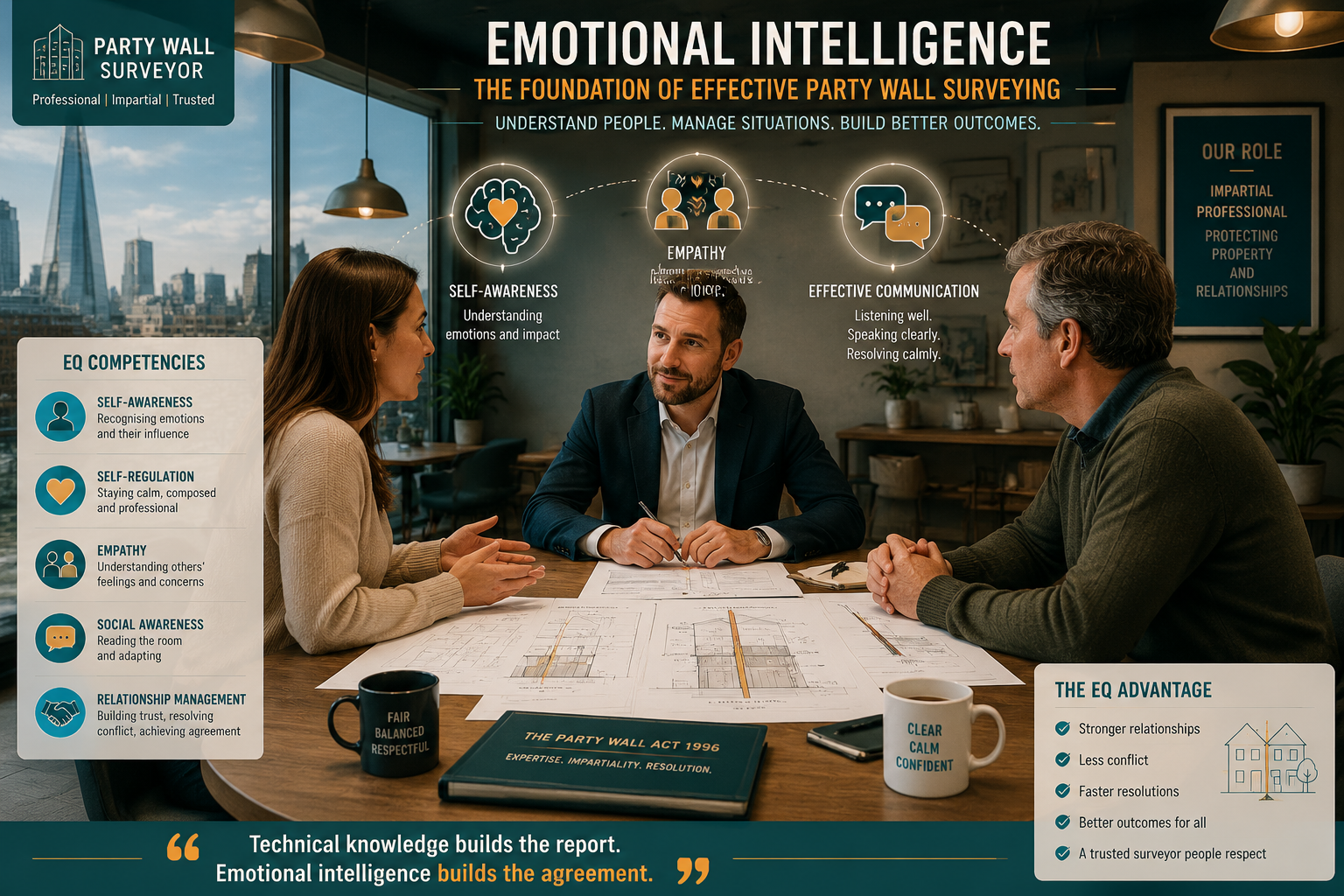
"The ability to monitor one's own and others' feelings and emotions, to discriminate among them, and to use this information to guide thinking and actions" — this is the core definition of emotional intelligence in professional contexts [2] — and it describes exactly what a skilled party wall surveyor must do.
The Four EQ Competencies That Shape Dispute Outcomes
Emotional intelligence research identifies four core competencies that translate directly into party wall practice:
| EQ Competency | What It Means | Party Wall Application |
|---|---|---|
| Self-Awareness | Recognizing your own emotional state | Noticing when you're absorbing client stress |
| Self-Regulation | Managing your reactions | Staying calm when parties escalate |
| Social Awareness (Empathy) | Reading others' emotions accurately | Understanding why an adjoining owner is resistant |
| Relationship Management | Influencing and guiding others | Steering both parties toward agreement |
These aren't abstract qualities. They are learnable, practicable skills that can be developed through deliberate training. The Clayton State University 2026 Emotional Intelligence Symposium (March 2026) highlighted exactly this point — that EQ competencies can be built through structured professional development [1]. The Faculty of Party Wall Surveyors (FPWS) similarly tracks continuing education events relevant to the profession [4], reflecting growing awareness that surveyors need more than legal knowledge.
The Cost of Low EQ in Party Wall Disputes
When a surveyor lacks emotional intelligence, the consequences are measurable:
- ❌ Disputes escalate to Third Surveyor referrals unnecessarily
- ❌ Awards are delayed by weeks or months
- ❌ Adjoining owners feel unheard and become obstructive
- ❌ Building owners lose confidence in the process
- ❌ Surveyors face complaints and reputational damage
Conversely, a surveyor with strong EQ can often achieve consent within days — saving all parties time, money, and stress. Understanding how to keep party wall costs down is partly a function of resolving disputes quickly, and quick resolution is largely an EQ outcome.
Practical EQ Techniques for De-Escalating Neighbor Disputes
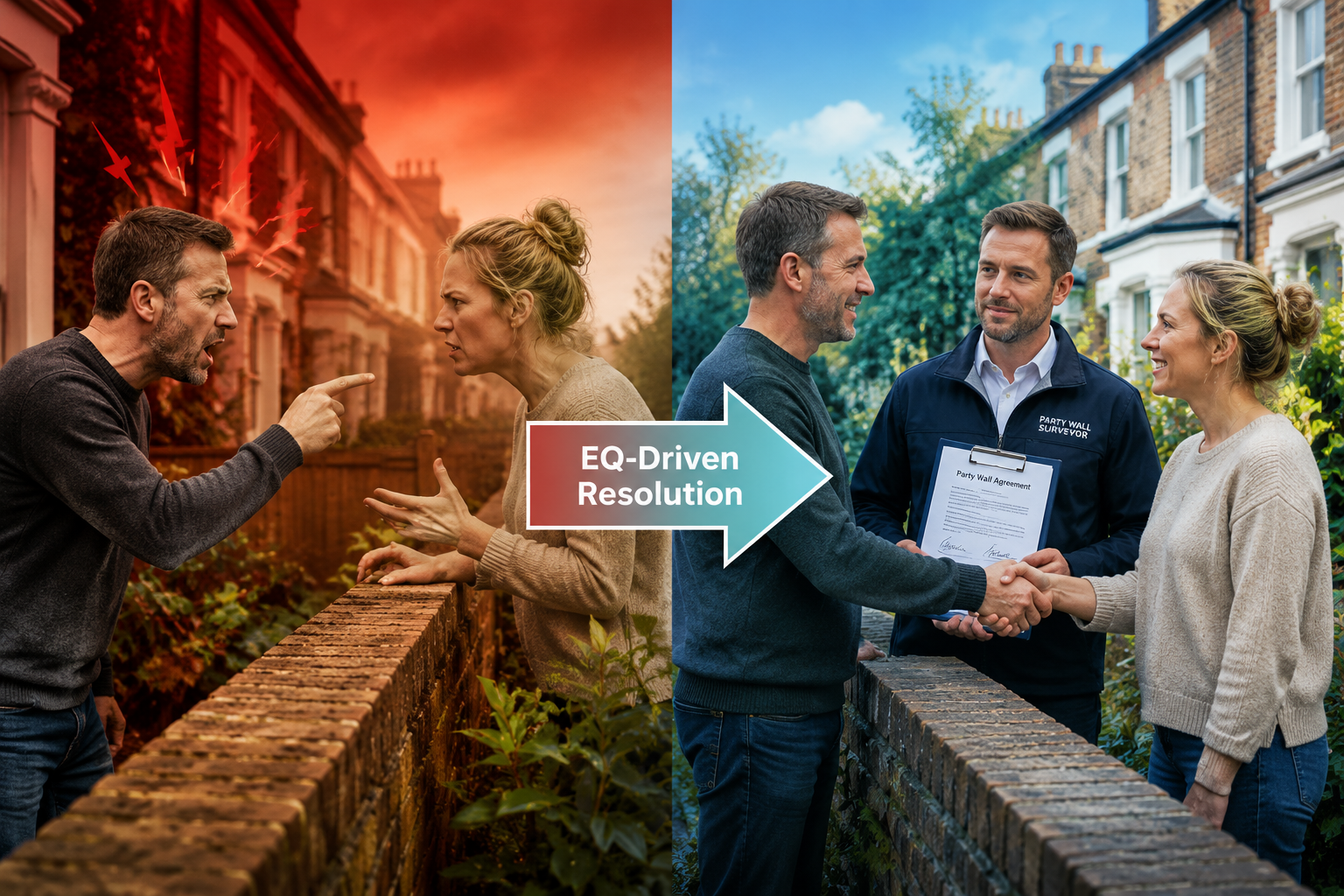
The moment a surveyor walks into a dispute, the emotional temperature of the room is already set. What happens next depends heavily on how the surveyor manages that temperature.
Technique 1: Validate Before You Educate
The most common mistake surveyors make is leading with legal information when a party is emotionally activated. When someone is angry or frightened, the rational brain is partially offline. Presenting a schedule of condition or explaining party wall awards to an agitated adjoining owner before acknowledging their concern is like handing someone a map when they're mid-panic.
The EQ approach:
- Acknowledge the emotion first ("It sounds like this has been really stressful for you")
- Validate the concern ("Your worry about structural impact is completely understandable")
- Then introduce information ("Let me show you how the process protects you")
This sequence — validate, then educate — dramatically reduces resistance and opens the door to rational discussion.
Technique 2: Active Listening as a Professional Tool
Active listening is not passive silence. It involves:
- 👁️ Eye contact and open body language
- 🔄 Reflecting back what has been said ("So what I'm hearing is…")
- ❓ Clarifying questions that show genuine interest
- ⏸️ Comfortable pauses that invite the other party to continue
When an adjoining owner feels genuinely heard, their defensive posture softens. This is not manipulation — it is professional respect that creates the psychological safety needed for agreement.
Technique 3: Reframing the Dispute Narrative
Many neighbor disputes are fueled by a zero-sum narrative: one party believes that for them to win, the other must lose. A skilled surveyor reframes this.
Instead of: "Your neighbor wants to build and you're blocking them"
Try: "Both of you want this resolved quickly and fairly — let's find the path that works for everyone"
This reframe is backed by assertiveness research in EQ, which emphasizes "communicating feelings, beliefs, thoughts openly in a socially acceptable, non-offensive manner" [2] — a skill surveyors must model and gently teach both parties.
Technique 4: Managing Your Own Emotional State
Self-regulation is arguably the most underrated EQ skill for surveyors. When both parties are stressed, there is enormous pressure on the surveyor to absorb that stress and react to it. The surveyor who can remain calm, grounded, and non-reactive becomes the emotional anchor of the process.
Practical self-regulation strategies include:
- Pre-meeting grounding: A brief mindfulness exercise before entering a tense meeting
- Physiological awareness: Recognizing physical signs of stress (tight shoulders, shallow breathing) and consciously releasing them
- Cognitive reframing: Reminding yourself that the dispute is not personal
- Debrief practice: Processing difficult meetings to avoid emotional accumulation
Surveyors working across high-pressure urban areas — whether as a party wall surveyor in South London or in North London — encounter multiple disputes simultaneously. Without strong self-regulation, burnout and reactive decision-making become real risks.
Technique 5: Structuring the First Meeting for Success
The first meeting between a surveyor and disputing parties sets the tone for everything that follows. A structured, EQ-informed agenda looks like this:
- Opening: Establish psychological safety ("This is a space where both of you can speak freely")
- Individual listening: Hear each party separately before bringing them together
- Shared summary: Present both perspectives back to the room neutrally
- Process explanation: Walk through the legal framework calmly and clearly
- Next steps: Agree on concrete actions before the meeting ends
This structure prevents the meeting from becoming a shouting match and keeps the surveyor in a facilitative — rather than reactive — role.
Building an EQ-Driven Practice: Tools, Training, and the Path Forward
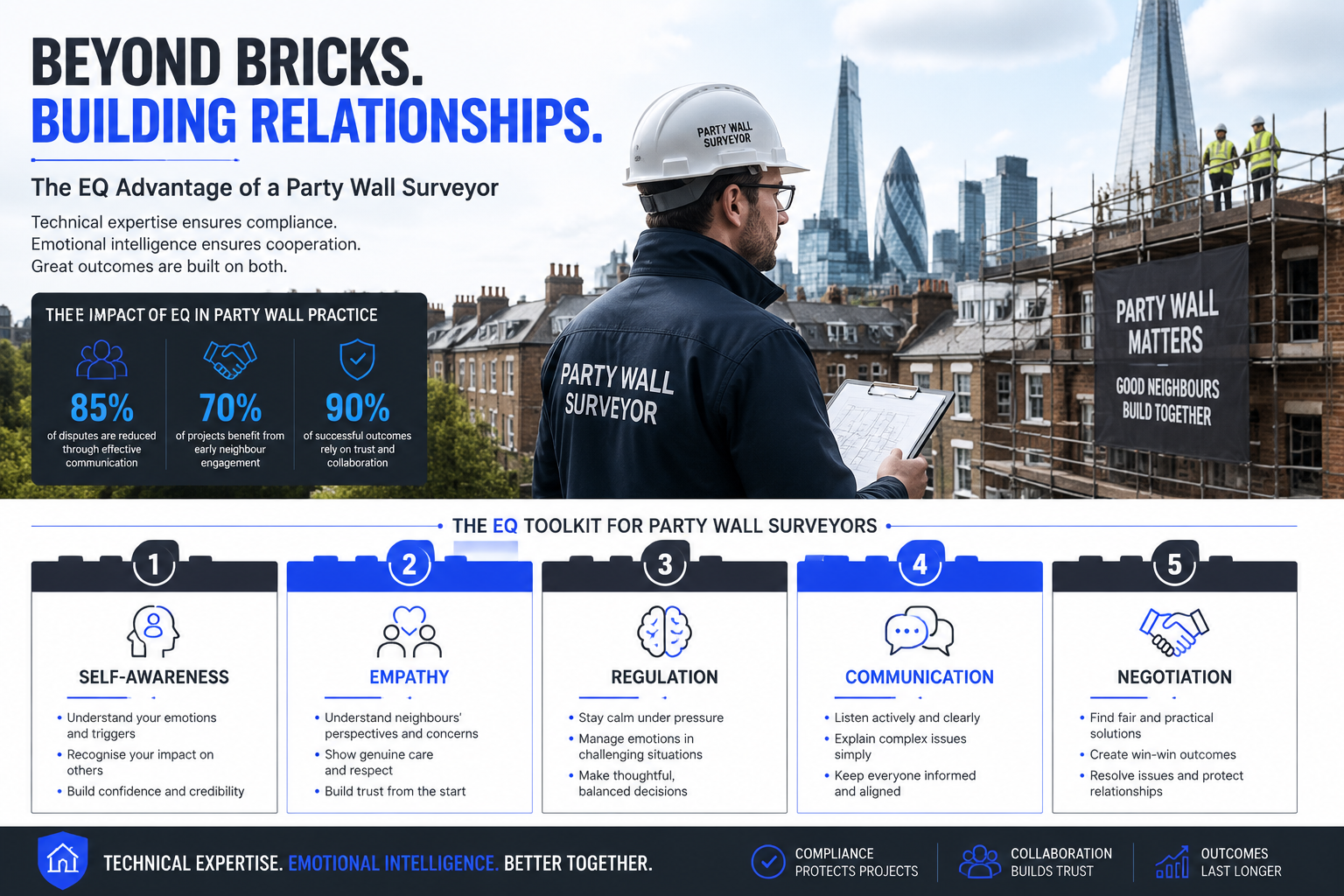
Emotional Intelligence for Party Wall Surveyors: Managing Neighbor Disputes and Securing Swift Agreements in 2026 is not just about individual technique — it is about building an EQ-informed professional practice from the ground up.
Formal EQ Training and Professional Development
The good news: EQ is trainable. Research consistently shows that targeted EQ development programs produce measurable improvements in professional outcomes. In 2026, several high-quality opportunities exist:
- The Tenth International Congress on Emotional Intelligence at Yale University (July 28–31, 2026) brings together 35 years of EQ research and offers pre-conference workshops [5]. While not surveyor-specific, the frameworks presented are directly applicable.
- The EI Group's EmotionIntell Conference 2026 offers structured EQ training for professionals [8].
- FPWS continuing education events [4] increasingly incorporate communication and conflict resolution modules alongside technical surveying content.
Surveyors should treat EQ development as a CPD (Continuing Professional Development) priority — not an optional extra.
Integrating EQ Into the Party Wall Process
EQ doesn't replace technical competence — it amplifies it. Here is how EQ integrates at each stage of the party wall process:
Stage 1 — Notice Service
When party wall notices are served, the adjoining owner's first emotional response is often alarm. A surveyor who anticipates this and provides a warm, clear, human explanation alongside the legal documentation immediately reduces anxiety and increases the likelihood of consent.
Stage 2 — Consent or Dissent
If the adjoining owner dissents, understanding why emotionally — not just legally — allows the surveyor to address the real concern. Often, dissent is driven by fear of disruption or distrust, not genuine legal objection.
Stage 3 — Award Preparation
When preparing a party wall award, EQ-informed surveyors communicate progress regularly to both parties, reducing the anxiety that fuels conflict. Transparency is an EQ act.
Stage 4 — Works in Progress
During construction, emotional flashpoints are common. A surveyor with strong relationship management skills can intervene early when tensions rise — before they become formal complaints.
The Business Case for EQ in Surveying Practice
Beyond dispute resolution, EQ delivers tangible business benefits for party wall surveyors:
| Business Outcome | EQ Driver |
|---|---|
| Higher referral rates | Clients recommend surveyors who made them feel heard |
| Faster case resolution | Less time spent on escalated disputes |
| Fewer complaints | Better communication prevents misunderstandings |
| Premium positioning | EQ-skilled surveyors differentiate in a crowded market |
| Lower stress | Self-regulation protects against professional burnout |
Surveyors operating in competitive urban markets — from Central London to East London — will find that EQ becomes a meaningful competitive advantage as clients increasingly value the experience of the process, not just the outcome.
Quick-Reference EQ Toolkit for Party Wall Surveyors
🧰 The Surveyor's EQ Toolkit:
- ✅ Validate emotions before presenting legal information
- ✅ Practice active listening in every client interaction
- ✅ Reframe zero-sum narratives into collaborative problem-solving
- ✅ Regulate your own stress with pre-meeting grounding techniques
- ✅ Structure first meetings to create psychological safety
- ✅ Communicate proactively throughout the award process
- ✅ Invest in formal EQ training as part of annual CPD
- ✅ Debrief after difficult cases to process and learn
A Note on Fairness and Boundaries
EQ does not mean becoming a therapist or taking sides emotionally. The surveyor's duty remains impartial and professional. Strong EQ actually reinforces impartiality — a self-aware surveyor recognizes when they are being drawn into one party's emotional narrative and consciously steps back.
The building owner's surveyor and the adjoining owner's surveyor each represent different parties, but both benefit from EQ skills that keep communication productive and professional.
Conclusion: The EQ Advantage in 2026 and Beyond
Emotional Intelligence for Party Wall Surveyors: Managing Neighbor Disputes and Securing Swift Agreements in 2026 represents a genuine evolution in professional practice. The technical framework of the Party Wall etc. Act 1996 provides the legal structure — but it is EQ that determines whether that structure is navigated smoothly or painfully.
As urban renovation continues to intensify and neighbor disputes grow more frequent, the surveyors who thrive will be those who combine rigorous technical knowledge with the human skills to de-escalate tension, build trust, and guide parties toward swift, fair agreements.
Actionable Next Steps for Surveyors
- Audit your current EQ practice: Reflect honestly on recent disputes — where did emotional management succeed or fail?
- Enroll in EQ training: Explore the EmotionIntell Conference 2026 [8] or similar structured programs as CPD.
- Restructure your first-meeting agenda: Incorporate the validate-educate sequence and individual listening before joint sessions.
- Develop a self-regulation routine: Build a pre-meeting grounding practice into your workflow.
- Communicate proactively: Set a standard of regular updates to all parties throughout the award process.
- Track outcomes: Monitor dispute resolution timelines before and after implementing EQ techniques to measure impact.
The party wall surveyor of 2026 is not just a legal technician — they are a skilled human navigator. The investment in emotional intelligence pays dividends in faster agreements, stronger reputations, and a more sustainable, rewarding professional practice.
References
[1] Symposium – https://claytonstatecape.com/symposium/
[2] Watch – https://www.youtube.com/watch?v=nOG1pqbteCk
[4] Eeeventslist – https://fpws.org.uk/eeeventslist/
[5] The Tenth International Congress On Emotional Intelligence Will Be Held At Yale University From July 29th To 31st 2026 – https://emotionalintelligencesociety.org/the-tenth-international-congress-on-emotional-intelligence-will-be-held-at-yale-university-from-july-29th-to-31st-2026/
[8] Emotionintell Conference 2026 – https://www.eiagroup.com/course/emotionintell-conference-2026/