


Only one in three adjoining owners who receive a party structure notice ever serves a formal counter-notice — yet this single legal step is often the most powerful tool available to protect a property from the risks of a neighbour's construction project. In 2026, with urban renovation activity at a decade-high and RICS guidance continuing to evolve, understanding Counter-Notices Under the Party Wall Act: Adjoining Owner Strategies to Demand Safeguards in 2026 Disputes has never been more critical. This guide walks through every stage of the counter-notice process, from statutory deadlines to surveyor-drafted demands, so adjoining owners can act decisively and protect their interests.
Key Takeaways 📋
- Counter-notices are only available in response to party structure notices (Section 4 of the Party Wall Act) — not boundary or excavation notices.
- Adjoining owners have a strict one-month window to serve a counter-notice after receiving a party structure notice.
- Counter-notices can legally demand structural features such as chimney breasts, piers, recesses, and deeper foundations — but cannot dictate how work is carried out.
- If the Building Owner does not respond within 14 days, a formal dispute is automatically triggered under the Act.
- A Schedule of Condition and a Party Wall Award are the two most important protective documents an adjoining owner should secure.
What Is a Counter-Notice and Why Does It Matter in 2026?
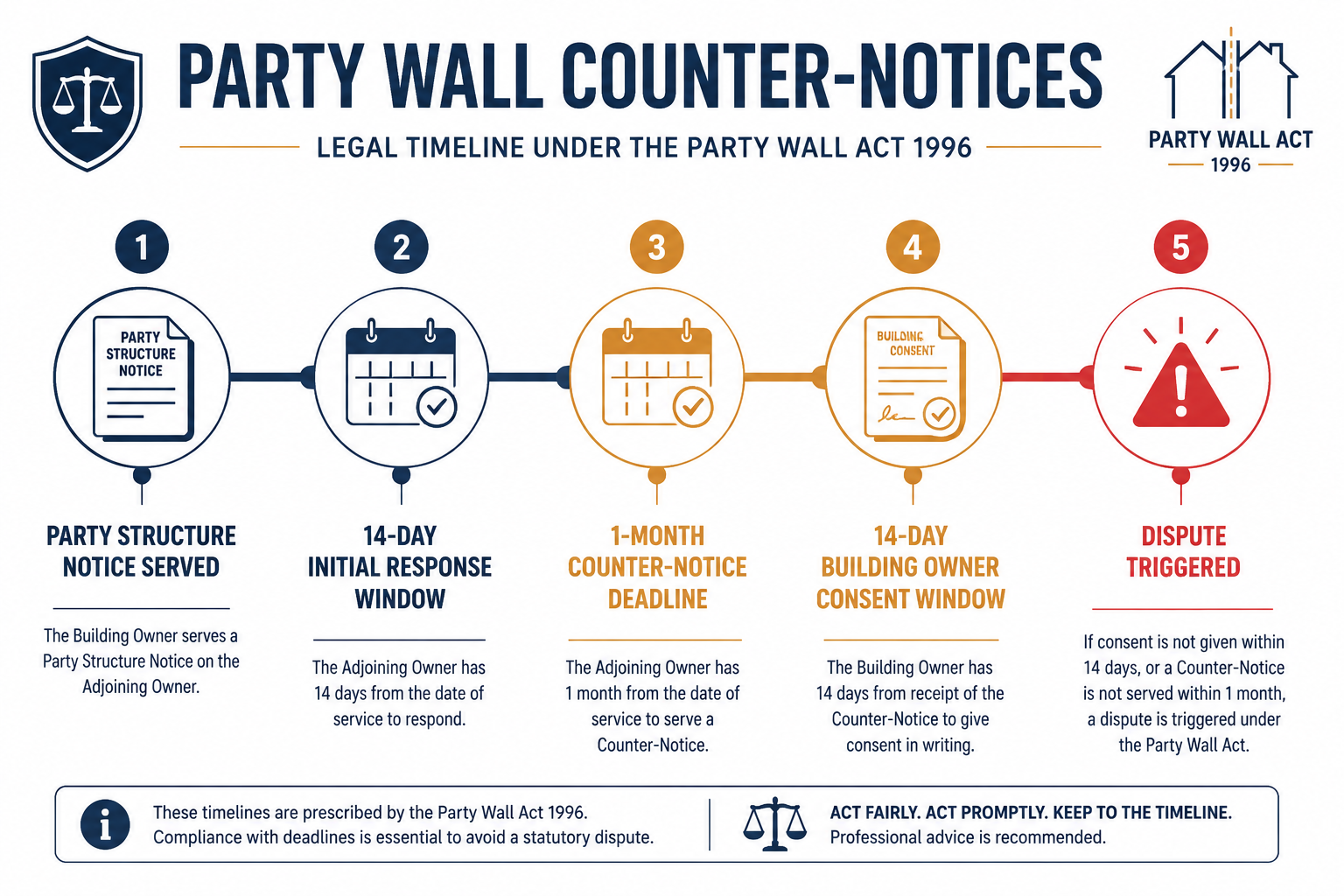
A counter-notice is a formal legal response served by an Adjoining Owner under Section 4 of the Party Wall etc. Act 1996. It allows the adjoining owner to require the Building Owner to carry out additional works that benefit the adjoining property — works that must be incorporated into the overall project. [1]
This mechanism is fundamentally different from simply consenting to or objecting to a party wall notice. To understand the full landscape of party wall notices and how to respond, it helps to first grasp the three types of notices under the Act:
| Notice Type | Section | Counter-Notice Available? | Notice Period |
|---|---|---|---|
| Line of Junction Notice | Section 1 | ❌ No | 1 month |
| Party Structure Notice | Section 3 | ✅ Yes | 2 months |
| Adjacent Excavation Notice | Section 6 | ❌ No | 1 month |
💡 Pull Quote: "The two-month notice period for party structure notices exists specifically to give adjoining owners enough time to consider and serve a counter-notice. This extra month is a legal right — use it." [1]
The longer notice period for party structure notices is not accidental. It is built into the statute to allow the adjoining owner time to consult a surveyor, assess the proposed works, and determine whether a counter-notice is appropriate. [1]
In 2026, with basement conversions, loft extensions, and rear additions dominating London's planning applications, the types of works triggering party structure notices are increasingly complex. [7] Adjoining owners who understand the types of party wall works that trigger these notices are far better positioned to respond strategically.
The Legal Framework: Counter-Notices Under the Party Wall Act and Adjoining Owner Strategies to Demand Safeguards
The One-Month Deadline: A Hard Statutory Limit
Once a party structure notice is received, the clock starts immediately. Adjoining owners must serve their counter-notice within one month of receiving the party structure notice. [1] Missing this deadline means forfeiting the right to make counter-notice demands entirely.
⚠️ Critical timing note: The 14-day initial response window for the party wall notice itself is separate from the counter-notice deadline. An adjoining owner who formally dissents to the original notice still has the full one-month period to serve a counter-notice. [3]
What Can a Counter-Notice Demand?
Section 4 of the Party Wall Act gives adjoining owners the right to require the Building Owner to execute specific works. These include: [1]
- Chimney copings, breasts, jambs, and flues — to maintain heating functionality and structural integrity
- Piers and recesses — structural elements that may be needed for future building plans
- Special foundations — constructed to greater depth or sufficient strength to support a future intended building by the adjoining owner
- Any other structural feature reasonably required by the adjoining owner
This is a significant power. An adjoining owner planning a future extension, for example, can legally require the Building Owner to install deeper foundations now — at the Building Owner's expense — rather than having to undertake costly underpinning later.
What a Counter-Notice Cannot Do
There is an important limitation. While a counter-notice can specify what works must be done, it cannot prescribe the manner or method by which those works are carried out. [1] This boundary was reinforced through case law, where courts struck out arguments that attempted to dictate execution methods rather than outcomes.
This distinction matters in practice. A counter-notice can demand that a pier be installed to a specific structural specification. It cannot, however, instruct the contractor to use a particular construction technique or sequence of operations.
Step-by-Step: How to Issue an Effective Counter-Notice in 2026
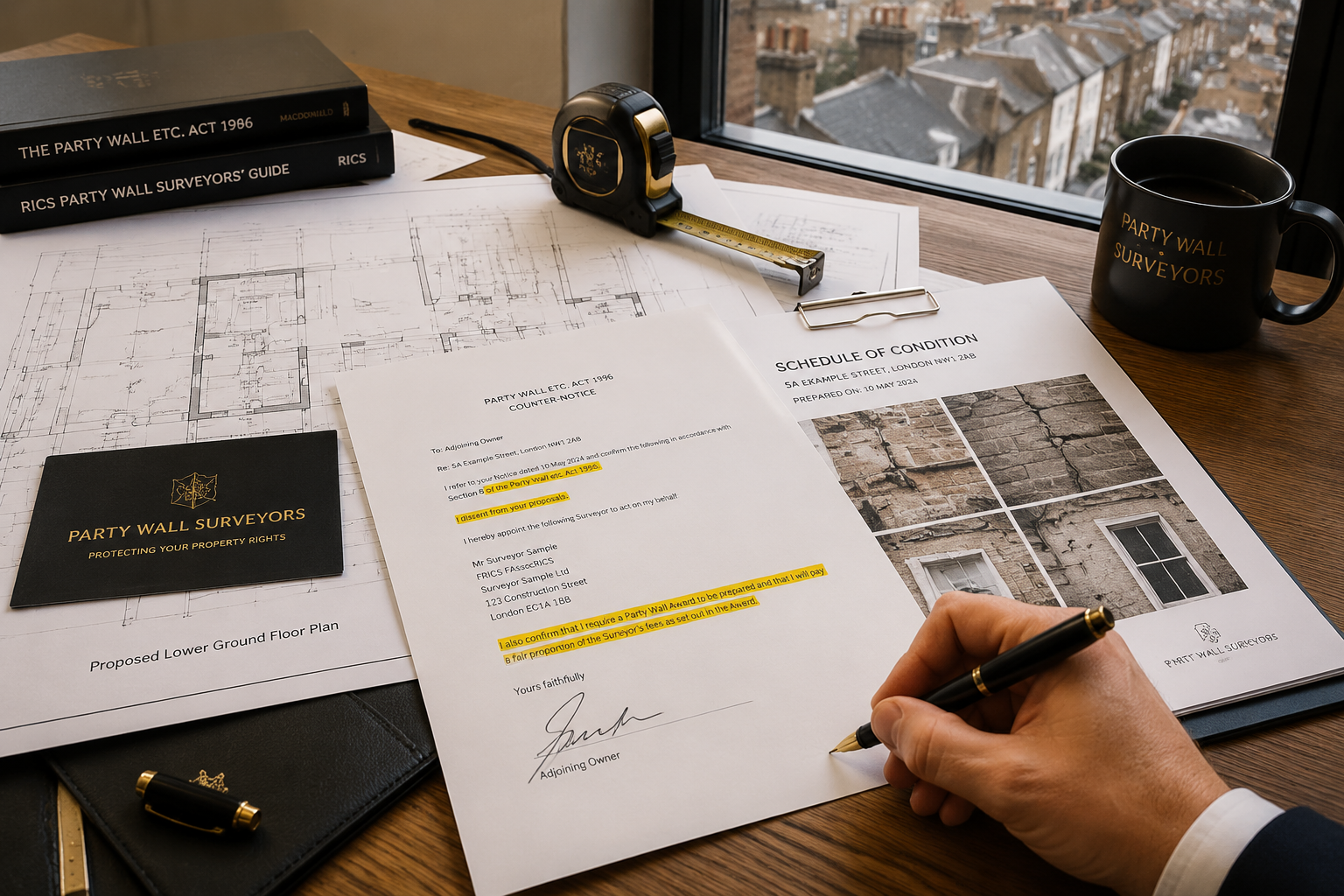
Step 1 — Appoint a Specialist Adjoining Owner's Surveyor
The single most effective action an adjoining owner can take is to appoint an experienced adjoining owner's surveyor immediately upon receiving a party structure notice. A qualified surveyor will:
- Review the Building Owner's proposed works in full
- Assess whether a counter-notice is appropriate and what it should contain
- Draft the counter-notice to ensure it is legally valid and strategically sound
- Manage all subsequent communications within statutory deadlines
Step 2 — Commission a Schedule of Condition
Before any counter-notice is served — and certainly before any work begins — an independent Schedule of Condition must be produced. This document records the current state of the adjoining property with photographs and written descriptions. [5]
Without this document, establishing which damage was caused by the construction works (versus pre-existing conditions) becomes extremely difficult. It is the adjoining owner's primary evidential protection. [5]
Step 3 — Draft and Serve the Counter-Notice
The counter-notice must be served in writing and must clearly specify the works required. A surveyor-drafted counter-notice will typically include:
COUNTER-NOTICE CHECKLIST ✅
□ Full names and addresses of both parties
□ Description of the original party structure notice received
□ Specific works required (e.g., "installation of a reinforced pier to
  a depth of X metres at grid reference Y")
□ Reference to Section 4 of the Party Wall etc. Act 1996
□ Date of service
□ Signature of Adjoining Owner or their authorised agent
Step 4 — Await the Building Owner's Response (14-Day Window)
Once the counter-notice is served, the Building Owner has 14 days to provide written consent. [1] If no response is received within this period, the Party Wall Act automatically deems a dispute to have arisen. [1][6] This triggers the formal dispute resolution process under Section 10 of the Act.
This automatic dispute mechanism is actually a protection for adjoining owners — it prevents Building Owners from simply ignoring counter-notice demands.
Step 5 — Dispute Resolution via Surveyors
If a dispute is triggered (whether by non-response or explicit refusal), the matter is referred to surveyors for determination. [1] The surveyors will assess whether the counter-notice demands are reasonable and produce a Party Wall Award — a legally binding document setting out the terms under which work may proceed. [3]
For adjoining owners unfamiliar with this process, the Party Wall Awards page provides a comprehensive overview of what these documents contain and how they protect both parties.
Grounds for Refusal: When Can a Building Owner Reject a Counter-Notice?
A Building Owner cannot simply refuse a counter-notice because the additional works are inconvenient or costly. The Act specifies only three legitimate grounds for refusal: [1]
| Ground | Description |
|---|---|
| Injurious | The requested works would cause actual harm to the Building Owner's property or interests |
| Unnecessary inconvenience | The works would cause disproportionate disruption beyond what is reasonable |
| Unnecessary delay | The works would cause unreasonable delay to the originally proposed project |
If none of these grounds apply, the Building Owner must comply with the counter-notice demands. Any dispute about whether these grounds are met is resolved by the appointed surveyors. [1]
💡 Pull Quote: "Adjoining owners who formally dissent and appoint their own surveyor gain significantly greater legal protections than those who passively accept or ignore notices. Dissent is a procedural mechanism, not a hostile act." [3]
Surveyor-Drafted Counter-Notice Examples: What Effective Demands Look Like
The following examples illustrate the type of language a qualified surveyor might use when drafting counter-notice demands. These are illustrative frameworks, not legal templates.
Example 1 — Foundation Depth Demand:
"The Adjoining Owner hereby requires, pursuant to Section 4(1)(b) of the Party Wall etc. Act 1996, that the Building Owner construct any new or modified foundations along the shared party wall to a minimum depth of [X] metres and to a structural specification sufficient to support a proposed two-storey rear extension to be erected by the Adjoining Owner in the future."
Example 2 — Chimney Breast Retention:
"The Adjoining Owner requires that the Building Owner retain and reinstate the existing chimney breast on the Adjoining Owner's side of the party wall, including all associated flues and jambs, to a standard consistent with the pre-works condition as documented in the Schedule of Condition dated [date]."
These demands, when properly drafted and served, carry full legal weight under the Act. [1][2]
Protecting Your Position: Award Enforcement and Adjoining Owner Rights in 2026 Disputes

The Party Wall Award as an Enforcement Tool
Once a Party Wall Award is made, it is a legally binding document. [3] If the Building Owner fails to comply with its terms — for example, by not constructing the foundations specified in the counter-notice — the adjoining owner has legal recourse. Courts take a serious view of non-compliance with Party Wall Awards. [6]
For adjoining owners in London, specialist surveyors are available across all areas. Whether the property is in North London, South London, or East London, local expertise in party wall matters is essential for effective award enforcement.
What Happens If a Building Owner Ignores the Process Entirely?
When a Building Owner fails to serve proper notices and simply begins work, the consequences can be severe. Courts have the power to: [6]
- Issue injunctions to stop construction immediately
- Order the Building Owner to pay for repairs that might not otherwise be their responsibility
- Award costs against the Building Owner in subsequent legal proceedings
This is why the counter-notice process — and the broader Party Wall etc. Act 1996 framework — exists: to provide a structured, fair resolution mechanism that protects both parties.
RICS Guidance Shifts in 2026
Recent legal developments in construction law and evolving RICS professional standards in 2026 have placed greater emphasis on early neighbour engagement and transparent notice procedures. [7][9] Surveyors are increasingly expected to advise adjoining owners proactively about counter-notice rights rather than waiting for clients to ask. This shift means adjoining owners who engage a surveyor early are more likely to receive comprehensive strategic advice about their options under Section 4.
Common Mistakes Adjoining Owners Make — and How to Avoid Them
❌ Mistake 1: Waiting too long to respond
The 14-day window for initial response and the one-month counter-notice deadline are strict. Seek surveyor advice immediately upon receiving any party wall notice.
❌ Mistake 2: Assuming consent is the safe option
Consenting to a party structure notice without conditions waives the right to a counter-notice. [3] Many adjoining owners consent without realising what protections they are giving up.
❌ Mistake 3: Skipping the Schedule of Condition
Without a pre-works Schedule of Condition, proving damage caused by the works becomes nearly impossible. This document is non-negotiable.
❌ Mistake 4: Trying to specify work methods in the counter-notice
Counter-notices that attempt to dictate how works are carried out (rather than what works must be done) are legally vulnerable and may be struck out. [1]
❌ Mistake 5: Assuming the process is adversarial
The party wall process is a legal framework for managing shared risk — not a dispute between enemies. Adjoining owners who approach it professionally, with proper surveyor representation, achieve better outcomes. [3]
Cost Considerations for Adjoining Owners
One common concern is who pays for the additional works specified in a counter-notice. The general principle is:
- Works required by the counter-notice that benefit the adjoining owner are typically paid for by the adjoining owner
- Works that benefit both parties may be apportioned between them
- The Building Owner's surveyor fees are generally paid by the Building Owner
For a detailed breakdown of costs and how to manage them, the guide on party wall costs and the process provides practical guidance on what to expect financially.
Conclusion: Actionable Next Steps for Adjoining Owners in 2026
Counter-Notices Under the Party Wall Act represent one of the most underused yet powerful tools available to adjoining owners facing 2026 disputes. The legal framework is clear, the timelines are strict, and the protections — when properly invoked — are substantial.
Here are the immediate next steps any adjoining owner should take upon receiving a party structure notice:
- ✅ Do not ignore the notice — the clock starts from the date of delivery, not the date it is opened
- ✅ Appoint a specialist adjoining owner's surveyor within days, not weeks
- ✅ Commission a Schedule of Condition before works begin — this is your evidential foundation
- ✅ Instruct your surveyor to assess whether a counter-notice is appropriate given your future plans for the property
- ✅ Serve the counter-notice within one month if structural demands are warranted
- ✅ Ensure a Party Wall Award is in place before any work starts on the shared structure
The party wall process is not a bureaucratic obstacle — it is a legal shield. In 2026's active construction environment, adjoining owners who understand and exercise their counter-notice rights are the ones who protect their properties, their investments, and their peace of mind.
References
[1] Party Wall Counter Notices – https://grahamkinnear.com/party-wall-counter-notices/
[2] Counter Notice – https://www.designingbuildings.co.uk/wiki/Counter_Notice
[3] Simple Guide To Party Wall Notice Reply – https://fpws.uk/simple-guide-to-party-wall-notice-reply/
[4] Understanding Party Wall Act What Homeowners Need Know Before Renovating – https://www.partywallslimited.com/blog/understanding-party-wall-act-what-homeowners-need-know-before-renovating
[5] Party Wall Agreement – https://hoa.org.uk/advice/guides-for-homeowners/i-am-improving/party-wall-agreement/
[6] Party Wall Agreements What You Need To Know – https://www.fmb.org.uk/find-a-builder/ultimate-guides-to-home-renovation/party-wall-agreements-what-you-need-to-know.html
[7] Avoiding Party Wall Disputes In 2026 Construction Boom Surveyor Best Practices For Notice Procedures And Early Neighbour Engagement – https://nottinghillsurveyors.com/blog/avoiding-party-wall-disputes-in-2026-construction-boom-surveyor-best-practices-for-notice-procedures-and-early-neighbour-engagement
[8] Building Owner Further Guidance – https://www.coburnspartywall.co.uk/building-owner-further-guidance.html
[9] Legal Developments In Construction Law February 2026 – https://www.mayerbrown.com/en/insights/publications/2026/02/legal-developments-in-construction-law-february-2026
