


Nearly two-thirds of building owners who trigger the Party Wall etc. Act 1996 are surprised to discover they must foot the bill not just for their own surveyor — but for their neighbour's too. Understanding who pays for party wall surveyors in 2026: building owner responsibilities, cost recovery from disputes, and award fee clauses is not just a legal formality; it is a financial decision that can add thousands of pounds to a renovation budget if handled poorly.
This guide cuts through the confusion, explains the statutory framework, and reveals practical strategies to keep costs under control — including the often-overlooked "agreed surveyor" approach that can save building owners over £1,000 on a standard project.
Key Takeaways 📋
- The building owner pays by default — Section 11(1) of the Party Wall etc. Act 1996 places all reasonable surveyor costs on the person carrying out the works.
- This includes the neighbour's surveyor fees, even if the building owner had no say in who was appointed.
- Costs in 2026 range from £800 to £10,000+, depending on project complexity and location.
- Section 10(13) of the Act gives surveyors the power to reallocate costs if either party behaves unreasonably.
- An agreed surveyor acting for both parties is the single most effective way to reduce total fees on straightforward projects.
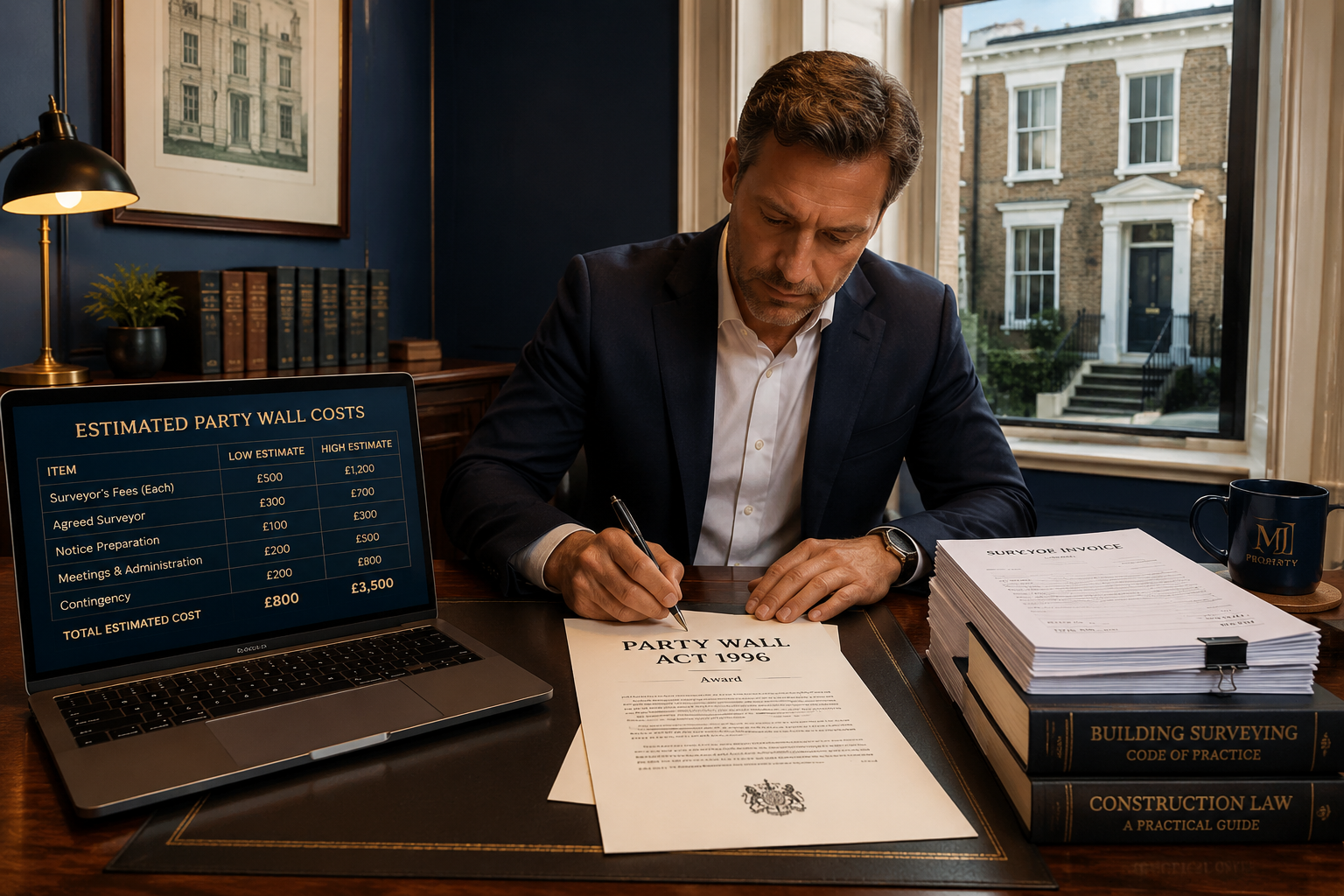
The Statutory Framework: Who Pays for Party Wall Surveyors in 2026?
Section 11(1): The Default Rule
The answer to who pays for party wall surveyors in 2026 starts with one piece of legislation: Section 11(1) of the Party Wall etc. Act 1996. This section states that all expenses relating to work carried out under the Act are borne by the building owner — the person who initiates the construction [1][3].
This is not a guideline. It is a statutory obligation. It covers:
- ✅ The building owner's own surveyor fees
- ✅ The adjoining owner's surveyor fees (even if the building owner didn't choose them)
- ✅ Party Wall Award preparation costs
- ✅ Third surveyor fees (if a dispute escalates that far)
- ✅ Schedule of Condition surveys
"The Act is designed to protect adjoining owners from financial burden for work they didn't initiate. They should not have to pay a penny for a process that exists because of someone else's building project." [1]
This protection principle is central to understanding the entire cost structure. The Party Wall etc. Act 1996 was designed to balance the rights of those who want to build with the rights of those who live next door.
What Counts as a "Reasonable Cost"?
Surveyors are not given a blank cheque. The Act specifies "reasonable costs", which means fees must be proportionate to the work involved. An adjoining owner cannot appoint an unnecessarily expensive surveyor and expect the building owner to absorb an inflated bill without question [3].
However, the building owner also cannot simply refuse to pay because they find the fee inconvenient. If the appointed surveyor's rates are within the normal market range, the bill stands.
For context, here are the 2026 market rates for party wall surveyor services [4][7]:
| Service | Cost Range (2026) |
|---|---|
| Agreed surveyor (both parties) | £900 – £2,700 |
| Two separate surveyors (total) | £1,800 – £5,400 |
| Loft conversion / rear extension | £800 – £3,500 total |
| Basement conversion | £5,000 – £10,000+ |
| Hourly rate (London) | £200 – £400/hr |
| Serving notices only | £75 – £200 |
| Simple Party Wall Award | £700 – £2,000 |
| Schedule of Condition | £300 – £1,000 |
London consistently sits at the top end of these ranges. For those in the capital, see regional guides for party wall surveyors in West London, South London, and East London for localised cost context.
Hidden Costs Building Owners Often Miss
Beyond headline surveyor fees, building owners should budget for these frequently overlooked expenses [4]:
- 🔍 Schedule of Condition (£300–£600): Documents the state of the neighbour's property before work begins
- 🏗️ Structural engineer review (from £500): Required on complex projects
- 📅 Monitoring visits during construction: Charged at hourly rates
- 💷 VAT: Applies if the surveyor is VAT-registered — add 20% to all figures above
Cost Recovery from Disputes and Award Fee Clauses
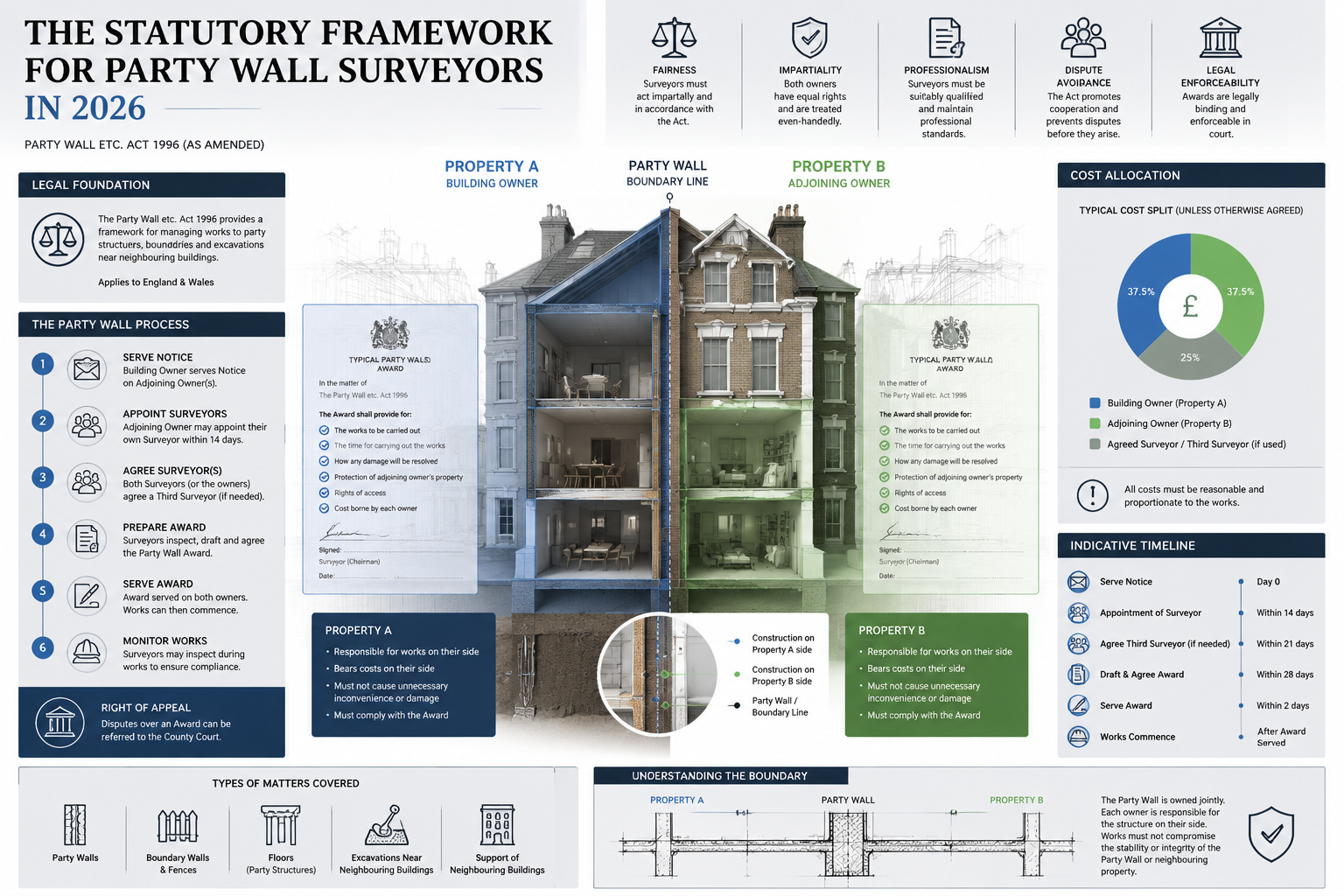
Section 10(13): The Surveyor's Power to Reallocate Costs
This is where things get more nuanced. While the building owner pays by default, Section 10(13) of the Party Wall etc. Act 1996 gives surveyors the power to allocate costs differently within the Party Wall Award [4]. This provision is the legal basis for cost recovery from disputes.
Surveyors can use this power when:
- Either party has behaved unreasonably during the process
- An adjoining owner has made excessive or unjustified demands
- A building owner has delayed the process unnecessarily
- Either party has caused unnecessary costs to be incurred [1]
In practice, this means an adjoining owner who repeatedly refuses reasonable proposals, demands unnecessary surveys, or causes deliberate delays could find themselves ordered to contribute to costs — or even bear the full cost of a specific element of the award.
Similarly, a building owner who ignores notices, fails to cooperate, or attempts to proceed without following the Act correctly may face a costs award that goes beyond the standard liability.
What Happens When the Adjoining Owner Appoints Their Own Surveyor?
This is one of the most common sources of confusion. When an adjoining owner dissents to a party wall notice and appoints their own surveyor, the building owner must still pay that surveyor's fees [3].
For example: if the adjoining owner appoints a surveyor who charges £600 for their involvement, that £600 bill lands with the building owner — regardless of whether the building owner approved the appointment or even knows who the surveyor is.
This is why understanding building owner responsibilities from the outset is so important. Surprises at invoice stage can derail project budgets.
The Award Document and Fee Clauses
A Party Wall Award is the formal document that resolves disputes and sets out the terms under which work can proceed. It typically includes:
- The scope of permitted works
- Working hours and access arrangements
- Damage liability provisions
- Critically: a costs clause specifying who pays what and to whom
The costs clause in the award is legally binding. Once the award is issued, the building owner has 14 days to appeal it to the County Court if they believe the costs are unreasonable. After that window closes, the award — including its fee provisions — becomes enforceable [2].
💡 Pro Tip: Always review the draft award carefully before it is finalised. Negotiate any costs clause that appears disproportionate to the actual work involved.
When Adjoining Owners Do Pay
There are limited circumstances where an adjoining owner bears some costs [1]:
- They request additional work beyond what the building owner proposed (e.g., asking for extra strengthening of the shared wall)
- They have caused unnecessary expense through unreasonable behaviour, as determined under Section 10(13)
- They benefit from the works — in some cases where both parties gain from the construction, costs may be shared proportionately
These situations are the exception, not the rule. The default position remains firmly with the building owner.
Strategies to Minimise Who Pays for Party Wall Surveyors in 2026: Agreed Surveyors and Cost Control

The Agreed Surveyor: The Most Effective Cost-Saving Strategy
The single most impactful way to reduce party wall surveyor costs is to use an agreed surveyor — one professional who acts impartially for both the building owner and the adjoining owner [1][7].
Under Section 10(1)(b) of the Act, both parties can agree to appoint a single surveyor. The financial benefit is substantial:
| Approach | Typical Total Cost |
|---|---|
| Two separate surveyors | £1,800 – £5,400 |
| Single agreed surveyor | £900 – £2,700 |
| Potential saving | £900 – £2,700 |
The agreed surveyor approach works best when:
- The project is straightforward (loft conversion, rear extension)
- The relationship between neighbours is cooperative
- Both parties trust an impartial professional
It is less suitable for complex basement projects or situations where the adjoining owner has significant concerns and wants independent representation.
For detailed guidance on keeping fees down, the party wall costs guide and this resource on how to keep party wall costs down are essential reading.
Serve Notices Correctly — First Time
One of the most avoidable cost drivers is serving incorrect or incomplete party wall notices. If a notice is invalid, the process restarts, wasting time and money [2].
Key notice requirements include:
- ✅ Correct identification of the works being carried out
- ✅ Proper service on all adjoining owners (including freeholders and leaseholders)
- ✅ Correct notice periods (1 month for Party Structure Notices, 2 months for Line of Junction Notices)
- ✅ Correct format and content
Understanding party wall notices and how to respond to them prevents costly restarts.
Negotiate Before Appointing Surveyors
Before the formal process begins, many building owners find success in having an informal conversation with their neighbour. If the adjoining owner consents to the works (by signing the consent section of the notice), no surveyor is needed at all — saving the entire cost [3].
This is not always possible, but it is always worth attempting. A clear explanation of the planned works, combined with reassurance about damage protection and working hours, can often secure consent without any formal dispute process.
Choose Fixed-Fee Surveyors Where Possible
Hourly-rate surveyors can be unpredictable in cost. Many reputable firms now offer fixed-fee structures for standard projects [2]:
- Notice serving: £75–£200
- Simple Party Wall Award: £700–£2,000
- Schedule of Condition: £300–£1,000
Fixed fees provide budget certainty and remove the incentive for a surveyor to prolong the process unnecessarily.
Understand the Schedule of Condition
A Schedule of Condition is a photographic and written record of the adjoining property's condition before works begin. While it adds to upfront costs (£300–£600), it is strongly recommended because it:
- Protects the building owner from inflated damage claims after construction
- Provides clear evidence if a genuine dispute about damage arises
- Can save thousands in disputed repair costs
Skipping this step to save money is a false economy on any project involving significant excavation or structural work.
Practical Checklist for Building Owners in 2026 ✅
Before starting any notifiable works, building owners should:
- Identify all adjoining owners — including freeholders, leaseholders, and tenants with long leases
- Serve valid party wall notices with correct notice periods
- Explore consent — an informal agreement avoids all surveyor costs
- Consider an agreed surveyor if the neighbour dissents
- Get fixed-fee quotes from at least two surveyors before appointing
- Commission a Schedule of Condition before works start
- Review the draft award carefully, especially the costs clause
- Budget for VAT and hidden costs — add 20–30% to headline figures
For those unsure whether their planned works require a party wall notice at all, the types of party wall works guide provides a clear breakdown of what is and is not notifiable.
Conclusion: Take Control of Party Wall Costs in 2026
The core principle is clear: the building owner pays. Section 11(1) of the Party Wall etc. Act 1996 places that responsibility squarely on the person initiating the works, and it extends to the adjoining owner's surveyor fees, award preparation, and any third surveyor involvement.
However, "the building owner pays" does not have to mean "the building owner overpays." In 2026, with surveyor hourly rates in London reaching £400/hr and basement projects exceeding £10,000 in total fees, proactive cost management is essential.
Actionable next steps:
- 🏠 Start early — serve notices as soon as plans are confirmed to avoid programme delays
- 🤝 Talk to your neighbour first — consent costs nothing
- 💼 Use an agreed surveyor on straightforward projects to halve total fees
- 📋 Always commission a Schedule of Condition — it protects against far larger costs later
- ⚖️ Understand Section 10(13) — unreasonable behaviour by either party can shift the cost burden
- 📄 Review every draft award before it is sealed and served
Party wall law does not have to be expensive if it is handled correctly from day one. The right preparation, the right surveyor appointment strategy, and a cooperative approach with neighbours can keep costs firmly within budget — even on complex London projects.
References
[1] Who Pays For A Party Wall Surveyor A Guide To Cost Responsibilities – https://nottinghillsurveyors.com/blog/who-pays-for-a-party-wall-surveyor-a-guide-to-cost-responsibilities
[2] Party Wall Dispute – https://onlinearchitecturalservices.com/party-wall-dispute/
[3] Who Pays For A Party Wall Surveyor – https://partywalldiy.com/guides/who-pays-for-a-party-wall-surveyor
[4] Who Pays For Party Wall Surveyor – https://blackacresurveyors.com/2026/03/12/who-pays-for-party-wall-surveyor/
[5] Who Pays For A Party Wall Surveyor – https://akt-surveyors.com/who-pays-for-a-party-wall-surveyor/
[6] Is A Party Wall Surveyor Worth The Cost – https://thepartywallguru.com/is-a-party-wall-surveyor-worth-the-cost/
[7] Costs – https://westvilleassociates.com/party-wall-surveyor/costs