


Nearly one in three party wall disputes escalates beyond informal resolution — often because the surveyor involved was perceived as partial from the very start. When a building owner selects their own surveyor to act as the "agreed" professional, the adjoining owner's trust in the process collapses before a single brick is moved. The principle of Independent Party Wall Surveyors: Why Neutral Appointments Trump Building Owner Choices for Fair Awards and Fewer Disputes is not just good practice — it is the cornerstone of a system designed by the Party Wall etc. Act 1996 to protect both sides equally.
In 2026, the Royal Institution of Chartered Surveyors (RICS) launched a formal consultation on the draft 8th edition of Party Wall Legislation and Procedure, explicitly targeting "competence and consistency" — a direct signal that the industry recognises how biased appointments fuel unnecessary conflict [1][2]. This article examines RICS guidance on personal and statutory appointments, the red flags that signal a compromised surveyor, and why adjoining owners benefit most from insisting on genuine neutrality.
Key Takeaways 📋
- Neutrality is a legal and ethical requirement: An agreed surveyor under the Party Wall Act must be genuinely independent — not the building owner's own professional.
- RICS is actively strengthening standards: The 2026 consultation on the 8th edition guidance reflects industry-wide concern about inconsistency and bias in surveyor appointments.
- Biased appointments produce flawed awards: Awards made by a perceived partial surveyor are more likely to be challenged, appealed, or litigated.
- Adjoining owners have the right to refuse: If an adjoining owner doubts a surveyor's neutrality, they can appoint their own surveyor — and often should.
- Documented neutrality saves money: Independent appointments reduce disputes, appeals, and the legal costs that follow a contested party wall award.
What the Party Wall Act Actually Requires from Surveyors
The Party Wall etc. Act 1996 establishes a clear framework. When a building owner serves a party wall notice and the adjoining owner dissents, both parties must appoint surveyors. The Act allows for one "agreed surveyor" to act for both — but this only works when that professional is genuinely neutral.
The Agreed Surveyor: A Neutral Role by Design
The agreed surveyor is not the building owner's representative. They are not the adjoining owner's advocate. Their role is quasi-judicial — to assess the proposed works, protect both properties, and produce a party wall award that is fair, enforceable, and evidence-based [4].
Key statutory requirements include:
| Requirement | Detail |
|---|---|
| Appointment window | Within 10 days of the adjoining owner receiving notice |
| Independence | Must not be the building owner's existing project surveyor |
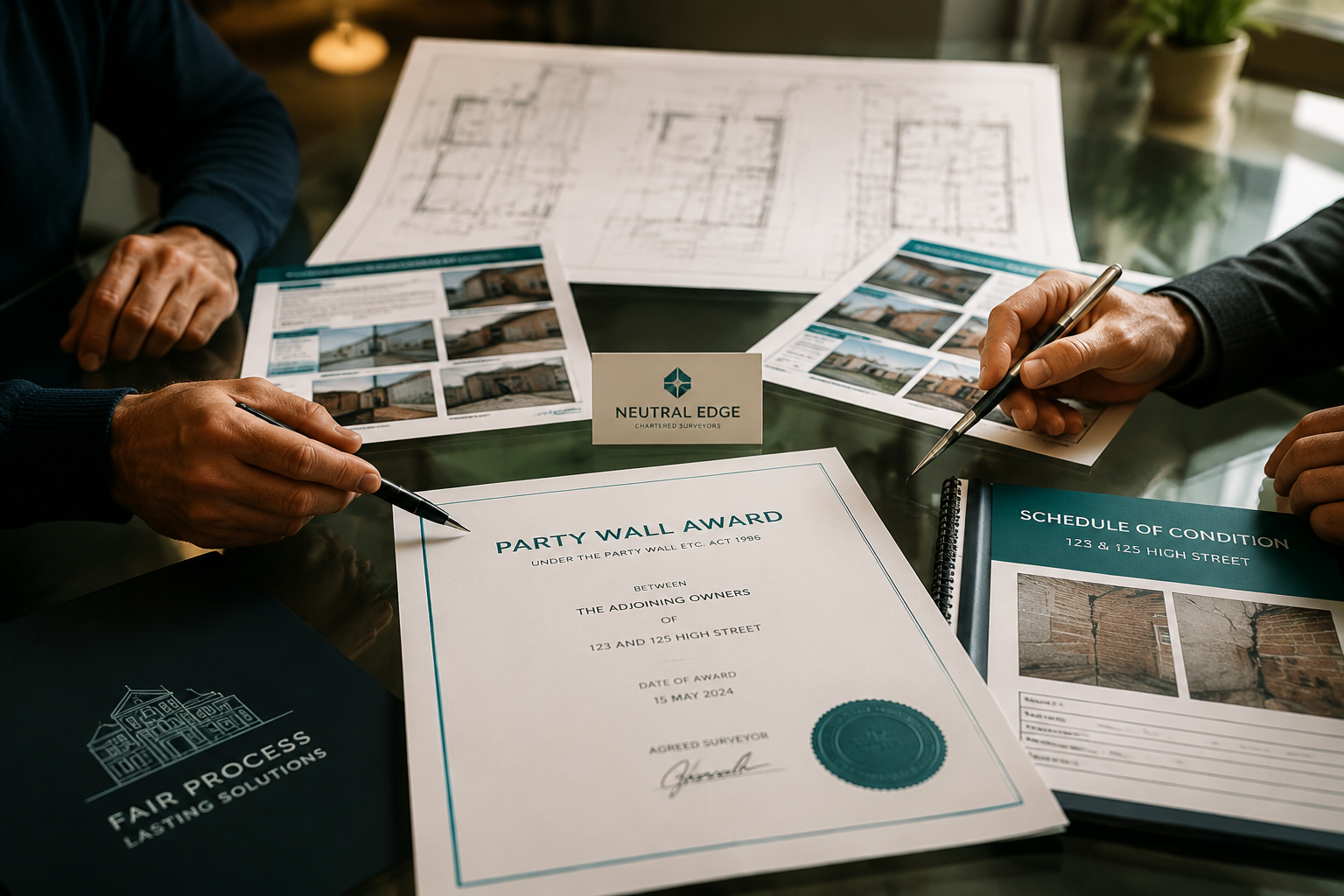
| Award content | Details of works, schedule of condition, protective measures |
| Fee responsibility | Building owner pays, but surveyor remains impartial |
| Appeal right | Both parties have 14 days to appeal to County Court |
💬 "The agreed surveyor should be independent and NOT the same surveyor the homeowner might be using for their own works — their neighbour is unlikely to view the surveyor as neutral." — HOA Party Wall Guidance [4]
This is not a technicality. Perceived conflicts of interest directly undermine the credibility of any award produced [4].
What a Party Wall Award Must Contain
A properly produced award from an independent surveyor includes:
- ✅ A full description of the proposed works
- ✅ A schedule of condition with photographs of the adjoining property
- ✅ Working hours and access arrangements
- ✅ Protective measures for the adjoining owner's property
- ✅ Dispute resolution provisions
The schedule of condition is particularly critical. It creates a documented baseline — photographic and written evidence of the adjoining property's state before works begin. Without a neutral surveyor producing this impartially, its evidential value is immediately questionable.
The RICS 2026 Guidance Consultation: Why It Matters Now
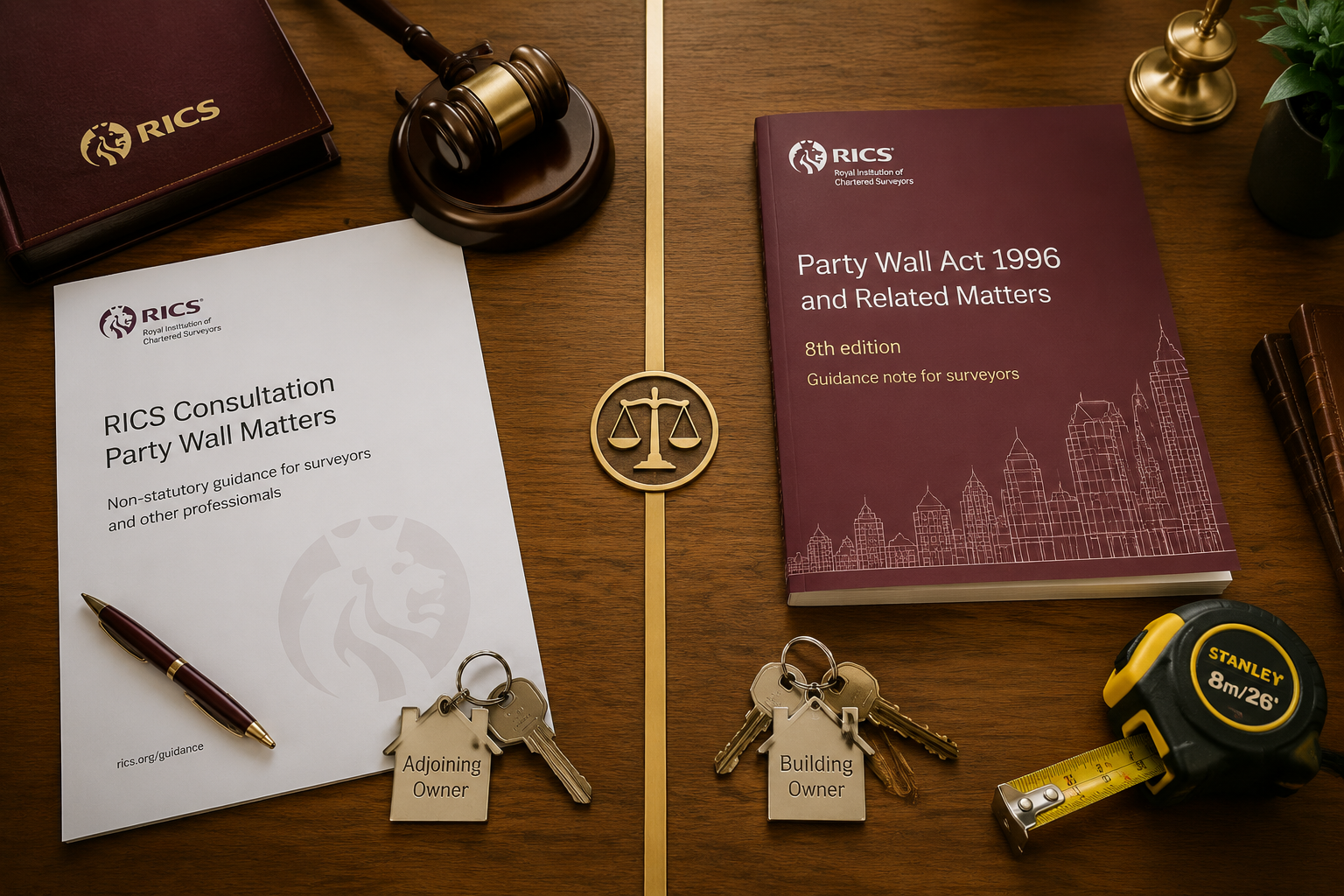
In April 2026, RICS launched an 8-week consultation inviting feedback from surveyors, legal professionals, dispute resolution practitioners, and other stakeholders on the draft 8th edition of Party Wall Legislation and Procedure [1][2]. The stated goal: improving "competence and consistency" across party wall practice in England and Wales.
This is not routine housekeeping. The decision to update formal guidance reflects patterns the industry has observed — including disputes that stem from appointments that lacked genuine independence.
What the Consultation Signals for Independent Party Wall Surveyors
The RICS consultation process reinforces several principles that are central to the argument for Independent Party Wall Surveyors: Why Neutral Appointments Trump Building Owner Choices for Fair Awards and Fewer Disputes:
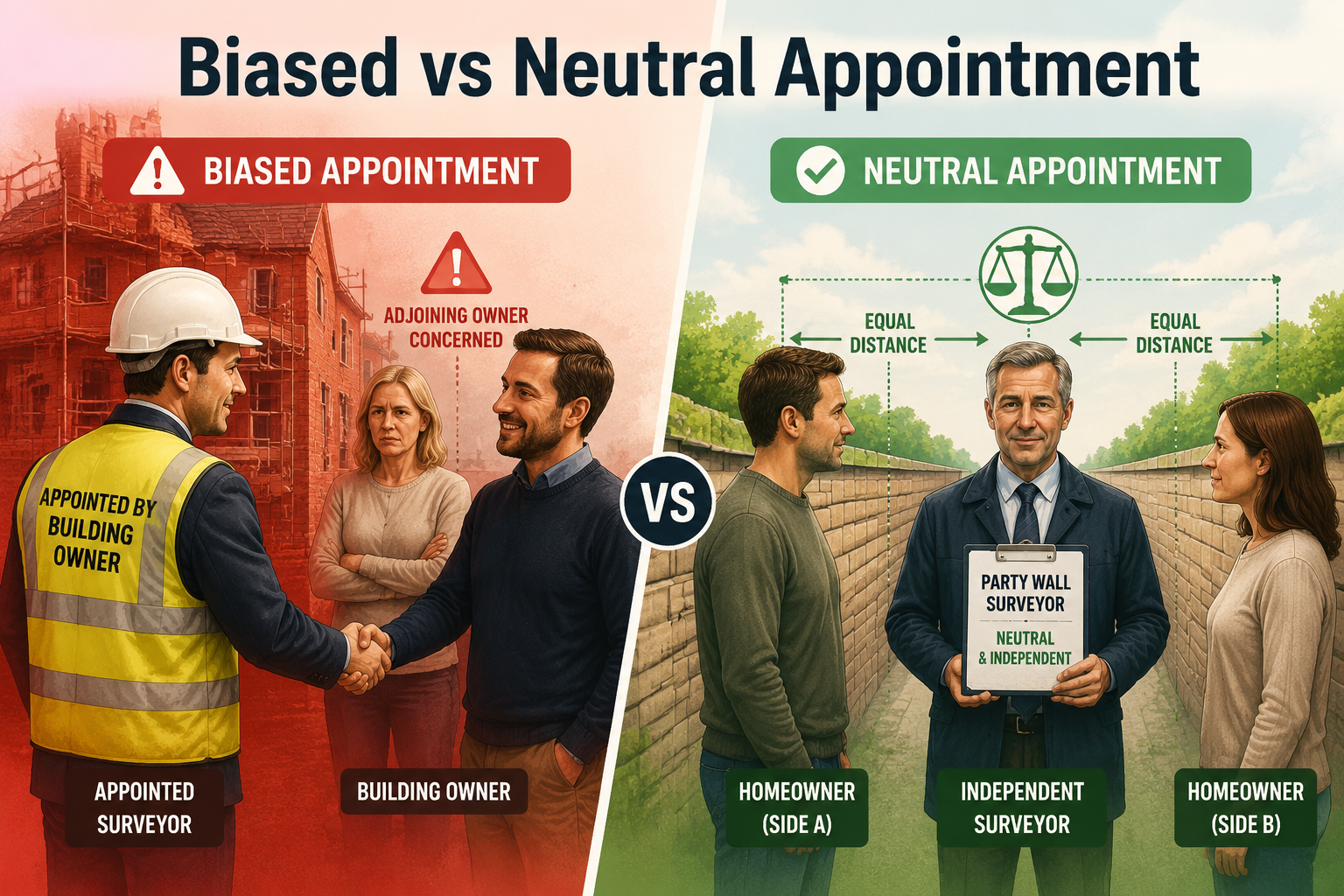
- Standardised neutrality protocols — The push for consistency suggests that current practice varies too widely, with some surveyors operating too close to the building owners who instruct them.
- Competence benchmarking — A neutral surveyor must not only be impartial but demonstrably qualified to produce awards that withstand scrutiny.
- Stakeholder-driven reform — By including dispute resolution practitioners in the consultation, RICS acknowledges that contested awards are a real and recurring problem [2].
The consultation was still open at the time of writing in May 2026, meaning its specific findings had not yet been published [1]. However, the direction of travel is clear: the profession is moving toward stricter standards for independence in surveyor appointments.
How RICS Guidance Distinguishes Personal from Statutory Appointments
Under the Act, there are two routes to surveyor appointment:
- Personal appointment: Each party appoints their own surveyor, and the two surveyors then select a third surveyor if they cannot agree.
- Agreed appointment: Both parties agree on a single surveyor to act for both.
RICS guidance is explicit that the agreed surveyor route — while more cost-effective — only functions fairly when the professional has no prior relationship with the building owner's project team [4]. Using the same surveyor who designed the loft conversion, for example, is a clear conflict of interest, even if that surveyor is technically qualified.
For building owners who want to keep costs down, the temptation to suggest their own surveyor is understandable. But the long-term cost of a disputed award far exceeds the short-term saving.
Red Flags: How to Spot a Biased Party Wall Surveyor
The case for Independent Party Wall Surveyors: Why Neutral Appointments Trump Building Owner Choices for Fair Awards and Fewer Disputes becomes most urgent when adjoining owners know what warning signs to watch for.
🚩 Six Red Flags That Signal a Compromised Appointment
1. The surveyor was introduced by the building owner
If the building owner suggests a specific "agreed" surveyor by name, that alone warrants scrutiny. A genuinely independent professional should be selected through a neutral process — not recommended by the party with the most to gain.
2. The surveyor is already working on the project
Any surveyor involved in designing, planning, or managing the building owner's works has an inherent conflict. Their professional loyalty — conscious or not — lies with the client paying their primary fee.
3. The schedule of condition is vague or incomplete
A biased surveyor may produce a superficial schedule of condition that fails to document existing defects. This leaves the adjoining owner exposed if damage occurs during works.
4. The award favours the building owner on every contested point
Party wall awards involve judgment calls. If every ambiguous decision goes the building owner's way, the award's impartiality deserves challenge.
5. The surveyor discourages the adjoining owner from seeking advice
An independent professional welcomes informed parties. A biased one may discourage the adjoining owner from consulting their own adjoining owner's surveyor.
6. Communication is one-sided
The agreed surveyor must communicate equally with both parties. If the adjoining owner is consistently last to receive information or finds it difficult to reach the surveyor, neutrality is compromised.
What Adjoining Owners Can Do
If any of these red flags appear, adjoining owners have clear options:
- Refuse the agreed surveyor and appoint their own adjoining owner's surveyor
- Request full documentation of the surveyor's prior relationship with the building owner
- Exercise the 14-day appeal right to County Court if a flawed award is issued [4]
- Seek a retrospective agreement if damage has already occurred [4]
💡 Pro tip for adjoining owners: Appointing your own surveyor does not mean the process becomes adversarial. It means both sides have professional representation — which often produces better outcomes for everyone, including the building owner.
Why Neutral Appointments Produce Better Awards and Fewer Disputes
The financial and practical case for independent appointments is compelling. Consider the numbers:
- A party wall award from an agreed neutral surveyor typically costs £1,000–£1,500 [4]
- A contested award that proceeds to County Court appeal can cost £5,000–£15,000+ in legal fees
- Retrospective agreements — needed when damage disputes arise after works — add further cost and delay [4]
The math is straightforward: genuine neutrality at the appointment stage is the most cost-effective risk management tool available to both parties. For advice on managing costs throughout the process, see this guide on how to keep party wall costs down.
The Schedule of Condition: Neutrality's Most Powerful Tool
A neutral surveyor's schedule of condition is the single most effective document for preventing post-works disputes. When produced impartially — with comprehensive photographs, written descriptions of existing cracks, damp patches, or structural issues — it creates an undeniable baseline [4].
If the building owner's surveyor produces this document, the adjoining owner has every reason to question whether pre-existing damage was deliberately under-documented. If a neutral professional produces it, both sides can rely on it.
How Neutral Awards Withstand Legal Challenge
Both parties retain a 14-day right to appeal any party wall award to the County Court [4]. Awards produced by genuinely independent surveyors are significantly less likely to be overturned on appeal because:
- The decision-making process is demonstrably impartial
- Both parties had equal access to the surveyor during the process
- The award reflects balanced professional judgment, not advocacy
Awards produced by building owner-aligned surveyors, by contrast, are vulnerable to challenge on procedural and substantive grounds — creating exactly the disputes the Act was designed to prevent.
Adjoining Owners: The Party with Most to Gain from Neutrality
For adjoining owners responding to a party wall notice, the choice of surveyor is the most important decision in the entire process. Understanding how to respond to party wall notices is the first step — but insisting on genuine independence in any agreed appointment is equally critical.
Adjoining owners who consent to a building owner-selected surveyor without scrutiny risk:
- An incomplete schedule of condition that cannot protect them if damage occurs
- An award that grants the building owner excessive access or working hours
- A document they cannot effectively challenge because they accepted the process
The adjoining owner's right to appoint their own surveyor is not a sign of bad faith. It is a statutory protection that exists precisely because the Act's drafters understood the risk of imbalanced appointments.
Practical Steps for Both Parties in 2026
Whether acting as a building owner or an adjoining owner, the following steps reflect best practice under current RICS guidance and the Party Wall Act:
For Building Owners 🏗️
- Serve notice correctly and on time — understand the types of party wall works that require notice
- Do not suggest your own surveyor as the agreed professional — it creates immediate suspicion
- Budget for genuine independence — the cost is modest compared to the risk of a disputed award
- Understand your obligations as a building owner under the Act
For Adjoining Owners 🏠
- Do not feel pressured to accept the building owner's suggested surveyor
- Request the surveyor's credentials and ask directly about any prior relationship with the building owner
- Consider appointing your own surveyor — the building owner typically pays both fees
- Understand your rights as an adjoining owner before responding to any notice
Conclusion: Neutrality Is Not Optional — It Is the Foundation
The principle examined throughout this article — Independent Party Wall Surveyors: Why Neutral Appointments Trump Building Owner Choices for Fair Awards and Fewer Disputes — is not abstract. It has direct, measurable consequences for the cost, speed, and fairness of every party wall process.
RICS's 2026 consultation on updated party wall guidance signals that the profession itself recognises the problem [1][2]. The direction is toward stricter standards, clearer competence benchmarks, and less tolerance for appointments that compromise the Act's fundamental purpose.
For building owners, the actionable takeaway is simple: resist the temptation to control the surveyor appointment. The short-term convenience is not worth the long-term exposure.
For adjoining owners, the message is equally clear: you have the right to insist on genuine independence, and exercising that right is not obstructive — it is exactly what the Act intended.
A neutral surveyor produces an award both sides can trust. A trusted award means fewer appeals, fewer disputes, and fewer retrospective agreements. In a process designed to protect both parties, genuine independence is not a luxury — it is the point.
References
[1] Rics Launches Consultation On Party Wall Guidance – https://thenegotiator.co.uk/news/regulation-law-news/rics-launches-consultation-on-party-wall-guidance/
[2] Rics Launches Consultation On Updated Party Wall Practice Guidance – https://www.rics.org/news-insights/rics-launches-consultation-on-updated-party-wall-practice-guidance
[4] Party Wall Agreement – https://hoa.org.uk/advice/guides-for-homeowners/i-am-improving/party-wall-agreement/