


A building owner who ignores party wall costs until the invoice arrives often ends up paying 40–60% more than one who plans ahead. Across London and the wider UK, party wall surveyor fees for a typical extension or loft conversion regularly land between £1,000 and £1,500 per surveyor — and that figure can double or triple once a second surveyor enters the picture. Understanding Party Wall Surveyor Fees and Reasonableness: 2026 Benchmarks, Negotiation Tactics, and Cost-Saving Strategies is not just useful background knowledge; it is the difference between a smooth build and a costly dispute.
This guide cuts through the jargon to deliver clear benchmarks, explain what drives fees up, and arm building owners with practical tools to keep costs reasonable in 2026.
Key Takeaways 📌
- Average fees per surveyor range from £900 to £2,700 depending on project type, with basement works reaching £5,400+ for dual-surveyor arrangements.
- The building owner pays all reasonable costs, including the adjoining owner's surveyor fees — there is no statutory fee cap under the Party Wall etc. Act 1996.
- Hourly rates in London run £200–£400; regional surveyors charge £80–£200 per hour.
- Fixed-fee agreements offer the best cost certainty for straightforward matters like loft conversions and single-storey extensions.
- Early engagement and an agreed surveyor are the two most powerful cost-saving moves available to any building owner.
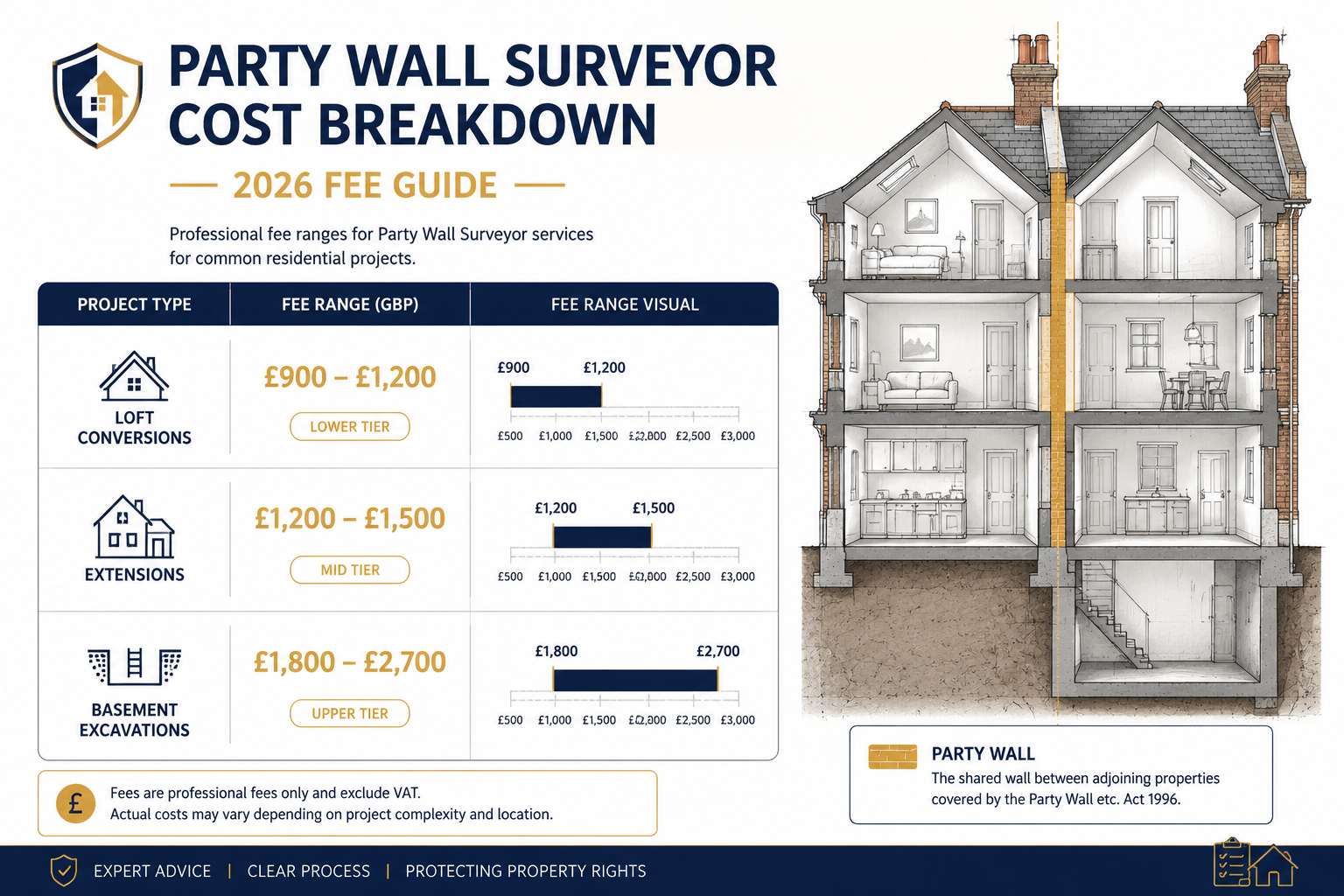
2026 Fee Benchmarks: What Does a Party Wall Surveyor Actually Cost?
The Party Wall etc. Act 1996 sets no fixed fees by law. Surveyors charge what is reasonable based on time spent and complexity [5]. That single fact explains why fees vary so widely — and why building owners need reliable benchmarks before any work begins.
Typical Fee Ranges by Project Type
| Project Type | Single Surveyor | Dual Surveyors |
|---|---|---|
| Loft conversion | £900–£1,200 | £1,800–£2,400 |
| Single-storey extension | £1,200–£1,500 | £2,400–£3,000 |
| Basement excavation | £1,800–£2,700 | £3,600–£5,400 |
| Complex basement (multiple neighbours) | £5,000+ | £10,000+ |
Sources: [2][6]
These figures represent the total fee per matter, not per hour. According to Faculty of Party Wall Surveyors (FPWS) guidance, a standard party wall matter typically requires 6–8 hours per surveyor [6]. Multiply that by London's going rate of £200–£400 per hour and the numbers above make immediate sense.
Hourly Rates in 2026
- 🏙️ London practitioners: £200–£400 per hour
- 🌍 Regional surveyors: £80–£200 per hour
- 📊 National range: £100–£450 per hour [1][6]
"Fees are not arbitrary — they reflect genuine professional time, site visits, correspondence, and legal drafting. The key is ensuring every hour charged is justified."
Fixed-Fee Breakdown for Individual Services
Some surveyors offer itemised fixed fees rather than a single project quote. Common line items include:
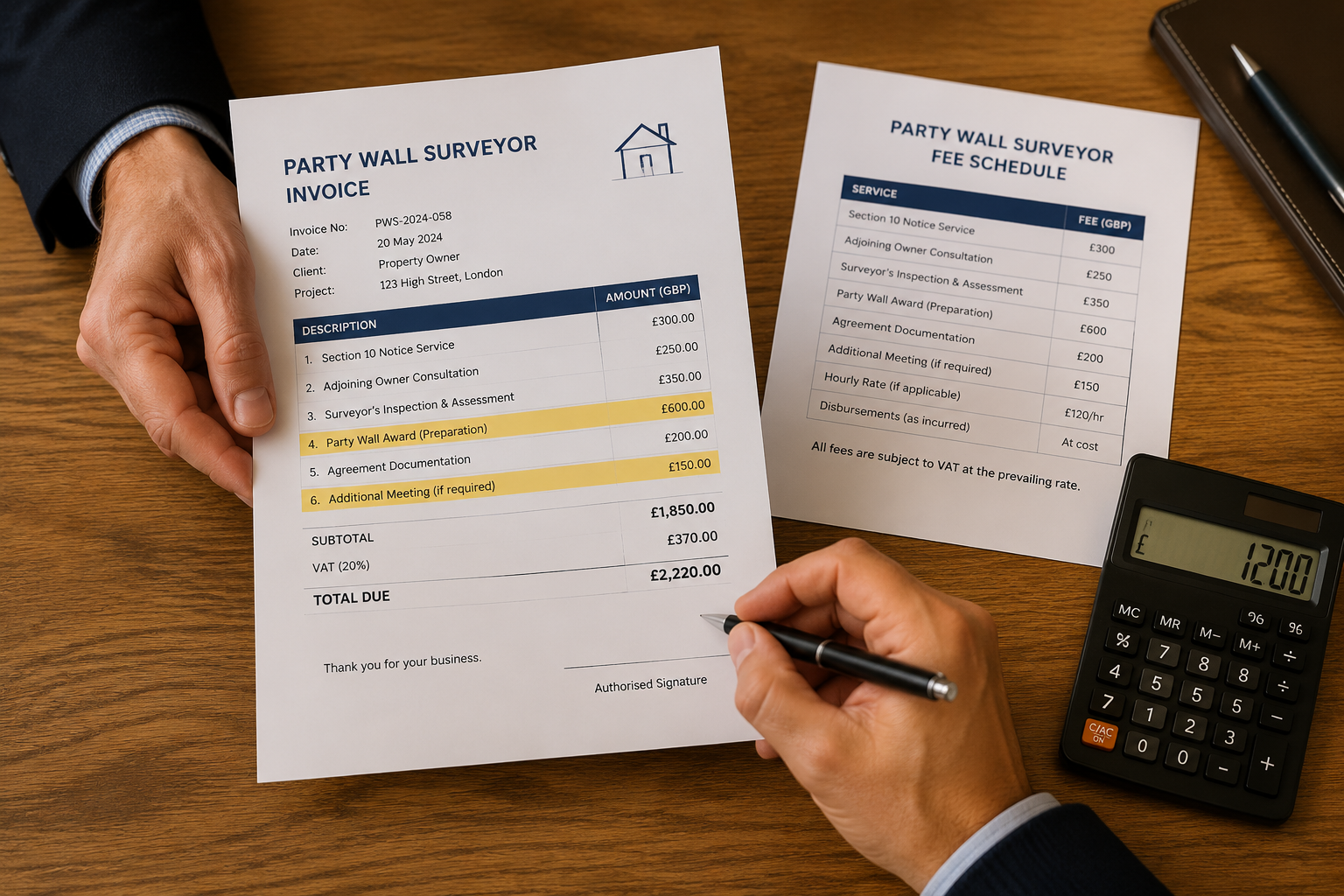
- Serving a Party Wall Notice: £75–£200
- Schedule of Condition survey: £300–£1,000
- Simple Party Wall Award preparation: £700–£2,000 [1]
For straightforward loft conversions or rear extensions, requesting a fixed-fee quote for each component is often the most transparent approach. Learn more about the costs involved in the party wall process to understand exactly what each stage involves.
Will Fees Rise in 2026?
Yes — modestly. General inflation, rising operational costs, and a construction uptick are all applying upward pressure to party wall surveyor fees in 2026 [5][7]. However, increases will not be uniform. Competitive markets and fixed-fee options mean cost-conscious building owners can still achieve predictable expenses if they plan ahead [5].
What Drives Party Wall Surveyor Fees Higher?
Understanding the cost drivers is the first step toward controlling them. Several factors push fees well beyond the average £1,000–£1,500 benchmark.
1. Project Complexity 🏗️
Basement excavations are the clearest example. They involve:
- Structural monitoring and multiple site inspections
- Detailed schedules of condition before, during, and after works
- Higher risk of damage claims, which increases surveyor liability and time
A schedule of condition for a basement project can alone cost £500–£1,000 per neighbouring property.
2. Number of Adjoining Owners
Each adjoining owner who dissents and appoints their own surveyor adds a full set of fees to the building owner's bill. A mid-terrace property with two neighbours could face two separate sets of dual-surveyor costs — potentially £5,000–£6,000 before a brick is laid.
3. Dual vs. Agreed Surveyor Arrangements
When each party appoints their own surveyor, costs roughly double. An agreed surveyor — one neutral professional appointed by both parties — is almost always cheaper. The difference between a single-surveyor arrangement (£900–£1,500) and a dual-surveyor arrangement (£1,800–£3,000) for an extension is significant [2].
4. Disputes and Third Surveyor Appointments
If the two appointed surveyors cannot agree, a third surveyor is called in to adjudicate. Third surveyor fees are charged at similar hourly rates and are again borne by the building owner [1]. Disputes are expensive — avoiding them through early communication is always preferable.
5. Monitoring and Ongoing Inspections
For works with a higher damage risk — deep excavations, underpinning, structural alterations — surveyors may need to visit the site multiple times during construction. Each visit adds hours to the final bill. Understanding the full types of party wall works that trigger these requirements helps building owners anticipate costs accurately.
6. Location
London commands premium rates. A party wall matter in Central London or West London will typically cost 30–50% more than the same project in a regional city, simply because surveyor overheads and market rates are higher.
Party Wall Surveyor Fees and Reasonableness: Negotiation Tactics for Building Owners
The legal framework matters here. Under the Party Wall etc. Act 1996, the building owner is responsible for all reasonable costs — but "reasonable" is a word with real legal weight. Fees that are excessive, duplicated, or not genuinely incurred can be challenged.
Tactic 1: Request Fixed Fees Upfront ✅
Before appointing any surveyor, ask for a fixed-fee quote covering:
- Notice serving
- Schedule of condition
- Party Wall Award drafting
- Any anticipated site visits
Fixed fees eliminate the risk of hourly billing creep. They are most achievable on straightforward loft conversions and extensions. Note that even with a fixed fee for your own surveyor, the adjoining owner's surveyor may still charge hourly rates — get written confirmation of their fee structure at the outset [5].
Tactic 2: Push for an Agreed Surveyor
The single most effective cost-saving tactic is persuading the adjoining owner to agree to a single, jointly appointed surveyor rather than each party appointing their own. This requires early, friendly communication with neighbours before any formal notice is served.
An agreed surveyor acts impartially for both parties and prepares a single Party Wall Award — halving the professional fees compared to a dual-surveyor arrangement.
Tactic 3: Serve Notices Early and Correctly
Errors in party wall notices force re-serving, extend timelines, and increase surveyor hours. Serving notices correctly the first time — and with adequate lead time — reduces unnecessary correspondence and keeps the process efficient. Familiarise yourself with what party wall notices are and how to respond before starting.
Tactic 4: Challenge Unreasonable Fee Schedules
If an adjoining owner's surveyor submits a fee schedule that appears disproportionate to the work done, the building owner's surveyor can raise this formally. Surveyors are bound by professional conduct rules and must charge only for work genuinely performed. In persistent cases, the matter can be referred to the third surveyor for determination [1].
Key questions to ask when reviewing a fee schedule:
- How many hours are claimed, and for what specific tasks?
- Were all site visits necessary and pre-agreed?
- Does the fee reflect the actual complexity of the project?
- Are any items duplicated across invoices?
Tactic 5: Compare Multiple Quotes
There is no obligation to appoint the first surveyor approached. Obtaining three quotes from qualified surveyors — particularly for the building owner's own appointment — is straightforward and can yield meaningful savings. For projects in East London or South London, local specialists often offer more competitive rates than national firms.
Tactic 6: Understand Cost-Sharing Exceptions
In most cases, all party wall costs fall to the building owner. However, if an adjoining owner encloses on the party wall — for example, by using a shared boundary wall for their own extension — they become liable for a proportion of costs [6]. This is a narrow exception, but it is worth understanding before assuming full liability.
Party Wall Surveyor Fees and Reasonableness: 2026 Cost-Saving Strategies
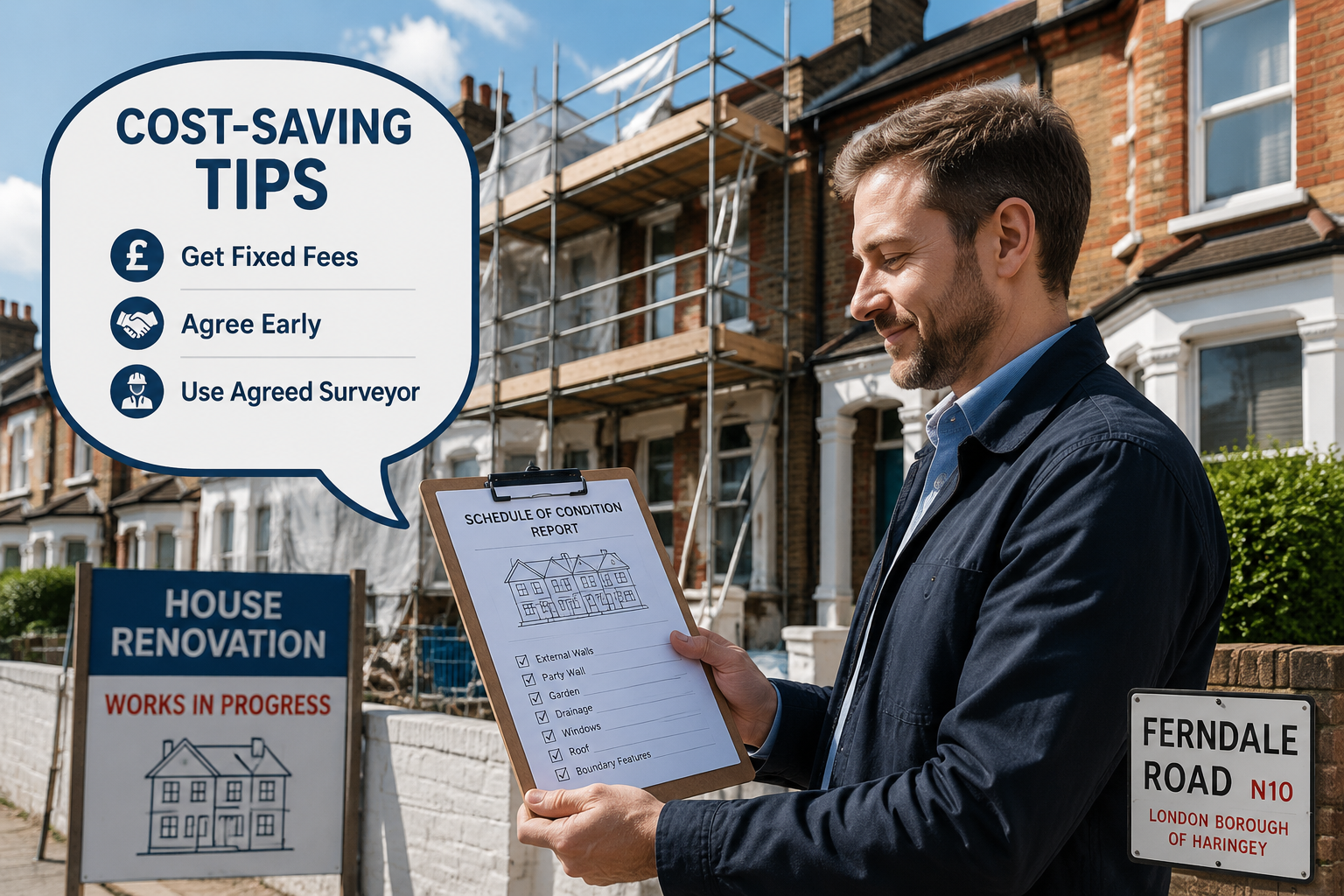
Beyond negotiation tactics, there are structural decisions that significantly reduce the total cost of party wall compliance.
Strategy 1: Engage Neighbours Before Serving Notice 🤝
A neighbour who receives a formal legal notice out of the blue is far more likely to dissent and appoint their own surveyor. A neighbour who has been briefed informally, shown the plans, and reassured about disruption is far more likely to consent — or agree to a single surveyor. This one conversation can save £1,000–£2,000 in dual-surveyor fees.
For detailed guidance, explore how to keep party wall costs down — a practical resource covering exactly this kind of proactive approach.
Strategy 2: Consider Whether a Surveyor Is Strictly Required
For very minor works, it may be possible to proceed with a written agreement between neighbours without formally appointing surveyors. This is only appropriate in limited circumstances and carries risk — but for genuinely simple matters, it is worth exploring. Read about having a party wall agreement without a surveyor to understand when this is and is not appropriate.
Strategy 3: Scope Works to Minimise Party Wall Triggers
Some works can be redesigned to avoid triggering the Act entirely, or to reduce the number of notices required. For example, a rear extension that avoids cutting into the party wall may require only a Line of Junction Notice rather than a full Party Structure Notice — a simpler and cheaper process. Consult an architect or surveyor early in the design phase to explore this.
Strategy 4: Bundle Multiple Works Under One Award
If planning multiple phases of construction — a loft conversion followed by an extension, for example — consider whether both can be covered under a single Party Wall Award. Bundling works reduces the number of separate surveyor appointments, notices, and awards required, cutting total fees meaningfully.
Strategy 5: Use Accredited, Specialist Surveyors
Counterintuitively, an experienced specialist often costs less in total than a generalist charging lower hourly rates. Specialists work faster, make fewer errors, and produce awards that are less likely to be challenged — reducing overall hours billed. Look for membership of the Faculty of Party Wall Surveyors (FPWS) or RICS accreditation as a quality indicator [7].
Quick Cost-Saving Checklist ✅
- Talk to neighbours before serving any notice
- Request fixed-fee quotes from at least three surveyors
- Explore agreed surveyor appointment with adjoining owner
- Serve notices correctly and on time to avoid re-serving costs
- Review all fee schedules line by line before paying
- Ask architect to assess whether works can be redesigned to reduce party wall triggers
- Bundle works where possible under a single award
Who Pays Party Wall Surveyor Fees?
This is one of the most common sources of confusion — and dispute — in the party wall process.
The building owner pays:
- Their own surveyor's fees ✅
- The adjoining owner's surveyor fees ✅
- Party Wall Award preparation costs ✅
- Third surveyor fees (if required) ✅
The adjoining owner pays nothing in the standard scenario. This is a deliberate feature of the Act — it ensures that neighbours are not financially penalised for asserting their legal rights [1].
"The building owner bears all reasonable costs. This is not negotiable — but 'reasonable' is the operative word, and it is always open to scrutiny."
The only exception arises when the adjoining owner has a concurrent interest in the works — for example, if they are also benefiting from the party wall being built up or enclosed [6]. In that case, costs may be apportioned.
For building owners who are also responding to a neighbour's works, the adjoining owner's surveyor page provides useful context on rights and the appointment process.
Conclusion: Take Control of Party Wall Costs in 2026
Party wall surveyor fees are a legitimate and often unavoidable cost of construction — but they are far from fixed. The benchmarks for 2026 are clear: £900–£1,500 per surveyor for most residential projects, rising sharply for basement works and multi-neighbour scenarios. Fees are expected to increase modestly through 2026 due to inflation and construction market activity, making early planning more valuable than ever.
The building owners who manage these costs most effectively share three habits: they engage neighbours early, they request fixed-fee quotes, and they understand that "reasonable" is a legally meaningful standard — not just a polite suggestion.
Actionable Next Steps
- Before serving any notice: Have an informal conversation with adjoining neighbours about your plans.
- When seeking quotes: Ask explicitly for fixed-fee proposals and compare at least three surveyors.
- When reviewing invoices: Request a full breakdown of hours and tasks — challenge anything that appears disproportionate.
- For complex projects: Engage a specialist party wall surveyor early in the design phase to assess cost exposure before works are committed.
- For all projects: Ensure notices are served correctly the first time to avoid costly delays and re-serving fees.
Understanding Party Wall Surveyor Fees and Reasonableness: 2026 Benchmarks, Negotiation Tactics, and Cost-Saving Strategies is not just about saving money — it is about running a professional, dispute-free construction project that protects both the building owner and their neighbours throughout the process.
References
[1] Party Wall Dispute – https://onlinearchitecturalservices.com/party-wall-dispute/
[2] Party Wall Surveyor Cost – https://hoa.org.uk/advice/guides-for-homeowners/i-am-improving/party-wall-surveyor-cost/
[3] Costs – https://westvilleassociates.com/party-wall-surveyor/costs
[4] Party Wall Surveyor Costs – https://www.designingbuildings.co.uk/wiki/Party%20Wall%20Surveyor%20Costs
[5] Will Party Wall Surveyor Fees Go Up In 2026 – https://www.simplesurvey.co.uk/article/will-party-wall-surveyor-fees-go-up-in-2026/
[6] Party Wall Surveyor Cost Analysis How Much Does A Party Wall Agreement Cost – https://www.surveymerchant.com/blog/party-wall-surveyor-cost-analysis-how-much-does-a-party-wall-agreement-cost
[7] Party Wall Surveys And Neighbour Disputes During 2026s Construction Uptick RICS Compliance Framework – https://nottinghillsurveyors.com/blog/party-wall-surveys-and-neighbour-disputes-during-2026s-construction-uptick-rics-compliance-framework