


A staggering proportion of party wall disputes that reach the County Court in England and Wales could have been avoided — not by better negotiation, but by catching procedural errors before the Award was ever signed. RICS compliance data consistently flags improper surveyor jurisdiction as one of the most exploited grounds for challenging a Party Wall Award, and with construction activity surging in 2026, the risk of flawed awards entering circulation has never been higher [7].
Ensuring Party Wall Award Validity: Surveyor Jurisdiction Checks and Avoiding 2026 Court Challenges is not a passive exercise. It demands active, step-by-step verification of every element — from the original notice through to the surveyor's appointment — before a single brick is disturbed. This guide unpacks exactly where awards go wrong, what surveyors and building owners must check, and how to build a legally watertight document that stands up to scrutiny.
Key Takeaways 📋
- A Party Wall Award is only as strong as the jurisdiction underpinning it — procedural errors at the notice stage can invalidate the entire document.
- Surveyor independence is non-negotiable: an agreed surveyor must have no conflict of interest with either party.
- The 14-day statutory response window is rigid; missing it triggers dissent and mandatory surveyor appointment.
- A Schedule of Condition is mandatory, not optional — its absence is a leading cause of court challenges.
- RICS compliance frameworks in 2026 place heightened scrutiny on jurisdictional validity, making pre-award checklists essential.
What Is a Party Wall Award and Why Does Validity Matter?
A Party Wall Award is a legally binding document prepared by one or more appointed party wall surveyors once a dispute or dissent has arisen under the Party Wall etc. Act 1996. It defines precisely how notifiable works must proceed, sets out protective conditions for the adjoining owner, and — critically — provides a legal framework that replaces the need for court intervention [4].
💡 Pull Quote: "A properly drafted Party Wall Award is one of the most powerful dispute-prevention tools in property law — but only if it is jurisdictionally sound from the outset."
Once an Award is in place, both the building owner and the adjoining owner are bound by its terms. It can cover everything from working hours and vibration limits to compensation for damage. However, the Award's enforceability depends entirely on whether the surveyors who made it had the legal authority — or jurisdiction — to do so [6].
If jurisdiction is absent or defective, the Award is a nullity. Courts have consistently held that a surveyor acting outside their statutory authority produces a document with no legal standing, leaving both parties exposed to costly litigation.
For a deeper understanding of how the award process fits into the broader statutory framework, the Party Wall etc. Act 1996 overview provides essential context.
The Jurisdiction Checklist: What Surveyors Must Verify in 2026
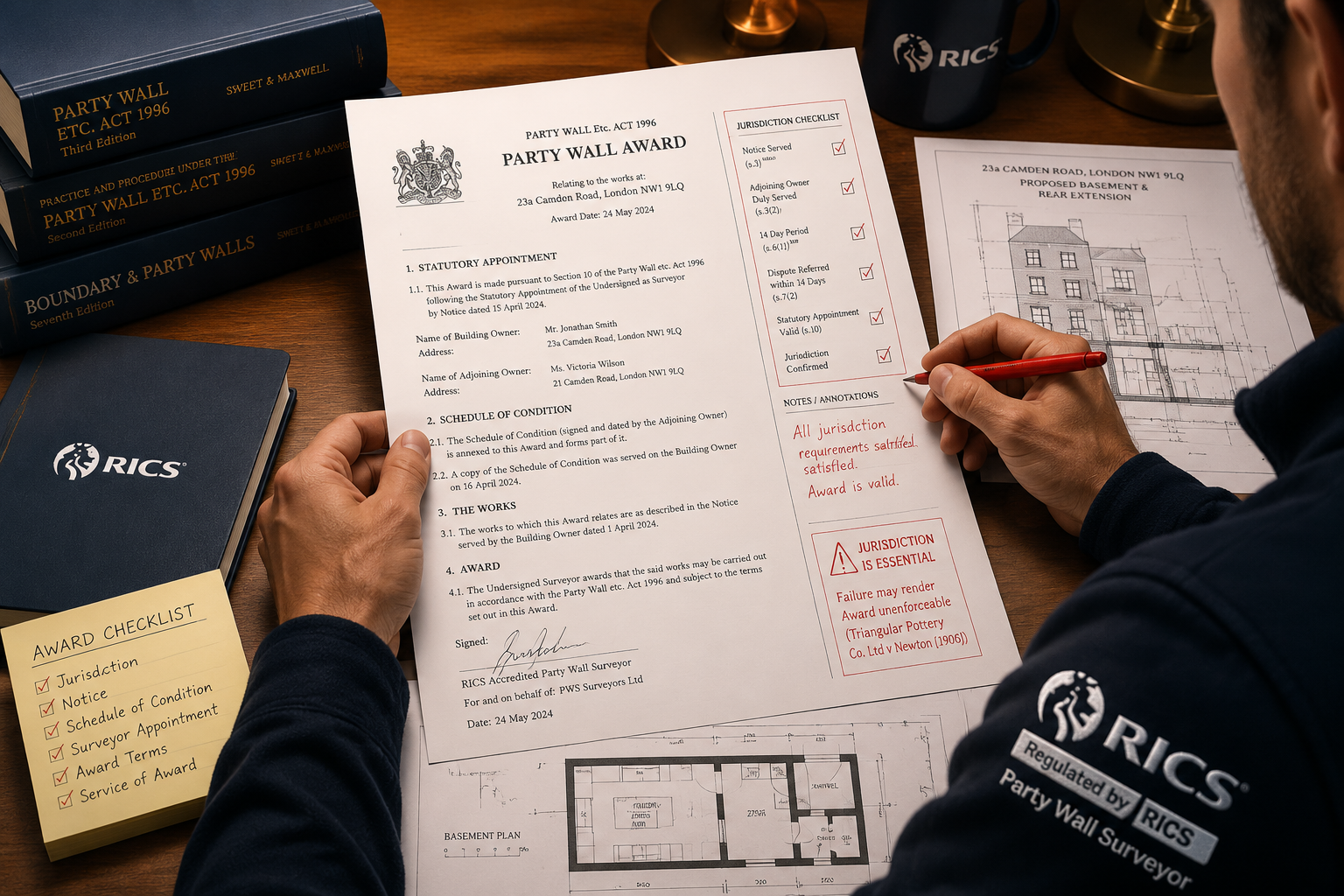
Ensuring Party Wall Award Validity: Surveyor Jurisdiction Checks and Avoiding 2026 Court Challenges begins with a structured pre-award verification process. The following checklist reflects current RICS guidance and the procedural requirements of the Party Wall etc. Act 1996 [7].
✅ Step 1: Confirm the Notice Is Valid
A Party Wall Award cannot exist without a valid preceding notice. The notice must:
| Requirement | Detail |
|---|---|
| Correct notice type | Line of Junction, Party Structure, or Three Metre Notice — depending on work type |
| Served on all adjoining owners | Every owner of every adjoining property, not just immediate neighbours |
| Served within statutory timeframes | Party Structure Notice: minimum 2 months before works; Three Metre Notice: minimum 1 month |
| Correct description of works | Sufficiently detailed to allow the adjoining owner to understand the scope |
| Served by the correct party | The building owner (or their authorised agent), not a contractor |
A notice that fails any of these tests is invalid, and any Award based on it is challengeable [2]. This is a critical point that is frequently overlooked in DIY notice situations [1].
For guidance on the different notice types and how to serve them correctly, see this detailed resource on Party Wall Act notices and how to respond.
✅ Step 2: Verify the 14-Day Response Window Was Observed
Adjoining owners have exactly 14 days from receipt of a valid notice to respond. Their options are:
- Consent in writing — no Award required
- Dissent and appoint a surveyor — triggers the Award process
- Fail to respond — treated as dissent by statute [4]
The 14-day clock is statutory and cannot be waived or shortened. If a building owner proceeds to appoint surveyors before this period has elapsed, the appointment — and any subsequent Award — may be void.
✅ Step 3: Confirm Surveyor Independence and Appointment Validity
This is where many awards fall apart. Surveyor independence is fundamental to Award validity [5]. The agreed surveyor — or each party's appointed surveyor — must:
- Have no financial or professional interest in the outcome of the works
- Not be the same surveyor already engaged by the building owner for the project design or project management
- Be properly appointed in writing by the relevant party
- Be a qualified surveyor (though the Act does not require RICS membership, RICS accreditation is strongly recommended under 2026 compliance frameworks) [7]
⚠️ Warning: Using a surveyor who is also the building owner's architect or project manager is a common and costly mistake. The adjoining owner is unlikely to view such an appointment as neutral, and courts have set aside awards on this basis [5].
For building owners seeking a properly independent appointment, the building owner's surveyor service and the adjoining owner's surveyor service provide properly structured, independent appointments.
✅ Step 4: Ensure the Award Covers All Notifiable Works
The Award's jurisdiction is limited to the works described in the notice. Surveyors cannot award on matters outside the scope of the original notice. If works expand during the project, a supplementary notice and, if necessary, a supplementary Award must be served and prepared.
Failing to do this means the additional works proceed without Award protection — leaving both parties unprotected and the building owner potentially liable for injunction proceedings [3].
Common Defects That Trigger 2026 Court Challenges
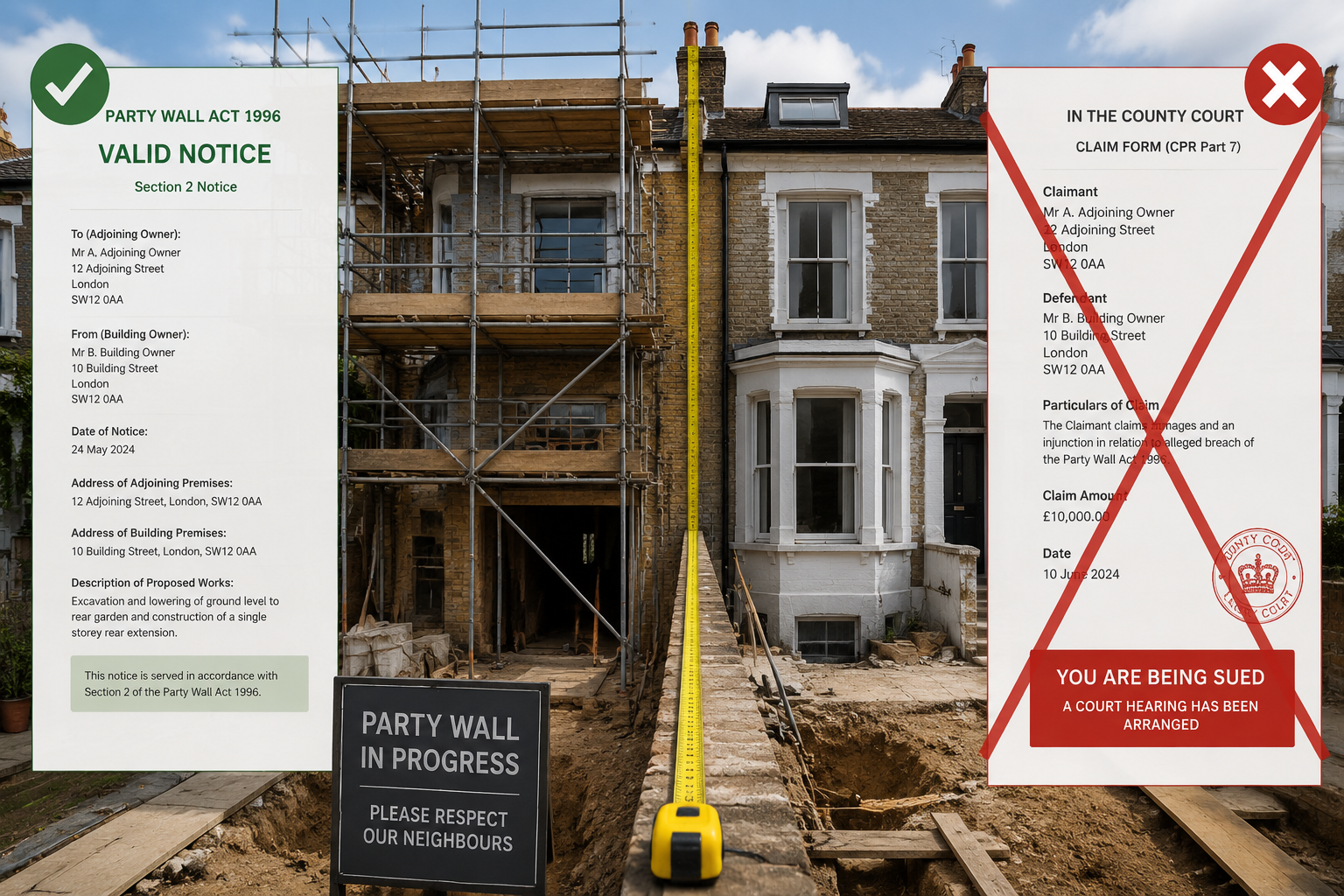
Understanding the specific defects that make awards vulnerable is central to Ensuring Party Wall Award Validity: Surveyor Jurisdiction Checks and Avoiding 2026 Court Challenges. The following defects are most frequently cited in appeal proceedings.
🔴 Missing or Inadequate Schedule of Condition
The Schedule of Condition is a mandatory component of any Party Wall Award. It must:
- Be prepared before works commence — not retrospectively
- Include photographs of the adjoining property's existing condition
- Document existing cracks, defects, and vulnerable features in detail
- Be agreed and signed by the appointed surveyor(s) [5]
Without a comprehensive Schedule of Condition, there is no baseline against which damage claims can be assessed. This creates disputes that courts are then asked to resolve — at significant cost to both parties.
For a detailed understanding of what a proper schedule involves, the Schedule of Condition service explains the documentation process.
🔴 Failure to Serve Notice on All Adjoining Owners
In leasehold properties, both the freeholder and the leaseholder may qualify as adjoining owners under the Act. Serving notice on only one of them creates a jurisdictional gap — the un-notified party retains the right to challenge the Award or seek an injunction to halt works [3].
🔴 Premature Commencement of Works
If works begin before the Award is formally made and served, the building owner loses the statutory protection the Act provides. They become liable in trespass and nuisance for any damage caused, regardless of what the Award subsequently says [6].
🔴 Awards Made by Improperly Appointed Third Surveyors
Where the two party-appointed surveyors cannot agree, the matter passes to a Third Surveyor selected from a list agreed at the outset. If the Third Surveyor was not properly selected — or was selected after a dispute arose rather than at appointment — their jurisdiction to make an Award is questionable [7].
The RICS Compliance Framework and 2026 Construction Activity
The surge in residential construction and renovation activity across London and major urban centres in 2026 has placed party wall procedures under heightened regulatory scrutiny [7]. RICS guidance now emphasises that surveyors must:
- Document their jurisdictional basis at the start of every appointment
- Maintain a clear audit trail from notice service through to Award execution
- Confirm in writing that all statutory timeframes have been observed before making an Award
- Disclose any potential conflicts of interest immediately upon appointment
This framework is particularly relevant for high-volume areas such as West London, East London, and South London, where dense terraced housing stock means party wall works are almost routine.
The Appeal Process: What Happens When an Award Is Challenged
Under Section 10(17) of the Party Wall etc. Act 1996, either party may appeal an Award to the County Court within 14 days of service. The court can:
- Confirm the Award
- Modify the Award
- Rescind the Award entirely
Rescission — effectively nullifying the Award — is the outcome that building owners most fear, as it can halt works already underway and expose them to damages claims. The grounds most commonly argued are:
- Lack of jurisdiction (invalid notice, improper appointment)
- Procedural unfairness (surveyor bias, conflict of interest)
- Failure to consider relevant matters (missing Schedule of Condition, incomplete works description)
Pre-Award Validation: A Practical Checklist for 2026
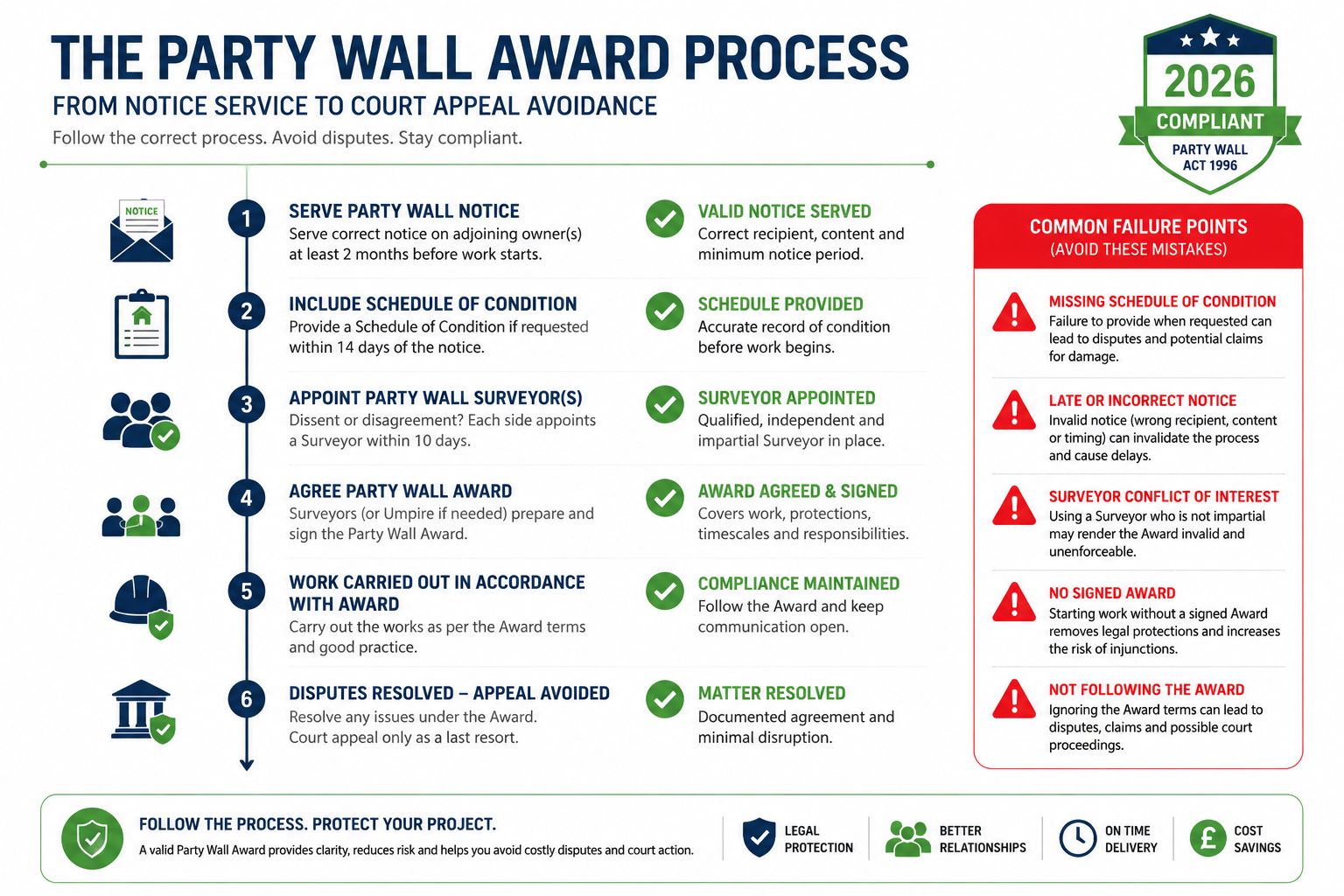
Use this checklist before any Party Wall Award is finalised and served.
📋 Notice Validity
- Correct notice type identified for the works proposed
- Notice served on all qualifying adjoining owners
- Statutory notice period observed (2 months or 1 month as applicable)
- Works described with sufficient detail
- Notice served by or on behalf of the building owner
📋 Response Period
- Full 14-day response window elapsed before any appointment made
- Response (or non-response) documented in writing
📋 Surveyor Appointment
- Appointed surveyor has no conflict of interest
- Appointment made in writing
- Third Surveyor selected at time of appointment (not after dispute)
- Agreed Surveyor confirmed as independent of both parties
📋 Award Content
- Schedule of Condition prepared and signed before works commence
- Works described match the notice scope
- Hours of work, noise, and vibration conditions included
- Compensation and insurance provisions addressed
- Award served on all parties
For a comprehensive look at what a properly structured Award document contains, the Party Wall Awards guide and the party wall contract template guide are essential reading.
Conclusion: Actionable Next Steps for Building Owners and Surveyors
Party wall law rewards those who get the process right from the start. The cost of a jurisdictional error — a voided Award, a court challenge, works halted mid-project — vastly outweighs the time invested in proper pre-award verification.
Here are the immediate actions to take in 2026:
-
Audit every notice before appointment — use the checklist above and verify notice type, recipients, and timeframes before a surveyor is engaged.
-
Appoint independent surveyors only — confirm in writing that the appointed surveyor has no existing relationship with the building owner's design or construction team.
-
Commission a Schedule of Condition early — this should be the first task after appointment, not an afterthought.
-
Select the Third Surveyor at appointment — do not wait for a dispute to arise.
-
Seek professional guidance if in doubt — the cost of a properly qualified party wall surveyor is minimal compared to the cost of County Court proceedings.
Whether carrying out works or responding to a neighbour's plans, understanding the full party wall process and associated costs ensures that every party is protected and that the Award, when made, is built on solid legal ground.
References
[1] 2026 Diy Party Wall Notice Validity Tips – https://www.simplesurvey.co.uk/uncategorised/2026-diy-party-wall-notice-validity-tips/
[2] What Makes A Party Wall Notice Valid – https://www.houricanassociates.com/party-wall-news/what-makes-a-party-wall-notice-valid/
[3] Party Wall Dispute – https://onlinearchitecturalservices.com/party-wall-dispute/
[4] Difference Between Party Wall Notices And Awards – https://www.partywallslimited.com/blog/difference-between-party-wall-notices-and-awards
[5] Party Wall Agreement – https://hoa.org.uk/advice/guides-for-homeowners/i-am-improving/party-wall-agreement/
[6] Understanding Party Wall Act What Homeowners Need Know Before Renovating – https://www.partywallslimited.com/blog/understanding-party-wall-act-what-homeowners-need-know-before-renovating
[7] Party Wall Surveys And Neighbour Disputes During 2026s Construction Uptick Rics Compliance Framework – https://nottinghillsurveyors.com/blog/party-wall-surveys-and-neighbour-disputes-during-2026s-construction-uptick-rics-compliance-framework
