

Nearly one in three party wall disputes in England and Wales stems not from genuine disagreement between neighbours, but from a notice that was incorrectly drafted or served too late. That single administrative error can stall a loft conversion, basement dig, or extension by months — and cost thousands in surveyor fees that could have been avoided entirely.
This guide covers everything needed to use Free Party Wall Notice Templates for 2026: Customizable Forms, Service Rules, and Surveyor Validation to Avoid Delays — from choosing the right template type and filling it in correctly, to serving it lawfully and knowing when a professional surveyor must step in.

Key Takeaways 📋
- Three distinct notice types exist under the Party Wall etc. Act 1996 — using the wrong one invalidates the process entirely.
- Free customizable templates are widely available online, but they must include specific mandatory fields to be legally valid. [1][6]
- Notice periods are strictly defined by law — typically one or two months depending on work type — and cannot be shortened by mutual verbal agreement.
- Surveyor validation is strongly recommended before service; errors discovered after the fact can trigger a dispute process automatically.
- Neighbours who receive a notice have 14 days to respond in writing; silence is treated as dissent, not consent.
Understanding the Party Wall etc. Act 1996: The Legal Foundation
Before downloading any template, it helps to understand why these forms exist. The Party Wall etc. Act 1996 creates a statutory framework that governs three categories of work:
- Work on an existing party wall or structure (e.g., cutting in beams, raising the wall, underpinning)
- New building at or astride the boundary line (line of junction works)
- Excavation within 3 or 6 metres of a neighbouring building depending on foundation depth
Each category requires a different notice type, served within a specific timeframe. Serving the wrong notice — or serving it too late — does not just create a paperwork problem. It can expose the building owner to an injunction that halts construction entirely.
💡 Pull Quote: "The Act is not optional. If your planned work falls within its scope, serving a valid notice is a legal obligation — not a courtesy."
For a detailed breakdown of what triggers the Act and what does not, the guide on party wall notices — what they are and how to respond provides clear, plain-English explanations.
The Three Notice Types: Which Template Do You Need?
1. 🏗️ Party Structure Notice
Used when carrying out work directly to a shared wall or structure. This includes:
- Cutting into a party wall to insert steel beams
- Raising or underpinning a party wall
- Demolishing and rebuilding a party wall
Notice period required: Two calendar months before work starts.
For full guidance on this specific notice type, see the detailed resource on what a party structure notice is and how to serve it in London.
2. 📐 Line of Junction Notice
Used when building a new wall at or astride the boundary line between two properties. Common for garden walls, new extensions built up to the boundary, and outbuildings.
Notice period required: One calendar month before work starts.
3. 🔩 Three Metre / Six Metre Notice (Excavation Notice)
Used when excavating within 3 metres of a neighbouring structure to a depth lower than its foundations, or within 6 metres if the excavation falls within a 45-degree line drawn from the base of the neighbour's foundations.
Notice period required: One calendar month before work starts.
Quick Reference Table: Notice Types at a Glance
| Notice Type | Trigger | Notice Period | Typical Works |
|---|---|---|---|
| Party Structure Notice | Work on shared wall/structure | 2 months | Loft conversions, extensions, underpinning |
| Line of Junction Notice | New build at/astride boundary | 1 month | New walls, garden rooms |
| Excavation Notice | Dig within 3m or 6m of neighbour | 1 month | Basements, deep foundations |
Free Party Wall Notice Templates for 2026: Where to Find Customizable Forms
The good news for homeowners in 2026 is that free party wall notice templates are more accessible than ever. Several platforms offer downloadable or online-generated forms at no cost. [1][3][6]
Online Template Generators 🖥️
Automated generators are the fastest route to a compliant draft. Platforms such as Aatos ask a series of guided questions about the project and automatically populate the correct template. [4] This removes the risk of selecting the wrong notice type for the work being carried out.
Party Wall DIY offers a similar stepped process — answering questions about work type triggers the correct template automatically. [5] A paid tier (around £89) provides a more comprehensive package, but the basic template generation is accessible to homeowners who want a starting point.
Downloadable PDF and Word Templates 📄
For those who prefer to work offline, printable templates are available from resources like PrintFriendly's party wall notice template collection, which provides free customizable forms for domestic residential use. [6]
Firms like Collier Stevens also publish free notice templates, though they note that templates designed for London and the South East may need local surveyor details replaced for use in other regions. [3] Importantly, these templates come with a clear restriction: users must not charge others a fee for distributing them. [3]
For a ready-to-use starting document, the free download sample party wall agreement template in Word format is a practical resource that can be adapted for most standard residential projects.
What Every Valid Notice Must Include ✅
Regardless of which template source is used, every party wall notice must contain specific mandatory information. Missing even one field can render the notice invalid. [7]
Mandatory Fields Checklist
- ✅ Full name and address of the building owner (the person carrying out the work)
- ✅ Full name and address of the adjoining owner (the neighbour receiving the notice)
- ✅ Detailed description of the proposed works — vague descriptions like "building works" are insufficient
- ✅ Materials to be used, where relevant
- ✅ Drawings and plans showing the nature and extent of the works
- ✅ Proposed start date (confirming the notice period has been respected)
- ✅ Statement that the notice is served under the Party Wall etc. Act 1996
- ✅ Signature and date of the building owner or their authorised agent
⚠️ Critical Warning: Drawings must be included where work affects the structure of the party wall. A notice served without adequate plans is routinely challenged and can be treated as invalid.
For a deeper look at what a completed agreement looks like once both parties have responded, the party wall contract template guide on party wall awards explains the full document trail from notice to award.
Step-by-Step: How to Serve a Party Wall Notice Correctly
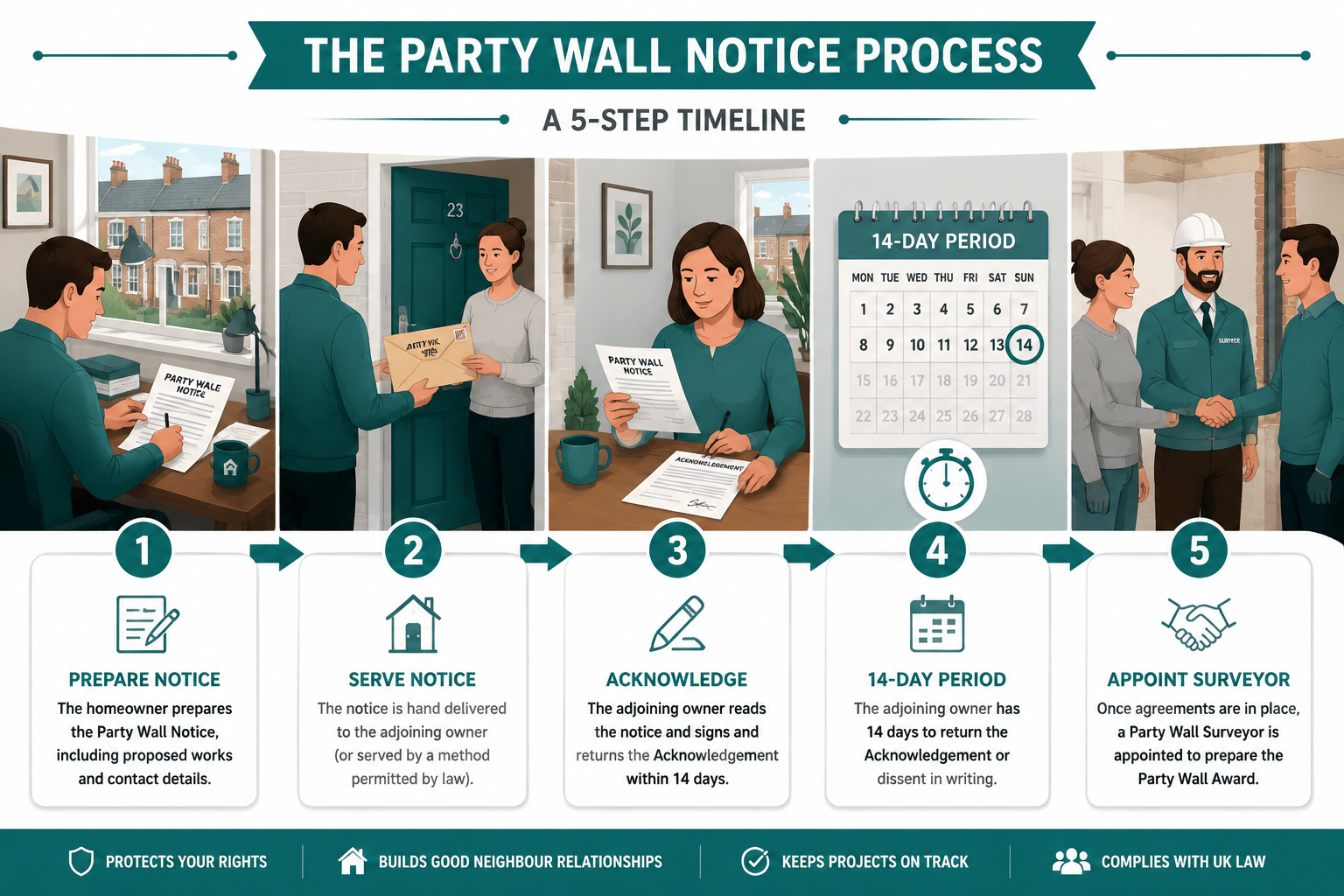
Serving a notice sounds simple, but the method of delivery matters legally. Here is the correct process for 2026:
Step 1: Identify All Adjoining Owners
An "adjoining owner" is anyone with a freehold or leasehold interest (of more than one year) in the neighbouring property. If the neighbour rents out their property, both the landlord and the tenant may need to receive a notice.
Step 2: Complete the Correct Template
Use the table above to select the right notice type. Fill in every mandatory field. Attach drawings where required.
Step 3: Choose a Valid Method of Service
Under the Act, valid service methods include:
| Method | Notes |
|---|---|
| Personal delivery | Hand the notice directly to the adjoining owner |
| Delivery to the property | Leave at the premises (not just the letterbox of a shared building) |
| Registered post | Provides proof of delivery — strongly recommended |
| First-class post | Acceptable but harder to prove receipt |
❌ Email and text message are NOT valid methods of service under the Act, regardless of any informal agreement.
Step 4: Keep Proof of Service
Retain the signed delivery receipt, postal tracking reference, or a dated photograph of personal delivery. This evidence becomes critical if a dispute arises later.
Step 5: Wait for the Response Period
The adjoining owner has 14 days to respond in writing. If they consent in writing, work can proceed (subject to any agreed conditions). If they dissent — or fail to respond — a dispute is deemed to have arisen, and surveyors must be appointed. [2]
Neighbours who receive a notice and want to respond formally can use a free party wall acknowledgement template to provide a written response. [2]
Common Pitfalls That Cause Delays ⚠️
Even well-intentioned homeowners make avoidable mistakes. The most frequent errors seen in practice include:
❌ Serving Too Late
The notice period is calculated from the date of service to the proposed start date — not from when the builder becomes available. Serving a two-month notice with only six weeks to go means the start date must be pushed back.
❌ Wrong Notice for the Work
A homeowner building an extension that involves both cutting into the party wall and excavating near the neighbour's foundations needs two separate notices — a Party Structure Notice and an Excavation Notice. One notice does not cover both triggers.
❌ Incorrect Owner Details
If the neighbouring property has recently changed hands or is owned by a company, the notice must name the current registered owner. Serving a notice on a previous owner is invalid.
❌ Inadequate Work Description
Describing works as "general building works" or "home improvements" is not sufficient. The description must be specific enough for the adjoining owner to understand what is being proposed and instruct a surveyor if needed. [7]
❌ Assuming Verbal Consent is Enough
Even if the neighbour verbally agrees to the works, this carries no legal weight under the Act. Written consent is required to avoid the dispute mechanism being triggered automatically.
When to Escalate: Surveyor Validation and Party Wall Awards

Free templates are a valuable starting point, but there are situations where professional surveyor involvement is not optional — it is essential.
When a Surveyor Must Be Appointed
- The adjoining owner dissents to the notice or fails to respond within 14 days
- The works are structurally complex (deep basements, significant underpinning, removal of load-bearing sections of a party wall)
- The adjoining property is tenanted or has multiple owners with conflicting interests
- There is any existing damage to the neighbouring property that could later be attributed to the works
In these cases, a party wall award — a legally binding document setting out the rights and responsibilities of both parties — must be prepared before work begins. [7]
The Role of Surveyor Validation
Even where both parties consent, having a qualified surveyor review the notice before service is strongly recommended. [7] A surveyor can:
- Confirm the correct notice type has been selected
- Check that the work description and drawings meet the Act's requirements
- Advise on the schedule of condition (a photographic record of the neighbouring property's pre-works state)
- Identify whether additional notices are needed for works not initially considered
💡 Pull Quote: "A surveyor reviewing a notice before service costs far less than resolving a dispute caused by an invalid one."
For those considering whether to proceed without professional help, the guide on having a party wall agreement without a surveyor sets out the risks and circumstances where DIY is — and is not — appropriate.
Finding a Surveyor in London
For London-based projects, qualified party wall surveyors are available across all areas:
- Party Wall Surveyor — Central London
- Party Wall Surveyor — South London
- Party Wall Surveyor — North London
Acknowledgement Templates: What Neighbours Need to Know
Receiving a party wall notice can feel daunting, but neighbours have clear rights under the Act. A formal written response — whether consent or dissent — must be provided within 14 days. [2]
Free acknowledgement templates allow adjoining owners to:
- Consent to the works (with or without conditions)
- Dissent and request the appointment of a surveyor
- Appoint a concurred surveyor jointly with the building owner to reduce costs
Using a formal acknowledgement template ensures the response is legally clear and avoids ambiguity that could complicate the process later. [2]
Conclusion: Actionable Next Steps for 2026
Getting party wall notices right in 2026 is entirely achievable with the right preparation. Here is a clear action plan:
- Identify your notice type using the table in this guide — Party Structure, Line of Junction, or Excavation Notice.
- Download a free customizable template from a reputable source, ensuring it covers all mandatory fields. [1][6]
- Complete the template fully — include drawings, materials, and a realistic start date that respects the statutory notice period.
- Serve the notice via a traceable method — recorded post is the safest option — and keep proof of delivery.
- Wait for the 14-day response window and follow up if no written response is received.
- Escalate to a qualified surveyor if the neighbour dissents, fails to respond, or if the works are structurally significant.
Taking these steps in order eliminates the most common causes of delay and dispute. Free party wall notice templates for 2026 provide an excellent foundation — but they work best when combined with accurate information, careful completion, and professional validation where the stakes are high.
References
[1] Party Wall Notice — https://www.template.net/edit-online/312800/party-wall-notice
[2] Free Party Wall Acknowledgement Template — https://www.houricanassociates.com/free-party-wall-acknowledgement-template/
[3] Party Wall Notice Templates — https://collier-stevens.co.uk/resources/party-wall-notice-templates/
[4] Party Wall Notice — https://aatos.app/uk/party-wall-notice/
[5] partywalldiy — https://partywalldiy.com
[6] Party Wall Notice Templates Instructions — https://www.printfriendly.com/document/party-wall-notice-templates-instructions
[7] Sample Party Wall Agreement Free Download Guidance — https://www.surveymerchant.com/blog/sample-party-wall-agreement-free-download-guidance
[8] Party Wall Agreement Template — https://www.jotform.com/pdf-templates/party-wall-agreement-template
[9] Party Wall Letter — https://www.scribd.com/document/511272774/Party-Wall-Letter