

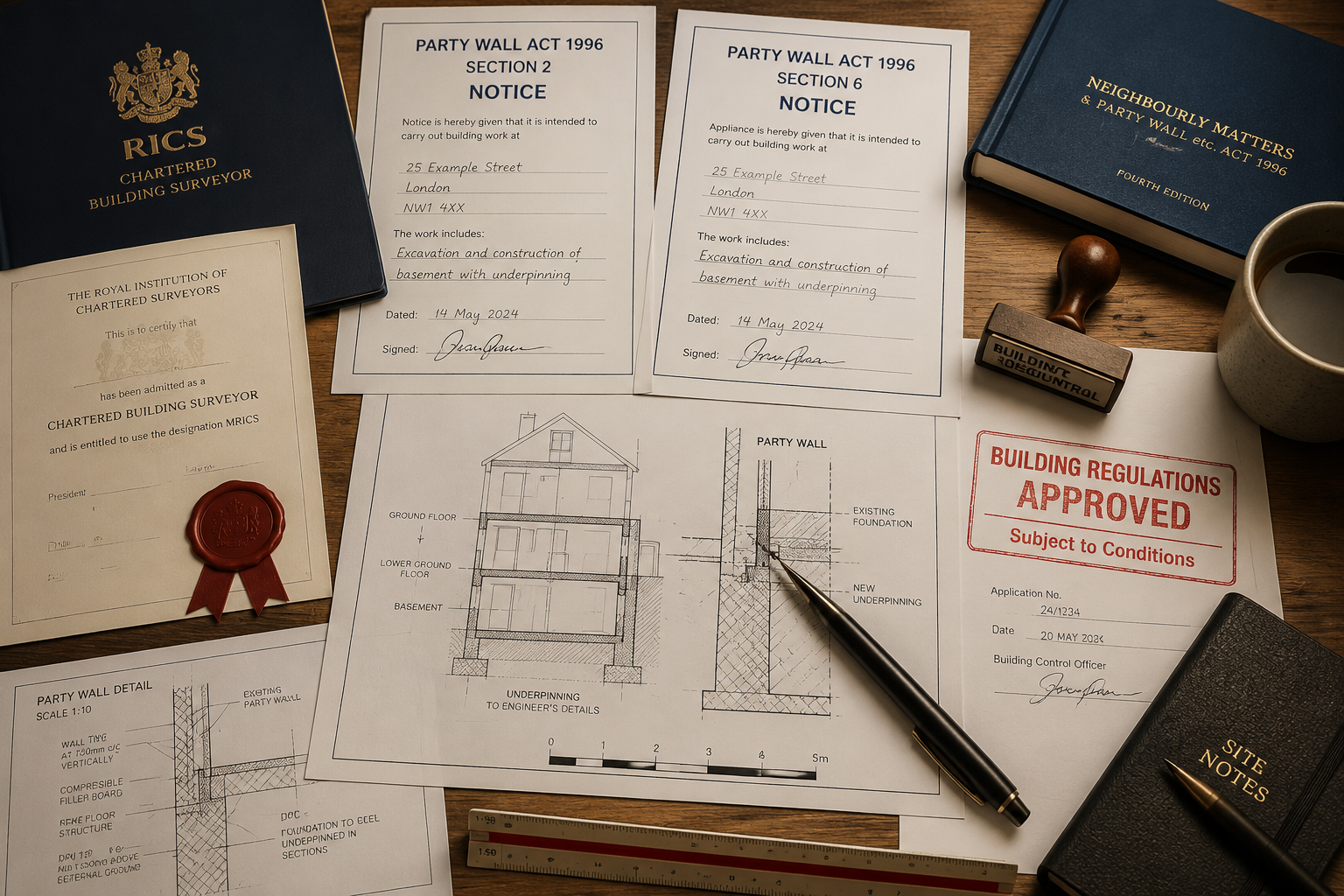
Nearly one in three residential building projects in England and Wales that require a Party Wall Award also need separate Building Regulations approval — yet a significant number of owners and even some surveyors treat these two processes as entirely independent. That disconnect causes delays, rework, and sometimes costly disputes. Understanding Party Wall Awards and Building Control: How Surveyors Should Coordinate Notices, Drawings, and Structural Sign-Off is not just good professional practice — it is the difference between a smooth build and a project that stalls at the most critical moment.
This guide cuts through the confusion. It explains where the Party Wall etc. Act 1996 ends and Building Regulations begin, how surveyors and building control officers (BCOs) should share information, and how building owners can sequence both processes to avoid expensive delays in 2026.
Key Takeaways 📋
- Two separate legal frameworks govern notifiable works near party walls — the Party Wall etc. Act 1996 and Building Regulations — and each has distinct requirements, timescales, and sign-off procedures.
- A Party Wall Award is not a substitute for Building Regulations approval, and vice versa. Both must be obtained for most structural works.
- Drawings and structural calculations must be consistent across both processes; discrepancies between party wall drawings and building control submissions are a leading cause of project delays.
- Sequencing matters: serving party wall notices before submitting a Building Regulations application is strongly recommended to prevent last-minute Award amendments.
- Surveyors who proactively communicate with building control — sharing schedules of condition, structural details, and method statements — dramatically reduce the risk of on-site disputes.
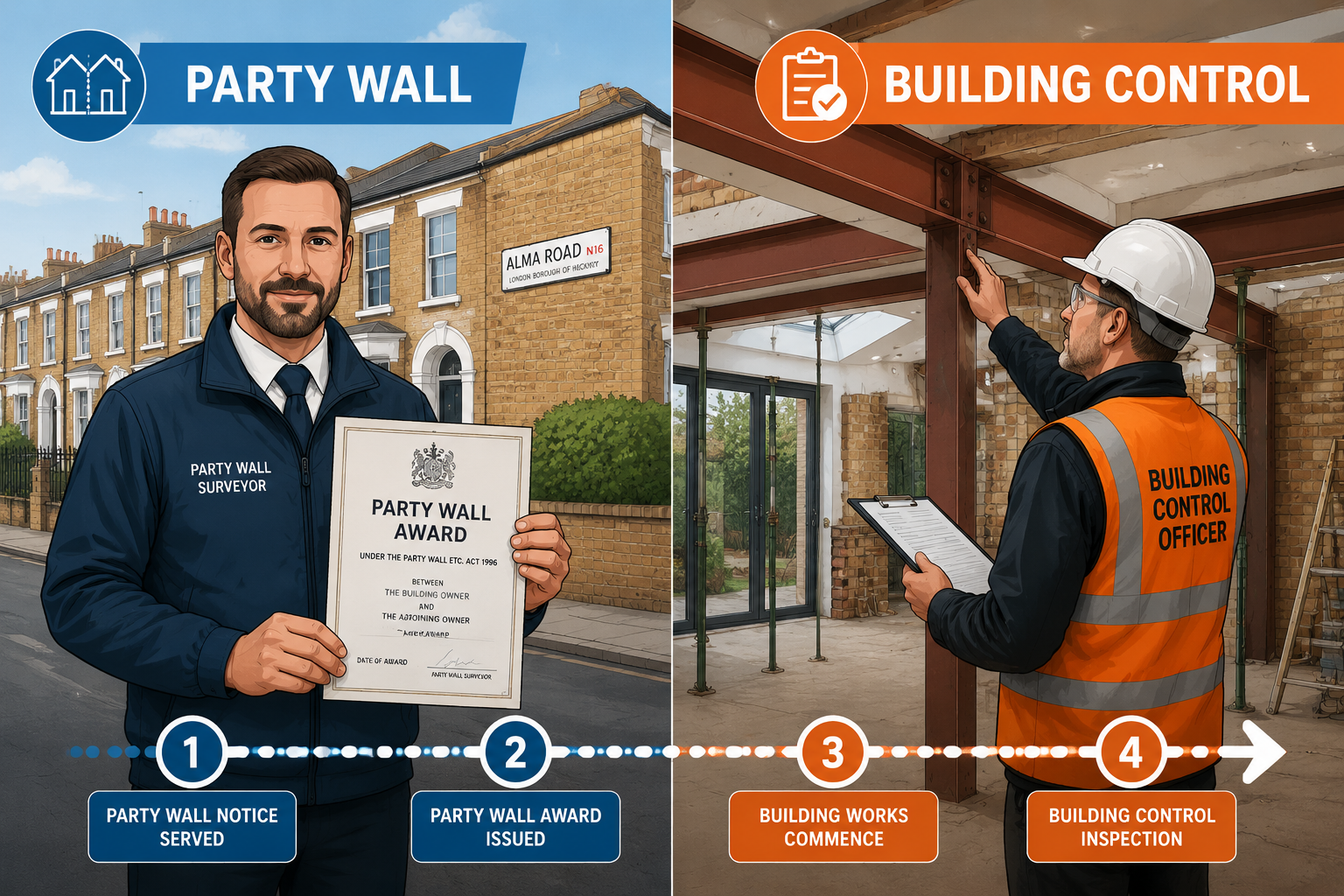
Understanding the Two Frameworks: Party Wall Act vs. Building Regulations
Before exploring coordination, it helps to be clear about what each framework actually does.
The Party Wall etc. Act 1996
The Party Wall etc. Act 1996 is a piece of civil legislation. It protects the rights of adjoining owners when a building owner proposes works that affect a shared or boundary wall, new foundations close to a neighbour's property, or excavations near adjoining structures. The Act requires the building owner to serve formal party wall notices on all affected adjoining owners before work begins.
If a neighbour dissents — or fails to respond within 14 days — the dispute resolution mechanism kicks in, resulting in a Party Wall Award. This is a legally binding document that sets out:
- The scope and method of the works
- Hours of working
- Rights of access
- Protective measures for the adjoining property
- A schedule of condition of the adjoining owner's property
The Award is drafted and agreed by surveyors appointed under the Act. It is not a planning or building control document.
Building Regulations
Building Regulations, administered by local authority building control departments or approved inspectors, are public safety legislation. They ensure that structural work is safe, energy-efficient, and compliant with national technical standards. For most structural alterations — including removing chimney breasts, installing steel beams, underpinning, or building new extensions — a Building Regulations application is mandatory.
Building control approval involves:
- Submission of drawings and structural calculations
- Inspection at key stages (foundations, damp-proof course, structural frame, etc.)
- A final completion certificate
💡 Pull Quote: "A Party Wall Award tells you how work near a shared wall will be carried out considerately. Building Regulations tell you whether that work is structurally safe. Both are essential — neither replaces the other."
Where the Two Overlap
The overlap occurs whenever notifiable works under the Party Wall Act also trigger Building Regulations. Common examples include:
| Work Type | Party Wall Act Triggered? | Building Regs Required? |
|---|---|---|
| Loft conversion cutting into party wall | ✅ Yes | ✅ Yes |
| Side-return extension with new foundations | ✅ Yes | ✅ Yes |
| Basement excavation near boundary | ✅ Yes | ✅ Yes |
| Removing chimney breast on party wall | ✅ Yes | ✅ Yes |
| Garden wall rebuild (boundary) | Sometimes | Rarely |
| Internal non-structural partition | ❌ No | ❌ No |
Party Wall Awards and Building Control: How Surveyors Should Coordinate Notices, Drawings, and Structural Sign-Off
This is where professional practice makes or breaks a project. The coordination challenge is real: party wall surveyors and building control officers operate under different legislation, answer to different clients, and work to different timescales. Yet they are often looking at the same wall, the same beam, and the same foundations.
Step 1 — Serve Notices Before Submitting to Building Control
The recommended sequence is to serve party wall notices first, or at least simultaneously with the Building Regulations application. Here is why:
- Party wall notices must be served at least two months before work starts for party structure notices, or one month for line of junction notices.
- If the Award is not agreed before building control approves the drawings, there is a risk that the structural design changes during Award negotiations — requiring an amendment to the Building Regulations submission.
- Serving notices early gives the adjoining owner's surveyor time to review the structural drawings and raise concerns before they become embedded in both the Award and the building control approval.
For a clear breakdown of notice types and how to serve them, see this guide on party wall notices and how to respond.
Step 2 — Align the Drawings Across Both Processes
One of the most common causes of delay is inconsistency between drawings. The structural engineer produces drawings for building control. The party wall surveyor attaches a different set of drawings to the Award. On site, the contractor is working from a third set. This creates confusion and, in the worst cases, a dispute about whether the actual works comply with the Award.
Best practice in 2026 requires:
- One set of structural drawings referenced in both the Party Wall Award and the Building Regulations submission, identified by the same drawing numbers and revision codes.
- The party wall surveyor should request copies of the structural engineer's calculations and drawings before finalising the Award.
- Any amendments to the structural design after the Award is made should trigger a supplemental Award — not just a building control amendment notice.
Step 3 — Include Method Statements in the Award
Building control inspectors check the finished product. Party wall surveyors protect the process. A well-drafted Party Wall Award should include a detailed method statement covering:
- Sequence of underpinning or excavation
- Temporary propping requirements
- Concrete mix specifications for new foundations
- Waterproofing details for basements
- How the new beam will be installed and what temporary support is needed
When this method statement aligns with the structural engineer's specification — which building control will also review — both processes reinforce each other rather than conflict.
Step 4 — Schedule of Condition Before Work Starts
The schedule of condition is a photographic and written record of the adjoining property's condition before work begins. Building control has no interest in this document — it is purely a party wall tool. However, it plays a critical role in protecting both parties if a dispute about damage arises during the build.
Surveyors should ensure the schedule of condition is completed after building control has approved the drawings but before the contractor mobilises on site.
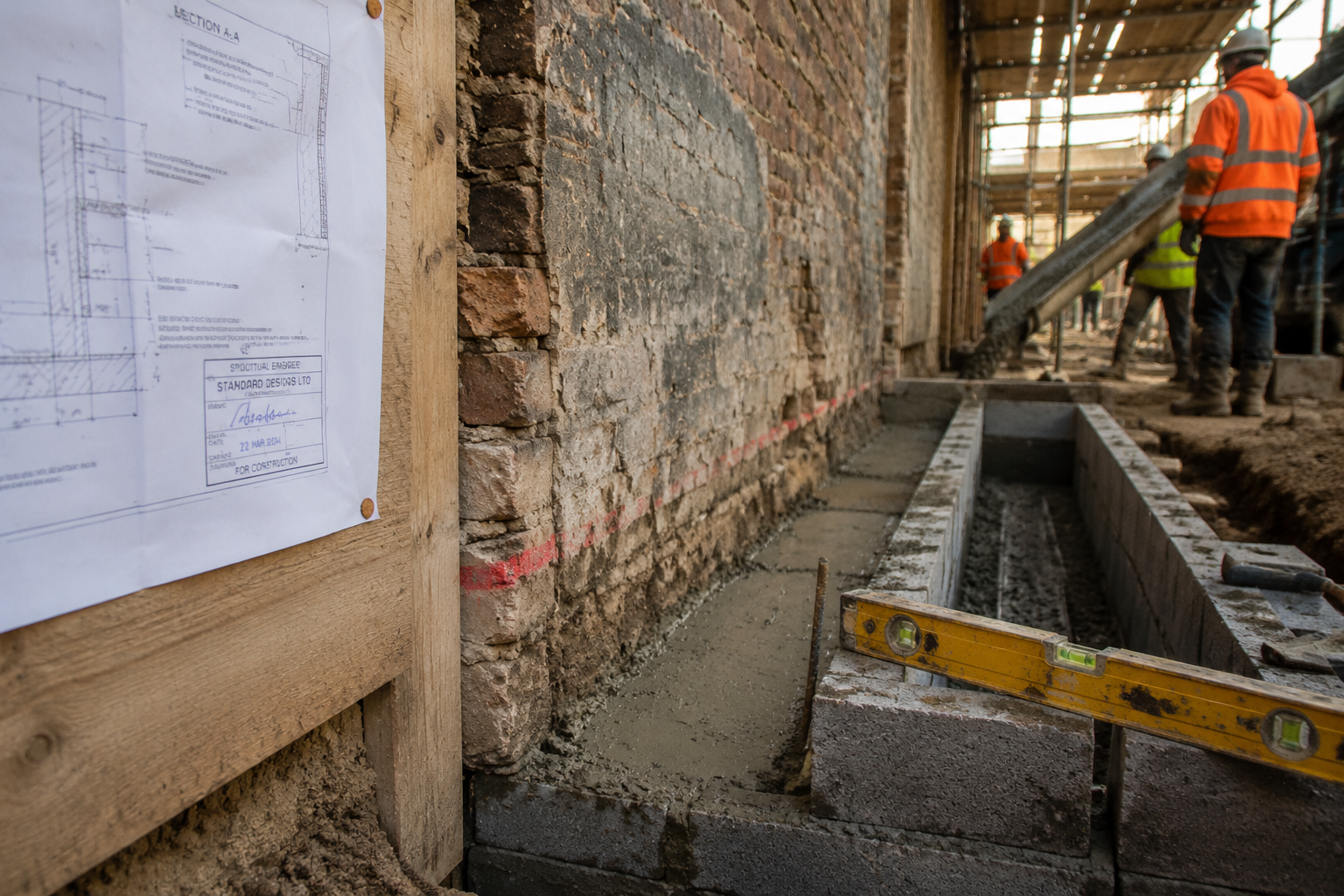
Practical Coordination: What Surveyors Should Do at Each Stage
Understanding the theory is one thing. Applying it on a live project is another. Below is a practical stage-by-stage guide for surveyors managing the overlap between party wall compliance and building control.
Pre-Application Stage
- Advise the building owner to engage a structural engineer early — ideally before notices are served — so that structural drawings are available for the adjoining owner's surveyor to review.
- Confirm which works trigger the Party Wall Act and which trigger Building Regulations. Some works trigger one but not the other.
- Check whether the local authority building control department has any specific requirements for works near party walls (some do).
For building owners who are new to this process, the building owners' guide provides a clear overview of responsibilities.
During Award Negotiations
- Request the structural engineer's drawings and calculations. Do not finalise the Award without them.
- Confirm that the drawings attached to the Award match those submitted to building control — same drawing numbers, same revision.
- Agree the method statement with the structural engineer, not just the building owner.
- If the adjoining owner appoints their own surveyor, ensure that surveyor also receives the structural drawings. An adjoining owner's surveyor has the right to scrutinise the structural design as it affects the shared wall.
During Construction
- Attend site at key stages — particularly when foundations are being poured, beams are being installed, or the party wall is being cut into.
- Communicate with the building control inspector. If the BCO raises a concern about the structural works, the party wall surveyor should be informed — especially if the concern relates to the party wall or adjoining structure.
- If the works deviate from the Award, act promptly. A supplemental Award may be needed before work continues.
Post-Completion
- Obtain a copy of the building control completion certificate and retain it on file.
- Confirm that all protective works specified in the Award have been removed or made good.
- Issue any final correspondence confirming the works are complete and the Award obligations have been discharged.
Common Mistakes That Cause Delays ⚠️
Even experienced professionals make avoidable errors when managing the overlap between party wall compliance and building control. The most frequent include:
- Starting building control applications before notices are served — this can result in approved drawings that then need to change following Award negotiations.
- Attaching outline or planning drawings to the Award instead of the final structural drawings — these are rarely detailed enough to protect either party.
- Failing to serve a party structure notice for works that clearly affect the party wall — building control approval does not excuse this omission.
- Not updating the Award when the structural design changes after the Award is made.
- Assuming the building control inspector will flag party wall issues — BCOs have no duty to enforce the Party Wall Act.
Party Wall Awards and Building Control: How Surveyors Should Coordinate Notices, Drawings, and Structural Sign-Off in Complex Projects
For larger or more complex projects — basements, multi-storey extensions, or works affecting multiple adjoining owners — the coordination challenge intensifies. Here are additional considerations for 2026.
Multiple Adjoining Owners
Where works affect more than one adjoining property, separate Awards are typically made with each adjoining owner. Each Award should reference the same set of structural drawings but may have different protective measures depending on the proximity and condition of each adjoining property.
Basement and Underpinning Works
Basement excavations are among the most technically demanding party wall scenarios. They almost always require:
- A party wall notice served under Section 6 of the Act (excavation within 3 or 6 metres of the adjoining structure)
- A Building Regulations application including structural calculations for the retaining walls, waterproofing system, and any underpinning
- An engineer's monitoring scheme — which should be referenced in both the Award and the building control submission
Structural Openings in Party Walls
Creating a new opening in a party wall — for example, to connect a new extension to the main house — requires a party structure notice and is notifiable under Building Regulations. The structural engineer must design the lintel or steel frame to satisfy both the party wall surveyor and the BCO. Coordination here is non-negotiable.
How Building Owners Can Avoid Delays
Building owners often bear the cost of delays caused by poor coordination between party wall and building control processes. Here is what owners can do to protect themselves:
- Appoint a building owner's surveyor early — ideally at the design stage, not after planning permission is granted. See the building owner's surveyor page for more on this role.
- Brief the structural engineer and party wall surveyor together — a single meeting at the start of a project can prevent weeks of delays later.
- Do not instruct the contractor to start until both the Party Wall Award is in place and building control has approved the drawings.
- Budget for a supplemental Award if the design changes — this is a normal part of complex projects, not a failure.
- Understand the costs involved — the party wall process costs guide explains what fees to expect at each stage.
Conclusion: Coordination Is Not Optional
The relationship between Party Wall Awards and Building Control is one of the most misunderstood aspects of residential construction in England and Wales. These two frameworks were designed independently, but they converge on the same physical structure — the party wall — and the same moment in time — the construction phase.
Surveyors who treat coordination as an afterthought create risk for their clients, for adjoining owners, and for themselves. Those who embed coordination into their process from day one — aligning drawings, sequencing notices correctly, communicating with building control, and drafting Awards that reflect the structural reality of the project — deliver better outcomes for everyone.
Actionable Next Steps ✅
- Serve party wall notices as soon as the structural design is sufficiently developed — do not wait for planning permission to be granted.
- Request structural drawings from the engineer before finalising any Party Wall Award.
- Cross-reference drawing numbers between the Award and the building control submission to ensure consistency.
- Attend key construction stages to verify compliance with both the Award and the approved drawings.
- Communicate proactively with the building control officer, especially on basement and underpinning projects.
- Obtain a completion certificate and retain it alongside the Award documentation.
For professional guidance tailored to your specific project, contact a qualified party wall surveyor who understands both the legal and technical dimensions of this coordination challenge.