


Fewer than one in three adjoining owners fully understand their legal rights within the first 14 days after receiving a party wall notice — yet those two weeks can determine whether a building project runs smoothly or descends into costly disputes. Understanding what happens after a party wall notice is served in 2026: consent, dissent, silence, and the surveyor timeline is essential for both building owners and their neighbours before a single brick is moved.
This step-by-step guide walks through every stage of the process — from the moment a notice lands on a doorstep to the point where work can legally begin — so both sides know exactly what to expect and when.
Key Takeaways 📋
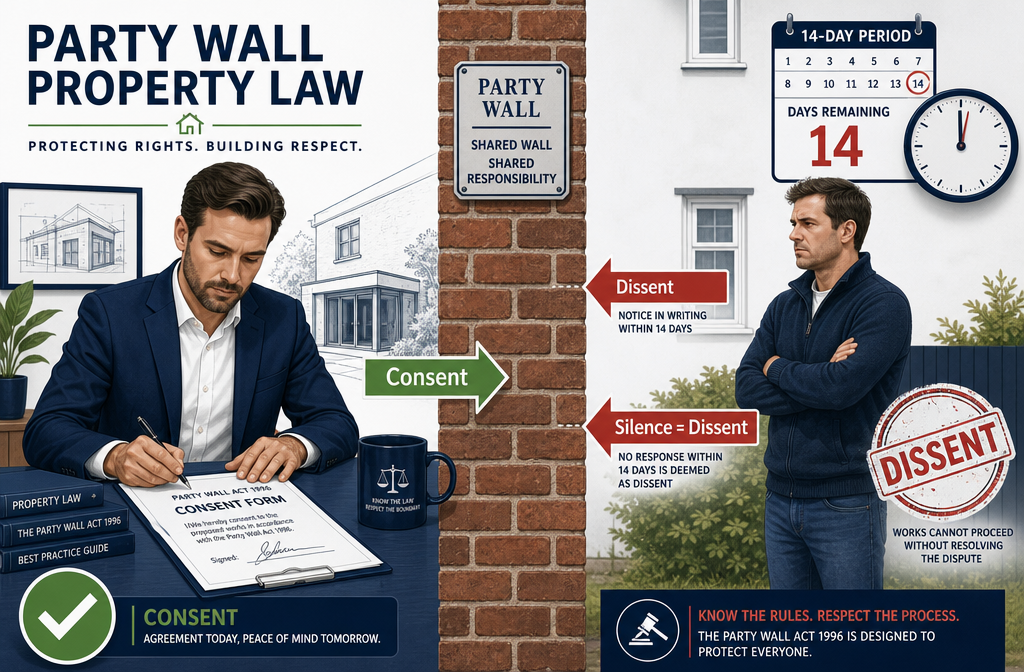
- Silence is legally treated as dissent — if a neighbour does not respond within 14 days, a dispute is automatically deemed to have arisen.
- Consent means work can proceed — but only after the correct notice period has elapsed (usually 1 or 2 months depending on notice type).
- Dissent triggers the surveyor appointment process, which must be completed before any notifiable works begin.
- A Party Wall Award is the formal document that governs how and when works are carried out — it protects both parties.
- Timing matters enormously — delays in responding or appointing surveyors can push back project start dates by weeks or months.
The Moment a Notice Is Served: What the Clock Starts
A party wall notice is a formal legal document served under the Party Wall etc. Act 1996. The moment it is delivered to an adjoining owner, a strict statutory timetable begins. There are three main types of notice:
| Notice Type | Trigger | Response Period |
|---|---|---|
| Party Structure Notice | Works to an existing party wall or structure | 2 months before works begin |
| Line of Junction Notice | Building a new wall at or astride the boundary | 1 month before works begin |
| Three Metre / Six Metre Notice | Excavations near a neighbour's foundations | 1 month before works begin |
Once served, the adjoining owner has 14 days to respond. That response — or lack of it — sets the entire process in motion.
💡 Pull Quote: "The 14-day response window is not a courtesy period — it is a statutory deadline with real legal consequences."
For a deeper understanding of the different notice types and how they are properly served, the guide to party wall act notices and how to respond provides a thorough breakdown.
Three Possible Responses: Consent, Dissent, and Silence
✅ Response 1: Consent
If the adjoining owner agrees to the proposed works, they sign and return a consent form within the 14-day window. This is the simplest outcome.
What consent means in practice:
- No surveyors need to be appointed (unless the parties choose to do so voluntarily)
- No Party Wall Award is required
- Work can proceed once the statutory notice period expires (1 or 2 months depending on notice type)
- The building owner must still carry out works in accordance with the Act
However, consent does not mean the adjoining owner gives up all rights. They can still hold the building owner liable for any damage caused during works. A schedule of condition — a photographic and written record of the adjoining property's condition before works begin — is strongly recommended even when consent is given. It protects both parties if a damage claim arises later.
❌ Response 2: Dissent
If the adjoining owner disagrees with the proposed works, they serve a counter-notice expressing dissent. This triggers the formal dispute resolution process under the Act.
What happens next after dissent:
- Both parties must appoint surveyors
- The surveyors agree on the terms under which works will be carried out
- A Party Wall Award is produced
- Works cannot begin until the Award is in place
Dissent does not mean the works cannot happen — it simply means they must be properly governed. The Act exists to protect both sides, not to block legitimate construction.
🔇 Response 3: Silence (The Most Misunderstood Outcome)
This is where many property owners are caught off guard. If an adjoining owner does not respond within 14 days, the law treats this as dissent. A dispute is automatically deemed to have arisen under Section 10 of the Party Wall etc. Act 1996.
This means:
- The building owner cannot proceed with works just because no reply was received
- The surveyor appointment process is triggered automatically
- Ignoring a notice does not make the problem go away — it simply delays the project and may expose the building owner to legal risk
⚠️ Important: Serving a notice and then starting work without waiting for a response — or assuming silence means approval — is one of the most common and costly mistakes in party wall matters.
What Happens After a Party Wall Notice Is Served in 2026: The Surveyor Appointment Process
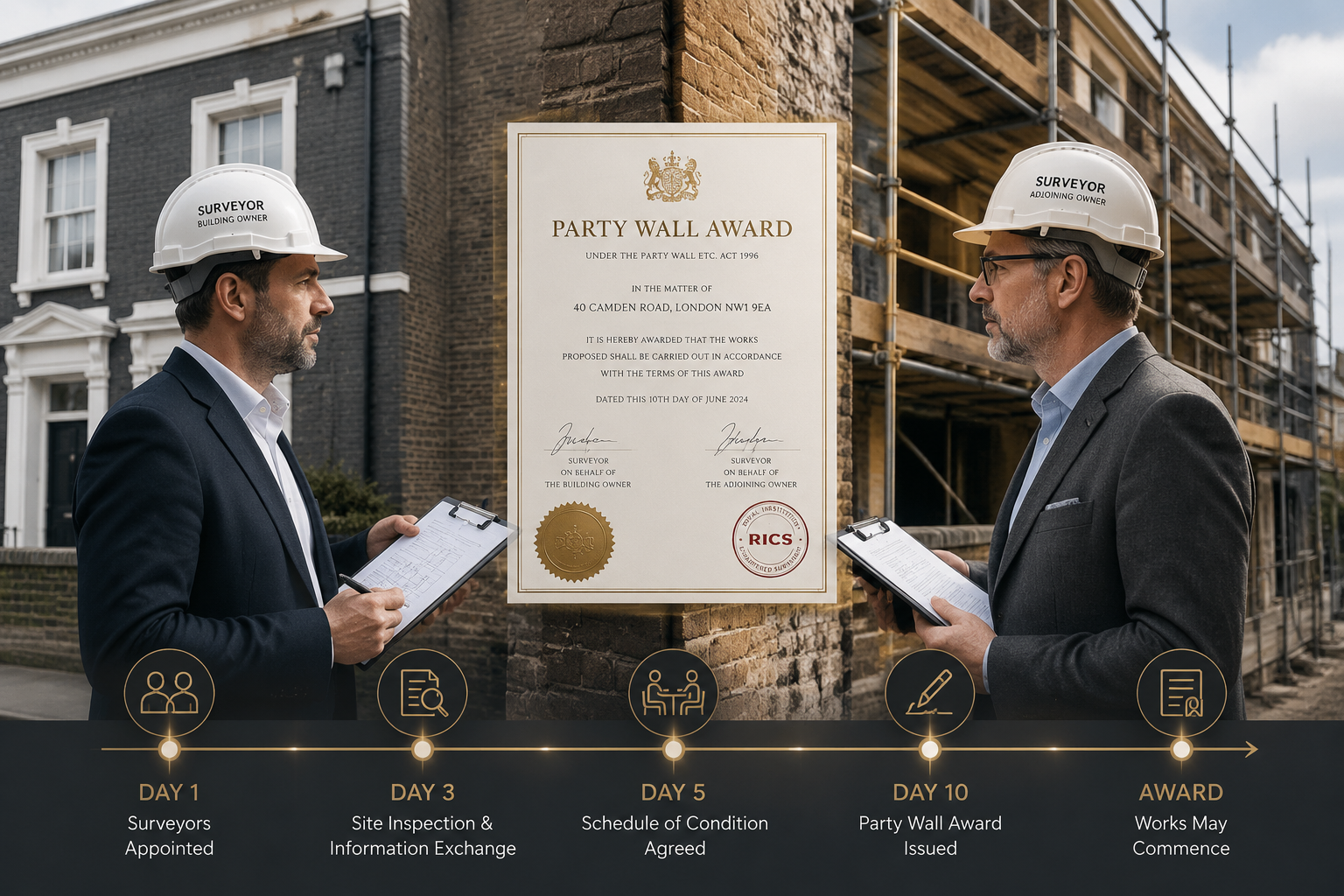
Once dissent (or deemed dissent through silence) is established, the surveyor appointment process begins. Understanding this stage is critical to project programming.
Appointing Surveyors: Three Options
The Act provides three surveyor appointment models:
| Model | Description | Best For |
|---|---|---|
| Agreed Surveyor | Both parties appoint the same single surveyor | Amicable situations, cost efficiency |
| Two Surveyors | Each party appoints their own surveyor | Situations with potential conflict |
| Third Surveyor | Selected by the two appointed surveyors as a referee | Used only when the two surveyors cannot agree |
The building owner's surveyor is appointed by the building owner. The adjoining owner's surveyor is appointed by the adjoining owner — not by the building owner, even if the building owner is paying the fees.
For guidance on what an adjoining owner's surveyor does and how they protect the adjoining owner's interests, it is worth reviewing the role in detail before making an appointment.
The 10-Day Rule for Surveyor Appointment
If an adjoining owner fails to appoint their own surveyor within 10 days of being asked to do so by the building owner, the building owner's surveyor may make the appointment on their behalf. This is an important safeguard that prevents the process from stalling indefinitely.
The Schedule of Condition: Protecting Both Parties
Before any notifiable works begin, surveyors will typically carry out a Schedule of Condition — a detailed record of the adjoining property's current state. This includes:
- Photographs of walls, ceilings, floors, and any existing cracks
- Written descriptions of defects already present
- Notes on garden structures, boundary features, and outbuildings
This document becomes the benchmark against which any post-works damage claims are assessed. Without it, disputes about whether a crack existed before or was caused by construction become very difficult to resolve fairly.
The Party Wall Award: What It Contains and Why It Matters
The Party Wall Award (sometimes called a Party Wall Agreement) is the formal written document produced by the appointed surveyor(s). It is legally binding on both parties and governs the entire works programme.
A typical Award will include:
- 📋 The works permitted — a precise description of what the building owner may do
- 🕐 Working hours — usually Monday to Friday, 8am–5pm or 6pm, no weekends
- 🔒 Access rights — when and how the building owner's contractors may access the adjoining property
- 📸 The Schedule of Condition — attached as an appendix
- 💷 Costs — who pays the surveyor fees (usually the building owner)
- 🛡️ Security for expenses — in some cases, the building owner must deposit funds as security
For a full explanation of what a party wall award contains and how it is structured, reviewing the detailed guidance is highly recommended before the Award is drafted.
💡 Pull Quote: "The Party Wall Award is not a bureaucratic hurdle — it is the document that keeps a construction project legally protected from start to finish."
How Timing Affects Project Programming
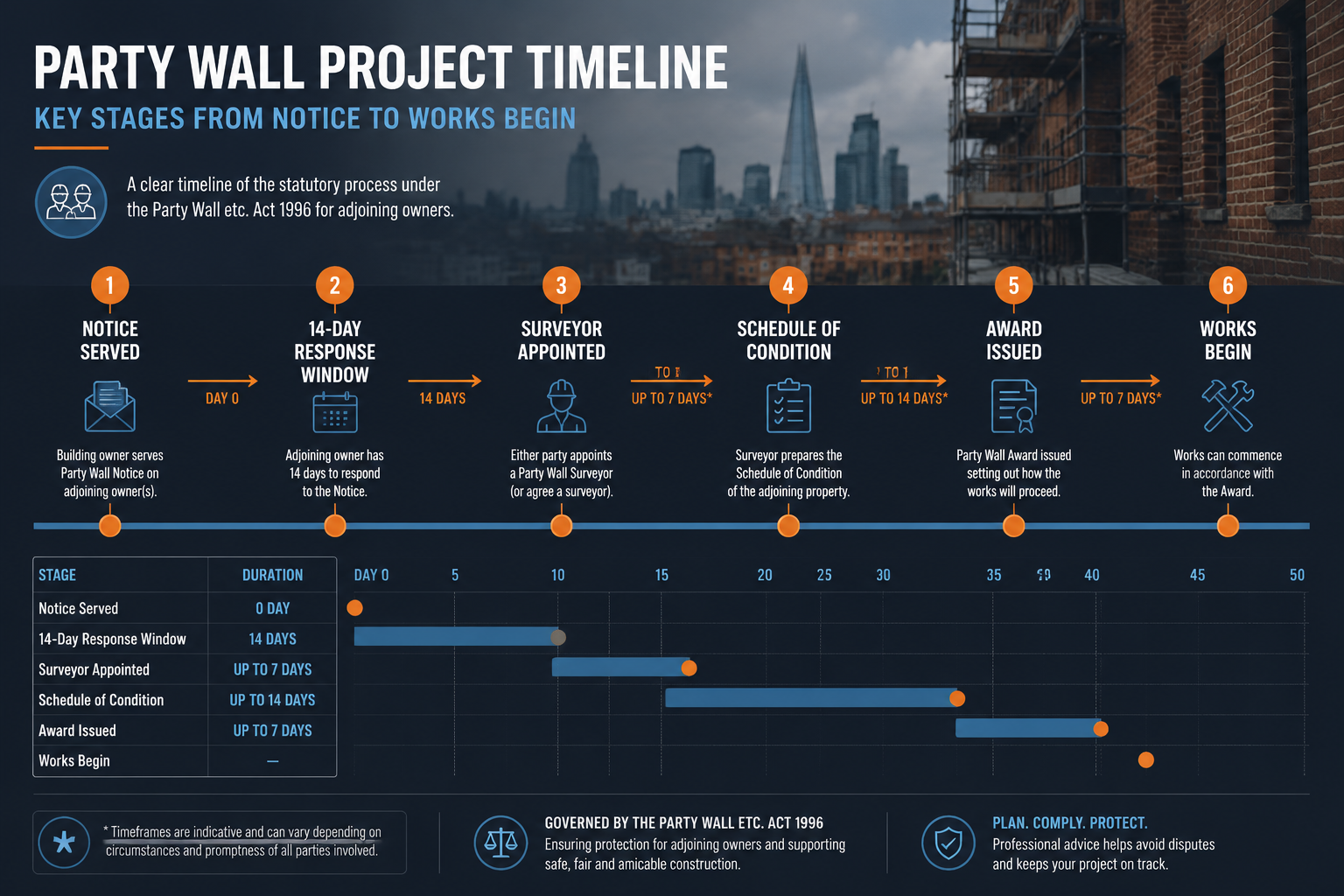
One of the most practical — and often overlooked — aspects of what happens after a party wall notice is served in 2026 is how the statutory timeline interacts with a building project's programme.
Realistic Timeline: From Notice to Works Starting
Day 1:        Notice served on adjoining owner
Day 1–14:     Adjoining owner's response window
Day 15:       If no response, deemed dissent triggered
Day 15–25:    Surveyor appointment process
Day 25–60+:   Surveyors prepare Schedule of Condition and draft Award
Day 60–90+:   Award issued — works can legally begin
⚠️ Key point for project managers: Even in the most straightforward cases, the period from notice service to Award can take 6 to 10 weeks. In complex cases involving multiple adjoining owners or disputed works, it can take significantly longer.
What Can Delay the Timeline?
Several factors can push back the Award date:
- Late surveyor appointment — adjoining owner delays choosing their surveyor
- Access disputes — difficulty arranging the Schedule of Condition inspection
- Complex works — structural engineers' drawings required before Award can be finalised
- Multiple adjoining owners — each must be served separately and may respond differently
- Counter-notices — adjoining owners can serve counter-notices requesting modifications
Building owners planning extensions, loft conversions, or basement works should factor these timelines into their project programme from the outset. For those carrying out works, the guidance for building owners provides a clear overview of responsibilities and timelines.
What Adjoining Owners Should Expect at Each Stage
For neighbours who have received a notice, the process can feel overwhelming. Here is what to expect at each stage:
Stage 1: Receiving the Notice
- Read it carefully and check it is valid (correct form, correct notice period, correct description of works)
- Decide whether to consent or dissent
- Seek advice from a qualified party wall surveyor if unsure
Stage 2: Appointing a Surveyor (if dissenting)
- The adjoining owner has the right to appoint their own surveyor, independent of the building owner
- The building owner typically pays the reasonable costs of the adjoining owner's surveyor
- The surveyor acts in a quasi-judicial capacity — they are not an advocate, but an impartial professional
Stage 3: The Schedule of Condition Visit
- A surveyor will visit the adjoining property to record its current condition
- This is in the adjoining owner's interest — it protects them if damage occurs
Stage 4: Reviewing and Signing the Award
- The adjoining owner's surveyor reviews the draft Award on their behalf
- Either party can appeal an Award to the County Court within 14 days of service
For adjoining owners who want to understand their rights in full, the adjoining owners' guidance page is an excellent starting point.
Can Works Proceed Without an Award?
Only in one scenario: where the adjoining owner has given written consent within the 14-day window. In all other cases — dissent or silence — works cannot lawfully begin until a Party Wall Award is in place.
Starting works without an Award when one is required is a serious legal risk. The adjoining owner can apply to the courts for an injunction to stop the works. This is far more expensive and disruptive than following the proper process from the start.
It is also worth noting that a party wall agreement without a surveyor is only possible in genuine consent situations — and even then, the parties must understand what they are agreeing to.
Costs: Who Pays for What?
In the majority of cases, the building owner pays the surveyor fees for both sides. This reflects the fact that the building owner is the one initiating the works that make the process necessary.
However, costs can become more complex when:
- The adjoining owner appoints an unreasonably expensive surveyor
- The adjoining owner's demands go beyond what the Act requires
- There is a counter-notice from the adjoining owner
For a detailed breakdown of party wall costs and the process, including what is and is not recoverable, reviewing the costs guidance before appointing a surveyor is advisable.
Conclusion: Actionable Next Steps for 2026
Understanding what happens after a party wall notice is served in 2026: consent, dissent, silence, and the surveyor timeline is not just a legal exercise — it is essential project management for anyone involved in property development or renovation near a shared boundary.
Actionable Next Steps ✅
If you are a building owner:
- Serve notices as early as possible — ideally 2–3 months before the planned start date
- Do not assume silence means consent — follow up and be prepared for the surveyor process
- Budget for surveyor fees on both sides from the outset
- Appoint an experienced building owner's surveyor to manage the process efficiently
If you are an adjoining owner:
- Respond within 14 days — even if just to say you need more time to consider
- Appoint your own independent surveyor if dissenting — do not rely on the building owner's surveyor to protect your interests
- Ensure a Schedule of Condition is carried out before works begin
- Keep records of all correspondence and the Award document
The Party Wall etc. Act 1996 exists to protect both sides. When followed correctly, it allows construction to proceed fairly, with clear rules that reduce the risk of neighbour disputes and costly legal action. The key is understanding the process before the clock starts — not after.