

Roughly one in three party wall disputes escalates beyond a simple notice exchange — yet many building owners and their neighbours still assume that appointing a single agreed surveyor is always the safest, cheapest, and friendliest way to handle the process. That assumption can be costly. The question of do you always need two surveyors? When the agreed surveyor route is appropriate and when it backfires is one of the most misunderstood aspects of the Party Wall etc. Act 1996, and getting it wrong can expose both parties to financial loss, legal delays, and damaged neighbourly relations.
This article cuts through the confusion. It explains exactly how the agreed surveyor model works, the specific scenarios where it genuinely serves both parties well, and — critically — the situations where appointing separate surveyors is the smarter, lower-risk choice.
Key Takeaways 📌
- The Party Wall etc. Act 1996 permits an agreed surveyor but does not require one — both parties always have the right to appoint separately.
- An agreed surveyor works best when the relationship between neighbours is cooperative and the proposed works are straightforward.
- Conflicts of interest, complex structural works, and pre-existing disputes are strong signals to appoint separate surveyors.
- Separate appointments provide an independent check-and-balance that an agreed surveyor structurally cannot offer.
- Cost savings from using one surveyor can be illusory if a dispute later requires the appointment to be unwound.
How the Agreed Surveyor Model Actually Works
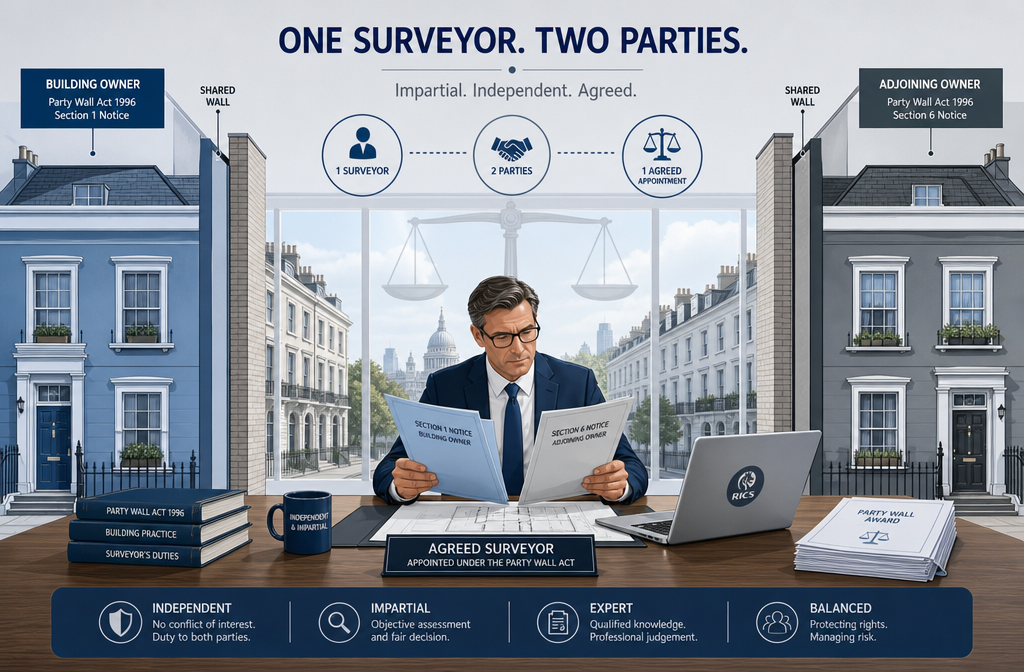
Under Section 10 of the Party Wall etc. Act 1996, when a building owner serves a party wall notice and the adjoining owner dissents, both parties must appoint surveyors. The Act offers three options:
| Option | Description |
|---|---|
| Agreed Surveyor | Both parties jointly appoint one impartial surveyor |
| Separate Surveyors | Each party appoints their own surveyor |
| Third Surveyor | A third surveyor is selected in advance to resolve any disagreement between two separate surveyors |
The agreed surveyor acts for both parties simultaneously. That surveyor's duty is to the Act itself — not to either individual. This is a subtle but crucial distinction. The surveyor is not the building owner's advocate, nor the adjoining owner's protector. Their job is to produce a fair party wall award that protects both parties' legitimate interests.
💬 Pull Quote: "An agreed surveyor serves the Act, not the parties. Understanding that distinction is the foundation of every sensible decision about whether to appoint jointly or separately."
The Appeal of One Surveyor
The agreed surveyor route is genuinely attractive for several practical reasons:
- ✅ Lower overall cost — one set of fees instead of two
- ✅ Faster process — no need for two surveyors to correspond and negotiate
- ✅ Simpler administration — one point of contact for both parties
- ✅ Less adversarial tone — signals goodwill between neighbours
For straightforward projects, these advantages are real. But they come with conditions.
When the Agreed Surveyor Route Is Appropriate
Not every party wall situation carries the same level of risk. There are clear scenarios where a single agreed surveyor is a sensible and efficient choice.
1. Simple, Low-Impact Works
Minor works — such as a small loft conversion, a single-storey rear extension, or minor repairs to a shared wall — carry limited structural risk to the adjoining property. When the types of party wall works involved are well-defined and unlikely to cause significant disruption, the agreed surveyor model can handle the process efficiently.
2. Genuinely Cooperative Neighbours
When both parties have a positive relationship, trust each other's intentions, and simply need the legal formalities completed, one surveyor can serve both parties without tension. The key word here is genuinely. Superficially polite relationships that mask underlying concerns are a different matter entirely.
3. Both Parties Understand the Process
An agreed surveyor appointment works best when both the building owner and the adjoining owner understand what the surveyor's role is — and is not. If the adjoining owner mistakenly believes the agreed surveyor is "their" representative, misunderstandings are almost inevitable. Understanding the costs and process of party wall matters beforehand helps set realistic expectations.
4. No Pre-Existing Property Concerns
If the adjoining property has no known structural vulnerabilities, no history of subsidence, no recent renovation work, and no sensitive features close to the boundary, the risk profile is lower. A schedule of condition can still be prepared by the agreed surveyor to document the property's state before works begin — and this remains important even in low-risk cases.
5. The Agreed Surveyor Is Truly Independent
The agreed surveyor must have no prior relationship with either party that could compromise impartiality. If the building owner's architect recommends a surveyor they regularly work with, the adjoining owner should ask questions. True independence is non-negotiable.

When the Agreed Surveyor Route Backfires — and Separate Appointments Are Smarter
This is where the question of do you always need two surveyors? When the agreed surveyor route is appropriate and when it backfires becomes genuinely critical. There are specific, identifiable scenarios where the agreed surveyor model creates more risk than it resolves.
1. Complex or High-Impact Structural Works
Basement excavations, underpinning, significant structural alterations, and deep excavations near the boundary are high-stakes works. The adjoining owner's property faces real, measurable risk. In these cases, having an independent surveyor whose sole duty is to protect the adjoining owner's interests is not a luxury — it is a practical safeguard.
⚠️ Important: An agreed surveyor cannot advocate for one party over the other. In complex works, the adjoining owner may benefit significantly from having a dedicated adjoining owner's surveyor who reviews every detail of the proposed works with their interests as the primary focus.
2. Pre-Existing Disputes or Tension
If the neighbours already have a difficult relationship — boundary disagreements, noise complaints, previous damage claims — the agreed surveyor model is almost certainly the wrong choice. The process requires both parties to trust the same professional. Where trust is already broken, that foundation does not exist.
3. The Proposed Surveyor Has a Prior Relationship With One Party
If the building owner has already engaged a surveyor for design or planning purposes, that surveyor cannot credibly act as an agreed surveyor. Even the appearance of a conflict of interest undermines the model. The adjoining owner should always feel confident appointing their own adjoining owner's surveyor in these circumstances.
4. The Adjoining Owner Does Not Fully Understand Their Rights
The Party Wall etc. Act 1996 gives adjoining owners significant protections. If an adjoining owner does not understand those rights — or feels pressured to agree to a joint appointment — they may inadvertently accept an award that does not fully protect them. Separate representation ensures someone is actively explaining those rights and fighting for them.
5. The Works Will Take a Long Time
Long construction programmes increase the likelihood that circumstances change — the scope of works expands, unexpected structural issues emerge, or the relationship between neighbours deteriorates. A single agreed surveyor managing a 12-month project faces increasing pressure to satisfy both parties simultaneously. Separate surveyors provide a cleaner mechanism for resolving disputes if they arise mid-project.
6. Damage Occurs During Works
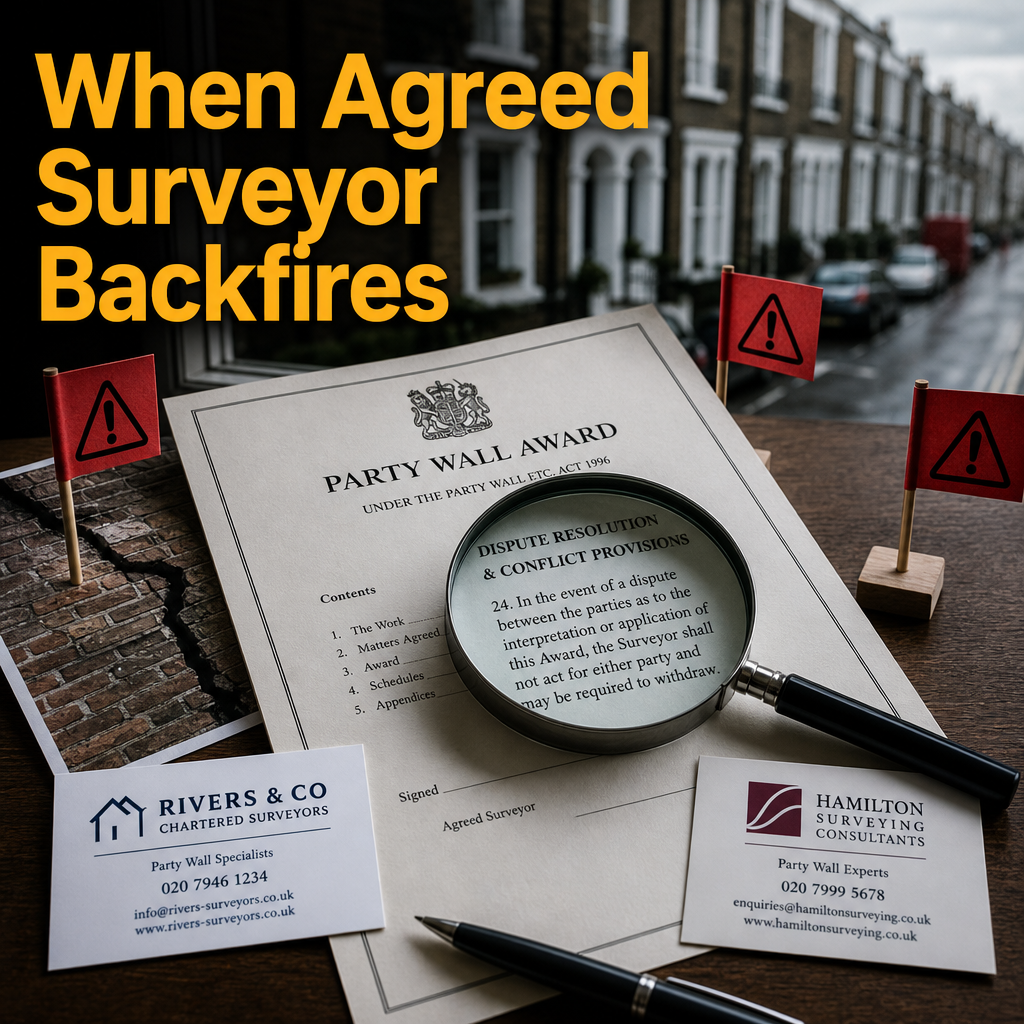
If damage to the adjoining property occurs during construction, having separate surveyors means the adjoining owner already has an independent professional in place to assess the damage and negotiate compensation. With an agreed surveyor, the adjoining owner may need to appoint a new surveyor at that point anyway — often at greater cost and with more delay than if they had appointed one from the start.
The Hidden Costs of Getting This Wrong
The agreed surveyor route is often chosen to save money. But the financial logic only holds if the process runs smoothly from start to finish. Consider what can go wrong:
- 🔴 The agreed surveyor is challenged — If the adjoining owner later argues that the agreed surveyor was not truly impartial, the entire award may be challenged in the County Court.
- 🔴 The award is inadequate — An award that does not properly protect the adjoining owner's property may leave them with no legal recourse if damage occurs.
- 🔴 Costs spiral — Appointing a second surveyor mid-process, after a dispute has already emerged, is typically more expensive than having separate appointments from day one.
- 🔴 Delays to the build — Legal challenges to a flawed award can halt construction entirely.
For building owners, understanding the building owner's surveyor role helps clarify what protections are in place for their side of the process — and why a properly structured appointment from the outset protects everyone.
Practical Checklist: Agreed Surveyor or Separate Appointments?
Use this checklist before deciding which route to take:
✅ Agreed Surveyor May Be Appropriate If:
- Works are minor and low-impact
- Both parties have a genuinely positive relationship
- Neither party has a pre-existing dispute or concern
- The proposed surveyor has no prior relationship with either party
- Both parties fully understand the surveyor's neutral role
- The construction programme is short
🚩 Consider Separate Appointments If:
- Works involve excavation, underpinning, or significant structural changes
- There is any existing tension or dispute between neighbours
- The proposed surveyor has worked with the building owner previously
- The adjoining owner is uncertain about their rights
- The project is complex or long-running
- Damage to the adjoining property is a realistic possibility
What the Party Wall Act Actually Says
The Party Wall etc. Act 1996 does not express a preference for either model. It simply provides the mechanism for both. Section 10(1)(b) states that both parties may concur in the appointment of one agreed surveyor. The word "may" is deliberate — it is an option, not a default.
This is a point worth emphasising: the agreed surveyor route requires active, informed consent from both parties. It is not something the building owner can impose. If the adjoining owner wishes to appoint their own surveyor, that is their absolute right under the Act — and no amount of pressure or persuasion changes that.
For a deeper understanding of the legal framework, the Party Wall etc. Act 1996 overview provides useful context on how the legislation structures these rights and responsibilities.
A Note on London-Specific Considerations
In London, where terraced and semi-detached properties are the norm and construction activity is intense, party wall matters arise frequently. The density of development, the age of the housing stock, and the prevalence of basement and loft conversions mean that the stakes are often higher than in less urbanised areas.
Whether the works are happening in Central London, South London, or North London, the same legal framework applies — but local knowledge of common construction methods, soil conditions, and property types can make a meaningful difference to the quality of the award produced.
Conclusion: One Surveyor or Two? Make an Informed Choice
The agreed surveyor model is a legitimate, useful tool within the Party Wall etc. Act 1996 — but it is not a universal solution. The central question of do you always need two surveyors? When the agreed surveyor route is appropriate and when it backfires has a clear answer: no, two surveyors are not always required, but the decision to use one should be made carefully, not by default.
Actionable next steps for building owners and adjoining owners in 2026:
- Assess the complexity of the works honestly — if there is any doubt, separate appointments offer better protection.
- Check the proposed surveyor's independence — ask directly whether they have any prior relationship with the other party.
- Ensure both parties understand the agreed surveyor's neutral role before consenting to the appointment.
- Do not let cost be the only driver — the savings from one surveyor can disappear quickly if a dispute emerges.
- Seek independent advice early — speaking to a qualified party wall surveyor before serving or responding to a notice costs very little and can prevent expensive mistakes.
The Party Wall etc. Act 1996 exists to protect both parties. Choosing the right appointment model is the first step in making sure it actually does.
Need guidance on party wall matters in London? Explore the full range of party wall services available or get in touch to discuss your specific situation.