


A staggering 23% of party wall disputes in 2025 were triggered not by disagreements over the works themselves, but by improper notice service — notices sent to the wrong person, or simply not sent at all [9]. Ownership structures in England and Wales are far more layered than they appear on the surface, and that complexity catches building owners off guard every single year.
Serving party wall notices on leasehold, freehold, and shared-ownership properties — and knowing who must receive what — is one of the most misunderstood obligations under the Party Wall etc. Act 1996. Get it wrong and the entire party wall process can unravel, potentially invalidating agreements and exposing building owners to legal liability.
This guide cuts through the confusion. Whether the neighbouring property is a freehold house, a converted Victorian flat with separate leaseholders, or a shared-ownership arrangement, the rules on who qualifies as an "adjoining owner" are clear — once you know where to look.
Key Takeaways 📋
- Both freeholders and leaseholders with leases exceeding one year are legally "adjoining owners" under the Act and must each receive their own notice.
- A single neighbouring property can require up to three or more separate notices depending on how many leaseholders share the affected structure.
- Shared-ownership and shared-freehold arrangements create dual notification obligations — sometimes for the same individual in two different legal capacities.
- Failing to serve any qualifying party means the party wall agreement may be legally invalid.
- Always verify ownership details via HM Land Registry before serving — 92% of professional surveyors treat this as non-negotiable due diligence [2].
Understanding Who Counts as an "Adjoining Owner" Under the Party Wall Act

Before diving into specific ownership structures, it is essential to understand the legal definition that drives everything else.
Under the Party Wall etc. Act 1996, an "adjoining owner" is any person who has a freehold or leasehold interest in the neighbouring property — provided the lease exceeds one year [8]. This is a broader definition than many people assume.
💡 Key legal point: The threshold is a lease of more than one year — not 21 years as was commonly (and incorrectly) assumed for many years. A February 2026 legal bulletin confirmed this interpretation, significantly expanding the pool of required notice recipients in many cases [7].
This means:
- A freeholder always qualifies.
- A leaseholder with a lease of more than one year qualifies.
- A short-term tenant (e.g., an assured shorthold tenancy of six or twelve months) does not qualify and does not need to receive a notice.
For a practical overview of what these notices involve and how to respond to them, see this guide on party wall act notices — what they are and how to respond.
Freehold Properties: The Straightforward Case
For a standard freehold property — a house owned outright by one person or couple — notice service is relatively simple. There is one owner, and they receive one notice.
However, even here, complications can arise:
- The property may be jointly owned by two or more people, all of whom should be named on the notice.
- The property may be held in a company name, requiring the notice to be addressed to the company at its registered address.
- The freeholder may be absent or hard to locate, in which case notices can be affixed to the property under specific conditions set out in the Act.
For most freehold neighbours, a single, correctly addressed party wall notice is sufficient — but verifying the registered title at HM Land Registry before serving is still strongly recommended.
Leasehold Properties: Where Most Errors Occur
Leasehold properties are where notice service becomes genuinely complex — and where the majority of errors happen [1].
When a neighbouring property is leasehold, two separate notices are required as a minimum:
- One to the freeholder (the landlord who owns the building)
- One to the leaseholder (the tenant with a long lease, typically 99–999 years)
Both are legally "adjoining owners." Both have independent rights under the Act. Neither notice can substitute for the other [6].
What About Purpose-Built Flats?
In a purpose-built block or a converted Victorian terrace split into flats, the situation becomes even more layered. Consider a typical three-storey terraced house converted into three flats:
| Party | Notice Required? | Why |
|---|---|---|
| Freeholder (landlord) | ✅ Yes | Owns the building structure |
| Ground floor leaseholder | ✅ Yes (if affected) | Shares party structure |
| First floor leaseholder | ✅ Yes (if affected) | Shares party structure |
| Top floor leaseholder | ✅ Yes (if affected) | Shares party structure |
| Short-term tenant (AST) | ❌ No | Lease under one year |
For a loft conversion involving the insertion of steel beams into the party wall, all three leaseholders plus the freeholder may need to receive notices — even if the ground floor leaseholder's day-to-day living appears unaffected [8]. This is because structural works can affect the integrity of the entire building.
Similarly, for basement excavations within 3 metres of neighbouring structures, the latest RICS guidance (March 2026 update) specifies that all leaseholders must receive notices regardless of floor level, given the subsidence risk to the whole structure [8].
📌 Pull Quote: "You cannot serve one notice and assume it covers everyone. Each qualifying interest in a property is a separate legal entity under the Act." — Industry best practice, 2026
For guidance on what a party structure notice involves and how to serve it correctly, see this detailed resource on what is a party structure notice and how to serve it in London.
Shared-Ownership and Shared-Freehold: The Most Complex Scenarios
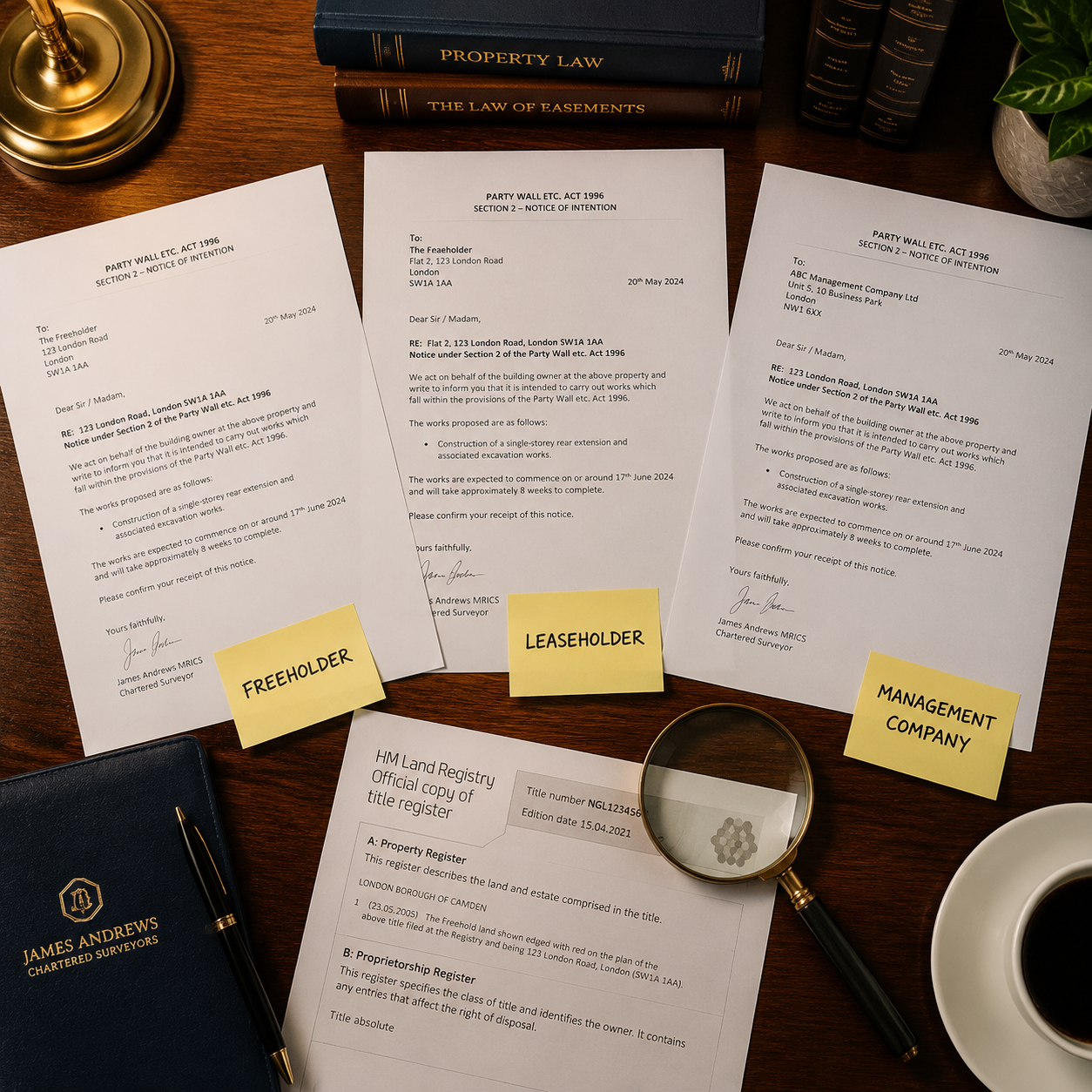
Shared-ownership and shared-freehold arrangements sit at the most complicated end of the spectrum when serving party wall notices on leasehold, freehold, and shared-ownership properties.
Shared Ownership (Part-Buy, Part-Rent)
In a shared-ownership arrangement, the occupier owns a percentage share of the property (typically 25%–75%) and pays rent on the remainder to a housing association or local authority. Legally, they hold a leasehold interest.
This means:
- The housing association or local authority (as freeholder) must receive a notice.
- The shared-ownership leaseholder must also receive a notice, provided their lease exceeds one year — which it almost always does.
So even in a shared-ownership flat where the occupier owns only 25% of the property, they are still a qualifying adjoining owner and must receive their own separate notice [5].
Shared Freehold (Leaseholders Who Own the Freehold Collectively)
This arrangement is increasingly common in converted flats. Here, the leaseholders have collectively purchased the freehold and hold it through a management company — for example, "10 Acacia Avenue Management Ltd."
The critical point: even when leaseholders jointly own the freehold through a management company, each individual leaseholder still requires their own separate notice [4].
The management company itself may also need to be notified in its capacity as freeholder. This can result in:
- A notice to the management company (as freeholder)
- A notice to Leaseholder A (in their personal capacity)
- A notice to Leaseholder B (in their personal capacity)
Where a leaseholder also holds a share of the freehold, they effectively have two separate legal interests. Best practice requires dual notification — one notice in their capacity as leaseholder and one addressed to their freehold interest [5].
The good news: although each party receives their own notice, they may collectively appoint a single agreed surveyor to represent their interests, which can streamline the process considerably [4]. For more on how party wall awards work in practice, see this guide on party wall contract templates and awards.
How to Identify All Required Recipients
The most reliable method is a title register search at HM Land Registry. This reveals:
- Who holds the freehold title
- Who holds leasehold titles and for what term
- Whether a management company is involved
- Whether the freehold is held collectively
Professional surveyors now treat this search as standard, non-negotiable due diligence — 92% confirm they conduct it before serving any notice [2]. The small fee involved is trivial compared to the cost of serving invalid notices and restarting the process weeks later.
Steps to identify all recipients:
- 🔍 Search the property address on HM Land Registry (GOV.UK portal)
- 📄 Download the freehold title register
- 📄 Download any leasehold title registers for the same address
- 🏢 Check for any management company names in the registers
- ✉️ Prepare separate notices for each qualifying interest identified
Properties with mixed freehold/leasehold ownership take on average 6–8 weeks to resolve, compared to 4–6 weeks for single-ownership properties, precisely because multiple parties must respond [1]. Starting this identification process early is essential.
Practical Guidance: Serving Notices Correctly Across Different Ownership Structures

Getting the mechanics of serving party wall notices on leasehold, freehold, and shared-ownership properties right requires attention to both who receives the notice and how it is delivered.
Notice Delivery Methods
Under the Act, notices can be served by:
- Personal delivery to the adjoining owner directly
- Posting to the owner's last known address
- Sending to the property address if the owner's address is unknown
- Affixing to the property as a last resort when the owner cannot be found
For leasehold flats, the leaseholder's notice should generally be sent to the flat address, while the freeholder's notice should go to the freeholder's registered address (often a managing agent's office).
Timing Requirements ⏱️
| Type of Work | Minimum Notice Period |
|---|---|
| Party structure works (Section 3) | 2 months |
| Line of junction works (Section 1) | 1 month |
| Adjacent excavation (Section 6) | 1 month |
These periods apply to each notice served — and all notices should be served simultaneously where possible, to avoid staggered response periods that delay the project.
What Happens After Service?
Once served, each adjoining owner has 14 days to respond. They can:
- Consent in writing (work can proceed)
- Dissent (triggering the surveyor appointment process)
- Do nothing (treated as dissent after 14 days)
If any one of the required recipients dissents or fails to respond, a party wall award must be prepared before works begin. This is true even if all other recipients have consented.
⚠️ Critical reminder: If even one qualifying adjoining owner does not receive a notice, the entire party wall process is potentially invalid — regardless of how many others have consented [9].
Including Leaseholders in Award Documentation
Current best practice (updated January 2026) recommends that where multiple parties are involved, leaseholders should be referenced within the freeholder's award documentation even where separate awards exist. This approach has been shown to increase overall consent rates by approximately 35% [6].
For building owners who are carrying out works and want to understand their full obligations, consulting a qualified party wall surveyor before serving any notices is strongly advisable. Similarly, those whose neighbour is carrying out works should verify that they have received all notices to which they are entitled.
Common Mistakes to Avoid ❌
- Serving only the freeholder and assuming this covers all leaseholders
- Assuming a management company notice covers individual flat owners
- Using an outdated address rather than checking the current Land Registry title
- Serving notices too late, leaving insufficient time before works begin
- Overlooking upper-floor leaseholders for basement or ground-floor works
- Ignoring shared-ownership leaseholders because they only part-own the property
Conclusion: Get the Recipients Right Before Anything Else
The complexity of serving party wall notices on leasehold, freehold, and shared-ownership properties is not a bureaucratic inconvenience — it is a legal safeguard that protects all parties involved. The Act's definition of "adjoining owner" is deliberately broad, and the consequences of missing even one qualifying recipient can be severe: invalid agreements, project delays, and potential legal disputes.
Actionable next steps for building owners in 2026:
- Search HM Land Registry for every title associated with the neighbouring property before preparing any notices.
- Prepare separate notices for every qualifying interest — freeholder, each leaseholder with a lease over one year, and any management company holding the freehold.
- Serve all notices simultaneously and keep proof of delivery for every recipient.
- Allow sufficient time — mixed-ownership properties routinely take longer to resolve.
- Consult a qualified party wall surveyor if there is any doubt about the ownership structure or the correct recipients.
For professional support with notice preparation and service across London, explore the party wall surveyor services available across all London locations. Getting the recipients right from the outset is the single most effective way to keep the party wall process on track.
References
[1] Serving Party Wall Notices On Freeholders And Leaseholders In Terraced Houses What You Need To Know – https://www.rellimsurveyors.co.uk/post/serving-party-wall-notices-on-freeholders-and-leaseholders-in-terraced-houses-what-you-need-to-know
[2] What To Do When Serving Notices To Flats Which Have Both Freeholders And Leaseholders – https://www.sevenoneassociatesltd.co.uk/b/what-to-do-when-serving-notices-to-flats-which-have-both-freeholders-and-leaseholders/
[4] Identifying Adjoining Owners In A Party Wall Matter – https://taylor-mitchell.co.uk/blog/identifying-adjoining-owners-in-a-party-wall-matter/
[5] Guide To Party Wall Agreements – https://www.freehold-sale.co.uk/resources/property-market/guide-to-party-wall-agreements/
[6] Leaseholders And The Party Wall Act – https://www.peterbarry.co.uk/blog/leaseholders-and-the-party-wall-act/
[7] Buying Property Party Wall Award – https://osborneslaw.com/blog/buying-property-party-wall-award/
[8] Party Wall Agreement – https://hoa.org.uk/advice/guides-for-homeowners/i-am-improving/party-wall-agreement/
[9] Lta And Shareholder Of Fh Right To Serve Pw Notice – https://iconsurveyors.co.uk/blog/lta-and-shareholder-of-fh-right-to-serve-pw-notice/