

Only one in three party wall notices served in busy urban markets receives a written response within the statutory 14-day window — yet many building owners still assume that silence means approval. That assumption is legally wrong, and acting on it can halt a project, expose owners to injunctions, and generate costs far exceeding the original build budget. Understanding the full mechanics of Navigating Silent Neighbors: Party Wall Notice Responses, Default Awards, and Escalation in 2026 is therefore essential for anyone planning works that touch a shared wall, boundary, or excavation near a neighbouring property.
The Party Wall etc. Act 1996 has not been amended in 2025–26 and remains the governing statute in England and Wales. Its rules on response windows, deemed dissent, and surveyor-led dispute resolution are as firm today as when the Act was first passed. This guide walks through every stage — from the moment a notice lands on a neighbour's doormat to the point at which a binding party wall award is issued — and offers practical tips to keep projects moving in 2026's competitive construction market.
Key Takeaways 📌
- Silence is not consent. Under the Act, a neighbour who does not respond within 14 days is treated as having dissented, triggering the formal dispute process [6].
- The 14-day clock is firm. Written consent must arrive within 14 days of service; verbal agreement offers no legal protection [2].
- Surveyors resolve disputes, not courts. Once dissent is deemed, one or two party wall surveyors produce a legally binding award [1].
- Default awards can be issued without the adjoining owner's cooperation. If a neighbour refuses to engage, the building owner's surveyor may act alone [7].
- Escalation to court is rare but available. Either party may appeal a party wall award to the county court within 14 days of service [4].
The 14-Day Response Window: What the Law Actually Requires
What Counts as a Valid Response?
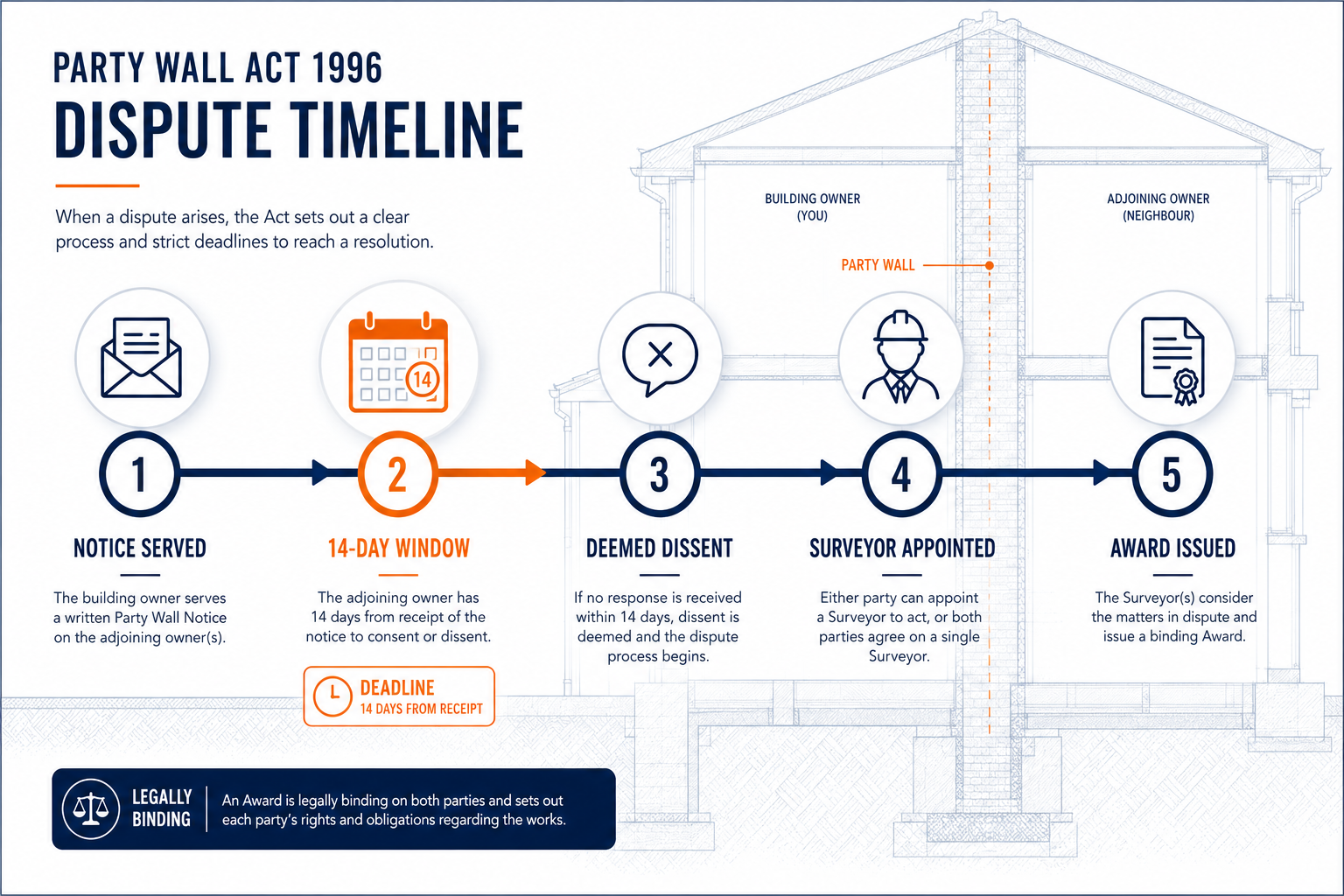
When a party wall notice is correctly served, the adjoining owner has exactly 14 days from the date of delivery to respond in writing. The government's own guidance is unambiguous: neighbours "must let you know in writing within 14 days if they consent" [6]. Three outcomes are possible:
| Response | Legal Effect | Next Step |
|---|---|---|
| ✅ Written consent | Agreement reached; works may proceed | No surveyor needed (usually) |
| ❌ Written dissent | Dispute formally arises; surveyors appointed | Party wall award required |
| 🔇 No response (silence) | Deemed dissent — dispute automatically arises | Party wall award required |
Pull Quote: "You cannot assume that no response means they agree to the works." — GOV.UK official guidance [6]
The critical point for 2026 is that verbal consent carries no legal weight. A neighbour who says "yes, go ahead" over the garden fence has not consented under the Act. Only a signed written acknowledgement satisfies the statutory requirement [2]. This matters especially in densely developed areas such as inner London, where informal conversations between neighbours are common but disputes can still arise months later.
Why the 14-Day Rule Feels Strict — But Isn't Unfair
The 14-day window exists to protect both parties. Adjoining owners get a defined period to review plans and seek independent advice. Building owners get certainty: after 14 days, the legal position is clear and the project can move forward — albeit through the award process if consent was not given. Understanding what party wall notices are and how to respond helps both sides avoid costly misunderstandings from the outset.
Practical tip for 2026: Serve notices by a method that generates proof of delivery — recorded post, hand delivery with a signed receipt, or a specialist notice-serving service. In a busy market where neighbours travel frequently or let properties through agents, documented delivery prevents disputes about whether the 14-day clock has even started.
Navigating Silent Neighbors: Party Wall Notice Responses, Default Awards, and Escalation in 2026 — The Deemed Dissent Procedure

Step 1 — Appointing Surveyors After Deemed Dissent
Once the 14-day window closes without a written response, a dispute is deemed to have arisen under Section 10 of the Act [7]. At this point, the building owner must appoint a surveyor. There are two routes:
- Agreed surveyor — Both parties appoint a single, jointly agreed surveyor. This is faster and cheaper but requires the adjoining owner to engage.
- Two surveyors — Each party appoints their own surveyor. The two surveyors then select a third surveyor in advance, to be called upon only if the two cannot agree.
The complication with silent neighbours is that they often remain unresponsive even after the dispute is deemed to have arisen. The Act anticipates this. If an adjoining owner refuses or neglects to appoint a surveyor within 10 days of being asked in writing, the building owner may appoint a surveyor on their behalf [1][7].
This is a powerful provision. It means a genuinely uncooperative neighbour cannot indefinitely stall a legitimate project simply by ignoring correspondence. For those dealing with a neighbour who is carrying out works or vice versa, understanding this mechanism is essential.
Step 2 — The Party Wall Award
The appointed surveyor(s) produce a party wall award — a legally binding document that sets out:
- 📋 The works permitted and their precise scope
- 🕐 Hours of working and access arrangements
- 🏠 A schedule of condition recording the adjoining property's pre-works state
- 💷 Costs and who bears them
- 🔧 Method statements for sensitive or high-risk operations
A thorough schedule of condition attached to the award is particularly valuable. It creates an objective photographic and written record of the adjoining property before any works begin, making it straightforward to assess whether damage occurred during construction.
Step 3 — Default Awards When Neighbours Remain Silent
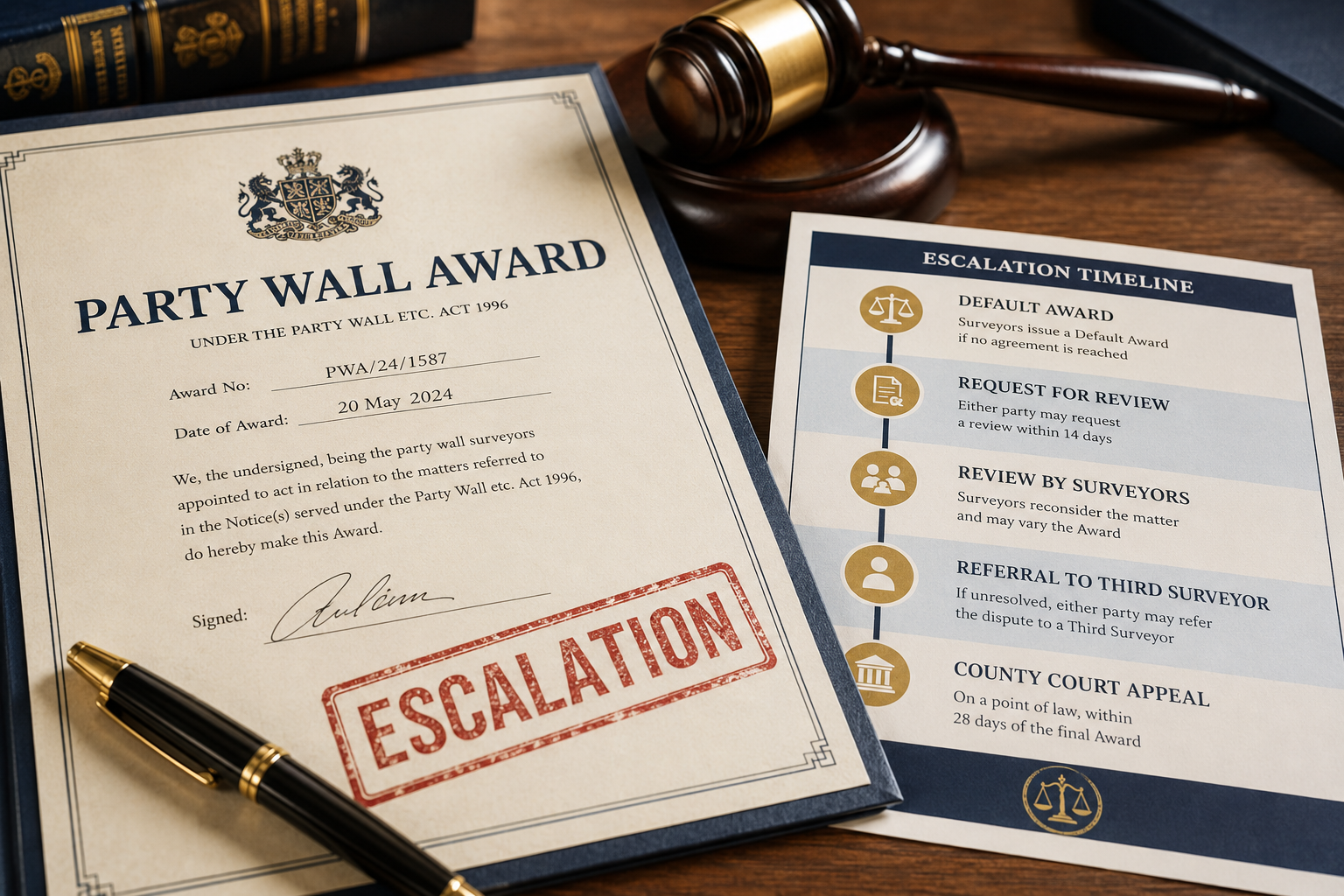
The most powerful tool for navigating truly silent neighbours is the default award (sometimes called an "ex parte" award). If the adjoining owner's appointed surveyor — whether appointed by the owner or by the building owner on their behalf — fails to participate in the award process, the building owner's surveyor can proceed alone and issue a valid, binding award [7][4].
Pull Quote: "The Act is specifically designed so that an uncooperative neighbour cannot hold a legitimate project hostage indefinitely."
This is not a loophole; it is an intentional feature of the Act's dispute-resolution architecture. The award issued in these circumstances carries the same legal force as one agreed between two active surveyors. However, it must still be properly served on all parties to be effective.
Tips to accelerate resolution in 2026's busy market:
- ✅ Send the formal "appoint your surveyor" letter by recorded delivery the day after the 14-day window closes — do not wait.
- ✅ Use a specialist party wall surveyor experienced in default procedures; not all generalist surveyors are comfortable proceeding ex parte.
- ✅ Keep a full paper trail of every attempt to engage the adjoining owner — this protects the award from later challenge.
- ✅ Consider instructing a surveyor who can also prepare the schedule of condition quickly, reducing the overall timeline.
Navigating Silent Neighbors: Party Wall Notice Responses, Default Awards, and Escalation in 2026 — Appeals and Court Escalation
When Can a Party Wall Award Be Challenged?
A party wall award is not entirely final. Either party — building owner or adjoining owner — may appeal to the county court within 14 days of the award being served [4][7]. The court has broad powers: it can confirm, modify, or rescind the award entirely.
Appeals are relatively rare in practice because:
- The award process is designed by specialist surveyors with detailed knowledge of the works.
- Courts are reluctant to second-guess technical construction decisions.
- Legal costs of a court challenge typically far exceed the cost of the original award.
That said, appeals do happen — most commonly where:
- The award was issued without proper notice to all parties.
- The surveyor exceeded their jurisdiction (e.g., addressed matters outside the Act's scope).
- There is a genuine procedural error in how the award was produced or served.
Injunctions: The Nuclear Option
Separately from the award appeal process, an adjoining owner who discovers that a building owner has started notifiable works without serving any notice at all may apply for an injunction to stop the works immediately [7]. Courts have granted such injunctions even where works are partially complete, requiring demolition of completed sections.
This is why serving notices correctly — and in good time — is non-negotiable. For a detailed breakdown of the types of party wall works that trigger notice obligations, reviewing the relevant guidance before breaking ground is strongly advisable.
Costs: Who Pays for All of This?
In the standard scenario where works are reasonable and the building owner has followed the Act correctly, the building owner pays the surveyor's fees — including the fee for any surveyor appointed on behalf of a non-responsive adjoining owner [2][1]. The adjoining owner generally bears no cost for the protection the Act gives them.
Costs escalate when:
- A neighbour actively obstructs the process, generating additional correspondence and surveyor time.
- Works are poorly specified, requiring multiple revisions to the draft award.
- An appeal is lodged, adding legal fees on top of surveyor fees.
For guidance on keeping the process affordable, the party wall costs overview provides a realistic breakdown of typical fee ranges in 2026.
Practical Timeline: From Silence to Award 🗓️
The table below summarises the key milestones when a neighbour does not respond to a party wall notice:
| Day | Event |
|---|---|
| Day 0 | Notice served (documented delivery) |
| Day 14 | Response deadline — silence = deemed dissent |
| Day 15 | Building owner writes formally requesting surveyor appointment |
| Day 25 | If no surveyor appointed, building owner appoints on neighbour's behalf |
| Day 26–45 | Surveyors (or sole surveyor) draft the award |
| Day 46–60 | Award served on all parties |
| Day 60–74 | 14-day appeal window opens and closes |
| Day 75+ | Works may proceed under the award |
Timelines are indicative and depend on surveyor availability and works complexity. In 2026's active London construction market, experienced surveyors are in high demand — early appointment is advisable.
Adjoining Owners: Your Rights Are Protected Even If You Stay Silent
It is worth addressing the adjoining owner's perspective directly. Staying silent does not mean losing rights. The deemed-dissent procedure and the award process are specifically designed to ensure that an adjoining owner's property is protected even if they choose not to engage [6][2].
Key protections that remain in place regardless of engagement level:
- 🏠 A schedule of condition is prepared before works begin.
- 📄 The award limits the scope, hours, and methods of works.
- 💷 Any damage caused during works remains the building owner's liability.
- ⚖️ The right to appeal the award within 14 days is preserved.
For adjoining owners who want to understand their position more fully, the adjoining owners' section provides clear guidance on rights and options at every stage.
Conclusion: Actionable Next Steps for 2026
Navigating Silent Neighbors: Party Wall Notice Responses, Default Awards, and Escalation in 2026 does not need to derail a project. The Act provides a clear, structured pathway that works even when neighbours refuse to engage — but only if building owners follow each procedural step correctly and promptly.
Actionable next steps:
- Serve notices early — allow buffer time for the 14-day window before your intended start date.
- Use documented delivery — recorded post or hand delivery with a receipt; never rely on an email alone.
- Do not wait after day 14 — write immediately to request surveyor appointment if no response is received.
- Appoint an experienced party wall surveyor — one familiar with default award procedures and London's 2026 market conditions.
- Prepare a schedule of condition — regardless of whether the neighbour cooperates, this protects both parties.
- Budget for the full process — include surveyor fees in your project costs from the start.
- Know your appeal rights — if an award is served that seems unreasonable, the 14-day appeal window is strict.
The law is on the side of those who follow it correctly. Silent neighbours are a frustration, not a barrier — provided the right procedures are followed from day one.
References
[1] I Havent Had A Reply To My Party Wall Notice – https://collier-stevens.co.uk/advice-hub/party-wall/i-havent-had-a-reply-to-my-party-wall-notice/
[2] Simple Guide To Party Wall Notice Reply – https://fpws.uk/simple-guide-to-party-wall-notice-reply/
[3] Watch – https://www.youtube.com/watch?v=HluuCtWt-hw
[4] Party Wall Notice Response Options – https://www.designingbuildings.co.uk/wiki/Party%20wall%20notice%20response%20options
[5] Party Wall Agreement Advice – https://www.reddit.com/r/DIYUK/comments/1f2sv8t/party_wall_agreement_advice/
[6] Reaching Agreement With Neighbours – https://www.gov.uk/party-walls-building-works/reaching-agreement-with-neighbours
[7] My Neighbour Hasnt Responded To My Party Wall Notice What Now – https://thebarristersinc.com/news/my-neighbour-hasnt-responded-to-my-party-wall-notice-what-now/
[9] Party Wall Agreement How To Avoid Disputes Neighbours – https://www.surveymerchant.com/blog/party-wall-agreement-how-to-avoid-disputes-neighbours