


Only 14 days. That is the window an adjoining owner has to respond to a party wall notice before the dispute mechanism kicks in automatically under the Party Wall etc. Act 1996. Yet in 2026, the gap between that tight statutory deadline and the date a final award lands on a building owner's desk can stretch to six months or more. Understanding exactly where time is lost — and how to claw it back — is now one of the most practical skills any renovator or developer in London can have.
This guide maps the full party wall process timelines in 2026, from the moment a notice is served through to the sealed award, with contingency plans for every stage where surveyor backlogs and neighbour delays are most likely to derail a project.
Key Takeaways
- Statutory notice periods remain unchanged at two months for party structure works and one month for line of junction or adjacent excavation notices.
- The full end-to-end journey from notice to award now typically runs two to three months for simple projects and four to six months or more where surveyor backlogs, structural engineers, or unresponsive neighbours are involved.
- There is no statutory deadline for surveyors to publish an award, making the post-appointment phase the most variable and hardest to control.
- Appointing an agreed surveyor — where both parties use one professional — is one of the most effective ways to compress timelines without sacrificing protection.
- Proactive notice service, early professional engagement, and a clear contingency buffer built into the project programme are the three pillars of timeline management in 2026.
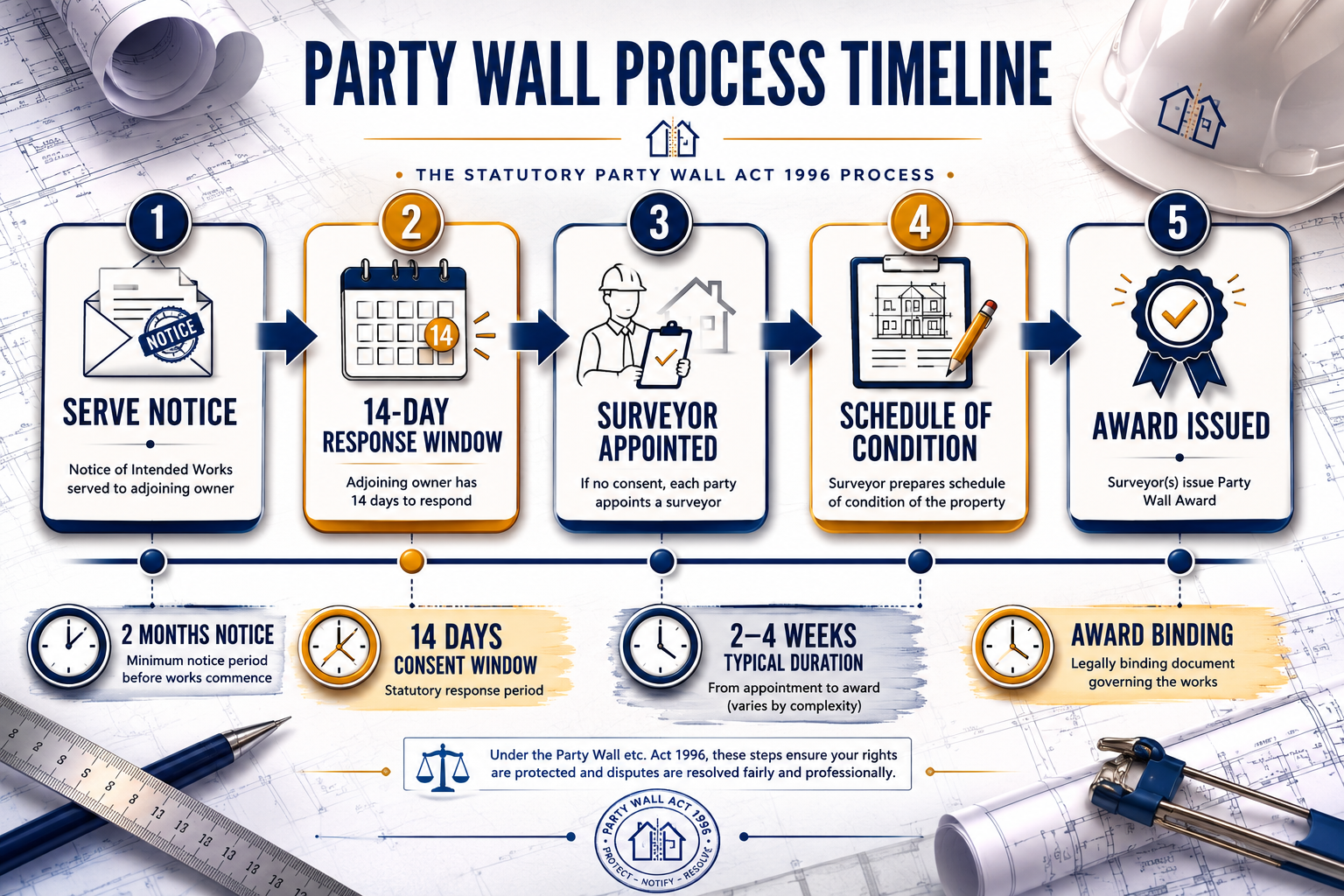
The Statutory Framework: What the Law Actually Requires in 2026
The Party Wall etc. Act 1996 has not been amended, and the RICS 7th edition practice guidance — still current in 2026 — confirms that the core statutory deadlines remain operative [9]. What has changed is the real-world gap between those minimums and actual practice.
Notice Periods
The Act draws a clear distinction between two types of notice, each carrying a different lead time [8]:
| Notice Type | Trigger | Statutory Notice Period |
|---|---|---|
| Party Structure Notice | Works to a shared wall, floor or ceiling | 2 months before works start |
| Line of Junction Notice | Building on or at the boundary | 1 month before works start |
| Adjacent Excavation Notice | Excavation within 3 or 6 metres | 1 month before works start |
These periods are non-negotiable. A building owner cannot start notifiable works before the notice period expires, regardless of how urgently the project needs to begin [8]. For a detailed breakdown of which works trigger which notice, the guide to party wall notices sets out the categories clearly.
The 14-Day Response Window
Once a notice is served, the adjoining owner has 14 days to respond [8]. Three outcomes are possible:
- Consent in writing — works can proceed; no award is needed.
- Dissent and appointment of a surveyor — the formal dispute resolution process begins.
- No response within 14 days — the adjoining owner is deemed to have dissented, and the building owner must then appoint a surveyor on their behalf [8].
If dissent occurs, the adjoining owner has a further 10 days to appoint their own surveyor. Failure to do so within that window allows the building owner's surveyor to act as the agreed surveyor [8].
For adjoining owners who are unsure how to respond, the article on party wall act notices — what they are and how to respond provides practical guidance on each option.
The Award Phase: No Statutory Deadline
Here is where the law creates its biggest vulnerability. There is no statutory deadline for surveyors to produce and serve the party wall award [8]. In theory, a straightforward award can be drafted and served within two to four weeks of both surveyors being appointed. In practice, 2026 conditions mean that figure is often optimistic [7].
Mapping Real-World Timelines: Where the Weeks Go
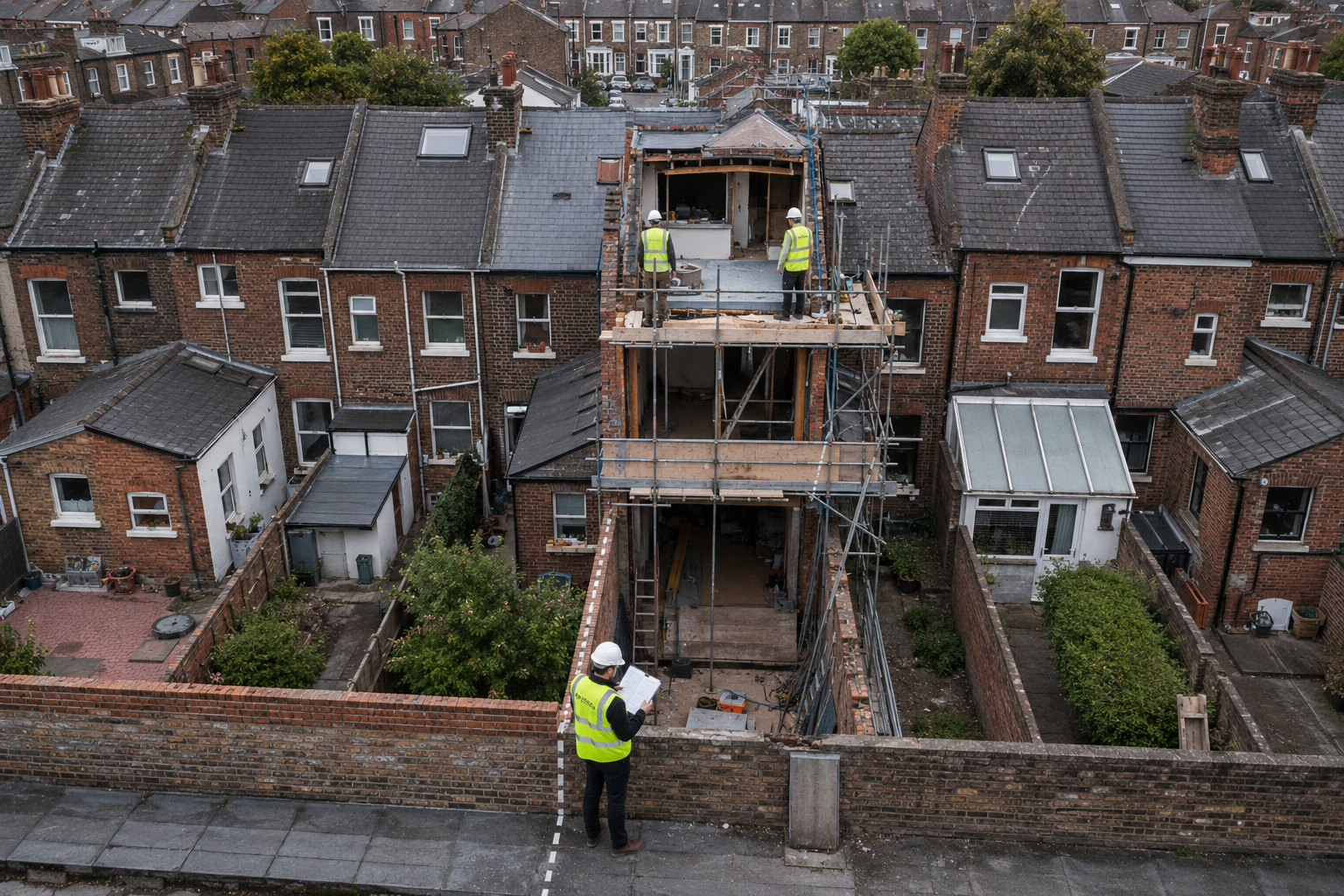
Understanding the party wall process timelines in 2026 requires mapping each stage individually rather than relying on a single headline figure. The table below shows the theoretical minimums alongside realistic 2026 durations.
| Stage | Theoretical Minimum | Realistic 2026 Duration |
|---|---|---|
| Prepare and serve notice | 1–3 days | 1–2 weeks |
| Statutory notice period | 1–2 months (depends on notice type) | 1–2 months (fixed by law) |
| Adjoining owner response window | 14 days | 14 days (fixed by law) |
| Surveyor appointment (if dissent) | 10 days | 1–3 weeks |
| Schedule of condition survey | 1–3 days | 1–2 weeks |
| Structural engineer input | 1–2 weeks | 2–12 weeks [12] |
| Award drafting and agreement | 1–2 weeks | 3–8 weeks |
| Total (simple project) | ~10 weeks | 2–3 months |
| Total (complex/basement) | ~14 weeks | 4–6+ months |
Sources: [7][8][11]
The Structural Engineer Bottleneck
One of the least-discussed causes of delay is the structural engineer's involvement in the award process. When works are technically complex — loft conversions with steel beams, rear extensions with deep foundations, or basement excavations — the party wall surveyor must wait for the structural engineer to respond to technical queries before the award can be finalised [12].
That wait alone can run from a couple of weeks to as long as 12 weeks in busy practices [12]. Building owners who appoint their structural engineer early and brief them on the party wall timetable can reduce this delay significantly.
Surveyor Backlogs in London
Specialist firms across London and the South East report that the "theoretical" two-to-four-week award window is increasingly unrealistic [12]. Periods of six to twelve weeks from the point of surveyor appointment to the final award are now common in areas with high construction activity [12].
For those in high-demand areas, local availability matters. Whether the project is in North London, South London, or Central London, surveyor workload varies by postcode and season, with spring and summer typically the busiest periods.
Neighbour Delays
Even before surveyors are involved, unresponsive neighbours add time. An adjoining owner who ignores the notice forces the building owner to wait the full 14-day window before triggering the deemed dissent procedure. If the neighbour then delays appointing their own surveyor, a further 10-day window opens. These statutory pauses are unavoidable, but they can be anticipated [8].
"The process can easily add four to six months to a project once neighbour delays and surveyor availability are factored in." [13]
Contingency Planning and Acceleration Strategies
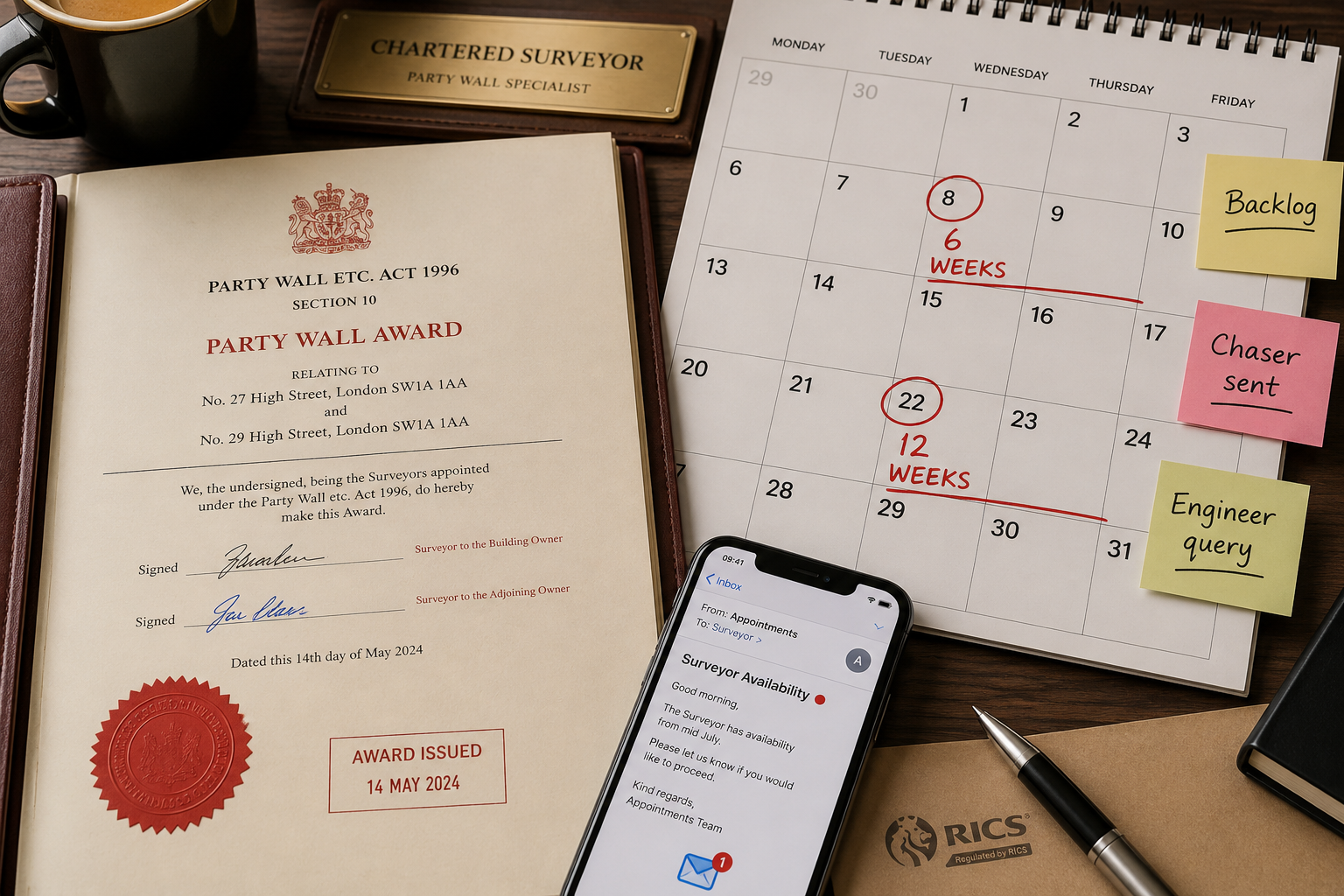
The party wall process timelines in 2026 are not entirely within a building owner's control, but there are concrete steps that compress the timeline at every stage. The following strategies are ranked by impact.
1. Serve Notice at the Earliest Possible Moment
The two-month notice period for party structure works is a fixed statutory floor. Every day of delay in serving notice is a day added to the project start date. Building owners should serve notice as soon as design drawings are sufficiently advanced — not after planning permission is granted, but in parallel with the planning process wherever possible.
For guidance on what a party structure notice must contain and how to serve it correctly, the detailed article on what is a party structure notice and how to serve it in London covers the requirements step by step.
2. Use an Agreed Surveyor
Where both the building owner and the adjoining owner are willing, appointing a single agreed surveyor — rather than two separate surveyors — is one of the most effective ways to accelerate the process. A single professional manages the entire procedure, eliminates the back-and-forth between two practices, and typically produces the award faster [3].
This approach works best where the relationship between neighbours is cooperative and the works are straightforward. It also reduces costs for both parties. The full breakdown of party wall costs and the process explains how the agreed surveyor model affects fees.
3. Commission the Schedule of Condition Early
The schedule of condition — a photographic and written record of the adjoining property's existing state — is a prerequisite for the award. Delays in arranging access to the adjoining property are common. Building owners should request this survey as soon as surveyors are appointed, rather than waiting for the award drafting to begin. A schedule of condition carried out promptly removes one of the most common causes of mid-process delay.
4. Brief the Structural Engineer on Party Wall Timelines
Structural engineers are often unaware of the party wall programme when they are first engaged. A clear brief — explaining that the surveyor will need their input within a defined window — allows the engineer to schedule their work accordingly. Building owners should request written confirmation of the engineer's availability before the party wall process begins.
5. Build a Contingency Buffer into the Project Programme
Even with all acceleration strategies in place, delays happen. A realistic project programme in 2026 should include a contingency buffer of four to six weeks beyond the theoretical award date for simple projects, and eight to twelve weeks for complex schemes. This buffer protects the construction programme if the award is delayed without requiring the building owner to start notifiable works before the award is served — which would be a breach of the Act.
6. Consider Professional Representation from the Start
Building owners who try to navigate the process without professional support often lose time correcting errors in notices or responding to challenges from the adjoining owner's surveyor. Engaging a building owner's surveyor from the outset ensures notices are correctly drafted and served, reducing the risk of having to restart the clock.
Similarly, adjoining owners who receive a notice should understand their rights before the 14-day window closes. The role of an adjoining owner's surveyor is to protect the adjoining property's interests throughout the process, including during the schedule of condition and award stages.
What Happens if Works Start Without an Award?
Starting notifiable works before the award is served — or before the notice period has expired — exposes the building owner to an injunction, which can halt the entire project. Courts have granted injunctions in these circumstances, and the cost and delay of injunction proceedings far exceeds any time saved by starting early. The contingency buffer described above is always the lower-risk option.
Understanding the Party Wall Award
The party wall award is the legally binding document that governs how works are carried out, protects the adjoining owner's property, and sets out the rights and responsibilities of both parties. It is not simply a formality — it is the mechanism through which the Act's protections are delivered [9].
A well-drafted award will typically cover:
- The works permitted — a precise description of what the building owner is authorised to do.
- Working hours and method — conditions on how and when works are carried out.
- Access rights — provisions for surveyors and contractors to enter the adjoining property if needed.
- Security for expenses — where appropriate, a requirement for the building owner to provide financial security.
- Dispute resolution — the procedure if either party believes the award has been breached.
For a detailed explanation of what a party wall award contains and how it operates, the guide on party wall awards is a useful reference. A party wall contract template guide also illustrates the structure of a typical award document.
Either party can appeal an award to the County Court within 14 days of service [8]. Appeals are relatively rare in straightforward residential cases, but they represent an additional source of delay that building owners should be aware of when planning complex or contentious projects.
Conclusion
The party wall process timelines in 2026 are shaped by a combination of fixed statutory requirements and highly variable real-world conditions. The law sets the floor — two months' notice, 14 days to respond, 10 days to appoint — but surveyor backlogs, structural engineer queues, and neighbour delays determine where the ceiling actually sits.
For time-strapped renovators and developers, the actionable steps are clear:
- Serve notice immediately — do not wait for planning approval to be granted before starting the party wall clock.
- Explore the agreed surveyor route — where neighbours are cooperative, a single surveyor compresses timelines and reduces costs.
- Engage professionals early — a building owner's surveyor and a briefed structural engineer reduce the risk of mid-process delays.
- Commission the schedule of condition without delay — arrange access to the adjoining property as soon as surveyors are appointed.
- Build a realistic contingency buffer — four to six weeks for simple projects, eight to twelve weeks for complex schemes.
- Never start notifiable works early — the cost of an injunction exceeds any time saved.
The party wall process does not have to be the bottleneck that derails a project. With the right preparation and professional support, the journey from notice to award can be managed efficiently even in a market where surveyor availability is stretched.
References
[1] Party Wall Agreement – https://hoa.org.uk/advice/guides-for-homeowners/i-am-improving/party-wall-agreement/
[2] Survey Of Party Wall 79ab42208 Party Wall Process Simulator 2026 Step Activity 7469270169396187136 Hgvo – https://www.linkedin.com/posts/survey-of-party-wall-79ab42208_party-wall-process-simulator-2026-step-activity-7469270169396187136-HgvO
[3] Understanding The Timescales For Party Wall Notices – https://www.expresspartywall.com/post/understanding-the-timescales-for-party-wall-notices
[4] What Is A Party Wall Agreement – https://www.peterbarry.co.uk/blog/what-is-a-party-wall-agreement/
[5] Party Wall Act Richmond Guide – https://www.artist-of-architecture.com/architecture-guides/richmond/party-wall-act-richmond-guide
[6] Party Wall Dispute – https://onlinearchitecturalservices.com/party-wall-dispute/
[7] Party Wall Act Procedure Long Take – https://www.murrins.co.uk/party-wall-act-procedure-long-take/
[8] Party Wall Act Timelines And Deadlines – https://charrettelaw.co.uk/party-wall-act-timelines-and-deadlines/
[9] Jan 22 Party Wall Legislation And Procedure 7th Edition – https://www.rics.org/content/dam/ricsglobal/documents/standards/jan_22_party_wall_legislation_and_procedure_7th_edition.pdf
[10] Party Wall Agreements Uk – https://natureworksdesign.co.uk/party-wall-agreements-uk