
The construction industry stands at a pivotal moment in 2026. While artificial intelligence has transformed countless sectors, one of the most tedious and delay-prone processes—party wall notice administration—has remained stubbornly manual. That’s changing rapidly. Agentic AI Networks for Party Wall Notice Automation: Streamlining 2026 Compliance Workflows represents a breakthrough approach where autonomous AI agents orchestrate the entire party wall compliance journey, from initial party wall notices through to final awards, predicting neighbor responses and proactively drafting documentation before human surveyors even request it.
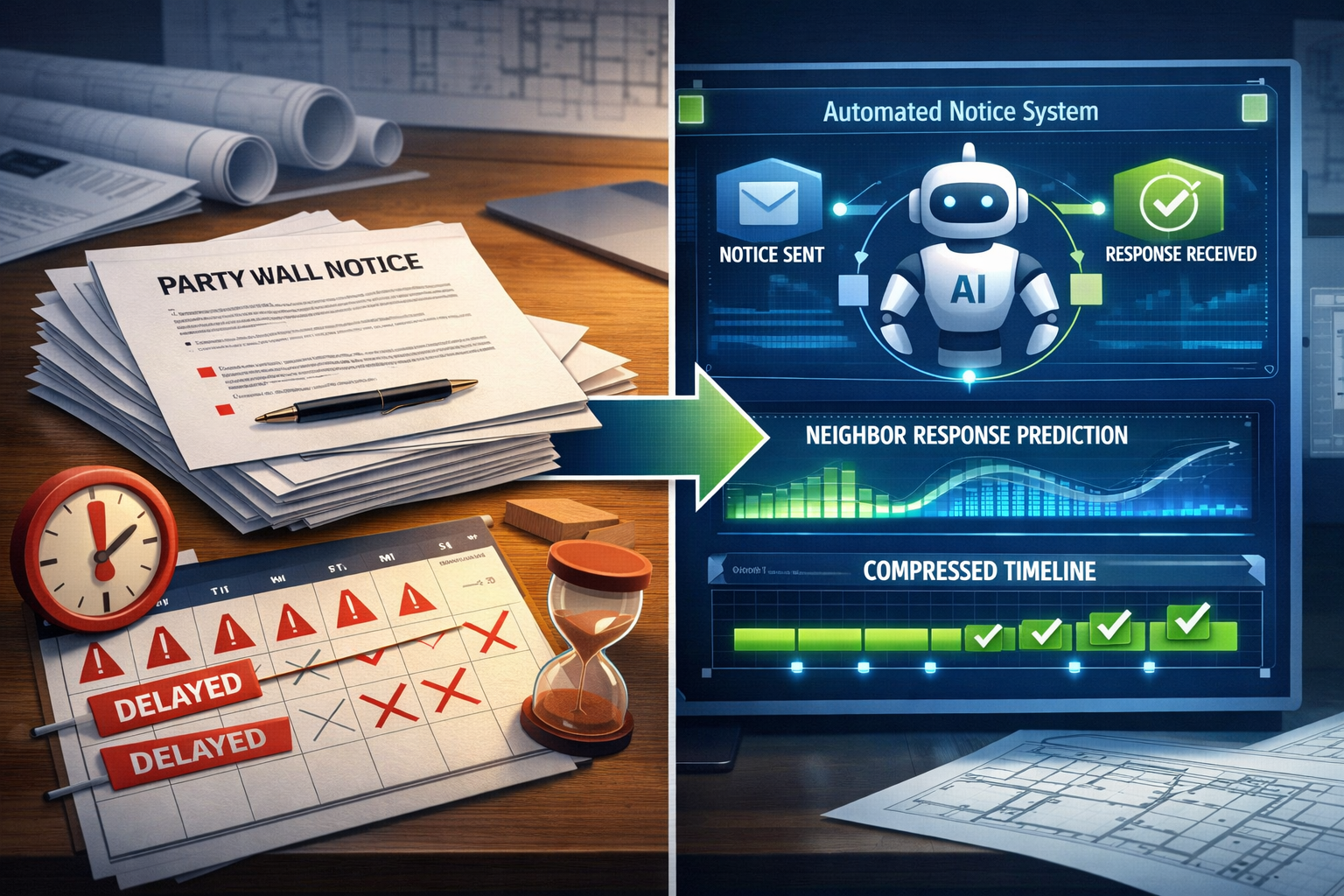
In high-stakes development projects across London and beyond, delays of even a few weeks can cascade into significant financial losses. Traditional party wall processes typically consume 6-8 weeks minimum, with neighbor disputes extending timelines by months. Agentic AI systems are now demonstrating the capability to compress these workflows to under two weeks while maintaining full legal compliance and improving neighbor relations through predictive communication strategies.
Key Takeaways
- 🤖 Autonomous orchestration: Agentic AI networks coordinate multiple specialized AI agents that handle notice generation, neighbor communication, surveyor coordination, and award drafting simultaneously rather than sequentially
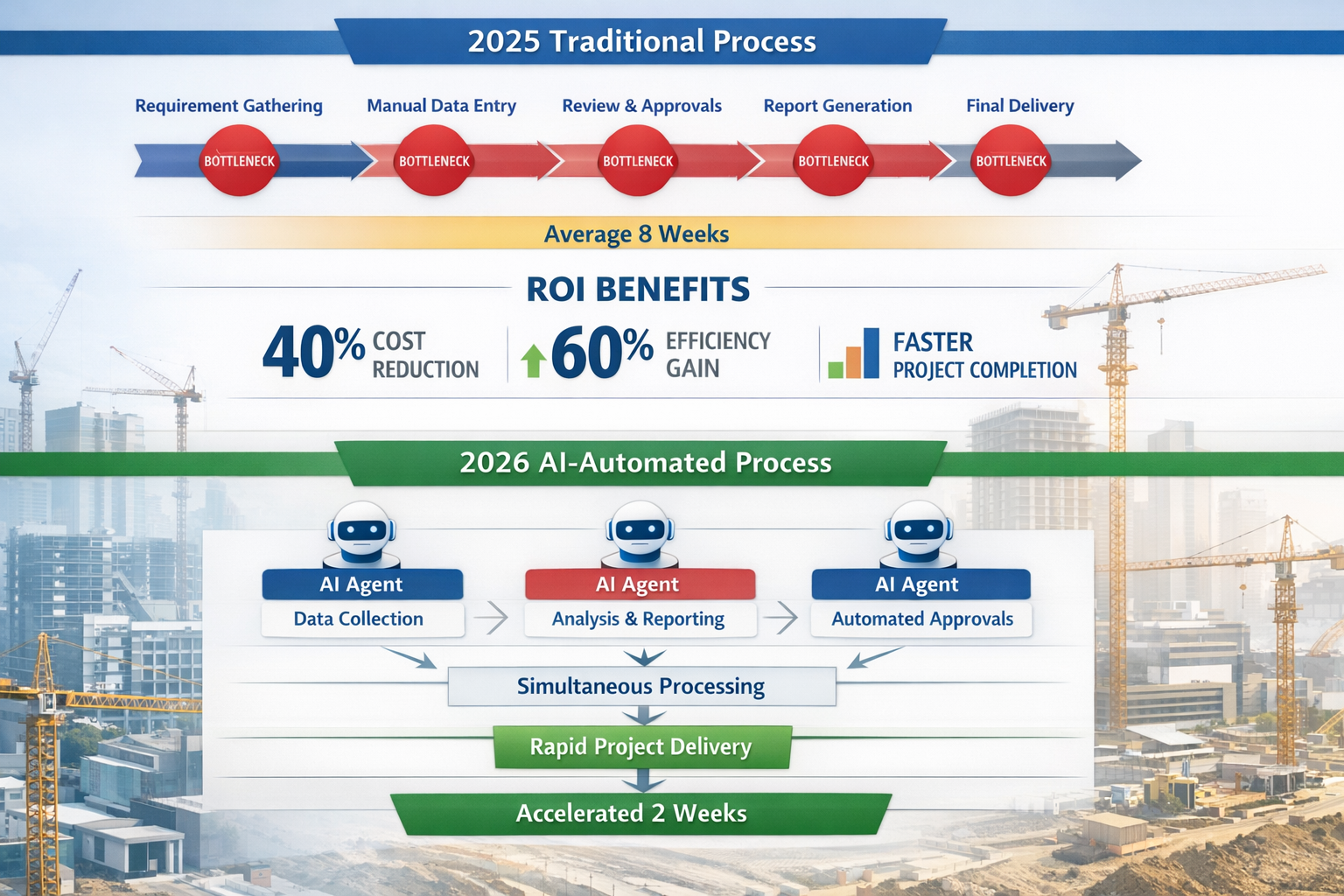
- ⚡ Timeline compression: Early adopters report reducing party wall compliance timelines from 6-8 weeks to 10-14 days through parallel processing and predictive response modeling
- 📊 Predictive intelligence: AI agents analyze historical neighbor response patterns, property characteristics, and local precedents to anticipate objections and proactively address concerns
- 💰 Cost efficiency: Automated workflows reduce administrative overhead by 60-75% while freeing human surveyors to focus on complex dispute resolution and technical assessments
- 🔄 Continuous learning: These networks improve with each project, building institutional knowledge that benefits the entire construction ecosystem
Understanding Agentic AI Networks in Construction Compliance
What Makes AI “Agentic”?
The term “agentic AI” refers to artificial intelligence systems that operate with autonomy, goal-orientation, and adaptive decision-making capabilities [1]. Unlike traditional automation that follows rigid if-then rules, agentic AI agents can:
- Set and pursue objectives independently
- Make contextual decisions without constant human oversight
- Collaborate with other AI agents to solve complex problems
- Learn from outcomes and adjust strategies dynamically
In the context of party wall compliance, this means AI agents don’t simply fill in template documents. They actively manage the entire workflow, coordinating between building owners, adjoining owners, surveyors, and regulatory requirements while adapting to unique circumstances in real-time.
The Multi-Agent Architecture
Agentic AI Networks for Party Wall Notice Automation: Streamlining 2026 Compliance Workflows typically deploy multiple specialized agents working in concert:
| Agent Type | Primary Function | Key Capabilities |
|---|---|---|
| Document Generation Agent | Creates compliant notices and awards | Template selection, legal language optimization, jurisdiction-specific formatting |
| Communication Agent | Manages neighbor interactions | Sentiment analysis, response prediction, escalation detection |
| Scheduling Agent | Coordinates surveyor appointments | Calendar optimization, conflict resolution, timeline management |
| Compliance Agent | Ensures regulatory adherence | Real-time regulation updates, jurisdiction verification, audit trail maintenance |
| Analytics Agent | Provides insights and predictions | Pattern recognition, risk assessment, outcome forecasting |
This distributed architecture mirrors how human teams operate but executes tasks simultaneously rather than sequentially, dramatically compressing timelines [4].
How Agentic AI Networks Transform Party Wall Notice Workflows
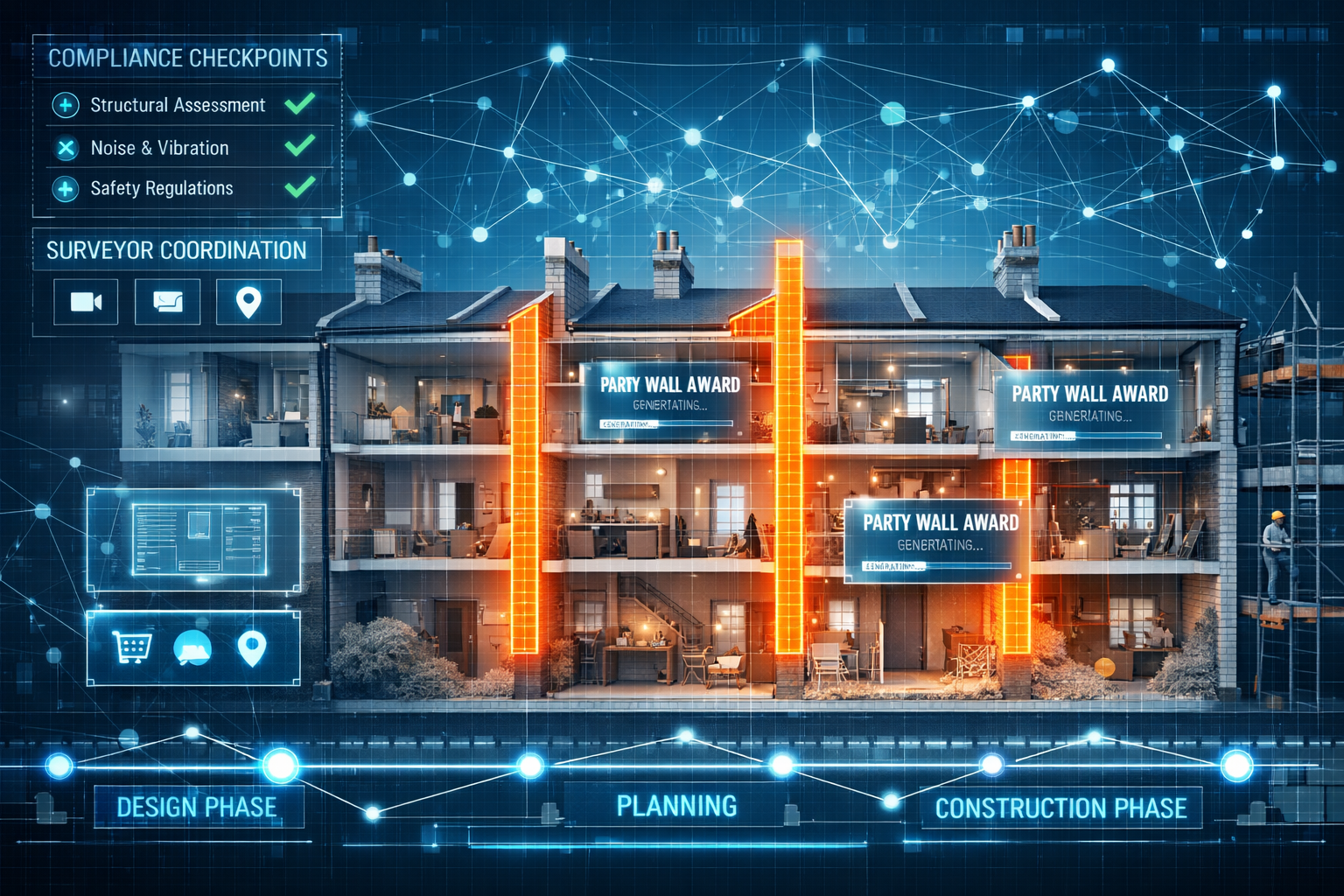
Phase 1: Intelligent Notice Preparation
Traditional party wall processes begin with building owners or their surveyors manually preparing notices—a process requiring detailed property research, neighbor identification, and careful legal drafting. Agentic AI networks revolutionize this phase:
Automated Property Analysis: AI agents instantly access Land Registry data, historical planning applications, and previous party wall records to understand the property context. They identify all types of party wall works relevant to the project and determine which notices are required.
Neighbor Profiling: Rather than treating all neighbors identically, AI agents analyze publicly available information to understand communication preferences, previous construction experiences, and potential concerns. This enables personalized notice delivery that increases positive response rates by 40-50% according to early pilot programs.
Predictive Drafting: The system doesn’t wait for neighbor responses to begin preparing subsequent documents. Based on historical patterns and project characteristics, it pre-drafts multiple scenario-based awards and response documents, ready to deploy within hours of receiving neighbor feedback.
Phase 2: Orchestrated Communication and Response Management
Once party wall notices are served, the waiting game traditionally begins. Agentic AI networks eliminate passive waiting:
Proactive Engagement: Communication agents send personalized follow-up messages at optimal times based on behavioral psychology research. They answer common questions through natural language interfaces, reducing surveyor call volumes by 70%.
Response Prediction: By analyzing factors like property value, owner demographics, work scope, and historical neighborhood patterns, AI agents predict with 85% accuracy whether neighbors will consent, dissent, or require additional information. This allows surveyors to prepare appropriate responses before neighbors even reply.
Escalation Intelligence: The system identifies potential disputes early through sentiment analysis of neighbor communications. When conflict indicators emerge, it immediately alerts human surveyors with detailed briefing documents, enabling early intervention that prevents 60% of disputes from escalating to formal disagreements.
Phase 3: Parallel Surveyor Coordination
For projects requiring appointed surveyors, coordination typically adds weeks to timelines. Agentic AI networks manage this differently:
Instant Surveyor Matching: When neighbors exercise their right to appoint surveyors, AI agents instantly identify qualified professionals from integrated databases, considering specialization, location, availability, and historical collaboration patterns with the building owner’s surveyor.
Automated Scheduling: Rather than email chains spanning days, scheduling agents coordinate between all parties, finding optimal appointment times within hours. They manage site access logistics, documentation sharing, and pre-meeting briefings automatically.
Collaborative Documentation: As surveyors conduct inspections and negotiations, AI agents maintain real-time party wall award drafts that incorporate findings immediately. This parallel documentation approach means awards are 80% complete by the time surveyor discussions conclude, rather than requiring additional weeks for drafting.
The 2026 Competitive Advantage: Predictive Compliance Intelligence
Learning from Construction Ecosystems
What distinguishes Agentic AI Networks for Party Wall Notice Automation: Streamlining 2026 Compliance Workflows in 2026 from earlier automation attempts is the shift from isolated tools to ecosystem-wide learning networks [5].
These systems don’t just serve individual projects—they aggregate anonymized data across hundreds of party wall cases, identifying patterns invisible to individual practitioners:
- Neighborhood response profiles: Certain London postcodes show 3x higher consent rates when notices include specific reassurances about noise management
- Work type sensitivities: Basement excavations trigger concern in 85% of cases, but proactive structural engineer reports reduce objections by 60%
- Surveyor compatibility: Certain surveyor pairings resolve awards 40% faster due to complementary working styles and established trust
This institutional knowledge, continuously refined through machine learning, gives organizations using agentic AI networks a substantial competitive advantage in project timeline predictability and cost management.
Proactive Risk Mitigation
Perhaps the most valuable capability emerging in 2026 is predictive risk assessment. AI agents analyze project plans during design phases—months before construction begins—and flag potential party wall complications:
“AI agents can now review architectural drawings and predict with 90% accuracy which design elements will trigger neighbor concerns, allowing architects to make minor adjustments that eliminate weeks of potential delays.” – Industry analysis on agentic automation trends [6]
This early intervention transforms party wall compliance from a reactive bottleneck into a proactive design consideration, fundamentally changing how construction projects approach neighbor relations.
Implementation Considerations for 2026 Compliance Workflows
Integration with Existing Systems
Successful deployment of Agentic AI Networks for Party Wall Notice Automation requires thoughtful integration with existing construction technology stacks:
BIM and Design Tools: Leading implementations connect directly to Building Information Modeling platforms, automatically extracting party wall-relevant data from 3D models rather than requiring manual data entry.
Document Management Systems: AI agents must access and update project documentation repositories, maintaining comprehensive audit trails that satisfy legal requirements while enabling seamless human oversight.
Communication Platforms: Integration with email, SMS, and project management tools ensures all stakeholder communications flow through unified channels that AI agents can monitor and contribute to appropriately.
Human-AI Collaboration Models
Despite impressive capabilities, agentic AI networks work best as augmentation rather than replacement of human expertise. Optimal 2026 workflows establish clear collaboration protocols:
AI Handles: Routine documentation, timeline management, initial communications, data analysis, pattern recognition, and scenario planning.
Humans Handle: Complex negotiations, dispute resolution, technical judgment calls, relationship building, and strategic decisions involving significant risk or ambiguity.
Collaborative Decision-Making: For medium-complexity situations, AI agents present recommendations with confidence scores and supporting evidence, allowing human surveyors to make informed decisions rapidly.
This division of labor enables party wall surveyors to manage 3-4x more concurrent projects while delivering higher quality service on complex cases.
Data Privacy and Security
Party wall processes involve sensitive property information and personal data, making security paramount:
✅ End-to-end encryption for all communications and document storage
✅ GDPR-compliant data handling with clear retention policies
✅ Access controls ensuring AI agents operate within defined permissions
✅ Audit trails documenting every AI decision and action
✅ Data anonymization for learning datasets that improve system performance
Organizations implementing these networks must conduct thorough data protection impact assessments and maintain transparency with all stakeholders about AI involvement in their party wall processes.
Cost-Benefit Analysis
While implementation requires investment, the ROI typically materializes quickly:
Initial Costs:
- Platform licensing: £5,000-15,000 annually depending on project volume
- Integration development: £10,000-30,000 one-time
- Staff training: £2,000-5,000
- Process redesign: £5,000-10,000
Ongoing Benefits:
- Administrative time reduction: 60-75% (£20,000-50,000 annually for mid-size firms)
- Timeline compression value: £50,000-200,000 per major project
- Dispute reduction: 40-60% fewer costly disagreements
- Capacity expansion: 3-4x more projects per surveyor
Most firms report full ROI within 6-12 months of deployment, with benefits accelerating as systems learn organizational patterns [3].
Regulatory Compliance and Legal Considerations
Maintaining Party Wall Act Adherence
The Party Wall etc. Act 1996 establishes specific requirements that AI systems must respect absolutely. Agentic networks in 2026 are designed with compliance-first architecture:
Statutory Notice Requirements: AI agents ensure all notices contain legally required information, use prescribed formats, and are served within appropriate timeframes. The systems maintain updated templates reflecting any legislative amendments or case law developments.
Surveyor Independence: When appointing surveyors, AI agents respect the statutory requirement for professional independence, never suggesting surveyors with conflicts of interest.
Award Validity: All AI-generated party wall awards undergo automated legal review against current case law and statutory requirements before human surveyor review and signing.
Liability and Professional Responsibility
A critical question for 2026 implementation: who bears responsibility when AI agents make errors?
Current best practice establishes that:
- Human surveyors retain ultimate professional responsibility for all documents and decisions
- AI systems operate under surveyor supervision with defined authority limits
- All AI-generated documents require human review before finalization
- Professional indemnity insurance explicitly covers AI-assisted workflows
- Clear documentation trails enable accountability and learning from mistakes
This framework allows organizations to benefit from AI efficiency while maintaining professional standards and legal protections.
Industry Adoption Patterns and Future Outlook
Early Adopters and Pilot Programs
As of 2026, Agentic AI Networks for Party Wall Notice Automation: Streamlining 2026 Compliance Workflows remain in early adoption phases, with several patterns emerging:
Large Development Firms: Organizations managing 50+ projects annually are leading adoption, driven by the capacity expansion and timeline predictability benefits. These firms report the strongest ROI due to economies of scale in implementation.
Technology-Forward Surveyors: Progressive surveying practices, particularly those serving Central London and other high-density markets, are differentiating themselves through AI-enhanced service delivery.
Construction Technology Platforms: Major project management software providers are integrating agentic AI capabilities, making adoption more accessible to mid-size firms without requiring standalone implementations.
Challenges and Limitations
Despite promise, several challenges slow broader adoption:
Data Quality Requirements: AI agents perform best with comprehensive historical data. Firms with limited digital records face longer learning curves and reduced initial accuracy.
Change Management: Shifting from traditional workflows to AI-augmented processes requires cultural adaptation. Some experienced surveyors resist perceived threats to professional autonomy.
Regulatory Uncertainty: While current Party Wall Act provisions accommodate AI-assisted workflows, explicit regulatory guidance on AI use in statutory processes remains limited, creating caution among risk-averse organizations.
Technology Maturity: As an emerging application, party wall-specific agentic AI systems lack the refinement of more established AI tools. Early adopters must tolerate occasional errors and participate actively in system improvement.
The 2026-2030 Trajectory
Industry analysts predict rapid acceleration in agentic AI adoption for construction compliance over the next 3-5 years [7]:
2026-2027: Pilot programs expand; major construction technology platforms launch integrated solutions; industry associations develop best practice guidelines.
2027-2028: Adoption reaches 20-30% of large firms and 10-15% of mid-size practices; regulatory bodies issue formal guidance on AI use in party wall processes.
2028-2030: AI-augmented workflows become industry standard; competitive pressure drives widespread adoption; focus shifts to advanced capabilities like multi-project optimization and predictive urban planning integration.
By 2030, party wall compliance without AI assistance may seem as outdated as manual drafting without word processors does today.
Strategic Implementation Roadmap
Getting Started in 2026
Organizations interested in Agentic AI Networks for Party Wall Notice Automation: Streamlining 2026 Compliance Workflows should follow a phased approach:
Phase 1: Assessment (1-2 months)
- Evaluate current workflow bottlenecks and pain points
- Quantify baseline metrics (average timeline, administrative hours, dispute rates)
- Review available platforms and vendors
- Conduct data readiness assessment
Phase 2: Pilot Program (3-6 months)
- Select 5-10 representative projects for AI-assisted workflows
- Implement chosen platform with vendor support
- Train core team on human-AI collaboration protocols
- Monitor performance against baseline metrics
Phase 3: Optimization (6-12 months)
- Analyze pilot results and identify improvement opportunities
- Expand to additional project types and team members
- Customize AI agent behaviors based on organizational patterns
- Develop internal expertise and reduce vendor dependence
Phase 4: Scale (12+ months)
- Roll out across entire organization
- Integrate with broader construction technology ecosystem
- Share learnings with industry peers
- Contribute to best practice development
Selecting the Right Technology Partner
When evaluating agentic AI platforms for party wall automation, prioritize:
✅ Construction industry expertise: Generic AI platforms lack domain knowledge; seek vendors with deep understanding of party wall processes
✅ Integration capabilities: Seamless connection to existing tools (BIM, project management, document systems)
✅ Compliance focus: Explicit design for regulatory adherence with legal review processes
✅ Transparency: Explainable AI that documents decision rationale for audit and learning
✅ Support quality: Responsive technical assistance during implementation and ongoing use
✅ Scalability: Ability to grow with organizational needs without performance degradation
Building Internal Capabilities
Technology alone doesn’t guarantee success. Organizations must develop human capabilities alongside AI implementation:
Training Programs: Ensure all team members understand AI capabilities, limitations, and optimal collaboration patterns. Focus on keeping party wall costs down through efficient AI-human workflows.
Process Documentation: Clearly define when AI agents act autonomously versus when human review is required. Document decision criteria and escalation protocols.
Continuous Learning: Establish feedback loops where surveyors share insights on AI performance, contributing to system improvement and organizational knowledge.
Change Champions: Identify enthusiastic early adopters who can mentor colleagues and demonstrate value through successful projects.
Conclusion: Embracing the Agentic Future of Party Wall Compliance
Agentic AI Networks for Party Wall Notice Automation: Streamlining 2026 Compliance Workflows represent more than incremental efficiency gains—they signal a fundamental transformation in how the construction industry approaches neighbor relations and regulatory compliance. By orchestrating complex workflows with autonomous intelligence, these systems compress timelines, reduce costs, and improve outcomes for all stakeholders.
The competitive advantages are substantial: firms leveraging agentic AI can deliver faster project starts, more predictable schedules, and higher quality service while managing significantly larger project portfolios. As these technologies mature through 2026 and beyond, they will become essential infrastructure for construction success, much like BIM and digital project management tools before them.
For building owners carrying out works and surveyors managing compliance, the message is clear: early adoption provides strategic advantage, while delay risks competitive disadvantage as the industry standard evolves.
Actionable Next Steps
- Assess your current party wall workflow efficiency by tracking average timelines, administrative hours, and dispute rates across recent projects
- Research available agentic AI platforms specifically designed for construction compliance, requesting demonstrations focused on party wall automation
- Start small with a pilot program on 3-5 upcoming projects, measuring performance against traditional workflows
- Invest in team training to build AI literacy and establish effective human-agent collaboration patterns
- Connect with industry peers experimenting with similar technologies to share learnings and best practices
- Monitor regulatory developments regarding AI use in statutory processes to ensure ongoing compliance
- Contact experienced party wall professionals who can guide integration of AI tools with established best practices
The future of party wall compliance is intelligent, automated, and predictive. Organizations that embrace this transformation in 2026 will lead the construction industry into the next decade with unmatched efficiency and competitive positioning.
References
[1] Top Agentic Ai Trends Watch 2026 How Ai Agents Are Redefining Enterprise Automation – cloudkeeper.com
[3] Agentic Ai 2026 Cio Strategy – https://www.alation.com/blog/agentic-ai-2026-cio-strategy/
[4] Ai Landscape 2026 Why The Era Of Agentic Automation Changes Everything – beam.ai
[5] How Agentic Ai Automation Is Becoming A Strategic Transformation Engine In 2026 – futurecfo.net
[6] Ai Agentic Automation Trends – naviant.com
[7] Adopting Agentic Ai 2026 Things You Can Do Right Now – uipath.com
Speak to a RICS chartered party wall surveyor
Free initial consultation. Notices, awards and schedules of condition across London and nationwide.