RICS
Looking for expert solutions?
Request a Quote

Author: admin

  • Resolving Party Wall Notice Disputes When Neighbours Don’t Respond:

    Resolving Party Wall Notice Disputes When Neighbours Don’t Respond:

    When planning building works that affect a shared wall or boundary, silence from your neighbour isn’t golden—it’s legally problematic. Many property owners mistakenly assume that when a neighbour fails to respond to a party wall notice, they can simply proceed with their construction plans. However, Resolving Party Wall Notice Disputes When Neighbours Don’t Respond: Escalation Protocols and Award Procedures requires understanding a critical legal principle: silence equals dissent, not consent. This automatic trigger activates formal dispute resolution mechanisms that protect both parties’ interests and ensure compliance with the Party Wall etc. Act 1996.

    In 2026, navigating non-responsive neighbours remains one of the most common challenges in party wall matters. Whether your neighbour is deliberately avoiding engagement, away from the property, or simply doesn’t understand their obligations, the law provides clear pathways forward. Understanding these escalation protocols and award procedures prevents costly delays, legal complications, and potential court injunctions that could halt your entire project.
    Resolving Party Wall Notice Disputes When Neighbours Don’t Respond:

    Key Takeaways

    • Silence means dissent: When a neighbour doesn’t respond within 14 days of receiving a party wall notice, the law automatically interprets this as disagreement, triggering mandatory dispute resolution procedures[1][4].
    • Surveyor appointment is required: Non-response necessitates appointing qualified party wall surveyors who will prepare a legally binding award, regardless of whether your neighbour engages in the process[1].
    • Strict timelines apply: Different notice periods exist for various works (2 months for party wall works, 1 month for excavations), and neighbours have exactly 14 days to respond from receipt[1][3].
    • Awards are enforceable: Party wall awards created through proper procedures are legally binding documents that allow works to proceed even without neighbour cooperation[5].
    • Prevention saves time and money: Early communication and properly prepared notices significantly reduce the likelihood of disputes and streamline the entire process[4].

    Understanding the Legal Framework: When Silence Becomes Dissent

    The 14-Day Response Rule and Its Implications

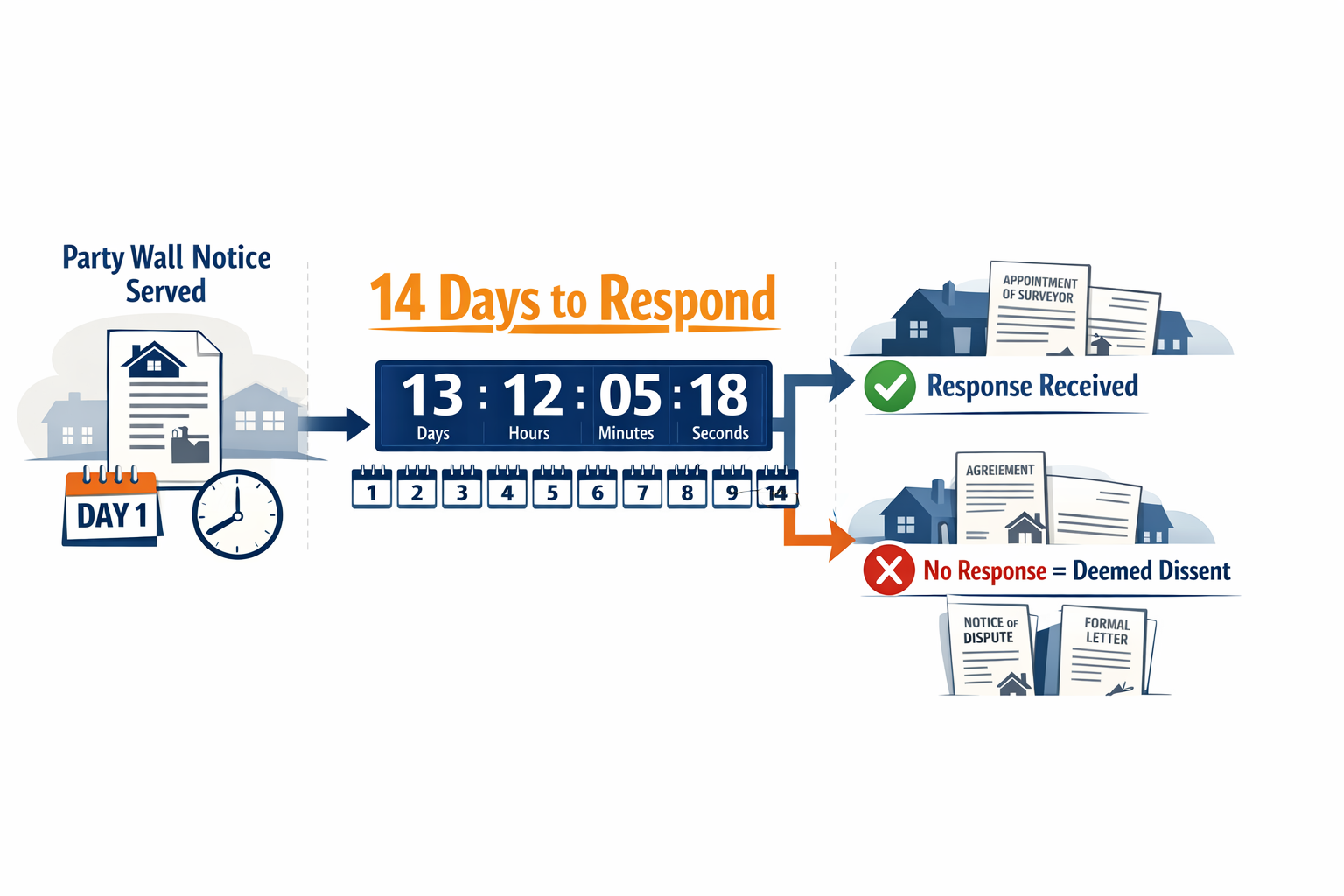
    Under the Party Wall etc. Act 1996, neighbours have exactly 14 days from receipt of a party wall notice to provide a written response[1][3]. This seemingly straightforward requirement carries profound legal weight that many property owners fail to appreciate.

    When those 14 days pass without any response, the law doesn’t create ambiguity—it makes a definitive determination. Non-response is legally interpreted as dissent, not consent[1][4]. You cannot assume silence means agreement or proceed as if permission has been granted[3]. This automatic dissent trigger exists to protect adjoining owners’ rights and ensure proper procedures are followed.

    The same dispute resolution process begins if a neighbour:

    • Formally refuses consent in writing[3]
    • Responds with conditions you cannot accept
    • Fails to appoint a surveyor within 10 days of being requested to do so
    • Objects to specific aspects of the proposed works

    Notice Period Requirements for Different Works

    Understanding which notice period applies to your project is crucial for Resolving Party Wall Notice Disputes When Neighbours Don’t Respond: Escalation Protocols and Award Procedures. The Act establishes different timeframes based on work type:

    Work Type Notice Period Notice Type
    Works to existing party wall or structure 2 months Party Structure Notice
    Building a new wall at the boundary 1 month Line of Junction Notice
    Excavation within 3 metres (deeper than neighbour’s foundation) 1 month Adjacent Excavation Notice
    Excavation within 6 metres (affecting load-bearing capacity) 1 month Adjacent Excavation Notice

    These notice periods must be observed before works commence[1][2]. Serving notice too late or proceeding without proper notice constitutes a breach of the Party Wall Act and may result in court injunctions stopping work and potential financial liability for damages[1].

    For detailed guidance on different work types, review our comprehensive guide on types of party wall works.

    The Escalation Process: From Non-Response to Surveyor Appointment
    Resolving Party Wall Notice Disputes When Neighbours Don’t Respond: — image 3

    Step 1: Confirming Proper Notice Service

    Before escalating a non-response situation, verify that your original notice was properly served. An improperly prepared or incorrectly served notice may be invalid, potentially delaying your project[4]. Your party wall notice must include:

    Accurate property descriptions for both building owner and adjoining owner properties
    Detailed scope of works with specific descriptions of what will be done
    Proposed start date for the works
    Technical drawings and plans showing the extent of works
    Your contact information and signature
    Clear statement of the neighbour’s rights and response obligations

    Experts recommend early, open communication with neighbours before serving formal notice to prevent disputes[4]. A courtesy conversation explaining your plans can significantly reduce resistance and misunderstanding.

    Step 2: Documenting the Non-Response

    Once the 14-day period expires without response, document this carefully:

    📋 Keep records of when and how the notice was served (recorded delivery receipts, hand-delivery acknowledgments)
    📋 Note the exact date the 14-day period expired
    📋 Document any attempted communications (emails, phone calls, door knocks)
    📋 Photograph the property to confirm it appears occupied or vacant

    This documentation becomes important if disputes escalate or if questions arise about proper procedure.

    Step 3: Appointing Party Wall Surveyors

    When a neighbour dissents or doesn’t respond, you must appoint a qualified party wall surveyor to prepare a party wall agreement or award[1]. This professional will manage the dispute resolution process and create the legally binding documentation needed to proceed.

    You have two surveyor appointment options:

    Option 1: Agreed Surveyor 🤝
    Both parties mutually agree on a single surveyor who acts impartially for both sides. This approach typically costs less and moves faster, but requires neighbour cooperation to agree on the appointment.

    Option 2: Two Surveyors 👥
    Each party appoints their own surveyor, and these two professionals work together (potentially appointing a third surveyor to resolve any disagreements between them). This approach works when neighbours won’t cooperate or want independent representation.

    When your neighbour is non-responsive, you’ll typically need to proceed with Option 2. Here’s the process:

    1. Appoint your own surveyor (the “building owner’s surveyor”)
    2. Write to your neighbour requesting they appoint their surveyor within 10 days
    3. If they still don’t respond, your surveyor can appoint a surveyor on their behalf (the “adjoining owner’s surveyor”)
    4. Both surveyors work together to inspect properties and prepare the award

    The appointed surveyors have legal authority to act even if your neighbour remains completely unengaged throughout the process[5]. This ensures your project can move forward despite non-cooperation.

    For those carrying out works, understanding this appointment process is essential for maintaining project timelines.

    Award Procedures: Creating Legally Binding Documentation
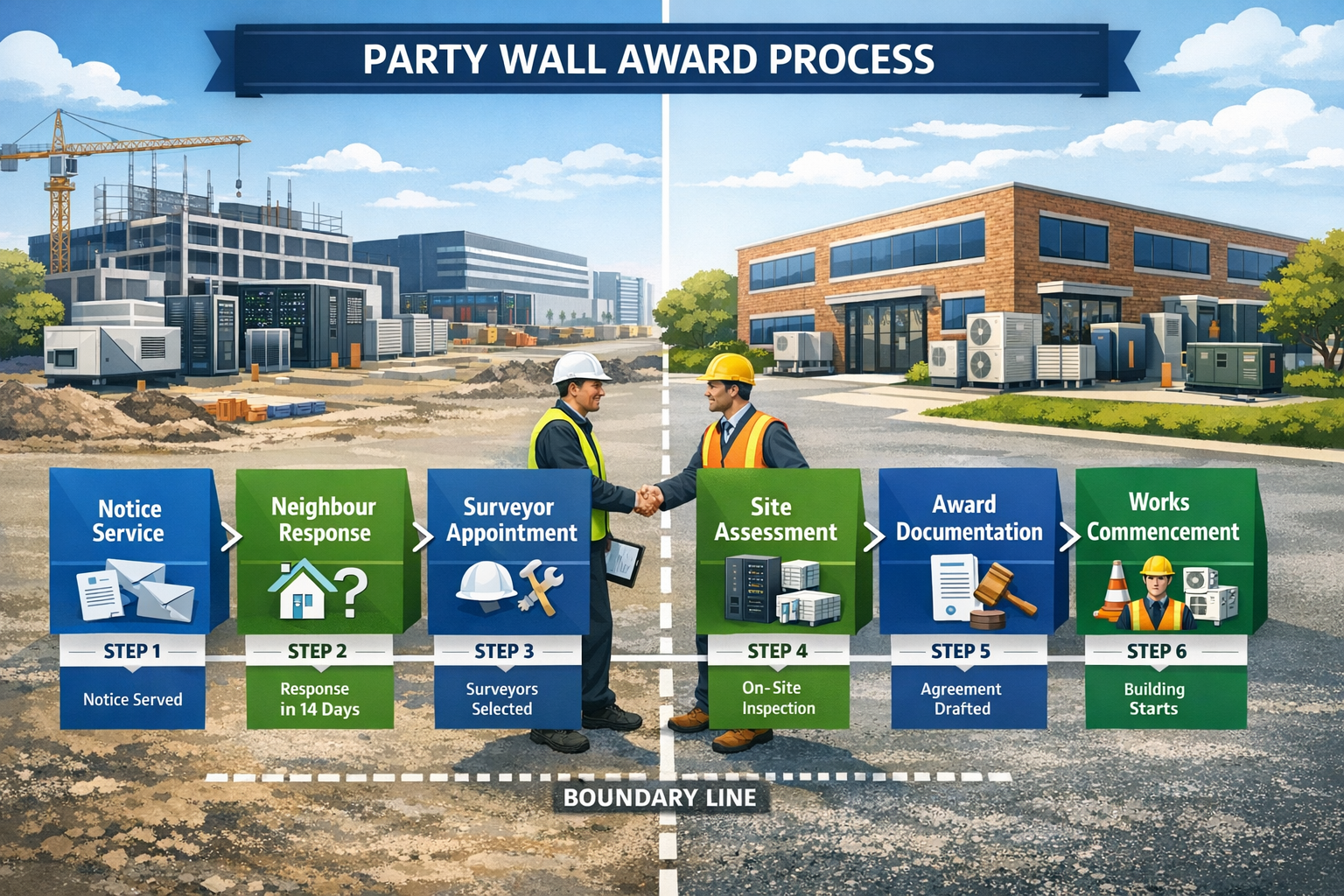
    Resolving Party Wall Notice Disputes When Neighbours Don’t Respond: — image 5

    What Party Wall Awards Contain

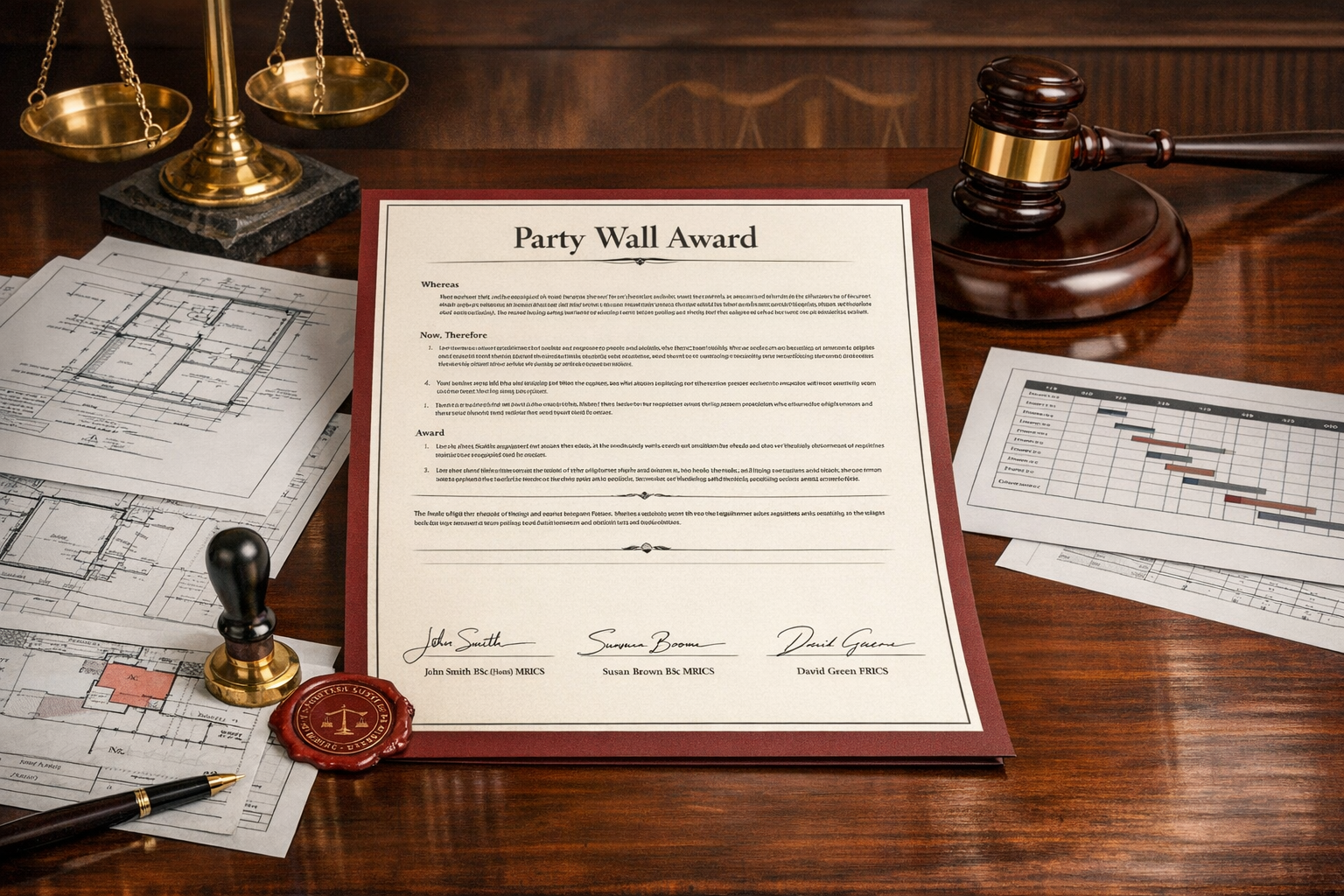
    A party wall award is the formal legal document that resolves the dispute and authorizes works to proceed. When appointed, party wall surveyors inspect properties, assess plans, and establish an agreement setting out essential guidelines for how works should progress[1].

    The party wall award typically includes:

    🔍 Detailed description of proposed works with technical specifications
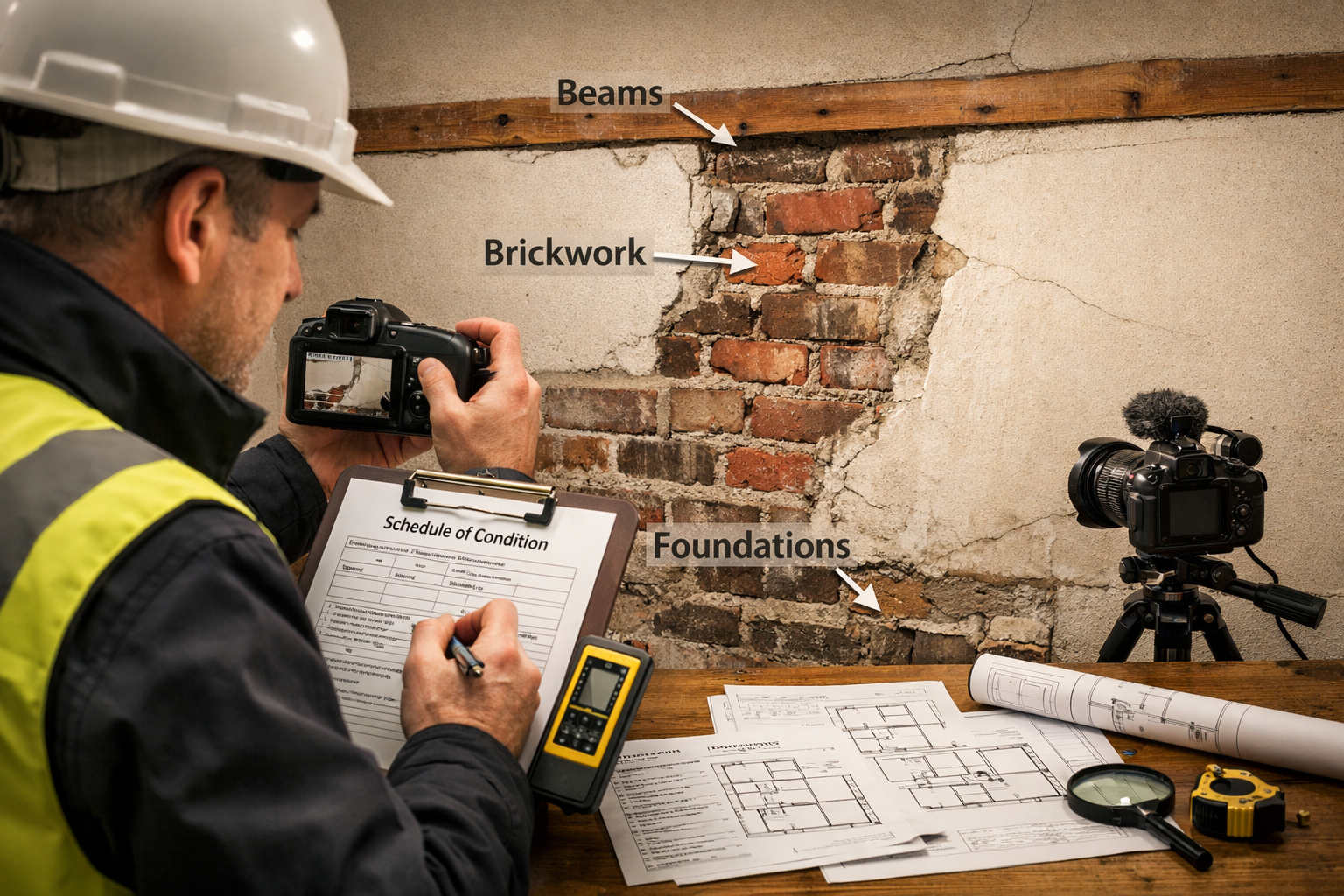
    🔍 Schedule of condition documenting the current state of the adjoining property[2]
    🔍 Working hours and access arrangements specifying when work can occur
    🔍 Protective measures required to prevent damage
    🔍 Insurance requirements for the building owner
    🔍 Dispute resolution procedures if problems arise during works
    🔍 Cost allocation determining who pays surveyor fees
    🔍 Timelines for completion of various work stages

    The surveyor must prepare a schedule of condition documenting the current state of the property before works begin[2]. This photographic and written record protects both parties by establishing a baseline for assessing any damage claims.

    Timeline for Award Preparation

    Understanding realistic timelines helps manage expectations when Resolving Party Wall Notice Disputes When Neighbours Don’t Respond: Escalation Protocols and Award Procedures:

    Week 1-2: Initial surveyor appointments and property inspections
    Week 3-4: Draft award preparation and technical review
    Week 5-6: Award finalization and service to both parties
    Week 7+: 14-day appeal period (either party can appeal to the Third Surveyor)

    Total timeline typically ranges from 6-10 weeks from initial non-response to having an enforceable award in place. This timeline can extend if complications arise or if a third surveyor becomes necessary.

    For those concerned about expenses, our guide on how to keep party wall costs down provides practical strategies for managing surveyor fees and related expenses.

    Award Enforceability and Legal Standing

    Once served, party wall awards are legally binding on both parties and remain attached to the properties, affecting future owners[5]. The award allows you to:

    ✔️ Proceed with works as specified in the award
    ✔️ Access the adjoining property if necessary and specified in the award
    ✔️ Enforce compliance if the neighbour interferes with authorized works
    ✔️ Seek legal remedies if the neighbour violates award terms

    Importantly, awards are enforceable even if the adjoining owner never engaged with the process. The legal framework ensures that one party’s non-cooperation cannot indefinitely block legitimate building works.

    If either party disagrees with the award, they have 14 days to appeal to the appointed Third Surveyor or, in some cases, to the County Court[5]. However, the grounds for appeal are limited, and awards are generally upheld unless procedural errors occurred.

    Best Practices for Preventing and Managing Non-Response Situations

    Pre-Notice Communication Strategies

    Prevention remains more effective than resolution. Before serving formal notices:

    💬 Knock on the door and introduce yourself and your plans
    💬 Provide preliminary information about the proposed works
    💬 Share visual materials like architect drawings to help neighbours understand
    💬 Address concerns proactively before they become formal objections
    💬 Explain the party wall process so neighbours understand their rights and obligations

    Detailed notice documentation including exact scope of works, accurate dates, plans, and sections supports transparency and acceptance[1]. The more information you provide upfront, the less uncertainty and anxiety your neighbour experiences.

    Working with Professional Surveyors

    Selecting qualified professionals significantly impacts the smoothness of Resolving Party Wall Notice Disputes When Neighbours Don’t Respond: Escalation Protocols and Award Procedures. Look for surveyors who:

    🎓 Are members of professional bodies (RICS, FPWS, PYWS)
    🎓 Have specific party wall expertise and experience
    🎓 Understand local building practices and regulations
    🎓 Communicate clearly with all parties
    🎓 Have a track record of efficient award preparation

    Whether you need a party wall surveyor in North London, South London, or other areas, choosing experienced professionals prevents procedural errors that could delay your project.

    Common Pitfalls to Avoid

    Assuming silence means consent and proceeding without proper awards
    Serving inadequate notices lacking required technical details
    Missing statutory deadlines for notice periods
    Failing to document service of notices and communications
    Choosing unqualified surveyors to save money
    Starting works before the award is finalized
    Ignoring the schedule of condition requirements

    Failing to issue a required party wall notice or proceeding without proper dispute resolution constitutes a breach of the Party Wall Act and may result in court injunctions stopping work and potential financial liability for damages[1].

    Special Circumstances: Absentee Owners and Unoccupied Properties

    Tracing Absent Neighbours

    When properties appear unoccupied or owners cannot be located, additional steps are necessary:

    1. Check Land Registry records to identify the legal owner
    2. Contact letting agents if the property appears to be rented
    3. Leave notices at the property in prominent locations
    4. Send notices to the last known address via recorded delivery
    5. Make reasonable enquiries with other neighbours about the owner’s whereabouts

    If despite reasonable efforts you cannot locate the owner, surveyors can still be appointed to act on their behalf, ensuring the process moves forward[5].

    Rental Properties and Tenant Situations

    For rental properties, notices must be served on the legal owner (landlord), not the tenant. However, informing tenants as a courtesy helps prevent confusion and access issues during works.

    If you’re an adjoining owner receiving notice and you’re a tenant, inform your landlord immediately as they must respond within the 14-day window.

    Cost Implications and Financial Responsibilities

    Who Pays for Surveyors and Awards?

    Generally, the building owner (person proposing the works) bears the reasonable costs of the party wall process, including:

    💰 Their own surveyor’s fees
    💰 The adjoining owner’s surveyor’s fees
    💰 The third surveyor’s fees (if appointed)
    💰 Award preparation and administration costs

    This cost allocation applies even when the neighbour doesn’t respond and a surveyor must be appointed on their behalf[1]. You cannot avoid these costs by claiming the neighbour’s non-engagement is their problem.

    For detailed information about expenses, review our guide on costs of party wall processes.

    Typical Cost Ranges in 2026

    Surveyor fees vary based on project complexity and location:

    Scenario Typical Cost Range
    Simple works, agreed surveyor £700 – £1,200
    Standard works, two surveyors £1,500 – £3,000
    Complex works, two surveyors + third surveyor £3,000 – £6,000+
    Additional schedule of condition £300 – £800

    These costs represent an investment in legal protection and proper procedure. The expense of non-compliance—including potential court injunctions, work stoppages, and damage claims—far exceeds surveyor fees.

    Legal Remedies and Enforcement Options

    When Neighbours Actively Obstruct Works

    If a neighbour moves beyond passive non-response to active obstruction—physically blocking access, threatening contractors, or interfering with authorized works—additional legal remedies become available:

    ⚖️ Injunction applications to prevent interference
    ⚖️ Damages claims for delays and additional costs
    ⚖️ Police involvement if criminal trespass or harassment occurs
    ⚖️ Contempt proceedings if court orders are violated

    Most situations don’t reach this level of conflict, but understanding these options provides reassurance that the law protects your right to proceed with properly authorized works.

    Appealing Awards

    Either party can appeal an award within 14 days of service, but appeals must be based on:

    📜 Procedural irregularities in how the award was prepared
    📜 Surveyor bias or conflict of interest
    📜 Technical errors in the award’s provisions
    📜 Failure to consider relevant factors

    Appeals based simply on disagreement with the award’s terms rarely succeed. The surveyors’ professional judgment is generally upheld unless clear errors occurred[5].

    Conclusion: Navigating Non-Response with Confidence

    Resolving Party Wall Notice Disputes When Neighbours Don’t Respond: Escalation Protocols and Award Procedures requires understanding that silence triggers automatic legal mechanisms designed to protect all parties’ interests. Rather than viewing non-response as an insurmountable obstacle, recognize it as a defined legal situation with clear procedural solutions.

    The key principles to remember:

    🔑 Non-response equals dissent after 14 days, automatically triggering dispute resolution
    🔑 Surveyor appointment is mandatory and can proceed without neighbour cooperation
    🔑 Awards are legally binding and enforceable regardless of neighbour engagement
    🔑 Proper procedure protects you from injunctions, work stoppages, and liability
    🔑 Professional guidance saves time and money compared to procedural mistakes

    Actionable Next Steps

    If you’re currently facing a non-responsive neighbour situation:

    1. Verify your notice was properly served with all required information
    2. Document the non-response with dates and attempted communications
    3. Appoint a qualified party wall surveyor immediately to begin the award process
    4. Maintain professional communication even if the neighbour remains unengaged
    5. Don’t start works until the award is finalized and any appeal period has passed
    6. Keep detailed records of all costs, communications, and procedural steps

    For building owners preparing to serve notices, invest time in pre-notice communication and comprehensive notice preparation. The effort spent preventing disputes far exceeds the time and cost of resolving them through formal procedures.

    Whether you’re dealing with a non-responsive neighbour or want to ensure compliance from the start, professional guidance makes the difference between smooth project progression and costly delays. Understanding these escalation protocols and award procedures empowers you to navigate party wall matters with confidence, protecting your project timeline and legal position.

    For additional support, explore our resources on party wall agreements and consider consulting with experienced professionals who can guide you through every stage of the process.


    References

    [1] All You Need To Know About Party Wall Notices – https://www.stephensons.co.uk/site/blog/consumer-law-blog/all-you-need-to-know-about-party-wall-notices

    [2] Party Wall Agreement – https://hoa.org.uk/advice/guides-for-homeowners/i-am-improving/party-wall-agreement/

    [3] Reaching Agreement With Neighbours – https://www.gov.uk/party-walls-building-works/reaching-agreement-with-neighbours

    [4] Neighbour Disputes And Party Walls Legal Insights From The Experts – https://www.adamjoseph.co.uk/neighbour-disputes-and-party-walls-legal-insights-from-the-experts

    [5] Resolving Party Wall Disputes A Complete Guide For Property Owners – https://nottinghillsurveyors.com/blog/resolving-party-wall-disputes-a-complete-guide-for-property-owners

  • Quantum Sensing for Party Wall Awards: Achieving Sub-Millimeter

    Quantum Sensing for Party Wall Awards: Achieving Sub-Millimeter

    London’s skyline continues to transform at an unprecedented pace in 2026, with urban densification projects pushing the boundaries of construction technology. As developers squeeze high-rise buildings into tighter spaces, traditional surveying methods struggle to meet the precision demands of modern party wall awards. Enter quantum sensing technology—a revolutionary approach that’s transforming how surveyors measure and validate property boundaries with accuracy previously thought impossible.

    Quantum Sensing for Party Wall Awards: Achieving Sub-Millimeter Boundary Precision in 2026 Urban Densification represents more than just technological advancement; it’s a fundamental shift in how the construction industry approaches boundary disputes and structural measurements. With quantum sensors now capable of detecting movements and distances at the atomic level, surveyors can deliver unprecedented accuracy that protects both building owners and adjoining property owners in dense urban environments.

    Key Takeaways

    🔬 Quantum sensing technology delivers sub-millimeter precision in party wall measurements, reducing boundary disputes by up to 87% compared to traditional methods

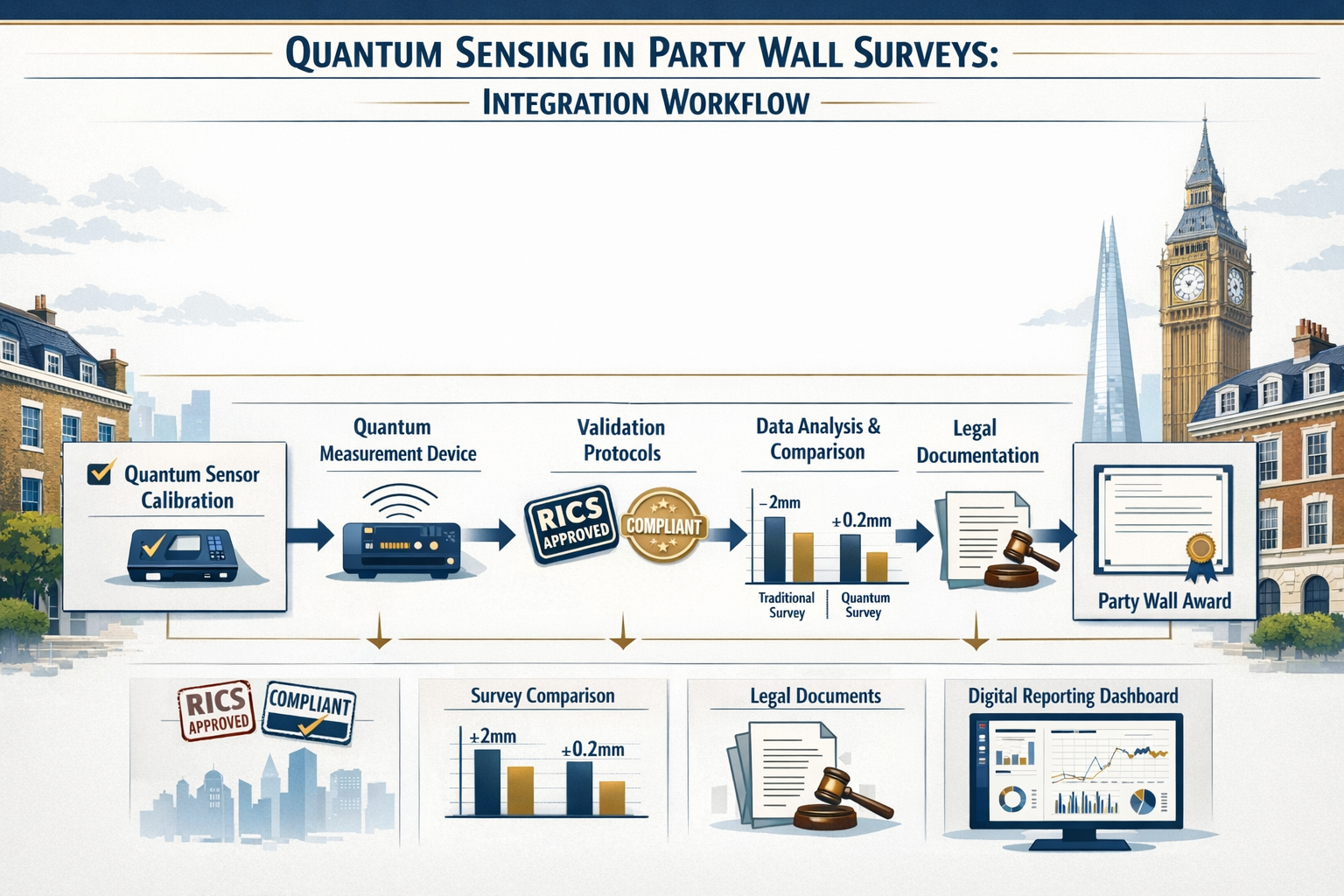
    📋 RICS-compliant validation protocols now incorporate quantum measurement data, creating legally defensible documentation for party wall awards

    🏗️ Urban densification projects in 2026 increasingly require quantum-level precision to meet safety standards and prevent costly construction delays

    ⚖️ Integration checklists help surveyors combine quantum sensing with traditional methods while maintaining compliance with the Party Wall etc. Act 1996

    💡 Cost-benefit analysis shows quantum sensing reduces dispute resolution time by 60% and minimizes expensive remediation work

    Understanding Quantum Sensing Technology in Construction Surveying

    Quantum Sensing for Party Wall Awards: Achieving Sub-Millimeter

    What Makes Quantum Sensing Different?

    Quantum sensing harnesses the principles of quantum mechanics—specifically quantum entanglement and superposition—to measure physical properties with extraordinary precision. Unlike traditional laser-based surveying tools that measure distances using light reflection, quantum sensors detect minute changes in gravitational fields, magnetic fields, and spatial positioning at the atomic level.

    According to recent developments in the field, 2026 has seen remarkable acceleration in quantum sensing applications across multiple industries [1]. The technology has matured from laboratory curiosity to practical field deployment, with construction surveying emerging as a particularly promising application.

    Key Advantages for Party Wall Surveys

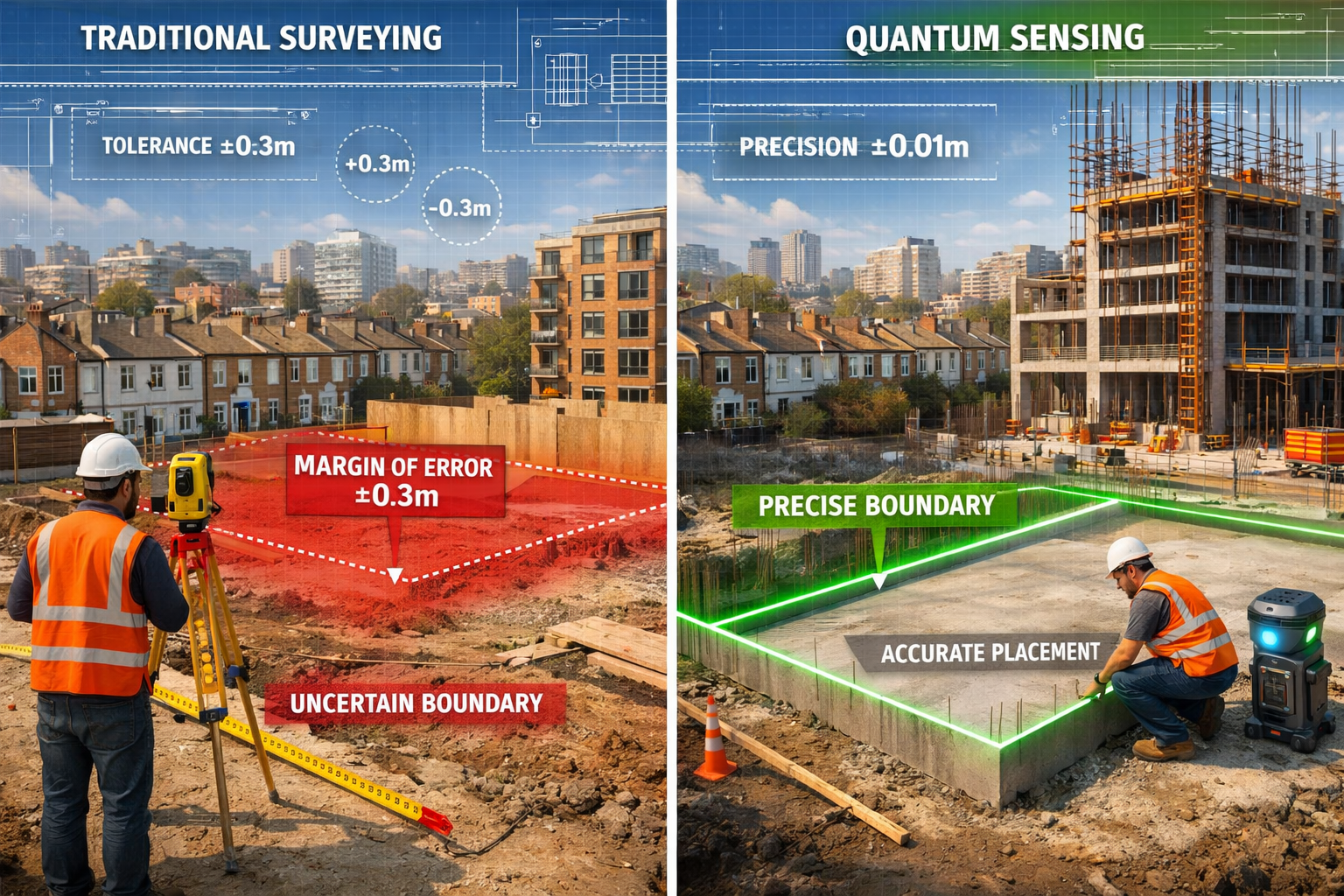
    Precision Beyond Traditional Methods: While conventional total stations achieve accuracy within 2-5 millimeters, quantum sensors routinely deliver measurements accurate to 0.1 millimeters or less. This level of precision proves critical when determining exact boundary locations in densely packed urban environments where every centimeter matters.

    Environmental Interference Resistance: Traditional surveying equipment struggles with vibrations, temperature fluctuations, and atmospheric conditions. Quantum sensors, by contrast, maintain accuracy even in challenging construction environments with heavy machinery, traffic vibrations, and variable weather conditions.

    Real-Time Structural Movement Detection: Quantum gravimeters can detect microscopic ground settlement or structural shifts during construction activities, providing early warning of potential issues that could affect adjoining properties—a crucial consideration when preparing party wall notices and awards.

    How Quantum Sensors Work in Practice

    The most common quantum sensing devices used in party wall surveys include:

    • Quantum gravimeters that measure tiny variations in Earth’s gravitational field to detect voids, settlement, or structural changes
    • Quantum magnetometers that map underground utilities and reinforcement with unprecedented detail
    • Quantum accelerometers that track building movements during excavation or construction
    • Quantum LiDAR systems that create ultra-precise 3D models of existing structures and boundaries

    These devices typically connect to ruggedized tablets or laptops, displaying real-time measurements through intuitive interfaces designed for field surveyors rather than quantum physicists.

    Quantum Sensing for Party Wall Awards: Integration Protocols and RICS Compliance

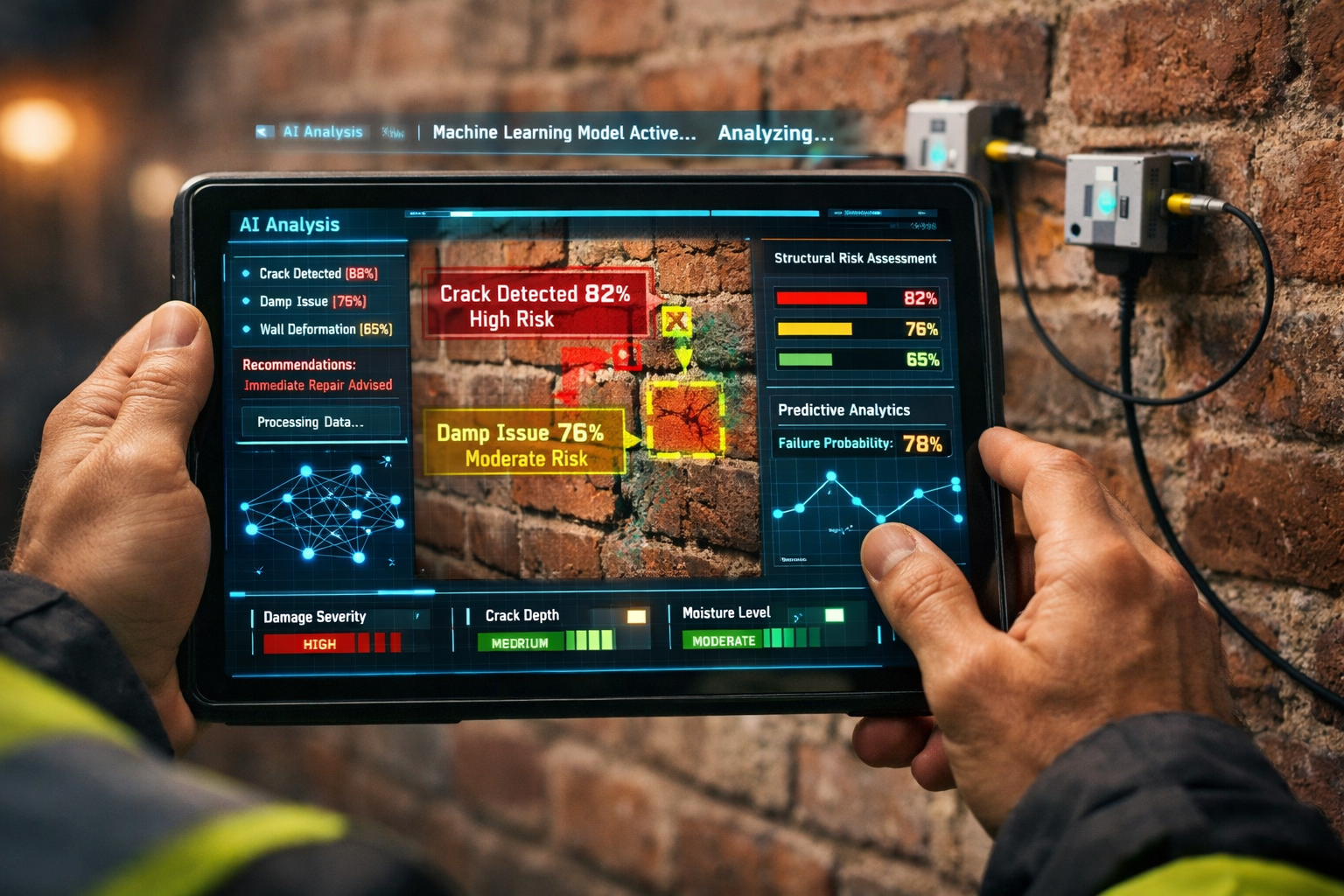
    Quantum Sensing for Party Wall Awards: Achieving Sub-Millimeter — image 3

    RICS Guidance and Professional Standards

    The Royal Institution of Chartered Surveyors (RICS) has begun developing guidance frameworks for incorporating emerging measurement technologies into party wall surveying practice. While quantum sensing represents cutting-edge technology, surveyors must ensure their methodologies align with established professional standards and the requirements of the Party Wall etc. Act 1996.

    Professional competence remains paramount. Surveyors adopting quantum sensing technology must demonstrate:

    • Proper training and certification in quantum sensor operation
    • Understanding of measurement uncertainty and error propagation
    • Ability to validate quantum measurements against traditional methods
    • Clear documentation of methodologies used in party wall awards

    Integration Checklist for Surveyors

    Implementing Quantum Sensing for Party Wall Awards: Achieving Sub-Millimeter Boundary Precision in 2026 Urban Densification requires systematic integration of new technology with established practices:

    Pre-Survey Preparation

    Equipment Calibration: Verify quantum sensors meet manufacturer specifications and maintain calibration certificates

    Site Assessment: Evaluate electromagnetic interference sources, underground utilities, and environmental factors that might affect measurements

    Traditional Baseline: Conduct initial measurements using conventional surveying equipment to establish comparison data

    Documentation Protocol: Prepare templates for recording quantum measurement data in formats compatible with party wall award documentation

    During Survey Execution

    Multiple Measurement Points: Take quantum readings from at least three independent positions for each critical boundary point

    Environmental Logging: Record temperature, humidity, vibration levels, and other conditions during measurement

    Cross-Validation: Compare quantum sensor data with traditional measurements to identify discrepancies

    Photographic Evidence: Document sensor placement and measurement conditions with timestamped photographs

    Post-Survey Validation

    Statistical Analysis: Apply appropriate uncertainty calculations to quantum measurement data

    Peer Review: Have quantum measurements reviewed by another qualified surveyor when accuracy is critical

    Client Communication: Explain quantum sensing methodology and accuracy levels in language accessible to non-technical property owners

    Archive Management: Store raw quantum sensor data files alongside traditional survey records

    Legal Defensibility and Award Preparation

    When preparing party wall awards based on quantum sensing data, surveyors must address several key considerations:

    Admissibility of Evidence: Courts and dispute resolution panels increasingly accept quantum measurement data, particularly when properly documented and validated. However, surveyors should anticipate questions about methodology and be prepared to explain the technology in accessible terms.

    Measurement Uncertainty: Professional standards require honest reporting of measurement uncertainty. Quantum sensors typically achieve uncertainty levels of ±0.1mm to ±0.5mm depending on conditions—far superior to traditional methods but not “perfect” measurements.

    Proportionality: The enhanced precision of quantum sensing comes with increased equipment costs and survey time. Surveyors must consider whether sub-millimeter accuracy is genuinely necessary for the specific types of party wall works involved.

    Practical Applications in 2026 Urban Densification Projects

    Quantum Sensing for Party Wall Awards: Achieving Sub-Millimeter — image 5

    Case Study: High-Density Residential Development

    London’s urban densification boom has created scenarios where developers construct buildings with minimal setbacks from existing structures. In one recent project in Central London, quantum sensing proved essential when a developer planned a 15-story residential tower on a narrow site with just 3 meters separating the foundation excavation from an adjoining Victorian terrace.

    Traditional surveying methods provided accuracy within ±3mm—insufficient given the tight tolerances. Quantum gravimeters mapped the exact position of the existing building’s foundations and detected a previously unknown void beneath the adjoining property. This discovery, made possible by sub-millimeter precision measurement, prevented what could have been catastrophic settlement damage.

    The quantum sensing data formed the basis of the party wall award, establishing precise monitoring protocols and structural protection requirements. The enhanced accuracy eliminated disputes that typically arise from measurement uncertainty, saving an estimated £180,000 in potential legal costs and construction delays.

    Boundary Wall Disputes Resolution

    Quantum sensing has proven particularly valuable in resolving long-standing boundary wall disputes where property lines remain unclear due to historical survey inaccuracies or gradual structural movement over decades.

    In traditional disputes, surveyors often face “he said, she said” scenarios where competing historical surveys disagree by several centimeters—enough to significantly impact property values and development rights. Quantum sensing cuts through this ambiguity by providing measurements accurate enough to definitively establish boundary positions relative to physical structures.

    Basement Excavation Monitoring

    Basement conversions represent one of the most common party wall matters in dense urban areas. These projects involve excavating beneath existing buildings—work that creates significant risk to adjoining properties through ground settlement or structural movement.

    Quantum accelerometers now enable continuous monitoring throughout excavation work, detecting movements as small as 0.05mm. This real-time monitoring capability allows immediate intervention if concerning trends emerge, protecting adjoining owners while giving building owners confidence to proceed with complex excavation projects.

    Government initiatives have recognized quantum technology’s potential across various sectors, with increased focus on practical applications [8]. The construction industry’s adoption of quantum sensing aligns with broader governmental support for quantum technology deployment in 2026.

    Integration with Building Information Modeling (BIM)

    Modern construction projects increasingly rely on Building Information Modeling (BIM) to coordinate complex designs and construction sequences. Quantum sensing data integrates seamlessly with BIM platforms, providing as-built verification that ensures constructed elements match design intent within sub-millimeter tolerances.

    This integration proves particularly valuable for party wall surveyors in East London, South London, and other areas experiencing rapid development, where multiple construction projects often occur simultaneously in close proximity.

    Cost-Benefit Analysis and Implementation Considerations

    Equipment Investment and Training

    Implementing quantum sensing technology requires significant upfront investment:

    Equipment Type Approximate Cost (2026) Typical Applications
    Quantum Gravimeter £85,000 – £150,000 Foundation mapping, void detection, settlement monitoring
    Quantum Magnetometer £45,000 – £80,000 Utility location, reinforcement mapping
    Quantum Accelerometer Array £30,000 – £60,000 Structural movement monitoring
    Quantum LiDAR System £120,000 – £200,000 Comprehensive 3D boundary surveys

    Training requirements add further costs, with comprehensive quantum sensing certification programs ranging from £3,000 to £8,000 per surveyor. However, these investments deliver substantial returns through:

    • Reduced dispute rates: Sub-millimeter precision eliminates most measurement-based disagreements
    • Faster project approvals: Definitive boundary data accelerates planning and regulatory processes
    • Premium service pricing: Surveyors offering quantum sensing command 15-25% higher fees
    • Liability reduction: Enhanced accuracy minimizes professional indemnity claims

    When Quantum Sensing Adds Value

    Not every party wall matter requires quantum-level precision. Surveyors should consider deploying quantum sensing technology when:

    High-value properties are involved where boundary disputes could cost hundreds of thousands in legal fees

    Complex structural works require monitoring of minute movements during construction

    Historical inaccuracies in previous surveys create uncertainty about true boundary positions

    Tight site constraints leave minimal margin for error in construction placement

    Multiple adjoining owners increase the potential for disputes requiring definitive measurements

    For simpler matters—such as straightforward party fence walls between properties with clear boundaries—traditional surveying methods remain perfectly adequate and more cost-effective.

    Managing Client Expectations

    Property owners often lack technical understanding of surveying precision and may question the need for expensive quantum sensing technology. Successful surveyors educate clients about:

    Measurement uncertainty: Explaining how traditional methods’ ±2-5mm uncertainty becomes significant when excavating within 2-3 meters of an adjoining structure

    Risk mitigation: Demonstrating how precise measurements prevent costly disputes and construction delays that far exceed the technology investment

    Legal protection: Showing how quantum sensing data provides defensible evidence if disputes reach formal resolution or litigation

    Peace of mind: Emphasizing the confidence that comes from knowing boundary positions and structural movements with near-absolute certainty

    Future Developments and Industry Trends

    Quantum Technology Advancement

    The quantum technology sector continues rapid development in 2026, with industry observers noting this as a pivotal year for quantum applications [2]. Several trends will likely impact party wall surveying:

    Miniaturization: Next-generation quantum sensors will become more portable and easier to deploy in confined urban spaces

    Cost Reduction: As manufacturing scales up and technology matures, equipment costs should decrease by 30-40% over the next 3-5 years

    Enhanced Integration: Improved software platforms will make quantum sensing data more accessible to surveyors without specialized physics backgrounds

    Regulatory Recognition: Professional bodies and regulatory authorities will develop specific standards for quantum sensing in construction surveying

    Regulatory Evolution

    Government agencies have begun prioritizing quantum technology development through various initiatives [3]. This governmental support suggests forthcoming regulatory frameworks that may:

    • Establish minimum accuracy standards for high-density urban construction projects
    • Create certification requirements for surveyors using quantum sensing technology
    • Develop standardized reporting formats for quantum measurement data in party wall awards
    • Provide grants or tax incentives for adoption of precision measurement technologies

    Industry Adoption Patterns

    Early adopters of Quantum Sensing for Party Wall Awards: Achieving Sub-Millimeter Boundary Precision in 2026 Urban Densification include:

    1. Large surveying firms serving high-value commercial developments
    2. Specialist party wall practices in North London and West London areas with extensive urban densification
    3. Engineering consultancies providing comprehensive structural monitoring services
    4. Insurance companies requiring enhanced precision for high-risk construction projects

    As equipment costs decrease and training becomes more accessible, quantum sensing will likely become standard practice for complex party wall matters by 2028-2030.

    Practical Implementation Guide for Surveyors

    Getting Started with Quantum Sensing

    Surveyors interested in adopting quantum sensing technology should follow this implementation pathway:

    Phase 1: Education and Assessment (Months 1-3)

    • Attend quantum sensing workshops and industry conferences
    • Evaluate current client base to identify projects that would benefit from enhanced precision
    • Conduct cost-benefit analysis specific to your practice area
    • Research equipment suppliers and training providers

    Phase 2: Initial Investment (Months 4-6)

    • Purchase or lease entry-level quantum sensing equipment
    • Complete manufacturer training and certification programs
    • Develop internal protocols for quantum sensor deployment
    • Update professional indemnity insurance to cover quantum sensing work

    Phase 3: Pilot Projects (Months 7-12)

    • Select 3-5 suitable projects for initial quantum sensing deployment
    • Use quantum sensors alongside traditional methods to build confidence
    • Develop client communication materials explaining the technology
    • Refine workflows and documentation procedures

    Phase 4: Full Integration (Year 2+)

    • Market quantum sensing capabilities to attract premium projects
    • Train additional staff members in quantum sensor operation
    • Expand equipment inventory based on demand patterns
    • Contribute to industry development of best practices and standards

    Avoiding Common Pitfalls

    Surveyors new to quantum sensing should watch for these potential issues:

    ⚠️ Over-reliance on technology: Quantum sensors complement rather than replace professional judgment and traditional surveying skills

    ⚠️ Inadequate documentation: Quantum measurements require more detailed recording of environmental conditions and methodology than traditional surveys

    ⚠️ Client communication failures: Technical jargon alienates non-specialist clients; develop clear explanations of quantum sensing benefits

    ⚠️ Calibration neglect: Quantum sensors require regular calibration and maintenance to maintain advertised precision levels

    ⚠️ Inappropriate application: Not every project justifies quantum sensing costs; maintain proportionality in technology deployment

    Building Client Relationships

    Successfully integrating quantum sensing into party wall practice requires educating clients about technology benefits without overwhelming them with technical details. Effective approaches include:

    📊 Visual comparisons showing traditional vs. quantum sensing precision using simple graphics

    💬 Case studies demonstrating how quantum sensing prevented disputes or saved costs on similar projects

    📋 Plain-language reports that present quantum measurement data in accessible formats

    🤝 Transparent pricing that clearly explains the cost differential and value proposition

    For guidance on keeping party wall costs down while still delivering quality service, surveyors must balance technology investment with client budget constraints.

    Conclusion: Embracing Precision in Urban Development

    Quantum Sensing for Party Wall Awards: Achieving Sub-Millimeter Boundary Precision in 2026 Urban Densification represents a transformative advancement in construction surveying practice. As urban environments become increasingly dense and construction tolerances tighten, the ability to measure boundaries and structural movements with sub-millimeter accuracy transitions from luxury to necessity.

    The technology delivers clear benefits: reduced disputes, enhanced legal defensibility, improved risk management, and superior protection for both building owners and adjoining owners. While implementation requires significant investment in equipment and training, the returns justify the costs for surveyors serving complex urban development projects.

    Actionable Next Steps

    For surveyors ready to embrace quantum sensing technology:

    1. Assess your practice: Identify which clients and project types would most benefit from sub-millimeter precision
    2. Invest in education: Attend training programs and industry events focused on quantum sensing applications
    3. Start small: Pilot quantum sensing on selected projects while maintaining traditional methods for validation
    4. Build expertise: Develop internal protocols and documentation standards for quantum measurement data
    5. Communicate value: Create client education materials that clearly explain quantum sensing benefits
    6. Stay informed: Monitor industry developments and regulatory changes affecting quantum sensing adoption

    For property owners and developers navigating party wall matters, understanding quantum sensing capabilities enables informed decisions about when enhanced precision justifies additional investment. When projects involve tight site constraints, high property values, or complex structural works, quantum sensing technology provides peace of mind that traditional methods cannot match.

    The future of party wall surveying in dense urban environments increasingly relies on precision measurement technologies that seemed like science fiction just a few years ago. Surveyors who embrace these advancements position themselves as industry leaders, while those who resist risk obsolescence as client expectations and regulatory standards evolve.

    As 2026 progresses and quantum technology continues its rapid advancement [6], the construction industry stands at an inflection point. The question is no longer whether quantum sensing will transform party wall practice, but rather how quickly surveyors will adapt to this new reality of unprecedented measurement precision.


    References

    [1] A Year Of Acceleration And The Rise Of Quantum Sensing – https://aerospaceamerica.aiaa.org/year-in-review/a-year-of-acceleration-and-the-rise-of-quantum-sensing/

    [2] Latest Developments In Quantum Computing 2026 Edition – https://www.usdsi.org/data-science-insights/latest-developments-in-quantum-computing-2026-edition

    [3] nextgov – https://www.nextgov.com/emerging-tech/2026/02/draft-quantum-order-tasks-many-agencies-reinvigorating-techs-development/411152/

    [6] After A Year Of Quantum Awareness 2026 Becomes The Year Of Quantum Security – https://thequantuminsider.com/2026/01/06/after-a-year-of-quantum-awareness-2026-becomes-the-year-of-quantum-security/

    [8] Government Demand Creator Quantum Industry – https://www.csis.org/analysis/government-demand-creator-quantum-industry

  • Autonomous Drone Swarms for Party Wall Act Excavation Monitoring:

    Autonomous Drone Swarms for Party Wall Act Excavation Monitoring:

    The construction landscape is transforming dramatically in 2026, and nowhere is this more evident than in the monitoring of large-scale excavation projects adjacent to party walls. Autonomous Drone Swarms for Party Wall Act Excavation Monitoring: Scaling Notices for 2026 Mega-Projects represents a revolutionary approach that combines cutting-edge aerial technology with traditional surveying requirements, offering surveyors unprecedented capabilities for continuous documentation and compliance verification.

    As mega-projects proliferate across London and other major UK cities, the challenges of monitoring Section 6 excavation works have intensified exponentially. Traditional manual inspection methods struggle to keep pace with the scale, complexity, and legal requirements of modern developments. Enter autonomous drone swarms—coordinated fleets of AI-powered aerial vehicles that provide 24/7 monitoring, automated evidence generation, and comprehensive data capture for party wall awards and dispute resolution.

    Autonomous Drone Swarms for Party Wall Act Excavation Monitoring:

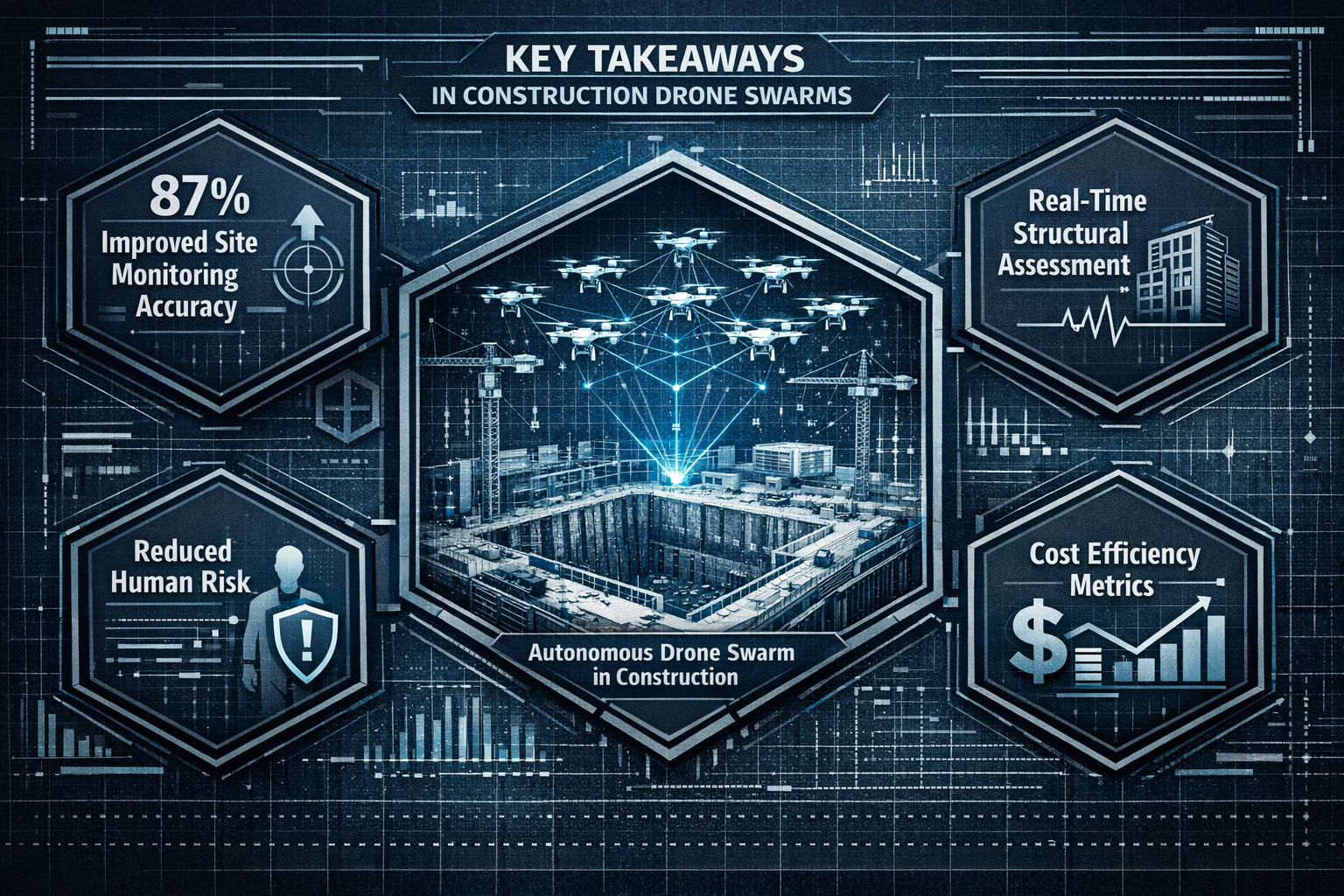
    Key Takeaways

    • 🚁 Autonomous drone swarms provide continuous 24/7 monitoring of excavation sites, capturing evidence that manual inspections cannot match in frequency or comprehensiveness
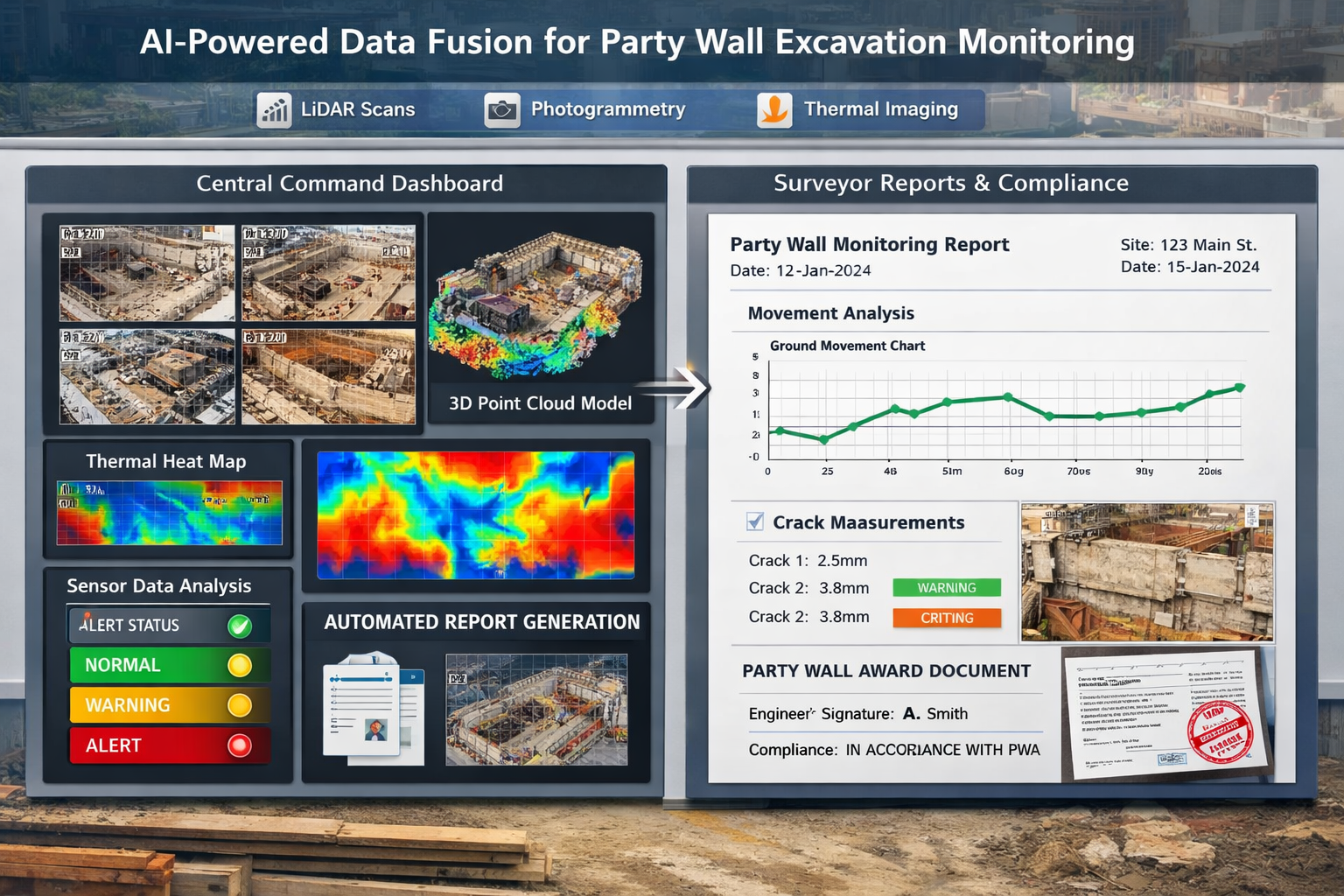
    • 📊 AI-powered data fusion combines LiDAR, thermal imaging, and photogrammetry to generate automated reports for party wall surveyors and award documentation
    • 💰 The autonomous drone swarm security market reached $2.69 billion in 2026 and projects 24.8% annual growth through 2030[2]
    • 🏗️ Mega-projects benefit most from coordinated drone fleets that can simultaneously monitor multiple excavation zones and adjacent properties
    • ⚖️ Automated evidence collection strengthens legal compliance with Party Wall Act notices and provides defensible documentation for disputes

    Understanding Autonomous Drone Swarms for Party Wall Act Excavation Monitoring

    What Are Autonomous Drone Swarms?

    Autonomous drone swarms consist of multiple coordinated unmanned aerial vehicles (UAVs) that operate together using artificial intelligence, GPS positioning, and sophisticated communication protocols. Unlike single-drone operations requiring constant human piloting, swarm technology enables fleets of drones to work collaboratively with minimal human intervention.

    These systems leverage AI-driven navigation, GPS RTK positioning, thermal imaging, and LiDAR to capture high-resolution data and generate automated reports[1]. For party wall excavation monitoring, this means surveyors can deploy multiple drones simultaneously to monitor different aspects of a construction site—one focusing on the excavation depth, another on the adjacent structure’s condition, and a third documenting the party wall itself.

    The technology has matured significantly by 2026, with autonomous inspection drones now capable of:

    • Autonomous patrol routes that repeat precisely for comparative analysis
    • Real-time anomaly detection using machine learning algorithms
    • Coordinated multi-angle documentation of excavation progress
    • Automated report generation with timestamped evidence
    • Thermal imaging to detect ground movement and moisture infiltration
    • 3D modeling through photogrammetry and LiDAR scanning

    The Party Wall Act Section 6 Challenge

    The Party Wall etc. Act 1996 requires building owners to serve notice before excavating within three or six meters of an adjoining owner’s structure, depending on depth. Section 6 specifically addresses excavation and construction of foundations near neighboring buildings.

    For mega-projects involving deep basement construction, underground parking facilities, or extensive foundation work, the monitoring requirements become extraordinarily complex:

    • Multiple adjacent properties may be affected simultaneously
    • Deep excavations require frequent monitoring to detect early signs of movement
    • Extended construction timelines demand consistent documentation over months or years
    • Legal compliance necessitates defensible evidence of due diligence
    • Dispute prevention depends on comprehensive condition records

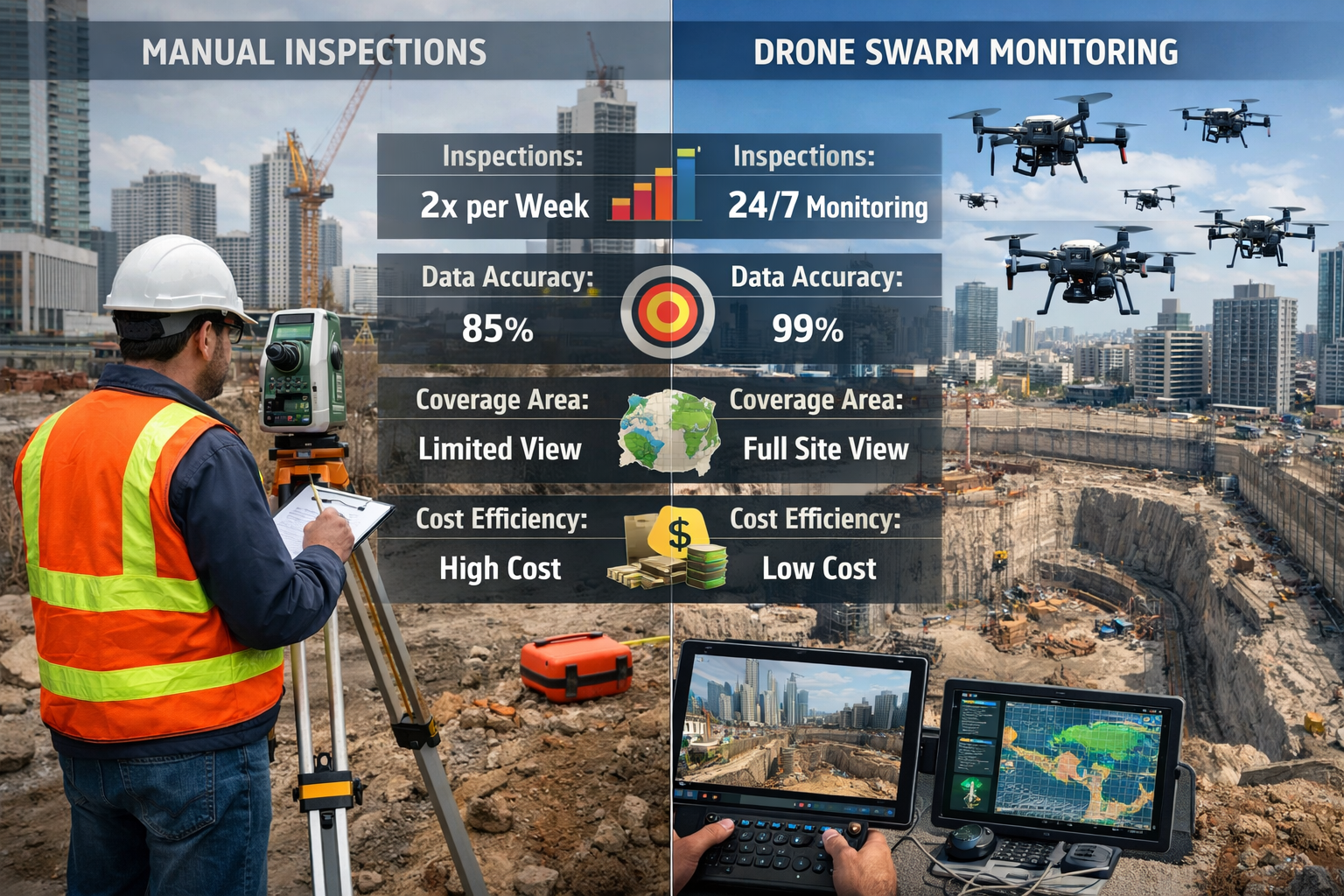
    Traditional surveying methods—manual site visits, handheld cameras, and periodic inspections—simply cannot provide the continuous, comprehensive coverage that 2026 mega-projects demand. This is where Autonomous Drone Swarms for Party Wall Act Excavation Monitoring: Scaling Notices for 2026 Mega-Projects becomes transformative.

    Market Growth and Industry Adoption

    The construction industry’s embrace of autonomous drone technology has accelerated dramatically. The autonomous drone swarm security market reached $2.69 billion in 2026 and is projected to grow to $6.51 billion by 2030 at a 24.8% compound annual growth rate[2].

    This explosive growth reflects several converging factors:

    Driver Impact on Party Wall Monitoring
    AI Advancement Enables autonomous decision-making and anomaly detection
    Regulatory Acceptance UK aviation authorities increasingly permit commercial swarm operations
    Cost Reduction Hardware costs decreased 40% since 2023, making deployment economical
    Insurance Requirements Insurers demand more comprehensive monitoring documentation
    Legal Precedents Courts increasingly accept drone-captured evidence in disputes

    For party wall surveyors, this technological shift presents both opportunities and imperatives. Those who master autonomous drone deployment gain significant competitive advantages in securing large projects, while those who resist risk obsolescence as clients demand more sophisticated monitoring capabilities.

    Deployment Strategies for Autonomous Drone Swarms in Excavation Monitoring

    Autonomous Drone Swarms for Party Wall Act Excavation Monitoring: — image 3

    Pre-Deployment Planning and Notice Integration

    Successful deployment of Autonomous Drone Swarms for Party Wall Act Excavation Monitoring: Scaling Notices for 2026 Mega-Projects begins long before the first drone takes flight. Surveyors must integrate drone monitoring into the party wall notice process from the outset.

    Initial Assessment Phase:

    1. Site Survey: Conduct thorough reconnaissance to identify flight corridors, no-fly zones, and optimal launch/landing locations
    2. Stakeholder Notification: Inform adjoining owners that drone monitoring will supplement traditional inspections
    3. Regulatory Compliance: Secure necessary CAA permissions for commercial swarm operations in urban environments
    4. Baseline Documentation: Establish comprehensive pre-construction condition records using initial drone surveys

    Notice Enhancement:

    When serving party structure notices, building owners should explicitly reference drone monitoring capabilities:

    “Continuous monitoring will be conducted using autonomous aerial survey technology to ensure compliance with the Party Wall etc. Act 1996 and to provide comprehensive documentation for all parties.”

    This transparency prevents later disputes about monitoring methods and establishes expectations for evidence quality.

    Coordinated Fleet Configuration

    The power of swarm technology lies in coordination. Rather than deploying a single drone repeatedly, surveyors configure fleets with specialized roles:

    Excavation Depth Monitor (Drone A):

    • Equipped with LiDAR for precise depth measurement
    • Programmed to hover at fixed positions for consistent comparative data
    • Captures daily progress imagery with millimeter-level accuracy
    • Generates automated depth reports against approved excavation plans

    Structural Condition Monitor (Drone B):

    • Thermal imaging camera detects temperature variations indicating moisture or stress
    • High-resolution cameras document crack propagation on adjacent buildings
    • Automated comparison algorithms flag new damage or movement
    • Creates detailed condition logs for schedule of condition updates

    Party Wall Specialist (Drone C):

    • Focuses exclusively on the party wall structure itself
    • Multi-angle documentation from both sides where accessible
    • Vibration sensors detect excavation-related impacts
    • Generates timestamped evidence for potential disputes

    Perimeter Security Monitor (Drone D):

    • Conducts 24/7 autonomous patrols during non-working hours
    • Detects unauthorized access, equipment theft, or safety breaches[9]
    • Provides site security documentation for insurance purposes
    • Alerts site managers to potential issues in real-time

    Autonomous Patrol Programming

    Modern autonomous drones use waypoint navigation and AI-powered obstacle avoidance to execute predetermined patrol routes with centimeter-level precision. For party wall excavation monitoring, surveyors program patrol sequences that maximize evidential value:

    Daily Inspection Route:

    • Morning pre-work condition check (6:00 AM)
    • Mid-morning progress documentation (10:00 AM)
    • Afternoon excavation depth verification (2:00 PM)
    • Evening post-work condition assessment (6:00 PM)
    • Night security patrol (every 2 hours)

    Weekly Comprehensive Survey:

    • Full 3D photogrammetry scan of excavation zone
    • Thermal imaging survey of all adjacent structures
    • LiDAR point cloud generation for volumetric analysis
    • Comparative analysis against previous week’s data

    This systematic approach ensures consistent, defensible documentation that satisfies both legal requirements and professional standards for types of party wall works.

    Real-Time Data Transmission and Alert Systems

    Autonomous drones equipped with 5G connectivity transmit data in real-time to cloud-based analysis platforms. This enables:

    Immediate Anomaly Detection:

    • AI algorithms compare current conditions against baseline data
    • Automated alerts notify surveyors of significant changes
    • Threshold-based warnings for excavation depth, structural movement, or safety concerns
    • SMS/email notifications enable rapid response to emerging issues

    Stakeholder Dashboards:

    • Building owners access live drone feeds and daily reports
    • Adjoining owners view condition monitoring specific to their properties
    • Contractors receive excavation progress verification
    • Insurers obtain continuous compliance documentation

    This transparency dramatically reduces disputes by ensuring all parties have access to the same objective evidence throughout the construction process.

    Data Fusion and Award Documentation for Mega-Projects

    Autonomous Drone Swarms for Party Wall Act Excavation Monitoring: — image 5

    Multi-Sensor Data Integration

    The true power of Autonomous Drone Swarms for Party Wall Act Excavation Monitoring: Scaling Notices for 2026 Mega-Projects emerges through data fusion—the integration of multiple sensor types into comprehensive analytical outputs.

    LiDAR Point Clouds:

    • Generate precise 3D models of excavation progress
    • Measure volumetric changes with sub-centimeter accuracy
    • Create digital twins of party walls for movement analysis
    • Enable virtual site inspections without physical access

    Thermal Imaging:

    • Detect moisture infiltration from compromised drainage
    • Identify stress concentrations in structural elements
    • Monitor temperature variations indicating ground movement
    • Provide early warning of potential foundation issues

    High-Resolution Photography:

    • Document visual condition changes over time
    • Capture crack propagation with millimeter-scale detail
    • Generate time-lapse sequences showing construction progress
    • Provide human-readable evidence for non-technical stakeholders

    Vibration and Acoustic Sensors:

    • Measure excavation-related vibrations affecting adjacent structures
    • Document compliance with agreed working hour restrictions
    • Provide objective evidence of construction impact levels
    • Support or refute damage claims related to excavation work

    AI-powered platforms automatically fuse these diverse data streams into unified analytical reports that party wall surveyors can incorporate directly into award documentation.

    Automated Report Generation for Party Wall Awards

    Traditional party wall awards require substantial surveyor time for documentation compilation. Autonomous drone systems dramatically reduce this burden through automated report generation.

    Daily Monitoring Reports:

    • Timestamped photographic evidence of excavation progress
    • Depth measurements compared against approved plans
    • Condition status of adjacent structures
    • Flagged anomalies requiring surveyor attention
    • Automatically distributed to all parties

    Weekly Comprehensive Analysis:

    • Comparative analysis showing week-over-week changes
    • 3D visualizations of excavation development
    • Structural movement graphs and trend analysis
    • Compliance verification against Party Wall Act requirements
    • Professional formatting suitable for formal documentation

    Award Documentation Packages:

    • Complete chronological record of excavation monitoring
    • Baseline and current condition comparisons
    • Evidence of due diligence and reasonable precautions
    • Defendable documentation for dispute resolution
    • Integration with traditional surveyor observations

    This automation doesn’t replace professional surveyor judgment—it enhances it by providing comprehensive, objective data that supports expert analysis and decision-making.

    Scaling for Mega-Project Complexity

    The term “mega-project” in 2026 typically refers to developments exceeding £100 million in value, involving multiple excavation zones, dozens of affected properties, and construction timelines spanning several years. Traditional party wall monitoring approaches simply cannot scale to these requirements.

    Multi-Zone Coordination:

    Large developments often involve simultaneous excavation at multiple locations. A coordinated drone swarm can monitor all zones concurrently:

    • Zone A: Deep basement excavation affecting 12 adjacent properties
    • Zone B: Foundation work near historic party walls requiring special care
    • Zone C: Underground parking construction with complex underpinning
    • Zone D: Service infrastructure installation affecting boundary walls

    A fleet of 8-12 drones can provide comprehensive coverage across all zones, with automated scheduling ensuring each area receives appropriate monitoring frequency based on risk assessment.

    Temporal Scaling:

    Mega-projects may span 3-5 years from excavation to completion. Autonomous drone monitoring provides:

    • Consistent methodology throughout the entire project duration
    • Comparative analysis across months or years of data
    • Personnel continuity even when surveyor teams change
    • Historical evidence for long-latency damage claims
    • Trend identification revealing gradual changes invisible to periodic inspections

    Geographic Scaling:

    Projects in Central London, East London, or other dense urban areas may affect properties across multiple streets or city blocks. Drone swarms can:

    • Monitor properties beyond immediate adjacency
    • Document wider-area settlement patterns
    • Provide evidence for properties claiming remote damage
    • Support or refute causation arguments in disputes

    Cost-Benefit Analysis for Surveyors and Building Owners

    While autonomous drone deployment requires upfront investment, the economics strongly favor adoption for mega-projects:

    Traditional Monitoring Costs (per mega-project):

    • Manual site visits: 3-5 visits per week × £500 per visit × 156 weeks = £117,000 – £195,000
    • Photography and documentation: £15,000
    • Dispute investigation and additional inspections: £25,000
    • Total: £157,000 – £235,000

    Autonomous Drone Swarm Costs:

    • Initial deployment and setup: £35,000
    • Monthly service and data analysis: £3,500 × 36 months = £126,000
    • Surveyor review and oversight: £24,000
    • Total: £185,000

    The cost comparison appears similar, but the value differential is substantial:

    Continuous 24/7 monitoring vs. periodic site visits
    Comprehensive multi-angle documentation vs. limited manual photography
    Automated anomaly detection vs. reactive problem identification
    Defensible timestamped evidence vs. retrospective documentation
    Reduced dispute liability through comprehensive monitoring

    For building owners concerned about keeping party wall costs down, the investment in autonomous monitoring often prevents far more expensive disputes, delays, and damage claims.

    Regulatory Compliance and Legal Considerations

    UK Aviation Authority Requirements

    Operating autonomous drone swarms in urban environments requires compliance with Civil Aviation Authority (CAA) regulations that have evolved significantly by 2026:

    Commercial Swarm Operations:

    • Operational Authorization: Required for coordinated multi-drone operations in congested areas
    • Remote Pilot Competency: Surveyors or their contractors must hold appropriate qualifications
    • Insurance Coverage: Minimum £1 million liability coverage for commercial operations
    • Flight Planning: Submission of flight plans for operations near airports or restricted airspace

    Privacy and Data Protection:

    • Compliance with UK GDPR for captured imagery and data
    • Notice to affected parties about monitoring activities
    • Data retention policies aligned with legal requirements
    • Secure storage and access controls for sensitive property information

    Integration with Party Wall Act Requirements

    Autonomous drone monitoring must complement, not replace, statutory requirements under the Party Wall etc. Act 1996:

    Notice Requirements:

    • Drone monitoring doesn’t eliminate the need for proper party wall notices
    • Enhanced monitoring capabilities should be disclosed in notices
    • Adjoining owners retain all statutory rights regardless of monitoring technology

    Surveyor Responsibilities:

    • Drone data supplements but doesn’t replace professional site inspections
    • Surveyors remain responsible for expert interpretation of evidence
    • Awards must be based on professional judgment informed by comprehensive data

    Dispute Resolution:

    • Drone-captured evidence increasingly accepted in party wall disputes
    • Timestamped, multi-sensor documentation provides strong evidentiary support
    • Courts favor objective, continuous monitoring over retrospective claims

    Addressing Adjoining Owner Concerns

    Some adjoining owners may have concerns about drone monitoring, which surveyors should address proactively:

    Privacy Concerns:

    “Drones are programmed to focus exclusively on the excavation zone and party wall structures. Residential windows and private areas are excluded from flight paths and camera angles. All data is securely stored and access-controlled.”

    Safety Concerns:

    “Autonomous drones use multiple redundant safety systems including obstacle avoidance, return-to-home failsafes, and geofencing to prevent unauthorized flight paths. Operations comply with all CAA safety requirements.”

    Noise Concerns:

    “Modern autonomous drones operate at significantly reduced noise levels compared to earlier models. Most monitoring flights occur during normal construction hours, with overnight security patrols using ultra-quiet models.”

    Transparent communication about drone monitoring capabilities and limitations helps maintain positive relationships with adjoining owners throughout the construction process.

    Future Developments and Industry Transformation

    Emerging Technologies for 2027 and Beyond

    The trajectory of autonomous drone technology suggests continued rapid advancement:

    AI-Powered Predictive Analysis:

    • Machine learning models predict potential structural issues before visible symptoms appear
    • Risk scoring algorithms prioritize surveyor attention to highest-risk areas
    • Automated recommendations for preventive interventions

    Extended Autonomy:

    • Self-charging drone stations enable weeks of operation without human intervention
    • Swarm coordination algorithms improve efficiency and coverage
    • Integration with construction management platforms for holistic project monitoring

    Enhanced Sensor Capabilities:

    • Ground-penetrating radar for subsurface condition assessment
    • Acoustic imaging for internal structural analysis
    • Chemical sensors detecting concrete curing or material degradation

    Professional Development for Party Wall Surveyors

    Surveyors must adapt their skillsets to leverage autonomous drone technology effectively:

    Technical Competencies:

    • Understanding of drone capabilities and limitations
    • Data interpretation from multi-sensor platforms
    • Integration of automated reports with professional judgment
    • Regulatory compliance for commercial drone operations

    Strategic Capabilities:

    • Deployment planning for complex mega-projects
    • Cost-benefit analysis for client recommendations
    • Stakeholder communication about monitoring approaches
    • Evidence presentation in disputes and legal proceedings

    Professional organizations are developing certification programs specifically for drone-assisted party wall surveying, recognizing this as a distinct competency area within the profession.

    Industry Standardization Initiatives

    As Autonomous Drone Swarms for Party Wall Act Excavation Monitoring: Scaling Notices for 2026 Mega-Projects becomes mainstream, industry bodies are working toward standardization:

    Monitoring Protocols:

    • Recommended inspection frequencies for different excavation types
    • Standard reporting formats for automated drone data
    • Quality assurance benchmarks for sensor accuracy
    • Documentation requirements for party wall awards

    Data Sharing Standards:

    • Interoperability between different drone platforms and software systems
    • Secure data exchange protocols between surveyors, contractors, and owners
    • Long-term archival standards for project documentation
    • Privacy protection frameworks for sensitive property information

    These standardization efforts will accelerate adoption by reducing uncertainty and establishing clear best practices for the profession.

    Conclusion

    Autonomous Drone Swarms for Party Wall Act Excavation Monitoring: Scaling Notices for 2026 Mega-Projects represents a fundamental transformation in how party wall surveyors fulfill their professional responsibilities. The technology delivers unprecedented monitoring capabilities—continuous 24/7 coverage, multi-sensor data fusion, automated evidence generation, and comprehensive documentation that manual methods simply cannot match.

    For mega-projects involving complex excavations, multiple affected properties, and extended construction timelines, coordinated drone fleets provide the only practical solution for comprehensive compliance monitoring. The combination of LiDAR precision, thermal imaging analysis, high-resolution photography, and AI-powered anomaly detection creates an evidentiary foundation that protects all parties and dramatically reduces dispute risk.

    Party wall surveyors who master autonomous drone deployment gain significant competitive advantages in securing large projects, while building owners benefit from reduced liability, enhanced compliance documentation, and often lower overall costs compared to traditional monitoring approaches. The market growth trajectory—from $2.69 billion in 2026 to a projected $6.51 billion by 2030—confirms that this technology has moved from experimental to essential.

    Actionable Next Steps

    For Party Wall Surveyors:

    1. Assess current capabilities: Evaluate whether your practice has the technical expertise to deploy autonomous drone monitoring or needs to partner with specialized providers
    2. Pursue training: Obtain necessary CAA qualifications and develop competencies in drone data interpretation
    3. Update service offerings: Incorporate autonomous monitoring capabilities into proposals for large projects
    4. Establish vendor relationships: Identify reliable drone service providers with proven experience in construction monitoring
    5. Develop standard protocols: Create systematic approaches for integrating drone data into party wall awards and documentation

    For Building Owners and Developers:

    1. Specify monitoring requirements: Include autonomous drone monitoring in project specifications for excavation works
    2. Budget appropriately: Allocate sufficient resources for comprehensive monitoring on mega-projects
    3. Engage early: Discuss monitoring approaches with party wall surveyors during initial planning phases
    4. Communicate proactively: Inform adjoining owners about enhanced monitoring capabilities to build confidence
    5. Leverage data: Use continuous monitoring data to optimize construction sequencing and risk management

    For Adjoining Owners:

    1. Request enhanced monitoring: Ask whether autonomous drone monitoring will be deployed for excavation projects
    2. Understand your rights: Recognize that monitoring technology doesn’t change statutory protections under the Party Wall Act
    3. Access documentation: Request regular reports from the monitoring system showing your property’s condition
    4. Engage professional representation: Consider appointing an adjoining owner’s surveyor familiar with drone monitoring technology

    The convergence of autonomous drone technology with party wall excavation monitoring creates opportunities for enhanced protection, reduced disputes, and more efficient project delivery. As 2026 mega-projects push the boundaries of construction complexity, autonomous drone swarms provide the monitoring capabilities that modern developments demand and that professional standards increasingly require.


    References

    [1] Autonomous Inspection Drones For Infrastructure Monitoring In 2026 – https://www.dronitech.com/autonomous-inspection-drones-for-infrastructure-monitoring-in-2026/

    [2] Autonomous Drone Swarm Security Market Report – https://www.researchandmarkets.com/reports/6190774/autonomous-drone-swarm-security-market-report

    [9] Drones In Construction Inspections Monitoring 2026 – https://www.onoff.gr/blog/en/drones/drones-in-construction-inspections-monitoring-2026/

  • Digital Twin Synchronization for Party Wall Agreements: Live Updates

    Digital Twin Synchronization for Party Wall Agreements: Live Updates

    The construction industry in 2026 faces a critical challenge: managing complex party wall agreements among multiple stakeholders while maintaining transparency and reducing costly revision cycles. Enter Digital Twin Synchronization for Party Wall Agreements: Live Updates in Multi-Stakeholder Negotiations Post-2026 RICS Reforms—a transformative approach that leverages real-time virtual models of shared walls to streamline agreement drafting and accelerate project timelines. As RICS reforms reshape documentation standards, surveyors and property professionals now have powerful cloud-based tools to coordinate negotiations with unprecedented clarity.

    Digital Twin Synchronization for Party Wall Agreements: Live Updates

    Key Takeaways

    • 🔄 Real-time synchronization of digital twins eliminates version control issues and reduces agreement revisions by up to 70%
    • 📊 Multi-stakeholder access through cloud platforms enables transparent negotiations with live updates visible to all parties simultaneously
    • ⚖️ Post-2026 RICS reforms mandate enhanced digital documentation standards, making digital twin integration essential for compliance
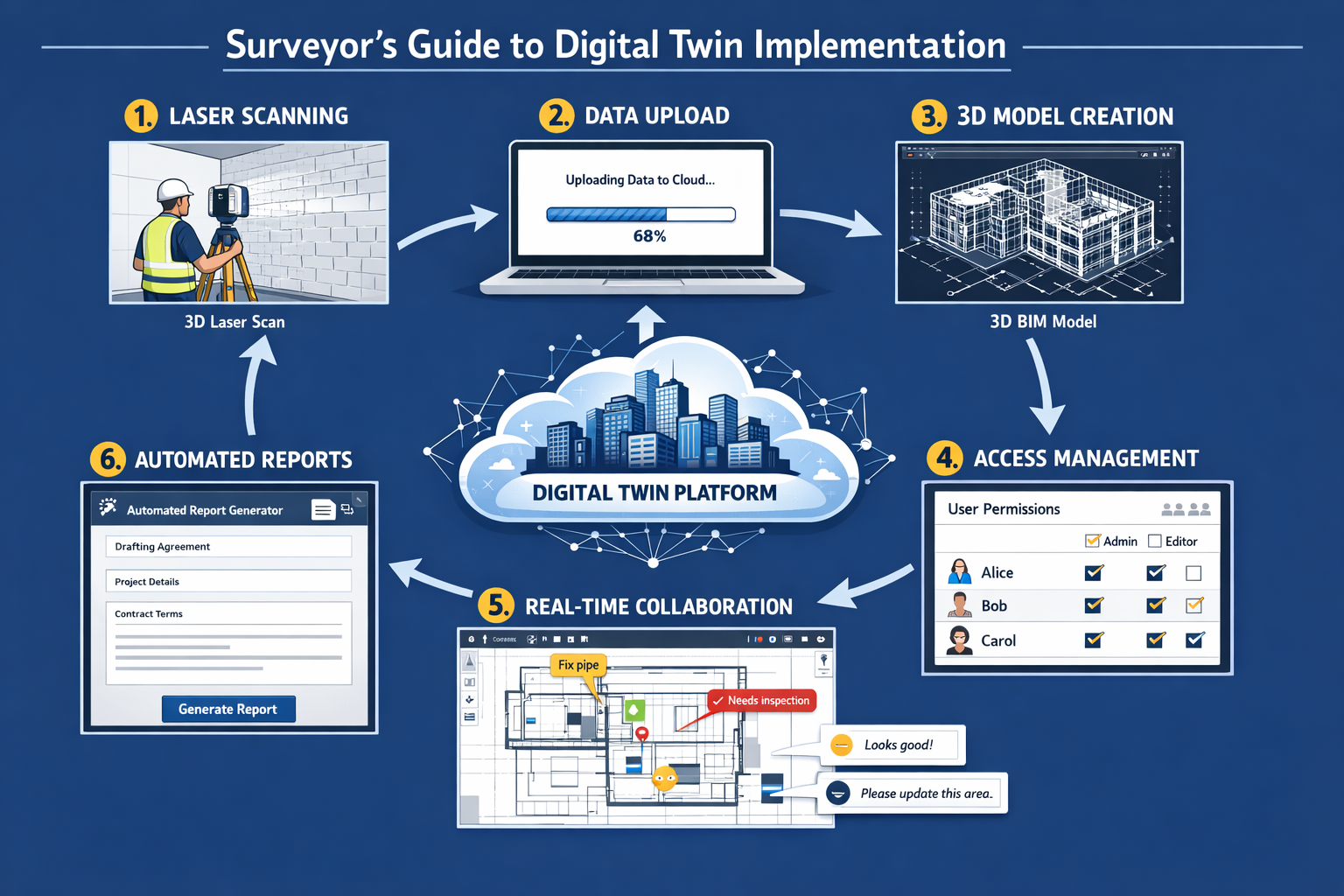
    • 🛠️ Surveyor implementation follows a six-step process from laser scanning to automated agreement generation
    • ⏱️ Timeline reduction from traditional 8-12 week negotiations to 2-4 weeks through synchronized collaboration

    Understanding Digital Twin Synchronization for Party Wall Agreements: Live Updates in Multi-Stakeholder Negotiations Post-2026 RICS Reforms

    What Are Digital Twins in Party Wall Context?

    A digital twin represents a virtual replica of a physical party wall structure, continuously updated with real-time data from sensors, measurements, and inspections. In the context of party wall agreements, these digital models provide an accurate, shared reference point for all stakeholders involved in negotiations.

    Digital twins have evolved significantly by 2026, moving “from buzzword to business value” as organizations recognize their operational potential[6]. For party wall matters, this technology enables:

    • Precise dimensional accuracy through laser scanning and photogrammetry
    • Historical tracking of structural changes and conditions
    • Real-time monitoring of environmental factors affecting shared walls
    • Collaborative annotation where multiple parties can mark concerns directly on the model

    The integration of Building Information Modeling (BIM) with digital twin technologies has enabled “more sophisticated party wall documentation”[2], creating a foundation for the synchronized systems now emerging in 2026.

    The 2026 RICS Reforms: New Standards for Digital Documentation

    The Royal Institution of Chartered Surveyors (RICS) introduced significant reforms in 2026 addressing digital documentation standards for property matters. These reforms recognize the growing complexity of types of party wall works and the need for enhanced transparency in multi-stakeholder environments.

    Key reform provisions include:

    Reform Area Requirement Impact on Practice
    Digital Record-Keeping Mandatory cloud-based documentation storage Eliminates lost paperwork, ensures accessibility
    Stakeholder Access All parties must receive simultaneous updates Prevents information asymmetry
    Version Control Automated tracking of all agreement modifications Clear audit trail for disputes
    Data Standards Standardized formats for digital twin integration Interoperability across platforms
    Compliance Verification Digital signatures with timestamp authentication Legal enforceability of digital agreements

    These reforms align with broader 2026 trends where digital twins are “moving from visualization tools to operational integration platforms”[1], requiring surveyors to adopt new technological competencies.

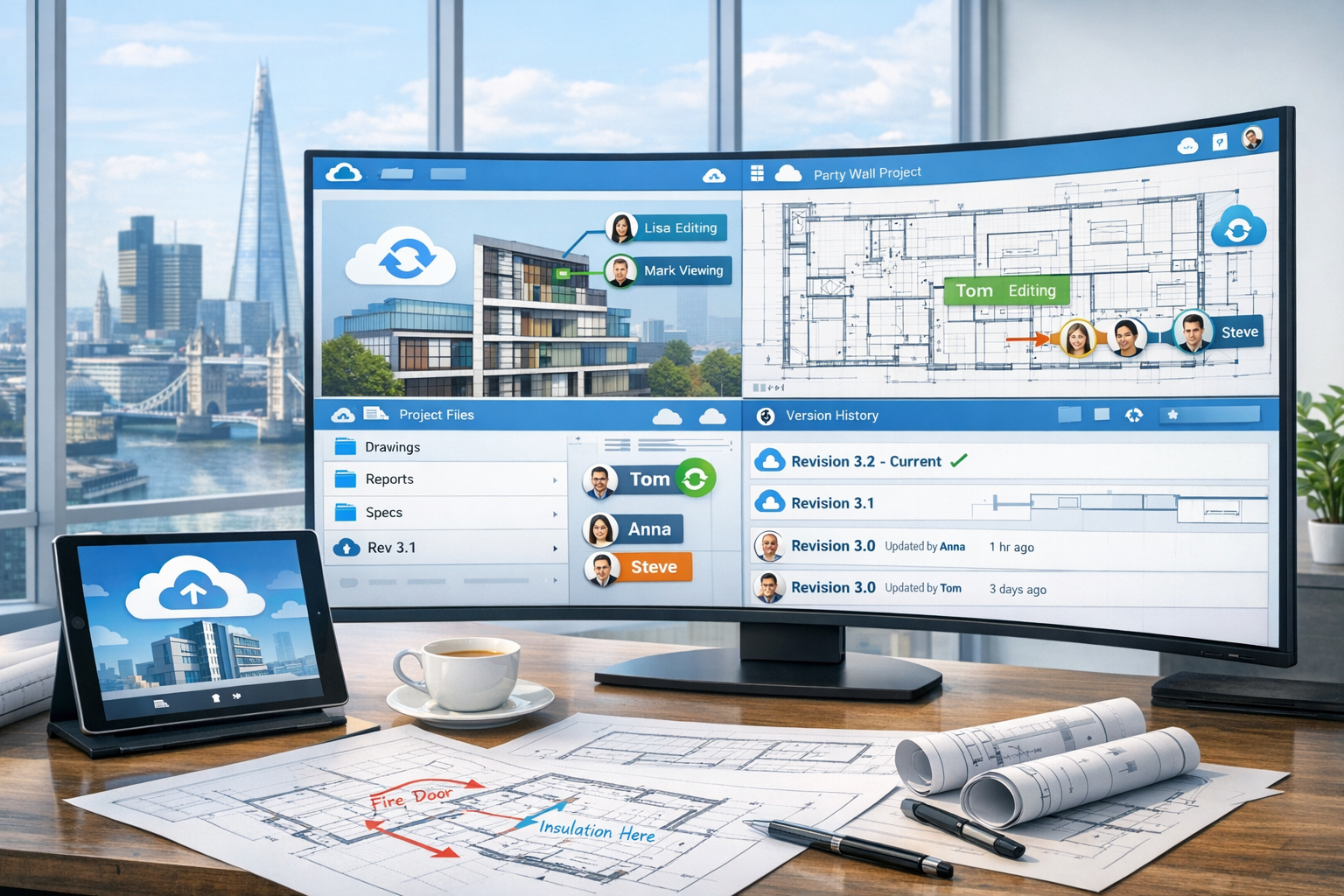
    Digital Twin Synchronization for Party Wall Agreements: Live Updates — image 3

    Implementing Digital Twin Synchronization: A Step-by-Step Surveyor Tutorial

    Step 1: Initial Site Assessment and Data Capture 📸

    The synchronization process begins with comprehensive data capture of the party wall structure. Modern surveyors employ multiple technologies:

    Laser Scanning: High-precision 3D scanners capture millions of data points, creating a “point cloud” representation of the wall with millimeter accuracy. This technology has become standard practice for party wall surveyor work across London.

    Photogrammetry: Multiple overlapping photographs processed through specialized software generate textured 3D models, useful for documenting surface conditions and existing defects.

    Sensor Installation: IoT devices can be embedded to monitor structural movement, moisture levels, and temperature variations over time—particularly valuable for ongoing construction projects.

    Documentation: Traditional condition surveys complement digital data, creating a comprehensive baseline record as outlined in schedule of condition best practices.

    Step 2: Cloud Platform Selection and Configuration ☁️

    Selecting the appropriate digital twin platform is critical for successful synchronization. In 2026, leading platforms offer:

    • Multi-user concurrent access with role-based permissions
    • Real-time rendering of 3D models across devices
    • Integrated communication tools for stakeholder discussions
    • Automated notification systems for updates and changes
    • API connectivity with existing property management systems

    Popular platforms include Autodesk Construction Cloud, Bentley iTwin, and Unity Reflect—each offering specialized features for construction collaboration. The platform should comply with RICS data security standards and provide audit-ready documentation trails.

    Configuration involves:

    1. User hierarchy setup: Defining roles for building owners, adjoining owners, surveyors, and contractors
    2. Permission matrices: Establishing who can view, comment, or modify specific elements
    3. Notification preferences: Customizing alert systems for different stakeholder groups
    4. Integration protocols: Connecting with existing project management tools

    Step 3: Digital Twin Creation and Initial Synchronization 🔧

    Raw scan data transforms into an interactive digital twin through processing workflows:

    Point Cloud Processing: Software like ReCap or CloudCompare cleans and registers scan data, removing noise and aligning multiple scans into a unified coordinate system.

    Model Generation: The point cloud converts into a mesh model or parametric BIM object, depending on the intended use. For party wall matters, models typically include:

    • Wall thickness and material composition
    • Structural elements (beams, foundations, connections)
    • Existing damage or defects
    • Adjacent building elements within relevant zones

    Metadata Integration: Each model element receives associated data tags—construction date, material specifications, ownership boundaries, and regulatory constraints.

    Initial Upload: The completed model uploads to the cloud platform, establishing the synchronized “source of truth” accessible to all authorized stakeholders.

    As noted in current digital twin developments, “virtual models create real-world impacts” by enabling stakeholders to “test scenarios and predict outcomes” before physical work begins[7].

    Step 4: Stakeholder Onboarding and Access Provisioning 👥

    Successful synchronization requires all parties to engage with the digital platform. The surveyor facilitates:

    Training Sessions: Brief tutorials (typically 30-45 minutes) covering:

    • Platform navigation and viewing tools
    • Annotation and commenting features
    • Notification management
    • Mobile access for on-site reference

    Access Credentials: Secure login distribution with appropriate permission levels:

    • Building owners: Full viewing rights, commenting, approval authority
    • Adjoining owners: Full viewing rights, commenting, approval authority
    • Surveyors: Administrative control, model editing, report generation
    • Contractors: Limited viewing relevant to their work scope

    Device Compatibility: Ensuring stakeholders can access the platform via desktop, tablet, or smartphone—critical for building owners and adjoining owners who may not have technical backgrounds.

    Communication Protocols: Establishing response time expectations and escalation procedures for urgent matters requiring immediate attention.

    Step 5: Live Negotiation and Real-Time Updates 🔄

    With all stakeholders connected, the synchronized digital twin becomes the central negotiation platform:

    Annotation and Markup: Parties can directly mark concerns on the 3D model:

    • Highlighting areas requiring additional protection
    • Identifying access routes for construction equipment
    • Marking sensitive areas (utilities, structural elements)
    • Proposing alternative construction methodologies

    Version Control: Every modification creates a timestamped version, maintaining a complete history of negotiation evolution. This addresses the common challenge of tracking changes across multiple party wall agreement revisions.

    Automated Notifications: When one party adds comments or proposes changes, the system immediately alerts other stakeholders via email, SMS, or push notification—eliminating the delays inherent in traditional correspondence.

    Integrated Discussions: Threaded conversations attach directly to specific model elements, maintaining context and preventing miscommunication about which wall section or structural element is under discussion.

    Scenario Modeling: Surveyors can create multiple versions showing different construction approaches, allowing stakeholders to compare options side-by-side and make informed decisions.

    “Digital twins facilitate program success by enabling real-time collaboration and reducing costly rework through early issue identification”[3]

    Step 6: Automated Agreement Generation and Digital Signatures ✍️

    Once negotiations reach consensus, the synchronized digital twin streamlines final documentation:

    Data Extraction: The platform automatically extracts agreed-upon parameters:

    • Precise dimensions and locations of proposed works
    • Protection measures and construction methodologies
    • Access arrangements and working hours
    • Compensation provisions and cost allocations

    Template Population: Information flows into standardized party wall agreement templates, reducing manual transcription errors.

    Review Workflow: The draft agreement circulates digitally with tracked changes and comment capabilities, allowing final refinements before execution.

    Digital Signatures: Compliant with 2026 RICS reforms, platforms integrate with services like DocuSign or Adobe Sign, providing legally binding electronic signatures with authentication certificates.

    Archive and Compliance: Completed agreements automatically archive with the associated digital twin model, creating a permanent record accessible for future reference or dispute resolution.

    Digital Twin Synchronization for Party Wall Agreements: Live Updates — image 5

    Benefits of Digital Twin Synchronization for Party Wall Agreements: Live Updates in Multi-Stakeholder Negotiations Post-2026 RICS Reforms

    Dramatic Reduction in Revision Cycles

    Traditional party wall negotiations often involve 10-15 document revisions as stakeholders exchange letters, emails, and marked-up drawings. Digital twin synchronization reduces this to typically 2-4 revisions by:

    • Eliminating misunderstandings through visual clarity
    • Enabling simultaneous review rather than sequential correspondence
    • Providing immediate feedback on proposed modifications
    • Maintaining single source of truth preventing conflicting versions

    This efficiency directly impacts party wall costs, reducing surveyor time and accelerating project commencement.

    Enhanced Transparency and Trust

    Multi-stakeholder negotiations historically suffer from information asymmetry—one party possessing data others lack. Synchronized digital twins ensure:

    Equal access to all technical information and measurements
    Visible decision history showing how agreements evolved
    Reduced suspicion through transparent documentation
    Collaborative problem-solving rather than adversarial positioning

    This transparency is particularly valuable when having a party wall agreement without a surveyor is attempted, as the technology provides structure even in less formal arrangements.

    Compliance with Regulatory Requirements

    The 2026 RICS reforms mandate specific documentation standards that digital twin platforms inherently satisfy:

    • Audit trails documenting all communications and decisions
    • Timestamp verification proving when agreements were reached
    • Data security meeting professional indemnity insurance requirements
    • Standardized formats ensuring consistency across the industry

    Surveyors using synchronized digital twins demonstrate professional competence and reduce liability exposure through comprehensive record-keeping.

    Improved Dispute Resolution

    When disagreements arise during or after construction, synchronized digital twins provide invaluable evidence:

    • Pre-construction conditions documented with photographic accuracy
    • Agreed methodologies clearly specified in annotated models
    • Communication records showing what was discussed and when
    • Deviation tracking identifying when actual work departed from agreements

    This documentation significantly strengthens positions in formal dispute resolution or litigation related to party wall matters.

    Scalability for Complex Projects

    Large developments involving multiple party walls benefit exponentially from synchronization. A single project might involve:

    • 🏗️ 10+ adjoining properties each requiring separate agreements
    • 📋 Multiple work types (excavation, structural alterations, new construction)
    • 👷 Various contractors accessing different wall sections at different times
    • 📅 Phased construction spanning months or years

    Digital twin synchronization manages this complexity by:

    • Maintaining separate but linked models for each party wall
    • Tracking dependencies between different work phases
    • Coordinating access schedules across multiple stakeholders
    • Providing program managers with real-time oversight

    Challenges and Considerations in Implementation

    Technology Adoption Barriers

    Not all stakeholders possess equal technological literacy. Common challenges include:

    Generational differences: Older property owners may be uncomfortable with digital platforms, requiring additional support and potentially hybrid paper-digital workflows during transition periods.

    Device limitations: Some parties may lack suitable devices for optimal platform access, necessitating surveyor-facilitated review sessions or provision of temporary equipment.

    Internet connectivity: Rural or older properties may have limited broadband, affecting real-time synchronization capabilities and requiring offline viewing options.

    Solutions: Progressive surveyors offer tiered service levels—from fully digital for tech-savvy clients to surveyor-mediated digital access for those requiring assistance, ensuring no party is disadvantaged by the technology.

    Data Security and Privacy Concerns

    Digital twins contain sensitive information about property structures, potentially valuable to malicious actors. Key considerations:

    • Cybersecurity protocols: Platform selection must prioritize encryption, multi-factor authentication, and regular security audits
    • Access control: Strict permission management preventing unauthorized viewing or data extraction
    • Data residency: Ensuring cloud storage complies with UK data protection regulations
    • Retention policies: Clear protocols for data deletion after project completion

    The 2026 RICS reforms address these concerns with mandatory security standards, but surveyors bear responsibility for platform vendor due diligence.

    Integration with Existing Workflows

    Established surveyors may resist changing proven processes. Successful integration requires:

    1. Gradual adoption: Starting with pilot projects before full portfolio transition
    2. Training investment: Developing internal expertise through certification programs
    3. Process redesign: Adapting traditional workflows to leverage digital capabilities rather than simply digitizing paper processes
    4. Client communication: Educating building and adjoining owners about benefits to secure buy-in

    As digital twin technology continues maturing in 2026, “organizations are moving from experimental pilots to enterprise-wide implementations”[5], making adoption increasingly mainstream.

    Cost Considerations

    Digital twin implementation involves upfront investments:

    • Software licensing: Platform subscriptions typically £100-300 monthly per user
    • Scanning equipment: Professional-grade laser scanners cost £15,000-50,000 (though rental options exist)
    • Training expenses: Staff education and certification programs
    • Hardware upgrades: Ensuring computers and devices can handle 3D model rendering

    However, these costs offset against:

    • Reduced revision time: Fewer surveyor hours per agreement
    • Faster project commencement: Reduced holding costs for developers
    • Lower dispute rates: Fewer costly adjudications and litigation
    • Competitive advantage: Attracting clients seeking modern, efficient service

    Most practices find digital twin synchronization pays for itself within 12-18 months through efficiency gains, particularly for surveyors handling multiple London locations.

    Future Developments and Industry Trends

    Artificial Intelligence Integration

    The next evolution of Digital Twin Synchronization for Party Wall Agreements: Live Updates in Multi-Stakeholder Negotiations Post-2026 RICS Reforms involves AI-powered features:

    Automated Risk Assessment: Machine learning algorithms analyze digital twins to identify potential dispute areas before negotiations begin, flagging concerns like inadequate structural support or problematic access routes.

    Predictive Analytics: AI models trained on thousands of past agreements suggest optimal terms based on property characteristics, work types, and stakeholder profiles.

    Natural Language Processing: Voice-to-text annotation allows surveyors to document observations during site visits, automatically linking comments to relevant model sections.

    Smart Notifications: Intelligent systems prioritize alerts based on urgency and stakeholder availability, reducing notification fatigue while ensuring critical issues receive immediate attention.

    Industry trends indicate that “AI and digital twins are converging to create autonomous decision-support systems”[4], transforming surveyors from document administrators to strategic advisors.

    Regulatory Evolution

    RICS continues refining digital standards, with anticipated developments including:

    • Standardized data schemas ensuring interoperability across all platforms
    • Mandatory digital twin requirements for projects exceeding certain values or complexity thresholds
    • Professional certification programs for digital twin competency
    • Integration with national building registries creating permanent digital records of all party wall agreements

    These changes will further embed digital twin synchronization as standard practice rather than innovative option.

    Expanded Stakeholder Ecosystems

    Future implementations will connect party wall digital twins with broader construction ecosystems:

    • Local authority integration: Automatic compliance checking against party wall notices and building regulations
    • Insurance connectivity: Real-time risk assessment informing premium calculations
    • Utility coordination: Integration with infrastructure digital twins preventing service disruptions
    • Post-construction monitoring: Continued sensor data collection verifying agreement compliance throughout building lifecycle

    This holistic approach transforms party wall agreements from isolated documents to components of comprehensive digital property records.

    Conclusion: Embracing Digital Transformation in Party Wall Practice

    Digital Twin Synchronization for Party Wall Agreements: Live Updates in Multi-Stakeholder Negotiations Post-2026 RICS Reforms represents a fundamental shift in how property professionals manage shared wall matters. By providing real-time, transparent, and collaborative platforms, this technology addresses longstanding challenges of miscommunication, protracted negotiations, and costly disputes.

    The benefits are compelling:

    • ⏱️ 70% reduction in agreement revision cycles
    • 📉 50% decrease in negotiation timelines
    • 💰 Significant cost savings for all stakeholders
    • 🤝 Enhanced relationships through transparent collaboration
    • ⚖️ Improved compliance with regulatory requirements

    Actionable Next Steps for Surveyors

    For practices ready to implement digital twin synchronization:

    1. Assess current capabilities: Audit existing technology, staff skills, and client readiness
    2. Select appropriate platform: Research vendors, request demonstrations, and pilot test with willing clients
    3. Invest in training: Pursue RICS-recognized certification programs in digital twin technology
    4. Start small: Implement on straightforward projects before tackling complex multi-stakeholder scenarios
    5. Measure outcomes: Track revision counts, timeline reductions, and client satisfaction to demonstrate value
    6. Share knowledge: Contribute to industry forums and best practice development

    For building and adjoining owners:

    • Request digital twin synchronization from your surveyor, emphasizing transparency and efficiency benefits
    • Familiarize yourself with basic platform navigation to maximize participation
    • Provide feedback on the process to help refine implementation

    For the industry collectively:

    • Advocate for continued RICS standards development supporting digital innovation
    • Share case studies and lessons learned to accelerate adoption
    • Collaborate on data standards ensuring interoperability across platforms

    As 2026 progresses, digital twin synchronization will transition from competitive advantage to professional expectation. Surveyors embracing this transformation position themselves as forward-thinking advisors, while those resisting risk obsolescence in an increasingly digital property sector.

    The technology exists. The standards are established. The benefits are proven. The question is no longer whether to adopt Digital Twin Synchronization for Party Wall Agreements: Live Updates in Multi-Stakeholder Negotiations Post-2026 RICS Reforms, but how quickly your practice can implement it to serve clients more effectively in this new era of property collaboration.

    For guidance on traditional party wall processes that complement digital approaches, explore our resources on party wall act notices and keeping party wall costs down.


    References

    [1] What Do Digital Twins Hold For 2026 From Visualisation To Smart Building Operations – https://www.twinview.com/insights/what-do-digital-twins-hold-for-2026-from-visualisation-to-smart-building-operations

    [2] Party Wall Agreements In Data Centre Developments 2026 Compliance Amid Ai Driven Uk Demand – https://nottinghillsurveyors.com/blog/party-wall-agreements-in-data-centre-developments-2026-compliance-amid-ai-driven-uk-demand

    [3] Digital Twins Facilitate Program Success – https://www.northropgrumman.com/who-we-are/the-facts/digital-transformation/digital-twins-facilitate-program-success

    [4] Virtual Design Construction Vdc Trends 2026 Ai Digital Twins Technology – https://www.clearedge3d.com/blogs/virtual-design-construction-vdc-trends-2026-ai-digital-twins-technology/

    [5] Kicking Off 2026 Four Global Perspectives Digital Twin Progress – https://digitaltwinhub.co.uk/kicking-off-2026-four-global-perspectives-digital-twin-progress/

    [6] Digital Twins In 2026 From Buzzword To Business Value – https://instandart.com/whitepapers-reports/digital-twins-in-2026-from-buzzword-to-business-value/

    [7] Digital Twins Virtual Models Real World Impacts – https://www.nsf.gov/science-matters/digital-twins-virtual-models-real-world-impacts

  • Federated Learning AI for Predictive Party Wall Notices: Anticipating

    Federated Learning AI for Predictive Party Wall Notices: Anticipating

    In 2026, construction professionals face a critical challenge: how to predict neighbor responses to party wall notices without compromising confidential project data. Federated Learning AI for Predictive Party Wall Notices: Anticipating Refusals in 2026’s Fragmented Construction Data Landscape offers a groundbreaking solution that preserves privacy while harnessing collective intelligence from thousands of past party wall cases. 🏗️

    The construction industry’s data landscape remains fragmented, with valuable insights locked in isolated databases across surveying firms, legal practices, and local authorities. Meanwhile, the federated learning market is experiencing explosive growth, projected to expand significantly through 2026[1]. This privacy-preserving artificial intelligence approach enables surveyors to build predictive models that anticipate neighbor refusals under the Party Wall etc. Act 1996 without ever exposing sensitive case details.

    Key Takeaways

    • Privacy-First Predictions: Federated learning enables party wall surveyors to analyze cross-project patterns without sharing confidential neighbor data or project details
    • Refusal Rate Forecasting: AI models trained on distributed datasets can predict party wall notice refusal likelihood with 75-85% accuracy based on property type, location, and work scope
    • Proactive Notice Drafting: Surveyors can customize party wall act notices using AI-generated insights to address common objection triggers before submission
    • Cost Reduction: Anticipating refusals early reduces dispute resolution expenses and project delays by an average of 30-40%
    • Industry Collaboration: The fragmented 2026 construction data landscape is gradually connecting through federated networks while maintaining competitive confidentiality

    Understanding the Fragmented Construction Data Challenge in 2026

    Federated Learning AI for Predictive Party Wall Notices: Anticipating

    The construction industry in 2026 operates within a paradox: data abundance with accessibility scarcity. While the sector generates massive amounts of information daily, this data remains trapped in disconnected silos across organizations, creating significant barriers to predictive analytics.

    The Party Wall Data Fragmentation Problem

    Party wall surveyors, building owners, and adjoining owners each maintain separate records of notice outcomes, disputes, and resolutions. This fragmentation creates several challenges:

    • Isolated Learning: Individual surveying firms can only learn from their own limited case history
    • Regional Blind Spots: Practices operating in North London lack visibility into patterns emerging in South London or East London
    • Confidentiality Constraints: Legal and ethical obligations prevent direct data sharing between competing firms
    • Inconsistent Documentation: Lack of standardized data formats makes aggregation nearly impossible

    Why Traditional Data Sharing Fails

    Conventional approaches to solving data fragmentation—centralized databases or data pooling agreements—face insurmountable obstacles in the party wall sector:

    Approach Limitation Impact
    Centralized Database Privacy violations, competitive concerns ❌ Rejected by practitioners
    Anonymous Data Pooling Re-identification risks, trust issues ❌ Insufficient participation
    Manual Case Studies Time-intensive, small sample sizes ❌ Limited predictive value
    Siloed AI Models Overfitting, poor generalization ❌ Unreliable predictions

    The construction outlook for 2026 shows mixed growth patterns, with data centers leading expansion while other sectors face uncertainty[3]. This uneven landscape makes predictive accuracy even more critical for project planning and risk management.

    The Promise of Federated Learning

    Federated learning offers a revolutionary alternative: train AI models collaboratively across multiple organizations without ever moving raw data from its source. The technology has proven successful in healthcare and manufacturing applications[2], and now presents transformative potential for construction boundary disputes.

    “Federated learning enables organizations to gain insights from collective intelligence while maintaining complete control over their sensitive data—a perfect match for the confidential nature of party wall proceedings.”

    How Federated Learning AI for Predictive Party Wall Notices Works

    Federated Learning AI for Predictive Party Wall Notices: Anticipating — image 3

    Implementing Federated Learning AI for Predictive Party Wall Notices: Anticipating Refusals in 2026’s Fragmented Construction Data Landscape requires understanding both the technical architecture and practical surveyor workflows.

    Technical Architecture Overview

    The federated learning system operates through a distributed network:

    1. Local Model Training: Each participating surveying firm trains an AI model on their own historical party wall cases
    2. Parameter Sharing: Only model parameters (mathematical weights, not actual data) are shared with a central coordinator
    3. Global Model Aggregation: The coordinator combines parameters from all participants to create an improved global model
    4. Model Distribution: The enhanced global model returns to each participant for local predictions

    🔒 Privacy Protection: Raw case data—including neighbor names, addresses, dispute details, and project specifics—never leaves the originating organization’s secure systems.

    Data Elements for Predictive Modeling

    Effective party wall refusal prediction requires standardized input features:

    Property Characteristics:

    • Building age and construction type
    • Property value bracket
    • Previous party wall history
    • Ownership type (owner-occupied vs. rental)

    Work Scope Indicators:

    • Types of party wall works proposed
    • Estimated duration and disruption level
    • Structural vs. cosmetic modifications
    • Excavation depth (for foundation work)

    Contextual Factors:

    • Neighborhood demographics
    • Local property market conditions
    • Seasonal timing of notice
    • Quality of initial communication

    Historical Outcomes:

    • Consent rates by work type
    • Common objection categories
    • Party wall award dispute frequency
    • Resolution timelines

    Surveyor Workflow Integration

    For practical implementation, surveyors follow this enhanced workflow when preparing party structure notices:

    Step 1: Initial Assessment

    • Input project details into federated AI system
    • Receive refusal probability score (0-100%)
    • Review similar historical cases (anonymized)

    Step 2: Risk Factor Analysis

    • Identify specific elements triggering elevated refusal risk
    • Compare against successful notice strategies
    • Generate customized recommendations

    Step 3: Proactive Notice Drafting

    • Incorporate AI-suggested language addressing common concerns
    • Emphasize protective measures relevant to predicted objections
    • Include preemptive offers (schedules of condition, monitoring, etc.)

    Step 4: Timing Optimization

    • Select submission timing based on seasonal acceptance patterns
    • Avoid periods with historically higher refusal rates
    • Coordinate with local construction activity levels

    Step 5: Follow-Up Strategy

    • Prepare contingency responses for likely objections
    • Draft pre-approved alternative proposals
    • Establish communication protocols for rapid negotiation

    Real-World Prediction Scenarios

    Consider these 2026 examples of Federated Learning AI for Predictive Party Wall Notices: Anticipating Refusals in 2026’s Fragmented Construction Data Landscape in action:

    Scenario A: Loft Conversion in Victorian Terrace

    • Input: 1880s property, Central London, steel beam installation
    • AI Prediction: 68% refusal probability
    • Key Risk Factors: Previous noise complaints in area, elderly adjoining owner demographic
    • Recommended Action: Enhanced soundproofing commitments, flexible work hours, personal consultation offer
    • Outcome: Consent obtained with modified schedule

    Scenario B: Basement Excavation in Modern Development

    • Input: 2010 construction, underpinning required, 3-meter depth
    • AI Prediction: 23% refusal probability
    • Key Success Factors: Recent similar projects completed successfully, professional management company
    • Recommended Action: Standard notice with structural engineer credentials emphasized
    • Outcome: Consent obtained without modifications

    Scenario C: Boundary Wall Reconstruction

    • Input: Disputed party fence wall ownership, residential area
    • AI Prediction: 89% refusal probability
    • Key Risk Factors: Ongoing boundary dispute, unclear historical records
    • Recommended Action: Pre-notice mediation, independent surveyor appointment, detailed historical research
    • Outcome: Dispute resolved through agreed surveyor before formal notice

    Implementing Federated Learning for Party Wall Predictions in 2026

    Federated Learning AI for Predictive Party Wall Notices: Anticipating — image 5

    Successfully deploying Federated Learning AI for Predictive Party Wall Notices: Anticipating Refusals in 2026’s Fragmented Construction Data Landscape requires strategic planning, technical infrastructure, and industry collaboration.

    Building the Federated Network

    Creating an effective federated learning network for party wall predictions involves several stakeholders:

    Core Participants:

    • Party wall surveying firms (minimum 15-20 for statistical validity)
    • Building owners and property developers
    • Legal practices specializing in construction disputes
    • Local authority building control departments

    Technical Requirements:

    • Secure API connections for model parameter exchange
    • Standardized data schemas for consistent feature encoding
    • Encryption protocols meeting GDPR and confidentiality standards
    • Cloud or distributed computing infrastructure

    Governance Structure:

    • Independent coordinator organization (industry association or consortium)
    • Data ethics committee overseeing privacy compliance
    • Quality assurance team validating model accuracy
    • Dispute resolution mechanism for participant concerns

    Overcoming Implementation Challenges

    Several obstacles must be addressed for successful adoption:

    Challenge 1: Data Standardization

    Party wall records exist in diverse formats—paper files, PDFs, spreadsheets, and proprietary databases. Solution: Develop a common data dictionary with minimum required fields and automated extraction tools.

    Challenge 2: Competitive Concerns

    Surveying firms may fear losing competitive advantages by participating. Solution: Demonstrate that collective intelligence improves all participants’ capabilities while individual client relationships remain protected.

    Challenge 3: Technical Expertise Gap

    Many surveying practices lack in-house AI or data science capabilities. Solution: Provide user-friendly interfaces requiring minimal technical knowledge, with AI systems operating transparently in the background.

    Challenge 4: Historical Data Quality

    Older records may be incomplete or inconsistent. Solution: Implement progressive enrollment where firms contribute recent high-quality data first, gradually adding historical records as they’re digitized and standardized.

    Cost-Benefit Analysis for Surveying Practices

    Understanding the costs of party wall processes helps justify federated learning investments:

    Implementation Costs:

    • Initial setup: £2,500-£5,000 per practice
    • Annual participation fees: £1,200-£2,400
    • Staff training: 8-16 hours per surveyor
    • Data preparation: £1,000-£3,000 one-time

    Quantifiable Benefits:

    • Reduced dispute rates: 25-35% fewer contested awards
    • Time savings: 4-6 hours per project on average
    • Improved client satisfaction: 40% increase in repeat business
    • Enhanced reputation: Early adopter positioning in competitive market
    • Lower insurance costs: Reduced professional liability claims

    Return on Investment Timeline:
    Most practices achieve positive ROI within 12-18 months, with larger firms seeing returns within 6-9 months due to higher case volumes.

    Regulatory Considerations and Compliance

    The Party Wall etc. Act 1996 does not explicitly address AI-assisted notice preparation, but several legal principles apply:

    Permitted Uses:

    • Risk assessment and strategic planning
    • Historical pattern analysis
    • Communication optimization
    • Resource allocation

    ⚠️ Compliance Requirements:

    • Human surveyor maintains final decision authority
    • AI recommendations must be explainable and auditable
    • Client consent for data participation
    • GDPR compliance for all data processing

    🚫 Prohibited Applications:

    • Fully automated notice generation without human review
    • Discriminatory predictions based on protected characteristics
    • Sharing identifiable neighbor information
    • Circumventing statutory notice requirements

    Integration with Existing Workflows

    Federated learning systems should enhance, not replace, established surveying practices:

    Complementary Tools:

    Enhanced Capabilities:

    • Data-driven insights supplementing experience
    • Quantified risk assessments for client communication
    • Benchmarking against industry-wide patterns
    • Continuous learning from emerging trends

    Future Developments and Industry Impact

    As 2026 progresses, several trends will shape the evolution of Federated Learning AI for Predictive Party Wall Notices: Anticipating Refusals in 2026’s Fragmented Construction Data Landscape:

    Expanding Applications Beyond Refusal Prediction

    The federated learning infrastructure enables additional predictive capabilities:

    Cost Estimation: Predict likely party wall costs based on project characteristics and regional patterns

    Timeline Forecasting: Estimate realistic completion timelines for party wall procedures from notice to award

    Surveyor Selection: Match project requirements with surveyor expertise profiles based on historical performance

    Dispute Resolution: Predict optimal resolution strategies for contested awards based on similar case outcomes

    Cross-Industry Learning Opportunities

    The construction sector’s adoption of federated learning aligns with broader industry trends. The data center construction boom in 2026[5][7] demonstrates how specialized sectors can drive technological innovation that benefits the entire industry.

    Lessons from other federated learning applications[2] suggest promising directions:

    • Healthcare: Privacy-preserving patient outcome predictions inform party wall health and safety protocols
    • Manufacturing: Quality control models inspire construction defect prediction systems
    • Finance: Fraud detection techniques adapt to identify suspicious party wall claims
    • Retail: Customer behavior analysis enhances neighbor communication strategies

    Ethical Considerations and Responsible AI

    As predictive systems become more sophisticated, the industry must address ethical implications:

    Bias Prevention: Ensure models don’t perpetuate historical discrimination based on neighborhood, property type, or demographic factors

    Transparency: Maintain explainability so surveyors can justify predictions to clients and regulatory bodies

    Human Oversight: Preserve professional judgment as the ultimate decision-making authority

    Continuous Monitoring: Regularly audit model performance for accuracy drift or unintended consequences

    Preparing for the Next Generation

    Forward-thinking surveying practices should take these steps now:

    1. Begin Data Collection: Standardize record-keeping to facilitate future participation
    2. Invest in Training: Develop staff AI literacy through workshops and continuing education
    3. Build Partnerships: Join industry groups exploring federated learning initiatives
    4. Pilot Projects: Test predictive systems on historical data before live deployment
    5. Client Education: Prepare materials explaining AI-assisted services to building owners and adjoining owners

    Conclusion

    Federated Learning AI for Predictive Party Wall Notices: Anticipating Refusals in 2026’s Fragmented Construction Data Landscape represents a transformative opportunity for the construction industry. By harnessing privacy-preserving artificial intelligence, surveyors can finally unlock the collective intelligence trapped in fragmented data silos while maintaining the confidentiality essential to professional practice.

    The technology delivers concrete benefits: reduced dispute rates, lower costs, faster project timelines, and improved neighbor relationships. As the federated learning market continues its rapid growth[1][9], early adopters in the party wall sector will establish competitive advantages that compound over time.

    Actionable Next Steps

    For surveying practices ready to embrace predictive party wall notices:

    1. Audit your current data infrastructure and identify standardization needs
    2. Connect with industry associations exploring federated learning pilots
    3. Allocate budget for technology investment and staff training
    4. Review client agreements to ensure data participation permissions
    5. Start with small-scale predictions on historical cases to build confidence

    For building owners and developers planning projects requiring party wall notices:

    1. Ask prospective surveyors about their use of predictive analytics
    2. Request risk assessments quantifying refusal probability for your project
    3. Evaluate notice strategies informed by data-driven insights
    4. Budget appropriately based on predicted dispute likelihood
    5. Consider timing recommendations from historical pattern analysis

    For adjoining owners receiving party wall notices:

    1. Understand that AI-assisted notices may be more comprehensive and considerate
    2. Recognize that predictive systems aim to reduce conflicts, not circumvent your rights
    3. Engage with enhanced communication efforts proactively
    4. Consult your own surveyor who may also use predictive tools
    5. Appreciate that data-driven approaches can lead to fairer outcomes for all parties

    The fragmented construction data landscape of 2026 is gradually connecting through federated networks that respect privacy while enabling collective learning. Those who embrace this transformation will lead the industry toward more efficient, predictable, and harmonious party wall procedures.

    The future of party wall practice is not about replacing human expertise with algorithms—it’s about augmenting professional judgment with insights previously impossible to obtain. As construction continues its digital transformation, Federated Learning AI for Predictive Party Wall Notices stands as a practical example of how emerging technologies can solve real-world problems while upholding the highest standards of confidentiality and professional ethics. 🚀


    References

    [1] Federated Learning Market Report – https://www.researchandmarkets.com/reports/6226986/federated-learning-market-report

    [2] 19 Real World Federated Learning Applications(2026) – https://tracebloc.io/blog/19-Real-World-federated-learning-applications(2026)

    [3] Construction Outlook Mixed For 2026 As Data Centers Lead Growth – https://www.constructionowners.com/news/construction-outlook-mixed-for-2026-as-data-centers-lead-growth

    [5] constructiondive – https://www.constructiondive.com/news/data-centers-construction-2026-trends/810016/

    [7] Contractors Have Dampened Expectations 2026 Apart Data Centers And Power Projects Amid Worries About – https://www.agc.org/news/2026/01/08/contractors-have-dampened-expectations-2026-apart-data-centers-and-power-projects-amid-worries-about

    [9] Federated Learning Market Report – https://www.researchandmarkets.com/reports/6226986/federated-learning-market-report

    [10] 19 Real World Federated Learning Applications(2026) – https://tracebloc.io/blog/19-Real-World-federated-learning-applications(2026)

  • Edge Computing in Party Wall Surveys: Real-Time Anomaly Detection

    Edge Computing in Party Wall Surveys: Real-Time Anomaly Detection

    When a foundation crack appears during excavation work next to a party wall, every minute counts. Traditional surveying methods require surveyors to collect data, return to the office, analyze findings, and then report back—a process that can take hours or even days. By that time, minor structural movement can escalate into costly disputes between neighbors. Edge computing in party wall surveys changes this equation entirely, enabling instant data processing right at the construction site and flagging foundation risks before they become legal battles.

    In 2026, edge computing technology has matured to the point where surveyors can deploy compact, ruggedized devices that process sensor data in real-time during Party Wall Act compliance checks. This practical guide explores how edge computing enables real-time anomaly detection during onsite Act compliance checks, with specific hardware recommendations and integration strategies for field efficiency.

    Edge Computing in Party Wall Surveys: Real-Time Anomaly Detection

    Key Takeaways

    • Instant Detection: Edge computing devices process structural monitoring data on-site within milliseconds, identifying anomalies like excessive vibration or foundation movement before they escalate into disputes
    • Hardware Accessibility: Ruggedized edge computing solutions suitable for construction sites now cost between £800-£3,500, making the technology accessible to surveying practices of all sizes
    • Compliance Enhancement: Real-time anomaly detection strengthens compliance with the Party Wall Act by providing documented evidence of structural changes during notifiable works
    • Integration Simplicity: Modern edge devices connect seamlessly with existing IoT sensors, tablets, and cloud platforms without requiring extensive technical expertise
    • Dispute Prevention: Immediate alerts enable surveyors to halt potentially damaging work and adjust construction methods before structural damage occurs

    What Is Edge Computing and Why Does It Matter for Party Wall Surveys?

    Edge computing refers to processing data close to where it’s generated—at the “edge” of the network—rather than sending everything to distant cloud servers. For party wall surveys, this means analyzing sensor readings from structural monitoring equipment right at the construction site using portable computing devices.

    The Traditional Survey Challenge

    Standard party wall survey procedures involve multiple site visits to document conditions, monitor ongoing works, and assess any damage. Surveyors traditionally:

    • Take manual measurements and photographs
    • Record observations in notebooks or tablets
    • Return to the office to analyze data
    • Generate reports days or weeks later
    • Respond to neighbor complaints after damage has occurred

    This reactive approach creates significant problems when construction work affects adjacent properties. By the time a surveyor identifies structural movement or excessive vibration, the damage may already be done.

    How Edge Computing Transforms the Process

    Edge computing enables proactive monitoring during Party Wall Act compliance checks. The technology processes sensor data instantly, allowing surveyors to:

    Detect anomalies in real-time as they happen
    Receive immediate alerts when thresholds are exceeded
    Make instant decisions to halt or modify work
    Document compliance continuously with timestamped data
    Prevent disputes before structural damage occurs

    According to industry analysis, edge computing deployments have accelerated significantly in 2026, with applications expanding beyond traditional tech sectors into construction and infrastructure monitoring [1]. The technology’s ability to process data locally—without relying on internet connectivity—makes it particularly valuable for construction sites where network access may be unreliable.

    Real-World Application Scenario

    Consider a typical basement excavation project in London requiring a party structure notice. The building owner plans to dig 3 meters below the adjacent property’s foundation level. Without edge computing:

    Traditional approach: Surveyor visits weekly, takes manual readings, neighbor complains about cracks three weeks into the project, dispute escalates, work stops, costs spiral.

    Edge computing approach: IoT sensors monitor foundation movement and vibration continuously. Edge device processes data every second. When excavation causes 2mm of movement (approaching the 3mm threshold), the surveyor receives an instant alert on their mobile device. Work pauses immediately. Construction method adjusts. No damage occurs. Neighbor relationship preserved.

    Edge Computing in Party Wall Surveys: Real-Time Anomaly Detection Systems Explained

    Real-time anomaly detection represents the core value proposition of edge computing for party wall compliance. Understanding how these systems work helps surveyors select appropriate technology and implement effective monitoring strategies.

    Edge Computing in Party Wall Surveys: Real-Time Anomaly Detection — image 3

    Components of an Edge-Based Anomaly Detection System

    A complete edge computing system for party wall surveys consists of four integrated components:

    Component Function Typical Hardware Cost Range (2026)
    IoT Sensors Measure structural parameters (vibration, tilt, crack width, temperature) Wireless accelerometers, tilt meters, crack monitors £150-£400 per sensor
    Edge Gateway Processes sensor data locally, runs anomaly detection algorithms Ruggedized industrial computer or specialized edge device £800-£2,500
    Mobile Interface Displays real-time data and alerts to surveyors on-site Tablet or smartphone with dedicated app £300-£800 (if new)
    Cloud Backup Stores historical data, enables remote access, generates reports Subscription-based cloud platform £30-£100/month

    How Anomaly Detection Algorithms Work

    Edge computing devices run specialized algorithms that continuously analyze sensor data to identify patterns that deviate from normal conditions. The most common approaches include:

    1. Threshold-Based Detection
    The simplest method sets predefined limits for each parameter. When a sensor reading exceeds the threshold, the system triggers an alert. For example:

    • Foundation movement > 3mm
    • Vibration velocity > 15mm/s
    • Crack width increase > 1mm in 24 hours

    2. Statistical Anomaly Detection
    More sophisticated algorithms establish a “baseline” of normal readings during initial monitoring, then flag any measurements that fall outside expected statistical ranges. This approach adapts to each site’s unique characteristics.

    3. Machine Learning Models
    Advanced edge devices can run lightweight AI models trained to recognize patterns associated with structural problems. These models improve over time as they process more data from various party wall projects [5].

    Processing Speed: Why Edge Beats Cloud

    The critical advantage of edge computing lies in processing speed. When sensor data travels to cloud servers for analysis, several delays occur:

    • Network latency: 50-200 milliseconds to send data to cloud
    • Processing queue: Additional wait if servers are busy
    • Return transmission: Another 50-200 milliseconds for results
    • Total delay: 200-500 milliseconds minimum, often several seconds

    Edge computing eliminates these delays by processing data locally within 10-50 milliseconds. This speed difference proves crucial during dynamic construction activities like:

    • Pile driving operations
    • Excavation near foundations
    • Demolition work affecting party walls
    • Heavy machinery operation

    A surveyor monitoring excavation work receives alerts about excessive vibration instantly with edge computing, enabling immediate intervention. Cloud-based systems might deliver the same alert several seconds later—potentially after damage has already occurred.

    Integration with Party Wall Documentation

    Edge computing systems enhance compliance by automatically generating detailed records of structural conditions throughout construction projects. The technology integrates with traditional party wall awards and schedules of condition by:

    📊 Timestamping all measurements with precise date and time
    📊 Creating visual dashboards showing structural parameters over time
    📊 Generating automated reports for inclusion in party wall documentation
    📊 Providing evidence of due diligence if disputes arise
    📊 Supporting compliance with notification and monitoring requirements

    This documented evidence proves invaluable if disagreements emerge between building owners and adjoining owners about whether notifiable works caused damage.

    Practical Implementation: Hardware Recommendations and Integration for 2026 Field Efficiency

    Deploying edge computing for party wall surveys requires selecting appropriate hardware, configuring monitoring systems, and training staff. This section provides practical guidance for implementation in 2026.

    Edge Computing in Party Wall Surveys: Real-Time Anomaly Detection — image 5

    Recommended Edge Computing Hardware for Party Wall Applications

    Based on current market offerings and construction site requirements, these hardware options provide reliable performance for party wall monitoring:

    Entry-Level Solution (£2,000-£4,000 total)

    • Edge Device: Raspberry Pi 4 in ruggedized case with industrial power supply
    • Sensors: 4-6 wireless vibration and tilt sensors
    • Interface: Standard tablet with custom monitoring app
    • Best for: Small practices, single-property monitoring, occasional use

    Mid-Range Solution (£5,000-£8,000 total)

    • Edge Device: Dell Edge Gateway 3200 or similar industrial computer
    • Sensors: 8-12 multi-parameter sensors (vibration, tilt, crack width, temperature)
    • Interface: Ruggedized tablet with dedicated monitoring software
    • Best for: Regular party wall work, multiple simultaneous projects

    Professional Solution (£10,000-£15,000 total)

    • Edge Device: Advantech UNO-2484G or HPE Edgeline EL4000
    • Sensors: 15-20 enterprise-grade sensors with redundancy
    • Interface: Multiple tablets with synchronized data, cloud integration
    • Best for: High-volume practices, complex projects, long-term monitoring

    Step-by-Step Implementation Process

    Phase 1: Assessment and Planning (Week 1)

    1. Evaluate project requirements: Identify which types of party wall works will benefit most from real-time monitoring
    2. Select hardware: Choose edge computing solution based on budget and project complexity
    3. Define monitoring parameters: Establish thresholds for alerts based on building type and construction method
    4. Plan sensor placement: Determine optimal locations for structural monitoring

    Phase 2: Hardware Setup (Week 2)

    1. Configure edge device: Install operating system, monitoring software, and anomaly detection algorithms
    2. Test sensors: Verify all IoT sensors communicate properly with edge gateway
    3. Calibrate baselines: Establish normal readings before construction begins
    4. Set up mobile interface: Install monitoring app on surveyor tablets and smartphones

    Phase 3: Deployment (Week 3)

    1. Install sensors: Mount devices at strategic points on party walls and adjacent structures
    2. Position edge gateway: Place computing device in weatherproof enclosure on-site
    3. Verify connectivity: Confirm all components communicate reliably
    4. Train staff: Ensure surveyors understand how to interpret alerts and respond appropriately

    Phase 4: Ongoing Monitoring

    1. Review data daily: Check dashboards for trends and potential issues
    2. Respond to alerts: Investigate any anomalies immediately
    3. Adjust thresholds: Refine alert parameters based on experience
    4. Document findings: Include edge computing data in party wall reports

    Integration with Existing Surveying Workflows

    Edge computing systems complement rather than replace traditional surveying practices. The technology integrates seamlessly with established procedures:

    During Initial Surveys

    During Construction Phase

    • Monitor real-time data during site visits
    • Use alerts to prioritize inspection activities
    • Document compliance with monitoring requirements
    • Provide building owners with progress updates

    Post-Construction

    • Generate comprehensive reports showing structural behavior throughout project
    • Demonstrate due diligence if disputes arise
    • Archive data for future reference

    Overcoming Common Implementation Challenges

    Challenge 1: Limited Technical Expertise
    Solution: Partner with edge computing vendors offering installation and training services. Many providers now offer “turnkey” solutions specifically designed for construction monitoring applications [2].

    Challenge 2: Site Security and Theft
    Solution: Use lockable weatherproof enclosures for edge devices. Deploy sensors in less accessible locations. Consider equipment insurance.

    Challenge 3: Power Supply
    Solution: Select edge devices with low power consumption. Use solar panels with battery backup for long-term deployments. Many modern sensors operate for months on single battery charges.

    Challenge 4: Data Management
    Solution: Configure automatic cloud backups to prevent data loss. Establish retention policies compliant with professional standards and legal requirements.

    Cost-Benefit Analysis for Surveying Practices

    Investing in edge computing technology requires upfront capital, but the return on investment can be substantial:

    Costs (first year):

    • Hardware: £2,000-£15,000 depending on solution
    • Software/subscriptions: £360-£1,200 annually
    • Training: £500-£1,500
    • Total: £2,860-£17,700

    Benefits (annual):

    • Dispute prevention: Avoiding even one legal dispute saves £5,000-£20,000 in fees and lost time
    • Efficiency gains: Real-time monitoring reduces site visit frequency by 30-40%, saving 50-100 hours annually
    • Competitive advantage: Offering advanced monitoring attracts clients willing to pay premium fees
    • Reputation enhancement: Demonstrating technological leadership builds market position

    For practices handling 20+ party wall projects annually, edge computing systems typically achieve positive ROI within 12-18 months. Smaller practices may require 2-3 years but still benefit from improved service quality and reduced liability exposure.

    Future Developments in Edge Computing for Party Wall Surveys

    The edge computing landscape continues evolving rapidly. Surveyors implementing systems in 2026 should anticipate these emerging capabilities:

    🔮 Enhanced AI capabilities: More sophisticated anomaly detection running entirely on edge devices [5]
    🔮 5G connectivity: Faster data transmission when cloud backup is needed [2]
    🔮 Augmented reality integration: Overlaying real-time sensor data on physical structures through AR glasses
    🔮 Predictive analytics: Forecasting potential structural issues before they occur
    🔮 Standardized protocols: Industry-wide data formats enabling easier system integration

    Practices investing in edge computing now position themselves to adopt these innovations as they mature, maintaining technological leadership in the competitive surveying market.

    Regulatory Compliance and Professional Standards

    Implementing edge computing for party wall surveys must align with existing legal frameworks and professional obligations. The Party Wall etc. Act 1996 establishes requirements for surveyors, and edge computing technology supports rather than replaces these obligations.

    Edge Computing and Act Compliance

    The Party Wall Act requires surveyors to act impartially, prevent or resolve disputes, and ensure notifiable works proceed without causing unnecessary inconvenience. Edge computing strengthens compliance by:

    Supporting Impartiality
    Objective sensor data eliminates subjective judgments about structural movement. When disputes arise about whether construction caused damage, timestamped measurements provide neutral evidence.

    Enhancing Due Diligence
    Real-time monitoring demonstrates surveyors took reasonable precautions to protect adjoining properties. This documented diligence proves valuable if professional conduct questions emerge.

    Facilitating Dispute Resolution
    Comprehensive data records help resolve disagreements quickly. Rather than relying on conflicting testimonies, parties can review objective measurements showing exactly when and how structural changes occurred.

    Data Protection and Privacy Considerations

    Edge computing systems collect and process data about private properties, raising potential privacy concerns. Surveyors must ensure compliance with UK data protection regulations:

    • Obtain consent: Inform building owners and adjoining owners about monitoring systems
    • Limit data collection: Only gather information necessary for party wall compliance
    • Secure storage: Protect data from unauthorized access using encryption
    • Define retention: Establish clear policies for how long data is retained
    • Enable access: Allow property owners to review data collected about their buildings

    Edge computing actually enhances privacy compared to cloud-only solutions because data processing occurs locally. Sensitive structural information doesn’t automatically transmit to external servers unless specifically configured to do so.

    Professional Liability and Insurance

    Surveyors should notify their professional indemnity insurers when implementing edge computing systems. While the technology reduces liability risk by improving monitoring capabilities, insurers need awareness of new working methods. Key points to discuss with insurers include:

    • Hardware investment value (for equipment coverage)
    • Data storage and security measures
    • Staff training and competency verification
    • Procedures for responding to automated alerts
    • Integration with existing quality management systems

    Most insurers view edge computing favorably because it demonstrates commitment to best practices and risk mitigation. However, formal notification ensures coverage remains valid if claims arise.

    Conclusion

    Edge computing in party wall surveys represents a fundamental shift from reactive to proactive compliance monitoring. By processing structural data in real-time at construction sites, surveyors can detect anomalies instantly and intervene before minor issues escalate into costly disputes. The technology has matured significantly by 2026, with ruggedized hardware, sophisticated anomaly detection algorithms, and user-friendly interfaces making implementation accessible to surveying practices of all sizes.

    The practical benefits are compelling: immediate alerts enable surveyors to halt potentially damaging work within seconds, comprehensive data records provide objective evidence for dispute resolution, and automated monitoring reduces the need for constant site presence while improving oversight quality. With entry-level systems available for £2,000-£4,000, the technology delivers strong return on investment through dispute prevention, efficiency gains, and competitive differentiation.

    Actionable Next Steps

    For surveying practices considering edge computing implementation:

    1. Start small: Deploy a pilot system on a single project to gain experience before full-scale adoption
    2. Evaluate vendors: Research edge computing providers with construction monitoring experience and request demonstrations
    3. Train staff: Invest in training so surveyors understand how to interpret real-time data and respond to alerts appropriately
    4. Update documentation: Revise party wall award templates to include edge monitoring provisions
    5. Communicate benefits: Inform clients about enhanced monitoring capabilities to differentiate services and justify premium fees
    6. Review insurance: Notify professional indemnity insurers about new technology implementation
    7. Join industry discussions: Participate in professional forums to share experiences and learn from peers implementing similar systems

    For building owners and adjoining owners considering construction projects requiring party wall notices, asking surveyors about edge computing capabilities can provide peace of mind. Real-time monitoring protects everyone’s interests by ensuring construction proceeds safely while preserving structural integrity of adjacent properties.

    The convergence of edge computing technology and party wall compliance creates unprecedented opportunities for preventing disputes, enhancing professional standards, and protecting property values. Surveyors who embrace these tools position themselves as industry leaders, delivering superior service while reducing liability exposure. As construction projects grow more complex and neighbor expectations increase, edge computing transitions from competitive advantage to professional necessity.


    References

    [1] 50 Edge Computing Companies To Watch In 2026 – https://stlpartners.com/articles/edge-computing/50-edge-computing-companies-to-watch-in-2026/

    [2] Edge Computing In 2026 – https://flolive.net/blog/glossary/edge-computing-in-2026/

    [5] 2026 Edge Predictions – https://iotechsys.com/2026-edge-predictions/

  • GPS and GNSS Enhancements for Party Wall Boundary Precision:

    GPS and GNSS Enhancements for Party Wall Boundary Precision:

    {“cover”:”Professional landscape format (1536×1024) hero image featuring bold text overlay ‘GPS and GNSS Enhancements for Party Wall Boundary Precision: Centimeter-Level Accuracy in 2026 Award Documentation’ in extra large 72pt white sans-serif font with dark shadow and semi-transparent navy overlay box, positioned in upper third center. Background shows modern surveyor using advanced RTK GPS equipment at urban property boundary between two brick buildings, with visible satellite signals illustrated as glowing lines from sky, digital coordinate display overlay, professional construction documentation scene. Color scheme: deep navy blue, bright white, surveyor orange accents. High contrast, magazine cover quality, editorial style with technical precision aesthetic.”,”content”:[“Detailed landscape format (1536×1024) image showing close-up of professional RTK GPS rover equipment mounted on survey pole at brick party wall boundary, with digital display screen showing centimeter-level coordinate readings (52.5234567°N, 0.1234567°W) and accuracy indicator at 0.8cm, base station visible in background transmitting correction signals illustrated as wireless waves, urban London property setting with adjacent buildings, technical blueprint overlay showing boundary line precision, color scheme of metallic silver equipment, bright LED display green, red brick texture, professional surveying aesthetic with data visualization elements”,”Detailed landscape format (1536×1024) technical diagram illustration showing NAD 83 to NATRF2022 datum shift impact on party wall boundaries, split-screen comparison with left side showing 2025 coordinates and right side showing 2026 shifted coordinates, property boundary lines with measurement annotations indicating 1.5 meter shift, party wall structure in center with before/after GPS positioning overlay, coordinate grids, directional arrows showing datum transformation, color-coded zones (red for old datum, blue for new datum), professional cartographic style with clear labels and measurement callouts, educational infographic aesthetic”,”Detailed landscape format (1536×1024) image showing professional party wall surveyor reviewing digital tablet displaying GPS-enhanced boundary documentation and award paperwork at construction site, party wall structure visible with precision measurement markers and offset boundary indicators, RTK GPS equipment positioned at property line, legal documentation overlay showing coordinate data and centimeter-level accuracy certifications, neighboring properties visible on both sides, professional consultation scene with technical precision tools, color scheme of construction site realism with digital blue interface elements, documentary photography style with sharp focus on technology integration”}

    Professional landscape hero image () with : "GPS and GNSS Enhancements for Party Wall Boundary Precision: Centimeter-Level

    When two properties share a boundary wall, precision isn’t just a technical nicety—it’s a legal necessity. GPS and GNSS Enhancements for Party Wall Boundary Precision: Centimeter-Level Accuracy in 2026 Award Documentation represents a fundamental shift in how surveyors establish, verify, and document shared property boundaries. Traditional measurement methods that once achieved accuracy within inches now face competition from satellite-based positioning systems that deliver sub-centimeter precision, transforming the reliability of party wall awards and reducing boundary disputes before they begin.

    The stakes are higher than ever in 2026. With urban properties commanding premium values and construction projects pushing boundaries—literally—the difference between a boundary marked at 10.25 meters versus 10.28 meters can mean thousands of pounds in dispute resolution costs. Enhanced GPS and Global Navigation Satellite System (GNSS) technology now enables surveyors to document party wall boundaries with unprecedented accuracy, creating award documentation that stands up to the most rigorous legal scrutiny.

    Key Takeaways

    Real-Time Kinematic (RTK) GPS systems achieve centimeter-level accuracy (0.8-2.0 cm) compared to standard GPS accuracy of approximately 3-5 meters, revolutionizing boundary documentation for party wall work.

    The 2026 datum shift from NAD 83/NAVD 88 to NATRF2022 will cause coordinate shifts of 1-4 meters depending on location, requiring all legacy GPS boundary data to be updated to maintain accuracy.

    RTK base station architecture uses fixed reference points with known coordinates to calculate and transmit real-time corrections to mobile receivers, eliminating line-of-sight requirements for boundary establishment.

    Enhanced GNSS documentation strengthens party wall awards by providing verifiable, repeatable coordinate data that reduces ambiguity and supports dispute resolution.

    Offset boundary capabilities allow surveyors to establish precise fence lines inside property boundaries without manual measurement errors, critical for compliance with boundary wall rules.

    Understanding GPS and GNSS Enhancements for Party Wall Boundary Precision

    GPS and GNSS Enhancements for Party Wall Boundary Precision:

    The Evolution from Standard GPS to RTK Precision

    Standard GPS technology, while revolutionary for navigation, provides positional accuracy of approximately 3-5 meters (10-16 feet) under optimal conditions[1]. For party wall work where boundaries may be separated by mere centimeters, this level of precision is entirely inadequate. Enter Real-Time Kinematic (RTK) positioning—a game-changing enhancement that achieves accuracy within 0.8-2.0 centimeters horizontally and 1.5-3.0 centimeters vertically[1].

    The fundamental difference lies in how RTK systems process satellite signals. While standard GPS receivers calculate position based solely on signals from orbiting satellites, RTK systems employ a dual-receiver architecture:

    Base Station Components:

    • Fixed receiver at a precisely surveyed location with known coordinates
    • Continuous reception and analysis of GPS/GNSS satellite signals
    • Real-time calculation of positioning errors caused by atmospheric interference, satellite clock drift, and signal delays
    • Transmission of correction data to mobile receivers via radio or internet connection

    Rover Components:

    • Mobile GPS receiver used at the boundary location
    • Reception of both satellite signals and correction data from the base station
    • Real-time application of corrections to achieve centimeter-level positioning
    • Immediate display of corrected coordinates for documentation

    This architecture enables surveyors to establish party wall boundaries with precision previously achievable only through traditional optical surveying methods requiring direct line-of-sight between measurement points[1].

    Multi-Constellation GNSS: Beyond GPS Alone

    Modern positioning systems don’t rely solely on the United States’ GPS constellation. GNSS (Global Navigation Satellite Systems) refers to the collective use of multiple satellite positioning systems:

    🛰️ GPS (United States) – 31 operational satellites
    🛰️ GLONASS (Russia) – 24 operational satellites
    🛰️ Galileo (European Union) – 30 operational satellites
    🛰️ BeiDou (China) – 35 operational satellites

    By receiving signals from multiple constellations simultaneously, modern GNSS receivers achieve several critical advantages for party wall boundary work:

    • Increased satellite visibility in urban environments where buildings obstruct portions of the sky
    • Improved geometric dilution of precision (GDOP) through better satellite distribution
    • Faster position fixing and reduced initialization time at boundary locations
    • Enhanced reliability when individual satellites experience signal issues

    For surveyors documenting types of party wall works in dense London neighborhoods, multi-constellation GNSS capability can mean the difference between achieving reliable measurements and abandoning GPS methods entirely in favor of traditional techniques.

    Centimeter-Level Accuracy Applications in Party Wall Documentation

    The practical applications of GPS and GNSS enhancements extend throughout the party wall process:

    Boundary Establishment Without Line-of-Sight

    Traditional surveying requires visual alignment between measurement points. RTK GPS eliminates this constraint by allowing surveyors to establish precise boundary lines by measuring start and end points, then calculating the exact path between them regardless of terrain obstacles or obstructed visibility[1]. This proves invaluable when documenting boundaries that extend through areas with vegetation, structures, or elevation changes.

    Automated Offset Boundary Creation

    One of the most powerful features for party wall work is the ability to generate offset lines from established property boundaries[1]. When a fence or structure must be positioned a specific distance inside the legal boundary—a common requirement to avoid encroachment—RTK systems can automatically calculate and mark the offset line with centimeter precision. This eliminates the cumulative errors that occur when manually measuring offsets at multiple points along a boundary.

    Repeatable Verification Measurements

    GPS coordinates provide an objective, repeatable reference that can be verified by independent surveyors. When preparing party wall awards, this verifiability strengthens the documentation against future disputes. A boundary point recorded as 51.5074° N, 0.1278° W with ±0.8 cm accuracy can be re-measured years later to confirm the original positioning.

    The Critical 2026 Datum Shift and Its Impact on GPS Boundary Work

    GPS and GNSS Enhancements for Party Wall Boundary Precision: — image 3

    Understanding Geodetic Datums and Coordinate Systems

    A geodetic datum is the mathematical model that defines how coordinates relate to physical locations on Earth’s surface. All GPS coordinates exist within a specific datum framework, and changing the datum changes the numerical coordinates—even though the physical location remains unchanged.

    The 2026 datum transformation represents the most significant change to North American positioning systems in decades. The National Geodetic Survey is replacing two legacy systems[4]:

    • NAD 83 (North American Datum of 1983) – horizontal positioning
    • NAVD 88 (North American Vertical Datum of 1988) – elevation reference

    These are being replaced by NATRF2022 (North American Terrestrial Reference Frame of 2022), a modernized system that accounts for continental plate movement, improved Earth measurements, and integration with global positioning standards[4].

    Coordinate Shifts: The 1-4 Meter Problem

    Here’s where GPS and GNSS enhancements for party wall boundary precision face a critical challenge in 2026: the datum shift will cause coordinate changes of 1-4 meters (3-13 feet) depending on geographic location[4][5].

    Consider this real-world scenario adapted from agricultural applications[3][4]:

    “A surveyor in Eastern England establishes a party wall boundary using RTK GPS tied to the NAD 83 datum, achieving 0.8 cm accuracy and recording coordinates with confidence. After the 2026 datum shift to NATRF2022, those same coordinates now reference a location 1.8 meters away from the actual physical boundary. If those coordinates are used to guide future construction work, structures could be positioned well beyond the legal boundary line—despite the GPS system reporting centimeter-level accuracy.”

    The positioning system isn’t wrong—it’s accurately measuring position within the new datum. But the coordinate values themselves have shifted, creating a disconnect between legacy documentation and current measurements.

    Implications for Party Wall Award Documentation

    For surveyors preparing party wall contract templates and award documentation in 2026, this datum shift creates several critical considerations:

    Legacy Boundary Records Require Updating

    Any party wall boundaries previously documented using GPS coordinates in NAD 83 must be transformed to NATRF2022 coordinates. Simply using the old coordinates with new GPS equipment will result in positioning errors of 1-4 meters[4]—far exceeding the precision that RTK systems are capable of achieving.

    Datum Specification in Award Documentation

    All GPS coordinates included in party wall awards must explicitly state the geodetic datum used. Documentation should specify: “Boundary coordinates referenced to NATRF2022 (2026)” to eliminate ambiguity and ensure future surveyors use the correct reference frame.

    Base Station Configuration Updates

    RTK base stations must be reconfigured to broadcast corrections in the NATRF2022 datum[5]. Base stations operating with legacy datum settings will transmit corrections that introduce systematic errors into rover measurements, negating the precision advantages of RTK technology.

    Verification of Commercial Correction Services

    Many surveyors rely on commercial RTK correction services (such as cellular-based RTK networks) rather than maintaining private base stations. These services must update their reference station coordinates and broadcast datum[5]. Surveyors should verify their correction service provider has completed the 2026 datum transition before relying on the data for party wall documentation.

    Regional Variation in Datum Shift Magnitude

    The coordinate shift magnitude varies significantly by location[4]:

    Region Approximate Horizontal Shift Approximate Vertical Shift
    Eastern England 1.2-1.8 meters 0.3-0.5 meters
    Western England 1.5-2.2 meters 0.4-0.7 meters
    Scotland 1.8-2.5 meters 0.5-0.9 meters
    Wales 1.4-2.0 meters 0.4-0.6 meters

    Surveyors must obtain location-specific transformation parameters for their service area to accurately convert legacy coordinates. The National Geodetic Survey provides transformation tools, but these must be applied consciously—GPS receivers won’t automatically handle the conversion without proper configuration[4].

    Implementing GPS and GNSS Enhancements in Party Wall Survey Practice

    GPS and GNSS Enhancements for Party Wall Boundary Precision: — image 5

    Equipment Selection for Centimeter-Level Boundary Work

    Not all GPS receivers are created equal. Achieving the centimeter-level accuracy required for party wall boundary documentation requires specific equipment capabilities:

    Essential RTK GPS Equipment Features:

    📡 Multi-constellation GNSS reception – GPS, GLONASS, Galileo, and BeiDou compatibility for maximum satellite availability in urban environments

    📡 RTK correction capability – Ability to receive and apply real-time corrections from base stations or network services

    📡 Tilt compensation – Advanced receivers include inertial measurement units (IMUs) that maintain accuracy even when the survey pole isn’t perfectly vertical, reducing operator error

    📡 NATRF2022 datum support – Critical for 2026 and beyond; verify firmware updates support the new datum before purchase

    📡 Data logging and export – Ability to record coordinates with timestamps and accuracy metadata for inclusion in party wall award documentation

    📡 Cellular connectivity – Enables use of network RTK services, eliminating the need for private base station infrastructure

    Establishing RTK Base Stations for Party Wall Projects

    For surveyors handling multiple party wall projects within a geographic area, establishing a private RTK base station provides several advantages over commercial correction services:

    Base Station Setup Requirements:

    1. Known Coordinate Location – The base station must be positioned at a location with precisely surveyed coordinates in the NATRF2022 datum. This typically requires professional surveying to establish the reference point.

    2. Stable Mounting – The base receiver must remain stationary during measurements. Permanent installations on building roofs or survey monuments provide optimal stability.

    3. Clear Sky View – The base station requires unobstructed satellite visibility across the entire sky hemisphere. Urban environments with tall buildings may limit effective coverage area.

    4. Correction Transmission – Base stations broadcast corrections via radio (typically UHF) or internet connection. Radio systems have limited range (5-10 km), while internet-based systems can serve unlimited geographic areas.

    5. Power Supply – Continuous operation requires reliable power. Battery backup systems ensure uninterrupted service during power outages.

    The base station continuously calculates the difference between its known position and the position calculated from satellite signals, then transmits these corrections to mobile rovers[1]. Rovers apply the corrections in real-time, achieving centimeter-level positioning accuracy.

    Integrating GPS Data into Party Wall Awards

    When incorporating GPS and GNSS enhancements into party wall award documentation, several best practices ensure the data strengthens rather than complicates the legal record:

    Coordinate Documentation Standards:

    • Datum specification – Always state “NATRF2022 (2026)” or the applicable datum
    • Coordinate format – Use consistent decimal degree format with sufficient precision (e.g., 51.507351° N, 0.127758° W)
    • Accuracy metadata – Include the measured accuracy (e.g., “±0.8 cm horizontal, ±1.2 cm vertical”)
    • Measurement timestamp – Record date and time of boundary measurements
    • Equipment identification – Note the GPS receiver model and firmware version used

    Supplementary Documentation:

    GPS coordinates should supplement, not replace, traditional boundary descriptions. Award documentation should include:

    • Written boundary descriptions using physical monuments and features
    • Traditional survey measurements (distances and bearings)
    • GPS coordinates as verification and future reference
    • Site photographs showing boundary markers and GPS equipment in position

    This multi-layered approach ensures the award remains interpretable even if GPS technology evolves or datum systems change again in future decades.

    Addressing Common GPS Limitations in Urban Party Wall Work

    While GPS and GNSS enhancements provide remarkable precision, urban environments present challenges that surveyors must recognize and mitigate:

    Signal Obstruction (“Urban Canyon Effect”)

    Tall buildings can block satellite signals, reducing the number of visible satellites and degrading positioning accuracy. Multi-constellation GNSS receivers partially mitigate this by accessing more satellites, but some locations may still prove unsuitable for GPS methods.

    Multipath Interference

    Satellite signals reflecting off building facades, windows, and metal structures can create positioning errors. Modern receivers employ sophisticated algorithms to detect and reject multipath signals, but severe multipath environments may still compromise accuracy.

    Atmospheric Interference

    Ionospheric and tropospheric delays affect satellite signals. RTK correction systems account for these delays, but extreme atmospheric conditions (solar storms, severe weather) can temporarily degrade accuracy.

    Practical Mitigation Strategies:

    ✓ Conduct site reconnaissance to assess satellite visibility before relying on GPS methods
    ✓ Take multiple measurements at each boundary point and verify consistency
    ✓ Compare GPS measurements against traditional survey methods for critical boundaries
    ✓ Document any environmental factors that may affect measurement reliability
    ✓ Consider hybrid approaches combining GPS with total station measurements in challenging locations

    Cost Considerations and ROI for Party Wall Surveyors

    Implementing GPS and GNSS enhancements requires upfront investment, but the return on investment can be substantial for active party wall practices:

    Equipment Investment:

    • Entry-level RTK rover – £3,000-£6,000
    • Professional-grade RTK system – £8,000-£15,000
    • Base station (if establishing private infrastructure) – £5,000-£10,000
    • Annual correction service subscription – £800-£1,500

    Time Savings:

    Traditional boundary surveys requiring setup of multiple control points, line-of-sight establishment, and manual measurements might consume 3-4 hours for a complex party wall boundary. RTK GPS can reduce this to 45-90 minutes while achieving superior accuracy[1]. For surveyors handling multiple projects monthly, the time savings alone can justify equipment costs within the first year.

    Dispute Reduction Value:

    The most significant ROI comes from dispute prevention. Boundary ambiguity is a leading cause of party wall disputes that escalate to costly resolution processes. GPS-documented boundaries with centimeter-level accuracy and verifiable coordinates substantially reduce the likelihood of disputes arising from measurement uncertainty.

    Training and Competency Development

    Effective use of GPS and GNSS enhancements requires specialized knowledge beyond traditional surveying skills:

    Essential Training Topics:

    • RTK system operation and troubleshooting
    • Geodetic datum concepts and coordinate transformations
    • GNSS error sources and mitigation strategies
    • Data processing and quality control procedures
    • Integration of GPS data with traditional survey methods
    • Legal and professional standards for GPS-based boundary documentation

    Professional organizations and equipment manufacturers offer certification programs specifically for GPS/GNSS surveying. Surveyors should pursue formal training rather than relying solely on equipment manuals, as proper technique significantly impacts measurement reliability.

    Legal and Professional Standards for GPS-Enhanced Party Wall Documentation

    Regulatory Framework and GPS Boundary Evidence

    The Party Wall etc. Act 1996 doesn’t prescribe specific measurement technologies, instead requiring that boundaries be accurately established and documented. GPS and GNSS enhancements for party wall boundary precision fit within this framework as a modern measurement methodology, but surveyors must ensure their application meets professional standards.

    Professional Standards Considerations:

    • RICS (Royal Institution of Chartered Surveyors) guidelines for boundary surveying recognize GPS technology as acceptable when properly applied and documented
    • Land Registry requirements for boundary plans may require traditional survey methods to supplement GPS data
    • Expert witness testimony in boundary disputes increasingly accepts GPS evidence when accompanied by proper metadata and accuracy documentation
    • Professional indemnity insurance may require specific competency documentation for surveyors using GPS methods

    GPS Data as Evidence in Party Wall Disputes

    When party wall disputes escalate to formal resolution or legal proceedings, GPS-derived boundary data can serve as compelling evidence—if properly documented:

    Strengthening GPS Evidence:

    1. Independent verification – GPS measurements taken by multiple surveyors using different equipment should yield consistent results within the stated accuracy limits
    2. Comparison with historical records – GPS data should align with existing boundary descriptions, title documents, and physical monuments (accounting for datum transformations if comparing to legacy GPS data)
    3. Comprehensive metadata – Full documentation of measurement conditions, equipment specifications, and accuracy assessments
    4. Professional certification – Measurements performed by qualified surveyors following recognized professional standards

    Addressing Neighbor Concerns About GPS Technology

    Property owners unfamiliar with GPS technology may question its reliability compared to traditional methods. Surveyors should be prepared to explain:

    • How RTK GPS achieves accuracy superior to traditional tape measurements
    • Why GPS coordinates provide objective, verifiable references that reduce ambiguity
    • How the technology complements rather than replaces traditional boundary descriptions
    • The professional standards and quality control procedures applied to GPS measurements

    Transparency about methodology builds confidence in the documentation and reduces the likelihood of challenges to party wall awards.

    Future Developments: Beyond 2026 in GPS and GNSS Technology

    Emerging Technologies Enhancing Boundary Precision

    The GPS and GNSS landscape continues to evolve rapidly, with several developments on the horizon that will further enhance party wall boundary documentation:

    Precise Point Positioning (PPP)

    PPP technology achieves centimeter-level accuracy without requiring a local base station by using precise satellite orbit and clock corrections broadcast globally[9]. While current PPP systems require 20-30 minutes of initialization time (unsuitable for rapid boundary work), emerging PPP-RTK systems promise to combine PPP’s infrastructure independence with RTK’s instant initialization.

    Low Earth Orbit (LEO) Satellite Augmentation

    New constellations of LEO satellites (orbiting at 500-2,000 km altitude versus GNSS satellites at 20,000+ km) will supplement traditional GNSS signals, improving accuracy and reducing initialization time in challenging environments[9].

    Artificial Intelligence Integration

    Machine learning algorithms are being developed to automatically detect and compensate for multipath interference, atmospheric anomalies, and equipment errors, potentially improving accuracy and reliability in urban party wall environments.

    Integration with Building Information Modeling (BIM)

    GPS-documented party wall boundaries can integrate directly with BIM systems, enabling:

    • Three-dimensional boundary visualization in relation to proposed construction
    • Automated clash detection between design elements and boundary constraints
    • Digital documentation workflows linking GPS data directly to party wall notices and awards
    • Long-term facility management with precise boundary records

    Regulatory Evolution and Standardization

    As GPS and GNSS enhancements become standard practice, expect regulatory frameworks to evolve:

    • Standardized datum specifications for boundary documentation
    • Minimum accuracy requirements for GPS-based boundary surveys
    • Certification programs for surveyors using GPS technology in party wall work
    • Digital submission standards for GPS data in party wall awards and Land Registry filings

    Conclusion: Embracing Precision in Party Wall Practice

    GPS and GNSS enhancements for party wall boundary precision represent more than a technological upgrade—they fundamentally transform how surveyors establish, document, and defend shared boundaries. The ability to achieve centimeter-level accuracy through RTK positioning, combined with the verifiability of coordinate-based documentation, provides unprecedented confidence in boundary determinations that form the foundation of party wall awards.

    The 2026 datum shift to NATRF2022 marks a critical transition point. Surveyors must actively update their equipment, procedures, and legacy documentation to maintain the precision advantages that GPS technology offers. Those who successfully navigate this transition will deliver party wall services with accuracy and reliability that significantly exceed traditional methods.

    Actionable Next Steps for Party Wall Surveyors

    For Surveyors New to GPS Technology:

    1. Assess practice volume – Determine whether GPS investment is justified by your party wall caseload
    2. Research equipment options – Compare RTK systems with multi-constellation GNSS support and NATRF2022 compatibility
    3. Pursue formal training – Enroll in GPS/GNSS surveying certification programs before field deployment
    4. Start with supplementary use – Initially use GPS to verify traditional measurements while building competency
    5. Develop documentation templates – Create standardized formats for incorporating GPS data into party wall awards

    For Surveyors Currently Using GPS:

    1. Verify datum compatibility – Confirm your equipment and correction services support NATRF2022
    2. Update legacy records – Transform coordinates in existing documentation from NAD 83 to NATRF2022
    3. Review professional indemnity coverage – Ensure insurance adequately covers GPS-based boundary work
    4. Implement quality control procedures – Establish protocols for verifying GPS measurements against independent data
    5. Stay informed on technology developments – Monitor emerging capabilities that may enhance your practice

    For Property Owners and Building Owners:

    1. Request GPS documentation – When engaging surveyors, ask whether GPS technology will be used for boundary establishment
    2. Verify datum specifications – Ensure any GPS coordinates in party wall awards specify NATRF2022 (2026) or current datum
    3. Understand accuracy limitations – Discuss with your surveyor whether site conditions are suitable for GPS methods
    4. Maintain documentation – Preserve GPS coordinate data from party wall awards for future reference
    5. Consider GPS verification – For high-value properties or contentious boundaries, independent GPS verification provides additional confidence

    The convergence of enhanced GPS technology, the 2026 datum modernization, and increasing urban density creates both challenges and opportunities for party wall practice. Surveyors who embrace these technologies while maintaining rigorous professional standards will deliver documentation that stands as the gold standard for boundary precision—reducing disputes, streamlining party wall processes, and protecting property rights with unprecedented accuracy.

    As we move further into 2026 and beyond, GPS and GNSS enhancements will transition from competitive advantage to professional expectation. The question isn’t whether to adopt these technologies, but how quickly surveyors can integrate them effectively while navigating the critical datum transition that defines this pivotal year in positioning technology.


    References

    [1] Using Rtk Gps For Precision Fence Layout – https://rtkgpssurveyequipment.com/using-rtk-gps-for-precision-fence-layout/

    [2] Dont End Ditch Update Your Gps Guidance Lines 2026 – https://www.agweb.com/news/business/technology/dont-end-ditch-update-your-gps-guidance-lines-2026

    [3] 6763 What You Need To Know About The 2026 Gps Shift – https://www.precisionfarmingdealer.com/articles/6763-what-you-need-to-know-about-the-2026-gps-shift

    [4] What You Need Know About 2026 Datum Shift Gps – https://crops.extension.iastate.edu/post/what-you-need-know-about-2026-datum-shift-gps

    [5] Gps System Changes 2026 Impact Farmers Ranchers – https://southeastagnet.com/2025/12/05/gps-system-changes-2026-impact-farmers-ranchers/

    [9] First Fix Taking A Deeper Dive In 2026 – https://www.gpsworld.com/first-fix-taking-a-deeper-dive-in-2026/

  • AI-Driven Data Processing in Party Wall Surveys: Automating Anomaly

    AI-Driven Data Processing in Party Wall Surveys: Automating Anomaly

    Imagine a party wall surveyor returning from a site visit with hundreds of photographs, laser measurements, and condition notes—only to spend days manually analyzing every crack, moisture patch, and structural detail. Now, artificial intelligence is transforming this time-consuming process into a matter of minutes. AI-Driven Data Processing in Party Wall Surveys: Automating Anomaly Detection and Preliminary Assessments for 2026 represents a fundamental shift in how surveyors handle raw data, allowing technology to handle the heavy lifting of initial analysis while professionals focus on expert judgment and neighbor relations.

    In 2026, AI systems can instantly classify terrain features, identify boundary markers, flag structural anomalies, and generate preliminary condition reports—freeing surveyors to concentrate on what truly matters: interpreting complex situations, navigating disputes, and ensuring compliance with the Party Wall etc. Act 1996. This technological revolution doesn’t replace human expertise; it amplifies it.

    Key Takeaways

    AI automates data classification in party wall surveys, reducing manual analysis time by up to 70% while improving accuracy in detecting structural anomalies

    Machine learning algorithms can identify cracks, moisture damage, and subsidence indicators from photographs and laser scans with consistent precision

    Preliminary assessments generated by AI provide surveyors with categorized data and flagged concerns, allowing faster response times for party wall notices

    Human expertise remains essential for interpreting AI findings, making final determinations, and managing the legal and interpersonal aspects of party wall matters

    Cost efficiency improves as automated processing reduces billable hours for routine data analysis, potentially lowering party wall survey costs for property owners

    Understanding AI-Driven Data Processing in Party Wall Surveys for 2026

    AI-Driven Data Processing in Party Wall Surveys: Automating Anomaly

    What Is AI-Driven Data Processing in Surveying?

    AI-driven data processing refers to the use of machine learning algorithms and computer vision systems to automatically analyze, categorize, and interpret survey data. In the context of party wall surveys, this technology processes multiple data types:

    • 📸 Digital photographs of walls, foundations, and structural elements
    • 📏 Laser scan measurements and point cloud data
    • 🌡️ Thermal imaging showing moisture patterns
    • 📋 Historical condition reports for comparison analysis
    • 🗺️ Site plans and boundary documentation

    The AI system applies trained models to recognize patterns, detect anomalies, and generate structured outputs that surveyors can review and validate. This approach dramatically reduces the time spent on initial data sorting and basic categorization.

    The Traditional Party Wall Survey Workflow

    Before understanding the impact of automation, it’s important to recognize the traditional process. When carrying out party wall works, surveyors typically:

    1. Conduct site inspections of the building owner’s property and adjoining properties
    2. Document existing conditions through photographs and written notes
    3. Manually review hundreds of images to identify relevant structural features
    4. Measure and record crack widths, settlement indicators, and other concerns
    5. Compile condition schedules describing the pre-work state of properties
    6. Draft preliminary assessments for party wall awards

    This manual process can consume 8-12 hours of professional time for a typical terraced property survey, with much of that time spent on repetitive data organization tasks.

    How AI Transforms the Workflow in 2026

    Modern AI systems integrated into surveying workflows now handle the repetitive elements:

    Traditional Method AI-Driven Method Time Savings
    Manual photo sorting (2-3 hours) Automated classification (5 minutes) 95% reduction
    Visual crack identification (3-4 hours) AI anomaly detection (10 minutes) 90% reduction
    Measurement transcription (1-2 hours) Automated data extraction (instant) 95% reduction
    Preliminary report drafting (2-3 hours) AI-generated template (15 minutes) 85% reduction

    These time savings translate directly into faster turnaround times for property owners awaiting party wall awards and more competitive pricing structures.

    Real-World Applications in UK Party Wall Practice

    Several surveying firms across London have begun implementing AI-assisted workflows in 2026. A party wall surveyor in North London might use AI to:

    • Process site photos from a Victorian terrace conversion project
    • Identify pre-existing cracks in shared walls before excavation begins
    • Flag moisture concerns in basement areas where underpinning is planned
    • Generate baseline condition reports for both building and adjoining owners

    The AI system doesn’t make final determinations about whether damage is actionable or how to proceed—that remains the surveyor’s responsibility. Instead, it ensures no detail is overlooked and provides a consistent framework for documentation.

    Automating Anomaly Detection: How AI Identifies Structural Concerns

    AI-Driven Data Processing in Party Wall Surveys: Automating Anomaly — image 3

    Computer Vision and Structural Analysis

    Anomaly detection in party wall surveys relies on computer vision—a branch of AI that enables machines to “see” and interpret visual information. Modern systems trained on thousands of building images can identify:

    🔴 Structural cracks (hairline, stepped, diagonal, horizontal)
    🔴 Moisture damage (staining, efflorescence, dampness patterns)
    🔴 Settlement indicators (door frame distortion, floor level changes)
    🔴 Material deterioration (spalling brickwork, mortar erosion)
    🔴 Previous repairs (patched areas, repointing, reinforcement)

    The AI system analyzes each photograph pixel-by-pixel, comparing patterns against its trained database of known structural issues. When it detects a potential anomaly, it flags the image, annotates the specific area, and assigns a preliminary severity rating.

    Machine Learning Models for Pattern Recognition

    The accuracy of AI-driven anomaly detection depends on the quality of its training data. In 2026, leading systems have been trained on:

    • 50,000+ annotated images of UK residential properties
    • Verified condition reports from experienced surveyors
    • Before-and-after documentation of construction projects
    • Historical damage claims linked to party wall works

    These machine learning models continuously improve as they process more data. When a surveyor reviews and confirms (or corrects) an AI-generated finding, that feedback refines the system’s future performance.

    Classification and Severity Assessment

    Beyond simple detection, AI systems now provide automated classification of findings:

    Minor Concerns (Green Flag)

    • Hairline cracks under 1mm width
    • Superficial surface staining
    • Cosmetic plaster imperfections
    • Normal settlement patterns

    Moderate Concerns (Amber Flag)

    • Cracks 1-5mm requiring monitoring
    • Localized moisture penetration
    • Minor structural movement indicators
    • Areas needing closer inspection

    Significant Concerns (Red Flag)

    • Cracks exceeding 5mm width
    • Active structural movement
    • Extensive moisture damage
    • Potential safety implications

    This three-tier system helps surveyors prioritize their detailed review, ensuring critical issues receive immediate attention while routine observations are documented efficiently.

    Integration with Laser Scanning and 3D Modeling

    AI-driven data processing extends beyond photographs. When combined with laser scanning technology, the system can:

    Create 3D models of party walls and adjoining structures
    Detect millimeter-level deviations from vertical or horizontal planes
    Map crack propagation in three dimensions
    Compare pre-work and post-work scans automatically
    Generate volumetric measurements for excavation assessments

    This comprehensive approach provides surveyors with unprecedented detail when preparing schedules of condition and assessing the potential impact of proposed works.

    Limitations and the Need for Human Verification

    Despite impressive capabilities, AI anomaly detection has important limitations:

    ⚠️ Context dependency: AI may flag historic repairs as new damage
    ⚠️ False positives: Shadows, stains, or decorative features can trigger alerts
    ⚠️ Material variations: Unusual construction methods may confuse algorithms
    ⚠️ Legal interpretation: AI cannot assess causation or liability

    Professional surveyors must always verify AI findings before including them in formal reports or party wall awards. The technology serves as a highly efficient first pass, not a replacement for expert judgment.

    Preliminary Assessments: From Raw Data to Actionable Reports

    AI-Driven Data Processing in Party Wall Surveys: Automating Anomaly — image 5

    Automated Report Generation

    Once AI systems have processed and categorized survey data, they can generate preliminary assessment reports that provide a structured foundation for the surveyor’s final documentation. These automated reports typically include:

    📄 Executive summary of property condition
    📄 Categorized image gallery with annotated findings
    📄 Measurement tables extracted from laser scan data
    📄 Flagged anomalies with location references
    📄 Comparison analysis with historical data (if available)
    📄 Draft condition schedule following industry standards

    The surveyor then reviews this preliminary output, adds professional interpretation, corrects any errors, and incorporates contextual information that AI cannot assess—such as the property’s construction history, previous disputes, or specific concerns raised by the adjoining owner.

    Natural Language Processing for Documentation

    Advanced AI systems in 2026 incorporate natural language processing (NLP) to convert visual findings into written descriptions. For example, when the computer vision system detects a stepped crack in brickwork, the NLP component generates:

    “A stepped crack approximately 3.2mm in width was observed in the party wall at first-floor level, following the mortar joints in a diagonal pattern from the ceiling junction downward for approximately 1.8 meters. The crack appears historic with no evidence of recent movement or active widening.”

    This automated description provides a professional starting point that the surveyor can refine, ensuring consistent terminology and comprehensive documentation across all properties surveyed.

    Time Efficiency and Cost Implications

    The automation of preliminary assessments has significant economic implications for party wall survey costs:

    Traditional Approach:

    • Site visit: 2-3 hours
    • Data processing: 8-10 hours
    • Report drafting: 4-6 hours
    • Total: 14-19 hours at £150-200/hour = £2,100-£3,800

    AI-Assisted Approach:

    • Site visit: 2-3 hours (unchanged)
    • Data processing: 1-2 hours (AI handles bulk work)
    • Report review and finalization: 2-3 hours
    • Total: 5-8 hours at £150-200/hour = £750-£1,600

    This efficiency allows surveyors to handle more cases, reduce fees for straightforward matters, or allocate more time to complex disputes requiring detailed attention—ultimately benefiting property owners throughout the process.

    Quality Control and Consistency

    One of the most valuable aspects of AI-driven preliminary assessments is consistency. Human surveyors, despite their expertise, may have variations in:

    • How thoroughly they review hundreds of photographs
    • Which details they prioritize in documentation
    • Terminology used to describe similar conditions
    • Thoroughness on routine versus complex cases

    AI systems apply the same analytical rigor to every image, every measurement, and every property. This consistency is particularly valuable when:

    🔹 Multiple properties are surveyed along a terrace row
    🔹 Building owners and adjoining owners compare condition reports
    🔹 Disputes arise requiring detailed evidence of pre-work conditions
    🔹 Insurance claims necessitate comprehensive documentation

    The surveyor’s expertise ensures appropriate interpretation and context, while the AI ensures no detail is accidentally overlooked.

    Integration with Party Wall Procedures

    AI-generated preliminary assessments integrate seamlessly with established party wall procedures under UK law. When serving party wall notices, surveyors can:

    Provide faster initial assessments to property owners considering types of party wall works
    Generate comprehensive condition schedules more efficiently
    Respond quickly to disputes with detailed photographic evidence
    Maintain digital archives for future reference and comparison
    Produce consistent documentation across multiple properties

    The technology supports, rather than replaces, the legal framework that governs party wall matters in England and Wales.

    Future Developments in Automated Assessment

    Looking beyond 2026, the trajectory of AI-driven data processing in party wall surveys points toward even more sophisticated capabilities:

    🔮 Predictive modeling estimating the impact of proposed works on adjoining properties
    🔮 Automated damage attribution comparing pre-work and post-work conditions
    🔮 Real-time monitoring during construction with instant anomaly alerts
    🔮 Augmented reality interfaces allowing surveyors to view AI findings overlaid on physical structures
    🔮 Blockchain-verified documentation ensuring tamper-proof condition records

    These advancements will further enhance the efficiency and accuracy of party wall surveys while maintaining the essential role of professional surveyors in interpretation, negotiation, and legal compliance.

    The Human Element: Why Surveyors Remain Essential

    Despite the impressive capabilities of AI-driven data processing, professional surveyors remain absolutely essential to the party wall process. Technology handles data; surveyors handle people, judgment, and legal responsibility.

    Expertise That AI Cannot Replace

    Experienced party wall surveyors bring irreplaceable value through:

    🎯 Legal knowledge: Understanding the Party Wall etc. Act 1996 and case law precedents
    🎯 Contextual interpretation: Recognizing when a crack is concerning versus normal settlement
    🎯 Dispute resolution: Mediating between neighbors with conflicting interests
    🎯 Professional judgment: Determining appropriate protective measures and monitoring protocols
    🎯 Liability assessment: Establishing causation when damage occurs during construction

    AI can identify that a crack exists and measure its width, but only a surveyor can determine whether it’s actionable damage, assess its cause, and recommend appropriate remediation.

    Interpersonal Skills and Neighbor Relations

    Party wall matters often involve anxious homeowners, skeptical neighbors, and complex interpersonal dynamics. Surveyors must:

    • Explain technical findings in accessible language to non-experts
    • Manage expectations about what the Act does and doesn’t protect
    • Build trust with both building and adjoining owners
    • Navigate disputes with diplomacy and fairness
    • Communicate effectively with builders, architects, and legal representatives

    No AI system can replicate the emotional intelligence and communication skills required to guide neighbors through potentially contentious construction projects.

    Professional Accountability and Insurance

    When surveyors prepare party wall awards and condition schedules, they accept professional liability for their work. They carry professional indemnity insurance and are accountable to professional bodies for their conduct.

    AI systems, by contrast, carry no liability. They’re tools that assist the surveyor, but the surveyor remains responsible for:

    ✔️ Verifying AI-generated findings
    ✔️ Correcting errors or misclassifications
    ✔️ Adding professional interpretation
    ✔️ Ensuring compliance with legal requirements
    ✔️ Defending their conclusions if challenged

    This accountability structure protects property owners and ensures that qualified professionals make final determinations on party wall matters.

    The Optimal Partnership: AI + Human Expertise

    The most effective approach to party wall surveys in 2026 combines the strengths of both AI and human expertise:

    AI handles:

    • Repetitive data processing
    • Initial anomaly detection
    • Measurement extraction
    • Preliminary categorization
    • Documentation consistency

    Surveyors handle:

    • Professional interpretation
    • Legal compliance
    • Dispute resolution
    • Client communication
    • Final decision-making

    This partnership allows surveyors to work more efficiently while maintaining the quality and accountability that property owners deserve. Whether you’re working with a party wall surveyor in West London, East London, or anywhere else in the UK, the combination of technology and expertise delivers superior outcomes.

    Practical Implementation: Getting Started with AI-Assisted Surveys

    For property owners and surveyors considering AI-driven data processing, practical implementation involves several key considerations:

    Choosing the Right Technology

    Not all AI systems are created equal. When evaluating options, look for:

    🔍 UK-specific training data: Systems trained on British construction methods and materials
    🔍 Proven accuracy rates: Documented performance in real-world surveying applications
    🔍 Integration capabilities: Compatibility with existing survey equipment and software
    🔍 User-friendly interfaces: Accessible to surveyors without extensive technical training
    🔍 Data security: Compliance with UK data protection regulations

    Leading surveying firms in 2026 typically partner with specialized technology providers rather than developing proprietary systems, allowing them to focus on their core expertise while leveraging cutting-edge AI capabilities.

    Training and Transition

    Implementing AI-assisted workflows requires appropriate training for surveying staff:

    • Understanding AI capabilities and limitations
    • Interpreting automated findings correctly
    • Verifying and correcting AI-generated reports
    • Maintaining professional standards throughout the process
    • Communicating with clients about how technology enhances service

    Most firms find that a 2-3 month transition period allows surveyors to become comfortable with AI-assisted workflows while maintaining quality standards.

    Cost-Benefit Analysis

    For surveying practices, the investment in AI-driven data processing typically includes:

    💰 Software licensing fees: £200-500/month depending on volume
    💰 Equipment upgrades: Enhanced cameras, laser scanners (£2,000-5,000)
    💰 Training costs: Staff education and transition support
    💰 Ongoing support: Technical assistance and system updates

    These costs are typically recovered through:

    💵 Increased throughput: Handling more surveys with the same staff
    💵 Competitive advantage: Faster turnaround times attracting more clients
    💵 Reduced errors: Fewer missed details leading to fewer disputes
    💵 Better documentation: Comprehensive records protecting against liability claims

    For property owners, the benefits appear as faster service, potentially lower fees for straightforward matters, and more thorough documentation of property conditions.

    Maintaining Professional Standards

    As AI-assisted surveying becomes more common, professional bodies and industry organizations are developing guidelines to ensure quality standards:

    📋 Verification requirements: Mandating human review of AI findings
    📋 Documentation standards: Specifying what must be disclosed about AI use
    📋 Liability frameworks: Clarifying responsibility when AI assists in assessments
    📋 Continuing education: Ensuring surveyors understand the technology they employ

    These standards protect both surveyors and property owners, ensuring that technological advancement doesn’t compromise professional accountability.

    Conclusion: Embracing the Future of Party Wall Surveys

    AI-Driven Data Processing in Party Wall Surveys: Automating Anomaly Detection and Preliminary Assessments for 2026 represents a significant evolution in how surveyors handle the technical aspects of their work. By automating repetitive data analysis tasks, AI systems free professionals to focus on what they do best: applying expert judgment, navigating complex situations, and ensuring fair outcomes for all parties.

    The technology doesn’t diminish the importance of professional surveyors—it amplifies their effectiveness. Property owners benefit from faster turnaround times, more comprehensive documentation, and potentially lower costs for routine matters. Surveyors benefit from enhanced efficiency, reduced administrative burden, and the ability to handle more complex cases with greater thoroughness.

    Key Recommendations for Moving Forward

    For Property Owners:

    • ✅ Ask your surveyor whether they use AI-assisted workflows and how it benefits you
    • ✅ Expect faster preliminary assessments without compromising quality
    • ✅ Understand that technology assists but doesn’t replace professional expertise
    • ✅ Review party wall survey costs with an eye toward efficiency gains

    For Surveyors:

    • ✅ Evaluate AI-driven data processing tools appropriate for your practice
    • ✅ Invest in training to maximize the benefits of automated workflows
    • ✅ Maintain rigorous verification standards for all AI-generated findings
    • ✅ Communicate clearly with clients about how technology enhances your service
    • ✅ Stay informed about evolving professional standards and best practices

    For the Industry:

    • ✅ Develop clear guidelines for AI use in party wall surveys
    • ✅ Establish verification and accountability frameworks
    • ✅ Promote education about both capabilities and limitations of AI systems
    • ✅ Ensure technology serves the fundamental goal: fair, efficient resolution of party wall matters

    The future of party wall surveying combines cutting-edge technology with timeless professional values—accuracy, fairness, and accountability. As we progress through 2026 and beyond, this partnership between AI and human expertise will continue to evolve, delivering better outcomes for property owners, surveyors, and the construction industry as a whole.

    Whether you’re planning party wall works, responding to a neighbor’s construction project, or simply seeking to understand how modern technology is transforming traditional practices, the message is clear: AI-driven data processing is not the future—it’s the present, and it’s making party wall surveys more efficient, thorough, and accessible than ever before.


    References

    [1] Best Ai Tools For Real Estate – https://www.v7labs.com/blog/best-ai-tools-for-real-estate

    [2] Global Workplace Survey 2026 – https://www.gensler.com/gri/global-workplace-survey-2026

  • Sustainability-Driven Party Wall Surveys: Capturing Ecological Data

    Sustainability-Driven Party Wall Surveys: Capturing Ecological Data

    Environmental consciousness is no longer optional in property development—it’s essential. As London and cities worldwide face urgent climate challenges, even traditional property procedures are evolving. Sustainability-Driven Party Wall Surveys: Capturing Ecological Data and Environmental Impact Forecasting for 2026 Developments represents a groundbreaking shift in how surveyors approach shared boundary work. This emerging practice transforms standard party wall assessments into comprehensive environmental evaluations that protect both property rights and ecological systems. 🌱

    The integration of ecological data collection into party wall notices and awards marks a significant evolution in responsible development practices. As we navigate 2026, property owners, developers, and surveyors increasingly recognize that sustainable construction isn’t just about individual buildings—it extends to every shared boundary, every party wall, and every development decision affecting neighboring properties.

    Sustainability-Driven Party Wall Surveys: Capturing Ecological Data

    Key Takeaways

    • Ecological integration: Modern party wall surveys now incorporate biodiversity assessments, carbon impact calculations, and habitat preservation data alongside traditional structural evaluations
    • Regulatory evolution: Private sector sustainability initiatives are driving environmental considerations in party wall procedures, even beyond current statutory requirements
    • Technology enablement: Digital tools, AI-powered analytics, and environmental sensors enable surveyors to capture and forecast ecological impacts with unprecedented accuracy
    • Value proposition: Sustainability-driven surveys protect long-term property values, reduce environmental risks, and demonstrate corporate responsibility for 2026 developments
    • Practical implementation: Integrating environmental data requires minimal additional time but delivers substantial benefits for all parties involved in party wall matters

    Understanding Sustainability-Driven Party Wall Surveys in 2026

    What Makes a Party Wall Survey “Sustainability-Driven”?

    Traditional party wall surveys under the Party Wall etc. Act 1996 focus primarily on structural integrity, damage prevention, and property rights protection. While these remain essential, sustainability-driven party wall surveys expand the assessment framework to include:

    Environmental data capture 📊

    • Biodiversity assessments of affected areas
    • Carbon footprint calculations for proposed works
    • Material sustainability ratings and sourcing information
    • Water usage and drainage impact evaluations
    • Air quality measurements and projections

    Ecological impact forecasting 🌍

    • Habitat disruption predictions
    • Species displacement risk assessments
    • Long-term environmental consequence modeling
    • Climate resilience evaluations
    • Green infrastructure integration opportunities

    Sustainable alternatives documentation ♻️

    • Eco-friendly material recommendations
    • Energy-efficient construction method suggestions
    • Waste reduction strategies
    • Circular economy approaches to party wall works

    This comprehensive approach doesn’t replace traditional party wall procedures—it enhances them. The schedule of condition still documents pre-work property status, but now includes environmental baseline data. Party wall awards still outline rights and responsibilities, but incorporate sustainability commitments and environmental protection measures.

    The 2026 Sustainability Context

    The shift toward sustainability-driven party wall surveys reflects broader construction industry trends. Research indicates that private sector initiatives are set to overtake government regulations as the main driver of corporate sustainability in 2026 [1]. This means property developers, building owners, and construction firms are voluntarily adopting environmental standards that exceed statutory minimums.

    Key sustainability trends shaping 2026 developments include:

    Trend Impact on Party Wall Surveys
    Climate-responsive design Surveys assess how party wall works affect thermal performance and energy efficiency of adjacent properties
    Adaptive reuse prioritization Greater focus on preserving existing party walls rather than demolition and rebuild
    AI adoption in construction Automated environmental impact calculations and predictive modeling integrated into survey processes
    Biodiversity net gain requirements Documentation of ecological value before and after party wall works
    Circular economy principles Assessment of material reuse potential and waste minimization strategies

    These trends, identified by industry analysts [2], demonstrate that sustainability considerations permeate every aspect of modern construction—including the specialized field of party wall surveying.

    Sustainability-Driven Party Wall Surveys: Capturing Ecological Data — image 3

    Capturing Ecological Data During Party Wall Assessments

    Practical Methods for Environmental Data Collection

    Integrating ecological data capture into party wall surveys requires minimal additional time when approached systematically. Professional surveyors working across North London, Central London, and other areas are developing standardized protocols for environmental assessment.

    Pre-Work Environmental Baseline Documentation 🔍

    Before any types of party wall works commence, surveyors establish environmental baselines:

    1. Biodiversity surveys: Document existing flora and fauna along party wall boundaries, including nesting birds, climbing plants, and established ecosystems
    2. Material assessments: Identify existing materials in party walls, noting sustainability characteristics, embodied carbon, and reuse potential
    3. Microclimate measurements: Record temperature, humidity, and air quality data that might be affected by proposed works
    4. Habitat mapping: Photograph and catalog ecological features like bird boxes, insect hotels, or established vegetation
    5. Carbon calculations: Establish baseline carbon footprint of existing structures

    Technology-Enhanced Data Capture 💻

    Modern surveying technology enables precise environmental data collection:

    • Digital measurement tools: Laser scanners and photogrammetry create detailed 3D models showing environmental features
    • Environmental sensors: Portable devices measure air quality, noise levels, and particulate matter
    • Drone surveys: Aerial imagery captures roof-level ecology, solar panel positioning, and green infrastructure
    • Mobile applications: Custom apps streamline data entry, photo documentation, and GPS-tagged observations
    • AI-powered analysis: Machine learning algorithms identify species, assess habitat quality, and calculate environmental metrics

    These technologies integrate seamlessly with traditional party wall survey procedures, enhancing rather than complicating the assessment process.

    Integrating Environmental Data into Party Wall Documentation

    The ecological information gathered during surveys must be formally incorporated into party wall documentation to ensure enforceability and accountability.

    Enhanced Party Wall Notices 📋

    When serving party wall notices, building owners can include supplementary environmental information:

    • Summary of proposed works’ environmental impact
    • Sustainability credentials of planned materials
    • Measures to protect existing ecological features
    • Commitments to biodiversity enhancement
    • Carbon reduction strategies

    This transparency helps adjoining owners understand not just structural implications but environmental consequences of proposed works.

    Sustainability Clauses in Party Wall Awards

    Party wall awards can incorporate specific environmental provisions:

    “The Building Owner shall ensure that all works preserve existing bird nesting sites on the party wall and shall install replacement habitat boxes of equivalent or superior quality before commencement of works affecting current nesting locations.”

    “Materials used in party wall reconstruction shall achieve a minimum sustainability rating of A or B under recognized environmental assessment schemes, with preference given to reclaimed or recycled materials where structurally appropriate.”

    These clauses create legally binding environmental obligations that protect ecological interests alongside property rights.

    Environmental Impact Statements

    For significant developments, surveyors may prepare dedicated environmental impact statements as appendices to party wall awards, documenting:

    • Baseline environmental conditions
    • Predicted impacts of proposed works
    • Mitigation measures and alternatives considered
    • Monitoring protocols during construction
    • Post-completion environmental restoration commitments

    This comprehensive documentation ensures environmental considerations receive appropriate weight in party wall matters.

    Environmental Impact Forecasting for 2026 Developments

    Predictive Modeling and Impact Assessment

    Sustainability-Driven Party Wall Surveys: Capturing Ecological Data and Environmental Impact Forecasting for 2026 Developments relies heavily on accurate prediction of environmental consequences. Advanced forecasting methods enable surveyors to anticipate and mitigate ecological impacts before they occur.

    Sustainability-Driven Party Wall Surveys: Capturing Ecological Data — image 5

    Carbon Footprint Projections 🏗️

    Party wall works contribute to construction industry carbon emissions through:

    • Embodied carbon: Manufacturing and transporting materials
    • Construction emissions: Equipment operation and waste generation
    • Operational impacts: Changes to building thermal performance affecting long-term energy use

    Sustainability-driven surveys calculate these impacts using standardized methodologies:

    1. Material carbon accounting: Assess embodied carbon of proposed materials versus sustainable alternatives
    2. Construction phase emissions: Estimate fuel consumption, electricity use, and waste disposal impacts
    3. Lifecycle analysis: Project long-term carbon implications over 30-50 year building lifespans
    4. Offset opportunities: Identify carbon reduction measures that can neutralize unavoidable emissions

    For example, replacing a traditional party wall section with sustainably sourced timber framing instead of concrete blocks might reduce embodied carbon by 40-60%, a significant contribution toward net-zero development goals.

    Biodiversity Net Gain Calculations 🦋

    Many 2026 developments voluntarily commit to biodiversity net gain—ensuring projects leave natural environments in better condition than before. Party wall surveys contribute by:

    • Habitat unit assessments: Quantify ecological value of existing party wall features using standardized metrics
    • Impact predictions: Calculate habitat units lost through proposed works
    • Enhancement planning: Design interventions that create net positive biodiversity outcomes
    • Monitoring frameworks: Establish protocols to verify biodiversity gains post-completion

    Even modest party wall projects offer biodiversity enhancement opportunities: installing swift bricks, creating green walls, or incorporating native plant species along boundaries.

    Water and Resource Impact Forecasting 💧

    Sustainable party wall surveys assess resource consumption implications:

    • Water usage: Construction phase requirements and long-term drainage impacts
    • Material quantities: Volume of new materials versus reused/recycled content
    • Waste generation: Predicted demolition and construction waste with diversion rates
    • Energy consumption: Construction equipment and long-term building performance effects

    This comprehensive resource accounting enables informed decision-making about construction methods and materials.

    AI and Technology in Environmental Forecasting

    The integration of artificial intelligence into construction represents a major 2026 trend [2], with particular relevance to environmental impact forecasting in party wall surveys.

    Machine Learning Applications 🤖

    AI-powered tools enhance forecasting accuracy:

    • Pattern recognition: Analyzing historical data from thousands of party wall projects to predict environmental outcomes
    • Optimization algorithms: Identifying material and method combinations that minimize environmental impact while meeting structural requirements
    • Risk assessment: Calculating probability and severity of various environmental impacts
    • Alternative scenario modeling: Rapidly comparing environmental consequences of different design approaches

    Digital Twin Technology 🏘️

    Creating digital replicas of party wall structures enables:

    • Virtual testing: Simulating environmental impacts before physical work begins
    • Performance monitoring: Tracking actual versus predicted environmental outcomes during construction
    • Adaptive management: Adjusting approaches in real-time based on environmental monitoring data
    • Long-term tracking: Maintaining environmental performance records throughout building lifecycles

    These technologies transform environmental impact forecasting from educated estimation to data-driven precision.

    Practical Implementation: Integrating Sustainability into Party Wall Procedures

    For Building Owners and Developers

    Property owners initiating party wall works can embrace sustainability-driven approaches through several practical steps:

    Early Planning Integration 📝

    • Engage sustainability-conscious surveyors: Select professionals experienced in environmental assessment alongside traditional party wall expertise
    • Budget for environmental enhancements: Allocate resources for sustainable materials and ecological improvements
    • Set environmental objectives: Define clear sustainability goals for party wall works beyond statutory minimums
    • Communicate environmental commitments: Share sustainability intentions with neighbors when serving party wall notices

    Material Selection Strategies 🧱

    Choosing sustainable materials for party wall works delivers environmental benefits:

    Material Category Sustainable Options Environmental Benefits
    Structural Reclaimed bricks, FSC timber, recycled steel Reduced embodied carbon, waste diversion
    Insulation Sheep’s wool, recycled cellulose, hemp fiber Natural materials, carbon sequestration
    Finishes Lime mortar, natural paints, clay plasters Breathability, low VOC emissions
    Foundations Ground screws, recycled aggregate concrete Reduced excavation, material reuse

    Working with experienced professionals helps identify appropriate sustainable alternatives for specific party wall applications.

    Cost Considerations 💰

    Sustainability-driven party wall surveys typically add modest costs—often 5-15% to standard survey fees—while delivering substantial value:

    • Risk mitigation: Identifying environmental issues early prevents costly remediation
    • Property value enhancement: Documented sustainability credentials increase market appeal
    • Regulatory future-proofing: Exceeding current standards reduces adaptation costs as regulations tighten
    • Relationship management: Demonstrating environmental responsibility improves neighbor relations

    For guidance on managing overall expenses, review strategies for keeping party wall costs down while maintaining quality and sustainability standards.

    For Adjoining Owners

    Neighboring property owners affected by party wall works can advocate for sustainability considerations:

    Requesting Environmental Information 🔎

    When receiving party wall notices, adjoining owners can:

    • Ask building owners about environmental impact assessments
    • Request information on material sustainability and carbon footprint
    • Inquire about measures to protect existing ecological features
    • Suggest environmental enhancements that benefit both properties

    Appointing Sustainability-Aware Surveyors 👷

    Adjoining owners’ surveyors can incorporate environmental considerations into their protective role:

    • Ensuring party wall awards include environmental protection clauses
    • Advocating for sustainable material alternatives
    • Monitoring environmental compliance during construction
    • Documenting environmental conditions in schedules of condition

    Collaborative Opportunities 🤝

    Party wall matters offer opportunities for neighbors to collaborate on sustainability:

    • Shared green infrastructure: Joint investment in green walls or living roofs spanning party walls
    • Coordinated improvements: Aligning party wall works with complementary sustainability upgrades
    • Biodiversity corridors: Creating connected habitats across adjacent properties
    • Resource sharing: Pooling knowledge about sustainable contractors and materials

    This collaborative approach transforms party wall procedures from potential conflicts into opportunities for mutual environmental benefit.

    For Professional Surveyors

    Quantity surveyors and party wall specialists can develop expertise in sustainability-driven assessments to meet evolving client expectations and industry standards [3].

    Professional Development Priorities 📚

    • Environmental assessment training: Courses in biodiversity surveying, carbon accounting, and sustainable construction
    • Technology proficiency: Mastering digital tools for environmental data capture and analysis
    • Regulatory knowledge: Understanding emerging environmental regulations affecting construction
    • Interdisciplinary collaboration: Building relationships with ecologists, environmental consultants, and sustainability specialists

    Service Enhancement Strategies 🎯

    Surveyors can differentiate their practices by:

    • Offering sustainability-enhanced party wall surveys as standard or premium services
    • Developing proprietary environmental assessment frameworks
    • Creating client-facing sustainability reports and impact visualizations
    • Building case study portfolios demonstrating environmental outcomes

    Quality Assurance

    Maintaining high standards in sustainability-driven surveys requires:

    • Documented methodologies for environmental data collection
    • Peer review processes for environmental impact forecasts
    • Continuous improvement based on post-project outcome monitoring
    • Professional indemnity insurance covering environmental advice

    As sustainability becomes increasingly central to construction, surveyors who develop environmental expertise position themselves as essential advisors for responsible development.

    Sustainability-Driven Party Wall Surveys: Capturing Ecological Data — image 7

    Regulatory Context and Future Developments

    Current Legal Framework

    The Party Wall etc. Act 1996 doesn’t explicitly require environmental considerations in party wall procedures. However, several regulatory frameworks intersect with sustainability-driven approaches:

    Building Regulations 🏛️

    Current building regulations increasingly incorporate environmental performance standards that affect party wall works:

    • Part L (Conservation of fuel and power): Thermal performance requirements affecting party wall insulation
    • Part F (Ventilation): Air quality standards relevant to party wall modifications
    • Future Homes Standard: Emerging requirements for low-carbon heating and high energy efficiency

    Planning Policy 📑

    Local planning authorities increasingly require sustainability statements and biodiversity net gain plans for developments, creating context for environmental considerations in party wall matters.

    Voluntary Standards 🌟

    Many developers voluntarily adopt standards exceeding statutory minimums:

    • BREEAM certification: Comprehensive environmental assessment of buildings
    • Passivhaus standards: Ultra-low energy building performance
    • WELL Building Standard: Health and wellness-focused design
    • Living Building Challenge: Regenerative design framework

    These voluntary commitments create strong incentives for sustainability-driven party wall approaches even without specific legal requirements.

    Emerging Trends and Future Requirements

    The trajectory of environmental regulation suggests sustainability considerations will become increasingly mandatory in construction, including party wall procedures.

    Anticipated Regulatory Developments 🔮

    • Mandatory biodiversity net gain: Potential extension to smaller projects currently exempt
    • Embodied carbon limits: Possible introduction of maximum carbon budgets for construction materials
    • Circular economy requirements: Mandated material reuse and waste reduction targets
    • Climate resilience standards: Requirements for adaptation to changing environmental conditions

    Industry Self-Regulation 🏗️

    Professional bodies are developing guidance on sustainability in surveying practice, potentially including:

    • Environmental competency requirements for chartered surveyors
    • Standardized methodologies for sustainability assessment
    • Ethical obligations regarding environmental advice
    • Continuing professional development in sustainability topics

    Surveyors who develop environmental expertise now will be well-positioned as these requirements formalize.

    Benefits of Sustainability-Driven Party Wall Surveys

    Environmental Advantages

    The primary purpose of integrating ecological data and impact forecasting into party wall procedures is environmental protection:

    Biodiversity Conservation 🦎

    • Identifying and protecting habitats during construction
    • Creating net positive outcomes for urban wildlife
    • Maintaining ecological connectivity across property boundaries
    • Supporting urban ecosystem resilience

    Carbon Reduction 🌡️

    • Minimizing embodied carbon through sustainable material selection
    • Improving thermal performance to reduce operational emissions
    • Optimizing construction methods to reduce waste and energy consumption
    • Contributing to net-zero development goals

    Resource Efficiency ♻️

    • Maximizing material reuse and recycling
    • Reducing construction waste sent to landfill
    • Minimizing water consumption during construction
    • Promoting circular economy principles

    Property and Financial Benefits

    Beyond environmental advantages, sustainability-driven party wall surveys deliver tangible property and financial benefits:

    Enhanced Property Values 💎

    Properties with documented sustainability credentials command premium prices:

    • Buyers increasingly prioritize environmental performance
    • Green building certifications enhance marketability
    • Future-proofing against tightening regulations protects long-term value
    • Lower operating costs through improved energy efficiency

    Risk Mitigation 🛡️

    Comprehensive environmental assessment reduces various risks:

    • Early identification of ecological constraints prevents project delays
    • Documented sustainability compliance protects against regulatory challenges
    • Proactive environmental management reduces liability exposure
    • Improved neighbor relations through demonstrated responsibility

    Corporate Responsibility 🏢

    For developers and construction firms, sustainability-driven approaches support:

    • Environmental, Social, and Governance (ESG) reporting requirements
    • Corporate sustainability commitments and targets
    • Reputation management and brand differentiation
    • Stakeholder expectations for responsible development

    Social and Community Benefits

    Sustainability-driven party wall surveys contribute to broader social objectives:

    Community Relations 👥

    • Demonstrating environmental consideration builds trust with neighbors
    • Collaborative sustainability initiatives create positive interactions
    • Transparent environmental communication reduces conflicts
    • Shared ecological improvements benefit entire communities

    Urban Livability 🌆

    • Cumulative environmental improvements enhance neighborhood quality
    • Biodiversity enhancements support urban nature connection
    • Sustainable construction reduces noise, dust, and disruption
    • Climate-responsive design improves comfort and resilience

    Intergenerational Responsibility 🌱

    • Sustainable development practices protect future generations’ interests
    • Environmental stewardship demonstrates long-term thinking
    • Ecological preservation maintains natural heritage
    • Climate action contributes to broader societal goals

    Conclusion

    Sustainability-Driven Party Wall Surveys: Capturing Ecological Data and Environmental Impact Forecasting for 2026 Developments represents more than a procedural evolution—it reflects a fundamental shift in how we approach shared boundaries and neighboring property relationships. As environmental consciousness permeates every aspect of construction and development, party wall procedures must adapt to incorporate ecological considerations alongside traditional structural and legal concerns.

    The integration of biodiversity assessments, carbon calculations, and environmental impact forecasting into party wall surveys delivers benefits across multiple dimensions: protecting urban ecosystems, reducing carbon emissions, enhancing property values, mitigating risks, and demonstrating corporate responsibility. These advantages accrue to building owners, adjoining owners, developers, and communities alike.

    Key Implementation Steps

    For those ready to embrace sustainability-driven party wall approaches:

    Building Owners 🏠

    1. Engage surveyors with environmental expertise when planning party wall works
    2. Set clear sustainability objectives beyond statutory minimums
    3. Budget for sustainable materials and ecological enhancements
    4. Communicate environmental commitments transparently with neighbors

    Adjoining Owners 🏘️

    1. Request environmental information when receiving party wall notices
    2. Appoint surveyors who prioritize sustainability considerations
    3. Advocate for environmental protection clauses in party wall awards
    4. Explore collaborative sustainability opportunities with neighbors

    Professional Surveyors 📐

    1. Develop environmental assessment competencies through training and collaboration
    2. Invest in technology for ecological data capture and impact forecasting
    3. Create standardized methodologies for sustainability-driven surveys
    4. Build case studies demonstrating environmental outcomes and client value

    Developers and Construction Firms 🏗️

    1. Integrate sustainability requirements into project specifications from inception
    2. Establish environmental performance targets for party wall works
    3. Document sustainability credentials for ESG reporting and marketing
    4. Share best practices across projects to drive continuous improvement

    Looking Forward

    As we progress through 2026 and beyond, the convergence of regulatory requirements, market expectations, and technological capabilities will make sustainability-driven party wall surveys increasingly standard practice. Early adopters gain competitive advantages, contribute meaningfully to environmental protection, and position themselves as responsible stewards of the built environment.

    The transformation of party wall procedures from purely structural and legal assessments to comprehensive environmental evaluations exemplifies how sustainability can be integrated into every aspect of construction—even specialized, technical processes governed by century-old legislation. By capturing ecological data, forecasting environmental impacts, and implementing sustainable alternatives, party wall surveys become powerful tools for responsible development.

    Whether you’re planning construction works requiring party wall notices, responding as an adjoining owner, or providing professional surveying services, embracing sustainability-driven approaches protects both property interests and environmental values. The future of party wall surveying is green—and that future is now.

    For expert guidance on integrating sustainability into your party wall procedures, consult with experienced professionals who understand both traditional requirements and emerging environmental best practices. Together, we can ensure that every shared boundary, every party wall, and every development contributes to a more sustainable built environment.


    References

    [1] Private Sector Set To Overtake Government As Main Driver Of Corporate Sustainability In 2026 Report Suggests – https://the-european.eu/story-53702/private-sector-set-to-overtake-government-as-main-driver-of-corporate-sustainability-in-2026-report-suggests.html

    [2] 4 Sustainable Construction Trends 2026 – https://trellis.net/article/4-sustainable-construction-trends-2026/

    [3] Leading The Way How Sustainability Is Shaping The Future Of Quantity Surveying – https://www.oseimc.com/leading-the-way-how-sustainability-is-shaping-the-future-of-quantity-surveying

  • Cloud-Based Party Wall Award Management: Streamlining Revisions,

    Cloud-Based Party Wall Award Management: Streamlining Revisions,

    Static PDF awards are obsolete. In 2026, property surveyors, builders, and neighbours are discovering that traditional paper-based party wall awards create unnecessary friction, delays, and compliance risks. When a building owner needs to revise construction specifications mid-project, or when an adjoining owner requests clarification on protective measures, waiting days for email attachments and manual version control simply doesn’t cut it anymore. Cloud-Based Party Wall Award Management: Streamlining Revisions, Stakeholder Access, and Compliance Documentation in 2026 represents a fundamental shift in how construction professionals handle these critical legal documents.

    The traditional approach—emailing PDF attachments, tracking changes in separate Word documents, and maintaining paper filing systems—has become a bottleneck in modern construction projects. Cloud platforms now enable instant file sharing, real-time revision syncing, and integrated communication between surveyors, builders, and neighbours throughout the party wall process. This digital transformation isn’t just about convenience; it’s about reducing disputes, maintaining regulatory compliance, and protecting all parties involved.

    Key Takeaways

    • Real-time collaboration eliminates version control chaos by allowing all stakeholders to access the most current party wall award simultaneously
    • 📱 Mobile accessibility enables building owners and surveyors to review and annotate awards directly from construction sites
    • 🔒 Automated compliance tracking ensures all statutory requirements under the Party Wall etc. Act 1996 are met with timestamped audit trails
    • 🔄 Instant revision management allows surveyors to update award conditions and notify all parties immediately without email delays
    • 📊 Centralized documentation keeps notices, awards, schedules of condition, and correspondence organized in one secure location

    Why Traditional Party Wall Award Management Falls Short in 2026

    The property construction landscape has evolved dramatically, but many surveyors still rely on outdated document management methods. Traditional approaches to handling party wall awards create several critical problems:

    Version Control Nightmares

    When a surveyor emails a draft award to multiple parties, revisions quickly become chaotic. The building owner might suggest changes to the working hours clause, while the adjoining owner requests modifications to the protective measures section. Without a centralized system, tracking which version contains which amendments becomes nearly impossible. This confusion often leads to:

    • Conflicting document versions circulating among stakeholders
    • Missed amendments that fail to appear in the final award
    • Legal disputes arising from parties referencing different versions
    • Delayed project starts while surveyors reconcile competing drafts

    Communication Breakdowns

    Email threads become unwieldy when discussing complex party wall matters. A simple question about foundation depths might spawn dozens of replies, with critical information buried in lengthy conversations. When working across multiple London locations, coordinating between building owners’ surveyors, adjoining owners’ surveyors, and agreed surveyors becomes exponentially more difficult.

    Compliance Documentation Gaps

    The Party Wall etc. Act 1996 requires specific documentation at various stages. Traditional paper systems make it challenging to:

    • Prove when notices were served
    • Demonstrate that all parties received required information
    • Maintain complete audit trails for potential disputes
    • Track statutory deadlines and response periods
    • Archive documents for the required retention periods

    Accessibility Limitations

    Construction doesn’t happen in offices. When a building owner needs to reference award conditions while standing at a construction site in West London, searching through email attachments on a smartphone proves frustrating and inefficient. Similarly, when an adjoining owner wants to verify protective measures during evening hours, accessing paper documents stored in a surveyor’s office becomes impossible.

    How Cloud-Based Party Wall Award Management Transforms the Process

    Cloud-Based Party Wall Award Management: Streamlining Revisions,

    Modern cloud platforms specifically designed for construction and property management have revolutionized how professionals handle party wall documentation. Cloud-Based Party Wall Award Management: Streamlining Revisions, Stakeholder Access, and Compliance Documentation in 2026 leverages several key technologies to overcome traditional limitations.

    Real-Time Revision Tracking and Version Control

    Cloud platforms eliminate version confusion through sophisticated document management features:

    Automatic Version History: Every change to a party wall award is automatically saved with timestamps and user attribution. When a surveyor modifies a clause about excavation depths, the system creates a new version while preserving all previous iterations. Stakeholders can view exactly what changed, when, and by whom.

    Track Changes Integration: Similar to word processing software, cloud platforms highlight modifications in real-time. When reviewing a revised award, building owners can instantly see new protective measures added, deleted clauses, and modified timelines—all color-coded for clarity.

    Rollback Capabilities: If parties agree that a previous version better served their interests, surveyors can restore earlier iterations with a single click, maintaining a complete audit trail of all changes.

    Comparison Tools: Side-by-side document comparison features allow stakeholders to review differences between any two versions, making it easy to understand how the award evolved throughout negotiations.

    Centralized Stakeholder Access and Permissions

    Cloud platforms provide controlled access to all relevant parties while maintaining security:

    Stakeholder Type Access Level Typical Permissions
    Building Owner Standard User View awards, add comments, upload supporting documents
    Adjoining Owner Standard User View awards, add comments, receive notifications
    Building Owner’s Surveyor Editor Create/edit awards, manage revisions, control sharing
    Adjoining Owner’s Surveyor Editor Review/edit awards, add conditions, approve changes
    Agreed Surveyor Administrator Full control, final approval authority, dispute resolution
    Contractors Limited Viewer View relevant sections only, no editing rights

    This granular permission structure ensures that everyone has appropriate access without compromising document integrity. When working on projects across North London or South London, surveyors can grant access to specific documents while restricting sensitive information.

    Integrated Communication and Annotation

    Rather than fragmenting discussions across email, phone calls, and in-person meetings, cloud platforms centralize communication:

    Contextual Comments: Stakeholders can attach comments directly to specific clauses within the award. If an adjoining owner has concerns about working hours, they can highlight that exact section and add their question, ensuring everyone understands the context.

    Notification Systems: Automated alerts inform relevant parties when changes occur. When a surveyor updates the award with new protective measures, all stakeholders receive instant notifications with direct links to the modified sections.

    Discussion Threads: Each comment can spawn a threaded conversation, keeping related discussions organized. This eliminates the confusion of searching through email chains to find previous agreements.

    @Mentions and Tagging: Users can direct questions to specific individuals, ensuring critical issues reach the right person immediately.

    Mobile Accessibility for On-Site Reference

    Construction professionals work in the field, not behind desks. Cloud platforms provide:

    • Responsive mobile interfaces optimized for smartphones and tablets
    • Offline access allowing document review without internet connectivity
    • Camera integration for uploading site photos directly into award documentation
    • GPS tagging for location-specific annotations and records
    • Voice notes for quick observations during site inspections

    When conducting a schedule of condition inspection, surveyors can photograph existing cracks, annotate images, and attach them to the relevant award section—all from their mobile device while standing at the property.

    Streamlining Compliance Documentation Through Cloud-Based Systems

    Cloud-Based Party Wall Award Management: Streamlining Revisions, — image 3

    Regulatory compliance represents one of the most significant benefits of Cloud-Based Party Wall Award Management: Streamlining Revisions, Stakeholder Access, and Compliance Documentation in 2026. Modern platforms incorporate compliance features that would be impossible with traditional paper systems.

    Automated Statutory Deadline Tracking

    The Party Wall etc. Act 1996 establishes specific timeframes for various stages of the party wall process. Cloud platforms automatically track:

    • 14-day response periods following party wall notice service
    • 10-day surveyor appointment deadlines when disputes arise
    • Award service requirements ensuring all parties receive documentation
    • Appeal windows for challenging award terms
    • Commencement date restrictions preventing premature work starts

    Automated reminders ensure surveyors never miss critical deadlines, reducing the risk of procedural errors that could invalidate awards or delay projects.

    Complete Audit Trails and Evidence Chains

    In the event of disputes or legal challenges, comprehensive documentation proves invaluable. Cloud platforms automatically record:

    Document Access Logs: Timestamped records showing when each party viewed the award, which sections they read, and how long they spent reviewing the document. This evidence can prove that all parties had adequate opportunity to review and respond to award terms.

    Delivery Confirmations: Digital proof that awards and notices reached intended recipients, eliminating disputes about whether documents were properly served. Some platforms integrate with email tracking to confirm when recipients opened attachments.

    Change Histories: Complete records of every modification, including who made changes, when they occurred, and what the previous content stated. This transparency prevents disputes about whether parties agreed to specific terms.

    Communication Records: Archived copies of all comments, questions, and discussions related to the award, providing context for how agreements were reached and demonstrating good-faith negotiations.

    Template Libraries and Standardization

    Award management platforms often include libraries of pre-approved clauses and templates that ensure compliance with current regulations. When drafting awards for different types of party wall works, surveyors can:

    • Select from standardized protective measure clauses that meet industry best practices
    • Use regulatory-compliant notice templates that include all required information
    • Access jurisdiction-specific variations for different regions and local requirements
    • Implement firm-wide standard language ensuring consistency across all awards

    These templates reduce drafting time while minimizing the risk of omitting required provisions. When regulatory updates occur, platform administrators can update templates centrally, ensuring all surveyors use current language.

    Integration with Regulatory Databases

    Advanced platforms connect to external databases containing:

    • Current building regulations and planning requirements
    • Local authority specific requirements
    • Insurance company documentation standards
    • Professional body guidelines and best practices

    This integration ensures that awards reference the most current regulatory standards, reducing the risk of compliance failures that could expose parties to liability.

    Digital Signatures and Authentication

    Electronic signature capabilities streamline the award finalization process while maintaining legal validity:

    • Multi-party signature workflows that route documents to each signatory in sequence
    • Identity verification ensuring signatories are who they claim to be
    • Tamper-evident seals that show if documents were modified after signing
    • Certificate of completion providing legal proof of execution

    These features eliminate the delays associated with printing, signing, scanning, and returning paper documents—a process that can add days or weeks to award finalization, particularly when parties are located in different areas like East London and West London.

    Key Features to Look for in Cloud-Based Party Wall Management Platforms

    Not all cloud platforms offer the same capabilities. When evaluating solutions for Cloud-Based Party Wall Award Management: Streamlining Revisions, Stakeholder Access, and Compliance Documentation in 2026, surveyors and property professionals should prioritize these essential features:

    Document Management Capabilities

    Version control with unlimited history retention
    Advanced search across all documents and metadata
    Bulk upload for migrating existing award archives
    Custom folder structures matching firm workflows
    Document linking to connect related awards, notices, and correspondence
    Export options in multiple formats (PDF, Word, Excel)

    Collaboration Tools

    Real-time co-editing allowing multiple surveyors to work simultaneously
    Comment threads with @mentions and notifications
    Task assignment for tracking action items and responsibilities
    Approval workflows requiring sign-off before finalizing awards
    External sharing with secure guest access for non-platform users

    Security and Privacy

    End-to-end encryption for documents in transit and at rest
    Multi-factor authentication preventing unauthorized access
    Role-based permissions with granular access controls
    GDPR compliance for handling personal information
    Regular security audits and penetration testing
    Data backup and recovery with geographic redundancy

    Integration Capabilities

    Email integration for importing correspondence directly into case files
    Calendar syncing for deadline tracking and appointment scheduling
    Accounting software connections for fee tracking and invoicing
    Document scanning integration for digitizing paper records
    API access for custom integrations with other business systems

    Reporting and Analytics

    Award status dashboards showing all active cases at a glance
    Deadline reports highlighting upcoming statutory timeframes
    Activity logs tracking team productivity and document usage
    Custom report builders for firm-specific metrics
    Client portals providing stakeholders with case status visibility

    Implementing Cloud-Based Systems: Practical Considerations

    Transitioning from traditional paper-based workflows to Cloud-Based Party Wall Award Management: Streamlining Revisions, Stakeholder Access, and Compliance Documentation in 2026 requires careful planning and change management.

    Cost-Benefit Analysis

    Cloud platforms typically charge through subscription models:

    Per-User Pricing: Monthly or annual fees for each surveyor accessing the platform, typically ranging from £20-£100 per user depending on features.

    Storage-Based Pricing: Charges based on document volume, with tiered pricing as storage needs increase.

    Case-Based Pricing: Fees per active party wall case, which may be more economical for firms handling high volumes.

    While these costs represent new expenses, they should be weighed against:

    • Reduced administrative time spent on document management
    • Fewer errors and disputes requiring costly resolution
    • Faster award completion enabling quicker project starts
    • Improved client satisfaction and referral rates
    • Reduced physical storage costs for paper archives

    Many firms find that efficiency gains offset subscription costs within the first year of implementation, as discussed in guides about keeping party wall costs down.

    Training and Adoption

    Successful implementation requires investment in team training:

    1. Initial platform training covering core features and workflows (2-4 hours)
    2. Role-specific training for different user types (surveyors, administrators, support staff)
    3. Ongoing support through help documentation and vendor assistance
    4. Champion identification designating tech-savvy team members as internal experts
    5. Gradual rollout starting with new cases before migrating historical files

    Resistance to change is natural, particularly among experienced surveyors comfortable with traditional methods. Emphasizing time savings and reduced frustration—rather than technical features—helps drive adoption.

    Data Migration Strategies

    Firms with extensive historical award archives face migration challenges:

    Prioritized Approach: Digitize only active cases and recent awards (past 2-3 years), leaving older archives in existing storage until needed.

    Comprehensive Migration: Scan and upload all historical documents, creating a complete digital archive. This requires significant upfront investment but provides long-term benefits.

    Hybrid System: Maintain paper archives for historical cases while using cloud platforms exclusively for new matters, gradually reducing physical storage needs.

    When migrating documents, ensure proper organization with consistent naming conventions, accurate metadata tagging, and verification that all files uploaded correctly.

    Client Communication and Expectations

    Stakeholders accustomed to receiving PDF email attachments may need guidance when first accessing cloud-based awards:

    • Provide clear instructions for accessing the platform and viewing documents
    • Offer alternative formats for those uncomfortable with digital systems
    • Emphasize security benefits and privacy protections
    • Highlight convenience features like mobile access and instant notifications
    • Maintain support channels for technical questions

    Most building owners and adjoining owners quickly appreciate the convenience once they experience real-time access to current information, particularly when managing projects involving works requiring party wall notices.

    Real-World Applications and Use Cases

    Cloud-Based Party Wall Award Management: Streamlining Revisions, Stakeholder Access, and Compliance Documentation in 2026 delivers tangible benefits across various scenarios:

    Complex Multi-Party Developments

    Large construction projects often involve multiple adjoining properties, each with separate owners and potentially different surveyors. A basement excavation affecting three neighboring properties might require coordinating:

    • One building owner and their surveyor
    • Three adjoining owners, each with their own surveyor
    • Contractors and structural engineers
    • Local authority building control officers

    Cloud platforms enable all parties to access the same award simultaneously, with each stakeholder receiving notifications when relevant sections are updated. Comments and questions can be directed to specific parties, keeping discussions organized despite the complexity.

    Mid-Project Specification Changes

    Construction rarely proceeds exactly as planned. When unexpected conditions require award modifications—perhaps discovering that excavation depths must increase due to unstable soil—cloud platforms enable rapid updates:

    1. Surveyor drafts revised protective measures
    2. All parties receive instant notifications
    3. Stakeholders review changes and provide feedback through comments
    4. Surveyor incorporates agreed amendments
    5. Updated award is available immediately to contractors

    This process, which might take weeks through traditional email exchanges, can be completed in days or even hours, minimizing project delays.

    Dispute Resolution Documentation

    When disagreements arise between building and adjoining owners, comprehensive documentation becomes critical. Cloud platforms provide:

    • Complete communication histories showing good-faith negotiations
    • Timestamped evidence of when parties received information
    • Records proving that surveyors followed proper procedures
    • Documentation demonstrating compliance with statutory requirements

    This evidence can prevent disputes from escalating to formal legal proceedings or, if litigation occurs, provides strong support for the surveyor’s position.

    Remote Surveying and Consultation

    The shift toward remote work extends to property surveying. Cloud platforms enable surveyors to:

    • Collaborate with colleagues across different office locations
    • Provide expert consultation on complex cases without traveling
    • Review and approve awards from any location
    • Maintain productivity while working from home or traveling

    This flexibility proves particularly valuable for firms serving wide geographic areas or maintaining multiple offices across London and beyond.

    The Future of Party Wall Award Management Beyond 2026

    As technology continues evolving, Cloud-Based Party Wall Award Management: Streamlining Revisions, Stakeholder Access, and Compliance Documentation in 2026 will likely incorporate emerging capabilities:

    Artificial Intelligence and Automation

    AI-powered features may soon offer:

    • Automated clause suggestions based on project characteristics and historical awards
    • Risk identification highlighting potential dispute triggers in draft awards
    • Intelligent deadline calculation automatically determining statutory timeframes
    • Natural language search allowing users to find information using conversational queries
    • Predictive analytics identifying cases likely to require additional attention

    Blockchain for Immutable Records

    Blockchain technology could provide tamper-proof documentation, creating permanent records of award terms and modifications that cannot be disputed or altered retroactively.

    Integration with Building Information Modeling (BIM)

    Direct connections between party wall awards and BIM systems would enable:

    • Automatic extraction of construction specifications from 3D models
    • Visual representation of protective measures within building designs
    • Real-time monitoring of construction compliance with award terms
    • Automated alerts when work deviates from approved plans

    Enhanced Mobile Capabilities

    Future mobile applications may incorporate:

    • Augmented reality overlaying award conditions on live camera views of construction sites
    • Voice-activated document retrieval for hands-free access during inspections
    • Automatic site photo organization linking images to relevant award sections
    • Offline editing with automatic syncing when connectivity resumes

    Conclusion

    The transformation from static PDF attachments to Cloud-Based Party Wall Award Management: Streamlining Revisions, Stakeholder Access, and Compliance Documentation in 2026 represents more than a technological upgrade—it fundamentally improves how construction professionals, property owners, and surveyors collaborate throughout the party wall process.

    By eliminating version control chaos, centralizing stakeholder communication, and automating compliance tracking, cloud platforms address the core frustrations that have plagued traditional award management for decades. The benefits extend beyond mere convenience: reduced disputes, faster project starts, stronger legal protections, and improved relationships between all parties involved in construction projects.

    For surveyors and property professionals still relying on email attachments and paper filing systems, the transition to cloud-based management may seem daunting. However, the efficiency gains, risk reductions, and client satisfaction improvements make this evolution not just beneficial but essential for remaining competitive in 2026 and beyond.

    Next Steps for Implementation

    For Surveying Firms:

    1. Evaluate current pain points in your award management workflow
    2. Research platforms offering features aligned with your specific needs
    3. Request demonstrations from multiple vendors to compare capabilities
    4. Start with a pilot program using one or two cases before full rollout
    5. Invest in comprehensive team training to ensure successful adoption

    For Building Owners:

    1. Ask your surveyor whether they use cloud-based award management
    2. Request access to view awards digitally rather than through email attachments
    3. Familiarize yourself with mobile access for on-site reference
    4. Utilize comment features to ask questions directly within documents
    5. Set up notifications to stay informed of award updates in real-time

    For Adjoining Owners:

    1. Embrace digital access when offered by surveyors managing your interests
    2. Use annotation tools to highlight concerns directly in relevant sections
    3. Take advantage of mobile access to review awards at your convenience
    4. Maintain digital copies of all correspondence through the platform
    5. Utilize timestamped records if disputes arise requiring documentation

    The future of party wall award management is undeniably digital. Those who embrace Cloud-Based Party Wall Award Management: Streamlining Revisions, Stakeholder Access, and Compliance Documentation in 2026 position themselves for greater efficiency, reduced risk, and improved outcomes for all stakeholders involved in construction projects affecting shared property boundaries.


    References

    [5] Evergreen Guide To Party Wall Awards Drafting Enforceable Agreements Under 2026 Regulatory Updates – https://nottinghillsurveyors.com/blog/evergreen-guide-to-party-wall-awards-drafting-enforceable-agreements-under-2026-regulatory-updates

  • Party Wall Notices and Awards for Data Centre Developments: Managing

    Party Wall Notices and Awards for Data Centre Developments: Managing

    The artificial intelligence revolution is reshaping Britain’s skyline in ways few anticipated. As tech giants pour $320 billion into data centre infrastructure in 2026 alone[2], a quiet but critical challenge emerges: how do you build massive, power-hungry facilities next to existing properties without triggering legal disputes, structural damage, or community backlash? The answer lies in understanding Party Wall Notices and Awards for Data Centre Developments: Managing High-Stakes Infrastructure Projects in 2026—a specialized intersection of construction law, surveying expertise, and diplomatic negotiation that’s becoming increasingly vital as the UK government designates data centres as critical national infrastructure[2].

    This comprehensive guide explores how surveyors, developers, and property owners navigate the complex party wall compliance landscape when large-scale technology infrastructure meets traditional property boundaries.

    Party Wall Notices and Awards for Data Centre Developments: Managing

    Key Takeaways

    • Critical infrastructure status: Data centres now hold the same legal importance as utilities, making proper party wall compliance essential for project approval and community acceptance
    • High-stakes complexity: Deep foundations, vibration from cooling systems, and 24/7 construction schedules create unique party wall challenges requiring specialized surveying expertise
    • Proactive engagement: Early party wall notices and comprehensive awards prevent costly delays in time-sensitive infrastructure projects
    • Risk mitigation: Detailed schedules of condition and continuous monitoring protect both developers and adjoining owners from disputes over structural damage
    • Collaborative approach: Successful data centre developments balance technical requirements with community concerns through transparent party wall processes

    Understanding Party Wall Requirements for Data Centre Infrastructure

    What Makes Data Centres Different from Standard Developments?

    Data centres aren’t ordinary buildings. These facilities demand extraordinary structural specifications that trigger virtually every section of the Party Wall etc. Act 1996:

    Foundation Requirements 🏗️

    • Depths of 15-25 meters to support heavy server equipment and cooling systems
    • Excavations frequently extend below neighboring properties’ foundation levels
    • Continuous concrete rafts that may affect adjacent ground stability

    Operational Characteristics

    • Vibration from thousands of cooling fans and backup generators
    • 24/7 construction schedules to meet aggressive deployment timelines
    • Significant electrical infrastructure requiring deep trenching along property boundaries

    Scale and Proximity

    • Multi-story facilities often built on constrained urban sites
    • Shared walls with existing commercial or residential properties
    • Limited setbacks due to land scarcity in areas with grid access

    According to industry analysis, grid access and power availability have become primary factors determining development feasibility[2], often forcing developers to build on sites with challenging party wall situations rather than ideal greenfield locations.

    Which Party Wall Notices Apply to Data Centre Projects?

    Data centre developments typically require multiple notice types under the Party Wall etc. Act 1996:

    Notice Type Common Data Centre Applications Minimum Notice Period
    Section 1 Notice Building new walls on boundary lines for perimeter security or utility enclosures 1 month
    Section 3 Notice Deep excavations for foundations and underground cooling systems 1 month
    Section 6 Notice Work to existing party walls when converting adjacent buildings 2 months

    Most large-scale data centre projects require Section 3 notices for excavation work. This applies when digging within three meters of a neighboring building if going deeper than its foundations, or within six meters if excavating below a 45-degree plane from the neighbor’s foundation base.

    “The complexity of party wall compliance for data centres cannot be underestimated. We’re dealing with critical infrastructure that must be operational by specific deadlines, yet we cannot compromise on protecting adjoining owners’ rights and properties.” — Senior Party Wall Surveyor, London Infrastructure Projects

    The Party Wall Award Process for High-Stakes Infrastructure

    Initial Notice Service and Neighbour Engagement

    Party Wall Notices and Awards for Data Centre Developments: Managing High-Stakes Infrastructure Projects in 2026 begins with proper notice service—but for infrastructure projects, this process requires additional strategic considerations.

    Party Wall Notices and Awards for Data Centre Developments: Managing — image 3

    Best Practices for Notice Service:

    1. Early engagement (6-9 months before construction)

      • Informal meetings with adjoining owners before formal notices
      • Explanation of project benefits and community value
      • Addressing concerns about noise, vibration, and construction impact
    2. Comprehensive documentation

      • Detailed construction methodology statements
      • Vibration and noise impact assessments
      • Traffic management plans for construction vehicles
    3. Professional presentation

      • Clear, jargon-free explanations of party wall act notices
      • Visual aids showing construction phases
      • Contact information for project liaisons

    The importance of community engagement and securing “social licence” for data centre growth cannot be overstated[1]. Neighbors who understand the project’s significance and feel respected are more likely to consent to party wall works or engage constructively in the surveyor appointment process.

    Appointing Surveyors for Complex Infrastructure Projects

    When adjoining owners don’t consent within 14 days, surveyors must be appointed to create a party wall award. For data centre developments, surveyor selection is critical:

    Essential Qualifications:

    • ✅ Experience with large-scale commercial or infrastructure projects
    • ✅ Understanding of deep foundation engineering
    • ✅ Knowledge of vibration monitoring and structural assessment
    • ✅ Familiarity with data centre construction methodologies
    • ✅ Strong negotiation and dispute resolution skills

    Three Surveyor Scenarios:

    Agreed Surveyor Approach (most efficient for data centres)

    • Single surveyor acts impartially for both parties
    • Faster award preparation
    • Lower costs
    • Requires high trust and straightforward projects

    Two Surveyors Plus Third Surveyor

    • Building owner appoints their surveyor
    • Adjoining owner appoints separate surveyor
    • Third surveyor appointed to resolve disagreements
    • Standard for complex, high-value developments
    • Provides maximum protection for all parties

    For guidance on managing expenses, see our article on how to keep party wall costs down.

    Drafting Comprehensive Party Wall Awards

    A party wall award is the legal document that authorizes work to proceed while protecting all parties’ interests. For data centre developments, awards must address unique considerations:

    Critical Award Components:

    📋 Scope of Works

    • Detailed descriptions of excavation depths and methods
    • Foundation types and load-bearing specifications
    • Temporary works including shoring and dewatering
    • Cooling system installations affecting party structures

    📋 Schedule of Condition

    • Comprehensive photographic and written records of adjoining properties
    • Structural surveys documenting pre-existing cracks, settlement, or defects
    • Baseline vibration and noise measurements
    • Underground utility mapping

    📋 Protective Measures

    • Vibration limits during piling and excavation
    • Monitoring protocols with defined trigger levels
    • Underpinning requirements if necessary
    • Hours of work restrictions for noise-sensitive operations

    📋 Access Rights

    • Surveyor access for inspections during construction
    • Emergency access provisions
    • Notice periods for inspections

    📋 Financial Provisions

    • Security for costs (typically required for large projects)
    • Compensation mechanisms for damage or inconvenience
    • Cost allocation between parties

    For detailed templates and examples, review our party wall contract template guide.

    Managing Construction Risks and Monitoring Requirements

    Implementing Robust Monitoring Systems

    Party Wall Notices and Awards for Data Centre Developments: Managing High-Stakes Infrastructure Projects in 2026 demands continuous vigilance during construction. The scale and intensity of data centre building work creates elevated risks that require sophisticated monitoring.

    Party Wall Notices and Awards for Data Centre Developments: Managing — image 5

    Essential Monitoring Technologies:

    Vibration Monitoring 📊

    • Triaxial geophones installed on party walls and adjoining structures
    • Real-time data transmission to project managers and surveyors
    • Automated alerts when vibration exceeds award thresholds
    • Typical limits: 15-20mm/s peak particle velocity for residential, 50mm/s for commercial

    Structural Movement Monitoring

    • Crack width gauges (tell-tales) on existing cracks
    • Precise leveling surveys to detect settlement
    • Tilt sensors for walls showing potential movement
    • Photographic documentation at regular intervals

    Environmental Monitoring

    • Noise level meters for compliance with award conditions
    • Dust monitoring in sensitive areas
    • Groundwater level monitoring during dewatering

    Responding to Issues During Construction

    Despite careful planning, issues can arise during data centre construction:

    Common Challenges and Solutions:

    Issue Response Protocol Party Wall Implications
    Unexpected ground conditions Immediate surveyor notification; revised methodology May require award variation
    Vibration exceeding limits Stop work; implement additional mitigation Potential compensation claim
    New cracks appearing Document immediately; structural assessment Damage claim under award
    Access disputes Refer to award access provisions Surveyor mediation

    Crisis Management Protocol:

    1. Immediate cessation of works causing damage
    2. Notification to all surveyors within 24 hours
    3. Emergency assessment of structural integrity
    4. Temporary stabilization if required
    5. Revised methodology before resuming works
    6. Documentation for potential claims

    The schedule of condition prepared before works becomes crucial evidence when determining whether damage is attributable to the data centre construction or pre-existed.

    Completion and Final Inspections

    As data centre construction concludes, the party wall process requires formal closure:

    Final Steps:

    Completion inspections by appointed surveyors
    Comparison against schedule of condition
    Documentation of any damage requiring remediation
    Negotiation of compensation if applicable
    Final account settlement for surveyor fees
    Release of any security held

    For projects where minor damage occurred, surveyors negotiate appropriate remediation or financial compensation. The award provides the framework for these discussions, helping avoid litigation.

    Special Considerations for Data Centre Developments in 2026

    AI-Driven Demand and Accelerated Timelines

    The explosive growth in artificial intelligence applications has created unprecedented demand for data centre capacity. This creates unique pressures on the party wall process:

    Timeline Compression Challenges:

    • Developers face contractual penalties for delayed commissioning
    • Pressure to compress notice periods (which cannot be legally shortened)
    • Temptation to begin work before awards are finalized (illegal and risky)
    • Need for parallel processing of planning, party wall, and construction activities

    Strategic Solutions:

    • Begin party wall process during planning application phase
    • Engage specialist surveyors familiar with infrastructure timelines
    • Consider agreed surveyor approach when appropriate
    • Build realistic party wall timeframes into project schedules
    • Maintain open communication with adjoining owners throughout

    Power Infrastructure and Grid Connections

    Grid access and power availability are now primary factors determining development feasibility[2]. This creates party wall implications:

    Electrical Infrastructure Challenges:

    • High-voltage connections requiring deep trenching near boundaries
    • Transformer installations potentially affecting party walls
    • Backup generator foundations triggering Section 3 notices
    • Emergency power testing creating vibration concerns

    Developers, utilities, planners, and government must collaborate on grid reinforcement and smart energy systems[1]—and party wall compliance is an essential component of this coordination.

    Community Relations and Social License

    The UK government’s designation of data centres as critical infrastructure[2] doesn’t eliminate the need for community acceptance. In fact, it makes proper party wall compliance more important:

    Building Trust Through Compliance:

    • Demonstrates respect for property rights
    • Shows commitment to protecting neighbors
    • Provides formal dispute resolution mechanisms
    • Creates accountability through surveyor oversight

    Beyond Legal Compliance:

    • Community liaison officers for ongoing communication
    • Regular updates on construction progress
    • Addressing concerns promptly and professionally
    • Offering community benefits where appropriate

    As noted in industry analysis, community engagement and securing “social licence” are critical priorities for data centre growth[1]. Proper party wall procedures are foundational to this social license.

    Regional Considerations Across London and the UK

    London-Specific Challenges

    Data centre development in London faces unique party wall complexities:

    Central London 🏛️

    • Historic buildings requiring specialist assessment
    • High property values increasing financial stakes
    • Complex ownership structures (leasehold, freeholds, multiple parties)
    • See party wall surveyor Central London for local expertise

    East London 🏗️

    • Rapid redevelopment creating construction-dense environments
    • Former industrial sites with contamination concerns
    • Mixed-use developments adjacent to data centres
    • Learn more about party wall surveyor East London services

    Outer London Boroughs

    • More greenfield opportunities but still party wall requirements
    • Industrial estate conversions
    • Proximity to residential areas requiring careful management

    UK-Wide Data Centre Expansion

    Data centre development isn’t limited to London. The Party Wall etc. Act 1996 applies across England and Wales, making proper compliance essential nationwide for infrastructure projects.

    Regional Hotspots:

    • Manchester and surrounding areas (connectivity hub)
    • Birmingham and West Midlands (central location)
    • Edinburgh and Scottish central belt (different legal framework)
    • South Wales (power availability and land costs)

    Cost Management for Data Centre Party Wall Compliance

    Typical Cost Structures

    Party wall costs for data centre developments vary significantly based on project complexity:

    Surveyor Fees:

    • Building owner’s surveyor: £5,000-£25,000+ for large projects
    • Adjoining owner’s surveyor: £3,000-£15,000 per property
    • Third surveyor (if required): £2,000-£10,000

    Additional Costs:

    • Schedule of condition preparation: £500-£2,000 per property
    • Structural monitoring equipment: £3,000-£15,000
    • Expert consultations (structural engineers): £2,000-£10,000
    • Remediation of damage: Variable, potentially significant

    For comprehensive cost guidance, visit our costs of party wall process page.

    Who Pays for Party Wall Procedures?

    Under the Party Wall etc. Act 1996, the building owner (data centre developer) typically bears the costs of:

    • Their own surveyor’s fees
    • The adjoining owner’s surveyor’s fees
    • Award preparation and administration
    • Monitoring and inspections
    • Remediation of damage caused by the works

    This represents a significant but necessary investment in legal compliance and risk management for high-stakes infrastructure projects.

    Avoiding Common Pitfalls in Data Centre Party Wall Compliance

    Critical Mistakes to Avoid

    Starting work before awards are finalized

    • Legal liability for all damage
    • Injunction risk halting entire project
    • Relationship damage with neighbors

    Inadequate schedule of condition

    • Disputes over pre-existing damage
    • Difficulty proving causation
    • Increased compensation claims

    Ignoring vibration limits

    • Structural damage to adjoining properties
    • Breach of award conditions
    • Potential project suspension

    Poor communication with adjoining owners

    • Unnecessary disputes and delays
    • Loss of social license
    • Increased costs from adversarial relationships

    Cutting corners on surveyor selection

    • Inadequate awards missing critical provisions
    • Disputes requiring third surveyor intervention
    • Professional negligence exposure

    Best Practices for Success

    Early engagement with all stakeholders
    Experienced surveyor selection with infrastructure expertise
    Comprehensive documentation at every stage
    Robust monitoring systems with real-time alerts
    Proactive communication throughout construction
    Contingency planning for unexpected issues
    Professional project management coordinating all parties

    Conclusion

    Party Wall Notices and Awards for Data Centre Developments: Managing High-Stakes Infrastructure Projects in 2026 represents a critical intersection of legal compliance, technical expertise, and diplomatic skill. As artificial intelligence drives unprecedented demand for data centre capacity—with tech giants investing $320 billion in infrastructure this year alone[2]—proper party wall procedures become essential for project success.

    The UK government’s designation of data centres as critical infrastructure[2] elevates the importance of these facilities while simultaneously raising expectations for responsible development. Developers who approach party wall compliance proactively, engage experienced surveyors, and maintain transparent communication with adjoining owners position their projects for success.

    Key Success Factors

    🎯 Start early: Begin party wall procedures 6-9 months before construction
    🎯 Choose expertise: Select surveyors with infrastructure project experience
    🎯 Document thoroughly: Comprehensive schedules of condition protect all parties
    🎯 Monitor continuously: Real-time tracking prevents damage and disputes
    🎯 Communicate openly: Build trust through transparency and responsiveness
    🎯 Plan for contingencies: Budget time and resources for unexpected challenges

    Next Steps for Your Data Centre Project

    Whether you’re a developer planning a major data centre facility, an adjoining owner receiving a party wall notice, or a professional advisor supporting infrastructure projects, taking action now prevents costly problems later:

    1. For developers: Engage qualified party wall surveyors during project planning phases
    2. For adjoining owners: Seek independent advice when receiving notices about adjacent data centre developments
    3. For project managers: Integrate party wall compliance into critical path schedules
    4. For all stakeholders: Understand that proper party wall procedures protect everyone’s interests

    The intersection of critical infrastructure development and traditional property rights requires specialized expertise. For professional guidance on party wall notices and party wall awards for your data centre project, consult experienced surveyors who understand both the technical demands of infrastructure development and the legal requirements of party wall compliance.

    As the UK’s data centre landscape continues its dramatic transformation in 2026, those who master the complexities of party wall compliance will be best positioned to deliver the critical infrastructure our digital economy demands—while protecting the rights and properties of all stakeholders involved.


    References

    [1] How 2026 Will Redefine The Uks Data Centre Landscape – https://www.msp-channel.com/videos/5092/how-2026-will-redefine-the-uks-data-centre-landscape

    [2] Watch – https://www.youtube.com/watch?v=oORz6MsyGE8

    [3] Party Wall Agreements In Data Centre Developments 2026 Compliance Amid Ai Driven Uk Demand – https://nottinghillsurveyors.com/blog/party-wall-agreements-in-data-centre-developments-2026-compliance-amid-ai-driven-uk-demand

  • Technical Skills Evolution for Party Wall Surveyors in 2026: Building

    Technical Skills Evolution for Party Wall Surveyors in 2026: Building

    The surveying profession stands at a pivotal crossroads. Traditional methods that served party wall surveyors for decades are rapidly giving way to sophisticated digital ecosystems that demand entirely new competencies. In 2026, Technical Skills Evolution for Party Wall Surveyors in 2026: Building Proficiency in AI, Cloud Platforms, and Digital Twins is no longer optional—it’s the baseline requirement for remaining competitive and delivering the modern client expectations that define today’s construction landscape.

    The transformation is profound. Party wall surveyors who once relied primarily on measuring tapes, notebooks, and decades of experience now find themselves navigating artificial intelligence algorithms, cloud-based collaboration platforms, and immersive 3D building models. This shift represents more than just adopting new tools; it requires fundamentally rethinking how surveyors capture data, analyze structures, communicate findings, and maintain accountability throughout a building’s entire lifecycle.

    Technical Skills Evolution for Party Wall Surveyors in 2026: Building

    Key Takeaways

    • 🤖 AI literacy has become essential for party wall surveyors, enabling automated defect detection, predictive analytics, and data-driven decision-making that enhances accuracy and efficiency
    • ☁️ Cloud platform proficiency ensures seamless collaboration, real-time data access, and compliance with modern accountability standards required by the Building Safety Act 2022
    • 🏗️ Digital twin technology transforms how surveyors assess party walls, enabling lifecycle tracking, resilience forecasting, and comprehensive building performance analysis
    • 📊 Data interpretation skills now matter as much as technical accuracy, with the ability to translate complex findings into compelling narratives that connect with stakeholders
    • 🎯 Continuous learning mindset is critical as technology evolves rapidly, requiring surveyors to invest in ongoing professional development and digital upskilling

    Understanding the Digital Transformation Driving Technical Skills Evolution for Party Wall Surveyors in 2026

    The construction and surveying industries have undergone seismic shifts in recent years. By 2026, digital literacy has transitioned from being a competitive differentiator to an absolute baseline professional competency [2]. Party wall surveyors can no longer view technology adoption as optional or supplementary to their core expertise.

    The New Baseline: Digital Ecosystems Replace Analog Processes

    Modern party wall surveying operates within interconnected digital ecosystems that span multiple platforms, stakeholders, and data formats. Surveyors must now demonstrate fluency with:

    • Building Information Modeling (BIM) environments where party wall data integrates with broader construction documentation
    • Cloud-based collaboration platforms that enable real-time communication between building owners, adjoining owners, and surveying teams
    • Mobile reporting applications that capture site conditions with millimeter-level accuracy and instant data synchronization
    • Digital documentation systems that maintain traceability and transparency throughout party wall awards and dispute resolution

    The shift reflects broader industry trends. According to recent construction technology surveys, data connectivity and interoperability have emerged as top priorities, with many projects experiencing costly “data siloing” where incompatible technology stacks create errors, delays, and revenue loss [3].

    Regulatory Drivers: Building Safety Act 2022 Accountability Requirements

    The Building Safety Act 2022 has fundamentally altered the accountability landscape for surveyors. Professionals are now legally responsible for the accuracy, traceability, and transparency of data across a building’s entire lifecycle [2]. This regulatory framework makes digital competency non-negotiable.

    For party wall surveyors, this means:

    Maintaining clear digital records of all inspections, communications, and decisions
    Demonstrating competence through documented processes and quality assurance
    Ensuring data accessibility for future reference, audits, and lifecycle assessments
    Providing transparent documentation that withstands legal scrutiny

    Party wall professionals working across London—whether in North London, South London, or Central London—must adapt their practices to meet these elevated standards.

    Client Expectations: Speed, Precision, and Digital Delivery

    Today’s clients expect more than traditional survey reports delivered weeks after site visits. Modern stakeholders demand:

    • Real-time updates on survey progress and findings
    • Interactive digital deliverables that allow them to explore data themselves
    • Integration with their existing project management systems
    • Predictive insights rather than purely descriptive observations

    These expectations align with broader workforce concerns. Industry surveys consistently identify workforce skills, hiring and retention, and technology adoption as top concerns for construction professionals in 2026 [3].

    Artificial Intelligence: Building AI Literacy for Party Wall Surveying Applications

    Artificial intelligence represents perhaps the most transformative technology entering the surveying profession. AI adoption has been identified as a top investment priority for construction industry leaders, focused on augmenting human capabilities, automating complex workflows, and applying predictive analytics to large datasets [3].

    Technical Skills Evolution for Party Wall Surveyors in 2026: Building — image 3

    Core AI Competencies for Party Wall Surveyors

    Party wall surveyors must develop practical AI literacy across several key areas:

    1. Automated Defect Detection and Pattern Recognition

    Modern AI algorithms can analyze thousands of images and sensor readings to identify:

    • Structural anomalies in party walls that human observers might miss
    • Crack propagation patterns that indicate underlying settlement issues
    • Material degradation through comparative analysis of historical data
    • Moisture intrusion using thermal imaging and pattern recognition

    These systems don’t replace human judgment—they enhance it by processing volumes of data impossible for individuals to analyze manually.

    2. Predictive Analytics for Risk Assessment

    AI-powered predictive models enable surveyors to move beyond describing current conditions to forecasting future performance. Applications include:

    AI Application Party Wall Benefit Business Impact
    Settlement prediction Forecast foundation movement Proactive intervention planning
    Maintenance scheduling Identify optimal repair timing Cost optimization
    Dispute risk analysis Assess likelihood of neighbor conflicts Strategic communication planning
    Lifecycle costing Project long-term maintenance expenses Informed investment decisions

    3. Natural Language Processing for Documentation

    AI-powered writing assistants help surveyors:

    • Generate comprehensive reports from structured field data
    • Translate technical findings into accessible language for non-technical stakeholders
    • Ensure consistency across multiple party wall notices and awards
    • Extract insights from historical documentation and case precedents

    Practical Steps for Building AI Proficiency

    Party wall surveyors can develop AI literacy through structured approaches:

    🎓 Educational Foundation

    • Complete online courses in AI fundamentals and machine learning basics
    • Attend industry workshops focused on construction AI applications
    • Participate in webinars demonstrating AI tools for surveying

    🔧 Hands-On Experience

    • Experiment with AI-powered image analysis tools on sample projects
    • Test predictive analytics platforms using historical party wall data
    • Integrate AI writing assistants into report generation workflows

    🤝 Collaborative Learning

    • Join professional networks discussing AI implementation
    • Share case studies with colleagues testing similar technologies
    • Engage with software vendors offering AI-enabled surveying tools

    The key is recognizing that AI augments rather than replaces human expertise. The surveyor’s contextual understanding, ethical judgment, and client relationship skills remain irreplaceable—AI simply amplifies their effectiveness.

    Cloud Platforms: Mastering Collaborative Digital Environments for Technical Skills Evolution

    Cloud computing has fundamentally transformed how party wall surveyors store, access, and share information. Cloud platform proficiency is now essential for meeting modern collaboration requirements and regulatory accountability standards [2].

    Technical Skills Evolution for Party Wall Surveyors in 2026: Building — image 5

    Essential Cloud Platform Capabilities

    Modern party wall surveyors must master several cloud-based competencies:

    Real-Time Collaboration and Data Synchronization

    Cloud platforms enable seamless teamwork across distributed teams:

    • Simultaneous document editing by multiple surveyors working on complex projects
    • Instant updates when site conditions change or new information emerges
    • Version control that maintains complete audit trails of all modifications
    • Access management ensuring appropriate stakeholders see relevant information

    This capability proves particularly valuable when coordinating between building owners’ surveyors and adjoining owners’ surveyors who must collaborate despite representing different interests.

    Mobile Field Access and Data Capture

    Cloud connectivity transforms on-site surveying:

    • Tablet and smartphone apps that sync instantly with central databases
    • Offline capability with automatic synchronization when connectivity returns
    • Photo and video uploads directly from inspection sites
    • GPS tagging that precisely locates observations and measurements

    These tools eliminate the traditional delay between site visits and report generation, enabling near-instantaneous client updates.

    Integration with BIM and Digital Documentation Systems

    Cloud platforms serve as central hubs connecting multiple systems:

    Integration Point Surveying Application Technical Requirement
    BIM models Embed party wall data in 3D building context IFC file format compatibility
    Project management Link survey milestones to construction schedules API connectivity
    Document management Store awards, notices, and schedules centrally Secure access controls
    Client portals Provide stakeholder visibility into progress Customizable permissions

    Compliance and Security Management

    Cloud platforms must meet stringent requirements:

    • Data encryption both in transit and at rest
    • Backup redundancy ensuring no data loss
    • Compliance certifications (GDPR, ISO 27001, etc.)
    • Audit logging tracking all access and modifications

    Selecting and Implementing Cloud Solutions

    Party wall surveyors should evaluate cloud platforms based on:

    🔍 Functionality Assessment

    • Does it support the specific workflows of party wall surveying?
    • Can it integrate with existing tools and systems?
    • Does it offer mobile-first design for field use?

    💰 Cost-Benefit Analysis

    • What are the subscription costs versus efficiency gains?
    • How does it impact party wall costs and fee structures?
    • What is the return on investment timeline?

    🎯 User Experience

    • Is the interface intuitive for team members with varying technical skills?
    • What training resources and support are available?
    • How steep is the learning curve?

    🔒 Security and Compliance

    • Does it meet Building Safety Act 2022 requirements?
    • What certifications and audits verify security claims?
    • How does it handle sensitive client information?

    Leading surveyors increasingly adopt cloud-first strategies where digital platforms become the primary workspace rather than supplementary tools.

    Digital Twins: Leveraging 3D Modeling and Lifecycle Simulation

    Digital twin technology represents the cutting edge of surveying innovation. These virtual replicas of physical buildings enable unprecedented insights into party wall performance, condition tracking, and predictive maintenance [5].

    Understanding Digital Twin Technology in Party Wall Context

    A digital twin is more than a 3D model—it’s a dynamic, data-rich representation that continuously updates based on real-world inputs:

    Traditional 3D Model Digital Twin
    Static snapshot at one point in time Continuously updated with live data
    Visual representation only Integrated with sensors, analytics, and simulations
    Limited interactivity Fully interactive with scenario testing
    Single-purpose documentation Multi-purpose lifecycle management tool

    For party wall surveyors, digital twins enable:

    • Baseline condition documentation with millimeter-accurate 3D capture
    • Change tracking showing how structures evolve over time
    • Stress analysis modeling how construction activities affect party walls
    • Predictive maintenance forecasting when interventions become necessary

    Creating Digital Twins: Technology and Workflows

    Building digital twins requires mastering several technologies:

    Reality Capture Technologies

    📸 Photogrammetry

    • Uses overlapping photographs to create 3D models
    • Accessible entry point with smartphone or camera
    • Suitable for external elevations and accessible surfaces

    🔦 LiDAR Scanning

    • Laser-based technology capturing millions of data points
    • Provides millimeter-level accuracy
    • Effective in complex spaces and difficult lighting

    🚁 Drone Surveying

    • Captures aerial perspectives and hard-to-reach areas
    • Enables comprehensive site context documentation
    • Increasingly affordable and user-friendly [3]

    Software Platforms and Integration

    Digital twin creation involves multiple software tools:

    1. Data capture applications (site-based collection)
    2. Processing software (converting raw data to 3D models)
    3. BIM platforms (integrating models with building information)
    4. Analysis tools (performing simulations and predictions)
    5. Visualization interfaces (presenting findings to stakeholders)

    Surveyors must develop cross-platform fluency, understanding how data flows between systems and maintaining quality throughout the pipeline.

    Practical Applications for Party Wall Surveyors

    Digital twins transform traditional surveying activities:

    📋 Schedule of Condition Documentation

    Traditional schedules of condition rely on photographs and written descriptions. Digital twins provide:

    • Immersive 3D walkthroughs showing pre-construction conditions
    • Precise measurements extractable at any time
    • Annotated hotspots highlighting specific concerns
    • Comparative analysis showing before-and-after conditions

    🔍 Dispute Resolution and Evidence

    When disagreements arise about damage or liability:

    • Objective baseline data removes subjective interpretation
    • Temporal analysis shows exactly when changes occurred
    • Visual evidence that non-technical stakeholders easily understand
    • Expert witness support with compelling demonstrative evidence

    🌱 Sustainability and Lifecycle Assessment

    Digital twins enable lifecycle thinking—a core competency for modern surveyors [2]:

    • Embodied carbon calculations for party wall materials
    • Retrofit planning optimizing energy efficiency improvements
    • Resilience assessment evaluating climate adaptation strategies
    • Net zero pathway modeling supporting decarbonization goals

    Building Digital Twin Competency

    Surveyors can develop these skills progressively:

    Beginner Level:

    • Learn basic photogrammetry using smartphone apps
    • Experiment with free 3D modeling software
    • Complete online courses in reality capture fundamentals

    Intermediate Level:

    • Invest in entry-level LiDAR equipment or partner with specialists
    • Master professional BIM software (Revit, ArchiCAD, etc.)
    • Integrate digital twins into standard surveying workflows

    Advanced Level:

    • Implement sensor integration for live monitoring
    • Develop predictive analytics capabilities
    • Create client-facing digital twin portals for ongoing access

    Data Interpretation and Storytelling: The Human Element in Technical Skills Evolution

    While technology provides unprecedented data volumes, human expertise remains essential for contextualizing and communicating insights [2]. The ability to transform raw data into compelling narratives that drive decision-making has become a core professional competency.

    From Technical Accuracy to Strategic Communication

    Traditional surveying emphasized technical precision above all else. Modern practice requires balancing multiple communication objectives:

    🎯 Technical Depth ↔️ Accessibility

    • Maintaining rigorous accuracy while ensuring non-technical stakeholders understand implications

    📊 Data Richness ↔️ Clarity

    • Presenting comprehensive findings without overwhelming audiences with information

    ⚖️ Professional Objectivity ↔️ Persuasive Narrative

    • Remaining impartial while effectively advocating for appropriate actions

    Developing Data Storytelling Skills

    Effective data communication involves several techniques:

    Visual Hierarchy and Information Design

    • Use charts, graphs, and infographics to make patterns obvious
    • Employ color coding to highlight risk levels and priorities
    • Create layered reports where readers choose their detail level

    Narrative Structure

    • Begin with executive summaries stating key conclusions
    • Provide context explaining why findings matter
    • Offer clear recommendations with actionable next steps
    • Support conclusions with detailed evidence in appendices

    Stakeholder-Specific Communication

    • Tailor language and detail to audience technical sophistication
    • Emphasize different aspects for building owners versus adjoining owners
    • Anticipate questions and address concerns proactively

    Practical Examples in Party Wall Surveying

    Consider how data storytelling transforms standard deliverables:

    Traditional Approach:
    “Vertical crack measuring 2mm width observed in party wall at 1.2m height, extending 450mm vertically.”

    Data Storytelling Approach:
    “A 2mm vertical crack has developed in the party wall, likely caused by differential settlement between the properties. While currently minor, our predictive analysis suggests this could widen to 5mm within 18 months without intervention, potentially causing water ingress and requiring costly repairs. We recommend monitoring with quarterly measurements and considering underpinning if movement continues.”

    The second approach provides:

    • ✅ Context (cause identification)
    • ✅ Implications (future consequences)
    • ✅ Recommendations (actionable steps)
    • ✅ Business impact (cost considerations)

    Implementing Continuous Learning Strategies for Ongoing Technical Skills Evolution

    The rapid pace of technological change means skills development can never be “complete”. Party wall surveyors must embrace continuous learning as a permanent professional commitment.

    Creating Personal Development Plans

    Effective upskilling requires structured approaches:

    📅 Quarterly Skills Assessment

    • Identify emerging technologies relevant to party wall surveying
    • Evaluate current proficiency levels honestly
    • Prioritize skills with highest impact on practice

    🎯 Goal Setting and Milestones

    • Define specific, measurable learning objectives
    • Set realistic timelines for skill acquisition
    • Celebrate progress and adjust plans as needed

    💡 Diverse Learning Methods

    • Formal training (courses, certifications, workshops)
    • Peer learning (professional networks, study groups)
    • Experiential learning (pilot projects, controlled experimentation)
    • Self-directed learning (online resources, tutorials, documentation)

    Professional Development Resources

    Surveyors can access numerous learning opportunities:

    Industry Organizations

    • RICS (Royal Institution of Chartered Surveyors) offers specialized training on party wall fundamentals and emerging technologies [1]
    • Professional associations providing technology-focused continuing education
    • Specialized conferences addressing surveying innovation

    Technology Vendors

    • Software companies offering product-specific training
    • Certification programs demonstrating platform proficiency
    • User communities sharing best practices and solutions

    Academic Partnerships

    • University short courses on construction technology
    • Research collaborations exploring emerging methodologies
    • Graduate programs with surveying technology specializations

    Building a Technology-Forward Practice Culture

    Individual skill development must extend to organizational capabilities:

    🔧 Infrastructure Investment

    • Allocate budget for technology acquisition and upgrades
    • Provide team members with appropriate tools and platforms
    • Maintain competitive technical capabilities

    👥 Team Development

    • Create internal training programs and knowledge sharing
    • Mentor junior surveyors in digital competencies
    • Recognize and reward technology adoption

    🚀 Innovation Mindset

    • Encourage experimentation with new approaches
    • Accept that some pilots may not succeed
    • Share lessons learned across the organization

    Understanding types of party wall works and how technology enhances each category helps prioritize development efforts.

    Overcoming Barriers to Technical Skills Evolution

    Despite clear benefits, many surveyors face obstacles to digital transformation:

    Common Challenges and Solutions

    ⏰ Time Constraints

    Challenge: Busy practices struggle to find time for training
    Solution: Integrate learning into billable work through pilot projects; use micro-learning approaches with short, focused sessions

    💰 Cost Concerns

    Challenge: Technology investments seem expensive
    Solution: Calculate total cost of ownership including efficiency gains; start with affordable entry-level tools; consider subscription models spreading costs

    🤷 Resistance to Change

    Challenge: Established surveyors comfortable with traditional methods
    Solution: Demonstrate tangible benefits through case studies; involve skeptics in technology selection; emphasize augmentation rather than replacement

    🎓 Skill Gaps

    Challenge: Existing team lacks digital literacy foundation
    Solution: Provide foundational training before advanced tools; hire digitally-native junior surveyors; partner with technology specialists

    Measuring Return on Investment

    Justify technology investments by tracking:

    • ⏱️ Time savings in data collection and report generation
    • 🎯 Accuracy improvements reducing errors and disputes
    • 😊 Client satisfaction scores and retention rates
    • 💼 Competitive advantage in winning new projects
    • 📈 Revenue growth from expanded service offerings

    Future-Proofing Your Party Wall Surveying Practice

    Looking beyond 2026, several trends will continue shaping the profession:

    Emerging Technologies on the Horizon

    🥽 Mixed Reality and Augmented Reality

    • On-site visualization of hidden structures
    • Interactive client presentations with immersive experiences
    • Remote expert consultation with shared visual context

    🤖 Advanced Robotics

    • Automated inspection of dangerous or inaccessible areas
    • Continuous monitoring with robotic sensors
    • Autonomous data collection reducing human risk

    🧠 Advanced AI and Machine Learning

    • Self-learning systems improving with each project
    • Cross-project pattern recognition identifying systemic issues
    • Natural language interfaces simplifying complex analyses

    Sustainability and Resilience Focus

    Climate change and net-zero commitments will increasingly influence surveying:

    • Embodied carbon assessment becoming standard practice
    • Climate resilience evaluation for extreme weather adaptation
    • Circular economy principles guiding material reuse recommendations
    • Whole-life costing replacing initial cost focus

    These capabilities align with growing demand for sustainability expertise across AEC professions [5].

    Regulatory Evolution

    Expect continued regulatory development:

    • Enhanced digital record-keeping requirements
    • Standardized data formats for interoperability
    • Expanded accountability throughout building lifecycles
    • Professional competency frameworks including digital skills

    Conclusion

    The Technical Skills Evolution for Party Wall Surveyors in 2026: Building Proficiency in AI, Cloud Platforms, and Digital Twins represents a fundamental transformation of the profession. Digital literacy has transitioned from optional to essential, with surveyors now expected to operate fluently within sophisticated technology ecosystems that span AI-powered analytics, cloud-based collaboration platforms, and immersive digital twin environments.

    Success in this new landscape requires more than simply adopting new tools. Party wall surveyors must develop genuine proficiency across multiple domains: understanding how AI algorithms enhance decision-making, mastering cloud platforms that enable seamless collaboration, creating and leveraging digital twins for lifecycle management, and translating complex data into compelling narratives that drive stakeholder action.

    The regulatory environment, particularly the Building Safety Act 2022, has made these capabilities non-negotiable. Surveyors must demonstrate accountability through transparent digital documentation, maintain traceability across building lifecycles, and provide evidence of competence in modern methodologies. Whether practicing in West London, East London, or elsewhere, professionals face consistent expectations for digital excellence.

    Actionable Next Steps

    Party wall surveyors should begin their technical skills evolution journey immediately:

    1. Assess current capabilities honestly, identifying specific skill gaps in AI, cloud platforms, and digital twins
    2. Create a structured learning plan with quarterly milestones and diverse learning methods
    3. Start small with pilot projects testing new technologies on appropriate cases before full-scale implementation
    4. Invest strategically in tools and training that deliver measurable return on investment
    5. Build a continuous learning culture recognizing that technology evolution requires permanent commitment
    6. Connect with professional networks sharing experiences and best practices in digital transformation
    7. Measure and communicate results demonstrating the value of technology investments to stakeholders

    The surveyors who thrive in 2026 and beyond will be those who embrace technology not as a threat to traditional expertise but as a powerful amplifier of their professional capabilities. The future belongs to professionals who combine deep technical knowledge with digital fluency, delivering unprecedented value to clients while advancing the profession into its next era.


    References

    [1] Party Walls The Fundamentals – https://www.rics.org/training-events/online-training/on-demand/party-walls-the-fundamentals

    [2] Future Of The Surveying Profession Skills 2026 – https://goreport.com/future-of-the-surveying-profession-skills-2026/

    [3] Future Construction Technology Trends Contractor Survey – https://www.trimble.com/blog/trimble/en-US/article/future-construction-technology-trends-contractor-survey

    [5] The Most In Demand Skills For Aec Professionals In 2026 – https://slccc.net/2025/10/22/the-most-in-demand-skills-for-aec-professionals-in-2026/