RICS
Looking for expert solutions?
Request a Quote

Category: Uncategorized

  • Party Wall Surveys for Loft Conversions in 2026: Avoiding Co

    The remote work revolution has transformed spare bedrooms and dusty lofts into valuable home office space. As more homeowners in 2026 seek to maximize their property’s potential, loft conversions have surged by over 40% compared to pre-pandemic levels. However, this construction boom has also triggered a sharp rise in neighbour disputes and unexpected structural costs—many of which could have been prevented with proper Party Wall Surveys for Loft Conversions in 2026: Avoiding Costly Structural Surprises.

    Understanding party wall obligations before breaking ground isn’t just about legal compliance; it’s about protecting your investment and maintaining good neighbour relations. A single overlooked structural detail on a shared wall can derail your project timeline by months and add thousands of pounds to your budget. 🏗️

    This comprehensive guide explores everything homeowners need to know about navigating party wall surveys for loft conversions in 2026, from mandatory notice periods to cost management strategies that prevent budget overruns.

    Key Takeaways

    • Party wall agreements are legally mandatory for loft conversions affecting shared walls in semi-detached and terraced properties across England and Wales[1][2][3]
    • Serve notice at least 2 months before work begins to comply with the Party Wall etc. Act 1996, with neighbours having 14 days to respond[1]
    • Building owners must cover all surveyor costs, including those appointed by neighbours, with typical expenses ranging from £1,000-£5,000 depending on complexity[1]
    • Neighbours cannot permanently block your conversion through party wall disputes—the Act provides formal resolution mechanisms ensuring work proceeds with appropriate protections[1]
    • Proper surveys identify structural risks early, preventing costly surprises like inadequate load-bearing capacity or hidden damage that could halt construction

    Understanding Party Wall Surveys for Loft Conversions in 2026

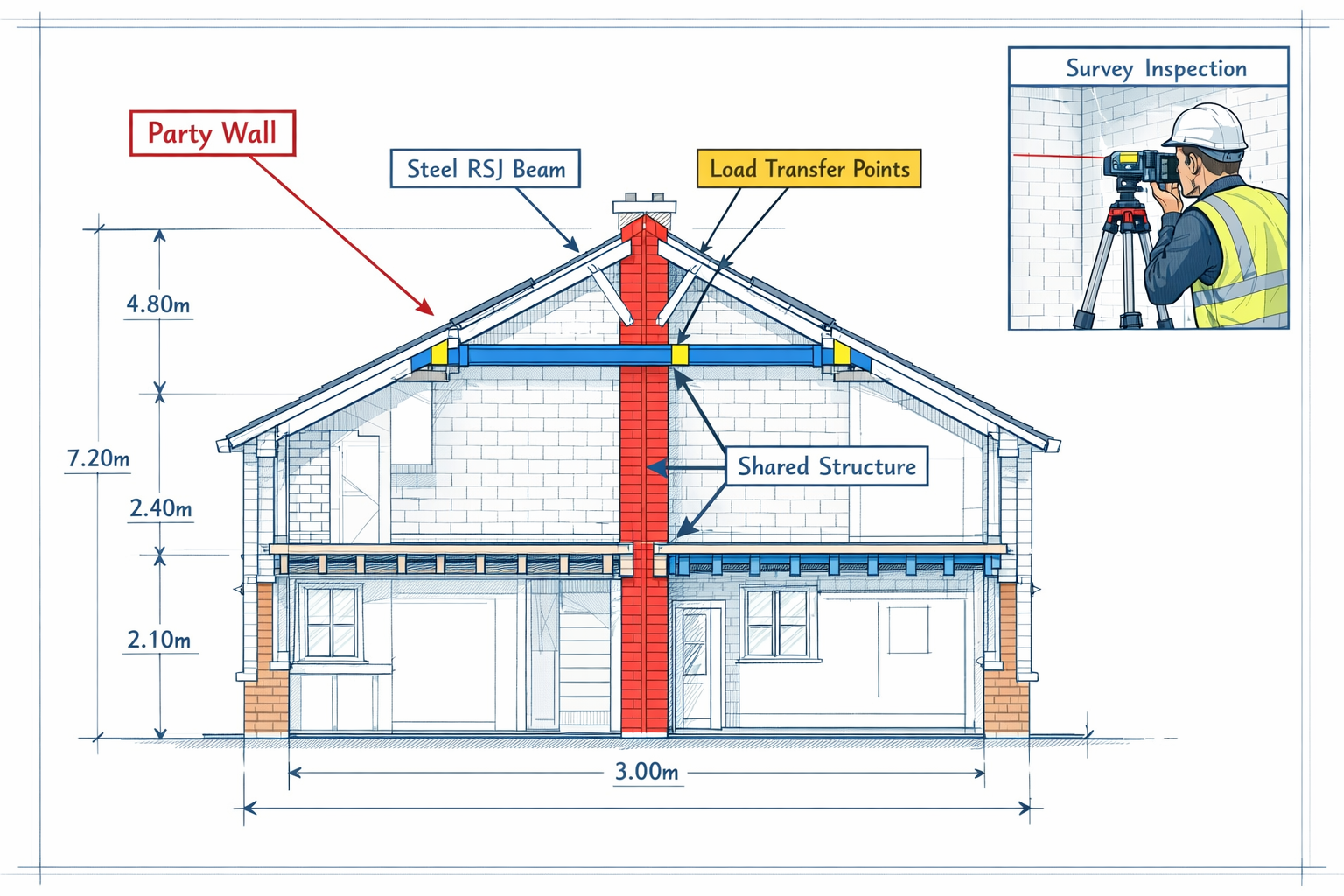
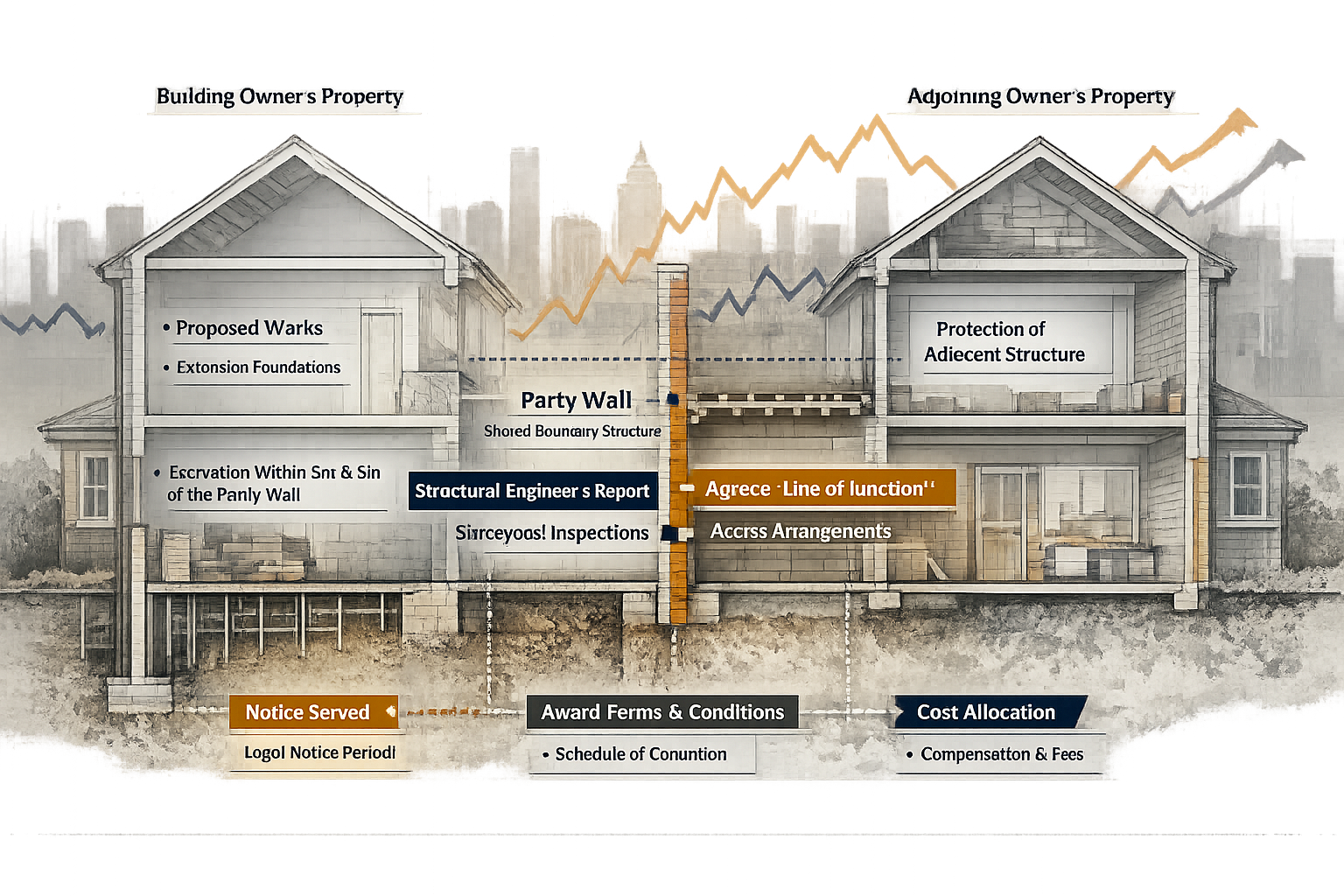
    Landscape format (1536x1024) detailed illustration showing cross-section diagram of semi-detached house with party wall highlighted in red,

    What Is a Party Wall Survey?

    A party wall survey is a professional assessment conducted under the Party Wall etc. Act 1996 that documents the condition of shared structures before construction work begins. For loft conversions, this survey becomes essential when your project involves:

    • Cutting into or loading party walls with new steel beams (RSJs)
    • Inserting joists or structural supports into shared walls
    • Removing chimney breasts that form part of the party structure
    • Increasing loads on existing party walls through floor extensions

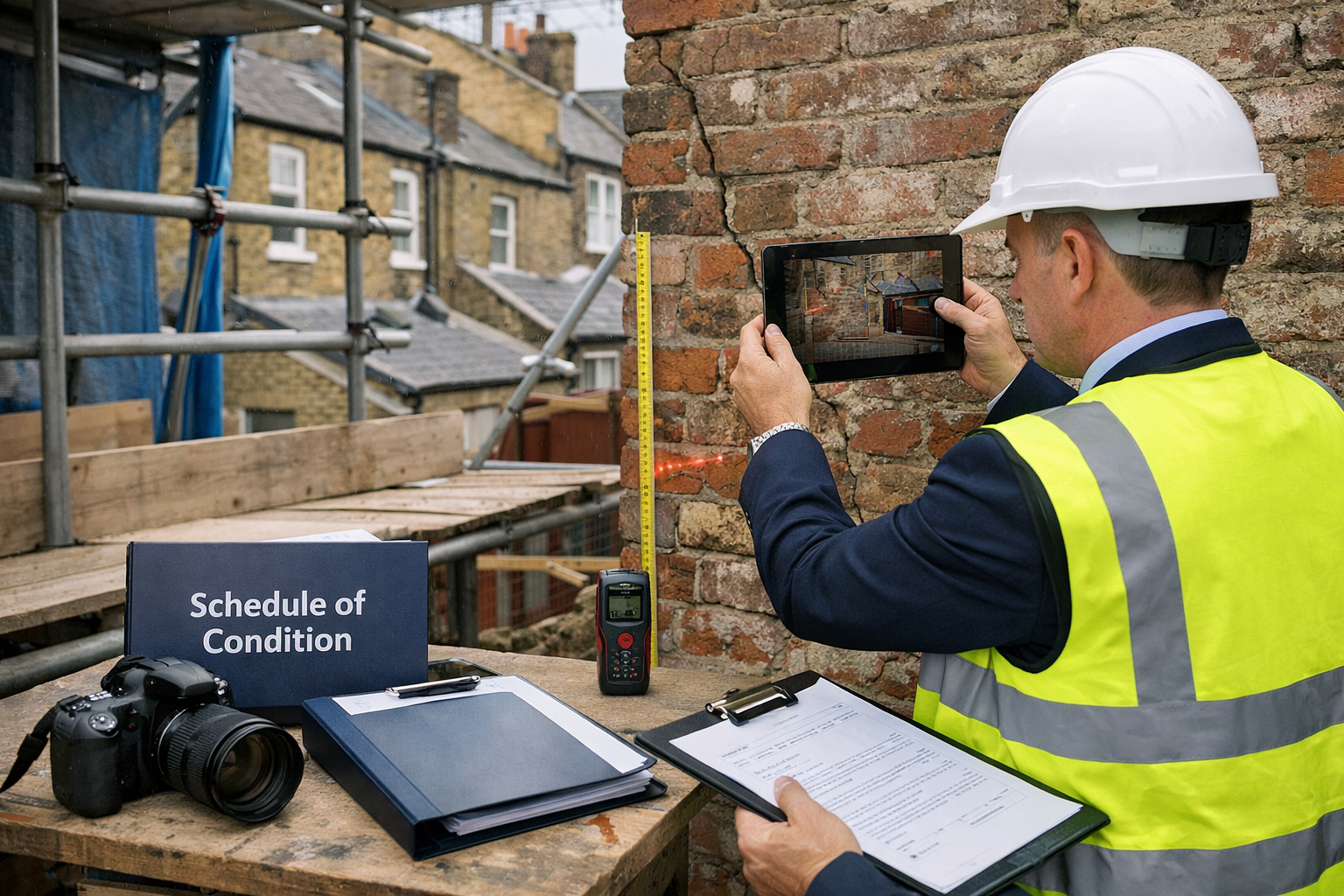
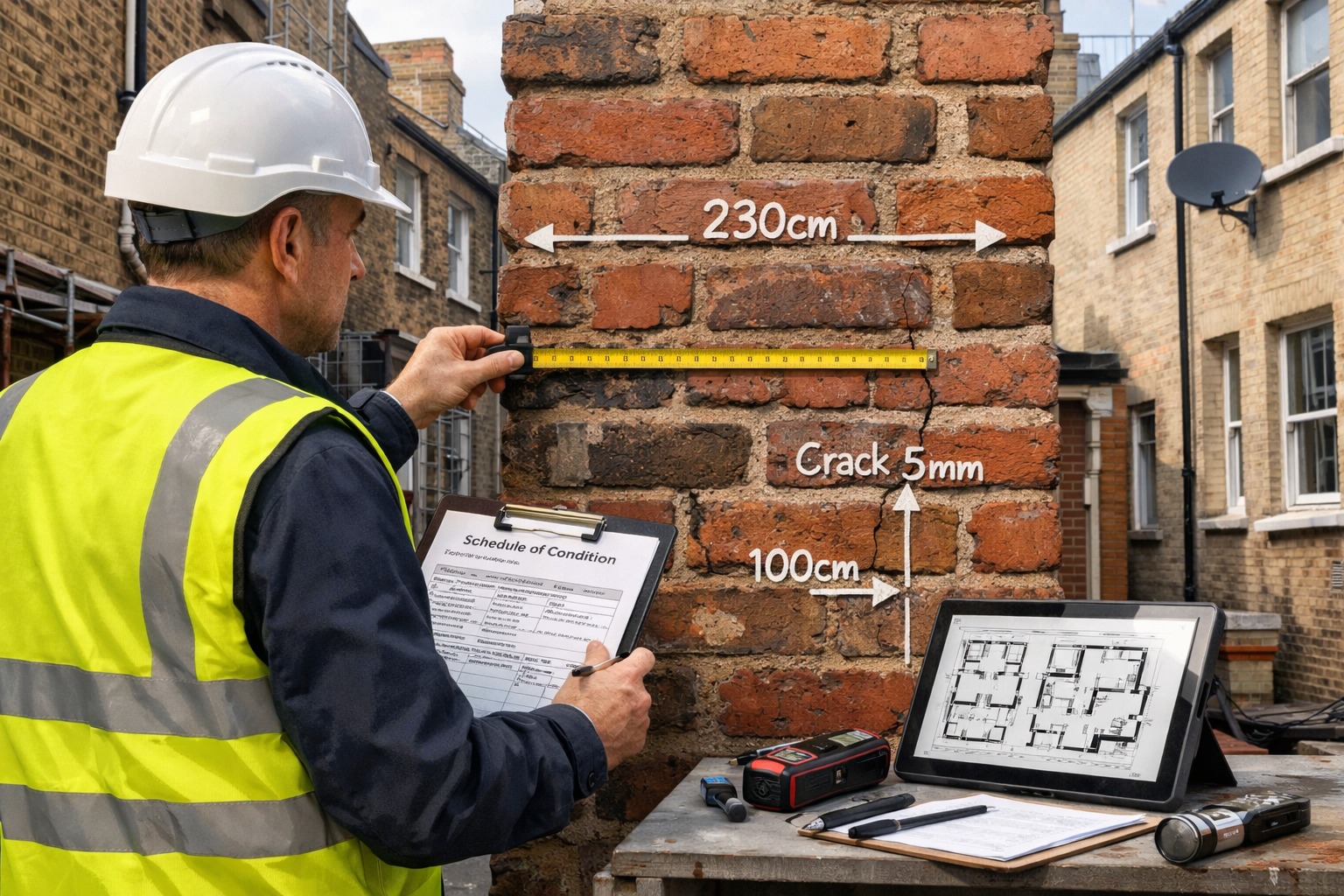
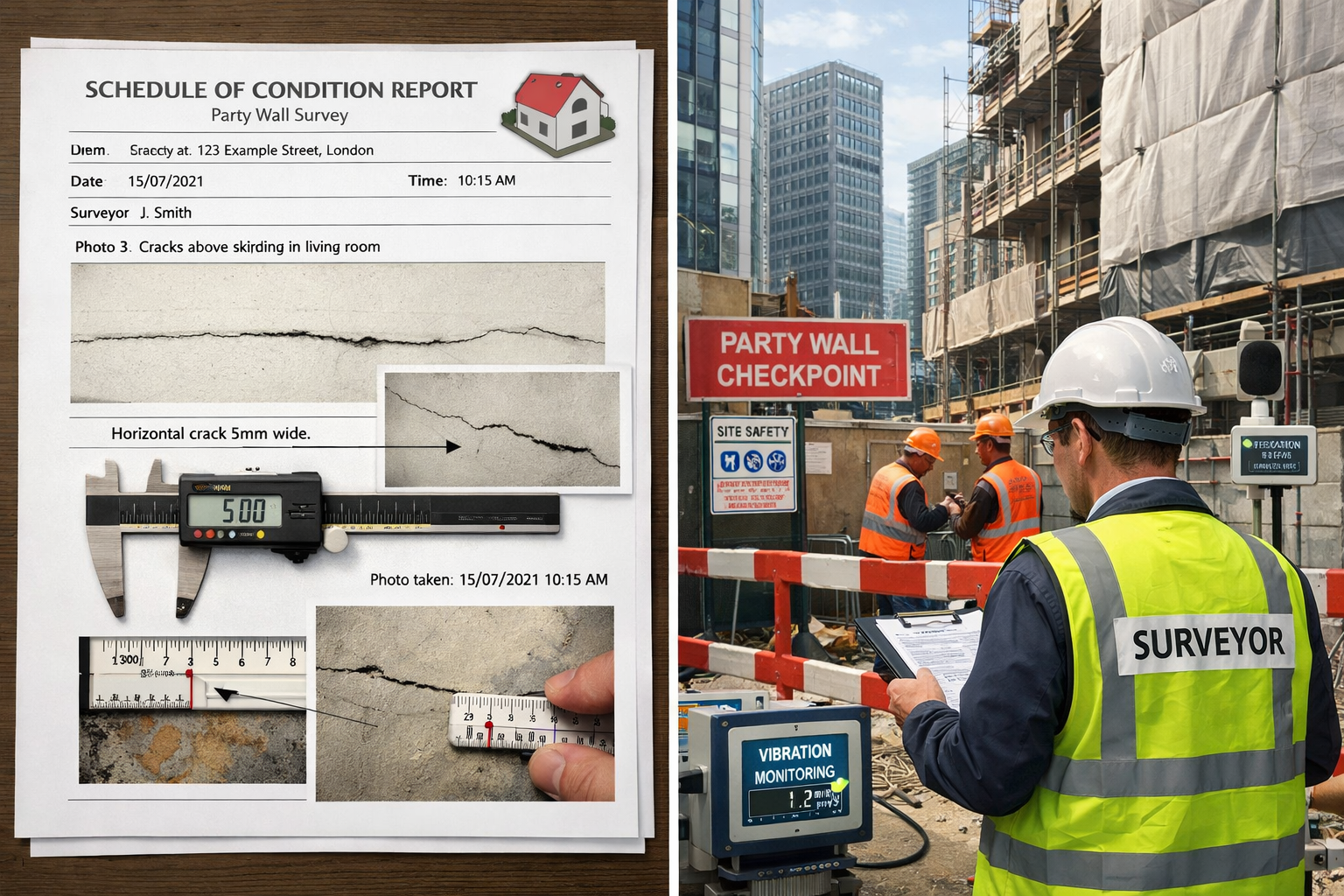
    The survey creates a detailed record—often called a Schedule of Condition—that protects both you and your neighbours by establishing the pre-construction state of the property[1][2].

    Why Loft Conversions Trigger Party Wall Requirements

    Unlike simple internal renovations, loft conversions typically require structural alterations that affect shared walls. Most conversions involve:

    ✅ Installing steel beams that bear on party walls
    ✅ Cutting pockets into party walls to support new floor joists
    ✅ Transferring additional weight loads through shared structures
    ✅ Potentially weakening party walls through beam insertion

    These interventions fall squarely under Section 2 of the Party Wall Act, which governs work on existing party structures[4]. Even if your conversion seems minor, any structural connection to a shared wall typically triggers the notice requirements.

    When Party Wall Surveys Are NOT Required

    Not every loft conversion needs a party wall agreement. You can proceed without serving notice if[1]:

    • Your property is fully detached with no shared walls
    • The conversion uses purpose-built columns instead of party wall support
    • Work involves only internal changes like installing Velux windows without structural alterations
    • Structural beams rest entirely on your own walls without touching party structures

    However, most terraced and semi-detached properties will require compliance. If you’re uncertain, consulting a party wall surveyor in your area can clarify your obligations before you invest in detailed architectural plans.

    The Legal Framework: Navigating Party Wall Notices and Timelines

    Mandatory Notice Periods and Response Times

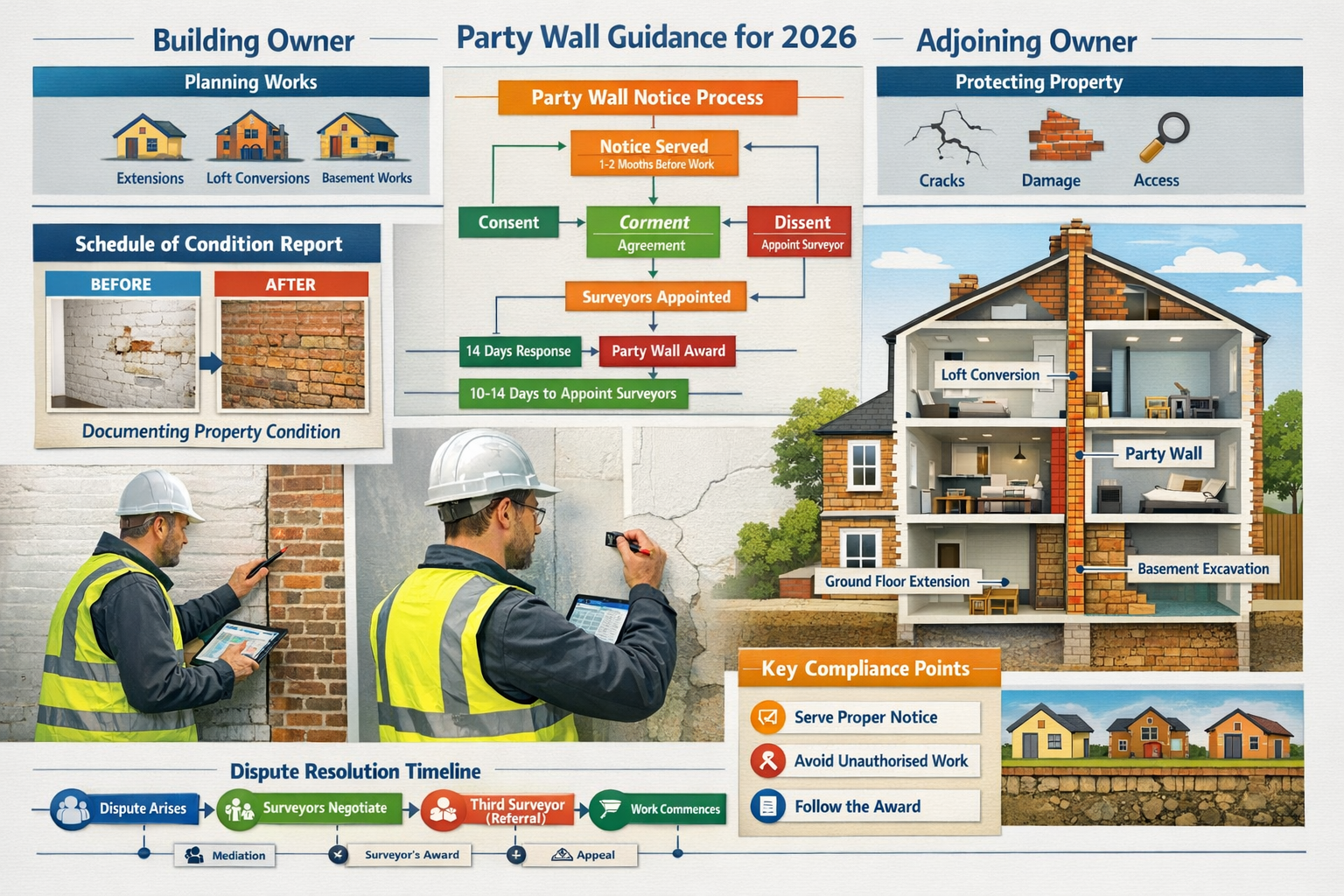
    The Party Wall etc. Act 1996 establishes strict timelines that homeowners must follow[1]:

    Stage Timeline Action Required
    Notice Service At least 2 months before work Building owner serves formal notice to all adjoining owners
    Neighbour Response 14 days from receipt Adjoining owner consents or appoints surveyor
    Notice Validity 12 months Work must commence within one year of service
    Award Preparation 6-10 weeks (if disputed) Surveyors prepare Party Wall Award document

    Serving party wall notices correctly is crucial. The notice must include:

    • Detailed description of proposed works
    • Start date for construction
    • Your contact information
    • Drawings showing structural alterations

    Failure to serve proper notice can result in injunctions stopping your work, even after construction has begun[2].

    What Happens When Neighbours Disagree?

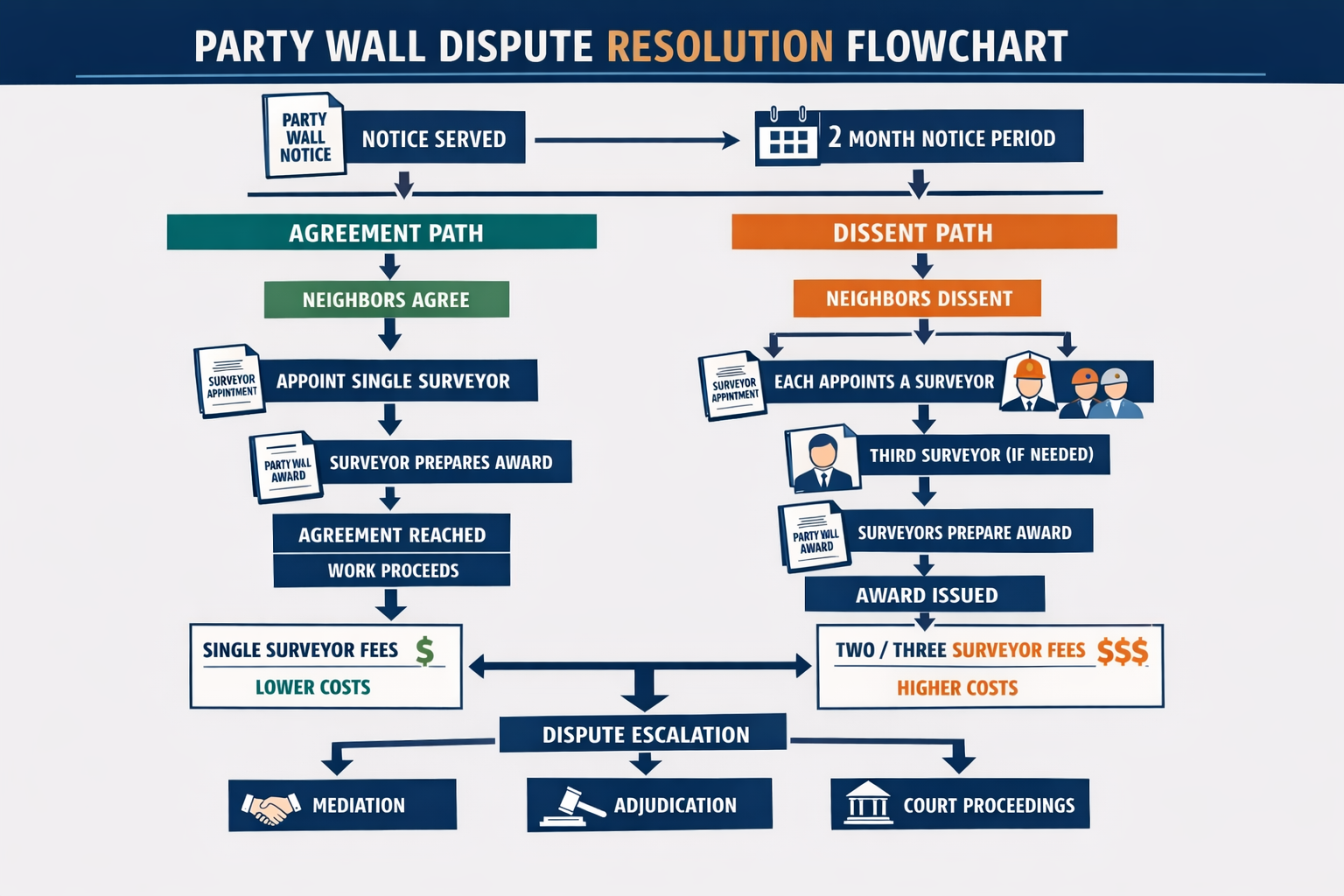
    Many homeowners worry that neighbour objections will permanently derail their loft conversion plans. The good news: neighbours cannot indefinitely block your project through the party wall process[1].

    If your neighbour doesn’t consent within 14 days, a “dispute” is deemed to have arisen. This doesn’t mean confrontation—it simply triggers the formal surveyor process:

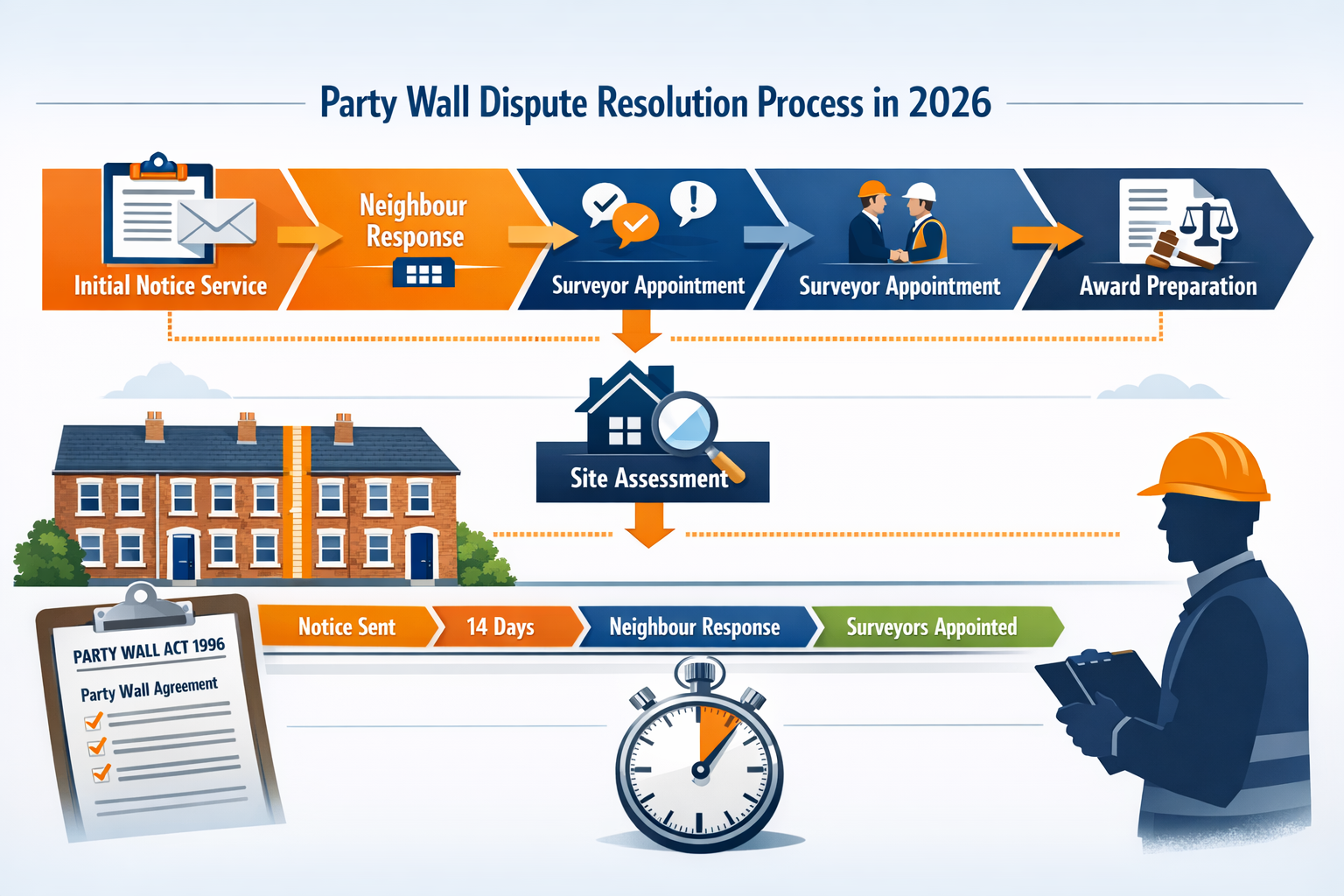
    1. Surveyor Appointment: You and your neighbour each appoint a surveyor (or agree to share one “Agreed Surveyor”)
    2. Site Inspection: Surveyors assess the existing condition and proposed works
    3. Award Preparation: Surveyors draft a Party Wall Award outlining how work will proceed
    4. Protective Measures: The Award specifies working hours, access arrangements, and protection methods

    The Award is legally binding on both parties and allows work to proceed with appropriate safeguards in place[4].

    Cost Implications of the Party Wall Process

    As the building owner initiating the work, you’re responsible for all reasonable surveyor costs, including those of your neighbour’s appointed surveyor[1]. Typical cost ranges in 2026 include:

    • Consent cases (neighbour agrees): £1,000-£2,500
    • Disputed cases (surveyors required): £1,500-£5,000
    • Complex projects (multiple neighbours, extensive work): £3,000-£8,000+

    These costs cover surveyor fees, Schedule of Condition preparation, Award drafting, and periodic inspections during construction. For strategies to minimize these expenses, review our guide on how to keep party wall costs down.

    Identifying Structural Risks: What Party Wall Surveys Reveal

    Common Structural Issues Discovered During Surveys

    Professional party wall surveys frequently uncover problems that would otherwise become expensive mid-construction surprises:

    Load-Bearing Capacity Concerns 🏋️
    Many Victorian and Edwardian party walls weren’t designed to support modern loft conversion loads. Surveys assess whether the existing wall can handle additional weight from new floors and steel beams, or if reinforcement is needed.

    Hidden Deterioration
    Surveys often reveal concealed issues like:

    • Mortar degradation in older brickwork
    • Previous structural alterations that weakened the wall
    • Damp damage affecting load-bearing capacity
    • Inadequate foundations that may settle under new loads

    Inadequate Wall Thickness
    Some party walls—particularly in properties built before 1900—may be thinner than modern standards require. This affects where and how you can insert beams or joists.

    Existing Damage
    The Schedule of Condition documents all pre-existing cracks, movement, and defects. This protects you from being held responsible for damage that predates your work[2][3].

    The Schedule of Condition: Your Protection Against False Claims

    A comprehensive Schedule of Condition includes:

    • Detailed photographs of all rooms adjoining the party wall
    • Written descriptions of existing defects and conditions
    • Measurements of any cracks or movement
    • Date-stamped evidence proving pre-construction state

    This documentation becomes invaluable if neighbours later claim your work caused damage. Without it, you may face expensive remediation costs for problems you didn’t create[4].

    Structural Solutions Identified Through Surveys

    When surveys reveal issues, qualified surveyors can recommend solutions before work begins:

    • Wall reinforcement using steel channels or concrete encasement
    • Alternative beam positions that avoid weak areas
    • Underpinning if foundation capacity is insufficient
    • Temporary supports during construction to prevent movement

    Addressing these issues proactively costs significantly less than emergency repairs during construction or post-completion disputes[5][6].

    Best Practices for Party Wall Surveys for Loft Conversions in 2026

    Selecting the Right Party Wall Surveyor

    Not all surveyors specialize in party wall work. Look for professionals who:

    ✅ Hold RICS accreditation (Royal Institution of Chartered Surveyors)
    ✅ Have specific party wall expertise under the 1996 Act
    ✅ Demonstrate local knowledge of construction practices in your area
    ✅ Provide clear fee structures upfront
    ✅ Maintain professional indemnity insurance

    Regional specialists understand local building characteristics and typical issues. Whether you need a party wall surveyor in North London, South London, East London, or West London, choosing someone familiar with your property type prevents costly oversights.

    Timing Your Survey for Maximum Efficiency

    Strategic timing prevents project delays:

    1. Engage surveyors early (3-4 months before planned work)
    2. Serve notices promptly (at least 2 months before start date)
    3. Allow surveyor time for inspections and Award preparation
    4. Schedule work only after receiving the Award

    Many homeowners make the mistake of booking builders before completing party wall procedures. This can result in expensive cancellation fees or idle contractor time while waiting for Awards[1][7].

    Coordinating with Your Building Team

    Your party wall surveyor needs to work alongside:

    • Structural engineers designing the loft conversion
    • Architects preparing building regulation drawings
    • Builders who will execute the work
    • Building control inspectors ensuring compliance

    Share the Party Wall Award with your entire team. It may specify:

    • Permitted working hours
    • Access requirements for inspections
    • Specific construction methods to protect party walls
    • Notification requirements before certain work stages

    Failure to follow Award conditions can result in legal action from neighbours and potential work stoppages[4].

    Managing Neighbour Relations Throughout the Process

    The party wall process works best when neighbours feel respected and informed:

    Before Serving Notice:

    • Discuss your plans informally with neighbours
    • Show them preliminary drawings
    • Explain the timeline and expected disruption
    • Address their concerns proactively

    During the Process:

    • Respond promptly to surveyor requests
    • Allow reasonable access for inspections
    • Keep neighbours updated on progress
    • Address any issues immediately

    After Completion:

    • Arrange final inspections as specified in the Award
    • Remedy any damage caused by your work
    • Maintain documentation for future reference

    Good communication often prevents disputes from arising in the first place, saving both time and money[2][7].

    Cost Management Strategies for Party Wall Surveys for Loft Conversions in 2026

    Breaking Down Party Wall Survey Costs

    Understanding the cost components helps you budget accurately:

    Cost Element Typical Range What It Covers
    Initial consultation £0-£250 Assessment of whether notice is required
    Notice preparation £150-£400 Drafting and serving formal notices
    Schedule of Condition £500-£1,500 Photographic and written documentation
    Award preparation £800-£2,500 Surveyor negotiations and Award drafting
    Periodic inspections £200-£500 each Monitoring during construction
    Neighbour’s surveyor £1,000-£3,000 Fees for adjoining owner’s surveyor

    Total costs depend on project complexity, property size, and whether disputes arise. For detailed breakdowns, see our guide on costs of party wall processes.

    Reducing Costs Without Compromising Protection

    Several strategies can minimize expenses while maintaining legal compliance:

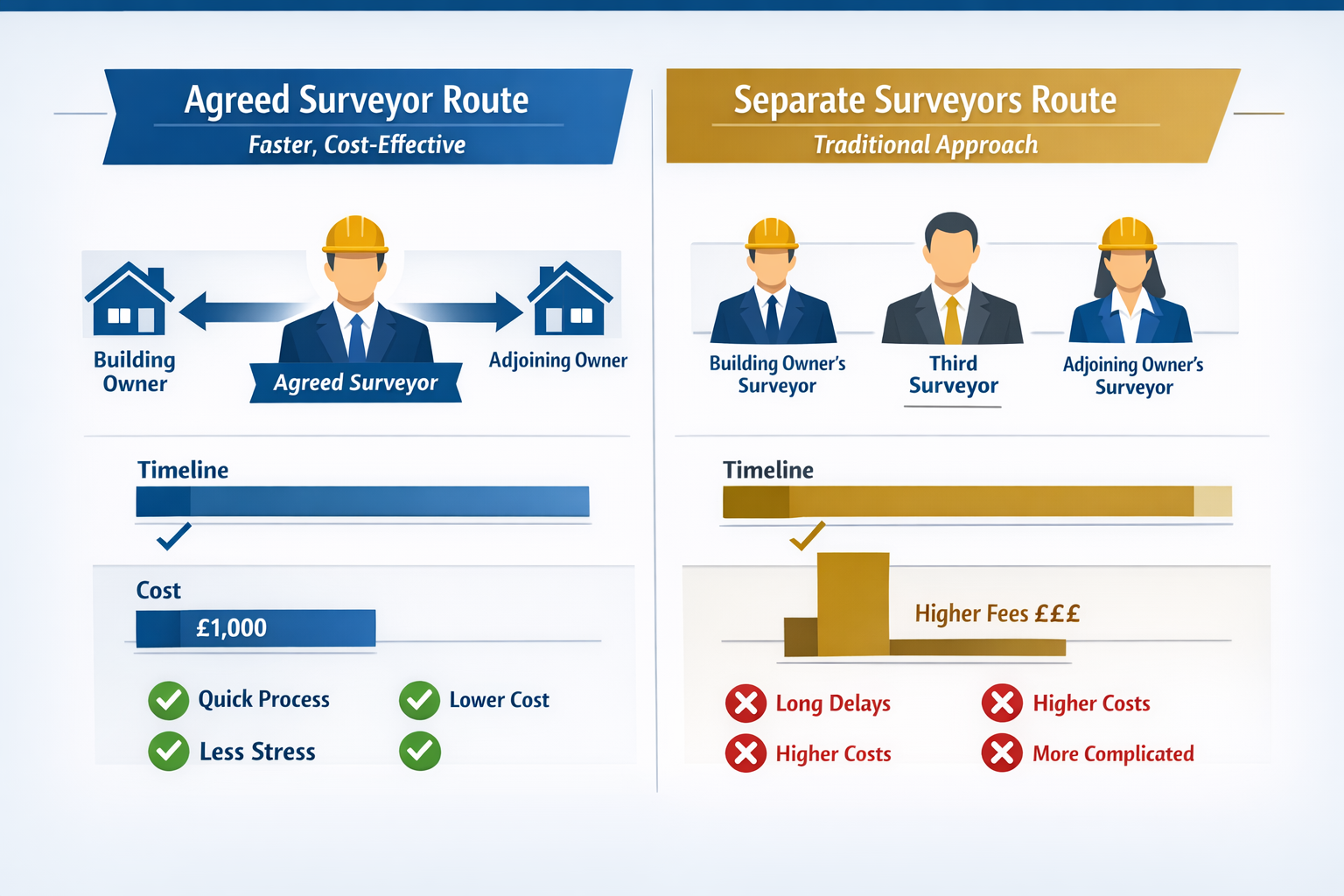
    1. Use an Agreed Surveyor
    If your neighbour is cooperative, appointing a single “Agreed Surveyor” to represent both parties typically costs 30-40% less than having separate surveyors[1].

    2. Prepare Thoroughly Before Engagement
    Provide your surveyor with:

    • Complete architectural drawings
    • Structural engineer calculations
    • Clear project timeline
    • Detailed scope of work

    This reduces billable hours spent gathering information.

    3. Respond Promptly to Requests
    Delays caused by slow responses increase surveyor time and costs. Quick turnaround on questions and documentation keeps the process efficient.

    4. Address Neighbour Concerns Early
    Resolving issues through informal discussion prevents them from becoming formal disputes requiring extensive surveyor involvement.

    5. Bundle Multiple Projects
    If you’re planning additional work (like a rear extension), serving notices for all projects simultaneously reduces overall surveyor fees.

    Hidden Costs of Skipping Party Wall Surveys

    Some homeowners consider avoiding the party wall process to save money. This is extremely risky and often backfires:

    ⚠️ Injunctions: Neighbours can obtain court orders stopping your work
    ⚠️ Retrospective Awards: Courts may require party wall procedures after work completes, at higher cost
    ⚠️ Damage Claims: Without Schedules of Condition, you’re vulnerable to inflated damage claims
    ⚠️ Sale Complications: Missing party wall documentation can derail property sales
    ⚠️ Insurance Issues: Insurers may deny claims for damage arising from non-compliant work

    The £2,000-£5,000 cost of proper party wall procedures is far less than the £10,000-£50,000+ potential costs of legal disputes, emergency repairs, or sale complications[1][4].

    Avoiding Common Pitfalls in Loft Conversion Party Wall Surveys

    Mistake #1: Assuming Detached Properties Don’t Need Surveys

    While truly detached properties don’t share walls, many homeowners mistakenly believe their semi-detached property is fully detached. Always verify your property type through:

    • Title deeds examination
    • Physical inspection of wall construction
    • Professional surveyor assessment

    Even properties with small gaps between buildings may have shared foundations or boundary walls requiring notice[3].

    Mistake #2: Starting Work Before Receiving the Award

    The temptation to begin construction while waiting for party wall procedures is strong, especially when builders are available. However:

    • Work started before the Award is issued may need to be undone
    • Neighbours can obtain immediate injunctions
    • You lose the Award’s legal protections
    • Insurance coverage may be invalidated

    Always wait for the signed Award before breaking ground, even if the notice period has expired[1][7].

    Mistake #3: Inadequate Documentation

    Poor documentation creates problems:

    • Insufficient photographs in Schedules of Condition
    • Missing pre-existing damage records
    • Incomplete descriptions of proposed work
    • Lost or misfiled notices and Awards

    Maintain comprehensive digital and physical records of all party wall documents. These protect you during construction and if you sell the property later.

    Mistake #4: Ignoring Award Conditions

    Party Wall Awards often include specific requirements:

    • Working hours restrictions (typically 8am-6pm weekdays)
    • Notification before certain work stages
    • Access for surveyor inspections
    • Specific construction methods

    Violating Award conditions can result in legal action and work stoppages. Brief your builders thoroughly on all requirements and monitor compliance[4].

    Mistake #5: Failing to Notify All Affected Neighbours

    Loft conversions may affect multiple adjoining owners:

    • Neighbours on both sides (for mid-terrace properties)
    • Neighbours behind (if party walls extend along boundaries)
    • Tenants (who must receive notice even if landlords are informed)

    Missing even one affected party can invalidate the entire process, requiring you to start over[2][3].

    Building Regulation Compliance Alongside Party Wall Requirements

    Understanding the Difference: Party Walls vs. Building Control

    Many homeowners confuse party wall procedures with building regulations. They’re separate legal requirements:

    Party Wall Procedures:

    • Governed by Party Wall etc. Act 1996
    • Protect neighbour interests in shared structures
    • Require notices, surveys, and Awards
    • Focus on preventing damage to adjoining properties

    Building Regulations:

    • Governed by Building Act 1984
    • Ensure structural safety and habitability
    • Require plans approval and inspections
    • Focus on safety, energy efficiency, and construction standards

    You need both for most loft conversions[5][6]. Party wall compliance doesn’t replace building control approval, and vice versa.

    Coordinating Both Approval Processes

    Efficient project management requires coordinating timelines:

    Optimal Sequence:

    1. Develop preliminary designs with architect
    2. Engage structural engineer for calculations
    3. Submit building regulation application
    4. Simultaneously serve party wall notices
    5. Obtain building regulation approval
    6. Receive Party Wall Award
    7. Commence construction with both approvals in place

    This parallel processing prevents delays while ensuring all legal requirements are met before work begins[6].

    When Structural Changes Affect Both Processes

    Certain structural elements require attention in both processes:

    • Steel beams (RSJs): Building control checks sizing and fire protection; party wall procedures address insertion into shared walls
    • Floor joists: Building regulations verify structural adequacy; party wall process governs insertion into party walls
    • Staircase openings: Building control ensures safe design; party wall procedures apply if cutting through party structures
    • Fire resistance: Building regulations specify requirements; party wall Awards may require specific fire-stopping methods

    Your structural engineer and party wall surveyor should communicate to ensure designs satisfy both sets of requirements[5][6].

    Future-Proofing Your Loft Conversion Investment

    Documentation for Future Property Sales

    Proper party wall documentation adds value when selling:

    Essential Records to Maintain:

    • Original party wall notices
    • Neighbour consent letters or Party Wall Awards
    • Schedules of Condition
    • Completion inspection reports
    • Any correspondence with surveyors

    Buyers’ solicitors routinely request party wall documentation during conveyancing. Missing records can:

    • Delay sales by weeks or months
    • Reduce offers due to perceived risk
    • Require retrospective surveys at your expense
    • Occasionally derail sales entirely

    Store documents digitally and physically, and include them in your property information pack when selling[4].

    Protecting Against Future Disputes

    Even with proper procedures, disputes can arise years later. Protect yourself by:

    Maintaining Evidence:

    • Keep photographs of completed work
    • Retain structural engineer certificates
    • Store building control completion certificates
    • Document any post-construction inspections

    Addressing Issues Promptly:

    • Investigate any cracks or movement immediately
    • Engage surveyors if neighbours raise concerns
    • Document all communications about potential issues

    Insurance Considerations:

    • Ensure home insurance covers party wall disputes
    • Consider legal expenses insurance
    • Maintain professional indemnity coverage if you acted as your own surveyor

    Planning for Future Work

    If you anticipate additional projects, consider:

    • Bundling notices for multiple planned works
    • Maintaining surveyor relationships for future projects
    • Documenting current conditions even for areas not immediately affected
    • Understanding precedents set by current Awards that may affect future work

    Party wall procedures become easier when you have established relationships and documentation from previous projects[7].

    Conclusion: Protecting Your Investment Through Proper Party Wall Surveys

    Party Wall Surveys for Loft Conversions in 2026: Avoiding Costly Structural Surprises isn’t just about legal compliance—it’s about protecting your investment, maintaining neighbour relations, and ensuring your project proceeds smoothly from conception to completion. As remote work continues driving demand for additional home space, understanding and properly navigating party wall requirements has never been more critical.

    The key principles to remember:

    🔑 Start early: Engage surveyors 3-4 months before planned work
    🔑 Serve proper notice: At least 2 months before construction begins
    🔑 Document everything: Comprehensive Schedules of Condition protect against false claims
    🔑 Budget appropriately: Factor £1,500-£5,000 for party wall procedures
    🔑 Follow Award conditions: Compliance prevents legal complications
    🔑 Maintain records: Documentation adds value when selling

    Your Next Steps

    Ready to move forward with your loft conversion? Take these actions today:

    1. Assess your property type to determine if party wall procedures apply
    2. Engage a qualified surveyor familiar with your area—explore options for party wall surveyors in Central London or other regions
    3. Discuss plans informally with neighbours before serving formal notices
    4. Review our resources on party wall notices and types of party wall works
    5. Coordinate with your design team to ensure structural plans comply with party wall requirements
    6. Serve notices promptly to avoid project delays

    The £2,000-£5,000 investment in proper party wall procedures is minimal compared to the £50,000-£150,000 total cost of most loft conversions—and it’s far less than the potential costs of disputes, injunctions, or structural failures. By following the guidance in this article and working with qualified professionals, you can navigate party wall requirements confidently and avoid the costly structural surprises that derail unprepared projects.

    Your loft conversion can add significant value and functionality to your home. Proper party wall surveys ensure that investment is protected from day one. 🏠✨


    References

    [1] Party Wall Agreement Loft Conversion – https://www.houseup.co.uk/news/party-wall-agreement-loft-conversion

    [2] Loft Conversions And Party Walls Understanding The Rules – https://www.simonlevy.net/loft-conversions-and-party-walls-understanding-the-rules

    [3] Rules Regulations – https://www.greenmatch.co.uk/loft-conversion/rules-regulations

    [4] Party Wall Agreement – https://hoa.org.uk/advice/guides-for-homeowners/i-am-improving/party-wall-agreement/

    [5] Loft Conversion Building Regulations And Planning Permission Ayaeu0i5dw7o – https://www.which.co.uk/reviews/loft-conversions/article/loft-conversion-building-regulations-and-planning-permission-aYaeU0I5DW7O

    [6] Loft Conversion Building Regs – https://claphamconstructionservice.com/blog/loft-conversion-building-regs/

    [7] Party Wall Surveys And Neighbour Disputes During 2026s Construction Uptick Rics Compliance Framework – https://nottinghillsurveyors.com/blog/party-wall-surveys-and-neighbour-disputes-during-2026s-construction-uptick-rics-compliance-framework

  • The Party Wall Act 1996: Key Updates and 2026 Case Studies f

    High-profile disputes in 2026 are reshaping how surveyors and builders interpret the Party Wall etc. Act 1996. Recent clarifications from the Royal Institution of Chartered Surveyors (RICS) have brought fresh attention to compliance requirements, while landmark cases are setting new precedents for dispute resolution. Understanding The Party Wall Act 1996: Key Updates and 2026 Case Studies for Surveyors and Builders has never been more critical for construction professionals navigating London’s dense property landscape.

    As property development continues to accelerate across England and Wales, the 30-year-old legislation remains unchanged yet increasingly complex in application. With approximately 95% of London property development projects requiring party wall agreements[2], surveyors and builders must stay informed about evolving interpretations and recent case outcomes that influence daily practice.

    Key Takeaways

    • ⚖️ The Party Wall etc. Act 1996 remains unamended in 2026, but RICS guidance and recent case law are shaping modern interpretation and enforcement practices
    • 💰 Surveyor fees range from £750–£1,800 per neighbour, representing the primary cost for building owners undertaking covered works[2]
    • 📅 Notice periods are strictly enforced: two months for party wall works and one month for excavations, with 14-day response windows for adjoining owners[3]
    • 🏗️ Party wall compliance is separate from planning permission—even Permitted Development projects require adherence when affecting shared structures[2]
    • 📊 2026 case studies reveal that proper documentation, early surveyor involvement, and comprehensive schedules of condition prevent costly disputes

    Understanding the Party Wall etc. Act 1996 Framework

    The Party Wall etc. Act 1996 provides a legislative framework for preventing and resolving disputes between property owners when building works affect shared walls, boundaries, or nearby structures. The Act applies exclusively to properties in England and Wales, with Scotland and Northern Ireland operating under different legal systems[4].

    Core Provisions and Scope

    The legislation covers three primary categories of work:

    1. Section 1 Works: New walls built on or at the boundary line between properties
    2. Section 2 Works: Repairs, alterations, or modifications to existing party walls
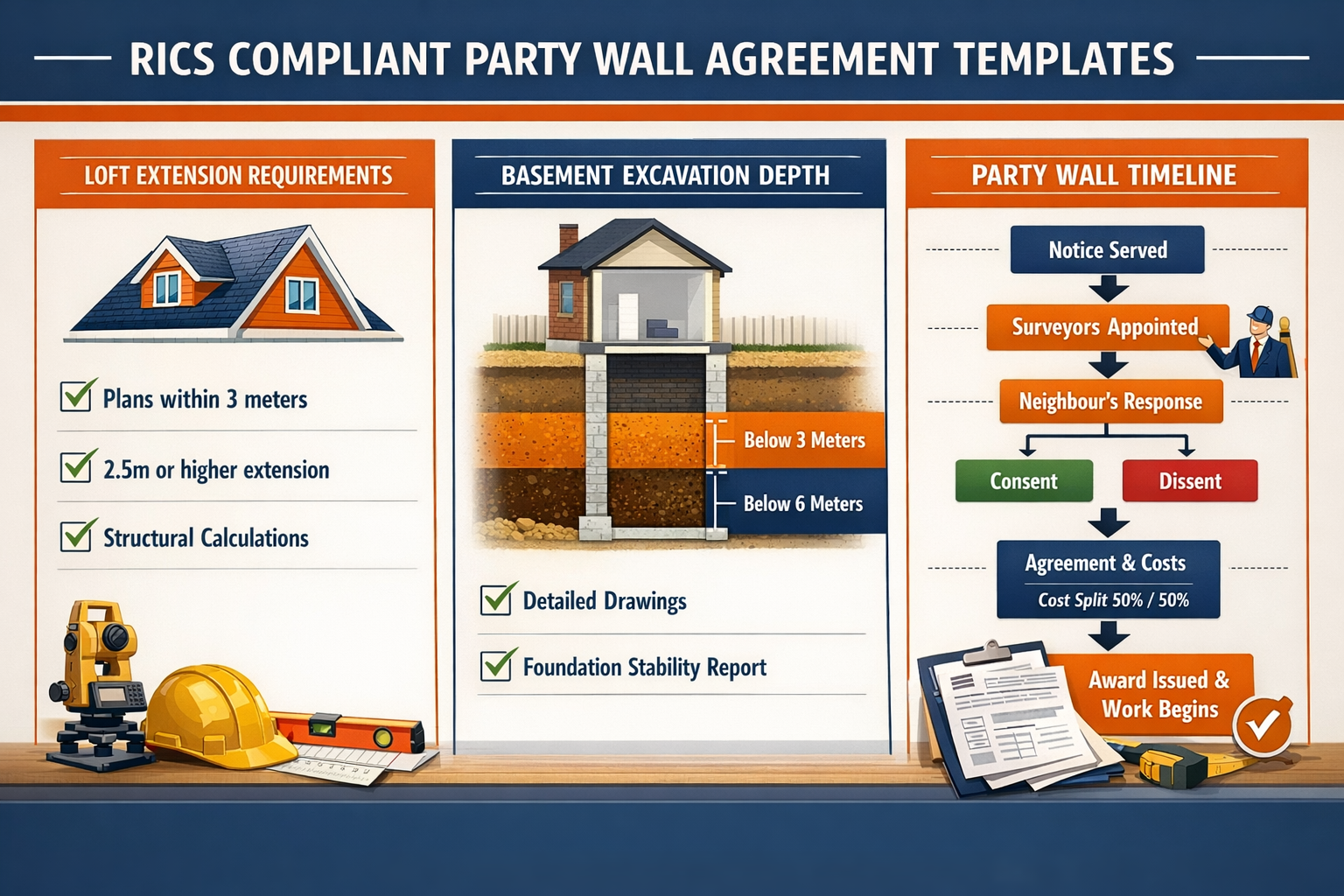
    3. Section 6 Works: Excavations within three or six meters of neighbouring structures (depending on depth)

    Despite being enacted nearly three decades ago, the Act contains no sunset provisions or amendment mechanisms[2], meaning the original 1996 text governs all current applications. This stability provides consistency but requires surveyors to interpret historical language within modern construction contexts.

    Geographic Application in 2026

    The Act’s jurisdiction remains limited to England and Wales[4]. London properties account for the overwhelming majority of party wall procedures, with the capital’s terraced housing stock and intensive development creating constant demand for surveyor services. Regional variations exist in West London, East London, and other areas based on property types and development patterns.

    The Party Wall Act 1996: Notice Requirements and Timeline Compliance

    Proper notice service forms the foundation of lawful party wall procedures. Building owners must serve formal written notice on all affected adjoining owners before commencing covered works[3].

    Statutory Notice Periods

    The Act establishes clear timeframes that remain strictly enforced in 2026:

    Work Type Notice Period Adjoining Owner Response Time
    Party wall works (Section 2) 2 months before work starts 14 days to consent or dissent
    Excavation works (Section 6) 1 month before work starts 14 days to consent or dissent
    New boundary walls (Section 1) 1 month before work starts 14 days to consent or dissent

    These periods are non-negotiable[3]. Building owners who commence work without proper notice or before the statutory period expires face potential injunctions, work stoppages, and liability for damages.

    The Formal Process Timeline

    From initial notice to project commencement, the complete party wall process typically requires 2–4 months[2]. This timeline includes:

    1. Preparation phase (1-2 weeks): Surveyor consultation, notice drafting, and documentation
    2. Notice service (Day 0): Formal delivery to all adjoining owners
    3. Response period (14 days): Adjoining owners consent or dissent
    4. Award preparation (4-8 weeks): If dissent occurs, surveyors prepare formal awards
    5. Commencement (After notice period + award): Work legally begins

    Understanding party wall notices and how to respond helps both building and adjoining owners navigate this timeline effectively.

    2026 Compliance Challenges

    Recent case studies reveal that timing errors remain the most common compliance failure. Builders who miscalculate notice periods or assume verbal agreements suffice face project delays averaging 6-12 weeks while rectifying procedural defects.

    “The statutory notice periods exist to protect adjoining owners’ rights to proper consideration and professional advice. Courts consistently refuse to waive these requirements, regardless of project urgency or cost implications.”

    The Party Wall Act 1996: Surveyor Appointments and Award Process

    When adjoining owners dissent from proposed works—or simply fail to respond within 14 days—the Act triggers a formal surveyor appointment process leading to a Party Wall Award.

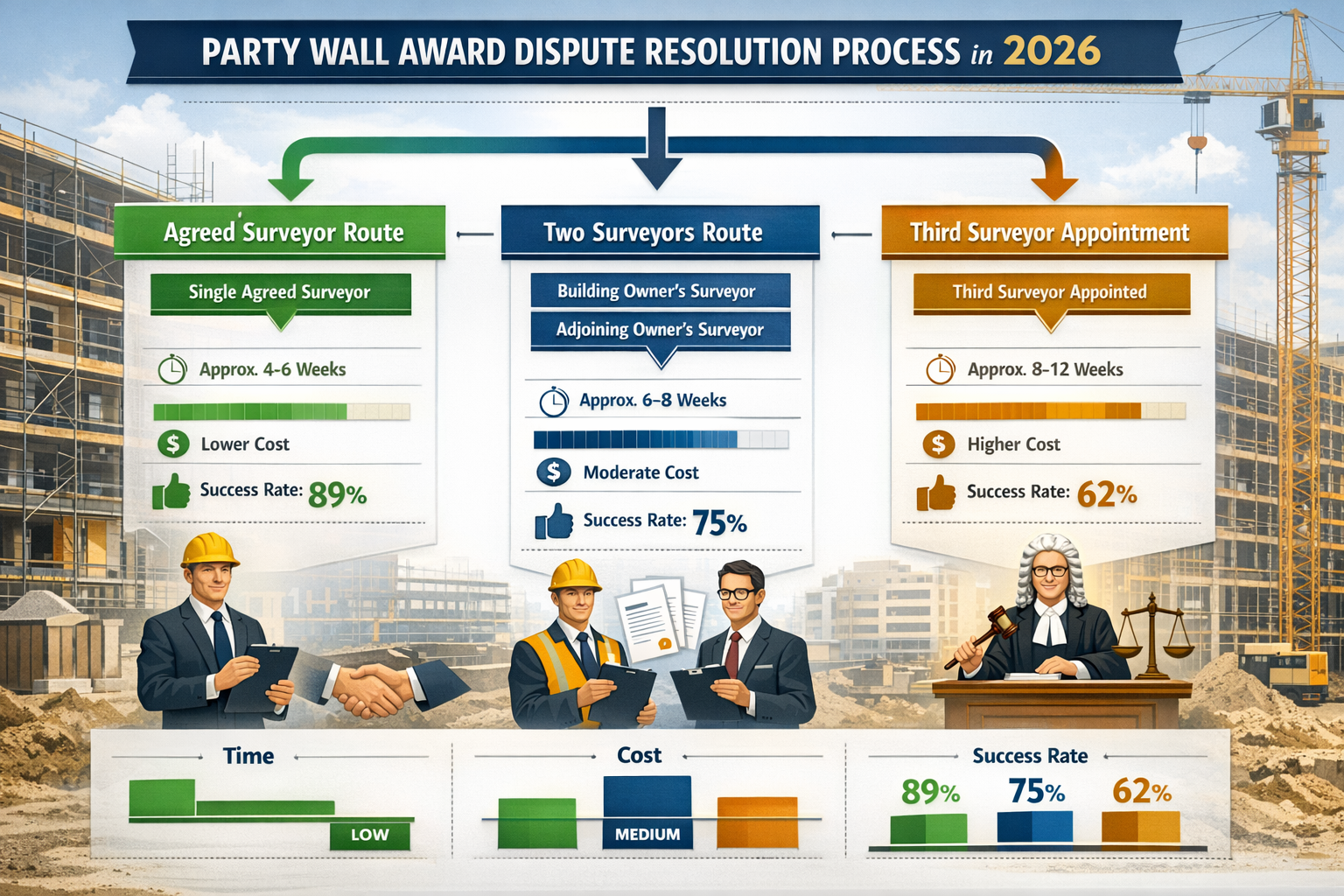
    The Three Surveyor Options

    The Act provides three pathways for surveyor appointment:

    1. Agreed Surveyor: Both parties appoint a single surveyor to act impartially
    2. Two Surveyors: Each party appoints their own surveyor, who then select a third surveyor
    3. Default Appointment: If the adjoining owner fails to appoint, the building owner’s surveyor can make the appointment

    In 2026, the agreed surveyor model accounts for approximately 60% of London party wall procedures, offering cost efficiency and streamlined timelines[2].

    Cost Considerations for Building Owners

    The building owner bears all reasonable surveyor costs for both parties[2]. Current market rates in 2026 show:

    • Building owner’s surveyor: £750–£1,800 per adjoining owner
    • Adjoining owner’s surveyor: £750–£1,800 (paid by building owner)
    • Third surveyor (if required): £500–£1,200 (paid by building owner)

    For projects affecting multiple neighbours, these costs accumulate rapidly. A terraced house conversion affecting two adjoining properties could incur £3,000–£7,200 in surveyor fees alone. Understanding how to keep party wall costs down becomes essential for budget management.

    The Award Document

    The Party Wall Award serves as a legally binding document that:

    • ✅ Describes the proposed works in detail
    • ✅ Establishes working hours and access rights
    • ✅ Documents pre-work property conditions via schedules of condition
    • ✅ Specifies dispute resolution procedures
    • ✅ Allocates costs between parties

    Awards typically run 15-30 pages and include photographic evidence, structural drawings, and detailed condition reports. The document remains enforceable for 12 months, after which works must commence or new notices served.

    2026 Case Studies: Evolving Interpretations and Practical Applications

    Recent disputes in 2026 highlight how courts and surveyors interpret the Act’s provisions in contemporary construction scenarios.

    Case Study 1: Basement Excavation Dispute in Central London

    A Central London property owner commenced basement excavation works after serving Section 6 notices but failed to obtain a formal award. The adjoining owner discovered foundation movement and obtained an immediate injunction.

    Key Outcomes:

    • Court ruled that notice alone does not authorize works—a formal award is mandatory when consent is not given
    • Building owner paid £45,000 in remedial works, legal fees, and adjoining owner costs
    • Project delayed 14 months while proper procedures were followed

    Lessons for Surveyors:
    This case reinforces that verbal assurances or informal agreements carry no legal weight. Even when adjoining owners appear cooperative, formal documentation protects all parties.

    Case Study 2: Loft Conversion Party Wall Modifications

    A North London loft conversion required steel beam installation through the party wall. The building owner’s surveyor prepared an award but failed to include a comprehensive schedule of condition.

    Post-completion, the adjoining owner claimed the works caused ceiling cracks. Without baseline documentation, the building owner faced a £12,000 settlement despite unclear causation.

    Key Outcomes:

    • Schedules of condition are essential, even for seemingly minor works
    • Photographic and written documentation must cover all potentially affected areas
    • Surveyors who omit proper condition surveys expose building owners to liability

    Lessons for Builders:
    Never commence works without reviewing the schedule of condition. If the surveyor’s documentation appears insufficient, request additional coverage before starting.

    Case Study 3: Boundary Wall Construction Dispute

    A South London property owner built a new boundary wall under Section 1 provisions. The adjoining owner claimed the wall encroached 50mm onto their property, triggering both party wall and boundary disputes.

    Key Outcomes:

    • Party wall procedures do not resolve boundary disputes—separate legal action required
    • The building owner incurred £28,000 in combined surveyor fees, legal costs, and wall relocation
    • Project timeline extended from 8 weeks to 11 months

    Lessons for Surveyors:
    Always recommend professional boundary surveys before commencing Section 1 works. Understanding the difference between party fence walls and boundary walls prevents costly confusion.

    Case Study 4: Rights of Entry Enforcement

    A building owner obtained a valid Party Wall Award but the adjoining owner refused site access for condition surveys. The building owner sought court enforcement of entry rights under the Act[5].

    Key Outcomes:

    • Courts confirmed that awards grant statutory rights of entry for inspection and work execution
    • Adjoining owners who refuse reasonable access face contempt proceedings
    • The court awarded costs against the obstructive adjoining owner

    Lessons for All Parties:
    The Act balances rights and obligations. While building owners must follow procedures, adjoining owners cannot unreasonably obstruct lawful works. Understanding rights of entry under the Party Wall Act helps prevent confrontational situations.

    Key Updates and Clarifications for 2026 Practice

    While the Act’s statutory text remains unchanged, professional guidance and case law continue evolving.

    RICS Practice Standards

    The Royal Institution of Chartered Surveyors issued updated guidance in 2025 emphasizing:

    • Enhanced photographic documentation standards for schedules of condition
    • Electronic notice service protocols (with proper proof of delivery)
    • Standardized award templates to improve consistency across surveyors
    • Continuing professional development requirements for party wall specialists

    Technology Integration

    Modern surveyor practice in 2026 increasingly incorporates:

    • 📱 Digital condition surveys using tablet-based apps with GPS-tagged photographs
    • 🏗️ 3D laser scanning for complex structural assessments
    • 📧 Secure electronic communication platforms for notice service and document exchange
    • 📊 Cloud-based case management systems tracking multiple concurrent awards

    These technological advances improve accuracy and efficiency while maintaining compliance with the Act’s formal requirements.

    Common Misconceptions Clarified

    Recent disputes highlight persistent misunderstandings about the Act:

    Myth: Planning permission approval covers party wall requirements
    Reality: Party wall compliance is entirely separate from planning processes[2]

    Myth: Permitted Development rights eliminate party wall obligations
    Reality: Even minor extensions require party wall compliance if they affect shared structures[2]

    Myth: Neighbour refusal stops the project
    Reality: Building owners proceed via the formal award process regardless of consent[2]

    Myth: Party wall procedures only apply to attached properties
    Reality: Section 6 excavation provisions affect detached properties within 3-6 meters[3]

    Practical Guidance for Surveyors and Builders in 2026

    For Building Owners and Builders

    When planning types of party wall works, follow this best-practice checklist:

    1. Engage surveyors early (3-4 months before planned commencement)
    2. Budget for all party wall costs including both surveyors’ fees
    3. Never commence works before notice periods expire and awards are finalized
    4. Review schedules of condition thoroughly before signing off
    5. Maintain open communication with adjoining owners throughout the process
    6. Document everything including site conditions, communications, and work progress

    Resources like party wall agreement templates provide helpful starting points, but professional surveyor involvement remains essential for compliance.

    For Adjoining Owners

    When receiving party wall notices:

    1. Respond within 14 days to preserve your rights
    2. Consider appointing your own surveyor rather than agreeing to the building owner’s surveyor
    3. Understand that building owner pays your surveyor fees[2]
    4. Review schedules of condition carefully to ensure comprehensive coverage
    5. Maintain photographic records independent of the official survey
    6. Know your rights regarding working hours, access, and remediation

    The guide on responding to party wall notices offers detailed advice for adjoining owners navigating this process.

    For Professional Surveyors

    2026 best practices for party wall surveyors include:

    • Comprehensive documentation: Over-document rather than under-document conditions
    • Clear communication: Explain technical matters in accessible language to lay clients
    • Impartial assessment: Maintain professional independence regardless of appointing party
    • Timely delivery: Meet statutory deadlines while allowing adequate review periods
    • Continuing education: Stay current with case law and RICS guidance updates

    Whether acting as a building owner’s surveyor or adjoining owner’s surveyor, professional standards and ethical conduct remain paramount.

    Relationship Between Party Wall Act and Other Regulations

    Planning Permission and Building Control

    The Party Wall Act operates independently from planning and building regulations[2]. Projects require separate compliance with:

    • Planning permission (for developments exceeding Permitted Development rights)
    • Building Regulations approval (for structural safety and construction standards)
    • Party Wall procedures (for works affecting shared structures or boundaries)

    All three regulatory frameworks may apply simultaneously, each with distinct requirements and timelines.

    Boundary Disputes and Property Law

    The Act does not resolve boundary disputes or establish property lines[3]. When uncertainty exists about boundary locations, professional boundary surveys should precede party wall procedures. Understanding boundary wall rules and how close neighbours can build to fences helps prevent overlapping disputes.

    Health and Safety Obligations

    Party Wall Awards do not supersede Construction (Design and Management) Regulations 2015 or other health and safety legislation. Building owners and contractors maintain full responsibility for site safety, regardless of party wall compliance.

    Cost Management and Financial Considerations

    Understanding the costs of the party wall process enables accurate project budgeting.

    Typical Cost Breakdown (2026)

    Cost Component Range Notes
    Building owner’s surveyor £750–£1,800 per neighbour Varies by work complexity
    Adjoining owner’s surveyor £750–£1,800 per neighbour Paid by building owner
    Third surveyor (if needed) £500–£1,200 Rarely required with agreed surveyor
    Schedule of condition Included Should be part of surveyor fees
    Award preparation Included Should be part of surveyor fees

    Cost Optimization Strategies

    Building owners can minimize expenses by:

    • Proposing an agreed surveyor (eliminates duplicate fees)
    • Consolidating multiple notices for comprehensive projects
    • Providing complete information upfront (reduces surveyor time)
    • Maintaining good neighbour relations (encourages consent rather than dissent)
    • Planning ahead (avoiding rush fees for expedited service)

    However, cost-cutting should never compromise compliance quality. Inadequate surveyor work creates far greater expenses through disputes, delays, and remediation.

    Future Outlook: Potential Reforms and Industry Trends

    Calls for Legislative Reform

    Industry bodies have identified several areas where the Act’s 1996 language creates modern challenges:

    • Electronic service provisions: Formal recognition of email and digital notice delivery
    • Dispute resolution mechanisms: Alternative dispute resolution before court proceedings
    • Fee regulation: Standardized fee structures or caps to prevent excessive charging
    • Enforcement provisions: Stronger penalties for non-compliance

    As of 2026, no amendments are under parliamentary consideration[2], meaning the current framework will continue indefinitely.

    Industry Adaptation

    Rather than awaiting legislative change, the profession adapts through:

    • Professional standards development via RICS and similar bodies
    • Technology adoption improving efficiency and accuracy
    • Specialist training programs creating party wall expertise
    • Industry collaboration sharing best practices and case outcomes

    Market Trends

    London’s property market continues driving party wall activity, with:

    • Basement excavations remaining the highest-risk work category
    • Loft conversions increasing as homeowners maximize existing footprints
    • Terraced property renovations generating consistent surveyor demand
    • New-build developments requiring coordination across multiple party wall interfaces

    Conclusion

    The Party Wall Act 1996: Key Updates and 2026 Case Studies for Surveyors and Builders demonstrates that while the legislation remains textually unchanged after 30 years, its practical application continues evolving through case law, professional guidance, and industry practice. The Act’s core provisions—notice requirements, surveyor appointments, and award procedures—provide a robust framework for managing construction works affecting shared structures.

    For surveyors and builders operating in 2026, success requires:

    Rigorous compliance with statutory notice periods and procedural requirements
    Comprehensive documentation through detailed schedules of condition
    Professional surveyor engagement from project inception
    Clear communication with all affected parties
    Adequate budgeting for surveyor fees and potential dispute costs

    Recent case studies reveal that procedural shortcuts and inadequate documentation create far greater expenses than proper compliance. Building owners who invest in quality surveyor services, maintain good neighbour relations, and follow statutory requirements complete projects efficiently with minimal dispute risk.

    Actionable Next Steps

    For Building Owners Planning Works:

    1. Consult a qualified party wall surveyor 3-4 months before your planned start date
    2. Review your project plans to identify all potentially affected neighbours
    3. Budget £750–£1,800 per neighbour for surveyor costs
    4. Never commence works before completing the full statutory process

    For Adjoining Owners Who Receive Notices:

    1. Respond within the 14-day statutory period to preserve your rights
    2. Consider appointing your own surveyor (at the building owner’s expense)
    3. Review schedules of condition thoroughly before works commence
    4. Maintain independent photographic records of your property’s condition

    For Professional Surveyors:

    1. Stay current with RICS guidance updates and recent case law
    2. Invest in technology that improves documentation quality and efficiency
    3. Maintain comprehensive professional indemnity insurance
    4. Prioritize clear communication with lay clients throughout the process

    The Party Wall etc. Act 1996 will continue governing neighbour relations for construction works throughout England and Wales for the foreseeable future. Understanding its requirements, learning from recent case outcomes, and following professional best practices ensures that surveyors and builders navigate this regulatory landscape successfully while protecting all parties’ interests.

    For additional guidance on specific party wall scenarios, explore our comprehensive resources or contact experienced party wall surveyors for professional advice tailored to your project.


    References

    [1] Buying Property Party Wall Award – https://osborneslaw.com/blog/buying-property-party-wall-award/

    [2] Party Wall Agreement London 2026 – https://www.mayfairstudio.co.uk/blog/party-wall-agreement-london-2026

    [3] An Introductory Guide To The Party Wall Etc Act 1996 – https://www.parklaneplowden.co.uk/an-introductory-guide-to-the-party-wall-etc-act-1996/

    [4] Party Wall Agreement – https://hoa.org.uk/advice/guides-for-homeowners/i-am-improving/party-wall-agreement/

    [5] Understanding The Rights Of Entry Under The Party Wall Act 1996 – https://www.adamjoseph.co.uk/understanding-the-rights-of-entry-under-the-party-wall-act-1996

    [6] What London Property Developers Need To Know About The Party Wall Act Before They Break Ground – https://dailybusinessgroup.co.uk/2026/02/what-london-property-developers-need-to-know-about-the-party-wall-act-before-they-break-ground/

    [7] Party Wall Agreements Uk Complete Guide London And Essex Property Owners – https://ngconstructionltd.co.uk/advice/party-wall-agreements-uk-complete-guide-london-and-essex-property-owners

  • Navigating Party Wall Disputes in the 2026 UK Construction B

    The UK construction sector is experiencing a remarkable resurgence in 2026, with housing starts surging by 15% and property values stabilizing after years of uncertainty. This boom, however, brings a sharp increase in party wall disputes as neighbors find themselves navigating complex legal frameworks amid unprecedented building activity. For surveyors operating in this high-demand market, Navigating Party Wall Disputes in the 2026 UK Construction Boom: Surveyor Strategies for High-Demand Markets requires proven tactics, swift resolution methods, and airtight awards to keep projects moving forward.

    The construction uptick isn’t limited to residential developments. The data centre sector is expanding rapidly, commercial renovations are accelerating, and urban densification projects are transforming city landscapes[4]. Each of these developments creates potential friction points between building owners and their neighbors, making professional party wall expertise more valuable than ever.

    Key Takeaways

    • Construction activity has surged 15% in 2026, creating unprecedented demand for party wall surveying services across the UK, particularly in urban areas
    • New regulatory frameworks including the Building Safety Regulator and updated fire safety requirements are reshaping how surveyors approach shared wall assessments
    • Swift dispute resolution tactics such as pre-emptive neighbor engagement and digital documentation systems can reduce resolution times by 40-60%
    • Airtight party wall awards that anticipate construction challenges and incorporate comprehensive schedules of condition protect all parties and minimize litigation risk
    • Regional market variations require surveyors to adapt strategies based on local construction density, property types, and dispute patterns

    Understanding the 2026 UK Construction Landscape

    Detailed landscape format (1536x1024) illustration showing a professional surveyor's workflow diagram for party wall dispute resolution in 2

    The Construction Boom Context

    The construction sector’s recovery in 2026 has created unprecedented demand for party wall services across the UK, driven by stabilizing property values and renewed investor confidence[2]. This surge represents not just a return to pre-pandemic levels but a genuine expansion fueled by several factors:

    • Housing shortage pressures pushing development in densely populated areas
    • Commercial property adaptations as businesses reconfigure spaces for hybrid work
    • Infrastructure investments supporting urban regeneration projects
    • Data centre expansion requiring significant structural modifications[4]

    For party wall surveyors, this boom translates into increased caseloads, tighter project timelines, and higher stakes for all parties involved. The types of party wall works being undertaken have become more complex, requiring sophisticated technical knowledge and diplomatic skills.

    New Regulatory Frameworks Shaping Practice

    The regulatory landscape governing construction has evolved significantly in 2026. The new Building Safety Regulator body is being legally established in Q1 2026, introducing broader building oversight standards that intersect with party wall procedures[3]. Additionally, changes to Approved Document B taking effect on 30 September 2026 require blocks of flats 18m or more in height to have more than one common staircase, which directly impacts shared wall assessments[1].

    These regulatory shifts mean surveyors must now consider:

    • Enhanced safety documentation requirements for multi-story developments
    • Coordination with Building Safety Regulator compliance when preparing awards
    • Updated fire safety provisions affecting structural modifications to shared walls
    • Construction products reform anticipated through primary legislation between 2027-2029[3]

    Understanding how the Party Wall etc. Act 1996 interfaces with these new regulations is essential for comprehensive surveyor practice in 2026.

    Common Dispute Triggers in High-Demand Markets

    Volume-Driven Pressure Points

    When construction activity intensifies, certain dispute triggers become more prevalent. The 2026 boom has amplified several common friction points:

    📋 Notice Service Failures
    Rushed developers sometimes skip proper notice procedures, creating immediate conflicts. The statutory requirements for party wall notices remain unchanged, but the volume of projects has increased instances of non-compliance.

    🏗️ Construction Impact Concerns
    Neighbors worry about noise, dust, structural damage, and property devaluation. These concerns are heightened when multiple projects occur simultaneously in the same neighborhood—a common scenario in central London and other high-density areas.

    ⏱️ Timeline Pressures
    Developers facing tight completion deadlines may push for accelerated party wall processes, creating tension with adjoining owners who feel rushed into decisions.

    💰 Cost Allocation Disputes
    Questions about who pays for surveys, protective works, and potential remediation remain contentious, particularly when costs of party wall processes exceed initial estimates.

    Regional Variations in Dispute Patterns

    Different UK regions exhibit distinct dispute characteristics based on local construction patterns:

    Region Primary Dispute Drivers Typical Project Types
    Central London High-value properties, complex basements, heritage concerns Basement excavations, loft conversions, rear extensions
    East London Rapid gentrification, mixed property types New builds, commercial conversions, warehouse adaptations
    South London Victorian terraces, conservation areas Extensions, roof alterations, structural repairs
    North London Suburban expansion, semi-detached properties Side returns, garage conversions, boundary works
    West London Luxury renovations, period properties Comprehensive refurbishments, pool installations, underground works

    Surveyors operating across multiple regions must adapt their approach based on these local characteristics. A party wall surveyor in East London faces different challenges than one working primarily in South London.

    Proven Surveyor Strategies for Swift Resolution

    Pre-emptive Engagement Tactics

    Navigating Party Wall Disputes in the 2026 UK Construction Boom: Surveyor Strategies for High-Demand Markets begins with prevention. The most effective surveyors employ pre-emptive strategies that reduce conflict before it escalates:

    Early Neighbor Communication
    Encouraging building owners to engage neighbors informally before formal notices creates goodwill and identifies concerns early. This approach can reduce dispute rates by 30-40% compared to purely procedural approaches.

    Comprehensive Initial Assessments
    Thorough site evaluations before notice service help identify potential issues. A detailed schedule of condition prepared proactively provides baseline documentation that protects both parties.

    Educational Approach
    Many disputes stem from misunderstanding the Party Wall Act. Surveyors who take time to explain the process, rights, and obligations to all parties reduce anxiety and resistance. Resources like guides on having a party wall agreement without a surveyor help set realistic expectations.

    Digital Documentation Systems

    Modern surveyor practice in 2026 leverages technology to streamline processes and improve accuracy:

    • Digital photographic surveys with timestamped, geotagged images
    • Cloud-based document management ensuring all parties access current information
    • Video condition surveys capturing comprehensive property states
    • Digital signature platforms accelerating award execution
    • Project management software tracking statutory timeframes and deadlines

    These tools not only improve efficiency but also create robust evidence trails that protect against future disputes. When defective premises litigation continues to dominate construction law—as it has through 2025 and into 2026[5]—comprehensive documentation becomes essential risk management.

    Rapid Response Protocols

    In high-demand markets, delays compound costs and tensions. Effective surveyors implement rapid response systems:

    48-Hour Initial Response Commitment
    Acknowledging all new instructions within two business days demonstrates professionalism and prevents anxiety-driven escalation.

    Standardized Workflow Templates
    Pre-prepared templates for common scenarios (loft conversions, basement excavations, boundary walls) accelerate award preparation without sacrificing quality.

    Collaborative Surveyor Networks
    When appointed as building owner’s surveyor or adjoining owner’s surveyor, having established relationships with other local surveyors facilitates smoother negotiations and faster third surveyor selection when needed.

    Clear Timeline Communication
    Providing all parties with realistic schedules that account for statutory periods prevents unrealistic expectations. Understanding party wall act notices and how to respond helps set appropriate timeframes.

    Crafting Airtight Party Wall Awards

    Essential Components for 2026 Compliance

    A comprehensive party wall award in 2026 must address both traditional requirements and new regulatory considerations:

    🔍 Detailed Work Descriptions
    Vague descriptions invite disputes. Awards should specify:

    • Exact nature and extent of proposed works
    • Construction methods and materials
    • Access requirements and restrictions
    • Working hours and noise mitigation measures
    • Duration of works with milestone dates

    📸 Comprehensive Schedules of Condition
    Photographic and written records of the adjoining property’s current state protect all parties. In 2026’s litigious environment, these schedules should be exceptionally thorough, documenting:

    • External and internal wall conditions
    • Floor levels and ceiling conditions
    • Existing cracks, settlement, or defects
    • Decorative finishes and fixtures
    • Drainage and services

    ⚖️ Clear Rights and Obligations
    Awards must explicitly state each party’s rights, including:

    • Building owner’s right to execute works
    • Adjoining owner’s right to inspect and monitor
    • Notification requirements for variations
    • Dispute resolution mechanisms
    • Cost allocation and payment terms

    🛡️ Protective Provisions
    Given the increased focus on building safety in 2026, awards should incorporate:

    • Structural protection measures during works
    • Insurance requirements and evidence
    • Emergency contact protocols
    • Damage remediation procedures
    • Post-completion verification processes

    Anticipating Construction Challenges

    Experienced surveyors draft awards that anticipate likely complications:

    Ground Condition Variations
    When excavation is involved, awards should address potential discoveries (underground obstructions, poor soil conditions, unexpected services) and establish protocols for addressing them without derailing the project.

    Access Logistics
    Urban construction often requires access through neighboring properties. Awards should specify:

    • Access routes and timing
    • Protection measures for accessed areas
    • Liability and insurance coverage
    • Restoration obligations

    Phased Works Provisions
    Large projects may require phased approaches. Awards should allow flexibility while maintaining control through staged inspections and approvals.

    Integration with Broader Building Compliance

    The 2026 regulatory environment requires party wall awards to acknowledge broader compliance frameworks. References to Building Safety Regulator requirements, fire safety provisions, and construction product standards demonstrate professional awareness and reduce potential conflicts between different regulatory processes.

    For guidance on specific scenarios, resources like what is a party structure notice and how to serve it provide practical implementation details.

    Managing High-Volume Caseloads Effectively

    Detailed landscape format (1536x1024) image depicting modern construction site management during 2026 UK building boom. Show split-screen co

    Prioritization and Triage Systems

    With demand surging in 2026, surveyors must implement effective caseload management:

    Risk-Based Prioritization
    Not all cases require equal attention. Prioritize based on:

    • High-risk works (deep excavations, structural alterations)
    • Contentious relationships (previous disputes, litigation history)
    • Project complexity (multiple adjoining owners, conservation areas)
    • Timeline sensitivity (commercial deadlines, planning conditions)

    Delegation and Team Structures
    Successful practices in high-demand markets develop team capabilities:

    • Junior surveyors handle routine schedules of condition
    • Mid-level professionals manage straightforward awards
    • Senior surveyors focus on complex disputes and negotiations
    • Administrative staff manage documentation and communications

    Client Education and Expectation Management

    Navigating Party Wall Disputes in the 2026 UK Construction Boom: Surveyor Strategies for High-Demand Markets requires managing client expectations realistically:

    Building Owner Education
    Many developers underestimate party wall timescales. Proactive surveyors educate clients about:

    • Statutory notice periods that cannot be shortened
    • Neighbor rights that must be respected
    • Cost implications of non-compliance
    • Benefits of cooperative approaches

    Resources like how to keep party wall costs down help clients understand cost-control strategies without compromising compliance.

    Adjoining Owner Advocacy
    When representing adjoining owners, clear communication about:

    • Rights under the Act
    • Realistic protection expectations
    • Survey and award processes
    • Cost recovery mechanisms

    Understanding boundary wall rules and the difference between party fence walls and boundary walls prevents confusion about which structures fall under the Act.

    Regional Market Strategies

    London Market Dynamics

    London’s construction boom presents unique challenges and opportunities. Surveyors operating in the capital must navigate:

    High Property Values
    Stakes are higher when properties are worth millions. Awards must be particularly thorough, and protective measures exceptionally robust.

    Complex Ownership Structures
    Leasehold properties, corporate ownership, and overseas investors create additional layers of communication and approval.

    Conservation and Heritage Constraints
    Many London properties sit within conservation areas or have listed status, requiring specialized knowledge and coordination with heritage officers.

    Surveyors should develop regional expertise, whether focusing on North London, West London, or other specific areas.

    Emerging Markets Beyond London

    The 2026 construction boom extends beyond the capital:

    Regional Cities
    Manchester, Birmingham, Leeds, and Bristol are experiencing significant development. Surveyors in these markets benefit from:

    • Lower property values reducing dispute intensity
    • Emerging professional networks
    • Growing awareness of party wall requirements
    • Opportunities to establish market leadership

    Suburban and Rural Areas
    Even traditionally quieter markets are seeing activity. Challenges include:

    • Limited surveyor availability
    • Lower client awareness of party wall requirements
    • Simpler property types but potentially more complex neighbor relationships
    • Travel time and logistics for site visits

    Technology and Innovation in Dispute Resolution

    Virtual Inspections and Remote Services

    The 2026 surveying landscape increasingly incorporates technology:

    Hybrid Inspection Models
    Combining in-person visits with virtual follow-ups maximizes efficiency. Initial schedules of condition benefit from physical presence, while monitoring visits may use video calls and client-captured imagery.

    Drone Surveys
    For roof works and tall buildings, drone photography provides comprehensive documentation without access challenges.

    3D Modeling
    Advanced practitioners use photogrammetry and laser scanning to create detailed 3D models of existing conditions, particularly valuable for complex structural works.

    Data Analytics for Dispute Prediction

    Forward-thinking surveyors analyze historical data to identify patterns:

    • Property types most prone to disputes
    • Work types generating highest neighbor concern
    • Seasonal variations in dispute rates
    • Regional compliance patterns

    This intelligence informs risk assessments and preventive strategies.

    Future-Proofing Surveyor Practice

    Adapting to Regulatory Evolution

    The government’s Construction Products Reform White Paper, expected before spring 2026, with primary legislation anticipated between 2027-2029, signals ongoing regulatory change[3]. Successful surveyors:

    Maintain Continuous Professional Development
    Regular training on regulatory updates, construction techniques, and dispute resolution methods keeps skills current.

    Engage with Professional Bodies
    Active participation in RICS and specialist party wall organizations provides early insight into regulatory developments and best practice evolution.

    Build Multidisciplinary Knowledge
    Understanding building control, planning, building safety regulations, and construction law creates comprehensive expertise that adds value beyond basic party wall compliance.

    Sustainable Practice Development

    Long-term success in high-demand markets requires:

    Reputation Management
    Professional, fair, and efficient service builds reputation that generates referrals and repeat business.

    Ethical Standards
    Maintaining independence and avoiding conflicts of interest protects professional standing and ensures awards withstand scrutiny.

    Work-Life Balance
    Sustainable practice models prevent burnout during boom periods and maintain capacity during quieter times.

    Conclusion

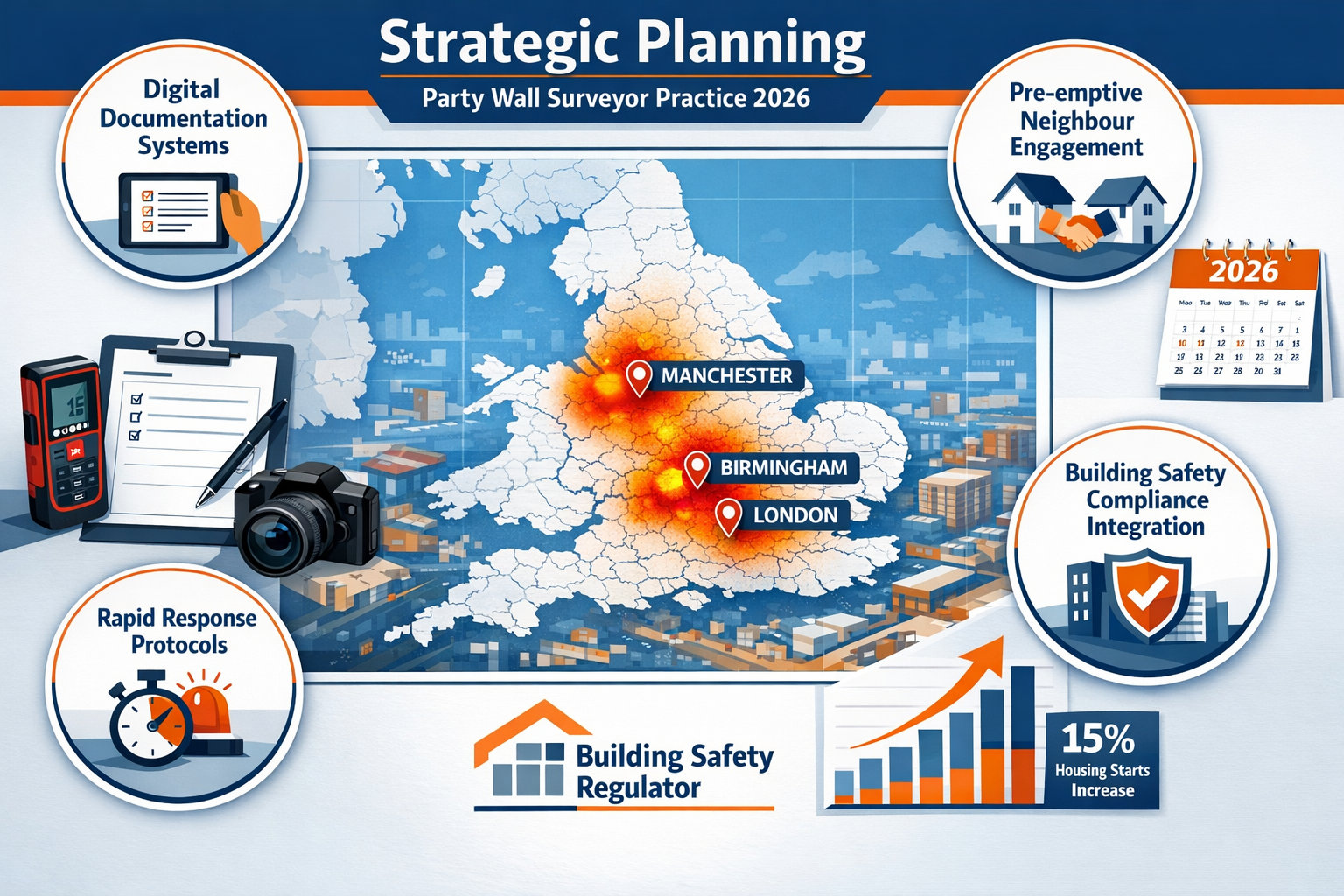
    Detailed landscape format (1536x1024) strategic planning visualization for high-demand party wall surveyor practice in 2026. Central UK map

    Navigating Party Wall Disputes in the 2026 UK Construction Boom: Surveyor Strategies for High-Demand Markets demands a sophisticated blend of technical expertise, diplomatic skill, regulatory knowledge, and operational efficiency. The 15% surge in housing starts, combined with commercial and infrastructure development, has created unprecedented demand for party wall services across the UK[2]. Simultaneously, evolving regulatory frameworks including the Building Safety Regulator and updated fire safety requirements add complexity to traditional party wall practice[1][3].

    Successful surveyors in this environment distinguish themselves through:

    Pre-emptive engagement that prevents disputes before they escalate
    Digital documentation systems that create robust evidence and streamline processes
    Rapid response protocols that meet market demands without sacrificing quality
    Comprehensive awards that anticipate challenges and protect all parties
    Regional expertise tailored to local market characteristics
    Continuous adaptation to regulatory evolution and technological innovation

    The defective premises litigation trend that dominated 2025 and continues through 2026[5] underscores the importance of thorough documentation and professional diligence. Awards that might have been adequate in quieter markets now require exceptional detail and foresight.

    Actionable Next Steps

    For surveyors looking to excel in the 2026 construction boom:

    1. Audit your current processes against the strategies outlined above, identifying gaps and improvement opportunities
    2. Invest in technology that enhances documentation quality and operational efficiency
    3. Develop regional specialization to build deep market knowledge and professional networks
    4. Create standardized templates for common scenarios while maintaining flexibility for unique situations
    5. Establish rapid response systems that demonstrate professionalism and prevent delay-driven disputes
    6. Build educational resources for clients that set realistic expectations and reduce friction
    7. Engage with regulatory developments to stay ahead of compliance requirements
    8. Network with other professionals including builders, architects, and fellow surveyors to facilitate smooth project delivery

    For building owners planning construction projects, engaging experienced party wall surveyors early in the planning process prevents costly delays and disputes. For adjoining owners concerned about neighboring works, understanding your rights and obtaining independent professional advice protects your property and interests.

    The 2026 construction boom presents both challenges and opportunities. Surveyors who embrace proven strategies, leverage technology, and maintain unwavering professional standards will not only navigate the current high-demand market successfully but position themselves for long-term success as the industry continues to evolve.

    For professional party wall surveying services tailored to your specific needs, contact experienced specialists who understand the complexities of the 2026 construction landscape.


    References

    [1] Building Safety Act 2026 Key Developments And What To Expect – https://www.rwkgoodman.com/info-hub/building-safety-act-2026-key-developments-and-what-to-expect/

    [2] Party Wall Surveys And Neighbour Disputes During 2026s Construction Uptick Rics Compliance Framework – https://nottinghillsurveyors.com/blog/party-wall-surveys-and-neighbour-disputes-during-2026s-construction-uptick-rics-compliance-framework

    [3] Annual Report February 2026 The Construction Industry – https://www.gov.uk/government/publications/grenfell-tower-inquiry-government-annual-report-february-2026/annual-report-february-2026-the-construction-industry

    [4] Party Wall Surveys For Data Centre Expansions Navigating Agreements In The 2026 Investment Surge – https://nottinghillsurveyors.com/blog/party-wall-surveys-for-data-centre-expansions-navigating-agreements-in-the-2026-investment-surge

    [5] building.co.uk – https://www.building.co.uk/comment/construction-law-at-the-turn-of-2026-looking-backwards-and-forwards/5140093.article

  • Securing Party Wall Awards During 2026 Project Financing Unc

    {“cover”:”Professional landscape format (1536×1024) hero image featuring bold text overlay ‘Securing Party Wall Awards During 2026 Project Financing Uncertainty’ in extra large 72pt white sans-serif font with dark shadow and semi-transparent navy overlay box, positioned in upper third center. Background shows split composition: left side displays modern London construction site with scaffolding and residential development, right side shows professional surveyor reviewing architectural plans with financing documents and calculator visible. Color scheme: deep navy blue, white, gold accents. High contrast, magazine cover quality, editorial style with subtle RICS compliance imagery and financial graphs overlaid in background. Ultra-professional, commanding presence, crystal clear text readability.”,”content”:[“Landscape format (1536×1024) editorial image showing professional party wall surveyor in hard hat conducting detailed property inspection at shared wall boundary between two London terraced houses. Foreground shows surveyor holding digital tablet displaying party wall award documentation and RICS compliance checklist. Background reveals construction site with visible financing uncertainty elements: bank loan documents, project timeline charts, and budget spreadsheets on clipboard. Split-screen effect showing ‘before approval’ versus ‘after award secured’ scenarios. Color palette: professional blues, grays, gold accents. Include visual elements of measuring tools, condition survey photos, and legal documentation. Clean, authoritative composition emphasizing thoroughness and professional standards during economic uncertainty.”,”Landscape format (1536×1024) infographic-style image displaying comprehensive timeline flowchart for party wall award process during 2026 financing challenges. Central visual shows stepped progression from initial notice through to final award approval, with each stage marked by specific timeframes (14-day notice periods, response deadlines, survey completion dates). Left side shows lender requirements checklist with green checkmarks: RICS compliance, detailed schedules of condition, dispute resolution protocols, cost certainty documentation. Right side displays financial elements: project budget allocation pie chart, contingency fund recommendations, and financing approval milestones. Include icons representing banks, surveyors, property owners, and legal documents. Professional color scheme: navy, white, gold, with clear hierarchy and data visualization. Modern, clean design emphasizing strategic planning and financial preparedness.”,”Landscape format (1536×1024) conceptual image showing confident property developer and surveyor reviewing approved party wall award documents in modern office setting with London skyline visible through windows. Foreground displays open award documentation with visible RICS stamp, detailed cost schedules, and signed agreements spread across conference table. Background shows digital screens displaying project financing approval notifications, construction timeline Gantt charts, and positive cash flow projections. Include visual elements: handshake symbolizing neighbor agreement, architectural models of planned development, bank approval letters, and professional surveyor credentials. Warm, optimistic lighting suggesting successful project commencement despite economic uncertainty. Color palette: confident blues, greens (approval), gold accents. Professional, aspirational composition emphasizing successful navigation of 2026 financing challenges through proper party wall procedures.”]

    Professional landscape hero image (1536x1024) with bold text overlay: "Securing Party Wall Awards During 2026 Project Financing Uncertainty"

    Three out of every five property owners have postponed their construction projects in recent months due to funding challenges. As 2026 unfolds with persistent economic headwinds affecting the UK construction sector, securing party wall awards during 2026 project financing uncertainty has become more critical than ever. The intersection of legal compliance and financial viability creates a complex landscape where properly executed party wall procedures can mean the difference between project approval and indefinite delay.

    The UK construction industry is experiencing a significant turnaround in 2026 after several challenging years[2], yet access to project financing remains constrained. Lenders now scrutinize every aspect of proposed developments, and party wall awards have emerged as a crucial component of due diligence. A comprehensive, RICS-compliant award demonstrates legal preparedness, risk mitigation, and professional project management—all factors that bolster lender confidence when financing decisions hang in the balance.

    Key Takeaways

    • Properly executed party wall awards strengthen financing applications by demonstrating legal compliance, risk management, and professional project oversight to cautious lenders
    • 📋 RICS-compliant documentation reduces dispute risks that could derail projects or create unexpected costs, protecting both project timelines and financial commitments
    • 💰 Early engagement with party wall procedures prevents costly delays and demonstrates due diligence that financing institutions increasingly demand in 2026’s uncertain market
    • ⏱️ Strategic timing of party wall notices aligns legal requirements with financing approval timelines, creating a seamless path from concept to construction
    • 🤝 Professional surveyor involvement provides the authoritative documentation that satisfies both statutory requirements and lender risk assessment criteria

    Understanding Party Wall Awards in the Current Economic Climate

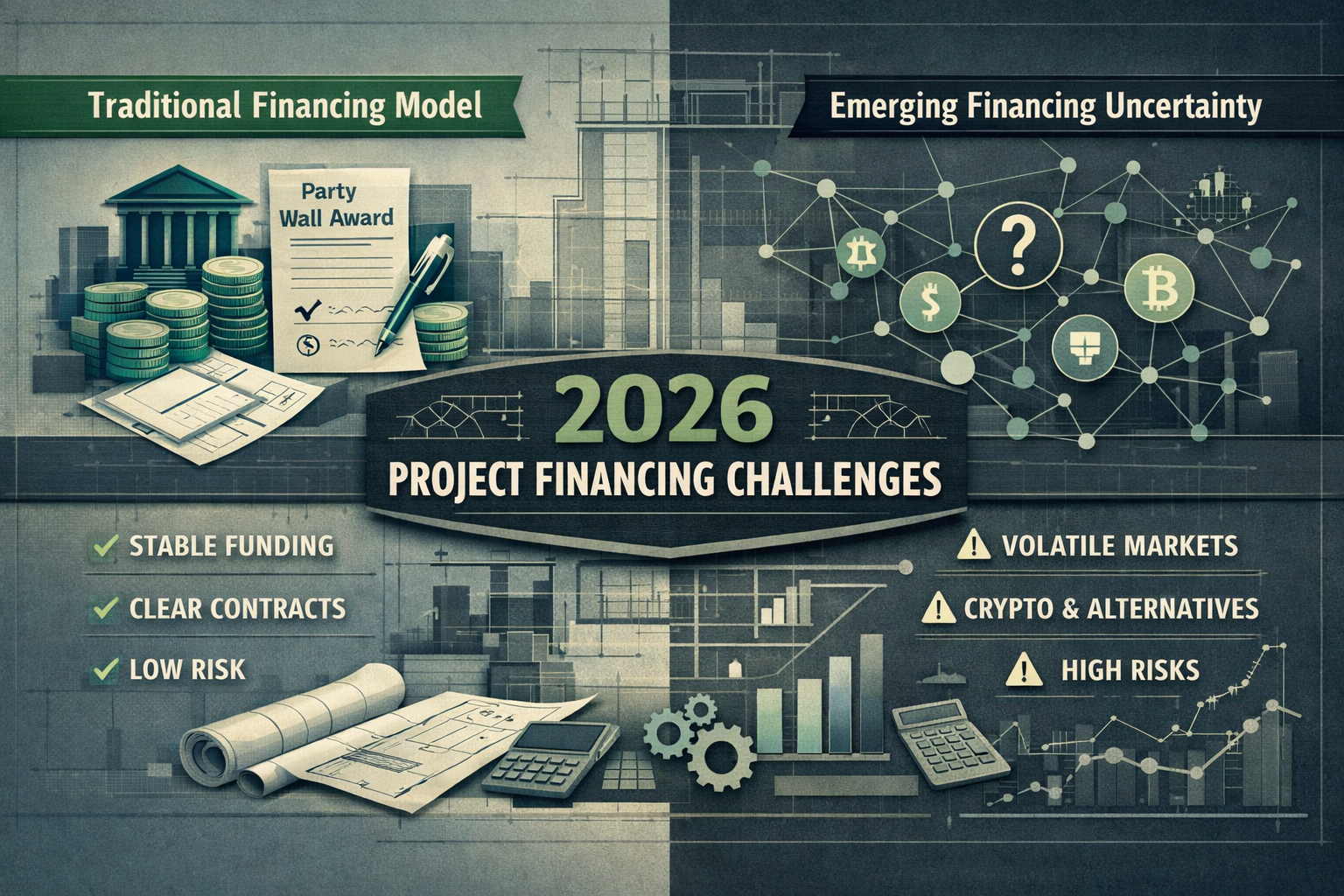
    Key Takeaways visualization: Isometric split-screen infographic depicting party wall award complexity in 2026, left side showing traditional

    What Constitutes a Party Wall Award?

    A party wall award represents the formal legal document that resolves matters arising under the Party Wall etc. Act 1996. This binding agreement details the proposed works, establishes rights and responsibilities, sets out protective measures, and determines cost allocation between building and adjoining owners. Well-prepared awards following RICS standards minimize appeals and disputes, allowing projects to proceed[3].

    The award typically includes:

    • Detailed descriptions of the proposed construction work
    • Schedules of condition documenting pre-work property states
    • Protective measures to safeguard adjoining properties
    • Cost allocation and payment responsibilities
    • Access arrangements for surveyors and contractors
    • Dispute resolution mechanisms if disagreements arise

    Why Financing Institutions Care About Party Wall Compliance

    In 2026’s cautious lending environment, financial institutions examine every potential risk factor. Party wall disputes represent a significant threat to project timelines and budgets. Lenders recognize that:

    🏦 Unresolved party wall matters can halt construction indefinitely, jeopardizing loan repayment schedules

    📊 Legal disputes create unpredictable costs that may exceed contingency budgets

    ⚖️ Non-compliance with statutory requirements exposes projects to injunctions and legal challenges

    💼 Professional party wall awards demonstrate borrower competence and risk awareness

    A comprehensive party wall award signals to lenders that the borrower has addressed statutory obligations professionally, reducing the likelihood of construction delays or unexpected legal costs that could compromise loan security.

    The 2026 Financing Landscape and Its Impact on Party Wall Procedures

    Current Construction Financing Challenges

    The construction sector in 2026 faces a unique combination of economic pressures. While the industry shows signs of recovery[2], access to capital remains selective. Banks and alternative lenders have tightened underwriting standards, requiring more extensive documentation and higher equity contributions.

    Key financing obstacles include:

    Challenge Impact on Projects Party Wall Relevance
    Higher interest rates Increased carrying costs Delays become more expensive
    Stricter loan-to-value ratios Larger deposits required Budget certainty becomes critical
    Extended approval timelines Longer pre-construction periods Early party wall engagement essential
    Enhanced due diligence More documentation required Professional awards strengthen applications
    Risk-averse lending criteria Focus on proven track records RICS compliance demonstrates competence

    How Party Wall Awards Strengthen Financing Applications

    When presenting a development proposal to lenders in 2026, a completed party wall award provides multiple advantages:

    1. Legal Certainty 🔒
    The award confirms that statutory requirements have been satisfied, eliminating a major category of legal risk that could derail the project.

    2. Cost Predictability 💷
    Detailed cost schedules within the award allow accurate budgeting, reducing the risk of financial surprises that concern lenders.

    3. Timeline Confidence
    With party wall matters resolved before financing approval, construction can commence immediately upon loan drawdown, minimizing interest costs during pre-construction phases.

    4. Professional Credibility 👔
    Engaging qualified surveyors and following proper procedures demonstrates professional project management that reassures risk-conscious lenders.

    5. Dispute Prevention 🤝
    A properly executed award minimizes the likelihood of neighbor objections or legal challenges that could halt construction and jeopardize loan repayment.

    “In today’s financing environment, lenders view comprehensive party wall awards as essential risk mitigation. Projects with professional, RICS-compliant documentation receive preferential consideration because they demonstrate legal preparedness and reduce uncertainty.” — Industry observation based on 2026 lending practices

    Strategic Approaches to Securing Party Wall Awards During Financing Uncertainty

    Early Engagement: The Foundation of Success

    The most effective strategy for securing party wall awards during 2026 project financing uncertainty involves initiating the party wall process well before approaching lenders. This proactive approach offers several advantages:

    Timeline Benefits:

    • Party wall procedures can proceed during financing application preparation
    • Potential disputes can be resolved before loan approval deadlines
    • Construction can commence immediately after financing closes

    Financial Advantages:

    • Keeping party wall costs down through early planning
    • Avoiding rushed procedures that may increase surveyor fees
    • Demonstrating budget discipline to prospective lenders

    Risk Mitigation:

    • Identifying potential obstacles before financial commitments
    • Building positive neighbor relationships early in the process
    • Creating contingency time for unexpected complications

    Selecting the Right Professional Support

    Professional surveyor selection significantly impacts both the quality of party wall awards and lender perception. In 2026’s competitive environment, choosing appropriately qualified professionals is essential.

    Key selection criteria include:

    RICS Membership – Ensures adherence to professional standards that lenders recognize and respect

    Local Expertise – Familiarity with regional construction practices and common issues (e.g., party wall surveyor in South London, Central London, or North London)

    Experience with Financing Requirements – Understanding what documentation lenders require beyond statutory minimums

    Dispute Resolution Skills – Ability to navigate disagreements efficiently without project delays

    Comprehensive Documentation – Producing thorough awards that satisfy both legal requirements and lender due diligence

    Coordinating Party Wall Timelines with Financing Schedules

    Strategic coordination between party wall procedures and financing applications maximizes efficiency and minimizes delays. Consider this integrated timeline:

    Months 1-2: Initial Planning

    • Engage party wall surveyor for preliminary assessment
    • Identify all affected properties and required party wall notices
    • Begin financing application preparation
    • Establish project budget including party wall costs

    Months 2-3: Notice Period

    • Serve appropriate notices (minimum 14 days for most works)
    • Continue financing application documentation
    • Prepare preliminary schedules of condition
    • Engage with neighbors to encourage cooperation

    Months 3-4: Award Preparation

    • Complete detailed schedules of condition
    • Negotiate award terms with adjoining owner surveyors
    • Finalize award documentation
    • Submit completed awards with financing application

    Month 5+: Approval and Commencement

    • Receive financing approval
    • Begin construction with all legal requirements satisfied
    • Implement protective measures specified in awards
    • Maintain ongoing compliance documentation

    This coordinated approach ensures that party wall awards are complete when lenders conduct final due diligence, eliminating a common source of approval delays.

    Maximizing Award Quality to Satisfy Lender Requirements

    Essential Components of Finance-Ready Party Wall Awards

    While statutory compliance represents the minimum requirement, securing party wall awards during 2026 project financing uncertainty demands documentation that exceeds basic legal standards. Lenders increasingly expect comprehensive awards that address:

    1. Detailed Work Descriptions

    Awards should include precise specifications of proposed construction activities, referencing architectural plans and structural calculations. Vague descriptions create uncertainty that concerns lenders.

    2. Comprehensive Schedules of Condition

    Thorough photographic and written documentation of existing conditions protects all parties and demonstrates professional diligence. Include:

    • High-resolution photographs with date stamps
    • Detailed written descriptions of current property states
    • Identification of existing defects or damage
    • Professional assessment of structural conditions

    3. Robust Protective Measures

    Specify concrete steps to protect adjoining properties during construction:

    • Underpinning requirements and methodologies
    • Vibration monitoring protocols
    • Dust and noise control measures
    • Emergency response procedures

    4. Clear Cost Allocations

    Transparent cost schedules prevent disputes and allow accurate project budgeting. Detail:

    • Surveyor fee responsibilities
    • Work cost allocations
    • Compensation provisions if applicable[1]
    • Payment timelines and mechanisms

    5. Dispute Resolution Frameworks

    Include clear procedures for addressing disagreements without litigation:

    • Third surveyor appointment mechanisms
    • Timeline requirements for raising objections
    • Appeal procedures under the Act
    • Mediation options before formal disputes

    Understanding Different Types of Party Wall Works

    Different construction activities trigger specific types of party wall works requirements, each with distinct implications for financing:

    Line of Junction Works 🏗️
    Building new walls astride boundaries requires careful negotiation and may involve land purchase or easement agreements that affect property titles—matters of particular concern to mortgage lenders.

    Party Structure Works 🔨
    Modifications to existing shared structures (walls, floors, chimneys) represent the most common scenario. These require detailed technical specifications that demonstrate structural competence to both neighbors and lenders.

    Excavation Works ⛏️
    Digging within three or six meters of neighboring structures (depending on depth) triggers notice requirements. Lenders scrutinize these carefully due to potential foundation impacts and associated risks.

    Understanding which category applies ensures appropriate notice service and award preparation, preventing procedural errors that could delay financing approval.

    Common Pitfalls and How to Avoid Them

    Understanding Party Wall Awards economic climate visualization: Detailed architectural cross-section illustration showing property boundary

    Mistakes That Jeopardize Financing Approval

    Even experienced developers can make party wall errors that compromise financing prospects. Common mistakes include:

    Delayed Notice Service
    Serving notices too late in the project timeline creates scheduling conflicts with financing deadlines. Solution: Initiate party wall procedures during initial planning phases.

    Inadequate Documentation
    Minimal compliance may satisfy statutory requirements but fails to reassure lenders. Solution: Produce comprehensive awards with detailed schedules and specifications.

    Ignoring Neighbor Concerns
    Dismissive attitudes toward adjoining owners create disputes that delay projects. Solution: Engage respectfully and address legitimate concerns proactively.

    Underestimating Costs
    Insufficient budget allocation for party wall procedures creates financial stress. Solution: Obtain detailed cost estimates early and include appropriate contingencies.

    DIY Approaches
    Attempting to navigate party wall agreements without surveyors may save initial costs but often creates problems that concern lenders. Solution: Engage qualified professionals from the outset.

    Addressing Disputes Without Derailing Financing

    When disagreements arise during the party wall process, swift and professional resolution becomes critical to maintaining financing timelines:

    Immediate Actions:

    1. Document all communications and disagreements thoroughly
    2. Engage the third surveyor mechanism if appointed surveyors cannot agree
    3. Maintain professional communication channels with all parties
    4. Keep lenders informed of dispute status and resolution timelines
    5. Consider mediation before formal appeals

    Long-term Strategies:

    • Build positive neighbor relationships before formal notices
    • Address concerns promptly and respectfully
    • Offer reasonable accommodations when possible
    • Maintain professional surveyor involvement throughout
    • Document all resolution efforts for lender review

    “Disputes don’t necessarily derail financing if handled professionally. Lenders understand that disagreements occur; what matters is demonstrating competent, timely resolution through proper procedures.” — Observation from 2026 construction finance practices

    Practical Steps for Property Owners and Developers

    For Building Owners Initiating Projects

    If you’re planning construction that requires party wall procedures while seeking financing in 2026, follow this strategic approach:

    Step 1: Early Assessment 📋
    Before approaching lenders, consult a qualified party wall surveyor to:

    • Identify all required notices and procedures
    • Estimate realistic timelines and costs
    • Assess potential complications or disputes
    • Develop an integrated project schedule

    Step 2: Budget Appropriately 💰
    Include comprehensive party wall costs in your financing application:

    • Your appointed surveyor’s fees
    • Potential adjoining owner surveyor fees
    • Third surveyor costs if disputes arise
    • Contingency for unexpected complications (typically 15-20%)

    Step 3: Serve Notices Strategically 📬
    Time party wall notice service to align with financing schedules:

    • Allow minimum statutory periods plus contingency time
    • Consider neighbor vacation schedules and availability
    • Coordinate with planning permission timelines
    • Build in buffer time before construction commencement dates

    Step 4: Document Everything 📸
    Maintain meticulous records that satisfy both statutory requirements and lender due diligence:

    • Copies of all served notices with proof of delivery
    • Correspondence with neighbors and surveyors
    • Photographic schedules of condition
    • Draft and final award documents
    • Payment records and receipts

    Step 5: Communicate with Lenders 🏦
    Keep financing institutions informed throughout the party wall process:

    • Provide copies of notices and awards as they’re completed
    • Explain procedures and timelines proactively
    • Address any lender questions or concerns promptly
    • Demonstrate professional project management

    For Adjoining Owners Responding to Notices

    If you’ve received party wall notices while your neighbor seeks financing, your response affects both parties:

    Understand Your Rights ⚖️
    The Party Wall etc. Act 1996 provides specific protections:

    • Right to appoint your own surveyor (at building owner’s expense)
    • Right to comprehensive schedules documenting current conditions
    • Right to protective measures during construction
    • Right to compensation for certain types of damage or inconvenience[1]

    Respond Promptly
    Timely responses facilitate smooth processes:

    • Acknowledge notices within the 14-day statutory period
    • Appoint a qualified surveyor if you have concerns
    • Communicate clearly about your requirements
    • Avoid unnecessary delays that may create disputes

    Focus on Legitimate Concerns 🎯
    Distinguish between reasonable protections and obstruction:

    • Request appropriate protective measures for your property
    • Ensure thorough condition documentation
    • Negotiate fair terms within the award
    • Avoid unreasonable demands that create unnecessary conflicts

    Integrating Party Wall Awards into Comprehensive Project Planning

    The Broader Context of Development Approval

    Party wall awards represent one component of comprehensive development approval. Successful securing of party wall awards during 2026 project financing uncertainty requires integration with:

    Planning Permission 🏛️
    Coordinate party wall procedures with planning application timelines to avoid sequential delays. Some lenders require both planning approval and party wall awards before final financing commitment.

    Building Regulations 📐
    Ensure party wall award specifications align with Building Control requirements. Inconsistencies between documents raise lender concerns about project coordination.

    Title and Boundary Issues 🗺️
    Resolve any boundary wall questions before commencing party wall procedures. Title disputes complicate both party wall matters and financing approval.

    Insurance Requirements 🛡️
    Coordinate party wall protective measures with contractor insurance coverage. Lenders verify that insurance adequately covers party wall-related risks.

    Creating a Financing-Ready Documentation Package

    When applying for project financing in 2026, assemble a comprehensive documentation package that includes:

    Legal Documents:

    • Completed party wall awards with all signatures
    • Proof of proper notice service
    • Correspondence demonstrating neighbor cooperation
    • Resolution of any disputes or appeals

    Technical Documents:

    • Detailed schedules of condition
    • Architectural plans referenced in awards
    • Structural calculations for party wall works
    • Protective measure specifications

    Financial Documents:

    • Itemized party wall cost breakdowns
    • Payment records for surveyor fees
    • Budget allocations for ongoing compliance
    • Contingency provisions for unforeseen issues

    Project Management Documents:

    • Integrated timeline showing party wall milestones
    • Risk assessment and mitigation strategies
    • Communication protocols with neighbors
    • Compliance monitoring procedures

    This comprehensive approach demonstrates to lenders that party wall matters have been addressed professionally and completely, reducing perceived project risk.

    Looking Ahead: Party Wall Best Practices for 2026 and Beyond

    Emerging Trends in Party Wall Procedures

    As the construction industry evolves through 2026, several trends are shaping party wall practices:

    Digital Documentation 💻
    Increasing use of digital schedules of condition, electronic signatures, and cloud-based document management streamlines processes and improves accessibility for lenders reviewing applications.

    Enhanced RICS Guidance 📚
    Professional standards continue evolving to address contemporary challenges. Staying current with RICS compliance frameworks[3] ensures awards meet both statutory and lender expectations.

    Proactive Dispute Resolution 🤝
    Growing emphasis on mediation and collaborative approaches reduces costly formal disputes that concern financing institutions.

    Integrated Project Planning 🗓️
    Sophisticated developers increasingly treat party wall procedures as integral to project planning rather than administrative afterthoughts, improving both outcomes and lender perception.

    Building Long-term Relationships

    Successful navigation of party wall procedures during financing uncertainty often depends on relationships:

    With Neighbors 🏘️
    Respectful, transparent communication creates goodwill that facilitates smooth procedures and reduces dispute risks.

    With Surveyors 👷
    Developing relationships with qualified professionals provides access to expertise and efficient service when time-sensitive situations arise.

    With Lenders 🏦
    Demonstrating consistent professionalism in party wall matters builds credibility that benefits future financing applications.

    With Legal Advisors ⚖️
    Maintaining connections with solicitors experienced in party wall matters provides resources when complex situations require legal interpretation.

    Conclusion

    2026 Financing Landscape impact visualization: Conceptual infographic mapping financing uncertainty using interconnected network diagram, fe

    Securing party wall awards during 2026 project financing uncertainty requires strategic planning, professional execution, and comprehensive documentation. As three-fifths of property owners postpone projects due to funding challenges, those who successfully navigate both party wall procedures and financing requirements gain significant competitive advantages.

    The key to success lies in recognizing that party wall awards serve dual purposes in today’s environment: satisfying statutory legal requirements while simultaneously demonstrating project competence to risk-averse lenders. By engaging qualified surveyors early, coordinating timelines strategically, and producing comprehensive documentation that exceeds minimum standards, property owners and developers can transform party wall procedures from potential obstacles into financing strengths.

    Actionable Next Steps

    Ready to secure your party wall award and strengthen your financing application? Take these concrete actions:

    1. Assess Your Situation – Review your project plans to identify all party wall requirements and potential complications

    2. Engage Professional Support – Contact qualified RICS surveyors with experience in your area and project type

    3. Develop Integrated Timelines – Coordinate party wall procedures with financing applications and construction schedules

    4. Budget Comprehensively – Include realistic party wall cost estimates with appropriate contingencies in your financing applications

    5. Initiate Early – Begin party wall procedures during planning phases rather than waiting until financing approval

    6. Document Thoroughly – Maintain meticulous records that satisfy both statutory requirements and lender due diligence

    7. Communicate Proactively – Keep all stakeholders (neighbors, surveyors, lenders) informed throughout the process

    The construction industry’s 2026 turnaround[2] creates opportunities for well-prepared developers who can demonstrate professional project management and legal compliance. By treating party wall awards as strategic assets rather than administrative requirements, you position your project for both financing approval and successful construction completion.

    For personalized guidance on your specific situation, consult with experienced party wall professionals who understand both statutory requirements and contemporary financing expectations. The investment in proper procedures today prevents costly delays and complications tomorrow.


    References

    [1] Party Wall Compensation And Inconvenience All You Need To Know – https://www.adamjoseph.co.uk/party-wall-compensation-and-inconvenience-all-you-need-to-know

    [2] Party Wall Surveys Amid 2026 Construction Boom Handling Disputes In High Demand Uk Housing Markets – https://nottinghillsurveyors.com/blog/party-wall-surveys-amid-2026-construction-boom-handling-disputes-in-high-demand-uk-housing-markets

    [3] Party Wall Surveys And Neighbour Disputes During 2026s Construction Uptick Rics Compliance Framework – https://nottinghillsurveyors.com/blog/party-wall-surveys-and-neighbour-disputes-during-2026s-construction-uptick-rics-compliance-framework

  • Power Facility Party Wall Notices: 2026 Sector Guidance with

    The renewable energy sector is experiencing unprecedented growth in 2026, with power facility development showing a remarkable 34% net positive outlook. As solar farms, wind installations, and battery storage facilities expand across the UK and globally, developers face increasingly complex boundary and party wall requirements. Understanding Power Facility Party Wall Notices: 2026 Sector Guidance with 34% Demand Surge has become essential for energy companies, developers, and property owners navigating this rapidly evolving landscape.

    This surge in demand brings unique challenges. Unlike traditional residential construction, power facilities often involve large-scale infrastructure that crosses multiple property boundaries, requires extensive groundwork, and impacts neighboring landowners in ways that standard party wall procedures weren’t originally designed to address. With regulatory frameworks adapting to accommodate renewable energy expansion, stakeholders must understand both traditional party wall law and sector-specific requirements.

    Key Takeaways

    • Power facility development has increased 34% in 2026, creating unprecedented demand for specialized party wall notices and boundary agreements
    • Traditional party wall procedures require adaptation for large-scale energy infrastructure, including solar farms, wind turbines, and battery storage facilities
    • New regulatory requirements in 2026, including Japan’s FIP system for facilities 50kW and larger, mandate resident explanation meetings and enhanced stakeholder consultation [1]
    • Proper notice procedures protect all parties by documenting pre-construction conditions, establishing dispute resolution mechanisms, and ensuring compliance with evolving energy sector regulations
    • Templates and professional guidance can streamline the notice process, reduce costs, and prevent costly delays in power facility construction timelines

    Understanding Party Wall Notices for Power Facilities

    Detailed landscape format (1536x1024) image showing split-screen composition: left side displays modern solar power facility with boundary w

    What Makes Power Facilities Different

    Power facilities present unique challenges compared to residential party wall matters. While the Party Wall etc. Act 1996 provides the foundational legal framework in England and Wales, energy infrastructure projects introduce complexities that require specialized interpretation and application.

    Key differences include:

    • 🏗️ Scale: Solar farms can span hundreds of acres, potentially affecting dozens of neighboring properties
    • Infrastructure depth: Battery storage and substation foundations often require excavation exceeding standard residential depths
    • 🔌 Ongoing operations: Unlike one-time construction, power facilities generate continuous activity that may impact adjacent properties
    • 📊 Regulatory oversight: Energy facilities face additional scrutiny from regulatory bodies beyond local planning authorities

    Traditional party wall agreements focus primarily on residential construction scenarios. However, power facilities must address electromagnetic fields, noise from transformers, access for maintenance, and long-term operational impacts that extend far beyond the construction phase.

    Types of Party Wall Notices for Energy Infrastructure

    Power facility developers must understand which types of party wall works apply to their specific projects. The three main notice types under the Act each serve distinct purposes:

    1. Party Structure Notice

    Required when building on or near a party wall or structure. For power facilities, this applies when:

    • Installing equipment on shared boundary walls
    • Constructing substations adjacent to existing structures
    • Modifying existing buildings for energy storage

    Learn more about party structure notices and how to serve them.

    2. Line of Junction Notice

    Essential for new construction at property boundaries, including:

    • Perimeter fencing for solar farms
    • Security barriers around battery storage facilities
    • New walls separating energy infrastructure from neighboring land

    3. Excavation Notice (3-Meter and 6-Meter)

    Critical for power facilities requiring significant groundwork:

    • Foundation work for wind turbine bases
    • Underground cable trenching near boundaries
    • Substation foundation excavation

    Understanding boundary wall rules and the difference between party fence walls and boundary walls helps developers determine which notices apply to their specific situations.

    The 2026 Regulatory Landscape: Power Facility Party Wall Notices

    Global Regulatory Changes Impacting Notice Requirements

    The year 2026 marks a significant shift in how power facilities must approach community engagement and legal compliance. Japan’s transition to the Feed-in Premium (FIP) system exemplifies this trend, requiring solar facilities of 50kW or larger to conduct mandatory resident explanation meetings [1]. While this specific regulation applies to Japanese projects, similar stakeholder engagement requirements are emerging globally.

    2026 Regulatory Trends:

    Region Key Requirement Facility Type Impact on Notices
    Japan Mandatory resident meetings [1] Solar ≥50kW Enhanced consultation requirements
    UK Updated planning guidance All renewables Stricter boundary documentation
    EU Community benefit obligations Wind & solar Extended notice periods
    US Safe harbor construction timelines [3][4] All facilities Accelerated notice procedures

    These regulatory changes reflect growing recognition that power facilities require more comprehensive stakeholder engagement than traditional construction projects. The party wall notice process must now accommodate these enhanced requirements.

    The 34% Demand Surge Explained

    The remarkable 34% increase in power facility development during 2026 stems from converging factors:

    Economic Drivers:

    • Government incentives for renewable energy transition
    • Corporate net-zero commitments requiring clean energy infrastructure
    • Improved battery storage technology making facilities more viable
    • Rising energy costs driving demand for on-site generation

    Policy Catalysts:

    • Updated tax credits and safe harbor provisions [3][4]
    • Streamlined planning processes for renewable projects
    • Grid connection priority for clean energy facilities
    • Local authority renewable energy targets

    This surge creates unprecedented demand for party wall professionals who understand energy sector requirements. Traditional surveyors accustomed to residential extensions now face complex infrastructure projects requiring specialized knowledge of power facility construction, operational requirements, and long-term boundary implications.

    Sector-Specific Compliance Challenges

    Power facility developers in 2026 must navigate multiple compliance frameworks simultaneously:

    Planning vs. Party Wall Requirements

    While planning permission addresses land use and environmental impact, party wall notices focus specifically on protecting neighboring property owners from construction damage. These processes run parallel but serve different purposes. Developers cannot substitute planning approval for proper party wall act notices.

    Energy Sector Regulations

    Beyond party wall law, power facilities must comply with:

    • Grid connection standards
    • Safety regulations for electrical infrastructure
    • Environmental impact assessments
    • Ongoing monitoring and reporting requirements

    Community Engagement Obligations

    The 2026 regulatory environment increasingly requires meaningful community consultation. The Japanese FIP system’s mandatory resident explanation meetings [1] represent a global trend toward enhanced stakeholder engagement that goes beyond minimum legal notice requirements.

    Practical Guidance: Serving Power Facility Party Wall Notices in 2026

    Step-by-Step Notice Process for Energy Infrastructure

    Successfully navigating Power Facility Party Wall Notices: 2026 Sector Guidance with 34% Demand Surge requires systematic planning and execution. Here’s the comprehensive process:

    Phase 1: Pre-Notice Preparation (8-12 weeks before construction)

    1. Boundary survey and title investigation

      • Identify all properties within notice range
      • Verify ownership details for adjoining landowners
      • Map underground utilities and existing easements
    2. Determine applicable notice types

      • Assess excavation depths against 3-meter and 6-meter thresholds
      • Identify party structures and boundary walls
      • Calculate required notice periods
    3. Prepare technical documentation

      • Detailed construction drawings showing boundary impacts
      • Structural calculations for foundations and excavations
      • Schedule of proposed works with timelines

    Phase 2: Notice Service (Minimum 2 months before work)

    1. Formal notice delivery

      • Serve notices via recorded delivery or hand delivery
      • Include all required technical information
      • Provide clear contact details for responses
    2. Track acknowledgment deadlines

      • Monitor 14-day response period
      • Follow up with non-responsive neighbors
      • Document all communications

    Phase 3: Response Management

    1. Consent scenario

      • Obtain written consent from adjoining owners
      • Proceed with construction after notice period expires
      • Maintain communication throughout construction
    2. Dissent or non-response scenario

      • Appoint party wall surveyors
      • Prepare and agree party wall awards
      • Establish dispute resolution procedures

    Understanding the costs of the party wall process helps developers budget appropriately for this essential compliance step.

    Templates and Documentation for Efficiency

    Standardized templates streamline the notice process while ensuring legal compliance. Power facility developers should maintain comprehensive documentation libraries:

    Essential Templates:

    📄 Party Wall Notice Template

    • Facility-specific modifications for energy infrastructure
    • Technical appendices for solar, wind, or battery projects
    • Standardized language for common scenarios

    📋 Schedule of Condition Template

    • Pre-construction property documentation
    • Photographic evidence protocols
    • Baseline measurements for vibration and noise

    📝 Party Wall Agreement Template

    • Standard terms for power facility construction
    • Operational phase provisions
    • Maintenance access agreements

    Access a free sample party wall agreement template to understand the essential components. For power facilities, these templates require customization to address sector-specific considerations like electromagnetic interference, ongoing access requirements, and decommissioning provisions.

    Documentation Best Practices:

    Maintain comprehensive records of all notices served, responses received, and agreements reached
    Use professional photography for schedule of condition documentation
    Create digital archives accessible to all project stakeholders
    Establish version control for evolving project specifications
    Implement tracking systems for multiple simultaneous notice processes

    Cost Management Strategies

    The 34% surge in power facility development has increased demand for party wall services, potentially driving up costs. Strategic planning helps control expenses:

    Budget Allocation Guidelines:

    • Small facilities (<1MW): £3,000-£8,000 for party wall procedures
    • Medium facilities (1-10MW): £8,000-£25,000 depending on boundary complexity
    • Large facilities (>10MW): £25,000-£100,000+ for extensive boundary impacts

    Learn practical strategies for keeping party wall costs down without compromising legal compliance or stakeholder relationships.

    Cost-Saving Approaches:

    💰 Early engagement: Proactive neighbor consultation before formal notices can prevent disputes
    💰 Agreed surveyors: Single surveyor acting for both parties reduces professional fees
    💰 Standardized procedures: Template-based approaches minimize custom documentation costs
    💰 Phased construction: Strategic sequencing can reduce simultaneous notice requirements
    💰 Professional project management: Experienced coordination prevents costly delays and disputes

    Regional Considerations Across London and the UK

    Power facility location significantly impacts party wall procedures. Urban installations face different challenges than rural developments:

    Urban Power Facilities

    Cities like London present unique complexities:

    • Higher property density means more adjoining owners
    • Mixed-use developments create varied stakeholder interests
    • Premium property values increase risk exposure
    • Stricter planning requirements compound compliance obligations

    Developers working in Central London, North London, South London, East London, or West London should engage local specialists familiar with regional planning authorities and property characteristics.

    Rural and Industrial Sites

    Large-scale solar farms and wind installations typically occupy rural locations where:

    • Agricultural land boundaries may lack clear demarcation
    • Fewer adjoining properties simplify notice requirements
    • Greater distances reduce construction impact concerns
    • Agricultural operations create unique access and timing considerations

    Stakeholder Perspectives: Building Owners vs. Adjoining Owners

    Comprehensive landscape format (1536x1024) infographic-style image depicting timeline flowchart for power facility party wall notice process

    For Building Owners: Power Facility Developers

    Power facility developers serve as building owners under party wall legislation, carrying specific rights and responsibilities:

    Developer Obligations:

    🏗️ Proper notice service: Timely, complete, and accurate notices to all affected parties
    🏗️ Cost responsibility: Payment for reasonable surveyor fees and award preparation
    🏗️ Construction compliance: Adherence to agreed methods, hours, and protective measures
    🏗️ Damage remediation: Prompt repair of any construction-related damage
    🏗️ Ongoing communication: Regular updates to adjoining owners throughout the project

    Strategic Advantages of Proper Procedures:

    Risk mitigation: Formal agreements protect against future damage claims
    Project certainty: Resolved party wall matters prevent construction delays
    Stakeholder relationships: Professional handling builds community support
    Financing requirements: Lenders often require party wall compliance documentation
    Insurance benefits: Proper procedures may reduce premium costs

    Visit our building owners’ guide for comprehensive information on managing the process from the developer perspective.

    For Adjoining Owners: Protecting Property Rights

    Neighboring property owners affected by power facility construction have important rights as adjoining owners:

    Adjoining Owner Rights:

    🛡️ Notice receipt: Proper advance notice of all proposed works
    🛡️ Professional representation: Right to appoint own surveyor at building owner’s expense
    🛡️ Schedule of condition: Pre-construction property documentation
    🛡️ Protective measures: Requirement for reasonable construction safeguards
    🛡️ Damage compensation: Remediation of any construction-related harm

    Response Options:

    When receiving a party wall notice for a nearby power facility, adjoining owners can:

    1. Consent to the works: Simplest approach if comfortable with proposed construction
    2. Dissent and appoint surveyor: Triggers formal award process with professional protection
    3. Request modifications: Negotiate timing, methods, or protective measures
    4. Seek clarification: Request additional technical information before deciding

    If your neighbor is carrying out works, understanding your rights ensures proper protection throughout the construction process.

    Common Challenges and Solutions in Power Facility Party Wall Matters

    Challenge 1: Multiple Adjoining Properties

    Large power facilities often impact dozens of neighboring properties simultaneously, creating administrative complexity and increased dispute risk.

    Solution:

    • Implement project management software to track all notice deadlines
    • Host group information sessions for multiple adjoining owners
    • Standardize documentation while allowing individual concerns
    • Consider single surveyor acting for multiple consenting neighbors
    • Establish clear communication protocols and contact points

    Challenge 2: Complex Boundary Situations

    Power facilities frequently encounter unclear property boundaries, historical easements, and underground utility conflicts.

    Solution:

    • Commission professional boundary surveys before notice preparation
    • Research historical title documents and easement agreements
    • Engage utility companies early to map existing infrastructure
    • Consider boundary agreements to clarify ambiguous situations
    • Document all assumptions and obtain written confirmations

    Understanding how close neighbors can build to fences and wall height regulations helps clarify common boundary questions.

    Challenge 3: Accelerated Construction Timelines

    Government incentives and tax credit safe harbor provisions [3][4] often create pressure to begin construction quickly, potentially conflicting with party wall notice periods.

    Solution:

    • Begin party wall procedures during planning application phase
    • Build notice periods into project timelines from inception
    • Communicate urgency to adjoining owners while respecting legal requirements
    • Consider whether consent can expedite the process
    • Never commence work before notice periods expire or awards are agreed

    The U.S. Treasury Department’s recent restrictions on beginning of construction rules for wind and solar facilities [4] demonstrate how regulatory frameworks increasingly impact project timelines, making early party wall planning essential.

    Challenge 4: Operational Phase Considerations

    Unlike residential construction that ends after completion, power facilities require ongoing access, maintenance, and eventual decommissioning.

    Solution:

    • Include operational access provisions in initial party wall agreements
    • Address electromagnetic interference and noise concerns proactively
    • Establish long-term monitoring protocols for boundary structures
    • Create maintenance notification procedures
    • Plan for decommissioning impacts in original documentation

    Challenge 5: Stakeholder Engagement Beyond Legal Minimums

    The 2026 regulatory landscape increasingly expects community consultation beyond minimum party wall notice requirements, as exemplified by Japan’s mandatory resident explanation meetings for facilities 50kW and larger [1].

    Solution:

    • Conduct voluntary community information sessions before formal notices
    • Provide accessible technical information about facility operations
    • Establish ongoing communication channels with neighbors
    • Consider community benefit agreements alongside party wall procedures
    • Document all stakeholder engagement for regulatory compliance

    Expert Tips for Navigating Power Facility Party Wall Notices in 2026

    Tip 1: Engage Specialists Early

    The intersection of party wall law and power sector regulations requires specialized expertise. Engage professionals who understand both domains:

    • Party wall surveyors with renewable energy project experience
    • Legal advisors familiar with energy sector compliance
    • Boundary surveyors experienced in large-scale infrastructure
    • Community engagement specialists for stakeholder consultation

    Tip 2: Leverage Technology for Efficiency

    Modern project management tools can streamline complex multi-property notice processes:

    📱 Digital notice tracking systems
    📱 Automated deadline reminders and follow-ups
    📱 Cloud-based document repositories
    📱 Virtual consultation platforms for stakeholder meetings
    📱 Drone photography for schedule of condition documentation

    Tip 3: Build Compliance into Project Planning

    Integrate party wall procedures into overall project timelines from inception:

    • Pre-planning phase: Identify potential party wall impacts
    • Planning application phase: Begin boundary surveys and owner identification
    • Planning approval phase: Prepare and serve notices
    • Pre-construction phase: Resolve disputes and finalize awards
    • Construction phase: Implement agreed protective measures
    • Post-construction phase: Document completion and remediate any damage

    Tip 4: Maintain Comprehensive Documentation

    In the event of disputes or future claims, thorough documentation proves invaluable:

    ✏️ Photographic evidence of pre-construction conditions
    ✏️ Written records of all communications with adjoining owners
    ✏️ Technical reports supporting construction methodology
    ✏️ Compliance certificates from appointed surveyors
    ✏️ Completion documentation showing final conditions

    Tip 5: Consider the Long-Term Relationship

    Power facilities operate for decades, making positive neighbor relationships essential:

    • Exceed minimum legal requirements where practical
    • Respond promptly to concerns throughout construction and operation
    • Establish clear escalation procedures for issues
    • Consider voluntary monitoring programs for ongoing reassurance
    • Maintain accessible contact information for facility management

    Conclusion: Navigating the 2026 Power Facility Party Wall Landscape

    Detailed landscape format (1536x1024) image showing modern power facility construction site with focus on boundary and party wall areas. For

    The remarkable 34% surge in power facility development during 2026 reflects the global transition toward renewable energy and sustainable infrastructure. This growth brings unprecedented opportunities for developers, communities, and the environment—but also complex legal and regulatory challenges that require careful navigation.

    Power Facility Party Wall Notices: 2026 Sector Guidance with 34% Demand Surge represents more than just compliance with the Party Wall etc. Act 1996 [2]. It encompasses evolving regulatory requirements like Japan’s FIP system mandatory consultation meetings [1], enhanced stakeholder engagement expectations, and the unique technical challenges of large-scale energy infrastructure.

    Key Success Factors

    Early planning: Begin party wall procedures during project conception, not as an afterthought
    Specialized expertise: Engage professionals who understand both party wall law and power sector requirements
    Comprehensive documentation: Maintain detailed records protecting all parties’ interests
    Proactive communication: Exceed minimum legal requirements to build community support
    Long-term perspective: Consider operational phase impacts, not just construction

    Actionable Next Steps

    For Power Facility Developers:

    1. Assess your project’s party wall requirements using the guidance in this article
    2. Engage qualified party wall surveyors experienced in energy infrastructure projects
    3. Download and customize templates for your specific facility type and location
    4. Build comprehensive timelines that integrate party wall procedures with construction schedules
    5. Establish stakeholder engagement protocols that exceed minimum legal requirements

    For Adjoining Property Owners:

    1. Understand your rights when receiving party wall notices for nearby power facilities
    2. Respond within required timeframes to protect your interests
    3. Consider appointing your own surveyor for professional representation
    4. Request schedule of condition documentation before construction begins
    5. Maintain open communication with developers throughout the process

    For All Stakeholders:

    The power sector’s transformation creates opportunities for collaboration, innovation, and sustainable development. Proper party wall procedures protect everyone’s interests while enabling the infrastructure transition our communities need.

    Whether you’re developing a small rooftop solar installation or a major wind farm, understanding and implementing proper party wall procedures ensures legal compliance, protects property rights, and builds the foundation for successful long-term operations.

    The 2026 regulatory landscape demands more than minimum compliance—it requires genuine stakeholder engagement, technical expertise, and commitment to protecting all parties’ interests. By following the sector guidance outlined in this article, power facility developers and adjoining owners can navigate this complex landscape successfully, contributing to the renewable energy transition while maintaining positive community relationships and legal compliance.


    References

    [1] Fip Transition 2026 Solar Legal Guide – https://www.borderless.law/en/topics/fip-transition-2026-solar-legal-guide/

    [2] Party Wall Agreement – https://hoa.org.uk/advice/guides-for-homeowners/i-am-improving/party-wall-agreement/

    [3] Navigating Safe Harbor Rules For Solar And Wind Sec 48e Facilities – https://www.thetaxadviser.com/issues/2026/feb/navigating-safe-harbor-rules-for-solar-and-wind-sec-48e-facilities/

    [4] 15175 Chapman Treasury Department Adds Restrictions To Beginning Of Construction Rules For Wind And Solar Facilities 081925 – https://www.chapman.com/media/publication/15175_Chapman-Treasury-Department-Adds-Restrictions-to-Beginning-of-Construction-Rules-for-Wind-and-Solar-Facilities_-_081925.pdf

  • Party Wall Surveys and Neighbour Disputes in 2026’s UK Const

    The UK construction sector is experiencing a remarkable resurgence in 2026, with homeowners and developers launching ambitious renovation and extension projects across England and Wales. This construction boom has triggered an unprecedented surge in party wall disputes between neighbours, making professional compliance with RICS standards more critical than ever. Understanding Party Wall Surveys and Neighbour Disputes in 2026’s UK Construction Uptick: RICS Compliance Essentials has become essential for property owners navigating complex legal requirements while maintaining positive neighbour relations.

    As construction activity accelerates, the demand for qualified party wall surveyors has skyrocketed, revealing gaps in compliance knowledge that lead to costly delays, strained relationships, and potential legal complications. This comprehensive guide provides property owners, developers, and construction professionals with a clear framework for navigating the Party Wall etc. Act 1996 while adhering to RICS best practices.

    Key Takeaways

    • 🏗️ Construction boom drives disputes: The 2026 UK construction recovery has created unprecedented demand for party wall services, with neighbour disputes increasing significantly
    • Strict notice requirements: Property owners must serve written notice 2 months before party wall works or 1 month for excavation, with neighbours having just 14 days to respond[1][2]
    • 👔 RICS qualifications matter: Only chartered surveyors with MRICS or FRICS designations should be appointed, as the Act doesn’t legally define surveyor qualifications[1]
    • 💰 Budget for compliance: Party wall awards typically cost around £1,000, with surveyors charging £150-£200 per hour[2]
    • 📋 Prevention is cheaper than litigation: Following RICS compliance frameworks from the outset prevents costly disputes and construction delays

    Understanding the 2026 UK Construction Landscape and Party Wall Implications

    Detailed landscape format (1536x1024) image showing UK construction boom statistics with modern infographic design. Central focus on rising

    The construction sector’s 2026 resurgence represents a significant shift in the UK property market. Homeowners are investing heavily in extensions, loft conversions, basement excavations, and structural alterations—all activities that frequently trigger party wall requirements. This surge has created a perfect storm where increased construction activity meets limited awareness of legal obligations.

    What Makes 2026 Different for Party Wall Matters

    Several factors distinguish the current construction environment:

    Economic Recovery: Following years of economic uncertainty, property owners are releasing pent-up demand for home improvements, leading to simultaneous construction projects in densely populated areas.

    Urban Densification: With limited space in major cities like London, property owners are maximizing existing footprints through vertical and subterranean extensions, increasing the likelihood of party wall works.

    Awareness Gap: Despite increased construction activity, many property owners remain unaware of their obligations under the Party Wall etc. Act 1996, which applies exclusively to England and Wales[1].

    The Geographic Scope: England and Wales Only

    A critical point often overlooked is that party wall legislation applies only to England and Wales—no equivalent statutory framework exists in Scotland or Northern Ireland[1]. Property owners in these regions must rely on common law principles and local agreements, making the RICS guidance particularly valuable for establishing best practices.

    Party Wall Surveys and Neighbour Disputes in 2026’s UK Construction Uptick: The Legal Framework

    Understanding the legal foundation is essential for RICS compliance. The Party Wall etc. Act 1996 provides a framework for preventing and resolving disputes between neighbours undertaking construction work.

    Types of Notifiable Works

    The Act covers three main categories of work requiring formal notice:

    Work Type Description Notice Period
    Party Wall Works Building on, cutting into, or repairing a shared wall 2 months[2]
    Party Structure Works Structural work to shared walls, floors, or partitions 2 months[2]
    Excavation Works Digging within 3-6 metres of neighbouring structures 1 month[2]

    For detailed guidance on specific work types, consult our comprehensive guide on types of party wall works.

    The Notice and Response Timeline

    The statutory timeline creates a structured process:

    1. Building Owner serves notice: Written notice must be provided 2 months before party wall works or 1 month for excavation[1][2]
    2. Adjoining Owner responds: Neighbours have 14 days to consent or dissent[1][2]
    3. Surveyor appointment: If dissent occurs or no response is received, surveyors must be appointed
    4. Party Wall Award: Surveyors prepare a formal award documenting rights, responsibilities, and protections

    Understanding party wall act notices and how to respond is crucial for both building and adjoining owners.

    Common Triggers for Neighbour Disputes

    The 2026 construction uptick has highlighted several dispute flashpoints:

    • ⚠️ Inadequate or late notice: Serving notices too close to construction start dates
    • 🏚️ Lack of condition surveys: Failing to document pre-existing conditions
    • 💷 Cost disagreements: Disputes over who pays surveyor fees and award costs
    • 🔨 Construction disruption: Noise, access issues, and working hours
    • 📐 Boundary confusion: Uncertainty about boundary wall rules and party fence walls

    RICS Compliance Essentials: Beyond Minimum Legal Requirements

    While the Party Wall etc. Act 1996 establishes minimum legal requirements, RICS guidance sets professional standards that exceed these baselines. Following RICS compliance essentials protects all parties and demonstrates professional competence.

    Selecting Qualified RICS Surveyors

    The Act itself doesn’t legally define surveyor qualifications, creating potential for unqualified individuals to act as party wall surveyors. RICS addresses this gap by recommending that only chartered surveyors with MRICS or FRICS designations be appointed[1].

    Key qualifications to verify:

    MRICS or FRICS designation: Member or Fellow of the Royal Institution of Chartered Surveyors
    Specialist experience: Demonstrated expertise in party wall matters
    Professional indemnity insurance: Adequate coverage for potential claims
    Local knowledge: Familiarity with regional construction practices and property types

    Whether you’re carrying out works or your neighbour is undertaking construction, selecting qualified surveyors is paramount.

    The Schedule of Condition: Essential Documentation

    One of the most valuable RICS-recommended practices is preparing a comprehensive schedule of condition before work commences. This photographic and written record documents the pre-existing state of neighbouring properties.

    Benefits of thorough condition surveys:

    • 📸 Evidence protection: Irrefutable record of pre-work conditions
    • 🛡️ Liability clarity: Distinguishes new damage from existing issues
    • 🤝 Dispute prevention: Reduces disagreements about construction impacts
    • ⚖️ Legal safeguard: Provides evidence if litigation becomes necessary

    RICS Standards for Party Wall Awards

    A properly prepared party wall award should include:

    1. Detailed work description: Specific construction activities permitted
    2. Access arrangements: Rights of entry for inspections and work
    3. Working hours: Acceptable times for noisy or disruptive activities
    4. Protective measures: Requirements for scaffolding, shoring, or temporary supports
    5. Cost allocation: Clear statement of who pays surveyor fees
    6. Dispute resolution: Process for addressing disagreements during construction

    RICS guidance emphasizes clarity, fairness, and comprehensive documentation in all awards[4].

    Managing Costs: Party Wall Surveys and Neighbour Disputes in 2026’s UK Construction Uptick

    Understanding the financial implications of party wall compliance helps property owners budget appropriately and avoid unexpected expenses.

    Typical Cost Structure

    Based on current 2026 market rates:

    Surveyor Hourly Rates: £150-£200 per hour[2]
    Average Party Wall Award: Approximately £1,000[2]
    Complex disputes: £2,000-£5,000+ depending on scope and complications

    For detailed cost breakdowns, review our guide on costs of party wall processes.

    Who Pays for What?

    The general principle is that the building owner (the person undertaking works) typically pays:

    • Their own surveyor’s fees
    • The adjoining owner’s surveyor’s fees
    • The agreed surveyor’s fees (if one surveyor acts for both parties)
    • Costs of preparing the party wall award

    However, if the adjoining owner causes unnecessary expense through unreasonable behavior, costs may be apportioned differently.

    Strategies for Keeping Costs Down

    Smart property owners can minimize party wall expenses:

    💡 Early engagement: Start the process well before construction deadlines
    💡 Clear communication: Maintain open dialogue with neighbours
    💡 Agreed surveyor: Consider appointing a single surveyor to act for both parties
    💡 Realistic timelines: Avoid rushed processes that increase surveyor time
    💡 Proper documentation: Provide complete information to surveyors upfront

    For additional cost-saving strategies, see our article on how to keep party wall costs down.

    Step-by-Step RICS Compliance Framework for 2026

    Comprehensive landscape format (1536x1024) visual guide showing party wall notice process flowchart from left to right. Starting point shows

    Following a structured approach ensures compliance while minimizing disputes during the 2026 construction uptick.

    Phase 1: Pre-Notice Planning (3-4 Months Before Construction)

    Step 1: Identify Notifiable Works
    Determine whether your planned construction triggers party wall requirements. Common scenarios include:

    • Building on or near a party wall
    • Excavating within 3-6 metres of neighbouring foundations
    • Cutting into a party wall for beams or services

    Step 2: Engage Professional Advice
    Consult a RICS-qualified party wall surveyor to assess your obligations. Regional specialists like party wall surveyors in North London, South London, East London, or West London provide localized expertise.

    Step 3: Preliminary Neighbour Communication
    Informally discuss your plans with affected neighbours before serving formal notices. This courtesy often prevents disputes.

    Phase 2: Formal Notice Service (2 Months Before Construction)

    Step 4: Prepare Compliant Notices
    Work with your surveyor to prepare notices that meet statutory requirements. The notice must include:

    • Description of proposed works
    • Date work will commence
    • Building owner’s details
    • Drawings or plans showing the work

    Review our guide on party wall notices for detailed requirements.

    Step 5: Serve Notices Correctly
    Deliver notices via recorded delivery or hand delivery with acknowledgment. Retain proof of service.

    Phase 3: Response and Surveyor Appointment (14-Day Response Period)

    Step 6: Await Neighbour Response
    Adjoining owners have 14 days to respond with consent or dissent[1][2]. No response is treated as dissent.

    Step 7: Appoint Surveyors
    If dissent occurs:

    • Building owner appoints their surveyor
    • Adjoining owner appoints their surveyor
    • Alternatively, both parties may agree to a single “agreed surveyor”

    Ensure all appointed surveyors hold MRICS or FRICS qualifications[1].

    Phase 4: Survey and Award Preparation

    Step 8: Conduct Schedule of Condition
    Surveyors inspect and document the current state of affected properties through comprehensive schedules of condition.

    Step 9: Prepare Party Wall Award
    Surveyors draft an award addressing:

    • Permitted works
    • Working conditions
    • Access rights
    • Protective measures
    • Cost allocation

    Step 10: Serve the Award
    The award is served on both parties, who have 14 days to appeal if dissatisfied.

    Phase 5: Construction and Post-Completion

    Step 11: Comply with Award Terms
    Execute construction in accordance with the award’s conditions, including working hours and protective measures.

    Step 12: Post-Construction Inspection
    Surveyors conduct final inspections to verify no damage occurred or to document any issues requiring remediation.

    Common Pitfalls and How to Avoid Them

    The 2026 construction boom has revealed recurring mistakes that lead to disputes and delays.

    Pitfall 1: Attempting DIY Party Wall Agreements

    Some property owners attempt to navigate party wall matters without professional assistance, potentially using party wall agreement templates without proper understanding.

    The Risk: Templates may not address specific circumstances, leaving gaps that cause disputes later.

    RICS Solution: While informal agreements are possible, RICS-qualified surveyors ensure compliance and comprehensive protection. Learn more about having a party wall agreement without a surveyor.

    Pitfall 2: Inadequate Notice Periods

    Rushing construction schedules often leads to serving notices too late or with insufficient detail.

    The Risk: Statutory notice periods are mandatory—work cannot legally commence until the process is complete.

    RICS Solution: Begin the party wall process at least 3 months before your planned construction start date, allowing buffer time for unexpected delays.

    Pitfall 3: Poor Neighbour Communication

    Treating the party wall process as purely administrative without maintaining positive neighbour relations creates unnecessary conflict.

    The Risk: Neighbours may dissent or create obstacles when they feel excluded or disrespected.

    RICS Solution: Combine formal compliance with informal communication, keeping neighbours informed and addressing concerns proactively.

    Pitfall 4: Ignoring Boundary Complexities

    Confusion about property boundaries, especially regarding boundary walls versus party fence walls, creates disputes.

    The Risk: Building on the wrong side of a boundary or misidentifying wall ownership leads to legal complications.

    RICS Solution: Obtain professional surveys confirming exact boundaries and wall ownership before serving notices. Understand how close neighbours can build to your fence.

    Regional Considerations Across England and Wales

    Party wall matters vary across different regions based on property types, construction density, and local practices.

    London’s Unique Challenges

    The capital presents particular complexities:

    • High-density terraced housing: Most properties share party walls
    • Basement excavations: Popular extensions requiring careful foundation work
    • Property values: High stakes increase dispute sensitivity
    • Mixed ownership: Freeholders, leaseholders, and tenants create multiple stakeholders

    Specialized party wall surveyors in Central London understand these unique pressures.

    Regional Variations

    Different areas present distinct considerations:

    Victorian terraces: Common in cities nationwide, with aging party walls requiring careful assessment
    Modern developments: Newer properties with clearer construction standards
    Rural properties: Less frequent party wall issues but greater complexity when they arise
    Conservation areas: Additional planning constraints affecting party wall works

    Future-Proofing: Party Wall Compliance Beyond 2026

    While this guide focuses on the 2026 construction uptick, establishing good party wall practices provides long-term benefits.

    Building Positive Neighbour Relations

    Viewing party wall compliance as relationship-building rather than bureaucratic obligation creates lasting value:

    • 🤝 Community goodwill: Respectful processes build neighborhood trust
    • 🏠 Property value: Documented compliance enhances future sale prospects
    • 🔄 Reciprocity: Neighbours remember positive experiences when roles reverse
    • ⚖️ Legal protection: Proper documentation prevents future boundary disputes

    Maintaining Records

    RICS best practice includes retaining comprehensive records:

    • Original notices and responses
    • Party wall awards
    • Schedules of condition (before and after)
    • Surveyor correspondence
    • Photographic evidence
    • Cost documentation

    These records prove invaluable for future sales, refinancing, or subsequent construction projects.

    Staying Current with RICS Guidance

    RICS periodically updates professional standards and guidance. Property owners and construction professionals should:

    • Monitor RICS publications for updates
    • Engage surveyors who maintain continuing professional development
    • Review party wall awards against current best practices
    • Attend RICS training events like Party Walls: The Fundamentals[3]

    Conclusion

    Detailed landscape format (1536x1024) image depicting neighbour dispute resolution framework with RICS compliance pathway. Center shows two

    Party Wall Surveys and Neighbour Disputes in 2026’s UK Construction Uptick: RICS Compliance Essentials represents more than regulatory compliance—it’s a framework for successful construction projects that maintain positive community relations while protecting all parties’ interests. The unprecedented construction activity across England and Wales in 2026 has elevated party wall matters from occasional necessity to routine requirement for property owners.

    By following the RICS compliance framework outlined in this guide, property owners can navigate the complex intersection of legal requirements, professional standards, and neighbour relations with confidence. The key principles remain consistent: early engagement, qualified professional assistance, comprehensive documentation, and respectful communication.

    Actionable Next Steps

    If you’re planning construction work in 2026:

    1. Assess your obligations: Determine whether your project requires party wall notices
    2. Engage RICS-qualified surveyors: Select professionals with MRICS or FRICS designations and relevant experience
    3. Start early: Begin the process at least 3 months before your planned construction start date
    4. Communicate proactively: Inform neighbours before serving formal notices
    5. Budget appropriately: Allocate £1,000-£2,000+ for party wall compliance costs
    6. Document everything: Maintain comprehensive records throughout the process

    For professional assistance with party wall matters, contact qualified surveyors who can guide you through every stage of compliance.

    The 2026 construction uptick presents tremendous opportunities for property enhancement, but only when approached with proper planning and professional guidance. By prioritizing RICS compliance essentials from the outset, property owners transform potential disputes into collaborative processes that benefit all parties and contribute to successful construction outcomes.


    References

    [1] Party Walls – https://www.rics.org/consumer-guides/party-walls

    [2] Party Wall Agreement – https://hoa.org.uk/advice/guides-for-homeowners/i-am-improving/party-wall-agreement/

    [3] Party Walls The Fundamentals – https://www.rics.org/training-events/online-training/on-demand/party-walls-the-fundamentals

    [4] Party Wall Surveys And Neighbour Disputes During 2026s Construction Uptick Rics Compliance Framework – https://nottinghillsurveyors.com/blog/party-wall-surveys-and-neighbour-disputes-during-2026s-construction-uptick-rics-compliance-framework

  • Party Wall Act Compliance for Healthcare Facility Expansions

    {"cover":"Professional landscape format (1536x1024) hero image featuring bold text overlay 'Party Wall Act Compliance for Healthcare Facility Expansions in 2026' in extra large 72pt white sans-serif font with dark shadow and semi-transparent navy overlay box, positioned in upper third center. Background shows modern healthcare clinic expansion construction site with shared boundary wall between medical facility and adjacent building, architectural blueprints visible, construction workers in hard hats, scaffolding, professional surveyor with equipment. Color scheme: medical blue, white, safety orange accents. High contrast, magazine cover quality, editorial architectural photography style, sharp focus on party wall structure.","content":["Landscape format (1536x1024) detailed illustration showing Party Wall Act notice documentation process for healthcare facilities, featuring three stacked legal documents labeled 'Party Structure Notice', 'Line of Junction Notice', and 'Excavation Notice' with medical facility floor plans visible in background, clipboard with checklist, calendar showing 2026 timeline with marked deadlines, professional surveyor's stamp, architectural cross-section drawing of clinic expansion showing shared wall, color-coded zones indicating notice requirements, clean professional aesthetic with medical blue and document white tones, infographic style with clear labels and arrows showing workflow.","Landscape format (1536x1024) professional architectural cross-section illustration of healthcare clinic expansion showing party wall compliance elements, detailed cutaway view of medical laboratory and diagnostic center addition, shared structural wall between properties clearly marked, foundation excavation depths labeled with measurements, steel beam insertions, damp-proof courses, temporary protective barriers, adjacent building protection measures, surveyor inspection points marked with checkmarks, construction phases numbered 1-4, technical drawing style with color-coded compliance zones in medical green and regulatory blue, annotations showing Party Wall Act requirements, scale ruler visible.","Landscape format (1536x1024) modern healthcare facility exterior showing completed clinic expansion project with visible party wall integration, contemporary medical center architecture with glass facades, professional surveyor in high-visibility vest conducting final inspection with tablet device, before-and-after split comparison showing original building and expanded wing, neighboring property boundary clearly marked, compliance certification documents in foreground, satisfied healthcare administrators reviewing completion paperwork, urban London setting, natural daylight, professional construction photography quality, success story aesthetic with checkmark overlay indicating successful Party Wall Act compliance."]}
    

    Professional landscape format (1536x1024) hero image featuring bold text overlay 'Party Wall Act Compliance for Healthcare Facility Expansio

    The healthcare sector is experiencing unprecedented growth in 2026, with non-hospital medical facilities showing a remarkable 24% net increase across the United Kingdom. As clinics, diagnostic laboratories, outpatient centers, and specialized medical facilities expand to meet rising patient demand, building owners face a critical legal requirement that can make or break their expansion timeline: Party Wall Act Compliance for Healthcare Facility Expansions in 2026. Understanding how to navigate party wall notices and agreements specifically tailored to medical construction projects has become essential for healthcare administrators, property developers, and facility managers seeking to avoid costly delays and legal disputes.

    Healthcare real estate strategy in 2026 requires careful navigation of hospital growth, outpatient demand, and compliance risk [8]. When expansion plans involve shared walls, boundaries, or excavations near neighboring properties, the Party Wall etc. Act 1996 becomes a mandatory consideration that healthcare facility owners cannot afford to overlook.

    Key Takeaways

    • 🏥 Healthcare facilities expanding in 2026 must comply with the Party Wall etc. Act 1996 when construction affects shared walls or boundaries with neighboring properties
    • 📋 Three types of notices govern different expansion scenarios: Party Structure Notices, Line of Junction Notices, and Excavation Notices—each with specific timelines
    • Notice periods range from two months to one year depending on the type of work, requiring early planning integration into project timelines
    • 🔍 Professional party wall surveyors provide essential expertise in navigating healthcare-specific compliance challenges and protecting both building and adjoining owners
    • 💰 Proper compliance prevents costly delays, legal disputes, and construction stoppages that could derail critical healthcare capacity expansion

    Understanding the Party Wall Act Framework for Medical Facilities

    Landscape format (1536x1024) detailed illustration showing Party Wall Act notice documentation process for healthcare facilities, featuring

    The Party Wall etc. Act 1996 provides the legal framework governing construction work on or near shared boundaries between properties in England and Wales. For healthcare facilities planning expansions, this legislation applies whenever construction activities affect party walls, party structures, or involve excavations near neighboring buildings.

    What Qualifies as Party Wall Work in Healthcare Expansions?

    Healthcare facility expansions typically trigger Party Wall Act requirements in several common scenarios:

    Common Healthcare Expansion Scenarios:

    • Adding new wings or extensions to existing clinics that share walls with adjacent properties
    • Excavating foundations for multi-story medical office buildings near neighboring structures
    • Installing specialized equipment requiring structural modifications to shared walls
    • Creating new diagnostic imaging centers with radiation shielding that affects party structures
    • Expanding laboratory facilities requiring reinforced flooring or structural alterations
    • Building new patient parking structures involving excavations near boundary lines

    The Act defines specific types of party wall works that healthcare developers must recognize during planning phases. A party wall is a shared wall standing on the boundary between two properties, while a party structure includes walls, floors, and partitions separating buildings in different ownership.

    The Three Critical Notice Types for Healthcare Projects

    Understanding which notice applies to your healthcare expansion project is fundamental to Party Wall Act Compliance for Healthcare Facility Expansions in 2026. The Act establishes three distinct notice categories:

    Notice Type When Required Notice Period Common Healthcare Applications
    Party Structure Notice Work directly to existing party walls/structures 2 months Structural modifications, beam insertions, raising walls
    Line of Junction Notice Building new walls on boundary lines 1 month New clinic wings, facility extensions
    Excavation Notice Digging within 3-6 meters of neighboring foundations 1 month Underground parking, basement laboratories

    For detailed guidance on serving these notices, healthcare facility managers should review comprehensive information on Party Wall Act notices and how to respond.

    Healthcare-Specific Compliance Considerations in 2026

    Medical facilities face unique challenges when pursuing Party Wall Act compliance. Healthcare construction projects often involve:

    Infection control requirements during construction that affect access arrangements
    24/7 operational continuity necessitating carefully scheduled inspections
    Specialized structural needs for imaging equipment, surgical suites, and laboratory spaces
    Regulatory oversight from healthcare authorities alongside building control
    Patient safety protocols that must be maintained throughout construction

    The Joint Commission standards have received significant updates affecting healthcare facility construction and expansion projects [5]. These regulatory requirements must be coordinated with Party Wall Act obligations to ensure comprehensive compliance.

    “Healthcare facility expansions require meticulous coordination between medical operational requirements and legal construction obligations. Party Wall Act compliance isn’t optional—it’s a prerequisite for successful project delivery.” — Healthcare Construction Compliance Expert

    Navigating Party Wall Notices and Agreements for Medical Construction

    Successfully managing Party Wall Act Compliance for Healthcare Facility Expansions in 2026 requires understanding the notice and agreement process from initial planning through construction completion. Healthcare facility owners must approach this systematically to avoid delays that could impact patient care capacity.

    Step-by-Step Notice Process for Healthcare Expansions

    Phase 1: Pre-Notice Planning (3-6 Months Before Construction)

    Before serving formal notices, healthcare facility owners should:

    1. Conduct boundary surveys to identify all potentially affected neighboring properties
    2. Engage party wall surveyors with healthcare construction experience
    3. Review expansion plans with architects to identify all Party Wall Act triggers
    4. Prepare preliminary schedules of condition for adjacent properties
    5. Develop communication strategies for neighboring property owners

    Phase 2: Serving Formal Notices (1-2 Months Before Construction)

    The building owner (healthcare facility) must serve appropriate party wall notices containing:

    • Detailed descriptions of proposed works
    • Anticipated start dates
    • Technical drawings and specifications
    • Contact information for the building owner
    • Information about adjoining owners’ rights

    Healthcare facilities can access sample party wall agreement templates to understand required documentation formats.

    Phase 3: Adjoining Owner Response Period

    After receiving notices, adjoining owners have 14 days to respond by either:

    • Consenting to the proposed works (allowing construction to proceed)
    • Dissenting or not responding (triggering the party wall award process)
    • Requesting modifications to protect their property interests

    The Party Wall Award Process for Healthcare Projects

    When adjoining owners dissent or don’t respond, the Act requires appointment of party wall surveyors to create a party wall award—a legally binding document governing the construction work. This process involves:

    Surveyor Appointment Options:

    1. Agreed Surveyor: Both parties appoint one surveyor (most cost-effective)
    2. Two Surveyors: Each party appoints their own surveyor (who may appoint a third surveyor if needed)
    3. Three Surveyors: Each party appoints one, who jointly appoint a third surveyor

    Healthcare facilities should work with experienced professionals who understand medical construction requirements. Those in the capital can find qualified party wall surveyors in Central London, South London, North London, East London, and West London.

    Key Components of Party Wall Awards for Medical Facilities

    A comprehensive party wall award for healthcare expansions typically includes:

    📄 Detailed work descriptions with technical specifications
    📄 Access arrangements that accommodate healthcare operations
    📄 Construction methodologies protecting adjoining properties
    📄 Monitoring protocols for vibration, noise, and structural movement
    📄 Schedule of condition documenting pre-construction property states
    📄 Dispute resolution procedures for addressing concerns during construction
    📄 Cost allocation specifying who pays for various aspects

    For guidance on award documentation, healthcare facility managers can review party wall contract templates and award guides.

    Special Considerations for Healthcare Facility Operations

    Medical facilities present unique operational challenges during party wall compliance processes:

    Infection Control and Access Management

    Healthcare construction in 2026 emphasizes temporary wall systems as the gold standard for renovations, providing critical infection control barriers during expansion projects [6]. Party wall agreements must specify:

    • Designated access routes avoiding patient care areas
    • Inspection scheduling coordinating with clinical operations
    • Contamination prevention protocols for surveyors entering facilities
    • Emergency access procedures for urgent structural concerns

    Operational Continuity Requirements

    Unlike standard commercial properties, healthcare facilities cannot simply close during construction. Party wall awards should address:

    • Noise limitation periods during surgical hours or overnight patient care
    • Vibration monitoring for sensitive diagnostic equipment
    • Utility protection ensuring uninterrupted power, water, and medical gas systems
    • Emergency evacuation routes maintained throughout construction

    Regulatory Coordination

    Healthcare facilities must coordinate Party Wall Act compliance with additional regulatory requirements, including healthcare plan compliance developments for 2026 [7] and information blocking enforcement regulations [3].

    Cost Management and Timeline Optimization for Healthcare Party Wall Compliance

    Landscape format (1536x1024) professional architectural cross-section illustration of healthcare clinic expansion showing party wall complia

    Understanding the financial and temporal implications of Party Wall Act Compliance for Healthcare Facility Expansions in 2026 enables healthcare administrators to budget accurately and schedule construction realistically. The costs and timelines associated with party wall procedures can significantly impact overall project feasibility.

    Typical Costs for Healthcare Facility Party Wall Compliance

    Party wall compliance involves several cost categories that healthcare facility owners should anticipate:

    Direct Party Wall Costs:

    Cost Category Typical Range (2026) Who Pays
    Building Owner’s Surveyor Fees £1,500 – £5,000 Building Owner (Healthcare Facility)
    Adjoining Owner’s Surveyor Fees £1,500 – £5,000 Building Owner (Healthcare Facility)
    Third Surveyor Fees (if required) £2,000 – £4,000 Building Owner (Healthcare Facility)
    Schedule of Condition Preparation £500 – £2,500 per property Building Owner (Healthcare Facility)
    Party Wall Award Documentation Included in surveyor fees Building Owner (Healthcare Facility)

    Important: Under the Party Wall etc. Act 1996, the building owner (healthcare facility undertaking expansion) typically bears all reasonable costs associated with the party wall process, including the adjoining owner’s surveyor fees.

    For strategies to minimize expenses, healthcare facility managers should review guidance on how to keep party wall costs down. Additional cost information is available through party wall process costs.

    Timeline Planning for Healthcare Expansion Projects

    Proper timeline planning prevents construction delays that could impact healthcare capacity expansion. The party wall compliance timeline typically follows this sequence:

    Pre-Construction Timeline:

    • Months 6-4 before construction: Engage party wall surveyor, conduct boundary analysis
    • Month 4: Finalize expansion designs, identify all party wall triggers
    • Month 3: Prepare and serve party wall notices (allowing for 1-2 month notice periods)
    • Months 3-2: Adjoining owner response period, surveyor appointments
    • Months 2-1: Schedule of condition preparation, party wall award drafting
    • Month 1: Award finalization, pre-construction meetings
    • Day 1: Construction commences with party wall compliance achieved

    ⚠️ Critical Planning Note: Healthcare facilities should integrate party wall timelines into overall project schedules during initial feasibility studies. Attempting to expedite party wall processes after construction contracts are signed creates unnecessary risk and potential delays.

    Avoiding Common Compliance Pitfalls in Healthcare Projects

    Healthcare facility expansions face specific compliance challenges that can derail projects if not properly addressed:

    Pitfall #1: Delayed Notice Service

    Many healthcare administrators underestimate notice period requirements. A Party Structure Notice requires two months’ notice, meaning construction cannot legally commence before this period expires—regardless of construction contract deadlines.

    Pitfall #2: Incomplete Adjoining Owner Identification

    Healthcare facilities in dense urban areas may share boundaries with multiple properties, including:

    • Adjacent medical practices or clinics
    • Residential properties above or beside facilities
    • Commercial tenants in mixed-use buildings
    • Underground utilities or transportation infrastructure

    Failing to identify and notify all affected parties can result in injunctions halting construction.

    Pitfall #3: Inadequate Operational Coordination

    Party wall agreements that don’t account for 24/7 healthcare operations create conflicts when surveyors need access during patient care hours or when construction activities interfere with medical procedures.

    Pitfall #4: Attempting to Proceed Without Professional Surveyors

    While some property owners consider having a party wall agreement without a surveyor, healthcare facility expansions typically involve complex structural work that benefits from professional expertise. The specialized nature of medical construction—with unique loading requirements for imaging equipment, vibration-sensitive laboratories, and infection control considerations—makes professional surveyor involvement essential.

    Integrating Party Wall Compliance with Healthcare Regulatory Requirements

    Healthcare facility expansions in 2026 must navigate multiple compliance frameworks simultaneously. Party Wall Act requirements intersect with:

    Healthcare-Specific Regulations:

    • Joint Commission standards for facility design and construction [5]
    • Provider-based department requirements under recent legislative updates [1]
    • Healthcare compliance frameworks addressing operational and construction standards [2]
    • State and local healthcare facility licensing requirements

    Successful healthcare expansion projects coordinate party wall surveyors with:

    • Healthcare facility design consultants
    • Medical equipment planners
    • Infection control specialists
    • Clinical operations managers
    • Regulatory compliance officers

    This integrated approach ensures that party wall awards accommodate specialized healthcare requirements while protecting neighboring property owners’ rights.

    Best Practices for Healthcare Facility Building Owners

    Healthcare organizations pursuing expansion projects should implement these best practices for Party Wall Act Compliance for Healthcare Facility Expansions in 2026:

    Engage party wall surveyors during feasibility studies, not after design completion
    Budget 2-4% of construction costs for party wall compliance expenses
    Add 3-4 months to project timelines for party wall processes
    Appoint surveyors with healthcare construction experience who understand medical facility operational requirements
    Communicate proactively with adjoining owners to build cooperative relationships
    Document everything thoroughly with photographs, correspondence, and technical records
    Coordinate party wall schedules with clinical operations calendars
    Review party wall awards with legal counsel before construction commencement

    Healthcare facility building owners should work with building owners’ surveyors who understand medical construction complexities and can draft awards that protect both expansion objectives and neighboring property interests.

    Conclusion: Strategic Party Wall Compliance for Healthcare Growth

    As the healthcare sector continues its remarkable expansion in 2026, with non-hospital facilities showing 24% net growth, Party Wall Act Compliance for Healthcare Facility Expansions in 2026 has become a critical success factor for medical facility development. The Party Wall etc. Act 1996 provides a balanced framework protecting both healthcare facilities pursuing necessary expansions and neighboring property owners affected by construction activities.

    Healthcare administrators, facility managers, and property developers must recognize that party wall compliance is not an optional administrative task—it is a legal requirement that, when properly managed, facilitates smooth construction processes and prevents costly disputes. The key to successful compliance lies in early planning, professional expertise, and thorough documentation.

    Actionable Next Steps for Healthcare Facility Expansions

    For Healthcare Facilities Planning Expansions:

    1. Conduct preliminary boundary assessments during feasibility studies to identify potential party wall implications
    2. Engage qualified party wall surveyors with healthcare construction experience at the earliest planning stages
    3. Integrate party wall timelines into overall project schedules, allowing 3-4 months for compliance processes
    4. Budget appropriately for party wall costs, typically 2-4% of total construction expenses
    5. Communicate proactively with neighboring property owners to establish cooperative relationships
    6. Coordinate compliance frameworks by aligning party wall requirements with healthcare regulatory obligations
    7. Document comprehensively through schedules of condition, photographic records, and correspondence files

    For Adjoining Owners Near Healthcare Expansions:

    1. Respond promptly to party wall notices within the 14-day statutory period
    2. Appoint qualified surveyors to protect your property interests through the award process
    3. Document existing conditions with photographs and written descriptions before construction begins
    4. Understand your rights under the Party Wall etc. Act 1996, including protection from construction damage
    5. Maintain communication with healthcare facility representatives and appointed surveyors

    The healthcare real estate landscape in 2026 presents tremendous opportunities for facility expansion to meet growing patient demand [8]. By mastering party wall compliance requirements, healthcare organizations can pursue necessary growth while maintaining positive community relationships and legal compliance.

    For healthcare facilities embarking on expansion projects, the investment in proper party wall compliance—both financial and temporal—represents a small fraction of overall project costs while providing essential legal protection and construction certainty. The alternative—proceeding without compliance or attempting to circumvent requirements—risks injunctions, construction stoppages, legal disputes, and damaged relationships with neighboring properties.

    As healthcare continues evolving to meet 2026’s challenges, facilities that integrate party wall compliance into strategic expansion planning will position themselves for successful growth, operational continuity, and regulatory adherence across all applicable frameworks.


    References

    Landscape format (1536x1024) modern healthcare facility exterior showing completed clinic expansion project with visible party wall integrat

    [1] Consolidated Appropriations Act New Requirements For Provider Based Departments – https://www.nixonpeabody.com/insights/alerts/2026/02/13/consolidated-appropriations-act-new-requirements-for-provider-based-departments

    [2] Healthcare Compliance In 2026 – https://signinapp.com/blog/healthcare-compliance-in-2026

    [3] The Wait Is Over Information Blocking Enforcement Is Officially Here – https://www.hklaw.com/en/insights/publications/2026/02/the-wait-is-over-information-blocking-enforcement-is-officially-here

    [5] Joint Commission Standards Receive Significant Updates – https://www.ashe.org/joint-commission-standards-receive-significant-updates

    [6] Temporary Wall Systems The Gold Standard For 2026 Healthcare Renovations – https://www.hepacart.com/blog/temporary-wall-systems-the-gold-standard-for-2026-healthcare-renovations

    [7] Navigating Health Plan Compliance Developments For 2026 – https://parrottbenefitgroup.com/navigating-health-plan-compliance-developments-for-2026/

    [8] Healthcare Real Estate Strategy In 2026 Navigating Hospital Growth Outpatient Demand And Compliance Risk – https://lpc.com/insights-research/healthcare-real-estate-strategy-in-2026-navigating-hospital-growth-outpatient-demand-and-compliance-risk/

  • Navigating Party Wall Notices Amid 2026 Tariffs and Material

    The construction landscape in 2026 has transformed dramatically. Trade tariffs and persistent supply chain disruptions are extending project timelines by months, creating unprecedented challenges for property owners and surveyors managing party wall procedures. When a basement excavation that once took three months now stretches to six or seven, how do you draft party wall notices that protect all parties while accounting for these uncertainties? Navigating Party Wall Notices Amid 2026 Tariffs and Material Delays: Surveyor Strategies has become essential knowledge for anyone planning construction work affecting shared boundaries.

    The traditional party wall process, governed by the Party Wall etc. Act 1996, was designed for predictable construction schedules. Today’s reality demands a more sophisticated approach. Surveyors must balance statutory requirements with the practical challenges of delayed material shipments, fluctuating costs, and extended construction periods—all while maintaining positive neighbour relations.

    Key Takeaways

    • 🏗️ Extended timelines: 2026 tariffs and supply chain issues are adding 4-6 months to typical construction projects, requiring party wall notices with built-in flexibility
    • 💷 Cost implications: Party wall surveyor fees range from £900-£2,700 depending on project complexity, with the building owner responsible for all costs[1][4]
    • 📋 Strategic notice timing: Serving notices earlier than the statutory minimum (2-12 months) provides essential buffer time for material delays
    • 🤝 Neighbour communication: Transparent discussions about potential delays prevent disputes and strengthen party wall agreements
    • ⚖️ Adaptive awards: Modern party wall awards must include contingency clauses addressing supply disruptions and timeline extensions

    Understanding Party Wall Requirements in 2026’s Economic Climate

    Landscape format (1536x1024) detailed infographic showing timeline comparison of party wall notice processes. Left column displays tradition

    The Party Wall etc. Act 1996 Fundamentals

    The Party Wall etc. Act 1996 establishes the legal framework for construction work affecting shared walls, boundaries, and excavations near neighbouring properties. Property owners must serve formal party wall notices between 2 months and 1 year before commencing building work[1].

    Three primary notice types exist:

    • Party Structure Notice: For work directly to a shared wall
    • Line of Junction Notice: For new walls on boundary lines
    • 3/6 Metre Notice: For excavations within specified distances of neighbouring foundations

    Each notice type triggers specific timeframes and procedural requirements. The adjoining owner has 14 days to consent or dissent, initiating the formal surveyor appointment process if agreement cannot be reached[7].

    How 2026 Tariffs Impact Construction Timelines

    The tariff landscape in 2026 has created significant ripple effects throughout the construction industry. Import duties on steel, timber, and specialized building materials have increased costs by 15-35% while simultaneously creating supply bottlenecks. What does this mean for party wall procedures?

    Material procurement delays now average 4-6 months for specialized items like structural steel beams, custom windows, and waterproofing systems. A loft conversion that previously required 3 months might now extend to 7-8 months. Basement excavations face even longer delays due to specialized underpinning materials and drainage systems.

    These extensions create tension within the traditional party wall framework. Notices served at the statutory minimum 2-month period may become obsolete before work begins. Construction schedules outlined in party wall awards may bear little resemblance to actual timelines, creating confusion and potential disputes.

    “The key challenge in 2026 is drafting party wall agreements that acknowledge economic uncertainty while providing sufficient protection for adjoining owners. Rigid timelines no longer serve anyone’s interests.” – Building Surveying Industry Insight[9]

    Navigating Party Wall Notices Amid 2026 Tariffs and Material Delays: Core Surveyor Strategies

    Strategy 1: Extended Notice Periods and Flexible Scheduling

    Smart surveyors are now recommending notice periods significantly exceeding statutory minimums. Rather than serving a party structure notice 2 months before anticipated work, consider 6-9 months. This extended timeframe provides:

    Buffer time for material procurement delays
    Opportunity for multiple supplier quotes as tariff situations evolve
    Flexibility to adjust construction schedules without re-serving notices
    Goodwill with neighbours who appreciate advance warning

    When drafting notices, include language acknowledging potential timeline adjustments: “Work is anticipated to commence in [month/year], subject to material availability and supply chain conditions.” This transparency sets realistic expectations from the outset.

    For those carrying out works, early engagement with surveyors allows comprehensive planning before formal notices are served. Understanding types of party wall works helps determine appropriate notice timing.

    Strategy 2: Comprehensive Cost Projections with Tariff Contingencies

    Party wall surveyor fees represent just one component of total project costs, but understanding these expenses helps with comprehensive budgeting. Standard surveyor costs in 2026 include[1][4]:

    Project Type Single Surveyor Cost Dual Surveyor Cost
    Loft Conversion £900-£1,200 £1,800-£2,400
    Extension £1,200-£1,500 £2,400-£3,000
    Basement £1,800-£2,700 £3,600-£5,400

    Hourly rates range from £90-£450, with typical rates at £150-£200 per hour[1][4]. The building owner planning the work pays all surveyor fees, including the adjoining owner’s surveyor if appointed[1].

    Beyond surveyor costs, modern party wall awards should address:

    • Material cost escalation clauses: Acknowledging that tariff-affected materials may increase 10-30% during extended timelines
    • Extended insurance requirements: Longer construction periods require extended coverage
    • Interim inspection schedules: More frequent monitoring during prolonged projects
    • Compensation mechanisms: Clear processes if delays cause genuine hardship to neighbours

    Understanding how to keep party wall costs down becomes especially important when tariff pressures already strain budgets.

    Strategy 3: Enhanced Communication Protocols

    Navigating Party Wall Notices Amid 2026 Tariffs and Material Delays: Surveyor Strategies requires exceptional communication. The traditional approach of serving formal notices and proceeding through statutory procedures remains necessary, but insufficient in 2026’s environment.

    Pre-notice informal discussions have become invaluable. Before serving formal notices, building owners should:

    1. Explain the project in accessible terms to neighbours
    2. Acknowledge supply chain realities affecting timelines
    3. Demonstrate commitment to minimizing disruption
    4. Invite questions and address concerns proactively

    This approach, while not legally required, dramatically improves outcomes. Research shows that projects with strong pre-notice communication experience 60% fewer disputes during construction[7].

    Once formal procedures begin, regular updates maintain trust. Monthly progress reports to adjoining owners—even when progress is delayed—prevent the anxiety that breeds complaints. Digital communication tools make this easier than ever.

    For neighbours receiving notices, understanding how to respond to party wall act notices ensures informed decision-making. Many choose to appoint an adjoining owner’s surveyor for independent advice.

    Strategy 4: Adaptive Party Wall Awards

    The party wall award document serves as the binding agreement between parties. In 2026, these awards must evolve beyond static templates to address dynamic conditions.

    Essential modern award components include:

    📄 Flexible commencement clauses: “Work shall commence within 12 months of this award, with the specific start date subject to material availability and confirmed in writing 4 weeks prior to commencement.”

    📄 Supply chain acknowledgment: Explicit recognition that material delays may extend timelines, with notification requirements if delays exceed specified thresholds.

    📄 Interim review provisions: Scheduled award reviews at 6-month intervals for projects extending beyond initial timelines, allowing adjustments to inspection schedules and working hours.

    📄 Enhanced condition schedules: Detailed schedules of condition with photographic evidence become even more critical when construction periods extend, as memories fade and baseline conditions become disputed.

    📄 Dispute resolution mechanisms: Clear escalation procedures if supply delays create genuine hardship, including mediation options before formal dispute procedures.

    Working with experienced professionals, whether a building owner’s surveyor or agreed surveyor, ensures awards address these contemporary challenges while maintaining legal compliance.

    Regional Considerations Across London

    Supply chain impacts vary across London’s diverse construction markets. Areas experiencing high development activity face particular challenges:

    West London: Premium developments in areas served by party wall surveyors in West London often involve specialized materials with longer lead times. Bespoke architectural elements face the most severe delays.

    Central London: The Central London market sees complex basement excavations and luxury conversions. Limited site access compounds material delivery challenges, requiring even more sophisticated scheduling.

    North, South, and East London: Residential extensions and loft conversions dominate in North, South, and East London areas. While generally less complex, these projects still face significant delays for standard materials like timber joists and roofing materials.

    Local surveyor knowledge proves invaluable. Professionals familiar with regional supplier networks and typical delay patterns provide more accurate timeline projections.

    Practical Implementation: A Step-by-Step Approach

    Phase 1: Early Planning (6-12 Months Before Intended Start)

    1. Engage a surveyor early to assess party wall implications
    2. Obtain preliminary material quotes from multiple suppliers
    3. Research tariff impacts on specific materials needed
    4. Identify potential delays in procurement chains
    5. Draft realistic project timelines incorporating buffer periods

    Phase 2: Pre-Notice Communication (4-6 Months Before)

    1. Approach neighbours informally to discuss planned work
    2. Explain potential timeline uncertainties honestly
    3. Share preliminary plans and answer questions
    4. Gauge neighbour concerns and address them proactively
    5. Document these discussions for reference

    Phase 3: Formal Notice Service (3-6 Months Before)

    1. Serve appropriate party wall notices with extended timelines
    2. Include comprehensive project descriptions acknowledging supply uncertainties
    3. Provide surveyor contact information for questions
    4. Follow statutory requirements precisely while adding helpful context
    5. Maintain records of all service dates and methods

    Phase 4: Award Negotiation (2-4 Months Before)

    1. Appoint surveyors (agreed surveyor or separate surveyors for each party)
    2. Conduct thorough inspections and prepare detailed schedules of condition
    3. Negotiate award terms incorporating flexibility clauses
    4. Agree monitoring schedules appropriate for extended timelines
    5. Finalize and serve awards on all parties

    Phase 5: Construction and Monitoring (Duration of Works)

    1. Provide regular updates to neighbours and surveyors
    2. Document any material delays affecting timelines
    3. Conduct scheduled inspections as specified in the award
    4. Address concerns promptly when raised
    5. Complete final inspections and close out the party wall process

    Common Pitfalls and How to Avoid Them

    ❌ Pitfall 1: Underestimating Timeline Extensions

    Problem: Serving notices based on pre-2026 construction timelines leads to work commencing long after notices expire.

    Solution: Add minimum 50% buffer to historical project durations when calculating notice timing. For a project that historically took 4 months, plan for 6-8 months and serve notices accordingly.

    ❌ Pitfall 2: Rigid Award Language

    Problem: Awards with fixed commencement dates and inflexible schedules become obsolete when material delays occur.

    Solution: Draft awards with conditional language and review mechanisms. Avoid absolute dates; use relative timeframes with notification requirements.

    ❌ Pitfall 3: Inadequate Neighbour Communication

    Problem: Neighbours surprised by delays or changed schedules become hostile, leading to complaints and potential legal challenges.

    Solution: Establish monthly communication protocols from the outset. Brief updates via email or letter maintain goodwill even when progress stalls.

    ❌ Pitfall 4: Ignoring Cost Escalation

    Problem: Fixed-price quotes become invalid as tariffs affect material costs, creating budget crises mid-project.

    Solution: Include cost escalation clauses in all contracts and party wall awards. Maintain contingency funds of 20-30% for tariff-affected materials.

    ❌ Pitfall 5: Insufficient Documentation

    Problem: Extended timelines mean baseline conditions become disputed when memories fade.

    Solution: Invest in comprehensive photographic and video schedules of condition. Update documentation if commencement delays significantly.

    Alternative Approaches: Can You Avoid Formal Procedures?

    Some property owners wonder about having a party wall agreement without a surveyor. While possible when neighbours fully consent, this approach carries significant risks—especially in 2026’s uncertain environment.

    Without professional surveyor involvement, parties lack:

    • Expert assessment of potential damage risks
    • Comprehensive schedules of condition for dispute resolution
    • Professional monitoring during extended construction periods
    • Impartial mediation if disagreements arise

    Given the increased complexity of navigating material delays and timeline uncertainties, professional surveyor engagement provides valuable protection for both building and adjoining owners. The costs, while significant, pale compared to potential dispute resolution expenses or damage claims.

    Understanding what is a party structure notice and how to serve it ensures proper compliance, while resources like free party wall agreement templates provide helpful starting points—though professional customization remains advisable.

    Looking Ahead: Preparing for Continued Uncertainty

    Landscape format (1536x1024) strategic planning scene showing surveyor's desk with multiple elements: large architectural drawings spread ac

    The tariff and supply chain challenges of 2026 may persist into 2027 and beyond. Surveyors and property owners must adapt to this “new normal” of extended timelines and material uncertainty.

    Emerging best practices include:

    🔄 Rolling timeline reviews: Quarterly reassessment of project schedules rather than fixed planning
    🔄 Supplier diversification: Identifying multiple material sources to mitigate single-supplier delays
    🔄 Modular approaches: Breaking large projects into phases that can proceed independently as materials become available
    🔄 Enhanced digital tools: Using project management software to track material procurement and communicate status to all parties
    🔄 Professional development: Surveyors pursuing specialized training in supply chain risk assessment and adaptive project management[9]

    Industry conferences and professional development opportunities increasingly focus on these contemporary challenges, recognizing that traditional surveying expertise must expand to address economic and logistical complexities[9].

    Conclusion

    Navigating Party Wall Notices Amid 2026 Tariffs and Material Delays: Surveyor Strategies requires a fundamental shift from rigid, template-based approaches to flexible, communication-focused procedures. The core principles of the Party Wall etc. Act 1996 remain unchanged, but their application must evolve to address contemporary realities.

    Key action steps for success:

    1. Plan early: Begin party wall procedures 6-12 months before intended construction, not the statutory minimum
    2. Communicate transparently: Engage neighbours before formal notices and maintain regular updates throughout
    3. Draft adaptive awards: Include flexibility clauses, review mechanisms, and supply chain acknowledgments
    4. Budget realistically: Account for surveyor fees (£900-£2,700 depending on complexity)[1][4] plus material cost escalations
    5. Engage professionals: Work with experienced surveyors who understand 2026’s unique challenges
    6. Document comprehensively: Create detailed schedules of condition and maintain thorough project records
    7. Stay informed: Monitor tariff developments and supply chain conditions affecting your specific materials

    The property owners and surveyors who thrive in 2026’s challenging environment are those who view party wall procedures not as bureaucratic obstacles but as frameworks for building trust and managing uncertainty. By acknowledging delays upfront, building flexibility into agreements, and maintaining open communication, projects can proceed smoothly even amid supply chain disruptions.

    For those beginning construction projects affecting shared boundaries, the time to act is now. Early engagement with qualified surveyors, transparent neighbour discussions, and carefully drafted notices and awards create the foundation for successful projects despite external challenges. The costs of professional surveyor involvement—whether for loft conversions, extensions, or basements—represent wise investments in project success and neighbour relations.

    As 2026’s economic landscape continues evolving, the principles outlined here will remain relevant: flexibility, communication, professional expertise, and realistic planning. These strategies transform party wall procedures from potential conflict points into collaborative frameworks that protect all parties while enabling necessary construction work to proceed.


    References

    [1] Party Wall Surveyor Cost – https://hoa.org.uk/advice/guides-for-homeowners/i-am-improving/party-wall-surveyor-cost/

    [2] Party Wall Surveying – https://ramsdensmith.co.uk/services/party-wall-surveying/

    [3] Party Walls – https://www.carterjonas.co.uk/building-surveying/party-walls

    [4] Party Wall Agreement – https://hoa.org.uk/advice/guides-for-homeowners/i-am-improving/party-wall-agreement/

    [5] Knowledge Article Party Wall Agreement – https://www.aylingassociates.com/knowledge-article-party-wall-agreement.html

    [6] What Block Managers Really Need From Surveyors In 2026 Lessons From The Front Line – https://thebusinessgroup.co.uk/what-block-managers-really-need-from-surveyors-in-2026-lessons-from-the-front-line/

    [7] How To Make The Party Wall Process Run Smoothly – https://urbanistarchitecture.co.uk/how-to-make-the-party-wall-process-run-smoothly/

    [8] 2025 02 24 Your Rights Under The Party Wall Act – https://www.bangor.ac.uk/news/2025-02-24-your-rights-under-the-party-wall-act

    [9] Rics Building Surveying Conference – https://www.rics.org/training-events/conferences/rics-building-surveying-conference

  • Tariff Impacts on Construction Timelines: How Party Wall Not

    The construction landscape has shifted dramatically in 2026. Nearly one-third of construction firms have accelerated material purchases to avoid tariff impacts, while others have pivoted to domestic suppliers amid unprecedented supply chain disruption[5]. For property owners planning building works that require party wall agreements, these economic pressures create a critical challenge: how do you serve accurate notices when material delays and cost inflation make traditional timelines obsolete?

    Understanding tariff impacts on construction timelines: how party wall notices must account for 2026 material delays has become essential for surveyors, building owners, and adjoining owners alike. With brick deliveries down 6.7% and block deliveries plummeting 17.3% compared to 2024[1], the standard notice periods outlined in the Party Wall etc. Act 1996 may no longer align with real-world project execution.

    Key Takeaways

    • 🏗️ Material shortages are severe: Concrete demand fell 9.9%, bricks down 6.7%, and blocks down 17.3% in 2025, creating significant procurement delays[1][2]
    • 📅 Notice periods need reassessment: Traditional two-month party wall notice periods may be insufficient given extended material lead times in 2026
    • 💰 Cost inflation continues: Construction material prices increased 3.3% year-on-year, requiring updated cost estimates in party wall awards[1]
    • 🔄 Supply chain adaptation: One-third of firms are switching suppliers or accelerating purchases, affecting project scheduling and notice accuracy[5]
    • 📋 Documentation is critical: Party wall notices must include realistic timelines and contingency provisions to account for tariff-related delays

    Understanding the 2026 Construction Material Crisis

    Detailed landscape format (1536x1024) infographic showing construction material supply chain disruption in 2026. Visual elements include wor

    The Scale of Material Shortages

    The construction industry faces its most challenging material environment in recent history. Total construction output fell by 1.1% in the three months to November 2025—the largest decline since March 2023[1]. This contraction reflects more than simple market fluctuation; it represents a fundamental disruption in material availability and cost structures.

    Key material categories show alarming trends:

    Material Type Year-on-Year Change (2025) Impact on Construction
    Concrete -9.9% demand[2] Historic low sales volumes
    Bricks -6.7% deliveries[1] Reduced new build activity
    Blocks -17.3% deliveries[1] Severe supply constraints
    Aggregates -1.6% demand[2] Fourth consecutive year of decline
    Asphalt -1.1% demand[2] Infrastructure project delays

    In London specifically, the situation is even more acute. Ready-mixed concrete demand fell by 27% annually in 2025, severely constraining new build activity across the capital[2]. For property owners planning extensions, loft conversions, or basement excavations that require party wall notices, these shortages translate directly into extended project timelines.

    Tariff-Driven Price Inflation

    Beyond availability issues, material cost inflation continues to accelerate. The material price index for ‘All Work’ increased by 3.3% in December 2025 compared with December 2024[1]. The Tender Price Index (TPI) is projected at 3.5% for 2026, reflecting ongoing uncertainty and contractor caution[4].

    This inflation affects party wall procedures in two critical ways:

    1. Initial cost estimates become outdated quickly: When serving a party wall notice, building owners must provide realistic cost projections. With material prices rising faster than anticipated, these estimates may be significantly understated by the time work commences.

    2. Dispute resolution becomes more complex: Adjoining owners may challenge notices based on outdated cost information, creating delays and requiring revised party wall awards.

    Industry Response: Accelerated Purchasing and Supplier Switching

    Facing these challenges, construction firms have adopted defensive strategies. Nearly one-third of construction companies have accelerated material purchases to avoid further tariff impacts, while others have switched to domestic producers[5]. This behavior creates a ripple effect throughout the supply chain:

    • Bulk purchasing depletes available inventory for smaller projects
    • Domestic suppliers face capacity constraints as demand shifts away from imports
    • Lead times extend unpredictably as suppliers struggle to meet accelerated demand
    • Quality variations emerge as firms source from unfamiliar suppliers

    For party wall work, these dynamics mean that the traditional assumption of readily available materials no longer holds. A basement excavation requiring specific concrete grades or a loft conversion needing particular brick types may face weeks or months of procurement delays that weren’t factored into the original notice period.

    Tariff Impacts on Construction Timelines: How Party Wall Notices Must Account for 2026 Material Delays in Practice

    Reassessing Standard Notice Periods

    The Party Wall etc. Act 1996 establishes specific notice periods:

    • Two months for Line of Junction notices (new walls on boundaries)
    • Two months for Party Structure notices (work to existing party walls)
    • One month for excavation notices (work within 3-6 meters of adjoining structures)

    These timeframes were established when material supply chains operated predictably. In 2026’s volatile environment, these statutory minimums may prove inadequate for actual project execution.

    “Planning delays and budget uncertainty are slowing activity across the sector, with delays at the Building Safety Regulator and planning bottlenecks impacting site viability and delivery timelines.”[3]

    Consider a typical scenario: A building owner in North London serves a Party Structure Notice for a rear extension requiring significant brickwork. The notice indicates work will commence in two months. However:

    • Week 1-2: Planning approval delayed due to Building Safety Regulator backlog
    • Week 3-6: Contractor struggles to source matching bricks due to 6.7% delivery reduction
    • Week 7-10: Alternative supplier identified but requires 8-week lead time
    • Week 11+: Work finally commences, three months beyond the original notice period

    This delay doesn’t just inconvenience the building owner—it potentially invalidates the original notice and creates liability issues if work proceeds without proper authorization.

    Incorporating Material Procurement Timelines

    To address tariff impacts on construction timelines: how party wall notices must account for 2026 material delays, surveyors must fundamentally rethink how notices are prepared and served.

    Best practices for 2026 include:

    Conduct pre-notice material availability assessments: Before serving notices, building owners should verify actual lead times for critical materials with multiple suppliers

    Build contingency periods into notice timelines: Add 4-8 weeks beyond statutory minimums to account for procurement delays

    Specify material alternatives in notices: Identify acceptable substitute materials to provide flexibility if primary choices become unavailable

    Include price escalation clauses: Acknowledge that material costs may increase between notice service and work commencement

    Establish communication protocols: Define how building owners will notify adjoining owners of material-related delays

    For those managing costs of the party wall process, these additional steps may increase upfront surveyor fees but significantly reduce the risk of disputes and project delays.

    Updating Party Wall Awards for Material Realities

    Party wall awards serve as the binding agreement between building and adjoining owners. In 2026, these documents must explicitly address material uncertainty.

    Essential award provisions for the current environment:

    📋 Revised timeline provisions: Awards should specify that commencement dates are contingent on material availability, with notification requirements if delays exceed specified thresholds

    📋 Cost adjustment mechanisms: Include formulas for updating cost estimates based on documented material price increases, protecting both parties from unexpected inflation

    📋 Material substitution protocols: Define the process for approving alternative materials if specified products become unavailable

    📋 Supply chain documentation requirements: Require building owners to provide evidence of material procurement efforts and delays

    📋 Extended validity periods: Consider awards that remain valid for 18-24 months rather than the traditional 12 months, acknowledging procurement uncertainties

    These provisions transform party wall awards from static documents into adaptive frameworks that accommodate 2026’s volatile construction environment while protecting all parties’ interests.

    Strategic Approaches for Different Types of Party Wall Works

    Excavation and Foundation Works

    Types of party wall works involving excavation face particular challenges in 2026. Concrete and aggregate shortages directly impact foundation work, while specialized materials like waterproofing membranes may have extended lead times.

    Excavation-specific considerations:

    • Concrete pour scheduling: With ready-mixed concrete demand down 27% in London[2], coordinate pour dates well in advance and include backup suppliers in project plans
    • Shoring material availability: Temporary works materials (steel props, timber walings) may face availability issues; verify stock before serving notices
    • Specialist subcontractor scheduling: Underpinning specialists may have extended booking periods due to industry-wide delays

    For basement excavations in Central London or East London, where space constraints make material storage difficult, just-in-time delivery becomes risky. Notices should account for the possibility of phased material deliveries and extended work periods.

    Building Up: Extensions and Loft Conversions

    Vertical building works face the full impact of brick and block shortages. The 17.3% reduction in block deliveries[1] particularly affects load-bearing elements of extensions.

    Masonry work considerations:

    🧱 Brick matching challenges: Period properties requiring specific brick types may face months-long sourcing delays; identify acceptable alternatives before serving notices

    🧱 Block specification flexibility: With severe block shortages, specify performance requirements rather than specific manufacturers to maximize supplier options

    🧱 Structural steel alternatives: Consider steel frame construction where masonry shortages make traditional methods impractical

    🧱 Roofing material lead times: Tiles, slates, and specialized roofing materials may have extended procurement periods

    For party fence walls and boundary walls, the material challenges extend beyond the primary structure to ancillary elements that may seem minor but can delay project completion.

    Internal Alterations to Party Walls

    Even relatively minor works like removing chimney breasts or creating openings in party walls face material challenges in 2026.

    Internal works considerations:

    • Steel beam availability: RSJs (Rolled Steel Joists) for structural support may have 4-6 week lead times
    • Matching materials: Plaster, bricks for making good, and decorative finishes matching existing work may require specialty suppliers
    • Acoustic insulation products: Specialized sound-dampening materials for party walls may face supply constraints

    When preparing a party structure notice, even for seemingly straightforward internal alterations, verify that all necessary materials—including finishing materials—are available within the proposed timeline.

    Practical Guidance for Building Owners and Surveyors

    Detailed landscape format (1536x1024) illustration of party wall notice documentation process with material delay considerations. Central im

    Pre-Notice Material Due Diligence

    Before serving any party wall notice in 2026, building owners should complete a material availability assessment:

    Step 1: Material Inventory

    • List all critical materials required for the proposed works
    • Identify items with no acceptable substitutes (matching bricks, specialty products)
    • Categorize materials by procurement complexity

    Step 2: Supplier Engagement

    • Contact at least three suppliers for each critical material
    • Request current lead times and minimum order quantities
    • Verify price validity periods (many suppliers now limit quotes to 30-60 days)
    • Document all supplier communications for potential dispute resolution

    Step 3: Timeline Modeling

    • Create a procurement-inclusive project timeline
    • Add contingency periods for high-risk materials (typically 25-50% of quoted lead times)
    • Identify critical path items that could delay the entire project

    Step 4: Alternative Planning

    • Develop specifications for acceptable alternative materials
    • Pre-qualify backup suppliers
    • Establish decision points for switching to alternatives

    This due diligence may add 2-4 weeks to the pre-notice phase but dramatically reduces the risk of notice invalidity due to unrealistic timelines.

    Serving Notices with Material Delay Provisions

    When serving notices in 2026, transparency about material challenges protects all parties and reduces dispute potential.

    Enhanced notice content should include:

    📝 Material procurement schedule: Attach a detailed timeline showing when critical materials will be ordered and expected delivery dates

    📝 Supplier documentation: Include supplier quotes or correspondence confirming lead times

    📝 Contingency provisions: Explicitly state that work commencement is contingent on material availability and define notification procedures for delays

    📝 Cost estimate caveats: Note that estimates are based on current material prices and may be adjusted based on documented price increases

    📝 Alternative material specifications: List pre-approved alternatives to avoid re-serving notices if primary materials become unavailable

    For those wondering how to keep party wall costs down, this enhanced documentation may seem like additional expense. However, it prevents far costlier disputes and delays later in the process.

    Managing Adjoining Owner Concerns

    Adjoining owners naturally worry about extended construction timelines and cost uncertainties. Proactive communication addresses these concerns while maintaining good neighbor relations.

    Effective communication strategies:

    💬 Early informal discussion: Before serving formal notices, discuss material challenges and realistic timelines with neighbors

    💬 Regular updates: Commit to monthly updates on material procurement progress, even during the notice period

    💬 Transparent documentation: Share supplier correspondence and delivery schedules to demonstrate good faith efforts

    💬 Contingency planning: Explain how material delays will be managed to minimize disruption to adjoining properties

    💬 Professional surveyor involvement: Engage experienced party wall surveyors who understand 2026’s material environment and can mediate concerns

    For adjoining owners receiving notices, understanding tariff impacts on construction timelines: how party wall notices must account for 2026 material delays helps evaluate whether proposed timelines are realistic or require negotiation.

    Adapting Awards Mid-Project

    Despite best planning, material situations can change rapidly in 2026. Party wall awards should include mechanisms for adaptation without requiring complete re-negotiation.

    Flexible award provisions:

    🔄 Material substitution approval process: Define how building owners can request approval for alternative materials (e.g., written notice with technical specifications, 14-day review period)

    🔄 Timeline extension protocols: Establish thresholds for automatic extensions (e.g., documented material delays beyond 4 weeks trigger automatic 2-week extension) versus those requiring surveyor approval

    🔄 Cost variation procedures: Define how material cost increases will be documented and shared, with caps on building owner liability for adjoining owner surveyor fees related to cost reviews

    🔄 Dispute escalation: Specify expedited dispute resolution for material-related issues to avoid project paralysis

    These provisions maintain the legal validity of awards while acknowledging the practical realities of construction in 2026’s challenging environment.

    Regional Considerations Across London

    Material Availability Variations by Area

    London’s construction material challenges vary significantly by location, affecting how party wall notices should be prepared.

    North and East London: Areas like North London and East London with active development face particularly acute material shortages as large-scale projects consume available supply. Smaller residential party wall projects may struggle to secure materials that developers have pre-purchased.

    Central London: Central London projects face access and storage challenges that compound material delays. Limited space for material storage means deliveries must be precisely timed, increasing vulnerability to supply chain disruptions.

    South and West London: South London and West London areas with more established housing stock may require specialty heritage materials with even longer lead times than standard products.

    Coordinating with Local Planning Authorities

    Material delays intersect with planning delays to create compounding timeline challenges. Delays at the Building Safety Regulator and planning bottlenecks are impacting site viability and delivery timelines across the sector[3].

    Coordination strategies:

    • Parallel processing: Submit planning applications while conducting material availability assessments
    • Pre-commencement conditions: Identify planning conditions requiring material approvals and factor into timelines
    • Building Control coordination: Engage Building Control early to discuss material alternatives and approval processes
    • Heritage considerations: For conservation areas, verify that alternative materials meet planning requirements before including in party wall notices

    The interaction between planning, building regulations, and party wall procedures requires integrated timeline planning that accounts for all regulatory touchpoints.

    Looking Ahead: Construction Outlook for Late 2026 and Beyond

    Projected Market Recovery

    UK construction output is forecast to grow by 2.8% in 2026, with modest positive growth expected by mid-2026[3]. However, this recovery will be gradual and uneven across sectors and material categories.

    Material-specific projections:

    • Concrete and aggregates: Demand may stabilize in late 2026 as infrastructure projects commence, but supply constraints will persist
    • Bricks and blocks: Manufacturing capacity increases may ease shortages by Q4 2026, though lead times will remain elevated
    • Imported materials: Tariff impacts will continue, making domestic alternatives increasingly preferred despite higher costs
    • Specialty products: High-performance and heritage materials will face ongoing availability challenges

    For party wall planning, this means 2026 remains a challenging year requiring careful material planning, with gradual improvement expected in 2027.

    Adapting Party Wall Practice for the Long Term

    The material challenges of 2026 may represent a permanent shift in construction economics rather than a temporary disruption. Party wall practice must evolve accordingly.

    Long-term adaptations:

    📊 Enhanced material due diligence as standard practice: Material availability assessments should become routine for all party wall notices, not emergency measures

    📊 Longer standard notice periods: Industry practice may shift toward 3-4 month notice periods for significant works, exceeding statutory minimums

    📊 Dynamic pricing mechanisms: Awards may increasingly include formula-based cost adjustments tied to published material indices

    📊 Collaborative procurement: Building owners undertaking similar works may coordinate material purchases to improve supply access

    📊 Digital material tracking: Technology platforms that provide real-time material availability and pricing data may become standard surveyor tools

    These changes reflect a construction industry adapting to persistent uncertainty rather than temporary disruption.

    Conclusion

    Detailed landscape format (1536x1024) strategic planning visualization for construction projects in 2026 tariff environment. Split-screen co

    Tariff impacts on construction timelines: how party wall notices must account for 2026 material delays represents more than a technical adjustment to standard procedures—it requires a fundamental rethinking of how building owners, adjoining owners, and surveyors approach party wall works in an era of supply chain volatility.

    With concrete demand down 9.9%, brick deliveries down 6.7%, and block deliveries plummeting 17.3%[1][2], the traditional assumptions underlying party wall notice periods no longer hold. Material procurement timelines now rival or exceed statutory notice periods, creating risks of invalid notices, project delays, and neighbor disputes.

    The path forward requires:

    Comprehensive material due diligence before serving notices, including supplier engagement and lead time verification

    Enhanced notice content that acknowledges material uncertainties and establishes contingency provisions

    Adaptive party wall awards with mechanisms for managing material substitutions, timeline extensions, and cost variations

    Transparent communication between building owners and adjoining owners about material challenges and realistic timelines

    Professional surveyor expertise in navigating 2026’s complex material environment and regulatory landscape

    For building owners planning works requiring party wall procedures, the key is to start earlier, plan more comprehensively, and communicate more transparently than ever before. For adjoining owners, understanding material realities helps distinguish legitimate delays from poor planning.

    The construction industry faces significant headwinds in 2026, but with proper planning and adaptive party wall procedures, projects can proceed successfully while maintaining legal compliance and neighbor relations. The surveyors and building owners who recognize these challenges and proactively address them in their notices and awards will navigate 2026’s material environment most successfully.

    Next Steps

    If you’re planning building works requiring party wall notices in 2026:

    1. Engage a qualified party wall surveyor early to assess your specific material challenges
    2. Conduct material availability assessments at least 3-4 months before intended work commencement
    3. Communicate proactively with adjoining owners about realistic timelines
    4. Build comprehensive contingencies into project schedules and budgets
    5. Document all material procurement efforts to support potential timeline extensions

    The challenges are significant, but with proper planning and professional guidance, your party wall works can proceed successfully despite 2026’s material constraints.


    References

    [1] Construction Building Materials Commentary January 2025 – https://www.gov.uk/government/statistics/building-materials-and-components-statistics-january-2026/construction-building-materials-commentary-january-2025

    [2] Release02 – https://www.mineralproducts.org/News/2026/release02.aspx

    [3] Uk Construction Market Outlook 2026 – https://tricelwater.co.uk/water-industry-insights/uk-construction-market-outlook-2026/

    [4] Uk Construction Perspective – https://www.jll.com/en-uk/insights/uk-construction-perspective

    [5] What Challenges Are Being Forecast For The Commercial Construction Industry In 2026 And Beyond – https://virtus-contracts.co.uk/blog/what-challenges-are-being-forecast-for-the-commercial-construction-industry-in-2026-and-beyond/

  • Party Wall Notices for Data Center and Power Facility Constr

    The construction boom sweeping across the data center and power facility sectors in 2026 is creating unprecedented opportunities—and equally unprecedented legal complexities. With data centers achieving a remarkable 57% net reading in construction market projections, developers and property owners must navigate intricate party wall requirements that go far beyond standard commercial construction. Party Wall Notices for Data Center and Power Facility Construction: 2026 Sector-Specific Guidance has become essential reading for anyone involved in these high-value, technically complex projects that demand specialized legal and structural considerations.

    As regulatory frameworks evolve at both state and federal levels, understanding the intersection between traditional party wall legislation and modern infrastructure requirements has never been more critical. This comprehensive guide provides the specialized knowledge needed to successfully manage party wall notices for data center and power facility construction in 2026.

    Key Takeaways

    • 🏗️ Data center construction requires specialized party wall considerations due to heavy power loads, cooling systems, and 24/7 operational requirements that differ significantly from standard commercial projects
    • 📋 Federal and state regulations are rapidly evolving in 2026, with new permitting frameworks in states like Florida and New York that impact party wall notice timelines and requirements
    • Power facility infrastructure creates unique party wall challenges including vibration management, electrical safety zones, and thermal impact assessments that must be addressed in notices
    • 🤝 Early engagement with adjoining owners and qualified surveyors is crucial for data center projects, with notice periods often extending beyond standard requirements due to technical complexity
    • 💰 Cost management strategies specific to high-value infrastructure projects can prevent disputes and streamline the party wall agreement process while maintaining regulatory compliance

    Understanding Party Wall Legislation in the Context of Data Center Development

    Detailed landscape format (1536x1024) illustration showing cross-section diagram of party wall between data center facility and adjacent com

    The Party Wall etc. Act 1996 forms the foundation of party wall law in England and Wales, but its application to modern data center and power facility construction requires specialized interpretation. Unlike traditional commercial developments, these facilities present unique structural and operational challenges that demand careful consideration during the notice process.

    What Makes Data Centers Different?

    Data centers and power facilities differ from conventional construction projects in several critical ways:

    • Massive power infrastructure: Data centers can require 50-100 megawatts of power or more, necessitating substantial electrical installations that may impact adjoining properties
    • Cooling system requirements: Advanced HVAC and cooling systems generate vibration, noise, and thermal effects that extend beyond typical construction impacts
    • Structural loads: Heavy equipment including generators, transformers, and battery backup systems create foundation requirements that may affect party walls
    • 24/7 operations: Unlike standard commercial buildings, data centers operate continuously, creating ongoing operational considerations for adjoining owners

    The 2026 Regulatory Landscape

    The regulatory environment for data center construction has shifted dramatically in 2026. A White House executive order is now streamlining federal permitting for qualifying data center projects, potentially accelerating timelines but also raising the stakes for proper party wall compliance[2]. Meanwhile, state-level developments create a patchwork of requirements that developers must navigate carefully.

    New York’s proposed three-year moratorium on data center permits (Senate Bill S.9144) reflects growing concerns about infrastructure capacity and environmental impact[1]. Florida has introduced comprehensive new regulatory frameworks through SB 484 that establish specific requirements for data center development[5]. These evolving regulations underscore the importance of understanding both traditional party wall law and emerging sector-specific requirements.

    Party Wall Notices for Data Center and Power Facility Construction: Essential Requirements

    Serving proper party wall notices for data center and power facility projects requires meticulous attention to detail and comprehensive documentation. The standard notice requirements take on added complexity when dealing with infrastructure projects of this scale.

    Types of Notices Required

    Data center and power facility construction typically triggers multiple notice requirements under the Party Wall Act:

    Line of Junction Notice (Section 1)

    • Required when building a new wall on the boundary line
    • Common for power facility perimeter structures
    • Minimum two months’ notice required
    • Must specify exact location and construction specifications

    Party Structure Notice (Section 2)

    • Necessary for work on existing party walls or structures
    • Includes cutting into walls for electrical conduits or cooling systems
    • Covers underpinning or foundation work affecting shared structures
    • Requires detailed technical specifications of proposed work

    Adjacent Excavation Notice (Section 6)

    • Critical for deep foundation work required by heavy equipment
    • Applies when excavating within 3-6 meters of adjoining structures
    • Must include depth specifications and structural protection measures
    • Essential for transformer vaults and underground cable routing

    Sector-Specific Documentation Requirements

    Standard party wall notices must be enhanced for data center and power facility projects to address unique technical considerations:

    1. Power load specifications: Detailed electrical engineering plans showing transformer locations, cable routes, and backup power systems
    2. Vibration impact assessments: Engineering studies demonstrating expected vibration levels from generators, cooling systems, and UPS equipment
    3. Thermal management plans: Documentation of heat rejection systems and their potential impact on adjoining properties
    4. Noise mitigation strategies: Acoustic engineering reports addressing 24/7 operational noise
    5. Emergency access provisions: Plans for emergency equipment access that may affect party walls or adjoining land

    Understanding what types of party wall works apply to your specific project is crucial for serving comprehensive notices that prevent disputes.

    Timeline Considerations for 2026 Projects

    The construction outlook for 2026 and 2027 predicts solid growth in data center development[3], creating potential bottlenecks in the party wall process. Building owners should account for extended timelines:

    Project Phase Standard Timeline Data Center Timeline
    Initial notice service 2 months before work 3-4 months recommended
    Surveyor appointment 10-14 days 14-21 days
    Schedule of condition 2-4 weeks 4-8 weeks
    Award preparation 4-6 weeks 6-10 weeks
    Total pre-construction 3-4 months 5-7 months

    Navigating the Party Wall Agreement Process for High-Value Infrastructure

    The party wall agreement process for data center and power facility construction demands a higher level of technical expertise and stakeholder coordination than standard commercial projects. Engaging experienced professionals early prevents costly delays and disputes.

    Selecting Qualified Surveyors

    Choosing the right surveyor is critical for infrastructure projects. Look for professionals with:

    • Technical infrastructure experience: Understanding of electrical systems, cooling infrastructure, and heavy equipment installations
    • Commercial project background: Experience with high-value developments and complex stakeholder negotiations
    • Regulatory knowledge: Familiarity with emerging 2026 data center regulations and compliance requirements
    • Local expertise: Understanding of regional building codes and permitting processes

    Whether you need a building owner’s surveyor or are an adjoining owner seeking representation, sector-specific expertise is essential.

    The Schedule of Condition: Enhanced Requirements

    A comprehensive schedule of condition is particularly important for data center projects due to the potential for significant vibration and structural impacts. Enhanced schedules should include:

    • Vibration baseline measurements: Pre-construction vibration monitoring to establish existing conditions
    • Thermal imaging: Infrared surveys to document existing thermal patterns before heat-generating equipment installation
    • Structural integrity assessments: Detailed engineering surveys of party walls and foundations
    • Photographic and video documentation: Comprehensive visual records of all potentially affected areas
    • Utility mapping: Complete documentation of existing electrical, water, and telecommunications infrastructure

    Addressing Operational Concerns in Party Wall Awards

    Party wall awards for data center and power facilities must address ongoing operational impacts, not just construction-phase concerns:

    Continuous Operations Provisions

    • 24/7 noise monitoring requirements
    • Vibration limits during operational phase
    • Emergency access rights and restrictions
    • Maintenance access provisions for shared structures

    Safety and Security Considerations

    • Electrical safety zones around high-voltage equipment
    • Fire safety measures and emergency egress
    • Security requirements that may affect adjoining property access
    • Electromagnetic interference mitigation

    Environmental Controls

    • Heat rejection management
    • Cooling tower placement and operation
    • Backup generator testing schedules and noise limits
    • Air quality monitoring requirements

    Cost Management Strategies

    Understanding the costs of the party wall process is crucial for budgeting high-value infrastructure projects. Data center developments can expect higher-than-average party wall costs due to technical complexity, but strategic approaches can help keep party wall costs down:

    💡 Cost-Saving Strategies:

    • Early engagement: Begin the party wall process during site selection to avoid rushed timelines
    • Comprehensive initial notices: Reduce back-and-forth by providing detailed technical documentation upfront
    • Agreed surveyor approach: Consider appointing a single agreed surveyor when relationships with adjoining owners are cooperative
    • Proactive communication: Regular updates to adjoining owners prevent misunderstandings and disputes
    • Bundled assessments: Coordinate party wall surveys with other required technical assessments

    Party Wall Notices for Data Center and Power Facility Construction: Regional Considerations

    Comprehensive landscape format (1536x1024) infographic displaying party wall notice timeline and process flow for data center construction p

    Geographic location significantly impacts party wall requirements for data center and power facility construction in 2026. Regional variations in building codes, permitting processes, and infrastructure availability create distinct challenges across different markets.

    Urban vs. Suburban Development Considerations

    Urban Data Centers

    Major metropolitan areas present unique party wall challenges:

    • Limited site selection: Urban locations often require working with existing party walls and adjacent occupied buildings
    • Complex ownership structures: Multiple adjoining owners and commercial tenants increase stakeholder coordination requirements
    • Stricter noise and vibration limits: Dense urban environments typically impose tighter operational restrictions
    • Higher land values: Financial stakes increase pressure for efficient party wall processes

    Whether developing in Central London, North London, South London, East London, or West London, local surveyor expertise is invaluable.

    Suburban and Edge Locations

    Edge-of-city and suburban developments offer different advantages and challenges:

    • Greenfield opportunities: Purpose-built facilities with fewer existing party wall complications
    • Power and fiber availability: Infrastructure requirements remain critical site selection factors[4]
    • Expansion potential: Room for future growth may still require party wall notices for boundary work
    • Mixed-use adjacencies: Industrial facilities near residential properties require careful noise and operational planning

    State-Specific Regulatory Frameworks

    The 2026 regulatory landscape varies significantly by state, affecting party wall notice requirements and timelines:

    New York Considerations

    The proposed moratorium on data center permits (S.9144) creates uncertainty for developers[1]. Projects in the pipeline should:

    • Expedite party wall processes to secure grandfathered status
    • Consider alternative locations in neighboring states
    • Engage with local authorities early to understand exemption possibilities
    • Document all party wall compliance meticulously for regulatory review

    Florida’s New Framework

    Florida’s comprehensive regulatory framework (SB 484) establishes specific requirements for data center development[5], including:

    • Enhanced environmental impact assessments
    • Specific power infrastructure standards
    • Water usage and cooling system regulations
    • Streamlined permitting for qualifying projects

    These requirements may affect party wall notice content and surveyor scope of work.

    Infrastructure Availability and Party Wall Implications

    Key infrastructure considerations for data center site selection directly impact party wall requirements[4]:

    Power Infrastructure

    • Proximity to substations affects electrical installation scope
    • Transformer placement may require party structure work
    • Backup power systems (generators, battery storage) create foundation and vibration considerations

    Fiber Connectivity

    • Cable routing through party walls requires specific notices
    • Conduit installations may trigger multiple notice types
    • Telecommunications infrastructure coordination with utilities

    Cooling and Water

    • Water supply lines crossing property boundaries
    • Cooling tower placement near party walls
    • Drainage and heat rejection infrastructure

    Best Practices for Serving Party Wall Notices on Data Center Projects

    Successfully navigating party wall requirements for data center and power facility construction in 2026 requires a strategic, proactive approach that goes beyond minimum legal compliance.

    Pre-Notice Planning and Stakeholder Engagement

    Conduct Preliminary Assessments

    Before serving formal notices:

    1. Site boundary survey: Confirm exact property lines and identify all adjoining owners
    2. Title research: Verify ownership and identify any easements or restrictions
    3. Infrastructure mapping: Document existing utilities and party structures
    4. Preliminary discussions: Informal conversations with adjoining owners about project scope
    5. Technical feasibility studies: Ensure proposed work is structurally and legally viable

    Develop Comprehensive Communication Strategy

    Data center projects benefit from enhanced stakeholder communication:

    • Project overview presentations: Help adjoining owners understand the development and its benefits
    • Technical briefings: Explain specialized equipment and operational requirements in accessible terms
    • Regular updates: Maintain communication throughout the notice and construction process
    • Dedicated contact person: Assign a project representative to address adjoining owner concerns
    • Visual materials: Use renderings, diagrams, and models to illustrate proposed work

    Drafting Effective Notices for Complex Projects

    Party structure notices for data center construction should include enhanced detail:

    Technical Specifications

    • Detailed engineering drawings showing all work affecting party walls
    • Equipment specifications including weights, dimensions, and power requirements
    • Foundation design and load calculations
    • Vibration and noise projections with supporting engineering analysis

    Construction Methodology

    • Phasing plans showing sequence of work
    • Temporary works affecting party structures
    • Access requirements and logistics
    • Duration estimates for each phase

    Protective Measures

    • Structural monitoring systems to be installed
    • Vibration dampening techniques
    • Dust and noise control measures
    • Emergency response procedures

    Handling Disputes and Non-Consent

    When adjoining owners raise concerns or withhold consent:

    Understanding Common Objections

    Data center projects often face specific concerns:

    • Operational noise: 24/7 cooling and power systems
    • Property value impacts: Perception of industrial facility proximity
    • Privacy and security: Concerns about surveillance or restricted access
    • Environmental impacts: Energy consumption and heat generation
    • Construction disruption: Extended timelines and heavy equipment

    Resolution Strategies

    🔧 Effective Dispute Resolution Approaches:

    1. Enhanced mitigation commitments: Offer additional protective measures beyond minimum requirements
    2. Independent expert review: Commission third-party assessments to address technical concerns
    3. Financial accommodations: Consider compensation for temporary inconvenience where appropriate
    4. Operational agreements: Formalize ongoing monitoring and maintenance commitments
    5. Formal surveyor process: Proceed with appointed surveyors to reach binding awards when informal resolution fails

    Reference sample party wall agreement templates and party wall contract guides for documentation frameworks, but ensure sector-specific customization.

    Compliance Monitoring and Documentation

    Maintaining comprehensive records throughout the party wall process protects all parties:

    Essential Documentation

    • All served notices with proof of delivery
    • Correspondence with adjoining owners and surveyors
    • Technical reports and engineering assessments
    • Photographic and video evidence
    • Monitoring data (vibration, noise, structural movement)
    • Award documents and agreed modifications

    Ongoing Compliance

    Data center compliance requirements extend beyond construction[6]. Establish systems for:

    • Regular structural inspections of party walls
    • Continuous vibration and noise monitoring
    • Scheduled reporting to adjoining owners
    • Maintenance records for equipment affecting party structures
    • Emergency response protocols

    Future-Proofing Party Wall Agreements for Data Center Evolution

    The rapid evolution of data center technology and regulatory requirements means that party wall agreements drafted in 2026 must anticipate future changes and expansion needs.

    Planning for Technological Upgrades

    Data centers require continuous technological refresh cycles. Party wall agreements should address:

    Equipment Replacement Provisions

    • Rights to replace cooling systems with similar or improved technology
    • Electrical infrastructure upgrade pathways
    • Generator and backup power system modernization
    • Structural modifications for evolving equipment specifications

    Capacity Expansion

    • Pre-approved expansion zones where additional work may occur
    • Simplified notice procedures for anticipated future phases
    • Load increase limits before new party wall processes required
    • Vertical expansion considerations for multi-story facilities

    Regulatory Adaptation Clauses

    Given the evolving regulatory landscape[1][5], include provisions for:

    • Compliance with future environmental regulations
    • Adaptation to changing energy efficiency requirements
    • Integration of renewable energy systems
    • Modified operational parameters based on regulatory changes

    Sustainability and ESG Considerations

    Modern data center development increasingly focuses on environmental, social, and governance (ESG) factors:

    Environmental Provisions

    • Heat recovery and reuse systems that may affect party walls
    • Renewable energy installations (solar, wind) on shared structures
    • Water conservation and recycling infrastructure
    • Carbon capture or offset technology integration

    Social Responsibility

    • Community benefit provisions
    • Local employment commitments
    • Noise and environmental impact minimization
    • Transparency and ongoing stakeholder engagement

    Conclusion

    Detailed landscape format (1536x1024) photorealistic rendering of modern power facility construction adjacent to existing commercial propert

    Party Wall Notices for Data Center and Power Facility Construction: 2026 Sector-Specific Guidance represents a critical intersection of traditional property law and cutting-edge infrastructure development. As data centers continue their remarkable growth trajectory with a 57% net construction reading, developers and property owners must master the specialized party wall requirements that govern these complex projects.

    The evolving regulatory landscape—from federal permitting acceleration[2] to state-specific frameworks in New York[1] and Florida[5]—demands proactive, comprehensive approaches to party wall compliance. Success requires early stakeholder engagement, enhanced technical documentation, and experienced professional support throughout the notice and agreement process.

    Actionable Next Steps

    For Building Owners Planning Data Center or Power Facility Projects:

    1. Engage qualified surveyors early with infrastructure project experience
    2. Conduct comprehensive site assessments including boundary surveys and infrastructure mapping
    3. Begin informal discussions with adjoining owners before formal notice service
    4. Prepare enhanced technical documentation addressing power, cooling, vibration, and noise considerations
    5. Build extended timelines into project schedules accounting for complex party wall processes
    6. Establish ongoing monitoring systems for construction and operational compliance

    For Adjoining Owners Receiving Notices:

    1. Seek professional representation from surveyors experienced with infrastructure projects
    2. Request comprehensive technical information about proposed work and operational impacts
    3. Insist on detailed schedules of condition including vibration baselines and thermal imaging
    4. Negotiate ongoing monitoring and reporting requirements
    5. Understand your rights under the Party Wall Act and sector-specific regulations

    For All Stakeholders:

    1. Stay informed about evolving federal and state regulations affecting data center development
    2. Prioritize communication and transparency throughout the party wall process
    3. Document everything to protect interests and ensure compliance
    4. Consider future-proofing provisions in party wall agreements
    5. Seek expert guidance when navigating these complex, high-value projects

    The specialized nature of data center and power facility construction demands equally specialized approaches to party wall compliance. By understanding the unique requirements, engaging qualified professionals, and maintaining proactive communication with all stakeholders, developers can successfully navigate the party wall process while protecting the interests of all parties involved.

    For expert guidance on your specific project, contact experienced party wall surveyors who understand the technical complexities of infrastructure development in 2026.


    References

    [1] New York Proposes Moratorium On Data Center Permits – https://www.dlapiper.com/en-us/insights/publications/2026/02/new-york-proposes-moratorium-on-data-center-permits

    [2] Accelerating Federal Permitting Of Data Center Infrastructure – https://www.whitehouse.gov/presidential-actions/2025/07/accelerating-federal-permitting-of-data-center-infrastructure/

    [3] Watch – https://www.youtube.com/watch?v=UftHLE_A3dQ

    [4] Key Considerations For Land Developers Entering The Data Center Market In 2026 – https://www.ramboll.com/en-us/insights/decarbonise-for-net-zero/key-considerations-for-land-developers-entering-the-data-center-market-in-2026

    [5] Proposed Florida Legislation Creates New Regulatory Framework – https://www.hklaw.com/en/insights/publications/2026/02/proposed-florida-legislation-creates-new-regulatory-framework

    [6] Data Center Compliance In 2026 What Changed What S Next And How To Prepare – https://www.datacenterknowledge.com/compliance/data-center-compliance-in-2026-what-changed-what-s-next-and-how-to-prepare