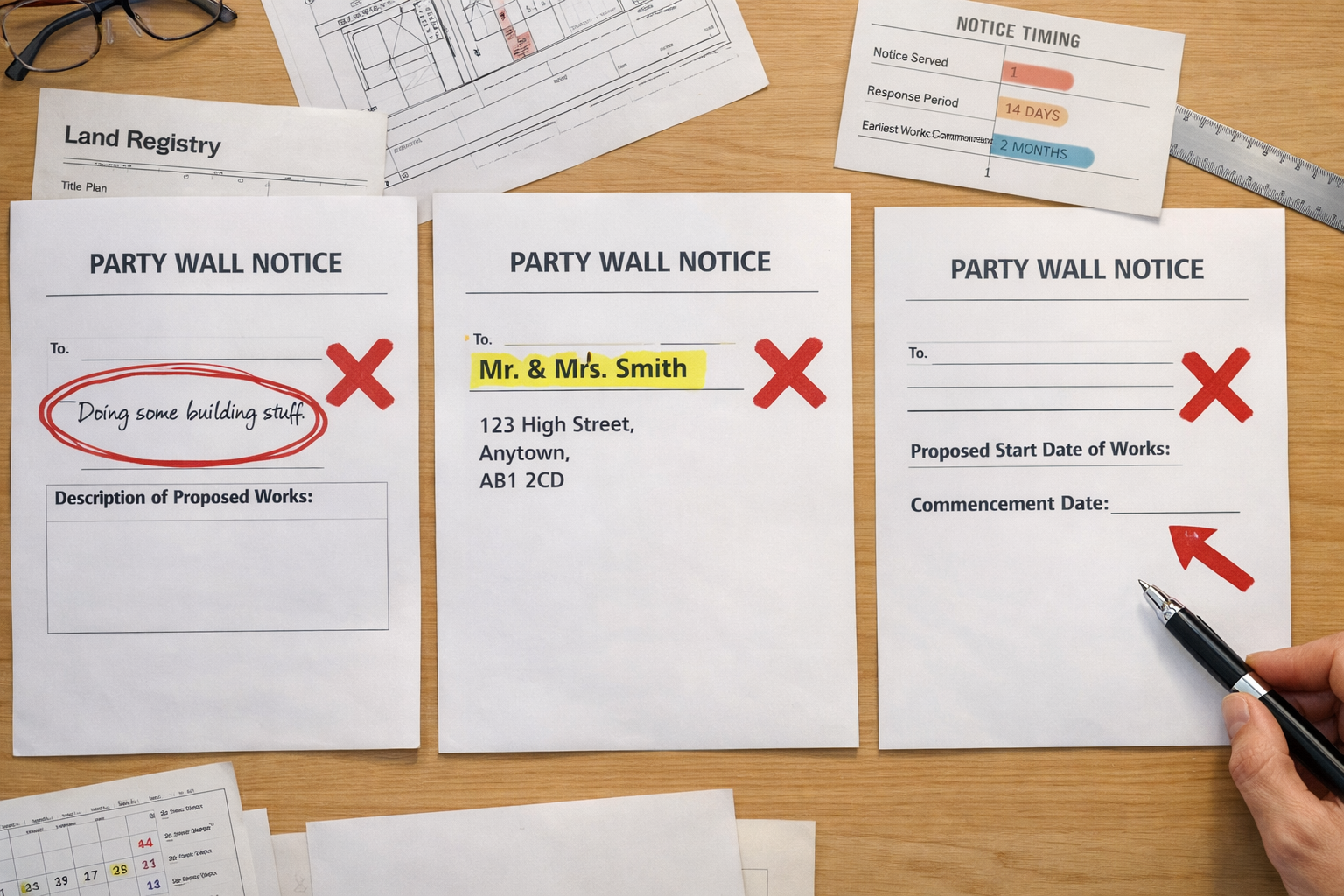
Nearly 40% of DIY party wall notices served in 2026 contain critical errors that render them legally invalid, exposing homeowners to expensive disputes, construction delays, and potential legal action. The three most common failures—vague work descriptions, incorrect recipient identification, and improper timing—account for the majority of invalidated notices, yet all are entirely preventable with proper guidance.[1]
Understanding the Common Party Wall Notice Mistakes Homeowners Make in 2026: Fixes and Surveyor Validation Checklists can save thousands of pounds in legal fees and prevent months of construction delays. This comprehensive guide examines real-world errors from actual party wall disputes, provides surveyor-approved templates, and offers practical checklists to ensure your notice meets all legal requirements under the Party Wall etc. Act 1996.

Key Takeaways
✅ Three critical errors invalidate most notices: vague work descriptions, incorrect recipient identification, and improper timing account for the majority of DIY failures
✅ Legal names must match Land Registry records exactly: serving notice to “the neighbour” instead of the registered freeholder invalidates the entire process
✅ Different notice types have distinct requirements: Section 1, Section 3, and Section 6 notices each demand specific information, drawings, and timing
✅ Proper service method is as important as content: notices must be delivered by hand, post, or legally accepted method with evidence of delivery
✅ Professional validation prevents costly disputes: surveyor-approved checklists catch errors before they become expensive legal problems
Understanding the Three Most Common Party Wall Notice Mistakes
The Common Party Wall Notice Mistakes Homeowners Make in 2026 stem from fundamental misunderstandings about legal requirements under the Party Wall etc. Act 1996. Each mistake carries serious consequences that can halt construction and trigger legal disputes.
Mistake #1: Vague or Insufficient Work Descriptions
The Problem: Homeowners frequently submit notices with one-line descriptions like “general building works” or “loft conversion.” These vague statements fail to meet legal requirements and leave adjoining owners unable to assess the impact on their property.[1]
Why It Matters: The notice must explicitly explain which part of the property is affected, the precise nature of the work, and whether it involves structural alteration, excavation, or both. Without specific details, the adjoining owner cannot provide informed consent or dissent.[1]
The Fix:
Your work description must include:
- Exact location within the property (e.g., “rear ground floor extension”)
- Specific structural work (e.g., “removing 2.4m section of party wall to create doorway”)
- Materials and methods (e.g., “installing steel beam RSJ 203x133x30kg/m”)
- Foundation details for excavation work (e.g., “excavating to 2.1m depth within 3m of boundary”)
- Impact on party structure (e.g., “cutting into party wall to insert beam bearings”)
Mistake #2: Incorrect Identification of Adjoining Owners
The Critical Error: Serving notice only to “the neighbour” or the person currently living next door is legally insufficient if they are not the registered owner.[1][2] This represents one of the most common and costly mistakes homeowners make.
Legal Requirements: You must identify and notify:
- All freeholders of adjoining properties
- Long leaseholders with more than one year remaining on their lease
- Joint owners (all names must be included)
- Owners at their actual contact address, not necessarily the adjoining property address[2]
Real-World Consequences: If the legal owner differs from the person notified, the notice does not count regardless of how clearly the work is described.[1] This mistake can invalidate months of planning and force you to restart the entire process.
The Fix:
- Obtain Land Registry documents for all adjoining properties (£3 per title)
- Extract full legal names exactly as they appear on the register
- Identify all registered proprietors including joint owners
- Verify current contact addresses through Land Registry or direct contact
- Serve notice to all owners at their registered correspondence address[2]
Mistake #3: Wrong Notice Type or Missing Sections
The Party Wall etc. Act 1996 defines three distinct notice types, each with different requirements and timing. Using the wrong type invalidates the entire process.[1]
The Three Notice Types:
| Notice Type | Purpose | Notice Period | Key Requirements |
|---|---|---|---|
| Section 1 | Works to existing party wall or structure | 2 months | Detailed description of structural work |
| Section 3 | Building new wall at boundary line | 1 month | Plans showing wall position and materials |
| Section 6 | Excavation within 3m (or 6m if deeper) of neighbour’s foundation | 1 month | Section drawing showing depths and distances[2] |
Common Error: Homeowners frequently fail to serve all applicable notice sections. For example, building a rear extension may require both Section 1 (if affecting an existing party wall) and Section 6 (for excavation work near the boundary).[2]
Critical Timing and Service Method Errors in Party Wall Notices
Beyond content errors, timing mistakes and improper service methods represent the second major category of failures that invalidate party wall notices in 2026.
Missing or Incorrect Commencement Dates
The Legal Requirement: Every party wall notice must include a specific commencement date—the date you intend to start work. This date must allow for the proper notice period: two months for Section 1 works, one month for Section 3 and Section 6 works.[1][3]
Common Mistakes:
- ❌ Omitting the commencement date entirely
- ❌ Starting work before the notice period expires
- ❌ Changing the start date without serving a new notice
- ❌ Using vague language like “sometime in spring”
The Fix: Include a specific date (e.g., “15 June 2026”) that allows for the full notice period plus a reasonable buffer. If plans change, serve a fresh notice with the updated date.
Improper Service Method
The Problem: Many homeowners assume that handing a notice to whoever answers the door or posting it through the letterbox constitutes proper service. While these methods can be valid, they must be executed correctly and documented.[1]
Legally Accepted Service Methods:
- Hand delivery to the owner personally (obtain signed receipt)
- Registered post or recorded delivery to the owner’s address
- Leaving at the owner’s residence (if they refuse to accept)
- Affixing to a conspicuous part of the property (as last resort)
Critical Requirement: You must be able to prove service if later questioned. Keep copies of:
- Signed receipts
- Postal tracking numbers and delivery confirmations
- Photographs of posted notices with timestamps
- Witness statements if delivered by hand
Address Errors: A frequent mistake is sending notices to the adjoining property address when the owner lives elsewhere. Always verify the owner’s actual contact address through Land Registry records.[2]
The 14-Day Response Window
After proper service, adjoining owners have 14 days to respond with either:
- Consent (work can proceed as described)
- Dissent (triggers the surveyor appointment process)
- Counter-notice (requesting additional protective measures)
Common Misunderstanding: Homeowners often believe that no response means automatic consent. This is incorrect. If the adjoining owner does not respond within 14 days, they are deemed to have dissented, which requires appointing surveyors.[3]
Surveyor-Approved Validation Checklist for Party Wall Notices
Professional surveyors have identified specific validation points that catch errors before notices are served. This surveyor validation checklist ensures compliance with all legal requirements.
Pre-Service Validation Checklist ✓
Owner Identification & Contact Details:
- Obtained current Land Registry title for all adjoining properties
- Extracted full legal names exactly as shown on register (no abbreviations)
- Identified all joint owners and long leaseholders
- Verified current correspondence addresses for all owners
- Confirmed owners are not companies requiring different service procedures
Notice Type & Content:
- Identified all applicable notice sections (Section 1, 3, and/or 6)
- Prepared separate notices for each section if multiple apply
- Included specific commencement date allowing full notice period
- Written detailed work description (minimum 100 words)
- Specified exact location of works within property
- Described structural impact on party wall or boundary
Required Drawings & Documentation:
- Attached section drawing for Section 6 excavation notices[2]
- Included plan showing new wall position for Section 3 notices
- Provided elevation drawings for significant structural work
- Labeled all drawings with property address and date
- Ensured drawings show relationship to adjoining property
Response Options & Legal Information:
- Clearly stated all response options available to adjoining owner
- Included 14-day response deadline
- Explained consequences of consent, dissent, and non-response
- Provided contact details for questions
- Referenced the Party Wall etc. Act 1996
Service Method Preparation:
- Selected appropriate service method (hand, post, or other)
- Prepared proof of service documentation
- Scheduled service date to allow full notice period
- Arranged for witness if hand-delivering
- Obtained tracked/recorded postal service if posting
Post-Service Documentation Checklist ✓
After serving your notice, maintain proper records:
- Filed copy of served notice with service date noted
- Stored proof of service (receipt, tracking number, photos)
- Calendared 14-day response deadline
- Prepared response protocol for consent, dissent, or silence
- Identified potential building owner’s surveyor if dissent occurs
- Budgeted for surveyor fees if dispute resolution needed
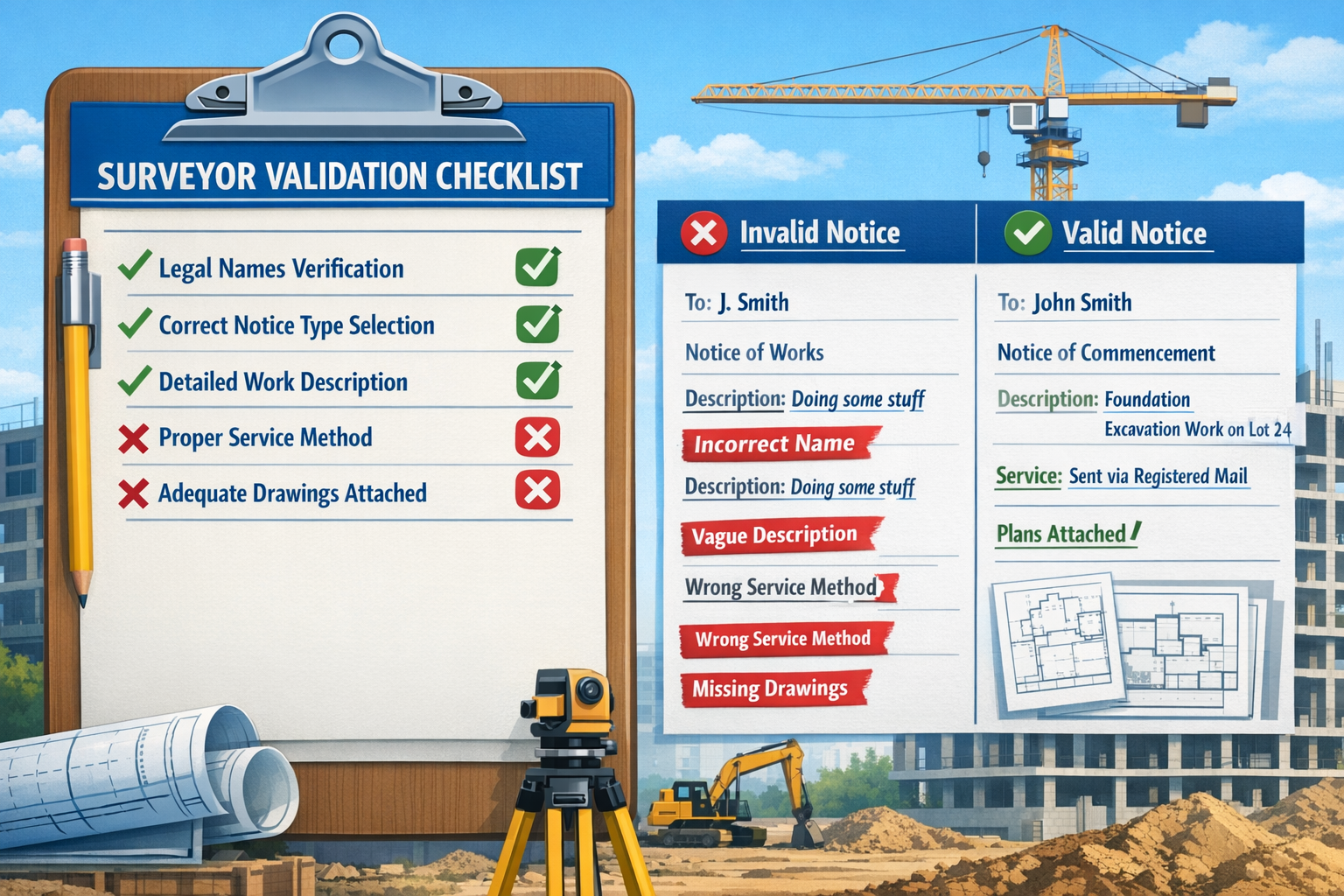
Real-World Fixes for Common Party Wall Notice Mistakes in 2026
When mistakes occur, swift correction prevents escalation into costly disputes. Here are practical fixes for the most common errors identified in 2026.
Fix #1: Correcting a Vague Work Description
Scenario: You served a notice stating “loft conversion work” without details.
Immediate Action:
- Withdraw the invalid notice in writing to the adjoining owner
- Prepare detailed description including:
- Steel beam installation specifications
- Party wall cutting locations and dimensions
- Foundation work details and depths
- Impact on shared chimney or roof structure
- Serve fresh notice with complete information
- Reset the notice period from the new service date
Prevention: Use the detailed work description template provided by professional party wall surveyors. Consult with your types of party wall works specialist before drafting.
Fix #2: Correcting Recipient Identification Errors
Scenario: You served notice to a tenant or the wrong owner.
Immediate Action:
- Obtain correct Land Registry documents immediately (£3 per title)
- Identify all registered proprietors with full legal names
- Locate current contact addresses for each owner
- Serve fresh notices to all correct recipients
- Document the correction in case of later questions
If Work Already Started: Stop immediately and seek professional advice. Starting work without valid notice exposes you to injunctions and damages claims.
Fix #3: Correcting Notice Type Errors
Scenario: You served only Section 1 notice but your excavation work also requires Section 6.
Immediate Action:
- Identify all applicable sections for your complete scope of work
- Prepare additional notices for missing sections
- Serve supplementary notices with appropriate notice periods
- Delay work commencement until all notice periods expire
- Coordinate timing so all notices align for a single start date
Complex Projects: For projects involving multiple notice types, consider engaging a professional party wall surveyor from the outset. Surveyors in South London, North London, East London, and West London can ensure all requirements are met before service.
Fix #4: Addressing Timing and Service Method Failures
Scenario: You started work before the notice period expired or cannot prove proper service.
Critical Response:
- Stop all work immediately if notice period not complete
- Document current state with photographs and measurements
- Serve proper notice with correct timing if not already done
- Communicate transparently with adjoining owner about the error
- Offer to engage surveyors to formalize the process properly
If Dispute Arises: The adjoining owner may appoint their own adjoining owner’s surveyor to assess any damage. Cooperate fully and consider this an opportunity to establish a proper party wall award that protects both parties.
Managing Dissent: Response Strategies When Neighbours Object
Understanding how to respond when an adjoining owner dissents is crucial for Common Party Wall Notice Mistakes Homeowners Make in 2026: Fixes and Surveyor Validation Checklists.
The Dissent Process Explained
When an adjoining owner dissents (or fails to respond within 14 days), the dispute resolution process begins:
Step 1: Surveyor Appointment
- You appoint a building owner’s surveyor
- The adjoining owner appoints their own surveyor
- Alternatively, both parties can agree to a single “agreed surveyor”
Step 2: Award Preparation
- The surveyors inspect both properties
- They prepare a schedule of condition documenting pre-work state
- They draft a party wall award outlining work permissions and protections
Step 3: Award Service
- The completed award is served on both parties
- It becomes legally binding after 14 days (unless appealed)
- Work can proceed according to award terms
Cost Management Strategies
Who Pays Surveyor Fees?: Generally, the building owner pays for both surveyors’ reasonable fees.[3] However, you can minimize these costs:
💰 Cost Control Tips:
- Propose an agreed surveyor (single surveyor for both parties) to reduce fees
- Obtain fixed-fee quotes before appointing surveyors
- Review our guide on how to keep party wall costs down
- Prepare thorough documentation to minimize surveyor investigation time
- Respond promptly to surveyor requests to avoid delays
Typical Costs in 2026:
- Agreed surveyor: £700-£1,200 per party wall matter
- Two surveyors: £1,500-£3,000 total (including both appointments)
- Complex projects: £3,000-£5,000+ for multiple walls or extensive work
For detailed cost breakdowns, consult the costs of party wall process guide.
Template Response to Dissent
When you receive a dissent notice, respond professionally:
Sample Response Letter:
[Your Name]
[Your Address]
[Date]
[Adjoining Owner Name]
[Their Address]
Dear [Name],
Re: Party Wall Notice – Dissent Response
Thank you for your dissent notice dated [date] regarding proposed works at [your address].
I acknowledge your dissent and propose we proceed with the surveyor appointment process under the Party Wall etc. Act 1996.
Option 1 – Agreed Surveyor: To minimize costs and expedite the process, I suggest we jointly appoint an agreed surveyor. I propose [Surveyor Name] of [Company], who is experienced and impartial. Please confirm if this is acceptable.
Option 2 – Separate Surveyors: If you prefer separate representation, I have appointed [Your Surveyor Name] of [Company] as my building owner’s surveyor. Please appoint your surveyor within 10 days, and provide their contact details so our surveyors can coordinate.
I remain committed to ensuring the works proceed with full protection for your property. The surveyors will prepare a schedule of condition and party wall award to formalize all protections.
Please contact me if you have any questions.
Yours sincerely,
[Your Signature]
[Your Name]
Advanced Validation: Professional Surveyor Review Protocols
Even with careful preparation, professional validation catches subtle errors that homeowners miss. Understanding what professional surveyors check provides insight into the Common Party Wall Notice Mistakes Homeowners Make in 2026: Fixes and Surveyor Validation Checklists.
What Professional Surveyors Verify
Legal Compliance Review:
- ✓ Full legal names match Land Registry records precisely (no middle name omissions)[2]
- ✓ All applicable notice sections identified and served[2]
- ✓ Sufficient detail in work descriptions to meet legal standards
- ✓ Correct notice periods calculated and allowed
- ✓ Proper service method documented with evidence
Technical Adequacy Review:
- ✓ Drawings show accurate relationship to adjoining property
- ✓ Section drawings for excavation include all required dimensions[2]
- ✓ Work description matches proposed drawings
- ✓ Structural implications clearly explained
- ✓ Special engineering provisions identified
Procedural Compliance Review:
- ✓ All response options clearly presented to adjoining owner[2]
- ✓ Contact information provided for questions
- ✓ Statutory references included
- ✓ Timeline allows for proper response period
- ✓ Follow-up procedures established
When to Engage a Professional Surveyor
Consider professional surveyor involvement before serving notice if:
🏗️ Your project involves complex structural work affecting multiple walls
🏗️ You’re excavating within 3 meters of your neighbour’s foundation
🏗️ Multiple adjoining properties are affected
🏗️ The adjoining property has known structural issues
🏗️ You’ve had previous disputes with the neighbour
🏗️ Your project timeline is critical and cannot accommodate delays
Proactive Engagement Benefits:
- Eliminates notice errors before they occur
- Establishes professional credibility with neighbours
- Provides expert witness if disputes arise
- Ensures comprehensive schedule of condition documentation
- Reduces overall project risk and potential delays
For complex projects, surveyors in Central London and other areas offer pre-service notice review services that catch errors before they become problems.
Conclusion: Preventing Party Wall Notice Mistakes in 2026
The Common Party Wall Notice Mistakes Homeowners Make in 2026: Fixes and Surveyor Validation Checklists reveal that most errors are entirely preventable with proper preparation and attention to legal requirements. The three critical areas—accurate work descriptions, correct owner identification, and proper notice type selection—account for the vast majority of invalidated notices.
Your Action Plan
Before Serving Notice:
- ✅ Obtain Land Registry documents for all adjoining properties
- ✅ Extract exact legal names and current contact addresses
- ✅ Identify all applicable notice sections for your work
- ✅ Prepare detailed work descriptions (minimum 100 words)
- ✅ Create or commission required technical drawings
- ✅ Calculate correct notice periods and commencement dates
- ✅ Review the complete surveyor validation checklist
During the Process:
- ✅ Serve notices using proper method with proof of service
- ✅ Document all communications with adjoining owners
- ✅ Respond professionally to questions or concerns
- ✅ Prepare for potential dissent with surveyor contacts ready
- ✅ Maintain detailed records of all steps taken
If Errors Occur:
- ✅ Stop work immediately if notice was invalid
- ✅ Serve corrected notices without delay
- ✅ Communicate transparently with affected parties
- ✅ Engage professional surveyors to formalize the process
- ✅ Document all corrective actions taken
Next Steps
For comprehensive guidance tailored to your specific project, explore these resources:
- Review party wall act notices and how to respond for detailed procedural information
- Download sample party wall agreement templates to understand proper formatting
- Understand what is a party structure notice for Section 1 works
- Learn about having a party wall agreement without a surveyor when neighbours cooperate
Professional Support: If your project involves significant structural work, excavation, or multiple adjoining properties, professional surveyor validation before serving notice can prevent costly mistakes and ensure smooth project progression.
The investment in proper notice preparation—whether through careful self-education or professional surveyor engagement—pays dividends in avoided disputes, maintained neighbour relationships, and uninterrupted construction schedules. Don’t let preventable notice errors derail your 2026 building project.
References
[1] 2026 Diy Party Wall Notice Validity Tips – simplesurvey.co.uk
[2] Party Wall Surveyor Mistakes – stokemont.com
[3] Party Wall Agreement – hoa.org.uk
Speak to a RICS chartered party wall surveyor
Free initial consultation. Notices, awards and schedules of condition across London and nationwide.