
Fewer than one in five homeowners planning chimney stack removals in 2026 realise that the legal obligations under the Party Wall etc. Act 1996 extend well beyond the removal of a chimney breast — and that getting this wrong can halt construction, trigger injunctions, and expose building owners to significant liability. The Party Wall Act for Shared Chimney Stacks: Removal Notices, Structural Surveys, and Award Enforcement Beyond Breast Works is a topic that demands precision, because the rules governing full-stack removals, flue integrity surveys, and award conditions differ substantially from the more commonly discussed breast-only works.
This guide cuts through the confusion, explaining exactly when notices are required, what surveyors must assess, and how Party Wall Awards are enforced when the scope of work reaches the roofline and beyond.
Key Takeaways 📌
- Not all chimney stack removals require a Party Wall Notice — but partial removals almost always do, and the distinction is critical.
- A Party Structure Notice under Section 3 of the Act must be served at least two months before work begins on a shared stack.
- Structural surveys for shared stacks must assess flue integrity, weatherproofing, and load-bearing implications — not just the breast below ceiling level.
- A Party Wall Award can include bespoke conditions covering stack-specific risks that go far beyond standard breast removal provisions.
- Freeholder consent is an additional legal requirement in leasehold properties and must not be overlooked.
Understanding the Party Wall Act for Shared Chimney Stacks: What Makes Stacks Different from Breast Works
The Anatomy of a Shared Chimney Stack
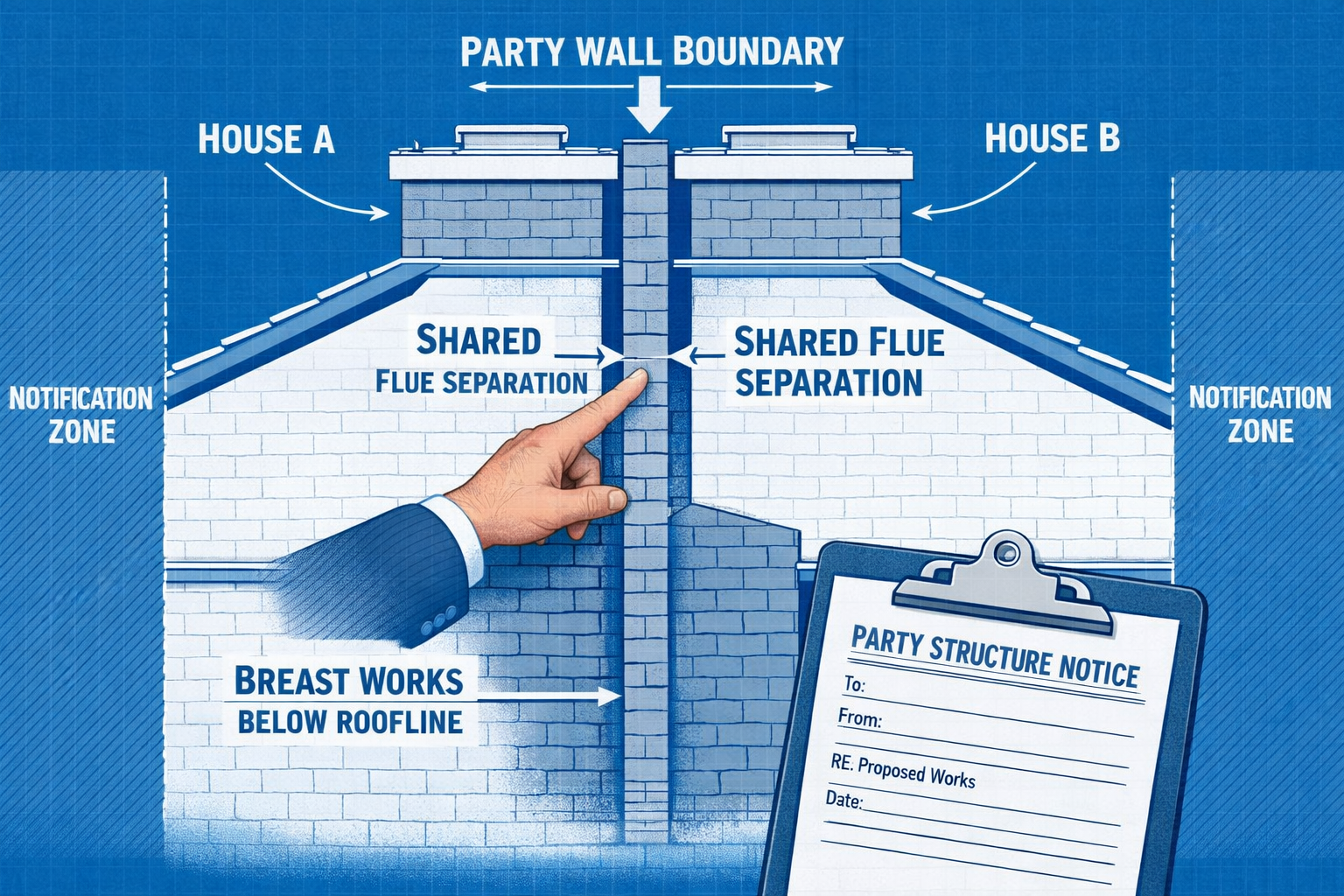
A chimney stack is the masonry structure that projects above the roofline, housing one or more flues from the properties below. In a typical Victorian or Edwardian terrace — still the dominant housing stock across London — the stack straddles the boundary between two homes. Inside the stack, a party wall separates the individual flues of each owner [1]. This internal dividing wall is usually protected from the elements by the surrounding brickwork, making it structurally distinct from the exposed party wall lower in the building.
The chimney breast, by contrast, is the section of masonry inside the property — the projecting structure within a room that houses the flue below ceiling level. Many homeowners conflate the two, but surveyors and solicitors treat them as separate elements with different legal implications.
Understanding this distinction is the foundation of applying the Party Wall etc. Act 1996 correctly to chimney works.
When Does the Act Apply to Chimney Stacks?
The Act’s application to chimney stacks depends on the scope and nature of the proposed work:
| Work Type | Party Wall Act Applies? | Notice Required? |
|---|---|---|
| Removing only your half of a shared stack | ✅ Yes | ✅ Party Structure Notice |
| Removing the entire shared stack (disused flues) | ⚠️ Conditional | ❌ Not always required [1] |
| Repointing or repairing the shared stack | ✅ Yes | ✅ Party Structure Notice |
| Removing chimney breast (internal only) | ✅ Yes | ✅ Party Structure Notice |
| Lining a flue within a shared stack | ✅ Yes | ✅ Party Structure Notice |
💡 Key distinction: Removing an entire shared chimney stack does not automatically require a Party Wall Notice if the connected fireplaces are no longer in use and the project is not otherwise covered by the Act [1]. However, removing only one owner’s portion of the stack — a half-stack removal — almost always triggers the Act, because masonry will be cut from the party wall and the exposed surface will face the elements [1].
This nuance is frequently misunderstood. Homeowners who assume that a full removal is always notifiable — or conversely, that a partial removal is exempt — risk either unnecessary delays or serious legal exposure.
For a broader overview of the types of party wall works covered by the Act, it is worth reviewing the full scope before planning any chimney project.
Serving Removal Notices: The Correct Legal Process for Shared Chimney Stack Works
The Party Structure Notice Explained
Any work on a shared chimney stack that falls within the Act requires a Party Structure Notice served under Section 3 of the Party Wall etc. Act 1996 [4]. This is a formal written document — verbal agreements carry no legal weight [5] — that must be served on the adjoining owner before work begins.
Key requirements of a valid Party Structure Notice include:
- ✅ Must be in writing (verbal notice is not sufficient) [5]
- ✅ Must be served a minimum of two months before the planned start date [4]
- ✅ Must describe the nature and extent of the proposed work clearly
- ✅ Must identify the party structure (in this case, the shared chimney stack) affected
- ✅ Must be served on the correct adjoining owner — only those who directly share the party wall where the chimney breast or stack is located, not every neighbour in a multi-unit building [4]
For a detailed walkthrough of what party wall notices are and how to respond, including template language and service methods, specialist guidance is strongly recommended.
Who Receives the Notice?
This is a point of genuine confusion in multi-unit buildings. The notice only needs to be served on the adjoining owner who directly shares the party wall containing the chimney breast being removed [4]. In a standard two-property terrace, this is straightforward. In a converted Victorian house with multiple flats, it becomes more complex.
Additionally, where the property is leasehold, the freeholder must also be notified and will typically need to provide consent, since chimney stack removal can affect the structural integrity of the entire building [5]. Failing to secure freeholder consent is a common and costly oversight.
Response Pathways After Notice Is Served
Once the notice is served, the adjoining owner has 14 days to respond in writing. Three outcomes are possible:
- Consent in writing — Work can proceed without further dispute resolution [2].
- Dissent — A Party Wall Award must be prepared by appointed surveyor(s) [2].
- No response within 14 days — This is treated as a deemed dissent, triggering the surveyor appointment process [2].
For those planning works, understanding the full party wall notices process — including deemed dissent timelines — is essential before serving any documentation.
Structural Surveys for Shared Chimney Stacks: Beyond the Breast
Why Chimney Stack Surveys Require Specialist Assessment
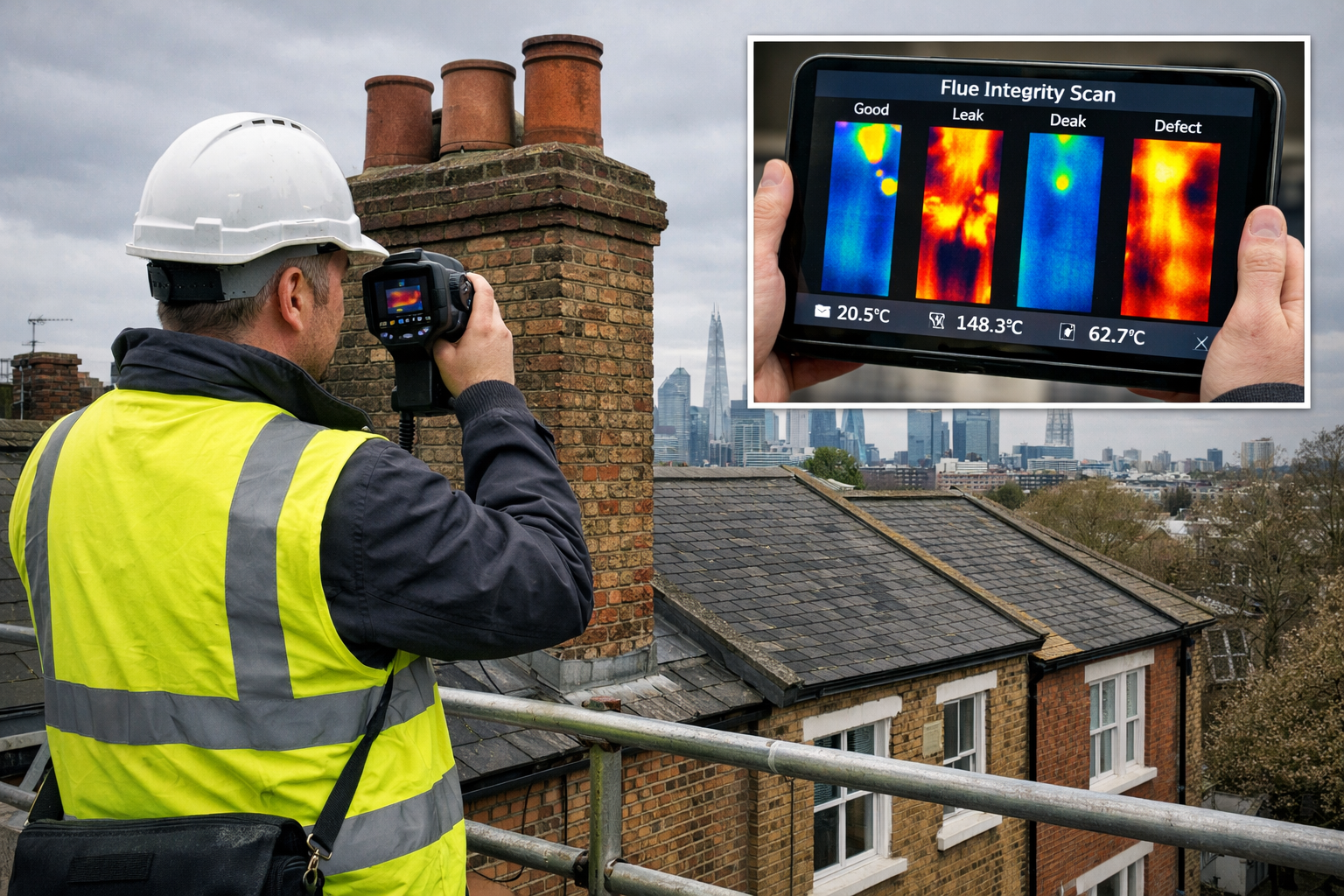
When the scope of work extends to the stack above the roofline, a standard party wall survey that focuses only on the breast below ceiling level is wholly inadequate. Qualified surveyors must assess a broader range of structural and weatherproofing factors that are unique to above-roof masonry [3].
A comprehensive structural survey for a shared chimney stack should address:
- Flue integrity — Are the individual flues structurally sound and properly separated by the internal party wall? Any compromise here creates fire and carbon monoxide risks for both properties.
- Weatherproofing exposure — If one owner’s portion of the stack is removed, the remaining masonry will be exposed to wind, rain, and frost. The survey must assess whether adequate weatherproofing can be achieved [1].
- Load-bearing implications — In some older properties, the chimney stack contributes to roof stability. Removing it without proper structural assessment can compromise the roof structure.
- Flashings and leadwork — The junction between the stack and the roof covering must be surveyed and any remediation planned before works commence.
- Condition of shared flue lining — Even if one owner is removing their breast, the shared flue lining within the party wall section of the stack may be affected.
🔍 Surveyor insight: In many cases, surveyors will include chimney stack condition in their discussions and recommendations even where the work is not formally notifiable under the Act — because the structural risks to both properties are too significant to ignore [1].
Schedule of Condition: Protecting Both Parties
Before any chimney stack work begins, a schedule of condition should be prepared. This is a detailed photographic and written record of the existing state of both properties — particularly the adjoining owner’s walls, ceilings, and roof structure near the stack.
The schedule of condition serves as the baseline for any damage claims after works are completed. Without it, disputes about whether cracking or dampness was pre-existing or caused by the works become extremely difficult to resolve.
Party Wall Award Enforcement: Tailored Conditions for Chimney Stack Works
What a Party Wall Award Covers for Shared Stacks
When the adjoining owner dissents or fails to respond, appointed surveyors must prepare a Party Wall Award — a legally binding document that governs how and when the works will be carried out [2]. For chimney stack removals, this award must go significantly further than the standard provisions used for breast-only removals.
A well-drafted Party Wall Award for shared chimney stack works should include:
Standard provisions:
- Description of the works and their extent
- Working hours and access arrangements
- Insurance requirements
- Dispute resolution mechanisms
Stack-specific provisions beyond breast works:
- Flue capping and sealing requirements — specifying materials and methods for permanently sealing the adjoining owner’s flue after the shared stack is partially removed
- Weatherproofing obligations — detailed specifications for the new parapet, coping, or rendered finish on the exposed party wall above the roofline
- Structural monitoring conditions — requiring the building owner to commission a structural engineer’s sign-off before and after removal
- Reinstatement obligations — if the adjoining owner’s flue or stack is damaged during works, the award should specify the standard of reinstatement required
- Timing restrictions — particularly relevant in winter months when frost can damage freshly exposed masonry
For a detailed understanding of how party wall awards are structured and what they legally require of each party, reviewing specialist guidance before the surveyor appointment process begins is highly advisable.
Enforcing the Award: Legal Mechanisms
A Party Wall Award is enforceable as a civil debt through the County Court. If a building owner proceeds with works in breach of the award conditions — for example, failing to properly cap the adjoining flue or leaving exposed masonry unweatherproofed — the adjoining owner has several remedies:
- Injunction — to halt works immediately until compliance is achieved
- Damages — for any loss or damage caused by the breach
- Specific performance — requiring the building owner to carry out remediation works to the standard specified in the award
⚖️ Important: An adjoining owner who believes the award does not adequately protect their interests has 14 days from the date of the award to appeal to the County Court under Section 10(17) of the Act. Missing this deadline significantly limits future options.
The Role of the Third Surveyor
Where each party appoints their own surveyor and those surveyors cannot agree on award terms, a Third Surveyor — agreed upon at the outset — can be called upon to resolve the dispute. For complex chimney stack cases involving disputed flue conditions or weatherproofing specifications, the Third Surveyor’s role is particularly valuable.
Those acting as adjoining owners should ensure their appointed surveyor has specific experience with above-roofline chimney works, not just standard party wall matters.
Practical Considerations for Building Owners in 2026
Costs and Timelines
Chimney stack party wall matters typically involve higher surveyor fees than standard breast removals, reflecting the additional complexity of above-roof assessments. Key cost factors include:
- Surveyor fees for both building owner and adjoining owner (the building owner typically pays both) [2]
- Structural engineer fees for load-bearing and flue integrity assessments
- Schedule of condition preparation costs
- Potential reinstatement costs if the adjoining owner’s stack or flue is affected
For guidance on how to keep party wall costs down without compromising on legal compliance, early engagement with a qualified surveyor is consistently the most effective strategy.
Common Mistakes to Avoid
❌ Assuming a full-stack removal is always exempt — check whether the flues are genuinely disused and whether the project triggers the Act through other elements [1]
❌ Serving notice on the wrong party — in leasehold buildings, both the leaseholder and freeholder may need to be notified [5]
❌ Using a verbal agreement — this has no legal standing under the Act [5]
❌ Failing to commission a schedule of condition — without this, damage disputes become almost impossible to resolve fairly
❌ Appointing a surveyor without chimney stack experience — the structural risks above the roofline require specialist knowledge
For those carrying out works, the dedicated guidance for building owners provides a clear roadmap of obligations from notice service through to award compliance.
Conclusion: Getting Chimney Stack Party Wall Matters Right in 2026
The Party Wall Act for Shared Chimney Stacks: Removal Notices, Structural Surveys, and Award Enforcement Beyond Breast Works is a genuinely complex area where the consequences of errors are serious — from injunctions halting construction to costly reinstatement obligations and neighbour disputes that damage property values.
The core principles are clear: serve the correct notice at the correct time, commission a structural survey that addresses the full scope of above-roof risks, and ensure that any Party Wall Award contains bespoke conditions that go beyond the standard breast-removal template. Freeholder consent in leasehold properties is a non-negotiable additional step.
✅ Actionable Next Steps
- Determine whether your proposed works are notifiable — consult a qualified party wall surveyor before assuming either way.
- Serve a valid Party Structure Notice at least two months before planned works, in writing, to the correct parties.
- Commission a specialist structural survey covering flue integrity, weatherproofing, and load-bearing implications above the roofline.
- Ensure a schedule of condition is prepared before any work begins.
- Review the Party Wall Award carefully before signing off — ensure it includes stack-specific enforcement provisions, not just standard breast-removal clauses.
- Seek specialist legal or surveyor advice if the adjoining owner dissents or if the award terms are disputed.
Early professional engagement is not just advisable — in 2026, with increasing scrutiny on structural works in the UK’s ageing housing stock, it is essential.
References
[1] Repairing Removing Shared Chimney Stacks – peterbarry.co.uk
[2] Removing A Chimney Breast On A Party Wall Costs Process Legal Requirements – thepartywallguru.com
[3] Shared Chimney Stack – hardingsurveyors.co.uk
[4] Taking Out A Chimney Breast – stokemont.com
[5] Removing Chimney Breast Party Wall Agreement – collier-stevens.co.uk
Speak to a RICS chartered party wall surveyor
Free initial consultation. Notices, awards and schedules of condition across London and nationwide.