
{“cover”:”Professional landscape format (1536×1024) hero image with bold text overlay: ‘Party Wall Awards for Basement Conversions 2026’ in extra large 72pt white bold sans-serif font with dark semi-transparent background panel, centered upper-third composition. Background shows a dramatic cross-section view of an urban London terrace row with a deep basement excavation underway, exposed concrete foundations, surveyors in hard hats reviewing technical drawings at street level, neighboring Victorian townhouses visible. Color palette: deep navy blue, white text, amber accent lines. Magazine cover aesthetic, editorial quality, high contrast.”,”content”:[“Detailed landscape format (1536×1024) editorial illustration showing a party wall surveyor in professional attire standing at the edge of a deep basement excavation site in a London terrace street, holding a formal Party Wall Award document. Visible elements include exposed brick foundations, timber shoring supports, neighboring property foundations shown in cross-section cutaway. Technical drawing overlays show 3-metre and 6-metre excavation radius zones marked with dashed lines. Color scheme: warm brick tones, blueprint blue overlays, white annotation text. Professional construction site photography style.”,”Detailed landscape format (1536×1024) showing a split-scene infographic-style image: left side depicts vibration monitoring equipment mounted on a party wall with digital readout displays showing settlement data and crack gauges installed at foundation level; right side shows a surveyor’s laptop screen displaying a monitoring log spreadsheet with timestamps and vibration readings. Background shows a basement conversion in progress with underpinning works visible. Color scheme: dark charcoal, electric green data readouts, white labels. Technical, professional, data-focused aesthetic.”,”Detailed landscape format (1536×1024) editorial photograph showing two property owners and a neutral party wall surveyor seated at a modern meeting table reviewing a Schedule of Condition report with photographic evidence pages spread out. A framed party wall award document sits prominently on the table. Through the window behind them, a residential London street with terraced houses is visible. Warm professional office lighting, calm dispute-resolution atmosphere. Color palette: warm neutrals, navy accents, natural light. Conveys professionalism, agreement, and resolution.”]
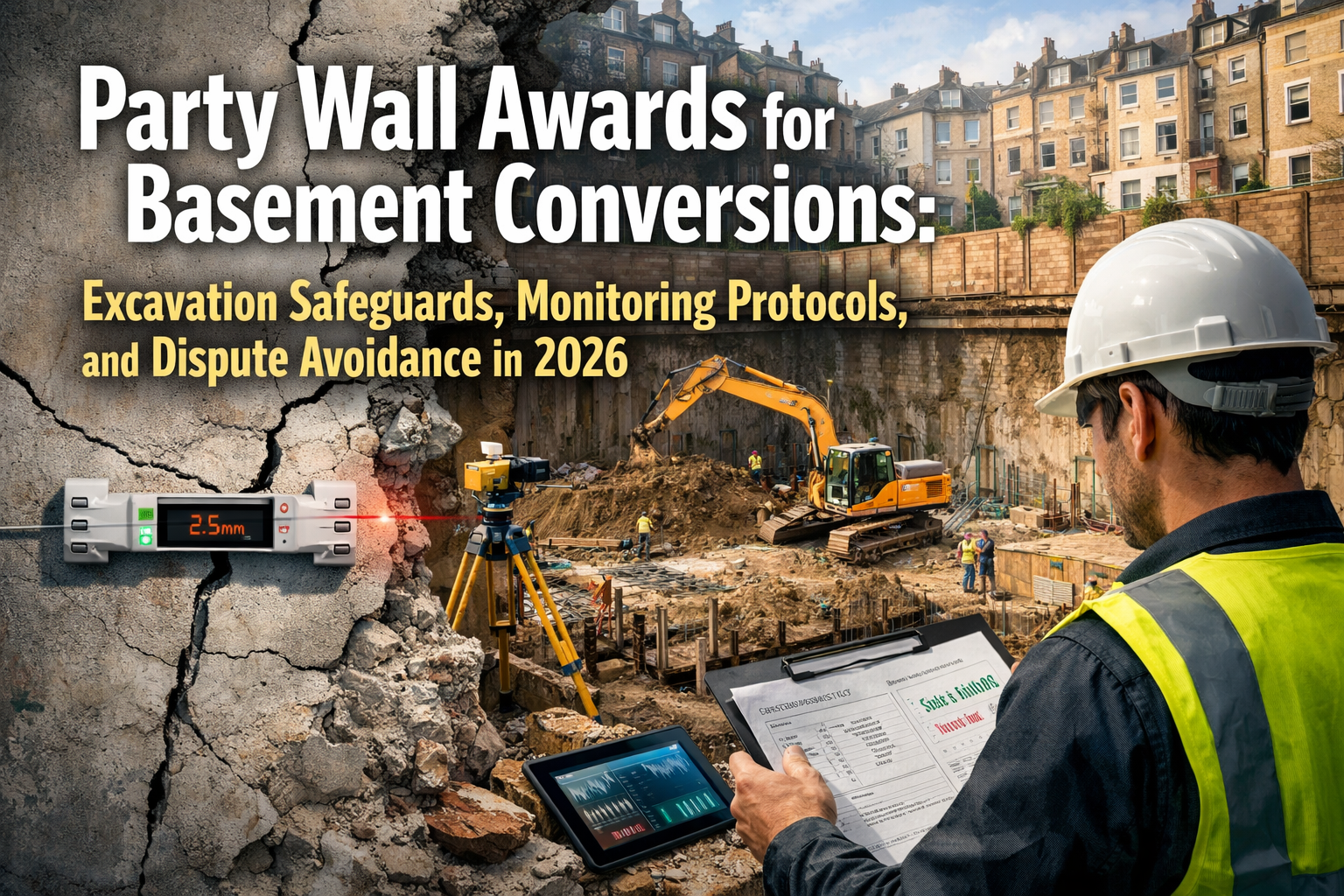
Nearly one in three London planning applications now includes some form of basement or subterranean extension — and the legal machinery that governs how those projects affect neighbours has never been under greater pressure. Party Wall Awards for Basement Conversions: Excavation Safeguards, Monitoring Protocols, and Dispute Avoidance in 2026 sit at the centre of this challenge, providing the formal framework that keeps deep excavations safe, neighbours protected, and projects on track in an increasingly dense housing market. [1]
This guide breaks down exactly what surveyors, building owners, and adjoining owners need to know — from the moment a spade hits the ground to the final sign-off.
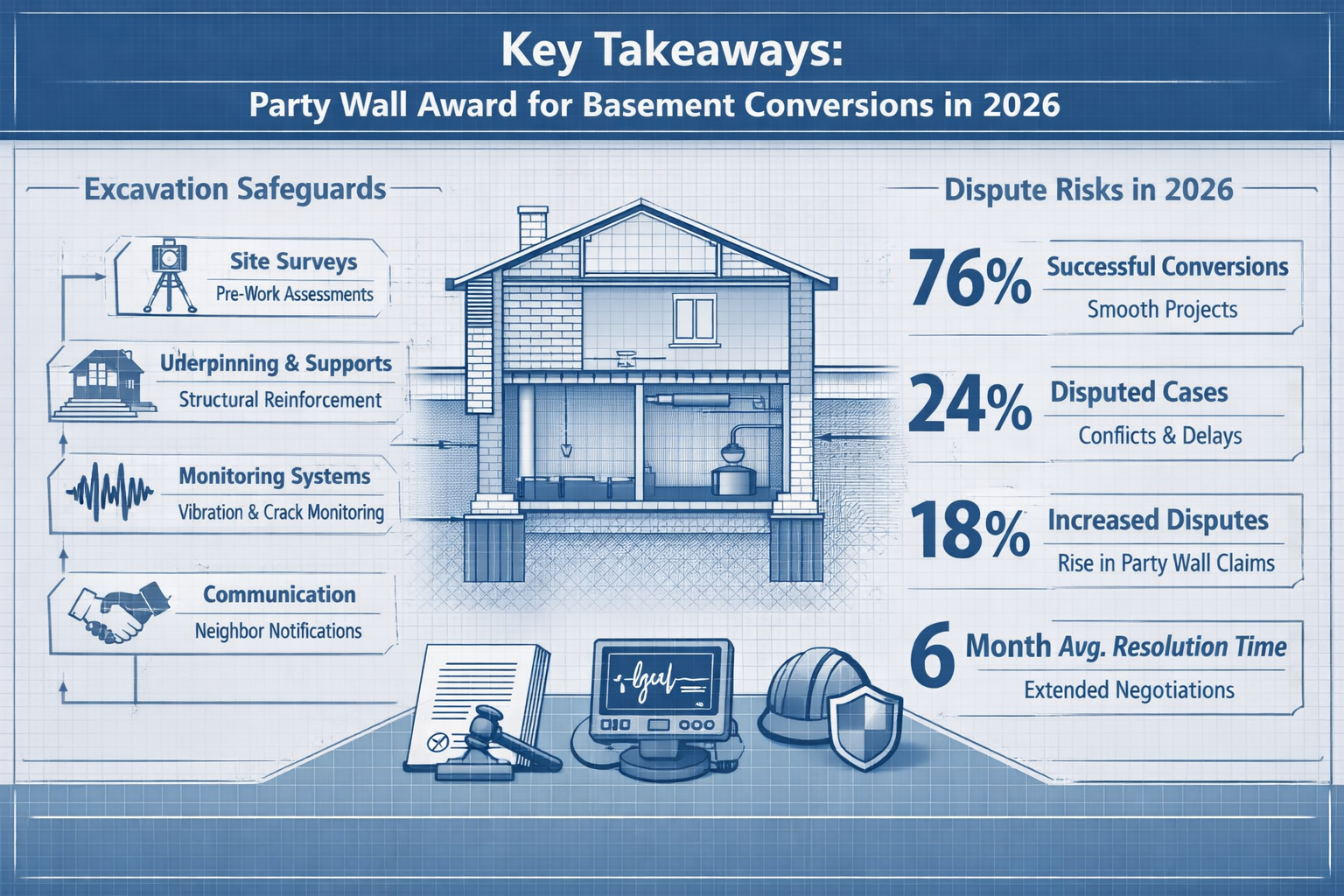
Key Takeaways 📋
- Basement excavations almost always trigger the Party Wall etc. Act 1996, requiring formal notices and a Party Wall Award before work begins.
- A Party Wall Award must document excavation safeguards, working methods, vibration limits, and settlement monitoring protocols — not just general permissions.
- A Schedule of Condition prepared before work starts is the single most effective tool for preventing post-project disputes.
- Early, clear communication with neighbours dramatically reduces the risk of injunctions, delays, and legal costs.
- Surveyor expertise matters: choosing a qualified surveyor experienced in deep excavation work is critical in 2026’s high-demand construction environment.
Why Basement Conversions Are High-Risk Under the Party Wall Act
The Excavation Thresholds That Trigger the Act
The Party Wall etc. Act 1996 is not optional — it is a statutory requirement. For basement conversions specifically, the Act is triggered when excavation occurs:
- Within 3 metres of a neighbouring building, and the excavation goes deeper than the neighbour’s foundations
- Within 6 metres of a neighbouring building, and the excavation cuts a line drawn at 45° downward from the neighbour’s foundation base [4]
Given that most urban terraced and semi-detached properties share walls and sit on shallow Victorian-era foundations, virtually every basement conversion in a dense residential area will cross one or both of these thresholds. This is why basement work is consistently classified as a higher-risk project category under the Act. [1]
💡 Pull Quote: “Basement-related excavation is one of the most consistent triggers for Party Wall Act requirements — and one of the most common sources of neighbour disputes when the process is ignored.” [1]
Three Categories of Notifiable Work in a Basement Project
Basement conversions typically activate not just one but multiple categories of notifiable work simultaneously:
| Category | Trigger | Common Basement Example |
|---|---|---|
| Line of Junction Notice | New structure at or astride the boundary | Underpinning near the shared wall |
| Party Structure Notice | Work directly on a party wall or floor | Cutting into a shared wall for beams |
| Three/Six Metre Notice | Excavation near neighbouring foundations | Digging for the basement slab |
Understanding which categories apply is the first job of a qualified party wall surveyor. Getting this wrong at the notice stage can invalidate the entire process. For a detailed breakdown of party wall notices and how to respond, it is worth reviewing the process carefully before serving anything. [4]
What a Party Wall Award Must Include for Basement Work
Core Components of the Award Document
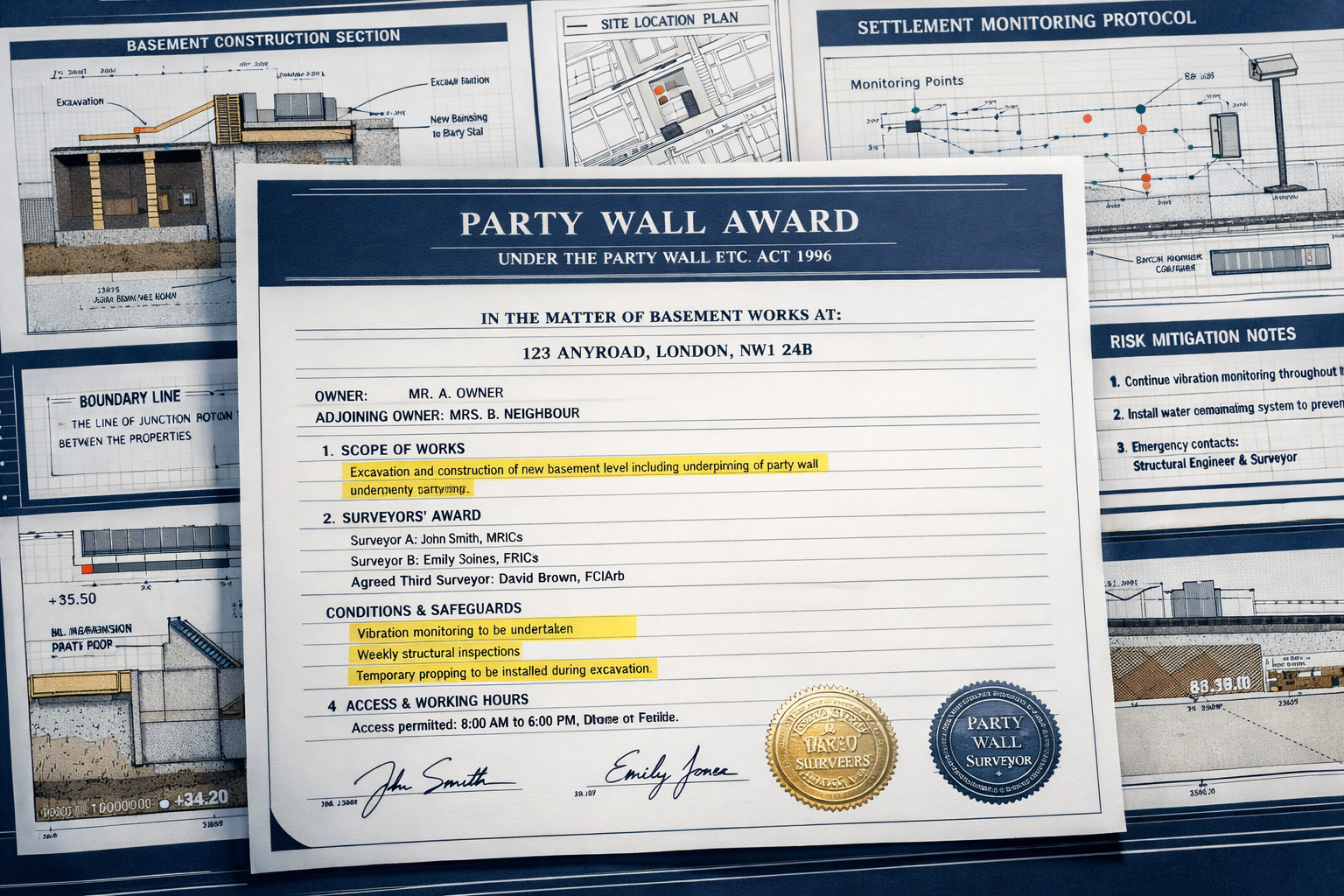
A Party Wall Award is far more than a permission slip. For basement conversions, it is a detailed operational document that sets out how the work will be carried out safely and fairly. [2] A well-drafted award for a basement project should include:
- ✅ Scope of permitted works — precise description of the excavation, underpinning, and structural works
- ✅ Working hours and access arrangements — when contractors can enter the site and whether access to the adjoining property is needed
- ✅ Protective measures — shoring methods, temporary support systems, and waterproofing requirements
- ✅ Vibration and noise limits — maximum permitted levels, especially relevant near older masonry
- ✅ Settlement monitoring protocols — frequency of readings, trigger levels, and response procedures
- ✅ Damage handling procedures — who assesses damage, how it is reported, and the timeline for resolution
- ✅ Cost allocation — who pays for surveyor fees and any remedial works [2][4]
For a comprehensive look at what goes into these documents, the Party Wall Awards guide provides a useful overview of the standard framework.
Vibration Monitoring: A Non-Negotiable Clause in 2026
Vibration from piling, breaking out concrete, and heavy plant movement is one of the most underestimated risks in basement excavations. In 2026’s construction climate — with more projects running simultaneously in dense urban areas — vibration monitoring clauses have become standard practice in well-drafted awards. [3]
A robust vibration monitoring protocol in the Award should specify:
- Baseline vibration levels recorded before work starts (using the Schedule of Condition as a reference point)
- Peak Particle Velocity (PPV) limits — typically following BS 7385 or BS 5228 standards
- Trigger and alarm thresholds — what happens when readings approach the limit
- Continuous or periodic monitoring — frequency depends on proximity to neighbouring foundations
- Escalation procedures — who is notified, and how quickly work must stop if thresholds are breached
Without these clauses, a building owner has no documented defence if a neighbour claims that vibration caused cracking — and no agreed process for resolving it fairly.
Settlement Monitoring and Underpinning Clauses
Deep excavations change the stress distribution in the ground around them. Settlement — the gradual sinking of a structure as ground conditions shift — is a real risk when basement work proceeds near shallow foundations. [2]
The Award should require:
- Tell-tales or crack gauges installed at key points on the adjoining wall before work begins
- Regular readings logged by a competent person throughout the excavation phase
- Photographic records of any movement, however minor
- Underpinning specifications — if underpinning of the party wall is required, the method (traditional mass concrete, mini-piles, or beam-and-base) must be described in detail
- Structural engineer sign-off at defined stages
This level of detail protects both parties. The building owner can demonstrate that work was carried out to the agreed standard; the adjoining owner has a clear record if something goes wrong.
The Schedule of Condition: Your Most Powerful Dispute-Prevention Tool
Why It Matters More Than Ever in 2026
A Schedule of Condition is a detailed photographic and written record of the adjoining property’s existing state — every crack, stain, damp patch, and imperfection — captured before excavation begins. [2]
Without this baseline, any crack that appears in a neighbour’s wall after the basement is dug becomes a potential dispute. The neighbour may genuinely believe the work caused it; the building owner may equally genuinely believe it was pre-existing. Without a Schedule, there is no objective way to resolve the disagreement. [4]
💬 Pull Quote: “A Schedule of Condition is not about distrust — it is about fairness. It protects the building owner from unfair claims and gives the adjoining owner confidence that any genuine damage will be taken seriously.” [2]
What a Good Schedule Covers
| Element | Detail Required |
|---|---|
| External walls | All visible cracks, mortar condition, previous repairs |
| Internal walls and ceilings | Hairline cracks, plasterwork condition, damp staining |
| Floors | Settlement, unevenness, cracked tiles |
| Windows and doors | Sticking, gaps, cracked glass |
| Drains and services | Condition of external drainage, visible pipe runs |
The Schedule is typically prepared by the surveyor acting for the adjoining owner, or by the agreed surveyor. It is appended to the Party Wall Award and forms part of the legally binding document. [2]
Even in cases where neighbours consent to works without a formal dispute — sometimes called proceeding without a surveyor — a Schedule of Condition is strongly advised as a minimum protection. [4]
Dispute Avoidance: The Surveyor’s Role in Keeping Projects on Track
Early Communication Is the Foundation
The most common cause of party wall disputes is not technical failure — it is poor communication. Serving notices too late, describing works vaguely, or simply failing to keep neighbours informed creates anxiety and hostility that can derail even well-planned projects. [4]
The notice periods under the Act exist for a reason:
- 1 month’s notice for Line of Junction works
- 2 months’ notice for Party Structure and Excavation works
These timelines allow the adjoining owner to understand the proposals, seek independent advice, and appoint their own surveyor for adjoining owners if needed. Rushing this process is one of the most expensive mistakes a building owner can make. [4]
The Two Surveyor Appointment Routes
When a neighbour does not consent to the works, the Act provides two routes for appointing surveyors:
- Two surveyors — each party appoints their own; if they cannot agree, they appoint a third surveyor as an umpire
- Agreed surveyor — both parties appoint a single impartial surveyor to act for both sides
The building owner typically covers the surveyor fees as the default position, though the Award can allocate costs differently in specific circumstances. [4] For a full breakdown of what to expect financially, the Party Wall costs and process guide is a useful reference.
What Happens Without an Award
If a building owner starts excavation without a Party Wall Award in place and a dispute arises, the consequences can be severe:
- 🚫 Injunction to stop works — a neighbour can apply to court to halt the project entirely
- 💰 Legal costs — court proceedings are expensive and time-consuming for both sides
- 🔨 Mandatory reinstatement — in serious cases, completed work may need to be undone
- 📉 Project delays — weeks or months lost while legal processes play out [4]
The cost of getting the Award right before work starts is a fraction of the cost of resolving a dispute mid-build.
2026’s Construction Uptick: Why Process Matters More Now
The surge in home improvement and basement conversion activity in 2026 — driven by high property prices making moving less attractive than extending — has increased pressure on the Party Wall process at every level. [3] Surveyors are busier, neighbours are more aware of their rights, and councils are receiving more complaints about construction impacts.
In this environment, cutting corners on party wall compliance is a higher-risk strategy than ever. Building owners who invest in a properly drafted Award, complete with vibration monitoring and settlement clauses, are protecting their projects as much as their neighbours.
For those in specific London areas, local expertise makes a significant difference. Whether the project is in North London, South London, or West London, working with a surveyor who knows the local housing stock and foundation types adds genuine value to the process.
Practical Steps: From Notice to Award for a Basement Conversion
A Step-by-Step Process Overview
Step 1: Appoint a qualified surveyor early — ideally before finalising the design, so the Award process can run in parallel with planning. A building owner’s surveyor will advise on which notices are needed.
Step 2: Serve the correct notices — using the right notice type for each category of work, with the required notice period. [4]
Step 3: Wait for the neighbour’s response — they have 14 days to consent or dissent. If they dissent or do not respond, the dispute resolution process begins.
Step 4: Surveyors draft the Award — this is where the excavation safeguards, vibration monitoring protocols, and settlement clauses are negotiated and documented. [2]
Step 5: Schedule of Condition is prepared — before any work starts, the adjoining property is inspected and recorded.
Step 6: Work proceeds under the Award — monitoring logs are kept, any issues are reported through the agreed procedure.
Step 7: Post-completion review — any damage claims are assessed against the Schedule of Condition baseline.
Conclusion: Getting Party Wall Awards Right for Basement Conversions in 2026
Party Wall Awards for Basement Conversions: Excavation Safeguards, Monitoring Protocols, and Dispute Avoidance in 2026 represent one of the most technically demanding areas of residential construction compliance. The stakes are high — deep excavations near shared foundations carry genuine risks, and the legal framework exists to manage those risks fairly for everyone involved.
The key lesson is straightforward: a well-drafted Award is not a bureaucratic obstacle — it is a project asset. It gives contractors clear parameters, gives neighbours documented protection, and gives building owners a defensible record if anything goes wrong.
Actionable Next Steps ✅
- Appoint a surveyor before finalising your basement design — early involvement shapes a better Award
- Serve notices with the full required notice period — do not compress timelines to save time
- Insist on vibration monitoring and settlement clauses in the Award, even if the neighbour seems unconcerned
- Commission a Schedule of Condition for every adjoining property within the Act’s distance thresholds
- Keep communication open with neighbours throughout the project — formal protection and good relationships are not mutually exclusive
- Choose a surveyor with deep excavation experience — not all party wall surveyors are equally equipped for basement work
The investment in getting this process right pays dividends in avoided disputes, faster project completion, and protected relationships with the people who will remain your neighbours long after the basement is finished.
References
[1] Party Wall Act Misunderstandings London – houricanassociates.com
[2] A Reasonable Party Wall Guide – howorth.uk
[3] Party Wall Surveys And Neighbour Disputes During 2026s Construction Uptick Rics Compliance Framework – https://nottinghillsurveyors.com/blog/party-wall-surveys-and-neighbour-disputes-during-2026s-construction-uptick-rics-compliance-framework
[4] Everything Essex Homeowners Need To Know About Party Walls Before They Start Building – essexmagazine.co.uk
[5] Party Wall Agreement London 2026 – mayfairstudio.co.uk
Speak to a RICS chartered party wall surveyor
Free initial consultation. Notices, awards and schedules of condition across London and nationwide.