


Nearly one in three party wall disputes in London now involves a basement or deep excavation project — and that figure has climbed sharply since 2024. For homeowners and developers planning to dig down, understanding Party Wall Awards for Basement Extensions in 2026: What Surveyors Now Prioritise Before Excavation Starts is no longer optional background knowledge. It is the difference between a smooth build and a costly legal standoff with neighbours.
The Party Wall etc. Act 1996 has always governed excavation near neighbouring structures, but 2026 has brought a step-change in how chartered surveyors approach basement-specific awards. Driven by updated RICS Matrics guidance and a surge in urban basement conversions, the pre-excavation checklist has grown significantly longer — and more enforceable [4]. This guide explains exactly what surveyors now require, why each element matters, and how building owners can prepare.
Key Takeaways 📋
- Basement projects trigger stricter, more detailed Party Wall Awards than surface-level extensions, with explicit clauses covering excavation depth, underpinning methods, and structural protection.
- A Schedule of Condition is now treated as essential — not optional — before any digging starts, protecting both parties from later disputes.
- Method statements and structural engineer sign-off must be appended to the Award before excavation begins.
- The Agreed Surveyor model can save time and money but requires strict impartiality, especially on high-risk basement schemes.
- Real-time monitoring conditions are increasingly written into Awards, requiring vibration and settlement data to be shared with the adjoining owner throughout the works.
Why Basement Extensions Demand a Different Kind of Party Wall Award
Not all construction works are equal under the Party Wall etc. Act 1996. A loft conversion or a rear extension typically affects party walls at or above ground level. A basement conversion is categorically different: it involves removing soil from beneath or adjacent to shared foundations, which creates risks of settlement, cracking, and structural movement that can affect a neighbour's property weeks or even months after the initial dig.
Under Section 6 of the Act, a building owner must serve notice if they intend to excavate within 3 metres of a neighbouring structure to a depth lower than that structure's foundations, or within 6 metres if the excavation would cut a 45-degree line drawn from the bottom of the neighbour's foundations. Most basement conversions in urban terraces fall squarely within these thresholds.
💡 Pull Quote: "Basement excavations are not just deeper — they are fundamentally riskier to neighbouring structures, and 2026 Awards must reflect that reality." [4]
The result is that party wall awards for basement works are now substantially more detailed documents than those produced for typical surface extensions. Surveyors are expected to address risks that simply do not arise with above-ground works [2].
What the 2026 RICS Matrics Framework Changes
The updated RICS Matrics guidance, which has shaped surveyor practice throughout 2026, formally classifies basement conversions as "high-risk excavations." This classification has several practical consequences:
| Requirement | Standard Extension | Basement Extension (2026) |
|---|---|---|
| Notice type | Party Structure Notice | Section 6 Notice (excavation) |
| Schedule of Condition | Recommended | Mandatory in practice |
| Structural engineer input | Optional | Required before Award |
| Method statement | Rarely required | Standard requirement |
| Monitoring conditions | Uncommon | Increasingly standard |
| Award length/detail | 10–20 pages typical | 30–60+ pages common |
This shift means that building owners who approach a basement project with the same administrative mindset as a rear extension are likely to face delays and requests for additional information before an Award can be issued [4].
The Pre-Excavation Checklist: What Surveyors Now Prioritise
Understanding Party Wall Awards for Basement Extensions in 2026: What Surveyors Now Prioritise Before Excavation Starts means working through the specific items surveyors now treat as non-negotiable before signing off an Award. Each element below reflects current best practice.
1. 🏗️ The Schedule of Condition — Now Treated as Mandatory
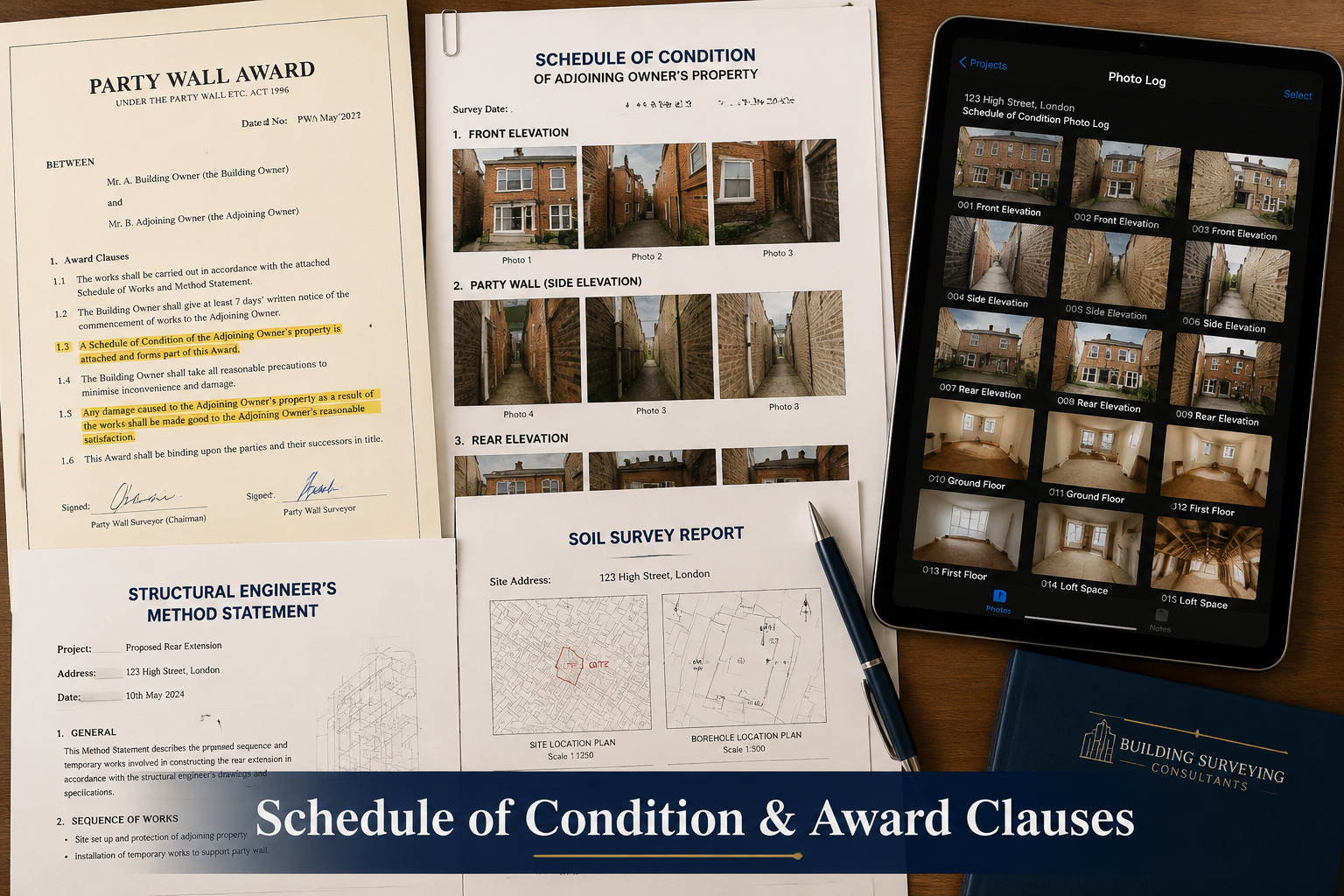
Before a single shovel breaks ground, surveyors now conduct a thorough Schedule of Condition of the adjoining property. This document records the existing state of the neighbour's walls, floors, ceilings, external areas, and — critically — any existing basement or cellar spaces [8].
In 2026 practice, this schedule routinely includes:
- Extensive photographic records of every room, corridor, and external elevation
- Video walkthroughs for high-value or complex properties
- Crack monitoring references — existing cracks are measured and photographed with scale markers
- External surveys covering garden walls, patios, and outbuildings within the zone of influence
The purpose is straightforward: if a neighbour later claims that a crack or settlement was caused by the excavation, the Schedule of Condition provides a dated, independent baseline. Without it, disputes become almost impossible to resolve fairly [3].
For more on how this process works in practice, see the detailed guidance on Schedule of Condition surveys.
2. 📐 Structural Engineer's Design and Method Statement
Surveyors in 2026 will not finalise a basement Award without sight of a structural engineer's design for the excavation and retention works. This is not merely good practice — it is now a baseline expectation under the updated RICS framework [4].
The method statement appended to the Award must clearly set out:
- Excavation depth and extent relative to neighbouring foundations
- Retention method (e.g., underpinning, piling, contiguous bored pile walls, sheet piling)
- Sequence of works — particularly for underpinning, where the sequence of bays is critical to managing risk
- Groundwater management strategy, including any dewatering proposals
- Temporary works design including propping and shoring
⚠️ Important: If a building owner cannot provide a signed structural engineer's method statement, a competent surveyor should decline to issue the Award. Doing so without this information would leave the adjoining owner without adequate protection [9].
3. 🔍 Soil and Ground Investigation Data
Ground conditions vary enormously across London and other urban areas. Clay soils — prevalent across much of London — are particularly susceptible to shrinkage and heave, which can cause settlement damage to neighbouring properties even when excavation is carried out carefully.
Surveyors now routinely request sight of:
- Ground investigation reports (trial pits or boreholes)
- Soil classification data relevant to the chosen retention method
- Any records of previous made ground or contamination
This information directly informs the Award's conditions. For example, in areas with high shrink-swell clay, the Award may require additional monitoring triggers and lower vibration thresholds [2].
4. 📊 Vibration and Settlement Monitoring Conditions
One of the most significant shifts in 2026 practice is the routine inclusion of monitoring conditions within basement Awards. Rather than simply recording pre-existing conditions and hoping for the best, surveyors now write in active monitoring requirements [3].
These typically include:
- Tell-tale crack monitors installed on existing cracks in the adjoining property before works begin
- Vibration monitoring at the party wall, with agreed trigger levels (often referenced to BS 7385 or BS 5228)
- Settlement monitoring points on the adjoining structure
- Reporting obligations — the building owner must share monitoring data with the adjoining owner (or their surveyor) at agreed intervals
If monitoring data reaches a pre-agreed trigger level, works must pause until the cause is investigated. This "traffic light" approach to risk management is now considered best practice for basement excavations [4].
5. 📋 Insurance and Security for Expenses
The Act allows surveyors to require the building owner to provide security for expenses before works begin — a provision that is more commonly invoked for basement projects than for surface works. In 2026, surveyors are more willing to use this power, particularly where:
- The building owner is a company with limited assets
- The project involves significant risk to a high-value adjoining property
- The adjoining owner has expressed concern about the building owner's financial standing [10]
Security is typically held in an escrow account and released when works are satisfactorily completed. Building owners should factor this into project financing from the outset.
Serving the Right Notice: Getting the Foundation Right
Before any Award can be issued, the correct party wall notice must be served. For basement extensions, this is almost always a Section 6 Notice under the Act, though works affecting the party wall itself (for example, installing a new beam or underpinning the party wall directly) may also require a Party Structure Notice.
Getting the notice right matters because:
- An incorrectly served notice can be challenged, causing delays
- The notice starts the clock on the statutory response period (one month for Section 6 notices)
- If a neighbour dissents or fails to respond, the dispute resolution process begins — and a surveyor must be appointed
For a clear overview of the different notice types and how to respond to them, the guide on Party Wall Act notices is an excellent starting point.
The Agreed Surveyor Model: Efficiency With Caution
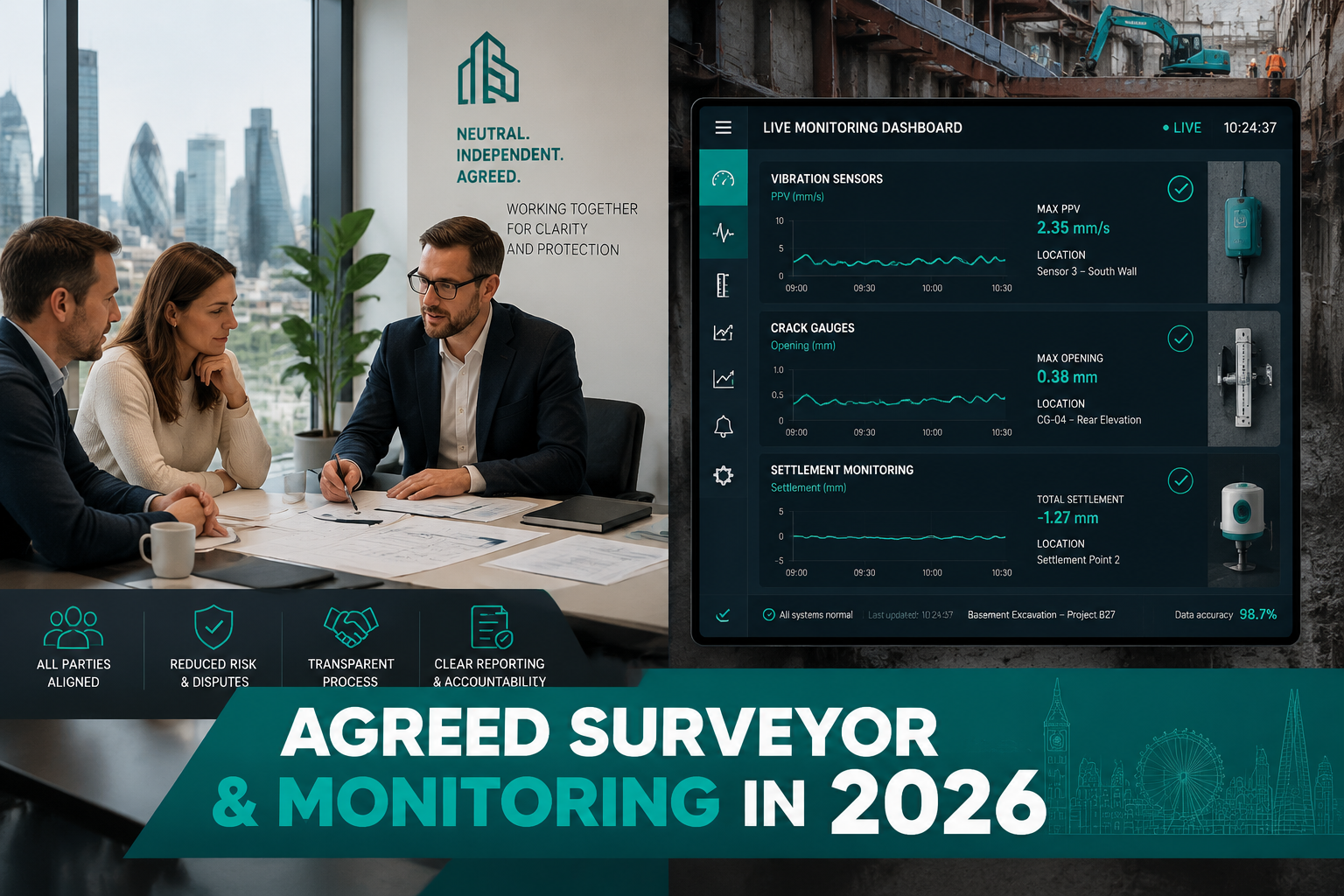
For many basement projects in London, the Agreed Surveyor model offers a faster and more cost-effective route to an Award than appointing two separate surveyors [1]. Under this arrangement, both the building owner and the adjoining owner jointly appoint a single surveyor, who acts impartially for both parties.
The benefits are real:
- Faster Award production — one surveyor, one set of negotiations
- Lower overall fees — typically significantly less than two separate appointments [1]
- Simpler communication — one point of contact for both parties
However, 2026 guidance places heavy emphasis on impartiality. The Agreed Surveyor must be entirely independent of the building owner's project team. A surveyor who has already been engaged as a project manager or design consultant cannot act as Agreed Surveyor [6].
For adjoining owners who are uncertain about the process, specialist adjoining owner surveyor services can provide independent advice before agreeing to a joint appointment.
💡 Pull Quote: "The Agreed Surveyor model works well when both parties trust the process — but on high-risk basement schemes, adjoining owners should satisfy themselves that the surveyor is genuinely independent." [1]
When Two Surveyors Are the Better Choice
On complex or contentious basement projects, appointing separate surveyors for each party may be the more appropriate route. This is particularly true where:
- The adjoining property is already showing signs of settlement or structural movement
- The relationship between neighbours is strained
- The basement extends beneath or very close to the party wall foundations
- The adjoining owner has their own basement or cellar that could be affected
In these cases, the building owner's surveyor and the adjoining owner's surveyor negotiate the Award between them, with a Third Surveyor available to resolve any deadlock.
Key Clauses Every Basement Award Should Contain in 2026
A well-drafted basement Party Wall Award is a detailed, enforceable document. Based on current best practice, the following clauses are now considered essential [9]:
Essential Award Clauses ✅
- Description of works — precise excavation depths, dimensions, and retention method
- Approved drawings reference — specific drawing numbers and revision status
- Method statement incorporation — the structural engineer's method statement is appended and forms part of the Award
- Working hours — typically restricted to prevent vibration during early mornings, evenings, and weekends
- Schedule of Condition — appended as a schedule, with photographic evidence
- Monitoring requirements — trigger levels, frequency of reporting, and action plan if triggers are reached
- Notification obligations — building owner must notify adjoining owner (and surveyor) before certain stages begin
- Damage resolution process — agreed procedure if damage is alleged during or after works
- Security for expenses — amount held, conditions for release
- Insurance — confirmation of contractor's public liability and employer's liability insurance
For a deeper look at drafting enforceable Awards, the guide on essential clauses for 2026 building works covers these requirements in detail.
Practical Tips for Building Owners Planning a Basement in 2026
Getting Party Wall Awards for Basement Extensions in 2026: What Surveyors Now Prioritise Before Excavation Starts right from the beginning saves time, money, and neighbour relationships. Here are the most important practical steps:
- 📅 Serve notice early — allow at least two to three months before the planned excavation start for the party wall process to run its course
- 🏗️ Commission ground investigation before serving notice — having soil data available speeds up the Award process considerably
- 📐 Appoint a structural engineer early — surveyors cannot finalise Awards without structural design input
- 🤝 Talk to your neighbours — informal communication before formal notice reduces the likelihood of dissent and dispute [7]
- 💰 Budget for security for expenses — this can represent a meaningful sum on high-value adjoining properties
- 📸 Cooperate fully with the Schedule of Condition survey — attempting to limit access creates distrust and can delay the Award
For those concerned about managing costs, the resource on how to keep party wall costs down offers practical guidance without cutting corners on essential protections.
Conclusion: Preparation Is the Best Protection
The evolution of Party Wall Awards for Basement Extensions in 2026: What Surveyors Now Prioritise Before Excavation Starts reflects a profession responding intelligently to the genuine risks that deep excavation poses to neighbouring properties. The pre-excavation checklist — Schedule of Condition, structural method statement, ground investigation data, monitoring conditions, and appropriate insurance — is not bureaucratic excess. Each element exists because basement projects have caused real damage to real homes, and well-drafted Awards prevent disputes that can otherwise run for years.
Actionable Next Steps 🚀
- Contact a qualified party wall surveyor as soon as basement plans are at design stage — not after planning permission is granted.
- Commission a ground investigation report to inform both the structural design and the party wall process.
- Ensure your structural engineer produces a detailed method statement before the surveyor is asked to issue an Award.
- Discuss the Agreed Surveyor option with your neighbour early — it can save both parties time and money on straightforward schemes.
- Review the party wall costs and process to budget accurately from the outset.
Whether the project is in East London, North London, South London, or West London, the fundamentals of a robust basement Party Wall Award remain the same. Starting the process with the right information — and the right surveyor — is the single most effective way to protect both the project and the relationship with the people next door.
References
[1] The Agreed Surveyor How To Save Time And Money On Your Party Wall Award – https://www.partywallslimited.com/blog/the-agreed-surveyor-how-to-save-time-and-money-on-your-party-wall-award
[2] Party Wall Challenges For 2026 New Build Expansions Surveys For 2 5 Price Growth And Defect Risks – https://kingstonsurveyors.com/party-wall-challenges-for-2026-new-build-expansions-surveys-for-2-5-price-growth-and-defect-risks/
[3] Party Wall Surveys In 2026 Urban Renewal Managing High Demand Disputes And Neighbour Relations – https://princesurveyors.co.uk/blog/party-wall-surveys-in-2026-urban-renewal-managing-high-demand-disputes-and-neighbour-relations/
[4] Party Wall Awards Under New 2026 Rics Matrics Essentials For Basement Conversions In Recovering Markets – https://www.canterburysurveyors.com/blog/party-wall-awards-under-new-2026-rics-matrics-essentials-for-basement-conversions-in-recovering-markets/
[6] Party Wall Agreement – https://hoa.org.uk/advice/guides-for-homeowners/i-am-improving/party-wall-agreement/
[7] Party Wall Faqs – https://christopheranthony.org.uk/party-wall-faqs/
[8] Party Wall Agreements For Basement Conversion – https://acdesignsolution.com/party-wall-agreements-for-basement-conversion/
[9] Drafting Enforceable Party Wall Awards Essential Clauses For 2026 Building Works And Safeguards – https://partywallsurveyorlondon.uk/blogs/drafting-enforceable-party-wall-awards-essential-clauses-for-2026-building-works-and-safeguards/
[10] Party Wall Awards By Chartered Building Surveyors Rics Services Fee Structures And Case Studies For 2026 – https://manchestersurveyors.com/party-wall-awards-by-chartered-building-surveyors-rics-services-fee-structures-and-case-studies-for-2026/
