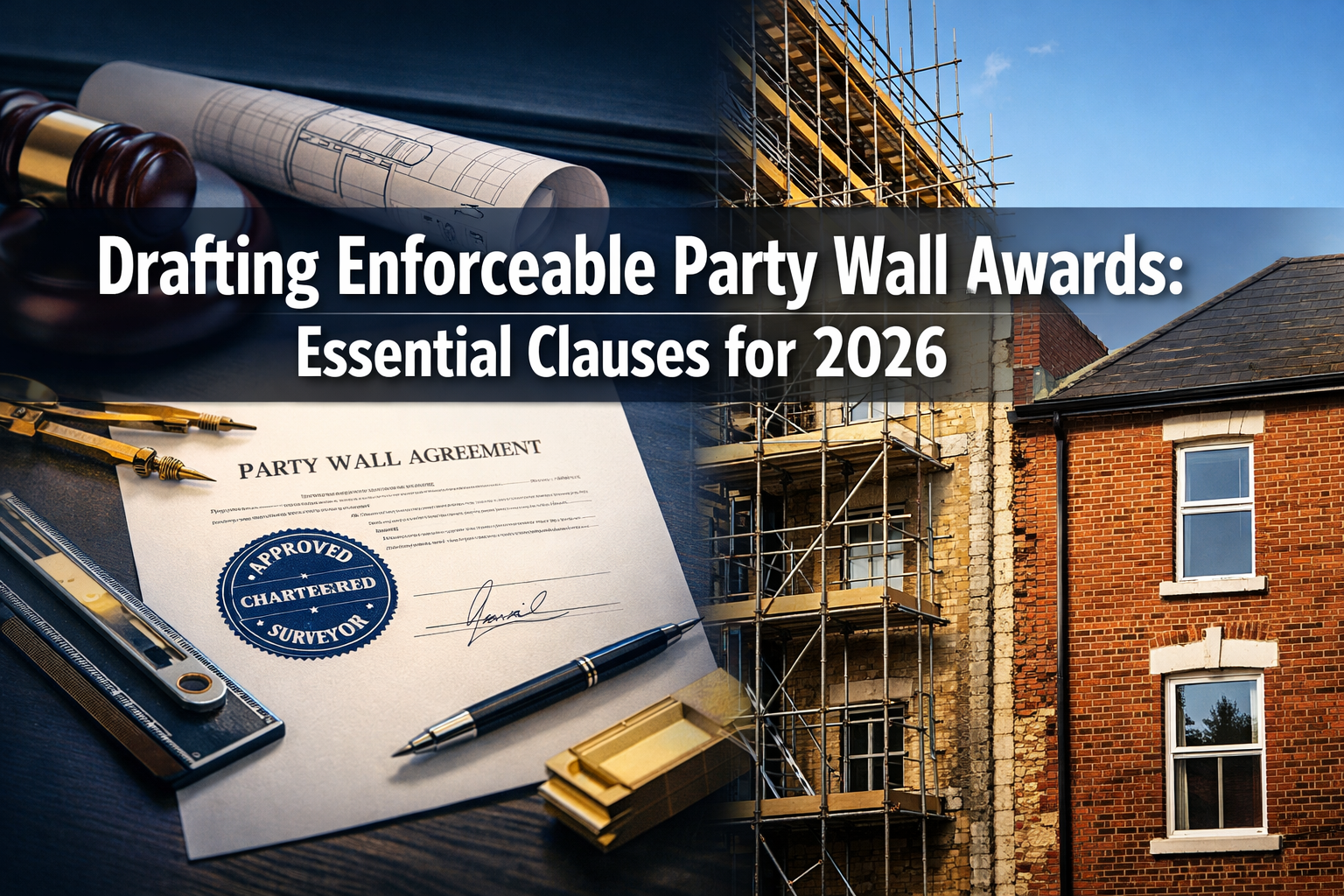
Nearly 40% of party wall disputes in England arise from poorly drafted awards that lack specific enforcement mechanisms or protective clauses. When building owners and adjoining owners find themselves in conflict over construction work, the quality of the party wall award becomes the critical factor determining whether the project proceeds smoothly or descends into costly litigation.
Drafting Enforceable Party Wall Awards: Essential Clauses for 2026 Building Works and Safeguards requires understanding both statutory requirements under the Party Wall etc. Act 1996 and practical protective measures that prevent disputes. This comprehensive guide provides templates, checklists, and clause-by-clause analysis drawn from RICS standards and recent case law to help surveyors, building owners, and adjoining owners create awards that stand up to scrutiny.
Key Takeaways
- Comprehensive scope documentation prevents disputes by detailing exact works, timelines, and access arrangements with measurable specificity
- Protective clauses including working hours, damage liability, and Schedule of Condition documentation create enforceable safeguards for both parties
- Proper enforcement mechanisms with clear appeal rights and further award provisions ensure awards remain effective throughout construction
- Professional surveyor involvement ensures compliance with RICS standards and reduces the risk of County Court appeals
- Template-based drafting using proven clause structures increases award enforceability while reducing preparation time
Understanding Party Wall Awards and Their Legal Foundation
A party wall award is a legally binding document issued by appointed surveyors that determines the rights and responsibilities of building owners and adjoining owners when construction work affects shared structures. Unlike simple agreements, awards carry statutory weight under the Party Wall etc. Act 1996, which applies exclusively to England and Wales.[3]
What Makes an Award Legally Enforceable
For an award to be enforceable in 2026, it must meet several fundamental requirements:
Statutory compliance elements:
- Proper notice served at least two months before work commences[2]
- Appointment of qualified surveyors following statutory procedures
- Detailed description of proposed works requiring party wall procedures
- Clear identification of all affected parties and properties
- Surveyor signatures and award issuance dates
The Party Wall etc. Act 1996 establishes the framework, but enforcement depends on specific, measurable clauses that leave no room for interpretation disputes.
Types of Works Requiring Party Wall Awards
Understanding which works require formal awards helps determine the appropriate level of detail needed in drafting:
| Notifiable Works | Non-Notifiable Works |
|---|---|
| Loft conversions affecting party walls | Internal plastering |
| New foundation excavations within 3-6 meters | Electrical installations |
| Insertion of damp proof courses | Drilling internal walls |
| Building new walls on boundary lines | Minor repairs not affecting structure |
| Underpinning existing foundations | Decorative work |
Works requiring party wall notices demand comprehensive awards with detailed protective clauses, while minor works may proceed without formal procedures.[3]
Core Components of Drafting Enforceable Party Wall Awards: Essential Clauses for 2026 Building Works and Safeguards
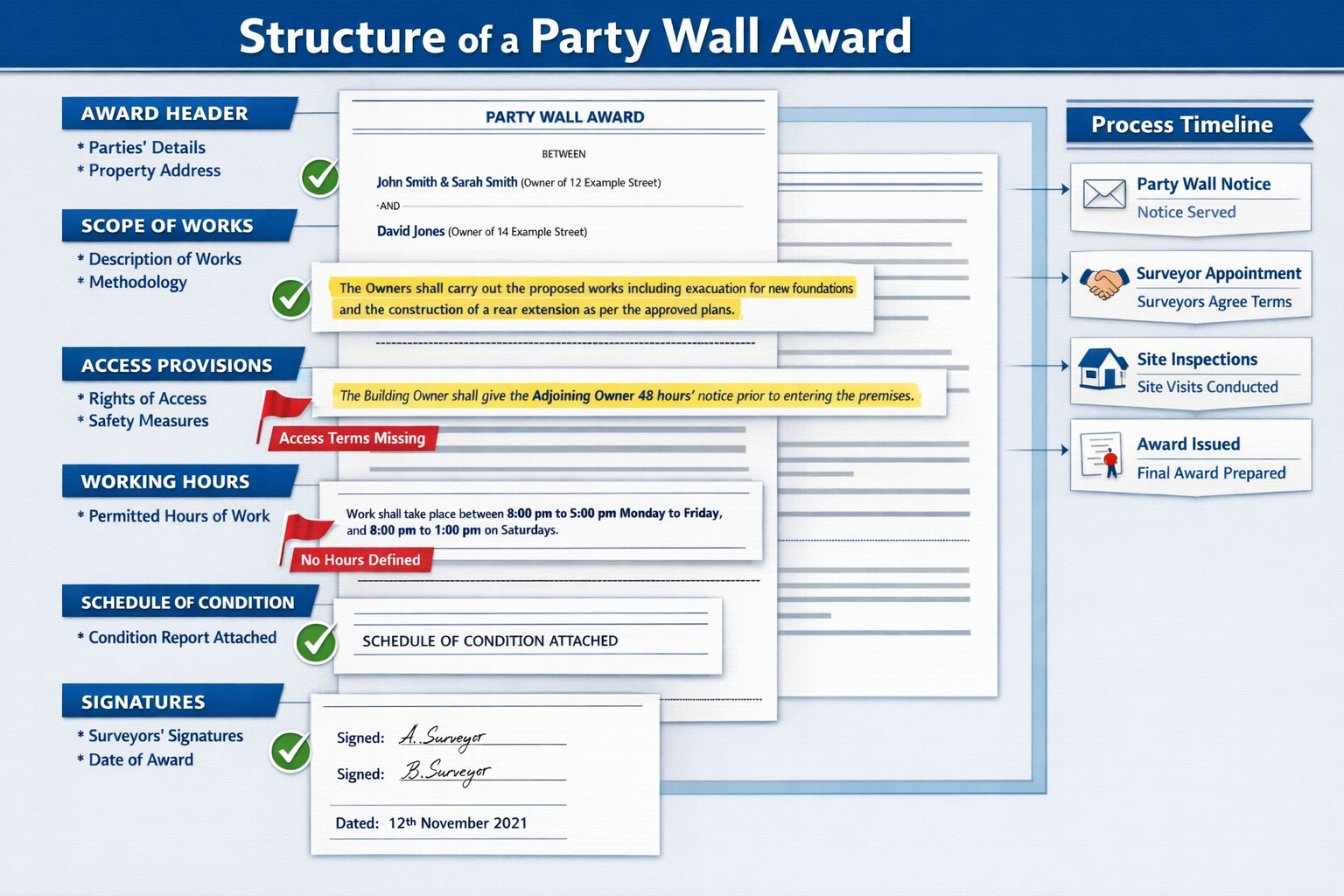
Every enforceable party wall award must contain specific sections that address both legal requirements and practical safeguards. The following components form the foundation of effective awards in 2026.
1. Detailed Scope of Works Section 📋
The scope of works clause must provide sufficient detail that any competent builder could understand exactly what is permitted. Vague descriptions like “general construction work” create enforcement problems.
Essential elements for scope clauses:
- Precise work description: “Excavation of foundations to a depth of 2.4 meters below ground level along the party wall line, extending 4.2 meters in length”
- Structural specifications: Materials, dimensions, methods, and techniques
- Phasing information: Sequence of work stages with estimated durations
- Exclusions: Works specifically not covered by the award
The scope section should reference architectural drawings by number and date, incorporating them as appendices to the award.[1]
2. Access Provisions and Working Hours ⏰
Access arrangements often become the most contentious aspect of construction projects. Drafting Enforceable Party Wall Awards: Essential Clauses for 2026 Building Works and Safeguards requires specific, measurable access terms.[3]
Template access clause:
“The Building Owner shall be granted access to the Adjoining Owner’s property at [specific address] for the purposes of executing the works described in Section 2 of this Award. Access shall be limited to:
- Days: Monday through Friday, excluding public holidays
- Hours: 08:00 to 18:00 GMT
- Personnel: Maximum of [number] workers at any time
- Notice: Minimum 48 hours’ written notice before each access requirement
- Supervision: All access must be supervised by the Building Owner’s appointed contractor”
This specificity prevents disputes about unreasonable access requests and provides clear enforcement standards.[3]
3. Schedule of Condition Documentation 📸
A Schedule of Condition serves as the baseline evidence for determining whether construction work caused damage to adjoining properties. Without this documentation, damage claims become nearly impossible to resolve fairly.[1]
Comprehensive Schedule of Condition requirements:
✅ Photographic evidence: High-resolution images of all rooms, external elevations, and structural elements
✅ Written descriptions: Detailed narrative of existing conditions, defects, and pre-existing damage
✅ Measurements: Crack widths, settlement indicators, and structural movement markers
✅ Date and signatures: Both owners or their surveyors must acknowledge the Schedule’s accuracy
✅ Storage: Secure copies held by both surveyors and all parties
Professional surveyors typically charge between £750 and £1,800 per property for comprehensive Schedule of Condition preparation in London during 2026.[6]
4. Damage Liability and Compensation Clauses 💷
Clear damage provisions eliminate ambiguity about responsibility for repairs and compensation. These clauses must specify both the process for identifying damage and the mechanism for obtaining remedies.[2]
Model damage liability clause:
“The Building Owner shall be responsible for making good all damage caused to the Adjoining Owner’s property as a direct result of the works described in this Award. Damage determination shall be based on comparison between the Schedule of Condition dated [date] and post-construction inspection.
Repair obligations:
- The Building Owner shall complete all repairs to a standard matching the pre-existing condition
- Repairs must commence within 14 days of damage notification
- The Adjoining Owner’s surveyor shall approve all repair work before final sign-off
Compensation provisions:
- If the Building Owner fails to complete repairs within 60 days, the Adjoining Owner may commission repairs and recover costs
- Compensation for loss of amenity shall be calculated at £[amount] per day for each day repairs remain incomplete beyond the 60-day period”
This structure provides both incentive for timely repairs and clear recourse if the building owner fails to fulfill obligations.[2]
5. Special Foundations and Structural Protection Measures 🏗️
When works involve excavation near existing foundations or underpinning, awards must include specific structural protection requirements based on engineering principles.
Protection clause elements:
- Excavation limitations: Maximum depths, distances from party wall, and shoring requirements
- Monitoring provisions: Settlement monitoring equipment, vibration limits, and inspection schedules
- Contingency procedures: Actions required if movement exceeds specified thresholds
- Professional oversight: Structural engineer involvement and reporting requirements
These technical provisions often require input from structural engineers to ensure they reflect current building standards for 2026 construction practices.
Essential Protective Clauses in Drafting Enforceable Party Wall Awards: Essential Clauses for 2026 Building Works and Safeguards
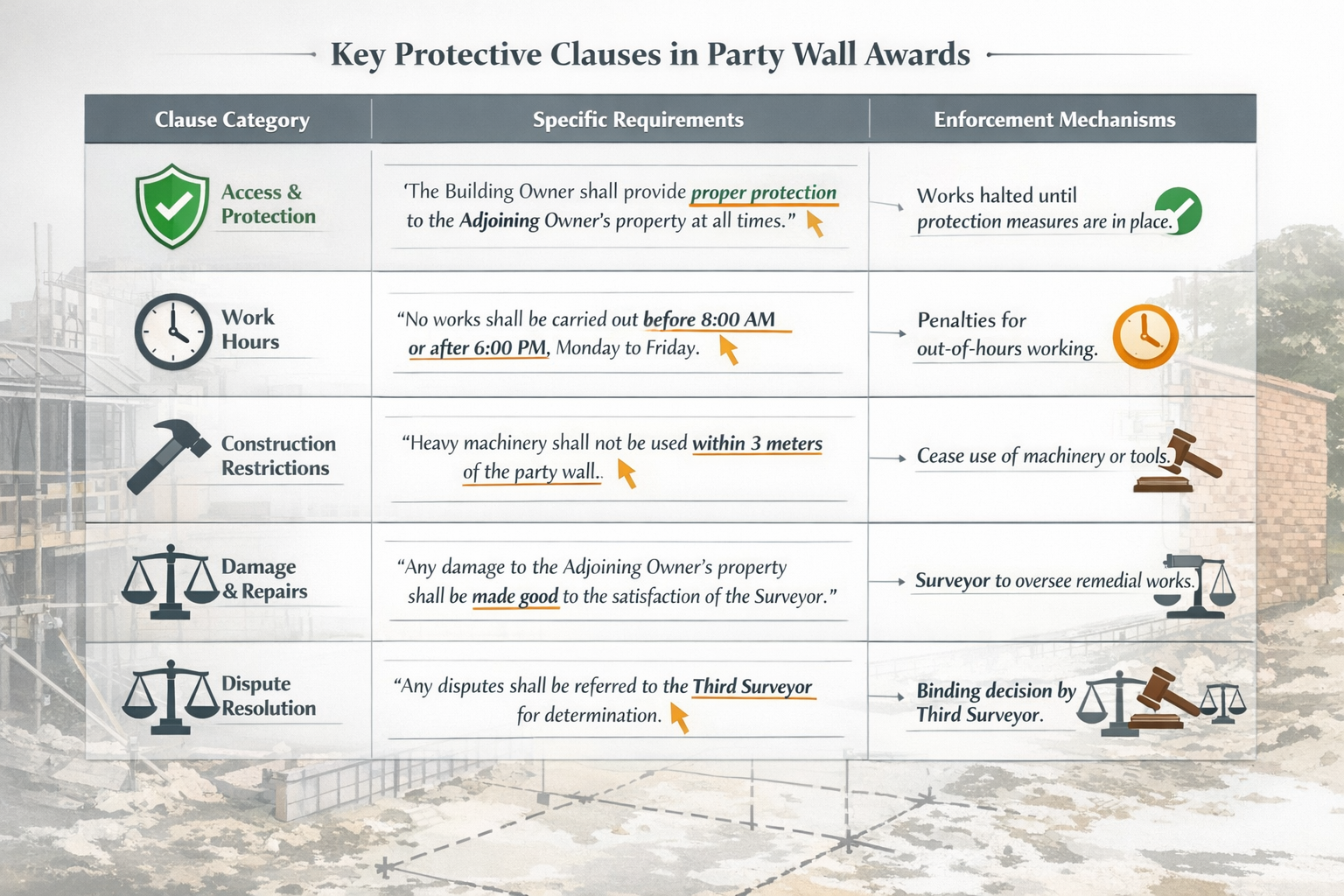
Beyond core components, effective awards include protective clauses that address common dispute scenarios and provide clear enforcement mechanisms.
Working Hours and Noise Restrictions
Standard working hours clauses prevent nuisance claims while allowing reasonable construction progress. Awards should specify:
Detailed working hours template:
- Standard hours: 08:00-18:00 Monday-Friday, 08:00-13:00 Saturday
- Prohibited times: Sundays and public holidays (unless emergency repairs)
- Noise limitations: Maximum decibel levels at party wall (typically 75dB during permitted hours)
- Quiet work exceptions: Non-noisy activities (painting, finishing) may extend to 19:00 with 7 days’ notice
- Emergency provisions: Structural safety work permitted outside standard hours with immediate notification
These restrictions balance construction efficiency with the adjoining owner’s right to peaceful enjoyment of their property.[3]
Insurance and Indemnity Provisions
Professional awards include insurance requirements that protect all parties from financial loss:
Insurance clause checklist:
✅ Public liability insurance minimum £5,000,000 (2026 standard)
✅ Contractor’s all-risks insurance covering the full project value
✅ Professional indemnity insurance for structural engineers and architects
✅ Evidence of insurance provided to adjoining owner before work commences
✅ Named party status for adjoining owner on building owner’s policy
These provisions ensure financial resources exist to address damage claims without lengthy litigation.
Dispute Resolution and Appeal Rights
Every award must inform parties of their statutory appeal rights and provide internal dispute resolution mechanisms.[3]
Appeal rights notification:
“Either party may appeal this Award to the County Court within 14 days of the date of service. Appeals must be filed at the County Court having jurisdiction over the property location. Failure to appeal within 14 days renders this Award final and binding.”
Internal dispute resolution clause:
“For disputes arising during construction that do not warrant County Court appeal, parties may request the appointed surveyors to issue a Further Award addressing the specific dispute. The surveyors shall inspect, consult with both parties, and issue a determination within 21 days of the dispute notification.”
This two-tier approach resolves minor issues quickly while preserving formal appeal rights for fundamental disagreements.
Security for Expenses
When significant costs are anticipated, awards may include security provisions requiring the building owner to deposit funds or provide guarantees:
Security clause template:
“The Building Owner shall, within 14 days of this Award, provide security for expenses in the sum of £[amount] by:
(a) Deposit with the Adjoining Owner’s surveyor in an interest-bearing escrow account; OR
(b) Provision of a bank guarantee from a UK-registered financial institutionThese funds shall be released upon:
- Completion of all works described in this Award
- Satisfactory post-construction inspection confirming no damage
- Agreement of both surveyors or expiry of 12 months from work completion”
Security provisions are particularly important for types of party wall works involving significant structural intervention.
Advanced Provisions: Further Awards and Scope Changes
Construction projects rarely proceed exactly as planned. Effective awards anticipate changes and provide mechanisms for addressing them without invalidating the original award.
Understanding Further Awards (Addendum Awards)
When the scope of work changes after an award is issued, surveyors can issue Further Awards that modify or extend the original document. These addendum awards typically run 2-3 pages and reference the principal award.[5]
When Further Awards are necessary:
- Additional excavation beyond originally specified depths
- Changes to structural methodology requiring different party wall interactions
- Extension of work timeline beyond original completion date
- Discovery of unforeseen conditions requiring additional protective measures
Further Award structure:
- Reference to principal award: “This Further Award supplements and amends the Award dated [date] between [parties]”
- Description of changes: Specific modifications to scope, timeline, or methods
- Additional provisions: New protective clauses or modified restrictions
- Cost implications: Surveyor fees and expense adjustments
- Signatures and service: Same formality as principal award
Further Awards allow flexibility while maintaining the legal framework established by the original award.[5]
Retrospective Awards and Damage Claims
When work proceeds without proper party wall procedures, retrospective awards can formalize arrangements and address damage claims. However, these awards face additional scrutiny and should include:
Retrospective award considerations:
⚠️ Acknowledgment of timing: Clear statement that work commenced before award issuance
⚠️ Damage assessment: Comprehensive evaluation of any damage already occurred
⚠️ Remedial requirements: Specific repair obligations with timelines
⚠️ Enhanced protections: Stricter monitoring for remaining work
⚠️ Cost allocation: Clear responsibility for retrospective surveyor fees
Retrospective situations often arise when building owners proceed without proper party wall agreement procedures, creating complex legal and practical challenges.[3]
Enforcement Mechanisms in Drafting Enforceable Party Wall Awards: Essential Clauses for 2026 Building Works and Safeguards
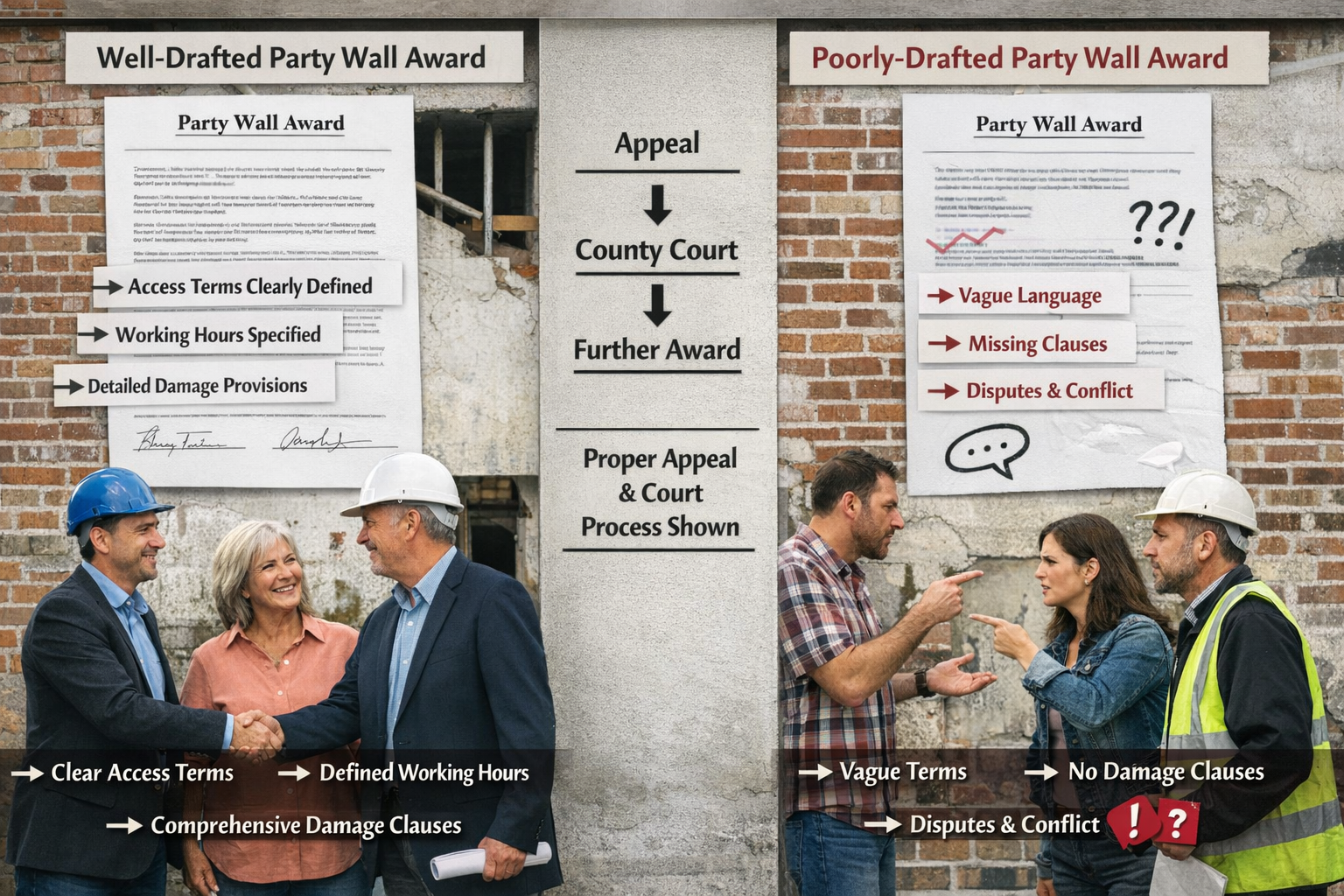
Even perfectly drafted awards require enforcement mechanisms to ensure compliance. Understanding these mechanisms helps surveyors create awards that parties will follow voluntarily.
Injunctive Relief and Court Enforcement
When building owners violate award terms, adjoining owners have several enforcement options:
Enforcement hierarchy:
- Surveyor intervention: Request appointed surveyors to inspect and issue compliance notice
- Further Award: Surveyors issue binding determination requiring compliance
- County Court injunction: Application for court order compelling compliance or stopping work
- Damages claim: Financial compensation for breach of award terms
The threat of injunctive relief often encourages voluntary compliance, making clear award terms essential for effective enforcement.
Practical Compliance Monitoring
Awards should include monitoring provisions that enable early detection of violations:
Monitoring clause template:
“The Adjoining Owner’s surveyor shall have right of access to the works at reasonable times upon 24 hours’ notice to inspect compliance with this Award. The Building Owner shall:
- Maintain a site diary recording work activities, hours, and personnel
- Provide monthly progress reports to both surveyors
- Notify surveyors 48 hours before commencing each major work phase
- Allow photographic documentation of work progress
Non-compliance discovered during monitoring shall be notified in writing with 7 days to remedy before further enforcement action.”
These provisions create accountability while providing opportunity to correct violations before they escalate into formal disputes.
Cost Recovery and Fee Provisions
Awards must clearly allocate surveyor fees and other costs to prevent disputes about payment obligations:
Standard cost allocation (2026):
- Building owner pays: Own surveyor fees, agreed surveyor fees (if appointed), reasonable adjoining owner surveyor fees
- Each owner pays: Own legal advice costs
- Building owner may pay: Security for expenses, Schedule of Condition costs, monitoring costs
Professional surveyor fees in London typically range from £750 to £1,800 per property for the complete process, which takes 2-4 months from notice to award issuance.[6]
Fee clause template:
“The Building Owner shall pay:
(a) The fees of [Building Owner’s Surveyor] in the sum of £[amount] plus VAT
(b) The fees of [Adjoining Owner’s Surveyor] in the sum of £[amount] plus VAT
(c) All reasonable costs of preparing the Schedule of ConditionPayment shall be made within 14 days of invoice. Interest shall accrue on unpaid fees at 8% above Bank of England base rate.”
Clear fee provisions prevent the most common source of post-award disputes. For guidance on managing expenses, see our article on how to keep party wall costs down.
Practical Drafting Tips from RICS Standards and Recent Case Law
Professional surveyors follow established best practices when drafting awards to ensure enforceability and minimize dispute risk.
Language and Clarity Standards
Effective award drafting principles:
✍️ Use active voice: “The Building Owner shall…” rather than “It is required that…”
✍️ Define technical terms: Include glossary for specialized construction terminology
✍️ Avoid ambiguity: Replace “reasonable time” with “within 14 days”
✍️ Number all clauses: Enable precise reference in correspondence and enforcement
✍️ Include measurements: Specify dimensions, depths, distances, and quantities
Awards written at Grade 7 reading level ensure all parties understand their obligations without requiring legal interpretation.
Common Drafting Mistakes to Avoid
❌ Vague work descriptions: “Various building works” provides no enforcement standard
❌ Missing timelines: Without completion dates, awards create open-ended obligations
❌ Incomplete access provisions: Failure to specify hours and notice requirements
❌ No damage baseline: Awards without Schedules of Condition cannot resolve damage claims
❌ Unclear cost allocation: Ambiguous fee provisions create payment disputes
Learning from these common errors helps surveyors draft awards that withstand scrutiny and provide clear guidance throughout construction.
Incorporating Standard Form Clauses
Many experienced surveyors maintain libraries of proven clauses for common situations. While each award must be tailored to specific circumstances, standard forms provide reliable starting points:
Recommended clause library categories:
- Access and working hours (residential, commercial, mixed-use variations)
- Excavation and underpinning (shallow, deep, adjacent foundation scenarios)
- Structural alterations (beam insertion, wall removal, opening creation)
- Damage liability (minor, major, structural damage provisions)
- Special conditions (heritage properties, commercial tenancies, multiple adjoining owners)
Professional bodies like RICS provide guidance documents that inform these standard clauses, though they must be adapted to 2026 regulatory requirements and local conditions.
For those seeking starting points, reviewing party wall contract templates can provide insight into effective structure and language.
Geographic Considerations and Jurisdictional Variations
While the Party Wall etc. Act 1996 applies throughout England and Wales, local factors influence award drafting in practice.
London-Specific Considerations for 2026
London’s dense urban environment and property values create unique challenges:
London award considerations:
🏙️ Higher property values: Increase security for expenses and insurance requirements
🏙️ Limited access: More restrictive working hours due to proximity of neighbors
🏙️ Conservation areas: Additional clauses addressing heritage protection requirements
🏙️ Multiple adjoining owners: Complex notification and agreement procedures
🏙️ Professional fees: Higher surveyor costs reflecting London market rates
Whether you need a party wall surveyor in Central London, North London, South London, East London, or West London, local expertise ensures awards reflect area-specific considerations.[6]
Scotland and Northern Ireland
Properties outside England and Wales do not benefit from the Party Wall etc. Act 1996. These jurisdictions rely on common law principles and voluntary agreements.[3]
Alternative approaches:
- Scotland: Common law of common interest and servitudes governs shared structures
- Northern Ireland: Access to Neighbouring Land Act and common law principles apply
- Voluntary agreements: Parties may create contractual arrangements similar to party wall awards
Surveyors working across UK jurisdictions must understand these fundamental differences to provide appropriate advice.
Checklist: Essential Elements for Drafting Enforceable Party Wall Awards in 2026
Use this comprehensive checklist when drafting or reviewing party wall awards to ensure all critical elements are included:
Preliminary Information ✅
- Full names and addresses of all building owners
- Full names and addresses of all adjoining owners
- Property descriptions with title numbers
- Details of appointed surveyors with professional credentials
- Date of award and date of service
- Reference to original notice(s) served
Scope of Works ✅
- Detailed description of all proposed works
- Referenced architectural and structural drawings
- Specifications for materials and methods
- Work phasing and estimated timeline
- Completion date or duration
Access and Working Conditions ✅
- Specific access requirements with notice periods
- Working hours (days, times, restrictions)
- Number of personnel permitted
- Noise and vibration limitations
- Parking and material storage provisions
Protective Measures ✅
- Schedule of Condition (attached or referenced)
- Structural protection requirements
- Monitoring provisions and thresholds
- Insurance requirements with minimum coverage
- Security for expenses (if applicable)
Damage and Liability ✅
- Damage liability allocation
- Repair obligations and standards
- Timeline for completing repairs
- Compensation provisions for delays
- Process for damage assessment
Legal and Procedural ✅
- Appeal rights notification (14-day period)
- Dispute resolution mechanism
- Further Award procedures
- Cost allocation and fee schedule
- Signatures of all appointed surveyors
Special Provisions ✅
- Special foundations or underpinning requirements
- Heritage or conservation considerations
- Multiple adjoining owner coordination
- Tenant notification requirements
- Emergency work procedures
This checklist ensures comprehensive coverage of all essential elements for Drafting Enforceable Party Wall Awards: Essential Clauses for 2026 Building Works and Safeguards.
Conclusion
Drafting Enforceable Party Wall Awards: Essential Clauses for 2026 Building Works and Safeguards requires balancing statutory compliance with practical protective measures that address real-world construction scenarios. Awards that include comprehensive scope descriptions, specific access provisions, detailed Schedules of Condition, clear damage liability clauses, and effective enforcement mechanisms provide the foundation for dispute-free construction projects.
The templates, checklists, and clause examples provided in this guide reflect current RICS standards and lessons learned from recent party wall disputes. By incorporating these elements, surveyors can draft awards that stand up to scrutiny, protect all parties’ interests, and provide clear guidance throughout the construction process.
Actionable Next Steps
For building owners planning construction:
- Serve proper party wall notices at least two months before work begins
- Appoint an experienced surveyor familiar with 2026 drafting standards
- Budget for comprehensive Schedule of Condition documentation
- Review draft awards against the checklist provided in this guide
- Ensure adequate insurance coverage before work commences
For adjoining owners receiving notices:
- Respond within 14 days or appoint a surveyor to represent your interests
- Request detailed scope of works information before agreeing to appointments
- Insist on comprehensive Schedule of Condition documentation
- Review proposed award terms for adequate protective clauses
- Understand your appeal rights and enforcement options
For surveyors drafting awards:
- Use template clauses as starting points but tailor to specific circumstances
- Include measurable, specific terms rather than vague obligations
- Ensure all statutory requirements are met before issuing awards
- Maintain clause libraries organized by work type and situation
- Stay current with RICS guidance and case law developments
The quality of party wall awards directly impacts construction success and neighbor relations. Investing time in comprehensive, clear drafting prevents disputes, reduces costs, and ensures projects proceed smoothly while protecting all parties’ rights and property interests.
For additional guidance on party wall procedures, explore our resources on party wall awards, building owner responsibilities, and adjoining owner rights.
References
[1] What Is A Party Wall Agreement And Party Wall Award – westvilleassociates.com
[2] Party Wall Awards – huntsmaneldridge.co.uk
[3] Party Wall Agreement – hoa.org.uk
[4] Sample Party Wall Documents – collier-stevens.co.uk
[5] Further Awards And The Party Wall Act – taylor-mitchell.co.uk
[6] Party Wall Agreement London 2026 – mayfairstudio.co.uk
[7] Evergreen Guide To Party Wall Awards Drafting Enforceable Agreements Under 2026 Regulatory Updates – https://nottinghillsurveyors.com/blog/evergreen-guide-to-party-wall-awards-drafting-enforceable-agreements-under-2026-regulatory-updates
Speak to a RICS chartered party wall surveyor
Free initial consultation. Notices, awards and schedules of condition across London and nationwide.