Over 60% of Party Wall disputes in England and Wales stem from misunderstandings about garden walls and boundary structures—yet most property owners wrongly assume timber fences and hedges trigger the same legal requirements as masonry walls. This confusion costs homeowners thousands in legal fees and project delays every year.

Understanding Party Wall Awards for Garden Walls and Boundary Fences: 2026 Compliance Guide for Extension Adjoining Owners is essential for anyone planning construction work near property boundaries. Whether you’re building an extension, raising an existing garden wall, or excavating near your neighbour’s structure, compliance with the Party Wall etc. Act 1996 protects both your project timeline and your relationship with adjoining property owners.
This comprehensive guide clarifies which garden structures require Party Wall Awards, explains the specific notice requirements for different work types, and provides practical checklists to ensure your 2026 project proceeds smoothly without costly legal complications.
Key Takeaways
✅ Only masonry “party fence walls” on boundary lines require Party Wall Awards—timber fences, metal railings, and hedges are exempt from the Act [1]
✅ Three distinct notice types apply: Section 1 for new boundary walls (1-month notice), Section 3 for existing party wall alterations (2-month notice), and Section 6 for excavation within 3 meters [6]
✅ Every Party Wall Award must include a Schedule of Condition—detailed photographic documentation protecting both parties from false damage claims [2]
✅ Sole-ownership garden walls are generally exempt, but excavation or building work near a neighbour’s structure may still trigger notice requirements [1]
✅ Non-compliance carries serious consequences: legal injunctions, project delays, and liability for neighbour damage without proper protective measures [2]
Understanding Garden Walls Under the Party Wall Act 1996
The Party Wall etc. Act 1996 applies exclusively to England and Wales, with no jurisdiction in Scotland or Northern Ireland [4]. This legislation governs specific types of boundary structures, but not all garden walls fall under its scope.
Which Garden Walls Require Party Wall Awards?
Party fence walls—the technical term for shared masonry walls built astride or along property boundaries—are the only garden structures covered by the Act [7]. These include:
🧱 Brick or stone walls built directly on the boundary line between two properties
🧱 Shared garden walls where both neighbours have ownership rights
🧱 Masonry boundary walls constructed partially on each property (straddling the line)
Importantly, the Act does not apply to:
❌ Timber fences of any height or construction type
❌ Metal railings, wire fencing, or chain-link barriers
❌ Hedges, living boundaries, or planted screens
❌ Sole-ownership walls entirely within one property’s boundaries [1]
This distinction creates significant confusion. Many homeowners mistakenly believe any boundary structure triggers Party Wall requirements, leading to unnecessary surveyor appointments and wasted expenses.
Sole-Ownership Garden Walls: The Exception
Even when a brick wall sits directly adjacent to a neighbour’s property, if it’s built entirely within your land boundaries, it typically remains outside the Act’s jurisdiction [1]. However, excavation or construction work near this wall may still require notices under Section 6 if:
- You’re digging within 3 meters of your neighbour’s structure
- The excavation depth extends below the foundation level of the adjoining building
- Your work could potentially affect the stability of neighbouring structures
For detailed guidance on boundary wall classifications, review our comprehensive guide on boundary wall rules and party fence wall differences.
Notice Types for Garden Wall Work: Party Wall Awards for Garden Walls and Boundary Fences in 2026
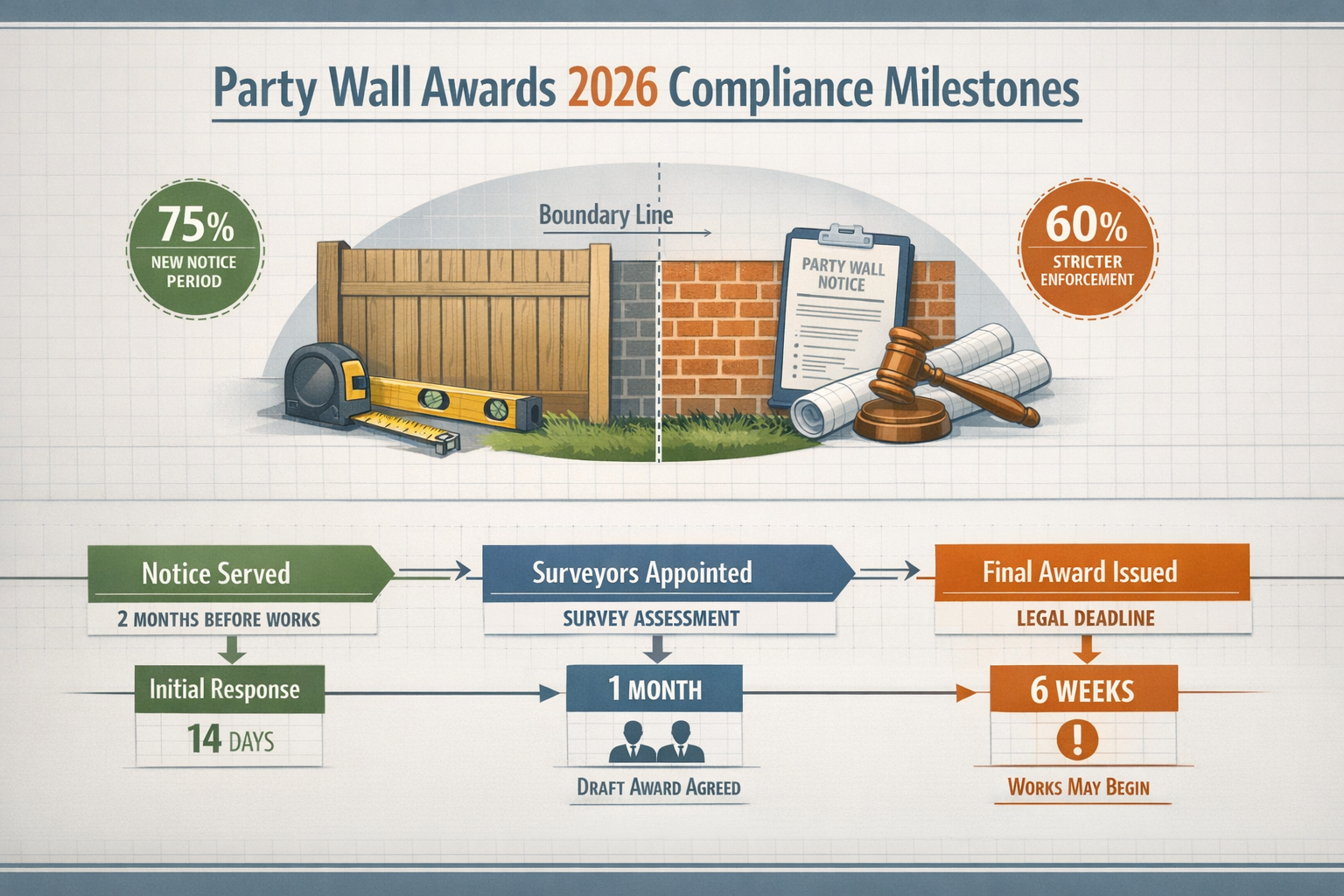
The Party Wall etc. Act 1996 establishes three distinct notice categories, each with specific requirements, timelines, and purposes [6]. Understanding which notice applies to your garden wall project is critical for legal compliance.
Section 1 Notices: Line of Junction (New Boundary Walls)
Section 1 notices apply when you’re constructing a new wall directly on the boundary line between properties. This is formally called a “Line of Junction” notice.
Minimum Notice Period: 1 month before construction begins [1]
Typical Scenarios:
- Building a new brick garden wall on the exact property boundary
- Constructing a party fence wall where none previously existed
- Replacing a timber fence with a masonry wall on the boundary line
Key Requirements:
✓ Written notice describing the proposed wall’s dimensions and materials
✓ Drawings showing the wall’s position relative to the boundary
✓ Specification of foundation depth and construction method
✓ Statement of whether you’re requesting neighbour contribution to costs
Your neighbour has 14 days to respond. Consent allows work to proceed; dissent triggers the Party Wall Award process requiring surveyor appointment.
Section 3 Notices: Work on Existing Party Structures
Section 3 notices cover alterations, repairs, or rebuilding of existing party fence walls already established on the boundary [6].
Minimum Notice Period: 2 months before work commences [1]
Common Applications:
- Raising the height of an existing shared garden wall
- Rebuilding a deteriorated party fence wall
- Underpinning or strengthening an existing boundary wall
- Repairing structural damage to a shared masonry wall
- Installing damp-proof courses in existing party walls
Critical Notice Elements:
✓ Detailed description of proposed alterations
✓ Technical drawings showing existing and proposed conditions
✓ Structural engineer’s calculations if increasing load or height
✓ Timeline for work completion
✓ Access requirements for contractors
For practical guidance on managing these procedures cost-effectively, see our article on keeping Party Wall costs down.
Section 6 Notices: Excavation Near Boundaries
Section 6 notices become necessary when excavating for extensions or foundations within 3 meters of a neighbour’s structure, even if you’re not touching their property [6].
Minimum Notice Period: 1 month before excavation begins
Trigger Conditions:
| Distance from Neighbour’s Structure | Depth Requirement |
|---|---|
| Within 3 meters | Excavation goes below their foundation level |
| Within 6 meters | Excavation creates a line drawn at 45 degrees from their foundation base |
Excavation Notice Must Include:
✓ Precise measurements showing distance to neighbour’s structures
✓ Proposed excavation depth with foundation level comparisons
✓ Structural engineer’s assessment of stability impact
✓ Proposed underpinning or support measures if required
✓ Schedule for excavation and foundation work
Many extension projects near garden walls require multiple notice types simultaneously—for example, a Section 3 notice for raising the existing party fence wall AND a Section 6 notice for excavation work [1].
Understanding what constitutes a party fence wall helps determine which notices your specific project requires.
The Party Wall Award Process: Essential Components for Garden Wall Projects
When neighbours dissent to your proposed work—or fail to respond within 14 days—the Act requires appointment of Party Wall Surveyors to prepare a formal Award [5]. This legally binding document functions as a contract governing your construction project.
Mandatory Award Components
Every Party Wall Award must contain specific elements to ensure legal enforceability and practical clarity [2]:
1. Schedule of Condition 📸
The Schedule of Condition represents the most critical protective element for both parties. This detailed photographic survey documents the adjoining property’s condition before any work begins [2].
Essential Documentation:
- High-resolution photographs of all rooms adjoining the party wall
- Exterior shots showing the garden wall from both sides
- Close-up images of existing cracks, defects, or damage
- Detailed written descriptions accompanying each photograph
- Date and time stamps on all documentation
This evidence becomes invaluable if disputes arise about alleged construction damage. Without a comprehensive Schedule of Condition, proving whether cracks existed before work began becomes nearly impossible.
Professional surveyors typically prepare Schedules using specialized software, creating permanent records that courts recognize as authoritative evidence. Learn more about this process through our Schedule of Condition services.
2. Permitted Work Scope and Specifications
Awards must precisely define what work is authorized, including:
✓ Exact dimensions of new or altered garden walls
✓ Materials specifications (brick type, mortar mix, foundation depth)
✓ Construction methodology and sequencing
✓ Structural support measures during construction
✓ Limitations on work scope to prevent unauthorized additions
Vague descriptions create enforcement problems. Professional Awards specify every detail, preventing scope creep and neighbour disputes.
3. Working Hours and Noise Restrictions ⏰
Party Wall Awards typically restrict construction activity to 8 am to 5 pm on weekdays, with additional limitations on noisy operations during evenings and weekends [2]. These provisions balance the building owner’s need to complete work efficiently against the adjoining owner’s right to reasonable enjoyment of their property.
Standard Restrictions:
- No work before 8:00 am or after 5:00 pm Monday-Friday
- Limited or no work on Saturdays (often until 1:00 pm only)
- No work on Sundays or public holidays
- Prohibition on particularly noisy operations (concrete breaking, pile driving) outside core hours
4. Dust and Debris Control Measures
Modern Awards include mandatory environmental protection clauses requiring contractors to minimize construction impacts [2]:
🛡️ Protective sheeting over doorways and windows
🛡️ Dust suppression systems during brick cutting or grinding
🛡️ Regular cleaning of shared access areas
🛡️ Secure storage of materials and equipment
🛡️ Waste removal protocols preventing accumulation
These measures protect the adjoining owner’s property from construction-related damage and maintain livable conditions during the work period.
5. Access Rights and Requirements
Awards specify how and when contractors and surveyors may access the adjoining property for:
- Pre-construction condition surveys
- Installation of protective measures
- Monitoring during construction
- Post-completion inspections
- Remedial work if damage occurs
Reasonable notice periods (typically 48-72 hours) balance access needs against privacy rights [3].
6. Cost Allocation and Payment Terms
The Award clarifies who pays for what:
💰 Building Owner typically pays: All surveyor fees (both appointed surveyors), Award preparation costs, and construction expenses
💰 Adjoining Owner may contribute: Costs for work providing them direct benefit (e.g., rebuilding a deteriorated shared wall they also use)
💰 Dispute resolution costs: Typically split or allocated based on reasonableness of positions
For detailed cost breakdowns, review our comprehensive guide to Party Wall process costs.
Surveyor Selection: Agreed Surveyor vs. Two Surveyors
When dissent occurs, two appointment pathways exist [5]:
Option 1: Agreed Surveyor (Single Surveyor)
- Both parties jointly appoint one impartial surveyor
- More cost-effective (single fee split between parties)
- Faster Award preparation
- Requires mutual trust and agreement
Option 2: Two Surveyors (Plus Third Surveyor if needed)
- Building Owner appoints their surveyor
- Adjoining Owner appoints a separate surveyor
- The two surveyors work together to prepare the Award
- If they disagree, they appoint a Third Surveyor to resolve disputes
- More expensive but provides independent representation
Understanding your rights as an adjoining owner or building owner helps navigate this decision effectively.
Surveyor Checklists for Garden Wall Stability Assessments
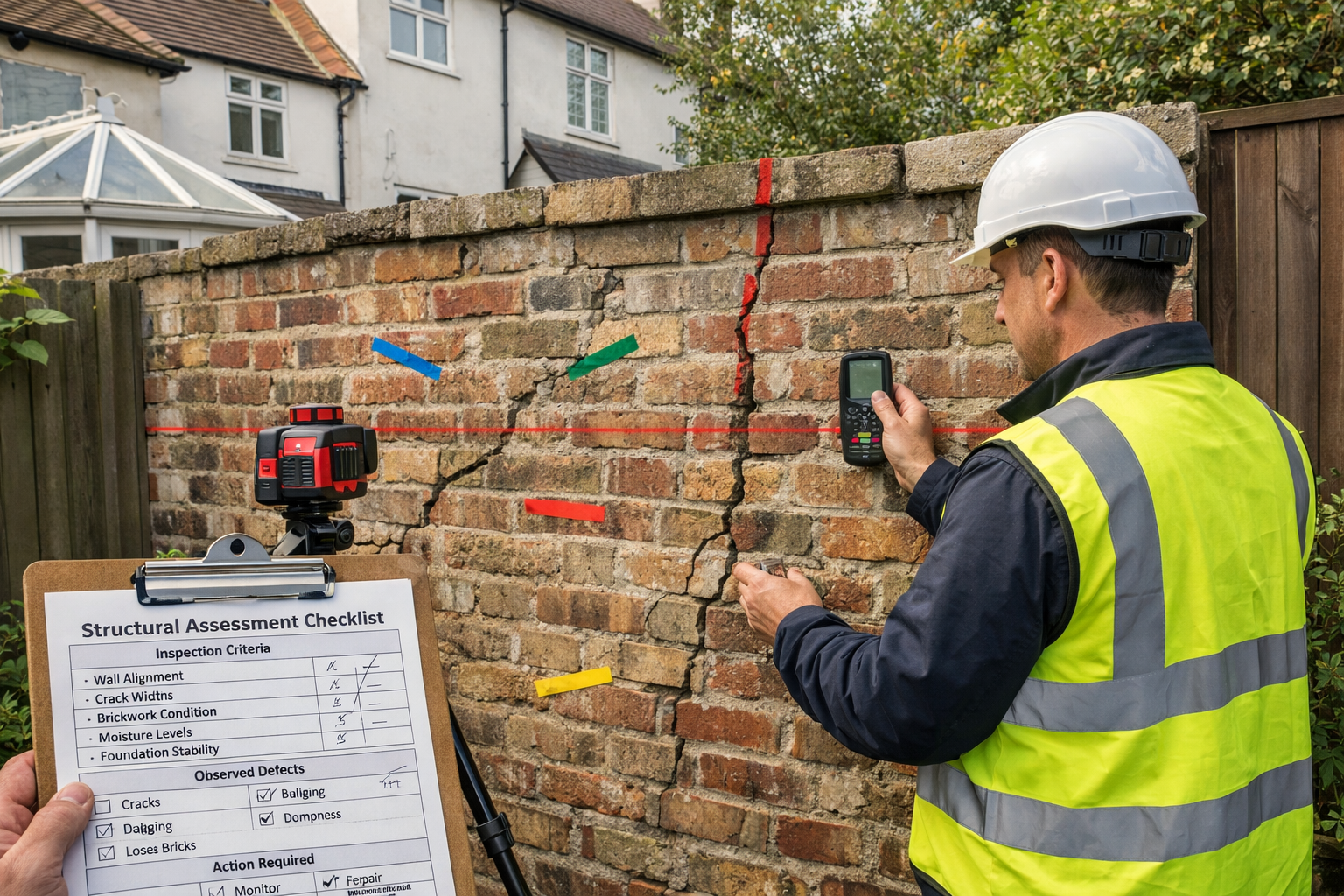
Professional Party Wall Surveyors follow systematic assessment protocols when evaluating garden walls for Award preparation. Understanding these checklists helps property owners anticipate requirements and prepare accordingly.
Pre-Work Structural Assessment Checklist
Before authorizing work on party fence walls, surveyors evaluate:
Foundation and Subsoil Conditions ⚙️
✓ Foundation depth measurement: Using trial pits or ground-penetrating radar to establish existing foundation levels
✓ Soil type analysis: Clay, sand, chalk, or mixed conditions affecting stability
✓ Drainage assessment: Water table levels, surface drainage, and subsurface moisture
✓ Root interference: Trees within influence zones that may affect foundations
✓ Previous movement evidence: Existing cracks, settlement, or heave indicators
Existing Wall Condition Evaluation
✓ Structural integrity: Vertical alignment, bulging, leaning, or deflection measurements
✓ Mortar condition: Joint deterioration, repointing requirements, erosion extent
✓ Brick/stone quality: Spalling, frost damage, chemical attack, or structural cracking
✓ Damp penetration: Rising damp, lateral moisture ingress, failed damp-proof courses
✓ Load-bearing capacity: Current loads and proposed additional loading from height increases
Height Increase Considerations
When raising existing garden walls, surveyors assess:
✓ Foundation adequacy: Whether existing foundations can support additional height
✓ Wind loading calculations: Increased exposure and lateral forces on taller walls
✓ Buttressing requirements: Need for additional support piers or returns
✓ Tie-in methodology: How new work connects to existing masonry
✓ Party Wall Act height limitations: Compliance with height regulations between neighbours
Construction Monitoring Checklist
During active construction, surveyors verify:
✓ Compliance with Award specifications: Materials, dimensions, and methods match approved plans
✓ Protective measures implementation: Dust sheets, barriers, and access controls in place
✓ Working hours adherence: Construction activity confined to permitted times
✓ Vibration monitoring: Sensitive equipment tracking ground movement if required
✓ Crack monitoring: Regular inspection of adjoining property for new damage
✓ Photographic documentation: Progressive records showing work stages
Post-Completion Verification
After work completion, surveyors conduct:
✓ Final condition survey: Comparing post-work state to original Schedule of Condition
✓ Damage assessment: Identifying any construction-related damage requiring remediation
✓ Specification compliance: Verifying completed work matches Award requirements
✓ Defect identification: Noting any workmanship issues requiring correction
✓ Sign-off documentation: Formal completion certificates releasing parties from further obligations
Common Neighbour Consent Pitfalls in Party Wall Awards for Garden Walls and Boundary Fences
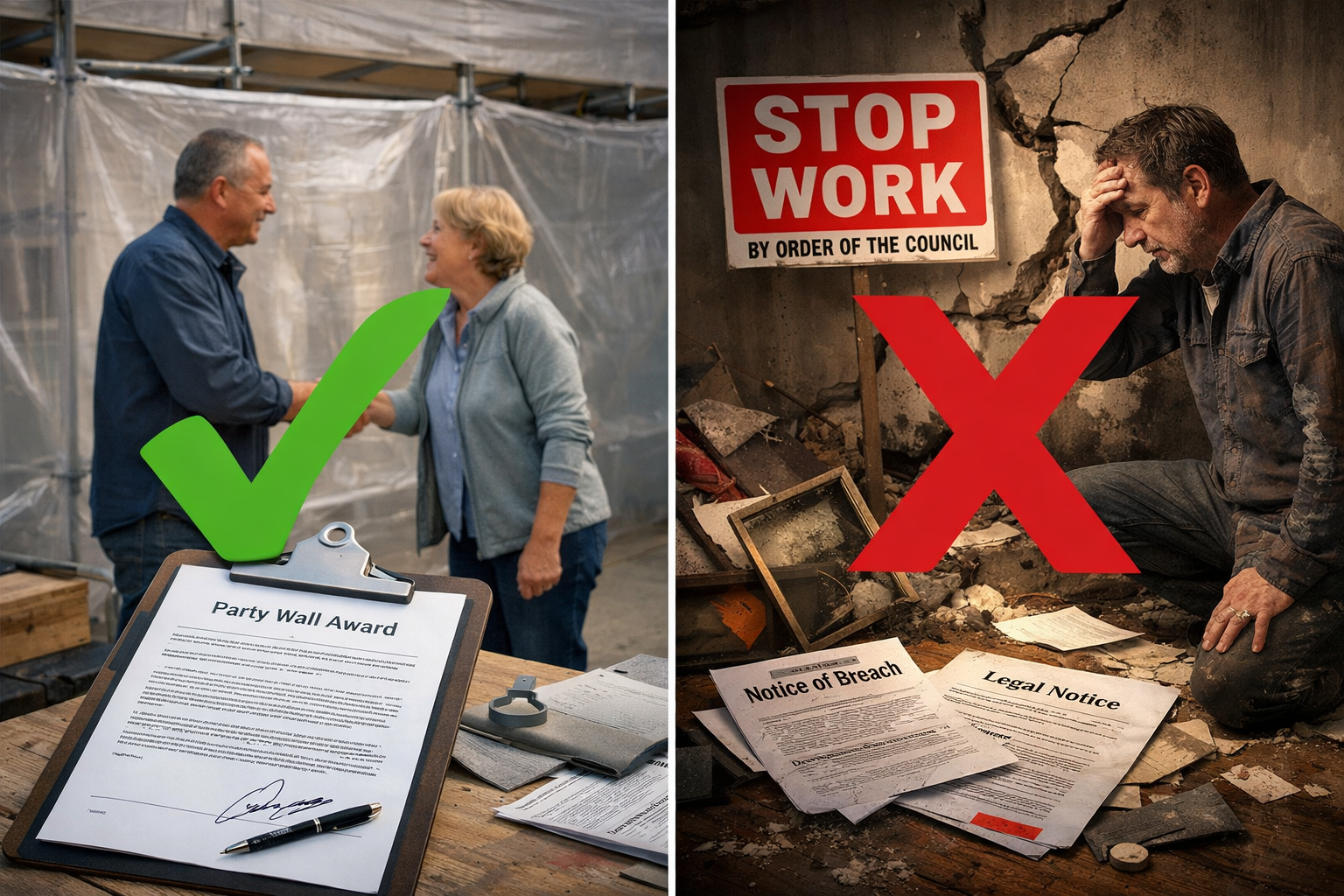
Even with proper legal procedures, specific mistakes repeatedly derail garden wall projects. Avoiding these common pitfalls saves time, money, and neighbourly relationships.
Pitfall 1: Assuming Verbal Agreement Suffices ❌
The Problem: Many neighbours verbally agree to proposed garden wall work, leading building owners to skip formal notice procedures.
The Consequence: Verbal agreements carry no legal weight under the Party Wall Act. If disputes arise during construction—or if the neighbour changes their mind—you lack legal protection to continue work [4].
The Solution: Always serve proper written notices, even when neighbours seem agreeable. Consider using Party Wall notice templates to ensure compliance.
Pitfall 2: Inadequate Notice Detail
The Problem: Vague or incomplete notice descriptions that fail to specify exact work scope, dimensions, materials, or timelines.
The Consequence: Neighbours reasonably dissent to unclear proposals, triggering unnecessary surveyor appointments and delays.
The Solution: Provide comprehensive notices including:
- Detailed architectural drawings with measurements
- Materials specifications
- Construction methodology descriptions
- Realistic work timelines
- Contact information for questions
Professional Party Wall contract templates ensure all required elements are included.
Pitfall 3: Ignoring the 14-Day Response Window ⏳
The Problem: Building owners serve notices but begin work before the 14-day response period expires.
The Consequence: Premature work commencement constitutes Act violation, potentially resulting in legal injunctions forcing work stoppage and exposing you to liability for any damage [8].
The Solution: Wait the full 14 days after serving notice. If no response arrives, the law treats silence as dissent, requiring surveyor appointment before proceeding [4].
Pitfall 4: Neglecting Excavation Notice Requirements
The Problem: Focusing solely on the garden wall itself while overlooking excavation work for extension foundations near the boundary.
The Consequence: Missing Section 6 notice requirements creates legal non-compliance, even if Section 1 or 3 notices were properly served [6].
The Solution: Map all proposed work comprehensively, identifying every Act trigger. Many projects require multiple simultaneous notices covering different work aspects.
Pitfall 5: DIY Awards Without Professional Surveyors
The Problem: Attempting to draft Party Wall Awards without qualified surveyor involvement to save costs.
The Consequence: Legally deficient Awards lack enforceability, fail to protect either party adequately, and often require expensive remedial legal work when disputes arise [5].
The Solution: Engage qualified Party Wall Surveyors with relevant professional memberships (RICS, FPWS, PYWS). The modest upfront investment prevents far costlier problems later.
Regional specialists understand local construction conditions and regulatory nuances—consider Party Wall surveyors in North London, South London, East London, or West London based on your project location.
Pitfall 6: Failing to Update Neighbours on Changes
The Problem: Project scope changes during construction without informing the adjoining owner or updating the Award.
The Consequence: Unauthorized variations breach the Award terms, potentially voiding its legal protections and creating liability exposure [2].
The Solution: Treat the Award as a binding contract. Any material changes require formal variation procedures, typically involving surveyor consultation and neighbour notification.
Pitfall 7: Inadequate Schedule of Condition Documentation
The Problem: Rushed or incomplete pre-work condition surveys that miss existing defects.
The Consequence: When neighbours claim construction damage, incomplete Schedules make defending against false claims nearly impossible, potentially resulting in unwarranted compensation payments [2].
The Solution: Insist on comprehensive photographic Schedules covering:
- Every room adjoining the work area
- All angles of external walls and structures
- Close-ups of any existing cracks or defects
- Time-stamped, dated images with location descriptions
Legal Consequences of Non-Compliance with Party Wall Awards
Understanding enforcement mechanisms motivates proper compliance. The Party Wall etc. Act 1996 carries significant legal teeth.
Injunctions and Work Stoppages ⚖️
Adjoining owners can seek court injunctions forcing immediate work cessation when building owners:
- Proceed without serving required notices
- Begin work before notice periods expire
- Violate Award terms and conditions
- Cause damage through non-compliant construction methods
Injunctions create project delays, legal costs, and potential contractor claims for standing time.
Financial Liability for Damage
Without proper Party Wall Awards and Schedules of Condition, building owners bear presumptive liability for any damage neighbours claim occurred during construction [8]. Proving you didn’t cause alleged damage becomes extremely difficult without baseline documentation.
Awards with comprehensive Schedules shift the burden of proof, requiring neighbours to demonstrate damage exceeds pre-existing conditions.
Cost Recovery Rights
When building owners fail to follow proper procedures, adjoining owners can recover:
💷 Legal costs for obtaining injunctions
💷 Surveyor fees for retrospective Award preparation
💷 Costs of remedial work for any damage
💷 Diminution in property value from unauthorized work
These expenses quickly exceed what proper compliance would have cost initially.
Criminal Penalties
While rare, persistent or egregious violations can result in criminal proceedings under related building control and property law statutes, particularly when unauthorized work creates safety hazards.
Regional Considerations for Party Wall Awards in 2026
Different London regions present unique challenges for garden wall projects:
Central London: Dense development, premium property values, and sophisticated neighbours familiar with Party Wall procedures make comprehensive compliance essential. Consider Party Wall surveyors in Central London with experience in high-value property disputes.
Suburban Areas: Older housing stock with deteriorated garden walls requires careful stability assessments before raising or rebuilding. Foundation conditions vary significantly based on local geology.
Conservation Areas: Additional planning restrictions may apply beyond Party Wall requirements, particularly for visible boundary walls affecting streetscape character.
New Developments: Modern estates often have restrictive covenants governing boundary treatments that operate alongside Party Wall legislation.
Practical Steps for 2026 Compliance
Follow this systematic approach for garden wall projects requiring Party Wall Awards:
Phase 1: Pre-Planning (2-3 months before construction) 📋
- Identify all work requiring notices: Map every Act trigger including excavation
- Engage a Party Wall Surveyor: Obtain professional advice on notice requirements
- Prepare detailed plans: Commission architectural drawings showing all proposed work
- Research neighbour relationships: Understand any existing disputes or sensitivities
Phase 2: Notice Service (1-2 months before construction)
- Serve formal written notices: Use proper templates with comprehensive details
- Provide supporting documentation: Include drawings, specifications, and timelines
- Offer to discuss concerns: Make yourself available for neighbour questions
- Document service: Keep proof of delivery (recorded mail or hand delivery with receipt)
Phase 3: Response Period (14 days minimum)
- Wait for responses: Do not begin work during this period
- Address concerns promptly: Respond to neighbour questions professionally
- If consent received: Proceed with construction while maintaining good communication
- If dissent or silence: Initiate surveyor appointment process immediately
Phase 4: Award Preparation (2-4 weeks)
- Surveyors conduct inspections: Cooperate fully with access requests
- Schedule of Condition prepared: Accompany surveyor during documentation
- Review draft Award: Ensure accuracy of work descriptions and conditions
- Award finalized: Receive signed copies before commencing work
Phase 5: Construction (per Award timeline)
- Comply strictly with Award terms: Follow all specifications, hours, and protective measures
- Maintain communication: Update neighbours on progress and any issues
- Document progress: Photograph work stages for records
- Address concerns immediately: Respond to neighbour complaints promptly
Phase 6: Completion and Sign-Off
- Request final inspection: Surveyors verify compliance and assess condition
- Address any identified issues: Complete remedial work promptly
- Obtain completion certificates: Secure formal sign-off from surveyors
- Maintain records: Keep all documentation for future reference
Conclusion
Party Wall Awards for Garden Walls and Boundary Fences: 2026 Compliance Guide for Extension Adjoining Owners provides essential protection for construction projects affecting boundary structures. While only masonry party fence walls trigger Act requirements—not timber fences or hedges—understanding which notice type applies to your specific work prevents costly legal complications.
The three distinct notice categories (Section 1 for new boundary walls, Section 3 for existing wall alterations, and Section 6 for nearby excavation) each carry specific timelines and requirements that must be meticulously followed. Professional Party Wall Awards with comprehensive Schedules of Condition protect both building owners and adjoining owners from disputes, providing clear frameworks for construction activity, protective measures, and damage resolution.
Common pitfalls—assuming verbal agreements suffice, providing inadequate notice detail, neglecting excavation requirements, or attempting DIY Awards—create far greater expenses than proper compliance costs. The systematic surveyor checklists for stability assessments ensure garden wall work proceeds safely without compromising structural integrity or neighbour relationships.
Your Next Steps for 2026 Garden Wall Projects 🎯
- Assess your project scope against the three notice categories to identify all Act triggers
- Engage a qualified Party Wall Surveyor at the planning stage, not after problems arise
- Serve comprehensive written notices with detailed plans, even if neighbours seem agreeable
- Insist on thorough Schedules of Condition documenting existing property conditions
- Comply strictly with Award terms regarding working hours, protective measures, and specifications
For immediate assistance with Party Wall Awards for your garden wall or extension project, contact our experienced team or explore our comprehensive Party Wall services. Whether you’re a building owner planning work or an adjoining owner responding to a neighbour’s notice, professional guidance ensures your 2026 project proceeds smoothly, legally, and without unnecessary conflict.
References
[1] Are Garden Walls Covered By The Party Wall Act A Comprehensive Guide – expresspartywall.com
[2] What Is Party Wall Award Your 2026 Homeowner S Guide – harperlatterarchitects.co.uk
[3] The Ultimate Guide To Party Walls – fastplansuk.co.uk
[4] Party Wall Agreement – hoa.org.uk
[5] Party Wall Guide – rellimsurveyors.co.uk
[6] Party Wall Contract Guide And Party Wall Award Template – https://nottinghillsurveyors.com/blog/party-wall-contract-guide-and-party-wall-award-template
[7] Party Fence Wall – partywall.expert
[8] Buying Property Party Wall Award – osborneslaw.com
Speak to a RICS chartered party wall surveyor
Free initial consultation. Notices, awards and schedules of condition across London and nationwide.