
Over 300,000 new homes are expected to be delivered across England and Wales in 2026 — and behind every shared wall, basement dig, or loft conversion sits a legal process that thousands of builders and homeowners are dangerously unprepared for.
Party Wall Awards in 2026 Construction Boom: Safeguarding Projects Amid Surveyor Shortages is not just a compliance headline — it is a live crisis reshaping how projects are planned, funded, and executed. With the UK government’s housing targets driving unprecedented construction activity, demand for qualified party wall surveyors has surged far beyond available supply. The result? Delays, disputes, cost overruns, and projects grinding to a halt before a single brick is laid.
The Party Wall etc. Act 1996 governs construction work on shared walls between adjoining properties across England and Wales [6]. It is not optional. It is not a formality. And in 2026’s feverish building environment, understanding how to navigate it — and how to secure a robust Party Wall Award before the queue gets longer — is one of the most valuable things any building owner can do.
Key Takeaways 📋
- Party Wall Awards are legally binding documents that protect both building owners and adjoining owners during construction — and demand for them is surging in 2026.
- Surveyor shortages are causing real delays: booking a qualified surveyor early is now a critical project management step, not an afterthought.
- Notice deadlines are strict: 2 months before works affecting a party wall, 1 month for excavations or new boundary walls [3].
- A complete party wall award costs approximately £1,000, with surveyors charging £150–£200 per hour [3] — costs that rise sharply when disputes arise.
- Robust award clauses and early engagement are the most effective tools for protecting timelines and budgets in today’s construction climate.
What Is a Party Wall Award — and Why It Matters More Than Ever in 2026
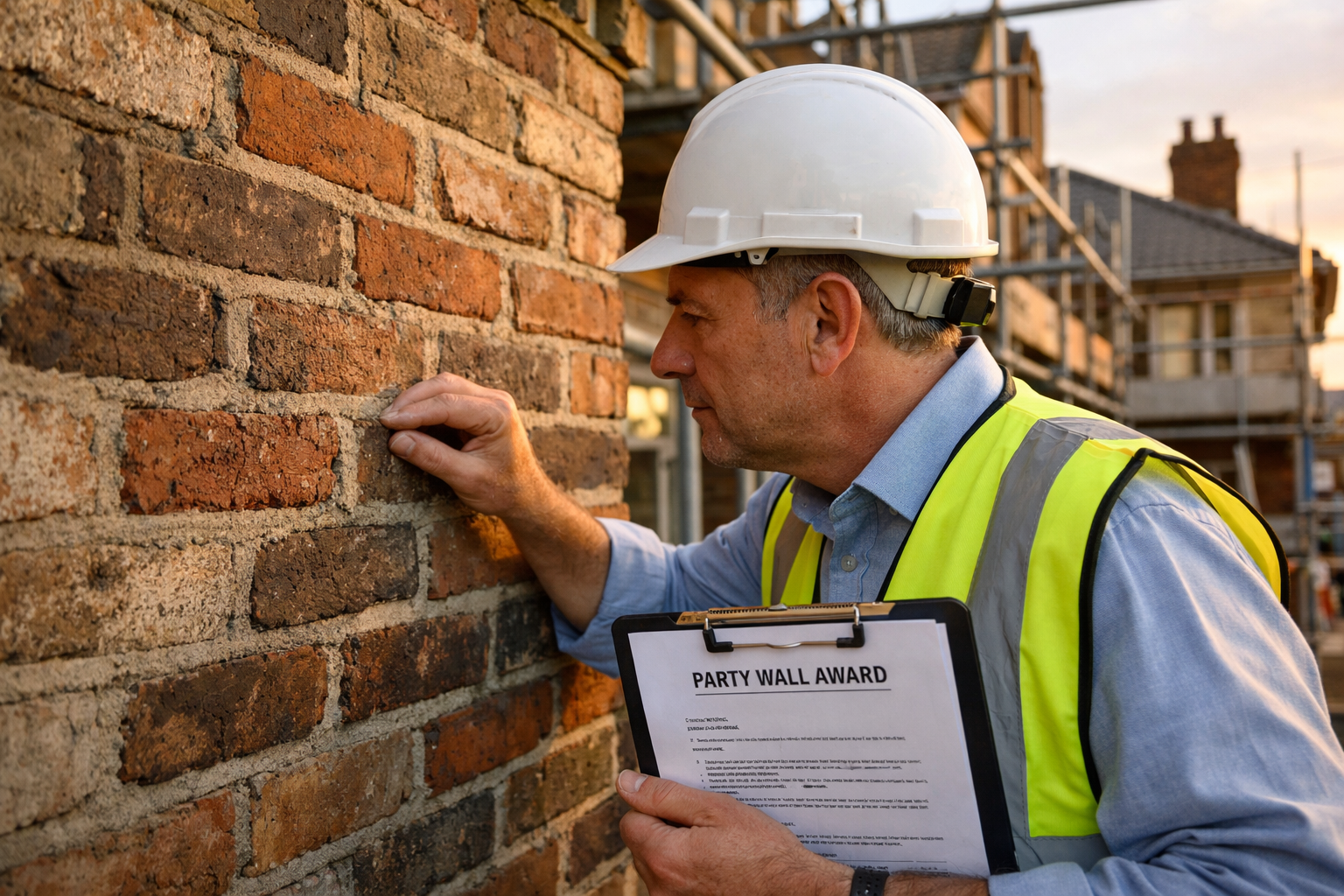
A Party Wall Award (sometimes called a party wall agreement) is a legally binding document prepared by one or more party wall surveyors. It sets out the rights and responsibilities of both the building owner (the person carrying out works) and the adjoining owner (the neighbour whose property shares a wall or boundary) [3].
The award covers:
- 📐 The scope of the proposed works
- 🕐 Working hours and access rights
- 🏗️ Methods of construction and protective measures
- 📸 Schedule of condition (a photographic record of the neighbour’s property before works begin)
- 💷 Who pays the surveyor’s fees
- ⚖️ Dispute resolution procedures
“A Party Wall Award is not bureaucratic red tape — it is the legal scaffolding that holds a construction project together when things get complicated.”
For a deeper understanding of the full scope of what these documents cover, the party wall awards guide provides a comprehensive breakdown of what to expect.
Who Needs a Party Wall Award?
Not every construction project triggers the Act. But many common works do, including:
| Type of Work | Act Triggered? |
|---|---|
| Loft conversions affecting a shared wall | ✅ Yes |
| Basement excavations near a boundary | ✅ Yes |
| Extensions built up to or astride a boundary | ✅ Yes |
| Internal renovations with no shared wall impact | ❌ No |
| New freestanding garden walls | ❌ No |
| Cutting into a party wall for beams | ✅ Yes |
Understanding types of party wall works that fall under the Act is the essential first step before any project begins.
The 2026 Surveyor Shortage: How the Construction Boom Is Creating a Bottleneck

The UK government’s commitment to building 1.5 million homes by 2029 has created a construction pipeline unlike anything seen in a generation. But the professional infrastructure supporting that pipeline — particularly the pool of qualified party wall surveyors — has not scaled at the same pace.
Why Surveyors Are in Short Supply
Several factors are converging in 2026 to create this shortage:
- Increased housing starts — More new builds and extensions mean more party wall notices being served simultaneously across every borough.
- Aging surveyor workforce — A significant proportion of RICS-accredited party wall surveyors are approaching retirement, and the pipeline of newly qualified professionals is thin.
- Geographic concentration — Surveyors are clustered in urban centres. In outer boroughs and commuter towns experiencing rapid development, the imbalance is acute.
- Complexity of modern projects — Basement conversions, modular builds, and mixed-use developments require more surveyor time per award, reducing overall capacity.
The practical consequence is stark: booking windows that once sat at 2–3 weeks are now stretching to 6–10 weeks in high-demand areas. For a project with a fixed start date, this is not a minor inconvenience — it is a programme-critical risk.
The Real Cost of Getting It Wrong
Party wall surveyors currently charge between £150 and £200 per hour, with a straightforward party wall award costing approximately £1,000 [3]. That figure sounds manageable. But when a project stalls because no surveyor was booked in time, or when a dispute arises mid-construction because the award lacked robust protective clauses, costs multiply rapidly.
Consider the compounding risks:
- Contractor standing time while legal matters are resolved
- Injunctions obtained by adjoining owners to halt works
- Damage claims without a pre-works schedule of condition
- Legal fees if the matter escalates beyond the surveyor framework
Understanding the full costs of party wall processes — and what drives them up — is essential reading before any project begins.
Party Wall Awards in 2026 Construction Boom: Practical Strategies to Safeguard Your Project
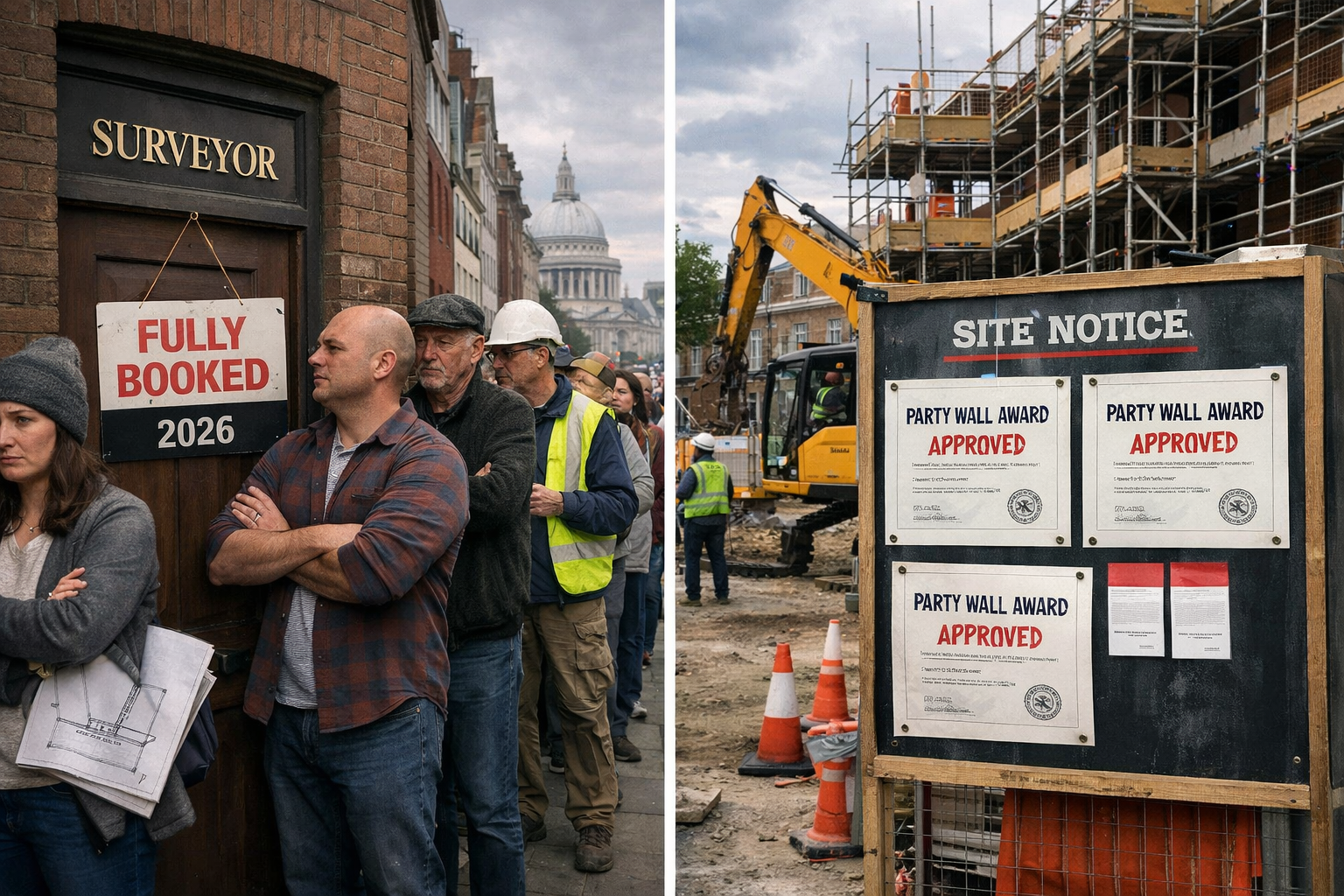
Navigating Party Wall Awards in 2026 Construction Boom: Safeguarding Projects Amid Surveyor Shortages requires a proactive, structured approach. The following strategies are drawn from best practice and reflect the realities of today’s constrained market.
✅ Strategy 1: Serve Notice Early — Much Earlier Than You Think
The Act requires building owners to serve formal notice 2 months before works affecting a party wall, or 1 month before excavation works or new boundary walls [3]. These are minimum periods. In 2026, treating them as targets is a mistake.
Practical recommendation: Serve notice as soon as planning permission is granted — or even at the pre-application stage if the project is complex. This creates maximum runway for the surveyor appointment process.
For a clear walkthrough of how party wall notices work and when to serve them, reviewing the formal notice requirements before instructing a surveyor is strongly advised.
✅ Strategy 2: Appoint a Surveyor Before You Need One
In a shortage market, the surveyor who is available when you need them is rarely the most qualified. The solution is to identify and provisionally engage a surveyor at the project inception stage, even before the notice period begins.
Key steps:
- Research surveyors with experience in your specific work type (basement, loft, extension)
- Confirm their availability against your programme
- Understand whether they can act as an agreed surveyor (one surveyor acting for both parties) or whether separate appointments will be needed
For projects in London, location-specific expertise matters. Whether the project is in North London, South London, East London, or West London, local knowledge of building stock, soil conditions, and common dispute patterns adds real value to the award process.
✅ Strategy 3: Invest in a Robust Award — Not Just a Compliant One
There is a significant difference between a party wall award that satisfies the minimum legal requirements and one that genuinely protects a project from delay and dispute. In 2026’s high-pressure environment, the latter is worth every penny.
A robust award should include:
- Detailed method statements for each phase of work
- Clear access provisions with notice periods for entry
- Specific noise and vibration limits tied to monitoring requirements
- Comprehensive schedule of condition covering all areas of risk
- Dispute escalation procedures that are fast and unambiguous
- Reinstatement obligations clearly defined with timelines
Reviewing a party wall contract template guide can help building owners understand what strong award clauses look like before instructing a surveyor.
✅ Strategy 4: Engage Adjoining Owners Early and Collaboratively
One of the most underestimated causes of delay in the party wall process is neighbour resistance — not because the works are unreasonable, but because the adjoining owner feels surprised, excluded, or anxious.
Early, informal communication before formal notice is served can:
- Reduce the likelihood of the adjoining owner dissenting and appointing a separate surveyor
- Build goodwill that smooths access arrangements
- Surface concerns early that can be addressed in the award rather than becoming disputes mid-build
The Act grants the adjoining owner specific rights and protections. Acknowledging these openly, rather than treating them as obstacles, is both legally sound and practically effective.
✅ Strategy 5: Understand the Agreed Surveyor Option
When both parties consent, a single agreed surveyor can be appointed to act impartially for both the building owner and the adjoining owner [3]. This approach:
- Reduces costs significantly (one fee instead of two)
- Speeds up the process by eliminating the need for two surveyors to negotiate
- Simplifies communication throughout the project
However, it requires trust from both parties. If the adjoining owner has any concerns about impartiality, separate appointments are the safer route. For those exploring whether a surveyor is strictly necessary in all cases, the guide on having a party wall agreement without a surveyor outlines the limited circumstances where this may apply.
Regional Hotspots: Where the Pressure Is Highest in 2026
The surveyor shortage is not uniform across England and Wales. Certain areas are experiencing acute pressure due to the intersection of high construction activity and limited local surveyor capacity.
| Region | Pressure Level | Primary Work Type |
|---|---|---|
| Inner London Boroughs | 🔴 Critical | Basement conversions, loft extensions |
| Greater Manchester | 🟠 High | New build terraces, extensions |
| Bristol & Bath | 🟠 High | Victorian terrace renovations |
| Birmingham | 🟡 Moderate-High | Mixed residential development |
| Leeds & Sheffield | 🟡 Moderate | Back-to-back terrace works |
For London-based projects specifically, the Central London party wall surveyor market is particularly constrained, with premium properties and complex basement projects dominating the workload.
The Legal Framework: What the Act Actually Requires
The Party Wall etc. Act 1996 applies to England and Wales and grants building owners the right to undertake certain works that might otherwise constitute trespass or nuisance [6]. The Act is not discretionary — failure to comply can result in injunctions, damages, and significant project delays.
Key Legal Obligations at a Glance
- Notice must be served in writing — verbal agreements have no legal standing
- Adjoining owners have 14 days to respond to a notice before dissent is assumed
- Surveyors must act impartially — they are officers of the Act, not advocates for the party who appointed them [4]
- Awards are binding on both parties and can only be challenged in a county court within 14 days of service
- The building owner bears costs in most cases, unless the adjoining owner has made unreasonable demands [3]
Conclusion: Act Now — The Queue Is Already Forming 🏗️
The convergence of a historic construction boom and a qualified surveyor shortage makes 2026 a uniquely challenging year for anyone planning works near a shared wall. Party Wall Awards in 2026 Construction Boom: Safeguarding Projects Amid Surveyor Shortages is not a problem that resolves itself — it requires deliberate, early action.
Actionable Next Steps
- Identify whether your project triggers the Act — review the types of works covered and serve notice at the earliest opportunity.
- Book a surveyor now — do not wait until the notice period is running. Availability windows are long and getting longer.
- Invest in a robust award — cheap and minimal is a false economy when a dispute halts a £150,000 project.
- Communicate with your neighbours early — goodwill costs nothing and prevents expensive dissent.
- Use the agreed surveyor route where possible — it saves time, money, and complexity.
- Document everything — a thorough schedule of condition before works begin is the single best protection against damage claims.
The Party Wall Act exists to protect everyone involved in construction near shared boundaries. In 2026’s pressured market, those who engage with it proactively will complete their projects on time and on budget. Those who treat it as an afterthought will join a very expensive queue.
References
[1] 62240 Border Wall Contractor Says 2b Federal Award Package Sets Stage For 2026 Construction – enr.com
[3] Party Wall Agreement – hoa.org.uk
[4] Party Walls The Fundamentals – rics.org
[6] Party Wall Act – designingbuildings.co.uk
Speak to a RICS chartered party wall surveyor
Free initial consultation. Notices, awards and schedules of condition across London and nationwide.