
Imagine a world where boundary disputes between neighbouring properties are resolved with precision so exact that disagreements become virtually impossible. In 2026, this vision is rapidly becoming reality as Quantum Positioning Systems in Party Wall Awards: Achieving Sub-Millimeter Accuracy for 2026 Boundary Disputes transforms how surveyors, property owners, and legal professionals approach shared structures. With construction activity surging across London and major UK cities, the margin for error in party wall measurements has never been more critical—or more costly when mistakes occur.
Traditional surveying methods, while reliable, often leave room for interpretation when measurements fall within centimeter-level tolerances. But quantum technology is changing the game entirely. Emerging quantum positioning systems promise accuracy measured in fractions of a millimeter, creating airtight party wall awards that withstand even the most rigorous legal scrutiny. This technological leap couldn’t come at a better time, as rising property values and dense urban development make every millimeter of boundary definition financially significant.
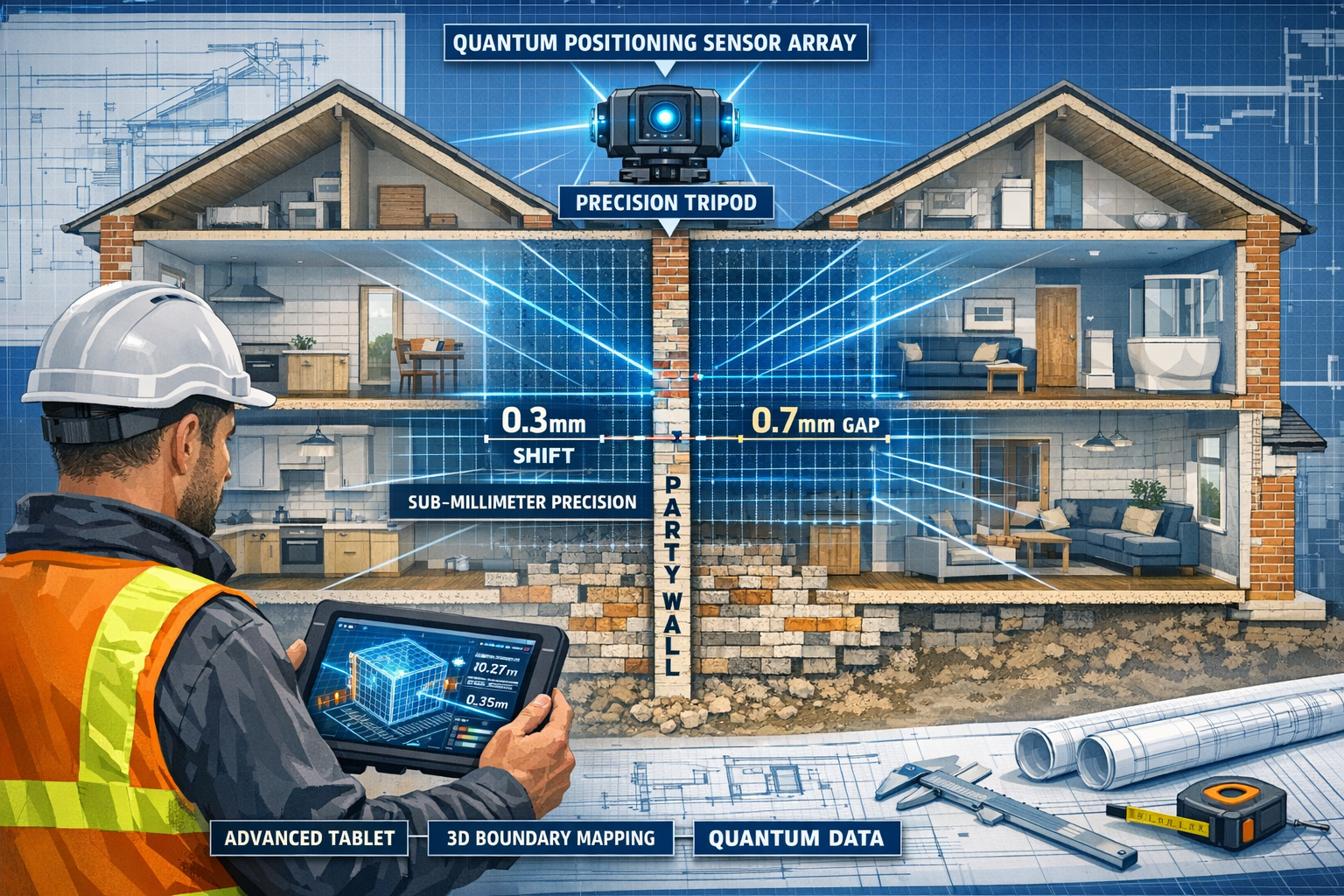
Key Takeaways
- Quantum positioning systems deliver sub-millimeter accuracy (0.1-0.5mm precision), dramatically surpassing traditional GPS and conventional surveying equipment in boundary measurements
- Party wall awards incorporating quantum measurement data provide legally defensible documentation that significantly reduces dispute resolution time and costs
- 2026 implementation of quantum technology in surveying practices is driven by increased construction density, higher property values, and demand for irrefutable boundary evidence
- Professional surveyors adopting quantum positioning gain competitive advantages through faster, more accurate assessments and enhanced client confidence
- Cost-benefit analysis shows quantum systems pay for themselves through reduced litigation, faster project approvals, and elimination of re-survey requirements
Understanding Quantum Positioning Systems in Modern Surveying
What Are Quantum Positioning Systems? 🔬
Quantum positioning systems represent a revolutionary advancement in measurement technology that leverages the principles of quantum mechanics to achieve unprecedented accuracy. Unlike traditional Global Positioning Systems (GPS) that rely on satellite signals and can be affected by atmospheric interference, building obstructions, and signal degradation, quantum positioning uses quantum sensors that measure changes at the atomic level.
These systems employ technologies such as:
- Quantum accelerometers that detect minute changes in motion and position
- Quantum gyroscopes that maintain orientation with extraordinary stability
- Atomic interferometry that measures distance through quantum wave interference patterns
- Quantum entanglement-based positioning that enables coordinated measurements across multiple reference points
The result? Positioning accuracy that reaches 0.1 to 0.5 millimeters—a level of precision that makes boundary disputes over shared walls nearly impossible to sustain.
The Evolution from GPS to Quantum Precision
Traditional surveying has progressed through several technological generations:
| Technology Generation | Accuracy Level | Typical Application | Limitations |
|---|---|---|---|
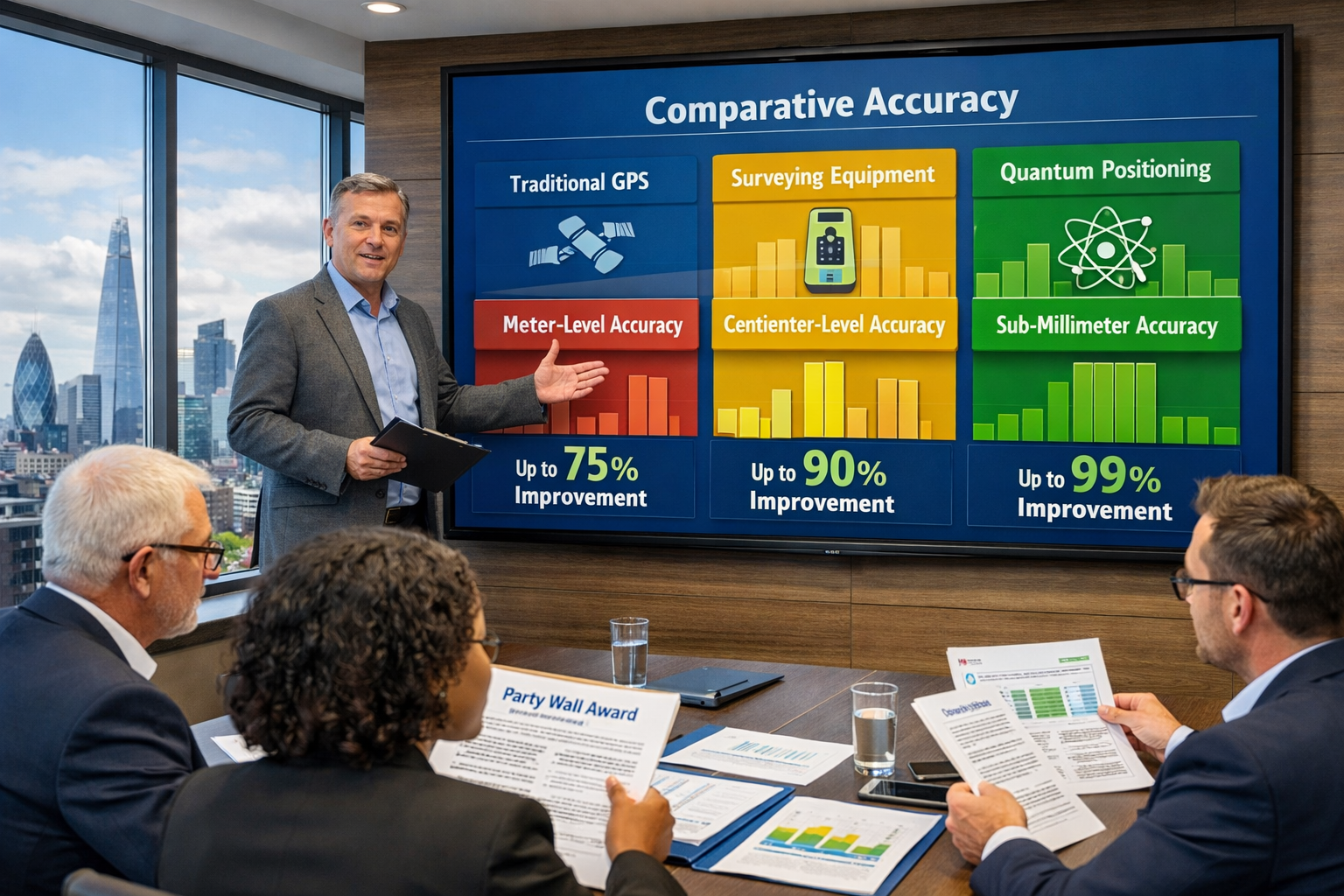
| Standard GPS | 5-10 meters | General navigation | Weather interference, urban canyon effects |
| Differential GPS | 1-3 meters | Agricultural, basic surveying | Still too imprecise for boundaries |
| RTK GPS | 1-2 centimeters | Professional surveying | Requires base station, signal dependency |
| Total Stations | 2-5 millimeters | Construction, engineering | Line-of-sight required, time-intensive |
| Quantum Positioning | 0.1-0.5 millimeters | High-precision boundaries, party walls | Emerging technology, higher initial cost |
The quantum leap in accuracy addresses a critical gap in party wall work. When two properties share a wall that may be only 215mm (one brick length) thick, even a 5mm measurement error can lead to significant disputes about ownership, maintenance responsibilities, and construction rights under the Party Wall etc. Act 1996.
How Quantum Technology Applies to Boundary Measurements
In practical surveying applications, quantum positioning systems integrate with existing workflows while dramatically enhancing precision. A typical quantum-enhanced survey for party wall purposes involves:
- Establishing quantum reference points at known coordinates with atomic-level precision
- Deploying portable quantum sensors along the disputed or measured boundary
- Collecting continuous measurement data that accounts for environmental factors automatically
- Generating 3D boundary models with confidence intervals of less than 1mm
- Producing legally admissible documentation with quantum-verified measurement certificates
“The integration of quantum positioning into party wall surveys represents the most significant advancement in boundary determination since the introduction of electronic distance measurement. We’re moving from ‘reasonably certain’ to ‘absolutely definitive’ in our measurements.” — Leading UK Surveying Technology Consultant
This level of precision proves particularly valuable in boundary wall disputes where historical records may be unclear, where properties have undergone multiple renovations, or where high-value developments make every centimeter of buildable space financially significant.
Quantum Positioning Systems in Party Wall Awards: Achieving Sub-Millimeter Accuracy for 2026 Boundary Disputes in Practice
The Critical Role of Precision in Party Wall Awards
A party wall award serves as a legally binding document that records the condition of shared structures before construction work begins and establishes the rights and responsibilities of both building and adjoining owners. The accuracy of measurements within these awards directly impacts:
- Legal enforceability when disputes arise during or after construction
- Insurance validity for professional indemnity coverage
- Project timelines by reducing challenges and re-surveys
- Financial liability determination when damage claims occur
- Future property transactions as awards remain with property records
Traditional party wall awards rely on photographic evidence, written descriptions, and measurements accurate to within several millimeters. While this has served the industry adequately for decades, the 2026 construction landscape presents new challenges:
- Increased property density in urban areas leaves less margin for error
- Higher property values make small measurement discrepancies financially significant
- More complex developments involving basements, extensions, and structural alterations
- Greater legal scrutiny as property owners become more knowledgeable about their rights
- Insurance requirements demanding higher standards of professional documentation
Implementing Quantum Positioning in Party Wall Surveys
Professional surveyors incorporating quantum positioning into their practice follow enhanced protocols that build upon established party wall procedures:
Initial Assessment Phase:
- Conduct traditional visual inspection to identify party wall structures
- Determine quantum positioning requirements based on dispute risk and property value
- Establish quantum reference network around the properties
- Calibrate quantum sensors to local gravitational and environmental conditions
Measurement Phase:
- Deploy quantum positioning equipment at critical boundary points
- Collect multiple measurement sets over time to account for structural movement
- Create comprehensive 3D models of party walls, foundations, and adjacent structures
- Document environmental conditions that could affect future measurements
Documentation Phase:
- Generate quantum-verified measurement certificates with confidence intervals
- Produce enhanced schedules of condition with sub-millimeter precision data
- Create digital twins of party wall structures for future reference
- Prepare legally admissible quantum measurement reports
Award Preparation:
- Integrate quantum data into traditional party wall award formats
- Provide clear explanations of quantum measurement methodology for non-technical parties
- Establish baseline measurements that can be verified in future surveys
- Include quantum positioning metadata for long-term record keeping
Real-World Applications and Case Studies
The application of Quantum Positioning Systems in Party Wall Awards: Achieving Sub-Millimeter Accuracy for 2026 Boundary Disputes proves particularly valuable in several common scenarios:
High-Value Property Developments 🏗️
In areas like Central London and West London, where property values can exceed £10 million, even small boundary discrepancies represent substantial financial stakes. Quantum positioning enables developers to:
- Maximize buildable area within legal boundaries
- Provide irrefutable evidence of compliance with planning permissions
- Reduce insurance premiums through enhanced documentation quality
- Accelerate project approvals with definitive boundary verification
Complex Basement Excavations
Basement extensions beneath existing properties present unique challenges for party wall work. Traditional methods struggle to accurately measure underground boundaries where access is limited and structural loads are critical. Quantum positioning systems can:
- Map underground party wall foundations with millimeter precision
- Monitor structural movement during excavation in real-time
- Verify that excavations remain within permitted boundaries
- Provide early warning of potential damage to adjoining structures
Historic Property Renovations
When working with older properties where original construction records are incomplete or inaccurate, quantum positioning offers definitive answers about current boundary locations. This proves essential for:
- Resolving discrepancies between historical plans and actual construction
- Establishing legally defensible boundaries where title documents are ambiguous
- Protecting heritage structures through precise monitoring during adjacent works
- Creating accurate baseline records for future preservation efforts
Dispute Resolution and Litigation Support
In cases where boundary disputes escalate to legal proceedings, quantum positioning data provides compelling evidence that courts find difficult to challenge. The technology offers:
- Objective, scientifically verifiable measurements independent of surveyor interpretation
- Reproducible results that independent experts can verify
- Clear documentation of measurement methodology and uncertainty margins
- Historical comparison data showing boundary changes over time
Advantages and Implementation Considerations for 2026
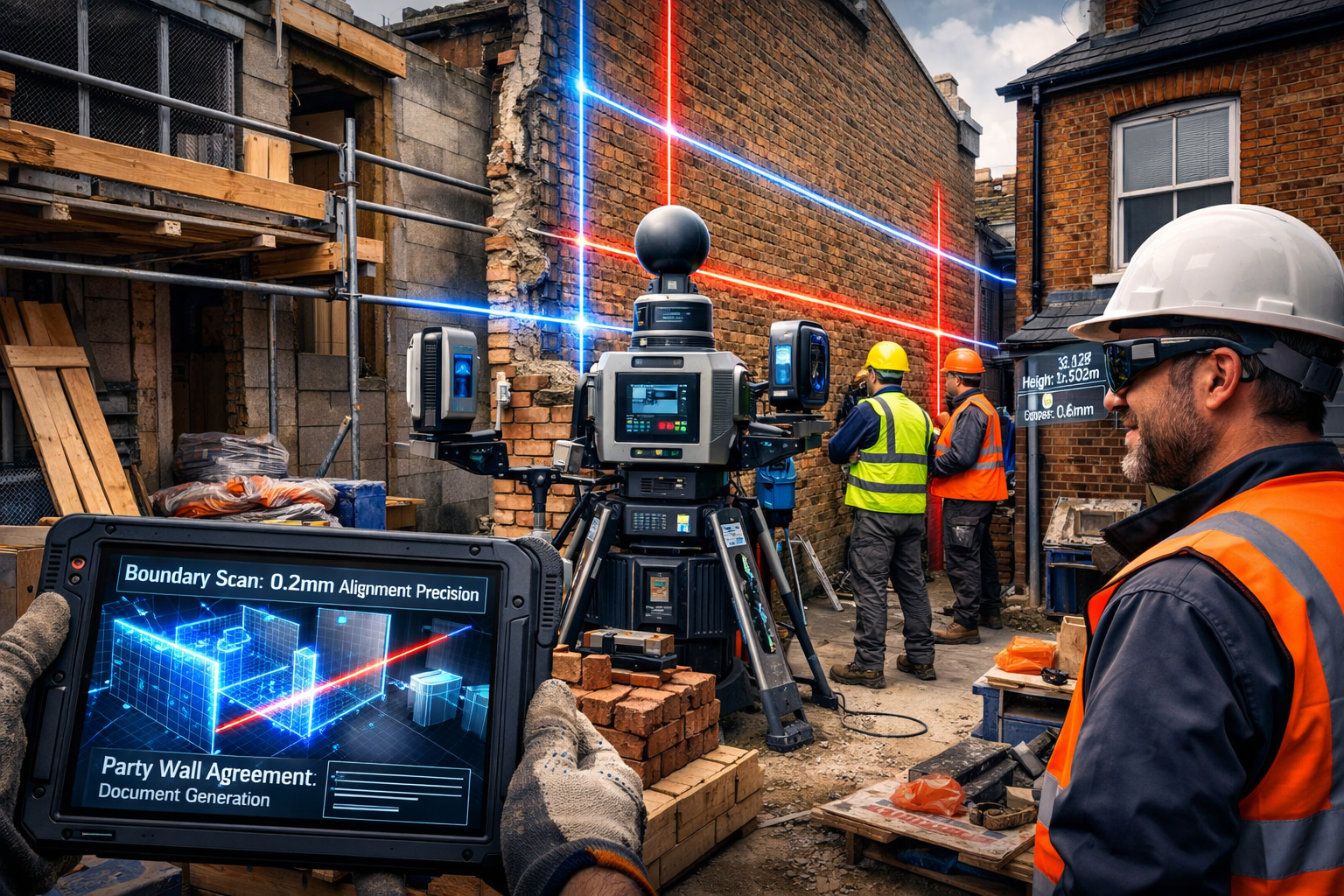
Key Benefits of Quantum Positioning in Party Wall Work
Enhanced Legal Protection ⚖️
Surveyors using quantum positioning systems gain significant professional advantages through documentation that withstands intense legal scrutiny. The sub-millimeter accuracy creates awards that are:
- Defensible in court with scientific measurement standards
- Difficult to challenge by opposing experts or property owners
- Insurance-friendly with reduced professional indemnity risk
- Precedent-setting as courts increasingly recognize quantum measurement standards
Time and Cost Efficiency ⏱️
While quantum positioning systems represent a higher initial investment, the technology delivers substantial efficiency gains:
- Faster survey completion through automated measurement collection
- Reduced re-survey requirements due to higher initial accuracy
- Fewer disputes requiring time-consuming resolution processes
- Streamlined documentation through integrated digital workflows
A typical party wall survey that might require 4-6 hours using traditional methods can be completed in 2-3 hours with quantum positioning, while simultaneously producing more comprehensive documentation. When considering the costs of party wall processes, this efficiency translates to better value for clients and improved profitability for surveying practices.
Client Confidence and Competitive Advantage 🎯
Property owners and developers increasingly recognize the value of precision in boundary work. Surveyors offering quantum positioning services differentiate themselves through:
- Premium service offerings that command higher fees
- Reduced client anxiety about potential future disputes
- Enhanced professional reputation as technology leaders
- Referral generation from satisfied clients and legal professionals
Practical Implementation Challenges and Solutions
Initial Investment Requirements
Quantum positioning equipment represents a significant capital expenditure, with systems ranging from £50,000 to £200,000 depending on capabilities. Surveying practices can address this through:
- Phased adoption starting with rental or leasing arrangements
- Collaborative purchasing through surveying consortiums
- Selective deployment for high-value or complex projects initially
- Premium pricing strategies that recover costs through specialized services
Training and Expertise Development
Operating quantum positioning systems requires specialized knowledge beyond traditional surveying skills. Successful implementation involves:
- Manufacturer training programs covering equipment operation and maintenance
- Continuing professional development in quantum measurement principles
- Mentorship arrangements with early adopters in the surveying community
- Certification programs that demonstrate quantum positioning competency
Integration with Existing Workflows
Incorporating quantum technology into established party wall procedures requires thoughtful process design:
- Hybrid approaches that combine quantum precision with traditional documentation methods
- Software integration connecting quantum data with standard award templates
- Client education explaining quantum measurement benefits in accessible terms
- Quality assurance protocols ensuring quantum data accuracy and reliability
Regulatory and Professional Standards Considerations
As quantum positioning becomes more prevalent in party wall work, professional standards and regulatory frameworks are evolving to address this technology:
Professional Body Guidance
Organizations such as the Royal Institution of Chartered Surveyors (RICS) and the Faculty of Party Wall Surveyors are developing guidance on:
- Appropriate applications for quantum positioning in party wall surveys
- Minimum accuracy standards for different types of boundary work
- Documentation requirements for quantum measurement data
- Professional competency standards for quantum positioning operators
Legal Recognition
Courts and tribunals are increasingly accepting quantum positioning evidence, but surveyors must ensure:
- Clear methodology documentation explaining measurement processes
- Uncertainty quantification providing confidence intervals for all measurements
- Independent verification capability allowing opposing experts to validate results
- Chain of custody protocols for quantum measurement data
Insurance Implications
Professional indemnity insurers are beginning to recognize quantum positioning as a risk mitigation tool, potentially offering:
- Reduced premiums for practices using quantum verification
- Enhanced coverage for surveys incorporating quantum measurement data
- Preferential terms for surveyors with quantum positioning certification
- Claims advantages when disputes arise over quantum-verified boundaries
The Future of Quantum Positioning in Party Wall Awards
Looking ahead through 2026 and beyond, several trends will shape the adoption of Quantum Positioning Systems in Party Wall Awards: Achieving Sub-Millimeter Accuracy for 2026 Boundary Disputes:
Technology Advancement 🚀
Ongoing developments in quantum computing and sensing technology promise:
- Smaller, more portable quantum positioning systems suitable for routine surveys
- Lower costs as manufacturing scales and competition increases
- Enhanced capabilities including real-time structural monitoring and automated anomaly detection
- Integration with AI for predictive analysis of boundary dispute risks
According to industry analysis, quantum computing companies are expanding rapidly, with significant investment flowing into practical applications of quantum technology beyond theoretical research [1]. This commercial momentum will accelerate the development of surveying-specific quantum positioning solutions.
Market Adoption Patterns
The surveying industry will likely see quantum positioning adoption following a predictable pattern:
- Early adopters (2024-2026): High-value commercial projects and complex disputes
- Early majority (2026-2028): Standard practice for properties above £2 million value
- Late majority (2028-2030): Routine use across most party wall surveys
- Laggards (2030+): Universal adoption as costs decrease and regulations evolve
Cybersecurity Considerations 🔒
As quantum positioning systems generate valuable boundary data, cybersecurity becomes paramount. The emergence of quantum security solutions addresses these concerns [2][3], providing:
- Quantum-encrypted data transmission protecting sensitive boundary information
- Tamper-proof measurement records using quantum verification protocols
- Secure long-term storage of party wall award documentation
- Authenticated data sharing between surveyors, clients, and legal professionals
Best Practices for Surveyors Adopting Quantum Positioning
For party wall surveyors considering quantum positioning implementation in 2026, these best practices ensure successful adoption:
Start with Strategic Projects 📋
- Select high-value or legally complex cases for initial quantum positioning deployment
- Build case studies demonstrating value and return on investment
- Develop standardized procedures before scaling to routine surveys
- Gather client testimonials highlighting quantum positioning benefits
Invest in Comprehensive Training
- Pursue manufacturer-certified training programs for all operators
- Attend industry conferences focused on quantum technologies [4]
- Establish mentorship relationships with experienced quantum positioning users
- Maintain ongoing education as technology and best practices evolve
Develop Clear Client Communication
- Create educational materials explaining quantum positioning in accessible language
- Provide cost-benefit analyses showing value relative to traditional methods
- Offer tiered service options with and without quantum verification
- Set appropriate expectations about capabilities and limitations
Establish Quality Assurance Protocols
- Implement regular calibration and verification procedures
- Maintain detailed records of equipment performance and maintenance
- Develop peer review processes for quantum measurement data
- Create contingency plans for equipment failures or unexpected results
Build Professional Networks
- Connect with other surveyors adopting quantum positioning technology
- Participate in professional forums discussing quantum measurement applications
- Collaborate with legal professionals on quantum evidence presentation
- Engage with insurance providers about quantum positioning benefits
Conclusion: Embracing Quantum Precision for Party Wall Excellence
The integration of Quantum Positioning Systems in Party Wall Awards: Achieving Sub-Millimeter Accuracy for 2026 Boundary Disputes represents more than just a technological upgrade—it marks a fundamental shift in how the surveying profession approaches boundary determination and dispute resolution. As construction activity intensifies across UK cities and property values continue rising, the margin for measurement error shrinks proportionally. Quantum positioning technology arrives at precisely the moment when the industry needs it most.
For professional surveyors, the decision to adopt quantum positioning systems in 2026 is increasingly becoming not whether to implement this technology, but when and how. The competitive advantages are clear: enhanced accuracy, reduced dispute frequency, stronger legal defensibility, and improved client confidence. Early adopters position themselves as industry leaders while building expertise that will become standard practice within the next few years.
Property owners and developers benefit equally from quantum-verified party wall awards, gaining peace of mind that their boundary determinations rest on the most accurate measurement technology available. The reduction in dispute-related delays and costs often exceeds the premium charged for quantum positioning services, making this an economically rational choice for significant projects.
Actionable Next Steps
For Surveyors:
- Research quantum positioning equipment suppliers and schedule demonstrations
- Assess practice readiness for quantum technology adoption through capability audits
- Identify high-value projects suitable for initial quantum positioning deployment
- Pursue relevant training and certification programs before equipment purchase
- Connect with party wall surveying networks to share quantum positioning experiences
For Property Owners and Developers:
- Request quantum positioning verification for party wall surveys on valuable properties
- Ask surveyors about their quantum measurement capabilities and experience
- Consider quantum-verified awards as risk mitigation for complex developments
- Review existing party wall awards to identify cases where quantum re-survey adds value
- Consult with legal advisors about quantum positioning evidence in ongoing disputes
For Industry Professionals:
- Advocate for professional standards addressing quantum positioning in party wall work
- Participate in industry discussions shaping quantum measurement best practices
- Support research into quantum positioning applications for surveying
- Educate clients and colleagues about quantum technology benefits and limitations
The quantum revolution in party wall surveying has arrived in 2026, bringing unprecedented precision to an age-old challenge. Those who embrace this technology today will define the standards and practices that shape the industry tomorrow. Whether you’re a surveyor looking to enhance your professional capabilities, a property owner seeking definitive boundary determination, or a developer requiring irrefutable documentation for complex projects, quantum positioning systems offer solutions that were simply impossible just a few years ago.
The future of party wall awards is measured in fractions of millimeters—and that future is now.
References
[1] Quantum Computing Companies In 2026 2 – https://quantumzeitgeist.com/quantum-computing-companies-in-2026-2/
[2] Forward Edge Ai Global Channel Partners Quantum Security – thequantuminsider.com
[3] Preparing For Quantum Security In 2026 – news.clearancejobs.com
[4] Quantum Technologies – spie.org
Speak to a RICS chartered party wall surveyor
Free initial consultation. Notices, awards and schedules of condition across London and nationwide.