Nearly 40% of adjoining owners who receive Party Wall Notices fail to respond within the statutory 14-day deadline, unknowingly triggering automatic dispute procedures that strip them of crucial control over surveyor selection and negotiation leverage. This single oversight can cost thousands in unnecessary fees and result in inadequate protections during construction work that could damage your property.
Understanding how to respond strategically to Party Wall Notices represents one of the most important skills for property owners in 2026. Responding to Party Wall Notices as Adjoining Owner in 2026: Dissent Rights, Surveyor Appointment, and Award Negotiation Tactics empowers you to protect your property interests, secure favorable terms, and ensure proper safeguards are established before construction begins. The difference between a passive response and strategic engagement can mean the difference between comprehensive protection and costly property damage with limited recourse.
This comprehensive guide reveals the exact timelines, decision pathways, and negotiation strategies that experienced adjoining owners use to maximize their legal protections while maintaining constructive neighbour relationships.
Key Takeaways
✅ Three response pathways exist: Consent, dissent with separate surveyors, or dissent with one Agreed Surveyor—each carries different cost and protection implications
✅ The 14-day response deadline is critical: Missing this window triggers automatic dispute procedures and may result in a surveyor being appointed on your behalf without your input
✅ Dissenting does not stop construction: It triggers professional surveyor involvement to establish enforceable safeguards, access controls, and damage procedures in a Party Wall Award
✅ Schedule of Condition provides essential baseline protection: Request this documentation even if consenting, as it establishes clear evidence of your property’s pre-construction state
✅ Negotiation leverage exists throughout the process: From surveyor selection to Award terms, strategic engagement can secure working hour restrictions, access protocols, and compensation mechanisms
Understanding Your Legal Position as an Adjoining Owner
When your neighbour plans construction work affecting a shared wall, boundary, or excavation near your property, they must serve you with formal notice under the Party Wall etc. Act 1996. This legal requirement applies to specific categories of work, and understanding your position as an adjoining owner provides the foundation for effective response strategies.
Works Requiring Party Wall Procedures
The Act mandates formal procedures for several construction scenarios [3]:
🏗️ Work on shared walls: Structural alterations, cutting into party walls, removing chimney breasts, or inserting damp-proof courses
🏗️ Excavation work: Digging within 3 metres of your structure if going deeper than its foundations, or within 6 metres if excavating below a 45-degree plane from the foundation base
🏗️ New boundary walls: Building new walls directly on the boundary line between properties
🏗️ Extensions and conversions: Loft conversions, basement construction, or extensions requiring deep foundations that affect shared structures
Minimum Notice Periods You Should Receive
Your neighbour must provide adequate advance notice before commencing work [3]:
| Work Type | Minimum Notice Period |
|---|---|
| Party wall works | 2 months |
| Excavation/boundary works | 1 month |
The notice must clearly describe the proposed work, including drawings and structural details sufficient for you to understand the scope and potential impact. If the notice lacks essential information, you have grounds to request clarification before your 14-day response period begins.
Minor Works Exempted from Procedures
Not all construction requires Party Wall procedures. Minor works such as plastering, electrical installations, drilling internal walls for fixtures, or installing kitchen units do not trigger the Act’s requirements [5]. Understanding these exemptions prevents unnecessary concern when receiving informal notifications about routine maintenance.
The Three Response Pathways: Consent, Dissent, and Agreed Surveyor
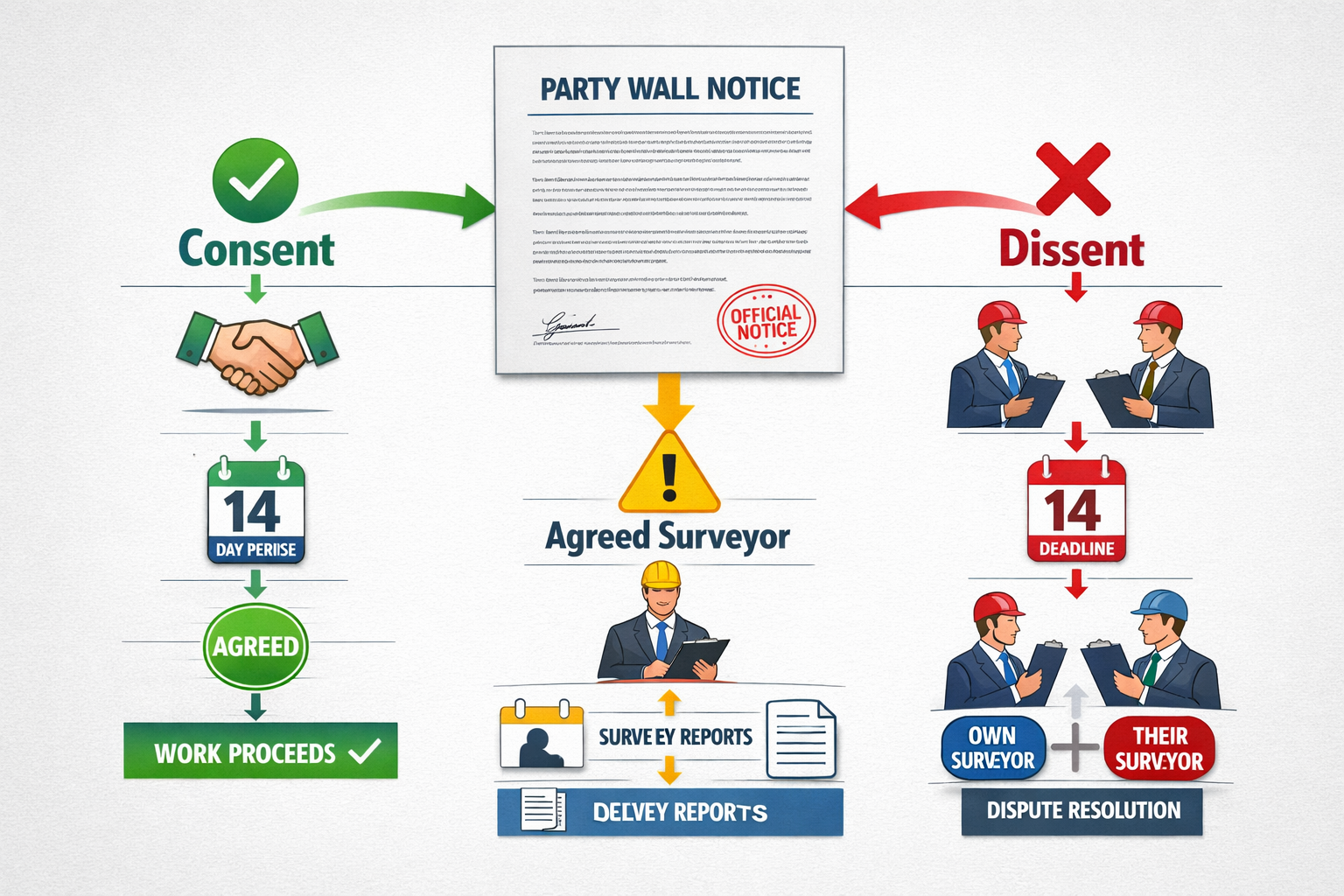
When you receive a valid Party Wall Notice, you face a critical decision within 14 days. Responding to Party Wall Notices as Adjoining Owner in 2026: Dissent Rights, Surveyor Appointment, and Award Negotiation Tactics begins with understanding these three distinct pathways, each carrying different implications for cost, control, and protection [1][2].
Pathway 1: Giving Written Consent
Consenting means you agree to the works as described in the notice without requiring formal surveyor involvement. This pathway offers the simplest and most cost-effective approach when:
✔️ The proposed works are minor and low-risk
✔️ You have complete trust in your neighbour’s approach
✔️ The construction poses minimal threat to your property
✔️ You want to maintain maximum goodwill
Critical misconception: Many adjoining owners incorrectly believe that consenting allows the neighbour to proceed without any protections. In reality, even when consenting, you should request a Schedule of Condition—a documented record of your property’s pre-construction state [1][2]. This provides essential evidence if damage occurs during construction.
💡 Pro Tip: You can consent while still requesting specific conditions, such as working hour restrictions or access limitations. Document these conditions in writing when providing consent.
Pathway 2: Dissenting and Appointing Separate Surveyors
Dissenting triggers the formal Party Wall Award process, where professional surveyors establish detailed safeguards and procedures. This pathway provides maximum protection when:
✔️ The proposed works are extensive or high-risk
✔️ Your property has existing vulnerabilities
✔️ You need enforceable access controls
✔️ Previous construction caused damage
✔️ The relationship with your neighbour is strained
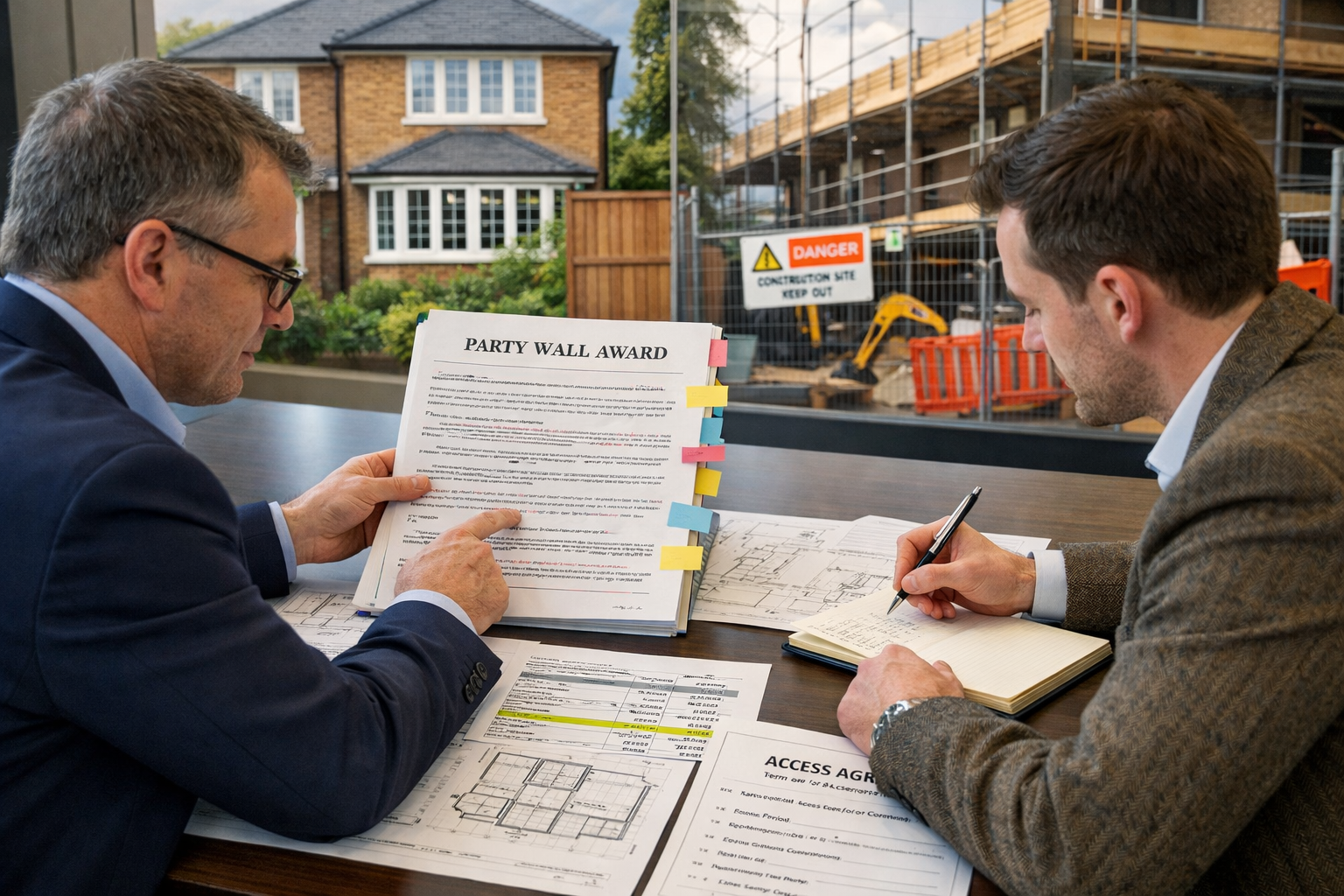
When you dissent, you appoint your own adjoining owner’s surveyor, while your neighbour appoints theirs. These two surveyors work together to produce a Party Wall Award—a legally binding document establishing:
📋 Detailed work descriptions and methodologies
📋 Working hours and access arrangements
📋 Vibration, dust, and noise controls
📋 Damage inspection and remedy procedures
📋 Insurance requirements
📋 Schedule of Condition documentation
Important clarification: Dissenting does not prevent or delay construction [4]. It simply ensures professional oversight and documented protections are in place before work begins. Your neighbour can still proceed with their project—but only within the parameters established by the Award.
Pathway 3: Agreeing to One Impartial Surveyor
The Agreed Surveyor model represents a middle ground where both parties jointly appoint a single impartial surveyor to act for both owners. This pathway works well when:
✔️ The works are straightforward with moderate risk
✔️ Both parties want cost efficiency
✔️ The relationship remains constructive
✔️ Neither party anticipates significant disputes
The Agreed Surveyor produces the same Party Wall Award with enforceable protections, but typically at lower cost since only one professional fee is involved [2]. However, this approach requires genuine agreement—if either party later feels uncomfortable, they can withdraw and appoint their own surveyor.
What Happens If You Don’t Respond
If you fail to provide written consent within 14 days, the statutory procedure automatically treats this as a dispute [2]. Your neighbour can then request that you appoint a surveyor. If you still fail to respond or appoint a surveyor after being requested, one can be appointed on your behalf under the Act’s procedure—potentially without your input on selection.
This automatic escalation underscores why understanding how to respond to Party Wall Act notices within the deadline is crucial for maintaining control over the process.
Strategic Surveyor Selection: Maximizing Your Protection
Choosing the right surveyor represents one of your most important decisions when dissenting. Unlike consenting, where you forgo professional representation, strategic surveyor selection in Responding to Party Wall Notices as Adjoining Owner in 2026: Dissent Rights, Surveyor Appointment, and Award Negotiation Tactics directly impacts the quality of protections you receive.
Key Qualifications to Seek
Look for surveyors with:
🎓 Chartered status: RICS (Royal Institution of Chartered Surveyors) membership demonstrates professional standards and accountability
🎓 Specialist experience: Party wall work requires specific expertise beyond general surveying—ask about their caseload of Party Wall Awards
🎓 Local knowledge: Familiarity with construction practices and property types in your area (such as South London, West London, or Central London) provides valuable context
🎓 Professional indemnity insurance: Protects you if surveyor negligence results in inadequate protections
Questions to Ask Potential Surveyors
Before appointing a surveyor, conduct brief consultations asking:
❓ How many Party Wall Awards have you produced in the past year?
❓ What is your typical timeline from appointment to Award completion?
❓ How do you handle disputes between surveyors during the Award process?
❓ What is your fee structure, and who pays your costs?
❓ Can you provide references from recent adjoining owner clients?
Understanding Fee Arrangements
Under the Party Wall Act, the building owner typically pays all reasonable surveyor fees—both their own surveyor’s costs and yours [2]. This means you can appoint professional representation without direct cost in most circumstances.
However, exceptions exist:
⚠️ If you request amendments to the works that benefit your property, you may need to contribute financially
⚠️ If you act unreasonably or cause unnecessary delays, you might be liable for additional costs
⚠️ If disputes escalate to requiring a Third Surveyor, additional fees may be apportioned
Understanding these fee dynamics allows you to engage professional representation confidently while avoiding cost liability.
The Third Surveyor Safety Net
When the two appointed surveyors cannot agree on specific Award terms, they jointly appoint a Third Surveyor to resolve the dispute [6]. This independent professional makes binding decisions on contested issues, ensuring the process moves forward even when disagreements arise.
The Third Surveyor mechanism provides reassurance that your interests remain protected even if your neighbour’s surveyor proves difficult or unreasonable.
Negotiating Favorable Party Wall Award Terms
Once surveyors are appointed, the Award negotiation phase begins. This represents your opportunity to secure specific protections tailored to your property’s vulnerabilities and your personal concerns. Responding to Party Wall Notices as Adjoining Owner in 2026: Dissent Rights, Surveyor Appointment, and Award Negotiation Tactics includes understanding which terms are negotiable and which represent standard practice.
Essential Protections to Negotiate
Work with your surveyor to ensure the Party Wall Award includes:
1. Comprehensive Schedule of Condition
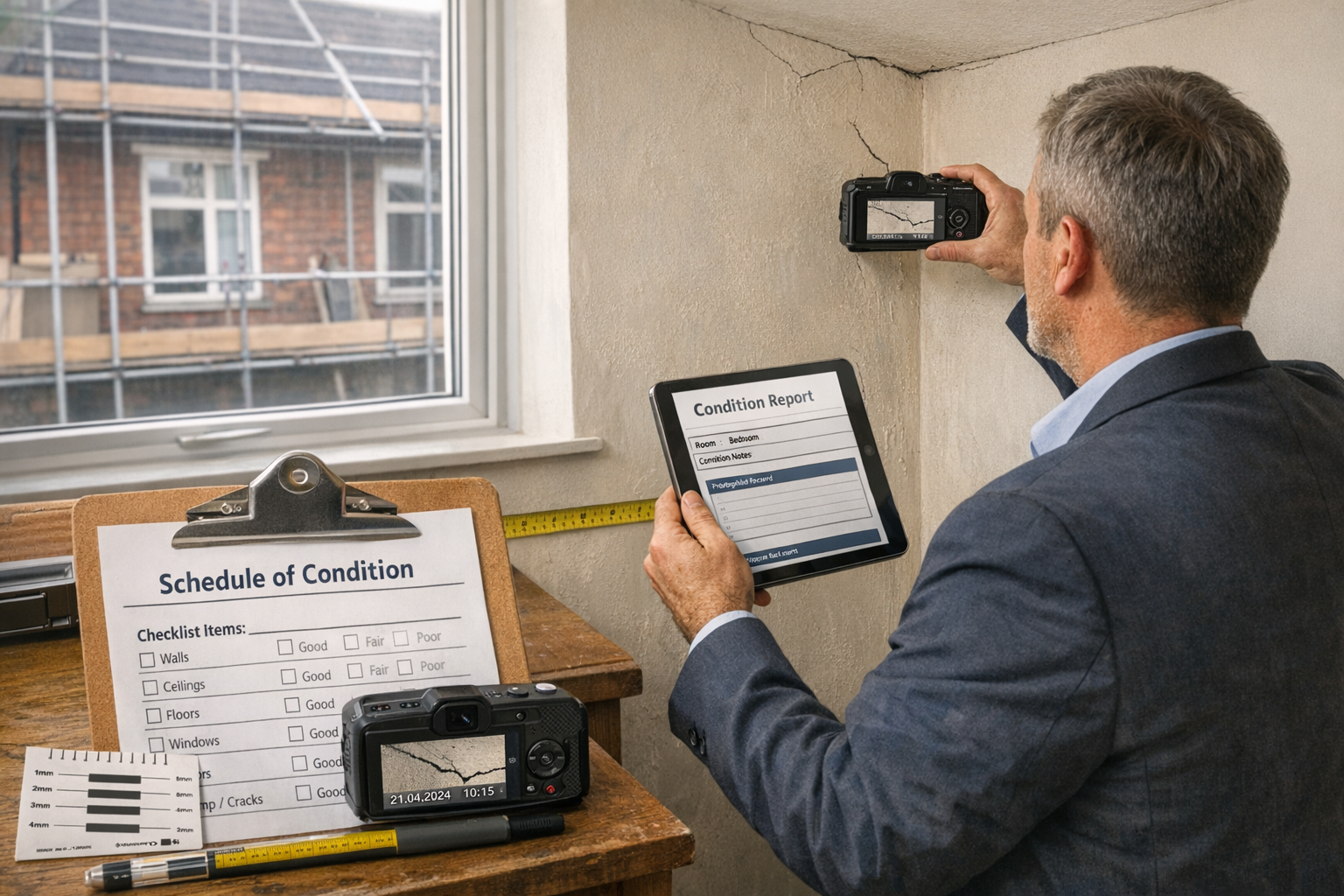
The Schedule of Condition represents your most important protection [1][2]. This detailed documentation should include:
📸 Extensive photographs of all rooms, focusing on walls, ceilings, and floors adjacent to the construction
📸 Written descriptions of existing cracks, settlement, or defects
📸 Measurements of significant cracks using crack width gauges
📸 External photographs of facades, rooflines, and boundary features
📸 Video walkthroughs providing additional context
Request that your surveyor conducts this inspection thoroughly, as it establishes the baseline for any future damage claims. Even minor pre-existing cracks should be documented, as construction vibration can exacerbate these issues.
2. Working Hours and Days
Standard construction hours in residential areas typically run Monday to Friday, 8:00 AM to 6:00 PM, with limited Saturday hours (8:00 AM to 1:00 PM) and no Sunday or bank holiday work [5]. However, you can negotiate more restrictive hours if:
🏠 You work from home and need quiet periods
🏠 You have young children with specific nap schedules
🏠 You have health conditions affected by noise
🏠 The construction involves particularly disruptive methods
Document your specific requirements clearly so your surveyor can advocate for appropriate restrictions.
3. Access Rights and Limitations
If the building owner requires access to your property—whether for scaffolding, material delivery, or construction access—the Award should specify [4]:
✅ Exact areas where access is permitted
✅ Days and times when access may occur
✅ Advance notice requirements (typically 7-14 days)
✅ Supervision requirements (whether you must be present)
✅ Liability for damage caused during access
✅ Restoration requirements for gardens, paving, or fences
You cannot prevent access entirely if it’s reasonably necessary for the works, but you can ensure access occurs under controlled, documented conditions [4].
4. Damage Procedures and Remedies
The Award should establish clear procedures if damage occurs:
🔧 Immediate notification requirements: Building owner must inform you and surveyors within 24-48 hours
🔧 Inspection protocols: Your surveyor inspects damage and compares against Schedule of Condition
🔧 Repair standards: Damage must be repaired to match pre-existing condition, not merely “made good”
🔧 Timeline for repairs: Specific deadlines for completing remedial work
🔧 Dispute resolution: Process if you disagree with proposed repairs
5. Vibration and Movement Monitoring
For extensive excavation or structural work, request vibration monitoring equipment installation [6]. This provides objective data about ground movement and vibration levels, supporting any future damage claims with scientific evidence.
Requesting Amendments to Proposed Works
As an adjoining owner, you have the legal right to request amendments to your neighbour’s proposals [1]. However, this right comes with financial caveats:
💷 If the amendment benefits your property, you must contribute financially to the additional cost
💷 If the amendment provides mutual benefit, costs may be shared proportionally
💷 If the amendment only protects your property from damage that would otherwise occur, the building owner typically bears the cost
Common amendment requests include:
- Strengthening works to party walls before construction begins
- Additional underpinning to protect your foundations
- Upgraded damp-proofing at shared wall junctions
- Improved sound insulation during reconstruction
Your surveyor can advise whether proposed amendments comply with the Party Wall Act and represent reasonable requests.
Counter-Notice for Additional Works
You may issue a counter-notice requesting that additional works be carried out simultaneously—such as repairs to the shared wall that benefit your property [7]. This allows you to take advantage of access and scaffolding already in place, but you would pay for works benefiting only your side.
Counter-notices must be served within specific timeframes (typically within 1 month of receiving the original notice), so discuss this option with your surveyor early in the process.
Protecting Your Rights During Construction
Once the Party Wall Award is agreed and construction begins, your role shifts from negotiation to monitoring and enforcement. The Award provides legally enforceable protections, but only if you actively ensure compliance.
Regular Monitoring and Documentation
Throughout construction:
📱 Photograph any new cracks or damage immediately and notify your surveyor
📱 Keep a construction diary noting dates, times, and types of work occurring
📱 Document any Award violations such as work outside permitted hours or unauthorized access
📱 Maintain communication records with your neighbour and surveyors
This documentation supports enforcement actions if the building owner breaches Award terms.
When to Involve Your Surveyor
Contact your surveyor immediately if:
⚠️ You notice new cracks, movement, or structural concerns
⚠️ The building owner works outside permitted hours
⚠️ Access occurs without proper notice or authorization
⚠️ The construction methodology differs from what was described
⚠️ You have concerns about safety or dust control
Your surveyor can inspect, document issues, and communicate with the building owner’s surveyor to resolve problems quickly.
Enforcement Options for Award Breaches
If the building owner breaches Party Wall Award terms, enforcement options include [6]:
🔨 Formal notice from surveyors requiring compliance
🔨 Injunction applications to stop work until compliance is achieved
🔨 Damages claims for losses caused by breaches
🔨 Cost recovery for additional surveyor fees necessitated by breaches
The Party Wall Award carries legal weight, making enforcement more straightforward than informal neighbour agreements.
Cost Considerations and Fee Management
Understanding the financial aspects of Responding to Party Wall Notices as Adjoining Owner in 2026: Dissent Rights, Surveyor Appointment, and Award Negotiation Tactics helps you make informed decisions about which response pathway suits your circumstances.
Typical Surveyor Fee Ranges
Party wall surveyor fees vary based on work complexity and property location [14]:
| Work Complexity | Typical Fee Range |
|---|---|
| Simple boundary wall | £500-£800 per surveyor |
| Standard extension | £800-£1,500 per surveyor |
| Complex excavation/basement | £1,500-£3,000+ per surveyor |
| Disputed or contentious cases | £2,000-£5,000+ per surveyor |
Remember, the building owner typically pays both surveyors’ fees, so these costs don’t usually fall on you as adjoining owner [2].
When You Might Face Costs
You may be liable for surveyor fees if:
❌ You request amendments benefiting only your property
❌ You act unreasonably or cause unnecessary delays
❌ You initiate disputes that surveyors deem frivolous
❌ You refuse reasonable access, necessitating legal action
Working cooperatively with your surveyor and responding promptly to requests minimizes any cost liability risk.
Strategies to Keep Costs Down
If you’re concerned about potential costs, consider:
💡 Agreeing to an Agreed Surveyor for straightforward works (typically 30-40% cheaper than separate surveyors)
💡 Responding promptly to surveyor requests to avoid delays
💡 Being reasonable about access and working hours
💡 Focusing negotiations on essential protections rather than minor preferences
For more detailed strategies, review guidance on how to keep party wall costs down.
Common Mistakes Adjoining Owners Make
Learning from others’ errors helps you avoid costly missteps when responding to Party Wall Notices:
Mistake 1: Ignoring the Notice
Failing to respond within 14 days triggers automatic dispute procedures and may result in a surveyor being appointed without your input [2]. Even if you intend to consent, provide written confirmation within the deadline.
Mistake 2: Believing Dissent Stops Construction
Many adjoining owners dissent hoping to prevent or delay their neighbour’s project [4]. In reality, dissent simply ensures professional oversight—it does not grant you veto power over permitted development.
Mistake 3: Consenting Without Requesting Schedule of Condition
Even when consenting to low-risk works, always request a Schedule of Condition [1]. This costs nothing (the building owner pays) and provides essential protection if unexpected damage occurs.
Mistake 4: Appointing Unqualified Surveyors
Some adjoining owners appoint general surveyors or builders without specific Party Wall Act expertise. This can result in inadequate Award terms and missed protection opportunities.
Mistake 5: Failing to Monitor Compliance
Once the Award is agreed, some adjoining owners assume everything will proceed smoothly. Active monitoring ensures breaches are caught and addressed promptly, before minor issues become major damage.
Special Circumstances and Complex Scenarios
Certain situations require adapted approaches to Responding to Party Wall Notices as Adjoining Owner in 2026: Dissent Rights, Surveyor Appointment, and Award Negotiation Tactics:
Multiple Adjoining Owners
When construction affects several properties, each adjoining owner can make independent decisions about consent or dissent. You’re not bound by your neighbours’ choices—assess the risks to your specific property and respond accordingly.
Leasehold Properties
If you’re a leaseholder, check your lease terms regarding Party Wall matters. Some leases require landlord involvement or approval for surveyor appointments. Coordinate with your freeholder to ensure proper representation.
Commercial Properties
Party Wall Act procedures apply equally to commercial properties, but working hour negotiations may differ. Commercial properties may accept longer working hours or weekend work more readily than residential owners.
When Your Neighbour Ignores the Act
If your neighbour begins work without serving proper notice, you have several options [9]:
🚫 Request immediate cessation of work until proper procedures are followed
🚫 Serve notice on the building owner requiring compliance
🚫 Apply for an injunction to stop unauthorized work
🚫 Claim damages for any harm caused by non-compliance
Seeking professional advice quickly is essential when dealing with non-compliant neighbours.
Conclusion
Responding to Party Wall Notices as Adjoining Owner in 2026: Dissent Rights, Surveyor Appointment, and Award Negotiation Tactics empowers you to protect your property interests while maintaining constructive relationships with neighbours undertaking legitimate construction projects. The key lies in understanding your three response pathways, the 14-day deadline’s critical importance, and the negotiation leverage available throughout the Award process.
Remember these essential principles:
✅ Respond within 14 days to maintain control over surveyor selection and process direction
✅ Dissenting provides protection, not prevention—it ensures professional oversight and documented safeguards
✅ Schedule of Condition is non-negotiable—request this documentation regardless of which pathway you choose
✅ The building owner typically pays surveyor fees—don’t let cost concerns prevent you from securing proper representation
✅ Party Wall Awards are legally enforceable—negotiated protections carry real weight if breaches occur
Your Next Steps
If you’ve received a Party Wall Notice:
- Review the notice carefully to understand the proposed works and notice period
- Assess the risk level to your property based on work scope and your property’s condition
- Decide your response pathway within the 14-day deadline
- Appoint a qualified surveyor if dissenting, prioritizing Party Wall Act specialists
- Request a comprehensive Schedule of Condition regardless of your response
- Engage actively in Award negotiations to secure tailored protections
- Monitor construction compliance and document any concerns immediately
For professional guidance tailored to your specific circumstances, consider consulting experienced party wall surveyors who can assess your property’s vulnerabilities and advocate for appropriate protections throughout the process.
The Party Wall Act exists to balance building owners’ development rights with adjoining owners’ protection needs. By understanding your rights, meeting critical deadlines, and engaging strategically with the process, you can ensure your property receives comprehensive safeguards while your neighbour proceeds with their legitimate construction project.
References
[1] Party%20wall%20notice%20response%20options – designingbuildings.co.uk
[2] Adjoining Owner Party Wall Info – houricanassociates.com
[3] Adjoining Owner Rights A Complete Guide To Handling Your Neighbours Building Work – adamjoseph.co.uk
[4] Watch – youtube.com
[5] Party Wall Agreement – hoa.org.uk
[6] Resolving Party Wall Disputes A Complete Guide For Property Owners – https://nottinghillsurveyors.com/blog/resolving-party-wall-disputes-a-complete-guide-for-property-owners
[7] Party Wall Agreements What You Need To Know – fmb.org.uk
[9] What To Do When Your Neighbour Ignores The Party Wall Act – peterbarry.co.uk
Speak to a RICS chartered party wall surveyor
Free initial consultation. Notices, awards and schedules of condition across London and nationwide.