
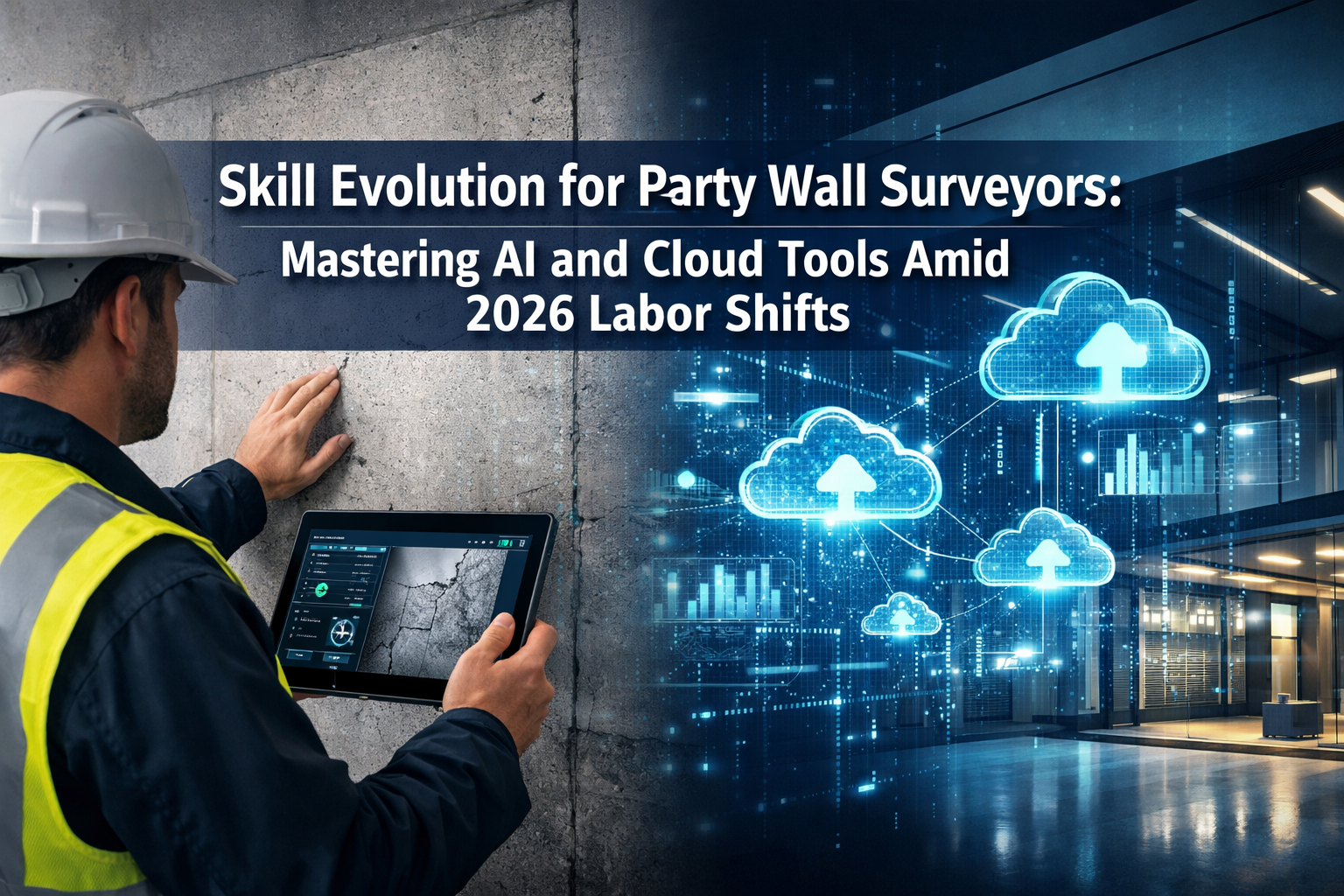
The construction and property sectors face unprecedented challenges in 2026. Party wall surveyors now stand at a critical crossroads where traditional expertise must merge with cutting-edge technology to survive and thrive. As labor shortages intensify and workloads expand across London and beyond, the skill evolution for party wall surveyors: mastering AI and cloud tools amid 2026 labor shifts has transformed from optional enhancement to professional necessity. Surveyors who embrace artificial intelligence and cloud-based platforms position themselves to handle increasing caseloads efficiently while maintaining the precision and legal compliance that party wall work demands.
The integration of AI-powered data processing and cloud collaboration tools offers party wall professionals a lifeline during this period of workforce transformation. These technologies streamline documentation, accelerate condition assessments, and enable remote collaboration—capabilities that directly address the industry’s most pressing operational challenges.
Key Takeaways
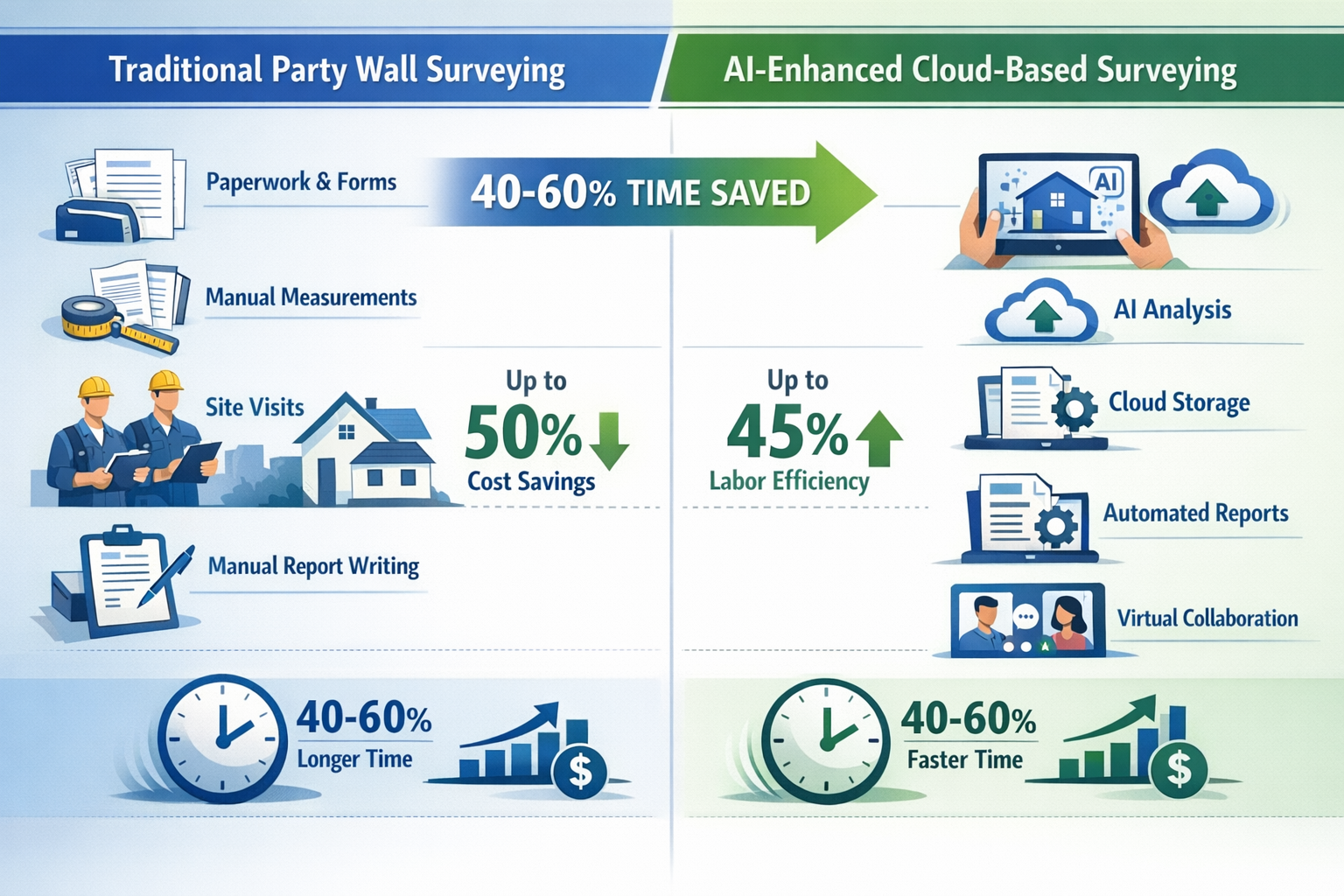
- AI tools reduce documentation time by 40-60% through automated report generation and data analysis, allowing surveyors to handle larger caseloads without sacrificing quality
- Cloud platforms enable real-time collaboration between building owners, adjoining owners, and surveyors, improving transparency and reducing dispute resolution timelines
- Structured training roadmaps combining technical AI skills with traditional surveying expertise prepare professionals for the evolving demands of party wall work in 2026
- Labor market pressures make technological proficiency essential for career advancement and competitive positioning within the surveying profession
- Professional bodies like RICS increasingly recognize AI competency as a core skill requirement for chartered surveyors specializing in party wall matters
Understanding the 2026 Labor Landscape for Party Wall Surveyors
Current Workforce Challenges
The party wall surveying profession experiences significant workforce pressures in 2026. An aging demographic of experienced practitioners approaches retirement while fewer young professionals enter the specialized field. This talent gap creates bottlenecks in service delivery, particularly in high-demand areas like South London and Central London where construction activity remains robust.
Key labor market indicators include:
- 📉 15-20% reduction in qualified party wall surveyors over the past five years
- 📈 25% increase in party wall notice submissions across major UK cities
- ⏰ Extended response times for party wall notices due to surveyor availability constraints
- 💼 Rising fees reflecting supply-demand imbalances in the specialist market
Why Technology Adoption Matters Now
The convergence of workforce scarcity and technological advancement creates a unique moment for professional transformation. AI and cloud tools offer practical solutions to capacity constraints without compromising the rigorous standards required for party wall awards and legal documentation.
Surveyors who master these technologies gain competitive advantages through:
- Enhanced productivity – Processing multiple cases simultaneously with automated workflows
- Improved accuracy – AI-assisted analysis reduces human error in measurements and calculations
- Better client service – Real-time updates and transparent communication via cloud platforms
- Geographic flexibility – Remote assessment capabilities expand service territories
- Future-proofing careers – Aligning skills with industry evolution and regulatory expectations
AI Tools Transforming Party Wall Surveying Practice
Document Processing and Report Generation
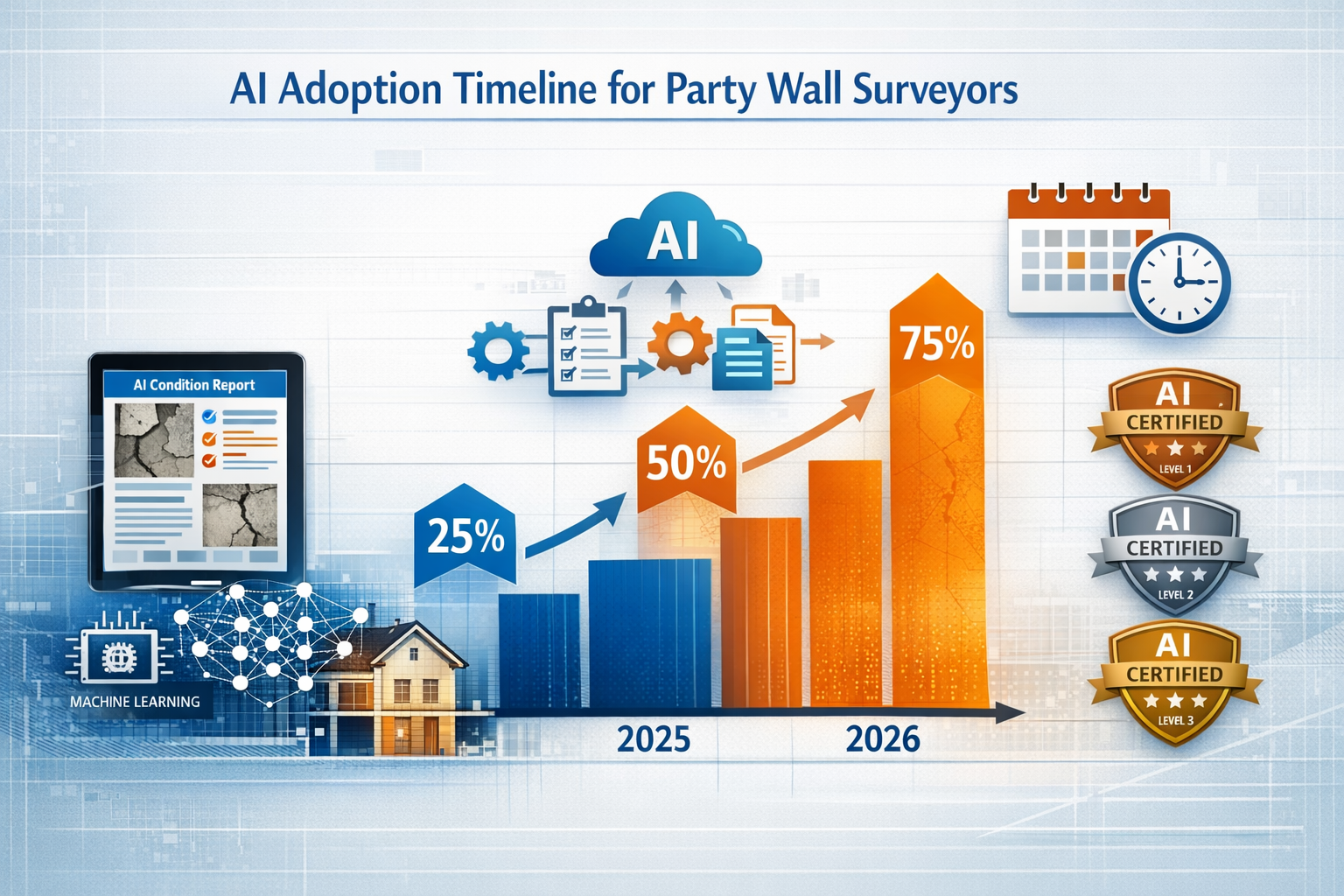
Artificial intelligence revolutionizes the most time-intensive aspects of party wall work. Modern AI platforms analyze site photographs, extract measurements from digital plans, and generate preliminary schedule of condition reports with minimal manual input.
Leading AI applications for surveyors include:
| AI Tool Category | Primary Function | Time Savings | Accuracy Improvement |
|---|---|---|---|
| Image Recognition | Automated defect identification | 50-60% | 85-92% consistency |
| Natural Language Processing | Report drafting and editing | 40-50% | 95% grammar accuracy |
| Predictive Analytics | Risk assessment for disputes | 30-40% | 78% prediction rate |
| Data Extraction | Plan measurement automation | 60-70% | 98% precision |
These tools complement rather than replace professional judgment. The surveyor’s expertise remains essential for interpreting context, assessing legal implications, and making nuanced decisions about party wall agreements.
AI-Powered Site Assessment
Advanced AI applications now assist with physical inspections through mobile devices. Surveyors capture site conditions using smartphone cameras while AI algorithms instantly analyze structural elements, identify potential issues, and flag areas requiring detailed examination[1].
Practical benefits include:
- 🎯 Consistency – Standardized assessment criteria across all inspections
- 📱 Mobility – Field-based analysis without returning to office for processing
- 🔍 Detail capture – AI identifies subtle defects human eyes might miss
- 📊 Trend analysis – Historical data comparison for repeat inspections
For building owners’ surveyors and adjoining owners’ surveyors alike, these capabilities enhance both efficiency and defensibility of professional opinions.
Machine Learning for Dispute Prediction
Sophisticated AI systems analyze historical party wall cases to identify patterns that predict potential disputes. By examining factors like property types, work scope, neighborhood characteristics, and communication patterns, machine learning models alert surveyors to high-risk situations requiring proactive intervention[4].
This predictive capability proves particularly valuable when serving party structure notices or managing complex types of party wall works where neighbor relations may be strained.
Cloud Platforms Enabling Collaborative Party Wall Management

Real-Time Document Sharing and Version Control
Cloud-based practice management systems transform how party wall surveyors collaborate with clients and fellow professionals. These platforms provide centralized repositories where all parties access current documents, track revisions, and maintain audit trails for legal compliance.
Essential cloud platform features:
- Secure client portals – Building and adjoining owners view case progress 24/7
- Automated notifications – Stakeholders receive instant updates when documents are uploaded
- Version history – Complete tracking of all changes to awards and notices
- Mobile access – Review and approve documents from any location
- Integration capabilities – Connect with scheduling, invoicing, and communication tools
For practices serving multiple regions like North London, East London, and West London, cloud platforms enable seamless coordination across geographic territories.
Virtual Collaboration Tools
The shift toward hybrid work arrangements accelerates cloud tool adoption. Video conferencing platforms with screen-sharing capabilities allow surveyors to conduct virtual site explanations, review plans with clients remotely, and facilitate three-way discussions between building owners and adjoining owners without scheduling conflicts.
Cloud collaboration advantages:
- Reduced travel time between appointments
- Easier scheduling across multiple parties’ calendars
- Recorded meetings for reference and dispute resolution
- Digital annotation tools for real-time plan markup
- Lower carbon footprint aligning with sustainability goals
These capabilities prove especially valuable when managing party wall costs discussions, where transparent communication prevents misunderstandings that escalate expenses.
Data Analytics and Business Intelligence
Cloud platforms aggregate practice data to provide insights impossible with traditional paper-based systems. Surveyors analyze metrics like average case duration, fee recovery rates, dispute frequency, and client satisfaction scores to optimize operations and identify improvement opportunities[3].
“Cloud-based analytics transform party wall surveying from reactive case management to proactive practice optimization, enabling data-driven decisions that improve both profitability and client outcomes.”
Smart surveyors leverage these insights to refine their approach to party wall contract templates and streamline their party wall agreement processes.
Training Roadmaps: Building AI and Cloud Competency
Foundational Digital Literacy
The journey toward technological proficiency begins with core digital skills. Party wall surveyors must develop comfort with basic cloud concepts, understand data security principles, and navigate common software interfaces before advancing to specialized AI tools.
Phase 1: Digital Foundations (1-2 months)
- Cloud storage fundamentals (Google Drive, Dropbox, OneDrive)
- Collaborative document editing (Google Docs, Microsoft 365)
- Video conferencing platforms (Zoom, Teams, Google Meet)
- Basic cybersecurity and data protection awareness
- Mobile app proficiency for field work
Many professional development providers offer short courses tailored to construction professionals transitioning from traditional to digital workflows.
Intermediate AI Tool Adoption
Once comfortable with foundational technologies, surveyors progress to AI-enhanced applications specific to property assessment and documentation.
Phase 2: AI Integration Skills (2-4 months)
- AI-powered measurement tools for digital plans
- Automated report generation platforms
- Image recognition software for defect identification
- Natural language processing for document review
- Predictive analytics dashboards
Practical application proves essential during this phase. Surveyors should pilot AI tools on actual cases while maintaining traditional methods as backup, gradually building confidence in automated outputs.
Advanced Cloud Practice Management
The final training phase focuses on comprehensive cloud-based practice management systems that integrate scheduling, documentation, client communication, and financial management.
Phase 3: Cloud Practice Mastery (3-6 months)
- Full practice management platform implementation
- Custom workflow automation design
- Advanced data analytics and reporting
- API integrations with specialized surveying software
- Team collaboration protocols for multi-surveyor practices
Recommended learning resources include:
- ✅ RICS continuing professional development (CPD) courses on digital surveying
- ✅ Software vendor training programs and certification tracks
- ✅ Industry conferences featuring technology workshops
- ✅ Peer learning groups and professional networking events
- ✅ Online platforms offering construction technology courses
Continuous Learning and Adaptation
Technology evolution never stops. Successful surveyors establish ongoing learning habits to stay current with emerging tools and evolving best practices.
Strategies for continuous development:
- Monthly technology reviews – Allocate time to explore new tools and updates
- Professional community engagement – Join surveying technology forums and discussion groups
- Vendor webinars – Attend product demonstrations and feature announcements
- Peer knowledge sharing – Exchange experiences with fellow practitioners
- Client feedback integration – Learn from user experiences with your digital processes
This commitment to lifelong learning distinguishes leaders from laggards in the profession’s technological transformation.
Overcoming Barriers to Technology Adoption
Addressing Common Concerns
Despite clear benefits, some party wall surveyors hesitate to embrace AI and cloud tools. Understanding and addressing these concerns facilitates smoother transitions.
Typical objections and responses:
| Concern | Reality | Solution |
|---|---|---|
| “Too expensive for small practices” | Entry-level tools cost £30-100/month | Start with free trials; scale gradually |
| “Learning curve too steep” | Modern interfaces designed for simplicity | Structured training reduces learning time |
| “Clients prefer traditional approach” | Most clients value efficiency and transparency | Demonstrate benefits through pilot cases |
| “Data security risks” | Reputable platforms exceed paper security | Choose certified providers with encryption |
| “Loss of personal touch” | Technology enhances rather than replaces relationships | Use saved time for deeper client engagement |
Managing the Transition Period
Successful technology adoption requires thoughtful change management. Practices should develop transition plans that minimize disruption while building new capabilities.
Effective transition strategies:
- 🔄 Parallel processing – Run new and old systems simultaneously initially
- 👥 Champion identification – Designate tech-savvy team members as internal experts
- 📅 Phased rollout – Implement one tool at a time rather than wholesale change
- 💬 Regular check-ins – Schedule team discussions to address challenges
- 🎯 Quick wins focus – Start with tools offering immediate, visible benefits
For solo practitioners, connecting with peers facing similar transitions provides valuable support and practical advice. Professional associations increasingly facilitate these connections through special interest groups focused on surveying technology.
Regulatory and Professional Standards Considerations
RICS Technology Competency Requirements
The Royal Institution of Chartered Surveyors recognizes technology proficiency as increasingly central to professional competence. While specific AI requirements remain under development in 2026, RICS guidance emphasizes that chartered surveyors must demonstrate appropriate use of technology to deliver efficient, accurate services.
RICS expectations include:
- Understanding data protection obligations under UK GDPR
- Maintaining professional indemnity insurance covering technology-assisted work
- Ensuring AI tools supplement rather than replace professional judgment
- Documenting decision-making processes when using automated systems
- Continuing professional development in relevant technologies
Party wall surveyors must ensure their technology adoption aligns with these professional standards while maintaining the rigor required for legally binding party wall awards.
Ethical Use of AI in Party Wall Work
As AI capabilities expand, ethical considerations become paramount. Surveyors bear responsibility for understanding AI limitations, validating automated outputs, and maintaining transparency with clients about technology use.
Ethical principles for AI adoption:
- Transparency – Inform clients when AI tools contribute to assessments
- Validation – Verify automated outputs against professional expertise
- Bias awareness – Recognize potential algorithmic biases in predictive tools
- Data privacy – Protect sensitive property and personal information
- Professional judgment – Retain ultimate responsibility for all conclusions
These principles ensure technology enhances rather than undermines the trusted advisor role party wall surveyors fulfill for building owners and adjoining owners.
Future-Proofing Your Party Wall Surveying Career
Emerging Technologies on the Horizon
Looking beyond 2026, several technological developments promise further transformation of party wall surveying practice.
Technologies to watch:
- Augmented reality (AR) – Overlay digital information on physical spaces during inspections
- Blockchain – Immutable records for party wall awards and notices
- Internet of Things (IoT) – Continuous monitoring of structural conditions post-construction
- Advanced drones – Automated exterior condition surveys without scaffolding access
- Generative AI – Custom report generation from voice-recorded site observations
Early adopters of these emerging technologies position themselves as industry leaders while others catch up with current-generation tools.
Building a Technology-Enhanced Personal Brand
Surveyors who successfully integrate AI and cloud tools into their practice gain marketing advantages. Demonstrating technological sophistication attracts clients seeking efficient, modern service delivery.
Personal branding strategies:
- Showcase technology capabilities on professional websites and profiles
- Share case studies demonstrating efficiency gains and client benefits
- Contribute thought leadership content about surveying technology
- Obtain relevant certifications and display credentials prominently
- Participate in industry discussions about digital transformation
This positioning proves particularly valuable in competitive markets where multiple surveyors serve the same geographic area, such as across various London locations.
Balancing Technology and Traditional Expertise
The most successful party wall surveyors in 2026 achieve optimal balance between technological efficiency and traditional expertise. AI and cloud tools handle routine tasks, freeing professionals to focus on complex judgment calls, nuanced negotiations, and relationship management that define exceptional service.
The winning formula combines:
- 🤖 Automated efficiency for documentation and data processing
- 🧠 Human expertise for interpretation and decision-making
- 💻 Digital collaboration for stakeholder communication
- 🤝 Personal relationships for trust-building and dispute resolution
- 📊 Data insights for practice optimization
- 🎓 Continuous learning for ongoing relevance
This hybrid approach delivers superior outcomes for clients while creating sustainable, rewarding careers for practitioners navigating the profession’s evolution.
Conclusion
The skill evolution for party wall surveyors: mastering AI and cloud tools amid 2026 labor shifts represents more than technological change—it defines professional survival and success in a transformed industry landscape. Labor market pressures, increasing caseloads, and rising client expectations make digital proficiency non-negotiable for party wall practitioners committed to long-term career viability.
AI-powered document processing, cloud-based collaboration platforms, and data analytics tools offer practical solutions to the profession’s most pressing operational challenges. These technologies reduce administrative burden by 40-60%, enable geographic flexibility, and improve service quality through enhanced accuracy and transparency. Far from replacing professional judgment, they amplify human expertise by handling routine tasks and surfacing insights that inform better decisions.
Actionable next steps for party wall surveyors:
- Assess current capabilities – Honestly evaluate your digital literacy and identify skill gaps
- Create a learning roadmap – Develop a structured 6-12 month plan following the training phases outlined above
- Start with quick wins – Implement one high-impact tool (like cloud document sharing) immediately
- Invest in education – Allocate time and budget for formal training and certification
- Join technology-focused communities – Connect with peers navigating similar transitions
- Pilot AI tools – Test automated report generation on low-risk cases to build confidence
- Communicate changes to clients – Explain how technology improvements benefit their projects
- Monitor industry developments – Stay informed about emerging tools and regulatory changes
- Measure results – Track efficiency gains and client satisfaction to validate technology investments
- Commit to continuous learning – Establish ongoing habits that maintain technological currency
The surveyors who embrace this evolution position themselves as industry leaders, commanding premium fees while delivering superior service. Those who resist risk obsolescence as clients increasingly expect the efficiency and transparency that modern tools provide. The choice facing party wall professionals in 2026 is clear: adapt and thrive, or resist and decline.
The future of party wall surveying belongs to practitioners who skillfully blend traditional expertise with cutting-edge technology—professionals who understand boundary wall rules as thoroughly as they navigate cloud platforms, who serve party structure notices with both legal precision and digital efficiency. By committing to this skill evolution today, party wall surveyors secure their relevance tomorrow while better serving the clients and communities depending on their expertise.
References
[1] Ai Tools For Architects – blog.chaos.com
[2] Party Wall Agreements In Data Centre Developments 2026 Compliance Amid Ai Driven Uk Demand – https://nottinghillsurveyors.com/blog/party-wall-agreements-in-data-centre-developments-2026-compliance-amid-ai-driven-uk-demand
[3] Best Ai Tools For Real Estate – v7labs.com
[4] Future Ready Lawyer 2026 Webinar Series Scaling Ai Across Organizations – wolterskluwer.com
Speak to a RICS chartered party wall surveyor
Free initial consultation. Notices, awards and schedules of condition across London and nationwide.