Section 10(13) of the Party Wall etc. Act 1996 establishes a clear principle: the building owner initiating construction work bears primary responsibility for all party wall surveyor fees. Yet in 2026, thousands of property owners across England and Wales continue to face unexpected bills, disputed charges, and confusion over who pays party wall surveyor fees, cost breakdown and recovery strategies under the 2026 Act. The reality extends far beyond this simple rule, with exceptions, negotiation opportunities, and cost-sharing scenarios that can significantly impact your project budget.
Understanding the financial responsibilities under the Party Wall Act isn’t just about compliance—it’s about protecting yourself from unnecessary expenses while maintaining good neighbour relations. Whether you’re planning a loft conversion, basement excavation, or structural work affecting a shared wall, knowing who pays party wall surveyor fees, cost breakdown and recovery strategies under the 2026 Act can save you thousands of pounds and prevent costly disputes.
Key Takeaways
- Building owners typically pay all surveyor fees (their own surveyor, the neighbour’s surveyor, and award preparation costs) under Section 10(13) of the Act [1]
- Total costs range from £600–£1,200 for agreed surveyors to £1,000–£2,000+ when separate surveyors are appointed [2]
- Adjoining owners usually pay nothing unless they request additional work or behave unreasonably during the process [4]
- Cost-sharing exceptions exist for defective shared walls (Section 11(4)) and when third surveyors rule in favour of building owners [4]
- Strategic negotiation and proper documentation can help building owners minimize expenses and maximize recovery opportunities
Understanding the Legal Framework: Who Pays Party Wall Surveyor Fees Under the 2026 Act
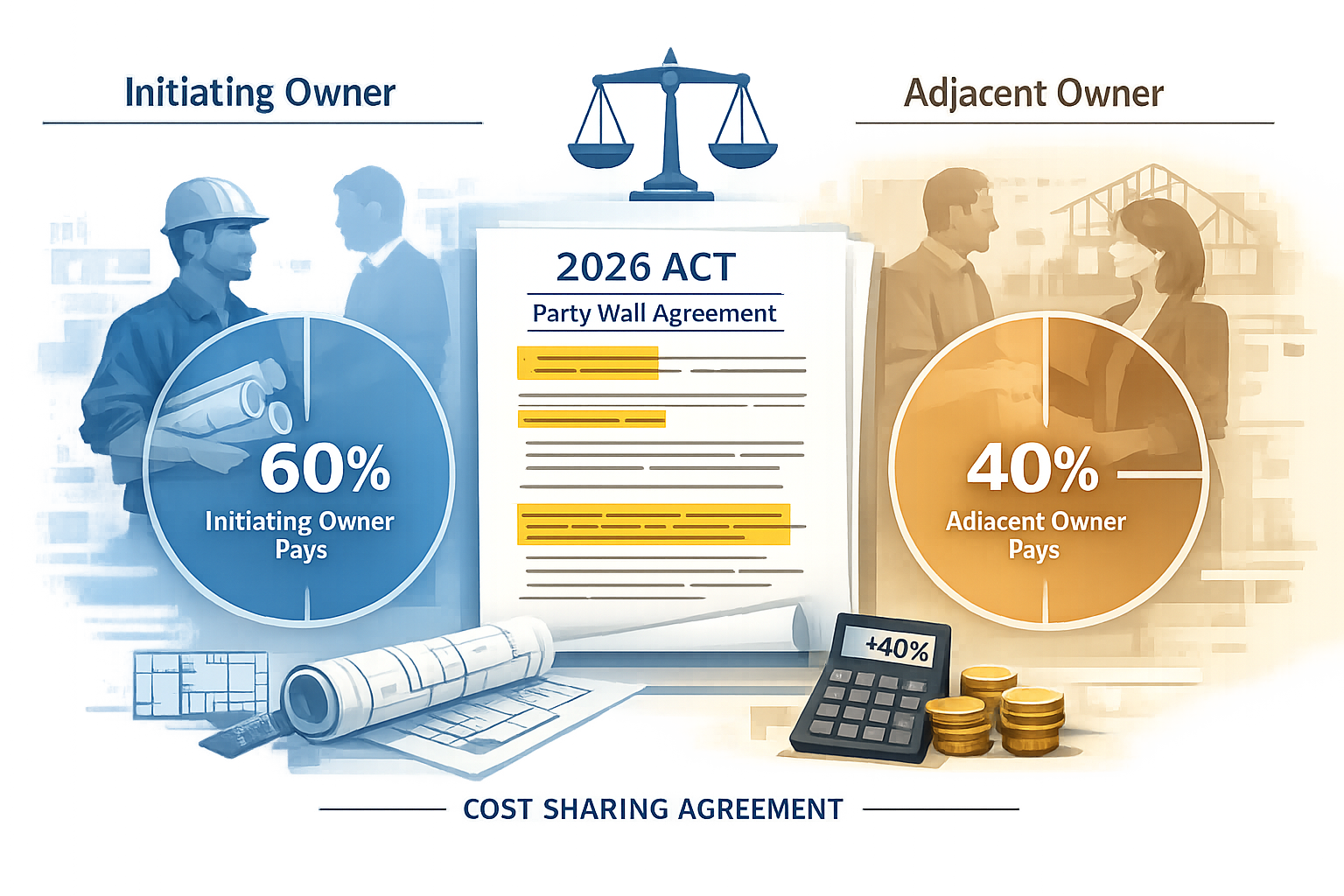
The Party Wall etc. Act 1996 remains the governing legislation in 2026, establishing clear financial responsibilities for party wall matters. Section 10(13) forms the cornerstone of fee allocation, stating that “the reasonable costs incurred in making or obtaining an award under this section shall be paid by the building owner” [1].
The Building Owner’s Primary Responsibility
When you initiate construction work requiring party wall procedures, you automatically assume financial responsibility for:
✅ Your own surveyor’s fees for preparing notices, conducting inspections, and drafting awards
✅ The adjoining owner’s surveyor fees for reviewing proposals and protecting their interests
✅ Award preparation costs including administrative expenses and documentation
✅ Third surveyor costs if disputes require independent arbitration [2]
This comprehensive responsibility exists regardless of whether your neighbour agrees to your proposed work. The Act’s intention is clear: property owners shouldn’t face financial burden for construction they didn’t initiate.
Why This Default Rule Exists
The legislation protects adjoining owners from being penalized for exercising their legal rights. Without this provision, neighbours might feel pressured to consent to potentially damaging work simply to avoid surveyor fees—undermining the Act’s protective purpose [1].
For building owners planning work across London, understanding these baseline responsibilities is crucial. Whether you need a party wall surveyor in South London or North London, the financial framework remains consistent.
Exceptions to the Standard Rule
While building owners bear primary responsibility, cost allocation can shift in specific circumstances:
🔄 Unreasonable behaviour: If either party acts unreasonably, costs may be reallocated [1]
🔄 Additional work requests: Adjoining owners requesting extra works beyond Act requirements must pay associated costs [4]
🔄 Defective shared structures: Section 11(4) allows proportionate cost-sharing when neither party caused wall defects [4]
🔄 Third surveyor decisions: When disputes escalate, the losing party may bear referral costs [2]
Understanding the costs of party wall processes helps building owners budget accurately from project inception.
Complete Cost Breakdown: What You’ll Actually Pay for Party Wall Surveyor Fees
Surveyor fees vary significantly based on work complexity, property location, and whether parties agree on a single surveyor or appoint separate representatives. In 2026, understanding who pays party wall surveyor fees, cost breakdown and recovery strategies under the 2026 Act requires examining each scenario’s financial implications.
Scenario 1: Agreed Surveyor (Single Surveyor) 💰
When both parties agree to appoint the same surveyor, costs remain relatively modest:
| Service Component | Typical Cost Range |
|---|---|
| Initial consultation & notice review | £150–£300 |
| Site inspection & schedule of condition | £200–£400 |
| Award preparation & documentation | £250–£500 |
| Total Agreed Surveyor Costs | £600–£1,200 |
The building owner pays this entire amount, but benefits from avoiding duplicate fees [2]. This represents the most cost-effective approach when neighbour relations are positive and work is straightforward.
Scenario 2: Two Separate Surveyors 💰💰
When the adjoining owner exercises their right to appoint their own surveyor, costs escalate:
| Service Component | Building Owner’s Surveyor | Adjoining Owner’s Surveyor |
|---|---|---|
| Initial work & notices | £300–£600 | £250–£500 |
| Inspections & assessments | £300–£500 | £300–£500 |
| Award negotiation & preparation | £400–£700 | £300–£600 |
| Subtotals | £1,000–£1,800 | £850–£1,600 |
Total cost to building owner: £1,850–£3,400 [2]
The building owner’s surveyor typically charges a fixed fee, while the adjoining owner’s surveyor usually applies hourly rates (£150–£250 per hour in 2026) [5]. This dual-surveyor scenario is standard practice and shouldn’t be viewed as adversarial—each surveyor protects their client’s interests professionally.
Scenario 3: Third Surveyor Referral 💰💰💰
When surveyors cannot reach agreement on specific matters, they appoint a third surveyor for independent determination:
- Third surveyor referral fees: £300–£600 per dispute [2]
- Additional surveyor time: £200–£400 (for both parties’ surveyors attending hearings)
- Total additional costs: £500–£1,000
Cost responsibility for third surveyor fees depends on the outcome. If the third surveyor rules in favour of the building owner, the adjoining owner may be required to contribute [4]. However, this remains the exception rather than the rule.
Regional Variations in Surveyor Fees
Geographic location significantly impacts costs in 2026:
📍 Central London: £1,500–£2,500+ for complex projects [3]
📍 Greater London suburbs: £1,000–£2,000 for standard work [3]
📍 Regional cities: £800–£1,500 for comparable projects [3]
📍 Rural areas: £600–£1,200 for straightforward matters [3]
If you’re working in specific areas, consulting specialists like a party wall surveyor in East London or West London provides accurate local cost estimates.
Hidden Costs and Additional Expenses
Beyond basic surveyor fees, building owners should budget for:
- Schedule of condition photography: £150–£300
- Structural engineer consultations: £300–£800 (if complex structural issues arise)
- Legal advice: £200–£500 per hour (if disputes escalate)
- Re-inspection fees: £100–£250 per visit (if work deviates from approved plans)
Understanding different types of party wall works helps anticipate which additional services your project may require.
Recovery Strategies: Minimizing Costs and Maximizing Reimbursement Opportunities
While building owners bear primary financial responsibility, strategic approaches can significantly reduce expenses and, in certain circumstances, enable cost recovery. Understanding who pays party wall surveyor fees, cost breakdown and recovery strategies under the 2026 Act empowers property owners to protect their financial interests.

Strategy 1: Negotiate for an Agreed Surveyor 🤝
Potential savings: 40–60% of total surveyor costs
The single most effective cost-reduction strategy involves convincing your neighbour to agree on one surveyor rather than appointing separate representatives. This approach:
- Eliminates duplicate inspection fees
- Reduces administrative overhead
- Streamlines the award process
- Maintains professional impartiality (the agreed surveyor must act fairly to both parties)
How to propose this effectively:
- Approach early: Discuss the agreed surveyor option before serving formal notices
- Emphasize mutual benefits: Faster process, reduced complexity, maintained professional standards
- Offer surveyor selection input: Allow your neighbour to review and approve the chosen surveyor
- Provide credentials: Share the surveyor’s qualifications, experience, and professional indemnity insurance details
Even when neighbours initially resist, demonstrating that an agreed surveyor remains legally obligated to protect their interests can alleviate concerns. For guidance on this approach, review information about having a party wall agreement without a surveyor.
Strategy 2: Request Detailed Fee Estimates Upfront 📋
Potential savings: 15–25% through competitive pricing
Before appointing surveyors, obtain detailed written quotations from multiple professionals:
Essential questions to ask:
- What’s included in your fixed fee versus hourly charges?
- How many site visits does your estimate cover?
- What triggers additional fees beyond the quoted amount?
- Do you charge for telephone consultations and email correspondence?
- What’s your policy on abortive fees if the neighbour consents without requiring an award?
Comparing quotes from three to five surveyors reveals significant price variations. However, don’t select solely on price—experience with similar projects and local knowledge prove equally valuable.
Strategy 3: Leverage Section 11(4) Cost-Sharing Provisions ⚖️
Potential recovery: 50% of costs in applicable situations
Section 11(4) of the Act provides for proportionate cost-sharing when:
- A party wall requires repair or reconstruction
- The defect wasn’t caused by either owner
- Both properties benefit from the work [4]
Example scenario: A 100-year-old shared wall shows structural deterioration from age rather than negligence. You propose underpinning to prevent collapse. Under Section 11(4), costs (including surveyor fees) may be divided proportionately based on the benefit each property receives.
To invoke this provision:
- Ensure your surveyor explicitly references Section 11(4) in the award
- Provide structural evidence demonstrating mutual benefit
- Document that neither party caused the defect
- Propose fair cost allocation based on property values or benefit received
This represents one of the few scenarios where adjoining owners contribute to surveyor fees, making it valuable for building owners facing necessary structural work on shared walls.
Strategy 4: Document Unreasonable Behaviour 📝
Potential recovery: Full cost reallocation in extreme cases
While rare, costs can be reallocated when parties behave unreasonably during the party wall process. Examples include:
❌ Adjoining owner unreasonable behaviour:
- Refusing access for necessary inspections without valid reason
- Making frivolous objections to delay the project
- Requesting excessive or unnecessary additional works
- Failing to respond to reasonable surveyor communications
❌ Building owner unreasonable behaviour:
- Proceeding with work before obtaining an award
- Refusing to provide required information to surveyors
- Ignoring award conditions or working hours restrictions
- Causing unnecessary damage beyond what the award permits
Documentation requirements:
- Maintain detailed records of all communications
- Photograph evidence of access refusals or non-compliance
- Obtain written confirmation from your surveyor regarding unreasonable conduct
- Keep copies of all notices, responses, and correspondence
Surveyors can recommend cost reallocation in the award when unreasonable behaviour is clearly evidenced [1]. This protection works both ways—building owners should also ensure their own conduct remains reasonable throughout.
Strategy 5: Minimize Surveyor Time Through Preparation 📊
Potential savings: 10–20% through efficiency
Since adjoining owner surveyors typically charge hourly rates, reducing the time they spend on your matter directly decreases costs:
Efficiency tactics:
✅ Provide comprehensive information with initial notices (detailed plans, structural calculations, methodology statements)
✅ Respond promptly to surveyor queries (delays extend billable hours)
✅ Schedule inspections efficiently (combine multiple site visits when possible)
✅ Ensure contractors understand award conditions (prevents non-compliance issues requiring additional surveyor involvement)
✅ Maintain open communication channels (reduces formal correspondence requirements)
For practical guidance, explore how to keep party wall costs down through strategic planning and preparation.
Strategy 6: Challenge Excessive or Unreasonable Fees 💷
Potential savings: Variable, but significant in cases of fee inflation
While building owners pay surveyor fees, those fees must be reasonable. Section 10(13) specifically references “reasonable costs” [1], providing grounds to challenge excessive charges.
Red flags indicating potentially unreasonable fees:
- Charges significantly exceeding market rates for comparable work
- Extensive billable hours for simple, straightforward matters
- Duplicate charges for the same activities
- Fees for work outside the Act’s scope (unrelated property advice)
- Lack of detailed invoicing or time breakdowns
Challenge process:
- Request itemized invoices with detailed time entries
- Compare charges against market rates for similar projects
- Raise concerns formally with your own surveyor
- If necessary, request third surveyor determination on fee reasonableness
- As a last resort, appeal to the County Court under Section 10(17) of the Act
The 2018 case of Amir-Siddique v Kowaliw established important precedents regarding fee reasonableness and allocation [6], demonstrating that courts will scrutinize excessive charges.
Strategy 7: Structure Work to Minimize Party Wall Involvement 🏗️
Potential savings: Elimination of costs for certain work elements
Not all construction near party walls requires party wall procedures. Strategic project design can sometimes avoid or minimize Act involvement:
Work that typically requires party wall procedures:
- Cutting into party walls for beams or damp-proof courses
- Building on or astride boundary lines
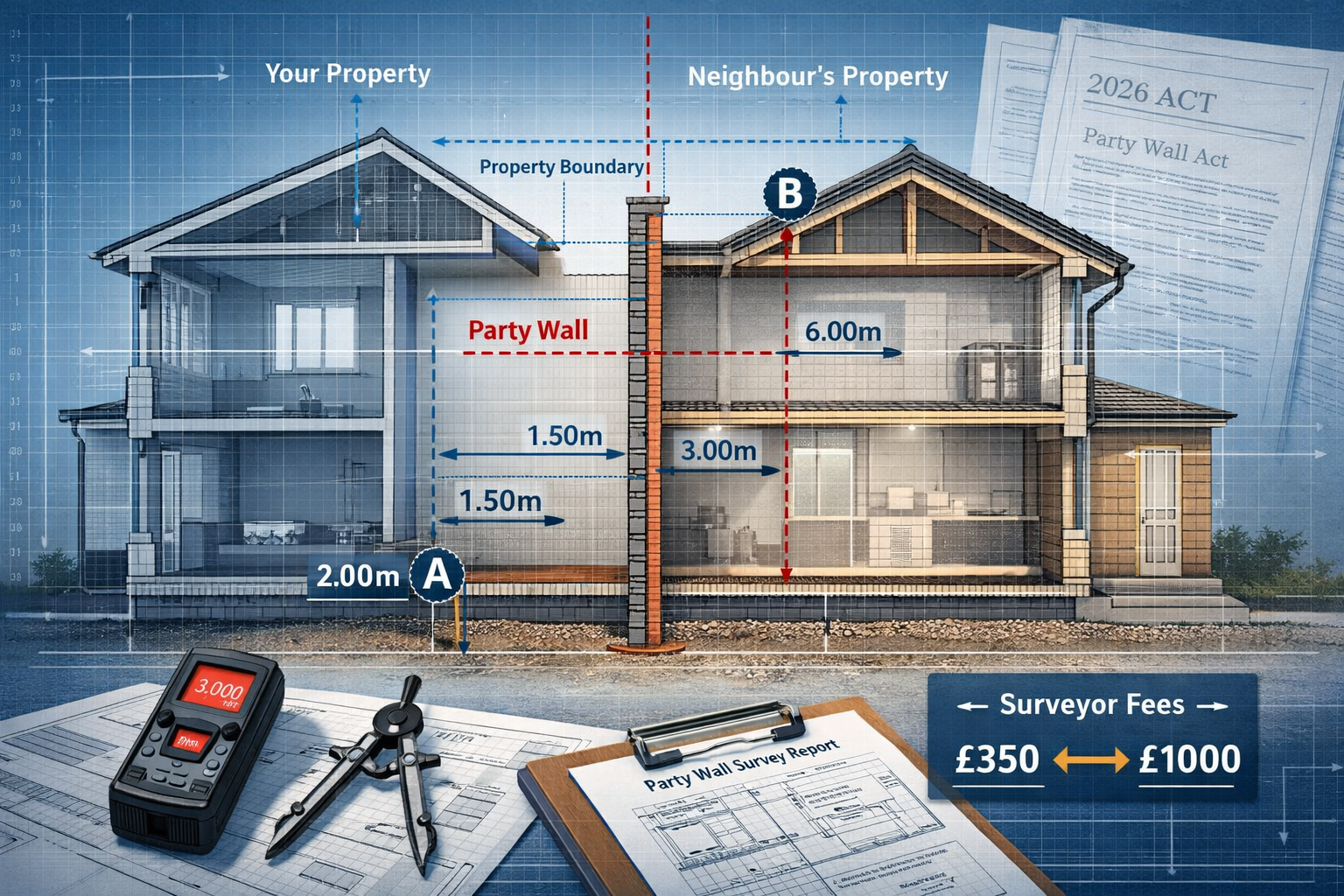
- Excavating within 3–6 meters of neighbouring structures [1]
Work that may avoid party wall requirements:
- Internal alterations not affecting party structures
- External work entirely within your property boundary
- Excavations beyond the Act’s distance thresholds
Consulting with your architect and surveyor during design phases identifies opportunities to structure work in ways that minimize party wall implications without compromising project goals. Understanding what is a party fence wall helps clarify which structures fall under the Act’s scope.
Recovery Through Project Insurance and Contracts 🛡️
Some building owners successfully recover party wall costs through:
- Project insurance policies: Certain comprehensive policies cover party wall surveyor fees as part of legal expenses
- Contractor agreements: Turnkey contracts may include party wall costs in overall project pricing
- Property sale negotiations: When selling soon after work completion, enhanced property value may offset surveyor fees
Review your insurance policies and contractor agreements to understand whether party wall costs are covered or can be incorporated into broader project budgets.
Special Circumstances: When Standard Fee Rules Don’t Apply
Several scenarios create exceptions to standard fee allocation under who pays party wall surveyor fees, cost breakdown and recovery strategies under the 2026 Act:
Commercial vs. Residential Projects
Commercial building owners face identical legal obligations regarding surveyor fees, but:
- Fee amounts typically run higher due to project complexity
- VAT considerations differ for commercial entities
- Cost recovery may be treated as legitimate business expenses for tax purposes
Multiple Adjoining Owners
When work affects several neighbouring properties:
- The building owner pays each adjoining owner’s surveyor separately
- Total costs multiply accordingly (potentially £2,000–£3,000 per neighbour)
- Agreed surveyor arrangements become even more valuable
- Staggered notice timing may spread costs across project phases
Abortive Fees When Neighbours Consent
If your neighbour consents to proposed work within 14 days of receiving notice, no award is necessary. However:
- Surveyors may charge abortive fees for initial consultations and notice preparation
- These typically range from £150–£400
- The building owner remains responsible for these costs
- Some surveyors waive abortive fees as a goodwill gesture
Retrospective Awards for Unauthorized Work
Building owners who proceed without proper party wall procedures face:
- Standard surveyor fees for preparing retrospective awards
- Potential additional costs for remedying non-compliance
- Possible damages to adjoining owners for any harm caused
- Legal costs if neighbours pursue court action
Prevention remains far less expensive than cure—always obtain proper party wall awards before commencing work.
Practical Tips for Building Owners in 2026
Before Starting Your Project
✅ Budget appropriately: Add 2–3% of total project costs for party wall procedures
✅ Serve notices early: Allow 2–3 months before intended work commencement
✅ Choose experienced surveyors: Verify RICS membership and party wall specialization
✅ Communicate proactively: Discuss plans with neighbours before formal notices
✅ Understand notice requirements: Review party wall notices and proper service procedures
During the Process
✅ Respond promptly: Quick responses minimize surveyor time and associated costs
✅ Maintain records: Document all communications, decisions, and expenditures
✅ Review draft awards carefully: Ensure conditions are workable before finalization
✅ Coordinate with contractors: Brief builders on award conditions and working hours
✅ Stay accessible: Make yourself available for surveyor queries and site meetings
After Award Completion
✅ Comply strictly: Follow all award conditions to avoid additional surveyor involvement
✅ Schedule final inspections: Complete the process properly with closing inspections
✅ Retain documentation: Keep awards and correspondence for future property transactions
✅ Maintain neighbour relations: Good relationships prevent future disputes
✅ Review outcomes: Learn from the process for any future projects
For role-specific guidance, consult resources for building owners and understand your specific responsibilities throughout the process.
Common Mistakes That Increase Surveyor Costs
Avoiding these errors saves significant money:
❌ Starting work before obtaining an award: Creates legal complications and additional costs
❌ Choosing the cheapest surveyor: Inexperience leads to errors, delays, and inflated hours
❌ Poor communication: Delays and misunderstandings extend surveyor involvement
❌ Incomplete initial information: Requires multiple surveyor site visits and clarifications
❌ Ignoring award conditions: Non-compliance necessitates additional inspections and variations
❌ Antagonizing neighbours: Damaged relationships lead to disputes and third surveyor referrals
❌ Failing to budget adequately: Financial surprises create project stress and potential delays
Understanding the Party Wall etc. Act 1996 thoroughly before starting your project prevents costly mistakes.
Conclusion
Understanding who pays party wall surveyor fees, cost breakdown and recovery strategies under the 2026 Act empowers building owners to navigate party wall procedures confidently and cost-effectively. While Section 10(13) establishes that building owners bear primary financial responsibility—typically ranging from £600–£1,200 for agreed surveyors to £1,000–£2,000+ for separate appointments—strategic approaches can significantly minimize these expenses.
The key principles remain clear: building owners initiating construction work pay surveyor fees to protect adjoining owners from financial burden for work they didn’t request. However, exceptions exist for defective shared structures, unreasonable behaviour, and specific circumstances where cost-sharing proves appropriate.
Your action plan for managing party wall surveyor fees:
- Budget appropriately from project inception, allocating 2–3% of construction costs for party wall procedures
- Negotiate for an agreed surveyor whenever possible to reduce costs by 40–60%
- Obtain detailed fee estimates from multiple surveyors before making appointments
- Document everything to protect yourself from unreasonable fee claims or behaviour
- Communicate proactively with neighbours to maintain positive relationships and minimize disputes
- Leverage cost-sharing provisions under Section 11(4) when circumstances warrant
- Ensure compliance with all award conditions to avoid additional surveyor involvement
Whether you’re planning a loft conversion, basement excavation, or structural work affecting shared walls, proper preparation and strategic thinking transform party wall procedures from potential obstacles into manageable administrative steps. The costs, while unavoidable, need not spiral out of control when you understand your rights, responsibilities, and recovery opportunities.
For personalized guidance on your specific project, consult qualified party wall surveyors in your area who can provide accurate cost estimates and strategic advice tailored to your circumstances. With proper planning and professional support, you’ll navigate the party wall process efficiently while maintaining positive neighbour relations and protecting your financial interests.
References
[1] Who Pays For A Party Wall Surveyor A Guide To Cost Responsibilities – https://nottinghillsurveyors.com/blog/who-pays-for-a-party-wall-surveyor-a-guide-to-cost-responsibilities
[2] Who Pays For A Party Wall Surveyor – partywalldiy.com
[3] Surveyors Fees For A Party Wall – oakfieldsurveyors.co.uk
[4] Party Wall Surveying Fee All You Need To Know – arunassociates.co.uk
[5] Who Pays For A Party Wall Surveyor – akt-surveyors.com
[6] Who Pays The Party Wall Surveyors Fees – peterbarry.co.uk
Speak to a RICS chartered party wall surveyor
Free initial consultation. Notices, awards and schedules of condition across London and nationwide.