{“cover”:”Professional landscape format (1536×1024) hero image featuring bold text overlay ‘Who Pays Party Wall Surveyor Fees in 2026?’ in extra large 72pt white sans-serif font with dark shadow and semi-transparent navy overlay box, positioned in upper third center. Background shows split composition: left side displays two neighboring London terraced houses with shared party wall highlighted, right side shows professional surveyor with clipboard and hard hat examining wall structure. Foreground includes floating transparent cost breakdown elements showing pound sterling symbols and calculator graphics. Color scheme: navy blue, white, gold accents. High contrast, editorial magazine cover quality, professional architectural photography style with sharp focus and modern aesthetic.”,”content”:[“Landscape format (1536×1024) detailed infographic illustration showing cost allocation flowchart for party wall surveyor fees. Central image features building owner figure on left with outward arrows pointing to three distinct cost boxes: ‘Building Owner’s Surveyor £400-900’, ‘Adjoining Owner’s Surveyor £300-700’, and ‘Award Preparation Costs’. Right side shows adjoining owner figure with single incoming arrow labeled ‘£0 typical cost’. Include pound sterling symbols, percentage breakdowns, and visual representation of 2026 market rates with bar graphs comparing loft conversion (£900-1200), extension (£1200-1500), and basement (£1800-2700) project costs. Professional business infographic style with clean lines, navy and gold color scheme.”,”Landscape format (1536×1024) comparison diagram showing two distinct surveyor appointment models side by side. Left half labeled ‘Agreed Surveyor Model’ displays single professional surveyor figure in center with both building owner and adjoining owner on either side, connected by handshake icon, with cost indicator showing ‘£900-1200 total’ and green checkmark for cost efficiency. Right half labeled ‘Two-Surveyor Model’ shows two separate surveyor figures with building owner and adjoining owner on opposite sides, cost indicator displaying ‘£1800-2400 total’ with yellow caution symbol. Include visual elements like scales showing cost difference, clock icons indicating time differences, and pros/cons bullet points overlaid. Clean architectural drawing style with blueprint aesthetic.”,”Landscape format (1536×1024) conceptual illustration depicting dispute resolution process and cost recovery mechanisms. Central image shows magistrates court building facade on left and county court building on right, connected by pathway labeled ‘Legal Enforcement Routes’. Foreground displays form documents labeled ‘Section 58 Magistrates Court Act 1980’ and ‘County Court Simple Claim Form’. Include visual representation of third surveyor as mediator figure with gavel, percentage indicator showing ‘30% cases require dispute resolution’, and timeline arrow showing resolution process stages. Background shows two property owners in disagreement with surveyor mediating between them. Professional legal documentation aesthetic with navy, burgundy, and gold color palette, sharp focus on forms and legal elements.”]”}
The building owner pays all party wall surveyor fees—a legal principle that surprises many property developers embarking on construction projects in 2026. Under the Party Wall etc. Act 1996, the homeowner initiating work bears responsibility for their own surveyor’s costs, the neighbour’s surveyor fees, and all expenses related to preparing the Party Wall Award. Understanding who pays party wall surveyor fees in 2026: cost recovery rules, agreed vs two-surveyor models, and dispute resolution can mean the difference between a £900 project expense and a £2,700 financial burden, making strategic planning essential for anyone undertaking building work[1][2].
This comprehensive guide examines the fundamental cost allocation principles under the Party Wall etc. Act 1996, explores current market rates for surveyor services in 2026, compares the financial implications of appointing an agreed surveyor versus separate surveyors, and outlines effective strategies for minimizing expenses while ensuring legal compliance.
Key Takeaways
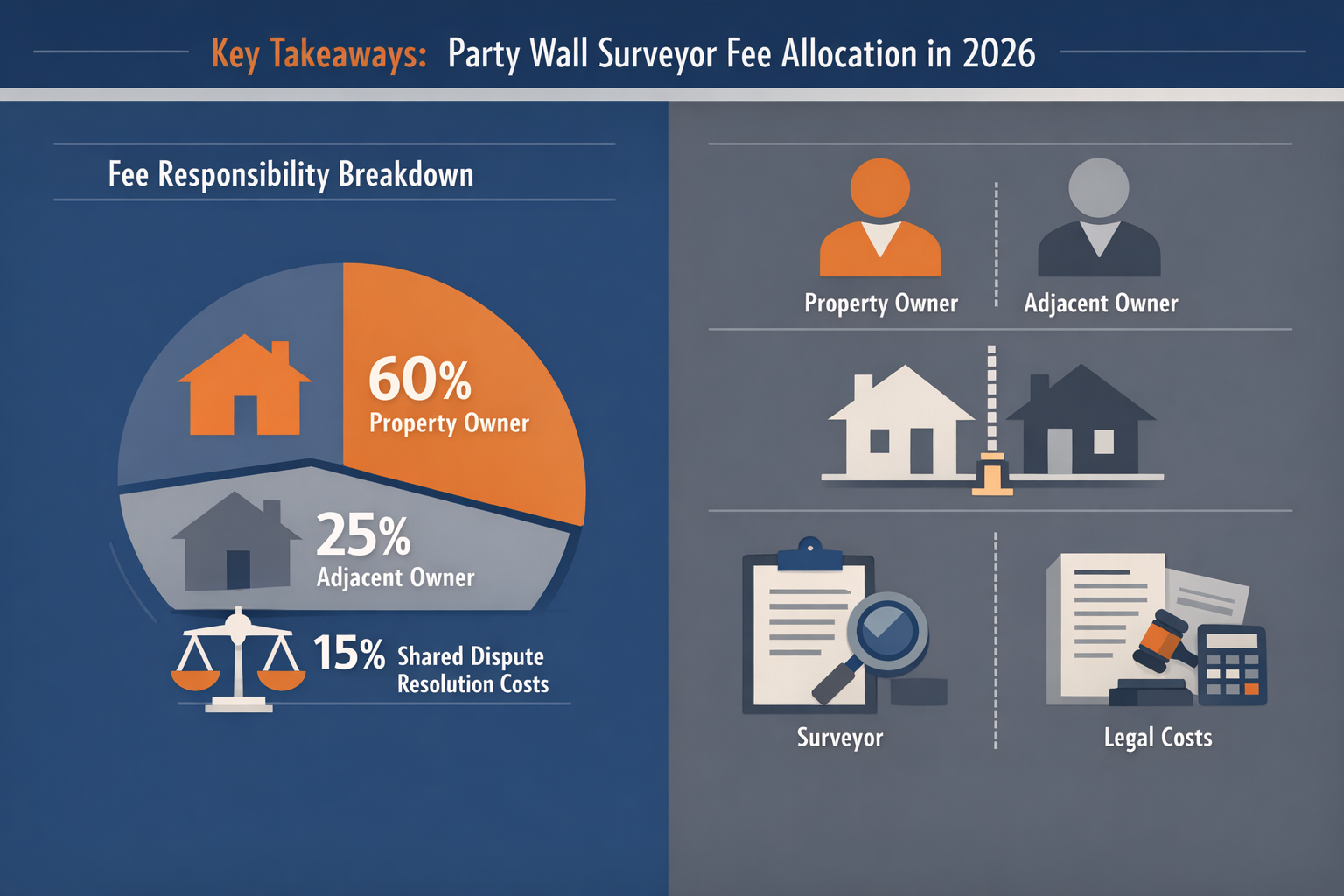
✅ Building owners pay all surveyor costs: The property owner initiating construction work is legally responsible for paying both their own surveyor and their neighbour’s surveyor fees, plus Award preparation costs[1][2].
💰 Agreed surveyor model cuts costs in half: Using one impartial surveyor acting for both parties typically costs £900-£1,500, while appointing separate surveyors approximately doubles expenses to £1,800-£2,400[5][6].
📊 2026 market rates vary by project complexity: Loft conversions range from £900-£1,200, extensions cost £1,200-£1,500, and basement excavations command £1,800-£2,700 in surveyor fees[5].
⚖️ Cost recovery mechanisms exist for unreasonable behaviour: When adjoining owners act unreasonably during the party wall process, building owners may recover costs through third surveyor determinations or legal proceedings[1][2].
🔧 Strategic planning minimizes out-of-pocket expenses: Proper notice timing, clear communication, and understanding the costs of party wall the process help building owners control expenses effectively.
Understanding the Fundamental Cost Allocation Principle Under the Party Wall etc. Act 1996
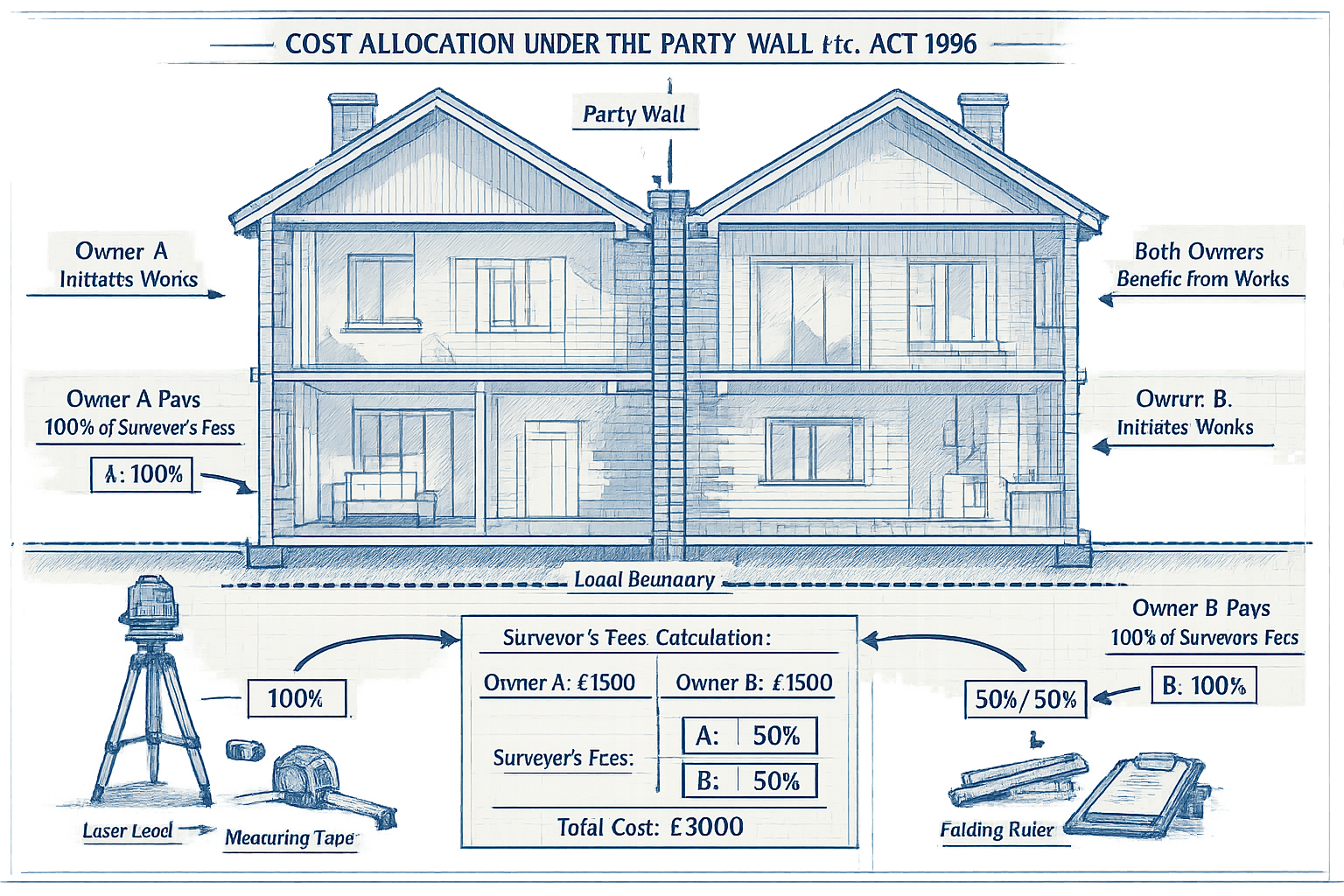
The Party Wall etc. Act 1996 establishes a clear and unambiguous principle: the building owner pays all surveyor fees. This fundamental rule protects adjoining owners from bearing financial responsibility for construction work they didn’t initiate or request[1].
Why Building Owners Bear All Costs
The legislative intent behind this cost allocation reflects a simple fairness principle—property owners who wish to undertake building work that affects shared structures or excavate near neighbouring property must absorb the associated administrative and professional costs. This approach ensures that neighbours aren’t financially penalized for someone else’s construction project[1][2].
The building owner’s financial responsibility typically includes:
- Building owner’s surveyor fees: £400-£900 depending on project complexity
- Adjoining owner’s surveyor fees: £300-£700 for professional representation
- Party Wall Award preparation costs: Administrative expenses for drafting the legal agreement
- Schedule of Condition: Often included, though some surveyors charge an additional £150-£300[6]
What Adjoining Owners Pay (Usually Nothing)
In most party wall scenarios, the adjoining owner incurs zero costs. This protection applies regardless of whether they appoint their own surveyor or consent to an agreed surveyor arrangement[1][2].
However, two exceptional circumstances exist where adjoining owners may face expenses:
- Requesting additional work: If the neighbour asks for specific modifications or improvements beyond the building owner’s planned work
- Shared wall disrepair: When a party wall is found to be defective and both owners share responsibility for the deterioration[1][5]
For guidance on avoiding unnecessary expenses, property owners can review strategies in our guide on how to keep party wall costs down.
2026 Market Rate Breakdown by Project Type
Party wall surveyor costs in 2026 vary significantly based on the complexity and scope of proposed building work. Understanding these cost ranges helps building owners budget accurately and avoid financial surprises.
| Project Type | Typical Cost Range | Factors Affecting Price |
|---|---|---|
| Loft Conversion | £900 – £1,200 | Roof structure complexity, number of adjoining properties |
| Extension | £1,200 – £1,500 | Foundation depth, shared wall involvement, property size |
| Basement Excavation | £1,800 – £2,700 | Excavation depth, proximity to neighbours, structural complexity |
| Simple Wall Works | £700 – £900 | Minimal structural impact, straightforward assessment |
These figures represent total costs when using an agreed surveyor model. Costs approximately double when separate surveyors are appointed for each party[5].
Hourly vs Fixed Fee Arrangements
Surveyors in 2026 typically offer two pricing structures:
Fixed Fee Arrangements (Most Common):
- Straightforward projects: £900-£1,500
- Predictable budgeting
- Covers all standard services including site visits, Award preparation, and correspondence[1][6]
Hourly Rate Arrangements:
- Range: £90-£450 per hour depending on experience and location
- Suitable for complex or unpredictable projects
- Risk of cost escalation if disputes arise[1]
For building owners working with professionals in different areas, regional variations exist. Those seeking services from a party wall surveyor in central London may encounter higher rates than those working with surveyors in outer London boroughs.
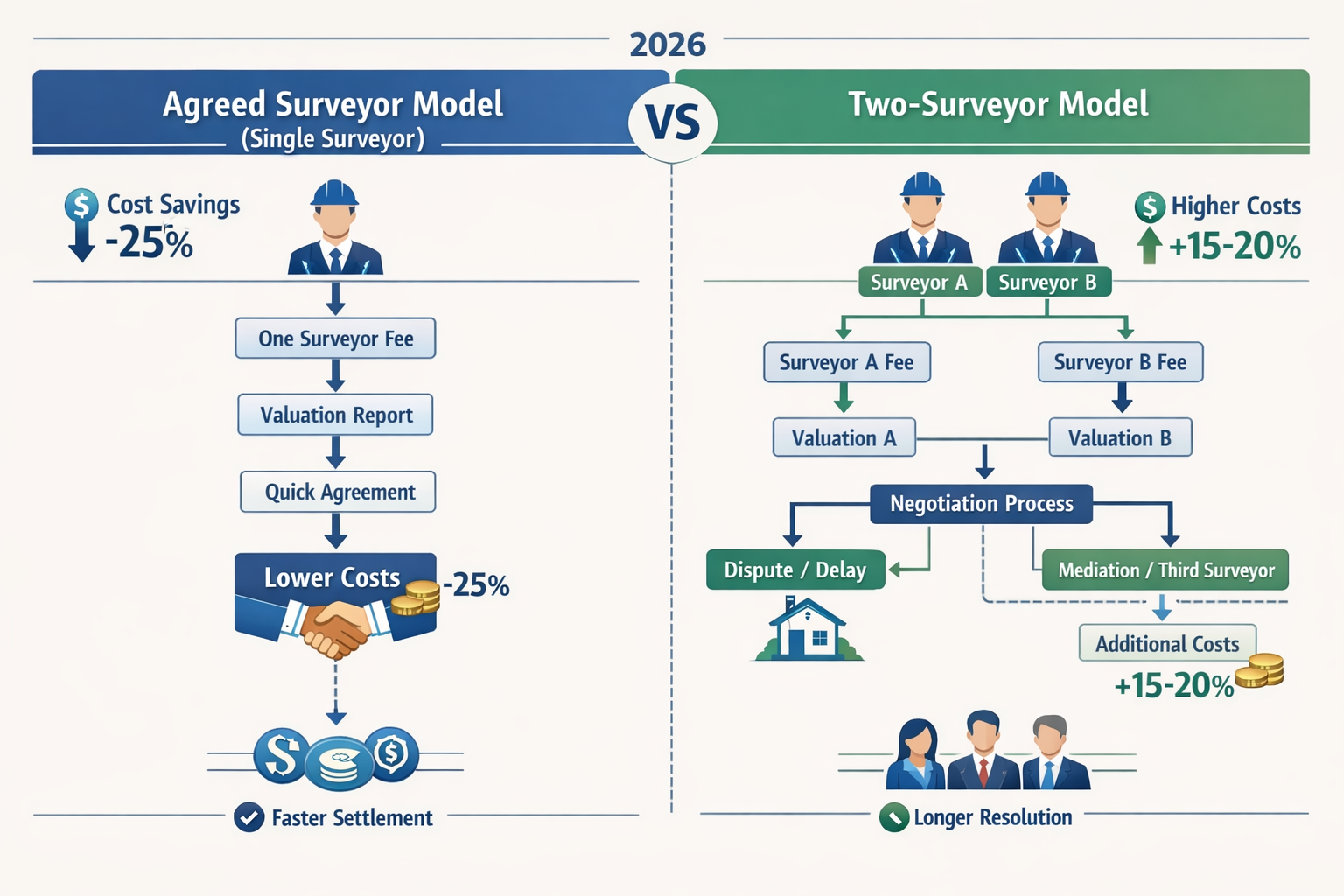
Agreed Surveyor vs Two-Surveyor Models: Cost Implications and Strategic Considerations in 2026
Choosing between an agreed surveyor and separate surveyors represents one of the most significant financial decisions in the party wall process. This choice can literally double or halve total surveyor expenses, making it essential to understand the cost implications and strategic advantages of each approach[5].
The Agreed Surveyor Model: Cost Efficiency and Streamlined Process
An agreed surveyor (also called a “single surveyor” or “appointed surveyor”) acts impartially for both the building owner and adjoining owner. This arrangement offers substantial financial and procedural advantages.
Cost Benefits:
- Total fees: £900-£1,500 for most residential projects
- Single fee structure: One professional handling all aspects
- Reduced administrative costs: Simplified communication and coordination
- No third surveyor risk: Eliminates the need for dispute resolution between surveyors[5][6]
Procedural Advantages:
- ⏱️ Faster timelines: Single point of decision-making accelerates Award preparation
- 📝 Simplified communication: Both parties interact with one professional
- 🤝 Reduced conflict potential: Impartial approach minimizes adversarial dynamics
- 💼 Streamlined documentation: Unified approach to Schedule of Condition and Award drafting
The agreed surveyor model works particularly well when:
- Neighbours maintain cordial relationships
- Proposed works are straightforward and non-contentious
- Both parties prioritize cost efficiency
- The building project has clear scope and minimal complexity
For those considering this approach, understanding the process of having a party wall agreement without a surveyor provides useful context, though professional involvement remains advisable for most projects.
The Two-Surveyor Model: Enhanced Representation with Higher Costs
The two-surveyor approach involves separate professionals representing each party’s interests. While more expensive, this model offers distinct advantages in certain circumstances.
Cost Structure:
- Building owner’s surveyor: £400-£900
- Adjoining owner’s surveyor: £300-£700
- Total combined fees: £1,800-£2,400 (approximately double the agreed surveyor cost)
- Potential third surveyor fees: Additional £300-£600 if surveyors disagree[5][6]
When Two Surveyors Make Sense:
🏗️ Complex or contentious projects: Significant structural work, deep excavations, or historically problematic properties benefit from specialized representation.
⚖️ Strained neighbour relations: When trust is lacking, separate surveyors provide independent advocacy and protection.
💡 Sophisticated technical issues: Projects involving unusual structural challenges or heritage properties may require dedicated expertise for each party.
🔍 Significant property values: High-value properties warrant the additional expense for comprehensive protection.
Strategic Considerations for Building Owners:
Building owners should recognize that while they pay for both surveyors, the two-surveyor model can actually reduce overall project risk by:
- Ensuring thorough technical assessment from multiple perspectives
- Providing clear documentation that protects against future disputes
- Creating balanced Awards that both parties accept without challenge
- Reducing the likelihood of costly legal proceedings later
For building owners seeking professional representation, understanding the role of the building owner’s surveyor helps clarify what services to expect.
Comparing Models: A 2026 Cost-Benefit Analysis
| Factor | Agreed Surveyor | Two Surveyors |
|---|---|---|
| Typical Total Cost | £900-£1,500 | £1,800-£2,400 |
| Timeline | 4-6 weeks | 6-10 weeks |
| Complexity Handling | Best for straightforward projects | Better for complex work |
| Dispute Risk | Lower (single decision-maker) | Moderate (potential surveyor disagreement) |
| Neighbour Relations | Requires basic cooperation | Works even with poor relations |
| Third Surveyor Risk | None | Possible (adds £300-£600) |
| Professional Advocacy | Impartial for both parties | Dedicated representation |
The Third Surveyor: When and Why They’re Needed
When two appointed surveyors cannot agree on specific aspects of the Award, they must jointly select a third surveyor to resolve the disagreement. This additional layer of dispute resolution carries important cost implications:
- Appointment: Required when surveyors disagree on technical or procedural matters
- Cost: £300-£600 per referral issue
- Payment responsibility: Building owner pays (as with all other surveyor fees)
- Decision authority: Third surveyor’s determination is binding on both parties[6]
The third surveyor mechanism provides a safety valve for the two-surveyor model, ensuring that disagreements between professionals don’t derail the entire process. However, their involvement adds both time and expense to the project.
Building owners can minimize third surveyor risk by:
- Selecting experienced, reputable surveyors initially
- Encouraging clear communication between appointed surveyors
- Ensuring project scope is well-defined before surveyor appointment
- Maintaining realistic timelines that don’t pressure rushed decisions
For those navigating the surveyor selection process, resources about the adjoining owner’s surveyor role help building owners understand what their neighbour’s representative will prioritize.
Cost Recovery Rules, Dispute Resolution, and Strategies to Minimize Out-of-Pocket Expenses in 2026
While the building owner bears primary responsibility for all surveyor fees, who pays party wall surveyor fees in 2026: cost recovery rules, agreed vs two-surveyor models, and dispute resolution mechanisms provide important protections against unreasonable behaviour and offer strategies for minimizing overall expenses.
Cost Recovery When Adjoining Owners Act Unreasonably
The Party Wall etc. Act 1996 includes provisions for cost reallocation when one party behaves unreasonably during the party wall process. This protection ensures that building owners aren’t financially penalized for neighbours who deliberately obstruct or unnecessarily complicate legitimate building work[1][2].
Circumstances Enabling Cost Recovery:
🚫 Unreasonable refusal to consent: When an adjoining owner refuses consent without valid technical or structural concerns
⏰ Deliberate delays: Intentional stalling tactics that extend timelines without justification
📋 Excessive demands: Requesting unnecessary surveys, reports, or conditions beyond reasonable protection
🗣️ Non-cooperation: Refusing reasonable access for Schedule of Condition or failing to respond to legitimate communications
Mechanism for Cost Recovery:
When unreasonable behaviour occurs, the third surveyor (if appointed) or the surveyors jointly can determine that costs should be reallocated. This determination becomes part of the Party Wall Award and is legally enforceable[1].
Approximately 30% of party wall cases may require some form of dispute resolution, ranging from informal mediation to formal legal proceedings[2]. Building owners should document all communications and maintain clear records to support cost recovery claims if necessary.
Legal Enforcement Options for Unpaid Surveyor Fees
When a party refuses to pay their legally required surveyor fees, the Party Wall etc. Act 1996 provides two primary enforcement mechanisms[3]:
Option 1: Magistrates Court Proceedings (Section 58)
- Process: File complaint using form 104 under Section 58 of the Magistrates Court Act 1980
- Jurisdiction: Local magistrates court
- Advantages: Relatively straightforward, designed for Party Wall Act disputes
- Timeline: Typically faster than County Court proceedings
- Cost: Lower court fees
Option 2: County Court Simple Claim
- Process: Issue simple claim through HM Courts and Tribunal services
- Jurisdiction: County Court
- Advantages: Broader enforcement powers, established debt recovery procedures
- Timeline: Standard civil claim timelines apply
- Cost: Standard court fees based on claim value
Both enforcement routes provide effective mechanisms for recovering unpaid fees, though building owners should consider the cost-benefit analysis before pursuing legal action. In some cases, the expense of legal proceedings may exceed the disputed fees themselves[3][8].
Shared Costs for Defective Party Walls
One exception to the “building owner pays all” principle occurs when a party wall is found to be in disrepair. In these circumstances, repair costs may be shared between owners based on:
- Cause of the defect: Whether deterioration resulted from one owner’s actions or natural aging
- Use of the wall: How each property benefits from the shared structure
- Responsibility for maintenance: Historical maintenance patterns and obligations[5]
A chartered surveyor assesses these factors and advises on correct cost apportionment. This evaluation ensures fairness when both parties bear some responsibility for the wall’s condition.
For example, if a 100-year-old party wall shows deterioration from age rather than either owner’s specific actions, and both properties rely equally on the structure, repair costs would typically be split 50/50. However, if one owner’s previous alterations contributed to the deterioration, their share might increase to 70% or more.
Strategic Approaches to Minimize Building Owner Expenses
Building owners in 2026 can employ several proven strategies to control party wall surveyor costs while maintaining legal compliance:
1. Early Planning and Clear Project Scope 📋
- Define work precisely before serving notices
- Avoid scope changes that require Award amendments
- Ensure architectural plans are finalized before surveyor appointment
- Understand types of party wall works to accurately categorize your project
2. Proper Notice Timing ⏱️
- Serve party wall notices at least two months before work commences
- Allow adequate time for neighbour response and surveyor appointment
- Avoid rushed timelines that require premium fees for expedited service
- Understand party wall act notices and how to respond to set realistic expectations
3. Open Neighbour Communication 🤝
- Discuss planned work informally before formal notices
- Address concerns proactively to reduce contentious dynamics
- Encourage agreed surveyor appointment through collaborative approach
- Maintain respectful dialogue throughout the process
4. Strategic Surveyor Selection 🔍
- Obtain quotes from multiple qualified surveyors
- Verify experience with similar project types
- Check professional memberships and qualifications
- Consider local expertise—surveyors familiar with party wall surveyor east London properties may offer efficiency advantages in those areas
5. Fixed Fee Arrangements 💰
- Negotiate fixed fees rather than hourly rates when possible
- Clarify what services are included in quoted fees
- Confirm whether Schedule of Condition is included or additional
- Understand payment terms and milestone billing
6. Minimize Scope Changes 🔧
- Avoid mid-project alterations that require Award amendments
- Ensure contractor understands approved work scope
- Communicate any necessary changes to surveyors immediately
- Recognize that amendments typically incur additional fees
7. Efficient Documentation 📸
- Provide clear, comprehensive project information to surveyors
- Respond promptly to surveyor requests for information
- Maintain organized records of all communications
- Prepare properties for Schedule of Condition inspections
Understanding Party Wall Awards and Their Cost Implications
The Party Wall Award represents the formal legal document that authorizes work and establishes conditions. Understanding Award components helps building owners anticipate costs:
Standard Award Components (Included in Basic Fees):
- Description of proposed works
- Time and manner of work execution
- Access arrangements
- Schedule of Condition
- Dispute resolution procedures
Potential Additional Cost Triggers:
- Extensive Schedule of Condition for large or complex properties
- Multiple site visits due to phased work
- Award amendments for scope changes
- Dispute resolution involving third surveyor
- Extended monitoring during construction phase
For detailed guidance on Award structure and content, the party wall contract template guide on party wall awards provides valuable insights into what building owners should expect.
Regional Variations in 2026 Surveyor Costs
Surveyor fees vary across London and the UK based on local market conditions, property values, and professional demand:
Premium Areas (Higher Fees):
- Central London: 15-25% above average rates
- High-value residential zones: Premium for experience with expensive properties
- Heritage areas: Specialist knowledge commands higher fees
Standard Areas (Average Fees):
- Suburban London: Mid-range pricing
- Established residential neighborhoods: Competitive market rates
Regional Considerations:
- Party wall surveyor west London rates may differ from party wall surveyor north London or party wall surveyor south London pricing
- Travel costs may apply for surveyors working outside their primary service area
- Local expertise often provides value beyond cost savings through regulatory knowledge
Conclusion: Strategic Financial Planning for Party Wall Surveyor Fees in 2026
Understanding who pays party wall surveyor fees in 2026: cost recovery rules, agreed vs two-surveyor models, and dispute resolution empowers building owners to make informed decisions that balance legal compliance with cost management. The fundamental principle remains clear: building owners bear responsibility for all surveyor costs, typically ranging from £900 for straightforward projects using an agreed surveyor to £2,700 or more for complex basement excavations requiring separate surveyors[5][6].
The choice between an agreed surveyor and two separate surveyors represents the single most impactful financial decision in the party wall process, with the potential to double or halve total expenses. Building owners should evaluate this decision based on project complexity, neighbour relations, and risk tolerance rather than cost alone. While the agreed surveyor model offers significant savings for straightforward projects, complex work or strained relationships may justify the additional investment in separate representation.
Cost recovery mechanisms provide important protections against unreasonable behaviour, though approximately 30% of cases may require some form of dispute resolution[2]. Building owners who maintain clear documentation, communicate effectively, and engage qualified professionals minimize both direct costs and dispute risk.
Actionable Next Steps for Building Owners
✅ Assess your project scope: Determine which types of party wall works apply to your construction plans
✅ Obtain multiple surveyor quotes: Compare fixed fee arrangements from qualified professionals in your area
✅ Evaluate surveyor model: Decide between agreed surveyor and two-surveyor approaches based on project complexity and neighbour relations
✅ Plan notice timing: Allow adequate time for the party wall process before construction must commence
✅ Communicate with neighbours: Discuss plans informally before serving formal notices to build cooperation
✅ Budget comprehensively: Include surveyor fees, potential Schedule of Condition costs, and contingency for disputes in project budgets
✅ Engage professionals early: Consult with surveyors during project planning rather than after architectural plans are finalized
For building owners embarking on construction projects in 2026, strategic planning around party wall surveyor fees represents an investment in both legal compliance and neighbour relations. By understanding cost allocation principles, comparing surveyor models, and implementing expense minimization strategies, property owners can navigate the party wall process efficiently while controlling out-of-pocket expenses.
Whether working with a party wall surveyor in central London or elsewhere in the UK, informed decision-making about surveyor selection and appointment models ensures that party wall compliance enhances rather than hinders successful construction projects.
References
[1] Who Pays For A Party Wall Surveyor A Guide To Cost Responsibilities – https://nottinghillsurveyors.com/blog/who-pays-for-a-party-wall-surveyor-a-guide-to-cost-responsibilities
[2] Surveyors Fees For A Party Wall – oakfieldsurveyors.co.uk
[3] How To Recover Party Wall Fees – stokemont.com
[5] Party Wall Surveyor Cost – hoa.org.uk
[6] Party Wall Agreement Cost – partywalldiy.com
[8] Enforcement Of Payments In Party Wall Matters – tanfieldchambers.co.uk
Speak to a RICS chartered party wall surveyor
Free initial consultation. Notices, awards and schedules of condition across London and nationwide.