


The UK construction sector is experiencing a remarkable resurgence in 2026, with homeowners and developers launching ambitious renovation and extension projects across England and Wales. This construction boom has triggered an unprecedented surge in party wall disputes between neighbours, making professional compliance with RICS standards more critical than ever. Understanding Party Wall Surveys and Neighbour Disputes in 2026's UK Construction Uptick: RICS Compliance Essentials has become essential for property owners navigating complex legal requirements while maintaining positive neighbour relations.
As construction activity accelerates, the demand for qualified party wall surveyors has skyrocketed, revealing gaps in compliance knowledge that lead to costly delays, strained relationships, and potential legal complications. This comprehensive guide provides property owners, developers, and construction professionals with a clear framework for navigating the Party Wall etc. Act 1996 while adhering to RICS best practices.
Key Takeaways
- 🏗️ Construction boom drives disputes: The 2026 UK construction recovery has created unprecedented demand for party wall services, with neighbour disputes increasing significantly
- ⏰ Strict notice requirements: Property owners must serve written notice 2 months before party wall works or 1 month for excavation, with neighbours having just 14 days to respond[1][2]
- 👔 RICS qualifications matter: Only chartered surveyors with MRICS or FRICS designations should be appointed, as the Act doesn't legally define surveyor qualifications[1]
- 💰 Budget for compliance: Party wall awards typically cost around £1,000, with surveyors charging £150-£200 per hour[2]
- 📋 Prevention is cheaper than litigation: Following RICS compliance frameworks from the outset prevents costly disputes and construction delays
Understanding the 2026 UK Construction Landscape and Party Wall Implications
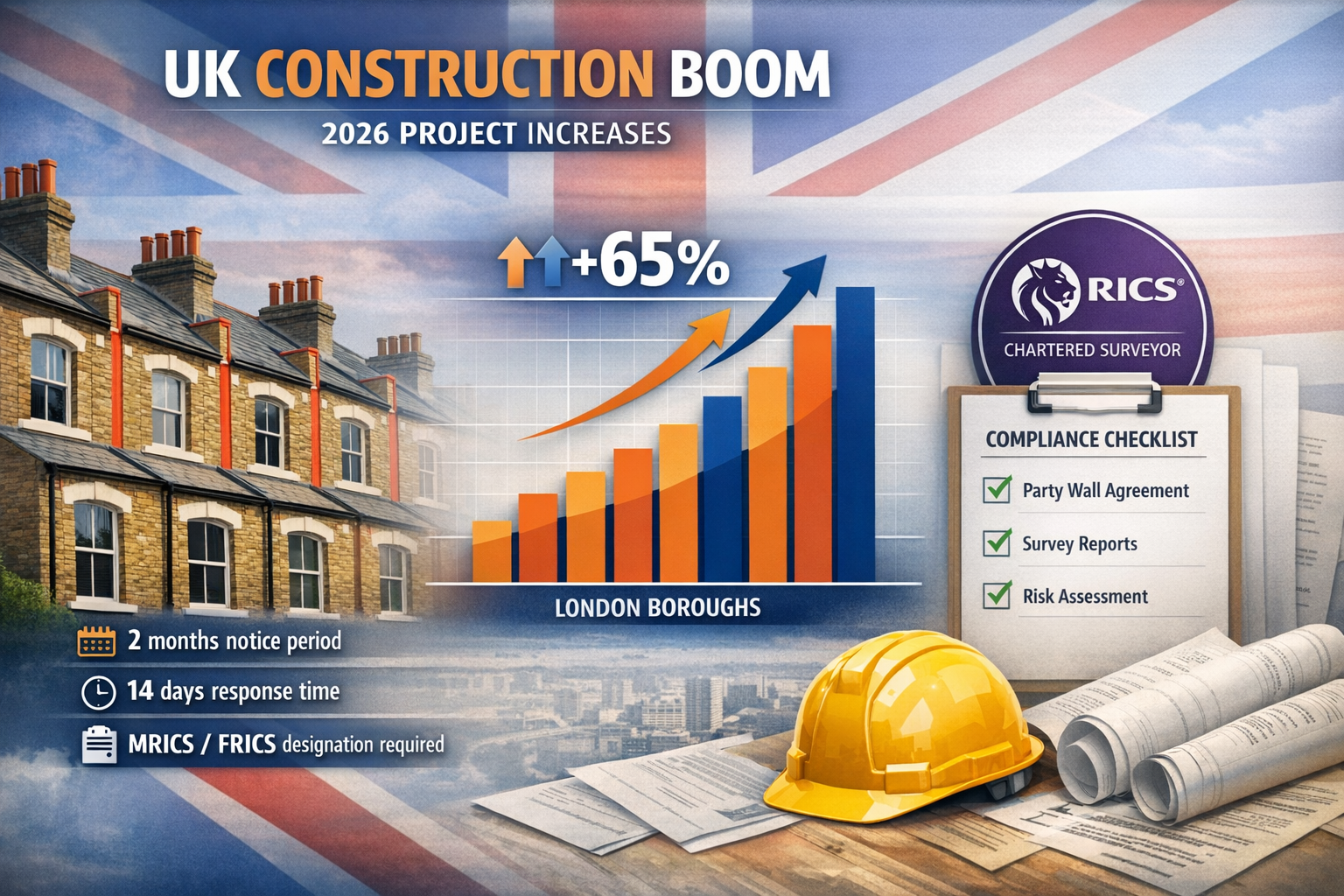
The construction sector's 2026 resurgence represents a significant shift in the UK property market. Homeowners are investing heavily in extensions, loft conversions, basement excavations, and structural alterations—all activities that frequently trigger party wall requirements. This surge has created a perfect storm where increased construction activity meets limited awareness of legal obligations.
What Makes 2026 Different for Party Wall Matters
Several factors distinguish the current construction environment:
Economic Recovery: Following years of economic uncertainty, property owners are releasing pent-up demand for home improvements, leading to simultaneous construction projects in densely populated areas.
Urban Densification: With limited space in major cities like London, property owners are maximizing existing footprints through vertical and subterranean extensions, increasing the likelihood of party wall works.
Awareness Gap: Despite increased construction activity, many property owners remain unaware of their obligations under the Party Wall etc. Act 1996, which applies exclusively to England and Wales[1].
The Geographic Scope: England and Wales Only
A critical point often overlooked is that party wall legislation applies only to England and Wales—no equivalent statutory framework exists in Scotland or Northern Ireland[1]. Property owners in these regions must rely on common law principles and local agreements, making the RICS guidance particularly valuable for establishing best practices.
Party Wall Surveys and Neighbour Disputes in 2026's UK Construction Uptick: The Legal Framework
Understanding the legal foundation is essential for RICS compliance. The Party Wall etc. Act 1996 provides a framework for preventing and resolving disputes between neighbours undertaking construction work.
Types of Notifiable Works
The Act covers three main categories of work requiring formal notice:
| Work Type | Description | Notice Period |
|---|---|---|
| Party Wall Works | Building on, cutting into, or repairing a shared wall | 2 months[2] |
| Party Structure Works | Structural work to shared walls, floors, or partitions | 2 months[2] |
| Excavation Works | Digging within 3-6 metres of neighbouring structures | 1 month[2] |
For detailed guidance on specific work types, consult our comprehensive guide on types of party wall works.
The Notice and Response Timeline
The statutory timeline creates a structured process:
- Building Owner serves notice: Written notice must be provided 2 months before party wall works or 1 month for excavation[1][2]
- Adjoining Owner responds: Neighbours have 14 days to consent or dissent[1][2]
- Surveyor appointment: If dissent occurs or no response is received, surveyors must be appointed
- Party Wall Award: Surveyors prepare a formal award documenting rights, responsibilities, and protections
Understanding party wall act notices and how to respond is crucial for both building and adjoining owners.
Common Triggers for Neighbour Disputes
The 2026 construction uptick has highlighted several dispute flashpoints:
- ⚠️ Inadequate or late notice: Serving notices too close to construction start dates
- 🏚️ Lack of condition surveys: Failing to document pre-existing conditions
- 💷 Cost disagreements: Disputes over who pays surveyor fees and award costs
- 🔨 Construction disruption: Noise, access issues, and working hours
- 📐 Boundary confusion: Uncertainty about boundary wall rules and party fence walls
RICS Compliance Essentials: Beyond Minimum Legal Requirements
While the Party Wall etc. Act 1996 establishes minimum legal requirements, RICS guidance sets professional standards that exceed these baselines. Following RICS compliance essentials protects all parties and demonstrates professional competence.
Selecting Qualified RICS Surveyors
The Act itself doesn't legally define surveyor qualifications, creating potential for unqualified individuals to act as party wall surveyors. RICS addresses this gap by recommending that only chartered surveyors with MRICS or FRICS designations be appointed[1].
Key qualifications to verify:
✅ MRICS or FRICS designation: Member or Fellow of the Royal Institution of Chartered Surveyors
✅ Specialist experience: Demonstrated expertise in party wall matters
✅ Professional indemnity insurance: Adequate coverage for potential claims
✅ Local knowledge: Familiarity with regional construction practices and property types
Whether you're carrying out works or your neighbour is undertaking construction, selecting qualified surveyors is paramount.
The Schedule of Condition: Essential Documentation
One of the most valuable RICS-recommended practices is preparing a comprehensive schedule of condition before work commences. This photographic and written record documents the pre-existing state of neighbouring properties.
Benefits of thorough condition surveys:
- 📸 Evidence protection: Irrefutable record of pre-work conditions
- 🛡️ Liability clarity: Distinguishes new damage from existing issues
- 🤝 Dispute prevention: Reduces disagreements about construction impacts
- ⚖️ Legal safeguard: Provides evidence if litigation becomes necessary
RICS Standards for Party Wall Awards
A properly prepared party wall award should include:
- Detailed work description: Specific construction activities permitted
- Access arrangements: Rights of entry for inspections and work
- Working hours: Acceptable times for noisy or disruptive activities
- Protective measures: Requirements for scaffolding, shoring, or temporary supports
- Cost allocation: Clear statement of who pays surveyor fees
- Dispute resolution: Process for addressing disagreements during construction
RICS guidance emphasizes clarity, fairness, and comprehensive documentation in all awards[4].
Managing Costs: Party Wall Surveys and Neighbour Disputes in 2026's UK Construction Uptick
Understanding the financial implications of party wall compliance helps property owners budget appropriately and avoid unexpected expenses.
Typical Cost Structure
Based on current 2026 market rates:
Surveyor Hourly Rates: £150-£200 per hour[2]
Average Party Wall Award: Approximately £1,000[2]
Complex disputes: £2,000-£5,000+ depending on scope and complications
For detailed cost breakdowns, review our guide on costs of party wall processes.
Who Pays for What?
The general principle is that the building owner (the person undertaking works) typically pays:
- Their own surveyor's fees
- The adjoining owner's surveyor's fees
- The agreed surveyor's fees (if one surveyor acts for both parties)
- Costs of preparing the party wall award
However, if the adjoining owner causes unnecessary expense through unreasonable behavior, costs may be apportioned differently.
Strategies for Keeping Costs Down
Smart property owners can minimize party wall expenses:
💡 Early engagement: Start the process well before construction deadlines
💡 Clear communication: Maintain open dialogue with neighbours
💡 Agreed surveyor: Consider appointing a single surveyor to act for both parties
💡 Realistic timelines: Avoid rushed processes that increase surveyor time
💡 Proper documentation: Provide complete information to surveyors upfront
For additional cost-saving strategies, see our article on how to keep party wall costs down.
Step-by-Step RICS Compliance Framework for 2026
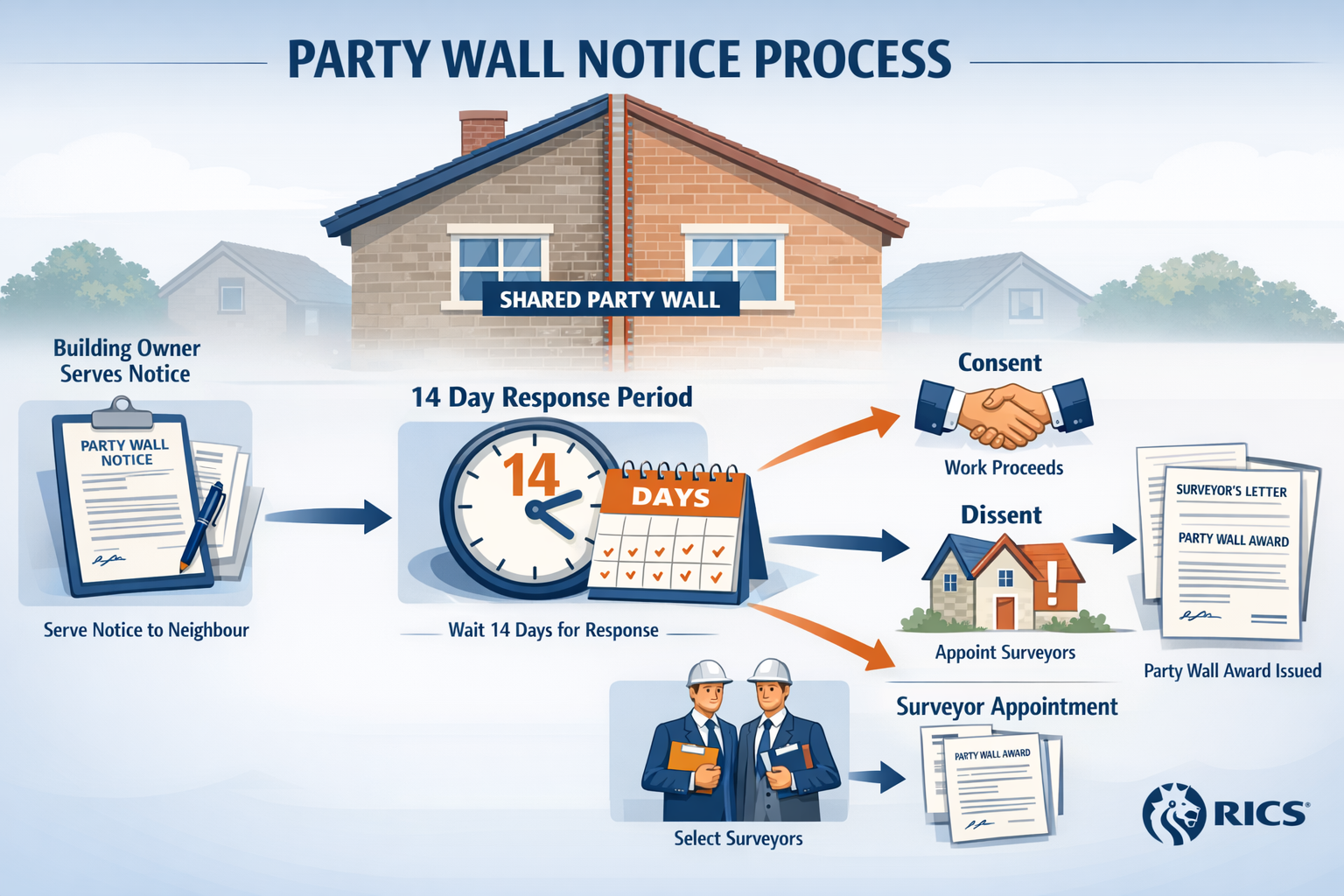
Following a structured approach ensures compliance while minimizing disputes during the 2026 construction uptick.
Phase 1: Pre-Notice Planning (3-4 Months Before Construction)
Step 1: Identify Notifiable Works
Determine whether your planned construction triggers party wall requirements. Common scenarios include:
- Building on or near a party wall
- Excavating within 3-6 metres of neighbouring foundations
- Cutting into a party wall for beams or services
Step 2: Engage Professional Advice
Consult a RICS-qualified party wall surveyor to assess your obligations. Regional specialists like party wall surveyors in North London, South London, East London, or West London provide localized expertise.
Step 3: Preliminary Neighbour Communication
Informally discuss your plans with affected neighbours before serving formal notices. This courtesy often prevents disputes.
Phase 2: Formal Notice Service (2 Months Before Construction)
Step 4: Prepare Compliant Notices
Work with your surveyor to prepare notices that meet statutory requirements. The notice must include:
- Description of proposed works
- Date work will commence
- Building owner's details
- Drawings or plans showing the work
Review our guide on party wall notices for detailed requirements.
Step 5: Serve Notices Correctly
Deliver notices via recorded delivery or hand delivery with acknowledgment. Retain proof of service.
Phase 3: Response and Surveyor Appointment (14-Day Response Period)
Step 6: Await Neighbour Response
Adjoining owners have 14 days to respond with consent or dissent[1][2]. No response is treated as dissent.
Step 7: Appoint Surveyors
If dissent occurs:
- Building owner appoints their surveyor
- Adjoining owner appoints their surveyor
- Alternatively, both parties may agree to a single "agreed surveyor"
Ensure all appointed surveyors hold MRICS or FRICS qualifications[1].
Phase 4: Survey and Award Preparation
Step 8: Conduct Schedule of Condition
Surveyors inspect and document the current state of affected properties through comprehensive schedules of condition.
Step 9: Prepare Party Wall Award
Surveyors draft an award addressing:
- Permitted works
- Working conditions
- Access rights
- Protective measures
- Cost allocation
Step 10: Serve the Award
The award is served on both parties, who have 14 days to appeal if dissatisfied.
Phase 5: Construction and Post-Completion
Step 11: Comply with Award Terms
Execute construction in accordance with the award's conditions, including working hours and protective measures.
Step 12: Post-Construction Inspection
Surveyors conduct final inspections to verify no damage occurred or to document any issues requiring remediation.
Common Pitfalls and How to Avoid Them
The 2026 construction boom has revealed recurring mistakes that lead to disputes and delays.
Pitfall 1: Attempting DIY Party Wall Agreements
Some property owners attempt to navigate party wall matters without professional assistance, potentially using party wall agreement templates without proper understanding.
The Risk: Templates may not address specific circumstances, leaving gaps that cause disputes later.
RICS Solution: While informal agreements are possible, RICS-qualified surveyors ensure compliance and comprehensive protection. Learn more about having a party wall agreement without a surveyor.
Pitfall 2: Inadequate Notice Periods
Rushing construction schedules often leads to serving notices too late or with insufficient detail.
The Risk: Statutory notice periods are mandatory—work cannot legally commence until the process is complete.
RICS Solution: Begin the party wall process at least 3 months before your planned construction start date, allowing buffer time for unexpected delays.
Pitfall 3: Poor Neighbour Communication
Treating the party wall process as purely administrative without maintaining positive neighbour relations creates unnecessary conflict.
The Risk: Neighbours may dissent or create obstacles when they feel excluded or disrespected.
RICS Solution: Combine formal compliance with informal communication, keeping neighbours informed and addressing concerns proactively.
Pitfall 4: Ignoring Boundary Complexities
Confusion about property boundaries, especially regarding boundary walls versus party fence walls, creates disputes.
The Risk: Building on the wrong side of a boundary or misidentifying wall ownership leads to legal complications.
RICS Solution: Obtain professional surveys confirming exact boundaries and wall ownership before serving notices. Understand how close neighbours can build to your fence.
Regional Considerations Across England and Wales
Party wall matters vary across different regions based on property types, construction density, and local practices.
London's Unique Challenges
The capital presents particular complexities:
- High-density terraced housing: Most properties share party walls
- Basement excavations: Popular extensions requiring careful foundation work
- Property values: High stakes increase dispute sensitivity
- Mixed ownership: Freeholders, leaseholders, and tenants create multiple stakeholders
Specialized party wall surveyors in Central London understand these unique pressures.
Regional Variations
Different areas present distinct considerations:
Victorian terraces: Common in cities nationwide, with aging party walls requiring careful assessment
Modern developments: Newer properties with clearer construction standards
Rural properties: Less frequent party wall issues but greater complexity when they arise
Conservation areas: Additional planning constraints affecting party wall works
Future-Proofing: Party Wall Compliance Beyond 2026
While this guide focuses on the 2026 construction uptick, establishing good party wall practices provides long-term benefits.
Building Positive Neighbour Relations
Viewing party wall compliance as relationship-building rather than bureaucratic obligation creates lasting value:
- 🤝 Community goodwill: Respectful processes build neighborhood trust
- 🏠 Property value: Documented compliance enhances future sale prospects
- 🔄 Reciprocity: Neighbours remember positive experiences when roles reverse
- ⚖️ Legal protection: Proper documentation prevents future boundary disputes
Maintaining Records
RICS best practice includes retaining comprehensive records:
- Original notices and responses
- Party wall awards
- Schedules of condition (before and after)
- Surveyor correspondence
- Photographic evidence
- Cost documentation
These records prove invaluable for future sales, refinancing, or subsequent construction projects.
Staying Current with RICS Guidance
RICS periodically updates professional standards and guidance. Property owners and construction professionals should:
- Monitor RICS publications for updates
- Engage surveyors who maintain continuing professional development
- Review party wall awards against current best practices
- Attend RICS training events like Party Walls: The Fundamentals[3]
Conclusion
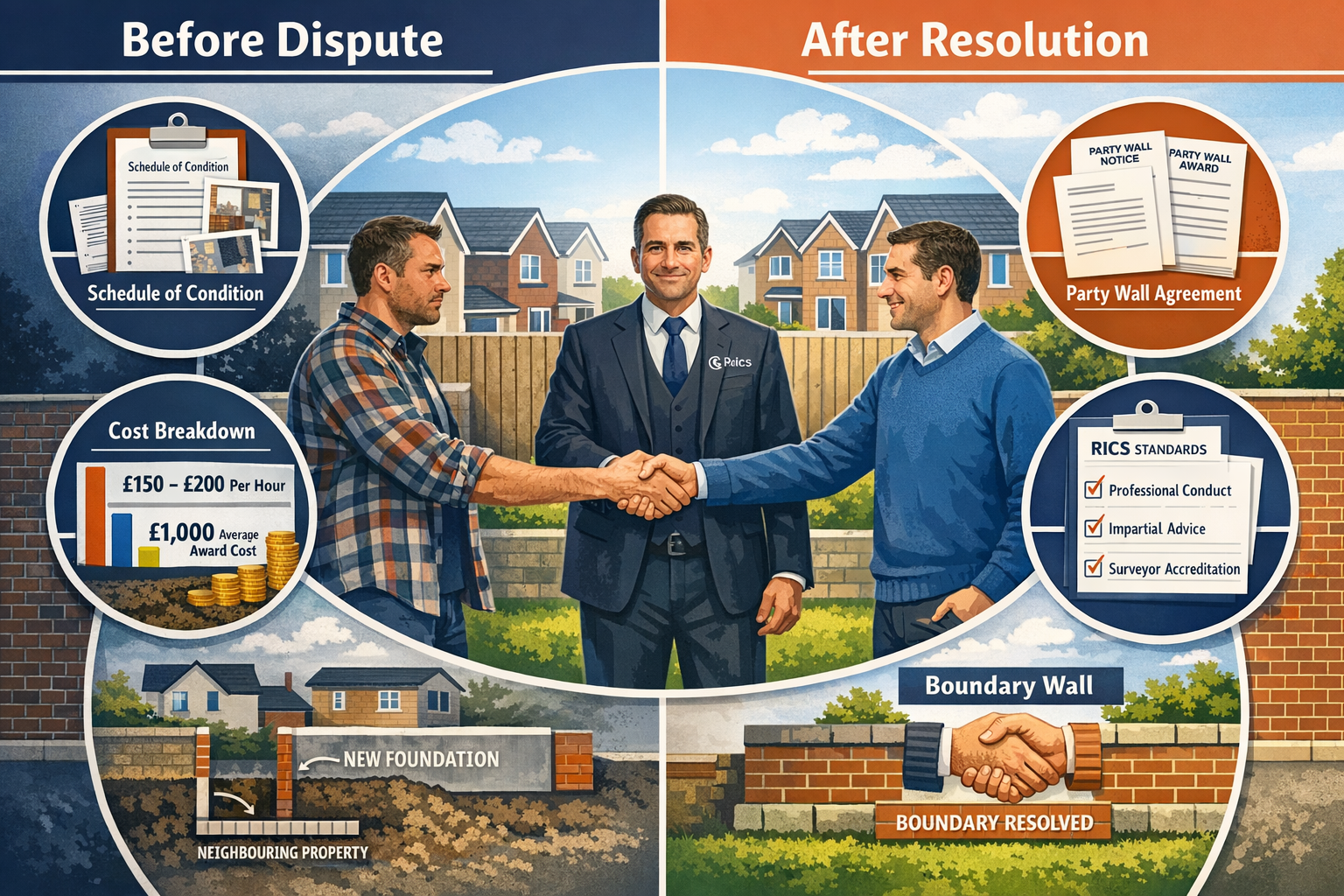
Party Wall Surveys and Neighbour Disputes in 2026's UK Construction Uptick: RICS Compliance Essentials represents more than regulatory compliance—it's a framework for successful construction projects that maintain positive community relations while protecting all parties' interests. The unprecedented construction activity across England and Wales in 2026 has elevated party wall matters from occasional necessity to routine requirement for property owners.
By following the RICS compliance framework outlined in this guide, property owners can navigate the complex intersection of legal requirements, professional standards, and neighbour relations with confidence. The key principles remain consistent: early engagement, qualified professional assistance, comprehensive documentation, and respectful communication.
Actionable Next Steps
If you're planning construction work in 2026:
- Assess your obligations: Determine whether your project requires party wall notices
- Engage RICS-qualified surveyors: Select professionals with MRICS or FRICS designations and relevant experience
- Start early: Begin the process at least 3 months before your planned construction start date
- Communicate proactively: Inform neighbours before serving formal notices
- Budget appropriately: Allocate £1,000-£2,000+ for party wall compliance costs
- Document everything: Maintain comprehensive records throughout the process
For professional assistance with party wall matters, contact qualified surveyors who can guide you through every stage of compliance.
The 2026 construction uptick presents tremendous opportunities for property enhancement, but only when approached with proper planning and professional guidance. By prioritizing RICS compliance essentials from the outset, property owners transform potential disputes into collaborative processes that benefit all parties and contribute to successful construction outcomes.
References
[1] Party Walls – https://www.rics.org/consumer-guides/party-walls
[2] Party Wall Agreement – https://hoa.org.uk/advice/guides-for-homeowners/i-am-improving/party-wall-agreement/
[3] Party Walls The Fundamentals – https://www.rics.org/training-events/online-training/on-demand/party-walls-the-fundamentals
[4] Party Wall Surveys And Neighbour Disputes During 2026s Construction Uptick Rics Compliance Framework – https://nottinghillsurveyors.com/blog/party-wall-surveys-and-neighbour-disputes-during-2026s-construction-uptick-rics-compliance-framework