


The construction landscape in 2026 presents unprecedented challenges for party wall surveyors. Modern builds—particularly data centers, mixed-use developments, and high-tech facilities—involve intricate mechanical systems, advanced structural engineering, and specialized materials that dwarf the complexity of traditional residential projects. This evolution has created a dangerous gap: party wall agreements drafted for simple extensions now govern projects requiring sophisticated technical oversight. Scope Creep Risks in Party Wall Agreements for Complex 2026 Builds: Essential Clauses for Surveyors have become a critical concern as surveyors find themselves inadvertently assuming design responsibilities, providing technical guidance beyond their expertise, and exposing themselves to significant liability.
The stakes have never been higher. Contractors entering 2026 face a legal environment driven by shifting regulations, technological advancement, and heightened expectations from all parties involved in construction disputes[1]. For party wall surveyors, this means every agreement must explicitly define boundaries, incorporate protective language, and anticipate the scope expansion that complex builds inevitably trigger.
Key Takeaways
✅ Complex 2026 builds dramatically increase scope creep risk as surveyors are asked to provide guidance on sophisticated systems beyond traditional party wall matters
⚠️ Design waiver clauses are essential protective tools that explicitly state surveyors' suggestions are non-binding and require design professional approval
📋 Clear scope limitation language must define not just what surveyors will do, but explicitly what they will not do to prevent liability expansion
🔄 Formal change management procedures within party wall awards prevent uncontrolled scope expansion and protect all parties
🛡️ No-warranty provisions shield surveyors from unintended professional liability when complex technical issues arise
Understanding Scope Creep in Modern Party Wall Agreements
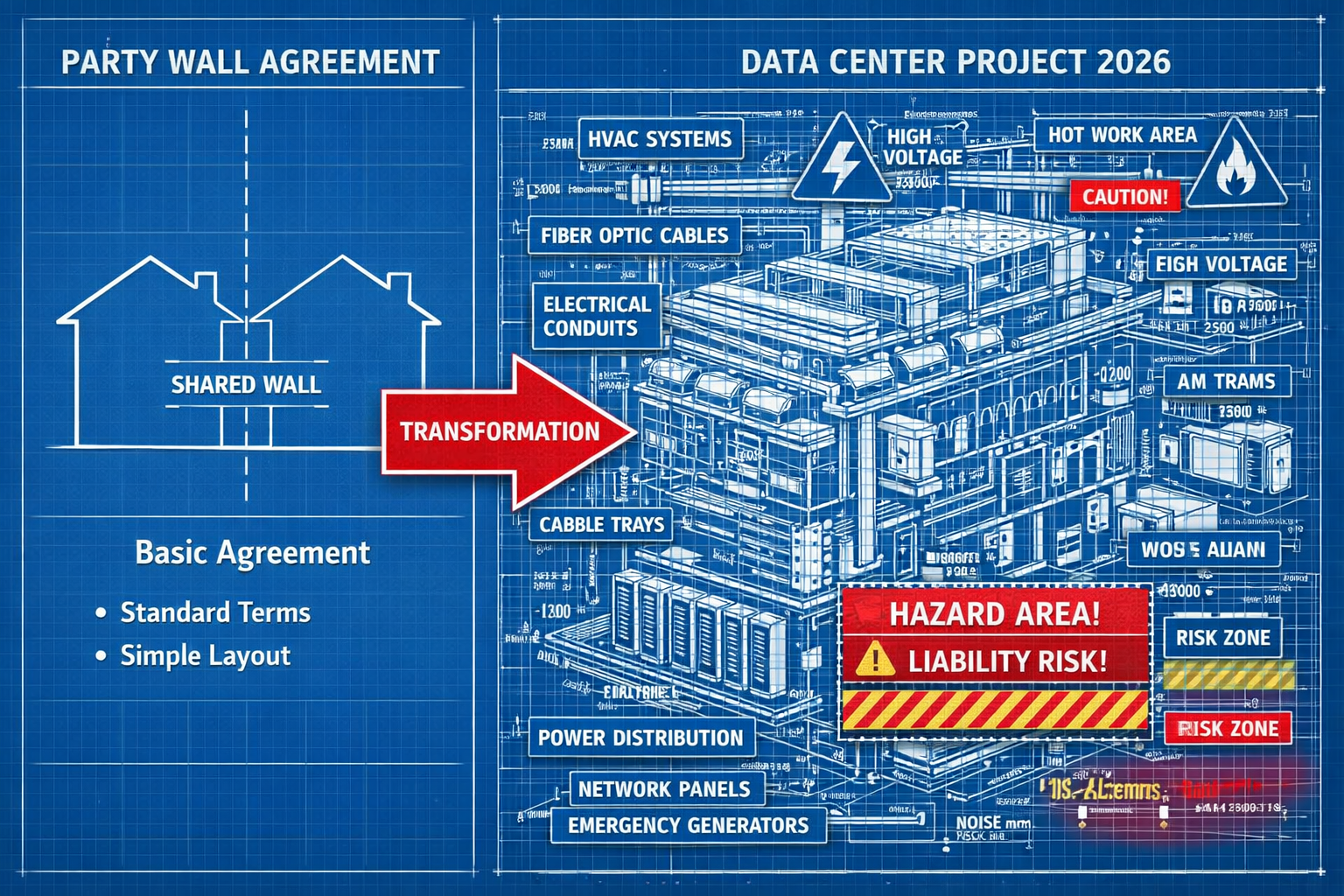
Scope creep occurs when a project's requirements expand beyond the originally agreed boundaries without corresponding adjustments to resources, timelines, or fees. In party wall matters, this phenomenon has become particularly problematic as building complexity increases.
The 2026 Complexity Factor
Traditional party wall work typically involved straightforward scenarios: a homeowner excavating a basement, building a rear extension, or raising a party wall. Surveyors assessed structural impact, documented existing conditions through a schedule of condition, and issued awards with clear parameters.
Today's complex builds present entirely different challenges:
- Data centers with sophisticated cooling systems requiring deep excavations and vibration-sensitive equipment
- Mixed-use developments combining residential, commercial, and industrial spaces with varying structural requirements
- Smart buildings incorporating integrated building management systems that cross property boundaries
- Sustainable construction using novel materials and techniques without established precedent
As building systems grow more complex, contractors and surveyors are increasingly being asked to provide guidance beyond their original scope—sometimes stepping into roles traditionally reserved for architects or engineers, expanding liability exposure[1].
How Scope Expands in Party Wall Matters
Scope creep in party wall agreements typically follows predictable patterns:
- Initial consultation expansion: Building owners seek "quick advice" on design feasibility during preliminary discussions
- Technical specification drift: Surveyors are asked to comment on structural calculations or material specifications
- Coordination responsibilities: Expectations grow that surveyors will coordinate between contractors, engineers, and architects
- Dispute resolution overreach: Parties expect surveyors to resolve design disputes or construction methodology conflicts
- Post-completion involvement: Ongoing requests to assess issues unrelated to the original party wall works
Without a clear change management strategy outlining how change requests will be handled, who is involved in decisions, and how resources will be realigned, scope changes can lead to uncontrolled scope creep[2].
The Liability Trap
When surveyors provide guidance beyond their defined scope—even informally—they may inadvertently:
- Assume professional liability for design decisions outside their expertise
- Create contractual obligations not covered by their insurance
- Undermine the authority of appointed design professionals
- Generate disputes about who is responsible when issues arise
Understanding types of party wall works helps establish appropriate scope boundaries from the outset.
Essential Protective Clauses for Scope Creep Risks in Party Wall Agreements for Complex 2026 Builds
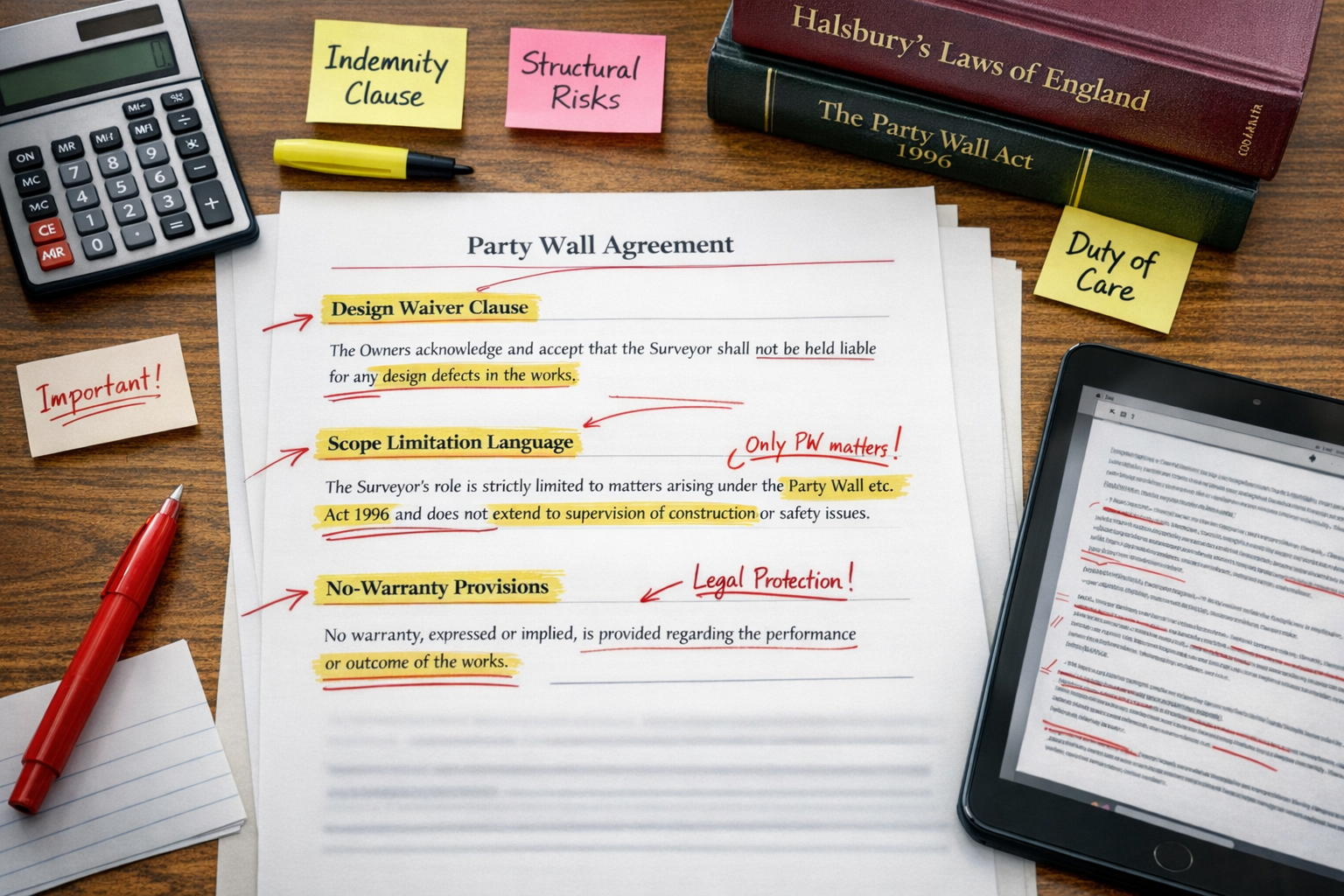
Protecting against scope creep requires proactive contract drafting. The following clauses provide essential safeguards for surveyors working on complex projects.
1. Design Waiver Clauses 🛡️
Purpose: Explicitly state that surveyors' suggestions regarding construction methodology, materials, or structural approach are non-binding observations only.
Sample Language:
"The surveyors appointed under this Award are not responsible for design, structural calculations, or specification of materials. Any observations, suggestions, or comments made by the surveyors regarding construction methodology, materials selection, or structural approach are provided for informational purposes only and do not constitute professional design advice. All such matters remain the sole responsibility of the Building Owner's appointed design professionals (architects, structural engineers, or other specialists as appropriate). The Building Owner and Adjoining Owner acknowledge that no reliance should be placed on surveyor comments regarding design matters, and any design decisions must receive explicit written approval from appropriately qualified design professionals before implementation."
Attorneys recommend clearly defining not just what contractors will do, but explicitly what they will not do—such as including design waivers stating that any suggestions beyond scope are non-binding and require sign-off from a design professional[1].
2. Scope Limitation Provisions
Purpose: Define the surveyor's role boundaries with precision, listing both included and excluded responsibilities.
Key Elements:
Surveyor Responsibilities Include:
- Assessing party wall impact under the Party Wall etc. Act 1996
- Preparing schedules of condition for affected properties
- Determining reasonable working hours and access provisions
- Resolving disputes specifically related to party wall matters
- Monitoring compliance with the Award's specific requirements
Surveyor Responsibilities Explicitly Exclude:
- Structural design or engineering calculations
- Building control or planning compliance
- Material specification or procurement
- Contractor selection or supervision
- Health and safety management
- Project management or coordination between trades
- Warranty or guarantee of construction quality
- Assessment of building defects unrelated to notifiable works
For guidance on the surveyor appointment process, review information about building owners' surveyors and adjoining owners' surveyors.
3. No-Warranty Language
Purpose: Prevent implied warranties about construction quality, durability, or fitness for purpose.
Sample Language:
"The surveyors provide no warranty, guarantee, or representation regarding the quality, durability, fitness for purpose, or compliance with building regulations of any works carried out pursuant to this Award. The surveyors' role is limited to assessing party wall impact and ensuring reasonable protection for the Adjoining Owner's property. All warranties regarding construction quality remain with the Building Owner, their contractors, and their design professionals."
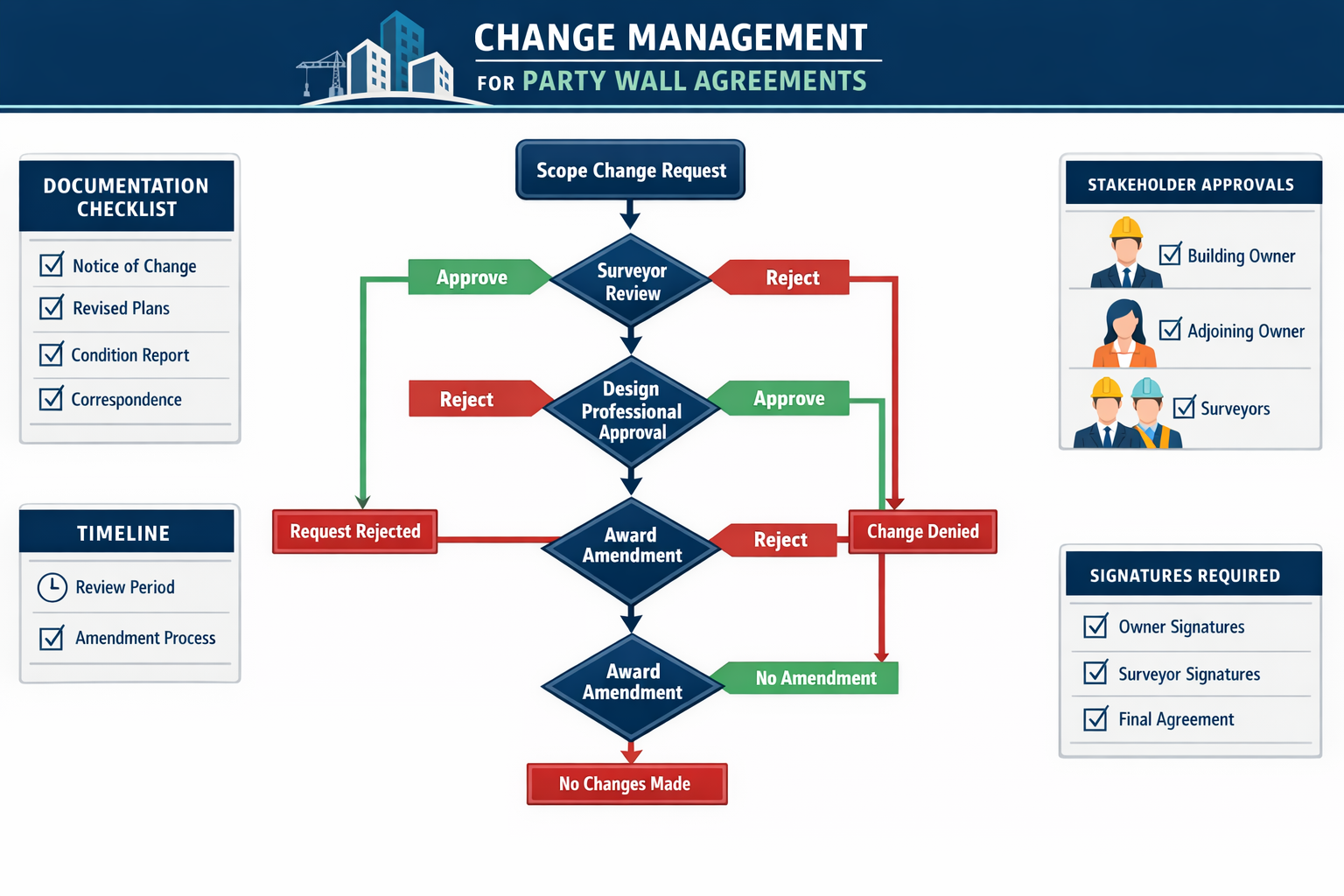
4. Change Management Procedures
Purpose: Establish formal processes for handling scope changes, preventing informal expansion of responsibilities.
Essential Components:
| Element | Requirement |
|---|---|
| Change Request Form | Written documentation required for any scope modification |
| Impact Assessment | Analysis of time, cost, and liability implications |
| Approval Authority | Designated decision-makers for both Building and Adjoining Owners |
| Fee Adjustment | Clear methodology for calculating additional surveyor fees |
| Award Amendment | Formal supplemental award documenting approved changes |
| Timeline Extension | Automatic adjustment to surveyor involvement period |
Understanding proper party wall award procedures ensures changes are documented appropriately.
5. Professional Boundary Clauses
Purpose: Clarify the relationship between surveyors and other construction professionals.
Sample Language:
"Where the Building Owner has appointed architects, structural engineers, or other design professionals, the surveyors shall defer to those professionals on all matters within their respective areas of expertise. The surveyors may request information, clarification, or modifications to protect the Adjoining Owner's interests, but shall not supersede or contradict the professional judgment of appointed design professionals. Any conflict between surveyor observations and design professional recommendations shall be resolved through formal consultation between those professionals, with the surveyors' role limited to articulating party wall protection requirements."
6. Complex Systems Exclusion
Purpose: Specifically address sophisticated building systems common in 2026 construction.
Sample Language:
"The surveyors are not responsible for assessing, approving, or monitoring: (a) HVAC systems and mechanical equipment; (b) electrical systems and data infrastructure; (c) building management and automation systems; (d) specialized waterproofing or tanking systems; (e) acoustic insulation or vibration control measures; (f) fire protection and compartmentation; (g) renewable energy installations; or (h) any other specialized building systems. Assessment of such systems remains the responsibility of appropriately qualified specialists appointed by the Building Owner."
7. Dispute Resolution Scope Limitation
Purpose: Prevent surveyors from being drawn into broader construction disputes.
Sample Language:
"The surveyors' dispute resolution authority is strictly limited to matters arising directly from notifiable party wall works under the Party Wall etc. Act 1996. Disputes regarding construction quality, contractor performance, design adequacy, building control compliance, or any matters outside the specific scope of party wall impact shall be resolved through separate mechanisms and do not fall within the surveyors' jurisdiction under this Award."
Implementing Scope Creep Protections in Complex 2026 Builds
Incorporating protective clauses is only the first step. Effective implementation requires ongoing vigilance and clear communication throughout the project lifecycle.
Pre-Appointment Strategies
1. Complexity Assessment 📊
Before accepting appointment, surveyors should evaluate:
- Building type and intended use
- Structural complexity and novel construction methods
- Presence of specialized systems or equipment
- Number of professional consultants involved
- Previous party wall history at the location
For location-specific considerations, consult resources for party wall surveyors in Central London, North London, South London, East London, or West London.
2. Fee Structure Alignment
Complex builds require fee structures that account for:
- Extended involvement periods
- Multiple site visits for sophisticated works
- Coordination with specialized consultants
- Potential for scope change requests
- Enhanced insurance requirements
Learn more about costs of party wall processes and strategies for keeping party wall costs down.
3. Clear Terms of Engagement
Appointment letters should explicitly reference:
- Scope limitation clauses
- Change management procedures
- Fee adjustment mechanisms
- Professional boundary acknowledgments
- Insurance coverage limits
During the Award Drafting Process
1. Incorporate Standard Protective Language
Develop template clauses for complex builds that can be customized for specific projects. Maintain a library of proven protective provisions.
2. Cross-Reference Design Documentation
Awards should explicitly reference and defer to:
- Structural engineer's calculations and drawings
- Architect's specifications
- Specialist consultant reports
- Method statements from contractors
3. Define Monitoring Parameters
Clearly specify what surveyors will monitor:
- ✅ Compliance with working hours
- ✅ Protection measures for adjoining property
- ✅ Adherence to agreed access arrangements
- ✅ Structural movement within specified tolerances
- ❌ NOT construction quality generally
- ❌ NOT compliance with building regulations
- ❌ NOT contractor workmanship standards
Understanding party wall notices and party structure notices helps establish appropriate monitoring scope.
Managing Scope During Construction
1. Document All Communications 📝
Maintain detailed records of:
- Requests for advice outside defined scope
- Referrals to appropriate design professionals
- Informal observations distinguished from formal determinations
- Scope change requests and responses
2. Redirect Inappropriate Requests
When asked to opine on matters outside scope:
"Thank you for your question regarding [technical matter]. This falls outside my scope as party wall surveyor and should be directed to [appropriate professional]. I'm happy to coordinate with them regarding any party wall implications once they've provided their professional assessment."
3. Formal Change Process Enforcement
Refuse to expand scope informally. Require:
- Written change request
- Impact assessment period
- Fee negotiation
- Supplemental award if approved
4. Regular Boundary Reinforcement
Periodically remind parties of scope limitations, especially when:
- New team members join the project
- Unexpected issues arise
- Project complexity increases
- Disputes emerge
Post-Completion Considerations
1. Clear Completion Documentation
Awards should specify:
- Surveyor involvement end date
- Final inspection parameters
- Handover procedures
- Ongoing obligations (if any)
2. Warranty Disclaimers
Final documentation should reiterate that surveyors provide no ongoing warranty regarding construction quality or durability.
3. Referral Protocols
Establish clear procedures for post-completion issues:
- Party wall matters → surveyors may remain involved
- Construction defects → building owner's design team
- Maintenance issues → property owners' responsibility
Special Considerations for Specific Complex Build Types
Different project types present unique scope creep risks requiring tailored protections.
Data Centers and Technical Facilities
Unique Risks:
- Sophisticated cooling and electrical systems
- Vibration-sensitive equipment
- 24/7 operational requirements
- Cybersecurity and access control concerns
Additional Protective Clauses:
- Explicit exclusion of IT infrastructure assessment
- Vibration monitoring by specialist consultants only
- Operational continuity as building owner responsibility
- Security protocol compliance outside surveyor scope
Mixed-Use Developments
Unique Risks:
- Multiple property types with different standards
- Varied occupancy during construction
- Complex phasing requirements
- Diverse stakeholder expectations
Additional Protective Clauses:
- Phase-specific scope definitions
- Separate awards for different building uses
- Stakeholder communication protocols
- Occupancy management as building owner responsibility
Historic or Listed Buildings
Unique Risks:
- Conservation requirements
- Specialist materials and techniques
- Heritage body involvement
- Precedent-setting implications
Additional Protective Clauses:
- Deference to conservation specialists
- Explicit exclusion of heritage compliance
- Listed building consent as prerequisite
- Traditional techniques outside surveyor expertise
Sustainable and Innovative Construction
Unique Risks:
- Novel materials without track record
- Experimental construction methods
- Renewable energy system integration
- Long-term performance uncertainty
Additional Protective Clauses:
- Innovation risk acknowledgment
- Performance warranty exclusions
- Specialist consultant requirements
- Long-term monitoring outside scope
Common Scope Creep Scenarios and Response Strategies
Scenario 1: "Can You Just Quickly Look at This?"
Situation: Building owner asks surveyor to "quickly review" structural calculations or material specifications.
Risk: Informal review creates implied approval and potential liability.
Response Strategy:
- Acknowledge the request
- Clarify it falls outside party wall scope
- Refer to appropriate professional (structural engineer)
- Offer to coordinate if party wall implications arise
- Document the referral in writing
Scenario 2: Design Professional Disagreement
Situation: Architect and structural engineer disagree on approach; parties ask surveyor to "settle" the dispute.
Risk: Surveyor lacks authority and expertise to resolve design disputes.
Response Strategy:
- Clarify surveyor role is limited to party wall matters
- Suggest design professionals resolve through their professional channels
- Offer to articulate party wall protection requirements once design is settled
- Document that surveyor takes no position on design dispute
- Suspend party wall work if necessary until design is resolved
Scenario 3: Contractor Seeks Method Statement Approval
Situation: Contractor submits detailed method statement asking surveyor to "approve" construction approach.
Risk: Approval implies responsibility for methodology and safety.
Response Strategy:
- Review only for party wall impact implications
- Confirm method statement addresses award requirements
- Explicitly state review is not approval of methodology generally
- Refer safety and technical matters to building owner's team
- Document limited nature of review
Scenario 4: Post-Completion Defect Investigation
Situation: Months after completion, adjoining owner reports defects and expects surveyor to investigate and determine responsibility.
Risk: Defect investigation exceeds party wall scope and may involve construction quality issues.
Response Strategy:
- Determine if issue relates to notifiable party wall works
- If yes: assess whether it falls within award scope
- If no: refer to building owner's warranty or design team
- Clarify surveyor involvement ended per award terms
- Suggest independent building surveyor if necessary
The 2026 Legal and Regulatory Context
Contractors entering 2026 face a legal environment driven by shifting regulations, technological advancement, and heightened professional standards[1]. Several factors make scope creep management particularly critical:
Increased Professional Liability Scrutiny
Courts and insurance providers are paying closer attention to:
- Professional boundary violations
- Scope of appointment clarity
- Documentation of limitations
- Referral to appropriate specialists
Technology Integration Challenges
Building information modeling (BIM), AI-assisted design, and smart building systems create new gray areas where traditional professional boundaries blur.
Sustainability and Innovation Pressures
The push toward net-zero construction introduces novel materials and methods that may fall outside traditional surveyor expertise.
Stakeholder Expectations
More sophisticated clients expect comprehensive guidance, potentially pushing surveyors beyond appropriate boundaries.
Best Practices for Surveyors in 2026
Professional Development
- Stay current on construction technology without claiming expertise outside qualifications
- Understand limitations of your knowledge and insurance coverage
- Build networks of specialist consultants for referrals
- Maintain clear records of scope boundaries in all projects
Communication Excellence
- Set expectations early about scope limitations
- Confirm understanding in writing after verbal discussions
- Use consistent language about what you will and won't do
- Educate clients about the value of staying within scope
Documentation Discipline
- Template libraries for protective clauses
- Scope confirmation letters for every appointment
- Change request forms ready for immediate use
- Referral tracking to demonstrate appropriate boundary maintenance
Insurance Alignment
- Review coverage for complex project types
- Confirm exclusions match scope limitations
- Notify insurers of unusual risk factors
- Maintain adequate limits for project scale
Resources and Tools for Managing Scope Creep Risks
Essential Documentation
- Free download sample party wall agreement template
- Party wall contract template guide on party wall awards
- Party Wall Act notices and how to respond
Understanding Boundaries
- Guide on boundary wall rules and differences between party fence walls and boundary walls
- Boundary rules: how close can my neighbour build to my fence
- Understanding party fence walls
Process Guidance
Conclusion
Scope Creep Risks in Party Wall Agreements for Complex 2026 Builds: Essential Clauses for Surveyors represent one of the most significant professional challenges facing the industry today. As construction projects grow increasingly sophisticated—incorporating data centers, smart building systems, and innovative sustainable technologies—the gap between traditional party wall scope and stakeholder expectations widens dangerously.
The protective clauses outlined in this guide provide essential safeguards:
✅ Design waiver clauses that explicitly disclaim responsibility for technical design matters
✅ Scope limitation provisions that define both included and excluded responsibilities
✅ No-warranty language that prevents implied guarantees about construction quality
✅ Change management procedures that formalize scope modification processes
✅ Professional boundary clauses that clarify relationships with other consultants
Success in 2026 requires more than simply incorporating these clauses into agreements. Surveyors must actively manage scope throughout the project lifecycle through clear communication, diligent documentation, and firm boundary maintenance. When asked to step beyond appropriate limits, the professional response is not expansion but referral to qualified specialists.
Actionable Next Steps
- Review your current agreement templates and incorporate the protective clauses outlined above
- Develop a scope change request form for immediate deployment when expansion requests arise
- Create a referral network of structural engineers, architects, and specialists for complex issues
- Audit your professional indemnity insurance to ensure coverage aligns with scope limitations
- Train your team on recognizing and responding to scope creep scenarios
- Document your scope boundaries in every client communication from initial inquiry through completion
- Stay informed about emerging construction technologies while maintaining clear expertise boundaries
The complexity of 2026 construction is not diminishing. By implementing robust scope protections now, surveyors can continue providing valuable party wall services while avoiding the liability traps that increasingly complex builds present. The key is clarity: clearly defined scope, clearly communicated limitations, and clearly documented boundaries throughout every engagement.
References
[1] 5 Legal Risks Contractors Cant Ignore In 2026 – https://www.constructionowners.com/news/5-legal-risks-contractors-cant-ignore-in-2026
[2] Scope Creep What It Is And How To Manage It – https://aliresources.hexagon.com/enterprise-project-performance/scope-creep-what-it-is-and-how-to-manage-it