


One in three party wall notices contains defects serious enough to invalidate the entire process — and in 2026, that figure is costing building owners weeks of delay and thousands in avoidable legal fees [10]. Whether a homeowner is planning a rear extension, a loft conversion, or a basement excavation, a defective notice does not just slow things down; it can expose the building owner to injunctions and civil liability before a single brick is laid.
This guide to the top 10 party wall notice mistakes in 2026: surveyor fixes for validity and swift neighbor responses breaks down the most common errors identified by practicing surveyors, explains exactly why each one matters under the Party Wall etc. Act 1996, and provides practical, surveyor-validated corrections that keep projects on schedule.
Key Takeaways
- Approximately 40% of party wall disputes in 2026 originate from preventable errors at the notice stage [1]
- Incorrect service methods, vague work descriptions, and missing statutory information are the three most frequent causes of invalid notices
- The RICS 8th Edition Party Wall Guidance 2026 introduces updated compliance standards that surveyors must now follow [7]
- Serving the wrong notice type or missing an adjoining owner can invalidate the entire statutory process
- Professional surveyor involvement significantly reduces the risk of dissent, delay, and court escalation
Why Notice Errors Dominate Party Wall Disputes in 2026
Around 40% of party wall disputes in 2026 trace back to errors made at the very first step: serving the notice [1]. This is not a minor administrative inconvenience. An invalid notice means the statutory process under the Party Wall etc. Act 1996 has not legally begun. The building owner cannot proceed lawfully, the neighbor has no obligation to respond within the standard 14-day window, and any work started in the interim risks injunction proceedings.
The Party Wall etc. Act 1996 was designed to protect both building owners and adjoining owners. When notices fail, both parties lose the protections the Act provides. Understanding the most common mistakes — and the surveyor-validated fixes for each — is the single most effective way to avoid costly delays.
The Top 10 Party Wall Notice Mistakes in 2026: Surveyor Fixes for Validity and Swift Neighbor Responses
Mistake 1: Serving the Wrong Type of Notice
The Act provides for three distinct notice types: a Party Structure Notice for works to a shared wall or structure, a Line of Junction Notice for building on or near the boundary, and a Three Metre or Six Metre Notice for excavations near neighboring foundations. Serving the wrong type — for example, issuing a Line of Junction Notice when a Party Structure Notice is required — invalidates the process entirely [2].
Surveyor fix: Before drafting any notice, surveyors conduct a detailed assessment of the proposed works and match them to the correct statutory trigger. RICS 2026-aligned templates are now used to prevent categorization errors. For an overview of which notice applies to which work, the types of party wall works guide provides a clear breakdown.
Mistake 2: Vague or Incomplete Work Descriptions
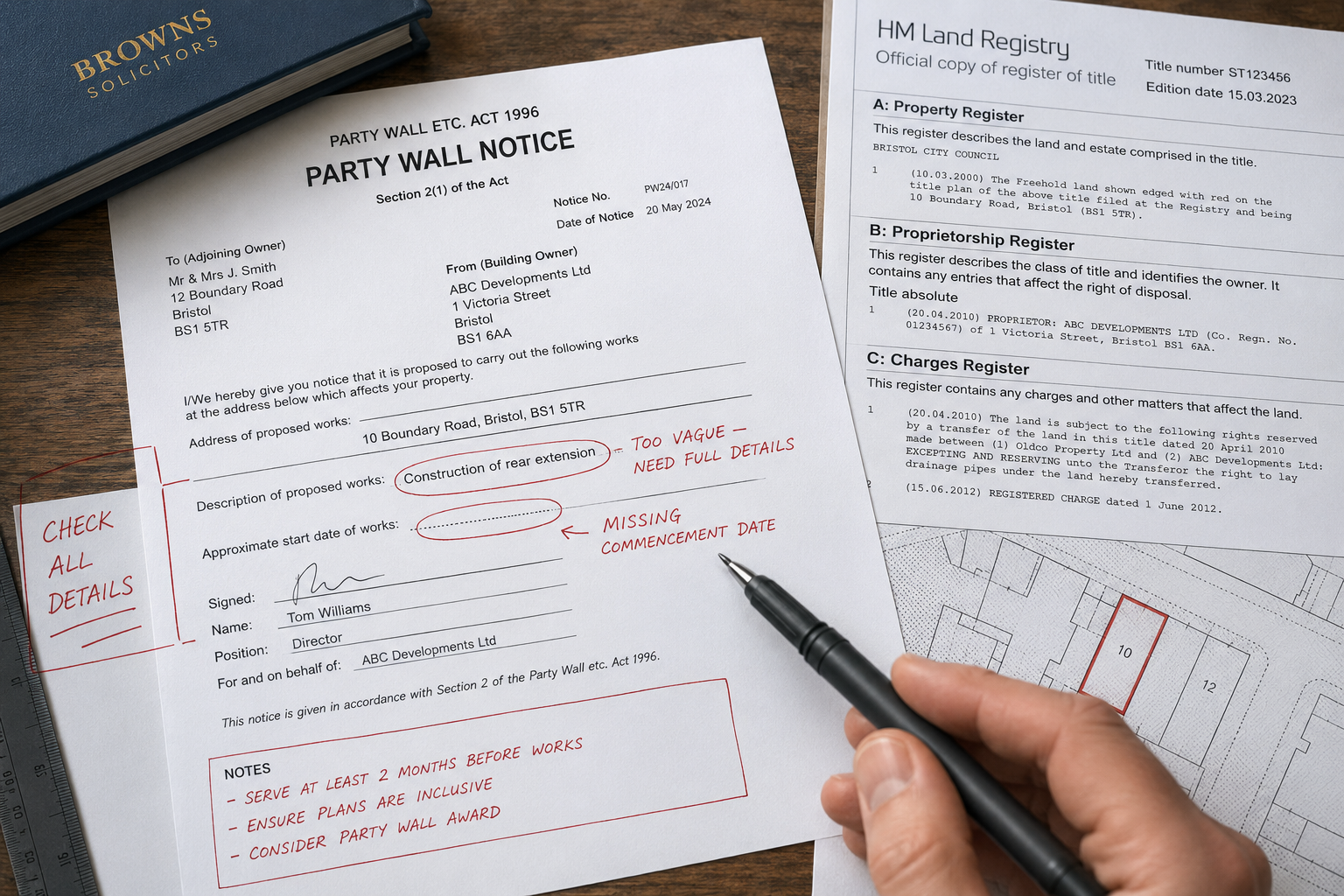
Over 25% of cases involve neighbor objections or dissent triggered by insufficient detail about proposed works [1]. A notice that simply states "rear extension works" gives the adjoining owner no meaningful basis on which to consent or object. Vague descriptions are one of the primary reasons neighbors dissent and appoint their own surveyor — triggering a formal dispute process that adds weeks and expense.
Surveyor fix: Surveyors now mandate comprehensive technical specifications and architectural drawings as attachments to the notice. The description should state the nature of the work, the materials to be used, the depth of any excavations, and the likely duration. Precision at this stage is the single most effective way to encourage consent rather than dissent.
Mistake 3: Missing Statutory Information
A valid notice must include specific mandatory information: the full legal name and address of the building owner, the address of the property where works will take place, a clear commencement date, and a statement of the owner's rights and the neighbor's rights under the Act [3]. Omitting any of these elements renders the notice invalid.
Surveyor fix: Standardized templates updated for 2026 are used to ensure every mandatory field is completed before service. A checklist review against the Act's requirements is conducted for every notice. For those considering a DIY approach, a free downloadable party wall agreement template is available, though professional review is strongly advised for complex projects.
Mistake 4: Incorrect Service Methods
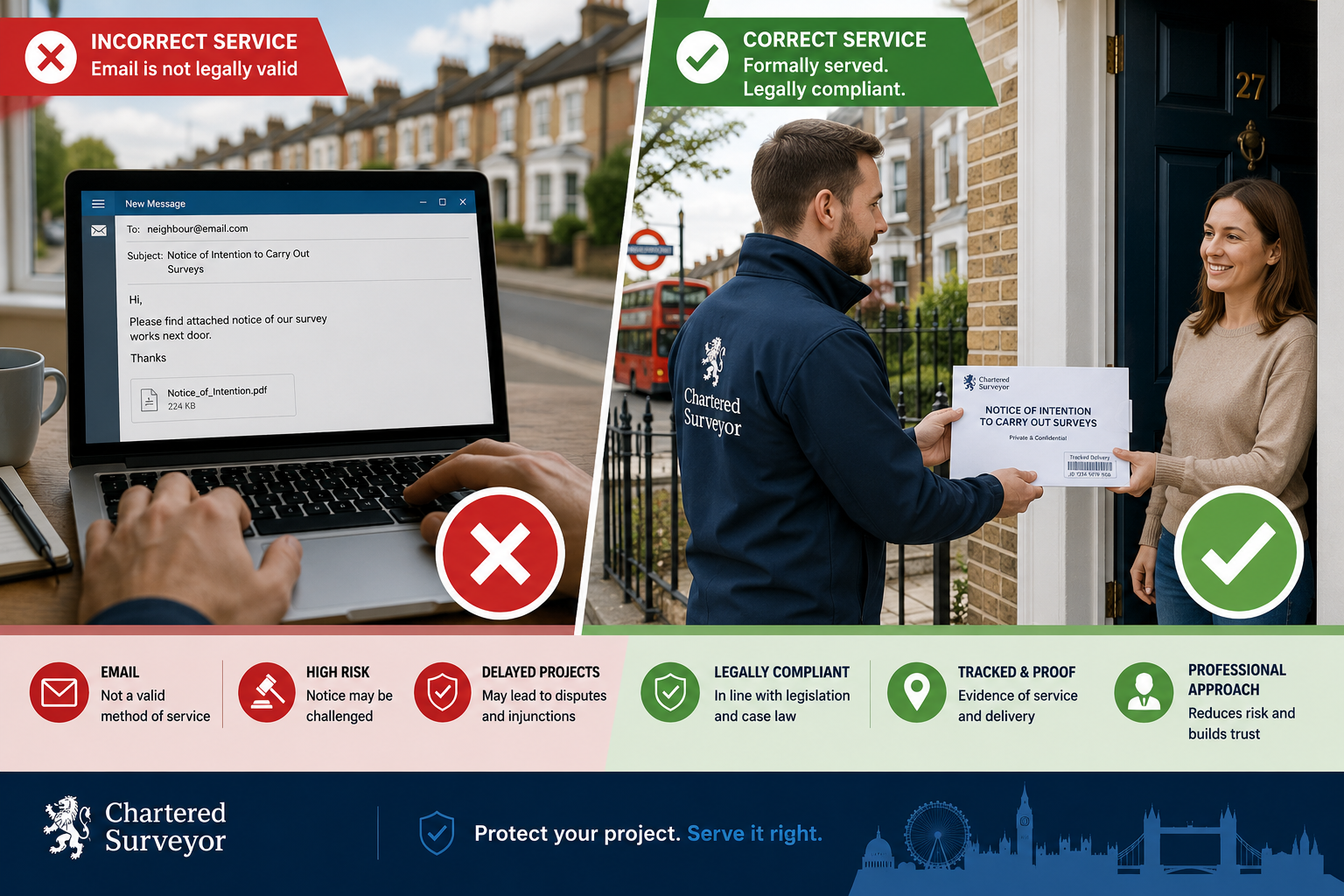
Approximately 30% of notice failures result from improper service methods [2]. Common errors include serving notice by email alone without postal confirmation, delivering to a tenant rather than the freeholder, or hand-delivering without obtaining a signed acknowledgment. None of these methods satisfy the Act's service requirements on their own.
Surveyor fix: The Act requires service by personal delivery, by post to the last known address, or by leaving the notice at the adjoining owner's premises. In 2026, surveyors are implementing tracked delivery systems with proof of postage and delivery confirmation. Where personal service is used, a contemporaneous record is kept.
"Proof of valid service is not optional — it is the foundation on which the entire statutory process rests."
Mistake 5: Failure to Identify All Adjoining Owners
Notices must be served on every person with a legal interest in the adjoining property. This includes freeholders and long leaseholders (typically those with leases of more than one year remaining). Serving only the occupying tenant, or missing a co-owner, means the notice is not validly served on all required parties [4].
Surveyor fix: A thorough Land Registry search is conducted before any notice is prepared. This identifies all registered proprietors and any long leaseholders with a qualifying interest. This step is non-negotiable on any project involving terraced, semi-detached, or flatted properties.
Mistake 6: Wrong or Missing Commencement Date
The Act requires that the notice specify a proposed commencement date for the works, and that this date falls within the correct statutory window — not less than one month (for Party Structure Notices) or two months (for Three Metre/Six Metre Notices) from the date of service. Notices with no date, an incorrect date, or a date that falls outside the statutory window are invalid [3].
Surveyor fix: Commencement dates are calculated precisely from the confirmed date of service, not the date of drafting. A buffer of several days is built in to account for postal delivery times. The proposed start date is then confirmed in writing with the building owner before the notice is dispatched.
Mistake 7: Starting Work Before the Statutory Waiting Period Expires
Even where a notice is validly served, commencing construction before the statutory notice period has expired — or before a Party Wall Award has been agreed — exposes the building owner to injunction proceedings [5]. Courts have shown little sympathy for building owners who proceed prematurely, regardless of whether the neighbor has informally indicated consent.
Surveyor fix: A formal project timeline is established at the outset, with the statutory waiting period built in as a non-negotiable milestone. Written consent from the adjoining owner is secured before any work begins. Where a neighbor has not responded within 14 days, the dispute resolution process is triggered immediately rather than assuming consent.
Mistake 8: DIY Notices on Complex Projects
While the Act does not prohibit building owners from serving their own notices, DIY notices on complex projects — particularly basement excavations, structural alterations to shared walls, or projects involving multiple adjoining owners — carry a significantly elevated risk of failure [6]. Common DIY errors include vague descriptions, missed owners, and incorrect notice types.
Surveyor fix: For straightforward projects with a single adjoining owner and simple works, a carefully prepared DIY notice using an up-to-date template may be adequate. For anything more complex, professional surveyor involvement from the outset is the most cost-effective approach. The party wall notices service page outlines what professional notice preparation covers.
Mistake 9: Failing to Serve Multiple Notices for Basement Extensions
Basement excavations near boundaries frequently trigger more than one type of notice under the Act. A basement that involves both work to a shared wall and excavation within three or six metres of a neighboring foundation requires both a Party Structure Notice and a Three Metre or Six Metre Notice [9]. Serving only one notice leaves part of the statutory process incomplete.
Surveyor fix: A pre-notice assessment is conducted for all basement and excavation projects to identify every statutory trigger. Where multiple notices are required, they are prepared and served simultaneously to avoid staggered timelines. For London-specific guidance, resources on party wall notice mistakes in basement extensions provide detailed advice.
Mistake 10: Ignoring the Third Surveyor Mechanism When Deadlock Occurs
When the two appointed surveyors cannot agree, the Act provides for a third surveyor to resolve the dispute. Only 37% of party wall disputes reaching deadlock are resolved without court escalation [8]. A common mistake is failing to activate the third surveyor mechanism promptly, allowing disputes to drift toward expensive litigation.
Surveyor fix: The third surveyor is selected and agreed upon at the outset of the process — not after a deadlock has developed. The RICS 8th Edition Party Wall Guidance 2026 provides updated protocols for third surveyor activation and cost recovery [7]. Prompt use of this mechanism is consistently faster and cheaper than court proceedings.
How the RICS 8th Edition Changes the Compliance Landscape in 2026
The RICS 8th Edition Party Wall Guidance, introduced in 2026, represents the most significant update to surveyor practice standards in over a decade [7]. Key changes affecting notice validity and neighbor responses include:
| Area of Change | Previous Practice | 2026 RICS 8th Edition Standard |
|---|---|---|
| Notice templates | Varied by firm | Standardized RICS-aligned templates |
| Service methods | Postal or personal | Tracked delivery with digital confirmation |
| Third surveyor selection | Often deferred | Selected at appointment stage |
| Fee disputes | Ad hoc resolution | Structured cost recovery protocols |
| Jurisdictional issues | Case-by-case | Clearer statutory interpretation guidance |
Surveyors who have not updated their practices to align with the 8th Edition risk producing notices and awards that are vulnerable to legal challenge. Building owners should confirm that any surveyor they appoint is working to current RICS standards.
Surveyor-Validated Checklist: Before You Serve Any Notice in 2026
The following checklist consolidates the surveyor fixes described above into a practical pre-service review:
- Confirm the correct notice type for each element of the proposed works
- Obtain a full Land Registry search to identify all adjoining owners
- Include full legal names, addresses, and the property address in the notice
- Attach detailed architectural drawings and technical specifications
- Calculate the commencement date correctly from the confirmed service date
- Use tracked postal delivery and retain proof of service
- Set a project timeline that respects all statutory waiting periods
- Identify and agree on a third surveyor at the outset
- For basement or excavation projects, assess whether multiple notices are required
- Use RICS 8th Edition-aligned templates for all notice documents
For building owners who want to understand the full process before instructing a surveyor, the party wall act notices guide provides a thorough introduction to how notices work and what neighbors can expect.
What Happens When a Notice Is Challenged or Ignored
Even a correctly served notice can encounter problems if the adjoining owner does not respond within 14 days. Under the Act, silence is treated as dissent, triggering the dispute resolution process and the appointment of surveyors. A party wall award then sets out the rights and obligations of both parties before work begins.
Where a notice is successfully challenged as invalid — because of any of the ten mistakes described above — the building owner must re-serve a corrected notice and restart the statutory clock. On a project with a two-month notice period, this can push the start date back by ten weeks or more. Add the cost of a neighbor's surveyor fees and potential injunction proceedings, and the financial case for getting the notice right the first time is overwhelming [10].

Regional Considerations: London-Specific Notice Challenges
London's dense urban environment creates particular challenges for party wall compliance. Terraced and semi-detached properties, basement conversions, and loft extensions in close proximity to multiple neighbors mean that a single project can require notices to three, four, or even five adjoining owners simultaneously. Missing any one of them invalidates the process for that boundary.
Surveyors operating across central London, east London, south London, and north London report that multi-owner notice failures are among the most common causes of project delays in the capital. A pre-notice Land Registry audit covering all boundaries is now standard practice for any London project involving excavation or structural works.
Conclusion
The top 10 party wall notice mistakes in 2026 — from serving the wrong notice type to ignoring the third surveyor mechanism — share a common thread: they are all preventable with the right preparation and professional input. The surveyor fixes outlined in this guide are not theoretical; they are the practical corrections that experienced party wall surveyors apply on every project to protect their clients from delay, dispute, and legal liability.
Actionable next steps for building owners in 2026:
- Instruct a qualified party wall surveyor before drafting any notice — not after a problem has arisen
- Commission a Land Registry search to confirm all adjoining owners before service
- Use RICS 8th Edition-aligned notice templates and attach full architectural drawings
- Build the statutory waiting period into the project programme from day one
- Agree on a third surveyor at the outset to avoid deadlock escalating to court
For neighbors who have received a notice and are unsure how to respond, the adjoining owners guide explains the options clearly. For building owners ready to proceed, the building owners surveyor service provides professional notice preparation and full statutory compliance support.
Getting the notice right is not just a legal formality — it is the single most effective investment a building owner can make before construction begins.
References
[1] Common Mistakes In Party Wall Notices How Surveyors Fix Dissent And Delays – https://partywallsurveyorlondon.uk/blogs/common-mistakes-in-party-wall-notices-how-surveyors-fix-dissent-and-delays/?utm_source=openai
[2] Invalid Party Wall Notices Surveyor Strategies To Avoid Injunctions And Delays In 2026 – https://wimbledonsurveyors.com/invalid-party-wall-notices-surveyor-strategies-to-avoid-injunctions-and-delays-in-2026/?utm_source=openai
[3] What Makes A Party Wall Notice Valid – https://www.houricanassociates.com/party-wall-news/what-makes-a-party-wall-notice-valid/?utm_source=openai
[4] Party Wall Notice Drafting Errors That Invalidate Compliance Avoiding Legal Challenges Before Work Begins – https://partywallsurveyorlondon.uk/blogs/party-wall-notice-drafting-errors-that-invalidate-compliance-avoiding-legal-challenges-before-work-begins/?utm_source=openai
[5] Partywallsurveyoressex – https://www.oseimc.com/partywallsurveyoressex?utm_source=openai
[6] Diy Party Wall Notice Or Surveyor – https://www.surveyofpartywall.co.uk/diy-party-wall-notice-or-surveyor/?utm_source=openai
[7] Rics 8th Edition Party Wall Guidance 2026 Implementation Challenges And Surveyor Compliance Strategies – https://wimbledonsurveyors.com/rics-8th-edition-party-wall-guidance-2026-implementation-challenges-and-surveyor-compliance-strategies/?utm_source=openai
[8] Third Surveyor Activation In Party Wall Deadlocks Rics 8th Edition Protocols And Cost Recovery Tactics For 2026 – https://manchestersurveyors.com/third-surveyor-activation-in-party-wall-deadlocks-rics-8th-edition-protocols-and-cost-recovery-tactics-for-2026/?utm_source=openai
[9] Party Wall Notice Mistakes Basement Extensions London 2026 The Complete Guide To Avoiding Costly Disputes – https://partywallsurveyorlondon.uk/blogs/party-wall-notice-mistakes-basement-extensions-london-2026-the-complete-guide-to-avoiding-costly-disputes/?utm_source=openai
[10] The Most Common Reasons Party Wall Awards Get Delayed Challenged Or Ignored – https://manchestersurveyors.com/the-most-common-reasons-party-wall-awards-get-delayed-challenged-or-ignored/?utm_source=openai
