
Property owners undertaking construction work in 2026 face a critical financial decision that could double their party wall expenses: appointing a single agreed surveyor or allowing each party to select independent professionals. This choice impacts not just immediate costs but also project timelines, dispute resolution efficiency, and neighbour relationships throughout the construction process.
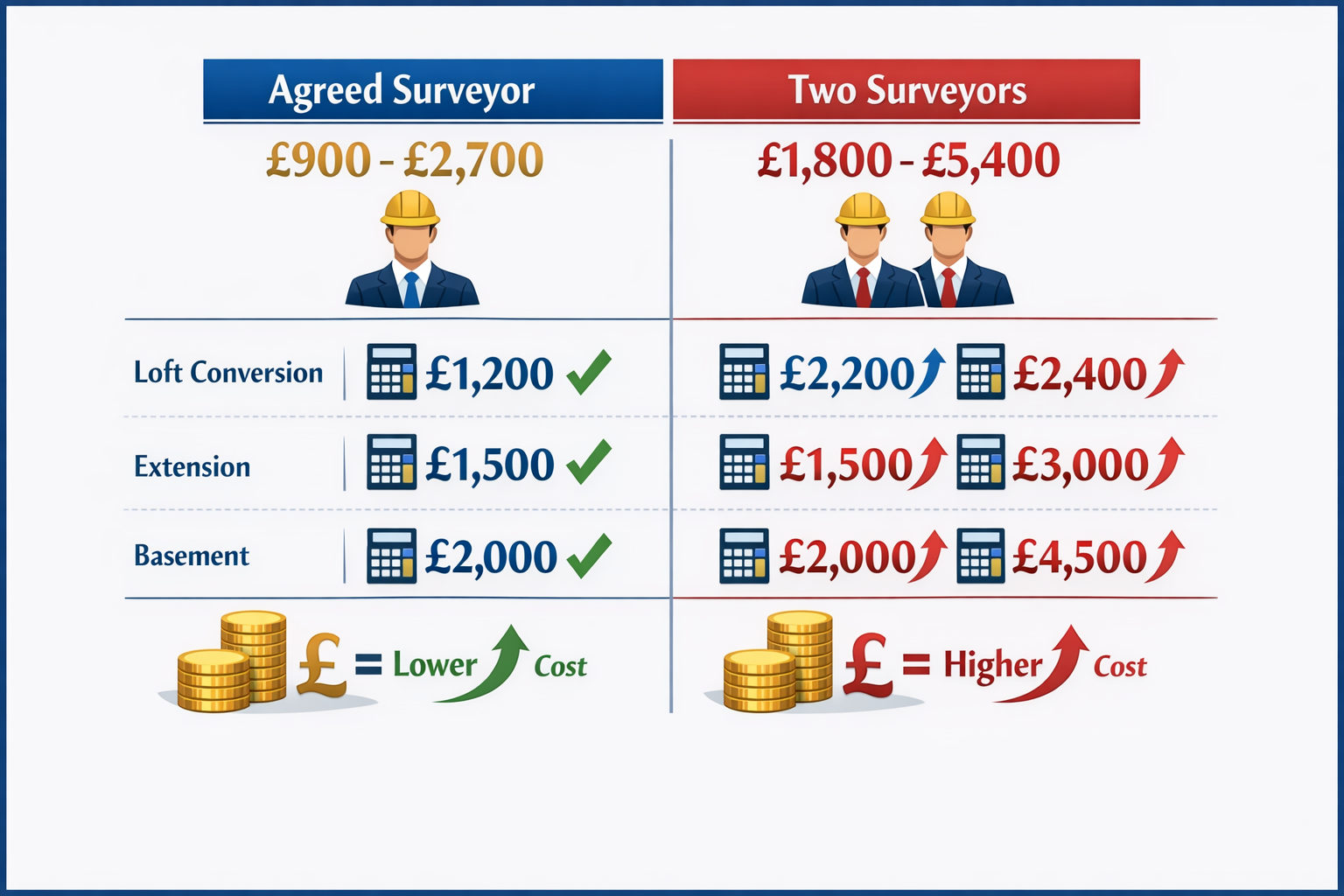
Understanding the Agreed Surveyor vs Two Surveyors: Cost-Benefit Analysis for Party Wall Awards is essential for anyone planning extensions, loft conversions, or basement excavations that affect shared walls. The financial implications are substantial—ranging from £900 to £5,400 depending on the approach selected—making this one of the most consequential decisions in the party wall process.[1]
Key Takeaways
- Single agreed surveyors cost £900–£2,700, while two separate surveyors range from £1,800–£5,400, potentially doubling expenses[1]
- Building owners typically pay all surveyor fees, regardless of which party appoints them, making cost efficiency crucial
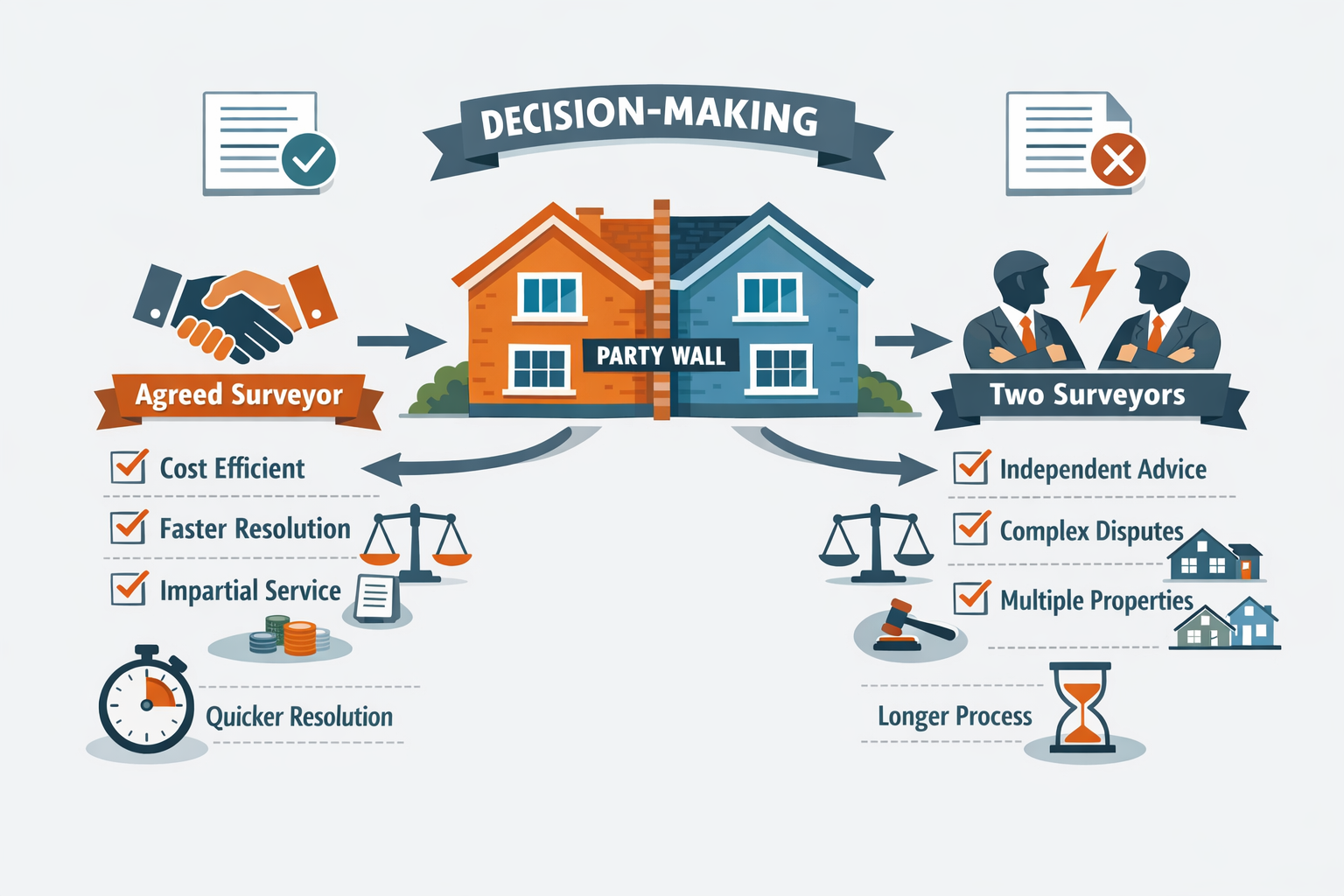
- Agreed surveyors provide impartial representation for both parties, reducing conflict and streamlining the award process
- Two surveyors offer independent advocacy but increase costs, timelines, and the risk of requiring a third surveyor for disputes
- Project complexity, property type, and neighbour relationships should guide the decision between approaches
Understanding Party Wall Surveyor Roles and Responsibilities
The Party Wall etc. Act 1996 establishes the legal framework for construction work affecting shared boundaries between properties. When a building owner serves proper notice and the adjoining owner dissents—or fails to respond within 14 days—surveyors must be appointed to prepare a party wall award that protects both parties’ interests.
The Agreed Surveyor Model 🤝
An agreed surveyor acts as a single professional appointed by mutual consent of both the building owner and adjoining owner. This individual must:
- Maintain complete impartiality between both parties
- Conduct thorough pre-construction inspections and documentation
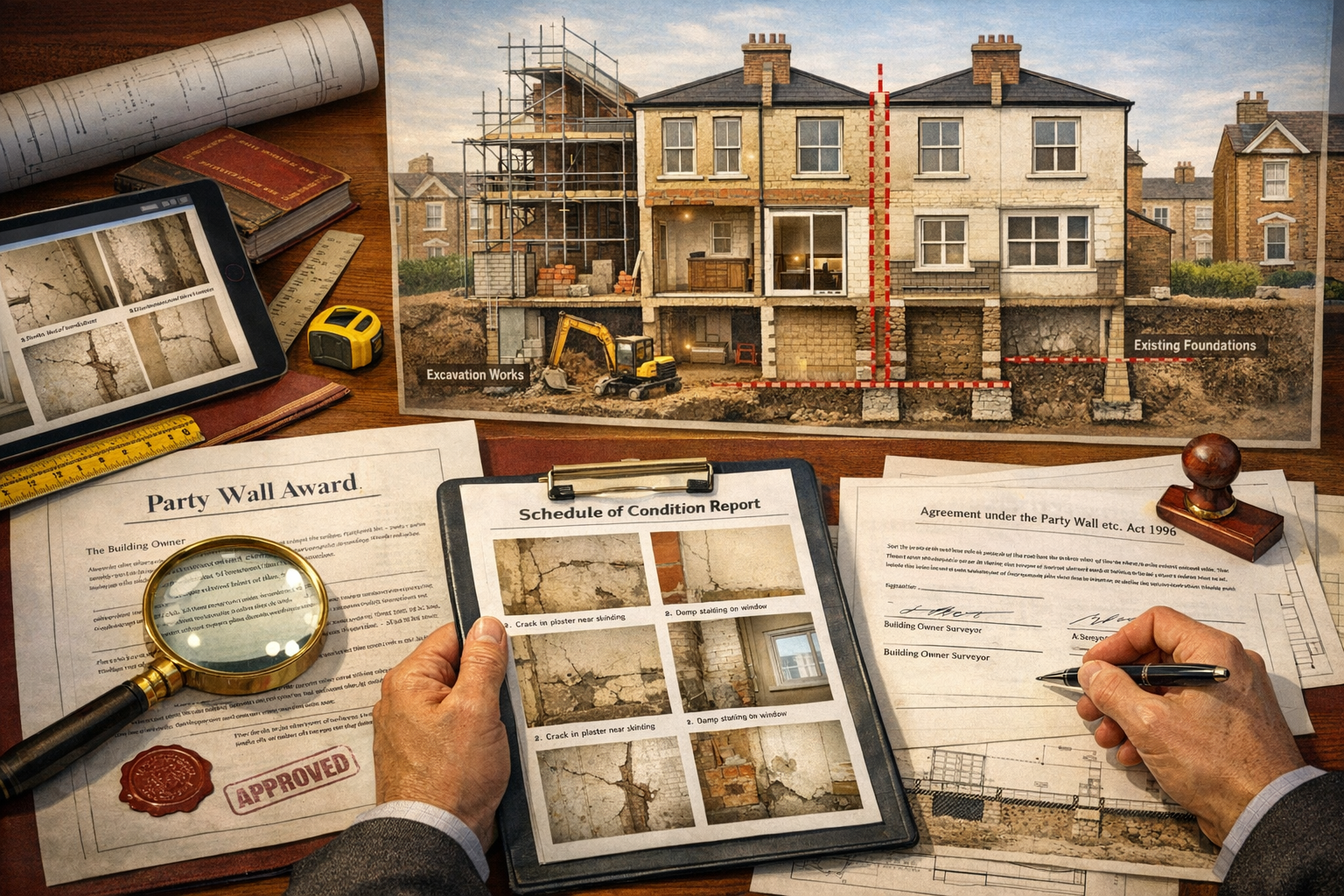
- Prepare schedules of condition recording the party wall’s current state
- Draft the party wall award with fair terms and conditions
- Oversee construction compliance and resolve minor disputes
- Conduct post-construction inspections to verify no damage occurred
The agreed surveyor essentially serves both neighbours simultaneously, balancing their respective interests while ensuring legal compliance.[2] This role requires exceptional diplomatic skills alongside technical expertise.
The Two Surveyor Approach ⚖️
When neighbours appoint separate professionals, each surveyor acts as an advocate for their appointing party:
- The building owner’s surveyor represents the person undertaking construction work
- The adjoining owner’s surveyor protects the neighbour’s property interests
- Both surveyors must collaborate to produce a single party wall award
- If they cannot agree, they appoint a third surveyor to resolve disputes
- Each surveyor charges separate fees, both typically paid by the building owner[1]
This model provides independent representation but introduces additional complexity and expense into the process.
Cost Analysis: Agreed Surveyor vs Two Surveyors for Party Wall Awards
The financial implications of surveyor selection extend far beyond initial appointment fees. Understanding the complete cost structure helps property owners make informed decisions.
Single Agreed Surveyor Cost Breakdown 💰
According to 2026 industry data, agreed surveyor fees vary significantly based on project scope:[1]
| Project Type | Agreed Surveyor Cost | Typical Timeline |
|---|---|---|
| Loft Conversion | £900–£1,200 | 3–4 weeks |
| Single-Storey Extension | £1,200–£1,500 | 4–6 weeks |
| Basement Excavation | £1,800–£2,700 | 6–8 weeks |
These figures represent the total professional fees for preparing the party wall award, conducting inspections, and providing construction oversight. The agreed surveyor model delivers cost efficiency through:
- Single professional fee rather than duplicate charges
- Streamlined communication reducing administrative time
- Faster dispute resolution without requiring third-party intervention
- Reduced documentation as one surveyor handles all records
For straightforward projects with cooperative neighbours, this approach offers substantial savings while maintaining legal compliance.
Two Surveyor Cost Structure 📊
When each party appoints independent surveyors, costs escalate significantly:[1]
| Project Type | Two Surveyors Cost | Potential Third Surveyor |
|---|---|---|
| Loft Conversion | £1,800–£2,400 | +£600–£1,000 |
| Single-Storey Extension | £2,400–£3,000 | +£800–£1,200 |
| Basement Excavation | £3,600–£5,400 | +£1,200–£1,800 |
The building owner typically bears all surveyor fees, including the adjoining owner’s surveyor costs.[2] This financial responsibility makes the two-surveyor approach considerably more expensive.
“Disputes between surveyors requiring third-party resolution can add 30–50% to total party wall costs, transforming a straightforward £1,500 project into a £2,500+ expense.”[1]
Hidden Costs and Additional Expenses
Beyond base surveyor fees, property owners should budget for:
- Multiple property inspections when several neighbours are affected
- Extended project delays if surveyors cannot reach agreement
- Legal consultation if disputes escalate beyond surveyor resolution
- Additional documentation for complex structural concerns
- Third surveyor fees when the two appointed surveyors disagree[3]
These hidden costs can transform an initially reasonable budget into a significant financial burden, particularly for complex projects in densely built areas of Central London or West London.
Agreed Surveyor vs Two Surveyors: Comprehensive Risk Assessment
Financial considerations represent only one dimension of the surveyor selection decision. Risk assessment requires evaluating dispute potential, project complexity, and relationship dynamics.
When an Agreed Surveyor Offers Optimal Value ✅
The single surveyor approach works exceptionally well when:
Neighbour Relationships Are Cooperative
- Both parties communicate respectfully and trust each other
- Previous interactions have been positive and constructive
- No history of property disputes or boundary conflicts
- Neighbours share similar goals for property improvement
Project Scope Is Straightforward
- Standard loft conversions following established building practices
- Single-storey rear extensions with minimal structural impact
- Simple party wall repairs or maintenance work
- Clear construction plans with no unusual engineering requirements
Timeline Efficiency Matters
- Building owner needs rapid party wall award approval
- Construction schedule has fixed start dates with contractor commitments
- Planning permission expiration creates time pressure
- Seasonal considerations affect construction feasibility
Budget Constraints Are Significant
- Total project budget is limited and cost control is essential
- Maximizing construction spend rather than professional fees is prioritized
- Multiple adjoining properties would multiply surveyor costs excessively[3]
For those exploring whether party wall agreements can proceed without surveyors, the agreed surveyor represents a middle ground—professional oversight at reasonable cost.
When Two Surveyors Provide Superior Protection 🛡️
Independent surveyors become advisable in specific circumstances:
Relationship Tensions Exist
- Previous disputes between neighbours about property matters
- Lack of trust or communication breakdowns
- Concerns about fair treatment or impartial representation
- One party feels vulnerable or disadvantaged
Complex Technical Challenges
- Extensive basement excavations affecting foundations
- Structural alterations to load-bearing party walls
- Multiple types of party wall works occurring simultaneously
- Properties with existing structural concerns or historical damage
High-Value Properties
- Luxury homes where potential damage claims could be substantial
- Properties with expensive finishes requiring detailed protection
- Investment properties where landlords need maximum legal protection
- Historic buildings with unique conservation requirements
Multiple Adjoining Owners
- Terraced properties affecting neighbours on both sides
- Flats with party walls, floors, and ceilings shared with multiple units
- Commercial properties with complex ownership structures
- Situations where one adjoining owner appoints a surveyor, triggering others to follow[3]
The independent advocacy provided by separate surveyors justifies the additional expense when stakes are high or relationships are strained.
Dispute Escalation Risks ⚠️
The most expensive scenario occurs when two appointed surveyors cannot reach agreement, requiring third surveyor appointment. This happens when:
- Fundamental disagreements exist about construction methodology
- Surveyors have significantly different interpretations of the Act
- One surveyor is inexperienced or unreasonably adversarial
- Technical complexities exceed the surveyors’ expertise
- Personal conflicts between surveyors impede collaboration
Third surveyor fees add £600–£1,800 to total costs, plus additional delays of 2–4 weeks.[1] This risk makes surveyor selection critical—choosing experienced professionals who collaborate effectively reduces escalation probability.
Strategic Decision Framework: Choosing Your Approach
Making the optimal choice between an agreed surveyor and two surveyors requires systematic evaluation of multiple factors.
Cost-Benefit Decision Matrix
Property owners should assess their situation using this framework:
Factor 1: Financial Impact (Weight: 30%)
- What is your total project budget?
- How much can you allocate to party wall compliance?
- Would doubling surveyor costs significantly impact construction scope?
- Are multiple adjoining properties involved, multiplying costs?
Factor 2: Relationship Quality (Weight: 25%)
- How would you characterize your neighbour relationship?
- Have you successfully resolved previous property matters together?
- Does your neighbour trust your intentions and construction plans?
- Are communication channels open and respectful?
Factor 3: Project Complexity (Weight: 25%)
- Does your project involve standard or unusual construction methods?
- Are structural concerns present in existing party walls?
- Will excavation affect neighbouring foundations?
- How detailed must the schedule of condition documentation be?
Factor 4: Risk Tolerance (Weight: 20%)
- What is your comfort level with potential disputes?
- How important is independent advocacy versus cost savings?
- Could construction delays significantly impact your plans?
- What are the financial consequences of damage claims?
Scoring each factor helps quantify the optimal approach for specific circumstances.
Regional Considerations Across London
Surveyor selection may vary based on property location and local construction patterns:
North London Considerations
- Victorian terraces with closely built properties
- Multiple adjoining owners common in densely populated areas
- Higher likelihood of existing structural issues requiring detailed assessment
South London Factors
- Mix of property types from terraces to semi-detached homes
- Varying neighbour relationship dynamics across different communities
- Growing basement conversion trend increasing complexity
East London Dynamics
- Rapid development and renovation activity
- Newer builds with clearer party wall conditions
- More straightforward projects suitable for agreed surveyors
Location-specific factors influence both cost expectations and optimal surveyor arrangements.
Professional Guidance on Cost Optimization
Experienced party wall professionals recommend several strategies for keeping party wall costs down:
Early Engagement ⏰
Appointing surveyors during the design phase—rather than after construction begins—prevents costly reactive measures. Early involvement allows surveyors to:
- Identify potential party wall issues before they escalate
- Recommend design modifications that reduce compliance complexity
- Establish neighbour communication channels proactively
- Prepare comprehensive documentation before construction pressure intensifies[3]
Transparent Communication 💬
Building owners who maintain open dialogue with neighbours often achieve agreed surveyor appointments more easily. Effective communication includes:
- Explaining construction plans clearly and honestly
- Addressing neighbour concerns before formal notice service
- Sharing architect drawings and construction schedules voluntarily
- Demonstrating commitment to protecting adjoining properties
Experienced Surveyor Selection 🎓
Choosing qualified professionals with proven party wall expertise prevents disputes and reduces overall costs. Key selection criteria include:
- Membership in professional bodies (RICS, FPWS, PYWS)
- Specific party wall specialization rather than general surveying
- Demonstrated experience with similar project types
- Reputation for collaborative, non-adversarial approaches
- Clear fee structures without hidden charges
The surveyor’s experience level directly impacts both cost efficiency and dispute probability.
Practical Implementation: Navigating the Surveyor Appointment Process
Understanding the procedural steps helps property owners execute their chosen approach effectively.
Appointing an Agreed Surveyor
When both parties consent to a single surveyor, the process follows these steps:
- Building owner serves proper party wall notice to adjoining owner
- Adjoining owner consents to the proposed work in writing
- Both parties agree on surveyor selection through mutual discussion
- Formal appointment letters are signed by both neighbours
- Surveyor conducts initial inspections and prepares schedules of condition
- Party wall award is drafted with terms protecting both parties
- Both parties receive and sign the completed award document
- Construction proceeds with surveyor oversight and compliance monitoring
The agreed surveyor must maintain strict impartiality throughout, ensuring neither party receives preferential treatment.[2]
Implementing the Two Surveyor Model
When independent representation is preferred, the procedure becomes more complex:
- Building owner serves party wall notice with surveyor details
- Adjoining owner appoints their own surveyor within 10 days of dissent
- Both surveyors exchange contact information and schedule coordination meetings
- Joint inspections are conducted with both professionals present
- Surveyors negotiate award terms through collaborative discussion
- Agreed terms are documented in a single party wall award
- If disagreement occurs, surveyors appoint a third surveyor for resolution
- Final award is issued and construction compliance is monitored
This approach requires effective collaboration between surveyors to avoid third-party intervention.[1]
Common Pitfalls to Avoid
Property owners frequently encounter these mistakes:
❌ Delaying surveyor appointment until construction is imminent
- Creates unnecessary time pressure and rushed decisions
- Limits surveyor availability and negotiation flexibility
- Increases likelihood of disputes due to compressed timelines
❌ Selecting surveyors based solely on lowest fees
- Inexperienced professionals may create more problems than they solve
- Poor surveyor performance can escalate costs through disputes
- Quality professional guidance prevents expensive mistakes
❌ Failing to communicate openly with neighbours
- Damaged relationships make agreed surveyor appointments impossible
- Adversarial dynamics increase costs and project delays
- Preventable disputes arise from misunderstandings
❌ Ignoring regional expertise requirements
- London party wall work requires specific local knowledge
- Different boroughs have varying construction regulations
- Local surveyors understand regional property characteristics better
Avoiding these errors significantly improves outcomes regardless of which surveyor approach is selected.
Real-World Cost Scenarios: Agreed Surveyor vs Two Surveyors
Examining specific examples illustrates the practical financial implications of surveyor selection.
Scenario 1: Simple Loft Conversion in Terraced Property
Project Details:
- Standard loft conversion with party wall exposure
- Cooperative neighbour relationship
- Straightforward construction with no unusual requirements
- Single adjoining property affected
Agreed Surveyor Approach:
- Surveyor fee: £1,000
- Timeline: 3 weeks to award issuance
- Total party wall cost: £1,000
Two Surveyor Approach:
- Building owner’s surveyor: £1,000
- Adjoining owner’s surveyor: £1,000
- Timeline: 5 weeks to award issuance
- Total party wall cost: £2,000
Cost difference: £1,000 (100% increase)
The agreed surveyor delivers identical legal protection at half the cost for this straightforward project.
Scenario 2: Complex Basement Excavation with Multiple Neighbours
Project Details:
- Deep basement excavation affecting foundations
- Three adjoining properties (terraced house)
- Mixed neighbour relationships (one cooperative, two neutral)
- Structural concerns in existing party walls
Agreed Surveyor Approach:
- Single surveyor managing all three neighbours: £2,500
- Challenges maintaining impartiality with complex interests
- Timeline: 7 weeks
- Total party wall cost: £2,500
Two Surveyor Approach:
- Building owner’s surveyor: £1,800
- Three adjoining owners’ surveyors: £1,800 × 3 = £5,400
- Better advocacy for each party’s specific concerns
- Timeline: 9 weeks
- Total party wall cost: £7,200
Cost difference: £4,700 (188% increase)
For complex projects with multiple stakeholders, the two-surveyor approach provides superior protection despite significantly higher costs. The independent advocacy justifies the expense when structural risks are substantial.
Scenario 3: Extension with Disputed Neighbour Relationship
Project Details:
- Two-storey rear extension
- Previous property disputes between neighbours
- Lack of trust and communication breakdowns
- Adjoining owner concerned about construction impact
Agreed Surveyor Approach:
- Attempted appointment fails due to lack of mutual trust
- Forced to proceed with two surveyors anyway
- Wasted time attempting agreed approach: 2 weeks
Two Surveyor Approach:
- Building owner’s surveyor: £1,400
- Adjoining owner’s surveyor: £1,400
- Independent advocacy reduces conflict
- Timeline: 6 weeks
- Total party wall cost: £2,800
When relationship tensions exist, attempting the agreed surveyor approach wastes time and ultimately fails. Proceeding directly with independent surveyors proves more efficient.
Emerging Trends in Party Wall Practice for 2026
The party wall landscape continues evolving, with several developments affecting surveyor selection decisions.
Digital Documentation and Virtual Inspections
Technology adoption has accelerated post-pandemic, with implications for costs:
- Digital schedules of condition using high-resolution photography and 3D scanning
- Virtual pre-construction inspections reducing surveyor travel time and costs
- Cloud-based document sharing improving communication between surveyors
- Digital signature platforms streamlining award execution
These innovations can reduce agreed surveyor fees by 10–15% while maintaining documentation quality.[4]
Regulatory Changes Under the Renters’ Rights Act 2026
New legislation affects party wall procedures for rental properties:
- Landlords undertaking improvements face modified notice requirements
- Tenant consultation processes add complexity to party wall timelines
- Enhanced protection measures for rental property party walls
- Modified cost allocation when tenants are affected by neighbouring work[5]
Property investors should factor these regulatory changes into surveyor selection and budgeting decisions.
Sustainability and Party Wall Compliance
Green building initiatives create new party wall considerations:
- Retrofit insulation projects affecting party walls require specialized assessment
- Heat pump installations may impact shared structures
- Solar panel mounting on party walls needs careful structural evaluation
- Energy efficiency upgrades triggering party wall notice requirements
Surveyors with sustainability expertise command premium fees but deliver value through specialized knowledge.
Conclusion: Making the Right Choice for Your Project
The Agreed Surveyor vs Two Surveyors: Cost-Benefit Analysis for Party Wall Awards reveals no universal “best” approach—optimal selection depends on project specifics, neighbour dynamics, and risk tolerance. However, clear patterns emerge from the analysis:
Choose an agreed surveyor when:
- Neighbour relationships are cooperative and trusting
- Projects are straightforward with standard construction methods
- Budget constraints make cost efficiency paramount
- Timeline pressures require rapid award preparation
- Single adjoining properties minimize complexity
Choose two surveyors when:
- Relationship tensions or communication breakdowns exist
- Complex structural work creates significant risk exposure
- High-value properties justify additional protection costs
- Multiple adjoining owners are involved
- Independent advocacy provides peace of mind
The financial implications are substantial—agreed surveyors cost £900–£2,700 while two surveyors range from £1,800–£5,400—but cost alone should not drive the decision.[1] Property protection, dispute prevention, and relationship preservation all factor into the optimal choice.
Actionable Next Steps 🎯
Property owners planning construction work should:
- Assess your specific situation using the decision framework provided
- Communicate with neighbours early to gauge cooperation potential
- Research qualified surveyors with proven party wall expertise in your area
- Obtain fee quotes from multiple professionals before committing
- Review the party wall contract template to understand award contents
- Serve proper notices according to Act requirements
- Document all communications with neighbours and surveyors
For complex situations or uncertainty about the optimal approach, consulting with an experienced party wall specialist provides clarity and prevents costly mistakes. The modest investment in professional guidance typically saves multiples of its cost through optimized surveyor selection and dispute prevention.
Whether you choose an agreed surveyor for cost efficiency or two surveyors for independent advocacy, proper party wall compliance protects your construction investment and preserves valuable neighbour relationships throughout the building process.
References
[1] Party Wall Surveyor Cost – hoa.org.uk
[2] Understanding The Importance Of Party Wall Surveys – akt-surveyors.com
[3] Party Wall Award Costs Explained What You Should Budget For – thepartywallguru.com
[4] Schedules Of Condition In Party Wall Works Best Practices To Prevent Post Construction Claims In 2026 – https://nottinghillsurveyors.com/blog/schedules-of-condition-in-party-wall-works-best-practices-to-prevent-post-construction-claims-in-2026
[5] Party Wall Surveys Under Renters Rights Act 2026 Protocols For Landlord Improvements Without Section 21 Evictions – https://nottinghillsurveyors.com/blog/party-wall-surveys-under-renters-rights-act-2026-protocols-for-landlord-improvements-without-section-21-evictions
Speak to a RICS chartered party wall surveyor
Free initial consultation. Notices, awards and schedules of condition across London and nationwide.