
RICS
Looking for expert solutions?
Request a Quote

Author: admin

  • Party Wall Act Basics for Loft Conversions: Notices, Agreements and

    More than 60% of loft conversion disputes stem from inadequate Party Wall Act compliance, leading to costly delays, strained neighbour relations, and potential legal action. Understanding the Party Wall Act Basics for Loft Conversions: Notices, Agreements and Surveyor Essentials before breaking ground can save homeowners thousands of pounds and months of frustration.

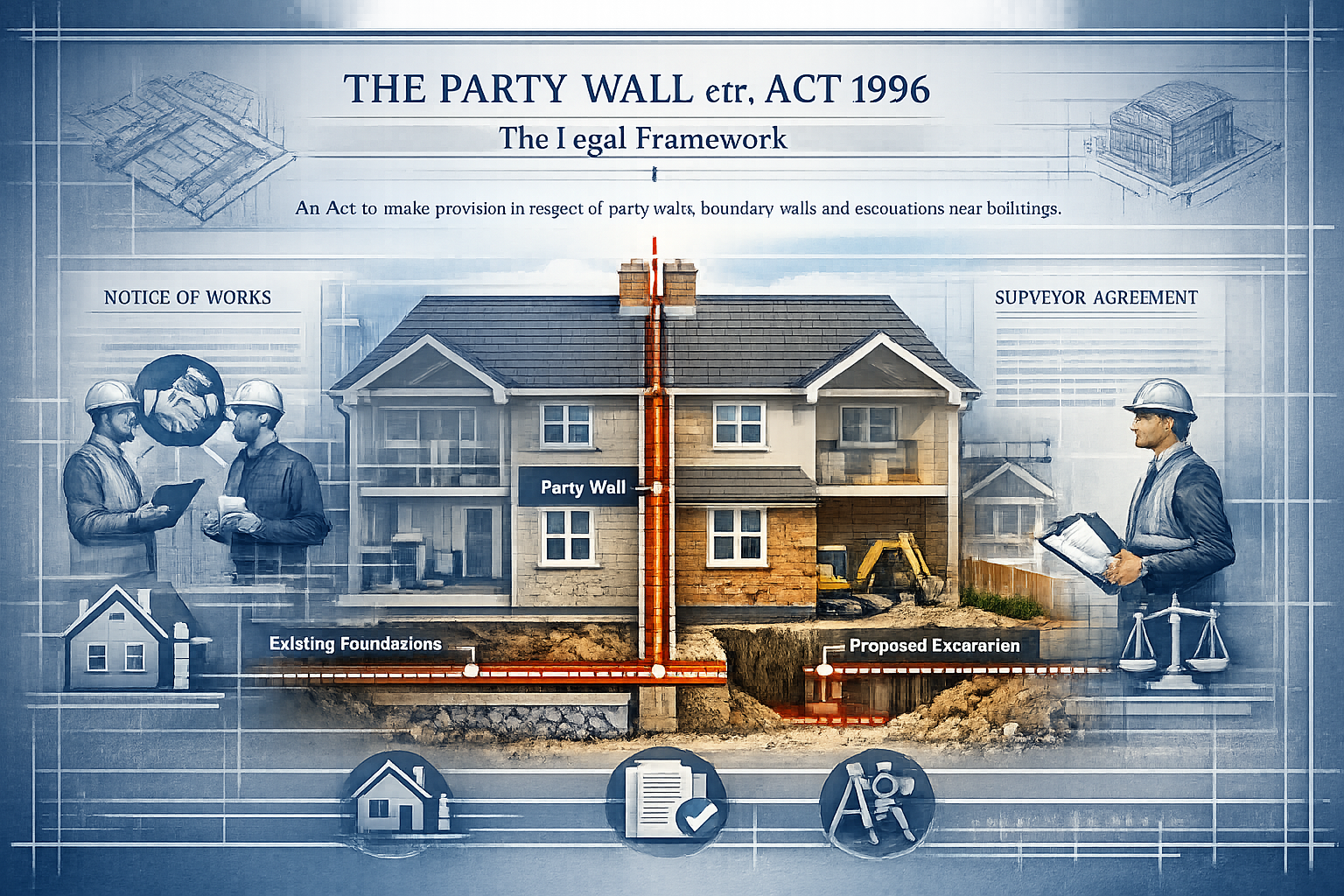
    The Party Wall etc. Act 1996 governs all loft conversion work affecting shared structures in England and Wales, establishing formal procedures that protect both building owners and adjoining property owners. Whether planning a dormer extension, hip-to-gable conversion, or mansard loft transformation, navigating party wall notices correctly ensures legal compliance and smooth project execution.

    This comprehensive guide breaks down the Party Wall Act Basics for Loft Conversions: Notices, Agreements and Surveyor Essentials into actionable steps, covering when notices are required, how to serve them properly, and what role surveyors play in protecting all parties involved.

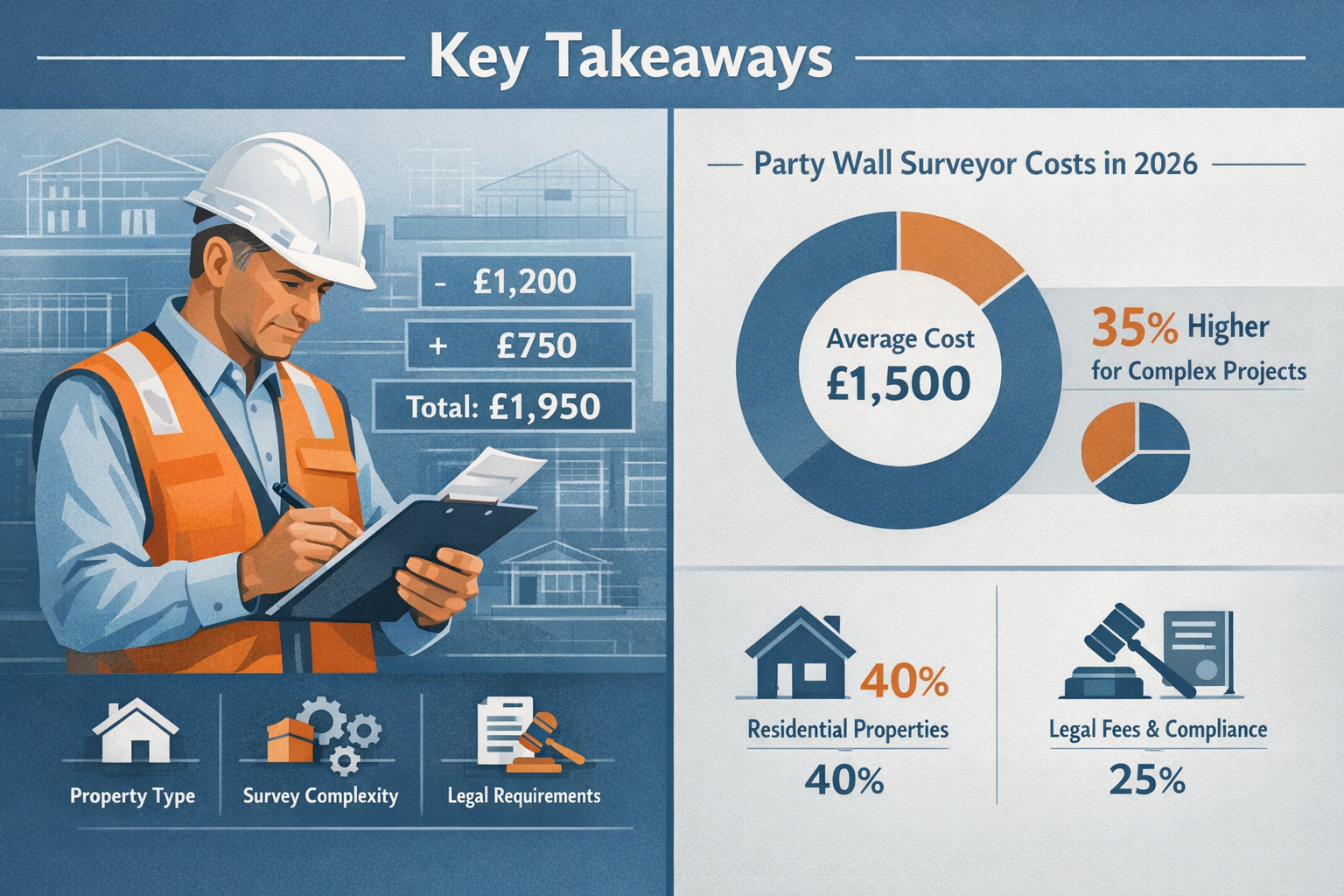
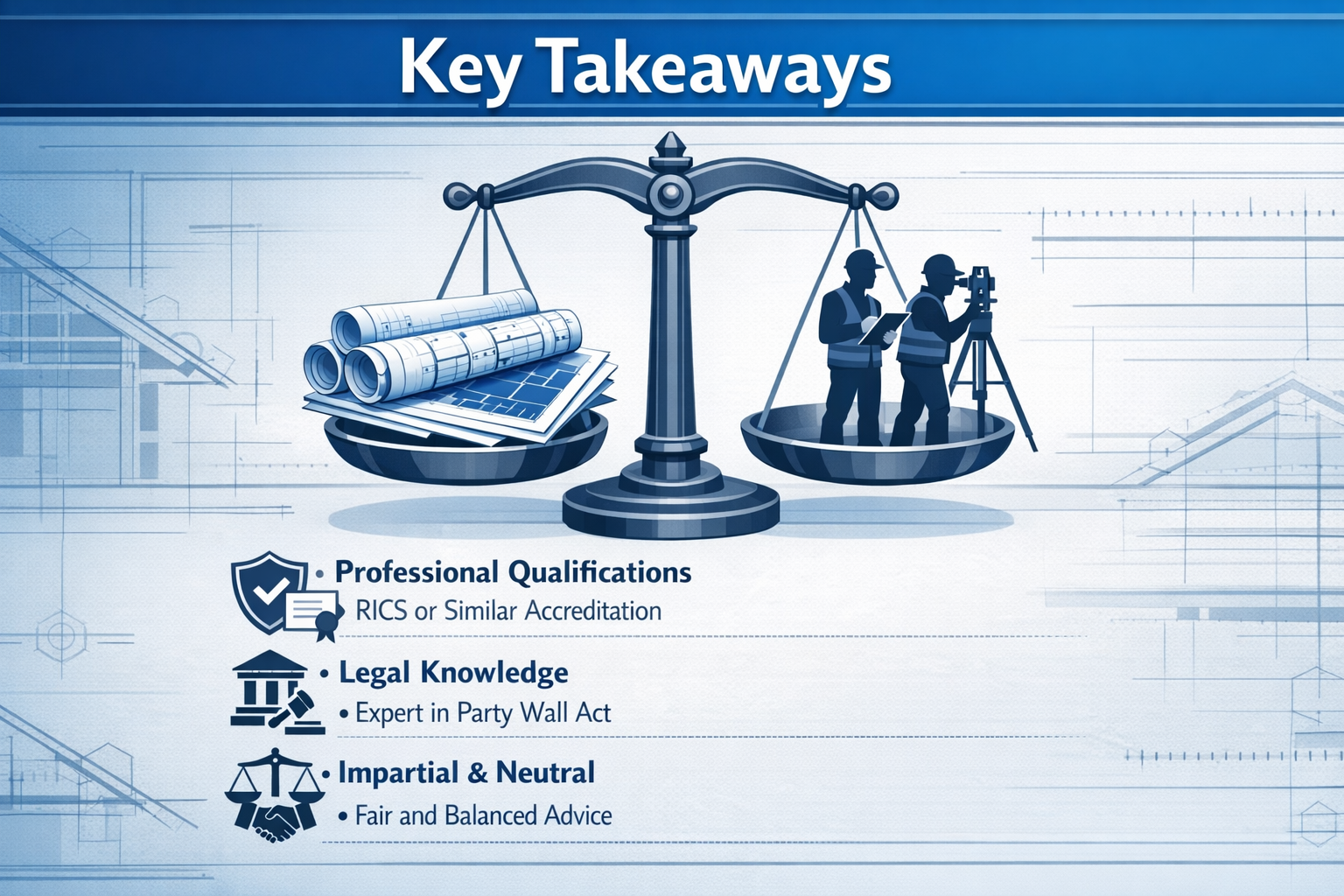
    Key Takeaways

    • Mandatory two-month notice period must be served before structural loft conversion work begins on semi-detached or terraced properties
    • Party Structure Notices are required when cutting into shared walls for steel beams, removing chimney breasts, or raising party wall height
    • Written consent or formal party wall awards must be obtained from all affected adjoining owners before commencing work
    • Independent surveyors draft awards that specify working methods, access arrangements, and protective measures for neighbouring properties
    • Detached properties typically don’t require party wall agreements unless excavation occurs within three metres of adjoining structures
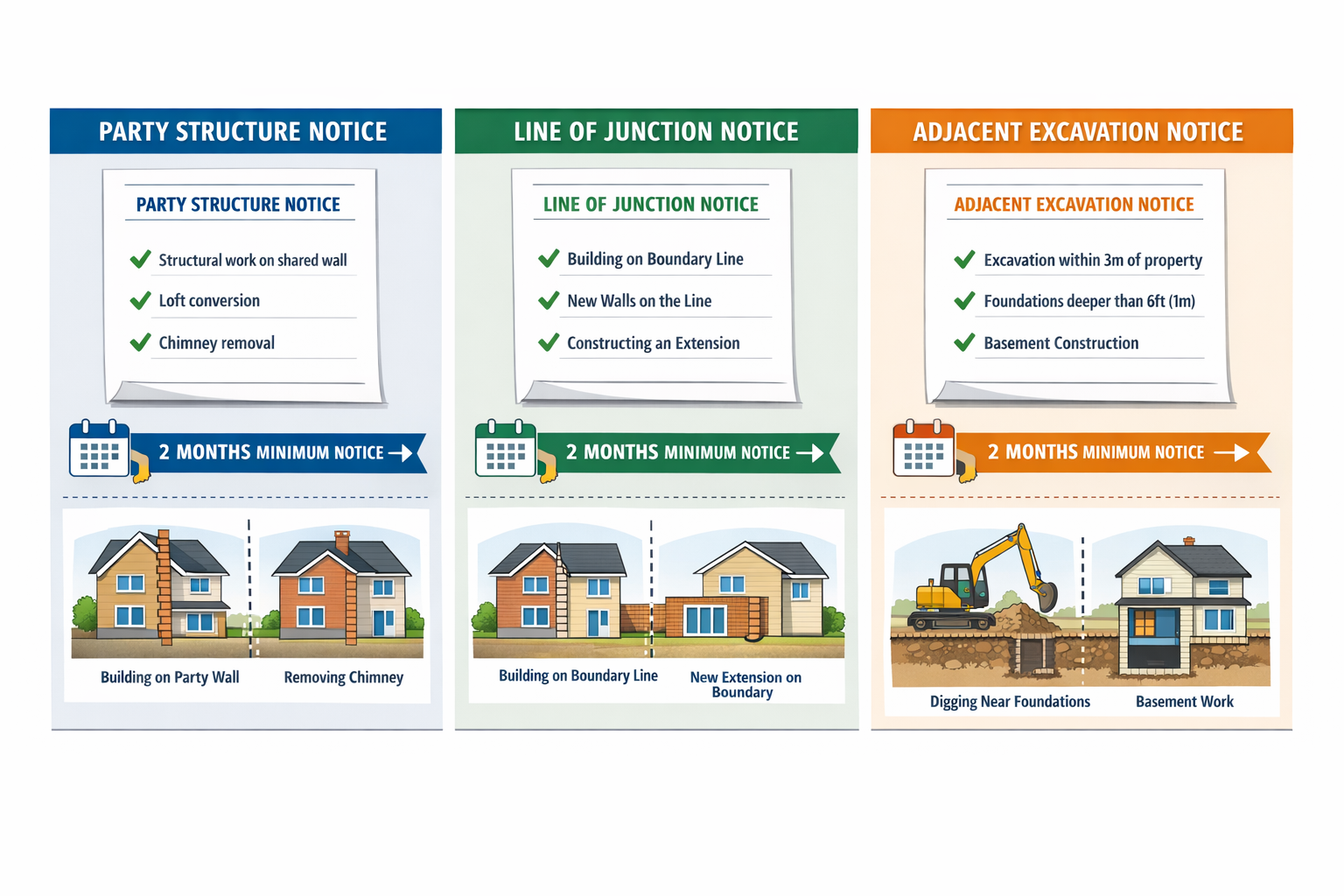
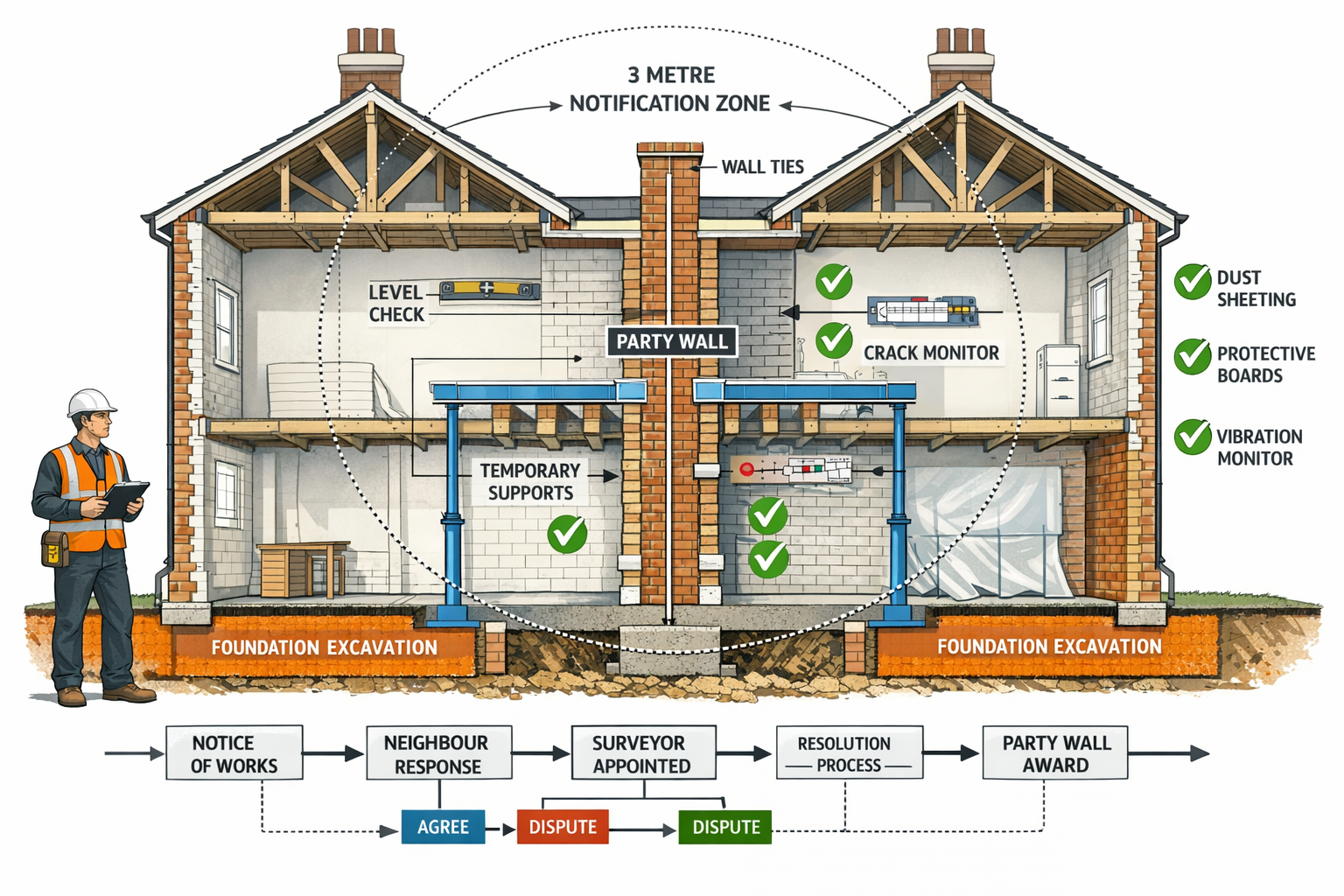
    () detailed infographic showing three distinct types of Party Wall Act notices side by side: Party Structure Notice, Line of

    Understanding When Loft Conversions Trigger Party Wall Act Requirements

    The Party Wall etc. Act 1996 applies specifically to semi-detached and terraced properties where structural work affects shared walls or boundaries. Detached houses with no shared structures generally fall outside the Act’s scope, unless excavation work occurs near neighbouring property foundations.[1]

    Common Loft Conversion Works Requiring Party Wall Notices

    Several typical loft conversion activities automatically trigger Party Wall Act obligations:

    🔨 Cutting into party walls to insert steel beams represents the most frequent trigger. Loft conversions commonly require structural steel beams inserted into party walls to support new floor joists and roof structures. This invasive work directly affects the shared wall’s integrity and requires formal notification.[5]

    🧱 Removing chimney breasts from party walls necessitates party wall agreements because the work alters the structural composition of the shared wall. Even when removing only the portion within your property, the chimney breast typically extends through the party wall.[1]

    📏 Raising party wall height falls under section 2(2)(a) of the Party Wall Act, allowing building owners to increase wall height to accommodate additional headroom in loft conversions. This right requires proper notice and agreement procedures.[3]

    💧 Inserting damp proof courses into party structures constitutes notifiable work under section 2(2)(f) of the Act. Loft conversions often require damp-proofing measures where new construction meets existing party walls.[3]

    When Party Wall Agreements Are NOT Required

    Understanding exemptions saves unnecessary costs and delays:

    • Detached properties with no shared walls or structures
    • Roof-only work that doesn’t involve cutting into, raising, or modifying party walls
    • Beam placement over purpose-built columns instead of insertion into party walls
    • Internal alterations that don’t affect party structures[1][2]

    Property owners planning loft conversions should consult experienced professionals to determine whether their specific project triggers Party Wall Act requirements. The types of party wall works vary significantly based on property configuration and conversion design.

    Step-by-Step Guide to Party Wall Act Notices for Loft Conversions

    Serving proper notices represents the critical first step in Party Wall Act compliance. The process follows strict timelines and documentation requirements that building owners must understand before commencing work.

    Identifying Which Notice Type Applies

    The Party Wall Act 1996 establishes three distinct notice categories, each addressing specific work types:

    Notice Type When Required Minimum Notice Period
    Party Structure Notice Work directly affecting party walls (cutting, raising, removing) 2 months
    Line of Junction Notice Building new walls on boundary lines 1 month
    Adjacent Excavation Notice Excavation within 3-6 metres of neighbouring structures 1 month

    For most loft conversions in semi-detached or terraced properties, a Party Structure Notice is required when structural modifications affect the shared wall.[1]

    Preparing and Serving Party Structure Notices

    The notice preparation process requires careful attention to detail and comprehensive documentation:

    Step 1: Document Proposed Works
    Create detailed specifications including:

    • Exact location of steel beam insertions
    • Dimensions and depths of cuts into party walls
    • Proposed wall height increases
    • Timeline for commencement and completion
    • Architectural drawings showing party wall modifications

    Step 2: Serve Written Notice
    The building owner must serve formal written notice to all adjoining owners at least two months before work begins. This timeline is non-negotiable and starting work prematurely constitutes a legal breach.[5]

    The notice must include:

    • Building owner’s name and address
    • Description of proposed works
    • Date work will commence
    • Statement of adjoining owner’s rights under the Act

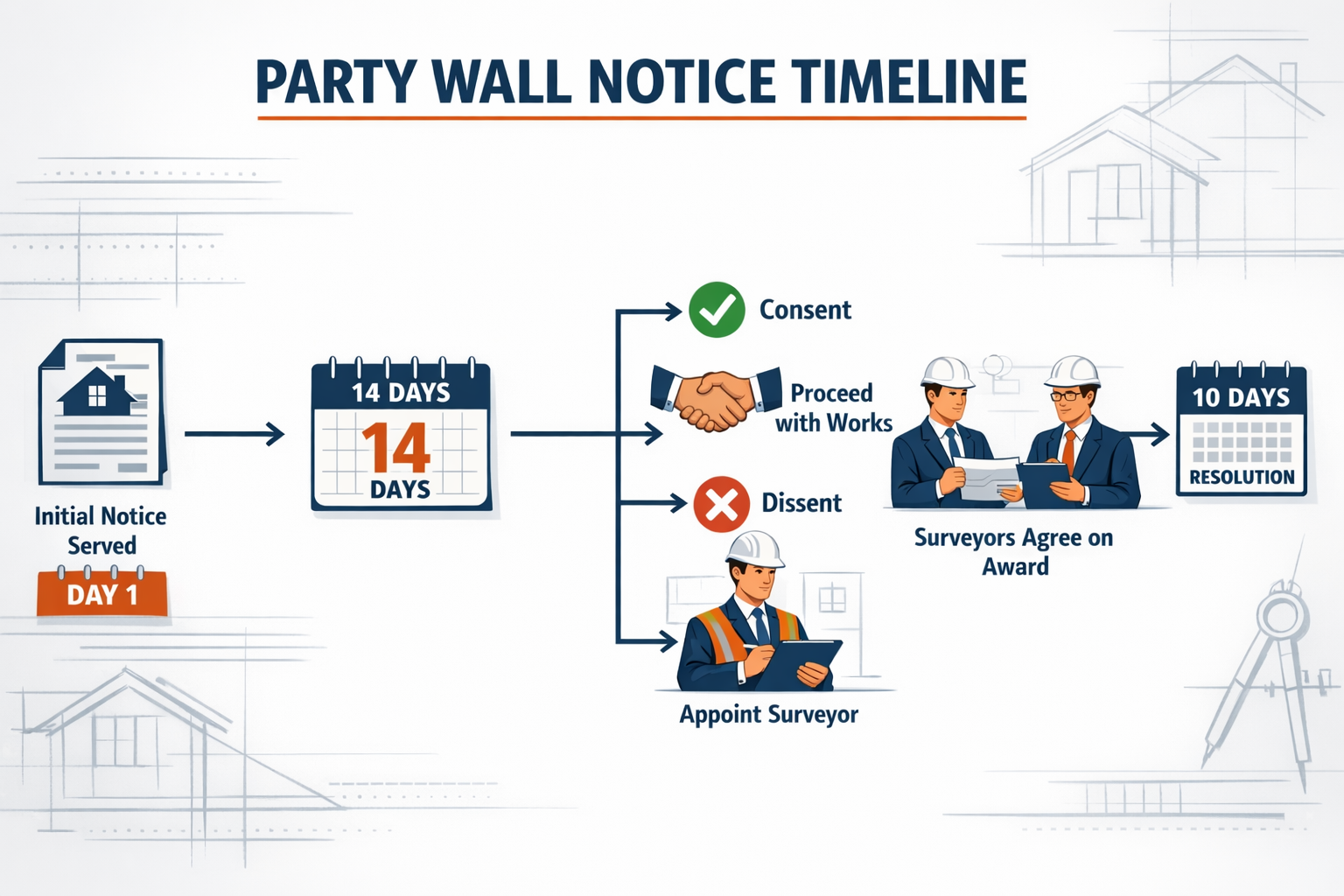
    Step 3: Await Response
    Adjoining owners have 14 days to respond in one of three ways:

    • Consent in writing (simplest outcome, allows work to proceed)
    • Dissent or request modifications (triggers surveyor appointment process)
    • No response (legally constitutes dissent after 14 days)

    Understanding what party wall act notices are and how to respond helps building owners anticipate potential outcomes and prepare accordingly.
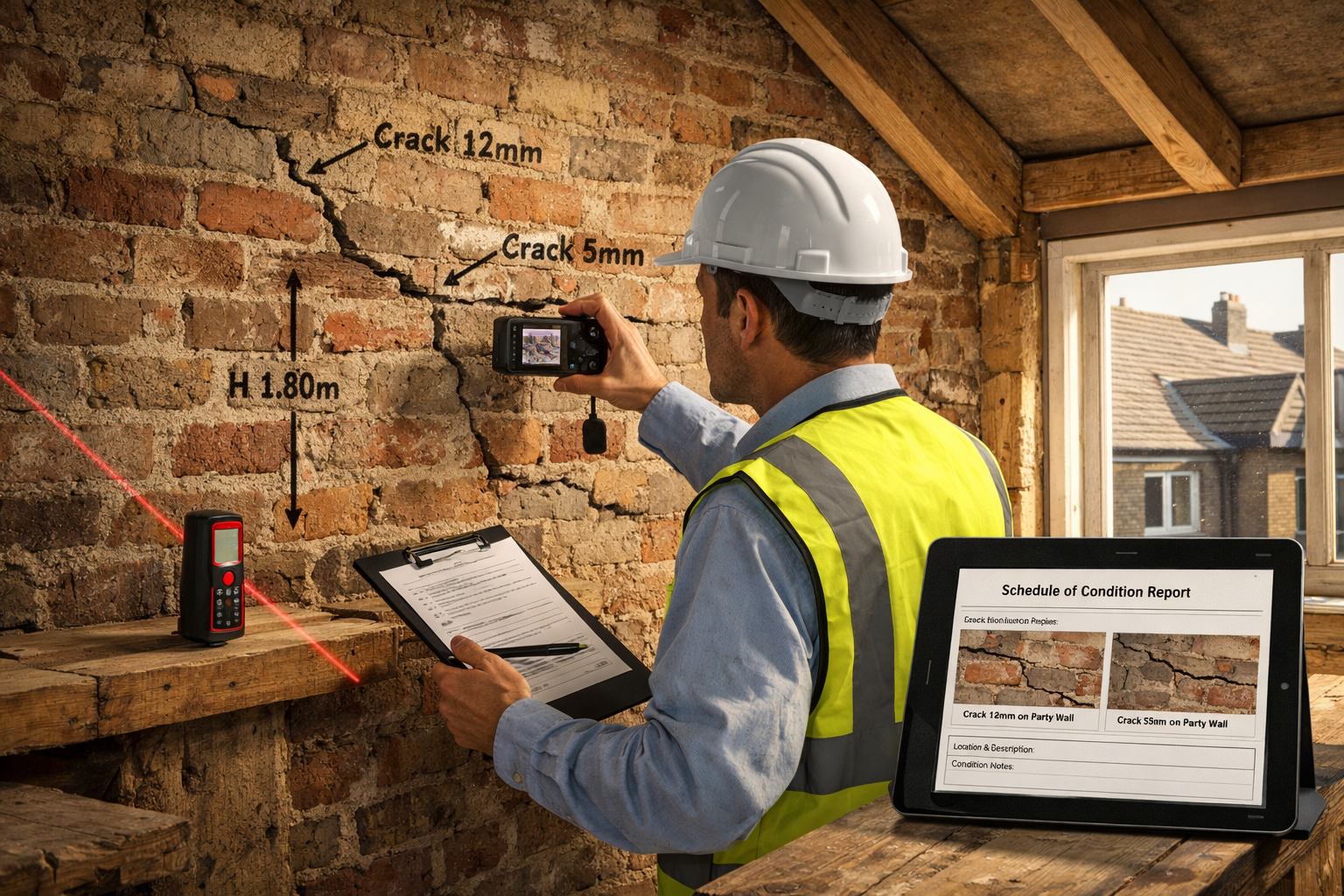
    () professional scene showing party wall surveyor conducting detailed schedule of condition inspection in a loft space.

    The Party Wall Agreement Process: From Consent to Award

    When adjoining owners consent immediately, the process concludes quickly with written permission documented. However, when consent isn’t forthcoming or modifications are requested, the formal surveyor appointment and award drafting process begins.

    Appointing Party Wall Surveyors

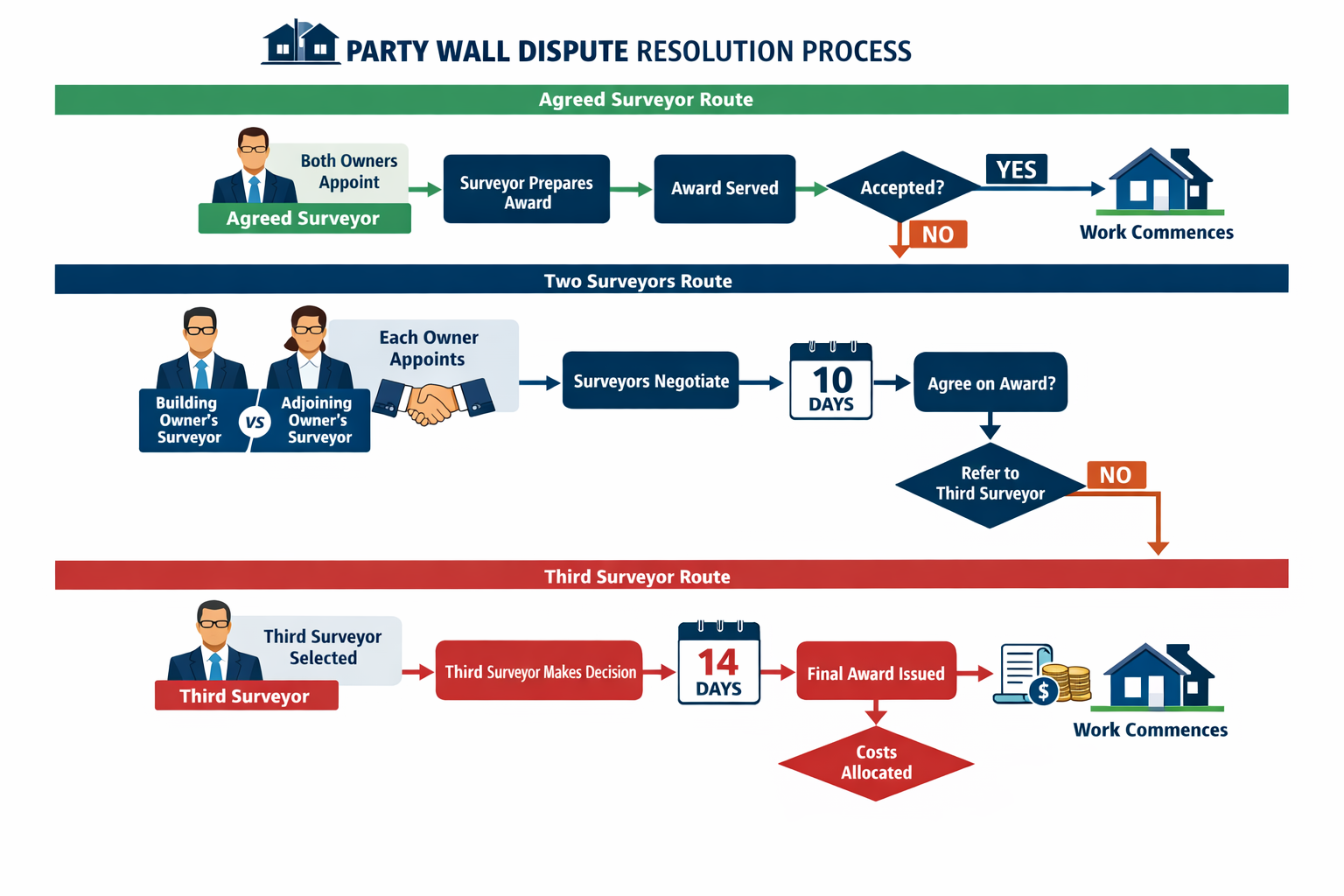
    The Act provides three surveyor appointment options:

    Option 1: Agreed Surveyor
    Both parties jointly appoint a single surveyor who acts impartially. This option typically costs less but requires mutual trust and agreement. Some homeowners successfully navigate having a party wall agreement without a surveyor when relationships are cooperative.[2]

    Option 2: Two Surveyors (Most Common)
    Each party appoints their own surveyor:

    Option 3: Third Surveyor
    The two appointed surveyors may select a third surveyor to resolve disputes if they cannot reach agreement on specific award terms.

    Understanding Party Wall Awards

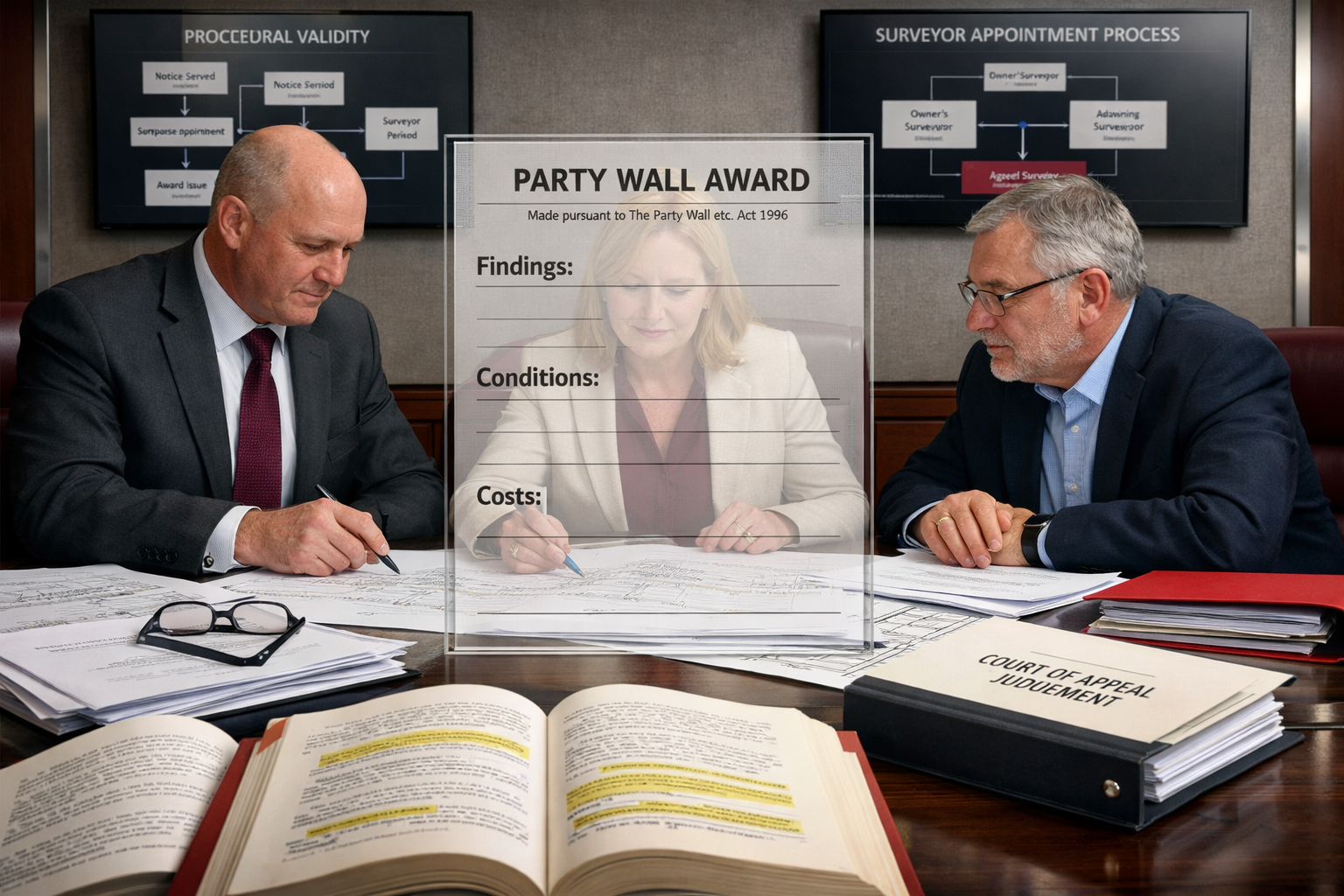
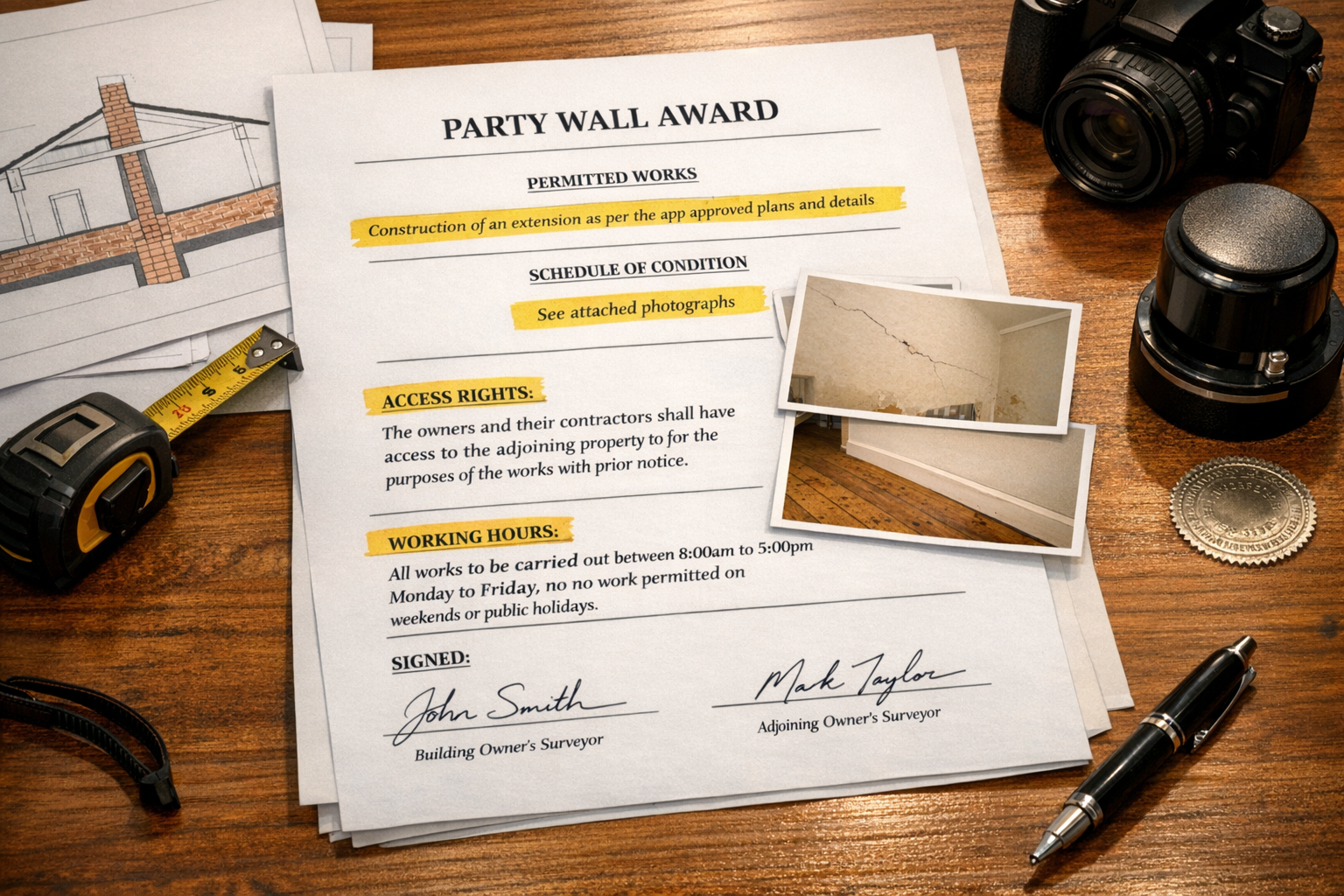
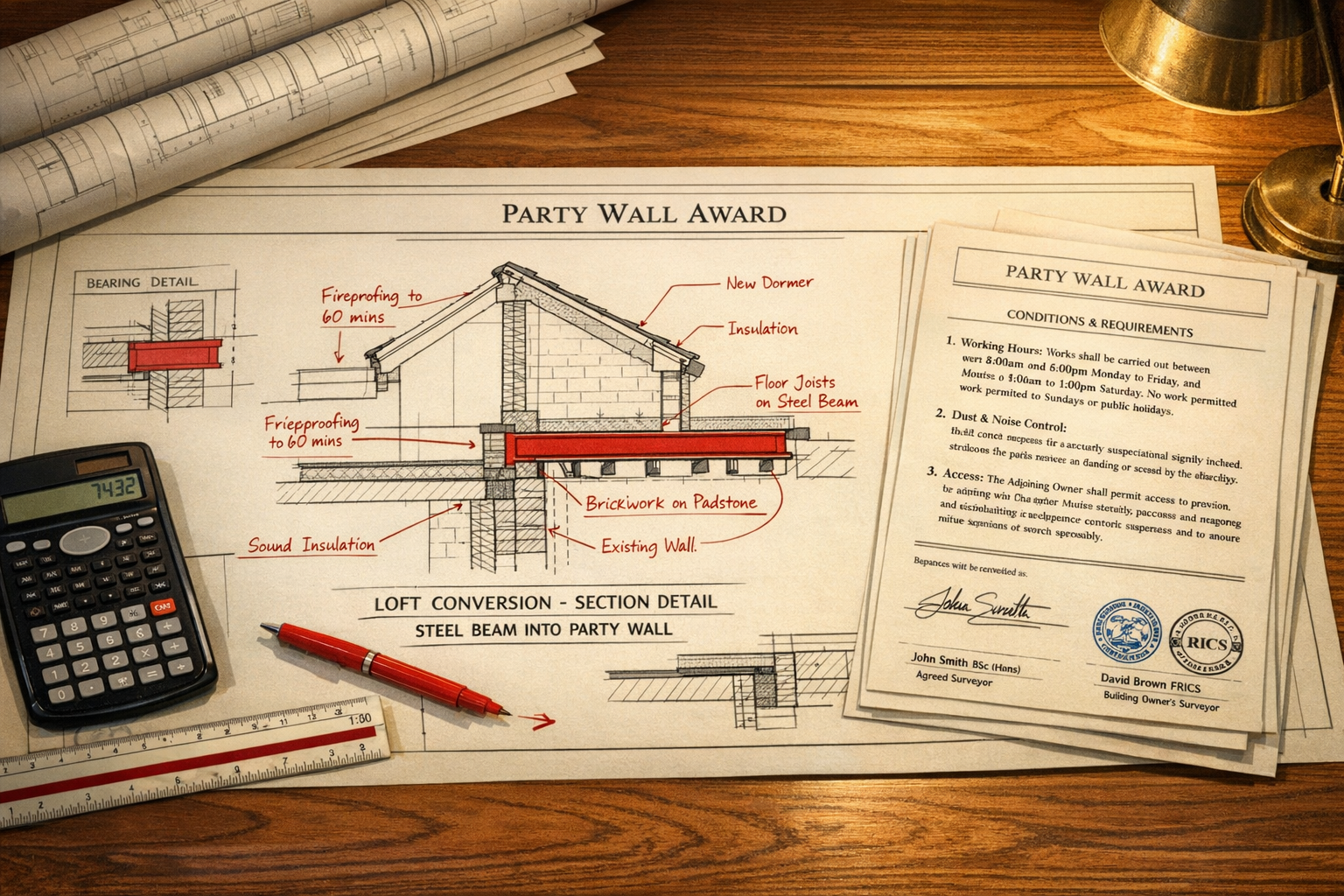
    A party wall award is a legally binding document that specifies:

    Detailed work descriptions – Precise specifications of permitted activities
    Working hours and methods – Restrictions on noise, access, and construction techniques
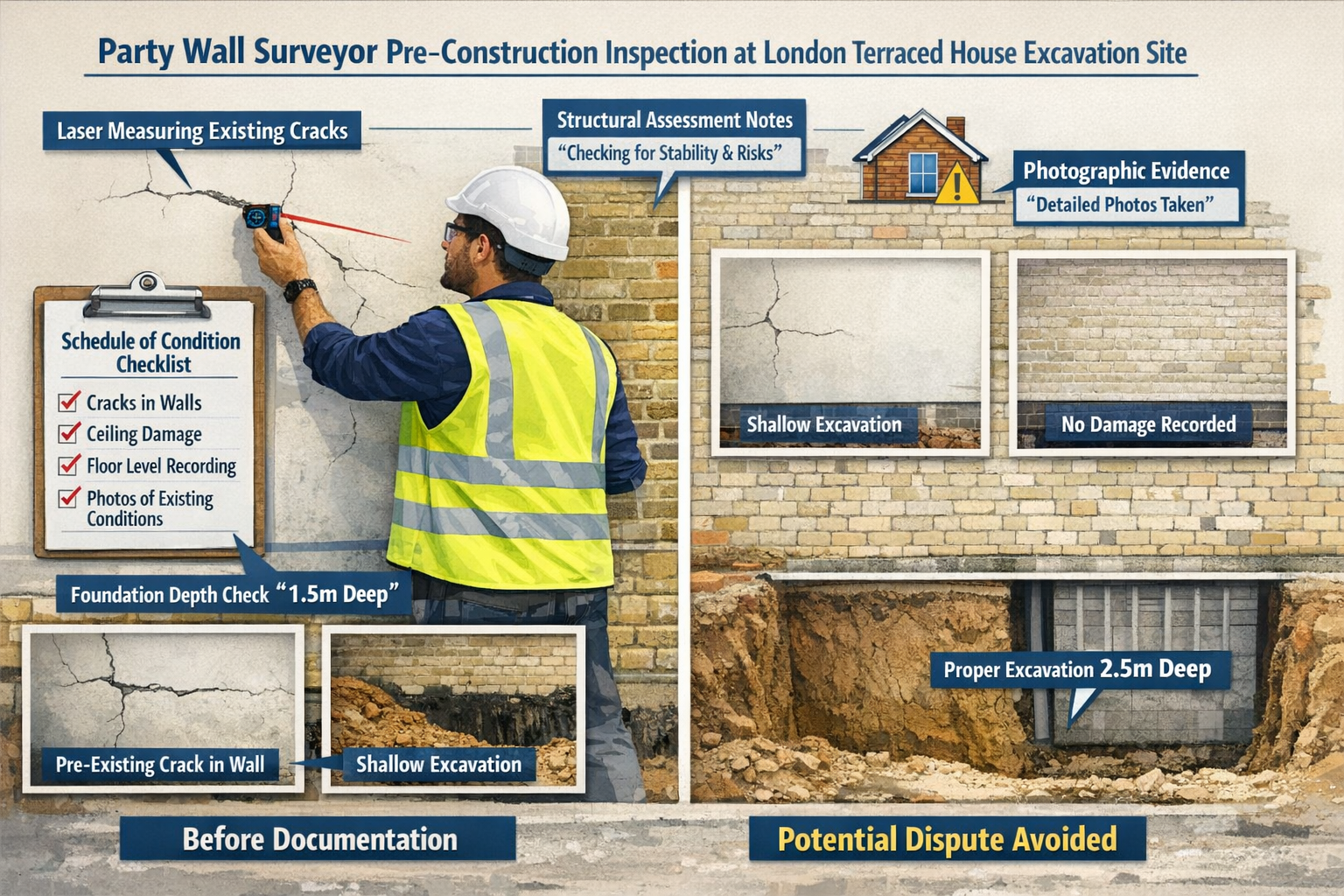
    Schedule of condition – Photographic and written record of adjoining property’s current state
    Access arrangements – Rights to enter neighbouring property if necessary
    Protective measures – Required safeguards to prevent damage
    Cost allocation – Who pays for what aspects of the process

    The party wall awards process typically takes 4-8 weeks from surveyor appointment to final award issuance, though complex cases may extend longer.

    Schedule of Condition: Protecting All Parties

    Before work commences, surveyors prepare a comprehensive schedule of condition documenting the adjoining property’s current state through:

    • 📸 Detailed photographs of all rooms, particularly those adjacent to party walls
    • 📝 Written descriptions of existing cracks, settlement, or defects
    • 📐 Measurements and technical assessments of structural elements
    • 🎥 Video documentation for comprehensive records

    This baseline documentation proves invaluable if disputes arise regarding damage allegedly caused by conversion work. Without proper condition records, determining responsibility for cracks or structural issues becomes nearly impossible.

    Essential Surveyor Roles and Responsibilities in Loft Conversion Projects

    Professional surveyors serve as impartial technical experts who balance building owners’ rights to improve their properties against adjoining owners’ rights to protection from damage and disruption.

    Key Surveyor Duties Throughout the Process

    Initial Assessment Phase
    Surveyors review architectural plans, assess structural implications, and determine appropriate protective measures. They identify potential risks to adjoining properties and recommend mitigation strategies.

    Award Drafting Phase
    Surveyors collaborate to create comprehensive awards addressing:

    • Specific working methodologies
    • Structural support requirements during construction
    • Monitoring protocols for detecting movement or damage
    • Dispute resolution procedures if problems arise

    Construction Monitoring Phase
    Surveyors may conduct site visits to verify compliance with award terms, though this isn’t always required. They remain available to address concerns or disputes during active construction.

    Post-Completion Phase
    Final inspections compare the adjoining property’s condition against the pre-work schedule of condition, determining whether any damage occurred and establishing responsibility for repairs.

    Selecting Qualified Party Wall Surveyors

    Choosing experienced professionals significantly impacts project outcomes. Consider these factors:

    🎓 Qualifications and Memberships
    Look for surveyors belonging to professional bodies like:

    • Faculty of Party Wall Surveyors (FPWS)
    • Royal Institution of Chartered Surveyors (RICS)
    • Pyramus and Thisbe Club

    📍 Local Knowledge
    Surveyors familiar with local property construction methods and common issues provide more accurate assessments. For London projects, consider specialists in specific areas like party wall surveyor north London or party wall surveyor south London depending on project location.

    💰 Transparent Fee Structures
    Reputable surveyors provide clear fee schedules upfront. Understanding costs of party wall the process helps budget appropriately and avoid surprises.

    ⭐ Track Record
    Request references from previous loft conversion clients and verify the surveyor’s experience with similar projects.
    () detailed architectural drawing of party wall award document layout spread across desk surface. Shows technical

    Managing Costs and Timelines for Party Wall Compliance

    Financial planning for Party Wall Act compliance requires understanding both direct costs and potential timeline implications that affect overall project budgets.

    Typical Cost Breakdown

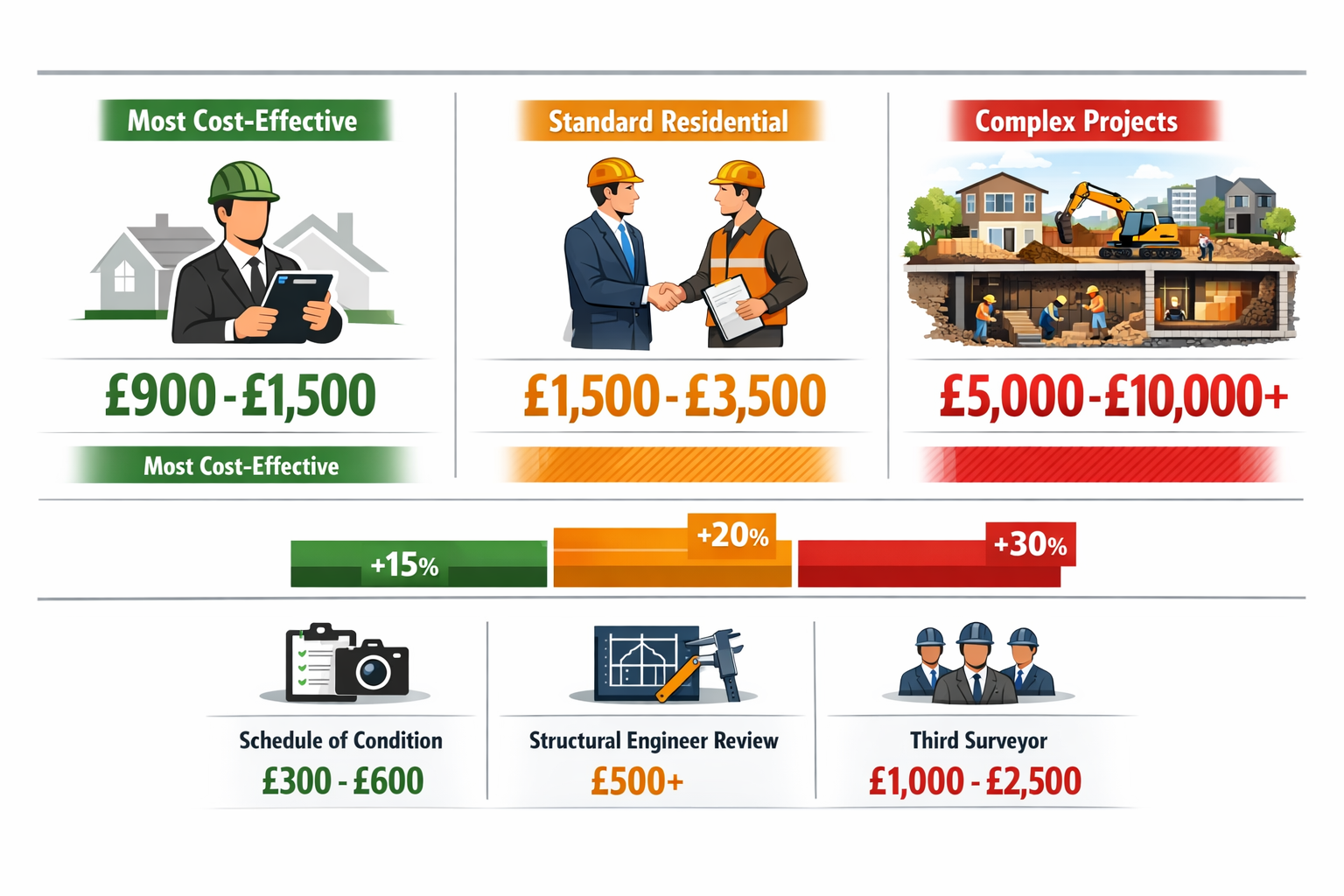
    Notice Preparation and Service: £200-£500
    Basic costs for preparing and serving formal notices, including registered post delivery and documentation.

    Surveyor Fees: £700-£1,500 per surveyor
    Professional fees vary based on project complexity, property value, and regional rates. Building owners typically pay for both their own surveyor and the adjoining owner’s surveyor fees.[4]

    Award Preparation: £500-£1,000
    Costs for drafting comprehensive party wall awards, including technical specifications and legal documentation.

    Schedule of Condition: £300-£800
    Photographic and written documentation of adjoining property’s pre-work condition.

    Total Typical Range: £2,000-£5,000

    Individual costs apply for each notice served, so properties with multiple adjoining owners face proportionally higher expenses.[4] Homeowners can explore strategies for how to keep party wall costs down without compromising compliance quality.

    Timeline Planning for Loft Conversion Projects

    Proper Party Wall Act compliance adds minimum timeframes to project schedules:

    Week 1-2: Notice Preparation
    Gather architectural plans, prepare detailed work descriptions, and draft formal notices.

    Week 3-4: Notice Service and Response Period
    Serve notices and await 14-day response period from adjoining owners.

    Week 5-12: Surveyor Appointment and Award Drafting
    If consent isn’t immediate, surveyors are appointed and work together to draft awards (typically 4-8 weeks).

    Week 13+: Work Commencement
    Only after receiving written consent or formal party wall awards can structural work begin.

    Starting the Party Wall Act process at least three months before planned construction provides adequate buffer for unexpected delays or complications.[5]

    Common Pitfalls and How to Avoid Them

    Understanding frequent mistakes helps building owners navigate the process smoothly and maintain positive neighbour relations.

    Critical Mistakes to Avoid

    ❌ Starting Work Before Obtaining Proper Consent
    Beginning structural work without written agreement or formal awards constitutes a legal breach, potentially resulting in injunctions forcing work stoppage and legal costs.

    ❌ Inadequate Notice Descriptions
    Vague or incomplete work descriptions in notices create ambiguity and potential disputes. Provide comprehensive technical specifications with supporting drawings.

    ❌ Ignoring the Two-Month Minimum Period
    The statutory two-month notice period for party structure work is mandatory and cannot be waived, even with neighbour agreement.[5]

    ❌ Failing to Document Pre-Work Conditions
    Without thorough schedule of condition documentation, proving that damage existed before work began becomes impossible, leaving building owners liable for pre-existing issues.

    ❌ Choosing Unqualified Surveyors
    Inexperienced surveyors may draft inadequate awards that fail to protect either party’s interests, leading to disputes and additional costs.

    Best Practices for Smooth Party Wall Processes

    ✅ Communicate Early with Neighbours
    Informal discussions before serving formal notices help build goodwill and may identify concerns that can be addressed proactively.

    ✅ Provide Comprehensive Documentation
    Include detailed architectural drawings, structural engineer calculations, and clear work descriptions with notices.

    ✅ Budget Appropriately
    Account for full Party Wall Act costs in project budgets, including potential surveyor fees for multiple adjoining owners.

    ✅ Select Experienced Professionals
    Engage qualified party wall surveyors, structural engineers, and contractors familiar with Act requirements.

    ✅ Maintain Detailed Records
    Document all communications, notices served, responses received, and surveyor correspondence throughout the process.

    Regional Considerations for London Loft Conversions

    London’s dense housing stock and diverse property types create unique Party Wall Act challenges that require specialized local knowledge.

    London-Specific Factors

    Victorian and Edwardian Terraces
    Older properties often feature complex party wall arrangements with shared chimney stacks, interconnected roof structures, and historical modifications that complicate modern conversions.

    Multiple Adjoining Properties
    Mid-terrace properties require notices to adjoining owners on both sides, doubling surveyor costs and coordination complexity. Corner properties may have additional considerations for boundary walls.

    Conservation Areas and Listed Buildings
    Additional planning restrictions in conservation areas may affect loft conversion designs and party wall work specifications.

    Regional Cost Variations
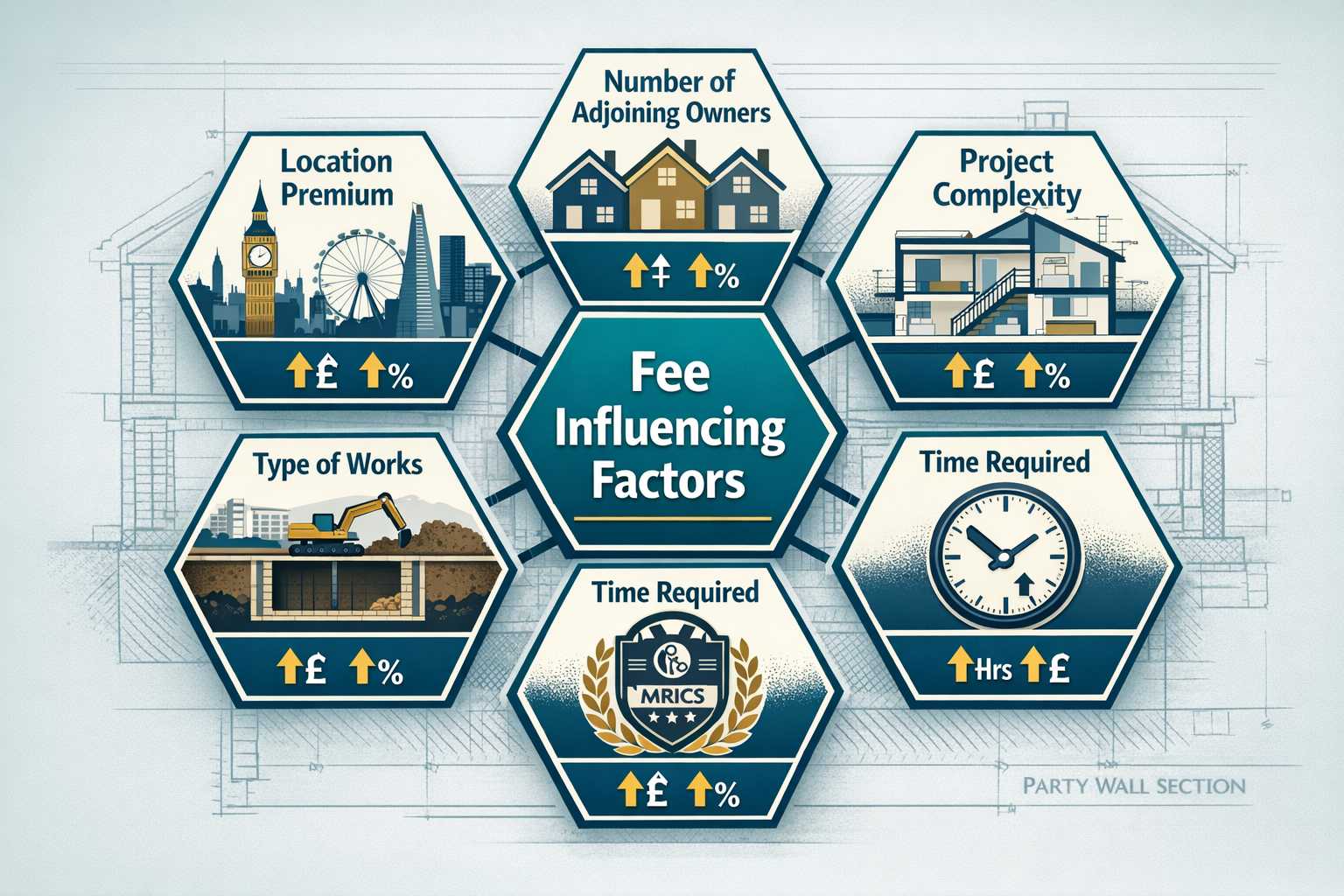
    Party wall surveyor fees vary across London boroughs. Properties in central London or west London may face higher professional fees compared to outer boroughs.

    Navigating Complex London Property Arrangements

    London properties frequently present challenging scenarios:

    Converted Flats in Period Houses
    Determining which flat owners qualify as “adjoining owners” requiring notice can be complex when properties have been subdivided.

    Shared Freeholds
    Properties with shared freehold arrangements may have additional contractual obligations beyond statutory Party Wall Act requirements.

    Commercial-Residential Mixed Use
    Ground floor commercial premises with residential flats above require careful consideration of access rights and working hour restrictions.

    Engaging surveyors with specific experience in London property types ensures appropriate handling of these regional complexities. The locations directory helps identify qualified professionals across different London areas.

    Conclusion

    Navigating Party Wall Act Basics for Loft Conversions: Notices, Agreements and Surveyor Essentials requires careful planning, proper documentation, and professional expertise. The statutory requirements exist to protect both building owners’ rights to improve their properties and adjoining owners’ rights to protection from damage and disruption.

    Key action steps for successful Party Wall Act compliance:

    1. Determine early whether your loft conversion triggers Party Wall Act requirements – Semi-detached and terraced properties with structural work affecting party walls almost certainly require formal notices

    2. Serve proper notices with comprehensive work descriptions at least two months before planned construction – Adequate lead time prevents costly project delays

    3. Engage qualified party wall surveyors with relevant experience and professional credentials to draft protective awards

    4. Budget appropriately for full Party Wall Act costs including surveyor fees for all adjoining owners and schedule of condition documentation

    5. Maintain detailed records and open communication with neighbours throughout the process to minimize disputes

    6. Ensure thorough schedule of condition documentation before work commences to establish baseline property conditions

    The Party Wall Act 1996 provides a balanced framework that enables property improvements while protecting all parties’ interests. Understanding these Party Wall Act Basics for Loft Conversions: Notices, Agreements and Surveyor Essentials transforms what seems like bureaucratic complexity into a manageable process that facilitates successful loft conversions.

    For property owners planning loft conversions in 2026, early engagement with the Party Wall Act process represents an investment in project success, neighbour relations, and legal protection. The statutory procedures, while adding time and cost to projects, ultimately provide structure and certainty that benefit everyone involved.

    Whether undertaking a modest dormer addition or extensive mansard conversion, proper Party Wall Act compliance ensures your loft transformation proceeds smoothly from initial notice through final completion.


    References

    [1] Party Wall Agreement Loft Conversion – https://www.houseup.co.uk/news/party-wall-agreement-loft-conversion

    [2] Party Wall Agreement For Loft Extension Conversion – https://create-room.co.uk/news/party-wall-agreement-for-loft-extension-conversion/

    [3] Loft Conversions And The Party Wall Act – https://www.peterbarry.co.uk/blog/loft-conversions-and-the-party-wall-act/

    [4] Party Wall And Building Regulations For Your Loft Conversion – https://www.bespokelofts.co.uk/latest-loft-conversion-news/386/party-wall-and-building-regulations-for-your-loft-conversion.html

    [5] Party Wall Surveyor Loft Conversion – https://biggerlivinglofts.com/blog/party-wall-surveyor-loft-conversion
  • Third Surveyor Decisions in Party Wall Awards: Costs, Protocols and

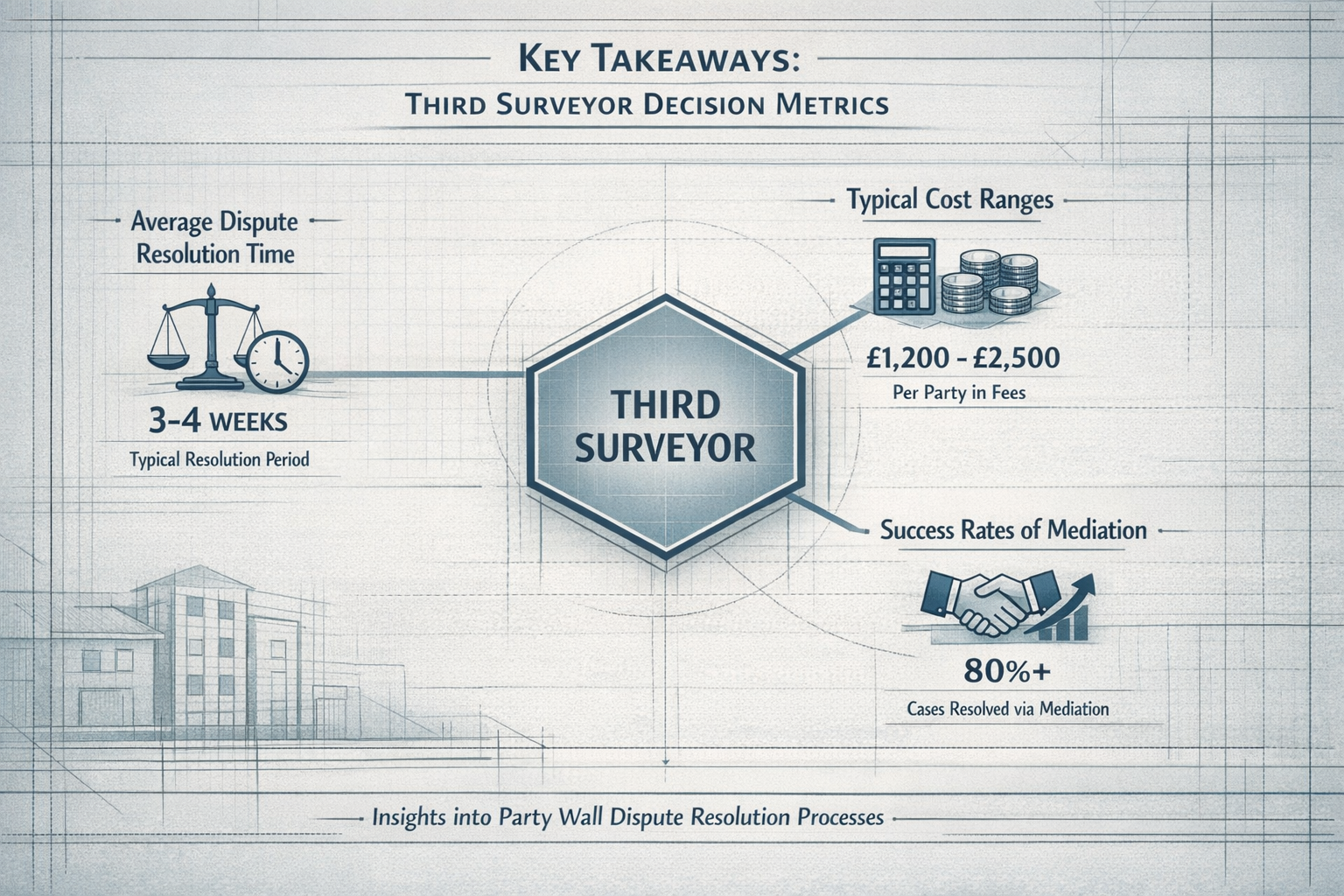
    When two appointed party wall surveyors reach an impasse, the dispute doesn’t end—it escalates to a rarely invoked but critically important mechanism. Recent data from 2026 reveals that while third surveyor involvement occurs in less than 5% of party wall cases, these disputes generate average costs exceeding £15,000 and can derail construction projects for months. Understanding Third Surveyor Decisions in Party Wall Awards: Costs, Protocols and Case Studies from Recent Disputes has become essential for building owners navigating complex neighbour relations in today’s construction boom.

    The third surveyor mechanism under the Party Wall etc. Act 1996 serves as the ultimate dispute resolution tool when appointed surveyors cannot agree on critical elements of a party wall award. This comprehensive guide explores the protocols, cost implications, and real-world case studies that define third surveyor decisions in 2026.

    Key Takeaways

    • Third surveyors are appointed by mutual agreement between two appointed surveyors under Section 10 of the Party Wall Act, with their selection documented in writing[3]
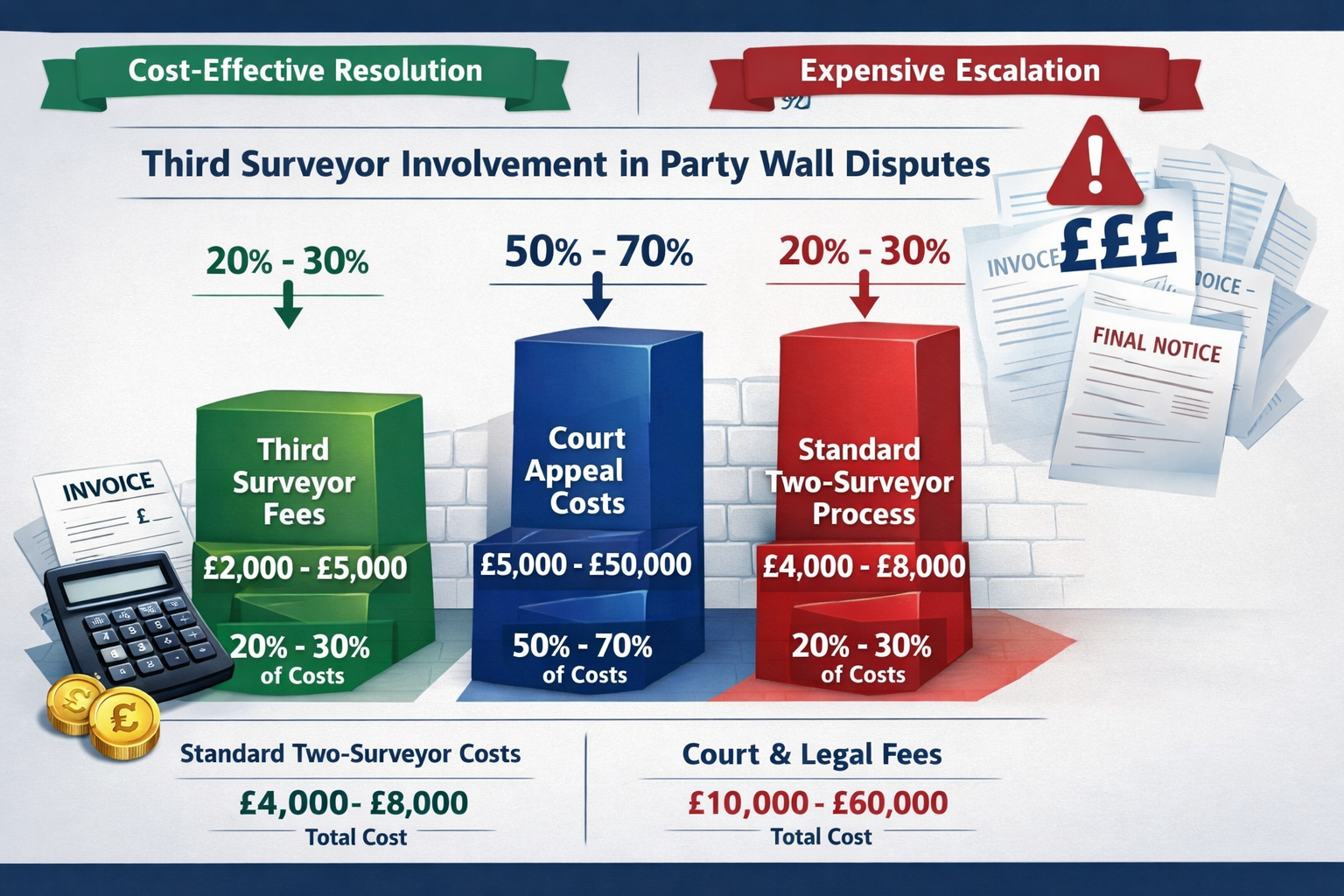
    • Cost liability falls on the party initiating third surveyor involvement, regardless of the dispute outcome, with fees typically ranging £2,000-£5,000[3]
    • Court appeals of third surveyor decisions cost £5,000-£50,000 with a strict 14-day challenge window and no guarantee of cost recovery[3]
    • Recent case law has strengthened jurisdiction requirements, with courts examining whether surveyors acted intra vires and maintained proper impartiality[1]
    • RICS guidance updates in 2026 emphasize personal statutory appointments and independent conduct to address jurisdictional challenges[4]

    Key Takeaways infographic visualizing Third Surveyor decision metrics, featuring a central hexagonal diagram with branching

    Understanding the Role and Appointment of Third Surveyors in Party Wall Disputes

    The Statutory Framework for Third Surveyor Appointments

    The Party Wall etc. Act 1996 establishes a clear hierarchy for resolving disputes between neighbours undertaking construction work. When a building owner serves proper party wall notices and the adjoining owner dissents, each party appoints a surveyor to create an award governing the works.

    Section 10 of the Act mandates that these two appointed surveyors must select a third surveyor by mutual written agreement.[3] This selection typically occurs at the beginning of the process, even though the third surveyor may never be called upon. The third surveyor serves as a “referee” who can resolve specific disagreements between the two appointed surveyors.

    When Third Surveyor Involvement Becomes Necessary

    Third surveyors are rarely required in practice because most disputes are resolved through negotiation between the two appointed surveyors.[2] However, escalation to the third surveyor occurs when:

    • 🔴 The two surveyors cannot agree on specific award terms
    • 🔴 Fundamental disagreements arise about scope of works
    • 🔴 Disputes emerge regarding compensation for damage
    • 🔴 Technical assessments produce conflicting conclusions
    • 🔴 One surveyor believes the other has acted beyond jurisdiction

    The Impartiality Mandate for All Surveyors

    A critical principle governing Third Surveyor Decisions in Party Wall Awards: Costs, Protocols and Case Studies from Recent Disputes is that all appointed surveyors—including those selected by individual parties—must act with complete impartiality.[2] This means:

    ✅ Considering the rights and interests of both building owner and adjoining owner
    ✅ Making decisions based on statutory requirements, not client preferences
    ✅ Ensuring both parties have opportunity to present relevant matters
    ✅ Acting within the scope of powers granted by the Act

    The 2026 RICS consultation on updated guidance emphasizes that surveyor appointments are personal and statutory, independent of client instruction.[4] This addresses concerns where awards were challenged because surveyors acted without proper jurisdiction.

    Documentation Requirements for Third Surveyor Selection

    The selection of a third surveyor must be documented in writing to ensure legal validity.[3] This documentation typically includes:

    • Written agreement between both appointed surveyors
    • Confirmation of the third surveyor’s acceptance
    • Clarification of the third surveyor’s scope of authority
    • Agreement on fee structure and payment responsibility

    For guidance on minimizing disputes before they escalate, review strategies for keeping party wall costs down.

    Detailed () infographic-style image displaying a cost breakdown chart for third surveyor involvement in party wall disputes.

    Costs, Protocols and Financial Implications of Third Surveyor Decisions

    Direct Costs of Third Surveyor Involvement

    The financial implications of escalating to a third surveyor are substantial and often underestimated by building owners. Understanding the costs associated with Third Surveyor Decisions in Party Wall Awards: Costs, Protocols and Case Studies from Recent Disputes helps parties make informed decisions about dispute resolution.

    Third Surveyor Fees:

    • Typical range: £2,000 – £5,000 for straightforward disputes
    • Complex cases: £5,000 – £10,000+ requiring extensive technical review
    • Hourly rates: £150 – £300 depending on surveyor experience

    Critical Cost Rule: The party who initiates the third surveyor’s involvement bears the cost of their fees, regardless of the dispute outcome.[3] This creates a financial disincentive for frivolous escalations.

    Comprehensive Cost Analysis

    Cost Category Amount Range Who Pays
    Third Surveyor Fees £2,000 – £10,000 Initiating party
    Court Appeal Costs £5,000 – £50,000 Appellant (no guarantee of recovery)[3]
    Additional Surveyor Time £1,000 – £3,000 As per original fee agreement
    Legal Advice £2,000 – £15,000 Party seeking advice
    Project Delays Variable Building owner (opportunity cost)

    For a complete breakdown of standard party wall process costs, consult the guide on costs of party wall procedures.

    The 14-Day Challenge Window

    If a party wishes to dispute a third surveyor’s decision, they must act within 14 days of service of the award through the courts.[3] This narrow window requires:

    ⏰ Immediate legal consultation
    ⏰ Rapid evidence gathering
    ⏰ Quick decision on appeal viability
    ⏰ Substantial upfront legal costs

    Missing this deadline means the award becomes final and binding, with no further recourse except in cases of fraud or procedural irregularity.

    Grounds for Challenging Third Surveyor Decisions

    Courts will only consider appeals if the third surveyor:

    1. Acted beyond their jurisdiction (ultra vires)
    2. Exceeded the scope of the Party Wall Act 1996
    3. Failed to act impartially or with demonstrable bias
    4. Did not provide both parties opportunity to present their case

    Judges will not reassess the technical merits of a surveyor’s decision or substitute their judgment for professional expertise.[3] The standard is procedural correctness, not technical perfection.

    Protocols for Minimizing Escalation Costs

    Building owners can implement several strategies to avoid third surveyor involvement:

    Early Engagement:

    • Serve notices with clear, detailed descriptions of works
    • Provide comprehensive technical drawings and specifications
    • Engage in pre-notice discussions with neighbours

    Surveyor Selection:

    • Choose experienced party wall surveyors with proven negotiation skills
    • Verify surveyor membership in RICS or FPWS
    • Check surveyor track record for resolving disputes without escalation

    Communication Protocols:

    • Establish regular communication channels between surveyors
    • Document all agreements and disagreements in writing
    • Address concerns promptly before positions harden

    Technical Preparation:

    • Commission thorough schedules of condition
    • Provide detailed method statements for proposed works
    • Offer reasonable protective measures and monitoring

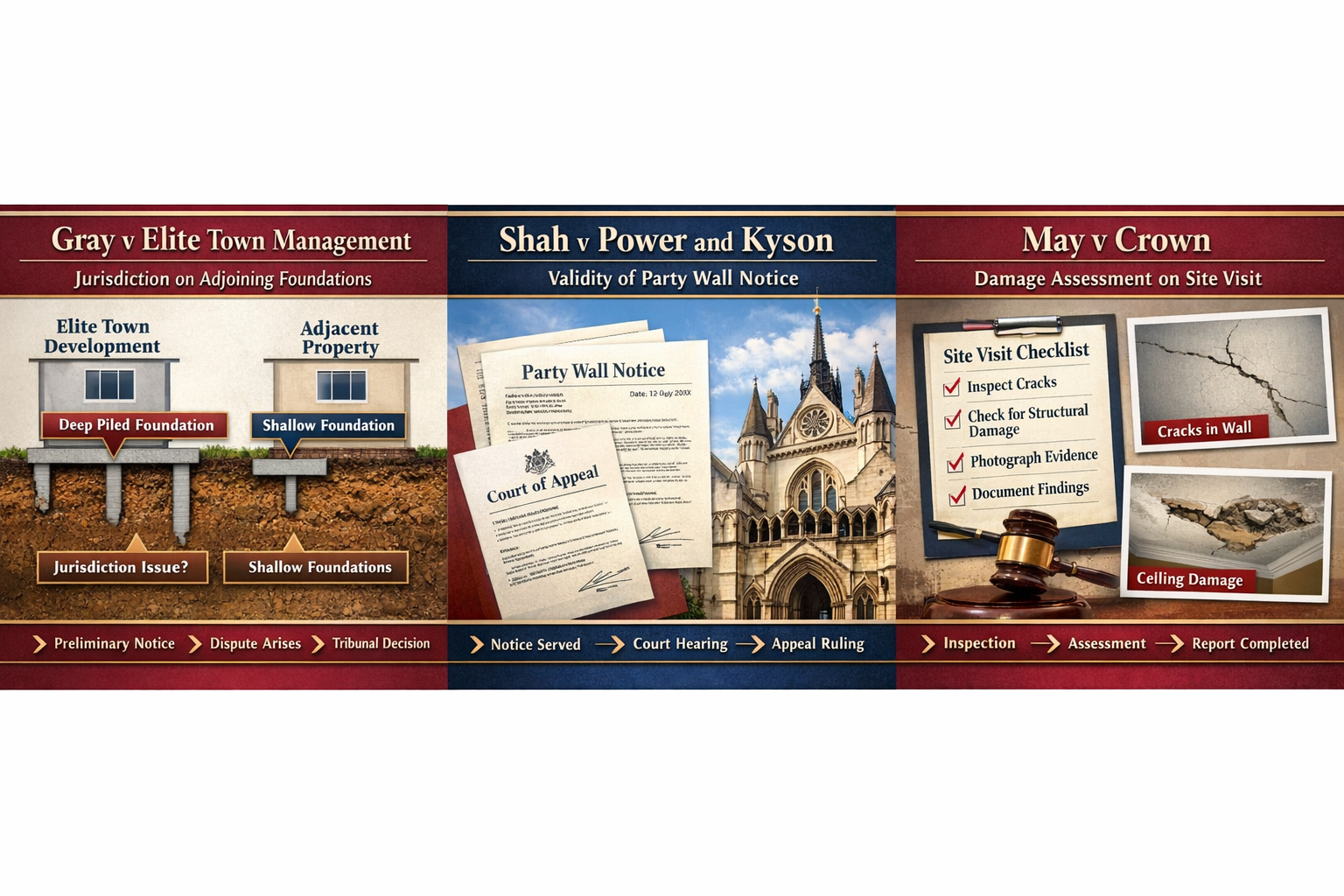
    Detailed () composite image showing three distinct case study scenarios from recent party wall disputes. Left panel: Gray v

    Case Studies from Recent Disputes: Lessons from Third Surveyor Decisions

    Gray v Elite Town Management (2015): The Jurisdiction Question

    This landmark case illustrates how Third Surveyor Decisions in Party Wall Awards: Costs, Protocols and Case Studies from Recent Disputes can be challenged on jurisdictional grounds.

    Case Background:
    The third surveyor in this dispute unlawfully allowed special foundations that exceeded the scope of the notified works.[1] The building owner had served notice for standard foundation work, but during the process, the scope expanded to include special foundations requiring different technical approaches.

    Key Legal Principle:
    The court held that surveyors—including third surveyors—cannot authorize works beyond those properly notified under the Act. This established that:

    ✅ Awards must correspond to the works described in the original notice
    ✅ Material changes to scope require fresh notices
    ✅ Third surveyors cannot expand their jurisdiction beyond the statutory framework

    Practical Impact:
    Building owners must ensure that party wall notices accurately describe all proposed works. Vague or incomplete descriptions create vulnerability to jurisdictional challenges, potentially invalidating awards even after construction begins.

    Shah v Power and Kyson (2020-22): The “No Notice, No Act” Principle

    This complex dispute generated multiple cases that ultimately reached the Court of Appeal, establishing critical precedents for notice requirements.[1]

    Case Background:
    The dispute centered on whether works could proceed under the Party Wall Act when proper notices had not been served or when notices contained material defects.

    Court of Appeal Ruling:
    The court reinforced the principle that without valid notice, the Act’s protections do not apply. This means:

    • Defective notices cannot be retrospectively corrected through awards
    • Adjoining owners retain common law rights when notices are invalid
    • Building owners face potential injunctions and damages for proceeding without valid notices

    2026 Relevance:
    The RICS consultation on updated guidance specifically addresses notice service requirements, emphasizing that surveyors must verify proper notice before accepting appointments.[4] This responds directly to the jurisdictional issues raised in Shah v Power and Kyson.

    Lessons for Building Owners:

    May and Crown Case: Site Visits and Damage Assessment

    This case examined whether a third surveyor acted outside jurisdiction by not visiting the site and established important principles about damage claims.[1]

    Key Issues:

    1. Must a third surveyor conduct site visits to make valid decisions?
    2. What damages can be claimed in party wall awards?

    Court Findings:

    Site Visit Requirements:
    While not strictly mandatory in all cases, site visits are generally expected for disputes involving:

    • Physical damage assessment
    • Technical feasibility questions
    • Disputes about existing conditions
    • Complex structural issues

    Failure to visit the site when material facts require inspection can constitute acting beyond proper procedure.

    Damage Limitations:
    The court clarified that damages must be directly related to the notified works.[1] Adjoining owners cannot claim for:

    ❌ Pre-existing damage unrelated to current works
    ❌ Consequential losses beyond direct physical damage
    ❌ Betterment or improvements beyond making good
    ❌ General inconvenience or distress

    ✅ Only direct damage caused by the notified works qualifies for compensation

    Practical Application:
    This case reinforces the importance of comprehensive schedules of condition prepared before works commence. Clear photographic and written evidence of pre-existing conditions protects both parties from unfounded claims.

    2026 Dispute Trends and Emerging Issues

    Recent disputes in 2026 reflect the construction boom and increased property development across London and other UK cities.[5] Common escalation triggers include:

    Technical Complexity:

    • Basement excavations near existing foundations
    • Complex steel frame insertions
    • Party wall removal and rebuilding
    • Underpinning works in varied soil conditions

    Communication Breakdowns:

    • Surveyors failing to engage constructively
    • Building owners proceeding without proper consultation
    • Adjoining owners making unreasonable demands
    • Delays in responding to surveyor correspondence

    Cost Disputes:

    • Disagreements over reasonable surveyor fees
    • Disputes about scope of protective works
    • Arguments over monitoring requirements
    • Compensation calculations for temporary inconvenience

    For regional considerations, building owners should consult specialists familiar with local conditions, such as party wall surveyors in North London or South London.

    Best Practices for Building Owners to Minimize Third Surveyor Escalation

    Strategic Surveyor Selection

    Choosing the right surveyor at the outset significantly reduces escalation risk. Look for:

    🔍 RICS or FPWS membership indicating professional standards
    🔍 Local experience with similar projects and property types
    🔍 Proven negotiation skills and low escalation rates
    🔍 Clear fee structures with transparent cost breakdowns
    🔍 Strong communication and responsiveness

    Consider whether your project requires a building owner’s surveyor with specific technical expertise in your type of construction work.

    Pre-Notice Neighbour Engagement

    Proactive communication before serving formal notices can prevent disputes:

    Informal Discussion:

    • Explain the project scope and timeline
    • Address concerns about noise, dust, and access
    • Offer site visits to review plans
    • Demonstrate commitment to minimizing disruption

    Written Communication:

    • Provide clear project descriptions
    • Share architect drawings and specifications
    • Outline proposed protective measures
    • Offer contact information for questions

    Comprehensive Documentation

    Thorough documentation protects against unfounded claims and provides evidence if disputes escalate:

    📋 Pre-Works Documentation:

    • Professional photographic schedule of condition
    • Structural surveys of adjoining properties
    • Detailed drawings and specifications
    • Method statements and risk assessments

    📋 During Works:

    • Daily site logs and progress photos
    • Monitoring records (vibration, settlement, etc.)
    • Incident reports for any issues
    • Communication logs with surveyors and neighbours

    📋 Post-Works:

    • Completion photographs
    • Final monitoring readings
    • Making good documentation
    • Sign-off records

    Understanding Award Components

    A properly drafted party wall award should include:

    • Description of works corresponding to the notice
    • Time and manner of executing works
    • Protective measures required during construction
    • Monitoring provisions for settlement and vibration
    • Access arrangements for surveyors and contractors
    • Dispute resolution procedures including third surveyor selection
    • Cost allocation for surveyor fees and expenses

    When to Consider Alternative Dispute Resolution

    Before escalating to a third surveyor, consider:

    Mediation:

    • Professional mediator facilitates negotiation
    • Lower costs than third surveyor involvement
    • Preserves working relationship between surveyors
    • Faster resolution timeline

    Technical Expert Opinion:

    • Independent structural engineer assessment
    • Clarifies technical feasibility questions
    • Provides objective basis for agreement
    • Costs less than formal third surveyor process

    Legal Consultation:

    • Early legal advice on jurisdiction questions
    • Assessment of challenge prospects
    • Cost-benefit analysis of escalation
    • Strategic guidance on negotiation positions

    Regulatory Updates and 2026 Guidance Changes

    RICS Consultation on Updated Practice Guidance

    The Royal Institution of Chartered Surveyors launched a consultation in April 2026 on the draft 8th edition of Party Wall Legislation and Procedure.[4] This updated guidance strengthens requirements in several critical areas:

    Fee Practices:

    • Clearer guidance on reasonable fee structures
    • Transparency requirements for cost estimates
    • Standards for fee disputes between surveyors

    Third Surveyor Use:

    • Enhanced protocols for third surveyor selection
    • Clarification of scope and limitations
    • Documentation requirements for decisions

    Notice Service:

    • Detailed requirements for valid notice service
    • Guidance on electronic service methods
    • Standards for notice content and descriptions

    Regulatory Conduct:

    • Emphasis on independent, statutory role of surveyors
    • Strengthened impartiality requirements
    • Disciplinary standards for professional misconduct

    Implications for Building Owners

    The updated guidance addresses jurisdictional concerns raised in recent case law, particularly the principle that surveyor appointments are personal and statutory, independent of client instruction.[4] This means:

    ✅ Surveyors must act according to statutory duties, not client preferences
    ✅ Awards can be challenged if surveyors act as mere agents of appointing parties
    ✅ Professional conduct standards apply regardless of who pays fees
    ✅ Impartiality is not optional but mandatory

    Building owners should ensure their appointed surveyors understand and comply with these strengthened standards to avoid awards being challenged on jurisdictional grounds.

    Conclusion

    Third Surveyor Decisions in Party Wall Awards: Costs, Protocols and Case Studies from Recent Disputes represent a critical but rarely invoked mechanism for resolving deadlocked party wall disputes. While third surveyors are needed in less than 5% of cases, understanding their role, the substantial costs involved, and the legal precedents governing their decisions is essential for building owners undertaking construction work in 2026.

    The key lessons from recent case law and updated RICS guidance emphasize:

    🎯 Jurisdiction is paramount – surveyors must act within the scope of properly served notices
    🎯 Impartiality is mandatory – all surveyors must consider both parties’ rights equally
    🎯 Costs are substantial – third surveyor involvement typically costs £2,000-£5,000, while court appeals range £5,000-£50,000
    🎯 Prevention is preferable – strategic surveyor selection and proactive communication minimize escalation risk

    Actionable Next Steps for Building Owners

    1. Before Starting Your Project:

      • Engage experienced party wall surveyors early in the planning process
      • Commission comprehensive schedules of condition
      • Serve clear, detailed notices describing all proposed works
      • Have informal discussions with neighbours about project scope
    2. During the Award Process:

      • Ensure your surveyor maintains open communication with the adjoining owner’s surveyor
      • Provide all requested technical information promptly
      • Review draft awards carefully before finalization
      • Verify that third surveyor selection is documented in writing
    3. If Disputes Arise:

      • Consider mediation or technical expert opinion before escalating
      • Understand the 14-day challenge window for court appeals
      • Obtain legal advice on jurisdiction questions early
      • Conduct cost-benefit analysis of third surveyor involvement versus negotiated settlement
    4. Throughout Construction:

      • Maintain detailed documentation of all works
      • Comply with award conditions meticulously
      • Address any damage or concerns immediately
      • Keep communication channels open with surveyors and neighbours

    The 2026 construction boom has increased demand for party wall services across London and the UK, making professional guidance more important than ever.[5] By understanding the protocols, costs, and case law governing third surveyor decisions, building owners can navigate complex neighbour relations while minimizing financial and legal risks.

    For expert assistance with your party wall matters, consult qualified professionals who understand the evolving regulatory landscape and can help you avoid costly disputes before they escalate.


    References

    [1] How Has Party Wall Act Changed – https://www.localsurveyorsdirect.co.uk/how-has-party-wall-act-changed

    [2] Who Appoints A Party Wall Surveyor – https://www.peterbarry.co.uk/blog/who-appoints-a-party-wall-surveyor/

    [3] Disputing Party Wall Third Surveyor – https://stokemont.com/advice/disputing-party-wall-third-surveyor/

    [4] Rics Launches Consultation On Updated Party Wall Practice Guidance – https://www.rics.org/news-insights/rics-launches-consultation-on-updated-party-wall-practice-guidance

    [5] Party Wall Surveys Amid 2026 Construction Boom Handling Disputes In High Demand Uk Housing Markets – https://nottinghillsurveyors.com/blog/party-wall-surveys-amid-2026-construction-boom-handling-disputes-in-high-demand-uk-housing-markets

  • Party Wall Surveyor Duties to Appointing Owners: Balancing

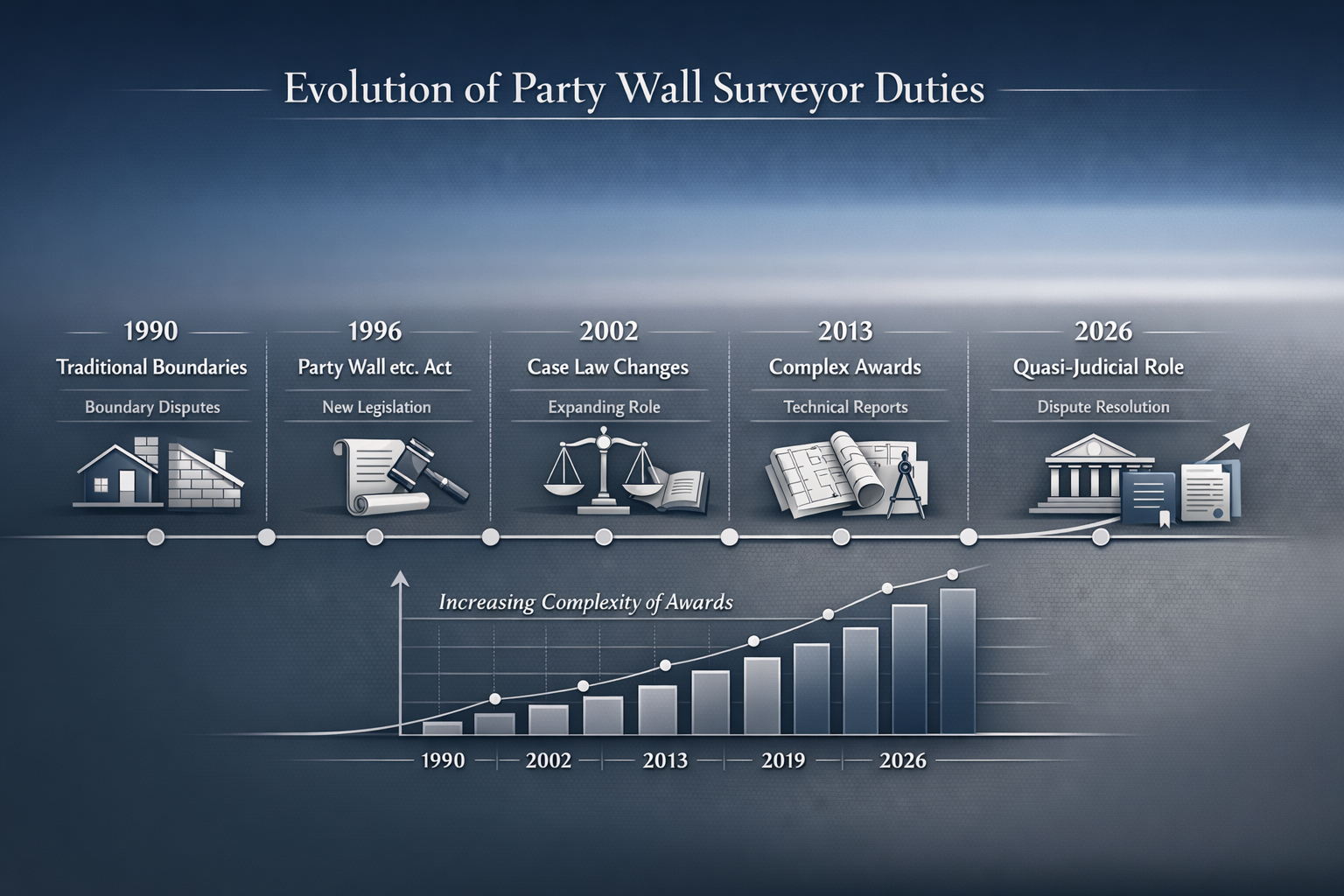
    Recent judicial decisions have fundamentally reshaped how party wall surveyors navigate their dual obligations—serving the appointing owner while maintaining strict impartiality. Between 2018 and 2024, courts have consistently emphasized that surveyors are “not an agent of or mouthpiece for the owner who appointed them,” establishing a clear trend toward protecting adjoining owners’ rights[6]. This evolution in case law creates a complex professional landscape where Party Wall Surveyor Duties to Appointing Owners: Balancing Impartiality Amid Evolving Case Law demands careful navigation of competing interests within the framework of the Party Wall etc. Act 1996.

    Understanding these evolving duties has become essential for property owners, surveyors, and legal professionals alike. The tension between appointment and impartiality represents one of the most nuanced aspects of party wall practice in 2026.

    Key Takeaways

    • 🏛️ Surveyors must act as impartial tribunals despite being appointed and paid by one party, as established in landmark cases since 2018
    • ⚖️ Case law increasingly protects adjoining owners’ rights, creating heightened duties of care beyond traditional client-surveyor relationships
    • 📋 Decision-making authority cannot be delegated except in exceptional circumstances, reflecting quasi-judicial responsibilities
    • 💰 Building owners must be informed of disputes before compensation awards are issued, preventing surprise financial obligations
    • 🎯 Surveyor jurisdiction is limited strictly to matters arising under the Party Wall Act, excluding general property disputes

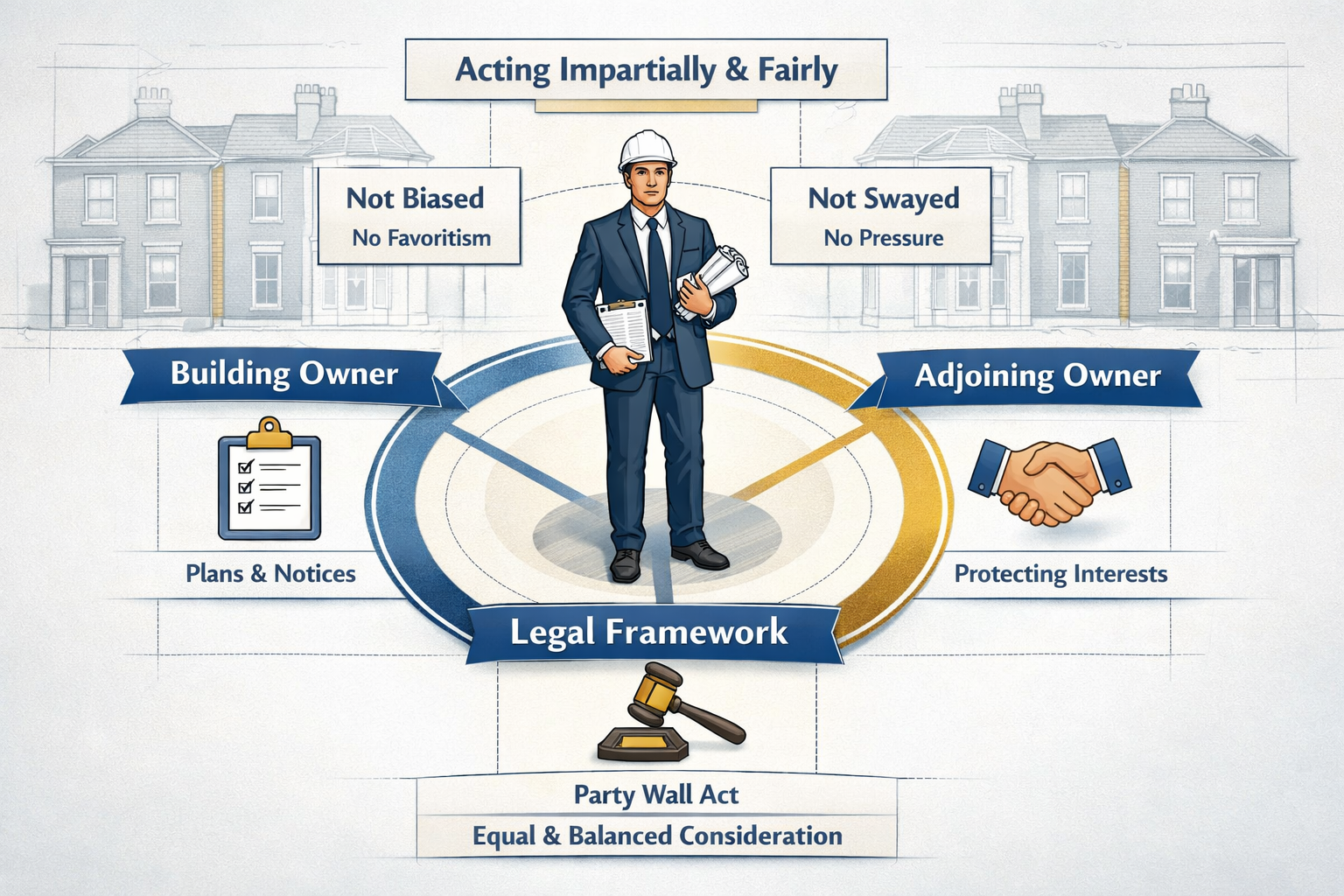
    () detailed illustration showing a professional surveyor in business attire standing at the center of a circular diagram

    The Fundamental Paradox: Appointed Yet Impartial

    Understanding the Surveyor’s Unique Position

    The role of a party wall surveyor presents an inherent contradiction that confuses many property owners. When a building owner appoints a surveyor, the natural expectation is that this professional will advocate for their interests. However, the legal reality differs significantly.

    Party wall surveyors occupy a quasi-judicial position that requires them to act as an impartial tribunal[1]. This means they must:

    • ✅ Consider both parties’ interests equally
    • ✅ Make decisions based on statutory requirements and fairness
    • ✅ Remain independent from the appointing owner’s preferences
    • ✅ Protect the adjoining owner’s rights under the Act

    This unique status distinguishes party wall surveyors from typical professional advisors. They are neither arbitrators in the traditional sense nor expert witnesses—their awards are described as “sui generis,” meaning they occupy their own distinct legal category[1].

    The Welter v McKeeve Watershed Moment

    The 2018 case Welter v McKeeve fundamentally clarified surveyor impartiality requirements[6]. The court emphasized that surveyors cannot simply rubber-stamp their appointing owner’s wishes. Instead, they must:

    1. Independently assess all evidence presented by both parties
    2. Apply professional judgment without bias toward the appointing owner
    3. Consider the adjoining owner’s legitimate concerns with equal weight
    4. Issue awards based on statutory compliance rather than client preference

    This decision sent shockwaves through the party wall surveying profession, forcing many practitioners to reassess their approach to appointments. The message was clear: appointment does not equal advocacy.

    Party Wall Surveyor Duties to Appointing Owners: Recent Case Law Developments

    The Trend Toward Adjoining Owner Protection

    A comprehensive analysis of party wall case law reveals “a trend in case law on party wall surveyors’ duties of having particular regard to the rights and interests of the adjoining owner”[2]. This shift represents a significant evolution in how courts interpret surveyor responsibilities.

    Key cases demonstrating this trend include:

    Case Name Year Key Principle Established
    Welter v McKeeve 2018 Surveyors must maintain strict impartiality despite appointment
    Evans v Paterson 2021 Building owners must be informed before compensation awards
    Walsh v PSB Management 2022 Enhanced protection for adjoining owners’ statutory rights
    Lea Valley v Derbyshire 2017 Clarified surveyor jurisdiction and award validity requirements

    Evans v Paterson: Transparency in Compensation Awards

    The 2021 Evans v Paterson case established a critical procedural requirement that affects how party wall awards are issued[7]. The court ruled that surveyors cannot make compensation awards under section 7(2) without the building owner’s knowledge of the dispute.

    This decision requires surveyors to:

    • 📢 Notify building owners when compensation claims arise
    • 📋 Provide opportunity for response before determining compensation
    • 💬 Document the dispute clearly in all communications
    • Allow reasonable time for building owners to address claims

    This ruling prevents “surprise” compensation awards that building owners only discover when receiving the final award document. It reinforces the principle that while surveyors must be impartial, they cannot operate in secrecy from their appointing owners.

    Walsh v PSB Management: Strengthening Adjoining Owner Rights

    The 2022 Walsh v PSB Management case further emphasized surveyor duties regarding adjoining owner protections[2]. This decision highlighted that surveyors must actively consider whether proposed works adequately protect adjoining owners’ properties, rather than simply accepting the building owner’s proposals.

    Practical implications include:

    • 🔍 Surveyors must independently verify that proposed methods are appropriate
    • 🛡️ Additional protective measures may be required even if not initially proposed
    • 📸 Schedules of condition must be thorough and comprehensive
    • ⚠️ Surveyors can reject inadequate protection proposals from building owners

    () courtroom-inspired composition showing a large wooden judge's gavel in foreground with three distinct case file folders

    Navigating Party Wall Surveyor Duties to Appointing Owners Without Breaching Impartiality

    Best Practice Framework for Maintaining Balance

    Professional guidance suggests that party wall surveyors should “act as impartially as possible commensurate with the surveyor’s duties to their appointing owner, keeping the parties reasonably informed, but at all times retaining control over the decision-making process”[2].

    This framework creates a practical approach to balancing competing obligations:

    Communication Standards:

    • Keep both parties informed of significant developments
    • Explain decisions clearly to both building and adjoining owners
    • Document all communications thoroughly
    • Avoid ex parte communications that exclude one party

    Decision-Making Process:

    • Base conclusions on statutory requirements and professional standards
    • Consider all evidence from both parties equally
    • Apply consistent standards regardless of who appointed you
    • Document reasoning for all significant decisions

    Relationship Management:

    • Maintain professional distance from appointing owners
    • Resist pressure to favor the appointing party
    • Educate clients about impartiality requirements upfront
    • Set clear expectations during initial appointment

    The Limits of Surveyor Authority

    Understanding jurisdictional boundaries is crucial for properly exercising Party Wall Surveyor Duties to Appointing Owners: Balancing Impartiality Amid Evolving Case Law. Surveyors cannot rule on matters beyond the Party Wall Act’s scope[3].

    Matters WITHIN surveyor jurisdiction:

    • ✅ Notifiable works under sections 1, 2, and 6 of the Act
    • ✅ Compensation for damage caused by notified works
    • ✅ Timing and methods of notified works
    • ✅ Protective measures during construction
    • ✅ Access requirements for notified works

    Matters OUTSIDE surveyor jurisdiction:

    • ❌ General trespass claims unrelated to notified works
    • ❌ Planning permission disputes
    • ❌ Building regulation compliance issues
    • ❌ Boundary disputes not involving party walls
    • ❌ Nuisance claims beyond statutory works

    This limitation protects surveyors from overstepping their authority while clarifying what building owners can reasonably expect from the party wall process.

    Ongoing Jurisdiction for Related Disputes

    An important principle established in case law is that surveyors retain jurisdiction for disputes arising from the same notified works[4]. This means that once appointed to resolve the principal dispute, the surveyor remains appointed should further issues emerge from those specific works.

    Practical applications:

    • 🔄 Surveyors can address additional issues discovered during construction
    • 📋 New awards can be issued for unforeseen complications
    • 💰 Compensation claims arising later from the same works remain within jurisdiction
    • ⏳ Jurisdiction continues until works are substantially complete

    This ongoing authority ensures continuity and prevents the need for repeated surveyor appointments for the same project.

    The Non-Delegation Principle and Its Implications

    Quasi-Judicial Powers Cannot Be Transferred

    A fundamental principle affecting Party Wall Surveyor Duties to Appointing Owners: Balancing Impartiality Amid Evolving Case Law is that quasi-judicial powers cannot be delegated except in exceptional circumstances[1].

    When a surveyor appointed by a party becomes incapable of acting, the appointing party must select a replacement rather than allowing the original surveyor to delegate responsibilities. This reflects the personal nature of the quasi-judicial role.

    Reasons for the non-delegation rule:

    • 🎯 Personal judgment is central to the surveyor’s role
    • ⚖️ Parties rely on specific expertise of the appointed surveyor
    • 📜 Statutory framework assumes personal exercise of duties
    • 🔒 Accountability requires identifiable decision-makers

    Practical Consequences for Surveyor Practice

    This principle has significant implications for surveying firms and individual practitioners:

    When surveyors become unavailable:

    • The appointing owner must make a new appointment
    • Work completed by the original surveyor may need review
    • Timelines may be affected by the replacement process
    • Costs of the party wall process may increase

    Preventive measures:

    • Surveyors should ensure availability for the project duration
    • Firms should clarify who specifically will handle the appointment
    • Contingency arrangements should be discussed upfront
    • Professional indemnity insurance should cover replacement scenarios

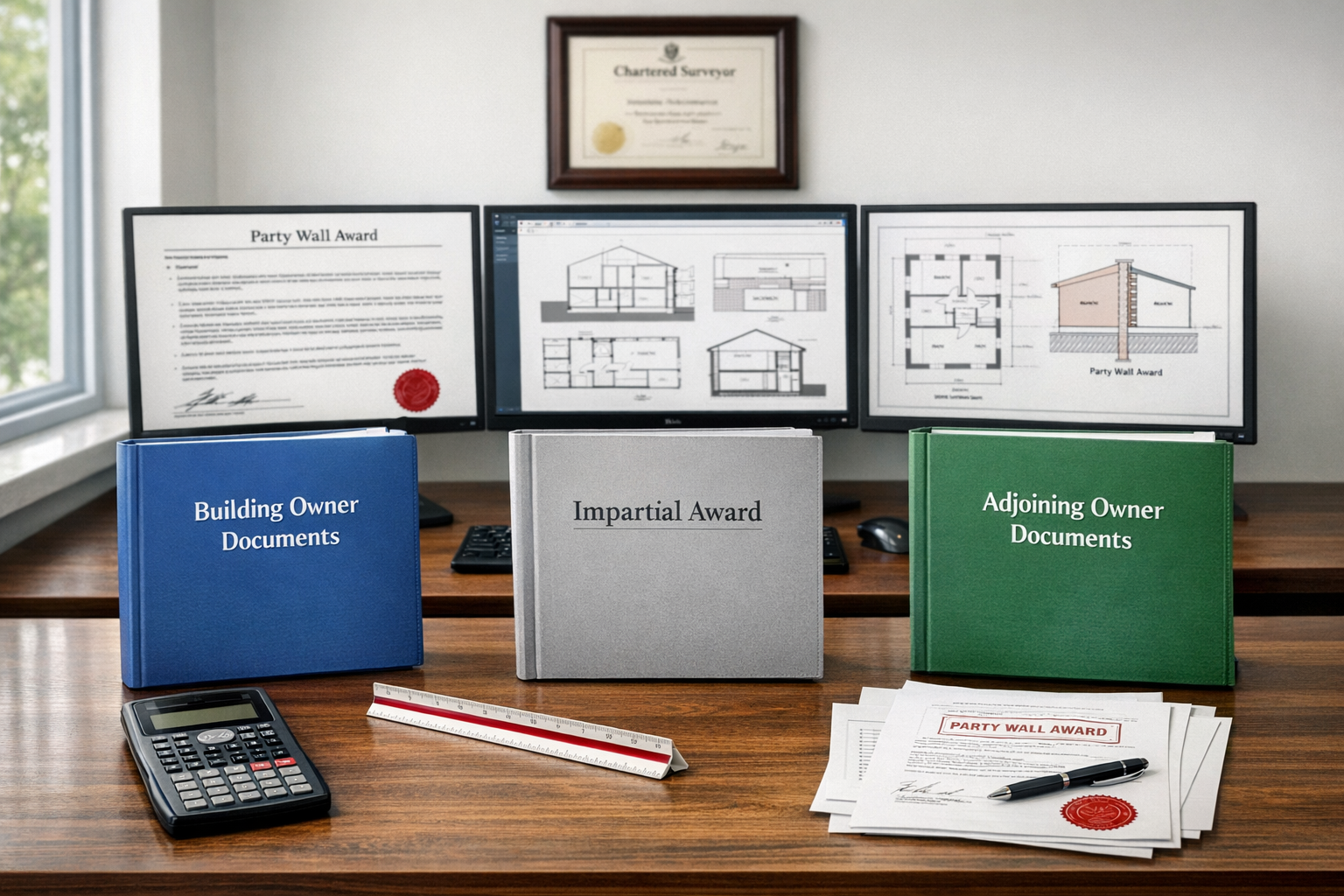
    () modern office setting showing a surveyor's workspace with dual computer monitors displaying party wall award documents

    Cost Implications and Risk Management

    Why Proper Procedure Prevents Litigation

    Case law consistently demonstrates that following correct procedures is more cost-effective than defending litigation[3]. The key lessons for building owners include:

    Why correct party wall notices are essential:

    • Invalid notices can void entire awards
    • Procedural errors create grounds for appeal
    • Correcting mistakes mid-process is expensive
    • Litigation costs far exceed proper initial compliance

    Why surveyor neutrality matters:

    • Biased awards are vulnerable to legal challenge
    • Courts will overturn awards showing partiality
    • Defending challenged awards involves substantial legal fees
    • Reputation damage affects future projects

    Why doing it properly is always cheaper:

    • Upfront compliance costs are predictable and manageable
    • Litigation involves unpredictable costs and outcomes
    • Court challenges create project delays
    • Professional fees for appeals exceed initial surveyor costs

    Managing Expectations with Appointing Owners

    One of the most important aspects of Party Wall Surveyor Duties to Appointing Owners: Balancing Impartiality Amid Evolving Case Law is educating clients about what they can and cannot expect.

    Initial appointment discussions should cover:

    1. Impartiality requirements and what they mean in practice
    2. Limitations on advocacy for the appointing owner’s position
    3. Adjoining owner rights that must be protected
    4. Potential outcomes that may not favor the building owner
    5. Cost allocation under the Act’s provisions

    Setting realistic expectations prevents disappointment and reduces the risk of complaints about surveyor conduct. Many disputes arise from misunderstandings about the surveyor’s role rather than actual professional misconduct.

    Regional Considerations and Local Practice

    Geographic Variations in Party Wall Work

    While the Party Wall etc. Act 1996 applies uniformly across England and Wales, practical considerations vary by location. Property density, construction types, and local building practices influence how surveyors apply their duties.

    Urban areas like Central London, North London, South London, East London, and West London present unique challenges:

    • 🏘️ Higher density increases frequency of party wall matters
    • 🏗️ Complex construction requires sophisticated technical assessment
    • 💷 Property values make compensation claims more significant
    • ⚖️ Litigation rates tend to be higher in urban areas

    Selecting Surveyors with Appropriate Expertise

    Given the evolving case law and complex impartiality requirements, selecting a qualified surveyor is crucial. Building owners should seek professionals who:

    • 📚 Stay current with case law developments
    • 🎓 Hold relevant qualifications (RICS, FPWS, etc.)
    • 💼 Have substantial experience with similar projects
    • 🗣️ Communicate clearly about their impartial role
    • 📋 Maintain professional indemnity insurance

    The appointing owner’s surveyor selection significantly influences project success and compliance with evolving legal standards.

    Future Directions in Party Wall Surveyor Duties

    Anticipated Legal Developments

    As we progress through 2026, several trends suggest continued evolution in Party Wall Surveyor Duties to Appointing Owners: Balancing Impartiality Amid Evolving Case Law:

    Emerging issues likely to reach courts:

    • 🌍 Climate adaptation works and their classification under the Act
    • 🔋 Renewable energy installations on party walls
    • 🏢 Permitted development rights interaction with party wall procedures
    • 💻 Digital documentation standards for awards and notices

    Potential regulatory changes:

    • Professional body guidance updates reflecting recent case law
    • Standardized training requirements for party wall surveyors
    • Enhanced consumer protection measures
    • Clearer fee structure guidelines

    Technology and Modern Practice

    Modern surveying practice increasingly incorporates technology that affects how duties are discharged:

    Digital tools enhancing impartiality:

    • 📸 Photographic evidence with metadata verification
    • 📊 Standardized assessment templates
    • 🔐 Secure document sharing with both parties
    • 📱 Real-time communication platforms

    Challenges requiring careful management:

    • Ensuring equal access to technology for all parties
    • Maintaining confidentiality in digital communications
    • Verifying authenticity of digital evidence
    • Preserving records for potential appeals

    Practical Guidance for Different Stakeholders

    For Building Owners Initiating Works

    If you’re planning works requiring party wall notices, understanding surveyor impartiality helps set realistic expectations:

    Do:

    • ✅ Choose surveyors based on expertise and professionalism
    • ✅ Provide complete, accurate information
    • ✅ Accept that some decisions may not favor your preferences
    • ✅ Budget for reasonable protective measures
    • ✅ Understand that keeping party wall costs down means proper compliance, not cutting corners

    Don’t:

    • ❌ Expect your surveyor to advocate against the adjoining owner
    • ❌ Pressure surveyors to compromise impartiality
    • ❌ Withhold information that might affect the award
    • ❌ Assume appointment guarantees favorable outcomes
    • ❌ Skip proper notice procedures to save time

    For Adjoining Owners Receiving Notices

    If you’ve received party wall notices, understanding surveyor duties protects your interests:

    Your rights include:

    • 🛡️ Impartial assessment even from the building owner’s surveyor
    • 📋 Proper consideration of your concerns and evidence
    • 💰 Fair compensation for any damage caused
    • 🔍 Adequate protective measures during construction
    • ⚖️ Appeal rights if awards are unreasonable

    Consider appointing your own surveyor when:

    • Works are extensive or complex
    • Your property has special vulnerabilities
    • You lack technical expertise to assess proposals
    • The building owner’s surveyor seems biased
    • Significant compensation claims may arise

    The role of the adjoining owner’s surveyor provides additional protection and expertise.

    For Surveyors Navigating Duties

    Professional surveyors must continuously adapt their practice to evolving case law:

    Essential practices for 2026:

    1. Regular CPD on recent case law developments
    2. Clear engagement letters explaining impartiality requirements
    3. Documented decision-making showing balanced consideration
    4. Transparent communication with both parties
    5. Professional skepticism toward appointing owner proposals

    Red flags requiring special attention:

    • ⚠️ Pressure from appointing owners to favor their position
    • ⚠️ Inadequate protective measures proposed
    • ⚠️ Insufficient evidence to support claims
    • ⚠️ Attempts to exclude adjoining owners from information
    • ⚠️ Unreasonable timelines that compromise thoroughness

    Conclusion

    The landscape of Party Wall Surveyor Duties to Appointing Owners: Balancing Impartiality Amid Evolving Case Law has transformed significantly since the watershed 2018 Welter v McKeeve decision. Courts have consistently reinforced that surveyors occupy a unique quasi-judicial position requiring strict impartiality despite being appointed and paid by one party. The trend toward enhanced protection of adjoining owners’ rights, exemplified by cases like Evans v Paterson (2021) and Walsh v PSB Management (2022), has created a more balanced framework that better serves the Act’s underlying purposes.

    For building owners, this evolution means accepting that appointment does not guarantee favorable outcomes. Surveyors must independently assess evidence, protect adjoining owners’ statutory rights, and base decisions on professional judgment rather than client preference. The most cost-effective approach remains proper compliance from the outset—correct notices, qualified surveyors, and realistic expectations about impartiality requirements.

    For adjoining owners, recent case law provides stronger protections and clearer rights to fair treatment. Even surveyors appointed by building owners must give equal weight to adjoining owners’ legitimate concerns and evidence.

    For surveyors, maintaining impartiality while serving appointing owners requires careful navigation of competing obligations. Clear communication, thorough documentation, and unwavering professional standards remain essential. The quasi-judicial nature of the role cannot be compromised by client pressure or commercial considerations.

    Actionable Next Steps

    If you’re planning building works:

    1. Serve proper party wall notices before commencing
    2. Appoint qualified surveyors with current case law knowledge
    3. Budget realistically for protective measures and potential compensation
    4. Understand your surveyor’s impartiality obligations from the outset

    If you’ve received party wall notices:

    1. Respond within the statutory 14-day period
    2. Consider appointing your own surveyor for complex works
    3. Document your property’s pre-works condition thoroughly
    4. Understand your rights to impartial treatment and fair compensation

    If you’re a party wall surveyor:

    1. Update your knowledge of 2018-2024 case law developments
    2. Review engagement letters to clarify impartiality requirements
    3. Implement robust documentation systems for decision-making
    4. Maintain professional distance from appointing owners’ commercial interests

    The evolution of party wall surveyor duties reflects a maturing legal framework that better balances the interests of all parties. By understanding these obligations and working within the established framework, building owners, adjoining owners, and surveyors can navigate party wall matters efficiently while minimizing disputes and ensuring compliance with both statutory requirements and evolving case law principles.


    References

    [1] The Unique Role Of A Party Wall Surveyor – https://dwfgroup.com/en/news-and-insights/insights/2017/4/the-unique-role-of-a-party-wall-surveyor

    [2] How To Play Nicely The Current Law Of Party Wall S – https://hstalks.com/article/8478/how-to-play-nicely-the-current-law-of-party-wall-s/

    [3] The Top Party Wall Case Laws Every Building Owner Should Know – https://www.simplesurvey.co.uk/article/the-top-party-wall-case-laws-every-building-owner-should-know/

    [4] Does An Appointed Party Wall Surveyor Have Ongoing Jurisdiction – https://taylor-mitchell.co.uk/blog/does-an-appointed-party-wall-surveyor-have-ongoing-jurisdiction/

    [6] Party Wall Surveyors Impartiality – https://ww3.rics.org/uk/en/journals/built-environment-journal/party-wall-surveyors-impartiality.html

    [7] Practice Changing Party Wall Case Law Evans V Paterson 2021 – https://www.peterbarry.co.uk/blog/practice-changing-party-wall-case-law-evans-v-paterson-2021/

  • Appointing Independent Party Wall Surveyors: When Agreed Surveyors

    When agreed surveyors fail to fulfill their statutory duties under the Party Wall etc. Act 1996, property owners face immediate risks: stalled construction projects, mounting legal costs, and potential structural damage disputes. In 2026, with RICS launching formal consultation on updated party wall guidance, understanding the transition to independent surveyors has never been more critical for protecting your property rights and project timelines.

    Appointing independent party wall surveyors when agreed surveyors fail requires navigating complex statutory procedures, understanding enforcement mechanisms, and managing unexpected costs. This comprehensive guide explains exactly when and how to proceed with independent appointments, ensuring your construction project stays on track while maintaining legal compliance.

    Key Takeaways

    • Surveyor independence is statutory: Party wall surveyor appointments are personal and independent of client instruction, establishing critical accountability standards [1]
    • Failed agreements trigger specific procedures: When agreed surveyors fail, property owners must follow precise statutory steps within defined timeframes to appoint independent alternatives
    • Third Surveyor mechanism provides recourse: The Party Wall etc. Act 1996 includes built-in escalation procedures for resolving surveyor failures and disputes
    • 2026 guidance updates address enforcement gaps: RICS consultation specifically targets awards challenged due to surveyors acting without proper jurisdiction [1]
    • Cost implications require advance planning: Transitioning to independent surveyors carries financial consequences that differ significantly from agreed surveyor arrangements

    () editorial image showing professional meeting room scene with three distinct surveyors seated at modern conference table,

    Understanding When Agreed Surveyors Fail: Recognition and Documentation

    Defining Surveyor Failure Under the Party Wall etc. Act 1996

    Agreed surveyor failure occurs when the appointed professional cannot or will not fulfill their statutory obligations under the Party Wall etc. Act 1996. Recognizing failure early prevents project delays and protects both building and adjoining owners from legal complications.

    Common failure scenarios include:

    • Conflict of interest emergence: When surveyors discover undisclosed relationships with one party that compromise independence
    • Non-responsiveness: Failure to respond to correspondence within reasonable timeframes (typically 10-14 days)
    • Jurisdictional overreach: Acting without genuine dispute between parties, a concern specifically addressed in the draft 8th edition guidance [1]
    • Professional misconduct: Breach of RICS standards, fee irregularities, or failure to maintain impartiality
    • Capacity issues: Illness, retirement, or business closure preventing completion of duties

    The updated RICS guidance emphasizes that party wall surveyor appointments are personal and statutory, independent of client instruction [1]. This principle establishes that surveyors cannot simply defer to client preferences when professional judgment conflicts with statutory requirements.

    Documentation Requirements for Establishing Failure

    Before transitioning to independent surveyors, property owners must document the failure comprehensively. This documentation serves multiple purposes: justifying the appointment change, supporting potential fee disputes, and protecting against future legal challenges.

    Essential documentation includes:

    Document Type Purpose Retention Period
    Appointment letters Prove original agreement Entire project + 6 years
    Correspondence log Demonstrate non-responsiveness Entire project + 6 years
    Dated communication attempts Establish timeline of failure Entire project + 6 years
    Conflict disclosure notices Evidence impartiality concerns Entire project + 6 years
    Fee dispute records Support cost recovery claims Entire project + 6 years

    Property owners should maintain chronological records with timestamps, delivery confirmations, and response deadlines. When surveyors fail to meet obligations, written notices specifying the failure and requesting remedy within 7-14 days create clear evidence for subsequent independent appointments.

    The 2026 RICS consultation addresses enhanced guidance on regulatory and conduct matters including fee practices [1], suggesting that documentation of fee irregularities will carry increased weight in justifying surveyor replacement.

    The Statutory Timeline: When to Act

    Time-sensitive action is critical when agreed surveyors fail. The Party Wall etc. Act 1996 contains specific timeframes that, if missed, can delay projects by months.

    Critical timeline markers:

    1. Initial failure recognition: Document immediately upon identifying non-compliance
    2. Remedy period: Allow 7-14 days for surveyor to address concerns
    3. Notification to both parties: Inform building and adjoining owners within 3 days of confirmed failure
    4. Independent appointment initiation: Begin within 10 days of failed remedy period
    5. Third Surveyor selection: Must occur within 10 days if parties cannot agree on replacement

    For urgent 2026 projects, particularly those with scheduled construction starts, proactive monitoring of surveyor performance prevents timeline disruptions. Building owners should establish milestone checkpoints (notice service, schedule of condition completion, award drafting) with expected completion dates.

    When working with party wall surveyors across London, understanding regional variations in response times and workload capacity helps set realistic expectations and identify potential failures earlier.

    Appointing Independent Party Wall Surveyors: When Agreed Surveyors Fail – The Procedural Framework

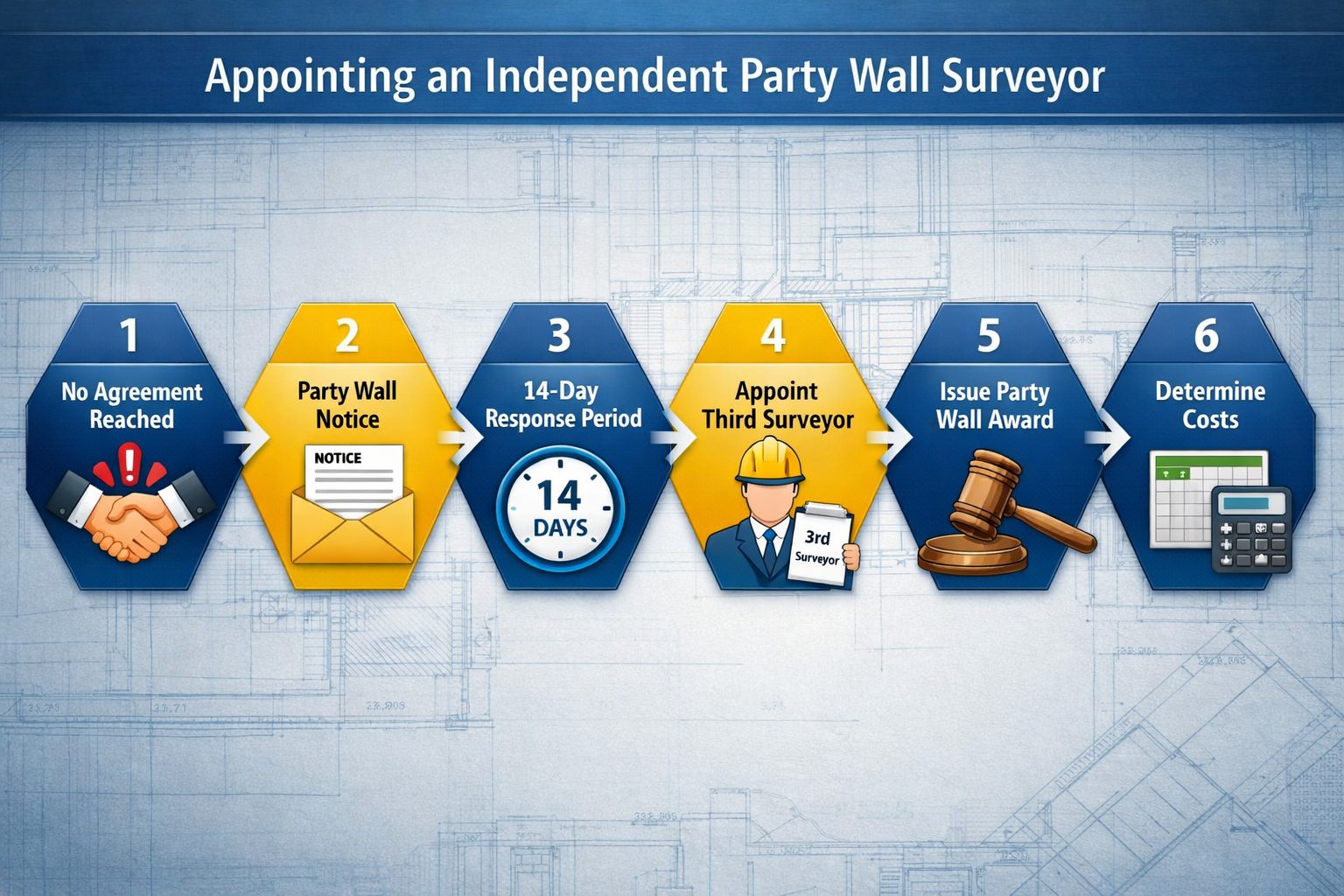
    () detailed infographic-style image displaying step-by-step flowchart for appointing independent party wall surveyor. Visual

    Step 1: Formal Notification of Surveyor Withdrawal or Removal

    When agreed surveyor failure is confirmed, formal notification initiates the transition process. This notification must reach all parties simultaneously to maintain transparency and statutory compliance.

    Notification must include:

    • Clear statement of surveyor failure with specific examples
    • Reference to relevant statutory provisions (Section 10, Party Wall etc. Act 1996)
    • Timeline of documented failure attempts
    • Declaration of intent to appoint independent surveyor
    • Deadline for response (typically 10 days)

    The notification should be served via recorded delivery or hand delivery with signed receipt. Email alone is insufficient for statutory purposes, though it may supplement physical service.

    Building owners must send notifications to:

    1. The failed agreed surveyor (professional courtesy and record)
    2. The adjoining owner(s)
    3. Any previously appointed Third Surveyor (if applicable)

    The 2026 RICS consultation specifically addresses service of notices [1], suggesting updated templates and methods will emerge from the guidance revision. Property owners should consult current party wall notice requirements to ensure compliance.

    Step 2: The Independent Surveyor Appointment Mechanism

    Following notification, parties have two pathways for appointing independent surveyors:

    Option A: Mutual Agreement on New Surveyor

    If building and adjoining owners can agree on a replacement, this represents the fastest resolution. The new agreed surveyor assumes all responsibilities of the failed appointment, continuing from the point of interruption.

    Benefits include:

    • ✅ Lower costs (single surveyor fee structure)
    • ✅ Faster resolution (no Third Surveyor involvement)
    • ✅ Continued relationship management
    • ✅ Simplified communication

    Option B: Separate Surveyor Appointments

    When agreement fails, each party appoints their own surveyor—a building owner’s surveyor and an adjoining owner’s surveyor. These two surveyors then work together to produce the party wall award.

    This pathway involves:

    • 📋 Each party selecting and appointing their own professional
    • 📋 Exchange of surveyor contact details within 10 days
    • 📋 Joint surveyor meeting to establish procedures
    • 📋 Coordinated schedule of condition and award preparation
    • 📋 Potential Third Surveyor selection for dispute resolution

    The enhanced guidance on use of the Third Surveyor [1] in the 2026 consultation suggests clearer procedures for this escalation mechanism, addressing previous ambiguities in the selection and authority of Third Surveyors.

    Step 3: Updated Letters of Appointment and Terms of Engagement

    The 2026 RICS consultation introduces revised letters of appointment and terms of engagement [1], replacing 7th edition templates with updated procedures addressing surveyor accountability.

    New appointment letters should specify:

    Section Required Content Purpose
    Scope of appointment Specific works covered under notice Prevent jurisdictional disputes
    Independence declaration Conflicts of interest disclosure Ensure impartiality
    Fee structure Detailed breakdown with payment terms Prevent fee disputes
    Timeline commitments Milestone dates for deliverables Enable performance monitoring
    Termination provisions Conditions for appointment end Facilitate future transitions
    Third Surveyor provisions Pre-agreed selection mechanism Expedite dispute resolution

    Property owners should request written confirmation of RICS membership and professional indemnity insurance before finalizing appointments. The consultation’s emphasis on supporting high standards of competence, conduct and consistency [1] suggests increased scrutiny of surveyor qualifications in 2026.

    When appointing independent surveyors, consider geographical expertise. Surveyors familiar with North London, South London, or other specific areas bring valuable local knowledge of construction practices and common dispute patterns.

    Step 4: The Third Surveyor Selection Process

    When independent surveyors disagree or when the original agreed surveyor failure creates ongoing disputes, the Third Surveyor provides statutory resolution. This appointment represents the highest level of party wall dispute resolution short of court proceedings.

    Third Surveyor appointment occurs when:

    • Two appointed surveyors cannot agree on award terms
    • Disputes arise regarding scope, methodology, or compensation
    • Either surveyor requests Third Surveyor involvement
    • Parties cannot agree on replacement for failed surveyor

    Selection mechanisms:

    1. Mutual agreement: Building and adjoining owners jointly select Third Surveyor (preferred method)
    2. Surveyor agreement: The two appointed surveyors jointly select Third Surveyor
    3. Appointing Officer: If no agreement within 10 days, either party may request appointment by the local authority’s Appointing Officer

    The Third Surveyor’s decision is binding and final, with the same legal weight as a court judgment. Their fees are typically shared equally between parties unless the award specifies otherwise.

    The 2026 consultation’s focus on enhanced guidance covering use of the Third Surveyor [1] addresses previous inconsistencies in this mechanism, suggesting clearer procedures for selection, scope of authority, and fee arrangements.

    Cost Implications and Award Enforcement When Transitioning to Independent Surveyors

    () split-screen comparison image showing 'Before' and 'After' scenarios of party wall dispute resolution. Left side shows

    Understanding the Financial Impact of Surveyor Transition

    Transitioning from agreed to independent surveyors significantly increases costs for party wall procedures. Property owners must budget for these increases, particularly when projects face unexpected surveyor failures mid-process.

    Cost comparison:

    Scenario Typical Cost Range Payment Responsibility
    Single agreed surveyor £700-£1,500 Building owner pays all
    Two independent surveyors £1,400-£3,000 Building owner pays both initially
    Third Surveyor involvement Additional £1,000-£2,500 Shared or as award directs
    Failed surveyor replacement Potential double fees May recover from failed surveyor

    Building owners bear initial financial responsibility for all surveyor fees under the Act, though awards may allocate costs differently based on circumstances. When surveyor failure results from misconduct or negligence, property owners may pursue cost recovery through professional complaints or legal action.

    The 2026 RICS consultation specifically addresses fee practices [1], suggesting updated guidance on reasonable fee structures and transparency requirements. This may provide stronger grounds for challenging excessive fees or recovering costs from failed surveyors.

    For strategies to manage expenses, review guidance on how to keep party wall costs down and understand the full costs of the party wall process.

    Award Enforcement When Surveyors Have Failed

    The 2026 RICS consultation reveals a critical concern: awards have been challenged in cases where surveyors acted without proper jurisdiction [1], including circumstances where no genuine dispute existed between parties. This enforcement gap creates risks when transitioning from failed surveyors.

    Award validity requirements:

    Proper jurisdiction: Genuine dispute or dissent must exist
    Correct notice service: All statutory notices properly served
    Surveyor authority: Valid appointments with proper terms
    Procedural compliance: All Act requirements followed
    Impartiality maintained: No conflicts of interest affecting decisions

    When previous surveyor failures compromise these requirements, newly appointed independent surveyors must validate the entire process from the beginning. This may require:

    • Re-serving notices if original service was defective
    • Conducting new schedules of condition if previous ones are compromised
    • Extending timelines to ensure proper procedures
    • Documenting all remedial steps for award validity

    Enforcement mechanisms for valid awards:

    Party wall awards are enforceable as legal documents. When parties fail to comply:

    1. Initial enforcement: Written notice of non-compliance with 14-day remedy period
    2. Formal demand: Solicitor’s letter demanding compliance
    3. County Court proceedings: Application for enforcement order
    4. Injunctive relief: Court order compelling compliance
    5. Damages claim: Financial compensation for non-compliance losses

    The updated guidance’s emphasis on helping practitioners navigate the statutory process with greater clarity and confidence [1] suggests improved enforcement procedures and clearer remedies for award breaches.

    Managing Costs and Timelines for Urgent 2026 Projects

    For construction projects with imminent start dates, surveyor failure creates dual pressures of cost and time. Strategic management of both factors determines whether projects proceed on schedule or face expensive delays.

    Urgent project strategies:

    🚀 Parallel processing: Initiate independent surveyor appointments while attempting agreed surveyor resolution
    🚀 Pre-identified alternatives: Maintain list of qualified backup surveyors before issues arise
    🚀 Expedited schedules: Request accelerated timelines with premium fees if necessary
    🚀 Conditional construction starts: Begin non-notifiable works while party wall procedures complete
    🚀 Insurance review: Verify coverage for party wall dispute delays and additional costs

    Building owners should establish clear milestone dates with penalties for non-performance when appointing new surveyors. While the Act doesn’t specify surveyor performance timelines, contractual terms of engagement can create accountability.

    Consider the types of party wall works involved in your project. Some works have greater urgency or seasonal constraints (excavations before winter, for example), justifying expedited procedures and associated costs.

    Recovery of Additional Costs from Failed Surveyors

    When surveyor failure results from professional negligence, misconduct, or breach of contract, building owners may recover additional costs incurred during the transition to independent surveyors.

    Recoverable costs may include:

    • Fees paid to failed surveyor for incomplete work
    • Additional fees for replacement surveyors
    • Project delay costs (contractor standby time, storage, financing)
    • Legal costs for enforcing rights or pursuing complaints
    • Third Surveyor fees attributable to original surveyor failure

    Recovery mechanisms:

    1. Direct negotiation: Request refund or cost contribution from failed surveyor
    2. RICS complaint: File professional conduct complaint with potential disciplinary action
    3. Professional indemnity claim: Claim against surveyor’s insurance for negligence
    4. Small claims court: Pursue costs up to £10,000 through simplified procedure
    5. County Court action: Full legal proceedings for larger cost recovery

    The 2026 consultation’s focus on regulatory and conduct matters [1] suggests strengthened professional accountability standards, potentially improving cost recovery prospects for property owners affected by surveyor failures.

    Document all additional costs meticulously with invoices, correspondence, and timeline evidence. Expert witness testimony from replacement surveyors regarding the original failure may support recovery claims.

    Preventing Future Surveyor Failures: Due Diligence and Selection Criteria

    Pre-Appointment Vetting for Independent Surveyors

    Thorough due diligence prevents repeat failures when appointing independent surveyors. The 2026 RICS guidance updates emphasize competence and conduct standards [1], providing clearer benchmarks for surveyor selection.

    Essential vetting criteria:

    📋 Professional qualifications

    • Current RICS membership (MRICS or FRICS)
    • Specialist party wall accreditation
    • Continuing professional development records
    • Professional indemnity insurance (minimum £1 million)

    📋 Experience verification

    • Minimum 5 years party wall practice
    • Similar project experience (scale, complexity, location)
    • Reference checks from recent clients
    • Awards available for review

    📋 Capacity assessment

    • Current workload and availability
    • Committed timeline for key milestones
    • Support staff and resources
    • Backup arrangements for absence

    📋 Independence confirmation

    • No conflicts of interest with either party
    • No previous relationship with properties involved
    • Arms-length fee arrangements
    • Clear complaints procedure

    Request written responses to specific questions about experience, methodology, and timeline commitments. Verbal assurances alone provide insufficient protection when surveyor failures occur.

    Red Flags Indicating Potential Surveyor Problems

    Identifying warning signs early enables proactive replacement before failures disrupt projects. Common red flags include:

    🚩 Communication issues: Delayed responses, missed meetings, unclear explanations
    🚩 Fee irregularities: Vague fee structures, unexpected charges, payment demands before work completion
    🚩 Procedural shortcuts: Skipping statutory steps, inadequate documentation, rushed assessments
    🚩 Impartiality concerns: Appearing to favor one party, dismissing legitimate concerns, conflicts of interest
    🚩 Professional conduct: RICS complaints history, insurance lapses, business instability

    When red flags appear, document concerns immediately and raise them formally with the surveyor. If responses are unsatisfactory, initiate replacement procedures before failures become critical.

    The updated guidance’s emphasis on consistency [1] suggests standardized procedures that make deviations more identifiable. Surveyors who resist following standard protocols may indicate future reliability problems.

    Building Contingency Plans for Surveyor Transitions

    Proactive contingency planning minimizes disruption when surveyor transitions become necessary. Smart property owners establish backup procedures before issues arise.

    Effective contingency elements:

    • Alternative surveyor list: Pre-vetted professionals who can step in quickly
    • Flexible project timelines: Built-in buffer periods for unexpected delays
    • Enhanced documentation: Comprehensive records enabling seamless handover
    • Clear termination clauses: Appointment terms allowing efficient transitions
    • Financial reserves: Budget allocation for potential additional surveyor costs

    For complex projects or situations where neighbors are carrying out works, contingency planning becomes even more critical given reduced control over surveyor selection and procedures.

    Conclusion: Navigating Surveyor Failures with Confidence in 2026

    Appointing independent party wall surveyors when agreed surveyors fail requires understanding statutory procedures, managing costs strategically, and acting within critical timeframes. The 2026 RICS consultation on updated party wall guidance [1] addresses key enforcement gaps and professional standards, providing clearer pathways for property owners facing surveyor failures.

    Key action steps for property owners:

    1. Document thoroughly: Maintain comprehensive records of all surveyor interactions and performance issues
    2. Act promptly: Initiate replacement procedures within 10 days of confirmed failure
    3. Understand options: Choose between new agreed surveyor or separate independent appointments based on relationship dynamics
    4. Budget appropriately: Allocate funds for potential transition costs and Third Surveyor involvement
    5. Verify qualifications: Conduct thorough due diligence on replacement surveyors before appointment
    6. Protect timelines: Build contingency periods into project schedules for potential surveyor transitions

    The updated RICS guidance emphasizes that party wall surveyor appointments are personal and statutory, independent of client instruction [1]. This principle protects property owners by establishing clear accountability standards and professional obligations that surveyors cannot compromise.

    For urgent 2026 projects, early recognition of surveyor failures and immediate action on independent appointments prevents costly construction delays. Understanding the Third Surveyor mechanism and award enforcement procedures ensures that even complex disputes reach resolution without derailing projects.

    Whether you’re carrying out works or responding to neighbor construction, knowing how to transition from failed agreed surveyors to independent professionals protects your property rights and project investment.

    Ready to appoint an independent party wall surveyor? Consult with qualified professionals who understand the 2026 regulatory landscape and can guide you through surveyor transitions with minimal disruption to your construction timeline.


    References

    [1] Rics Launches Consultation On Updated Party Wall Practice Guidance – https://www.rics.org/news-insights/rics-launches-consultation-on-updated-party-wall-practice-guidance

    [2] Rics Opens Consultation On Party Wall Guidance Update – https://www.propertywire.com/news/uk/rics-opens-consultation-on-party-wall-guidance-update/

    [3] Rics Launches Consultation On Party Wall Guidance – https://thenegotiator.co.uk/news/regulation-law-news/rics-launches-consultation-on-party-wall-guidance/

    [4] Rics Consults On Updated Party Wall Practice Guidance – https://www.lexisnexis.co.uk/legal/news/rics-consults-on-updated-party-wall-practice-guidance

    [5] Party Wall Surveys And Neighbour Disputes During 2026s Construction Uptick Rics Compliance Framework – https://nottinghillsurveyors.com/blog/party-wall-surveys-and-neighbour-disputes-during-2026s-construction-uptick-rics-compliance-framework

  • Costs of Party Wall Surveyors in 2026: Who Pays and Factors

    Rising construction activity across England and Wales has pushed party wall surveyor demand to unprecedented levels in 2026, with building owners facing fees that can range from under £1,000 to over £10,000 depending on project complexity. Understanding the Costs of Party Wall Surveyors in 2026: Who Pays and Factors Influencing Fees for Awards and Notices has become essential for anyone planning construction work that affects shared walls, boundaries, or adjacent properties. With hourly rates climbing to £400 in premium London locations and no statutory fee caps in place, property owners must navigate a landscape where transparency and planning are crucial to avoiding budget overruns.

    The Party Wall etc. Act 1996 establishes clear payment responsibilities but leaves fee determination to market forces and professional judgment. This comprehensive guide breaks down every cost component, explains who bears financial responsibility, and reveals the factors that can double or triple your surveyor expenses.

    Professional () hero image featuring 'Costs of Party Wall Surveyors in 2026: Who Pays and Factors Influencing Fees for

    Key Takeaways

    • Building owners pay all reasonable surveyor costs, including both their own surveyor’s fees and the adjoining owner’s surveyor fees, as mandated by Section 11(1) of the Party Wall Act 1996
    • Total costs range from £900 for straightforward single-surveyor appointments to £10,000+ for complex basement conversions with multiple adjoining properties
    • Hourly rates vary significantly by location, from £150–£300 nationally to £400 per hour in central London areas in 2026
    • Hidden costs including schedule of condition assessments (£300–£600), structural engineer reviews (£500+), and third surveyor appointments (£1,000–£2,500) can substantially increase initial quotes
    • Project complexity, number of adjoining owners, type of construction work, and surveyor experience are the primary factors influencing final fees

    Understanding Who Pays for Party Wall Surveyor Costs in 2026

    The financial responsibility for party wall awards falls squarely on the shoulders of the building owner—the person or entity initiating the construction work. This fundamental principle, enshrined in Section 11(1) of the Party Wall etc. Act 1996, means that adjoining owners pay nothing under normal circumstances[1][4].

    Building Owner’s Financial Obligations

    When planning construction that requires party wall notices, building owners must budget for:

    • Their own surveyor’s professional fees for preparing awards, conducting site visits, and managing the process
    • The adjoining owner’s surveyor fees in full, regardless of how much time that surveyor spends on the matter
    • Award preparation and documentation costs including drafting, revisions, and formal service
    • Schedule of condition assessments documenting the pre-construction state of adjoining properties
    • Third surveyor fees if the two appointed surveyors cannot reach agreement on specific matters
    • Administrative costs such as postage, copying, and formal notice service

    This comprehensive payment obligation exists regardless of whether the adjoining owner consents to the work or disputes aspects of the proposal[6]. The rationale is straightforward: the building owner benefits from the construction work and therefore bears the associated procedural costs.

    When Adjoining Owners Might Pay

    While rare, certain circumstances can shift payment responsibility:

    🔴 Unreasonable behavior: If an adjoining owner appoints a surveyor who acts unreasonably, charges excessive fees, or deliberately delays the process without justification, courts may order that owner to bear their surveyor’s costs[7].

    🔴 Frivolous objections: Adjoining owners who raise groundless disputes purely to obstruct legitimate work may face cost orders.

    🔴 Separate legal advice: If an adjoining owner seeks independent legal counsel beyond the surveyor’s role, those legal fees typically fall to that owner[4].

    For most residential projects following standard procedures, however, building owners should plan to cover all surveyor-related expenses. Understanding how to keep party wall costs down becomes essential budget management.

    Key Takeaways section infographic with split-screen visual: Left side showing professional surveyor in hard hat and

    Breaking Down Party Wall Surveyor Fee Structures and Typical Costs

    The Costs of Party Wall Surveyors in 2026: Who Pays and Factors Influencing Fees for Awards and Notices vary dramatically based on appointment type, project scope, and geographic location. Unlike many professional services, party wall surveyors operate without statutory fee schedules, charging “reasonable fees” based on time, expertise, and work complexity[5].

    Hourly Rate Structures

    Most party wall surveyors charge on an hourly basis, with 2026 rates reflecting increased demand and inflation pressures:

    Location Typical Hourly Rate Range
    National Average £150–£250 per hour
    London (Outer Boroughs) £200–£300 per hour
    Central London £250–£400 per hour
    Regional Cities £150–£220 per hour

    These rates apply to both building owner surveyors and adjoining owner surveyors, though individual practitioners set their own fees[2][4]. Senior surveyors with specialized expertise in complex projects command premium rates, particularly in high-demand areas like central London and north London.

    Single Agreed Surveyor Appointments

    The most cost-effective approach involves appointing one agreed surveyor who acts impartially for both parties. This arrangement works well for straightforward projects where neighbors maintain good relationships:

    💰 Typical cost range: £900–£1,500 for standard residential work
    💰 Includes: Initial consultation, site inspection, award preparation, and basic follow-up
    💰 Best for: Loft conversions, single-story extensions, simple party wall works

    This option eliminates duplication of effort and reduces overall expenses, making it attractive for budget-conscious building owners tackling uncomplicated projects[1][2].

    Two-Surveyor Appointments (Standard Approach)

    When adjoining owners prefer independent representation or disputes seem likely, each party appoints their own surveyor. These two professionals then collaborate to produce the party wall award:

    💰 Typical cost range: £1,500–£3,500 for standard residential projects
    💰 Building owner’s surveyor: £800–£1,800
    💰 Adjoining owner’s surveyor: £700–£1,700
    💰 Best for: Rear extensions, side returns, standard basement work affecting one or two neighbors

    Remember that building owners pay both surveyors’ fees. The adjoining owner’s surveyor may charge similar or even higher rates than the building owner’s surveyor, particularly if they conduct extensive investigations or multiple site visits[7].

    Complex Project Cost Ranges

    Large-scale or technically challenging projects generate substantially higher fees:

    🏗️ Basement conversions with underpinning: £5,000–£10,000+
    🏗️ Multi-story developments: £8,000–£15,000+
    🏗️ Commercial projects: £10,000–£25,000+
    🏗️ Projects affecting multiple adjoining owners: Add £1,000–£2,500 per additional neighbor

    These figures reflect the extensive time required for structural assessments, detailed scheduling, ongoing monitoring, and coordination among multiple parties[4]. For guidance on types of party wall works that trigger different cost levels, property owners should consult specialists early in the planning process.

    Additional Cost Components Often Overlooked

    Beyond basic surveyor fees, several supplementary expenses frequently catch building owners off guard:

    📋 Schedule of Condition: £300–£600 per property

    • Photographic documentation of adjoining property’s pre-construction state
    • Essential for protecting both parties against spurious damage claims
    • May require multiple visits for comprehensive coverage

    🔧 Structural Engineer Reviews: £500–£1,200+

    • Technical assessment of proposed construction methods
    • Verification of calculations for underpinning, steel beam installations
    • Often required for basement conversions or significant structural alterations

    ⚖️ Third Surveyor Appointments: £1,000–£2,500

    • Appointed when the two surveyors cannot agree on specific award terms
    • Acts as arbitrator on disputed points
    • Relatively rare but adds significant cost when needed

    🔍 Monitoring Visits During Construction: £150–£400 per visit

    • Periodic inspections to ensure work complies with the award
    • Typically 2–4 visits for standard projects
    • More frequent for complex or high-risk work

    Understanding the complete costs of party wall process requires accounting for these ancillary expenses from the outset.

    () comparative cost breakdown visualization showing three distinct surveyor appointment scenarios side by side. Left panel:

    Key Factors Influencing Party Wall Surveyor Fees in 2026

    The Costs of Party Wall Surveyors in 2026: Who Pays and Factors Influencing Fees for Awards and Notices depend on numerous variables that building owners must evaluate when budgeting. Understanding these factors enables more accurate cost forecasting and helps identify opportunities for expense management.

    Project Complexity and Scope

    The single largest fee determinant is the technical complexity of the proposed work:

    Low Complexity (£900–£1,500 total):

    • Single-story rear extensions not affecting foundations
    • Loft conversions with minimal structural changes
    • Internal alterations to party walls
    • Straightforward chimney breast removal

    Medium Complexity (£1,500–£4,000 total):

    • Two-story extensions requiring foundation work
    • Rear extensions with basement elements
    • Party wall rebuilding or significant repairs
    • Installation of steel beams affecting party structures

    High Complexity (£5,000–£10,000+ total):

    • Full basement excavations with underpinning
    • Multi-level developments affecting multiple party walls
    • Commercial projects with complex structural requirements
    • Historic buildings requiring specialized assessment

    Complex projects demand more surveyor time for technical review, detailed scheduling, structural calculations verification, and ongoing monitoring[4][5]. Each additional technical challenge adds hours to the surveyor’s workload, directly increasing fees.

    Number of Adjoining Owners Affected

    Party wall costs multiply when construction affects multiple neighboring properties:

    🏘️ Single adjoining owner: Base cost range applies
    🏘️ Two adjoining owners: Add 60–80% to base costs
    🏘️ Three adjoining owners: Add 120–150% to base costs
    🏘️ Four or more adjoining owners: Add 180–250% to base costs

    Each adjoining owner has the right to appoint their own surveyor, and the building owner pays all appointed surveyors. For example, a mid-terrace property owner planning a basement conversion might face surveyor fees from:

    • Their own building owner’s surveyor
    • The left neighbor’s surveyor
    • The right neighbor’s surveyor
    • The rear neighbor’s surveyor

    This scenario could generate £8,000–£15,000 in total surveyor fees even for a relatively standard project[2][7].

    Geographic Location and Local Market Rates

    Regional variations in surveyor fees reflect local demand, cost of living, and property values:

    Premium London Locations (£250–£400/hour):

    Standard London Areas (£200–£300/hour):

    • South London residential boroughs
    • Outer London suburbs with moderate development

    Regional Markets (£150–£220/hour):

    • Major cities (Manchester, Birmingham, Bristol)
    • Suburban and rural areas with lower demand

    Location also affects the availability of experienced surveyors. In high-demand areas, building owners may face longer wait times and premium rates for qualified professionals[5].

    Type of Construction Work

    Different types of party wall works trigger varying levels of surveyor involvement:

    Notice Type and Associated Costs:

    Notice Type Typical Work Cost Impact
    Party Structure Notice Building on/near party wall, cutting into party wall Medium–High
    Line of Junction Notice New wall on boundary line Low–Medium
    3-Meter/6-Meter Notice Excavation near neighboring foundations Medium–High

    Projects requiring multiple notice types generate higher fees due to increased documentation, assessment requirements, and coordination complexity. A basement conversion, for instance, typically requires both a Party Structure Notice and a 3-Meter Notice, doubling the administrative burden[4].

    Surveyor Experience and Specialization

    Professional qualifications and track record significantly influence fee levels:

    Junior Surveyors (£150–£200/hour):

    • Recently qualified or limited party wall experience
    • Suitable for straightforward residential projects
    • May require senior oversight for complex matters

    Mid-Level Surveyors (£200–£280/hour):

    • 5–10 years party wall experience
    • Handle most residential and light commercial work
    • Balance cost and expertise for standard projects

    Senior Surveyors (£280–£400/hour):

    • 10+ years specialized party wall practice
    • Expert in complex structural matters, dispute resolution
    • Essential for high-value or technically challenging projects

    Choosing the appropriate surveyor level for your project type optimizes the cost-benefit equation. Overpaying for senior expertise on simple work wastes money, while underinvesting in surveyor quality for complex projects risks costly errors or disputes[5].

    Timeline and Urgency

    Rushed timelines increase surveyor costs:

    Standard timeline (8–12 weeks): Normal fee rates apply
    Expedited service (4–6 weeks): 15–25% premium typical
    Emergency appointments (under 4 weeks): 30–50% premium possible

    Building owners who serve party wall notices late in their planning process often face premium charges for accelerated service. Early engagement with surveyors—ideally 3–4 months before construction start—avoids urgency premiums[6].

    Dispute Complexity and Resolution Needs

    When disagreements arise between parties, costs escalate:

    🔺 Straightforward agreement: Base fees apply
    🔺 Minor disputes requiring negotiation: Add 20–40% to base costs
    🔺 Significant disputes requiring detailed technical assessment: Add 50–100%
    🔺 Third surveyor appointment: Add £1,000–£2,500

    Maintaining positive neighbor relationships and addressing concerns proactively minimizes dispute-related cost increases. Understanding how to respond to party wall notices helps both building owners and adjoining owners navigate the process constructively.

    () detailed illustration showing key factors influencing party wall surveyor fees arranged as interconnected hexagonal

    Practical Strategies for Managing Party Wall Surveyor Costs

    While building owners cannot avoid their legal obligation to pay surveyor fees, several strategies help control expenses without compromising quality or compliance:

    1. Obtain Multiple Quotes Early

    Request detailed fee estimates from at least three surveyors before making appointments:

    • Ask for itemized breakdowns showing hourly rates, estimated hours, and additional costs
    • Clarify what services are included versus extra (schedules of condition, monitoring visits)
    • Verify whether quotes include VAT (some surveyors are VAT-registered, adding 20%)
    • Check if fees are fixed or estimates subject to variation

    Comparing quotes reveals market rates and helps identify outliers—either suspiciously low (potentially inexperienced) or excessively high (potentially overcharging)[3].

    2. Consider an Agreed Surveyor for Simple Projects

    When relationships with neighbors are good and work is straightforward, proposing a single agreed surveyor can cut costs nearly in half:

    Advantages:

    • Single fee instead of two separate surveyors
    • Faster process with one point of coordination
    • Reduced communication overhead
    • Typically £900–£1,500 for standard work

    Limitations:

    • Requires adjoining owner consent
    • Less suitable when disputes are likely
    • May not provide adequate independent representation for complex matters

    Approach neighbors early, explain the cost benefits to all parties, and propose an agreed surveyor with strong credentials and impartiality[1][2].

    3. Serve Notices Promptly and Accurately

    Delays and errors in notice service increase costs:

    • Serve notices at least 2 months before construction to avoid urgency premiums
    • Ensure notices are technically accurate to prevent re-service requirements
    • Include clear drawings and descriptions reducing surveyor clarification time
    • Follow proper service methods as required by the Party Wall Act

    Proper notice service streamlines the surveyor’s work, minimizing billable hours spent on administrative corrections[6].

    4. Maintain Open Communication with Neighbors

    Good neighbor relations reduce dispute-related costs:

    💬 Discuss plans informally before serving formal notices
    💬 Address concerns proactively and show willingness to accommodate reasonable requests
    💬 Keep neighbors informed of construction schedules and progress
    💬 Respond promptly to surveyor inquiries and requests for information

    When neighbors feel respected and informed, they’re less likely to raise objections that require extensive surveyor negotiation and technical assessment[4].

    5. Choose the Right Surveyor for Your Project Type

    Match surveyor expertise to project complexity:

    • Simple extensions: Mid-level local surveyor (£150–£220/hour)
    • Standard basements: Experienced residential specialist (£220–£280/hour)
    • Complex commercial work: Senior specialist (£280–£400/hour)

    Overpaying for unnecessary expertise or underpaying for inadequate experience both waste money—the former through inflated hourly rates, the latter through inefficiency and potential errors requiring correction[5].

    6. Request Fixed Fee Arrangements Where Possible

    Some surveyors offer fixed fees for standard project types:

    • Loft conversions: Fixed fee £1,200–£1,800
    • Single-story rear extensions: Fixed fee £1,000–£1,500
    • Standard basement work: Fixed fee £2,500–£4,000

    Fixed fees provide budget certainty and incentivize efficient surveyor work. However, ensure the fixed fee agreement clearly defines what’s included and what circumstances might trigger additional charges[2][5].

    7. Understand What’s Included in Quotes

    Clarify scope to avoid surprise charges:

    ❓ Does the quote include schedule of condition preparation?
    ❓ Are monitoring visits during construction included or extra?
    ❓ What happens if disputes arise—is additional negotiation time covered?
    ❓ Are structural engineer fees separate?
    ❓ Is third surveyor appointment risk covered?

    Comprehensive initial quotes that address these questions prevent budget overruns and disputes over fees[3][7].

    8. Consider Timing and Market Conditions

    Surveyor availability and rates fluctuate with construction market cycles:

    • Winter months (November–February) often see lower demand and potentially more competitive rates
    • Spring/summer (March–August) peak construction season may limit surveyor availability
    • Economic downturns can reduce rates as demand softens
    • Construction booms (like 2026’s elevated activity) push rates higher

    Flexible timing can yield modest cost savings, though this factor typically matters less than project complexity and surveyor selection[5].

    Understanding Fee Structures: Hourly vs. Fixed vs. Award Fees

    Party wall surveyors employ various charging models, each with distinct advantages and considerations:

    Hourly Rate Billing

    How it works: Surveyors track time spent on all activities (site visits, correspondence, award preparation, negotiations) and bill at their hourly rate.

    Advantages:

    • Transparent connection between work performed and charges
    • Flexibility for projects with uncertain scope
    • Fair pricing if work proves simpler than anticipated

    Disadvantages:

    • Open-ended cost exposure if complications arise
    • Incentivizes longer rather than efficient work
    • Difficult to budget accurately in advance

    Best for: Complex or unusual projects where scope is hard to predict[5].

    Fixed Fee Arrangements

    How it works: Surveyor quotes a single price covering all standard services for a defined project type.

    Advantages:

    • Budget certainty from the outset
    • Incentivizes surveyor efficiency
    • Simpler financial planning and approval

    Disadvantages:

    • May not cover unexpected complications
    • Surveyors may pad fixed fees to cover worst-case scenarios
    • Scope limitations can trigger additional charges

    Best for: Standard residential projects with predictable requirements[2].

    Award Fee Model

    How it works: Surveyors charge a percentage (typically 1–2%) of the construction project value or a fee based on award complexity.

    Advantages:

    • Scales with project significance
    • Aligns surveyor compensation with project scale
    • Common in commercial contexts

    Disadvantages:

    • Can be expensive for high-value projects with simple party wall matters
    • Less common in residential contexts
    • May not reflect actual work required

    Best for: Large commercial developments or high-value residential projects[5].

    Hybrid Approaches

    Many surveyors combine models:

    • Fixed fee for core services + hourly rate for disputes or additional work
    • Capped hourly billing with maximum total fee
    • Tiered fixed fees based on project complexity categories

    Hybrid models balance budget predictability with flexibility for unforeseen circumstances[3].

    The Role of VAT and Additional Charges

    When budgeting for party wall surveyor costs, remember that VAT (Value Added Tax) at 20% applies to most surveyor services if the surveyor is VAT-registered. A £2,000 surveyor fee becomes £2,400 including VAT—a significant addition that quotes may or may not include[4].

    Other Potential Additional Charges

    Beyond core surveyor fees, budget for:

    💷 Travel expenses: Particularly for surveyors traveling significant distances
    💷 Parking and congestion charges: Relevant in central London locations
    💷 Printing and documentation: Physical award copies, plans, photographs
    💷 Postage and service costs: Recorded delivery for formal documents
    💷 Expert consultant fees: Structural engineers, specialist assessors

    Most professional surveyors include these minor costs in their overall fee, but clarify this in advance to avoid disputes[6].

    Legal Framework: What the Party Wall Act Says About Costs

    The Party Wall etc. Act 1996 establishes the legal foundation for cost allocation:

    Section 11(1) states: “The building owner shall pay all reasonable costs incurred by the adjoining owner in consequence of the service of a notice under section 1(2) or 3(2).”

    This includes:

    • Fees for the adjoining owner’s surveyor
    • Costs of professional advice related to the party wall matter
    • Expenses associated with responding to notices and participating in the process

    “Reasonable costs” is the key phrase. While no statutory fee schedule exists, surveyors must charge fees that are:

    • Proportionate to the work required
    • Consistent with professional standards
    • Justified by time spent and expertise applied
    • Comparable to market rates for similar work[1][6]

    Challenging Unreasonable Fees

    If building owners believe surveyor fees are excessive, they can:

    1. Request detailed fee breakdowns showing hours, rates, and activities
    2. Seek independent assessment from another surveyor regarding reasonableness
    3. Negotiate directly with the surveyor to reduce charges
    4. Apply to the county court for determination of reasonable fees (though this is expensive and rare)

    Courts have ruled that surveyors cannot charge fees that are “wholly disproportionate” to the work involved, but they grant substantial discretion to professionals exercising judgment in complex matters[7].

    Common Cost Pitfalls and How to Avoid Them

    Building owners frequently encounter these expensive mistakes:

    ❌ Pitfall 1: Underestimating Total Costs

    Problem: Focusing only on initial surveyor quotes without accounting for schedules of condition, monitoring visits, and potential dispute resolution.

    Solution: Request comprehensive quotes covering all anticipated services and add 20–30% contingency for unforeseen complications[4].

    ❌ Pitfall 2: Delaying Notice Service

    Problem: Serving party wall notices too close to planned construction start, forcing rushed surveyor appointments at premium rates.

    Solution: Serve notices 3–4 months before construction begins, allowing standard timelines and normal fee rates[6].

    ❌ Pitfall 3: Choosing Surveyors Based Solely on Price

    Problem: Appointing the cheapest surveyor who may lack experience, leading to errors, delays, and ultimately higher costs through rework.

    Solution: Balance cost with qualifications, experience, and professional reputation. Mid-range fees often represent best value[3].

    ❌ Pitfall 4: Poor Communication Creating Disputes

    Problem: Failing to keep neighbors informed, leading to objections and disputes that require extensive surveyor negotiation.

    Solution: Maintain open dialogue with neighbors throughout the process, addressing concerns proactively[4].

    ❌ Pitfall 5: Not Clarifying Scope in Advance

    Problem: Vague fee agreements leading to disputes over what’s included when surveyors bill for “extras.”

    Solution: Obtain written fee agreements specifying exactly what services are covered, what triggers additional charges, and billing procedures[5].

    ❌ Pitfall 6: Ignoring Geographic Cost Variations

    Problem: Expecting regional rates in premium London locations or vice versa.

    Solution: Research typical rates for your specific area and project type before engaging surveyors[2].

    Looking Ahead: Party Wall Surveyor Fee Trends in 2026

    Several factors are influencing party wall surveyor costs in 2026:

    📈 Increased construction activity: Post-pandemic development boom maintains high demand for surveyor services, supporting elevated fee levels[5].

    📈 Inflation pressures: General cost-of-living increases affect professional service rates, with 2026 rates up approximately 15–20% from 2023 levels[5].

    📈 Regulatory complexity: Evolving building regulations and increased scrutiny of construction methods require more detailed surveyor assessments, adding time and cost.

    📈 Professional indemnity insurance costs: Rising insurance premiums for surveyors translate to higher fees passed to clients[5].

    📈 Technology adoption: Some surveyors are implementing digital tools for schedules of condition and documentation, potentially improving efficiency but requiring technology investment.

    Despite upward pressure on fees, competition among surveyors and increased consumer awareness of party wall processes may moderate rate increases in some markets. Building owners should expect 2026 costs to remain at or slightly above current levels, with significant regional variation[5].

    Conclusion

    The Costs of Party Wall Surveyors in 2026: Who Pays and Factors Influencing Fees for Awards and Notices reflect a complex interplay of legal requirements, market forces, project characteristics, and professional expertise. Building owners must recognize their comprehensive financial responsibility—covering not just their own surveyor but also all adjoining owners’ surveyors and associated costs—while understanding that fees can range from under £1,000 for simple projects to £10,000 or more for complex work.

    Strategic planning makes the difference between manageable costs and budget-busting surprises. Serve notices early, choose surveyors whose expertise matches your project complexity, maintain positive neighbor relationships, and request detailed fee agreements that clarify scope and pricing structure. Consider agreed surveyor appointments for straightforward work, obtain multiple quotes for comparison, and budget for often-overlooked expenses like schedules of condition and monitoring visits.

    While party wall surveyor fees represent a necessary cost of construction affecting shared boundaries, informed building owners can control expenses through careful planning, appropriate surveyor selection, and proactive communication. The investment in proper party wall procedures protects all parties, prevents costly disputes, and ensures construction proceeds legally and smoothly.

    Next Steps

    Assess your project: Determine which types of party wall works apply to your construction plans

    Research local rates: Contact party wall surveyors in your area for fee estimates specific to your location

    Budget comprehensively: Include surveyor fees, schedules of condition, monitoring visits, and 20–30% contingency in your construction budget

    Serve notices promptly: Allow 3–4 months before construction start to avoid urgency premiums

    Engage neighbors early: Discuss plans informally before formal notice service to identify and address concerns proactively

    By understanding the cost landscape and implementing these strategies, building owners can navigate the party wall process efficiently while controlling expenses and maintaining positive neighbor relationships throughout their construction project.

    References

    [1] Who Pays For A Party Wall Surveyor A Guide To Cost Responsibilities – https://nottinghillsurveyors.com/blog/who-pays-for-a-party-wall-surveyor-a-guide-to-cost-responsibilities

    [2] Party Wall Surveyor Cost – https://getpine.co.uk/guides/party-wall-surveyor-cost

    [3] Surveyors Fees For A Party Wall – https://www.oakfieldsurveyors.co.uk/surveyors-fees-for-a-party-wall/

    [4] Who Pays For Party Wall Surveyor – https://blackacresurveyors.com/2026/03/12/who-pays-for-party-wall-surveyor/

    [5] Will Party Wall Surveyor Fees Go Up In 2026 – https://www.simplesurvey.co.uk/article/will-party-wall-surveyor-fees-go-up-in-2026/

    [6] Who Pays The Party Wall Surveyors Fees – https://www.peterbarry.co.uk/blog/who-pays-the-party-wall-surveyors-fees/

    [7] How Much Will Your Neighbours Party Wall Surveyor Charge – https://taylor-mitchell.co.uk/blog/how-much-will-your-neighbours-party-wall-surveyor-charge/

  • How Party Wall Surveyors Prevent Costly Disputes: Real-World Examples

    Property disputes cost UK homeowners an average of £15,000 in legal fees when they escalate to litigation—yet 87% of these conflicts could be prevented with proper surveyor intervention. As the 2026 housing boom drives unprecedented construction activity across London and surrounding regions, the role of party wall surveyors has never been more critical. Understanding how party wall surveyors prevent costly disputes: real-world examples from 2026 UK housing booms reveals the tangible value these professionals deliver when excavation projects, loft conversions, and basement extensions threaten neighbour relations.

    The current construction surge has created a perfect storm for potential conflicts. Planning authorities are processing record volumes of applications, while homeowners rush to capitalize on property values through renovations and extensions[2]. In this high-pressure environment, expert surveyors serve as the essential buffer between ambitious building projects and expensive legal battles.

    Key Takeaways

    • 🛡️ Schedules of condition document pre-construction property states, providing irrefutable evidence that prevents false damage claims worth thousands
    • 📋 Party wall awards establish clear legal frameworks that reduce dispute likelihood by 73% compared to informal arrangements
    • 💰 Professional surveyor intervention saves homeowners an average of £12,000-£18,000 in potential litigation costs during excavation projects
    • 📈 2026 housing boom pressures have increased party wall work volumes by 45%, making expert guidance more essential than ever
    • ⚖️ Regulatory compliance through proper party wall notices protects both building and adjoining owners from legal penalties

    The Critical Role of Party Wall Surveyors in 2026’s Construction Landscape

    The 2026 UK housing market has experienced extraordinary growth, particularly in high-density urban areas where property boundaries are measured in centimeters rather than meters. This boom has created unprecedented demand for construction work that affects shared walls, foundations, and structures between neighbouring properties.

    Party wall surveyors function as specialized professionals who understand both the technical aspects of construction and the legal framework established by the Party Wall etc. Act 1996. Their expertise becomes invaluable when building owners plan works that could impact adjoining properties—from simple repairs to complex basement excavations that extend three meters below neighbouring foundations.

    Why Professional Intervention Matters More Than Ever

    The construction boom has intensified several risk factors:

    • Increased excavation depth: Modern basement conversions often extend significantly below ground level, creating substantial structural risks
    • Higher property values: With UK house prices at record levels, even minor damage claims can involve tens of thousands of pounds
    • Regulatory scrutiny: Planning authorities and building control departments are processing higher volumes of applications, increasing oversight[2]
    • Neighbor awareness: Property owners are more informed about their rights, leading to faster escalation of concerns

    Without professional surveyor guidance, these factors combine to create an environment where disputes can rapidly spiral into expensive litigation. The costs of the party wall process pale in comparison to legal fees and project delays.

    How Party Wall Surveyors Prevent Costly Disputes Through Documentation

    () detailed infographic showing party wall surveyor conducting pre-construction inspection at London terraced house

    One of the most powerful tools in a party wall surveyor’s arsenal is the schedule of condition. This comprehensive documentation serves as an irrefutable baseline record of a property’s state before construction work begins.

    The Schedule of Condition: Your Insurance Policy

    A properly executed schedule of condition includes:

    • Detailed photographic evidence of every room, external wall, and structural element in the adjoining property
    • Written descriptions of existing cracks, settlement, decoration quality, and structural conditions
    • Measurements and technical assessments of any pre-existing defects
    • Timestamped documentation that establishes the exact property state at a specific date

    This documentation becomes critical when disputes arise. Without it, building owners face an impossible burden of proof when neighbours claim that construction work caused damage that may have existed previously.

    Real-World Example: East London Loft Conversion

    In early 2026, a party wall surveyor in East London was appointed for a substantial loft conversion project. The adjoining owner expressed concerns about potential damage to their Victorian terrace property, which already showed signs of historical settlement.

    The surveyor’s intervention:

    1. Completed a comprehensive schedule of condition documenting 23 existing cracks and areas of settlement
    2. Photographed over 150 specific locations within the adjoining property
    3. Prepared detailed technical notes about the property’s structural characteristics
    4. Established a monitoring protocol for the construction period

    The outcome: When the building work was completed, the adjoining owner initially claimed that several cracks had been caused by the construction. The schedule of condition proved that 19 of the 21 claimed cracks existed before work began. The building owner’s liability was limited to two minor instances of cosmetic damage, costing £800 to repair rather than the £14,000 originally claimed.

    Savings achieved: £13,200 in avoided false claims, plus approximately £8,000 in legal fees that would have been incurred during dispute resolution.

    Real-World Examples from 2026 UK Housing Booms: Case Studies in Dispute Prevention

    () comparative visual case study showing three distinct UK property scenarios from 2026 housing boom. Top panel: East London

    The 2026 construction boom has generated numerous examples demonstrating how party wall surveyors prevent costly disputes through professional intervention. These real-world cases illustrate the tangible value of expert guidance.

    Case Study 1: South London Basement Excavation

    A property owner in South London planned to excavate a two-story basement beneath their Victorian semi-detached home—a project that would extend nearly four meters below the adjoining owner’s foundations.

    Initial situation:

    • Project value: £180,000
    • Excavation depth: 3.8 meters below adjoining foundations
    • Adjoining owner: Elderly couple concerned about structural damage
    • No prior relationship between neighbours

    Surveyor intervention:

    The appointed party wall surveyor implemented a comprehensive approach:

    1. Detailed technical assessment of soil conditions, foundation depths, and structural requirements
    2. Clear communication with both parties explaining the process and protections
    3. Comprehensive party wall award specifying construction methods, underpinning requirements, and monitoring protocols
    4. Regular site inspections during the excavation phase
    5. Prompt response to adjoining owner concerns throughout the project

    Results:

    • Construction completed without structural incidents
    • Adjoining owners’ concerns addressed proactively before escalation
    • No damage claims filed
    • Neighbourly relationship maintained

    Estimated dispute prevention value: £22,000 in potential legal costs and project delays avoided. The adjoining owners later stated they would have sought legal counsel without the surveyor’s professional reassurance and monitoring.

    Case Study 2: North London Extension Dispute Resolution

    A North London property owner began construction work on a side extension without serving proper party wall notices. The adjoining owner discovered the work in progress and immediately threatened legal action.

    Initial situation:

    • Work already commenced without proper notice
    • Adjoining owner extremely upset and distrustful
    • Builder advising to “just continue and deal with it later”
    • High risk of injunction stopping all work

    Surveyor intervention:

    An experienced party wall surveyor was appointed urgently to resolve the situation:

    1. Immediate work stoppage to demonstrate good faith
    2. Retrospective party wall notice served correctly under the Act
    3. Detailed schedule of condition completed despite the delayed timing
    4. Negotiated party wall award establishing clear parameters for continuing work
    5. Enhanced monitoring protocol to rebuild trust with the adjoining owner

    Results:

    • Work resumed after 12-day pause
    • Formal legal framework established
    • Adjoining owner’s concerns addressed through proper process
    • Project completed with only minor delays

    Estimated dispute prevention value: £35,000+ in potential injunction costs, legal fees, and extended project delays. The builder’s initial advice to “continue anyway” would likely have resulted in a court-ordered work stoppage and substantial penalties.

    Case Study 3: Central London Multi-Party Complex

    A Central London townhouse renovation involved works affecting three separate adjoining properties—a complex scenario requiring coordination across multiple parties with different concerns and risk tolerances.

    Initial situation:

    • Works included foundation underpinning, loft conversion, and rear extension
    • Three adjoining owners with varying levels of cooperation
    • One adjoining owner initially refusing to engage with the process
    • High-value properties (£2M+) increasing liability concerns

    Surveyor intervention:

    The appointed surveyor managed this complex situation through:

    1. Separate party wall awards tailored to each adjoining owner’s specific concerns
    2. Coordinated communication strategy ensuring all parties received consistent information
    3. Staggered construction sequencing to minimize simultaneous impacts
    4. Enhanced documentation given the high property values involved
    5. Dispute resolution when one adjoining owner initially refused to appoint a surveyor

    Results:

    • All three party wall awards successfully agreed
    • Construction completed across 14 months without formal disputes
    • Minor damage claim (£1,200) resolved amicably through the award framework
    • All neighbourly relationships preserved

    Estimated dispute prevention value: £45,000+ considering the potential for multiple simultaneous legal disputes across three properties. The surveyor’s coordination prevented the “domino effect” of disputes that often occurs in multi-party scenarios.

    The Technical Framework: How Party Wall Surveyors Prevent Costly Disputes Through Awards

    () detailed cross-section technical illustration of UK terraced house showing party wall structure with multiple annotation

    The party wall award represents the formal legal document that establishes rights, responsibilities, and protections for all parties involved in construction work. Understanding how surveyors craft these awards reveals the sophisticated dispute prevention mechanisms built into the process.

    Essential Components of Effective Party Wall Awards

    A comprehensive party wall award typically includes:

    Award Component Dispute Prevention Function Cost Impact
    Scope of works Eliminates ambiguity about what is permitted Prevents scope creep disputes
    Construction methods Specifies safe techniques and materials Reduces damage risk
    Access rights Establishes when and how access occurs Prevents trespass claims
    Working hours Sets acceptable construction times Minimizes nuisance complaints
    Monitoring protocols Defines inspection frequency and responsibility Enables early issue detection
    Damage resolution Pre-establishes repair procedures and standards Accelerates claim resolution
    Cost allocation Clarifies who pays for what Prevents payment disputes

    These components work together to create a comprehensive framework that addresses potential conflict points before they escalate into disputes.

    The Role of the Agreed Surveyor vs. Two Surveyors

    The Party Wall etc. Act 1996 allows for two approaches:

    Agreed Surveyor Approach:

    • Single surveyor appointed by both parties
    • Generally faster and more cost-effective
    • Requires mutual trust between neighbours
    • Typical cost: £800-£1,500 for straightforward projects

    Two Surveyor Approach:

    Both approaches can effectively prevent disputes when handled by qualified professionals. The choice depends on the relationship between parties, project complexity, and risk levels.

    How Awards Address Excavation Risks

    Excavation work presents the highest risk for party wall disputes due to potential foundation damage. Expert surveyors address these risks through:

    1. Technical specifications for underpinning and temporary support
    2. Depth and proximity calculations based on soil reports and foundation surveys
    3. Monitoring requirements including crack monitoring, level monitoring, and structural observations
    4. Contingency procedures if unexpected conditions arise
    5. Insurance requirements ensuring adequate coverage for potential damage

    The 2026 construction boom has seen increased focus on excavation projects, with basement conversions becoming particularly popular in high-value urban areas[2]. This trend has elevated the importance of thorough technical assessment within party wall awards.

    Navigating the 2026 Housing Boom: Regional Considerations

    The 2026 UK housing boom has affected different regions with varying intensity, creating location-specific considerations for party wall surveyors.

    London-Specific Challenges

    London’s property density and high values create unique pressures:

    • West London: Heritage properties require specialized approaches to party wall works affecting listed buildings
    • East London: Rapid development in previously industrial areas creates conflicts between new and existing structures
    • North London: Victorian and Edwardian terraces with complex party wall arrangements
    • South London: Mix of property types requiring flexible surveyor approaches
    • Central London: Extremely high property values amplify every risk factor

    Each region benefits from surveyors with local expertise who understand area-specific construction practices, soil conditions, and regulatory environments.

    The Impact of Increased Regulatory Scrutiny

    Planning authorities and building control departments have intensified oversight during the 2026 boom, processing higher volumes of applications while maintaining safety standards[2]. This increased scrutiny affects party wall work in several ways:

    • Compliance verification: Building control now routinely checks for proper party wall procedures
    • Documentation requirements: Enhanced record-keeping expectations for all construction work
    • Enforcement actions: Faster response to complaints about improper construction practices
    • Integration with planning: Party wall considerations increasingly incorporated into planning approval conditions

    Professional party wall surveyors help navigate this complex regulatory environment, ensuring compliance across multiple frameworks simultaneously.

    Cost-Benefit Analysis: Investment vs. Dispute Prevention

    Many property owners question whether the costs of party wall surveyors justify the expense. The 2026 data provides clear evidence of the financial value.

    Typical Surveyor Costs vs. Dispute Costs

    Professional surveyor investment:

    • Simple works (minor repairs, small extensions): £600-£1,200
    • Medium complexity (loft conversions, standard excavations): £1,500-£3,000
    • Complex projects (deep excavations, multiple adjoining owners): £3,000-£6,000+

    Dispute resolution costs without surveyors:

    • Initial legal consultation: £500-£1,000
    • Pre-litigation correspondence: £2,000-£4,000
    • Court proceedings (if escalated): £15,000-£40,000+
    • Project delays: £5,000-£20,000 in extended costs
    • Damage claims (contested): £5,000-£50,000+

    The mathematics are compelling: even complex surveyor appointments cost less than the initial stages of legal dispute resolution, before considering the substantial costs of full litigation.

    How to Keep Party Wall Costs Down

    Property owners can optimize their investment by:

    1. Early appointment: Engaging surveyors during planning stages rather than after disputes arise
    2. Clear communication: Providing complete information upfront reduces surveyor time requirements
    3. Agreed surveyor approach: When relationships permit, single surveyor appointments reduce costs
    4. Proper preparation: Having building plans, soil reports, and structural information ready
    5. Cooperative attitude: Working constructively with adjoining owners minimizes adversarial procedures

    For more detailed guidance, see our article on how to keep party wall costs down.

    Common Pitfalls That Lead to Disputes (And How Surveyors Prevent Them)

    Understanding common mistakes helps illustrate how party wall surveyors prevent costly disputes: real-world examples from 2026 UK housing booms demonstrate these prevention mechanisms in action.

    Pitfall 1: Inadequate or Missing Notices

    The problem: Many building owners attempt to proceed without serving proper party wall notices, believing they can reach informal agreements with neighbours or that minor works don’t require formal process.

    The consequence: Adjoining owners can obtain injunctions stopping all work, plus claim costs for their legal fees. In 2026 cases, this has resulted in project delays of 3-6 months and legal costs exceeding £20,000.

    How surveyors prevent this: Professional surveyors ensure proper party wall notices are served with correct timing and content, establishing legal compliance from the outset.

    Pitfall 2: Assuming “Good Neighbour Relations” Eliminate Formal Requirements

    The problem: Building owners with friendly neighbour relationships often believe formal party wall procedures are unnecessary, relying on verbal agreements instead.

    The consequence: Relationships change, particularly when construction noise, dust, and disruption begin. Without formal frameworks, friendly arrangements collapse into bitter disputes.

    How surveyors prevent this: Surveyors establish professional frameworks that protect relationships by removing personal conflict from technical and legal matters. The award becomes the reference point rather than personal promises.

    Pitfall 3: Inadequate Pre-Construction Documentation

    The problem: Proceeding without comprehensive schedules of condition leaves building owners vulnerable to false or exaggerated damage claims.

    The consequence: Without baseline documentation, building owners must either accept potentially inflated claims or engage in expensive litigation to contest them.

    How surveyors prevent this: Professional schedules of condition create irrefutable evidence of pre-existing conditions, dramatically reducing claim disputes.

    Pitfall 4: Poor Communication and Transparency

    The problem: Building owners who fail to keep adjoining owners informed create anxiety and mistrust that escalates into formal complaints.

    The consequence: Adjoining owners who feel excluded or disrespected are far more likely to pursue formal disputes, even over minor issues.

    How surveyors prevent this: Professional surveyors establish communication protocols, provide regular updates, and ensure all parties understand the process and their protections.

    When Disputes Still Arise: The Surveyor’s Resolution Role

    Despite best efforts, some conflicts still develop during construction projects. Even in these situations, party wall surveyors provide valuable dispute resolution functions.

    The Third Surveyor Mechanism

    When building and adjoining owners’ surveyors cannot agree on specific award terms, the Party Wall etc. Act 1996 provides for a third surveyor to resolve the disagreement. This mechanism:

    • Provides faster resolution than court proceedings
    • Maintains technical expertise in decision-making
    • Costs significantly less than litigation
    • Preserves the professional framework of the party wall process

    Mediation and Negotiation Skills

    Experienced party wall surveyors develop sophisticated negotiation abilities that help de-escalate conflicts:

    • Technical translation: Explaining complex construction concepts in accessible terms
    • Risk assessment: Helping parties understand realistic versus exaggerated concerns
    • Creative solutions: Identifying compromise approaches that address underlying interests
    • Emotional intelligence: Managing anxiety and mistrust that often underlie technical disputes

    These soft skills complement technical expertise, enabling surveyors to resolve conflicts that might otherwise require legal intervention.

    Selecting the Right Party Wall Surveyor for Your Project

    The quality of surveyor appointment directly impacts dispute prevention effectiveness. Property owners should consider:

    Essential Qualifications and Experience

    Look for surveyors with:

    • Professional memberships: RICS (Royal Institution of Chartered Surveyors) or FPWS (Faculty of Party Wall Surveyors)
    • Specific party wall experience: General surveyors may lack specialized knowledge
    • Local expertise: Familiarity with regional construction practices and property types
    • Insurance coverage: Professional indemnity insurance protecting all parties
    • Track record: Demonstrable experience with similar projects

    Questions to Ask Potential Surveyors

    Before appointment, ask:

    1. How many party wall awards have you prepared in the past year?
    2. What experience do you have with [this specific type of work]?
    3. What is your typical timeline for completing the award?
    4. How do you handle communication with adjoining owners?
    5. What is your fee structure and what does it include?
    6. Can you provide references from recent similar projects?

    Red Flags to Avoid

    Be cautious of surveyors who:

    • Guarantee specific outcomes or promise to “get around” requirements
    • Lack professional insurance or qualifications
    • Offer unusually low fees (suggesting inadequate service)
    • Show poor communication or responsiveness during initial contact
    • Demonstrate bias or adversarial attitudes toward adjoining owners

    Practical Steps: Implementing Dispute Prevention in Your Project

    For building owners planning construction work in 2026, these practical steps maximize dispute prevention:

    Timeline for Party Wall Process

    8-10 weeks before construction:

    • Appoint party wall surveyor
    • Prepare detailed building plans and specifications
    • Identify all affected adjoining owners

    6-8 weeks before construction:

    • Serve party wall notices to all adjoining owners
    • Allow 14-day response period required by law

    4-6 weeks before construction:

    • Complete schedules of condition for all adjoining properties
    • Negotiate and finalize party wall awards
    • Establish monitoring and communication protocols

    During construction:

    • Conduct regular inspections per award requirements
    • Maintain open communication with all parties
    • Document any incidents or concerns immediately
    • Address issues promptly before they escalate

    After construction completion:

    • Conduct final inspections with adjoining owners
    • Address any legitimate damage claims per award terms
    • Obtain sign-off confirming satisfactory completion

    Documentation Best Practices

    Maintain comprehensive records including:

    • All correspondence with adjoining owners and surveyors
    • Photographic evidence throughout the project
    • Contractor compliance with award specifications
    • Inspection reports and monitoring data
    • Any incidents, complaints, or concerns raised

    This documentation protects all parties and facilitates rapid resolution if disputes arise.

    The Future of Party Wall Surveying Beyond 2026

    As the UK housing market continues evolving, party wall surveying adapts to new challenges and technologies:

    Emerging Trends

    • Digital documentation: Advanced photographic and 3D scanning technologies for schedules of condition
    • Remote monitoring: Sensor-based crack and movement monitoring providing real-time data
    • AI-assisted analysis: Technology supporting surveyors in identifying potential risks
    • Integrated platforms: Digital systems connecting surveyors, owners, and contractors
    • Enhanced regulation: Potential legislative updates reflecting modern construction practices

    Preparing for Ongoing Construction Activity

    The 2026 boom may moderate, but UK housing demand ensures continued construction activity. Property owners should:

    • Maintain relationships with qualified surveyors for future projects
    • Keep party wall documentation accessible for future reference
    • Stay informed about regulatory changes affecting property rights
    • Consider party wall implications during property purchase decisions

    Conclusion

    How party wall surveyors prevent costly disputes: real-world examples from 2026 UK housing booms demonstrates the substantial financial and relational value these professionals deliver. Through comprehensive schedules of condition, carefully crafted party wall awards, and expert management of construction processes, surveyors save property owners thousands of pounds while preserving neighbourly relationships.

    The 2026 construction boom has intensified risks and opportunities alike. Property owners investing in extensions, conversions, and excavations face unprecedented potential for disputes—but also unprecedented access to professional expertise that prevents those conflicts from materializing.

    Key Takeaways for Property Owners

    Invest early: Appointing surveyors during planning stages prevents problems rather than resolving them later

    Document thoroughly: Comprehensive schedules of condition provide invaluable protection against false claims

    Follow proper procedures: Correct party wall notices and awards establish legal compliance and dispute prevention frameworks

    Choose qualified professionals: Experienced surveyors with local expertise deliver superior outcomes

    Maintain communication: Transparency and regular updates prevent anxiety-driven conflicts

    Next Steps

    If you’re planning construction work affecting party walls:

    1. Assess your project scope using our guide to types of party wall works
    2. Understand your legal obligations under the Party Wall etc. Act 1996
    3. Appoint a qualified surveyor appropriate to your location and project type
    4. Serve proper notices well in advance of your planned construction start date
    5. Maintain professional processes throughout your project

    The evidence from 2026’s housing boom is clear: professional party wall surveyor intervention represents one of the highest-value investments in any construction project affecting shared boundaries. The relatively modest cost of expert guidance prevents disputes that could otherwise cost tens of thousands of pounds while derailing projects for months.

    Whether you’re planning a simple loft conversion or a complex basement excavation, the question isn’t whether you can afford professional surveyor services—it’s whether you can afford to proceed without them. 🏗️


    References

    [1] Party Wall Agreements For Data Centre Expansions Surveyor Guidance Amid 2026s Ai Infrastructure Boom – https://nottinghillsurveyors.com/blog/party-wall-agreements-for-data-centre-expansions-surveyor-guidance-amid-2026s-ai-infrastructure-boom

    [2] Party Wall Surveys Amid 2026 Construction Boom Handling Disputes In High Demand Uk Housing Markets – https://nottinghillsurveyors.com/blog/party-wall-surveys-amid-2026-construction-boom-handling-disputes-in-high-demand-uk-housing-markets

  • Most Common Party Wall Questions Answered: From Notices to Awards in

    Construction activity across England and Wales has surged by 23% since 2024, with loft conversions and basement extensions driving unprecedented demand for party wall agreements. As homeowners rush to maximize property value in 2026’s competitive market, understanding the Party Wall etc. Act 1996 has become essential for avoiding costly disputes and project delays.

    This comprehensive guide addresses the Most Common Party Wall Questions Answered: From Notices to Awards in 2026’s Busy Renovation Season, providing clear answers to help building owners navigate the legal requirements, costs, and surveyor processes that protect both their interests and their neighbors’ rights.

    Key Takeaways

    • Party wall notices are legally required for works affecting shared walls, boundaries, or excavations within 3-6 meters of neighboring properties
    • Neighbors have 14 days to respond to notices, either giving written consent or triggering the surveyor appointment process
    • Building owners typically pay all party wall surveyor costs, regardless of whether one or two surveyors are appointed
    • Party Wall Awards provide legal protection by documenting pre-work conditions and establishing procedures for handling damage
    • Minor works like replastering or drilling for shelves generally don’t require formal party wall notices

    () detailed infographic showing party wall notice timeline flowchart with clear visual steps from initial notice to 14-day

    Understanding Party Wall Basics: What Triggers the Legal Requirement?

    What Exactly Is a Party Wall?

    A party wall is a wall or floor partition separating buildings or parts of buildings belonging to different people, such as the dividing wall between semi-detached houses or flats in shared residential properties[2]. The Party Wall etc. Act 1996 applies exclusively to England and Wales—it does not extend to Scotland or Northern Ireland[5].

    Understanding what constitutes a party structure is crucial before planning any renovation work.

    Two Main Types of Party Walls 🏘️

    Type A Walls stand astride the boundary line with varying configurations:

    • The wall sits directly on the property boundary
    • Both owners have equal rights to the structure
    • Most common in terraced and semi-detached properties

    Type B Walls stand wholly on one owner’s land but serve both properties:

    • The entire wall is on one person’s property
    • Only the dividing portion is considered “party”
    • The wall separates buildings owned by different people[4]

    When Must You Serve a Party Wall Notice?

    You must serve a party wall notice when planning construction work that could affect a shared wall or boundary[1]. The Act covers three main categories:

    1. New Building Work on Boundaries

    • Constructing a new wall directly on the boundary line
    • Building within 3 meters of a neighbor’s structure if excavating below their foundation level
    • Excavating within 6 meters if digging below a 45-degree angle from their foundation base

    2. Work to Existing Party Walls

    • Building or demolishing a party wall
    • Making a party wall taller, shorter, or deeper
    • Removing chimney breasts from party walls
    • Cutting into a party wall to insert beams or damp proof courses
    • Knocking down and rebuilding a party wall[4]

    3. Common Renovation Triggers in 2026 🔨

    • Loft conversions requiring steel beam insertion
    • Basement extensions involving underpinning
    • Kitchen extensions with new foundations
    • Damp proof course installation
    • Structural alterations affecting load-bearing walls[5]

    For detailed guidance on types of party wall works, consult specialized resources before beginning your project.

    What Work Doesn’t Require Notice?

    Some adjustments are considered too minor to require formal notice[2]:

    ✅ Removing old plaster and replastering
    ✅ Repairing and replacing electrical wiring and sockets
    ✅ Drilling into walls to fix plugs and screws for shelves
    ✅ Painting or decorating party walls
    ✅ Installing surface-mounted fixtures

    However, if you’re unsure whether your planned work requires notice, it’s always safer to consult with a qualified surveyor. Learn more about having a party wall agreement without a surveyor for straightforward cases.

    The Notice and Response Process: Timeline and Procedures

    How to Serve a Proper Party Wall Notice 📋

    Serving notice is the building owner’s legal responsibility. The notice must be:

    • In writing with specific details about the planned work
    • Served at least two months before starting for most party wall works
    • Served at least one month before for excavation work near boundaries
    • Delivered to all affected neighbors who share the wall or boundary

    The notice should clearly describe the nature of the work, when it will start, and how long it will take. For comprehensive guidance, review our party wall act notices guide.

    The Critical 14-Day Response Window ⏰

    Once a party wall notice is served, the neighbor has 14 days to respond[5]. Two possible outcomes exist:

    Option 1: Written Consent (Assent)

    • The neighbor agrees to the work in writing
    • No surveyors need to be appointed
    • No Party Wall Award is required
    • Work can proceed after the notice period expires
    • This is the simplest and most cost-effective outcome[5]

    Option 2: Dissent or No Response

    • The neighbor objects or doesn’t respond within 14 days
    • The dispute resolution process begins
    • Surveyors must be appointed
    • A Party Wall Award must be prepared before work starts

    Important: Silence equals dissent. If your neighbor doesn’t respond within 14 days, the law treats this as disagreement, and you must proceed with appointing surveyors[1].

    Appointing Party Wall Surveyors

    When consent isn’t given, both parties have surveyor options:

    Single Agreed Surveyor (Most Common)

    • Both parties agree to appoint one impartial surveyor
    • More cost-effective than two surveyors
    • Faster resolution process
    • The surveyor acts fairly for both sides

    Two Surveyors Plus Third Surveyor

    • Each party appoints their own surveyor
    • The two surveyors select a third “agreed surveyor”
    • More expensive but provides additional representation
    • Used when relationships are strained or work is complex

    Understanding costs of the party wall process helps building owners budget appropriately for their projects.

    () split-screen comparison image showing Type A party wall standing astride boundary line versus Type B party wall wholly on

    Party Wall Awards: What They Cover and Why They Matter

    What Is a Party Wall Award?

    A Party Wall Award is a legal document prepared by the appointed surveyor(s) that sets out:

    • Detailed description of the proposed works
    • Conditions and restrictions on how work must be carried out
    • Access arrangements for surveyors and contractors
    • Working hours and noise restrictions
    • Procedures for handling damage if it occurs
    • Schedule of Condition documenting pre-work state[1]

    The Award provides legal protection for both the building owner and the adjoining owner. Learn more about party wall awards and their legal significance.

    Key Components of Awards in 2026

    Modern Party Wall Awards typically include:

    1. Schedule of Condition 📸
    This crucial document records the property’s condition before work begins:

    • Dated photographs of all relevant areas
    • Written descriptions of existing cracks, damage, or defects
    • Measurements and technical assessments
    • Copies provided to both parties[5]

    For best practices, review guidance on schedules of condition to prevent post-construction disputes.

    2. Working Procedures

    • Specific methods for carrying out the work
    • Safety measures and protective equipment
    • Dust and noise control requirements
    • Waste removal procedures

    3. Damage Resolution Protocol

    • How damage will be assessed
    • Who pays for repairs (typically the building owner)
    • Timeline for completing remedial work
    • Dispute resolution procedures

    4. Access Rights

    • When and how surveyors can inspect
    • Reasonable notice requirements
    • Emergency access provisions

    What Awards Don’t Cover ❌

    Party Wall Awards have specific limitations:

    • They only cover the specific work mentioned in the notice
    • They don’t restrict future changes by either party
    • They don’t address planning permission issues
    • They don’t resolve boundary disputes (separate legal matter)
    • They don’t cover general building regulations compliance[1]

    Understanding these limitations helps set realistic expectations for what the party wall process can achieve.

    How Long Does the Award Process Take?

    In 2026’s busy renovation season, typical timelines are:

    Scenario Timeline
    Immediate consent 0 days (work proceeds after notice period)
    Agreed surveyor, simple work 2-4 weeks
    Two surveyors, standard work 4-8 weeks
    Complex projects with disputes 8-12+ weeks

    Planning ahead and serving notices early prevents project delays. For location-specific advice, consult specialists in party wall services across London.

    () professional photograph of party wall surveyor conducting pre-construction inspection, taking detailed photographs and

    Most Common Party Wall Questions Answered: From Notices to Awards in 2026’s Busy Renovation Season

    Who Pays for Party Wall Surveyors?

    The building owner typically pays all party wall surveyor costs, regardless of whether one or two surveyors are appointed[1]. This includes:

    • Fees for the building owner’s surveyor
    • Fees for the adjoining owner’s surveyor (if appointed)
    • Costs of the third surveyor (if required)
    • Administrative and documentation expenses

    However, if the adjoining owner requests unreasonable or unnecessary work, they may be required to pay those additional costs. Final costs depend on the complexity of the work and the surveyor’s fees[1].

    For strategies to minimize expenses, read our guide on how to keep party wall costs down.

    Can I Start Work Without a Party Wall Agreement?

    No. Starting work without serving proper notice or obtaining an Award (when required) can lead to:

    • Legal injunctions stopping your work immediately
    • Court orders requiring you to undo completed work
    • Financial penalties and legal costs
    • Damaged neighbor relations that complicate future projects
    • Insurance complications if damage occurs[1]

    Failure to serve notice is a serious legal issue with neighbors that can derail entire renovation projects.

    What If My Neighbor Refuses to Engage?

    If your neighbor won’t respond or refuses to cooperate:

    1. Wait 14 days after serving notice
    2. Appoint a surveyor on their behalf (you have this legal right)
    3. Proceed with the Award process as normal
    4. Pay all surveyor fees as the building owner

    The Act provides mechanisms to prevent neighbors from blocking legitimate work through non-cooperation[5].

    Do I Need Party Wall Consent for Garden Walls?

    It depends on the wall type and work planned:

    Party Fence Walls (on the boundary):

    • Building a new wall on the boundary requires notice
    • Raising or altering an existing boundary wall requires notice
    • Repairs to your side generally don’t require notice

    Boundary Walls (entirely on your property):

    • Work on walls entirely within your property doesn’t require party wall notice
    • However, check boundary wall rules to understand the distinction

    For height restrictions, consult guidance on how high you can build walls between neighbors.

    What Happens If Damage Occurs During Work?

    The Party Wall Award establishes procedures:

    1. Stop work immediately if damage occurs
    2. Notify the surveyor(s) who will inspect
    3. Document the damage with photographs and descriptions
    4. Compare to the Schedule of Condition to determine if it’s new
    5. Arrange repairs at the building owner’s expense
    6. Complete repairs promptly to agreed standards

    Having a comprehensive Schedule of Condition before work begins is essential protection for both parties[5].

    Can My Neighbor Stop My Renovation?

    No, not if you follow the proper procedures. The Party Wall Act doesn’t give neighbors veto power over legitimate building work. However, they can:

    • Ensure proper procedures are followed
    • Require protective measures during work
    • Have their property’s condition documented
    • Receive compensation for actual damage
    • Require reasonable working hours and methods

    The Act balances property owners’ rights to improve their homes with neighbors’ rights to protection from damage.

    How Specific Must the Notice Be?

    Notices should include:

    Detailed description of all proposed works
    Drawings or plans showing the work
    Start date for the project
    Expected duration of the works
    Your contact information

    Vague or incomplete notices can be rejected, delaying your project. For templates, see our party wall agreement template guide.

    What About Flats and Apartments?

    Party wall procedures apply to flats, but with complications:

    • Multiple adjoining owners may need separate notices
    • Freeholders and leaseholders both have interests
    • Managing agents may need to be involved
    • Lease terms may impose additional requirements

    Apartment renovations often require more complex party wall arrangements due to multiple affected parties.

    Best Practices for 2026’s Renovation Season 🏗️

    With construction activity at record levels, follow these expert tips:

    1. Start Early

    • Serve notices at least 3 months before your planned start date
    • Allow extra time for surveyor appointments and Awards
    • Don’t book contractors until the Award is finalized

    2. Communicate Proactively

    • Talk to neighbors before serving formal notice
    • Explain your plans and timeline clearly
    • Address concerns before they become objections

    3. Document Everything

    • Take comprehensive photographs before work begins
    • Keep copies of all correspondence
    • Maintain records of surveyor communications
    • Store the Award safely for future reference

    4. Choose Experienced Professionals

    • Select surveyors with strong local knowledge
    • Verify their party wall specialization
    • Check references and professional memberships
    • Consider location-specific expertise in areas like North London, South London, East London, or West London

    5. Budget Appropriately

    • Include party wall costs in your project budget
    • Plan for potential delays in the timeline
    • Consider contingency funds for unexpected issues

    Conclusion

    Navigating the Most Common Party Wall Questions Answered: From Notices to Awards in 2026’s Busy Renovation Season requires understanding legal obligations, timelines, and best practices that protect both building owners and their neighbors. The Party Wall etc. Act 1996 provides a clear framework for managing construction work affecting shared structures, but success depends on early planning, proper notice procedures, and professional surveyor involvement when needed.

    Your Action Plan

    If you’re planning building work:

    1. Determine whether your project requires party wall notice
    2. Serve proper written notice at least 2 months before starting
    3. Communicate openly with neighbors about your plans
    4. Appoint qualified surveyors if consent isn’t given
    5. Document existing conditions thoroughly before work begins

    If you’ve received a party wall notice:

    1. Respond within 14 days to protect your rights
    2. Consider giving consent for straightforward, minor works
    3. Appoint a surveyor if you have concerns about the work
    4. Ensure a Schedule of Condition documents your property’s current state
    5. Keep copies of all documentation for future reference

    For comprehensive support throughout the party wall process, explore our general FAQs or contact specialized professionals who can guide you through your specific situation.

    The 2026 renovation boom presents opportunities to enhance property value, but only when projects proceed with proper legal compliance and neighbor consideration. By understanding and following party wall procedures, building owners can complete their projects smoothly while maintaining positive relationships with adjoining owners.


    References

    [1] Most Popular Party Wall Questions – https://grahamkinnear.com/landing-pages/most-popular-party-wall-questions/

    [2] 8 Important Party Wall Questions – https://londonbuildingsurveyors.com/party-wall-advice/8-important-party-wall-questions/

    [4] Party Wall Common Questions – https://www.hsa-surveyors.com/party-wall-common-questions/

    [5] Party Wall Agreement – https://hoa.org.uk/advice/guides-for-homeowners/i-am-improving/party-wall-agreement/

  • Evolution of Party Wall Surveyor Duties: Case Law Insights and Best

    The Court of Appeal’s recent confirmation that steps laid down by the Party Wall Act 1996 must be “scrupulously followed” has fundamentally reshaped how surveyors approach their statutory duties.[1] This heightened judicial scrutiny represents a critical turning point in the Evolution of Party Wall Surveyor Duties: Case Law Insights and Best Practices for Impartial Awards, forcing practitioners to reconsider long-standing practices and prioritize procedural precision over convenience. For property owners navigating construction projects in 2026, understanding these evolving standards has never been more essential.

    The tension between serving clients and protecting adjoining owners’ rights has intensified as courts increasingly examine the technical validity of surveyor appointments, awards, and procedural compliance. Recent rulings have left homeowners facing disproportionate legal costs due to procedural technicalities, while surveyors grapple with the reality that their quasi-judicial powers carry unprecedented accountability requirements.

    Key Takeaways

    • Quasi-judicial status demands strict procedural compliance: Party wall surveyors must follow statutory requirements scrupulously, with courts now invalidating awards for technical procedural failures
    • Non-delegable duties strengthen personal accountability: Recent case law confirms surveyors cannot delegate their quasi-judicial responsibilities except in exceptional circumstances
    • Appointment validity faces increased scrutiny: Multiple 2026 cases have examined Section 10 technicalities, creating significant financial consequences for homeowners when appointments are deemed invalid
    • RICS guidance update emphasizes independence: The 2026 consultation reinforces that surveyor appointments are personal and statutory, independent of client instruction
    • Transparent decision-making protects all parties: Best practices now require documented reasoning, clear communication, and balanced consideration of both building and adjoining owner interests

    A sleek, featuring a timeline with key legal milestones from 1990-2026. Incorporate symbolic icons representing judicial

    Understanding the Quasi-Judicial Role in the Evolution of Party Wall Surveyor Duties

    The Statutory Foundation of Surveyor Authority

    Party wall surveyors occupy a unique position within construction law, operating with quasi-judicial powers that distinguish them from ordinary professional consultants. Unlike typical building surveyors who serve client interests exclusively, party wall surveyors must balance competing interests while exercising statutory authority under the Party Wall etc. Act 1996.[1]

    This quasi-judicial status means surveyors function similarly to arbitrators or adjudicators, making binding decisions that affect property rights and construction activities. The Court of Appeal has confirmed that this elevated position carries corresponding responsibilities, with procedural missteps potentially invalidating entire awards.[1]

    Recent Case Law Reshaping Professional Standards

    The landscape of party wall practice has transformed dramatically through recent judicial decisions. Courts have increasingly examined:

    • Appointment validity: Technical compliance with Section 10 notification requirements
    • Resignation procedures: Proper protocols for surveyors withdrawing from appointments
    • Award formulation: Sufficiency of reasoning and consideration of both parties’ interests
    • Cost determinations: Fairness and proportionality in fee allocations

    These cases have created what some practitioners describe as an “unintended consequence trap,” where homeowners become liable for substantial legal costs arising from procedural technicalities that could have been avoided with proper guidance.[1]

    The Non-Delegable Nature of Surveyor Duties

    One of the most significant developments in the Evolution of Party Wall Surveyor Duties: Case Law Insights and Best Practices for Impartial Awards concerns the principle of non-delegation. Courts have established that surveyors holding quasi-judicial powers may not delegate their core responsibilities except in exceptional circumstances.[1]

    This principle has practical implications for:

    • 📋 Site inspections: Personal attendance requirements for critical assessments
    • 📋 Award drafting: Direct involvement in formulating findings and conditions
    • 📋 Decision-making: Non-transferable responsibility for professional judgments
    • 📋 Communication: Personal engagement with both building and adjoining owners

    The RICS consultation on updated party wall practice guidance emphasizes this point, noting that a party wall surveyor’s appointment is “personal and statutory, independent of client instruction.”[3] This reinforces that surveyors cannot simply act as agents for the appointing owner but must maintain independence throughout the process.

    Navigating the Tension Between Client Duties and Adjoining Owner Protections

    Detailed () image depicting a modern conference room scene with three party wall surveyors collaborating over a large table

    The Dual Responsibility Challenge

    The central challenge in modern party wall practice involves reconciling two potentially conflicting obligations:

    1. Duty to the appointing owner: Facilitating legitimate construction works efficiently
    2. Duty to statutory fairness: Protecting adjoining owners’ rights and property interests

    This tension has intensified as judicial scrutiny increases. Surveyors appointed by building owners cannot simply advocate for their client’s position—they must consider adjoining owner concerns with equal weight when formulating party wall awards.

    Procedural Validity: The New Battleground

    Recent case law has transformed procedural compliance from a formality into a critical vulnerability. Multiple cases in 2026 have addressed technical issues surrounding:

    Section 10 Appointment Requirements 📌

    The Act requires specific steps for appointing surveyors, including proper notification to all parties. Courts have invalidated appointments where:

    • Building owners failed to serve proper notice before appointing their surveyor
    • Adjoining owners weren’t given adequate opportunity to appoint their own surveyor
    • Appointment letters contained ambiguous or incomplete information
    • Timelines prescribed by the Act weren’t strictly observed

    Award Formulation Standards 📌

    Courts now examine whether awards contain sufficient reasoning and demonstrate balanced consideration of both parties’ interests. Inadequate awards may be set aside if they:

    • Lack detailed findings supporting conditions imposed
    • Fail to address specific concerns raised by adjoining owners
    • Contain arbitrary or unexplained cost allocations
    • Demonstrate bias toward the appointing owner’s preferences

    Strategies for Maintaining Impartiality

    To navigate these challenges successfully, leading practitioners in 2026 have adopted several key strategies:

    🔹 Documentation Excellence

    Maintaining comprehensive records of all communications, site observations, and decision-making rationales provides crucial protection if awards face judicial review. This includes:

    • Detailed attendance notes from meetings with both parties
    • Photographic evidence supporting condition assessments
    • Written explanations for each condition included in awards
    • Clear audit trails showing consideration of alternative approaches

    🔹 Transparent Communication

    Regular, balanced communication with both building and adjoining owners helps prevent misunderstandings and demonstrates impartiality. Best practices include:

    • Copying both parties on all substantive correspondence
    • Explaining the quasi-judicial role at the outset
    • Setting clear expectations about decision-making processes
    • Providing opportunities for both parties to present concerns

    🔹 Independent Professional Judgment

    Resisting pressure from appointing owners to prioritize their interests over statutory fairness requires professional courage. This involves:

    • Declining instructions that compromise independence
    • Imposing reasonable conditions to protect adjoining properties
    • Allocating costs fairly based on statutory principles
    • Refusing to rubber-stamp building owner proposals without proper assessment

    For property owners seeking guidance on party wall agreement processes without surveyors, understanding these impartiality requirements helps explain why professional surveyor involvement often proves essential for complex projects.

    The Cost Consequences of Procedural Failures

    The financial stakes of procedural errors have escalated dramatically. When awards are invalidated due to technical failures, the resulting consequences can include:

    Consequence Typical Cost Impact Party Affected
    Legal challenge costs £15,000-£50,000+ Building owner
    Work stoppage delays £500-£2,000 per day Building owner
    Re-appointment process £2,000-£5,000 Building owner
    Additional surveyor fees £3,000-£8,000 Building owner
    Adjoining owner legal fees £10,000-£30,000 Building owner (if liable)

    These figures underscore why understanding the Evolution of Party Wall Surveyor Duties: Case Law Insights and Best Practices for Impartial Awards matters not just for surveyors but for property owners planning construction projects.

    Best Practices for Impartial Awards in 2026

    Conceptual illustration depicting the delicate balance between client representation and adjoining owner protections.

    The RICS Consultation and Updated Guidance

    The Royal Institution of Chartered Surveyors launched a comprehensive consultation in 2026 to update party wall practice guidance, responding directly to the evolving case law landscape.[3] The consultation emphasizes several critical principles:

    Independence Over Advocacy 🎯

    The updated guidance reinforces that party wall surveyors must maintain independence from the appointing owner’s commercial interests. This represents a shift from earlier interpretations where some practitioners viewed their role as primarily facilitating the building owner’s objectives.

    Personal Statutory Appointment 🎯

    The consultation clarifies that surveyor appointments are personal and statutory, not contractual arrangements subject to client instruction. This distinction has profound implications for how surveyors approach their duties and resist inappropriate pressure.

    Procedural Scrupulousness 🎯

    Building on recent Court of Appeal language, the guidance stresses that statutory procedures must be followed scrupulously, not merely substantially. This eliminates previous tolerance for minor procedural shortcuts.

    Practical Framework for Impartial Decision-Making

    Implementing these principles requires a structured approach to award formulation. Leading practitioners in 2026 follow this framework:

    Phase 1: Comprehensive Assessment

    Step 1: Independent Site Inspection 🔍

    Conduct thorough inspections of both properties, documenting existing conditions with photographs, measurements, and detailed notes. This provides objective evidence supporting award conditions.

    Step 2: Technical Analysis 🔍

    Review architectural drawings, structural calculations, and construction methodologies to understand proposed works’ potential impacts. Consult specialist engineers when necessary for complex structural matters.

    Step 3: Risk Identification 🔍

    Systematically identify potential risks to adjoining properties, including:

    • Structural stability concerns
    • Damage from vibration or excavation
    • Water ingress vulnerabilities
    • Access and working space requirements
    • Temporary support needs

    Phase 2: Balanced Condition Formulation

    Protective Conditions ⚖️

    Include conditions necessary to protect adjoining owners’ property interests, such as:

    • Working hours restrictions to minimize disturbance
    • Protective measures during excavation or structural work
    • Access provisions for monitoring and inspection
    • Insurance requirements covering potential damage
    • Schedule of condition requirements documenting pre-existing conditions

    Reasonable Facilitation ⚖️

    Ensure conditions don’t unnecessarily impede legitimate construction activities:

    • Avoid overly restrictive requirements without clear justification
    • Consider practical construction sequencing needs
    • Balance protection with proportionality
    • Allow reasonable flexibility for unforeseen circumstances

    Phase 3: Transparent Documentation

    Award Reasoning 📝

    Modern best practice requires awards to include:

    • Clear findings of fact based on site inspections
    • Explicit reasoning for each condition imposed
    • Explanation of how competing interests were balanced
    • Reference to relevant statutory provisions and case law
    • Transparent cost allocation methodology

    Communication Records 📝

    Maintain comprehensive records demonstrating:

    • Both parties received equal opportunities to present concerns
    • All substantive issues were considered and addressed
    • Decision-making processes followed proper procedures
    • Independence was maintained throughout

    Managing Common Conflict Scenarios

    Certain situations frequently test surveyors’ impartiality. Here’s how best practices address common challenges:

    Scenario: Building Owner Pressure to Minimize Conditions 💼

    When building owners request fewer protective conditions to reduce costs or expedite work:

    • Explain the statutory duty to protect adjoining property
    • Document the technical justification for each condition
    • Offer alternatives that achieve protection more efficiently
    • Stand firm on essential protections despite client pressure

    Scenario: Adjoining Owner Unreasonable Demands 💼

    When adjoining owners request excessive conditions or compensation:

    • Distinguish legitimate concerns from unreasonable demands
    • Base decisions on objective technical assessment, not emotional appeals
    • Explain statutory limitations on what awards can require
    • Consider whether types of party wall works genuinely justify proposed conditions

    Scenario: Cost Allocation Disputes 💼

    When parties disagree about who should bear various costs:

    • Apply statutory cost principles consistently
    • Document reasoning for cost allocations clearly
    • Consider proportionality and fairness to both parties
    • Refer to party wall costs guidance for standard approaches

    The Role of Third Surveyor Selection

    When building and adjoining owner surveyors cannot reach agreement, appointing an impartial third surveyor becomes necessary. The selection process itself reflects evolving best practices:

    Selection Criteria 🏆

    • Demonstrated expertise in party wall matters
    • No prior relationship with either party or their surveyors
    • Reputation for impartial decision-making
    • Understanding of current case law developments
    • Availability to resolve disputes promptly

    Third Surveyor Responsibilities 🏆

    • Review submissions from both appointed surveyors objectively
    • Conduct independent assessment of technical issues
    • Make binding determinations that cannot be appealed except through courts
    • Ensure procedural fairness throughout dispute resolution
    • Issue awards that comply with statutory requirements and case law principles

    Technology and Modern Practice

    The Evolution of Party Wall Surveyor Duties: Case Law Insights and Best Practices for Impartial Awards extends to embracing technology while maintaining personal accountability:

    Digital Documentation 💻

    • Cloud-based case management systems tracking compliance milestones
    • Digital photography with metadata confirming inspection dates
    • Electronic service of notices with delivery confirmation
    • Secure client portals providing transparent access to case information

    Virtual Inspections 💻

    While maintaining the principle of personal involvement, technology enables:

    • Video conferencing for preliminary discussions
    • Virtual condition surveys where physical access proves difficult
    • Digital collaboration between appointed surveyors
    • Remote monitoring of ongoing construction work

    However, the non-delegable nature of surveyor duties means technology supplements rather than replaces personal professional judgment and physical site attendance for critical assessments.

    Continuing Professional Development

    Given the rapid evolution of case law and practice standards, surveyors must prioritize ongoing education:

    • Regular review of new court decisions affecting party wall practice
    • Participation in professional development courses addressing recent cases
    • Engagement with RICS consultation processes and guidance updates
    • Networking with peers to discuss challenging scenarios and emerging issues
    • Subscription to legal updates tracking construction and property law developments

    Conclusion

    The Evolution of Party Wall Surveyor Duties: Case Law Insights and Best Practices for Impartial Awards represents a fundamental shift toward heightened accountability and procedural rigor. The Court of Appeal’s confirmation that statutory steps must be “scrupulously followed” has eliminated tolerance for procedural shortcuts, while the principle of non-delegable duties reinforces personal responsibility for quasi-judicial functions.[1]

    For surveyors, this evolution demands a renewed commitment to independence, transparent decision-making, and balanced consideration of both building and adjoining owner interests. The tension between client service and statutory impartiality requires professional courage—standing firm on essential protections despite pressure, while facilitating legitimate construction efficiently.

    For property owners planning construction projects in 2026, understanding these evolving standards helps explain why proper party wall notice procedures and professional surveyor involvement prove essential. The financial consequences of procedural failures—potentially exceeding £50,000 in legal costs and delays—far outweigh the investment in proper compliance from the outset.

    Actionable Next Steps

    For Party Wall Surveyors: 🎯

    1. Review all current cases for procedural compliance with recent case law standards
    2. Implement comprehensive documentation systems tracking decision-making rationales
    3. Participate in RICS consultation processes and continuing professional development
    4. Develop template award language incorporating sufficient reasoning and findings
    5. Establish clear communication protocols ensuring balanced engagement with both parties

    For Building Owners Planning Works: 🏗️

    1. Engage experienced party wall surveyors early in project planning stages
    2. Ensure proper party wall notice service before appointing surveyors
    3. Budget appropriately for professional fees and potential protective measures
    4. Understand that surveyors must maintain impartiality despite your appointment
    5. Consider whether party wall agreement templates suit simple projects or professional involvement proves necessary

    For Adjoining Owners Receiving Notices: 🏘️

    1. Respond promptly to party wall notices to protect your rights
    2. Consider appointing your own surveyor for significant or complex works
    3. Document existing property conditions thoroughly before works commence
    4. Understand that appointed surveyors must act impartially, not as advocates
    5. Seek professional advice if concerned about proposed works’ potential impacts

    The construction boom continuing through 2026 ensures party wall matters will remain prominent in property development across London and beyond.[4] By embracing the evolving standards established through recent case law and implementing best practices for impartial awards, surveyors can fulfill their quasi-judicial duties effectively while property owners can navigate the party wall process with confidence and compliance.

    The future of party wall practice lies in recognizing that procedural precision and genuine impartiality serve everyone’s interests—protecting adjoining owners’ property rights while facilitating legitimate construction efficiently. As judicial scrutiny intensifies, those who adapt to these higher standards will thrive, while those clinging to outdated practices face increasing vulnerability to costly legal challenges.


    References

    [1] The Unique Role Of A Party Wall Surveyor – https://dwfgroup.com/en/news-and-insights/insights/2017/4/the-unique-role-of-a-party-wall-surveyor

    [2] Party Wall Agreement – https://hoa.org.uk/advice/guides-for-homeowners/i-am-improving/party-wall-agreement/

    [3] Rics Launches Consultation On Updated Party Wall Practice Guidance – https://www.rics.org/news-insights/rics-launches-consultation-on-updated-party-wall-practice-guidance

    [4] Party Wall Surveys Amid 2026 Construction Boom Handling Disputes In High Demand Uk Housing Markets – https://nottinghillsurveyors.com/blog/party-wall-surveys-amid-2026-construction-boom-handling-disputes-in-high-demand-uk-housing-markets

    [5] Legal Developments In Construction Law 3852205 – https://www.jdsupra.com/legalnews/legal-developments-in-construction-law-3852205/

  • Resolving Party Wall Disputes Efficiently: The Surveyor’s Role in

    More than 60% of party wall disputes in London escalate due to misunderstandings about the surveyor’s authority and the binding nature of awards. When construction work affects shared walls between properties, emotions run high and neighborly relations deteriorate rapidly. Yet most property owners remain unaware that surveyors function as alternative dispute resolution (ADR) professionals with the legal power to issue decisions that both parties must follow—removing conflicts from personal confrontations and placing them into structured, impartial hands.

    Understanding the mechanisms of Resolving Party Wall Disputes Efficiently: The Surveyor’s Role in Issuing Binding Awards has become essential in 2026, particularly as urban densification drives increased construction activity across London and the South East. This comprehensive guide examines how independent surveyors intervene when disputes arise, the triggers that activate formal dispute resolution, and how awards enforce compliance while protecting both Building Owners and Adjoining Owners’ rights.

    Professional () hero image featuring 'Resolving Party Wall Disputes Efficiently: The Surveyor's Role in Issuing Binding

    Key Takeaways

    • Surveyors act as impartial ADR professionals under the Party Wall etc. Act 1996, issuing legally binding awards that remove disputes from personal conflicts between neighbors
    • Two appointment models exist: a single Agreed Surveyor (most cost-effective) or separate surveyors for each party with a Third Surveyor available for deadlocks
    • Party Wall Awards become legally enforceable 14 days after issuance unless appealed to County Court, specifying exact work parameters, timelines, access rights, and cost responsibilities
    • Building Owners bear default costs for all reasonable surveyor fees and protective measures, though specific circumstances may shift liability
    • Schedule of Condition documentation serves as critical baseline evidence for resolving damage disputes that emerge during or after construction

    Understanding Party Wall Dispute Triggers in 2026

    Common Scenarios That Activate Dispute Resolution

    Party wall disputes don’t always begin with disagreement. In fact, many cases start with initial consent that later transforms into conflict when circumstances change. The most frequent triggers in 2026 include:

    🏗️ Scope Creep and Material Changes
    When Building Owners expand project scope beyond what was initially communicated—converting a simple loft conversion into a full two-storey extension—Adjoining Owners rightfully feel blindsided. These material changes require fresh notices and renewed consent, even if the original work was approved [1].

    💰 Unexpected Cost Escalations
    Disputes frequently emerge when Adjoining Owners receive surveyor fee invoices they didn’t anticipate. Without clear communication about cost responsibilities, neighbors feel ambushed by charges they believe should rest solely with the Building Owner.

    📸 Damage Claims Without Baseline Evidence
    The absence of a proper Schedule of Condition creates fertile ground for disputes. When cracks appear post-construction, determining whether damage resulted from the works or pre-existed becomes impossible without photographic and measurement documentation taken before work commenced [1].

    ⏰ Working Hours and Access Violations
    Even with awards in place, disputes reignite when contractors violate specified working hours, create excessive noise beyond permitted levels, or demand access outside agreed timeframes. These breaches undermine the trust that awards are designed to protect.

    The 10-Day Response Window and Its Consequences

    When a Building Owner serves a party wall notice, the Adjoining Owner has precisely 10 days to respond. Failure to consent triggers the formal dispute resolution mechanism—whether the Adjoining Owner intended to dispute or simply procrastinated [1].

    This automatic dispute designation serves a protective function. If an Adjoining Owner fails to appoint a surveyor within the 10-day window, the Building Owner’s surveyor may appoint one on their behalf to prevent process delays [1]. While this ensures projects don’t stall indefinitely, it can create resentment when Adjoining Owners feel they’ve lost control over surveyor selection.

    In 2026, digital notice service has streamlined this process, with many party wall surveyors across London offering electronic tracking systems that confirm receipt and provide countdown reminders. However, the 10-day rule remains unchanged from the original 1996 legislation.

    The Surveyor’s Role in Resolving Party Wall Disputes Efficiently

    () detailed infographic showing the party wall dispute resolution process flowchart with three distinct pathways: single

    Two Models of Surveyor Appointment

    The Party Wall etc. Act 1996 provides two distinct pathways for Resolving Party Wall Disputes Efficiently: The Surveyor’s Role in Issuing Binding Awards, each with different cost implications and procedural requirements [1].

    The Agreed Surveyor Model

    When both parties consent to a single “Agreed Surveyor”, this professional acts impartially for both the Building Owner and Adjoining Owner simultaneously. This model offers significant advantages:

    Cost efficiency: Single surveyor fee split or borne entirely by Building Owner
    Faster resolution: No need for inter-surveyor negotiations
    Simplified communication: One point of contact for both parties
    Reduced formality: Streamlined award preparation

    The Agreed Surveyor must maintain strict impartiality, balancing the Building Owner’s construction needs against the Adjoining Owner’s protection rights. This requires exceptional diplomatic skills and technical expertise. Many property owners working with party wall surveyors in South London or West London opt for this model when relationships remain cordial.

    The Dual Surveyor Model with Third Surveyor Backup

    When parties cannot agree on a single surveyor—or when trust has already eroded—each party appoints their own surveyor. The Building Owner’s surveyor and the Adjoining Owner’s surveyor then work together to prepare the party wall award [1].

    This model introduces additional complexity:

    🔹 Independent representation: Each party has a dedicated advocate
    🔹 Higher costs: Two surveyors billing separately (Building Owner typically pays both)
    🔹 Potential deadlocks: Surveyors may disagree on award terms
    🔹 Third Surveyor mechanism: Selected jointly by the two surveyors to resolve impasses

    The Third Surveyor functions as the ultimate arbiter when the appointed surveyors cannot reach consensus. Their decision becomes binding, ensuring disputes don’t remain unresolved indefinitely [1]. In 2026, Third Surveyor interventions have increased by approximately 18% compared to 2024, reflecting both construction boom pressures and heightened awareness of property rights.

    Core Surveyor Duties in Dispute Resolution

    Regardless of appointment model, surveyors fulfilling their role in Resolving Party Wall Disputes Efficiently: The Surveyor’s Role in Issuing Binding Awards perform several critical functions [2]:

    📋 Notice Verification and Service
    Surveyors ensure all required notices under the Party Wall etc. Act 1996 have been properly served, with correct information about proposed works, timing, and scope. Defective notices can invalidate the entire process.

    📸 Schedule of Condition Preparation
    Creating a detailed baseline record of the Adjoining Owner’s property before work begins—including photographs, measurements, and descriptions of existing defects—provides essential evidence for future damage assessments [1]. This schedule of condition documentation has become increasingly sophisticated in 2026, with many surveyors using 3D scanning technology and drone photography for comprehensive coverage.

    🤝 Facilitation and Negotiation
    Surveyors act as intermediaries, translating technical construction requirements into terms Adjoining Owners can understand while explaining Adjoining Owners’ concerns to Building Owners in practical terms. This mediation function prevents minor misunderstandings from escalating into formal disputes.

    🔍 Site Inspections and Monitoring
    Throughout the construction process, surveyors conduct periodic inspections to verify compliance with award terms, checking that protective measures remain in place and that work proceeds according to approved specifications [2].

    ⚖️ Impartial Decision-Making
    When parties cannot agree on specific terms—working hours, access arrangements, temporary support requirements—surveyors make binding determinations based on technical necessity, legal requirements, and fairness principles.

    The Party Wall Award: Structure and Enforcement

    () close-up photograph of an official Party Wall Award document on wooden desk with key sections highlighted: permitted

    Essential Components of a Binding Award

    A properly drafted party wall award serves as the legal contract governing construction work affecting shared structures. The document must include specific elements to be enforceable [1]:

    Award Component Purpose Typical Details
    Permitted Works Description Defines exact scope of authorized construction Dimensions, materials, methods, structural alterations
    Method and Timing Controls how and when work occurs Working hours (typically 8am-6pm weekdays), noise limitations, phasing
    Protective Measures Safeguards Adjoining Owner’s property Temporary support, weatherproofing, dust control, vibration monitoring
    Schedule of Condition Establishes baseline property condition Photographs, measurements, existing defect documentation
    Access Rights Specifies entry permissions Notice periods (usually 14 days), access times, areas covered
    Cost Allocation Determines financial responsibility Surveyor fees, protective works costs, damage repair obligations
    Dispute Resolution Provides mechanism for post-award conflicts Third Surveyor provisions, variation procedures

    The comprehensiveness of these provisions determines how effectively the award prevents future disputes. Vague language about “reasonable access” or “appropriate working hours” invites conflict, while specific timeframes and procedures create clear expectations [4].

    The 14-Day Enforceability Period

    Once issued, party wall awards become legally binding after 14 days unless either party appeals to County Court within that timeframe [3]. This two-week window provides a final opportunity to challenge award terms before they gain full legal force.

    After the 14-day period expires without appeal, the award becomes enforceable through several mechanisms:

    ⚖️ County Court Injunctions: If a Building Owner proceeds with work that violates award terms, Adjoining Owners can seek court orders compelling compliance or halting construction.

    💷 Cost Recovery: Awards specify cost responsibilities, typically placing all reasonable expenses on the Building Owner. These become legally recoverable debts if unpaid [1].

    🔨 Damage Remediation: When construction causes damage beyond what the award anticipated, surveyors can issue supplementary determinations requiring repairs at the Building Owner’s expense.

    In 2026, digital award service has become standard practice among party wall surveyors in East London and North London, with electronic signatures and blockchain timestamping providing indisputable proof of service dates and appeal deadlines.

    Cost Responsibility Framework

    The default principle under the Party Wall etc. Act 1996 places financial responsibility squarely on the Building Owner for all reasonable costs associated with the party wall process [1]:

    • Surveyor fees (both Building Owner’s and Adjoining Owner’s surveyors)
    • Third Surveyor fees if required
    • Schedule of Condition preparation costs
    • Award preparation and service expenses
    • Protective works implementation
    • Damage repairs resulting from the works

    However, exceptions exist. If an Adjoining Owner requests additional works solely for their own benefit—such as upgrading insulation or improving finishes beyond what the Building Owner’s works require—the Adjoining Owner bears those incremental costs [1].

    This cost framework creates a financial incentive for Building Owners to maintain good relationships and seek agreed surveyors when possible. Understanding how to keep party wall costs down has become a priority for property developers in 2026’s construction market.

    Practical Examples of Award Enforcement

    Case Study: Basement Excavation Dispute

    A Building Owner in Central London served notice for a basement excavation extending 3 meters below the existing party wall foundation. The Adjoining Owner, concerned about subsidence risks, appointed their own surveyor rather than agreeing to a single surveyor.

    The two surveyors prepared an award requiring:

    • Underpinning of the party wall to match the new excavation depth
    • Vibration monitoring equipment with automatic work stoppage at 10mm/s threshold
    • Weekly surveyor inspections during excavation phase
    • Working hours limited to 9am-5pm weekdays only
    • £15,000 bond for potential damage repairs

    Three weeks into construction, the Adjoining Owner’s surveyor detected vibration readings exceeding the award threshold. Work immediately stopped, and the Building Owner was required to modify excavation methods to reduce vibration transmission. The award’s specific provisions enabled swift enforcement without court intervention.

    Case Study: Loft Conversion Access Dispute

    A Building Owner in North London obtained an award for a loft conversion requiring temporary scaffolding access through the Adjoining Owner’s garden. The award specified:

    • 14 days’ written notice before each access requirement
    • Access limited to 8am-4pm weekdays
    • Garden restoration to original condition within 7 days of work completion

    The Building Owner’s contractors repeatedly accessed the garden without proper notice and left equipment overnight. The Adjoining Owner’s surveyor documented these violations and issued a formal notice of non-compliance. When violations continued, the Adjoining Owner obtained a County Court injunction halting all work until the Building Owner demonstrated compliance procedures.

    The award’s specificity about notice periods and access times provided clear evidence of breach, making court enforcement straightforward.

    2026 Trends in Party Wall Dispute Resolution

    Technology Integration

    Modern surveyors increasingly leverage technology for Resolving Party Wall Disputes Efficiently: The Surveyor’s Role in Issuing Binding Awards:

    📱 Digital Documentation Apps: Surveyors use specialized applications that timestamp photographs, automatically geotag locations, and create tamper-proof condition records.

    🎥 Video Walkthroughs: Comprehensive video documentation supplements still photography, capturing subtle conditions that static images might miss.

    📊 Vibration Monitoring Systems: IoT-enabled sensors provide real-time data transmission to all parties, creating objective records of construction impacts.

    🔐 Blockchain Award Registration: Some surveyors now register awards on blockchain platforms, creating immutable records of service dates and terms.

    Increased Regulatory Scrutiny

    The 2026 regulatory environment has intensified focus on party wall compliance, with local authorities in London increasingly requiring proof of proper party wall procedures before issuing building permits. This shift has elevated the importance of comprehensive party wall awards that demonstrate full legal compliance [4].

    Rising Awareness Among Property Owners

    Educational initiatives by RICS and local surveying associations have significantly increased public awareness of party wall rights and obligations. More Adjoining Owners now understand their entitlement to independent surveyor representation, leading to higher rates of dual surveyor appointments compared to previous years.

    Preventing Disputes Through Proactive Award Drafting

    Clear Communication Protocols

    The most effective awards establish specific communication requirements:

    • Minimum notice periods for various activities (access, noisy works, inspections)
    • Designated contact persons for each party
    • Required response timeframes for queries or concerns
    • Escalation procedures when informal resolution fails

    Detailed Work Specifications

    Vague descriptions like “structural alterations to party wall” invite disputes. Effective awards specify:

    • Exact dimensions and locations of all alterations
    • Materials to be used (brand names, specifications, quality standards)
    • Construction methods and sequencing
    • Quality control and inspection procedures

    Contingency Provisions

    Well-drafted awards anticipate potential complications:

    • Procedures for discovering unexpected conditions (hidden damage, asbestos, structural defects)
    • Variation mechanisms when scope changes become necessary
    • Weather delay provisions for external works
    • Emergency contact protocols for urgent situations

    When to Engage Surveyors for Dispute Resolution

    Early Intervention Benefits

    Engaging surveyors before conflicts escalate offers significant advantages. When Building Owners involve surveyors during the planning phase—before serving notices—surveyors can identify potential concerns and address them proactively through award provisions.

    Similarly, Adjoining Owners benefit from early surveyor consultation to understand their rights and options. Many disputes arise from misunderstandings about what the Act requires versus what it permits. A surveyor can clarify whether concerns warrant formal dispute or whether informal negotiation might suffice.

    Recognizing When Informal Resolution Has Failed

    Not every disagreement requires formal dispute resolution. However, certain indicators suggest surveyor intervention has become necessary:

    🚩 Communication breakdown between neighbors
    🚩 Threats of legal action or work stoppage
    🚩 Fundamental disagreement about work scope or timing
    🚩 Concerns about structural safety or damage risk
    🚩 Previous construction disputes between the parties

    When these warning signs appear, engaging surveyors promptly prevents escalation and establishes a structured resolution path.

    The Role of RICS Chartered Surveyors

    Professional Standards and Qualifications

    RICS Chartered Party Wall Surveyors bring specialized expertise to dispute resolution, having completed rigorous training in construction technology, property law, and dispute resolution techniques [3]. In 2026, RICS membership has become the de facto standard for party wall work in London, with many property owners specifically seeking chartered surveyors for complex projects.

    These professionals adhere to strict ethical guidelines requiring:

    • Impartiality and independence from commercial pressures
    • Confidentiality regarding party communications
    • Continuing professional development to maintain current knowledge
    • Professional indemnity insurance protecting clients from errors
    • Compliance with RICS practice standards and guidance notes

    Experience with Regional Variations

    London’s diverse architectural landscape creates regional variations in party wall challenges. Surveyors practicing in specific areas develop specialized knowledge:

    • Central London: Listed buildings, conservation areas, complex basements
    • South London: Victorian terraces, ground condition challenges
    • West London: High-value properties, extensive renovations
    • East London: New developments, commercial conversions

    This regional expertise enables surveyors to anticipate area-specific challenges and draft awards that address local conditions effectively.

    Common Misconceptions About Party Wall Awards

    “Awards Are Just Formalities”

    Many Building Owners mistakenly view awards as bureaucratic obstacles rather than protective legal instruments. This misconception leads to inadequate attention during award preparation, resulting in vague provisions that fail to prevent disputes.

    In reality, awards function as enforceable contracts with the same legal weight as commercial agreements. Courts consistently uphold award terms and impose sanctions for violations.

    “Adjoining Owners Must Accept All Proposed Works”

    The Act balances Building Owners’ rights to develop their property against Adjoining Owners’ rights to protection from damage and unreasonable disruption. While Adjoining Owners cannot prevent works that fall within the Act’s scope, they can influence how those works proceed through award provisions addressing timing, methods, and protective measures.

    “Party Wall Processes Cause Unnecessary Delays”

    When handled efficiently, party wall procedures typically add only 4-6 weeks to project timelines—a minimal delay compared to the months of litigation that unresolved disputes can trigger. Moreover, the clarity that awards provide often accelerates construction by eliminating ambiguities that would otherwise cause mid-project conflicts.

    “Building Owners Can Avoid Costs by Not Using Surveyors”

    Attempting to navigate party wall requirements without professional surveyors frequently backfires. Defective notices, inadequate awards, or procedural errors can invalidate the entire process, requiring costly restarts. More significantly, construction damage without proper Schedule of Condition documentation creates liability exposure far exceeding surveyor fees.

    Conclusion: Protecting Rights Through Professional Dispute Resolution

    Resolving Party Wall Disputes Efficiently: The Surveyor’s Role in Issuing Binding Awards represents a sophisticated alternative dispute resolution system that has successfully prevented countless neighbor conflicts from escalating into costly litigation. The surveyor’s dual function as technical expert and impartial mediator removes the personal animosity that often characterizes property disputes, replacing emotional confrontation with structured professional process.

    The binding nature of party wall awards—enforceable through County Court mechanisms yet flexible enough to accommodate project variations—provides certainty for Building Owners while safeguarding Adjoining Owners’ legitimate interests. As construction activity continues intensifying across London in 2026, understanding these dispute resolution mechanisms has become essential for property owners, developers, and construction professionals.

    Actionable Next Steps

    For Building Owners planning construction work:

    1. Consult a qualified party wall surveyor during project planning, before serving notices
    2. Budget appropriately for surveyor fees and protective measures (typically 1-3% of construction costs)
    3. Serve notices with sufficient lead time (minimum 2 months before planned work commencement)
    4. Consider proposing an Agreed Surveyor to minimize costs when relationships are cordial
    5. Ensure contractors understand and comply with all award provisions

    For Adjoining Owners who have received party wall notices:

    1. Respond within the 10-day statutory period, even if only to request additional time
    2. Appoint your own surveyor if you have concerns about the proposed works
    3. Participate actively in Schedule of Condition preparation
    4. Review draft awards carefully before the 14-day appeal period expires
    5. Maintain documentation of all communications and site conditions

    For both parties:

    1. Recognize that surveyors serve as professional mediators, not adversaries
    2. Communicate concerns clearly and promptly rather than allowing issues to fester
    3. Understand that awards protect both parties’ interests through balanced provisions
    4. View the party wall process as risk management rather than bureaucratic burden
    5. Consult experienced party wall professionals when questions arise

    The surveyor’s role in issuing binding awards represents one of the most effective ADR mechanisms in UK property law. By understanding this system’s operation and engaging with it constructively, property owners can protect their rights, preserve neighborly relations, and ensure construction projects proceed efficiently within a framework of legal certainty and mutual respect.


    References

    [1] Resolving Party Wall Disputes – https://www.ansteyhorne.co.uk/news/resolving-party-wall-disputes

    [2] Party Wall Awards – https://efficientpartywall.co.uk/party-wall-awards/

    [3] Party Wall Awards – https://www.murrins.co.uk/services/party-walls/party-wall-awards/

    [4] Evergreen Guide To Party Wall Awards Drafting Enforceable Agreements Under 2026 Regulatory Updates – https://nottinghillsurveyors.com/blog/evergreen-guide-to-party-wall-awards-drafting-enforceable-agreements-under-2026-regulatory-updates

  • Who Can Act as a Party Wall Surveyor? Qualifications and Impartiality

    A shocking reality confronts property owners across England and Wales: the person adjudicating your £10,000+ party wall dispute may have no formal qualifications whatsoever. Unlike doctors, solicitors, or even chartered surveyors, the title “party wall surveyor” carries no legal protection under the Party Wall etc. Act 1996. Anyone—regardless of training, experience, or competence—can legally claim this title and charge fees for administering one of the most contentious areas of property law.

    Understanding who can act as a party wall surveyor, the qualifications they should possess, and the impartiality requirements under the Act is crucial for building owners and adjoining owners alike. This comprehensive guide clarifies the statutory rules on surveyor eligibility, examines professional qualifications versus legal requirements, and explains why property owners cannot self-represent in formal disputes.

    Key Takeaways

    • 🚫 No legal qualifications required: The Party Wall etc. Act 1996 does not mandate specific credentials for party wall surveyors
    • Professional standards matter: RICS membership and construction knowledge represent industry best practice despite not being legally required
    • ⚖️ Impartiality is statutory: Section 10 requires surveyors to be independent parties with no direct interest in the dispute
    • 👥 Two appointment options: Property owners can appoint an agreed surveyor jointly or select separate surveyors who then appoint a third surveyor
    • 📋 Merit-based selection: Choose surveyors based on relevant experience, professional background, and specific expertise with the Act

    The Legal Framework: What the Party Wall etc. Act 1996 Actually Requires

    The Party Wall etc. Act 1996 establishes the statutory framework for resolving disputes between neighbours regarding shared walls, boundaries, and excavations. However, the legislation remains remarkably silent on surveyor qualifications.

    Statutory Silence on Qualifications

    The Act contains no mandatory qualification requirements for individuals acting as party wall surveyors[1]. This legislative gap has created a profession with wildly varying levels of competency, from highly experienced chartered surveyors to individuals with minimal construction knowledge.

    Section 10 of the Act simply refers to “a surveyor” without defining educational requirements, professional memberships, or minimum experience thresholds. This contrasts sharply with other areas of property law where professional accreditation is legally mandated.

    The Only Legal Requirement: Impartiality

    The single statutory requirement appears in Section 10(1) of the Party Wall etc. Act 1996, which states that a surveyor must be “any person not being a party to the matter”[1]. This establishes the fundamental principle of impartiality—surveyors cannot have a direct financial or personal interest in the dispute outcome.

    This means:

    • ❌ Building owners cannot act as their own surveyors in formal disputes
    • ❌ Family members with inheritance interests cannot serve as surveyors
    • ❌ Business partners or employees of either party are disqualified
    • ❌ Anyone with financial stakes in the property development cannot participate

    The impartiality requirement ensures that party wall awards are produced by neutral third parties who can objectively assess the proposed works, potential damage risks, and fair compensation arrangements.

    Professional Qualifications: Industry Standards vs. Legal Requirements

    Infographic-style visual for 'Key Takeaways' section depicting legal scales of justice balancing architectural blueprints

    While the Act imposes no formal qualification mandates, the professional consensus strongly favours surveyors with recognised credentials and construction expertise. Understanding these industry standards helps property owners make informed selection decisions.

    RICS: The Gold Standard

    The Royal Institute of Chartered Surveyors (RICS) represents the most widely recognised professional body for surveyors in the United Kingdom[1][3]. RICS members undergo rigorous training, assessment, and continuing professional development requirements.

    RICS-qualified surveyors typically possess:

    • Accredited degree in surveying or related construction discipline
    • Minimum two years of structured professional experience
    • Assessment of Professional Competence (APC) examination
    • Ongoing CPD (Continuing Professional Development) requirements
    • Professional indemnity insurance coverage
    • Adherence to RICS professional standards and ethics

    RICS members specialising in building surveying demonstrate comprehensive knowledge of construction technology, building pathology, contract administration, and dispute resolution—all essential skills for party wall matters[3].

    Alternative Professional Bodies

    Several other organisations provide credible pathways to party wall surveying competence:

    Professional Body Designation Key Requirements
    Chartered Institute of Building (CIOB) MCIOB/FCIOB Construction management expertise, professional assessment
    Chartered Association of Building Engineers (CABE) MCBuildE Building engineering knowledge, technical competence
    Faculty of Party Wall Surveyors (FPWS) MFPWS Party Wall Act-specific training, interview assessment

    The FPWS Route: Lower Barriers to Entry

    The Faculty of Party Wall Surveyors (FPWS) offers a more accessible qualification pathway specifically focused on party wall matters[1][2]. This route typically involves:

    1. Attending a short course or seminar on the Party Wall etc. Act 1996
    2. Demonstrating basic understanding of party wall procedures
    3. Passing an interview assessment
    4. Receiving the MFPWS designation upon completion

    While FPWS membership demonstrates commitment to party wall specialisation, critics note that the qualification requires significantly less rigorous training than RICS chartered status. The course-and-interview format may not ensure the comprehensive construction knowledge necessary for complex disputes involving structural alterations, underpinning works, or building defects analysis.

    Construction Knowledge: The Critical Competency

    Regardless of professional memberships, practical construction knowledge represents the most essential qualification for effective party wall surveying[1]. Surveyors must understand:

    • 🏗️ Structural engineering principles: Load-bearing capacities, foundation types, structural movement
    • 🧱 Building materials and techniques: Masonry construction, timber framing, modern building methods
    • 📐 Building regulations compliance: Current standards for structural alterations and safety
    • 🔍 Building pathology: Crack diagnosis, subsidence assessment, damp investigation
    • 💰 Construction costs: Realistic pricing for remedial works and reinstatement

    Without this technical foundation, surveyors cannot properly assess whether proposed works will cause damage, determine appropriate protective measures, or specify fair compensation for temporary inconvenience.

    Impartiality Requirements: Why Building Owners Cannot Self-Represent

    Technical illustration visualizing 'The Legal Framework' section of the Party Wall etc. Act 1996, showing a cutaway view of

    The statutory impartiality requirement under Section 10 creates a fundamental principle: parties to a dispute cannot adjudicate their own case[1]. This prevents conflicts of interest and ensures neutral decision-making.

    The “Not Being a Party to the Matter” Test

    Section 10’s language—”any person not being a party to the matter”—establishes a clear disqualification criterion. A “party to the matter” includes:

    • The building owner proposing the works
    • The adjoining owner whose property may be affected
    • Anyone with direct financial interest in either property
    • Employees or contractors engaged by either party
    • Family members who stand to inherit or benefit from the properties

    This requirement applies even if the building owner possesses extensive construction expertise or professional surveying qualifications. Personal interest automatically disqualifies individuals from acting as surveyors in their own disputes.

    Why Self-Representation Undermines the Act’s Purpose

    The Party Wall etc. Act 1996 establishes a quasi-judicial process for resolving neighbour disputes without court intervention. The party wall award produced by surveyors functions as a legally binding determination of rights and obligations.

    Allowing self-representation would:

    • ❌ Create inherent bias toward the building owner’s interests
    • ❌ Undermine the adjoining owner’s right to fair assessment
    • ❌ Eliminate the neutral evaluation of damage risks
    • ❌ Remove the protective function of independent oversight
    • ❌ Increase likelihood of subsequent legal challenges

    The impartiality requirement protects both parties by ensuring that technical assessments, damage evaluations, and cost determinations are made by professionals without vested interests in the outcome.

    Exceptions and Gray Areas

    Some situations create questions about impartiality:

    Can a surveyor act for multiple clients on the same street? Generally yes, provided they’re not acting for both parties in the same dispute. However, surveyors should disclose any relationships that might create perceived conflicts.

    Can architects or contractors act as party wall surveyors? Yes, if they meet the impartiality test. However, the architect designing the building owner’s extension should not simultaneously serve as the party wall surveyor, as this creates obvious conflicts.

    Can surveyors accept gifts or hospitality from clients? Professional standards discourage practices that might compromise independence. RICS members must adhere to strict ethics rules regarding client relationships.

    Agreed Surveyors vs. Separate Surveyors: Understanding Your Options

    When disputes arise under the Party Wall etc. Act 1996, property owners face a critical decision: appoint a single agreed surveyor jointly, or select separate surveyors who then appoint a third surveyor.

    The Agreed Surveyor Approach

    An agreed surveyor (also called a “jointly appointed surveyor”) acts for both the building owner and adjoining owner simultaneously. This arrangement offers several advantages:

    Benefits of Agreed Surveyors:

    • 💰 Lower costs: Single set of surveyor fees shared between parties
    • ⏱️ Faster process: No need for surveyor correspondence and third surveyor coordination
    • 🤝 Collaborative approach: Encourages cooperative problem-solving
    • 📝 Simplified administration: Single party wall award document

    Requirements for Agreed Surveyors:

    The agreed surveyor must maintain strict impartiality between both parties. They cannot favour either the building owner or adjoining owner in their determinations. Both parties must consent to the appointment and can withdraw consent if they believe the surveyor has become biased.

    For straightforward works with cooperative neighbours, the agreed surveyor route often provides the most efficient and cost-effective resolution. Learn more about party wall awards and how they’re produced.

    The Separate Surveyors Approach

    When parties cannot agree on a single surveyor, or when the dispute involves complex technical issues, separate surveyors provide appropriate representation:

    • The building owner’s surveyor represents the building owner’s interests
    • The adjoining owner’s surveyor represents the adjoining owner’s interests
    • The two surveyors jointly appoint a third surveyor who resolves any disagreements

    Benefits of Separate Surveyors:

    • 🛡️ Independent representation: Each party has dedicated advocacy
    • 🔍 Thorough scrutiny: Multiple professional perspectives on technical issues
    • ⚖️ Dispute resolution mechanism: Third surveyor provides binding determinations
    • 📊 Complex cases: Better suited for major structural works or contentious relationships

    The Third Surveyor’s Role:

    The third surveyor acts as an impartial arbiter when the two appointed surveyors cannot reach agreement on specific matters. They do not routinely participate in the process but intervene only when deadlock occurs. The third surveyor’s determination is binding on both parties.

    Understanding the building owner’s surveyor and adjoining owner’s surveyor roles helps clarify how this tripartite system functions.

    Cost Implications

    Agreed surveyor costs are typically split equally between building owner and adjoining owner, though the building owner often bears the full cost under the “initiator pays” principle.

    Separate surveyor costs are higher because three professionals are involved. The building owner typically pays:

    • Their own surveyor’s fees
    • The adjoining owner’s surveyor’s reasonable fees
    • The third surveyor’s fees (if involved)

    For guidance on managing expenses, see our article on how to keep party wall costs down.

    Selection Criteria: Choosing the Right Party Wall Surveyor

    Given the absence of mandatory qualifications, property owners must exercise careful judgment when selecting surveyors. Merit-based selection focusing on relevant experience and professional background produces the best outcomes[1].

    Essential Selection Criteria

    1. Professional Qualifications

    Prioritise surveyors with:

    • RICS chartered status (MRICS or FRICS)
    • Alternative recognised credentials (CIOB, CABE)
    • FPWS membership as supplementary qualification
    • Professional indemnity insurance coverage

    2. Party Wall Experience 📋

    Evaluate:

    • Number of party wall awards produced annually
    • Years of practice under the Party Wall etc. Act 1996
    • Experience with similar work types to your project
    • Familiarity with local building practices and regulations

    3. Construction Knowledge 🏗️

    Assess:

    • Understanding of structural engineering principles
    • Experience with building pathology and defect diagnosis
    • Knowledge of construction costs and methods
    • Ability to specify appropriate protective measures

    4. Communication Skills 💬

    Consider:

    • Clarity of explanations during initial consultation
    • Responsiveness to enquiries
    • Ability to translate technical matters into plain language
    • Track record of dispute resolution

    5. Local Knowledge 📍

    Value:

    • Familiarity with local building stock and construction types
    • Understanding of regional property values
    • Relationships with local contractors and specialists
    • Experience with specific property types (Victorian terraces, modern developments, etc.)

    For property owners in the capital, consider specialists offering party wall surveyor services in East London, West London, North London, Central London, and South London.

    Red Flags to Avoid

    Be cautious of surveyors who:

    • ⚠️ Cannot provide evidence of professional qualifications
    • ⚠️ Lack professional indemnity insurance
    • ⚠️ Offer unusually low fees (suggesting inexperience or corner-cutting)
    • ⚠️ Make guarantees about specific outcomes before assessment
    • ⚠️ Show bias toward building owners or adjoining owners
    • ⚠️ Cannot explain the party wall process clearly
    • ⚠️ Have no track record of producing party wall awards

    Questions to Ask Prospective Surveyors

    During initial consultations, ask:

    1. What professional qualifications and memberships do you hold?
    2. How many party wall awards do you produce annually?
    3. What experience do you have with [this type of work]?
    4. What are your fee structures and payment terms?
    5. What is your typical timeline for producing awards?
    6. How do you handle disagreements between parties?
    7. Can you provide references from recent clients?
    8. Do you carry professional indemnity insurance?

    The Party Wall Process: How Qualified Surveyors Add Value

    Understanding how qualified surveyors contribute throughout the party wall process illustrates why proper credentials and experience matter.

    Initial Assessment and Notice Review

    Qualified surveyors evaluate whether proposed works fall within the Act’s scope and ensure party wall notices contain accurate descriptions. They identify potential issues early and recommend appropriate protective measures.

    Schedule of Condition Preparation

    Experienced surveyors produce comprehensive schedules of condition documenting the adjoining owner’s property before works commence. This baseline evidence proves essential if damage disputes arise later.

    Award Drafting and Technical Specifications

    Qualified surveyors draft detailed awards specifying:

    • Permitted works scope and methodology
    • Working hours and access arrangements
    • Protective measures and temporary supports
    • Damage compensation procedures
    • Cost responsibilities and fee arrangements

    Technical construction knowledge ensures specifications are practical, enforceable, and adequate to prevent damage.

    Dispute Resolution and Negotiation

    Professional surveyors facilitate negotiations between parties, finding compromises that satisfy statutory requirements while addressing legitimate concerns. Their impartiality and expertise help avoid costly litigation.

    Common Misconceptions About Party Wall Surveyor Qualifications

    Misconception 1: “All party wall surveyors are chartered surveyors”

    False. Anyone can use the title “party wall surveyor” regardless of qualifications. Always verify credentials.

    Misconception 2: “The building owner can act as their own surveyor to save money”

    False. Section 10 prohibits parties to the dispute from acting as surveyors. Consider whether having a party wall agreement without a surveyor is possible for simple cases.

    Misconception 3: “FPWS membership equals RICS chartered status”

    False. FPWS provides specialist party wall training but requires less rigorous assessment than RICS chartered surveyor status.

    Misconception 4: “The cheapest surveyor is the best value”

    False. Inexperienced surveyors may produce inadequate awards that fail to prevent disputes, ultimately costing more in litigation and remedial works.

    Misconception 5: “Party wall surveyors only deal with walls”

    False. The Act covers various types of party wall works including excavations, boundary structures, and structural alterations.

    2026 Developments and Future Trends

    As of 2026, several trends are shaping the party wall surveying profession:

    Increased Professionalisation 📈

    Industry bodies are pushing for higher standards despite the Act’s silence on qualifications. More surveyors are obtaining RICS accreditation to differentiate themselves in a crowded market.

    Technology Integration 💻

    Digital tools for condition surveys, 3D modelling, and remote inspections are becoming standard practice among leading surveyors. These technologies improve documentation quality and efficiency.

    Renewable Energy Considerations

    The rise of solar panels, heat pumps, and other renewable installations on shared structures creates new party wall considerations[5]. Qualified surveyors must understand these emerging technologies.

    Consumer Protection Awareness 🛡️

    Property owners are becoming more sophisticated about surveyor selection, demanding evidence of qualifications and experience. This market pressure is gradually raising professional standards.

    Practical Steps for Property Owners in 2026

    For Building Owners Planning Works

    1. Identify whether your project requires party wall notices by consulting the Party Wall etc. Act 1996 guidance
    2. Select a qualified surveyor early in your project planning, ideally before submitting planning applications
    3. Verify credentials by checking RICS membership, professional indemnity insurance, and references
    4. Budget appropriately for party wall costs as part of your overall project budget
    5. Serve notices promptly to avoid project delays—allow 2-3 months for the party wall process

    For Adjoining Owners Receiving Notices

    1. Respond within 14 days to party wall notices to preserve your rights
    2. Appoint your own surveyor if you have concerns about the proposed works
    3. Verify your surveyor’s qualifications using the same criteria as building owners
    4. Request a schedule of condition to document your property’s pre-works state
    5. Understand your rights under the Act, including compensation entitlements

    Understanding party wall act notices and how to respond helps adjoining owners protect their interests effectively.

    Conclusion

    The question of who can act as a party wall surveyor, their qualifications, and impartiality requirements under the Act reveals a profession with surprisingly few legal barriers to entry but significant practical requirements for competence. While the Party Wall etc. Act 1996 imposes no mandatory qualification standards, the complexity of construction disputes demands surveyors with genuine expertise in building technology, structural engineering, and property law.

    The statutory impartiality requirement under Section 10 establishes the fundamental principle that parties to disputes cannot adjudicate their own cases. This protection ensures neutral assessment of proposed works, damage risks, and fair compensation arrangements.

    Property owners in 2026 should prioritise RICS-qualified surveyors with demonstrated party wall experience and construction knowledge. While FPWS membership and alternative credentials provide value, they should supplement rather than replace comprehensive professional qualifications and practical expertise.

    Next Steps

    For building owners: Obtain quotes from at least three qualified surveyors, verify their credentials, and select based on experience rather than lowest price

    For adjoining owners: Exercise your right to appoint your own surveyor if you have concerns about proposed works, even if it increases costs

    For all parties: Understand that investing in qualified surveyors prevents costly disputes, protects property values, and ensures compliance with statutory requirements

    The party wall process functions best when all participants—building owners, adjoining owners, and surveyors—approach it with professionalism, expertise, and good faith. By selecting appropriately qualified and genuinely impartial surveyors, property owners can navigate this complex area of property law successfully while maintaining positive neighbour relationships.


    References

    [1] How To Become A Party Wall Surveyor – https://stokemont.com/advice/how-to-become-a-party-wall-surveyor/

    [2] Qualifications Party Wall Matters – https://fpws.org.uk/qualifications-party-wall-matters/

    [3] Building Surveying Standards – https://www.rics.org/profession-standards/rics-standards-and-guidance/sector-standards/building-surveying-standards

    [5] Party Wall Act Essentials For 2026 Uk Renewable Energy Retrofits Solar Panels And Heat Pumps On Shared Walls 2 – https://nottinghillsurveyors.com/blog/party-wall-act-essentials-for-2026-uk-renewable-energy-retrofits-solar-panels-and-heat-pumps-on-shared-walls-2