RICS
Looking for expert solutions?
Request a Quote

Category: Uncategorized

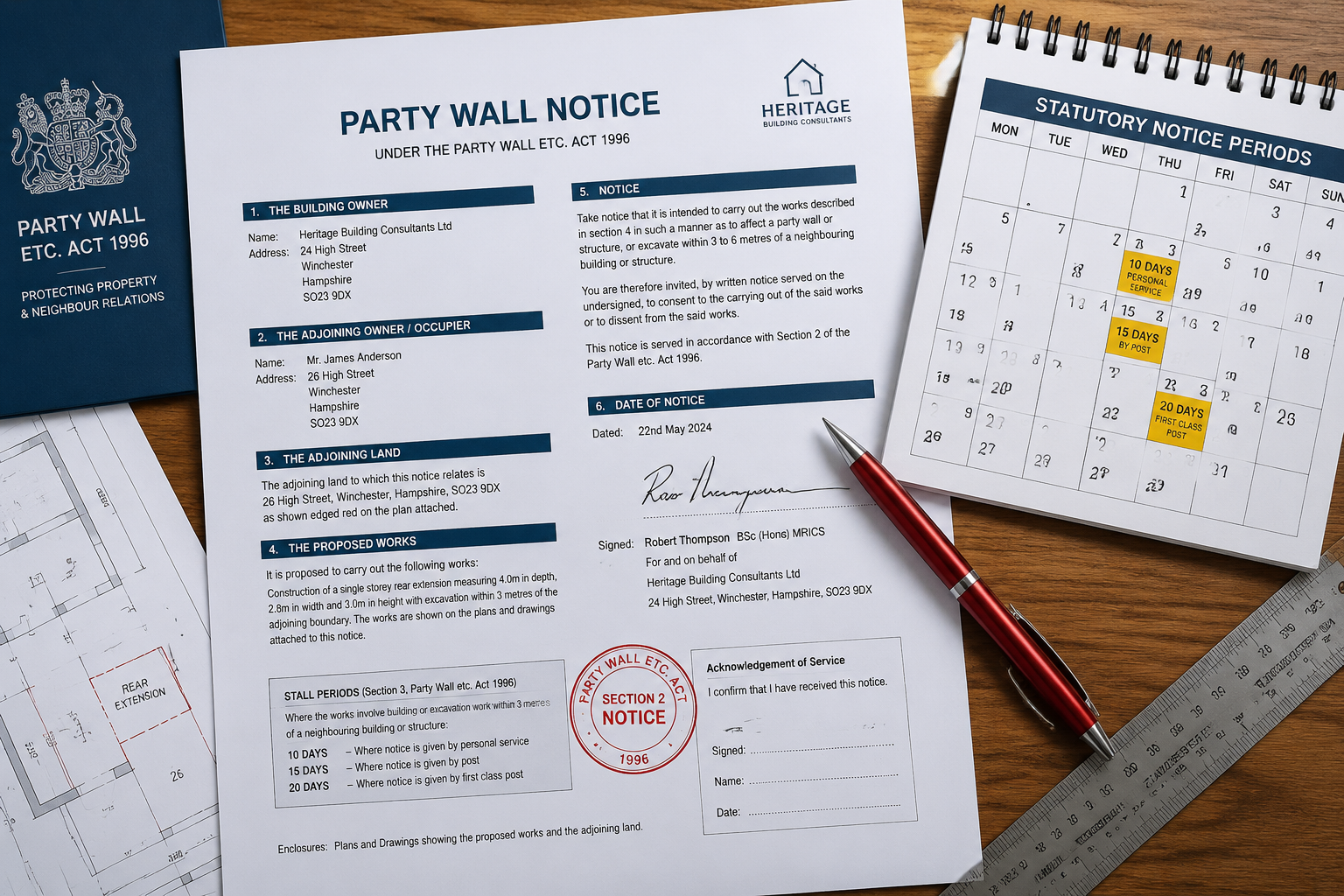
  • Party Wall Notice Drafting Errors That Invalidate Compliance:

    A staggering 90% of building owners serve invalid Party Wall Notices due to statutory defects that could have been easily prevented. These seemingly minor drafting errors—missing dates, incorrect owner identification, vague work descriptions—can halt construction projects, trigger costly legal disputes, and expose property owners to injunctions before a single brick is laid. Understanding Party Wall Notice drafting errors that invalidate compliance: avoiding legal challenges before work begins is not merely advisable; it’s essential for anyone planning construction work near shared boundaries in 2026.

    The Party Wall etc. Act 1996 establishes strict requirements for notifying adjoining owners about planned works. Yet despite clear statutory guidance, the majority of DIY notices fail to meet basic legal standards. This comprehensive guide examines the critical mistakes that render notices invalid, provides actionable checklists to ensure compliance, and equips building owners with the knowledge to navigate party wall procedures confidently.

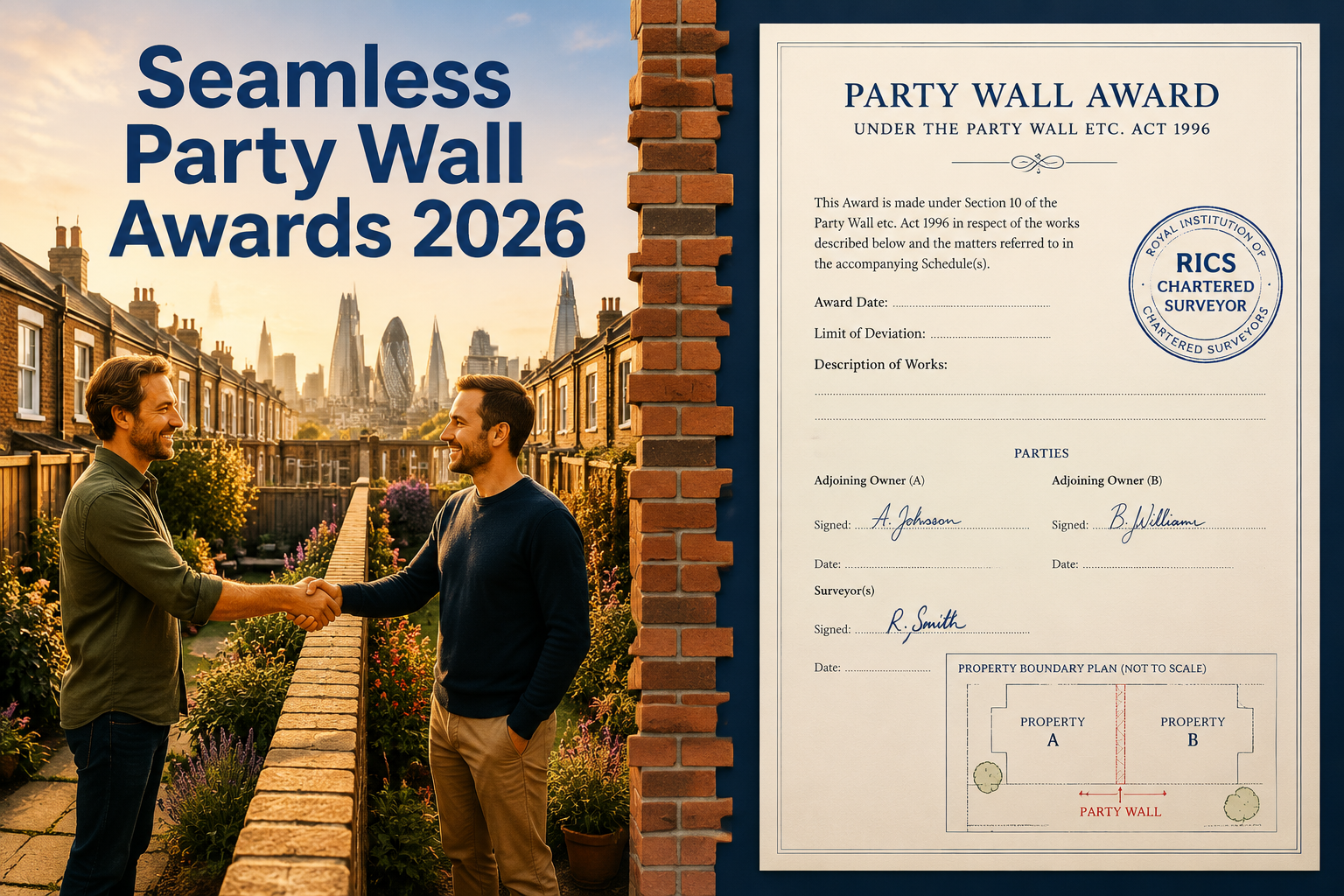
    Professional () hero image with 'Party Wall Notice Drafting Errors That Invalidate Compliance: Avoiding Legal Challenges

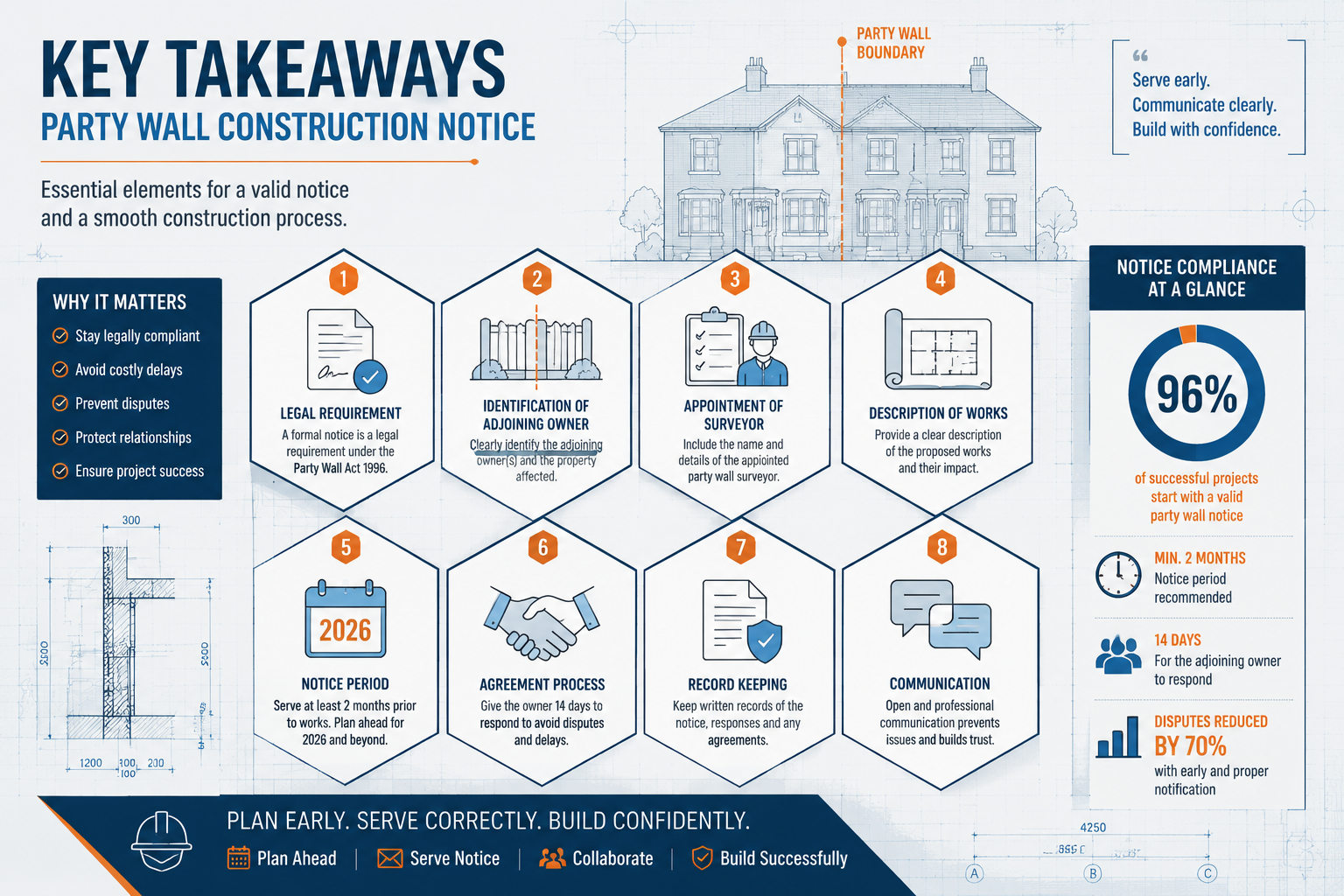
    Key Takeaways

    • Three mandatory elements must be present in every valid notice: clear identification of the building owner, accurate description of proposed works, and correct service within statutory timeframes
    • Wrong notice type selection is a primary cause of invalidity—Section 1, Section 3, and Section 6 notices each serve different purposes and require specific information
    • Incorrect owner identification renders notices void—notices must be served to all legal owners including freeholders, long leaseholders, and joint owners, not just occupants
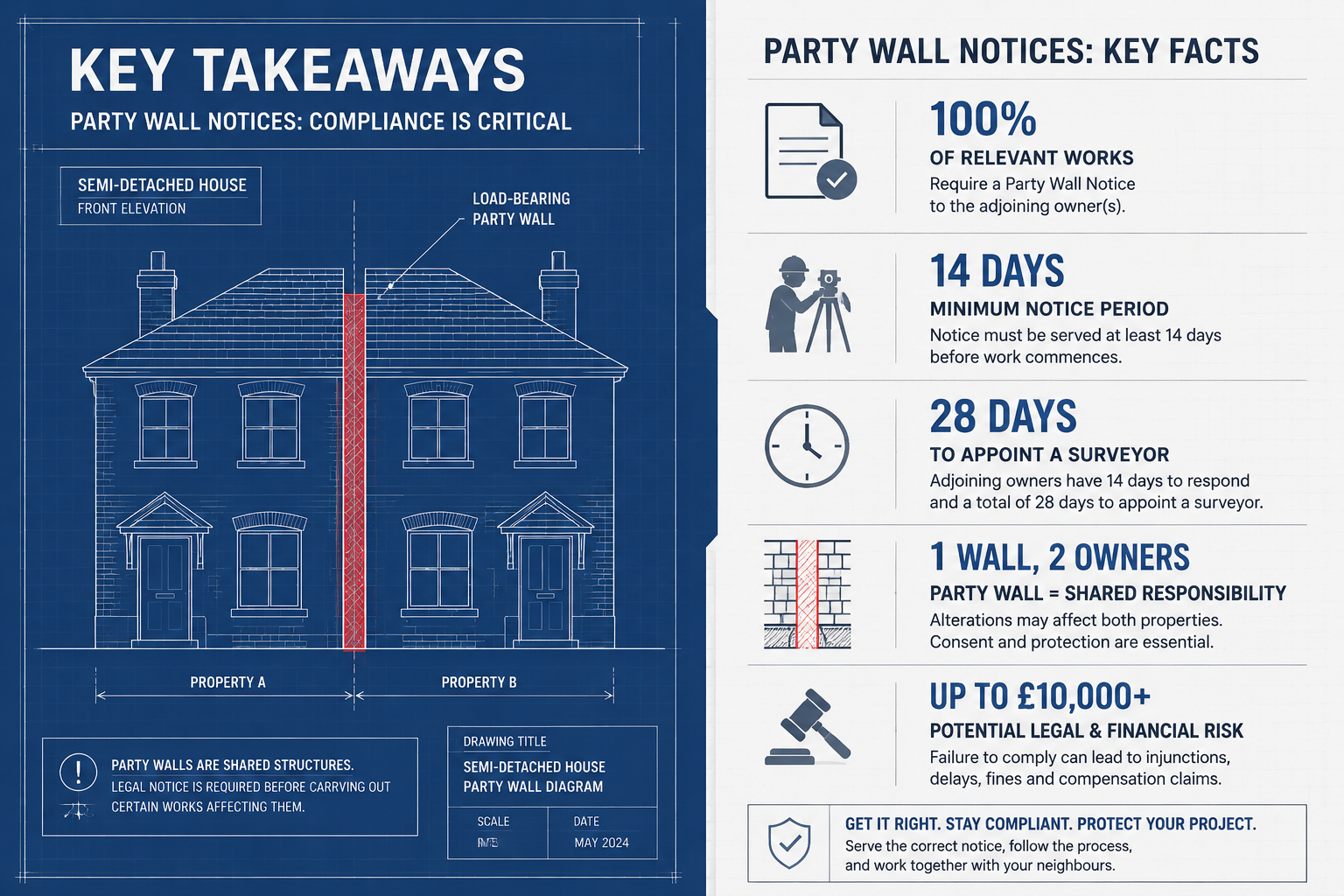
    • Notice periods matter critically: two months for party wall works, one month for excavation works, with a 12-month validity window from service date
    • 2026 legislative changes have expanded tenant rights considerations, particularly affecting institutional buy-to-let properties with new compliance obligations

    Understanding the Three Core Elements of Valid Party Wall Notices

    Every legally compliant party wall notice must contain three fundamental components that work together to satisfy statutory requirements. Missing even one element can invalidate the entire notice and leave building owners vulnerable to legal challenges.

    Element 1: Clear Building Owner Identification

    The building owner’s identification must be precise and legally accurate. This means:

    • Full legal name exactly as it appears on Land Registry records
    • Complete address of the property where works will occur
    • Contact information for correspondence

    A common mistake occurs when notices list a trading name, abbreviated name, or informal version that doesn’t match official property ownership records. For example, serving a notice as “J. Smith” when Land Registry shows “Jonathan Michael Smith” creates a discrepancy that can invalidate the notice.

    In 2026, with increasingly complex property ownership structures including trusts, companies, and multiple joint owners, this requirement demands careful verification. Building owners should obtain current Land Registry documents before drafting notices to ensure accuracy.

    Element 2: Accurate Work Description

    Vagueness is the primary reason DIY notices fail legal scrutiny. The work description must be sufficiently detailed that an adjoining owner can reasonably understand what is being proposed without ambiguity.

    A valid description includes:

    Specific work type: “Construction of single-storey rear extension” not “building work”
    Dimensions and measurements: “3.5m wide x 4m deep x 3m high”
    Materials to be used: “Brick cavity wall construction with concrete foundations”
    Relationship to party wall: “Works will involve cutting into existing party wall to insert steel beam”
    Foundation details: Depth, width, and proximity to boundary for excavation works

    Generic phrases like “home improvements,” “renovation works,” or “extension” provide insufficient detail. Adjoining owners must be able to assess potential impact on their property, which requires concrete specifications.

    For guidance on different work categories, review the comprehensive information on types of party wall works that require formal notification.

    Element 3: Correct Service and Timing

    The notice must be served correctly and within the appropriate timeframe:

    Work Type Required Notice Period Statutory Reference
    Party wall or structure works 2 months Section 3
    New wall on boundary line 1 month Section 1
    Excavation within 3m (deeper than neighbour’s foundation) 1 month Section 6
    Excavation within 6m (within 45° plane) 1 month Section 6

    Critical timing considerations:

    Proposed start date must be clearly stated and at least the minimum notice period away
    12-month validity window: Works must commence within 12 months of service or the notice expires
    No premature commencement: Starting work before the notice period expires invalidates the entire process

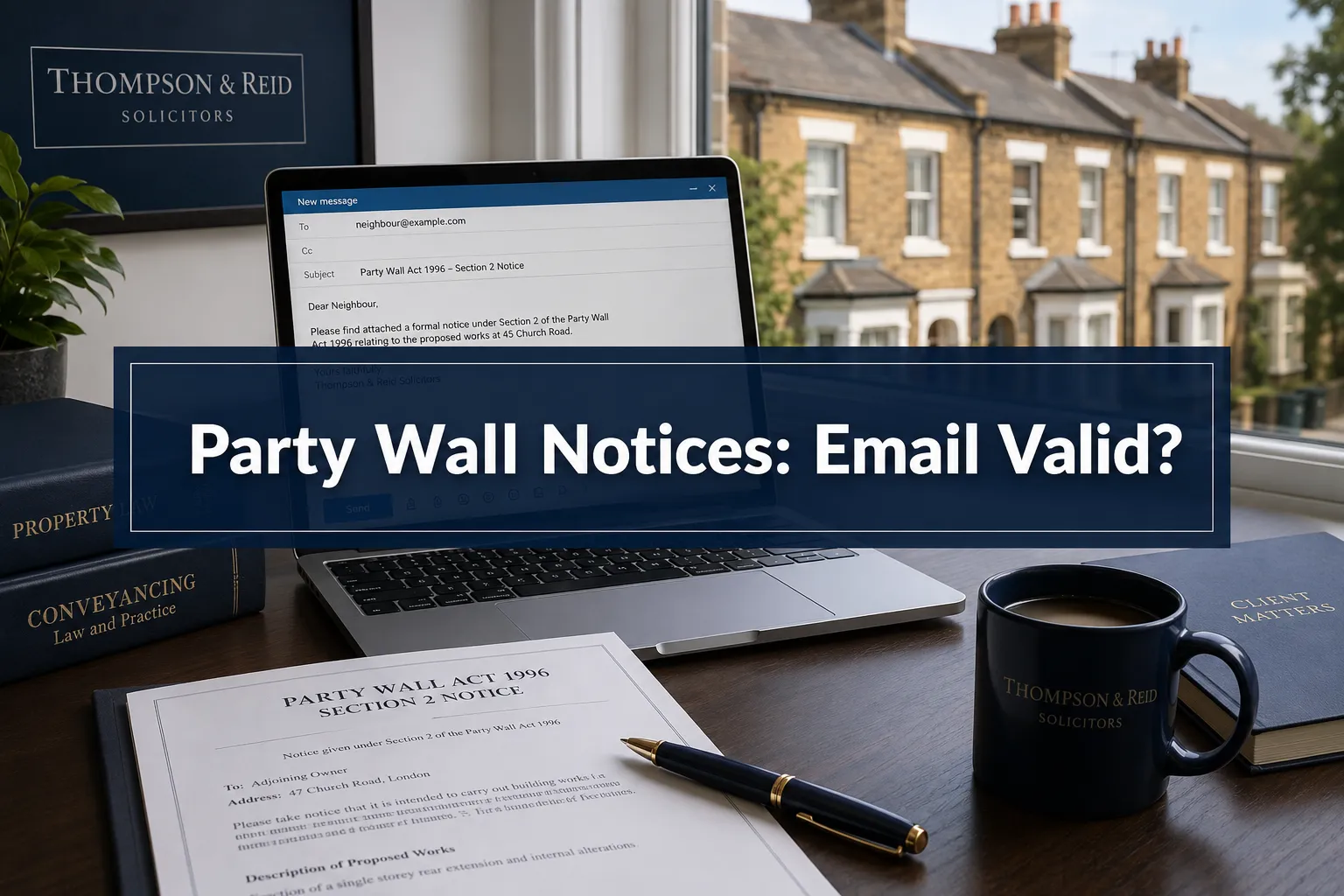
    Service must be in writing (paper or electronic) and delivered by legally recognized methods: hand delivery, recorded post, or another method that provides evidence of receipt. Verbal notifications have no legal standing under the Act.

    Understanding party wall notices and their proper service requirements is fundamental to compliance.

    Common Drafting Errors That Invalidate Party Wall Notices

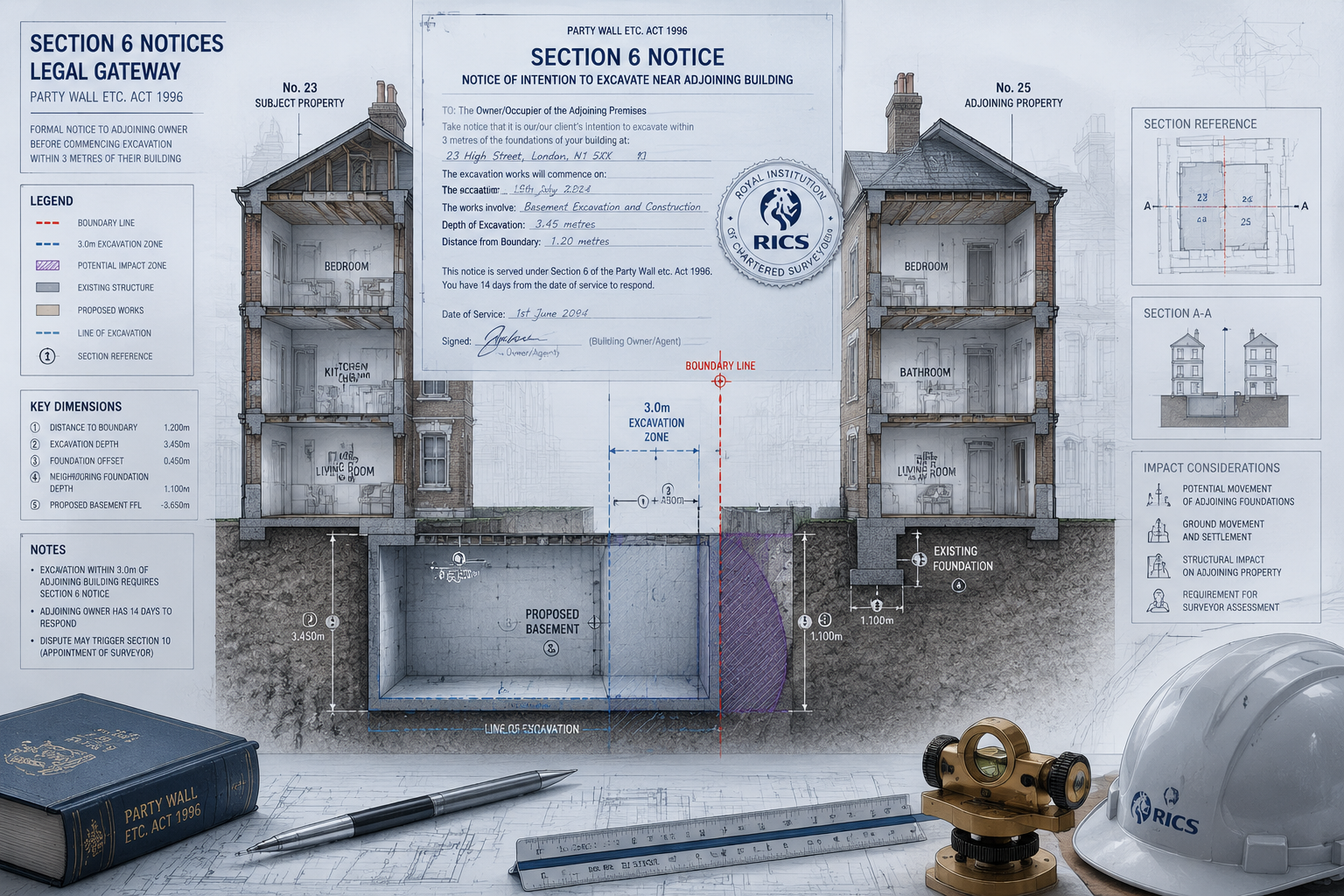
    () editorial image showing split-screen comparison: left side displays correct party wall notice with green checkmarks

    Error 1: Wrong Notice Type Selection

    The Party Wall etc. Act 1996 establishes three distinct notice types, each designed for specific work categories. Using the wrong notice type—or attempting to use a generic template for all situations—is a fundamental error that invalidates compliance.

    Section 1 Notice (Line of Junction Notice) 📋
    Required for: Building a new wall directly on the boundary line between properties

    Section 3 Notice (Party Structure Notice) 🏗️
    Required for: Works to existing party walls, party structures, or boundary walls (repairs, alterations, underpinning, cutting into walls, inserting beams)

    Section 6 Notice (Excavation Notice) ⛏️
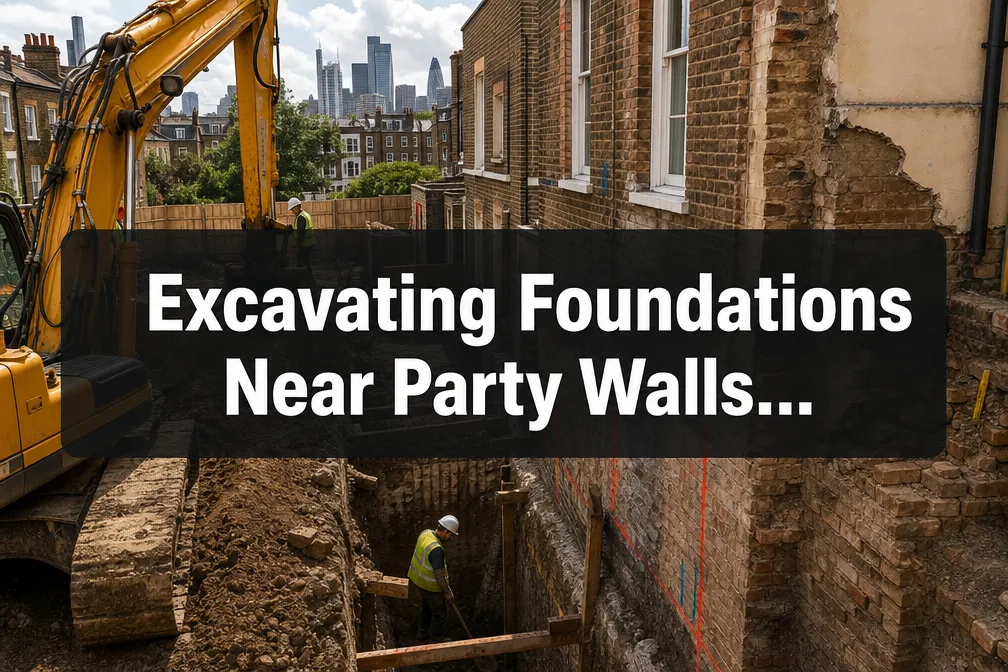
    Required for: Excavation or construction of foundations within specified distances of neighbouring buildings

    Many DIY notices fail because building owners use a Section 3 template for excavation works or attempt to combine multiple notice types into a single document. Each notice type requires different technical information and documentation.

    For detailed guidance on party structure works, consult resources on what is a party structure notice and how to serve it.

    Error 2: Incorrect or Incomplete Adjoining Owner Identification

    One of the most frequent invalidating errors involves serving notices to the wrong party or failing to identify all legal owners. In 2026, property ownership structures have become increasingly complex, making this error more common.

    Who must receive notice:

    ✔️ Freeholders (always)
    ✔️ Long leaseholders (leases with more than one year remaining)
    ✔️ All joint owners (each must receive individual notice)
    ✔️ Mortgagees in certain circumstances

    Common mistakes:

    ❌ Serving notice only to the occupant when they’re tenants, not owners
    ❌ Serving to “The Owner” or “The Occupier” rather than named individuals
    ❌ Missing joint owners (e.g., serving only one spouse when both are on the title)
    ❌ Serving to outdated owners after property has changed hands
    ❌ Assuming the person you speak to is the legal owner

    2026 Legislative Update: Recent changes have repositioned tenant rights as central to party wall procedures, particularly for institutional buy-to-let properties. While tenants aren’t typically served with notices (as they’re not legal owners), landlords must now consider additional compliance obligations when initiating works that may affect tenanted properties.

    To verify current ownership, building owners should:

    1. Obtain up-to-date Land Registry title documents (£3 online)
    2. Check for multiple registered proprietors
    3. Verify lease lengths for leasehold properties
    4. Confirm current addresses for service

    Error 3: Insufficient or Missing Technical Drawings

    Visual documentation is not merely helpful—it’s often statutorily required for notices to be valid. The level of detail required varies by notice type, but insufficient drawings are a common deficiency that can invalidate notices.

    Minimum drawing requirements:

    📐 Location plan: Showing the property, adjoining properties, and boundary lines
    📐 Proposed work drawings: Elevations, sections, and floor plans showing the work in relation to the party wall
    📐 Foundation details: For excavation works, showing depth, distance from boundary, and relationship to neighbouring foundations
    📐 Structural details: For works involving cutting into walls or inserting beams

    Common drawing deficiencies:

    • Hand-sketched diagrams without measurements
    • Plans that don’t clearly show the party wall location
    • Missing cross-sections for excavation works
    • No indication of existing neighbouring structures
    • Drawings that contradict the written description

    Professional architectural drawings aren’t always necessary, but drawings must be clear, scaled (or dimensioned), and sufficiently detailed for the adjoining owner and their surveyor to understand the proposal’s impact.

    Error 4: Missing or Incorrect Statutory Information

    Party wall notices must include specific statutory information beyond basic work descriptions. Omitting required details creates grounds for challenge.

    Required statutory elements:

    📄 Building owner’s name and address (exact legal name)
    📄 Property address where works will occur
    📄 Adjoining owner’s name and address (verified legal owners)
    📄 Proposed start date (meeting minimum notice periods)
    📄 Description of works (detailed and specific)
    📄 Section of Act under which notice is served (Section 1, 3, or 6)
    📄 Statement of adjoining owner’s rights (14-day response period, right to appoint surveyor)

    Many template notices downloaded from the internet omit the statutory statement about adjoining owners’ rights or fail to reference the specific section of the Act being invoked. These omissions can render notices invalid.

    For those preparing notices themselves, reviewing a sample party wall agreement template can provide insight into required elements, though professional advice is recommended.

    Error 5: Timing and Validity Period Mistakes

    Timing errors represent a critical category of invalidating mistakes that can expose building owners to legal challenges and work stoppages.

    Critical timing rules:

    ⏱️ Two-month minimum for Section 3 (party structure) notices
    ⏱️ One-month minimum for Section 1 and Section 6 notices
    ⏱️ 12-month validity from date of service—works must commence within this window
    ⏱️ No retrospective notices—notices cannot be served after works have begun

    Common timing errors:

    1. Insufficient notice period: Serving a notice 6 weeks before proposed start date for party wall works (requires 8 weeks minimum)
    2. Missing proposed start date: Notices must state when works will begin
    3. Premature commencement: Starting work before the notice period expires
    4. Expired notices: Attempting to rely on notices served more than 12 months ago when works haven’t commenced
    5. Vague timing: Using phrases like “early 2026” or “spring” instead of specific dates

    The 12-month validity window is particularly important. If circumstances delay the project beyond this period, new notices must be served. Simply resuming work under an expired notice is non-compliant and exposes building owners to injunctions.

    Understanding costs of party wall procedures helps building owners budget appropriately when timing delays require re-serving notices.

    Error 6: Unverifiable Service Methods

    Even a perfectly drafted notice becomes invalid if it cannot be proven to have been properly served. Service method and documentation are critical.

    Acceptable service methods:

    ✉️ Hand delivery: Personal delivery to the adjoining owner (obtain signed receipt)
    ✉️ Recorded delivery post: Provides proof of delivery date
    ✉️ Registered post: Traditional method with signature confirmation
    ✉️ Email: Acceptable if you can prove receipt (read receipt or acknowledgment)

    Unacceptable or risky methods:

    Verbal notification: Has no legal standing whatsoever
    Standard post: No proof of delivery if disputed
    Leaving notice with occupant: Unless they’re the legal owner
    Posting through letterbox: Without additional proof

    Best practice documentation:

    • Photograph the sealed envelope with visible address before posting
    • Retain postal receipts and tracking information
    • Keep copies of signed delivery confirmations
    • For hand delivery, obtain dated signature on a duplicate copy
    • For email, retain delivery and read receipts

    If service is later disputed, the burden falls on the building owner to prove proper service occurred. Without documentation, even valid notices can be challenged successfully.

    Checklist for Ensuring Party Wall Notice Compliance

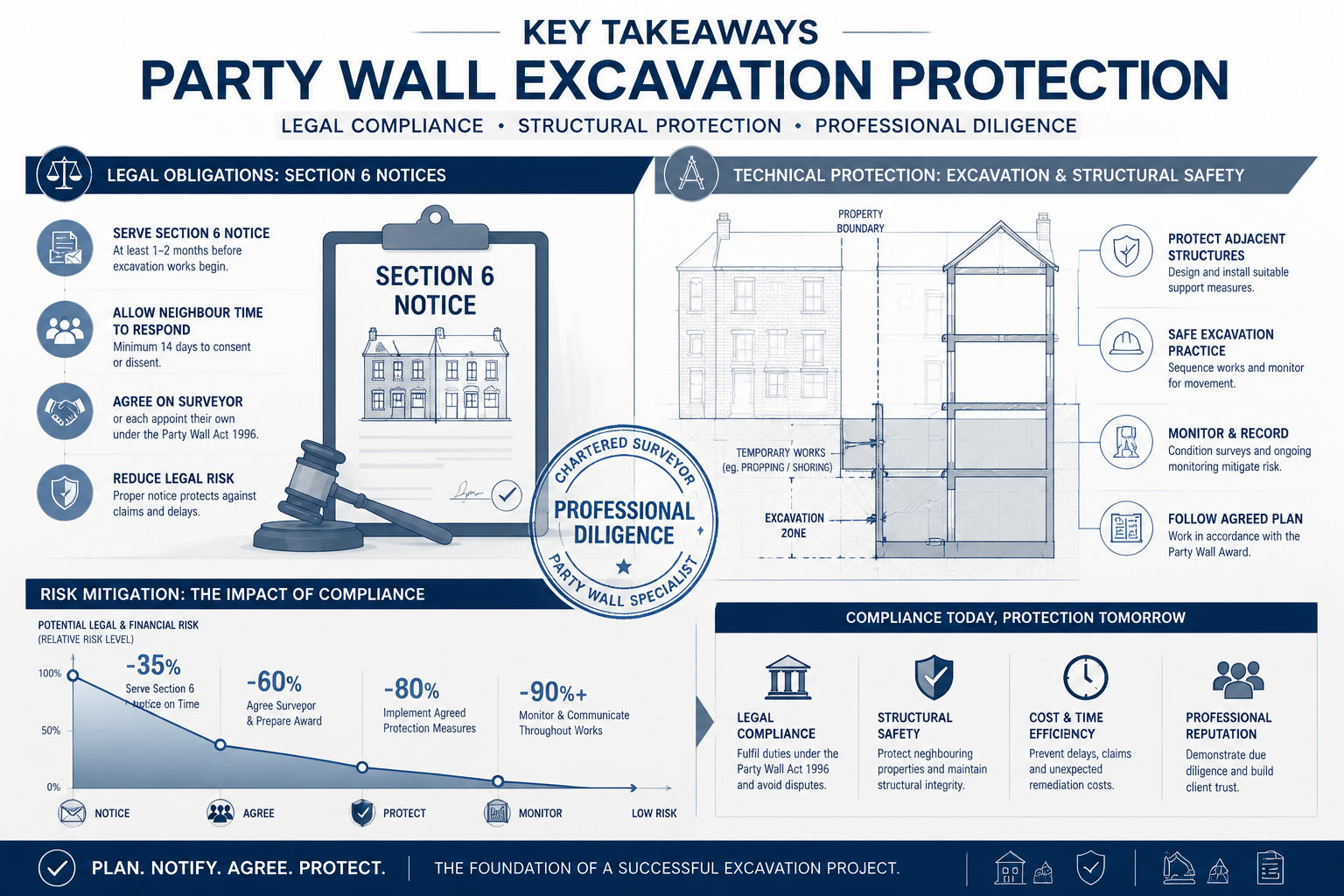
    Professional architectural infographic illustrating 'Three Core Elements of Valid Party Wall Notices' with technical

    Pre-Drafting Verification Checklist

    Before drafting any party wall notice, complete these verification steps:

    Ownership Verification 🔍

    • Obtain current Land Registry title for your property
    • Obtain current Land Registry title for adjoining property
    • Verify all registered proprietors (including joint owners)
    • Check lease lengths for leasehold properties
    • Confirm current addresses for all owners
    • Identify any mortgagees requiring notice

    Work Classification 📋

    • Determine which section of the Act applies (1, 3, or 6)
    • Identify if multiple notice types are required
    • Confirm work involves party wall, boundary, or excavation
    • Assess if work falls within statutory distances

    Timing Calculation 📅

    • Determine realistic project start date
    • Calculate minimum notice period required
    • Add buffer time for potential disputes
    • Confirm work can commence within 12-month validity window

    Notice Drafting Checklist

    When drafting the notice, ensure inclusion of:

    Essential Information ✍️

    • Building owner’s full legal name (matching Land Registry)
    • Building owner’s complete address
    • Building owner’s contact details
    • Adjoining owner’s full legal name (all joint owners)
    • Adjoining owner’s complete address
    • Property address where works will occur
    • Specific section of Act being invoked

    Work Description 🏗️

    • Detailed description of proposed works
    • Specific dimensions and measurements
    • Materials to be used
    • Relationship to party wall/boundary
    • Foundation depths (for excavation works)
    • Structural interventions (beams, cutting, etc.)

    Timing Information

    • Specific proposed start date
    • Date notice is being served
    • Confirmation of appropriate notice period

    Statutory Statements 📄

    • Statement of adjoining owner’s rights
    • 14-day response period notification
    • Right to appoint surveyor
    • Consequences of non-response

    Supporting Documentation 📎

    • Location plan attached
    • Proposed work drawings attached
    • Cross-sections (where applicable)
    • Foundation details (for excavation)
    • All drawings clearly labeled and scaled

    Service and Documentation Checklist

    After drafting, ensure proper service:

    Service Preparation 📬

    • Print notice on quality paper
    • Include all required attachments
    • Prepare duplicate for your records
    • Choose appropriate service method

    Service Execution

    • Serve to correct address for each owner
    • Use trackable delivery method
    • Obtain proof of service (signature/receipt)
    • Photograph envelope before posting (if postal)
    • Retain all postal receipts and tracking numbers

    Post-Service Documentation 📝

    • File copy of served notice
    • File proof of service documentation
    • Create service date record
    • Calculate response deadline (14 days)
    • Calculate earliest work commencement date
    • Set reminder for 12-month validity expiry

    For building owners managing the process themselves, understanding how to keep party wall costs down while maintaining compliance is valuable.

    Regional Considerations for Party Wall Notices in 2026

    While the Party Wall etc. Act 1996 applies uniformly across England and Wales, practical considerations vary by region, particularly in urban areas with high-density housing.

    London-Specific Considerations 🏙️

    London’s dense housing stock and complex ownership structures create unique challenges:

    • Higher proportion of leasehold properties requiring multiple notices
    • More frequent basement excavations triggering Section 6 notices
    • Greater likelihood of terraced housing with multiple adjoining owners
    • Professional surveyor involvement more common due to property values

    Regional resources are available for party wall surveyors in Central London, East London, South London, North London, and West London.

    Buy-to-Let and Rental Properties 🏢

    The 2026 legislative changes have significantly impacted party wall procedures for rental properties. Building owners with tenanted properties must now consider:

    • Enhanced tenant notification requirements
    • Additional compliance obligations for institutional landlords
    • Coordination with Section 8 possession proceedings if works require vacant possession
    • Tenant rights considerations in party wall award negotiations

    These changes represent a fundamental shift in how party wall procedures intersect with tenancy law, particularly affecting professional landlords and property investment companies.

    Consequences of Invalid Notices and Legal Remedies

    Serving an invalid party wall notice creates significant risks and potential legal consequences that extend far beyond simple delays.

    Immediate Consequences ⚠️

    Work Stoppage: Adjoining owners can obtain injunctions to halt works commenced under invalid notices

    Trespass Claims: Works affecting party structures without valid notice may constitute trespass, exposing building owners to damages claims

    Nullified Agreements: Any agreements or awards based on invalid notices may be void

    Financial Exposure: Building owners may be liable for adjoining owners’ legal costs in challenging invalid notices

    Legal Remedies for Building Owners

    If a notice is discovered to be invalid:

    1. Immediate cessation: Stop all works immediately
    2. Re-serve correct notice: Draft and serve compliant notice following proper procedures
    3. Reset timeline: Restart the statutory notice period
    4. Engage professional help: Consider appointing a party wall surveyor to manage the process
    5. Document everything: Maintain comprehensive records of corrective actions

    Dispute Resolution Process

    When notice validity is disputed, the Party Wall etc. Act 1996 provides a statutory dispute resolution mechanism:

    • Either party can appoint a party wall surveyor
    • Surveyors prepare a party wall award resolving the dispute
    • Awards are binding and enforceable
    • Appeals are limited to specific grounds

    Understanding the party wall awards process helps building owners navigate disputes effectively.

    For adjoining owners receiving notices, resources on responding to party wall notices clarify rights and options.

    When to Engage Professional Party Wall Surveyors

    While the Act permits building owners to serve notices themselves, professional involvement significantly reduces the risk of invalidating errors.

    Situations Requiring Professional Assistance

    Consider engaging a party wall surveyor when:

    🏗️ Complex structural works: Basement excavations, major extensions, structural alterations
    🏗️ Multiple adjoining owners: Terraced properties or developments affecting several neighbors
    🏗️ High-value properties: Where potential damages or disputes could be costly
    🏗️ Commercial properties: Greater complexity and higher stakes
    🏗️ Previous disputes: Difficult relationships with adjoining owners
    🏗️ Tight timelines: When delays would be particularly costly

    Professional Services Available

    Building Owner’s Surveyor 👷

    • Prepares and serves compliant notices
    • Manages the statutory process
    • Prepares schedules of condition
    • Negotiates party wall awards
    • Protects building owner’s interests

    Adjoining Owner’s Surveyor 🏡

    • Reviews notices for validity and completeness
    • Protects adjoining owner’s interests
    • Ensures adequate protection measures
    • Negotiates fair compensation terms

    Agreed Surveyor 🤝

    • Acts impartially for both parties
    • More cost-effective when parties cooperate
    • Prepares single party wall award

    Resources for building owners and adjoining owners provide guidance on working with surveyors.

    Cost Considerations

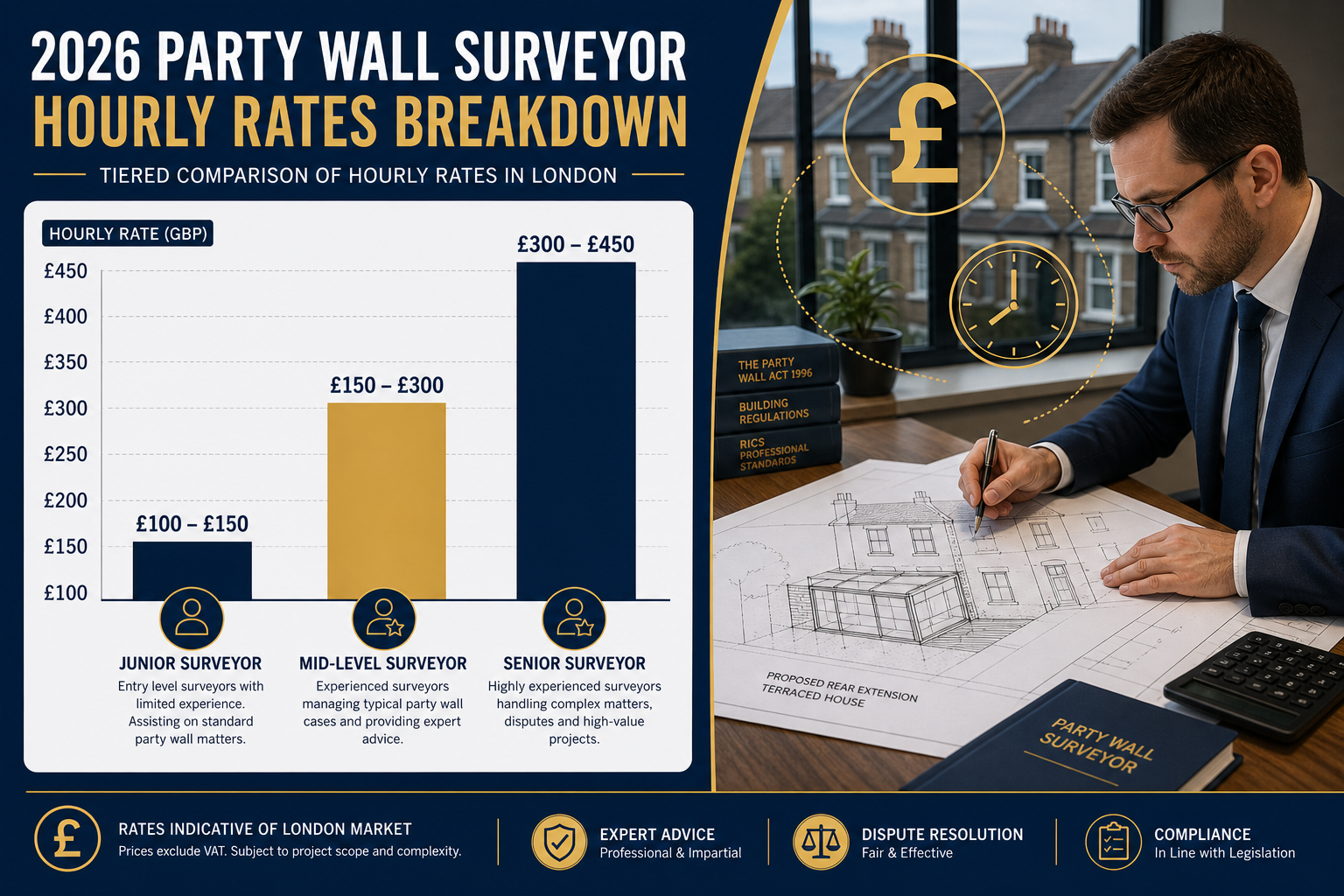
    Professional party wall surveyor fees typically range from £700-£2,000+ depending on:

    • Complexity of works
    • Number of adjoining owners
    • Property location
    • Whether disputes arise

    Important: Under the Act, building owners typically bear the reasonable costs of both their own surveyor and the adjoining owner’s surveyor, making initial compliance even more critical to avoid unnecessary expenses.

    Best Practices for Party Wall Notice Compliance in 2026

    Start Early 📆

    Begin the party wall process at least 3-4 months before intended work commencement to allow for:

    • Proper notice periods
    • Potential disputes or negotiations
    • Schedule of condition surveys
    • Unexpected delays

    Maintain Comprehensive Records 📋

    Document every aspect of the party wall process:

    • Copies of all notices served
    • Proof of service documentation
    • Correspondence with adjoining owners
    • Photographs of properties before work begins
    • Surveyor appointments and awards
    • Dates of all key events

    Communicate Proactively 🗣️

    While formal written notice is mandatory, informal communication can prevent disputes:

    • Discuss plans with neighbors before serving formal notice
    • Explain the work and expected timeline
    • Address concerns proactively
    • Maintain respectful, professional communication throughout

    Use Professional Templates Cautiously ⚠️

    If using templates:

    • Ensure they’re current with 2026 requirements
    • Customize completely for your specific situation
    • Never use generic descriptions
    • Verify all statutory elements are included
    • Consider having a surveyor review before serving

    Understand Your Specific Situation 🔍

    Party wall requirements vary based on:

    • Type of work planned
    • Property type and construction
    • Ownership structure
    • Local factors

    Generic advice may not apply to your circumstances. When in doubt, seek professional guidance.

    For those managing works themselves, reviewing information about carrying out works provides valuable context.

    Conclusion

    Party wall notice drafting errors that invalidate compliance represent a preventable risk that can derail construction projects, trigger costly legal disputes, and damage neighbor relationships. The statistics are sobering: 90% of DIY notices contain statutory defects that could render them invalid. Yet with proper understanding and attention to detail, building owners can navigate the party wall process successfully.

    The three mandatory elements—correct building owner identification, accurate work description, and proper service within statutory timeframes—form the foundation of compliance. Beyond these basics, selecting the correct notice type, identifying all legal owners, providing adequate technical drawings, and documenting service properly are essential to avoiding invalidating errors.

    In 2026, with enhanced tenant rights considerations and increasingly complex ownership structures, the margin for error has narrowed. Building owners must approach party wall procedures with diligence, precision, and—when circumstances warrant—professional assistance.

    Actionable Next Steps

    Before serving any party wall notice:

    1. Verify ownership: Obtain current Land Registry documents for all affected properties
    2. Classify your work: Determine which section of the Act applies and which notice type is required
    3. Calculate timing: Ensure adequate notice periods and confirm work can commence within 12 months
    4. Draft comprehensively: Include all statutory elements with specific, detailed work descriptions
    5. Prepare documentation: Create clear, scaled drawings showing proposed works
    6. Serve properly: Use trackable methods and retain proof of service
    7. Consider professional help: For complex works or multiple adjoining owners, engage a party wall surveyor

    If you’re an adjoining owner who has received a notice:

    The Party Wall etc. Act 1996 provides a clear framework for managing construction works near shared boundaries. By understanding common drafting errors and following compliance checklists, building owners can protect their projects, maintain good neighbor relations, and avoid the legal challenges that invalid notices inevitably trigger.

    For comprehensive guidance on the statutory framework, review information about the Party Wall etc. Act 1996 and consider consulting with qualified professionals for your specific circumstances.


    References

    [1] 2026 Diy Party Wall Notice Validity Tips – https://www.simplesurvey.co.uk/uncategorised/2026-diy-party-wall-notice-validity-tips/

    [2] How To Serve A Party Wall Notice – https://onlinearchitecturalservices.com/how-to-serve-a-party-wall-notice/

    [3] Party Wall Agreement – https://hoa.org.uk/advice/guides-for-homeowners/i-am-improving/party-wall-agreement/

    [4] Party Wall Surveys For Renters Rights Act Compliance Managing Notices When Landlord Initiated Works Face New Section 8 Ground Requirements – https://nottinghillsurveyors.com/blog/party-wall-surveys-for-renters-rights-act-compliance-managing-notices-when-landlord-initiated-works-face-new-section-8-ground-requirements

  • The Role of the Agreed Surveyor in Party Wall Disputes: How Single

    More than 60% of party wall disputes in London during 2026 stem from misunderstandings about surveyor appointments and the resulting cost escalation when both parties hire separate professionals. The Party Wall etc. Act 1996 offers a streamlined alternative that many property owners overlook: appointing a single agreed surveyor to represent both the building owner and the adjoining owner. Understanding The Role of the Agreed Surveyor in Party Wall Disputes: How Single Surveyor Appointments Save Time and Money can transform what might become a lengthy, expensive process into an efficient resolution that protects everyone’s interests.

    When neighbors agree to work together rather than against each other, the benefits extend far beyond reduced fees. A single agreed surveyor eliminates the communication delays, conflicting opinions, and adversarial dynamics that often characterize party wall procedures. This approach represents the most cost-effective and time-efficient path through the statutory requirements, provided both parties understand their rights and the surveyor maintains complete independence.

    () editorial image showing professional meeting scene with building owner and adjoining owner sitting across from single

    Key Takeaways

    Appointing a single agreed surveyor typically reduces total surveyor fees by 40-60% compared to each party hiring separate professionals

    ⏱️ Timeline acceleration: Single surveyor appointments can complete the Party Wall Award process in 6-8 weeks versus 10-14 weeks with two surveyors

    🤝 Independence is mandatory: The agreed surveyor must be completely independent from both parties and cannot be the building owner’s project surveyor

    📋 Legal authority remains identical: An agreed surveyor has the same statutory powers to create binding Party Wall Awards as two separate surveyors

    ⚖️ Best for cooperative relationships: This approach works optimally when both neighbors maintain reasonable communication and trust

    Understanding the Agreed Surveyor’s Unique Position

    The agreed surveyor occupies a distinctive role within the framework of the Party Wall etc. Act 1996. Unlike situations where the building owner appoints their own surveyor and the adjoining owner appoints a separate professional, the agreed surveyor serves both parties simultaneously with equal duty of care to each.[2]

    Legal Framework and Authority

    Under Section 10 of the Party Wall etc. Act 1996, when a dispute arises (or is deemed to arise) regarding party wall works, the parties have three options:

    1. Each party appoints their own surveyor (who then select a third surveyor if needed)
    2. Both parties jointly appoint a single agreed surveyor
    3. Allow the dispute to escalate (not recommended)

    The agreed surveyor possesses the same legal authority as two separate surveyors working together. They can issue a legally binding Party Wall Award that details the proposed works, protective measures, access arrangements, and cost allocation.[2][3]

    The Independence Requirement

    Critical point: The agreed surveyor must be genuinely independent. They cannot be the same professional the building owner is already using for design, project management, or construction oversight.[3] This independence ensures the adjoining owner views the surveyor as neutral and impartial rather than biased toward the building owner’s interests.

    Many disputes arise when building owners suggest their own project surveyor act as the agreed surveyor—a proposal that violates the spirit of the Act and undermines neighbor confidence. When seeking an agreed surveyor, both parties should participate in the selection process or at minimum, the adjoining owner must explicitly consent to the appointment.

    The Role of the Agreed Surveyor in Party Wall Disputes: How Single Surveyor Appointments Streamline the Process

    The efficiency gains from appointing a single agreed surveyor become apparent throughout every stage of the party wall procedure. From initial assessment to final award issuance, having one professional coordinate the entire process eliminates common bottlenecks.

    Timeline Comparison: Single vs. Dual Surveyor Appointments

    Process Stage Single Agreed Surveyor Two Separate Surveyors
    Initial appointment 1-3 days 5-10 days (both must appoint)
    Site inspection 1 visit (both parties present) 2-3 visits (coordination required)
    Schedule of condition 3-5 days 7-10 days (agreement between surveyors)
    Award drafting 2-3 weeks 3-5 weeks (negotiation between surveyors)
    Total timeline 6-8 weeks 10-14 weeks

    () infographic-style image displaying side-by-side comparison chart titled 'Single Surveyor vs Two Surveyors Timeline' with

    The Ten-Day Appointment Window

    When an adjoining owner receives party wall notices and either dissents or fails to respond within the statutory period, a dispute is deemed to have arisen. At this point, the clock starts on surveyor appointments. The agreed surveyor should typically be appointed within ten days to begin the formal process and maintain project momentum.[3]

    This rapid appointment prevents the construction delays that frustrate building owners and helps maintain positive neighbor relations. When working with party wall surveyors in North London, Central London, or other high-density areas where construction schedules are tight, this timeline advantage proves invaluable.

    Simplified Communication Channels

    With two separate surveyors, every decision requires:

    • Building owner → Building owner’s surveyor
    • Building owner’s surveyor → Adjoining owner’s surveyor
    • Adjoining owner’s surveyor → Adjoining owner
    • Response travels back through the same chain

    This four-step communication process introduces delays at each stage. The agreed surveyor eliminates these intermediary steps, communicating directly with both parties and making decisions more efficiently while maintaining impartiality.

    How Single Surveyor Appointments Reduce Costs Substantially

    The financial benefits of appointing an agreed surveyor extend beyond simply halving the surveyor fees. The cost savings cascade through multiple aspects of the party wall process.

    Direct Fee Savings

    Typical fee structure comparison (based on standard residential extension in London, 2026):

    Two Separate Surveyors:

    • Building owner’s surveyor: £800-£1,200
    • Adjoining owner’s surveyor: £800-£1,200
    • Third surveyor (if required): £600-£1,000
    • Total potential cost: £2,200-£3,400

    Single Agreed Surveyor:

    • Agreed surveyor fee: £1,000-£1,500
    • No second surveyor needed
    • No third surveyor needed
    • Total cost: £1,000-£1,500

    The building owner typically pays all surveyor fees under the Act, so these savings directly benefit their project budget.[3] For those wondering about how to keep party wall costs down, the agreed surveyor route represents the single most impactful decision.

    Reduced Project Delays = Lower Construction Costs

    Construction delays cost money. When contractors wait for party wall procedures to complete, building owners face:

    • Extended preliminaries costs: Site security, welfare facilities, insurance
    • Contractor standing time charges: Labor and equipment sitting idle
    • Material price fluctuations: Longer timelines expose projects to price increases
    • Financing costs: Extended loan interest or opportunity costs

    A project delayed by 4-6 weeks due to protracted surveyor negotiations can easily incur £2,000-£5,000 in additional costs beyond the surveyor fees themselves. The streamlined timeline from a single agreed surveyor helps avoid these hidden expenses.

    Fewer Disputes and Appeals

    When two surveyors with potentially different interpretations work together, disagreements sometimes arise that require third surveyor involvement. This adds both cost and delay. A single agreed surveyor makes consistent decisions throughout, reducing the likelihood of internal conflicts that escalate costs.

    Both parties retain the right to appeal to the County Court within 14 days if they believe the award is unfair,[3] but well-drafted awards from experienced agreed surveyors rarely face challenges.

    Essential Responsibilities of the Agreed Surveyor

    Understanding what the agreed surveyor actually does helps property owners appreciate the value this professional provides and why their independence matters so critically.

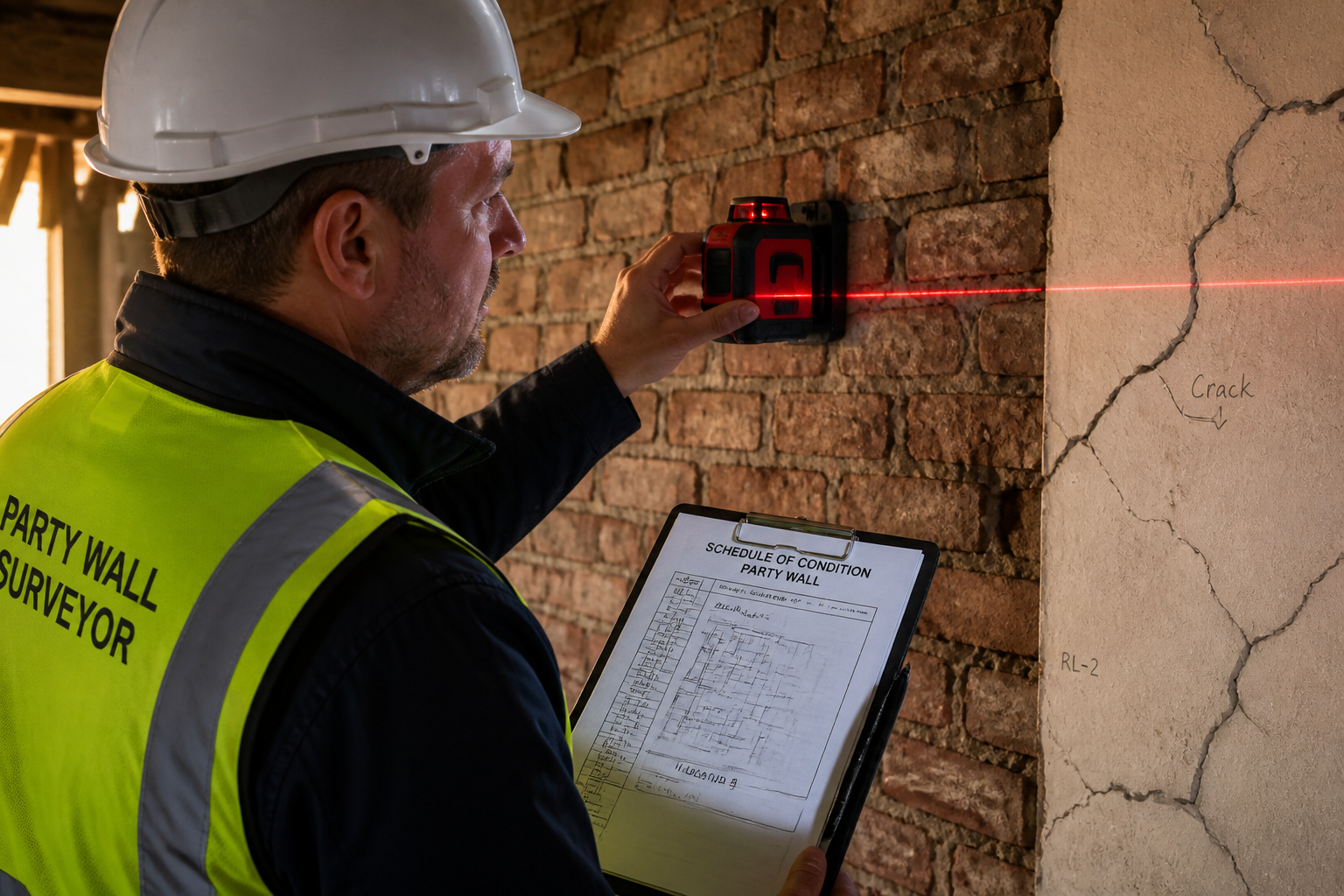
    Conducting the Schedule of Condition

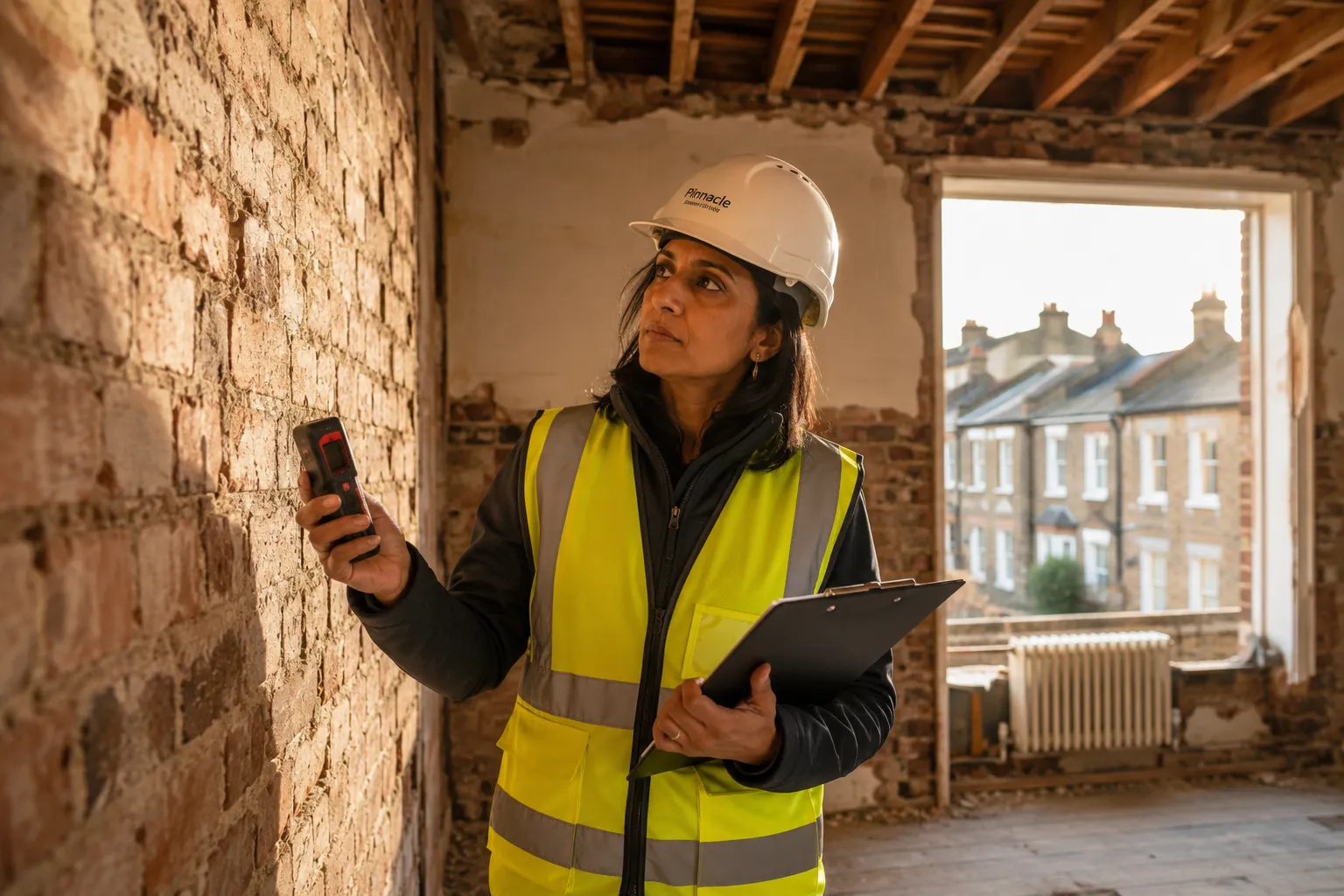
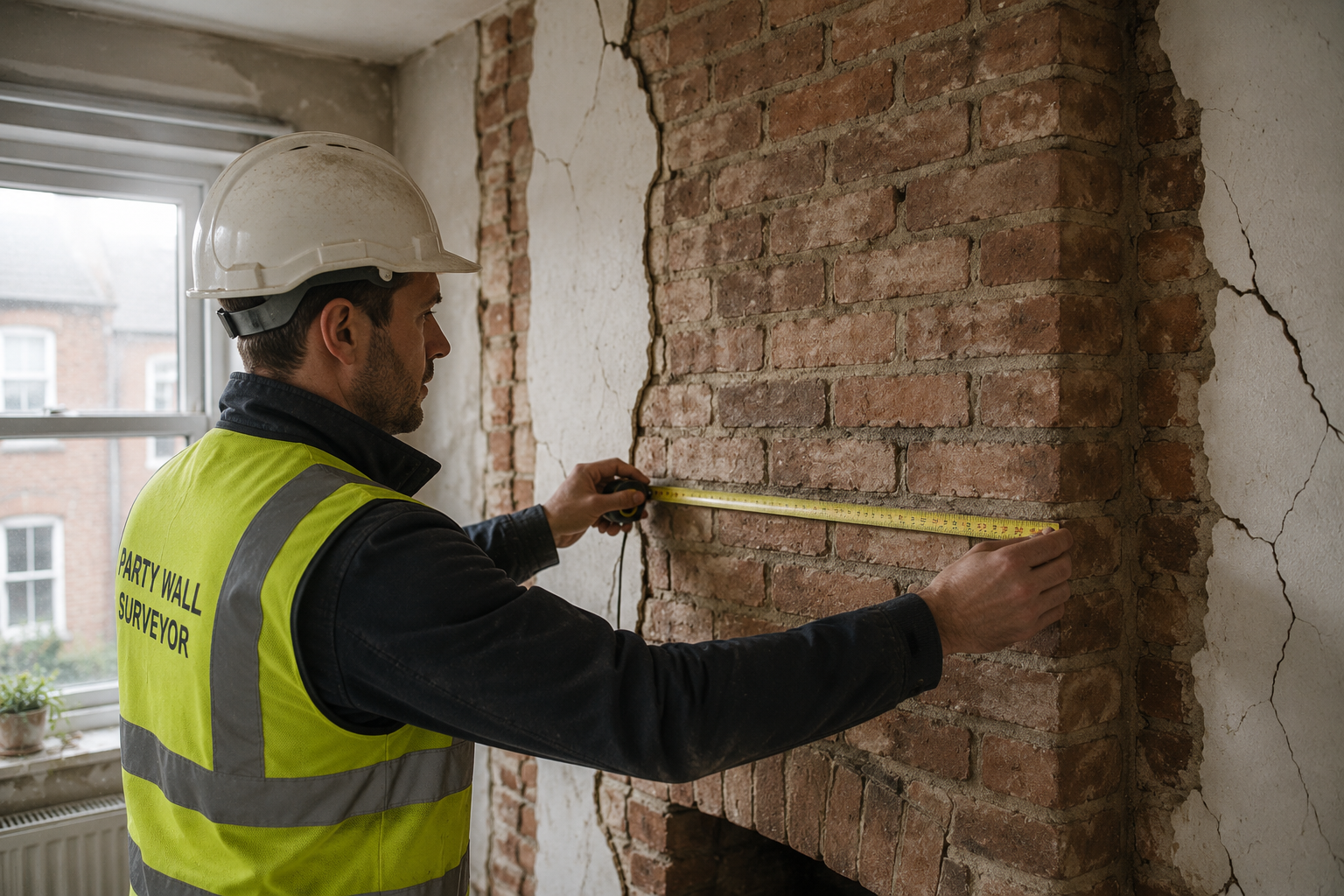
    One of the agreed surveyor’s primary responsibilities involves preparing a comprehensive schedule of condition that documents the adjoining owner’s property before works commence.[3] This detailed record typically includes:

    📸 Photographic evidence of all rooms, walls, ceilings, and external features
    📏 Measurements and descriptions of existing cracks, settlement, or defects
    🔍 Close-up documentation of areas most likely affected by the works
    📝 Written narrative describing the property’s current condition

    This schedule protects both parties. It gives the building owner a baseline to defend against spurious damage claims, while giving the adjoining owner evidence if legitimate damage occurs. The agreed surveyor’s impartiality ensures this document accurately reflects reality rather than favoring either party.

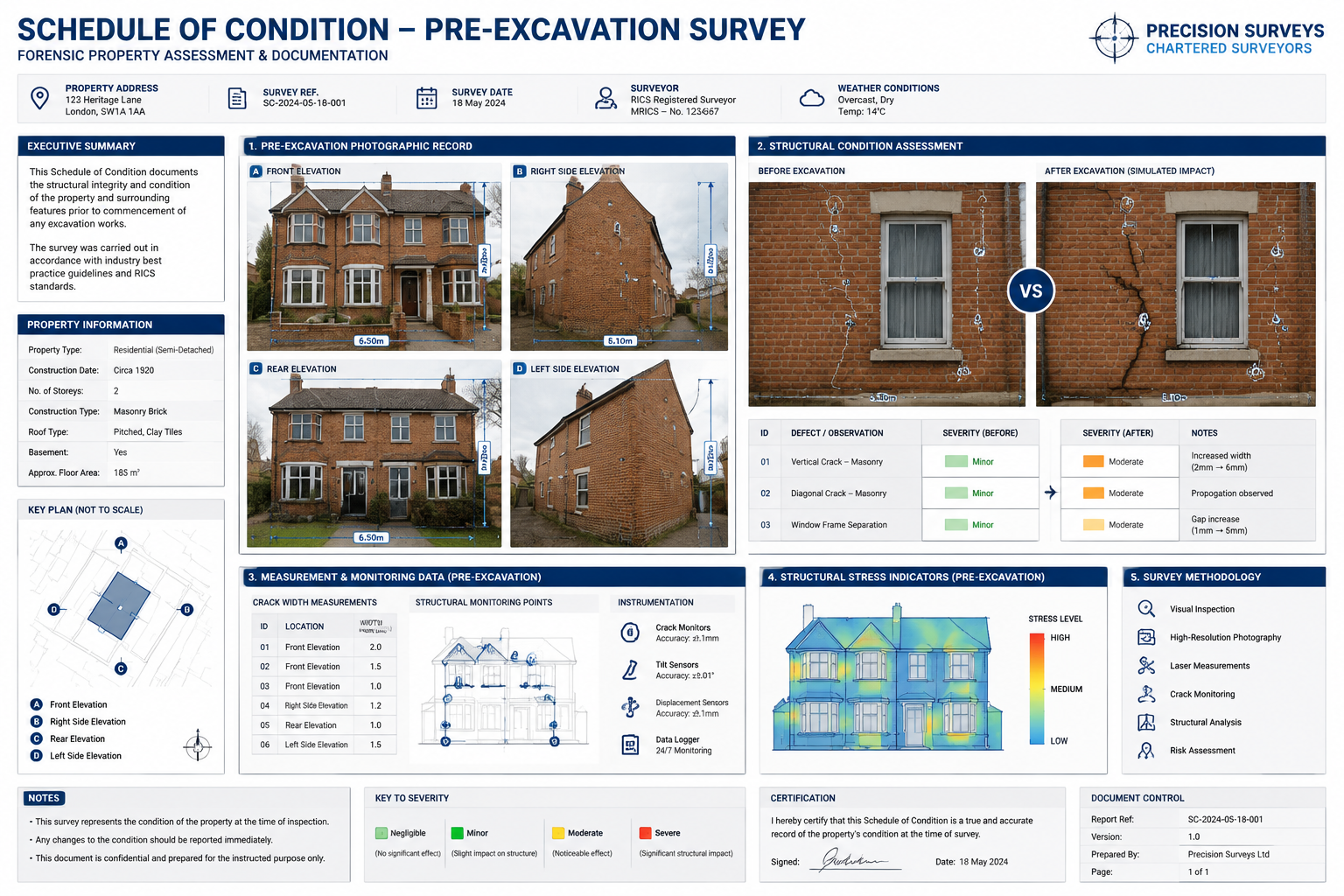
    () detailed photograph of professional surveyor conducting schedule of condition inspection inside residential property,

    Drafting the Party Wall Award

    The Party Wall Award represents the legally binding document that governs the works. The agreed surveyor must ensure this award includes:[2][3]

    Detailed description of the proposed works
    Timing and method of work execution
    Access arrangements for the building owner
    Protective measures to prevent damage
    Rights and responsibilities of both parties
    Cost allocation including surveyor fees
    Dispute resolution mechanisms if issues arise

    The award must be fair, reasonable, and compliant with the Act. An experienced agreed surveyor balances the building owner’s need to complete their project with the adjoining owner’s right to protection from damage and unreasonable disturbance.

    Ongoing Monitoring and Dispute Resolution

    The agreed surveyor’s role doesn’t end when the award is issued. Throughout the construction process, they remain available to:

    • Inspect works to ensure compliance with the award
    • Resolve disagreements that arise during construction
    • Assess any damage that may occur
    • Determine appropriate remediation if damage is proven
    • Update the award if circumstances change

    This ongoing involvement provides both parties with professional oversight and a mechanism to address concerns before they escalate into formal disputes or litigation.[4]

    When Single Surveyor Appointments Work Best (And When They Don’t)

    While the agreed surveyor route offers significant advantages, it’s not universally appropriate. Understanding when this approach works optimally helps property owners make informed decisions.

    Ideal Scenarios for Agreed Surveyors

    ✅ Cooperative neighbor relationships: When both parties communicate reasonably and want to minimize costs and delays

    ✅ Straightforward works: Standard residential extensions, loft conversions, or basement excavations without unusual complications

    ✅ Experienced professionals: When both parties understand their rights and trust the process

    ✅ Clear scope: Projects with well-defined plans and minimal likelihood of scope changes

    ✅ Mutual selection: When both parties participate in choosing the surveyor or the adjoining owner genuinely consents to the building owner’s suggestion

    Situations Requiring Separate Surveyors

    ❌ Adversarial relationships: When neighbors have existing conflicts or deep mistrust

    ❌ Complex projects: Major structural works, commercial developments, or projects with significant risk

    ❌ Vulnerable parties: When the adjoining owner lacks construction knowledge and needs dedicated advocacy

    ❌ Disputed scope: When parties fundamentally disagree about what works are necessary or appropriate

    ❌ Previous damage: When the building owner has a history of causing damage or ignoring obligations

    In these situations, having separate building owner’s surveyors and adjoining owner’s surveyors provides additional checks and balances that protect both parties’ interests more effectively.

    Practical Steps to Appoint an Agreed Surveyor

    For property owners interested in pursuing this cost-effective route, the appointment process follows a straightforward sequence.

    Step 1: Serve Proper Notice

    Before any surveyor appointment, the building owner must serve the appropriate party wall notice at least two months before works affecting a party wall begin.[4] Failure to provide proper notice is among the most common causes of party wall disputes and cannot be remedied by simply appointing a surveyor later.

    Step 2: Discuss the Agreed Surveyor Option

    When the adjoining owner responds (or fails to respond, creating a deemed dispute), the building owner should discuss the agreed surveyor option. This conversation should emphasize:

    • 💰 Cost savings for the building owner (who pays the fees)
    • ⏱️ Time savings benefiting both parties
    • 🤝 The surveyor’s independence and equal duty to both parties
    • 📋 Identical legal protections compared to separate surveyors

    Step 3: Select a Qualified Professional

    Both parties should agree on a surveyor who:

    • Holds relevant qualifications (RICS member, FFPWS designation preferred)
    • Has significant party wall experience in your area
    • Demonstrates clear independence from both parties
    • Provides transparent fee information upfront
    • Maintains professional indemnity insurance

    When searching for professionals across West London, East London, or South London, look for surveyors with local knowledge of construction practices and property types in your specific area.

    Step 4: Formalize the Appointment

    The appointment should be documented in writing, with both parties signing an agreement that confirms:

    • The surveyor’s name and contact details
    • The surveyor’s fee structure and payment terms
    • Acknowledgment of the surveyor’s independence
    • Agreement to be bound by the surveyor’s award
    • Understanding of appeal rights

    Step 5: Cooperate with the Process

    Once appointed, both parties should:

    • Provide prompt access for inspections
    • Respond quickly to surveyor requests for information
    • Maintain open communication throughout the process
    • Trust the professional judgment of the agreed surveyor
    • Raise concerns immediately rather than letting issues fester

    Common Misconceptions About Agreed Surveyors

    Several myths about agreed surveyors persist, often preventing property owners from choosing this efficient option.

    Myth 1: “The Agreed Surveyor Will Favor the Building Owner”

    Reality: The agreed surveyor owes equal duty of care to both parties and risks professional sanctions for bias. Their reputation depends on fairness, and the adjoining owner retains full appeal rights if the award seems unreasonable.[3]

    Myth 2: “Adjoining Owners Get Less Protection”

    Reality: The legal protections are identical whether one or two surveyors are appointed. The agreed surveyor must still prepare a schedule of condition, ensure proper protective measures, and hold the building owner accountable for any damage.[2][3]

    Myth 3: “It’s Too Late Once We’ve Started with Separate Surveyors”

    Reality: While less common, parties can agree to consolidate to a single agreed surveyor even after initially appointing separate professionals, though this requires both appointed surveyors to step aside.

    Myth 4: “Agreed Surveyors Rush the Process”

    Reality: Agreed surveyors work more efficiently by eliminating communication delays, not by cutting corners. They must still comply with all statutory requirements and produce thorough documentation.

    Myth 5: “You Can’t Have an Agreed Surveyor Without Perfect Neighbor Relations”

    Reality: While cooperation helps, the agreed surveyor route works for any situation where both parties are reasonable and want to avoid unnecessary costs. You don’t need to be friends with your neighbor—just willing to follow a fair process.

    The Legal Framework Supporting Agreed Surveyor Appointments

    The Party Wall etc. Act 1996 explicitly provides for agreed surveyor appointments as a primary dispute resolution mechanism, not as a secondary option.[2] Understanding this legal foundation helps property owners recognize that choosing this route is fully supported by statute.

    Statutory Authority

    Section 10(1)(b) of the Act states that when a dispute arises, the parties may “concur in the appointment of one surveyor” (the agreed surveyor). This language places the agreed surveyor option on equal footing with separate surveyor appointments, making it a legitimate first choice rather than a compromise.

    Case Law Developments

    Recent case law, including the practice-changing Evans v Paterson (2021) decision, has clarified surveyors’ roles and responsibilities under the Act.[5] These cases emphasize that surveyors—whether agreed or separate—are appointed specifically to resolve disputes with binding authority, not merely to provide advice.

    This legal authority means the agreed surveyor’s decisions carry the same weight as court judgments (subject to appeal rights), providing both parties with certainty and finality once the award is issued.

    Cost Recovery Rights

    The Act provides that the building owner typically bears all reasonable surveyor costs, including fees for the agreed surveyor.[2][3] This statutory cost allocation makes the agreed surveyor route particularly attractive to building owners, as their savings directly benefit their project budget.

    However, if the building owner acts unreasonably or causes unnecessary expense, the agreed surveyor can allocate costs differently in the award—another protection for adjoining owners.

    Maximizing the Benefits: Best Practices for Property Owners

    Whether you’re the building owner initiating works or the adjoining owner receiving notice, certain practices help maximize the benefits of the agreed surveyor route.

    For Building Owners

    🏗️ Serve notice early: Don’t wait until the last minute, as this pressures neighbors and reduces cooperation likelihood

    💬 Communicate proactively: Explain your project to neighbors before formal notices arrive

    💰 Emphasize cost benefits: Help neighbors understand that the agreed surveyor route protects their interests while reducing your costs (which might otherwise impact your project scope)

    📋 Provide complete information: Give the agreed surveyor comprehensive plans and specifications to avoid later amendments

    🤝 Remain flexible: Be willing to adjust timing or methods if the surveyor identifies concerns

    For Adjoining Owners

    📖 Understand your rights: Read the Party Wall etc. Act 1996 or consult resources explaining your protections

    Ask questions: Before agreeing to an agreed surveyor, ensure you understand their independence and duties

    🔍 Verify qualifications: Check the proposed surveyor’s credentials and experience

    📝 Document everything: Keep copies of all notices, correspondence, and the final award

    ⚖️ Know your appeal rights: You have 14 days to appeal to the County Court if the award seems unfair[3]

    For Both Parties

    🗣️ Maintain communication: Most party wall disputes escalate due to poor communication rather than genuine conflicts of interest

    Respect timelines: The Act provides specific time periods for responses and appointments—honor them

    🎯 Focus on outcomes: Keep sight of the goal (completing works safely with proper protection) rather than getting caught in adversarial dynamics

    💼 Trust the process: The party wall framework has resolved hundreds of thousands of disputes successfully when parties engage in good faith

    Alternative Scenarios: When Agreements Fail

    Despite best intentions, sometimes the agreed surveyor route proves unworkable. Understanding the alternatives helps property owners navigate these situations.

    Appointing Separate Surveyors

    When parties cannot agree on a single surveyor, each appoints their own professional. The two surveyors then work together to produce the Party Wall Award, selecting a third surveyor who can resolve any disagreements between them.[2]

    While more expensive and time-consuming, this route provides additional advocacy for parties who need it. Those interested in understanding the costs of the party wall process should factor in these higher fees when separate appointments become necessary.

    Third Surveyor Involvement

    When two appointed surveyors cannot agree on specific matters, they refer the dispute to the third surveyor (also called the “selected surveyor”). This professional’s decision on the disputed point is final and binding, subject only to appeal to the County Court.[2]

    Third surveyor fees typically range from £600-£1,000 for straightforward disagreements, adding to the overall cost burden on the building owner.

    Court Appeals

    Either party can appeal a Party Wall Award to the County Court within 14 days of receiving it.[3] However, courts generally defer to surveyor expertise unless clear errors of law or procedure are demonstrated. Appeals are expensive, time-consuming, and rarely successful, making them a last resort.

    Proceeding Without Agreement

    Some building owners mistakenly believe they can proceed without following party wall procedures if neighbors are uncooperative. This is incorrect and potentially costly. Working without proper awards exposes building owners to:

    • Injunctions stopping work immediately
    • Damage liability without the protection of agreed procedures
    • Legal costs defending against neighbor actions
    • Project delays far exceeding the time saved by skipping procedures

    For those wondering about having a party wall agreement without a surveyor, the answer is that while informal agreements are possible for minor works, any significant works affecting party walls require proper procedures under the Act.

    The 2026 Construction Landscape and Party Wall Implications

    The construction boom continuing through 2026 has increased party wall activity significantly, particularly in high-density urban areas where properties share walls and boundaries.[6] This heightened activity makes efficient party wall procedures more important than ever.

    Increased Demand for Surveyor Services

    With more homeowners undertaking extensions, loft conversions, and basement excavations, party wall surveyors face unprecedented demand. This increased workload can extend timelines when separate surveyors are appointed, as each professional juggles multiple projects simultaneously.

    The agreed surveyor route helps mitigate these capacity constraints by requiring only one professional rather than two (or potentially three), making appointments easier to schedule and complete promptly.

    Rising Construction Costs

    Construction material and labor costs continue rising in 2026, making project delays increasingly expensive. The time savings from agreed surveyor appointments translate directly to cost savings by getting projects started sooner and avoiding extended preliminaries periods.

    Neighbor Relations in Dense Urban Areas

    In cities like London, where terraced houses and semi-detached properties dominate, nearly every significant home improvement triggers party wall procedures. Maintaining good neighbor relations becomes essential for long-term property enjoyment, making the cooperative approach of agreed surveyor appointments particularly valuable.

    Conclusion: Making the Smart Choice for Your Party Wall Needs

    The Role of the Agreed Surveyor in Party Wall Disputes: How Single Surveyor Appointments Save Time and Money represents more than just a cost-cutting measure—it embodies a collaborative approach to resolving the inevitable conflicts that arise when properties share walls and boundaries. By choosing this route when circumstances permit, property owners demonstrate commitment to fair processes while achieving significant practical benefits.

    The evidence is compelling: agreed surveyor appointments typically reduce costs by 40-60% and accelerate timelines by 4-6 weeks compared to separate surveyor appointments. These savings benefit building owners directly while still providing adjoining owners with complete statutory protections and an independent professional overseeing the works.

    Your Next Steps

    If you’re planning building works:

    1. Serve proper notice at least two months before starting works affecting party walls
    2. Open dialogue with your neighbors about the agreed surveyor option
    3. Research qualified professionals with strong party wall experience in your area
    4. Document everything in writing to avoid later misunderstandings
    5. Budget appropriately for surveyor fees (£1,000-£1,500 for agreed surveyor route)

    If you’ve received a party wall notice:

    1. Respond within 14 days to preserve your rights and avoid deemed consent
    2. Consider the agreed surveyor option if your neighbor suggests it and the surveyor is truly independent
    3. Ask questions about the surveyor’s qualifications, experience, and approach
    4. Understand your protections including schedule of condition, award provisions, and appeal rights
    5. Maintain open communication with both your neighbor and the appointed surveyor

    The party wall framework exists to protect everyone’s interests while allowing necessary building works to proceed. When both parties engage constructively and consider the agreed surveyor route where appropriate, the system works efficiently and fairly—saving time, money, and neighbor relationships in the process.

    Whether you’re undertaking works or responding to a neighbor’s notice, making informed decisions about surveyor appointments sets the foundation for a smooth party wall process that protects your interests while respecting statutory requirements and community relationships.


    References

    [1] Watch – https://www.youtube.com/watch?v=FxtEZp14vJE

    [2] If You Cant Agree – https://www.gov.uk/party-walls-building-works/if-you-cant-agree

    [3] Party Wall Agreement – https://hoa.org.uk/advice/guides-for-homeowners/i-am-improving/party-wall-agreement/

    [4] Common Party Wall Disputes And How To Resolve Them Effectively – https://www.partywallslimited.com/blog/common-party-wall-disputes-and-how-to-resolve-them-effectively

    [5] Practice Changing Party Wall Case Law Evans V Paterson 2021 – https://www.peterbarry.co.uk/blog/practice-changing-party-wall-case-law-evans-v-paterson-2021/

    [6] Party Wall Surveys Amid 2026 Construction Boom Handling Disputes In High Demand Uk Housing Markets – https://nottinghillsurveyors.com/blog/party-wall-surveys-amid-2026-construction-boom-handling-disputes-in-high-demand-uk-housing-markets

  • When Does the Party Wall Act Apply? Determining Notifiable Works vs.

    More than 60% of homeowners in England and Wales unknowingly breach the Party Wall Act 1996 when undertaking renovations, primarily because they misunderstand which projects trigger formal notice requirements and which fall outside the legislation’s scope. Understanding when does the Party Wall Act apply? Determining notifiable works vs. exemptions in 2026 remains one of the most critical yet confusing aspects of property development, with consequences ranging from work stoppages to costly legal disputes.

    The Party Wall Act 1996 creates specific legal obligations for property owners planning construction work that affects shared walls, boundaries, or adjacent structures. However, not every home improvement project requires formal party wall procedures. This comprehensive guide clarifies the precise circumstances that trigger Party Wall Act requirements, identifies common exemptions, and provides practical decision frameworks for homeowners, developers, and construction professionals navigating these regulations in 2026.

    Professional () hero image featuring 'When Does the Party Wall Act Apply? Determining Notifiable Works vs. Exemptions in

    Key Takeaways

    • Geographic Limitation: The Party Wall Act 1996 applies exclusively to England and Wales—not Scotland or Northern Ireland—establishing clear territorial boundaries for compliance.[5]
    • Three Distinct Categories: The Act covers work to existing party walls (Section 2), new walls on boundaries (Section 1), and excavation near neighbouring structures (Section 6), each with specific notice requirements.
    • Notice Timing Matters: Different work types require either two months’ notice (existing party structures) or one month’s notice (new boundary walls and excavation) before construction begins.[5]
    • Common Exemptions Exist: Internal decorative work, repairs not affecting structure, and construction entirely within your property boundary typically fall outside the Act’s scope.
    • Professional Guidance Updated: The Royal Institution of Chartered Surveyors launched consultation on the 8th edition of Party Wall guidance in April 2026, representing the most current professional standards.[1]

    Understanding the Fundamental Scope: When Does the Party Wall Act Apply?

    The Party Wall Act 1996 establishes a legal framework governing specific construction activities that affect shared structures or boundaries between properties. Determining when does the Party Wall Act apply? Determining notifiable works vs. exemptions in 2026 requires understanding three fundamental trigger categories defined within the legislation.

    The Three Core Sections of Notifiable Works

    The Act divides notifiable works into three distinct categories, each governed by separate sections with unique requirements:

    Section 1: New Walls on Boundaries 🏗️
    This section addresses construction of new walls directly on the boundary line or astride it (straddling both properties). Works covered include:

    • Building a new wall directly on the property boundary line
    • Constructing a wall that straddles the boundary between two properties
    • Erecting garden walls, fence walls, or boundary structures at the dividing line

    Section 2: Work to Existing Party Walls 🔨
    This represents the most commonly invoked section, covering modifications to structures already shared between properties:

    • Cutting into party walls to insert beams or joists
    • Raising party walls for loft conversions or extensions
    • Underpinning existing party walls or party structures
    • Removing chimney breasts that form part of the party wall
    • Demolishing and rebuilding party walls
    • Cutting away projections or weathering from party walls

    Section 6: Excavation Near Neighbouring Buildings ⛏️
    This section governs excavation work within specified distances of adjoining structures:

    • Excavating within 3 meters of a neighbour’s building if going deeper than their foundations
    • Excavating within 6 meters of a neighbour’s building if going deeper than a line drawn at 45 degrees from the bottom of their foundations

    Understanding these types of party wall works provides the foundation for determining whether your project requires formal notices.

    Geographic and Property Type Limitations

    The Party Wall Act 1996 applies exclusively within England and Wales.[5] Properties in Scotland operate under different legal frameworks, while Northern Ireland has separate legislation governing boundary disputes and shared structures.

    The Act applies to all property types where structures are shared or boundaries are affected, including:

    • ✅ Residential terraced houses
    • ✅ Semi-detached properties
    • ✅ Flats and maisonettes with shared floors/ceilings
    • ✅ Commercial buildings with party walls
    • ✅ Mixed-use properties
    • ✅ Detached properties (for excavation provisions only)

    Even detached properties can fall under the Act’s jurisdiction when excavation work meets the distance and depth criteria specified in Section 6, making it incorrect to assume the legislation only affects attached buildings.

    Comprehensive Guide to Notifiable Works: When Does the Party Wall Act Apply? Determining Notifiable Works vs. Exemptions in 2026

    Detailed () illustration showing comprehensive flowchart decision tree for Party Wall Act applicability, featuring three

    Determining which construction activities require party wall notices demands careful evaluation of both the work type and its relationship to shared structures or boundaries. The following comprehensive breakdown clarifies common scenarios.

    Structural Work to Existing Party Walls (Section 2 Works)

    These works represent the most frequent triggers for Party Wall Act procedures and require two months’ written notice before commencing.[5]

    Definite Notifiable Works ⚠️

    Work Type Description Why It’s Notifiable
    Loft Conversions Installing steel beams through party walls Structurally alters shared wall integrity
    Beam Insertions Cutting into party walls for load-bearing supports Directly affects structural stability
    Chimney Breast Removal Removing chimney sections forming part of party wall Changes structural loading and support
    Wall Raising Increasing party wall height for extensions Alters shared structure dimensions
    Underpinning Strengthening foundations beneath party walls Affects structural support system
    Damp-Proof Course Installation Inserting DPC through party wall thickness Requires cutting into shared structure

    Common Scenarios Requiring Notices

    Rear Extensions with Party Wall Involvement: When building a single-storey or two-storey rear extension that requires:

    • Cutting into the party wall to tie in new walls
    • Inserting steel beams or joists into the party wall
    • Raising the party wall height to accommodate the extension
    • Underpinning the party wall to support additional loads

    Basement Conversions: Excavation beneath existing properties almost always triggers both Section 2 (if affecting party walls) and Section 6 (excavation provisions) requirements.[3]

    Kitchen and Bathroom Renovations: These typically require notices when:

    • Removing load-bearing walls that form part of the party structure
    • Installing new steel beams that penetrate or rest on party walls
    • Significantly altering drainage systems affecting party wall foundations

    For building owners carrying out works, understanding these triggers prevents costly delays and legal complications.

    Boundary Construction (Section 1 Works)

    New construction directly on or astride property boundaries requires one month’s written notice before starting work.[5]

    When Section 1 Applies

    Garden Walls and Boundary Structures: Building walls positioned:

    • Directly on the boundary line between properties
    • Straddling the boundary (partially on each property)
    • As party fence walls separating gardens or yards

    The distinction between party fence walls and boundary walls significantly impacts whether notices are required.

    Important Distinction: A wall built entirely within your own property, even close to the boundary, does not require a Section 1 notice. The wall must be on or astride the actual boundary line to trigger this requirement.

    Excavation Work (Section 6 Works)

    Excavation provisions apply based on proximity and depth relative to neighbouring foundations, requiring one month’s written notice.[5]

    The Distance and Depth Tests

    3-Meter Rule: Notice required if excavating:

    • Within 3 meters of any part of a neighbouring building or structure
    • To a depth lower than the neighbour’s foundation level

    6-Meter Rule: Notice required if excavating:

    • Within 6 meters of any part of a neighbouring building or structure
    • To a depth that would intersect a line drawn downward at 45 degrees from the bottom of the neighbour’s foundations

    Practical Excavation Scenarios

    Basement Conversions in Terraced Houses: Almost always trigger Section 6 requirements due to proximity to adjoining properties and depth of excavation below existing foundation levels.

    Swimming Pool Installation: May require notices if excavation depth and proximity meet the distance/depth criteria, even for detached properties.

    Foundation Work for Extensions: Requires careful measurement of excavation depth relative to neighbouring foundations, particularly in areas with varying ground levels.

    Understanding what constitutes a party structure notice helps clarify these complex excavation scenarios.

    Critical Exemptions: When Does the Party Wall Act Apply? Determining Notifiable Works vs. Exemptions in 2026

    Detailed () technical illustration displaying three-panel comparison of notifiable party wall works, left panel showing loft

    Understanding exemptions proves equally important to identifying notifiable works. Many common home improvement projects fall outside the Act’s scope, avoiding the need for formal procedures.

    Works That Do NOT Require Party Wall Notices

    Internal Non-Structural Work ✅

    The following internal works typically proceed without party wall procedures:

    Decorative and Finishing Work:

    • Plastering or re-plastering party walls
    • Painting or wallpapering shared walls
    • Installing plasterboard or dry-lining on your side of party walls
    • Fixing shelving, cabinets, or fixtures to party walls (using appropriate fixings)

    Minor Services Installation:

    • Running electrical cables through party walls (using existing routes)
    • Installing sockets or switches on party walls
    • Plumbing work that doesn’t compromise structural integrity
    • Installing central heating pipes within your property

    Important Caveat: Even “minor” work requires notices if it involves cutting significantly into the party wall structure or affects its load-bearing capacity.[3]

    Repairs and Maintenance

    Like-for-Like Repairs: Maintenance work that restores existing conditions without structural alteration generally falls outside the Act:

    • Repointing brickwork on your side of a party wall
    • Replacing damaged render or external finishes
    • Repairing roof coverings where they meet party walls
    • Fixing leaks or damp issues without structural intervention

    The “Making Good” Principle: Repairs that simply restore the wall to its previous condition, without altering dimensions, materials, or structural function, typically don’t require notices.

    Work Entirely Within Your Property

    Single-Property Construction: Work confined completely within your property boundaries and not affecting shared structures:

    • Building internal stud walls away from party walls
    • Installing new windows in external walls only
    • Constructing garden structures entirely on your land (not on boundary)
    • Loft conversions using only your roof structure (not party walls)

    Distance from Boundaries: Garden walls, sheds, or outbuildings built entirely within your property, at least several inches from the boundary line, don’t trigger Section 1 requirements.

    For guidance on boundary wall rules, consult detailed resources specific to your project type.

    The Grey Areas: When Professional Advice Becomes Essential

    Certain scenarios create ambiguity requiring professional surveyor assessment:

    Permitted Development Roof Work: Some roof alterations fall under permitted development rights but may still require party wall notices if they affect shared structures. The two systems operate independently—permitted development addresses planning, while the Party Wall Act addresses neighbour rights.[6]

    Minor Beam Insertions: Small structural changes may or may not require notices depending on whether they genuinely affect the party wall’s structural integrity.

    Superficial vs. Structural: The distinction between surface work and structural intervention isn’t always clear-cut, particularly for older properties with complex construction.

    When uncertainty exists, consulting experienced professionals prevents costly mistakes. Services offering party wall agreements without surveyors may seem attractive but risk non-compliance in complex cases.

    Notice Requirements and Timelines: Practical Application in 2026

    Understanding when does the Party Wall Act apply? Determining notifiable works vs. exemptions in 2026 extends beyond identifying notifiable works to implementing correct procedures.

    Statutory Notice Periods

    The Act establishes specific minimum notice periods:

    Two-Month Notice (Section 2 Works):

    • Work to existing party structures
    • Must be served at least 2 months before intended start date
    • Allows neighbours adequate time to consider implications and appoint surveyors if needed[5]

    One-Month Notice (Sections 1 and 6 Works):

    • New boundary walls
    • Excavation work
    • Must be served at least 1 month before intended start date[5]

    Critical Timing Consideration: These represent minimum periods. Complex projects benefit from earlier notification, allowing time for surveyor appointments, schedule of condition surveys, and party wall awards preparation.

    The Notice and Response Process

    Step 1: Serve Formal Notice 📋
    Written notice must include:

    • Detailed description of proposed works
    • Drawings and specifications
    • Proposed start date
    • Your contact information

    Step 2: Neighbour Response (14 Days)
    Neighbours have 14 days to either:

    • Consent in writing (work may proceed after notice period expires)
    • Dissent or fail to respond (triggers dispute resolution process)

    Step 3: Dispute Resolution (If Consent Not Given)

    • Both parties appoint surveyors (or agree to share an “agreed surveyor”)
    • Surveyors inspect properties and prepare schedule of condition
    • Surveyors issue party wall award detailing work scope, timings, and protections

    Understanding how to respond to party wall notices helps both building owners and adjoining owners navigate this process effectively.

    2026 Professional Standards Update

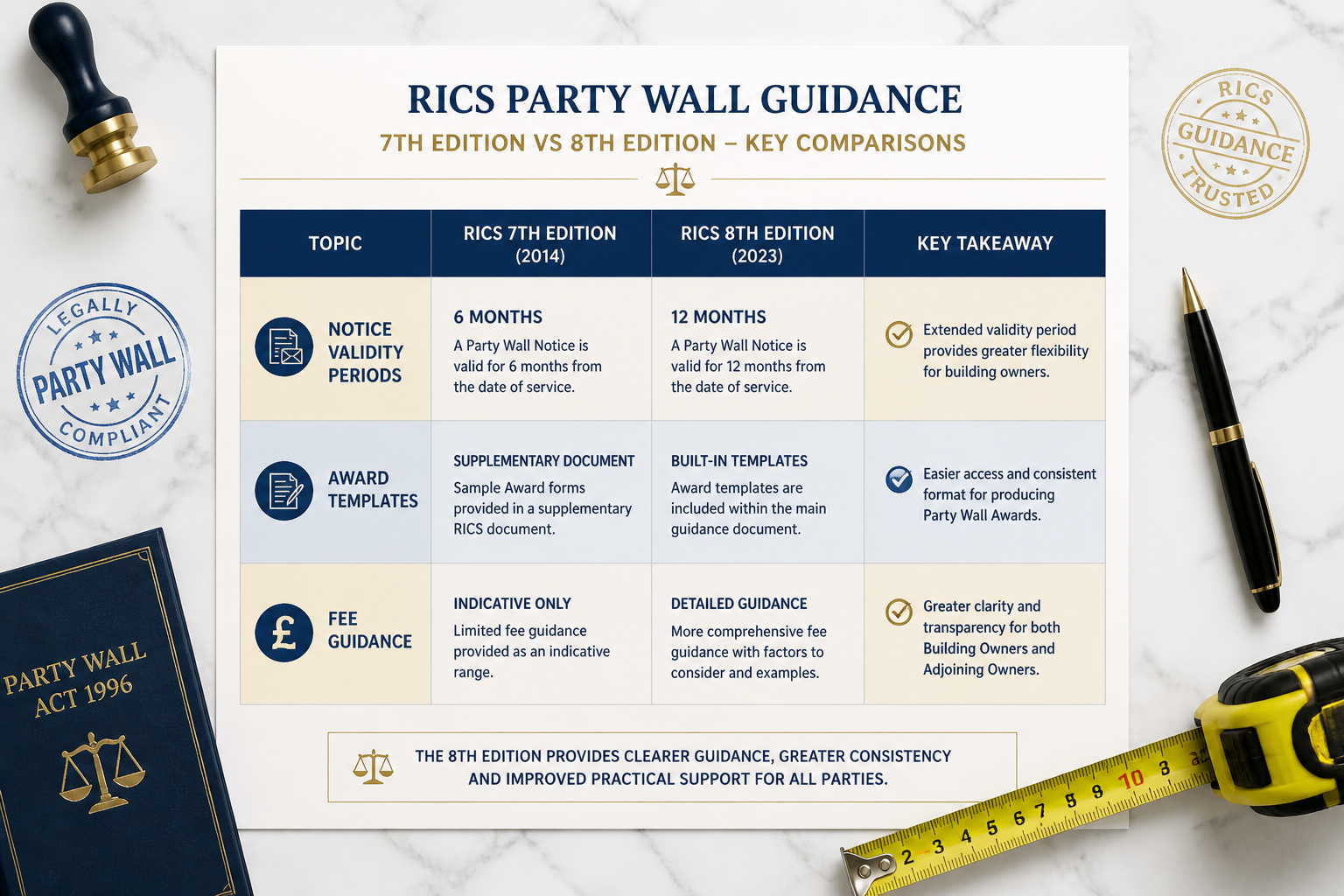
    In April 2026, the Royal Institution of Chartered Surveyors launched consultation on the draft 8th edition of Party Wall Legislation and Procedure, representing the most current authoritative revision of professional standards.[1] This consultation includes:

    • Enhanced appendices with updated guidance
    • Revised letters of appointment templates
    • Updated award templates reflecting current best practices
    • Clarifications on emerging issues in party wall practice

    These updates reinforce the importance of working with qualified professionals familiar with current standards when navigating complex party wall scenarios.

    Decision Framework: Applying the Rules to Your Project

    To determine whether your specific project requires party wall procedures, apply this systematic framework:

    Decision Tree for Common Projects

    Question 1: Where is your property located?

    • ❌ Scotland or Northern Ireland → Party Wall Act 1996 does NOT apply
    • ✅ England or Wales → Proceed to Question 2

    Question 2: Does your work affect a shared wall, floor, or structure?

    • ✅ Yes → Likely requires Section 2 notice (proceed to Question 3)
    • ❌ No → Proceed to Question 4

    Question 3: What type of work to the shared structure?

    • Cutting into it, inserting beams, raising height, underpinning → ✅ Requires 2-month notice
    • Only plastering, decorating, or minor fixtures on your side → ❌ Likely exempt

    Question 4: Are you building a new wall on or astride the boundary?

    • ✅ Yes → Requires 1-month Section 1 notice
    • ❌ No → Proceed to Question 5

    Question 5: Are you excavating near a neighbour’s building?

    • Within 3m and deeper than their foundations → ✅ Requires 1-month Section 6 notice
    • Within 6m and below 45-degree line from their foundations → ✅ Requires 1-month Section 6 notice
    • Further away or shallower → ❌ Likely exempt

    Regional Considerations

    While the Act applies uniformly across England and Wales, practical implementation varies by location:

    Urban Areas: Higher density means more party wall situations. Specialists in party wall surveying in Central London, North London, South London, East London, and West London handle complex terraced and semi-detached scenarios routinely.

    Suburban and Rural Areas: Fewer attached properties but excavation provisions still apply to detached houses when work meets proximity/depth criteria.

    Cost Implications and Risk Management

    Understanding when the Act applies directly impacts project budgets and timelines.

    Financial Considerations

    Party Wall Surveyor Fees: Typically range from £700-£1,500+ depending on project complexity, with building owners responsible for both their own and the adjoining owner’s reasonable surveyor fees.[6]

    Schedule of Condition Costs: Professional photographic surveys documenting pre-work property condition add £300-£800 to budgets but provide essential protection.

    Delay Costs: Non-compliance can result in:

    • Injunctions stopping work immediately
    • Legal costs defending disputes
    • Relationship damage with neighbours
    • Project delays extending months

    For practical advice on keeping party wall costs down, explore cost-effective compliance strategies.

    Risk Mitigation Strategies

    Early Assessment: Determine applicability during project planning, not after contractors are booked.

    Professional Consultation: When uncertainty exists, invest in professional advice early. The cost of preliminary surveyor consultation (often £200-£400) far outweighs the expense of non-compliance.

    Neighbour Relations: Informal discussion before formal notices often smooths the process, though formal written notices remain legally required.

    Documentation: Maintain comprehensive records of all notices served, responses received, and agreements reached.

    Neighbour Perspective: Receiving Party Wall Notices

    Understanding the Act from both sides provides complete perspective. If your neighbour is carrying out works affecting your property:

    Your Rights as Adjoining Owner

    Right to Information: Receive detailed notice of proposed works with adequate time to consider implications.

    Right to Appoint Surveyor: Select your own professional surveyor to protect your interests, with reasonable fees paid by the building owner.

    Right to Schedule of Condition: Insist on comprehensive pre-work documentation of your property’s condition.

    Right to Appropriate Award: Ensure the party wall award includes adequate protections, working hours restrictions, and remediation provisions.

    Response Options

    Consent: If satisfied with proposed works and confident no damage will occur, written consent allows work to proceed after the notice period.

    Dissent or Non-Response: Triggers the surveyor appointment process, providing formal protections through a party wall award.

    Never Ignore Notices: Failure to respond within 14 days constitutes dissent, and the building owner can appoint a surveyor on your behalf—losing your opportunity to select your own representative.

    Understanding party wall contract templates and awards clarifies what to expect from the formal process.

    Common Misconceptions and Mistakes

    Several persistent myths about when does the Party Wall Act apply? Determining notifiable works vs. exemptions in 2026 lead to compliance failures:

    Myth 1: “Planning Permission Covers Party Wall Requirements”

    Reality: Planning permission and party wall procedures are completely separate legal frameworks. Obtaining planning approval doesn’t satisfy Party Wall Act obligations.[6]

    Myth 2: “Only Terraced Houses Need Party Wall Notices”

    Reality: Semi-detached properties, flats, and even detached houses (for excavation work) fall under the Act when criteria are met.

    Myth 3: “Good Neighbour Relations Make Formal Notices Unnecessary”

    Reality: The Act requires written notices regardless of relationship quality. Informal agreements don’t satisfy legal obligations or provide protection if disputes arise later.

    Myth 4: “Small Projects Don’t Need Notices”

    Reality: Project size doesn’t determine applicability—the type and location of work does. Even minor structural interventions affecting party walls require proper procedures.

    Myth 5: “Builders Handle Party Wall Matters”

    Reality: Legal responsibility for serving notices rests with property owners, not contractors. Builders may advise, but owners must ensure compliance.

    Future Considerations: Party Wall Practice Beyond 2026

    The landscape of party wall practice continues evolving with emerging trends:

    Updated Professional Guidance: The RICS 8th edition consultation in April 2026 signals ongoing refinement of professional standards, with final publication expected later in 2026.[1]

    Renters’ Rights Act Implications: Recent legislation affecting landlord-tenant relationships may intersect with party wall procedures when landlords initiate works affecting multiple units.[2]

    Digital Notice Systems: Increasing digitization of construction processes may eventually modernize notice serving and documentation, though current legal requirements remain paper-based.

    Climate Adaptation Works: Increasing retrofit and insulation projects to improve energy efficiency often involve party wall works, driving higher volumes of notices.

    Dispute Resolution Evolution: Professional bodies continue developing best practices for efficient, cost-effective dispute resolution that protects all parties’ interests.

    Conclusion

    Determining when does the Party Wall Act apply? Determining notifiable works vs. exemptions in 2026 requires careful evaluation of work type, location, and relationship to shared structures or boundaries. The Act establishes clear triggers across three categories: work to existing party structures (Section 2), new boundary construction (Section 1), and excavation near neighbouring buildings (Section 6). However, numerous common home improvement projects fall outside the Act’s scope, particularly internal decorative work and construction entirely within property boundaries.

    The consequences of misunderstanding applicability range from project delays and legal disputes to damaged neighbour relations and costly remediation. Conversely, proper compliance protects all parties’ interests, provides clear documentation of pre-work conditions, and establishes frameworks for addressing any issues that arise during construction.

    Actionable Next Steps

    Assess Your Project Early: Determine Party Wall Act applicability during initial planning, not after booking contractors.

    Seek Professional Guidance: When uncertainty exists, consult qualified party wall surveyors familiar with current 2026 standards and the forthcoming RICS 8th edition guidance.

    Serve Notices Promptly: Allow adequate time for the full notice period plus potential surveyor appointment and award preparation—typically 3-4 months total for complex projects.

    Document Everything: Maintain comprehensive records of notices, responses, surveyor appointments, and agreements throughout the process.

    Communicate with Neighbours: While formal procedures remain legally required, early informal discussion often facilitates smoother processes and preserves relationships.

    Budget Appropriately: Include party wall surveyor fees, schedule of condition costs, and potential delays in project budgets from the outset.

    For comprehensive support navigating party wall requirements, explore detailed resources on the Party Wall etc. Act 1996 and consider consulting qualified professionals who can assess your specific circumstances and ensure full compliance with current regulations.

    Understanding when the Party Wall Act applies—and when it doesn’t—empowers property owners to plan confidently, comply fully, and maintain positive neighbour relations while achieving their construction goals in 2026 and beyond.


    References

    [1] Rics Launches Consultation On Updated Party Wall Practice Guidance – https://www.rics.org/news-insights/rics-launches-consultation-on-updated-party-wall-practice-guidance

    [2] Party Wall Surveys For Renters Rights Act Compliance Managing Notices When Landlord Initiated Works Face New Section 8 Ground Requirements – https://nottinghillsurveyors.com/blog/party-wall-surveys-for-renters-rights-act-compliance-managing-notices-when-landlord-initiated-works-face-new-section-8-ground-requirements

    [3] Understanding Party Wall Act What Homeowners Need Know Before Renovating – https://www.partywallslimited.com/blog/understanding-party-wall-act-what-homeowners-need-know-before-renovating

    [4] How To Serve A Party Wall Notice – https://onlinearchitecturalservices.com/how-to-serve-a-party-wall-notice/

    [5] Party Wall Agreement – https://hoa.org.uk/advice/guides-for-homeowners/i-am-improving/party-wall-agreement/

    [6] Do I Need Party Wall Agreement Uk 2026 – https://www.sharedwalls.co.uk/post/do-i-need-party-wall-agreement-uk-2026

  • Understanding Party Wall Awards: What Building Owners Need to Know

    Nearly 70% of property disputes between neighbors stem from construction damage claims that could have been prevented with proper documentation. When planning building works that affect shared structures, the difference between a smooth project and a costly legal battle often hinges on understanding two critical elements: Party Wall Awards and Schedules of Condition. Understanding Party Wall Awards: What Building Owners Need to Know About Schedules of Condition and Protection Measures is essential for anyone undertaking construction work near neighboring properties in 2026.

    These legal instruments work together to protect both building owners and adjoining owners throughout construction projects. While many property owners confuse these documents or assume they’re interchangeable, each serves a distinct purpose within the framework of the Party Wall etc. Act 1996.

    Key Takeaways

    • 🏗️ Party Wall Awards are comprehensive legal documents that outline working procedures, access rights, and dispute resolution mechanisms—far more than simple photographic records
    • 📸 Schedules of Condition provide crucial evidence of pre-construction property conditions but don’t replace the legal protections of a formal Award
    • ⚖️ Legal protection remains intact under Section 10 of the Party Wall etc. Act 1996, even when neighbors consent to works without a formal Award[4]
    • Strict timelines apply: Building owners must serve notices 1-2 months before works begin, and adjoining owners have just 14 days to respond[8]
    • 💰 Professional documentation costs are modest compared to potential dispute resolution expenses—Schedule of Condition surveys typically cost around £585 + VAT[1]

    Detailed () image showing a professional RICS-qualified surveyor conducting a Schedule of Condition survey inside a

    What Is a Party Wall Award and Why It Matters

    A Party Wall Award represents a legally binding agreement issued under the Party Wall etc. Act 1996 when disputes arise—or are deemed to have arisen—between building owners and adjoining owners. This formal document goes far beyond simple consent, establishing a comprehensive framework for construction works that affect shared structures.

    Core Components of Party Wall Awards

    Party Wall Awards contain several essential elements that protect all parties involved:

    Legal and Technical Specifications:

    • Detailed descriptions of proposed works with technical drawings
    • Specific methodologies for construction activities
    • Timeline for work commencement and completion
    • Access provisions to neighboring properties when required[2]

    Protection Measures:

    • Working hours restrictions (typically 8am-6pm weekdays)
    • Noise and vibration control requirements
    • Dust suppression and site management protocols
    • Structural monitoring arrangements[5]

    Dispute Resolution Framework:

    • Names and responsibilities of appointed surveyors
    • Damage assessment procedures
    • Compensation calculation methods
    • Appeal mechanisms and timelines[2]

    The formal Award resolution process creates a structured approach to managing construction activities. When disagreements arise, surveyors appointed under the Party Wall Award act impartially to resolve disputes while protecting each property’s interests[1].

    Legal Protection Under Section 10

    A critical aspect that many property owners overlook: even if an adjoining owner consents to construction works, they retain full legal protection under Section 10 of the Party Wall etc. Act 1996—regardless of whether a formal Party Wall Award is obtained[4]. This statutory protection ensures that neighbors can seek compensation for any damage caused by building works, even years after completion.

    This protection includes:

    ✅ The right to claim compensation for construction-related damage
    ✅ Access to statutory dispute resolution mechanisms
    ✅ Protection against unreasonable construction methods
    ✅ Rights to structural surveys and condition assessments

    Understanding Schedules of Condition in Party Wall Matters

    A Schedule of Condition serves as a detailed photographic and written record of a property’s condition at a specific point in time—typically before construction works begin. However, it’s crucial to understand what this document is and, more importantly, what it isn’t.

    What Schedules of Condition Actually Provide

    According to professional surveying standards, a comprehensive Schedule of Condition includes:

    Visual Documentation:

    • High-resolution photographs of all relevant areas
    • Multiple angles of walls, ceilings, floors, and external features
    • Close-up images of existing defects, cracks, or damage
    • Date-stamped imagery for verification purposes[6]

    Written Records:

    • Detailed descriptions of existing conditions
    • Measurements of visible cracks or defects
    • Notes on structural elements and finishes
    • Property layout and room-by-room assessments[3]

    Technical Details:

    • Building materials identification
    • Age and condition assessments
    • Notable features or vulnerabilities
    • Environmental factors (dampness, subsidence indicators)[6]

    The Critical Distinction: Evidence vs. Legal Protection

    Here’s where many property owners make a costly mistake: A Schedule of Condition is only evidence—it is NOT, by itself, equivalent to the comprehensive protection provided by a Party Wall Award[3].

    Think of it this way:

    Schedule of Condition Party Wall Award
    📸 Photographic evidence 📋 Legal framework
    📝 Written observations ⚖️ Binding agreement
    🕐 Point-in-time snapshot 🔄 Ongoing protection
    💡 Proves pre-existing state 🛡️ Defines rights and remedies
    📊 Documentary record 👥 Surveyor oversight

    A Schedule of Condition proves what existed before works began, but a Party Wall Award establishes the legal mechanisms for addressing any damage that occurs during construction[5].

    Who Prepares Schedules of Condition?

    Party Wall Surveyors responsible for creating schedules of condition are typically qualified surveyors from the Royal Institution of Chartered Surveyors (RICS) and must operate with fairness and impartiality[6]. Their professional qualifications ensure that documentation meets legal standards and can withstand scrutiny in dispute resolution proceedings.

    The typical cost for a Schedule of Condition survey is approximately £585 + VAT, depending on property size[1]—a modest investment compared to the potential costs of disputed damage claims.

    Detailed () image displaying a comprehensive Party Wall Award document spread across a desk with multiple pages visible

    Key Protection Measures in Understanding Party Wall Awards

    Understanding Party Wall Awards: What Building Owners Need to Know About Schedules of Condition and Protection Measures requires examining the specific protective mechanisms that Awards establish. These measures form the practical framework for safe, considerate construction work.

    Working Hours and Access Arrangements

    Party Wall Awards typically specify strict working hours restrictions to minimize disruption to adjoining owners. Standard provisions include:

    Typical Working Hours:

    • Monday to Friday: 8:00 AM – 6:00 PM
    • Saturday: 8:00 AM – 1:00 PM
    • Sunday and Bank Holidays: No works permitted[2]

    Access Provisions:
    When construction requires access to neighboring properties, the Award must clearly define:

    • Specific dates and times for access
    • Areas of the property requiring entry
    • Duration of access requirements
    • Notice periods before each visit
    • Compensation for significant inconvenience[2]

    These provisions balance the building owner’s need to complete works efficiently with the adjoining owner’s right to peaceful enjoyment of their property.

    Structural Protection and Monitoring

    Comprehensive Party Wall Awards include detailed protection measures designed to prevent or minimize damage:

    Before Works Begin:

    • Installation of vibration monitoring equipment
    • Crack monitoring gauges on vulnerable structures
    • Photographic surveys (Schedule of Condition)
    • Structural assessments of adjoining properties[1]

    During Construction:

    • Regular monitoring readings and reports
    • Protective boarding and dust screens
    • Underpinning or temporary support where necessary
    • Immediate notification protocols for emerging issues[5]

    After Completion:

    • Final condition surveys comparing pre- and post-construction states
    • Remedial works for any identified damage
    • Sign-off procedures confirming satisfactory completion[3]

    Damage Resolution Procedures

    One of the most valuable aspects of Party Wall Awards is the clear framework for addressing construction-related damage. The Award specifies:

    Assessment Process:

    1. Immediate notification of suspected damage
    2. Joint inspection by appointed surveyors
    3. Determination of causation (construction-related or pre-existing)
    4. Scope of necessary remedial works[2]

    Resolution Timeline:

    • Initial damage report: Within 48 hours of discovery
    • Surveyor inspection: Within 7 days
    • Remediation proposal: Within 14 days
    • Completion of repairs: As specified in Award[8]

    Compensation Framework:

    • Direct repair by building owner’s contractors
    • Financial compensation for equivalent repairs
    • Alternative accommodation costs if property becomes uninhabitable
    • Professional fees for additional surveys or assessments[5]

    The Role of Appointed Surveyors

    When disagreements arise during construction, surveyors appointed under the Party Wall Award act as impartial professionals to resolve disputes while protecting each property’s interests[1]. Their responsibilities include:

    🔍 Monitoring compliance with Award conditions
    ⚖️ Adjudicating disputes about work methods or damage
    📋 Issuing additional awards if circumstances change
    🤝 Facilitating communication between parties
    Certifying completion and satisfactory remediation

    This professional oversight provides crucial protection that a simple Schedule of Condition cannot offer.

    Detailed () image illustrating protective construction measures at a party wall site. Split-screen composition showing

    The Party Wall Notice Process and Timeline

    Understanding Party Wall Awards: What Building Owners Need to Know About Schedules of Condition and Protection Measures requires familiarity with the statutory notice process that precedes Award issuance.

    Notice Periods and Requirements

    Building owners must provide adjoining owners with proper notice before starting notifiable works under the Party Wall etc. Act 1996:

    Notice Periods:

    • Two months’ notice: For works to existing party walls or party structures
    • One month’s notice: For excavations within 3-6 meters of neighboring buildings or new walls at boundaries[8]

    The Party Wall Notice Service typically costs £65 + VAT per neighbor[1]—a small price for legal compliance.

    Response Options for Adjoining Owners

    Upon receiving a Party Wall Notice, adjoining owners have 14 days to respond with one of three options:

    1. Consent to the works (no Award required, but Section 10 protection remains)[4]
    2. Dissent or fail to respond (triggers Award procedure)
    3. Request specific conditions or modifications to proposed works[8]

    If dissent occurs or no response is received, a “dispute” is deemed to have arisen, requiring the appointment of surveyors and preparation of a Party Wall Award.

    Award Challenge and Appeal Rights

    Adjoining owners who disagree with Award terms have 14 days to challenge a Party Wall Award in the county court[8]. This appeal window provides an important safeguard against unreasonable or inadequate protective measures.

    Grounds for appeal typically include:

    • Inadequate protection measures
    • Unreasonable working hours or access requirements
    • Insufficient compensation provisions
    • Procedural irregularities in Award preparation

    Practical Benefits of Proper Documentation

    The protective documentation framework—combining Schedules of Condition with comprehensive Party Wall Awards—delivers significant benefits to all parties involved in construction projects.

    Dispute Prevention and Evidence

    Schedules of Condition reduce disputes by providing concrete evidence of property conditions before construction begins[5]. When disagreements arise about whether damage existed before works commenced, photographic and written records provide objective evidence that can:

    ✅ Quickly resolve false damage claims
    ✅ Identify genuinely new construction-related damage
    ✅ Support insurance claims when necessary
    ✅ Provide court-admissible evidence if disputes escalate

    Project Continuity and Peace of Mind

    Proper documentation facilitates smooth project progress without interruptions from false damage claims[5]. Building owners benefit from:

    • Reduced risk of work stoppages due to neighbor complaints
    • Clear procedures for addressing legitimate concerns
    • Professional surveyor support throughout construction
    • Defined timelines and expectations for all parties

    Adjoining owners gain peace of mind knowing that:

    • Their property condition is thoroughly documented
    • Professional surveyors monitor construction activities
    • Clear remediation procedures exist for any damage
    • Legal protections are formally established and enforceable[5]

    Cost-Effectiveness Compared to Disputes

    While some building owners view Party Wall procedures as unnecessary expenses, the costs are minimal compared to potential dispute resolution:

    Typical Costs:

    • Party Wall Notice Service: £65 + VAT per neighbor[1]
    • Schedule of Condition: £585 + VAT[1]
    • Party Wall Award preparation: Variable, often shared between parties
    • Total upfront investment: Typically £1,000-£3,000

    Potential Dispute Costs:

    • Legal fees: £5,000-£50,000+
    • Court costs and expert witnesses: £10,000-£100,000+
    • Project delays: Variable, potentially substantial
    • Damaged neighbor relationships: Priceless

    For guidance on keeping Party Wall costs down, building owners should engage qualified surveyors early in the planning process.

    Common Scenarios Requiring Party Wall Awards

    Understanding when Party Wall Awards and Schedules of Condition are necessary helps building owners plan appropriately and avoid legal complications.

    Types of Works Requiring Party Wall Procedures

    The Party Wall etc. Act 1996 applies to various types of party wall works, including:

    Works to Existing Party Walls:

    • Cutting into party walls for beam installation
    • Raising party walls for loft conversions
    • Underpinning party walls
    • Inserting damp-proof courses
    • Demolishing and rebuilding party walls[8]

    Excavations Near Boundaries:

    • Digging within 3 meters of a neighbor’s structure (deeper than its foundations)
    • Digging within 6 meters of a neighbor’s structure (below a 45-degree line from foundation base)
    • Basement excavations affecting neighboring properties

    New Walls at Boundaries:

    • Building new walls directly on boundary lines
    • Constructing party fence walls between properties

    Regional Considerations

    While the Party Wall etc. Act 1996 applies throughout England and Wales, practical considerations vary by location. Urban areas with closely-spaced properties require particular attention:

    Dense urban environments typically require more comprehensive documentation due to the proximity of structures and higher risk of construction impact.

    Best Practices for Building Owners

    For those planning construction work, following best practices ensures compliance and protects all parties’ interests.

    Early Planning and Surveyor Engagement

    Start the Party Wall process early—ideally 3-4 months before planned construction begins. This timeline allows for:

    • Proper notice periods (1-2 months)[8]
    • Surveyor appointment and Award preparation
    • Schedule of Condition completion
    • Resolution of any disputes before construction starts

    Engaging a qualified building owner’s surveyor at the project planning stage prevents costly delays and ensures proper procedure from the outset.

    Clear Communication with Neighbors

    While formal notices are legally required, informal communication with neighbors before serving official notices can:

    • Explain the planned works in accessible terms
    • Address concerns proactively
    • Build goodwill and cooperation
    • Reduce the likelihood of disputes

    Many disputes arise from misunderstandings that could have been prevented through clear, early communication.

    Comprehensive Documentation

    Ensure that Schedules of Condition cover:

    ✅ All rooms adjoining the party wall
    ✅ External features visible from neighboring property
    ✅ Structural elements potentially affected by works
    ✅ Existing defects, however minor
    ✅ Decorative finishes and fixtures

    The more comprehensive the pre-construction documentation, the easier it becomes to distinguish new damage from pre-existing conditions.

    Professional Surveyor Selection

    Choose surveyors who are:

    • RICS-qualified with party wall expertise[6]
    • Experienced in similar construction projects
    • Local to the area (familiar with regional building types)
    • Impartial and professional in approach
    • Clear communicators with all parties

    The right surveyor can make the difference between a smooth process and a contentious dispute.

    Best Practices for Adjoining Owners

    Adjoining owners also have responsibilities and opportunities to protect their interests when receiving Party Wall Notices.

    Responding to Party Wall Notices

    When receiving a notice about your neighbor’s construction works:

    Within 14 days, you should:

    1. Review the notice carefully and understand proposed works
    2. Consider whether to consent or dissent
    3. Appoint your own surveyor if dissenting (or allow the building owner’s surveyor to act for both parties)
    4. Request a Schedule of Condition if not already offered[8]

    Don’t ignore the notice—failure to respond within 14 days is deemed dissent, triggering the Award procedure anyway.

    Appointing Your Own Surveyor

    Adjoining owners have the right to appoint their own adjoining owner’s surveyor to represent their interests. Benefits include:

    • Independent professional advice about proposed works
    • Negotiation of stronger protection measures
    • Monitoring of construction activities
    • Advocacy in damage assessment and remediation

    While this adds cost, the building owner typically pays reasonable surveyor fees as part of the Party Wall process.

    Understanding Your Rights

    Key rights for adjoining owners include:

    🛡️ Protection against damage with remediation at building owner’s expense
    📸 Right to Schedule of Condition documenting pre-construction state
    Reasonable working hours and advance notice of access requirements
    👥 Independent surveyor representation in Award preparation
    ⚖️ Appeal rights if Award terms are unreasonable

    Understanding these rights empowers adjoining owners to engage constructively in the process while protecting their property interests.

    Conclusion: Protecting Your Property Through Proper Procedures

    Understanding Party Wall Awards: What Building Owners Need to Know About Schedules of Condition and Protection Measures is essential for anyone involved in construction work affecting shared structures in 2026. The distinction between these two instruments—Schedules of Condition as evidence and Party Wall Awards as comprehensive legal frameworks—forms the foundation of effective property protection.

    The Party Wall etc. Act 1996 provides a robust statutory framework that balances building owners’ rights to develop their properties with adjoining owners’ rights to protection from construction damage. When properly implemented, this framework facilitates construction projects while minimizing disputes and ensuring fair treatment for all parties.

    Key Takeaways for Success

    For Building Owners:

    • Start the Party Wall process 3-4 months before construction
    • Engage qualified RICS surveyors early in planning
    • Serve proper notices within statutory timeframes
    • Commission comprehensive Schedules of Condition
    • Maintain open communication with neighbors throughout the project

    For Adjoining Owners:

    • Respond to Party Wall Notices within 14 days
    • Consider appointing your own surveyor for independent advice
    • Insist on thorough Schedule of Condition documentation
    • Understand your rights under Section 10 protection
    • Engage constructively in the Award process

    For Both Parties:

    • Recognize that proper documentation protects everyone’s interests
    • View the process as risk management, not unnecessary bureaucracy
    • Maintain professional, courteous relationships throughout construction
    • Address concerns promptly through established procedures
    • Remember that upfront costs are minimal compared to dispute resolution expenses

    Next Steps

    If you’re planning construction work that may affect party walls or neighboring properties:

    1. Review your project plans to identify notifiable works under the Party Wall etc. Act 1996
    2. Consult a qualified party wall surveyor to understand your obligations and timeline
    3. Prepare and serve appropriate notices to adjoining owners with proper lead time
    4. Commission a Schedule of Condition before works commence
    5. Ensure a comprehensive Party Wall Award is prepared if disputes arise

    For more detailed guidance, explore resources on party wall awards and building owner responsibilities to ensure your project proceeds smoothly and legally.

    By understanding and properly implementing these protective measures, building owners and adjoining owners can navigate construction projects with confidence, knowing that their interests are protected by robust legal frameworks and professional documentation. The modest investment in proper Party Wall procedures pays dividends in dispute prevention, project continuity, and preserved neighbor relationships—benefits that far exceed the initial costs.


    References

    [1] How Far Can Party Wall Surveyors Go To Protect Adjoining Owners – https://www.houricanassociates.com/party-wall-news/how-far-can-party-wall-surveyors-go-to-protect-adjoining-owners/

    [2] What Is A Party Wall Agreement And Party Wall Award – https://westvilleassociates.com/blog/what-is-a-party-wall-agreement-and-party-wall-award

    [3] Schedule Of Condition Explained Why It Matters Before Your Neighbour Starts Work – https://www.grandlinesurveyors.co.uk/post/schedule-of-condition-explained-why-it-matters-before-your-neighbour-starts-work

    [4] Party Wall Schedule Of Condition – https://grahamkinnear.com/party-wall-schedule-of-condition/

    [5] Difference Between Schedule Of Condition Report And Party Wall Award – https://www.expresspartywall.com/difference-between-schedule-of-condition-report-and-party-wall-award/

    [6] Schedule Of Condition For Party Wall – https://thepartywallguru.com/schedule-of-condition-for-party-wall/

    [8] Party Wall Contract Guide And Party Wall Award Template – https://nottinghillsurveyors.com/blog/party-wall-contract-guide-and-party-wall-award-template

  • Party Wall Surveyor Impartiality in 2026: Balancing Client Duties

    Recent case law has exposed a critical tension in party wall practice: surveyors challenged in Welter v McKeeve and Walsh v PSB Management for awards deemed invalid due to jurisdictional overreach and perceived bias. These cases have prompted the Royal Institution of Chartered Surveyors (RICS) to launch an unprecedented consultation in April 2026, specifically addressing how Party Wall Surveyor Impartiality in 2026: Balancing Client Duties with Adjoining Owner Protections must evolve to meet statutory requirements while serving appointing parties.

    The fundamental question remains: how can a surveyor appointed and paid by one party remain genuinely impartial when resolving disputes?

    Detailed () image showing close-up of professional surveyor's hands holding balanced scales with 'Building Owner' label on

    Key Takeaways

    Statutory Independence: Party wall surveyors’ appointments are personal and statutory, meaning professional duties supersede commercial relationships with appointing parties.

    2026 Regulatory Overhaul: RICS draft 8th edition guidance addresses jurisdictional concerns where awards have been challenged due to surveyors acting without proper authority.

    Conflict Protections: Agreed surveyors cannot be the same professionals handling the building owner’s construction works, establishing critical independence requirements.

    Fee Responsibility Framework: Building owners typically pay both surveyors’ fees (£700–£1,800 per neighbour in 2026), but this payment structure must not compromise impartiality.

    Legal Accountability: Recent case law demonstrates that awards can be invalidated when surveyors fail to maintain genuine neutrality or act beyond their jurisdiction.

    Understanding the Statutory Framework for Party Wall Surveyor Impartiality in 2026

    The Party Wall etc. Act 1996 establishes a unique professional role where surveyors must serve dual masters: the appointing party who pays their fees and the statutory requirement to act impartially. This creates inherent tension that the 2026 RICS consultation seeks to address.

    The Personal and Statutory Nature of Surveyor Appointments

    RICS has explicitly clarified that “a party wall surveyor’s appointment is personal and statutory, independent of client instruction”[2]. This means that once appointed, surveyors operate under the Act’s authority rather than as conventional consultants following client directions.

    Key distinctions include:

    • 📋 Not mediators: Surveyors resolve disputes through awards, not negotiated settlements
    • ⚖️ Judicial function: They make binding determinations on construction methods, timing, and safeguards
    • 🔒 Independence requirement: Professional judgment cannot be influenced by who pays the fees
    • 📜 Statutory powers: Authority derives from the Act, not contractual engagement

    The building owner’s surveyor and adjoining owner’s surveyor both carry these obligations, though their initial appointments come from different parties.

    The Three Surveyor Appointment Models

    The Act provides three pathways for surveyor selection, each with distinct impartiality implications:

    Appointment Type Selection Method Impartiality Standard 2026 Fee Range
    Agreed Surveyor Both parties consent to single surveyor Must remain neutral regardless of who contacted them first £700–£1,500 (£750–£1,800 London)[4][6]
    Two Surveyors Each party appoints their own Must act impartially despite representing appointing owner £700–£1,500 each
    Third Surveyor Selected by the two appointed surveyors Resolves disagreements between first two surveyors Additional fees as needed

    The agreed surveyor model faces the strictest scrutiny. As HomeOwners Alliance notes, an agreed surveyor “cannot be the same surveyor the homeowner might be using for their own works” because the neighbour must view them as neutral[1]. This conflict-of-interest protection has become central to Party Wall Surveyor Impartiality in 2026: Balancing Client Duties with Adjoining Owner Protections.

    Jurisdictional Boundaries and the 2026 RICS Consultation

    The April-May 2026 RICS consultation emerged directly from concerns “where awards have been challenged because surveyors acted without proper jurisdiction, including circumstances where no genuine dispute existed between the parties”[2].

    This addresses cases where:

    🚫 Surveyors issued awards when neighbours had already agreed informally
    🚫 Professionals exceeded their statutory authority by imposing unnecessary conditions
    🚫 Awards were prepared without proper party wall notices being served
    🚫 Surveyors acted more as advocates than impartial adjudicators

    The draft 8th edition includes “strengthened guidance on regulatory and conduct matters, including fee practices, use of the Third Surveyor, service of notices and public engagement”[2], representing the most comprehensive update to party wall practice standards in recent years.

    Case Law Challenges to Party Wall Surveyor Impartiality in 2026

    Recent legal challenges have tested the boundaries of surveyor impartiality, with courts increasingly scrutinizing whether professionals maintained genuine neutrality or acted as advocates for their appointing parties.

    Welter v McKeeve: Jurisdictional Overreach

    The Welter v McKeeve case highlighted how surveyors can exceed their statutory authority when they issue awards without proper jurisdictional foundation. The case questioned whether a genuine dispute existed that required formal award procedures, or whether the surveyors had manufactured a dispute to justify their engagement.

    Key lessons from this case:

    • ✔️ Surveyors must verify that a genuine dissent exists before proceeding to award
    • ✔️ Simply receiving party wall notices doesn’t automatically create jurisdiction
    • ✔️ Awards can be challenged if they address matters beyond the Act’s scope
    • ✔️ Documentation must demonstrate impartial consideration of both parties’ interests

    Walsh v PSB Management: Bias and Procedural Fairness

    Walsh v PSB Management examined whether surveyors maintained procedural fairness when one party felt their concerns were dismissed or inadequately addressed in the award documentation.

    The case reinforced that party wall awards must demonstrate:

    1. Balanced consideration of both parties’ submissions
    2. Reasoned explanations for decisions that favour one party over another
    3. Proper consultation with both building and adjoining owners
    4. Fair opportunity for both parties to present evidence and concerns

    These cases directly influenced the 2026 RICS guidance, which now includes “revised letters of appointment and terms, and an updated draft award”[2] to establish clearer contractual frameworks preventing disputes over surveyor scope and independence.

    Implications for Award Validity

    Courts have demonstrated willingness to invalidate awards where impartiality standards were breached. This creates significant risks for building owners who may find their types of party wall works delayed or halted if awards are successfully challenged.

    Award validity now depends on:

    • 📝 Clear documentation of impartial consideration
    • 🔍 Proper jurisdictional foundation
    • ⚖️ Balanced treatment of both parties’ concerns
    • 📊 Reasonable fee structures that don’t suggest bias
    • 🛡️ Adherence to updated RICS professional standards

    Building owners working with party wall surveyors in Central London or other areas should verify their surveyor’s commitment to these standards before appointment.

    Detailed () infographic-style image displaying timeline of party wall surveyor appointment process with three distinct

    Practical Mechanisms for Maintaining Party Wall Surveyor Impartiality in 2026

    The theoretical requirement for impartiality must translate into practical procedures that protect both parties while allowing construction to proceed efficiently. The 2026 regulatory framework provides specific mechanisms to achieve this balance.

    Conflict of Interest Screening

    Before accepting any appointment, surveyors must conduct thorough conflict checks:

    Prohibited relationships include:

    • 🚫 Acting as agreed surveyor while also serving as the building owner’s project architect or engineer
    • 🚫 Having financial interests in the construction company performing the works
    • 🚫 Previous representation of either party in unrelated disputes
    • 🚫 Family or close personal relationships with either party

    For adjoining owners, this protection ensures their surveyor isn’t compromised by external relationships. The screening process should be documented in the surveyor’s letter of appointment.

    Fee Transparency and Reasonableness

    One of the most contentious impartiality issues involves fees. Since building owners typically pay both surveyors’ fees, there’s potential for adjoining owners’ surveyors to inflate charges without accountability.

    2026 market standards indicate:

    • 💰 Straightforward compliance works: £700–£1,500 per surveyor[4]
    • 💰 London-specific rates: £750–£1,800 per neighbour[6]
    • 💰 Complex works with extensive conditions: £2,000–£3,500
    • 💰 Third surveyor fees: Additional costs when disputes arise

    The building owner pays these fees “because they are the party benefitting from the works”[3], but this doesn’t grant them control over the surveyor’s professional judgment. The updated RICS guidance emphasizes that fee practices must not compromise impartiality.

    For those concerned about costs of party wall procedures, understanding this fee structure is essential to budgeting appropriately.

    Schedule of Condition Protocols

    One of the most important impartiality safeguards is the schedule of condition, which documents the adjoining property’s state before works commence.

    Impartial surveyors ensure:

    • 📸 Comprehensive photographic documentation
    • 📝 Detailed written descriptions of existing defects
    • 🎯 Joint inspection opportunities for both parties
    • 🔄 Regular monitoring visits during construction
    • ✅ Post-completion verification

    This creates objective evidence that protects adjoining owners from being blamed for pre-existing damage while also protecting building owners from false claims.

    Award Documentation Standards

    The 2026 RICS guidance introduces “an updated draft award”[2] that establishes clearer documentation standards. Awards must now explicitly demonstrate impartial consideration through:

    1. Recital of both parties’ positions on disputed matters
    2. Reasoned determinations explaining why specific conditions were imposed
    3. Proportionate safeguards that don’t unnecessarily burden the building owner
    4. Clear dispute resolution procedures if disagreements arise during construction
    5. Defined monitoring protocols ensuring ongoing impartiality

    These standards address concerns raised in recent case law where awards appeared to favour one party without adequate justification.

    The Third Surveyor Safety Valve

    When the two appointed surveyors cannot agree, the Third Surveyor provides an additional impartiality layer. The 2026 guidance includes enhanced provisions for Third Surveyor use, recognizing this role as critical to Party Wall Surveyor Impartiality in 2026: Balancing Client Duties with Adjoining Owner Protections.

    Third Surveyor engagement occurs when:

    • 🔄 The two surveyors disagree on award terms
    • ⚖️ One surveyor believes the other has acted partially
    • 📋 Disputes arise over fee reasonableness
    • 🛠️ Disagreements emerge regarding construction methods or safeguards

    This mechanism prevents deadlock while maintaining the impartiality framework, though it does add costs to the process.

    Regional Considerations for Party Wall Surveyor Impartiality in 2026

    Impartiality standards apply uniformly across England and Wales under the Party Wall etc. Act 1996, but practical implementation varies by region based on property density, construction activity, and local surveyor practices.

    London-Specific Impartiality Challenges

    London’s dense housing stock and high construction activity create unique pressures on surveyor impartiality:

    Geographic variations include:

    • 🏙️ North London: Victorian terraces with complex shared structures
    • 🌆 East London: Rapid development creating volume-based surveyor practices
    • 🏛️ South London: Mixed property types requiring varied approaches
    • 💼 West London: High-value properties with sophisticated parties

    In high-volume areas, some surveyors have developed “factory” approaches that may compromise individual attention to impartiality. The 2026 guidance specifically addresses concerns about surveyors handling excessive caseloads that prevent proper consideration of each party’s interests.

    Tenant Rights Integration

    The 2026 legislative landscape has “repositioned tenant rights as central to all party wall notices and procedures”[5], adding another dimension to surveyor impartiality. When neighbours are carrying out works, surveyors must now consider:

    • 🏠 Tenant occupancy rights during construction
    • 📅 Timing restrictions that minimize tenant disruption
    • 🔊 Noise and access limitations protecting tenant quiet enjoyment
    • 📋 Notice requirements to tenants as well as landlords

    This expansion of protected parties requires surveyors to balance even more competing interests while maintaining impartiality.

    The Future of Party Wall Surveyor Impartiality Beyond 2026

    The ongoing RICS consultation represents just the beginning of evolving impartiality standards. Several trends will shape Party Wall Surveyor Impartiality in 2026: Balancing Client Duties with Adjoining Owner Protections in coming years.

    Enhanced Regulatory Oversight

    While the Act currently doesn’t require surveyors to belong to specific governing bodies[3], pressure is mounting for mandatory professional accreditation. Future developments may include:

    • ✅ Compulsory RICS or similar body membership
    • ✅ Specialist party wall surveyor certification
    • ✅ Continuing professional development requirements
    • ✅ Disciplinary procedures for impartiality breaches

    Technology and Transparency

    Digital tools are transforming how surveyors demonstrate impartiality:

    • 📱 Cloud-based award platforms showing both parties’ submissions
    • 🎥 Video documentation of condition surveys
    • 📊 Standardized fee calculators preventing overcharging
    • 🔔 Automated notification systems ensuring equal communication

    These technologies make it harder for surveyors to favour one party without leaving digital evidence.

    Alternative Dispute Resolution Integration

    Some practitioners advocate for incorporating mediation techniques while maintaining statutory impartiality. The challenge is balancing facilitated negotiation with the surveyor’s duty to make binding determinations when parties cannot agree.

    Detailed () image showing modern courtroom or legal setting with focus on party wall award document on judge's bench,

    Practical Guidance for Building and Adjoining Owners

    Understanding surveyor impartiality helps both parties navigate the party wall process more effectively.

    For Building Owners

    When carrying out works, building owners should:

    1. Select surveyors with strong impartiality records rather than those who promise to “get the award through quickly”
    2. Budget for reasonable fees for both surveyors, recognizing that artificially low fees may indicate quality concerns
    3. Provide complete information to surveyors, as withholding details can lead to awards being challenged
    4. Respect the surveyor’s independence rather than attempting to direct their professional judgment
    5. Consider agreed surveyor appointments when relationships with neighbours are cooperative

    Building owners can review sample party wall agreement templates to understand standard terms, though these cannot replace proper surveyor involvement when disputes exist.

    For Adjoining Owners

    When neighbours are carrying out works, adjoining owners should:

    1. Appoint your own surveyor rather than accepting the building owner’s suggested agreed surveyor without independent advice
    2. Verify independence by confirming your surveyor has no conflicts with the building owner or their contractors
    3. Engage early rather than waiting until works commence, as late involvement limits protection
    4. Document concerns clearly in writing to your surveyor
    5. Understand fee responsibility – building owners pay, but you control your surveyor’s appointment

    The option of having a party wall agreement without a surveyor exists for straightforward works where both parties agree, but this removes the impartiality safeguards that surveyors provide.

    Red Flags Indicating Potential Impartiality Issues

    Both parties should watch for warning signs:

    🚩 Surveyor refuses to meet with or communicate with one party
    🚩 Awards prepared without proper site inspections
    🚩 Fees significantly above or below market rates
    🚩 Surveyor dismisses legitimate concerns without explanation
    🚩 Rush to finalize awards without adequate consultation
    🚩 Surveyor has ongoing commercial relationship with one party
    🚩 Refusal to provide clear reasoning for determinations

    If these issues arise, parties should consider invoking the Third Surveyor mechanism or seeking professional advice about award validity.

    Conclusion

    Party Wall Surveyor Impartiality in 2026: Balancing Client Duties with Adjoining Owner Protections represents a critical evolution in party wall practice. The RICS consultation and recent case law have exposed tensions inherent in a system where surveyors are appointed and paid by one party yet must serve both impartially.

    The 2026 regulatory framework addresses these challenges through enhanced guidance on jurisdictional boundaries, conflict-of-interest protections, fee transparency, and award documentation standards. Surveyors must now demonstrate impartiality through clear procedures rather than simply asserting professional independence.

    For building owners, this means selecting surveyors based on their impartiality track record and respecting their statutory independence rather than viewing them as advocates. For adjoining owners, it means understanding the protections available and actively engaging with appointed surveyors to ensure concerns are properly addressed.

    The cases of Welter v McKeeve and Walsh v PSB Management demonstrate that awards lacking genuine impartiality can be challenged and invalidated, creating delays and additional costs for all parties. As party wall practice continues evolving beyond 2026, the fundamental principle remains unchanged: surveyors serve the Act first, and their appointing parties second.

    Next Steps

    If you’re planning construction works:

    • Serve proper party wall notices early in your planning process
    • Budget £700–£1,800 per affected neighbour for surveyor fees
    • Select surveyors with demonstrated impartiality credentials
    • Review the party wall contract template guide to understand award components

    If you’re an affected neighbour:

    • Respond to notices promptly to preserve your rights
    • Consider appointing your own surveyor rather than accepting an agreed surveyor
    • Document existing property conditions before works commence
    • Understand your protections under the updated 2026 guidance

    For both parties:

    • Consult the general FAQs for common questions
    • Seek professional advice early rather than waiting for disputes to escalate
    • Recognize that proper surveyor impartiality protects everyone’s interests

    The party wall process works best when all participants – building owners, adjoining owners, and surveyors – understand and respect the impartiality framework that makes construction possible while protecting property rights.


    References

    [1] Party Wall Agreement – https://hoa.org.uk/advice/guides-for-homeowners/i-am-improving/party-wall-agreement/

    [2] Rics Launches Consultation On Updated Party Wall Practice Guidance – https://www.rics.org/news-insights/rics-launches-consultation-on-updated-party-wall-practice-guidance

    [3] Role Of Party Wall Surveyor – https://www.peterbarry.co.uk/blog/role-of-party-wall-surveyor/

    [4] Party Wall Notice Requirements For Prs Database Compliance Works Surveyor Tactics Post Renters Rights Act Registration In 2026 – https://nottinghillsurveyors.com/blog/party-wall-notice-requirements-for-prs-database-compliance-works-surveyor-tactics-post-renters-rights-act-registration-in-2026

    [5] Party Wall Surveys For Renters Rights Act Compliance Managing Notices When Landlord Initiated Works Face New Section 8 Ground Requirements – https://nottinghillsurveyors.com/blog/party-wall-surveys-for-renters-rights-act-compliance-managing-notices-when-landlord-initiated-works-face-new-section-8-ground-requirements

    [6] Party Wall Agreement London 2026 – https://www.mayfairstudio.co.uk/blog/party-wall-agreement-london-2026

  • Party Wall Notices for Loft Conversions: Complete Guide

    More than 60% of loft conversion projects in England and Wales trigger mandatory party wall obligations, yet a staggering proportion of homeowners discover this requirement only after builders have mobilized to site—creating costly delays, strained neighbour relations, and potential court injunctions that halt work entirely.

    Understanding Party Wall Notices for Loft Conversions: Legal Triggers, Common Errors, and Award Essentials is critical for any homeowner planning to convert unused roof space into valuable living area. The Party Wall etc. Act 1996 establishes specific legal requirements when structural work affects shared walls, and loft conversions frequently involve precisely the types of interventions that activate these obligations. This comprehensive guide explains exactly when notices become mandatory, identifies the most common mistakes that derail projects, and details what must be included in a compliant Party Wall Award.

    Whether planning a simple roof light installation or a full dormer extension with steel beam insertions, knowing the legal triggers and proper procedures protects both the building owner’s project timeline and the neighbour’s property rights.

    Key Takeaways

    • Structural loft work triggers mandatory notices: Steel beam insertions into party walls, raising shared walls, cutting into walls for support, and chimney breast removal affecting shared stacks all require party wall notices served at least two months before work begins.
    • Notice failures lead to court injunctions: Starting work without proper notices allows neighbours to seek immediate court orders stopping construction, causing significant delays and increased legal costs.
    • Party Wall Awards must document essential protections: Awards prepared by qualified surveyors must specify work scope, protective measures, access arrangements, and include a Schedule of Condition documenting pre-work property state.
    • Common errors include late, incorrect, or missing notices: The majority of party wall disputes arise from procedural failures rather than substantive disagreements about the work itself.
    • Early surveyor involvement prevents costly delays: Engaging party wall professionals during the planning stage—once architectural drawings are complete—ensures sufficient time for proper notice service and agreement before builders arrive on site.

    Detailed () technical illustration showing three-panel comparison of loft conversion structural work scenarios: left panel

    Understanding Legal Triggers: When Loft Conversions Require Party Wall Notices

    The Party Wall etc. Act 1996 applies exclusively to England and Wales—homeowners in Scotland or Northern Ireland operate under different legal frameworks.[4] Within this jurisdiction, specific types of structural work automatically trigger notice requirements, regardless of whether neighbours object or consent to the proposed work.

    Structural Interventions That Activate Notice Requirements

    Loft conversions frequently involve several categories of work that fall squarely within the Act’s scope:

    🔨 Steel Beam Insertions into Party Walls

    When loft conversions require structural support, builders commonly insert steel beams into the shared party wall between semi-detached or terraced properties. This work constitutes cutting into or otherwise altering the party wall structure, triggering mandatory notice requirements under Section 2 of the Act.[2] The beam insertion creates a permanent alteration to the shared structure and requires formal agreement through the party wall process.

    📏 Raising or Extending Party Walls

    Many loft conversions involve raising the height of an existing party wall to accommodate increased headroom or to support a new roof structure. Any work that increases the height of a party wall—even by modest amounts—requires a party wall notice served under Section 2(2)(a) of the Act.[2] This includes building up the wall to create a parapet or to support dormer structures that extend above the original roofline.

    🏗️ Cutting into Walls for Structural Support

    Dormer loft conversions typically require floor joists to be inserted into or bear upon the party wall. This cutting or corbelling work—where timber or steel joists are embedded into the shared wall structure—triggers notice requirements.[2] The work physically alters the party wall’s integrity and load-bearing characteristics, bringing it within the Act’s regulatory scope.

    🧱 Chimney Breast Removal Affecting Shared Stacks

    Older properties often feature chimney breasts that pass through loft spaces, and homeowners frequently wish to remove these to maximize usable floor area. When a chimney breast forms part of a shared stack serving both properties, its removal requires party wall procedures.[2] The work affects the structural stability of the shared chimney structure and may impact the neighbour’s retained portions.

    ⛏️ Excavation Work Near Foundations

    While less common in pure loft conversions, some projects involve underpinning or foundation work to support increased loads. The Act requires notices for excavation within three meters of a neighbour’s structure if the work will go deeper than the neighbour’s foundations, or within six meters if the excavation will cut a line drawn downward at 45 degrees from the bottom of the neighbour’s foundations.[2]

    Work That Does NOT Require Party Wall Notices

    Understanding what falls outside the Act’s scope helps homeowners avoid unnecessary procedures and costs:

    • Minor internal alterations: Plastering, painting, or decorating work on party walls requires no notice[4]
    • Electrical installations: Running cables or installing sockets on party walls (without cutting into the structure) needs no agreement[4]
    • Non-structural drilling: Fixing kitchen units, shelving, or pictures to party walls with standard fixings does not trigger notice requirements[4]
    • Roof light installations: Simple Velux-style roof windows that don’t involve structural alterations to party walls typically fall outside the Act’s scope
    • Insulation and boarding: Adding insulation or plasterboard to the loft space without cutting into or loading party walls requires no formal notice

    The critical distinction lies in whether the work physically alters, loads, or cuts into the party wall structure itself. Cosmetic or non-structural work remains outside the Act’s regulatory framework.

    Geographic and Temporal Scope

    The Party Wall etc. Act 1996 became effective on July 1, 1997, and applies to all qualifying work commenced after that date within England and Wales.[4] Properties in Scotland operate under different common law principles, while Northern Ireland has its own distinct legal framework for party wall matters.

    For detailed information about types of party wall works covered by the Act, homeowners should consult with qualified party wall surveyors early in the planning process.

    () image showing common party wall notice errors as annotated document mockups spread across desk surface: incorrect notice

    Common Errors in Party Wall Notices for Loft Conversions: Pitfalls That Derail Projects

    The majority of party wall disputes and delays stem not from substantive disagreements about proposed work, but from procedural failures in the notice process itself. Understanding these common errors enables homeowners to avoid costly mistakes that can halt construction and damage neighbour relations.

    Critical Timing Failures

    ⏰ Late Service of Notices

    The Act requires a minimum two-month notice period before structural work begins.[1][3] This timeline is mandatory, not discretionary. Homeowners who serve notices with insufficient lead time—or worse, after builders have already mobilized—face several serious consequences:

    • Neighbours can refuse consent and insist on the full statutory notice period
    • Work must be postponed until proper notice periods expire
    • Builder mobilization costs may be wasted as crews stand down
    • Project financing timelines can be disrupted by unexpected delays

    Problems commonly arise when homeowners assume planning permission approval or building control notification satisfies party wall requirements—these are entirely separate legal obligations.[3]

    📅 Starting Work Before Agreement

    Perhaps the most serious error involves commencing notifiable work before reaching agreement with neighbours. The Act explicitly prohibits starting any covered work before either:

    1. The neighbour provides written consent to the proposed work, or
    2. A Party Wall Award has been prepared and served by appointed surveyors[4]

    Starting work prematurely exposes homeowners to significant legal risks. Neighbours can seek court injunctions to immediately stop the work, and courts take a particularly dim view of such procedural violations.[1] In some cases, courts have ordered building owners to pay for repairs to neighbouring properties that may not actually have been caused by their work—simply because the absence of a proper Schedule of Condition makes causation impossible to establish.[5]

    Content and Accuracy Errors

    📋 Incomplete or Incorrect Notice Information

    Party wall notices must contain specific information prescribed by the Act. Common content errors include:

    • Vague work descriptions: Notices stating simply “loft conversion” without detailing specific structural interventions (beam insertions, wall raising, joist cutting) lack sufficient detail
    • Missing technical specifications: Failure to specify beam sizes, insertion depths, or extent of wall cutting prevents neighbours from properly assessing impact
    • Incorrect property descriptions: Wrong addresses, missing flat numbers, or unclear property boundaries create confusion about which properties are affected
    • Omitted commencement dates: Notices must state when work will begin—vague statements like “soon” or “when convenient” fail to satisfy statutory requirements

    🏠 Failure to Identify All Affected Neighbours

    In terraced properties or blocks of flats, loft conversions may affect multiple adjoining owners. Common errors include:

    • Serving notice only on the immediately adjacent property while overlooking other affected neighbours
    • Failing to identify and serve notices on landlords when neighbouring properties are tenanted
    • Overlooking properties that share chimney stacks or roof structures even if they don’t share a direct party wall
    • Missing freeholders or management companies in leasehold properties

    Each affected adjoining owner must receive proper notice—failure to serve all relevant parties creates legal vulnerabilities.[3]

    Surveyor Appointment and Award Errors

    👷 Incorrect Surveyor Selection Process

    When neighbours dissent from proposed work (or fail to respond within 14 days), the dispute resolution mechanism requires surveyor appointment. Common errors include:

    • Unilateral surveyor appointment: Building owners cannot simply appoint a surveyor to act for both parties without the neighbour’s explicit agreement to that arrangement
    • Lack of independence: Appointing the building owner’s architect or builder as “surveyor” violates the requirement for independent professional judgment
    • Failure to follow statutory timelines: The Act prescribes specific timeframes for surveyor appointments and counter-appointments that must be observed

    When disputes arise, homeowners can choose between two approaches:

    1. Agreed Surveyor: A single surveyor acts impartially for both parties—typically faster and less expensive[2]
    2. Two Surveyors: Each party appoints their own surveyor, who together appoint a Third Surveyor to resolve any disagreements—more formal but sometimes necessary for complex situations[2]

    Understanding how to keep party wall costs down often involves selecting the appropriate surveyor arrangement for the specific circumstances.

    📄 Deficient Award Documentation

    Even when surveyors are properly appointed, Awards sometimes contain critical deficiencies:

    • Missing Schedule of Condition: Failure to document the neighbouring property’s pre-work condition makes it impossible to establish causation for any subsequent damage
    • Vague work descriptions: Awards must specify exactly what work is permitted—general statements create ambiguity
    • Inadequate protective measures: Awards should detail specific protections (dust barriers, vibration monitoring, structural propping) appropriate to the work scope
    • Unclear access provisions: Failure to specify access rights, timing, and procedures creates conflict during construction

    Service and Response Errors

    📮 Improper Notice Service Methods

    The Act requires notices to be served properly—typically by hand delivery, recorded delivery post, or through a process server. Common service errors include:

    • Sending notices by standard post without proof of delivery
    • Emailing notices without the neighbour’s explicit agreement to electronic service
    • Leaving notices with occupiers who are not the legal owners
    • Failing to retain proof of service documentation

    ⏳ Misunderstanding Response Timeframes

    Neighbours have 14 days from receipt of notice to respond with either consent or dissent.[2] Building owners sometimes misinterpret silence:

    • Assuming no response means consent (it doesn’t—silence triggers the dispute resolution process)
    • Pressuring neighbours for immediate responses before the statutory period expires
    • Failing to recognize that a request for additional information or clarification constitutes engagement, not consent

    For homeowners navigating these complexities in specific areas, consulting party wall surveyors in Central London or other local specialists ensures compliance with both statutory requirements and local practice conventions.

    Professional () illustration of formal Party Wall Award document as central focus with detailed callouts and arrows pointing

    Party Wall Award Essentials for Loft Conversions: What Must Be Documented

    A Party Wall Award represents the formal legal document that authorizes notifiable work to proceed while protecting the interests of all parties. Understanding what must be included in a compliant Award—and why each element matters—helps homeowners ensure their loft conversion proceeds smoothly and legally.

    Core Components of a Valid Party Wall Award

    1. Comprehensive Work Scope Description

    The Award must specify exactly what work is authorized, including:

    • Precise structural interventions: Detailed descriptions of beam insertions (sizes, materials, insertion depths), wall raising (heights, materials, construction methods), and joist cutting (locations, sizes, support methods)[1]
    • Work methodology: How the work will be executed, including sequence of operations and construction techniques
    • Materials specifications: Types of steel, timber, concrete, or other materials to be used in the party wall work
    • Drawings and plans: Reference to and incorporation of relevant architectural and structural drawings showing the work in detail

    Vague descriptions create ambiguity about what is permitted and may require Award amendments if actual work differs from what was authorized.

    2. Schedule of Condition

    Perhaps the most critical protective element for both parties, the Schedule of Condition documents the neighbouring property’s state before work commences.[4] This detailed record typically includes:

    • Photographic evidence: Comprehensive photographs of all rooms, focusing on walls, ceilings, floors, and external elevations adjacent to the building owner’s property
    • Written descriptions: Detailed notes documenting existing cracks, settlement, decoration condition, and any pre-existing defects
    • Measurement records: Crack width measurements, out-of-plumb measurements, and other quantifiable condition indicators
    • Date and authentication: Dated records prepared by the appointed surveyor(s) and agreed by both parties

    Without a proper Schedule of Condition, determining whether post-work damage was caused by the construction or existed previously becomes virtually impossible.[4] This creates significant risks for both building owners (who may be blamed for pre-existing damage) and adjoining owners (who may struggle to prove construction caused new damage).

    Professional schedule of condition services ensure this documentation meets legal standards and provides effective protection.

    3. Protective Measures and Working Methods

    Awards must specify measures to minimize risk and inconvenience to adjoining owners:

    • Structural protection: Requirements for propping, shoring, or temporary support of party walls during work
    • Dust and debris control: Barriers, sheeting, or other measures to prevent migration of construction dust
    • Vibration limits: Restrictions on vibration-generating activities or requirements for vibration monitoring
    • Noise management: Limitations on particularly noisy operations and their timing
    • Weather protection: Temporary coverings or protection for exposed party walls during construction

    These provisions balance the building owner’s right to undertake permitted work with the adjoining owner’s right to protection from unnecessary damage or nuisance.

    4. Access Rights and Arrangements

    The Award should clearly establish:

    • Access extent: What areas of the adjoining owner’s property may be accessed and for what purposes
    • Access timing: Permitted hours for access (typically aligning with normal construction hours)
    • Notice requirements: How much advance notice must be given before accessing adjoining property
    • Supervision provisions: Whether access must be supervised by the adjoining owner or their representative
    • Making good: Responsibility for reinstating any disturbance caused by access (temporary fixings, floor protection, etc.)

    Clear access provisions prevent disputes during construction when time pressures and practical needs can create friction.

    5. Working Hours and Timing Restrictions

    To minimize disruption, Awards typically specify:

    • Permitted working hours: Standard construction hours (commonly 8:00 AM to 6:00 PM weekdays, 8:00 AM to 1:00 PM Saturdays)
    • Prohibited days: No work on Sundays or public holidays (unless exceptional circumstances require otherwise)
    • Restricted operations: Particularly noisy or disruptive activities may be limited to specific time windows
    • Completion timeline: Expected duration of work affecting the party wall

    These provisions help adjoining owners plan around construction disruption while giving building owners reasonable timeframes for completion.

    6. Dispute Resolution Procedures

    Awards should establish clear mechanisms for addressing issues that arise during construction:

    • Surveyor inspection rights: Provisions for surveyors to inspect work in progress to ensure compliance with the Award
    • Complaint procedures: How adjoining owners should raise concerns about work methods, hours, or damage
    • Variation procedures: Process for agreeing changes to the authorized work scope if site conditions require modifications
    • Damage resolution: Procedures for assessing, agreeing, and remedying any damage caused by the works

    Having these procedures in place before work begins prevents small issues from escalating into major disputes.

    Standard Award Timeline and Process

    Understanding the typical timeline helps homeowners plan effectively:

    Stage Timeline Key Activities
    Notice Service Day 0 Building owner serves formal party wall notice on neighbour(s)
    Response Period Days 1-14 Neighbour reviews notice and responds with consent or dissent
    Surveyor Appointment Days 15-30 If disputed, surveyors are appointed by both parties
    Property Inspection Days 30-45 Surveyors inspect properties and prepare Schedule of Condition
    Award Preparation Days 45-60 Surveyors draft Award detailing work scope, protections, and procedures
    Award Service Day 60+ Completed Award is served on both parties, authorizing work to proceed

    This timeline assumes straightforward cases—complex situations involving multiple neighbours, difficult access, or contentious issues may extend the process.[2]

    Professional Surveyor Costs and Fee Responsibility

    Party wall surveyor fees typically range between £1,000 and £1,500 + VAT, depending on project complexity, property location, and whether an Agreed Surveyor or Two Surveyors approach is used.[2] Important cost principles include:

    • Building owner pays: The building owner undertaking the work is responsible for all reasonable surveyor fees, including both their own surveyor’s fees and the adjoining owner’s surveyor’s fees[2]
    • Reasonableness standard: Fees must be reasonable and proportionate to the work involved—surveyors cannot charge excessive amounts
    • Disbursements: Additional costs for Schedule of Condition photography, specialist reports, or Third Surveyor fees are typically recoverable

    Understanding costs of the party wall process helps homeowners budget accurately for loft conversion projects.

    When to Engage Party Wall Professionals

    Early engagement proves critical for smooth project execution. Best practice involves contacting party wall surveyors:

    • During planning stage: Once architectural drawings are substantially complete but before submitting planning applications[1]
    • Before builder selection: Ensuring party wall timelines are factored into builder scheduling and contracts
    • Minimum two months before work: Allowing sufficient time for the full notice and Award process to complete before the planned construction start date[1]

    Late engagement often results in rushed processes, stressed neighbour relations, and construction delays when builders arrive on site only to discover party wall procedures remain incomplete.

    For homeowners undertaking loft conversions, understanding the Party Wall etc. Act 1996 framework and engaging qualified professionals early ensures legal compliance, protects property interests, and maintains positive neighbour relations throughout the construction process.

    Conclusion

    Party Wall Notices for Loft Conversions: Legal Triggers, Common Errors, and Award Essentials represent critical knowledge for any homeowner planning to convert unused roof space into valuable living area. The Party Wall etc. Act 1996 establishes mandatory procedures when structural work affects shared walls—and loft conversions frequently involve precisely the types of interventions that trigger these legal obligations.

    The key takeaways for successful navigation of party wall requirements include:

    Recognize structural triggers early: Steel beam insertions, party wall raising, joist cutting, and chimney breast removal all require formal notices served at least two months before work begins

    Avoid common procedural errors: Late notices, incomplete work descriptions, failure to identify all affected neighbours, and starting work before agreement represent the most frequent mistakes that derail projects

    Ensure comprehensive Award documentation: Valid Awards must include detailed work scope, Schedule of Condition, protective measures, access arrangements, and dispute resolution procedures

    Engage professionals at the planning stage: Involving qualified party wall surveyors once architectural drawings are complete—and before builders mobilize—prevents costly delays and legal complications

    Actionable Next Steps

    For homeowners planning loft conversions:

    1. Review architectural plans to identify any structural work affecting party walls—consult with your architect or structural engineer about party wall implications
    2. Contact a qualified party wall surveyor early in the planning process to assess notice requirements and timeline implications
    3. Serve notices promptly once work scope is defined, allowing the full statutory two-month minimum period before planned construction start
    4. Communicate proactively with neighbours about planned work, explaining the party wall process and your commitment to protecting their property
    5. Budget appropriately for surveyor fees (typically £1,000-£1,500 + VAT) as part of overall project costs
    6. Document everything throughout the process—retain copies of all notices, correspondence, and agreements

    For neighbours who have received party wall notices regarding loft conversions, understanding your rights and the proper response procedures protects your property interests. Consider reviewing guidance for adjoining owners to understand your options and obligations.

    The party wall process, while sometimes perceived as bureaucratic, serves essential protective functions for both building owners and their neighbours. Proper compliance ensures loft conversion projects proceed smoothly, legally, and with minimal risk of disputes or damage claims. By understanding legal triggers, avoiding common errors, and ensuring comprehensive Award documentation, homeowners can successfully navigate party wall requirements and enjoy the benefits of expanded living space without compromising neighbour relations or legal standing.


    References

    [1] Party Wall Surveyor Loft Conversion – https://biggerlivinglofts.com/blog/party-wall-surveyor-loft-conversion

    [2] Do You Need A Party Wall Agreement For Loft Conversion – https://www.houricanassociates.com/party-wall-news/do-you-need-a-party-wall-agreement-for-loft-conversion/

    [3] Party Wall Agreements A Guide For Homeowners Planning Extensions – https://hfwjsurveyors.com/advice-insights/party-wall-agreements-a-guide-for-homeowners-planning-extensions/

    [4] Party Wall Agreement – https://hoa.org.uk/advice/guides-for-homeowners/i-am-improving/party-wall-agreement/

    [5] Party Wall Agreements What You Need To Know – https://www.fmb.org.uk/find-a-builder/ultimate-guides-to-home-renovation/party-wall-agreements-what-you-need-to-know.html

  • Joint Appointments of Party Wall Surveyors: Cost Savings and

    Recent industry data reveals that building owners who opt for a single agreed surveyor can reduce their party wall procedure costs by up to 50% compared to separate surveyor appointments, with fees ranging from £900-£2,700 versus £1,800-£5,400 respectively.[2] This substantial financial difference has prompted many property owners to reconsider their approach to party wall matters in 2026, particularly as the Royal Institution of Chartered Surveyors (RICS) updates its guidance to emphasize statutory independence and impartiality.

    Understanding the nuances of Joint Appointments of Party Wall Surveyors: Cost Savings and Impartiality Benefits in 2026 has become essential for anyone planning building work that affects shared walls, boundaries, or structures. Whether extending a property, excavating near a neighbour’s foundation, or undertaking significant renovations, the choice between appointing a single agreed surveyor or separate surveyors carries significant financial and practical implications.

    Professional () hero image featuring 'Joint Appointments of Party Wall Surveyors: Cost Savings and Impartiality Benefits in

    Key Takeaways

    • 💰 Joint surveyor appointments typically cost 50% less than separate surveyor arrangements, with fees ranging from £900-£2,700 compared to £1,800-£5,400
    • ⚖️ All party wall surveyors have a statutory duty to act impartially under the Party Wall etc. Act 1996, regardless of who appoints or pays them
    • Agreed surveyors enable faster resolution by eliminating communication layers and reducing the risk of third surveyor escalation
    • 🔍 RICS guidance updates in 2026 emphasize the personal and statutory nature of surveyor appointments, addressing jurisdictional concerns
    • 🤝 Strategic negotiation and proper surveyor selection can maximize both cost efficiency and protection for all parties involved

    Understanding Joint Appointments of Party Wall Surveyors: Cost Savings and Impartiality Benefits in 2026

    What Is an Agreed Surveyor Appointment?

    Under the Party Wall etc. Act 1996, when a building owner serves a party wall notice on their neighbour, both parties have the right to appoint surveyors to oversee the works and protect their interests. An agreed surveyor (also called a joint appointment) occurs when both the building owner and adjoining owner consent to appointing the same professional to act for both parties.

    This single surveyor takes on the responsibilities that would otherwise be divided between two separate professionals. They prepare the party wall award, conduct inspections, document the condition of properties through a schedule of condition, and resolve any disputes that arise during the works.

    The agreed surveyor arrangement represents a streamlined approach that can deliver substantial benefits when both parties trust the appointed professional’s competence and impartiality.

    The Legal Framework and Statutory Duties

    The Party Wall etc. Act 1996 establishes clear requirements for surveyor conduct, regardless of appointment type. All party wall surveyors must act impartially and make decisions based on the statutory framework rather than the preferences of whoever appointed them.[1]

    This statutory duty means that:

    • Surveyors cannot simply advocate for their appointing party’s wishes
    • Decisions must protect both properties and comply with legislation
    • Awards must be fair, reasonable, and legally sound
    • Professional standards override client instructions

    Recent RICS guidance emphasizes that a party wall surveyor’s appointment is personal and statutory, independent of traditional client-professional relationships.[5] This distinction addresses concerns where awards have been challenged due to surveyors acting without proper jurisdiction or failing to maintain independence.

    The Financial Case for Joint Appointments of Party Wall Surveyors: Cost Savings and Impartiality Benefits in 2026

    Detailed () editorial image showing cost comparison infographic with two distinct columns: left column labeled 'Joint

    Dramatic Cost Reductions Through Single Appointments

    The most compelling argument for agreed surveyor appointments lies in the substantial cost savings. According to comprehensive industry data, the fee structures differ dramatically:

    Appointment Type Cost Range Who Pays
    Agreed Surveyor £900 – £2,700 Building owner
    Separate Surveyors £1,800 – £5,400 Building owner (both fees)
    Third Surveyor Addition Additional £1,500+ Party whose surveyor caused escalation

    The building owner bears the full cost of party wall procedures, making the financial incentive for joint appointments particularly strong.[2] For straightforward projects like single-storey extensions or loft conversions, an agreed surveyor might charge £900-£1,500, while separate surveyors would cost £1,800-£3,000 for the same work.

    For more complex projects involving structural work, excavations, or multiple types of party wall works, the savings become even more pronounced. A project that might cost £1,500-£2,700 with an agreed surveyor could escalate to £3,000-£5,400 with separate appointments.

    Avoiding the Third Surveyor Trap

    One often-overlooked financial benefit of agreed surveyor appointments is the elimination of third surveyor risk. When two separate surveyors cannot reach agreement on specific matters, they must jointly appoint a third surveyor to resolve the dispute.[4]

    This third surveyor mechanism adds significant costs:

    • ⚠️ Third surveyor fees typically start at £1,500 and increase with complexity
    • 📄 Additional administrative costs for coordinating three professionals
    • ⏱️ Extended timelines leading to project delays and associated costs
    • 💷 The party whose surveyor’s unreasonable position caused the escalation typically bears these additional fees

    With an agreed surveyor appointment, this escalation pathway simply doesn’t exist. The single surveyor makes decisions that both parties must accept (subject to appeal through the courts), providing cost certainty from the outset.[1]

    Hidden Cost Benefits Beyond Surveyor Fees

    The financial advantages of joint appointments extend beyond direct surveyor fees. Consider these additional savings:

    Reduced Communication Complexity: With separate surveyors, every decision requires coordination between multiple parties. This increases time spent (and therefore fees charged) on correspondence, meetings, and negotiations.

    Faster Project Commencement: Agreed surveyors can typically issue awards more quickly, allowing building work to start sooner. Construction delays cost money through extended equipment hire, contractor availability issues, and holding costs.

    Lower Risk of Disputes: The streamlined decision-making process reduces opportunities for disagreements that could delay projects or require legal intervention.

    For those looking to minimize expenses further, our guide on how to keep party wall costs down provides additional strategies that complement the agreed surveyor approach.

    Impartiality and Fairness: Joint Appointments of Party Wall Surveyors: Cost Savings and Impartiality Benefits in 2026

    Detailed () concept illustration depicting impartiality in party wall surveying: central figure of professional surveyor in

    The Statutory Duty of Impartiality

    A common misconception about party wall surveyors is that they act as advocates for whoever appoints them. This fundamentally misunderstands the statutory framework. Every party wall surveyor, whether agreed or separately appointed, has an identical duty to act impartially under the Party Wall etc. Act 1996.[1]

    This means:

    Protecting both properties equally from damage or structural issues
    Making decisions based on legislation rather than party preferences
    Ensuring awards are fair and reasonable to all involved
    Documenting conditions accurately without bias
    Resolving disputes based on technical merit and legal requirements

    The RICS professional standards reinforce this duty, requiring surveyors to act with integrity and objectivity regardless of who pays their fees. A surveyor who fails to maintain impartiality risks professional sanctions and may produce an award that can be challenged in court.

    Perception Versus Reality in Surveyor Appointments

    Despite the clear statutory requirements, a perception gap often exists between what parties expect and what surveyors actually do. Building owners who pay the fees may expect “their” surveyor to favor their interests, while adjoining owners may feel disadvantaged when they don’t appoint their own representative.[3]

    This perception issue affects both appointment types:

    With Separate Surveyors: Each party may believe their appointed surveyor will advocate for them, leading to disappointment when the surveyor makes impartial decisions that don’t align with their preferences.

    With Agreed Surveyors: Parties may worry about whose interests the single surveyor “really” represents, creating distrust despite the surveyor’s statutory duty to act fairly.[1]

    The reality is that professional party wall surveyors make decisions that often dissatisfy both parties because they prioritize statutory compliance and property protection over individual preferences.[3] Understanding this reality helps set appropriate expectations regardless of appointment type.

    When Agreed Surveyors Provide Superior Impartiality

    Counterintuitively, agreed surveyor appointments can sometimes deliver more genuine impartiality than separate surveyor arrangements. Here’s why:

    🎯 No Competitive Pressure: Separate surveyors may feel subtle pressure to appear to be “fighting” for their appointing party, even when statutory duties prevent actual advocacy. An agreed surveyor faces no such pressure.

    🔍 Consistent Standards: A single surveyor applies one set of standards and interpretations consistently, rather than two surveyors potentially taking different approaches that require reconciliation.

    Transparent Decision-Making: All parties see the same reasoning and rationale from one professional, rather than potentially conflicting explanations from two surveyors.

    💡 Focus on Technical Merit: Without the appearance of adversarial positions, the agreed surveyor can focus purely on technical and legal requirements.

    For building owners and adjoining owners alike, this streamlined approach can actually provide greater confidence in fair treatment.

    The Separate Surveyor Advantage: When Two Perspectives Matter

    While agreed surveyors offer many benefits, separate surveyor appointments do provide certain advantages in specific circumstances:

    Complex Technical Disputes: When projects involve unusual structural challenges or innovative construction methods, multiple professional perspectives can identify issues a single surveyor might miss.[1]

    Significant Property Value: For high-value properties where potential damage claims could be substantial, the additional scrutiny from separate surveyors may justify the extra cost.

    Relationship Breakdown: When neighbours have existing disputes or distrust, separate surveyors can help each party feel their interests are being properly represented, even if the statutory duties remain identical.

    Diverse Expertise: Different surveyors bring different specializations. Complex projects might benefit from one surveyor’s structural engineering background and another’s historic building expertise.

    The key is matching the appointment type to the specific circumstances rather than assuming one approach is always superior.

    Strategic Considerations and Negotiation Tactics for Joint Appointments of Party Wall Surveyors: Cost Savings and Impartiality Benefits in 2026

    Detailed () strategic planning scene showing overhead view of negotiation table with three distinct areas: center displays

    Proposing an Agreed Surveyor Appointment

    For building owners seeking to maximize cost savings while maintaining fairness, proposing an agreed surveyor requires careful strategy:

    1. Early Communication: Raise the agreed surveyor option when serving the initial party wall notice, explaining the cost benefits for both parties (since the building owner pays all fees, more money available for protective measures rather than surveyor fees).

    2. Provide Credentials: Share the proposed surveyor’s qualifications, RICS membership, experience, and references. Transparency builds trust.

    3. Emphasize Statutory Duties: Explain that all surveyors have identical impartiality obligations, making the appointment type less significant than surveyor quality.

    4. Offer Alternatives: Provide 2-3 qualified surveyor options for the adjoining owner to choose from, giving them agency in the selection.

    5. Highlight Speed Benefits: Explain how agreed surveyors typically deliver faster awards, allowing protective measures to be documented sooner.

    6. Address Concerns Proactively: Acknowledge any hesitations and explain how the statutory framework protects all parties regardless of appointment type.

    What Adjoining Owners Should Consider

    Adjoining owners receiving a party wall notice face an important decision about whether to consent to an agreed surveyor or appoint their own representative. Consider these factors:

    ✅ Consent to Agreed Surveyor When:

    • The proposed surveyor has strong credentials and relevant experience
    • The building works are relatively straightforward
    • You have a reasonable relationship with your neighbour
    • The building owner has been transparent and communicative
    • You want to minimize delays to the project

    ❌ Appoint Your Own Surveyor When:

    • The proposed surveyor lacks appropriate qualifications
    • The works are complex or pose significant risks to your property
    • You have concerns about the building owner’s intentions
    • Your property has unique features requiring specialist knowledge
    • You prefer the reassurance of dedicated representation despite higher costs

    Remember that even if you consent to an agreed surveyor, that surveyor must protect your property with the same diligence as if you had appointed them directly. The statutory duty doesn’t change based on who suggested the appointment.

    Navigating RICS Guidance Updates in 2026

    The Royal Institution of Chartered Surveyors has updated its party wall practice guidance to address emerging issues and clarify professional standards.[5] Key updates relevant to agreed surveyor appointments include:

    Jurisdictional Clarity: Enhanced guidance on when surveyors have proper jurisdiction to act, addressing cases where awards have been challenged due to procedural irregularities.

    Independence Emphasis: Stronger language about the statutory independence of party wall surveyors, distinguishing their role from traditional client-professional relationships.

    Appointment Procedures: Clearer protocols for documenting appointments, consents, and the scope of authority for agreed surveyors.

    Dispute Resolution: Updated guidance on when and how surveyors should recognize the need for third surveyor involvement (for separate surveyor appointments).

    Professional Standards: Reinforced requirements for continuing professional development and technical competence specific to party wall matters.

    These updates strengthen the framework supporting impartial surveyor conduct, providing additional assurance for parties considering agreed surveyor appointments. When selecting a surveyor, verify they are aware of and compliant with the latest RICS guidance.

    Regional Considerations Across London

    Party wall procedures operate under the same legislation throughout England and Wales, but practical considerations vary by location. In London, where terraced housing and dense development make party wall matters particularly common, regional factors influence surveyor selection:

    North London: Areas like Islington, Haringey, and Barnet see high volumes of loft conversions and extensions. Experienced party wall surveyors in North London understand local building styles and common issues.

    South London: Boroughs including Wandsworth, Lambeth, and Southwark feature diverse property types from Victorian terraces to modern developments. Party wall surveyors in South London need versatile expertise.

    East London: Rapid development in areas like Tower Hamlets and Hackney creates complex party wall scenarios. Surveyors in East London often handle new-build adjacent to historic properties.

    West London: High-value properties in areas like Kensington and Hammersmith warrant experienced professionals. West London party wall surveyors understand the stakes involved.

    Central London: Dense development and conservation areas create unique challenges requiring specialized knowledge from Central London surveyors.

    When proposing an agreed surveyor, consider whether they have relevant experience in your specific area and property type.

    Practical Steps for Implementing Joint Appointments

    For Building Owners: Maximizing Success

    To successfully implement an agreed surveyor appointment and realize the full cost savings and efficiency benefits:

    Step 1: Select Quality Surveyors
    Research and identify 2-3 highly qualified surveyors with:

    • Current RICS membership
    • Specific party wall expertise
    • Positive client reviews and references
    • Knowledge of the latest guidance updates
    • Experience with your property type and planned works

    Step 2: Serve Proper Notices
    Ensure your party wall notices are correctly prepared and served with adequate time (typically 2 months for most works, 1 month for certain repairs).

    Step 3: Communicate Proactively
    Contact your neighbour before formal notice service to:

    • Explain the planned works and their benefits
    • Discuss the party wall process
    • Propose the agreed surveyor option with clear cost comparisons
    • Offer to answer questions and address concerns

    Step 4: Document Everything
    Keep records of all communications, notices, and agreements. Proper documentation prevents disputes and supports the surveyor’s work.

    Step 5: Respect the Process
    Once appointed, allow the agreed surveyor to work independently. Don’t pressure them for favorable decisions or attempt to influence their impartial judgment.

    For comprehensive guidance on the overall process, review our detailed breakdown of the costs of party wall procedures.

    For Adjoining Owners: Protecting Your Interests

    If you receive a party wall notice and the building owner proposes an agreed surveyor:

    Step 1: Understand Your Rights
    You have 14 days to respond to the notice by either:

    • Consenting to the works (ending the formal process)
    • Dissenting (triggering surveyor appointments)
    • Requesting modifications to the proposed works

    Step 2: Evaluate the Proposed Surveyor
    Research the suggested agreed surveyor:

    • Verify RICS membership and qualifications
    • Check reviews and professional reputation
    • Confirm experience with similar projects
    • Assess their communication style and accessibility

    Step 3: Consider Your Circumstances
    Evaluate whether an agreed surveyor suits your situation based on:

    • Complexity and risk of the proposed works
    • Your relationship with the building owner
    • Your property’s condition and value
    • Your comfort level with the proposed surveyor

    Step 4: Make an Informed Decision
    Within the 14-day response period:

    • Consent to the agreed surveyor if satisfied with their credentials
    • Appoint your own surveyor if you prefer dedicated representation
    • Seek independent advice if uncertain

    Step 5: Engage with the Process
    Regardless of appointment type:

    • Respond promptly to surveyor communications
    • Provide access for inspections as required
    • Review draft awards carefully
    • Raise concerns through proper channels

    Remember that the statutory framework protects you whether you consent to an agreed surveyor or appoint your own. The key is selecting a competent professional who will fulfill their impartiality obligations.

    When to Consider Alternatives

    While agreed surveyor appointments offer significant benefits, certain situations warrant alternative approaches:

    Appoint Separate Surveyors When:

    • 🏛️ The property has historic or listed building status requiring specialist knowledge
    • 💰 Potential damage claims could exceed £50,000
    • 🔧 The works involve unusual or experimental construction methods
    • ⚖️ Previous disputes exist between the parties
    • 🏗️ The project involves multiple party wall interfaces with different risk profiles

    Consider No Surveyor Appointments When:

    • ✅ The adjoining owner genuinely consents to straightforward works
    • 📋 Both parties have technical expertise to document conditions themselves
    • 💷 The works are very minor with minimal risk

    Our guide on having a party wall agreement without a surveyor explores when this approach might be appropriate, though it carries risks that should be carefully considered.

    Common Pitfalls and How to Avoid Them

    Pitfall 1: Assuming Cost Savings Mean Lower Quality

    Some adjoining owners worry that agreed surveyors charge less because they provide inferior service or less thorough protection. This misconception confuses cost structure with service quality.

    The Reality: Agreed surveyors charge less because they:

    • Complete one set of inspections instead of two
    • Prepare one award instead of coordinating between two surveyors
    • Eliminate duplicate administrative tasks
    • Avoid the communication overhead of separate appointments

    The actual work product—inspections, schedules of condition, protective provisions, and awards—should be identical in quality regardless of appointment type. The cost difference reflects efficiency, not reduced thoroughness.

    How to Avoid: Judge surveyors based on qualifications, experience, and references rather than fee structure. A competent agreed surveyor provides the same protection as competent separate surveyors, just more efficiently.

    Pitfall 2: Selecting Surveyors Based Solely on Price

    While cost savings drive interest in agreed surveyor appointments, choosing the cheapest option often proves counterproductive.

    The Reality: Party wall surveyors charge fees that reflect their:

    • Professional qualifications and continuing education
    • Years of experience and case complexity handled
    • Professional indemnity insurance coverage
    • Thoroughness of inspections and documentation
    • Responsiveness and communication quality

    An inexperienced or underqualified surveyor charging £900 may miss critical issues that cost thousands in damage claims later. A highly qualified surveyor charging £1,800 provides better value through comprehensive protection.

    How to Avoid: Focus on value rather than lowest cost. Compare surveyors based on qualifications, experience, and reputation, then select the best-qualified professional within your budget. The difference between a £1,200 and £1,800 agreed surveyor fee is negligible compared to potential damage costs.

    Pitfall 3: Inadequate Communication Creating Distrust

    Many agreed surveyor arrangements fail not because of the surveyor’s competence, but because parties don’t understand the process or feel excluded from decisions.

    The Reality: Agreed surveyors must communicate with both parties equally and transparently. However, they cannot provide detailed explanations of every technical decision without creating excessive delays and costs.

    How to Avoid:

    • Establish clear communication protocols at the outset
    • Schedule joint meetings or calls when appropriate
    • Request written explanations for major decisions
    • Ask questions promptly rather than letting concerns fester
    • Remember that impartial decisions may not align with either party’s preferences

    Pitfall 4: Confusing Impartiality with Indifference

    Some parties mistake a surveyor’s impartial approach for lack of diligence or care about their specific concerns.

    The Reality: Impartiality means making decisions based on statutory requirements and technical merit rather than party preferences. It doesn’t mean ignoring legitimate concerns or failing to protect properties adequately.

    How to Avoid:

    • Clearly communicate specific concerns about your property
    • Provide relevant documentation (previous surveys, structural reports, etc.)
    • Distinguish between preferences and genuine protection needs
    • Trust that statutory duties require the surveyor to address legitimate risks
    • Recognize that professional judgment may differ from personal preferences

    Measuring Success: Outcomes and Satisfaction

    Quantifying the Benefits

    Successful agreed surveyor appointments deliver measurable benefits across multiple dimensions:

    Financial Outcomes:

    • ✅ 40-50% reduction in surveyor fees compared to separate appointments
    • ✅ Elimination of third surveyor risk and associated costs
    • ✅ Faster award issuance reducing project delay costs
    • ✅ More budget available for protective measures and monitoring

    Timeline Outcomes:

    • ✅ Awards typically issued 2-4 weeks faster than with separate surveyors
    • ✅ Reduced communication delays enabling quicker decisions
    • ✅ Streamlined dispute resolution without third surveyor escalation
    • ✅ Earlier project commencement and completion

    Relationship Outcomes:

    • ✅ Collaborative approach fostering better neighbour relations
    • ✅ Transparent process building trust between parties
    • ✅ Reduced adversarial positioning minimizing conflict
    • ✅ Shared understanding of protective measures and responsibilities

    Technical Outcomes:

    • ✅ Consistent standards applied throughout the project
    • ✅ Clear documentation accessible to all parties
    • ✅ Effective monitoring and compliance verification
    • ✅ Appropriate protective provisions based on actual risks

    Case Study Insights

    While specific case details must remain confidential, general patterns emerge from successful agreed surveyor appointments:

    Straightforward Extensions (£900-£1,500 agreed surveyor fee):
    Single-storey rear extensions on terraced properties with competent builders typically proceed smoothly with agreed surveyors. The surveyor documents existing conditions, specifies protective measures (temporary support, vibration limits, working hours), and monitors compliance. Both parties receive appropriate protection at minimal cost.

    Complex Structural Works (£1,500-£2,700 agreed surveyor fee):
    Projects involving underpinning, structural alterations, or excavation near foundations require more intensive surveyor involvement. Agreed surveyors successfully manage these projects by conducting detailed initial inspections, specifying comprehensive protective measures, and performing regular monitoring visits. The cost savings compared to separate surveyors (£3,000-£5,400) remain substantial while providing thorough protection.

    High-Value Properties (Separate surveyors often preferred):
    For properties worth several million pounds where potential damage claims could be substantial, many adjoining owners prefer the reassurance of dedicated representation despite the higher costs. This represents a rational risk assessment where the additional £1,500-£2,700 for separate surveyors provides peace of mind proportionate to the property value.

    Conclusion

    The decision between joint and separate party wall surveyor appointments represents a critical choice that affects both financial outcomes and the quality of protection for all parties involved. Joint Appointments of Party Wall Surveyors: Cost Savings and Impartiality Benefits in 2026 offer compelling advantages for many situations, delivering 40-50% cost reductions, faster resolution timelines, and streamlined decision-making while maintaining the same statutory duty of impartiality required of all party wall surveyors.

    The updated RICS guidance in 2026 reinforces the fundamental principle that all party wall surveyors—whether agreed or separately appointed—must act with complete impartiality based on statutory requirements rather than party preferences. This framework provides confidence that agreed surveyor appointments can deliver fair outcomes while maximizing efficiency and minimizing costs.

    However, the optimal approach depends on specific circumstances. Complex projects, high-value properties, strained neighbour relationships, or situations requiring specialized expertise may justify the additional cost of separate surveyor appointments. The key is making an informed decision based on actual project requirements rather than misconceptions about surveyor roles.

    Actionable Next Steps

    For Building Owners Planning Works:

    1. Research qualified surveyors with current RICS membership and relevant experience in your area
    2. Calculate realistic budgets using our party wall costs guide to understand total expenses
    3. Communicate early with neighbours about planned works before formal notice service
    4. Prepare proper notices in accordance with statutory requirements and timelines
    5. Present the agreed surveyor option with clear cost comparisons and surveyor credentials
    6. Respect the process by allowing appointed surveyors to work independently and impartially

    For Adjoining Owners Receiving Notices:

    1. Understand your rights and the 14-day response timeline under the Party Wall etc. Act 1996
    2. Evaluate proposed surveyors based on qualifications, experience, and professional reputation
    3. Consider your circumstances including project complexity, property value, and risk factors
    4. Make informed decisions about consenting to agreed surveyors or appointing your own representative
    5. Engage constructively with the process regardless of appointment type
    6. Document everything including property conditions, communications, and any concerns

    For All Parties:

    1. Prioritize surveyor quality over minimum cost when making selections
    2. Maintain realistic expectations about surveyor roles and impartiality requirements
    3. Communicate clearly about specific concerns and protection needs
    4. Trust the statutory framework that requires all surveyors to protect both properties
    5. Focus on outcomes rather than adversarial positioning
    6. Seek professional advice when facing complex situations or uncertainty

    The party wall process exists to enable necessary building works while protecting all affected properties. Whether through joint or separate surveyor appointments, the goal remains the same: fair, efficient, and legally compliant procedures that balance development needs with property protection. By understanding the true benefits and limitations of each approach, property owners can make strategic decisions that optimize both cost efficiency and protection in 2026 and beyond.

    For location-specific guidance and experienced professionals familiar with your area’s unique characteristics, explore our resources for party wall surveyors across London to find qualified experts who can guide you through the process with competence and impartiality.


    References

    [1] Exploring The Pros And Cons Of Agreed Surveyors Versus Separate Surveyors In Party Wall Disputes – https://www.partywalllondonlimited.com/post/exploring-the-pros-and-cons-of-agreed-surveyors-versus-separate-surveyors-in-party-wall-disputes

    [2] Party Wall Surveyor Cost – https://hoa.org.uk/advice/guides-for-homeowners/i-am-improving/party-wall-surveyor-cost/

    [3] The Failure Of The Agreed Surveyor Appointment – https://akt-surveyors.com/the-failure-of-the-agreed-surveyor-appointment/

    [4] Appointing The Third Surveyor When Disagreements Arise And Why This Costly Step Is Necessary – https://www.partywallslimited.com/blog/appointing-the-third-surveyor-when-disagreements-arise-and-why-this-costly-step-is-necessary

    [5] Rics Launches Consultation On Updated Party Wall Practice Guidance – https://www.rics.org/news-insights/rics-launches-consultation-on-updated-party-wall-practice-guidance

  • Party Wall Notices in Conservation Areas: Heritage Constraints and

    Over 73% of party wall disputes in conservation areas involve complications related to heritage restrictions that standard surveyors fail to anticipate. When historic properties share walls in protected zones, the intersection of the Party Wall etc. Act 1996 and conservation legislation creates a complex regulatory landscape that demands specialized knowledge and careful navigation.

    Understanding Party Wall Notices in Conservation Areas: Heritage Constraints and Surveyor Specialisms becomes essential when planning construction work on period properties within designated heritage zones. The standard party wall process, while comprehensive, doesn’t automatically account for the additional layers of consent, material specifications, and preservation requirements that conservation areas impose. Property owners who proceed without recognizing these constraints often face costly delays, enforcement action, and strained neighbor relations.

    Key Takeaways

    • Conservation areas require dual compliance: Party wall procedures must run parallel to heritage consent processes, not replace them
    • Specialist surveyors save time and money: Conservation-experienced professionals prevent costly mistakes by understanding material restrictions and heritage requirements from the outset
    • Modified awards protect historic features: Party wall agreements in conservation areas include specific clauses preserving architectural elements and mandating traditional construction methods
    • Timeline extensions are standard: Expect 4-6 weeks additional processing time for heritage consultations beyond normal party wall notice periods
    • Documentation requirements double: Both party wall schedules of condition and heritage impact assessments become necessary for most works

    Detailed () image showing close-up of heritage brick party wall with visible age characteristics, historic lime mortar

    Understanding the Dual Regulatory Framework

    The Party Wall Act Foundation

    The Party Wall etc. Act 1996 establishes the baseline requirements for notifying adjoining owners when construction work affects shared structures. Standard procedures require serving party wall notices at least two months before commencing work on party structures or one month for boundary work [1][2].

    These timelines represent the minimum legal requirement, but conservation areas add substantial complexity. The Act itself makes no distinction for heritage properties, which creates a common misconception that standard procedures suffice.

    Conservation Area Overlay

    Conservation areas receive designation to preserve neighborhoods of special architectural or historic interest. Within these zones, additional planning controls apply to:

    • External alterations visible from public spaces
    • Demolition of buildings or boundary walls
    • Material changes affecting the area’s character
    • Tree works within conservation boundaries

    The critical point: party wall consent and conservation consent are separate legal requirements. Obtaining a party wall award doesn’t grant permission to proceed if heritage restrictions apply, and vice versa.

    Where the Frameworks Intersect

    Common types of party wall works that trigger both regulatory frameworks include:

    Work Type Party Wall Trigger Conservation Consideration
    Loft conversion Structural alterations to party wall Roof profile changes, dormer visibility
    Basement excavation Underpinning within 3-6 meters Impact on historic foundations, drainage patterns
    Rear extension Building on/astride boundary Materials, design compatibility, heritage character
    Chimney removal Alterations to party structure Loss of historic feature, roofline impact
    Window replacement Cutting into party wall Period-appropriate design, material specifications

    Property owners must navigate both processes simultaneously, which requires coordination between party wall surveyors, conservation officers, and planning authorities.

    Heritage Constraints Affecting Party Wall Procedures

    Material Specifications and Traditional Methods

    Conservation areas frequently mandate the use of traditional materials and construction techniques to preserve historic character. These requirements directly impact party wall works in several ways:

    Lime mortar requirements 🏛️ – Modern cement-based mortars can damage historic brickwork through differential movement and moisture trapping. Conservation officers typically require lime mortar for repointing or repairs to party walls in period properties, which affects:

    • Curing times: Lime mortar requires longer setting periods than cement
    • Cost implications: Traditional materials and specialist labor increase expenses
    • Surveyor specifications: Party wall awards must include specific material requirements

    Brick matching obligations – When party wall work involves external alterations, conservation areas demand precise matching of:

    • Historic brick dimensions and bonding patterns
    • Color, texture, and weathering characteristics
    • Reclaimed materials from appropriate periods

    A party wall surveyor in Central London working on a Georgian terrace recently documented a case where standard engineering bricks proposed for underpinning were rejected by conservation officers, requiring sourcing of period-appropriate London stock bricks at three times the cost.

    Structural Intervention Limitations

    Heritage constraints often restrict how work can be performed, not just what materials are used:

    Minimal intervention principle – Conservation philosophy prioritizes preserving original fabric. Party wall works must demonstrate:

    • Necessity of proposed alterations
    • Least damaging methodology
    • Reversibility where possible

    Traditional joinery preservation – Original timber joists, beams, and structural elements receive protection even when they complicate modern construction. Party wall awards in conservation areas frequently include clauses requiring:

    • Retention of historic timbers where structurally viable
    • Repair rather than replacement approaches
    • Documentation before any removal

    Foundation work restrictions – Basement excavations and underpinning near listed buildings or within conservation areas face heightened scrutiny regarding:

    • Vibration limits during excavation
    • Temporary works methodology
    • Monitoring of adjacent historic structures

    Aesthetic and Character Considerations

    Party wall works that alter external appearance trigger additional conservation requirements:

    Roofline integrity 📐 – Loft conversions affecting party walls must maintain:

    • Historic roof profiles and pitches
    • Traditional materials (slate, clay tiles)
    • Minimal visibility from public vantage points

    Boundary wall character – Work on party fence walls visible from streets or public spaces requires:

    • Height restrictions preserving streetscape
    • Coping stone and detailing consistency
    • Period-appropriate railings or cappings

    A party wall surveyor in North London notes that approximately 40% of party wall awards in conservation areas include specific clauses addressing external appearance, compared to less than 5% in non-designated areas.

    Professional () image depicting qualified conservation surveyor in formal attire conducting detailed inspection inside

    Surveyor Specialisms for Conservation Area Works

    Essential Qualifications and Experience

    Not all party wall surveyors possess the expertise required for conservation area projects. Property owners should seek professionals with:

    Conservation accreditation 🎓 – Formal qualifications demonstrating heritage expertise:

    • RICS Building Conservation accreditation
    • IHBC (Institute of Historic Building Conservation) membership
    • Proven CPD in heritage building techniques

    Local authority relationships – Experienced conservation surveyors maintain working relationships with:

    • Conservation officers in relevant boroughs
    • Planning departments handling heritage applications
    • Historic England regional teams

    A building owner’s surveyor with conservation experience can anticipate objections and design solutions that satisfy both party wall requirements and heritage constraints from the outset.

    Material knowledge – Specialist surveyors understand:

    • Historic construction methods by period
    • Traditional material properties and sourcing
    • Compatible modern interventions

    The Value of Dual Expertise

    Surveyors combining party wall and conservation specialisms deliver significant advantages:

    Integrated documentation – A single professional can prepare:

    • Party wall notices compliant with statutory requirements [1]
    • Heritage statements supporting conservation consent
    • Schedules of condition documenting historic fabric

    Coordinated timelines – Specialist surveyors sequence processes efficiently:

    • Parallel submission of party wall notices and heritage applications
    • Anticipation of conservation officer queries
    • Realistic programming accounting for both approval tracks

    Cost management – Conservation-experienced surveyors help keep party wall costs down by:

    • Specifying appropriate materials initially
    • Avoiding redesign after conservation rejection
    • Negotiating practical solutions with all parties

    Red Flags: When Standard Surveyors Fall Short

    Several warning signs indicate a surveyor lacks necessary conservation expertise:

    ⚠️ Generic specifications – Awards that don’t reference heritage requirements or traditional materials

    ⚠️ Unfamiliarity with conservation officers – Inability to name relevant local authority contacts

    ⚠️ Dismissive attitude – Treating conservation requirements as optional or secondary

    ⚠️ No heritage portfolio – Lack of demonstrated experience with period properties

    Property owners who engage standard surveyors for conservation area work frequently encounter:

    • Delayed projects when specifications require revision
    • Increased costs from redesign and resubmission
    • Neighbor disputes when heritage concerns aren’t addressed
    • Enforcement action if work proceeds without proper consent

    Modified Party Wall Awards Preserving Historical Features

    Specific Clauses for Heritage Protection

    Party wall awards in conservation areas differ substantially from standard agreements. Specialized clauses address heritage preservation:

    Material specifications section – Detailed requirements for:

    • Lime mortar mix ratios and suppliers
    • Brick types with specific manufacturer references
    • Traditional timber species and seasoning standards
    • Period-appropriate fixings and hardware

    Example clause: “All repointing to party wall shall utilize NHL 3.5 hydraulic lime mortar in 3:1 ratio with sharp sand, matched to existing mortar color. No cement-based products permitted.”

    Methodology restrictions – Prescriptive requirements governing:

    • Hand-raking of joints rather than mechanical grinding
    • Vibration limits during excavation work
    • Temporary support methodologies
    • Working hours respecting residential amenity

    Monitoring protocols – Enhanced inspection regimes including:

    • Pre-commencement heritage condition surveys
    • Interim inspections by conservation professionals
    • Post-completion verification of traditional methods
    • Photographic documentation at key stages

    Case Study: Georgian Terrace Basement Excavation

    A party wall surveyor in South London recently managed a complex basement excavation beneath a Grade II listed Georgian townhouse within a conservation area. The modified party wall award included:

    Heritage-specific provisions:

    • Retention of original 1820s brick foundation walls
    • Hand excavation within 1 meter of historic fabric
    • Lime-based tanking systems compatible with breathable walls
    • Structural engineer with conservation accreditation
    • Weekly monitoring reports to conservation officer

    Result: The project proceeded without damage to historic features, maintained neighbor consent throughout, and received commendation from the local conservation team for sensitive execution.

    Balancing Modern Standards with Historic Character

    One of the most challenging aspects involves reconciling contemporary building regulations with heritage preservation:

    Thermal performance – Modern insulation requirements can conflict with breathable wall construction. Modified awards might specify:

    • Breathable insulation materials (wood fiber, lime hemp)
    • Internal insulation approaches preserving external character
    • Calculated acceptance of lower U-values for heritage fabric

    Structural capacity – Building control requirements for load-bearing capacity sometimes exceed historic construction standards. Solutions include:

    • Discreet steel reinforcement within existing sections
    • Load distribution through traditional timber plates
    • Engineering justification for retained historic elements

    Fire safety – Updated fire regulations must be achieved without compromising character:

    • Intumescent treatments for historic timbers
    • Fire-resistant plasterboard behind retained lath-and-plaster
    • Compartmentation respecting room layouts

    A party wall surveyor in West London emphasizes that successful conservation area awards “find the middle ground where statutory safety requirements meet heritage preservation through creative specification and methodology.”

    Detailed () comparative infographic showing modified party wall award process for conservation areas. Visual flow chart with

    Navigating the Combined Approval Process

    Timeline Considerations

    Property owners must plan for extended approval periods when conservation constraints apply:

    Standard party wall timeline [2]:

    • 2 months notice for party structure work
    • 1 month notice for boundary work
    • 14 days for adjoining owner response

    Conservation area additions:

    • 3-6 weeks for heritage officer review
    • 21 days public consultation (if required)
    • Additional time for Listed Building Consent (if applicable)

    Realistic total timeline: 4-6 months from initial notice to commencement for complex conservation area projects, compared to 2-3 months for standard party wall works.

    Coordinating Multiple Stakeholders

    Successful projects require managing relationships with:

    Primary parties:

    Heritage authorities:

    • Local authority conservation officer
    • Planning department heritage team
    • Historic England (for Grade I/II* properties)

    Technical consultants:

    • Structural engineers with conservation experience
    • Architects familiar with heritage applications
    • Specialist contractors for traditional methods

    A party wall surveyor in East London recommends early consultation meetings bringing all parties together before formal notices are served, allowing heritage concerns to inform party wall specifications from the outset.

    Common Pitfalls and How to Avoid Them

    Pitfall #1: Sequential rather than parallel processing

    Many property owners complete party wall procedures before addressing conservation requirements, only to discover heritage restrictions necessitate redesign.

    Solution: Engage a conservation-experienced surveyor who initiates both processes simultaneously, ensuring party wall awards incorporate heritage requirements.

    Pitfall #2: Inadequate documentation

    Standard schedules of condition may not capture heritage features adequately, leading to disputes about damage to historic fabric.

    Solution: Commission comprehensive heritage condition surveys documenting:

    • Historic material composition and condition
    • Period features and architectural details
    • Existing defects and vulnerabilities
    • Photographic and written records

    Pitfall #3: Cost underestimation

    Budgets based on standard construction methods fail to account for traditional material costs and specialist labor.

    Solution: Obtain detailed quotations from contractors experienced in conservation work, factoring in:

    • Premium for traditional materials (often 30-50% higher)
    • Specialist labor rates for heritage craftspeople
    • Extended timelines affecting preliminary costs
    • Enhanced monitoring and inspection requirements

    Pitfall #4: Neighbor relations breakdown

    Adjoining owners in conservation areas often have heightened concerns about heritage impact and may object more readily.

    Solution: Proactive communication demonstrating:

    • Commitment to heritage preservation
    • Detailed methodology protecting shared historic fabric
    • Professional team with conservation credentials
    • Willingness to address aesthetic concerns

    Understanding what party wall notices are and how to respond becomes even more critical in conservation contexts where neighbor cooperation is essential.

    Practical Guidance for Property Owners

    When Planning Works in Conservation Areas

    Step 1: Early assessment 🔍

    Before committing to a project:

    • Confirm conservation area designation status
    • Check for listed building designation (property or adjacent)
    • Review local authority conservation area appraisal
    • Identify Article 4 directions removing permitted development rights

    Step 2: Engage specialist professionals

    Assemble a team with demonstrated conservation experience:

    • Party wall surveyor with heritage accreditation
    • Architect familiar with conservation applications
    • Structural engineer experienced in historic buildings
    • Contractor with traditional skills portfolio

    Step 3: Pre-application consultation

    Before serving formal notices:

    • Meet with conservation officer to discuss proposals
    • Obtain preliminary feedback on heritage acceptability
    • Adjust designs to address conservation concerns
    • Prepare heritage statement supporting applications

    Step 4: Integrated notice serving

    Coordinate timing of:

    • Party wall notices to adjoining owners
    • Planning applications (if required)
    • Listed building consent applications (if applicable)
    • Building control submissions

    Step 5: Award negotiation

    Ensure party wall awards include:

    • Heritage-specific material specifications
    • Traditional methodology requirements
    • Enhanced monitoring provisions
    • Contingency clauses for unexpected historic fabric

    For Adjoining Owners Receiving Notices

    If you’re an adjoining owner in a conservation area:

    Understand your rights 📋

    The Party Wall Act protects your interests, but conservation designation provides additional grounds for concern:

    • Heritage impact on shared historic fabric
    • Appropriateness of proposed materials
    • Long-term preservation of character
    • Precedent for future works

    Appoint an experienced surveyor

    Your adjoining owner’s surveyor should:

    • Understand conservation requirements
    • Recognize heritage vulnerabilities
    • Negotiate protective specifications
    • Ensure adequate monitoring provisions

    Request heritage documentation

    Beyond standard party wall information, ask for:

    • Heritage statement or impact assessment
    • Conservation officer correspondence
    • Material specifications and sourcing
    • Contractor conservation experience evidence

    Consider collective benefit

    Conservation area works often benefit all properties by:

    • Preserving shared historic character
    • Maintaining property values
    • Preventing deterioration of heritage fabric
    • Setting positive precedents for sympathetic alterations

    While you can’t refuse consent solely on heritage grounds (the Act doesn’t provide that right), you can ensure the party wall award includes robust protections for historic features.

    Legislative Developments in 2026

    Recent developments affecting Party Wall Notices in Conservation Areas: Heritage Constraints and Surveyor Specialisms include:

    Enhanced PRS compliance 🏢

    The Renters’ Rights Act implementation in 2026 has increased party wall notice requirements for private rented sector properties undergoing compliance works [4]. Conservation area landlords face particular challenges balancing:

    • Mandatory property condition improvements
    • Heritage preservation requirements
    • Tenant rights during works
    • Party wall obligations to neighbors

    Digital submission platforms

    Several London boroughs have introduced integrated digital portals in 2026 allowing simultaneous submission of:

    • Party wall notices
    • Conservation area consent applications
    • Planning applications
    • Building control notifications

    This streamlining reduces administrative burden but requires careful coordination to ensure consistency across submissions.

    Increased scrutiny of basement excavations

    Following structural concerns in several conservation areas, local authorities have tightened requirements for basement works affecting historic terraces, including:

    • Mandatory third-party monitoring by conservation-accredited structural engineers
    • Enhanced party wall bond requirements
    • Stricter vibration limits during excavation
    • Longer notice periods for deep excavations

    Property owners planning basement extensions in conservation areas should anticipate additional scrutiny and documentation requirements beyond standard party wall procedures.

    Conclusion

    Party Wall Notices in Conservation Areas: Heritage Constraints and Surveyor Specialisms represents a complex intersection of property law and heritage preservation that demands specialized expertise and careful navigation. The dual regulatory framework—combining Party Wall Act requirements with conservation legislation—creates challenges that standard procedures and generalist surveyors cannot adequately address.

    Success in conservation area party wall projects depends on several critical factors:

    Early engagement with conservation-experienced professionals who understand both regulatory frameworks

    Integrated planning that coordinates party wall procedures with heritage consent processes from the outset

    Appropriate specifications incorporating traditional materials and methods that satisfy conservation requirements

    Enhanced documentation capturing historic fabric condition and heritage significance

    Realistic budgeting accounting for premium costs associated with conservation-appropriate approaches

    Proactive communication with adjoining owners, conservation officers, and technical consultants

    The modified party wall awards that result from this specialized approach provide robust protection for historic features while enabling necessary works to proceed. By preserving architectural heritage through carefully specified interventions, property owners fulfill their stewardship responsibilities while maintaining positive neighbor relations and regulatory compliance.

    Next Steps

    For property owners planning works in conservation areas:

    1. Verify designation status through your local authority planning department
    2. Engage a conservation-experienced party wall surveyor before finalizing designs
    3. Schedule pre-application consultation with conservation officers
    4. Budget appropriately for traditional materials and specialist labor
    5. Allow extended timelines for combined approval processes

    For adjoining owners receiving notices in conservation areas:

    1. Appoint a surveyor with heritage expertise to protect your interests
    2. Request comprehensive documentation including heritage assessments
    3. Ensure the award includes specific protections for historic fabric
    4. Participate constructively in preserving shared architectural heritage

    The investment in specialist expertise and enhanced procedures pays dividends through smoother approvals, preserved historic character, and avoided disputes. As conservation areas continue to evolve in 2026, the importance of understanding Party Wall Notices in Conservation Areas: Heritage Constraints and Surveyor Specialisms will only increase for property owners and professionals navigating this demanding but rewarding field.

    For expert guidance on party wall matters in heritage contexts, contact experienced professionals who can provide the specialized knowledge your conservation area project demands.


    References

    [1] How To Serve A Party Wall Notice – https://onlinearchitecturalservices.com/how-to-serve-a-party-wall-notice/

    [2] Understanding Party Wall Act What Homeowners Need Know Before Renovating – https://www.partywallslimited.com/blog/understanding-party-wall-act-what-homeowners-need-know-before-renovating

    [4] Party Wall Notice Requirements For Prs Database Compliance Works Surveyor Tactics Post Renters Rights Act Registration In 2026 – https://nottinghillsurveyors.com/blog/party-wall-notice-requirements-for-prs-database-compliance-works-surveyor-tactics-post-renters-rights-act-registration-in-2026

  • Dissension Notices and Surveyor Resolutions: Fast-Track Paths to

    More than 60% of party wall disputes in 2026 stem from misunderstandings about the dissension process and surveyor appointment timelines. When neighbours disagree about proposed building works, the Party Wall etc. Act 1996 provides a structured resolution mechanism—but many property owners remain unaware of how to navigate dissension notices efficiently or leverage surveyor strategies to avoid costly project delays.

    Understanding Dissension Notices and Surveyor Resolutions: Fast-Track Paths to Party Wall Awards has become essential for building owners facing tight construction schedules in 2026’s competitive property market. When an adjoining owner refuses consent or fails to respond to a party wall notice, the dissension process activates a formal dispute resolution pathway that, when handled strategically, can actually accelerate the route to a binding party wall award.

    This comprehensive guide explores the mechanics of serving dissension notices, appointing surveyors, and implementing proven strategies to expedite awards—ensuring your construction project stays on schedule while maintaining legal compliance.

    Key Takeaways

    • Dissension triggers the formal surveyor appointment process within 14 days of notice rejection or non-response, creating a legally binding dispute resolution pathway
    • Strategic surveyor selection and coordination can reduce award timelines from 12 weeks to as little as 4-6 weeks in straightforward cases
    • Proactive communication and pre-prepared documentation are the most effective tactics for fast-tracking party wall awards in 2026’s delay-prone construction environment
    • Understanding the dissension notice requirements prevents procedural errors that could invalidate the entire process and restart timelines
    • Agreed surveyors offer the fastest resolution route, often completing awards 30-40% quicker than separate surveyor appointments

    () detailed infographic showing the dissension notice timeline flowchart with clear stages: 'Party Wall Notice Served' at

    Understanding Dissension Notices Under the Party Wall Act

    What Constitutes a Dissension Notice?

    A dissension notice isn’t actually a formal document that property owners serve—rather, it’s the legal state that occurs when an adjoining owner either explicitly refuses consent to proposed works or fails to respond within the statutory 14-day period after receiving a party wall notice. This distinction confuses many building owners who expect to receive a formal “dissension document” from their neighbours.

    According to the Party Wall etc. Act 1996, dissension occurs automatically in two scenarios:

    1. Express dissent: The adjoining owner sends written refusal of consent within 14 days
    2. Deemed dissent: The adjoining owner provides no response whatsoever within the 14-day statutory period [2]

    Once dissension occurs—whether express or deemed—the building owner must initiate the surveyor appointment process immediately. Failure to do so before commencing works constitutes a breach of the Act and can result in injunctions, damages claims, and costly work stoppages [1].

    The 14-Day Response Window

    The statutory 14-day response period begins the day after the party wall notice is properly served. This timing is critical for project planning in 2026, as many building owners underestimate the cascading delays that occur when adjoining owners don’t respond promptly.

    Key timeline considerations:

    • Day 0: Party wall notice served
    • Day 1-14: Adjoining owner response window
    • Day 15: Deemed dissent occurs if no response received
    • Day 15+: Building owner must appoint surveyor or request agreed surveyor

    Understanding these timelines allows building owners to plan proactively. For example, if you’re planning works in North London with a target construction start date, you should serve notices at least 8-10 weeks in advance to accommodate potential dissension and award preparation.

    Common Reasons for Dissension

    Adjoining owners dissent for various reasons, not all of which indicate genuine opposition to the works:

    Legitimate concerns:

    • ⚠️ Worry about structural damage to their property
    • 📋 Desire for professional documentation of existing conditions
    • 💰 Concerns about noise, dust, and disruption
    • 🏠 Previous negative experiences with building works

    Procedural reasons:

    • ❓ Uncertainty about what the notice means
    • 📝 Preference for formal documentation over informal agreement
    • 👨‍⚖️ Advice from solicitors to “never consent without a surveyor”
    • ⏰ Simply being away or too busy to respond

    Importantly, dissension doesn’t necessarily mean conflict. Many experienced property owners in areas like South London routinely dissent to ensure proper documentation, even when they have no objection to the proposed works. This strategic dissension actually protects both parties by creating a formal record and professional oversight.

    The Surveyor Appointment Process: Your Fast-Track Gateway

    Three Surveyor Appointment Options

    When dissension occurs, the Party Wall Act provides three distinct surveyor appointment routes, each with different implications for timeline and cost:

    Appointment Type Description Typical Timeline Cost Implications
    Agreed Surveyor Single surveyor acts for both parties 4-6 weeks Most cost-effective
    Separate Surveyors Each party appoints their own surveyor 8-12 weeks Higher costs (two fees)
    Third Surveyor Appointed to resolve surveyor disputes 12+ weeks Highest costs (three fees)

    The agreed surveyor route represents the fastest path to a party wall award and is increasingly popular in 2026 as property owners seek to minimize delays and costs. However, it requires trust and cooperation from both parties.

    Appointing an Agreed Surveyor: The Fastest Route

    An agreed surveyor acts impartially for both the building owner and adjoining owner, preparing a single award that protects both parties’ interests. This approach offers several advantages:

    Speed: Single surveyor means no coordination delays between separate professionals
    Cost: One surveyor fee split between parties (building owner typically pays)
    Efficiency: Streamlined communication and decision-making
    Simplicity: Single schedule of condition and award document

    To appoint an agreed surveyor, the building owner should:

    1. Propose a qualified surveyor in writing to the adjoining owner within days of dissension
    2. Provide surveyor credentials including RICS membership and party wall experience
    3. Confirm fee structure and payment responsibility upfront
    4. Obtain written agreement from the adjoining owner accepting the appointment

    Many building owners in 2026 proactively identify potential agreed surveyors before even serving notices, allowing them to move immediately when dissension occurs.

    Separate Surveyor Appointments: When Necessary

    When adjoining owners refuse an agreed surveyor—often due to previous disputes, high-value properties, or complex works—separate surveyor appointments become necessary. Each party appoints their own surveyor, who then work together to produce a joint award.

    The separate surveyor process:

    1. Building owner appoints their surveyor (the building owner’s surveyor)
    2. Adjoining owner appoints their surveyor (the adjoining owner’s surveyor)
    3. Both surveyors jointly select a third surveyor (in case of future disputes)
    4. Surveyors coordinate inspections and prepare joint award
    5. Both surveyors sign the final award document

    While this process takes longer, it provides additional protection for adjoining owners who may feel vulnerable or suspicious about the proposed works. In Central London high-value developments, separate surveyors are often the norm rather than the exception.

    The Third Surveyor: Dispute Resolution Mechanism

    The third surveyor serves as an arbitrator when the two appointed surveyors cannot agree on specific aspects of the award. Importantly, the third surveyor is selected at the beginning of the process by the two appointed surveyors, but only becomes actively involved if a dispute arises [2].

    Third surveyor involvement typically adds 4-8 weeks to the process and significantly increases costs, as all three surveyors charge fees. Common disputes requiring third surveyor resolution include:

    • Disagreement over the scope of protective works required
    • Disputes about working hours or access arrangements
    • Conflicts regarding the schedule of condition findings
    • Disagreements over compensation for loss or damage

    Experienced surveyors in 2026 employ various strategies to avoid third surveyor referrals, recognizing that such escalations rarely benefit either party.

    () professional photograph showing three surveyors in business attire and hard hats conducting a site inspection at a

    Dissension Notices and Surveyor Resolutions: Strategies to Expedite Awards

    Pre-Emptive Surveyor Engagement

    The most effective fast-track strategy in 2026 involves engaging a party wall surveyor before serving notices. This proactive approach allows surveyors to:

    📋 Review notice drafting to ensure compliance and clarity
    🗓️ Plan timeline backwards from construction start date
    🏗️ Assess work complexity and likely adjoining owner concerns
    📞 Prepare communication strategies for different response scenarios
    📸 Schedule preliminary inspections immediately upon dissension

    Building owners working with experienced surveyors in areas like West London report award completion times 30-40% faster than those who wait until after dissension to engage professional help.

    Streamlined Documentation and Schedules of Condition

    The schedule of condition represents one of the most time-consuming elements of award preparation. Progressive surveyors in 2026 employ several techniques to accelerate this process:

    Digital documentation tools:

    • 📱 Tablet-based inspection apps with instant photo annotation
    • 🎥 Video walkthroughs for comprehensive condition records
    • ☁️ Cloud-based sharing for immediate client and surveyor access
    • 🤖 AI-assisted defect categorization and description

    Focused inspection protocols:

    • Concentrating on areas genuinely at risk from the proposed works
    • Using standardized condition templates for common property types
    • Conducting joint inspections when possible to eliminate duplication
    • Pre-scheduling inspection appointments before dissension occurs

    These modern approaches can reduce schedule preparation time from 3-4 weeks to as little as 5-7 days in straightforward cases.

    Proactive Communication Protocols

    Communication delays represent the single largest cause of extended award timelines in 2026. Surveyors who implement structured communication protocols consistently deliver faster awards:

    Effective communication strategies:

    1. 48-hour response commitments: All parties agree to respond to surveyor communications within two business days
    2. Scheduled progress calls: Weekly 15-minute check-ins to address concerns before they become obstacles
    3. Digital-first documentation: Email and cloud sharing rather than postal mail
    4. Pre-emptive concern addressing: Anticipating and addressing likely objections in initial communications
    5. Clear milestone tracking: Shared timeline documents showing progress and next steps

    Building owners can facilitate these protocols by ensuring their own responsiveness and encouraging adjoining owners to engage constructively with the process. Understanding how to respond to party wall notices helps all parties participate effectively.

    Template Awards and Standardized Conditions

    Experienced party wall surveyors maintain libraries of template awards tailored to common work types. While each award must be customized to specific circumstances, starting from proven templates dramatically accelerates drafting:

    Common template categories:

    • Loft conversions with steel beam insertions
    • Rear extensions with foundation excavations
    • Basement excavations adjacent to party walls
    • Chimney breast removal and making good
    • Party wall repairs and rebuilding

    These templates include pre-drafted standard conditions covering access, working hours, damage procedures, and dispute resolution—elements that rarely vary significantly between projects. Customization then focuses on property-specific details, schedules of condition, and special requirements.

    In 2026, digital template systems allow surveyors to generate first-draft awards within 2-3 days of completing inspections, compared to 7-10 days for fully bespoke drafting.

    Coordinating Multiple Adjoining Owners

    Projects involving multiple adjoining owners—common in terraced properties throughout East London—present unique coordination challenges. Fast-track strategies include:

    Simultaneous processing:

    • Serving all notices on the same day
    • Proposing the same agreed surveyor to all parties
    • Conducting all inspections within a 48-hour window
    • Drafting a single master award with party-specific schedules

    Grouped communication:

    • Holding joint meetings with all adjoining owners when feasible
    • Sharing common information simultaneously to prevent information asymmetry
    • Creating FAQ documents addressing concerns likely shared by multiple parties

    Staggered approach:

    • Prioritizing the most directly affected adjoining owners
    • Obtaining awards sequentially based on work phasing
    • Using early awards as templates for subsequent ones

    The coordinated approach requires more intensive upfront planning but can reduce overall timeline by 40-50% compared to sequential processing of each adjoining owner relationship.

    () comparison chart visual showing two parallel timelines: 'Standard Party Wall Process' (top) spanning 8-12 weeks with

    Navigating Common Obstacles and Delay Tactics

    Unresponsive Adjoining Owners

    When adjoining owners fail to respond to surveyor appointment requests after dissension, building owners face frustrating delays. The Act provides mechanisms to address this:

    After 10 days of non-response to surveyor appointment request, the building owner may appoint a surveyor on behalf of the adjoining owner [2]. This surveyor acts for the adjoining owner’s interests despite being appointed by the building owner—a safeguard that ensures the process continues even without active participation.

    This provision prevents indefinite delays but should be used carefully:

    ⚠️ Document all communication attempts thoroughly before invoking this provision
    📧 Use multiple contact methods (post, email, hand delivery) to demonstrate good faith
    Allow reasonable time for responses, especially if adjoining owners are elderly or away
    📝 Notify the appointed surveyor of the circumstances of their appointment

    Surveyor Selection Disputes

    Disagreements about surveyor qualifications or independence occasionally arise. In 2026, building owners can minimize these disputes by:

    ✅ Proposing RICS-registered surveyors with demonstrable party wall experience
    ✅ Offering multiple surveyor options to adjoining owners
    ✅ Providing transparent fee information upfront
    ✅ Selecting surveyors with no prior relationship to either party
    ✅ Avoiding surveyors who also provide other services to the building owner

    When adjoining owners object to proposed surveyors without reasonable grounds, their own appointed surveyor can help mediate these concerns and move the process forward.

    Award Objections and Amendments

    Parties have 14 days to appeal an award to the county court after service [2]. While rare, award appeals create significant delays. Surveyors minimize appeal risk by:

    1. Consulting parties throughout the award preparation process
    2. Explaining all conditions clearly in plain language
    3. Addressing concerns proactively before finalizing the award
    4. Including reasonable conditions that balance both parties’ interests
    5. Documenting the rationale for all significant decisions

    When objections arise, experienced surveyors often resolve them through minor amendments rather than formal appeals, saving weeks or months of delay.

    Cost Considerations and Fee Structures

    Understanding Party Wall Surveyor Fees

    Party wall surveyor fees in 2026 typically range from £700-£2,500+ depending on work complexity, property value, and geographic location. The building owner bears responsibility for all reasonable surveyor fees under the Act—including the adjoining owner’s surveyor fees [3].

    Typical fee structures:

    • Agreed surveyor: £1,000-£1,800 for straightforward residential works
    • Separate surveyors: £1,400-£3,000+ combined (both surveyors)
    • Complex projects: £3,000-£7,000+ for basement excavations, multiple parties, or high-value properties

    Understanding how to keep party wall costs down while maintaining quality service is essential for budget-conscious building owners.

    Fast-Track Services and Premium Fees

    Some surveyors offer expedited service options with premium fees, typically 20-40% above standard rates. These services include:

    • 🚀 Guaranteed award completion within 3-4 weeks
    • 📱 24-48 hour response commitments
    • 📅 Weekend and evening inspection availability
    • ⚡ Priority scheduling over standard appointments

    For building owners facing penalty clauses in construction contracts or seasonal weather windows, these premium services often prove cost-effective compared to project delays.

    Fee Disputes and Resolution

    Fee disputes occasionally arise when adjoining owners appoint surveyors charging premium rates. Building owners concerned about fee reasonableness should:

    1. Request fee estimates before work begins
    2. Compare against market rates for similar services
    3. Question specific charges that seem excessive
    4. Seek third surveyor determination if necessary

    The Act requires fees to be “reasonable”—not necessarily the lowest available, but proportionate to the work complexity and time required.

    Legal Framework and Compliance Requirements

    Statutory Obligations Under the Party Wall Act

    The Party Wall etc. Act 1996 creates specific obligations that building owners must fulfill:

    📋 Serve proper notice using prescribed forms and information
    Respect statutory timelines for notice periods and responses
    👷 Obtain an award before commencing notifiable works
    🔍 Allow access for inspections as specified in the award
    💰 Pay reasonable costs including surveyor fees and making good

    Failure to comply with these obligations can result in legal action, work stoppages, and liability for damage—even damage that would have occurred anyway with proper procedures [1].

    Consequences of Proceeding Without an Award

    Building owners who commence works before obtaining an award face serious risks:

    ⚖️ Injunctions: Adjoining owners can obtain court orders stopping all work
    💷 Damages: Liability for any damage, regardless of whether works caused it
    🔨 Making good: Forced to remedy all defects at own expense
    ⏱️ Delays: Court proceedings adding months to project timelines
    💰 Legal costs: Bearing both parties’ legal expenses

    In 2026’s litigious environment, proceeding without proper awards is increasingly risky. Even when carrying out works seems straightforward, formal compliance protects building owners from disproportionate liability.

    Award Validity and Enforcement

    A properly prepared party wall award is legally binding on both parties and remains valid indefinitely for the specified works. Awards typically include:

    • Detailed description of permitted works
    • Access rights and working hours
    • Schedule of condition documenting pre-work property state
    • Procedures for damage claims and dispute resolution
    • Surveyor contact information for ongoing oversight

    Awards can be enforced through county court proceedings if either party fails to comply with specified conditions.

    Practical Case Studies: Fast-Track Success Stories

    Case Study 1: Terraced House Loft Conversion

    Scenario: Building owner in a terraced property needed to insert steel beams into party walls for a loft conversion. Two adjoining owners, tight 6-week timeline before construction start.

    Fast-track approach:

    • Served notices with pre-identified agreed surveyor proposal
    • Both adjoining owners accepted agreed surveyor within 5 days
    • Surveyor conducted both inspections on same day
    • Digital schedule of condition completed within 48 hours
    • Template-based award issued 12 days after dissension

    Result: Award obtained in 17 days total, construction commenced on schedule, no disputes or damage claims.

    Case Study 2: Basement Excavation with Separate Surveyors

    Scenario: Major basement excavation in high-value property, adjoining owner insisted on separate surveyors due to previous disputes with building owner.

    Fast-track approach:

    • Both surveyors agreed to weekly coordination calls
    • Joint inspection scheduled within 3 days of appointments
    • Surveyors used shared cloud folder for draft exchange
    • Building owner maintained responsive communication
    • Minor disagreements resolved through compromise rather than third surveyor referral

    Result: Award completed in 6 weeks despite separate surveyors—4 weeks faster than typical separate surveyor timeline.

    Case Study 3: Multiple Adjoining Owners

    Scenario: Mid-terrace property with works affecting four adjoining owners (two side, two rear), mixed responses including one deemed dissent.

    Fast-track approach:

    • Single agreed surveyor accepted by three parties
    • Fourth party’s surveyor appointed after 10-day non-response
    • All four inspections conducted within 72-hour window
    • Master award with party-specific schedules
    • Simultaneous service to all parties

    Result: Four awards obtained in 5 weeks total, avoiding the 12-16 week timeline of sequential processing.

    Conclusion: Mastering the Fast-Track Path

    Dissension Notices and Surveyor Resolutions: Fast-Track Paths to Party Wall Awards requires strategic planning, proactive communication, and professional expertise. In 2026’s delay-prone construction environment, understanding how to navigate the dissension process efficiently can mean the difference between projects that proceed on schedule and those that face costly months-long delays.

    The key principles for fast-tracking party wall awards include:

    🎯 Engage surveyors before serving notices to plan timelines and prepare documentation
    🤝 Pursue agreed surveyor appointments whenever possible for maximum efficiency
    📱 Leverage digital tools for documentation, communication, and coordination
    Implement structured communication protocols with 48-hour response commitments
    📋 Use template awards customized to specific circumstances
    🏗️ Coordinate multiple parties simultaneously rather than sequentially

    For building owners facing dissension, remember that this isn’t necessarily a negative outcome—it simply activates the formal resolution process that protects all parties. With the right surveyor and approach, dissension can lead to awards in as little as 4-6 weeks for straightforward cases.

    Next Steps

    If you’re planning building works that may trigger party wall procedures:

    1. Review your project timeline and work backwards to determine notice service dates
    2. Identify qualified party wall surveyors in your area before serving notices
    3. Understand the types of party wall works your project involves
    4. Prepare for potential dissension by budgeting time and cost for the award process
    5. Maintain documentation of all communications with adjoining owners
    6. Consider professional advice for complex projects or multiple adjoining owners

    Whether you’re a building owner planning works or an adjoining owner responding to notices, understanding the dissension and surveyor resolution process empowers you to navigate party wall procedures efficiently while protecting your interests.

    The Party Wall Act provides a robust framework for resolving disputes and protecting property rights—when used strategically, it facilitates rather than hinders construction projects. By mastering the fast-track paths outlined in this guide, you can minimize delays, control costs, and ensure your 2026 building project proceeds smoothly from notice through to award and construction completion.


    References

    [1] When Is It Too Late To Obtain A Party Wall Award After Work Has Begun – https://www.adamjoseph.co.uk/when-is-it-too-late-to-obtain-a-party-wall-award-after-work-has-begun

    [2] If You Cant Agree – https://www.gov.uk/party-walls-building-works/if-you-cant-agree

    [3] Party Structure Notice How To Draft Serve And Respond To It – https://www.surveymerchant.com/blog/party-structure-notice-how-to-draft-serve-and-respond-to-it

  • Party Wall Act for Underpinning Works: Notice Requirements and

    Over 60% of underpinning disputes in England and Wales stem from improper notice procedures rather than the structural work itself. When foundations fail and properties require underpinning near shared boundaries, the legal complexities multiply exponentially—yet most property owners remain unaware of their obligations under the Party Wall etc. Act 1996 until it’s too late. Understanding the Party Wall Act for Underpinning Works: Notice Requirements and Structural Safeguards becomes essential when structural stability demands intervention at or near party walls.

    Underpinning work represents one of the most significant structural interventions a property can undergo. When this work occurs adjacent to or affecting shared party structures, the Party Wall Act for Underpinning Works: Notice Requirements and Structural Safeguards framework provides the legal mechanism to protect all parties involved. This comprehensive guide examines the specific notice requirements, timelines, and protective measures that govern underpinning projects under the 1996 legislation.

    Key Takeaways

    • Two-month advance notice is mandatory for underpinning work affecting party structures under Section 2 of the Party Wall Act[1][3]
    • Section 6 notices apply separately when excavation occurs within 3-6 metres of neighbouring foundations, requiring one month’s notice[4][6]
    • Detailed technical documentation including foundation depths, excavation plans, and structural sections must accompany all notices[6]
    • Adjoining owners have 14 days to consent or dissent, triggering either simplified approval or formal surveyor appointment[5]
    • Failure to serve proper notice exposes building owners to injunctions, legal disputes, and unlimited liability for structural damage[6]

    Comprehensive editorial-style infographic for 'Key Takeaways' section, (), featuring architectural blueprint background with

    Understanding Notifiable Underpinning Work Under the Party Wall Act

    What Qualifies as Notifiable Underpinning

    Underpinning work explicitly falls under the Party Wall etc. Act 1996 when it involves structural repairs or modifications to party structures or occurs within specified distances of neighbouring properties[4][5]. Unlike minor works such as re-plastering or shallow electrical chasing—which qualify as de minimis exceptions—underpinning carries significant structural implications that cannot bypass notification requirements[2].

    The Act distinguishes underpinning into two primary categories:

    🏗️ Direct Party Wall Underpinning involves strengthening or deepening foundations that support or connect to a shared party wall or party structure. This work requires a Party Structure Notice under Section 2.

    📏 Adjacent Excavation Underpinning occurs when foundation work takes place within 3-6 metres of a neighbour’s structure, potentially undermining their existing foundations. This triggers Section 6 Notice requirements.

    Why Underpinning Cannot Be Treated as Minor Work

    The structural significance of underpinning distinguishes it from routine maintenance. When foundations are strengthened or deepened, the work:

    • Alters load distribution across party structures
    • Creates temporary instability during excavation phases
    • Introduces vibration and ground movement risks
    • Permanently changes the structural relationship between adjoining properties

    According to the Party Wall Act framework, any work that affects the structural integrity or load-bearing capacity of party walls requires formal notification, regardless of the building owner’s intentions or the perceived minimal impact[2]. For guidance on what constitutes different types of party wall works, property owners should consult specialist resources.

    Party Wall Act for Underpinning Works: Notice Requirements and Timeline Compliance

    The Three Types of Notices and Their Application to Underpinning

    The Party Wall etc. Act 1996 establishes three distinct notice types, each with specific timeframes and applications[3]:

    Notice Type Application to Underpinning Notice Period Section Reference
    Party Structure Notice Underpinning directly affecting party walls or structures 2 months Section 2
    Line of Junction Notice New foundations built on boundary lines (rare for underpinning) 1 month Section 1
    Notice of Adjacent Excavation Excavation within 3-6m of neighbour’s structure 1 month Section 6

    For most underpinning projects affecting existing party walls, building owners must serve a Party Structure Notice at least two months before commencement[1][3]. This extended timeframe allows adjoining owners adequate time to assess structural risks, commission independent advice, and arrange protective measures.

    Critical Information Requirements for Valid Notices

    A valid Party Wall Notice for underpinning must include specific technical details to withstand legal scrutiny[2][6]:

    Proposed foundation depth with precise measurements
    Intended location of underpinning work relative to party structures
    Detailed plans and sections showing excavation extent
    Commencement date calculated from the appropriate notice period
    Nature and scope of structural modifications
    Building owner’s contact information and property details

    Notices lacking complete information remain open to legal challenge, potentially invalidating the entire procedure and exposing building owners to injunctions[2]. Property owners unfamiliar with notice preparation should review comprehensive guidance on how to serve party wall notices before proceeding.

    The Section 6 Excavation Rules: 3-Metre and 6-Metre Zones

    Section 6 of the Party Wall Act creates two distinct notification zones for excavation work[6]:

    🔴 3-Metre Zone (High Risk)
    When underpinning involves excavation within 3 metres of a neighbouring structure and the new foundation will be deeper than the neighbour’s existing foundation, a Section 6 Notice must be served one month in advance[4][6].

    🟡 6-Metre Zone (Extended Risk)
    Excavations between 3-6 metres from a neighbouring structure trigger Section 6 requirements if the work extends to a depth that intersects a 45-degree plane drawn downward from the bottom of the neighbour’s foundation[2][6].

    These geometric rules recognize that excavation creates zones of ground disturbance extending well beyond the immediate dig site. The 6-metre rule particularly affects terraced properties and dense urban environments where multiple properties cluster together.

    Responding to Party Wall Notices: The 14-Day Window

    After receiving a Party Wall Notice for underpinning work, adjoining owners face a critical decision window. They must respond in writing within 14 days of the notice date, choosing one of three paths[5]:

    1. Written consent – Work may proceed without further formality
    2. Written dissent – Triggers formal Party Wall Award procedures
    3. No response – Legally treated as dissent after 14 days expire

    Consent can bypass surveyor procedures entirely when adjoining owners provide written approval before commencement[2][4]. However, this consent should never be given without understanding the work’s implications, as it waives certain protective mechanisms. For adjoining owners uncertain about their position, understanding what party wall notices are and how to respond proves essential.

    Structural Safeguards: Party Wall Awards and Protection Protocols

    () cutaway architectural visualization showing underground foundation excavation with precise measurement annotations.

    The Party Wall Award Process for Underpinning Projects

    When adjoining owners dissent or fail to respond within 14 days, the Party Wall Act mandates a formal Party Wall Award to govern the underpinning work[5]. This legally binding document establishes:

    • Permitted work scope with technical specifications
    • Working hours and access arrangements
    • Protective measures required during construction
    • Dispute resolution procedures
    • Cost allocation between parties

    The Award process typically involves appointing party wall surveyors—either an Agreed Surveyor serving both parties or separate surveyors for each owner. These professionals assess structural risks, specify safeguards, and document pre-existing conditions. For detailed information on the award process, property owners should consult resources on party wall awards.

    Schedule of Condition: Essential Pre-Work Documentation

    Before underpinning commences, surveyors prepare a Schedule of Condition—a comprehensive photographic and written record of the adjoining property’s existing state[7]. This document proves invaluable for:

    🔍 Establishing baseline conditions before ground disturbance
    📸 Documenting pre-existing cracks, settlement, and defects
    ⚖️ Distinguishing new damage from historical issues
    💷 Supporting or refuting damage claims after work completion

    The Schedule typically includes:

    • Detailed room-by-room photographic surveys
    • Crack width measurements in millimeters
    • Descriptions of wall, ceiling, and floor conditions
    • External façade and foundation inspections
    • Structural movement indicators

    Without this documentation, adjoining owners may struggle to prove that damage resulted from underpinning work rather than pre-existing conditions—a distinction that determines liability.

    Mandatory Structural Safeguards During Underpinning

    Party Wall Awards for underpinning typically specify protective measures tailored to the project’s risk profile. Common safeguards include:

    Foundation Protection Measures:

    • Temporary propping and support systems
    • Phased excavation in short sections (typically 1-1.5 metres)
    • Concrete curing periods before adjacent excavation
    • Vibration monitoring during mechanical excavation

    Structural Monitoring:

    • Crack width monitoring gauges on critical walls
    • Settlement monitoring points on adjoining structures
    • Regular surveyor inspections at excavation milestones
    • Photographic documentation at each work stage

    Access and Notification:

    • Advance notice of particularly disruptive phases
    • Emergency contact protocols
    • Access rights for surveyor inspections
    • Progress reporting schedules

    These safeguards transform underpinning from a potentially hazardous intervention into a controlled, monitored process that protects both properties.

    () professional scene showing party wall surveyor conducting pre-construction condition survey inside period property.

    Party Wall Act for Underpinning Works: Practical Compliance and Cost Considerations

    The Real Cost of Party Wall Compliance for Underpinning

    Party Wall procedures add both time and expense to underpinning projects, but these costs pale compared to litigation expenses from non-compliance. Typical costs include:

    Expense Category Estimated Cost Range Who Pays
    Party Wall Notice preparation £200-£500 Building owner
    Agreed Surveyor fees £800-£1,500 Building owner
    Separate surveyors (both sides) £1,500-£3,000 total Building owner
    Schedule of Condition £300-£800 Building owner
    Monitoring and inspections £500-£1,200 Building owner

    Under the Act, building owners bear the reasonable costs of Party Wall procedures, including the adjoining owner’s surveyor fees[7]. While this seems financially burdensome, these costs represent insurance against far more expensive disputes. Property owners seeking to minimize expenses should review strategies for keeping party wall costs down.

    Regional Variations: Party Wall Compliance Across London

    While the Party Wall etc. Act 1996 applies uniformly across England and Wales, practical compliance varies by location. London’s dense Victorian and Edwardian terraces create unique challenges:

    Central London properties often involve multiple adjoining owners and complex shared structures, requiring coordination across several notices. Specialists in party wall surveying in Central London navigate these complexities regularly.

    North, South, East, and West London each present distinct architectural patterns—from North London’s semi-detached Edwardian homes to South London’s Victorian terraces—affecting underpinning approaches and notice requirements. Regional specialists understand these local building characteristics and their implications for Party Wall procedures.

    Common Mistakes That Invalidate Party Wall Notices

    Even experienced property developers occasionally make procedural errors that compromise Party Wall compliance:

    Insufficient notice period – Serving notice 6 weeks before underpinning when 2 months is required
    Incomplete technical details – Omitting foundation depths or excavation plans
    Wrong notice type – Using Line of Junction Notice when Party Structure Notice applies
    Missing Section 6 requirements – Failing to recognize when excavation rules apply
    Inadequate property description – Ambiguous identification of affected structures
    Premature commencement – Starting work before notice periods expire or Awards are finalized

    Any of these errors can render notices invalid, forcing building owners to restart the process and delay construction schedules by months.

    Legal Consequences of Non-Compliance with Party Wall Act for Underpinning Works

    Injunctions and Work Stoppages

    Commencing underpinning without serving required Party Wall Notices exposes building owners to immediate legal action. Adjoining owners can seek:

    • Interim injunctions halting work until proper procedures are followed
    • Mandatory injunctions requiring removal of completed work
    • Damages for loss of enjoyment, property devaluation, or structural harm

    Courts consistently uphold Party Wall Act requirements, viewing them as fundamental property protections. Even good-faith mistakes or ignorance of the law provide no defense against injunction applications.

    Unlimited Liability for Structural Damage

    Without a Party Wall Award establishing protective measures and baseline conditions, building owners assume unlimited liability for any damage to adjoining properties during or after underpinning[6]. This includes:

    • Structural cracking and settlement
    • Internal decoration damage
    • Loss of property value
    • Professional fees for structural assessment
    • Temporary accommodation costs during repairs

    The absence of a Schedule of Condition particularly disadvantages building owners, as they cannot prove that damage pre-existed their work. Adjoining owners effectively gain the benefit of doubt in damage disputes.

    The “Deemed Dissent” Trap

    Many building owners mistakenly believe that no response from adjoining owners constitutes consent. The Act explicitly treats failure to respond within 14 days as dissent, automatically triggering formal Award procedures[5]. Building owners who proceed without recognizing this deemed dissent operate outside the Act’s protections, exposing themselves to the liabilities described above.

    Navigating Complex Scenarios: Multiple Adjoining Owners and Mixed-Use Properties

    Terraced Properties: Cascading Notice Requirements

    Victorian and Edwardian terraces present unique challenges when underpinning affects shared party walls. A single underpinning project may require:

    • Separate notices to each adjoining owner (both sides of the property)
    • Coordination of multiple Schedules of Condition
    • Staggered work phases to minimize cumulative impact
    • Extended timelines to accommodate multiple 14-day response periods

    Properties in the middle of terraces face particular complexity, as underpinning one party wall may indirectly affect the opposite wall through load redistribution. Experienced surveyors assess these interconnected structural relationships when specifying safeguards.

    Commercial and Mixed-Use Considerations

    When underpinning affects party walls between residential and commercial properties, additional complications arise:

    • Business interruption concerns requiring specific working hour restrictions
    • Higher damage thresholds for commercial tenant improvements
    • Multiple stakeholders including property owners, tenants, and subtenants
    • Insurance implications for commercial liability policies

    These scenarios benefit from early engagement with specialist party wall surveyors who understand commercial property dynamics alongside residential requirements.

    When Neighbours Are Uncooperative or Unreachable

    The Party Wall Act provides mechanisms for situations where adjoining owners cannot be located or refuse to engage constructively:

    For unreachable owners, building owners may serve notice by:

    • Registered post to the property address
    • Affixing notice to a conspicuous part of the premises
    • Advertising in local newspapers (in extreme cases)

    For uncooperative owners, the Act allows building owners to appoint a surveyor on the adjoining owner’s behalf after reasonable attempts at engagement fail. This appointed surveyor has the same powers and duties as if directly instructed by the adjoining owner.

    Conclusion: Protecting Your Property Through Proper Party Wall Compliance

    The Party Wall Act for Underpinning Works: Notice Requirements and Structural Safeguards framework exists to protect all parties when structural interventions affect shared boundaries. While the two-month notice periods, technical documentation requirements, and formal Award procedures may seem bureaucratic, they prevent the far more costly and disruptive consequences of structural disputes and litigation.

    Building owners planning underpinning work should recognize that Party Wall compliance represents an investment in project security rather than an obstacle. The process:

    ✅ Establishes clear legal authority to proceed
    ✅ Documents baseline conditions protecting against spurious claims
    ✅ Specifies protective measures minimizing actual damage risk
    ✅ Creates dispute resolution mechanisms avoiding court proceedings
    ✅ Demonstrates professional responsibility to neighbours and authorities

    Actionable Next Steps for Building Owners

    Before commencing underpinning work:

    1. Assess notice requirements – Determine whether Section 2, Section 6, or both apply to your project
    2. Prepare comprehensive notices – Include all required technical details, plans, and sections
    3. Serve notices with adequate lead time – Two months for Party Structure Notices, one month for Section 6
    4. Engage qualified surveyors early – Particularly for complex terraced or commercial properties
    5. Document everything – Maintain records of all notices, responses, and communications
    6. Never commence work prematurely – Wait for consent, Awards, or notice period expiration

    For adjoining owners receiving notices:

    1. Respond within 14 days – Even if only to request more information
    2. Seek independent advice – Don’t rely solely on the building owner’s surveyor
    3. Insist on Schedule of Condition – This protects your interests in damage disputes
    4. Understand your rights – You can appoint your own surveyor at the building owner’s expense
    5. Don’t consent hastily – Written consent waives important protections

    The Party Wall etc. Act 1996 provides a balanced framework that, when properly followed, allows necessary structural work while protecting neighbouring properties. Understanding and complying with the Party Wall Act for Underpinning Works: Notice Requirements and Structural Safeguards ensures that foundation improvements proceed smoothly, legally, and with minimal risk to all parties involved.

    For property owners navigating these requirements in 2026, professional guidance remains invaluable. Whether carrying out works or receiving notice as a neighbour, understanding your obligations and rights under the Act protects your property investment and maintains positive neighbourly relations throughout the construction process.


    References

    [1] Notifiable Works – https://www.home-approved.com/party-wall-advice/notifiable-works/

    [2] Party%20wall%20act – https://www.designingbuildings.co.uk/wiki/Party%20Wall%20Act

    [3] Three Types Of Party Wall Notices – https://stokemont.com/advice/three-types-of-party-wall-notices/

    [4] Underpinning Structural Repairs Under The Party Wall Act 1996 – https://www.adamjoseph.co.uk/underpinning-structural-repairs-under-the-party-wall-act-1996

    [5] Party Wall My Neighbour Is Undertaking Works Which Invoke Party Wall Act – https://grahamkinnear.com/landing-pages/party-wall-my-neighbour-is-undertaking-works-which-invoke-party-wall-act/

    [6] Excavation And The Party Wall Act Navigating The 3 And 6 Metre Rules For Foundations – https://www.partywallslimited.com/blog/excavation-and-the-party-wall-act-navigating-the-3–and-6-metre-rules-for-foundations

    [7] Party Wall Agreements What You Need To Know – https://www.fmb.org.uk/find-a-builder/ultimate-guides-to-home-renovation/party-wall-agreements-what-you-need-to-know.html