Building owners undertaking construction projects in 2026 face a critical decision that can save them thousands of pounds and weeks of delays: choosing between an agreed surveyor or separate surveyors for party wall matters. With typical party wall surveyor rates ranging from £150-£200 per hour and full awards costing approximately £1,000, the financial implications of this choice extend far beyond initial estimates [5]. As construction demands surge across London and neighbouring disputes become increasingly common, understanding the Advantages of Using an Agreed Surveyor for Party Wall Awards: Cost Savings and Faster Resolutions in 2026 has never been more essential for property owners seeking efficient, cost-effective solutions.

Key Takeaways
✅ Single Fee Structure: Building owners pay for only one surveyor instead of two, typically reducing costs by 40-50% compared to separate surveyor appointments
⏱️ Accelerated Timelines: Agreed surveyors streamline communication and decision-making, reducing resolution times from 6-8 weeks to 2-3 weeks
⚖️ Maintained Impartiality: Despite being a single appointment, agreed surveyors are legally required to act neutrally with no bias toward either party
💰 Reduced Overall Burden: Both parties share the same professional, resulting in lower overall fees and simplified administrative processes
🚀 Smoother Project Progression: Faster finalization of party wall awards allows building owners to commence works sooner and avoid costly project delays
Understanding the Agreed Surveyor Approach
The Party Wall etc. Act 1996 provides property owners with two distinct pathways when navigating party wall matters: appointing separate surveyors for each party or selecting a single agreed surveyor to act on behalf of both the building owner and adjoining owner. This choice fundamentally shapes the entire process, from initial costs to final resolution timelines.
What Is an Agreed Surveyor?
An agreed surveyor is a single professional appointed jointly by both the building owner (the person undertaking works) and the adjoining owner (the neighbour whose property may be affected). This individual assumes responsibility for preparing all necessary documentation, conducting property inspections, and issuing the party wall award that governs the proposed works [6].
Key characteristics include:
- Independent status: Must be separate from any surveyor used for the building owner’s design or construction works
- Dual representation: Acts on behalf of both parties simultaneously
- Legal obligations: Bound by the same statutory duties as separate surveyors
- Neutral positioning: Cannot favour one party over another
The Alternative: Separate Surveyors
When parties cannot agree on a single surveyor, each appoints their own professional. The building owner’s surveyor and the adjoining owner’s surveyor then work together, often appointing a third surveyor to resolve any disputes that arise between them. This traditional approach, while providing perceived independence, introduces additional complexity and expense.
According to industry data, the separate surveyor route typically involves:
- Two sets of professional fees
- Extended communication chains
- Potential for disagreement requiring third surveyor involvement
- Longer overall timelines
For building owners concerned about costs of party wall processes, understanding these differences proves crucial for informed decision-making.
Cost Savings: The Primary Financial Advantage of Using an Agreed Surveyor for Party Wall Awards in 2026
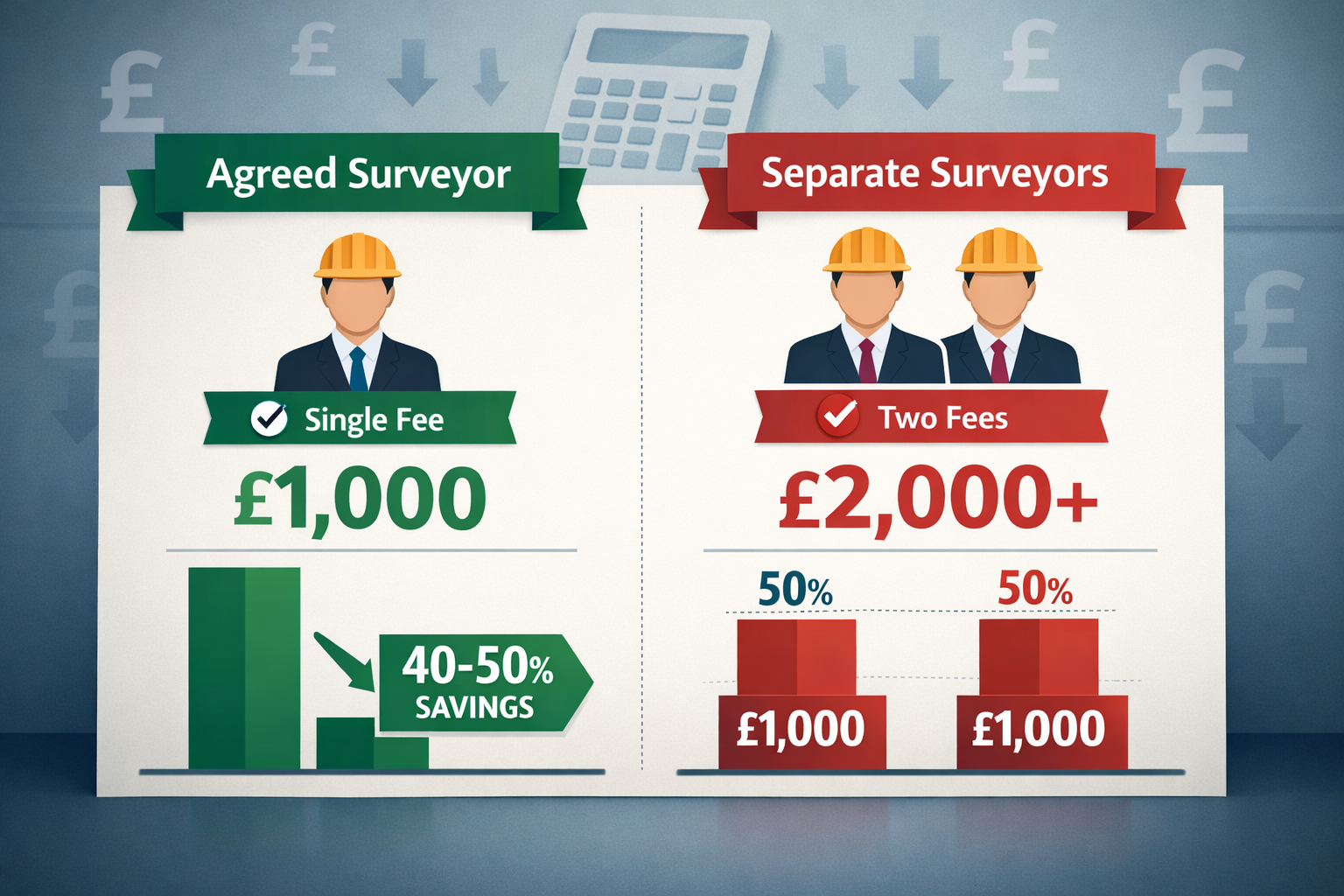
The most compelling advantage of appointing an agreed surveyor centres on substantial cost reductions. Building owners bear financial responsibility for all surveyor fees under the Party Wall Act, regardless of which appointment structure they choose. This legal requirement makes the single-surveyor approach particularly attractive from a budgetary perspective.
Single Fee Structure Breakdown
When using an agreed surveyor, the building owner pays for:
- Initial consultation and advice: £200-£400
- Schedule of condition preparation: £300-£500
(photographic documentation of the adjoining property) - Award preparation and issuance: £300-£500
- Follow-up inspections: £150-£300 per visit
Total typical cost: £1,000-£1,700 [5]
This single fee structure contrasts sharply with the separate surveyor approach, where building owners must fund:
- Their own surveyor’s fees: £1,000-£1,700
- The adjoining owner’s surveyor’s fees: £1,000-£1,700
- Potential third surveyor fees (if disputes arise): £500-£1,500
Total typical cost: £2,000-£5,000+
Real-World Savings Examples
Consider a typical loft conversion project in Central London requiring party wall notices:
| Scenario | Agreed Surveyor | Separate Surveyors | Savings |
|---|---|---|---|
| Simple project (single notice, cooperative neighbour) | £1,000 | £2,000 | £1,000 (50%) |
| Standard project (multiple notices, standard complexity) | £1,500 | £3,400 | £1,900 (56%) |
| Complex project (multiple properties, detailed conditions) | £2,200 | £5,000+ | £2,800+ (56%) |
These savings become even more significant for institutional landlords managing buy-to-let expansions across multiple properties, where the agreed surveyor approach can reduce overall portfolio costs by tens of thousands of pounds [7].
Hidden Cost Advantages
Beyond the obvious fee reductions, agreed surveyors offer additional financial benefits:
🔹 Reduced administrative burden: Single point of contact minimizes time spent coordinating between multiple professionals
🔹 Lower dispute resolution costs: Eliminates need for third surveyor appointments in most cases
🔹 Faster project commencement: Reduced delays mean lower holding costs and earlier project completion
🔹 Simplified accounting: Single invoice rather than multiple fee structures to track and manage
For practical guidance on minimizing expenses, property owners should review strategies on how to keep party wall costs down.
Faster Resolutions: Time Advantages of Using an Agreed Surveyor for Party Wall Awards in 2026
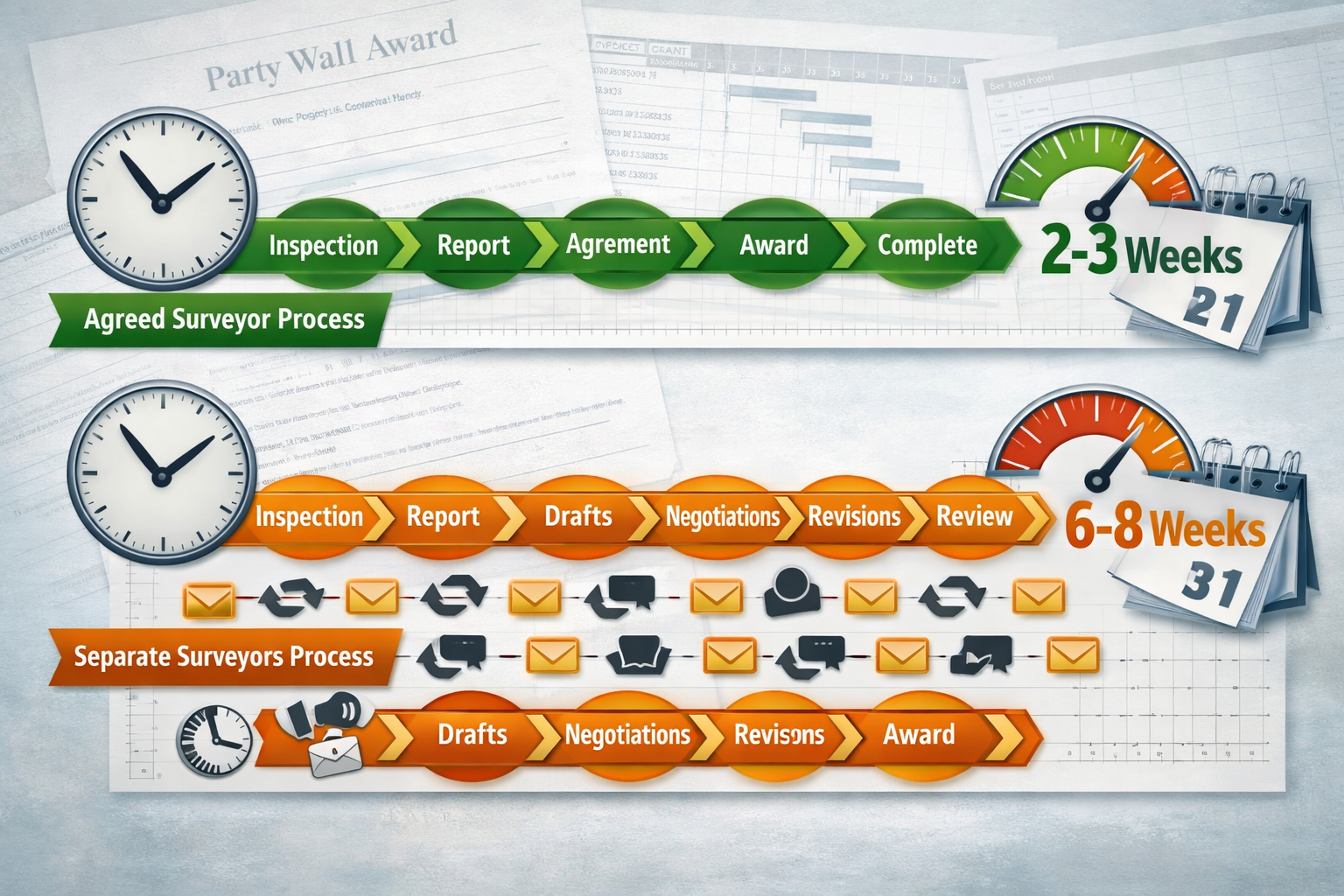
Time represents money in construction projects, where delays translate directly into extended financing costs, contractor standby charges, and postponed project benefits. The Advantages of Using an Agreed Surveyor for Party Wall Awards: Cost Savings and Faster Resolutions in 2026 extend significantly into timeline efficiency.
Streamlined Communication Channels
The agreed surveyor approach eliminates multiple layers of professional communication that typically slow the separate surveyor process [2]. Instead of information flowing through:
❌ Building owner → Building owner’s surveyor → Adjoining owner’s surveyor → Adjoining owner
The agreed surveyor model creates direct pathways:
✅ Both parties → Single agreed surveyor → Both parties
This simplified structure reduces:
- Email chains and phone tag: Single professional coordinates all communications
- Scheduling conflicts: One diary to coordinate rather than multiple professionals
- Information inconsistencies: Single source of truth for all parties
- Decision-making delays: No need for inter-surveyor negotiations
Typical Timeline Comparisons
Agreed Surveyor Process:
- Week 1: Appointment and initial property inspection
- Week 2: Schedule of condition preparation and review
- Week 3: Award drafting and party consultations
- Week 3-4: Award issuance and commencement
Total timeline: 2-4 weeks [3]
Separate Surveyors Process:
- Week 1-2: Both surveyors appointed and initial communications
- Week 2-3: Separate property inspections scheduled and conducted
- Week 3-5: Surveyors negotiate award terms back and forth
- Week 5-6: Schedule of condition prepared and reviewed
- Week 6-8: Award drafting, revisions, and potential disputes
- Week 8+: Award issuance (if no third surveyor needed)
Total timeline: 6-10+ weeks [3]
Preventing Project Delays
Construction projects operate on tight schedules with interconnected dependencies. Contractors, materials, and financing arrangements all hinge on confirmed start dates. When party wall procedures extend beyond anticipated timelines, the cascading effects include:
- Contractor rescheduling fees: £500-£2,000+
- Extended financing costs: Additional interest on construction loans
- Material price fluctuations: Risk of cost increases during delays
- Lost rental income: For buy-to-let projects, delayed completion means postponed revenue
The faster resolution offered by agreed surveyors directly mitigates these risks, allowing building owners to maintain project momentum and avoid costly interruptions.
Expedited Award Finalization
The agreed surveyor’s singular focus on preparing the party wall award document eliminates the negotiation phase that separate surveyors must navigate. Without the need to reconcile different professional opinions or mediate between competing interests, the award moves from draft to finalization much more rapidly [1].
This efficiency proves particularly valuable for projects in high-demand areas like West London or North London, where construction activity remains intense throughout 2026.
Impartiality and Professional Standards: Maintaining Fairness in the Agreed Surveyor Model
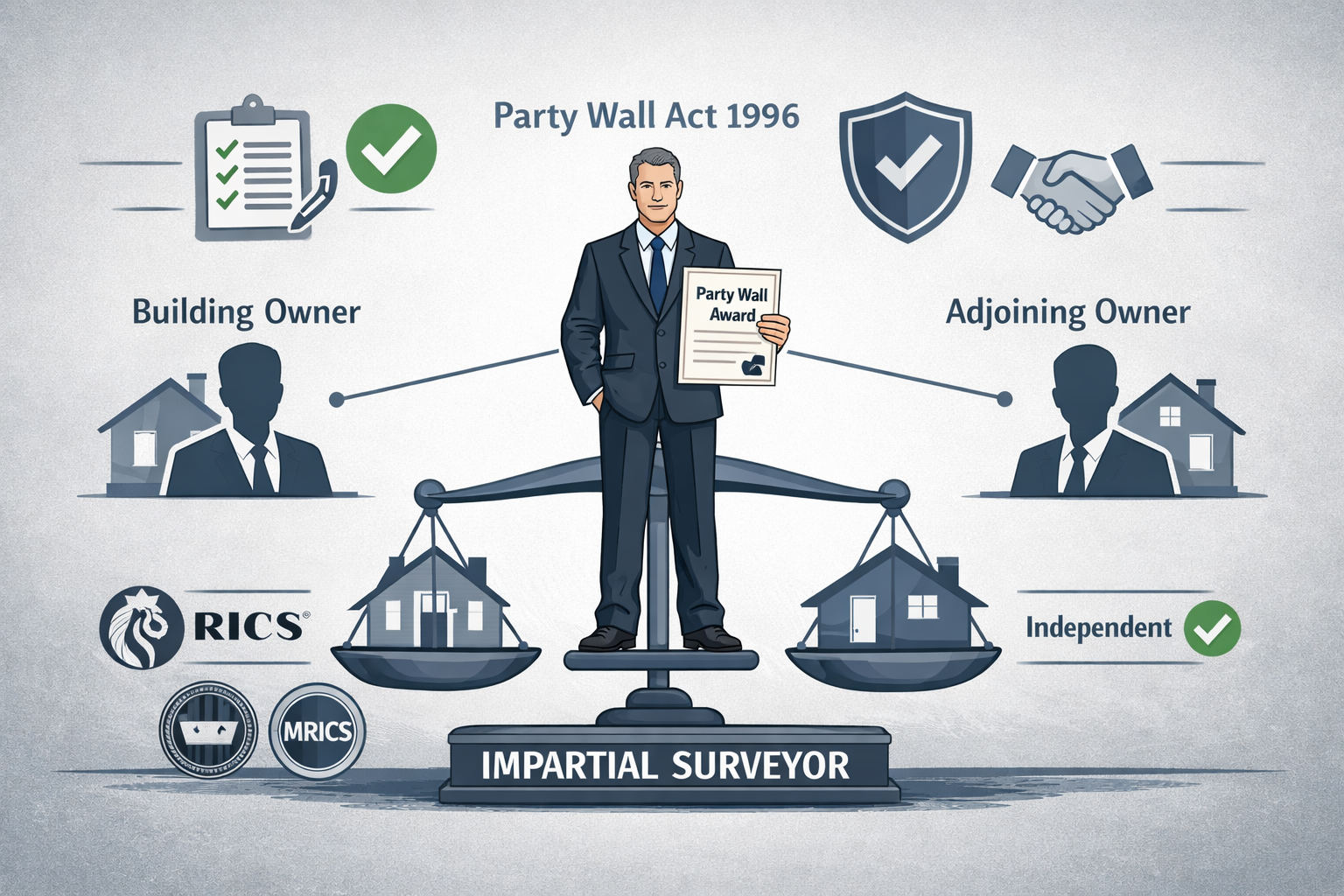
A common concern about the agreed surveyor approach centres on potential bias: if the building owner pays the fees, won’t the surveyor favour their interests? The Party Wall Act 1996 addresses this concern through strict professional obligations that ensure neutrality regardless of appointment structure.
Legal Duty of Impartiality
Agreed surveyors operate under the same statutory framework as separate surveyors, with explicit requirements to:
⚖️ Act impartially: Must give equal consideration to both parties’ interests and concerns
📋 Follow prescribed procedures: Cannot deviate from Act requirements to favour either party
🛡️ Protect both properties: Responsible for preventing damage to both the building owner’s and adjoining owner’s structures
📸 Document conditions fairly: Schedule of condition must accurately represent the adjoining property’s state
According to industry professionals, “the agreed surveyor is required by duty to act impartially with no perceived bias toward either party” [2]. This legal obligation carries professional liability implications, meaning surveyors who favour one party risk disciplinary action and potential legal consequences.
Independence Requirements
The Party Wall Act mandates that agreed surveyors maintain independence from the building owner’s other professional relationships. Specifically:
- Cannot be the building owner’s architect or designer: Ensures no conflict of interest with project design decisions
- Cannot be employed by the building owner: Maintains professional distance
- Must be separately instructed: Formal appointment process distinct from other project roles
- Should be acceptable to the adjoining owner: Neighbour must feel comfortable with the selection [5]
This independence ensures the adjoining owner views the surveyor as a neutral professional rather than an extension of the building owner’s team.
Professional Standards and Accountability
Agreed surveyors typically belong to professional bodies such as:
- Royal Institution of Chartered Surveyors (RICS)
- Faculty of Party Wall Surveyors (FPWS)
- Pyramus and Thisbe Club
These organizations enforce codes of conduct that require:
✔️ Competence: Demonstrated expertise in party wall matters
✔️ Integrity: Honest and transparent dealings with all parties
✔️ Objectivity: Professional judgment free from bias
✔️ Professional behaviour: Adherence to ethical standards
Surveyors who violate these standards face disciplinary proceedings, professional censure, and potential removal from membership registers. This accountability framework provides additional assurance of impartial conduct beyond statutory requirements.
Comprehensive Documentation Practices
The agreed surveyor’s responsibilities include preparing thorough documentation that protects both parties [1]:
Schedule of Condition:
- Detailed photographic record of the adjoining property before works commence
- Written descriptions of existing conditions, defects, and vulnerabilities
- Baseline for assessing any damage claims post-construction
- Protects both the building owner (from false claims) and adjoining owner (from uncompensated damage)
Party Wall Award:
- Specifies permitted works and construction methods
- Establishes working hours and access arrangements
- Defines monitoring and inspection protocols
- Sets out dispute resolution procedures
This comprehensive approach ensures both parties receive equal protection throughout the construction process, regardless of who pays the surveyor’s fees.
When the Agreed Surveyor Approach Works Best
While the Advantages of Using an Agreed Surveyor for Party Wall Awards: Cost Savings and Faster Resolutions in 2026 apply broadly, certain circumstances make this approach particularly beneficial:
Ideal Scenarios for Agreed Surveyors
🏘️ Cooperative neighbour relationships: When adjoining owners maintain positive communication and trust
💼 Straightforward projects: Standard loft conversions, basement excavations, or extensions without unusual complexity
⏰ Time-sensitive works: Projects with tight deadlines or seasonal constraints
💰 Budget-conscious building owners: Situations where cost control remains paramount
🏢 Portfolio projects: Institutional landlords managing multiple properties requiring consistent procedures [7]
When Separate Surveyors May Be Preferable
Conversely, some situations warrant the separate surveyor approach despite higher costs:
⚠️ Pre-existing disputes: Ongoing neighbour conflicts that preclude joint appointments
🏗️ Highly complex works: Unusual structural interventions requiring specialized expertise
🤝 Adjoining owner preference: When neighbours feel more comfortable with independent representation
📜 Historical properties: Listed buildings or conservation areas with heightened sensitivities
Property owners can explore alternatives by reviewing guidance on having a party wall agreement without a surveyor for very simple situations.
The Appointment Process: Securing an Agreed Surveyor in 2026
Appointing an agreed surveyor follows a straightforward process governed by the Party Wall Act:
Step-by-Step Appointment Procedure
1. Serve Party Wall Notice
The building owner must first serve appropriate party wall notices on adjoining owners, specifying the proposed works and providing required details about timing and methods.
2. Ten-Day Response Window
Adjoining owners have ten days to respond to the notice [5]. During this period, they can:
- Consent to the works (ending the party wall procedure)
- Dissent or fail to respond (triggering surveyor appointment requirements)
3. Propose Agreed Surveyor
If the adjoining owner dissents or doesn’t respond, the building owner can propose an agreed surveyor. This proposal should include:
- The surveyor’s name and qualifications
- Confirmation of independence from the building owner’s design team
- Fee estimate for the anticipated work
- Assurance of impartial conduct
4. Obtain Neighbour Consent
The adjoining owner must agree to the proposed surveyor within the statutory timeframe. If they accept, the agreed surveyor appointment proceeds. If they refuse, both parties must appoint separate surveyors [1].
5. Formal Appointment
Both parties sign appointment letters confirming:
- The surveyor’s scope of work
- Fee arrangements (building owner pays)
- Timelines for award preparation
- Communication protocols
Finding Qualified Agreed Surveyors
Property owners seeking qualified professionals should consider:
📍 Location-specific expertise: Surveyors familiar with local construction practices and property types in areas like East London or South London
🎓 Professional credentials: RICS membership and party wall specialization
⭐ Reputation and references: Track record of successful awards and satisfied clients
💬 Communication skills: Ability to explain complex matters clearly to both parties
🕐 Availability: Capacity to meet project timelines without delays
Risk Management and Protection Under the Agreed Surveyor Model
Effective party wall procedures serve primarily to minimize risks for all parties involved. The agreed surveyor approach maintains these protective functions while streamlining delivery [3].
Risk Reduction for Building Owners
Agreed surveyors help building owners mitigate:
Structural damage liability: Proper procedures and documentation limit exposure to damage claims
Neighbour disputes: Professional mediation prevents conflicts from escalating
Project delays: Faster awards reduce timeline risks and associated costs
Legal complications: Compliance with statutory requirements avoids enforcement actions
Protection for Adjoining Owners
Despite not selecting or paying the surveyor, adjoining owners receive comprehensive protection:
Property documentation: Detailed schedule of condition establishes pre-work baseline
Damage compensation: Award provisions ensure repair obligations for any construction-related damage
Access controls: Specified working hours and access arrangements protect privacy and convenience
Professional oversight: Surveyor monitors works to ensure compliance with agreed terms
Dispute Resolution Mechanisms
The party wall award prepared by an agreed surveyor includes provisions for handling disagreements that arise during construction:
- Inspection protocols: Regular monitoring to identify issues early
- Variation procedures: Process for addressing necessary changes to planned works
- Damage assessment: Framework for evaluating and resolving damage claims
- Appeals process: Right to challenge surveyor decisions through third surveyor appointment
These mechanisms ensure both parties retain recourse if problems emerge, maintaining fairness throughout the construction period.
Comparing Agreed Surveyors to Other Party Wall Options
Understanding how the agreed surveyor approach compares to alternatives helps property owners make informed decisions:
Agreed Surveyor vs. Separate Surveyors
| Factor | Agreed Surveyor | Separate Surveyors |
|---|---|---|
| Cost | £1,000-£1,700 | £2,000-£5,000+ |
| Timeline | 2-4 weeks | 6-10+ weeks |
| Communication | Direct, streamlined | Multiple layers |
| Complexity | Simple process | More administrative burden |
| Impartiality | Legally required | Perceived through independence |
| Best for | Cooperative relationships | Contentious situations |
Agreed Surveyor vs. No Surveyor (Consent Route)
Some neighbours consent to works without requiring surveyors, but this approach carries risks:
Advantages of consent:
- Zero surveyor fees
- Immediate project commencement
- Minimal administrative burden
Risks of consent:
- No baseline property documentation
- Unclear damage liability framework
- Potential for disputes without resolution mechanisms
- Reduced protection for both parties
The agreed surveyor approach provides professional oversight at reasonable cost, offering superior risk management compared to proceeding without any surveyor involvement.
Third Surveyor Appointments
When separate surveyors disagree on award terms, they must appoint a third surveyor to resolve the dispute. This scenario represents the most expensive and time-consuming option:
- Additional fees: £500-£1,500+ for third surveyor
- Extended timelines: Several additional weeks for resolution
- Increased complexity: Three professionals coordinating decisions
The agreed surveyor model eliminates this risk entirely by having a single professional make determinations from the outset [2].
Practical Considerations for 2026 Construction Projects
As construction activity continues to intensify across London and other urban areas in 2026, several practical factors influence the agreed surveyor decision:
Rising Construction Demand
Increased development activity means:
📈 Higher surveyor demand: Popular professionals may have limited availability
💷 Potential fee increases: Market pressures could raise hourly rates
⏱️ Timeline pressures: Delays become more costly as project schedules tighten
These factors make the efficiency and cost savings of agreed surveyors even more valuable for building owners carrying out works.
Institutional Landlord Considerations
Buy-to-let portfolio expansions require consistent, scalable approaches to party wall matters. Agreed surveyors offer institutional landlords:
- Standardized procedures: Consistent approach across multiple properties
- Cost predictability: Easier budgeting with single fee structures
- Relationship management: Single professional handling multiple projects
- Efficiency at scale: Streamlined processes multiply benefits across portfolios [7]
Neighbour Relations in Dense Urban Areas
Properties in tightly packed urban environments face unique challenges:
🏘️ Multiple adjoining owners: Single project may affect several neighbours
🔊 Noise and disruption concerns: Higher sensitivity in dense residential areas
🏗️ Complex structural relationships: Interconnected buildings with shared elements
Agreed surveyors can navigate these complexities efficiently when neighbours maintain cooperative attitudes, but separate surveyors may prove necessary when multiple parties have conflicting concerns.
Common Misconceptions About Agreed Surveyors
Several myths persist about the agreed surveyor approach that deserve clarification:
Myth 1: “Agreed Surveyors Always Favour Building Owners”
Reality: Professional duties and legal obligations require strict impartiality. Surveyors who demonstrate bias face professional discipline and liability claims [2].
Myth 2: “Adjoining Owners Have No Protection with Agreed Surveyors”
Reality: The same statutory protections apply regardless of surveyor structure. Schedules of condition, award provisions, and damage remediation requirements remain identical.
Myth 3: “Agreed Surveyors Cut Corners to Save Time”
Reality: Agreed surveyors must follow the same procedural requirements as separate surveyors. Time savings come from streamlined communication, not reduced diligence.
Myth 4: “Neighbours Must Accept Any Proposed Agreed Surveyor”
Reality: Adjoining owners retain the right to refuse a proposed agreed surveyor and insist on separate appointments if they feel uncomfortable with the suggestion [1].
Myth 5: “Agreed Surveyors Are Only for Simple Projects”
Reality: While particularly efficient for straightforward works, agreed surveyors can handle complex projects when both parties trust the professional’s expertise and impartiality.
Maximizing the Benefits: Best Practices for Agreed Surveyor Appointments
Property owners can optimize the agreed surveyor approach by following proven strategies:
For Building Owners
✅ Propose early: Suggest an agreed surveyor in the initial party wall notice to set expectations
✅ Choose carefully: Select qualified professionals with strong reputations for impartiality
✅ Communicate openly: Maintain transparent dialogue with neighbours about the benefits
✅ Provide information: Supply complete project details to enable efficient surveyor work
✅ Respect the process: Allow the surveyor to act independently without pressure
For Adjoining Owners
✅ Research the proposed surveyor: Verify qualifications and independence before agreeing
✅ Ask questions: Seek clarification about procedures, timelines, and protections
✅ Document concerns: Raise any property-specific worries early in the process
✅ Participate actively: Respond promptly to surveyor communications and inspection requests
✅ Understand your rights: Know that you can refuse and request separate surveyors if uncomfortable
For Both Parties
✅ Maintain perspective: Remember that professional oversight protects everyone’s interests
✅ Communicate directly: When possible, discuss concerns with each other before escalating to the surveyor
✅ Focus on outcomes: Prioritize completing the process efficiently rather than winning disputes
✅ Trust the framework: The Party Wall Act has successfully governed these matters for decades
Future Outlook: Agreed Surveyors in the Evolving Construction Landscape
As 2026 progresses and construction practices continue evolving, several trends may influence agreed surveyor appointments:
Technology Integration
Digital tools increasingly support party wall procedures:
📱 Virtual inspections: Video technology enabling remote property assessments
📊 Digital documentation: Cloud-based schedules of condition with enhanced photo capabilities
✍️ Electronic signatures: Streamlined award execution without physical document exchanges
🤖 AI-assisted analysis: Automated damage detection and condition comparison
These innovations may further accelerate the agreed surveyor advantage by reducing administrative overhead and improving documentation quality.
Regulatory Developments
Potential changes to party wall legislation or practice standards could affect:
- Fee structures and payment obligations
- Surveyor qualification requirements
- Award content and format specifications
- Dispute resolution procedures
Property owners should stay informed about regulatory developments that might impact their projects.
Market Dynamics
Construction sector trends influencing party wall matters include:
🏗️ Increased urban densification: More projects affecting multiple neighbours
♻️ Sustainability requirements: Additional considerations for energy efficiency and environmental impact
🏛️ Heritage conservation: Growing emphasis on protecting historic building fabric
💼 Institutional investment: Continued growth in professional landlord portfolios
These factors reinforce the value of efficient, cost-effective party wall procedures that agreed surveyors provide.
Conclusion
The Advantages of Using an Agreed Surveyor for Party Wall Awards: Cost Savings and Faster Resolutions in 2026 represent compelling benefits for building owners navigating party wall procedures. By appointing a single professional to act on behalf of both parties, property owners typically achieve:
💰 Substantial cost savings: Reducing surveyor fees by 40-50% or more compared to separate appointments
⚡ Accelerated timelines: Completing awards in 2-4 weeks rather than 6-10+ weeks
🤝 Maintained impartiality: Benefiting from legally required neutral conduct and professional standards
📋 Comprehensive protection: Receiving the same statutory safeguards as separate surveyor arrangements
🎯 Streamlined processes: Eliminating communication layers and administrative complexity
While the agreed surveyor approach works best when neighbours maintain cooperative relationships and projects involve standard construction activities, the model delivers proven advantages across diverse scenarios. The single fee structure, faster resolution timelines, and simplified procedures make this option particularly attractive in 2026’s demanding construction environment.
Next Steps for Property Owners
If you’re planning works that require party wall procedures:
- Assess your situation: Consider your neighbour relationship and project complexity
- Research qualified surveyors: Identify professionals with appropriate credentials and local expertise
- Serve proper notices: Ensure compliance with Party Wall Act requirements
- Propose an agreed surveyor: Present the option to your neighbour with clear benefits explained
- Proceed professionally: Whether using an agreed or separate surveyors, maintain respectful communication throughout
For personalized guidance on your specific project, consider contacting experienced party wall professionals who can evaluate your circumstances and recommend the optimal approach.
The agreed surveyor model represents a proven, efficient pathway through party wall procedures that benefits building owners through reduced costs and faster resolutions while maintaining essential protections for all parties. As construction activity continues throughout 2026, this approach offers a practical solution for navigating neighbour relations and statutory requirements with minimal friction and maximum efficiency.
References
[1] Watch – youtube.com
[2] Exploring The Pros And Cons Of Agreed Surveyors Versus Separate Surveyors In Party Wall Disputes – partywalllondonlimited.com
[3] Agreed Surveyor Vs Two Surveyor – stokemont.com
[4] Understanding The Importance Of Party Wall Surveys – akt-surveyors.com
[5] Party Wall Agreement – hoa.org.uk
[6] Why You Should Use An Agreed Surveyor For A Party Wall Award – harrisonclarke.co.uk
[7] Party Wall Awards For Buy To Let Expansions In 2026 Protocols Amid Institutional Landlord Surge – https://nottinghillsurveyors.com/blog/party-wall-awards-for-buy-to-let-expansions-in-2026-protocols-amid-institutional-landlord-surge
Speak to a RICS chartered party wall surveyor
Free initial consultation. Notices, awards and schedules of condition across London and nationwide.