RICS
Looking for expert solutions?
Request a Quote

Author: admin

  • Party Wall Surveys for PEEPs Compliance in High-Rise Projects:

    Over 4.8 million people in England live in high-rise residential buildings — and until April 2026, a significant proportion of those who cannot self-evacuate had no formal, legally mandated plan to get out alive in a fire. That gap is now closing. New Personal Emergency Evacuation Plan (PEEP) regulations, taking effect from April 2026, are reshaping what responsible parties must document, share, and enforce — and they are pulling party wall surveys squarely into the fire safety conversation.

    For developers, building owners, and surveyors working on multi-storey projects, Party Wall Surveys for PEEPs Compliance in High-Rise Projects: Integrating Fire Safety Mandates into Awards Post-April 2026 is no longer a niche regulatory footnote. It is a core professional obligation that must be woven into every party wall award issued for qualifying buildings.


    Key Takeaways 📋

    • PEEPs are now mandatory for high-rise residential buildings 18 metres or taller (7+ storeys) from April 2026, requiring documented evacuation plans for residents who cannot self-evacuate.
    • Party wall awards must now incorporate fire safety clauses that reflect PEEPs obligations, especially where construction works affect shared boundaries, escape routes, and structural fire compartmentation.
    • Responsible Persons (RPs) — including building owners and managers — must identify vulnerable residents, agree written evacuation statements, and review these annually.
    • Surveyors face new due diligence requirements: failing to address PEEPs-related fire safety in awards for qualifying buildings may expose parties to legal liability.
    • Information sharing with Fire & Rescue Authorities is permitted only with resident consent and is limited to essential evacuation data — not medical records.
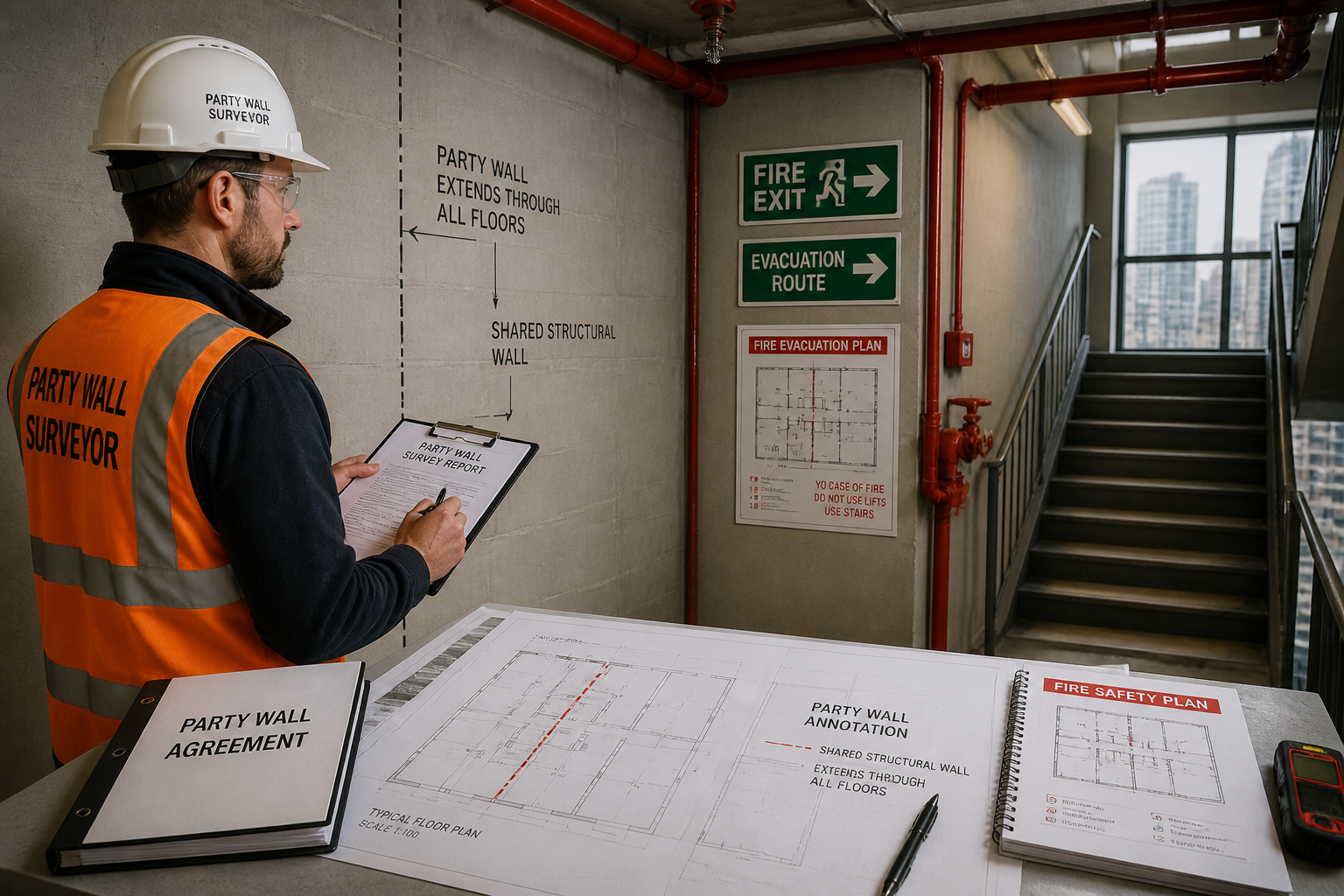
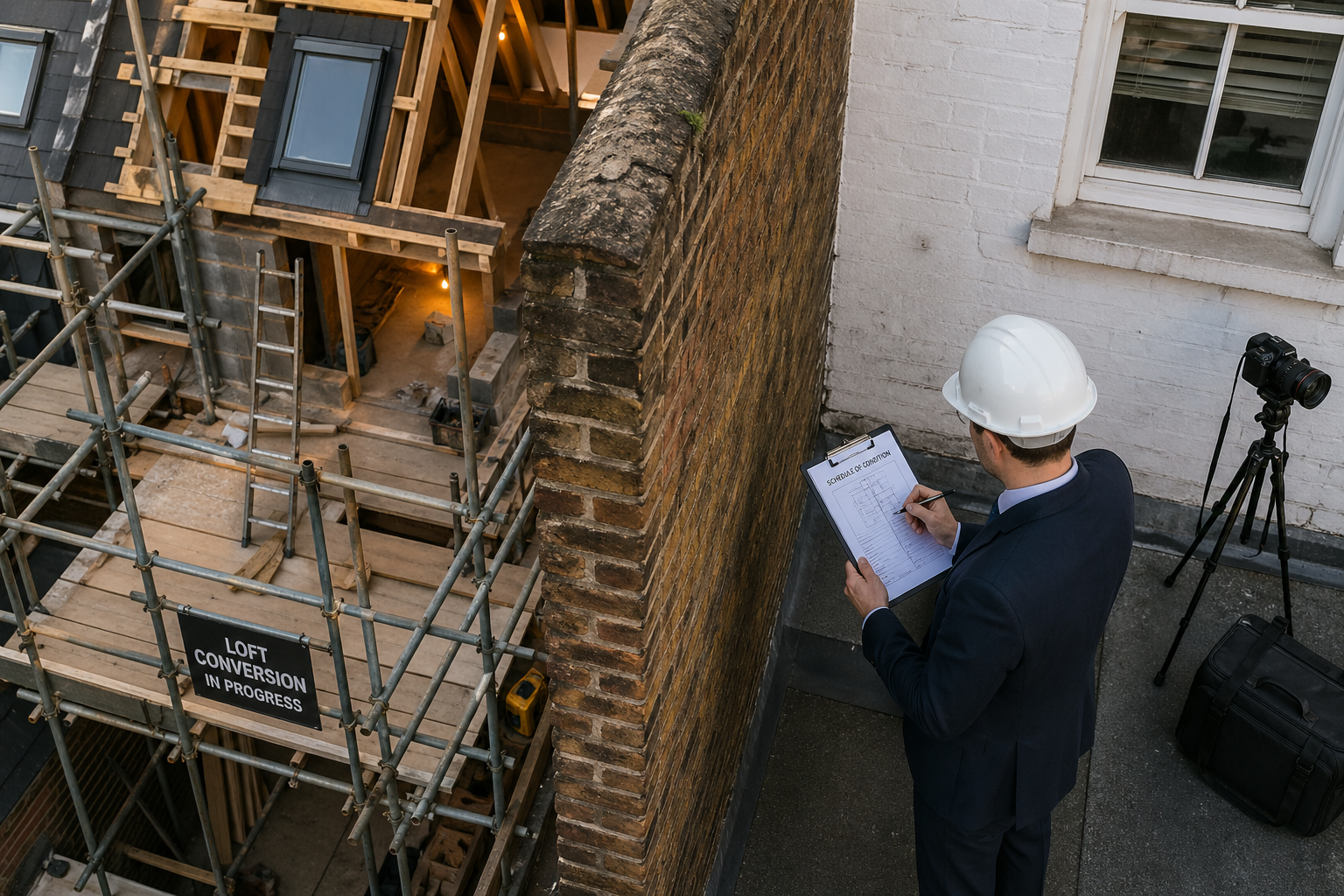
    Wide-angle editorial photograph of a professional party wall surveyor in a hard hat and hi-vis vest examining shared

    Why PEEPs Are Changing the Party Wall Landscape in 2026

    For decades, party wall practice and fire safety compliance existed in largely separate professional silos. A surveyor appointed under the Party Wall etc. Act 1996 focused on protecting structural integrity and adjoining owners’ property rights. Fire safety officers focused on evacuation strategies and risk assessments. April 2026 has changed that division of labour.

    What Are PEEPs and Who Do They Cover?

    A Personal Emergency Evacuation Plan is a bespoke, written document that sets out how a specific resident — one whose ability to evacuate independently is affected by a physical or cognitive condition — will safely exit a building in an emergency.

    Under the new regulations, PEEPs apply to:

    Building Type Threshold
    High-rise residential 18 metres or taller OR 7+ storeys [1][2]
    Mid-rise with simultaneous evacuation 11+ metres [1]

    💡 Pull Quote: “A party wall award that ignores PEEPs obligations in a qualifying high-rise is not just incomplete — it may be legally indefensible post-April 2026.”

    The Responsible Person (RP) — typically the building owner, freeholder, or management company — must use reasonable efforts to identify any resident whose evacuation ability is affected by cognitive or physical conditions. Once identified, the RP must offer a person-centred fire risk assessment and agree a written evacuation statement with that resident [2].

    The Construction-Evacuation Overlap

    Here is where party wall practice becomes directly implicated. Construction works in high-rise buildings — whether excavations, structural alterations, or works to party structures — routinely affect:

    • Fire compartmentation in shared walls and floors
    • Common escape routes such as stairwells and corridors
    • Structural elements that support fire suppression systems

    When a party wall award is issued for works in a qualifying high-rise, it governs what can be done, when, and how. If that award does not address how PEEPs-related evacuation routes and fire safety measures will be maintained during and after construction, the award is materially deficient.


    How Party Wall Surveys for PEEPs Compliance in High-Rise Projects Must Evolve

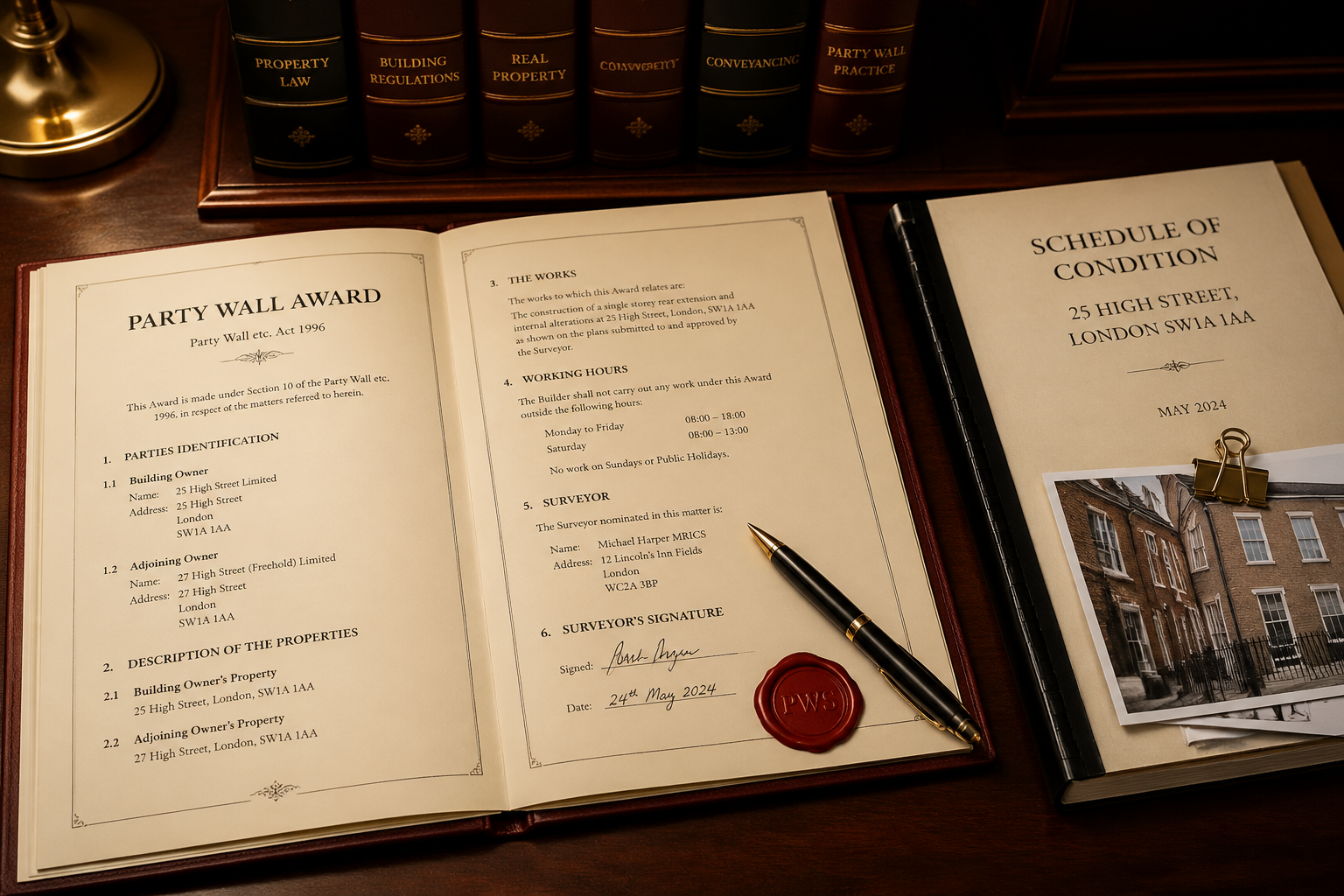
    Flat-lay infographic-style editorial image showing a formal party wall award document on a polished desk, surrounded by

    The integration of fire safety mandates into party wall awards is not simply a matter of adding a boilerplate clause. It requires surveyors to understand the PEEPs framework and translate its requirements into enforceable award conditions.

    Step 1: Identify Whether the Building Is a Qualifying High-Rise

    Before serving party wall notices or drafting an award, the building owner’s surveyor must confirm whether the building meets the 18-metre/7-storey threshold [1][7]. This determination affects the entire scope of fire safety obligations embedded in the award.

    Buildings that qualify as Higher Risk Buildings (HRBs) under the Building Safety Act 2022 framework face the most stringent requirements. The government’s definition of HRBs has been subject to ongoing review [7], and surveyors must stay current with any threshold changes.

    Step 2: Assess the Impact of Proposed Works on Evacuation Routes

    A thorough schedule of condition — already a standard component of party wall practice — must now be extended to document:

    • Pre-works condition of fire doors along shared boundaries
    • Existing signage and lighting on escape routes adjacent to the party structure
    • Sprinkler or suppression system pipework running through or near the party wall
    • Current PEEP-relevant access points such as refuge areas and evacuation lifts

    This documentation creates a baseline against which post-works conditions can be assessed, protecting both the building owner and the adjoining owner from disputes about fire safety degradation caused by construction.

    Step 3: Draft PEEPs-Aware Award Clauses

    The party wall award must include specific, enforceable clauses addressing:

    🔥 Fire Compartmentation Integrity

    • Works must not compromise fire-rated party walls or floors without approved temporary protection measures.
    • Any breaches to compartmentation must be reinstated to the original or superior fire rating within a defined timeframe.

    🚪 Escape Route Continuity

    • Construction activities must not obstruct or reduce the width of designated escape routes without prior written agreement and alternative provision.
    • Where escape routes are temporarily affected, the RP must update all relevant PEEPs to reflect the temporary alternative route [2].

    📋 Notification Obligations

    • The building owner must notify the RP of any works phase that affects evacuation routes at least 14 days in advance.
    • The RP must in turn update individual evacuation statements for affected residents within a defined period [1].

    🔒 Information Box Compliance

    • Building-wide evacuation plans stored in secure information boxes on the premises must be updated to reflect any construction-phase changes to escape routes [2].

    📅 Annual Review Alignment

    • The award should specify that post-works fire risk assessments, including any PEEPs updates, must be completed within 30 days of practical completion and then aligned with the statutory annual review cycle [2].

    Step 4: Coordinate with the Responsible Person

    Party wall surveyors are not fire safety officers. However, in 2026, they must engage with the RP as part of the award process for qualifying buildings. This coordination ensures:

    • The RP is aware of construction phases that trigger PEEP updates
    • The RP’s obligations to share limited evacuation data with the Fire & Rescue Authority (with resident consent) are not inadvertently compromised by construction-related changes [1][2]
    • The award reflects the RP’s existing evacuation strategy rather than cutting across it

    ⚠️ Important: Information shared with Fire & Rescue Authorities is strictly limited to flat number, floor number, and assistance needs. Medical diagnoses and unnecessary personal details must never be included — and resident consent is mandatory before any sharing occurs [1][2].


    Practical Compliance: Integrating Fire Safety Mandates into Awards Post-April 2026
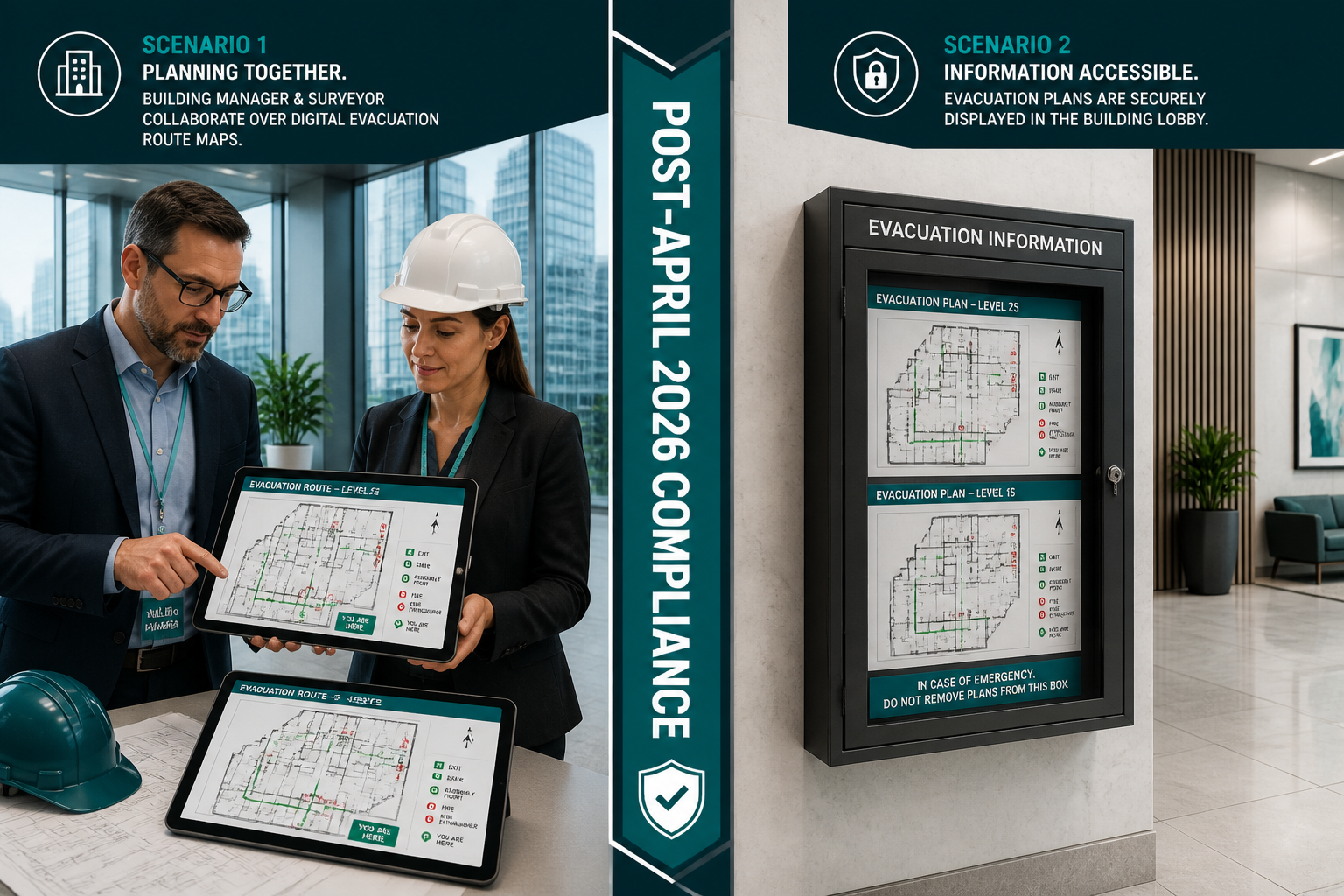
    Split-scene editorial illustration showing two contrasting scenarios side by side: left panel depicts a building manager and

    Understanding the theory is one thing. Implementing Party Wall Surveys for PEEPs Compliance in High-Rise Projects: Integrating Fire Safety Mandates into Awards Post-April 2026 in practice requires a structured workflow that surveyors, building owners, and RPs can follow consistently.

    A Practical Compliance Checklist ✅

    Pre-Notice Stage

    • Confirm building height and storey count against HRB thresholds [1][7]
    • Obtain existing fire risk assessment and current evacuation plan from RP
    • Identify any residents with active PEEPs whose accommodation adjoins the party structure
    • Review secure information box contents for current evacuation data [2]

    Notice and Award Stage

    • Serve notices in accordance with the Party Wall etc. Act 1996 with a cover letter flagging PEEPs implications
    • Include fire safety schedule in the award documentation
    • Draft compartmentation, escape route, and notification clauses (see Step 3 above)
    • Obtain RP sign-off on construction-phase evacuation amendments

    During Works

    • Monitor compliance with escape route continuity obligations
    • Require contractor to report any unplanned compartmentation breaches within 24 hours
    • Ensure RP updates individual PEEPs when escape routes change [2]

    Post-Works

    • Commission post-works fire risk assessment within 30 days of completion
    • Update schedule of condition to reflect final state of fire-rated elements
    • Confirm RP has reviewed and updated all affected evacuation statements [1]
    • Ensure building-wide evacuation plan in information box reflects final building configuration [2]

    The Role of the Adjoining Owner’s Surveyor

    Adjoining owners in high-rise buildings have a direct stake in PEEPs compliance. If construction works affect their escape routes or the fire compartmentation protecting their unit, they need a surveyor who understands both party wall law and the new fire safety framework.

    An adjoining owner’s surveyor should now routinely:

    • Request sight of the RP’s current evacuation plan before consenting to award terms
    • Insist on notification clauses that give the adjoining owner advance warning of escape route disruptions
    • Ensure the award includes reinstatement standards that meet or exceed the original fire rating

    For those carrying out works, understanding your obligations as a building owner under both the Party Wall Act and the new PEEPs framework is essential before a single notice is served.

    Costs and Proportionality

    Integrating PEEPs compliance into party wall awards does add complexity — and some additional cost. However, the costs of the party wall process must be weighed against the liability exposure of issuing a deficient award in a qualifying high-rise.

    A party wall award that fails to address fire safety obligations in a building where a resident subsequently cannot evacuate safely during construction could expose the building owner — and potentially the surveyor — to significant legal and regulatory consequences under the Building Safety Act 2022 framework.

    The proportionate approach is to build PEEPs awareness into the standard fee structure for high-rise party wall instructions, treating it as a specialist uplift rather than an optional add-on.

    Regional Considerations in London

    London’s high-rise residential stock is concentrated in specific boroughs, and party wall surveyors working in these areas will encounter PEEPs obligations with increasing frequency. Whether working in East London, South London, or Central London, surveyors must be prepared to apply the integrated PEEPs framework to every qualifying instruction.

    The density of high-rise development in inner London means that many party wall instructions will now automatically trigger PEEPs considerations — making specialist knowledge in this area a genuine competitive differentiator for surveyors in 2026.


    Common Mistakes to Avoid 🚫

    Mistake Why It Matters Correct Approach
    Treating PEEPs as a fire safety issue only Party wall awards govern construction that directly affects evacuation infrastructure Integrate fire safety clauses into every qualifying award
    Failing to identify HRB threshold Awards for non-qualifying buildings need not include PEEPs clauses Confirm height/storeys before drafting
    Sharing resident PEEP data without consent Breach of data protection and regulatory requirements [1][2] Obtain explicit written consent before any data sharing
    Omitting annual review obligations Post-works PEEPs may become outdated as building use changes [2] Include review cycle in award conditions
    Ignoring temporary works phases Escape routes may be affected during construction, not just after [2] Address all construction phases in the award

    Conclusion: Actionable Next Steps for Surveyors and Building Owners

    The arrival of mandatory PEEPs regulations in April 2026 marks a genuine inflection point for party wall practice in high-rise residential buildings. Party Wall Surveys for PEEPs Compliance in High-Rise Projects: Integrating Fire Safety Mandates into Awards Post-April 2026 is not a theoretical concern — it is a live professional obligation that affects every qualifying instruction issued from this point forward.

    Here is what to do right now:

    1. Audit your current instructions. Review any active party wall matters in buildings at or above 18 metres. Identify whether PEEPs clauses need to be incorporated into pending awards.

    2. Update your standard award precedents. Add a fire safety schedule and PEEPs-specific clauses to your high-rise award templates. Do not wait for a dispute to expose the gap.

    3. Build relationships with Responsible Persons. Establish a protocol for engaging RPs at the notice stage of qualifying instructions. Their evacuation data is essential to drafting a compliant award.

    4. Invest in continuing professional development. The intersection of party wall law and building safety regulation is evolving rapidly. Surveyors who understand both frameworks will be better placed to serve clients and avoid liability.

    5. Communicate clearly with clients. Building owners need to understand that PEEPs compliance is now part of the party wall process for qualifying buildings — and that the cost of getting it right is far lower than the cost of getting it wrong.

    The post-April 2026 landscape demands a more integrated, safety-conscious approach to party wall practice. Surveyors and building owners who adapt now will be better protected, better informed, and better equipped to serve the residents who depend on them.


    References

    [1] Residential Peeps What Property Managers Need To Know Tetra Consulting – https://tetraconsulting.co.uk/residential-peeps-what-property-managers-need-to-know-tetra-consulting/

    [2] What Every High Rise Resident Needs To Know About New Peeps Rules – https://internationalfireandsafetyjournal.com/what-every-high-rise-resident-needs-to-know-about-new-peeps-rules/

    [7] Definition Of Higher Risk Buildings Initial Review And Plans For Ongoing Review – https://www.gov.uk/government/publications/review-of-the-definition-of-higher-risk-buildings/definition-of-higher-risk-buildings-initial-review-and-plans-for-ongoing-review
  • Women Leading Party Wall Surveying in 2026: Career Paths, Challenges,

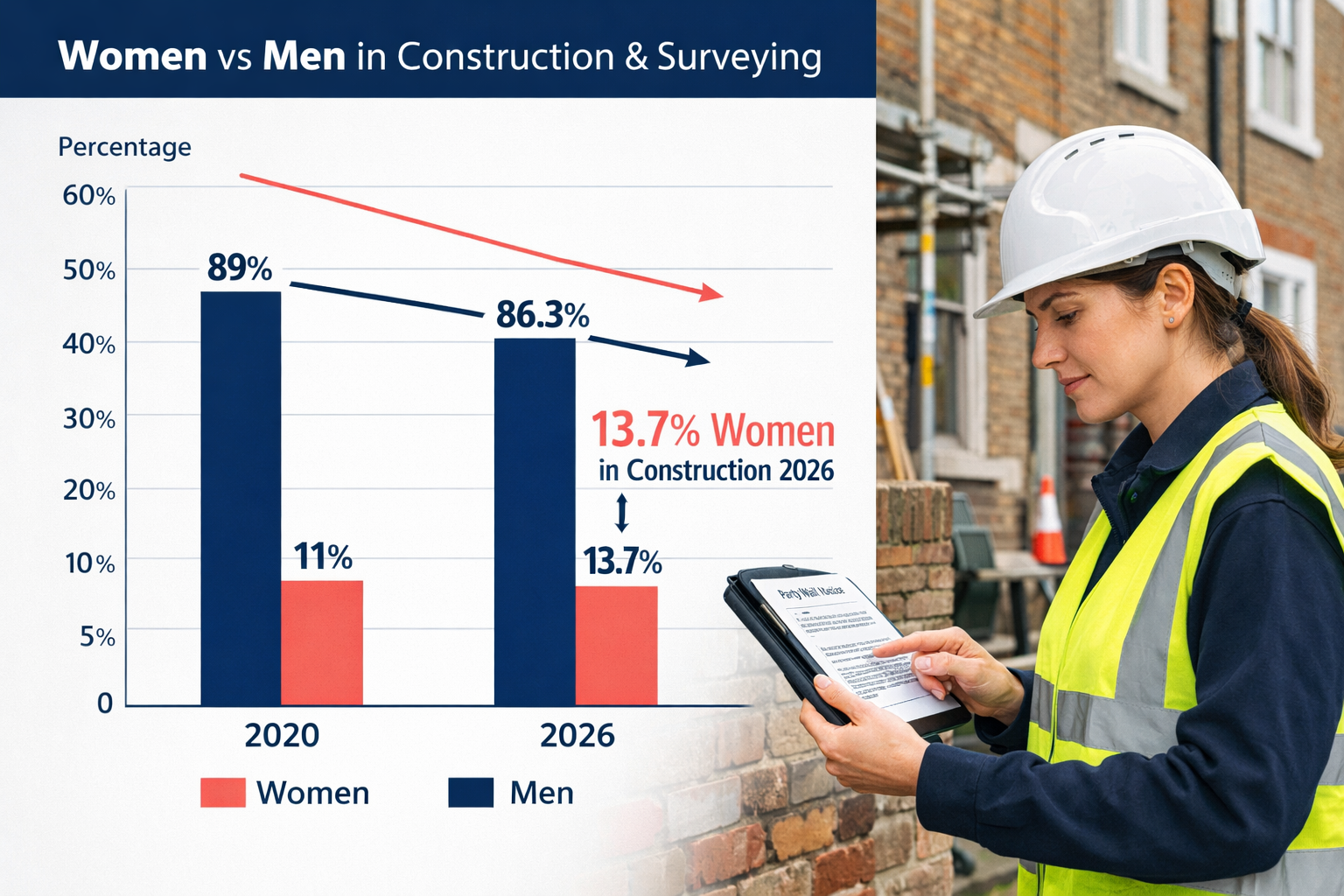
    Only 15% of chartered surveyors in the UK identify as women — yet in 2026, that figure is shifting faster than at any point in the profession’s history. Nowhere is this change more visible than in the specialist world of party wall surveying, where a new generation of skilled women professionals is reshaping how disputes are handled, how notices are served, and how the built environment is protected.

    Inspired by trailblazers like Sarah Tanner and other rising female surveyors, the story of women leading party wall surveying in 2026 is one of ambition, resilience, and real market opportunity. As London’s construction boom accelerates and party wall notices multiply across the capital, the demand for qualified surveyors has never been higher — and women are stepping in to meet it.

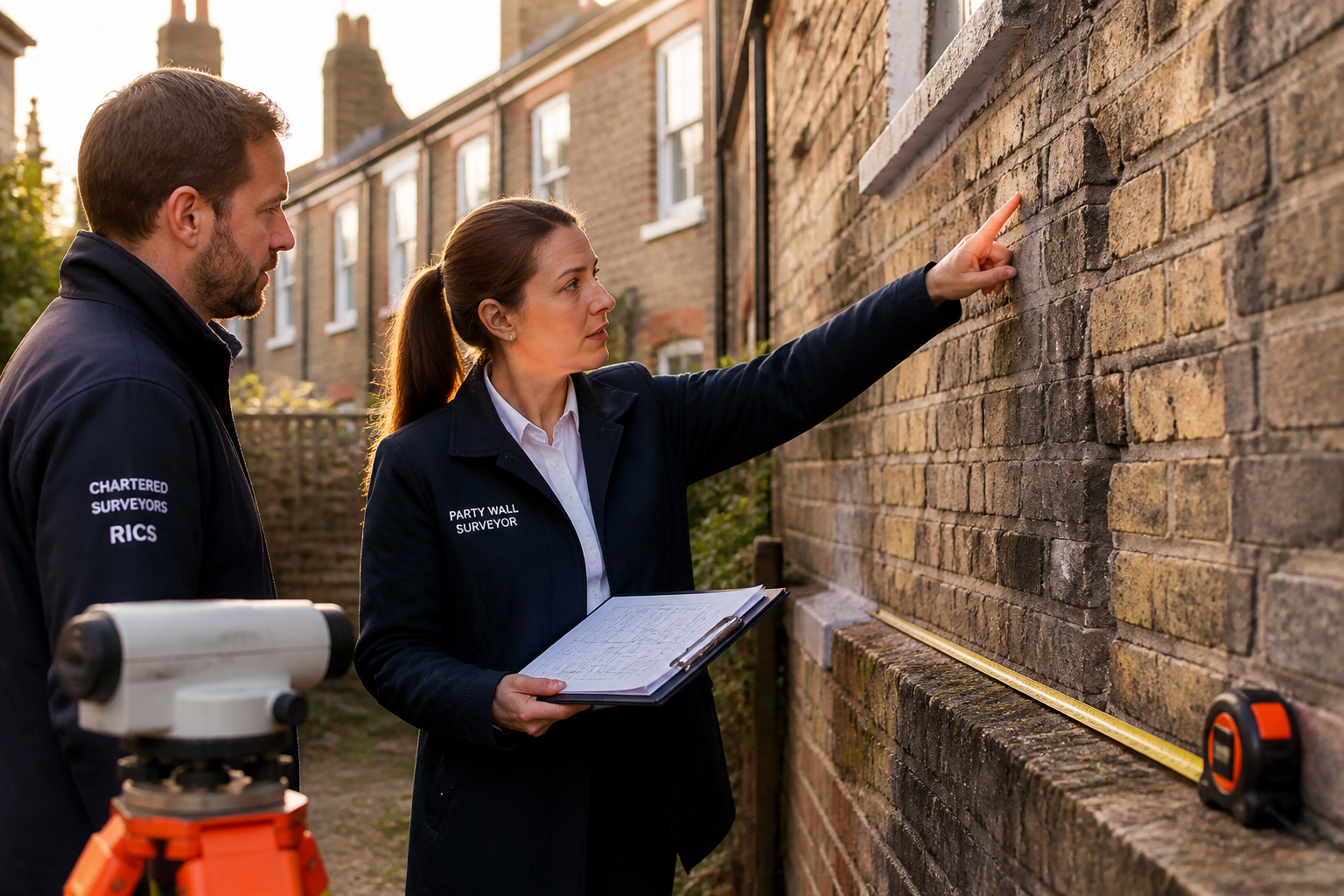
    Wide-angle editorial photograph showing a female party wall surveyor in professional attire conducting a site inspection


    Key Takeaways 📋

    • Women now represent a growing share of party wall surveyors in the UK, driven by 2026 construction demand and active diversity initiatives.
    • Career entry routes include RICS accreditation, apprenticeships, and graduate schemes — all accessible to women from varied backgrounds.
    • Bias, pay gaps, and site culture remain real barriers, but mentorship networks and professional bodies are actively working to close the gap.
    • Party wall surveying offers strong earning potential, flexible working, and growing specialisation opportunities.
    • Practical steps exist for women to enter, advance, and lead in this field — even amid ongoing industry challenges.

    The State of Women in Surveying: Where Things Stand in 2026

    The construction and surveying sectors have long been dominated by men. But the numbers are moving. Professional bodies and diversity summits — including events like the Women Surveyors Summit [1] — are creating visible platforms for female professionals across land and built environment disciplines.

    Within party wall surveying specifically, the shift is noticeable. More women are qualifying as RICS-accredited surveyors, taking on roles as both building owners’ surveyors and adjoining owners’ surveyors, and building independent practices. The 2026 construction surge in London — driven by housing demand, infrastructure investment, and urban regeneration — has created a skills shortage that is actively pulling more professionals into the field, regardless of gender.

    “The best party wall surveyor is the one who understands the law, communicates clearly, and keeps disputes from escalating. Gender has nothing to do with that.” — Sentiment widely shared across the RICS community in 2026.

    Why Party Wall Surveying?

    Party wall surveying is a highly specialised legal and technical discipline governed by the Party Wall etc. Act 1996. Surveyors in this field:

    The work is intellectually demanding, legally precise, and people-focused — qualities that many women in the profession say align naturally with their professional strengths.


    Career Paths for Women Leading Party Wall Surveying in 2026

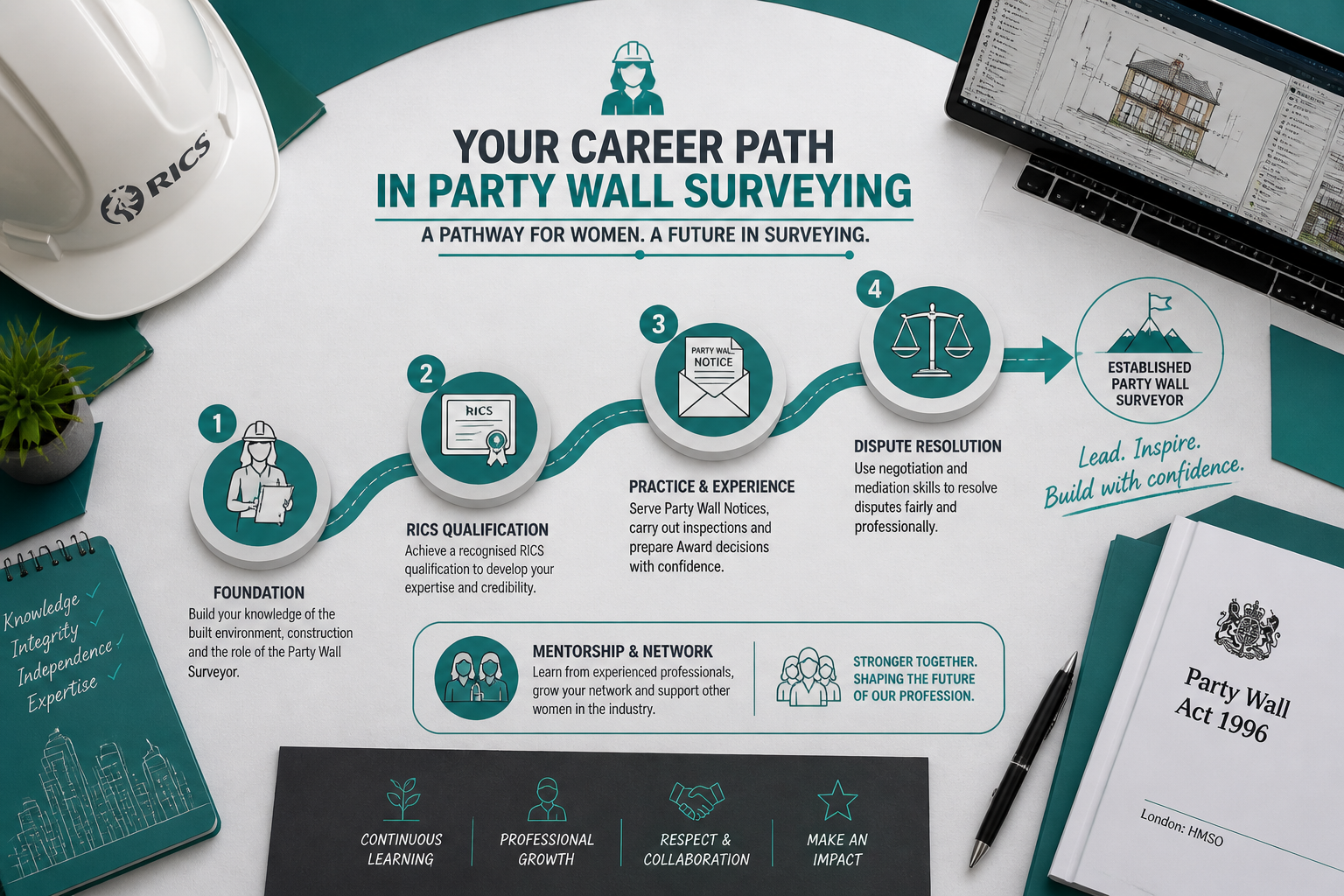
    Overhead flat-lay infographic-style image showing a career pathway map for women entering party wall surveying: icons

    Entry Routes into the Profession

    There is no single path into party wall surveying, which makes it more accessible than many assume. The most common routes in 2026 include:

    Route Description Typical Duration
    RICS Graduate Route Degree in surveying + Assessment of Professional Competence (APC) 4–6 years
    Apprenticeship Degree apprenticeship combining work and study 4–5 years
    Conversion Route Professionals from law, architecture, or construction converting via RICS 2–3 years
    Technician Route AssocRICS qualification for those without a degree 2–4 years

    Women entering from legal backgrounds — particularly property law — often find the transition to party wall surveying straightforward. The work involves interpreting legislation, drafting formal documents, and managing competing interests: skills that transfer directly.

    Specialisation Within Party Wall Surveying

    Once qualified, women in the field are increasingly specialising in high-demand areas:

    • 🏗️ Residential extensions and loft conversions — the most common trigger for party wall notices in London
    • 🏢 Commercial and mixed-use developments — higher complexity, higher fees
    • ⚖️ Dispute resolution and third surveyor appointments — requiring strong legal knowledge
    • 📋 Schedule of condition reporting — a critical protective document for both parties

    Understanding the costs of party wall processes is also part of the job. Female surveyors who develop strong client communication skills around fees and timelines often build loyal client bases quickly.

    Building an Independent Practice

    Several women in 2026 are choosing to establish their own party wall surveying practices rather than joining larger firms. The benefits are clear:

    • Flexible working arrangements — particularly valuable for those managing family responsibilities
    • Direct client relationships — building reputation through word of mouth
    • Geographic specialisation — focusing on specific London areas such as East London, North London, or South London where construction activity is concentrated

    Challenges Facing Women in Party Wall Surveying — And How to Overcome Them

    The Bias Problem

    Bias in construction and surveying is real and documented. Women entering site environments or attending dispute hearings sometimes face assumptions about their authority or expertise. This is not unique to party wall surveying — it reflects broader patterns across the built environment sector.

    Research on women in leadership roles consistently shows that even highly qualified women face disproportionate scrutiny. [3] In surveying, this can manifest as clients requesting a “second opinion” from a male colleague, or contractors being slow to cooperate during site inspections.

    Practical strategies that work:

    • Lead with credentials — introduce yourself with your RICS status and relevant experience upfront
    • Document everything — thorough written records protect professional authority
    • Build a referral network — trusted colleagues who can vouch for your work
    • Join professional networks — RICS Matrics, Women in Property, and similar groups offer peer support

    The Pay Gap

    The gender pay gap in surveying remains a live issue in 2026. Women in the profession earn, on average, less than male counterparts at equivalent career stages. This is partly explained by the prevalence of men in senior and equity partner roles — but it also reflects negotiation gaps and unconscious bias in fee-setting.

    Women entering party wall surveying as independents have a direct opportunity to set their own fees from the outset. Understanding the market rate — and not undercharging — is a critical financial skill.

    Work-Life Balance and Site Culture

    Construction sites can be physically demanding and culturally challenging environments. Women working in party wall surveying spend time on-site conducting inspections, which means navigating spaces that have historically been unwelcoming.

    In 2026, this is improving — but slowly. Larger firms have made more progress than smaller contractors. Women report that:

    • Personal protective equipment (PPE) is still not always sized for women
    • Informal site culture can be exclusionary
    • Client-facing roles are more comfortable than contractor-facing ones at early career stages

    The good news: party wall surveying is significantly more office and document-based than many other construction roles. Much of the work — drafting notices, preparing awards, advising clients — happens in professional settings where these barriers are lower.


    Demand in 2026: Why Now Is the Right Time to Enter

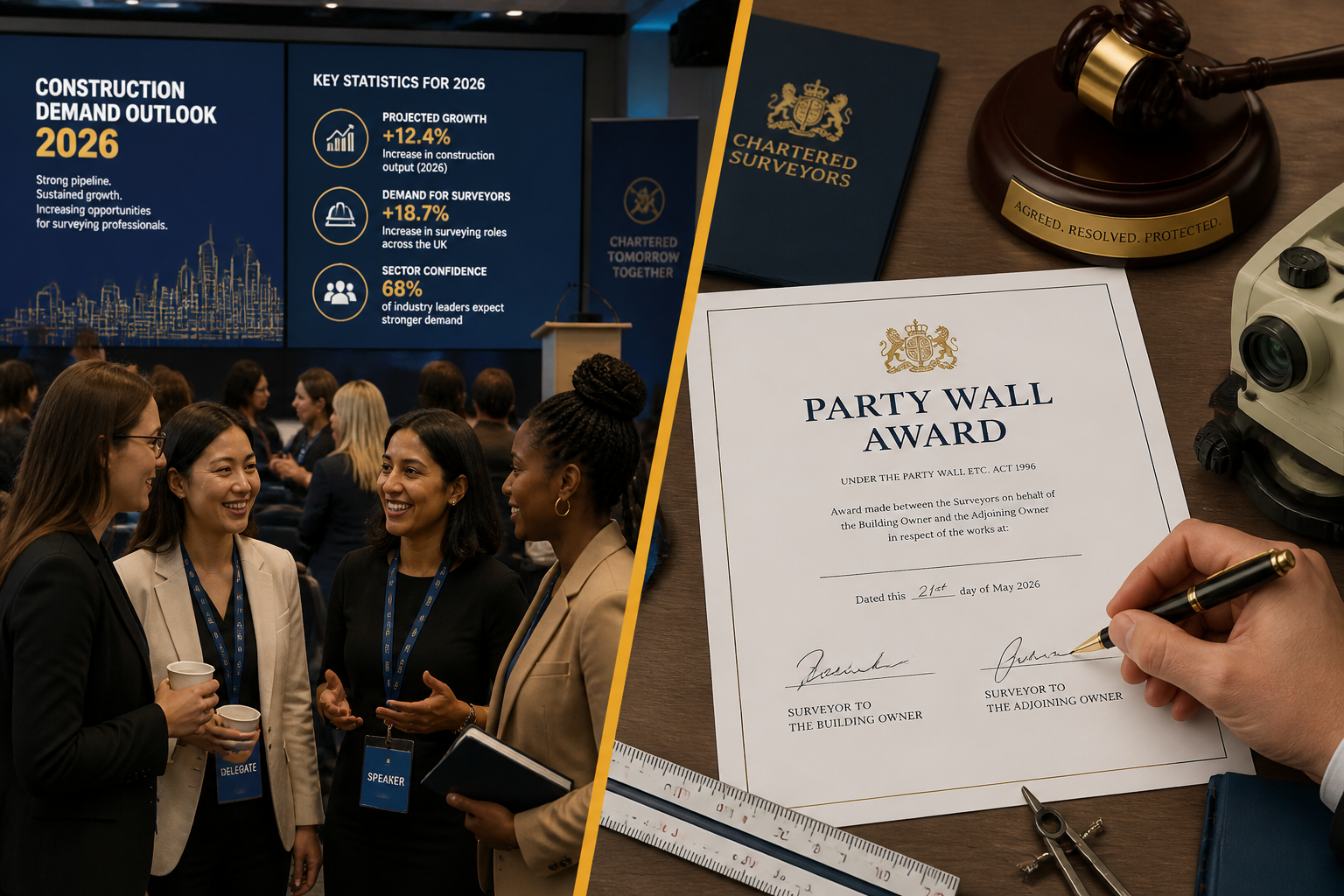
    Split-screen editorial image: left side shows a diverse group of women at a professional surveying conference with name

    London’s Construction Boom Is Creating Real Opportunity

    London’s housing shortage, combined with major infrastructure projects and urban regeneration schemes, has created sustained demand for party wall surveyors across the capital. Areas like Central London and West London are seeing high volumes of residential and commercial work, with party wall notices being served at record rates.

    This demand means:

    • Qualified surveyors can command strong fees — typically £700–£1,500+ per case at the party wall award stage
    • Workloads are consistent — the volume of construction work shows no sign of slowing
    • Specialist expertise is valued — clients are willing to pay for surveyors who know the Act inside out

    The Diversity Dividend

    There is growing evidence that diverse teams produce better outcomes in professional services. Clients — particularly residential homeowners navigating party wall disputes for the first time — often respond positively to surveyors who communicate clearly, listen carefully, and explain complex processes in plain language.

    Many women in the profession report that these interpersonal skills give them a competitive edge. The ability to de-escalate a dispute between neighbours, explain how a party wall agreement works without a surveyor (and when one is genuinely needed), and manage client anxiety is genuinely valuable.

    What the Numbers Suggest

    While specific data on women in party wall surveying is limited, broader trends in professional surveying are encouraging:

    • Women now account for approximately 30% of RICS student members in the UK — a significant pipeline
    • Diversity-focused events like the Women Surveyors Summit [1] are growing in attendance year on year
    • Professional bodies are introducing mentorship programmes, flexible qualification routes, and diversity targets

    The trajectory is clear: more women are entering, more are qualifying, and more are reaching senior roles. [3]


    Practical Tips for Women Entering Party Wall Surveying in 2026

    Here is a focused action plan for women considering or early in a party wall surveying career:

    🎯 Step 1: Get the Right Qualification

    • Target RICS accreditation via the most appropriate route for your background
    • Consider the AssocRICS route if you are changing careers mid-life
    • Look for firms that offer structured APC support

    🤝 Step 2: Find a Mentor

    • Connect with experienced female surveyors through RICS Matrics or Women in Property
    • Seek out practices with visible female leadership
    • Attend events like the Women Surveyors Summit [4] to build your network

    📚 Step 3: Know the Act Inside Out

    💼 Step 4: Build Your Client Base Strategically

    • Start with residential work to build confidence and case experience
    • Develop clear, jargon-free client communication — a genuine differentiator
    • Use geographic specialisation to become the go-to surveyor in a specific London area

    💰 Step 5: Price Your Services Correctly

    • Research market rates before setting fees
    • Do not undercharge in the hope of winning work — it devalues the profession
    • Review your fee structure annually as your experience grows

    The Role Models Making a Difference

    Women like Sarah Tanner have demonstrated that it is entirely possible to build a respected, successful party wall surveying practice. The qualities that define the best practitioners in this field — attention to detail, legal literacy, strong communication, and the ability to manage conflict — are not gendered. They are professional.

    What role models provide is proof of possibility. When young women entering construction or property careers see women leading party wall surveying in 2026 — handling complex disputes, issuing awards, advising developers and homeowners — the field becomes something they can genuinely envision for themselves.

    “Representation matters not because women need permission to succeed, but because visibility removes the assumption that they cannot.”


    Conclusion: The Path Forward for Women in Party Wall Surveying

    The evidence is clear: women leading party wall surveying in 2026 is not a future aspiration — it is a present reality, growing stronger every year. The combination of rising construction demand, active diversity initiatives, and a new generation of qualified female professionals is reshaping a field that was, for too long, the preserve of a narrow demographic.

    The challenges are real — bias, pay gaps, and site culture have not disappeared overnight. But the tools to navigate them exist, and the professional rewards are substantial.

    Actionable Next Steps

    If you are considering the field: Research RICS qualification routes and speak to a female surveyor already working in party wall practice.

    If you are early in your career: Prioritise mentorship, invest in deep knowledge of the Party Wall etc. Act 1996, and build your network through professional bodies.

    If you are a firm or practice: Review your hiring, progression, and pay practices. The talent pipeline of qualified women is growing — make sure your culture is ready to retain it.

    If you are a client: Know that the gender of your surveyor has no bearing on the quality of advice you receive. Choose based on qualifications, experience, and communication style.

    The party wall surveying profession needs skilled, knowledgeable practitioners. In 2026, more of those practitioners are women — and the field is better for it.


    References

    [1] Women Surveyors Summit – https://futuresurveyors.org/women-surveyors-summit

    [2] Wle 2026 Insight Survey – https://www.womenleadinged.org/resources/wle-2026-insight-survey

    [3] Women Leaders How Far Have We Come – https://www.spencerstuart.com/research-and-insight/women-leaders-how-far-have-we-come

    [4] Women Surveyors Summit 2026 San Diego – https://www.centralcoastclsa.org/index.php/event/women-surveyors-summit-2026-san-diego/

  • Party Wall Act Notices for Boundary Fence Rebuilds: When They Apply

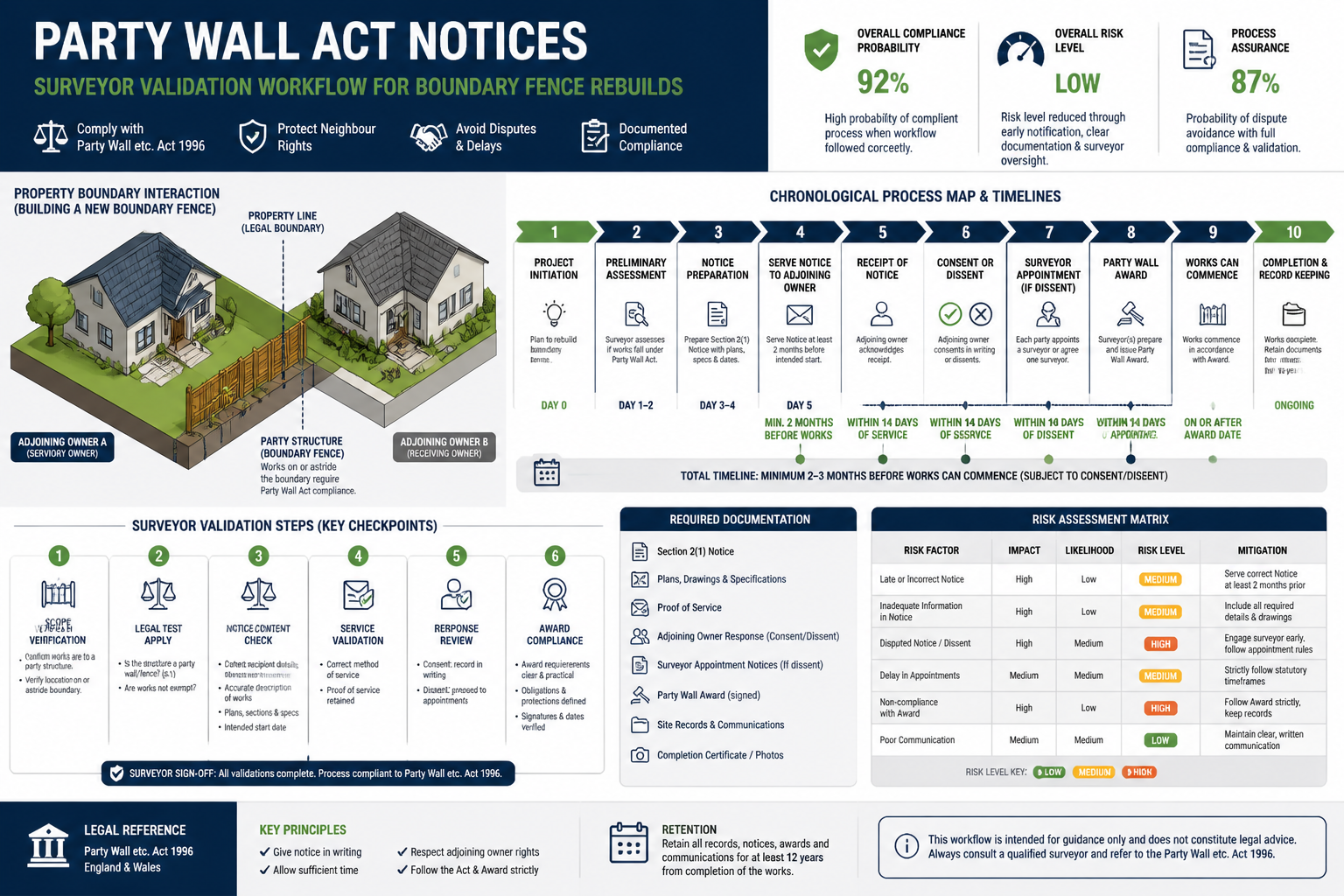
    {“cover”:”Professional landscape format (1536×1024) hero image with bold text overlay: ‘Party Wall Act Notices for Boundary Fence Rebuilds’ in extra large 72pt white bold sans-serif font with dark semi-transparent background panel, centered upper third. Background shows a British residential street with two adjoining properties, a surveyor in high-visibility vest holding a clipboard examining a brick boundary fence being rebuilt, construction materials visible, warm afternoon light. Color scheme: deep navy blue, white text, amber accent lines. Magazine cover aesthetic, editorial quality, high contrast.”,”content”:[“Detailed landscape format (1536×1024) split-scene infographic illustration showing left side: a simple garden fence exempt from Party Wall Act (wooden picket fence, no foundation, single property side), right side: a notifiable boundary wall rebuild (brick wall straddling boundary line, deep foundation, surveyor measuring height with tape measure). Bold label overlays: ‘EXEMPT’ in green and ‘NOTIFIABLE’ in red. Clean architectural diagram style, white background with blue grid lines, professional property law visual aesthetic.”,”Detailed landscape format (1536×1024) close-up overhead desk scene showing a Party Wall Notice document being completed by a hand holding a pen, surrounded by a surveyor’s checklist clipboard with items ticked off (foundation depth, wall height, shared ownership), a measuring tape, architectural boundary drawings, and a calendar showing a two-month countdown. Warm office lighting, shallow depth of field, professional legal/surveying aesthetic. Color palette: cream, charcoal, gold accents.”,”Detailed landscape format (1536×1024) showing a professional party wall surveyor standing at a boundary wall site, using a laser level and measuring equipment to validate wall height and foundation depth. A second person (property owner) stands nearby reviewing documents. Inset diagram panel shows a Schedule of Condition checklist with photographs of wall sections, crack measurements, and signed Party Wall Award paperwork. Realistic editorial photography style, natural daylight, urban London residential backdrop.”]

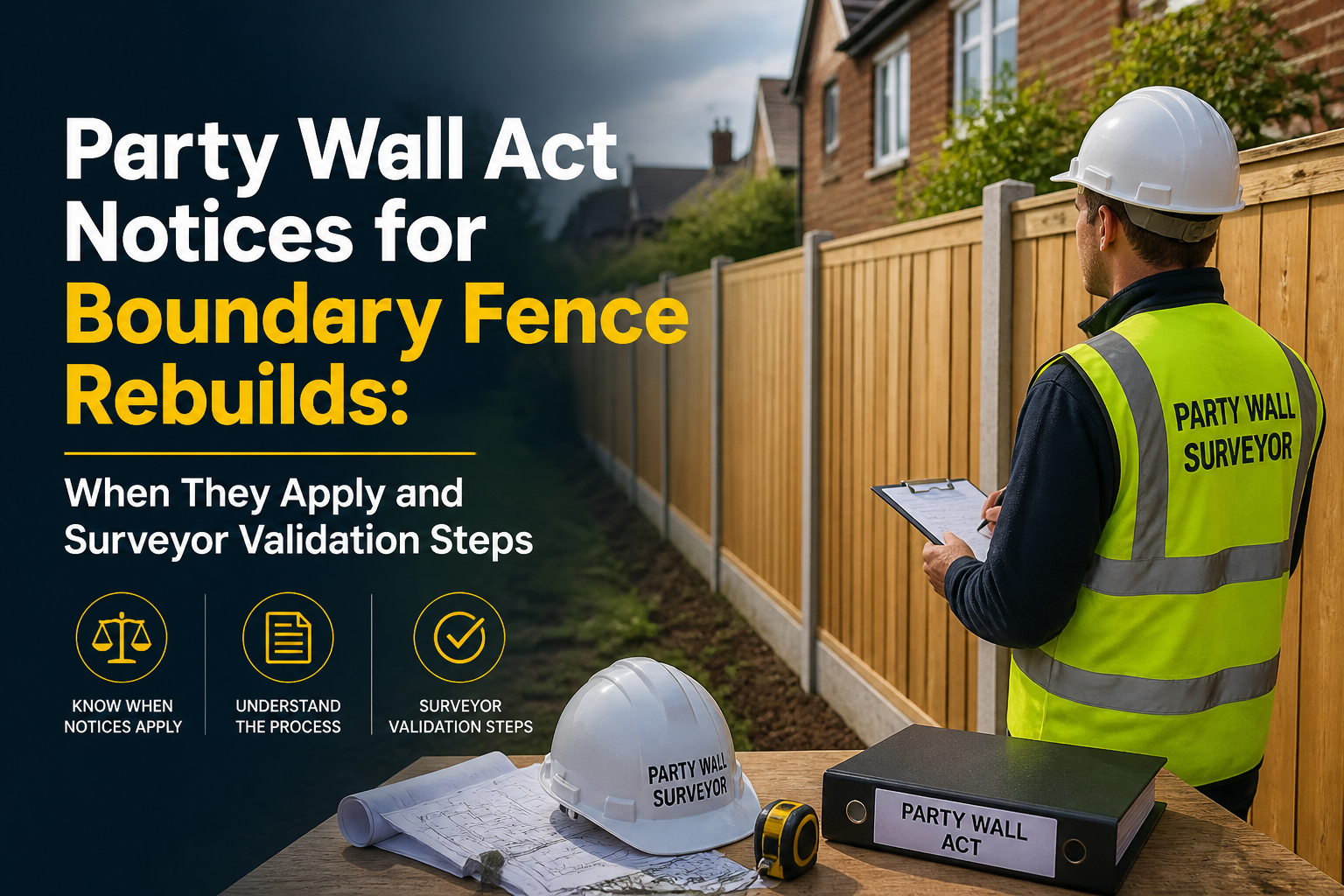
    Professional landscape hero image () with : "Party Wall Act Notices for Boundary Fence Rebuilds: When They Apply and

    Nearly one in three boundary disputes in England and Wales involves a fence or wall rebuild where the property owner had no idea a formal notice was required — and paid the legal price for it. [2] Understanding Party Wall Act Notices for Boundary Fence Rebuilds: When They Apply and Surveyor Validation Steps is not just a legal formality; it is the difference between a smooth project and a costly neighbour dispute that can delay works by months.

    The Party Wall etc. Act 1996 draws a precise — and often misunderstood — line between works that are entirely exempt and those that trigger mandatory notice obligations. This guide cuts through the confusion, explains exactly when notices apply to boundary fence and wall rebuilds, and walks through the surveyor validation steps that protect every party involved.


    Key Takeaways 📋

    • Not all boundary fences trigger the Act — only walls that straddle the boundary line or involve deep excavations are notifiable.
    • Two types of notice apply: a two-month notice for existing party wall works, and a one-month notice for new boundary wall builds or excavations.
    • Neighbours have 14 days to consent or dissent; silence counts as dissent and triggers surveyor appointment.
    • Surveyor validation includes a Schedule of Condition, foundation depth checks, height measurement, and a formal Party Wall Award.
    • 2026 boundary dispute reforms have sharpened enforcement, making procedural compliance more important than ever.

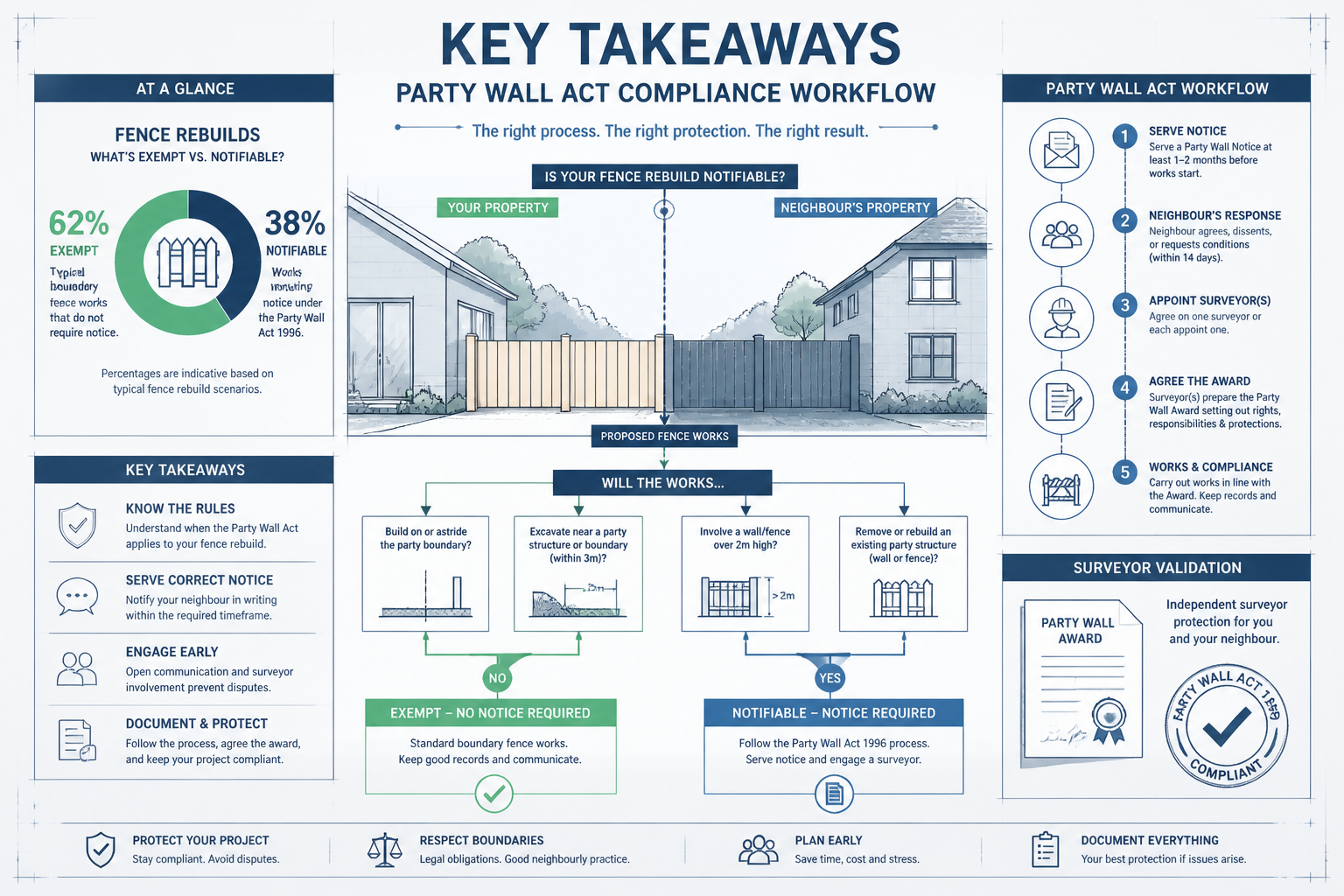
    Infographic-style visual for 'Key Takeaways' section depicting Party Wall Act compliance workflow. Central graphic shows a

    Understanding the Act: Exempt Rebuilds vs. Notifiable Works

    What the Party Wall etc. Act 1996 Actually Covers

    The most common misconception is that any fence or wall on a property boundary automatically falls under the Party Wall etc. Act 1996. It does not. [2] The Act specifically covers three categories of work:

    1. Works to an existing party wall or party structure
    2. Building a new wall or fence astride the boundary line (a party fence wall)
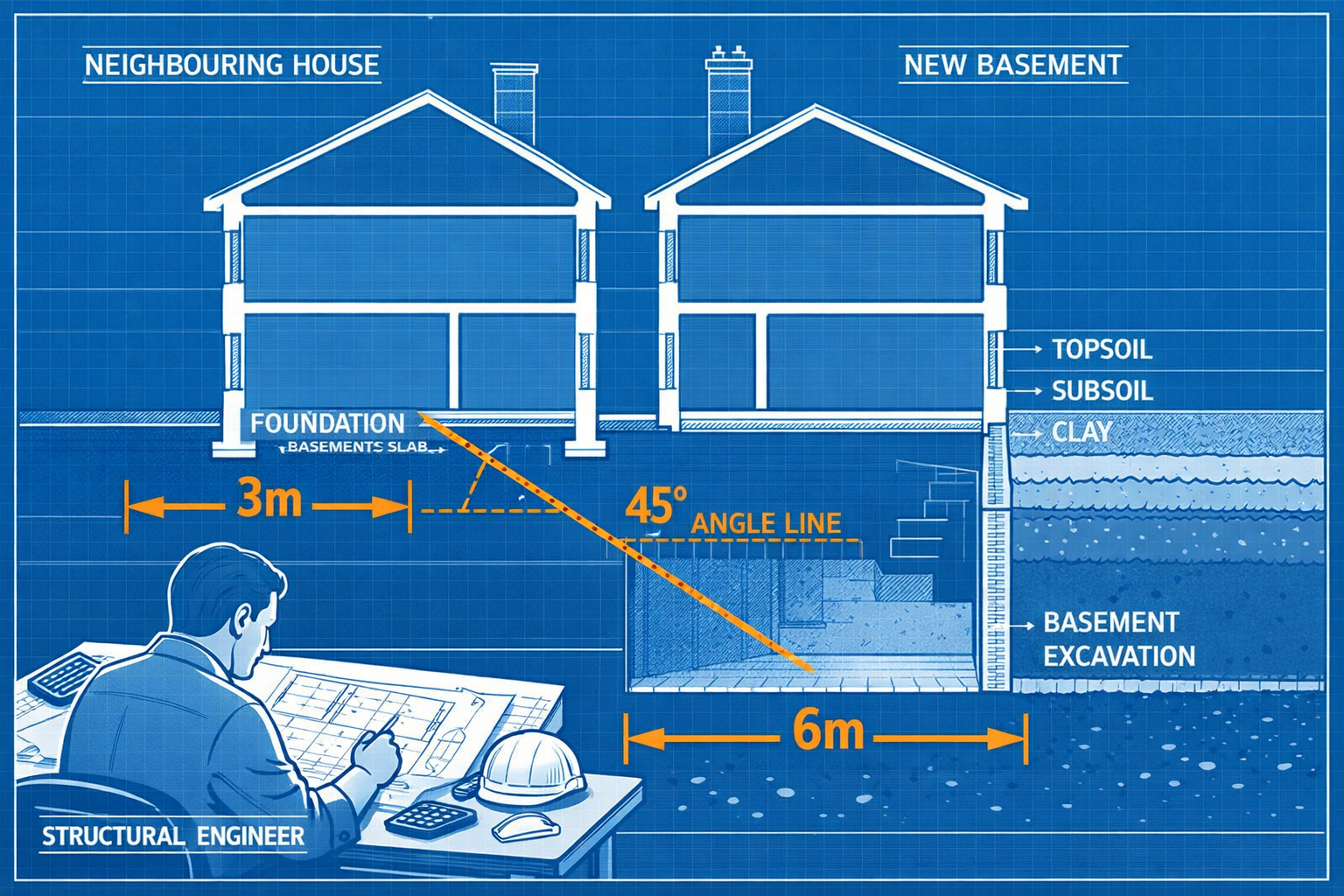
    3. Excavation within 3 or 6 metres of a neighbouring structure, depending on depth

    A standard garden fence — a simple wooden or metal structure sitting entirely on one owner’s land — is not a party fence wall under the Act. [1] It is a boundary feature, but it carries no shared legal ownership and therefore falls outside the Act’s scope. To understand the precise legal distinction, it helps to read the Party Wall Act definition of a party fence wall before making any assumptions about your project.

    The Critical Distinction: Party Fence Wall vs. Boundary Wall

    Feature Boundary Wall (Exempt) Party Fence Wall (Notifiable)
    Position Entirely on one owner’s land Straddles the boundary line
    Ownership Single owner Shared between both owners
    Act applies? ❌ No ✅ Yes
    Notice required? ❌ No ✅ Yes
    Surveyor needed? Only if dispute arises Required if neighbour dissents

    💡 Pull Quote: “A boundary wall is not automatically a party fence wall under the Act — position and shared ownership are what trigger notice obligations.” [1]

    For a deeper breakdown of these legal categories, the guide on boundary wall rules and the difference between party fence walls and boundary walls is an essential reference.

    When a Fence Rebuild Becomes Notifiable in 2026

    Several common rebuild scenarios cross the threshold into notifiable territory:

    • Rebuilding a fence wall that sits astride the boundary — even partial rebuilding of an existing party fence wall triggers the Act [2]
    • Raising the height of a shared boundary wall — height changes to a party structure require notice
    • Deepening foundations during a rebuild — excavation near a neighbour’s structure may invoke the excavation provisions
    • Cutting into a party wall to insert new posts or supports

    The types of party wall works page provides a comprehensive list of notifiable activities that building owners often overlook.


    Party Wall Act Notices for Boundary Fence Rebuilds: When They Apply and Surveyor Validation Steps — Notice Types and Timelines

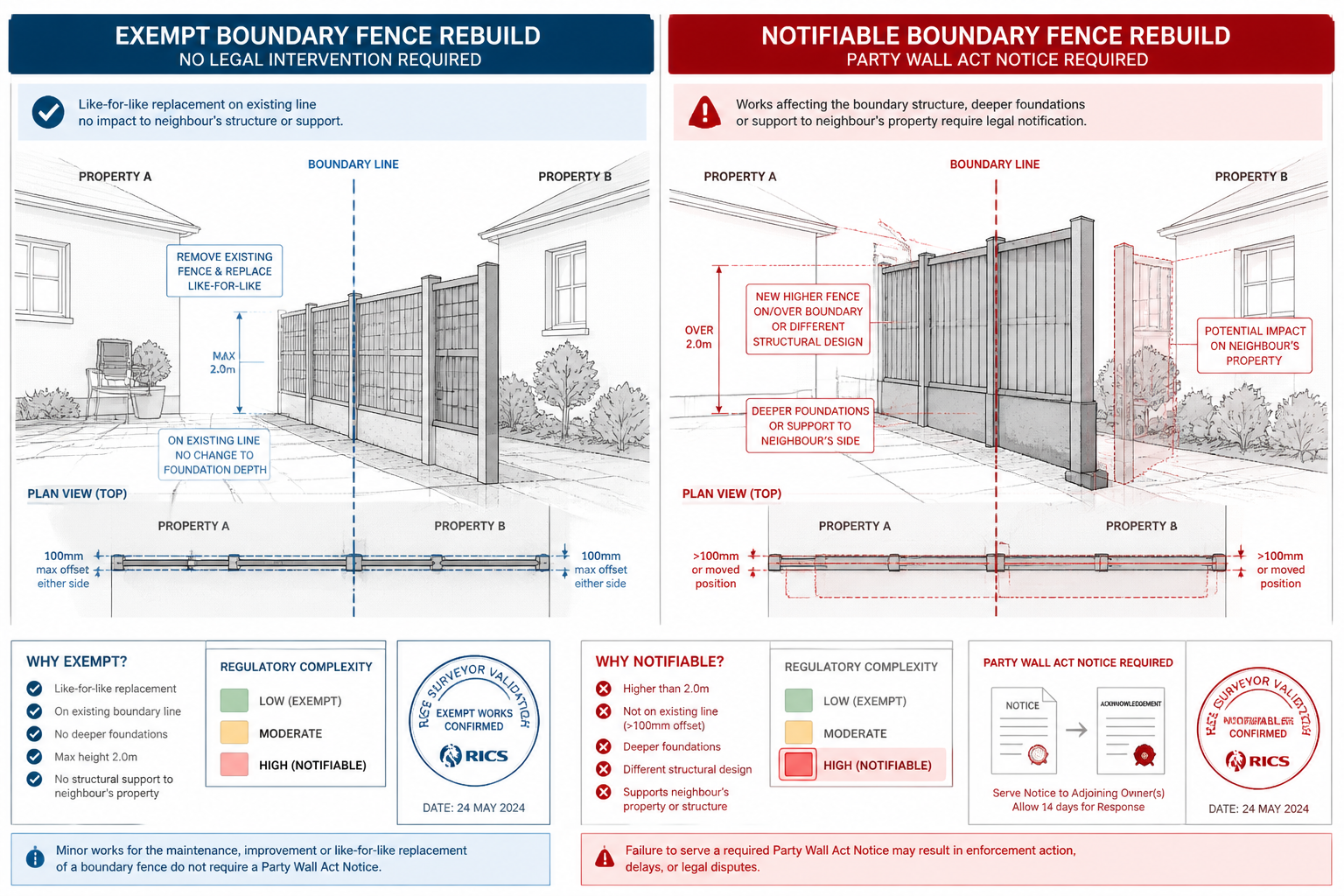
    Architectural illustration comparing exempt and notifiable boundary fence rebuilds, split-screen . Left side shows simple

    Which Notice Applies to Your Rebuild?

    Two distinct notice types apply under the Act, and choosing the wrong one — or serving it too late — can invalidate the entire process.

    🕐 Two-Month Notice (Party Structure Notice)

    • Required when modifying, repairing, or rebuilding an existing party wall or party fence wall
    • Must be served at least two months before work begins [1]
    • Covers works such as raising, underpinning, or cutting into a shared wall

    🕐 One-Month Notice (Line of Junction Notice)

    • Required when building a new wall astride or adjacent to the boundary line
    • Must be served at least one month before work begins [1]
    • Also applies to excavation works within proximity thresholds

    For full guidance on Party Wall Act notices — what they are and how to respond, property owners on both sides of the boundary should familiarise themselves with the process before any works begin.

    Building Astride the Boundary: The Consent Rule

    If the plan is to build a new party fence wall astride the boundary line, the neighbour must give written consent within 14 days of receiving the notice. [2] Without that written consent:

    • The building owner has no right to build astride the boundary
    • All works must be carried out entirely on the building owner’s own land
    • All costs fall to the building owner [2]

    This is a firm statutory rule, not a guideline. Many homeowners discover this only after starting works — at which point the legal exposure can be significant.

    The 14-Day Response Window

    Once a Party Wall Notice is served, the adjoining owner has 14 days to respond with either:

    • Written consent — works can proceed without a surveyor (though a Schedule of Condition is still advisable)
    • Dissent — a Party Wall Surveyor must be appointed [1]
    • 🔇 No response (silence) — treated as dissent, triggering mandatory surveyor appointment [2]

    ⚠️ Important: Verbal agreement from a neighbour carries no legal weight under the Act. Consent must always be in writing.


    Surveyor Validation Steps: The Complete Checklist

    Comprehensive visual workflow diagram for Party Wall Act Notices, illustrating surveyor validation steps for boundary fence

    Party Wall Act Notices for Boundary Fence Rebuilds: When They Apply and Surveyor Validation Steps — The Surveyor’s Role

    When dissent is registered — or when the complexity of a rebuild warrants professional oversight — a qualified Party Wall Surveyor steps in to protect both parties. The validation process follows a structured sequence.

    Step 1: Appointment of Surveyor(s)

    Both parties may appoint their own surveyor, or agree to use a single Agreed Surveyor who acts impartially. [6] The building owner typically bears the cost of the process, though this can vary depending on the circumstances of the works.

    Step 2: Schedule of Condition

    Before any work begins, the surveyor must prepare a Schedule of Condition — a detailed photographic and written record of the adjoining property’s current state. [1] This document:

    • Establishes a baseline for comparing pre- and post-construction condition
    • Protects the building owner from unfounded damage claims
    • Protects the adjoining owner by documenting existing defects

    The schedule typically covers: existing wall surfaces, cracks, foundations visible at ground level, garden features near the boundary, and any structures within the zone of influence.

    Step 3: Foundation Depth Validation ⚙️

    For fence wall rebuilds, the surveyor checks whether the proposed foundation depth triggers the excavation provisions of the Act:

    Excavation Depth Distance from Neighbour’s Structure Notice Required?
    Any depth Within 3 metres and deeper than neighbour’s foundations ✅ Yes
    Any depth Within 6 metres and on a line 45° from neighbour’s foundations ✅ Yes
    Shallow (above neighbour’s foundation level) Beyond 3 metres ❌ No

    [2] These thresholds are non-negotiable. Even a modest fence post rebuild can trigger the excavation provisions if the ground conditions require deep footings.

    Step 4: Height and Boundary Position Checks

    The surveyor validates:

    • Exact boundary position using title deeds, Land Registry data, and physical measurement
    • Proposed wall height against permitted development rules and any existing restrictions
    • Whether the wall straddles the boundary or sits entirely on one owner’s land
    • Compliance with height limits — relevant guidance on how high you can build a wall between neighbours is an important parallel consideration

    Step 5: Drafting the Party Wall Award

    The surveyor’s final output is the Party Wall Award — a legally binding document that: [1]

    • Specifies the exact works permitted
    • Sets out working hours and access arrangements
    • Defines protection measures for the adjoining property
    • Establishes the process for resolving any damage claims after completion

    The Award is enforceable in the County Court, giving both parties genuine legal protection. For a detailed look at what this document contains, the guide on Party Wall Awards and contract templates is a practical resource.


    2026 Updates: Boundary Disputes and Post-Reform Compliance

    What Has Changed in 2026?

    The landscape for boundary fence disputes in England has shifted noticeably in 2026. Following the Law Commission’s ongoing review of property boundaries and the increased volume of post-pandemic home improvement projects, enforcement of Party Wall Act procedures has become more rigorous. Key developments include:

    • Increased use of injunctions by adjoining owners to halt non-compliant works mid-project
    • Greater scrutiny of notice validity — courts have been stricter about notices that fail to meet statutory content requirements
    • Digital service of notices gaining wider acceptance, though physical delivery remains the safest approach
    • Boundary dispute mediation being encouraged before formal surveyor appointment in some local authority areas

    💡 Pull Quote: “In 2026, procedural compliance is not just best practice — it is the primary line of defence against injunctions and compensation claims.”

    Common Mistakes That Lead to Disputes

    🚫 Starting works before the notice period expires
    🚫 Serving notice to the wrong person (e.g., a tenant instead of the freeholder)
    🚫 Failing to describe the works accurately in the notice
    🚫 Assuming a verbal agreement replaces a written notice
    🚫 Ignoring the excavation provisions for deep fence post foundations

    For those considering whether a surveyor is strictly necessary, the article on having a party wall agreement without a surveyor explains the limited circumstances where this is legally permissible — and the significant risks involved.


    Quick Reference: Is Your Fence Rebuild Notifiable?

    Use this decision tree to assess your project:

    Is the fence/wall sitting astride the boundary line?
        YES → Notice required (Line of Junction or Party Structure Notice)
        NO  → Is it an existing party fence wall being modified?
                  YES → Two-month Party Structure Notice required
                  NO  → Do foundations exceed 3m proximity to neighbour's structure?
                            YES → Excavation notice required
                            NO  → Works likely exempt from the Act ✅
    

    Conclusion: Act Early, Document Everything

    Party Wall Act Notices for Boundary Fence Rebuilds: When They Apply and Surveyor Validation Steps is a topic that rewards early attention and penalises last-minute action. The Act’s requirements are clear, but they are frequently misapplied — most often because property owners assume a boundary fence is automatically exempt.

    Actionable Next Steps ✅

    1. Identify the legal status of your boundary structure — is it a party fence wall or a simple boundary feature? Use the party fence wall definition guide as a starting point.
    2. Determine which notice applies — one month for new builds, two months for existing party wall works.
    3. Serve notice in writing with full details of the proposed works, well before the statutory deadline.
    4. Appoint a qualified surveyor if the neighbour dissents or if the rebuild involves deep foundations or shared ownership.
    5. Ensure a Schedule of Condition is completed before any spade hits the ground.
    6. Seek local expert advice — whether in South London, North London, or elsewhere, a local party wall surveyor brings invaluable knowledge of regional boundary conventions and dispute patterns.

    Taking these steps in 2026 is not bureaucratic box-ticking — it is the most effective way to protect the project, the property, and the neighbourly relationship.


    References

    [1] How Close Can My Neighbour Build To My Fence Learn The Party Fence Wall Rules – https://www.surveymerchant.com/blog/how-close-can-my-neighbour-build-to-my-fence-learn-the-party-fence-wall-rules

    [2] The Party Wall Etc Act 1996 Explanatory Booklet – https://www.gov.uk/government/publications/preventing-and-resolving-disputes-in-relation-to-party-walls/the-party-wall-etc-act-1996-explanatory-booklet

    [6] Party Wall Agreements What You Need To Know – https://www.fmb.org.uk/find-a-builder/ultimate-guides-to-home-renovation/party-wall-agreements-what-you-need-to-know.html

    [7] Understanding Party Fence Walls And Boundary Walls – https://acdesignsolution.com/understanding-party-fence-walls-and-boundary-walls/


  • Party Wall Notices for Steel Beam Installations: Structural Protocols

    Nearly one in three party wall disputes in England and Wales involves structural alterations to shared walls — and steel beam insertions are among the most frequently mishandled. Homeowners routinely begin works without serving the correct notice, only to face injunctions, costly delays, and damaged neighbour relationships. Understanding Party Wall Notices for Steel Beam Installations: Structural Protocols and Award Essentials Under the 2026 Act is not optional — it is a legal obligation with real financial consequences.

    This guide breaks down every critical step: from identifying notifiable thresholds and serving a valid Party Structure Notice, to understanding what a Party Wall Award must contain when structural steel is involved.


    Key Takeaways 📋

    • Steel beam insertions into a party wall almost always require a Section 2 Party Structure Notice served at least two months before works begin.
    • Vague notice descriptions are invalid — the notice must specifically describe the beam installation, not just reference “extension works.”
    • A Party Wall Award for steel beam works must address load distribution, vibration safeguards, and working method statements.
    • Minor fixings like joist hangers or wall plates may not trigger a formal notice requirement, but professional advice is essential before assuming an exemption applies.
    • A Schedule of Condition must be prepared before works start to protect both the building owner and the adjoining owner.

    What the Party Wall Etc. Act Covers for Steel Beam Works

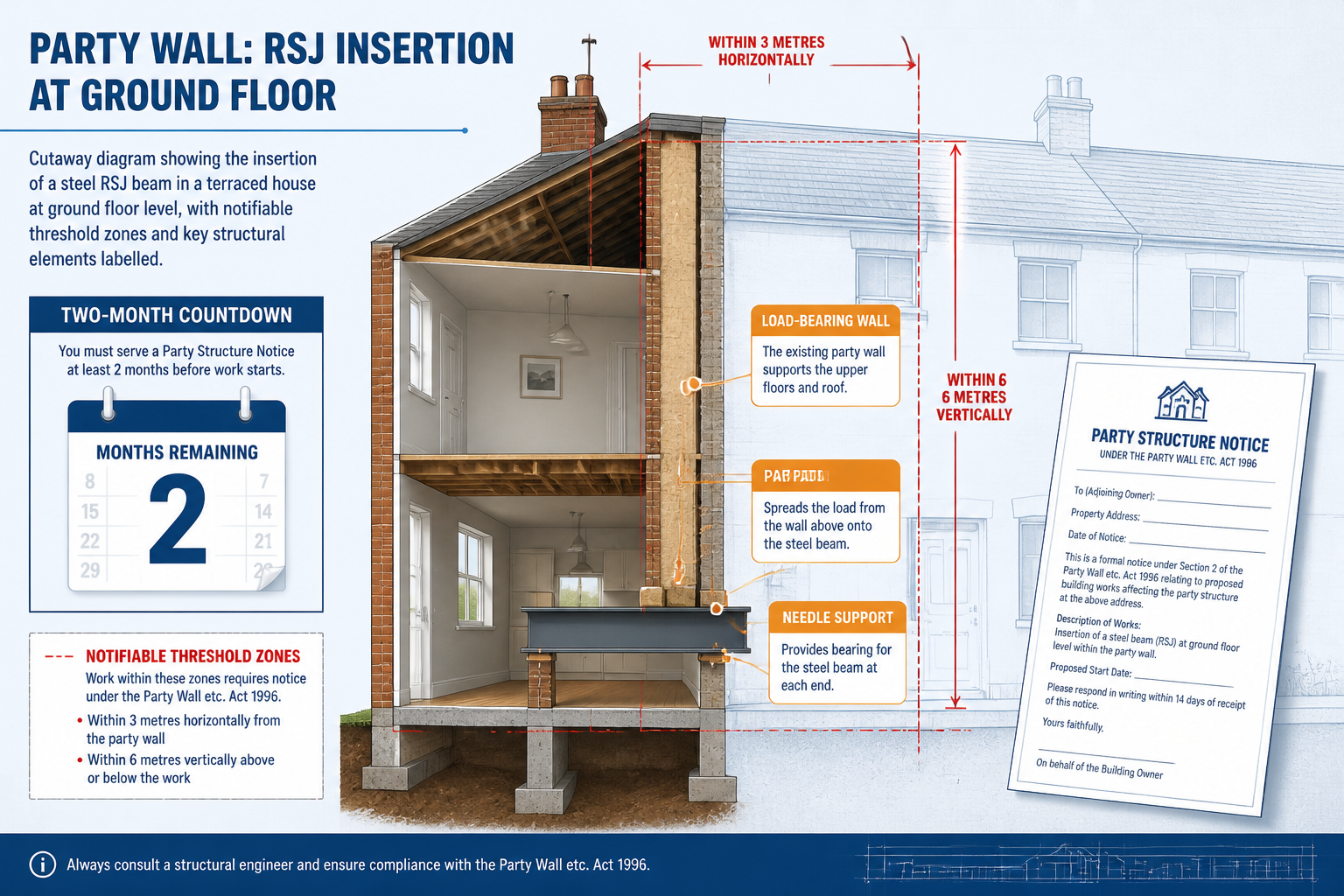
    Detailed () infographic-style illustration showing a cutaway diagram of a terraced house party wall with a steel RSJ beam

    The Shared Wall Principle

    A party wall is not solely your property. It is a wall owned jointly by two or more people — typically the boundary wall between two terraced or semi-detached homes [1]. This shared ownership principle means that even if a steel beam is being inserted from your side of the wall, your neighbour retains a legal interest in that structure. Works that cut into, load, or alter the wall’s structural integrity therefore require formal notification under the Party Wall Etc. Act 1996.

    When Does a Steel Beam Trigger a Section 2 Notice?

    Under Section 2(2) of the Act, a Party Structure Notice is required for any work that involves:

    • Cutting into the party wall to insert a steel beam or its padstone
    • Placing a load-bearing element onto or through the party wall
    • Removing chimney breasts supported by the party wall
    • Forming an opening in the wall to accommodate structural steelwork [2]

    💡 Pull Quote: “Inserting a steel beam into a party wall is one of the most structurally significant works a homeowner can carry out — and one of the most commonly under-notified.”

    The key distinction is whether the work physically alters or loads the party wall. If a steel RSJ (Rolled Steel Joist) is to bear on padstones cut into the party wall, Section 2 applies without exception [1].

    The Minor Works Exception — and Its Limits

    Not every steel-related fixing requires a formal notice. Inserting joist hangers or wall plates into a party wall is typically considered minor and non-invasive, and does not require a Section 2 Party Wall Notice — provided the work does not involve substantial cutting, structural alteration, or load transfer [2].

    However, this exception is narrow. If there is any doubt about whether the work crosses the notifiable threshold, professional advice from a qualified party wall surveyor is strongly recommended before proceeding [2]. Assuming an exemption applies without verification is one of the most common — and costly — errors building owners make.

    To understand the full range of types of party wall works that trigger notice requirements, it is worth reviewing the Act’s scope carefully.


    Serving a Valid Party Structure Notice: Protocols and Common Errors

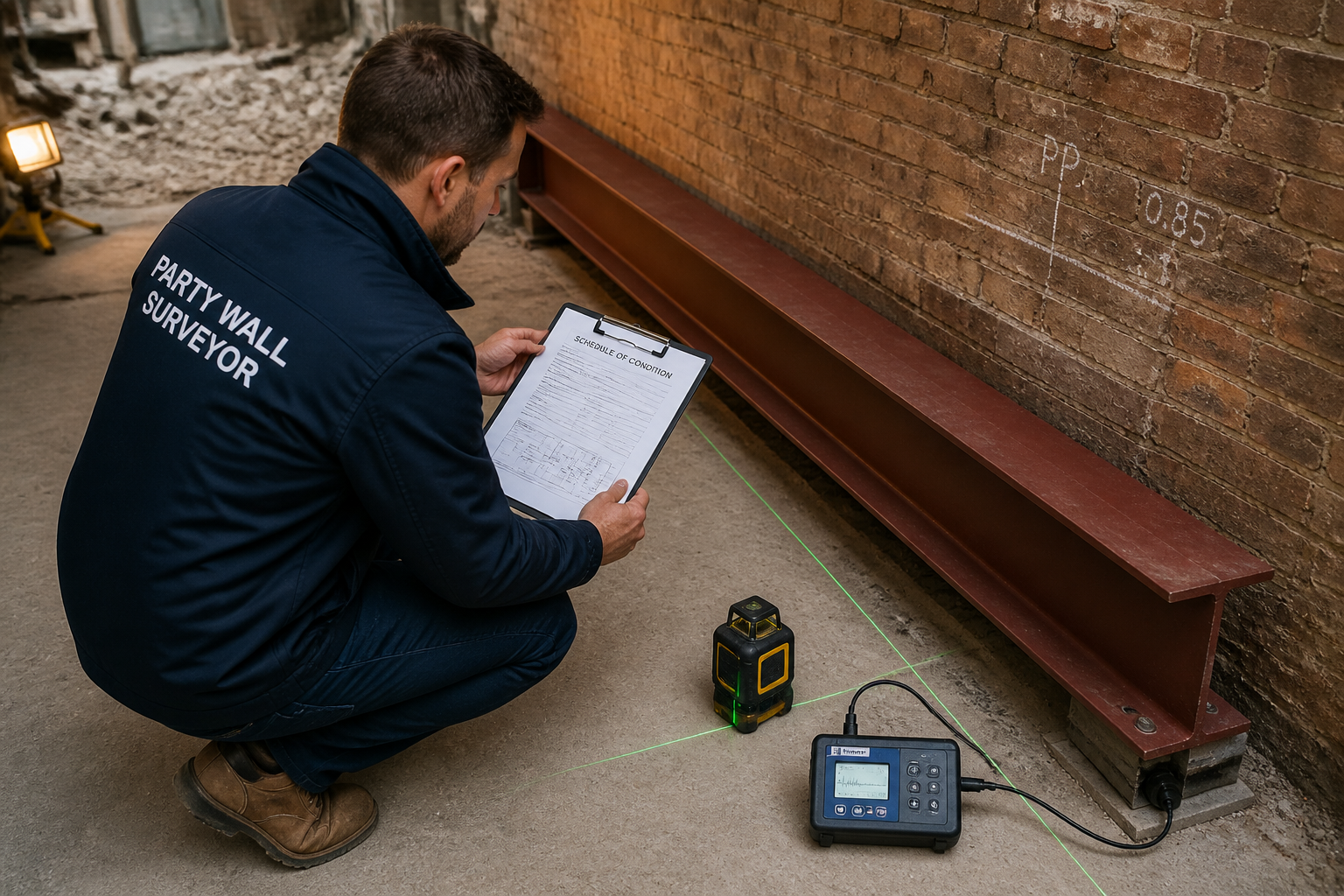
    () overhead aerial-perspective scene of a party wall surveyor in professional attire crouching beside a freshly installed

    The Two-Month Notice Requirement

    Section 2 works — including all steel beam insertions into an existing party wall — require a minimum of two months’ written notice to the adjoining owner before works can commence [4]. This is a hard legal deadline. Starting works before the notice period expires, or without obtaining written consent or a Party Wall Award, exposes the building owner to injunctions and liability for any damage caused [8].

    The notice must be served on every adjoining owner — including freeholders, leaseholders, and any other party with a legal interest in the adjoining property.

    What a Valid Notice Must Contain

    This is where many homeowners and even some contractors go wrong. A Party Structure Notice for steel beam installation must include:

    Required Element Example for Steel Beam Works
    Name and address of building owner Full legal name and property address
    Description of proposed works “Cut into party wall at ground floor level to insert steel RSJ beam and padstones”
    Proposed start date At least 2 months from service date
    Plans and sections (where relevant) Structural drawings showing beam position and load path

    Critically, notices cannot describe works vaguely as “extension works” or “internal alterations.” The description must clearly specify what is being done — for example: “Cut into the party wall to accommodate steel beams at ground floor level” [3]. Vague descriptions are a leading cause of invalid notices and subsequent disputes.

    For a detailed guide on what party wall notices are and how to respond to them, including templates and response timelines, professional resources are available.

    Common Errors That Invalidate a Notice ⚠️

    Based on RICS guidance and surveyor case experience, the most frequent errors include:

    1. Insufficient description — failing to mention the steel beam specifically
    2. Wrong notice type — serving a Line of Junction Notice instead of a Party Structure Notice
    3. Incorrect service method — not serving notice in writing or failing to confirm delivery
    4. Missing structural drawings — omitting engineer’s plans when the works are structurally complex
    5. Serving notice too late — beginning works before the two-month period has elapsed [4]
    6. Omitting adjoining owners — failing to identify and notify all parties with a legal interest [1]

    🔑 Key Point: An invalid notice does not just delay the project — it can render the entire works unlawful, exposing the building owner to injunctions and civil liability.

    To understand what a Party Structure Notice is and how to serve it correctly in London, including service requirements and timeframes, professional guidance is essential.

    After the Notice Is Served: Consent or Dispute?

    Once the notice is served, the adjoining owner has 14 days to respond in writing. They can:

    • Consent — works can proceed without a formal Party Wall Award (though a Schedule of Condition is still advisable)
    • Dissent and agree to a single agreed surveyor — one surveyor acts for both parties
    • Dissent and appoint their own surveyor — two surveyors (or a third, if needed) prepare the Award

    If no response is received within 14 days, a deemed dispute arises automatically, and the surveyor appointment process begins [5]. Building owners planning steel beam works should factor this timeline into their project programme from the outset.


    Party Wall Awards for Steel Beam Installations: What Must Be Covered

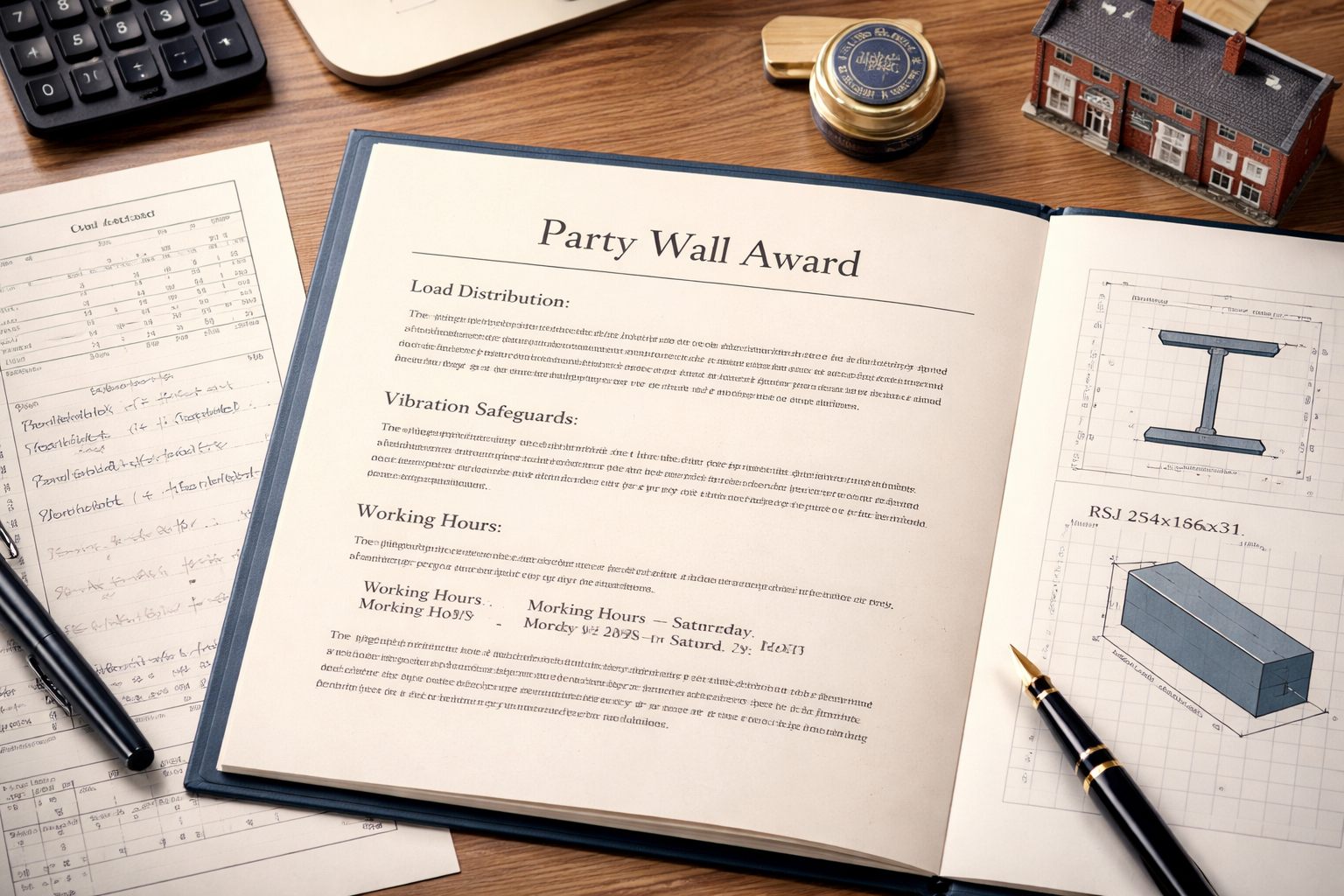
    () flat-lay styled image of a Party Wall Award document spread open on a wooden desk, showing clauses about load

    The Purpose of the Party Wall Award in Structural Works

    A Party Wall Award is a legally binding document that governs how notifiable works are carried out. For steel beam installations, it serves a particularly important function: it protects the adjoining owner’s property from structural harm while giving the building owner a clear framework within which to operate [5].

    Before any party wall building works can start, the building owner needs either a written agreement from all affected neighbours or a Party Wall Award prepared by a surveyor [5]. There is no lawful shortcut.

    For those unfamiliar with the Award process, a guide to Party Wall Awards provides a clear overview of what the document contains and how it is enforced.

    Structural Protocols the Award Must Address

    For steel beam insertions specifically, a well-drafted Party Wall Award should include the following provisions:

    🏗️ Load Distribution and Structural Method Statement

    The Award must reference a structural engineer’s specification confirming:

    • The beam size, grade, and bearing length
    • Padstone dimensions and material (typically dense concrete or engineering brick)
    • The load path through the party wall and into the foundations
    • Temporary support arrangements (needles, props) during installation

    This is not merely good practice — it is essential for protecting the structural integrity of the adjoining property. A poorly specified beam installation can cause differential settlement, cracking, and long-term damage to the shared wall [9].

    📳 Vibration Safeguards

    Steel beam installations often involve breaking out masonry, using rotary hammers, and operating heavy cutting equipment. The Award should specify:

    • Maximum vibration levels permitted during works (often referenced against BS 7385 thresholds)
    • Monitoring requirements — particularly for older or already-cracked party walls
    • Prohibited working hours to limit vibration impact on occupants

    🕐 Working Hours and Method of Working

    Standard Award provisions for noisy structural works typically restrict operations to:

    • Monday to Friday: 8:00am – 5:00pm
    • Saturday: 8:00am – 1:00pm
    • No works on Sundays or Bank Holidays

    The Award should also specify the sequence of works — for example, requiring that temporary propping be in place before any masonry is removed.

    📸 Schedule of Condition

    A Schedule of Condition is a photographic and written record of the adjoining property’s condition before works begin. For steel beam installations, this is particularly important because:

    • It establishes a baseline for any crack monitoring
    • It protects the building owner from spurious damage claims
    • It protects the adjoining owner by documenting pre-existing defects

    The Schedule should cover all rooms adjacent to or above the party wall, including ceilings, floors, and any chimney breast structures.

    Who Pays for the Party Wall Award?

    In most cases, the building owner pays the costs of the Party Wall Award process — including the fees of both surveyors (their own and the adjoining owner’s) [6]. This is a standard principle under the Act: the person carrying out the works bears the cost of the statutory process they have triggered.

    For those looking to manage expenses, practical advice on how to keep party wall costs down can help building owners plan their budget without compromising on compliance.


    Practical Steps for Building Owners in 2026

    Step-by-Step Compliance Checklist ✅

    1. Confirm the works are notifiable — consult a party wall surveyor before assuming an exemption applies
    2. Commission structural drawings — obtain engineer’s plans showing beam size, padstone design, and load path
    3. Identify all adjoining owners — check Land Registry records to confirm legal interests
    4. Serve a valid Party Structure Notice — with a clear description, correct start date, and supporting plans
    5. Wait for the statutory response period — 14 days for consent; two months before works can start
    6. Instruct surveyors if disputed — appoint promptly to avoid programme delays
    7. Ensure the Award is in place before any structural works begin
    8. Prepare a Schedule of Condition for all affected adjoining properties
    9. Follow the Award’s working method throughout the construction phase
    10. Notify the surveyor of any unexpected structural findings during beam installation

    Building owners in London can access local expertise through party wall surveyors across London, covering all areas of the capital.

    What Happens If Works Proceed Without Notice?

    Installing a steel beam into a party wall without serving notice is an unlawful act under the Party Wall Etc. Act. The adjoining owner can apply to the courts for an injunction to stop the works immediately [8]. Beyond the injunction risk, the building owner may face:

    • Liability for all costs of making good any damage
    • Retrospective surveyor fees
    • Potential difficulty selling the property without evidence of compliance

    Conclusion: Protect Your Project and Your Neighbour’s Property

    Party Wall Notices for Steel Beam Installations: Structural Protocols and Award Essentials Under the 2026 Act represent one of the most technically demanding areas of residential construction compliance. The stakes are high: a missed notice, a vague description, or an Award that fails to address vibration and load distribution can result in legal action, structural damage, and significant financial loss.

    Actionable Next Steps:

    • 📞 Consult a party wall surveyor early — ideally at the design stage, before structural drawings are finalised
    • 📄 Serve a precise, detailed Party Structure Notice at least two months before your intended start date
    • 🏗️ Ensure your Party Wall Award covers load distribution, vibration safeguards, and a Schedule of Condition
    • 💷 Budget for surveyor fees from both sides — these are a legitimate and necessary project cost
    • Never assume a minor works exemption applies without professional confirmation

    For building owners and adjoining owners alike, working with an experienced party wall surveyor is the most reliable way to navigate Party Wall Notices for Steel Beam Installations: Structural Protocols and Award Essentials Under the 2026 Act efficiently and lawfully. The process exists to protect everyone — and when followed correctly, it does exactly that.


    References

    [1] Steel Beam Into Party Wall – https://mosaicpw.co.uk/steel-beam-into-party-wall

    [2] Party Structure Works – https://www.partywalllondonlimited.com/post/party-structure-works

    [3] Party Wall Notices Explained A Simple Guide For Home Extensions – https://www.prideroad.co.uk/party-wall-notices-explained-a-simple-guide-for-home-extensions/

    [4] Three Types Of Party Wall Notices – https://stokemont.com/advice/three-types-of-party-wall-notices/

    [5] Party Wall Agreement – https://hoa.org.uk/advice/guides-for-homeowners/i-am-improving/party-wall-agreement/

    [6] Do I Need A Party Wall Agreement – https://collier-stevens.co.uk/advice-hub/party-wall/do-i-need-a-party-wall-agreement/

    [8] Installed Metal Steel Beam Party Wall Without Notice – https://www.justanswer.co.uk/home-improvement/uvg8w-installed-metal-steel-beam-party-wall-without.html

    [9] Party Wall Agreement For Wall Removal Chimney Breast Removal 2026 Complete Guide – https://guardianstructuralltd.co.uk/party-wall-agreement-for-wall-removal-chimney-breast-removal-in-stockport-warrington-2026-complete-guide

  • Party Wall Awards for Underpinning Works: Surveyor Risk Assessments

    Nearly one in three party wall disputes in dense London boroughs now involves underpinning or foundation-related works — a figure that has climbed steadily as basement conversions, structural extensions, and urban densification projects accelerate across the capital in 2026. When a building owner proposes to underpin a shared wall, the legal, structural, and financial stakes rise sharply for everyone involved.

    Party Wall Awards for Underpinning Works: Surveyor Risk Assessments and Safeguard Clauses in 2026 Urban Projects sit at the intersection of property law, structural engineering, and neighbour relations. Getting the process right protects both parties; getting it wrong can trigger subsidence claims, costly legal battles, and project delays that run into months. This guide unpacks everything property owners, surveyors, and developers need to know in 2026. [1][3]


    Key Takeaways 📌

    • Underpinning a party wall is legally classified as high-risk structural work and triggers mandatory notice requirements under the Party Wall etc Act 1996.
    • A properly drafted Party Wall Award must include risk assessment findings, method statements, safeguard clauses, and a schedule of condition.
    • Adjoining owners have the right to request an advising engineer and demand security for expenses before works begin.
    • In 2026, RICS-compliant awards are reducing appeals and keeping urban projects on schedule during a significant construction uptick.
    • The building owner pays all surveyor fees — typically £150–£200/hour, with a full award costing around £1,000.

    Why Underpinning Triggers the Party Wall Act

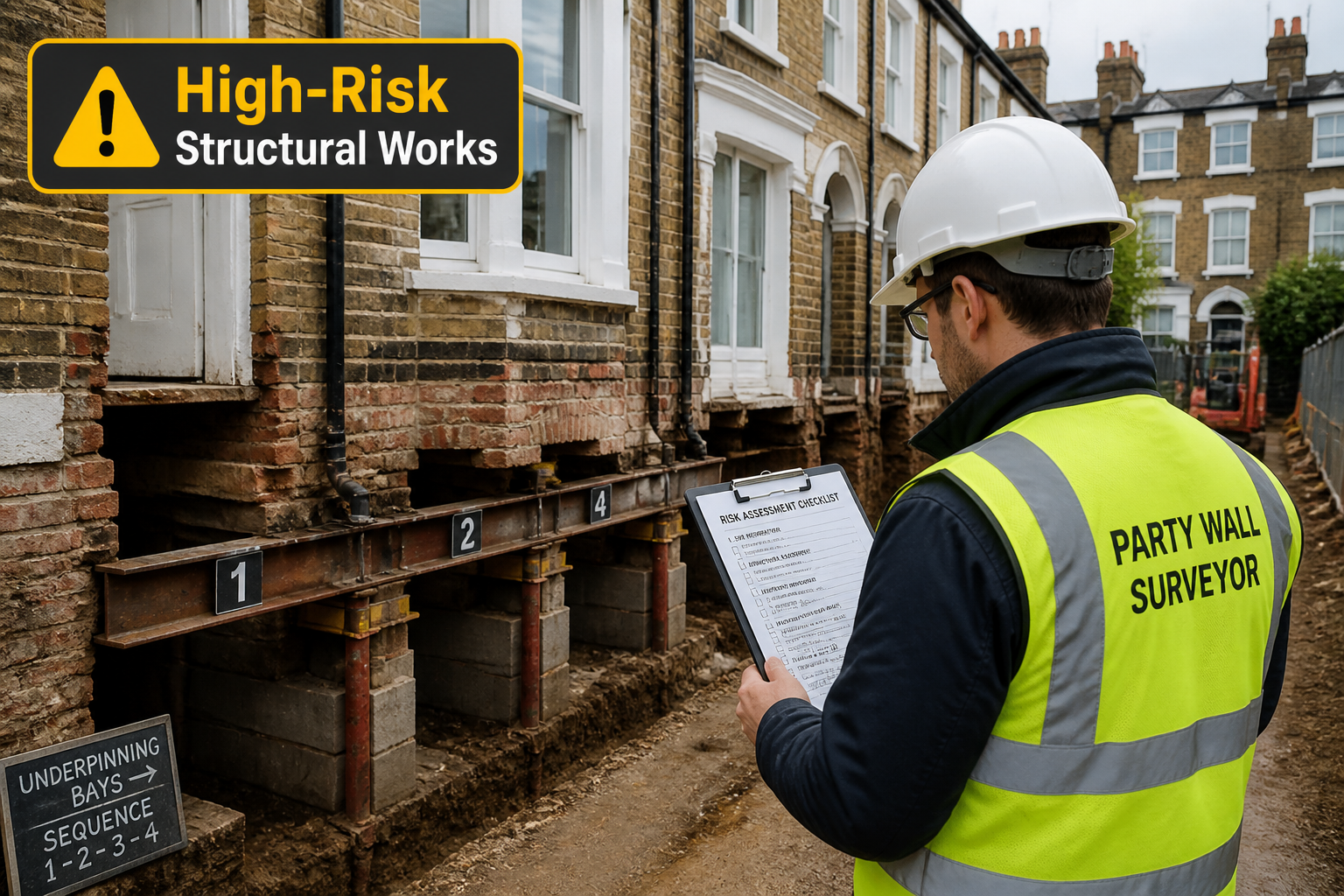
    Detailed () editorial illustration showing a party wall surveyor in a hard hat and hi-vis vest conducting a structural risk

    The Legal Basis Under the 1996 Act

    The Party Wall etc Act 1996 explicitly covers underpinning works, defining the right “to underpin, thicken or raise a party structure, a party fence wall, or an external wall which belongs to the building owner and is built against a party structure or party fence wall.” [3] This means the moment a building owner plans to underpin any shared or adjoining wall, the Act is engaged — there is no grey area.

    Before any spade hits the ground, the building owner must serve a Party Structure Notice on all adjoining owners. Failure to do so doesn’t just create a legal risk; it can result in injunctions halting the project entirely. For a clear overview of how notices work, see this guide on Party Wall Act notices and how to respond.

    Why Underpinning Is Classified as High-Risk

    Not all party wall works carry equal risk. Underpinning is classified as a high-risk type of structural work because it directly interferes with the load-bearing capacity of foundations shared between two or more properties. [3] The risks include:

    • 🏚️ Differential settlement — uneven movement between the building owner’s and adjoining owner’s structure
    • 💧 Water ingress — open excavation trenches can allow groundwater to destabilise adjacent foundations
    • 🧱 Cracking and structural damage — vibration and ground movement can affect brickwork, plasterwork, and drainage
    • ⚠️ Partial completion risk — if works stop mid-way, open bays can leave the adjoining structure temporarily unsupported

    These risks explain why the surveyor’s role in drafting the award goes far beyond paperwork. In 2026 urban projects — particularly in areas with Victorian-era terrace housing stock — these risks are amplified by the age and condition of existing foundations.


    💬 “Underpinning is not simply a construction method — it is a legal event that demands procedural precision, multi-party coordination, and enforceable safeguards from day one.”


    Surveyor Risk Assessments: What the Award Must Cover

    The Three-Party Coordination Requirement

    Underpinning a party wall requires three professionals to work in close coordination: the building owner’s architect, the structural engineer, and the on-site contractor. [3] The party wall surveyor does not replace these specialists — instead, the surveyor ensures that the award reflects their combined input and that procedural requirements are fully understood before works commence.

    This coordination is particularly important when it comes to the method statement — a document that details exactly how underpinning will be carried out, in what sequence, and with what safety measures. A well-drafted Party Wall Award will incorporate or reference the method statement directly, making it legally binding on the contractor.

    For those carrying out works and needing to understand the full process, the building owner’s surveyor service provides expert guidance tailored to the building owner’s position.

    What a Structural Risk Assessment Should Include

    A thorough risk assessment embedded in the Party Wall Award for underpinning works should address the following:

    Risk Factor Assessment Required
    Foundation depth and type Comparison of both properties’ foundation levels
    Soil conditions Borehole or trial pit data, bearing capacity
    Underpinning sequence Bay-by-bay methodology, maximum open bay width
    Vibration and noise limits Agreed thresholds to protect adjoining structure
    Groundwater management Dewatering plan if water table is a concern
    Monitoring regime Settlement monitoring points, frequency of readings
    Emergency procedures Protocol if unexpected movement is detected

    The Adjoining Owner’s Right to an Advising Engineer

    One of the most important — and often overlooked — provisions in the Act is the adjoining owner’s right to request input from an advising engineer. [3] The party wall surveyor acting on behalf of the adjoining owner can legally require the building owner to fund an independent structural engineer to:

    • Review the proposed underpinning approach
    • Verify that procedures are toward the lower-risk end of the spectrum
    • Ensure the adjoining structure has been fully considered in the design

    In 2026, with construction activity rising sharply across London, this provision is being invoked more frequently — particularly in areas where older housing stock sits above clay soils prone to shrinkage and heave. If you are an adjoining owner facing underpinning works next door, the adjoining owner’s surveyor service can help protect your interests.


    Safeguard Clauses in Party Wall Awards for Underpinning Works

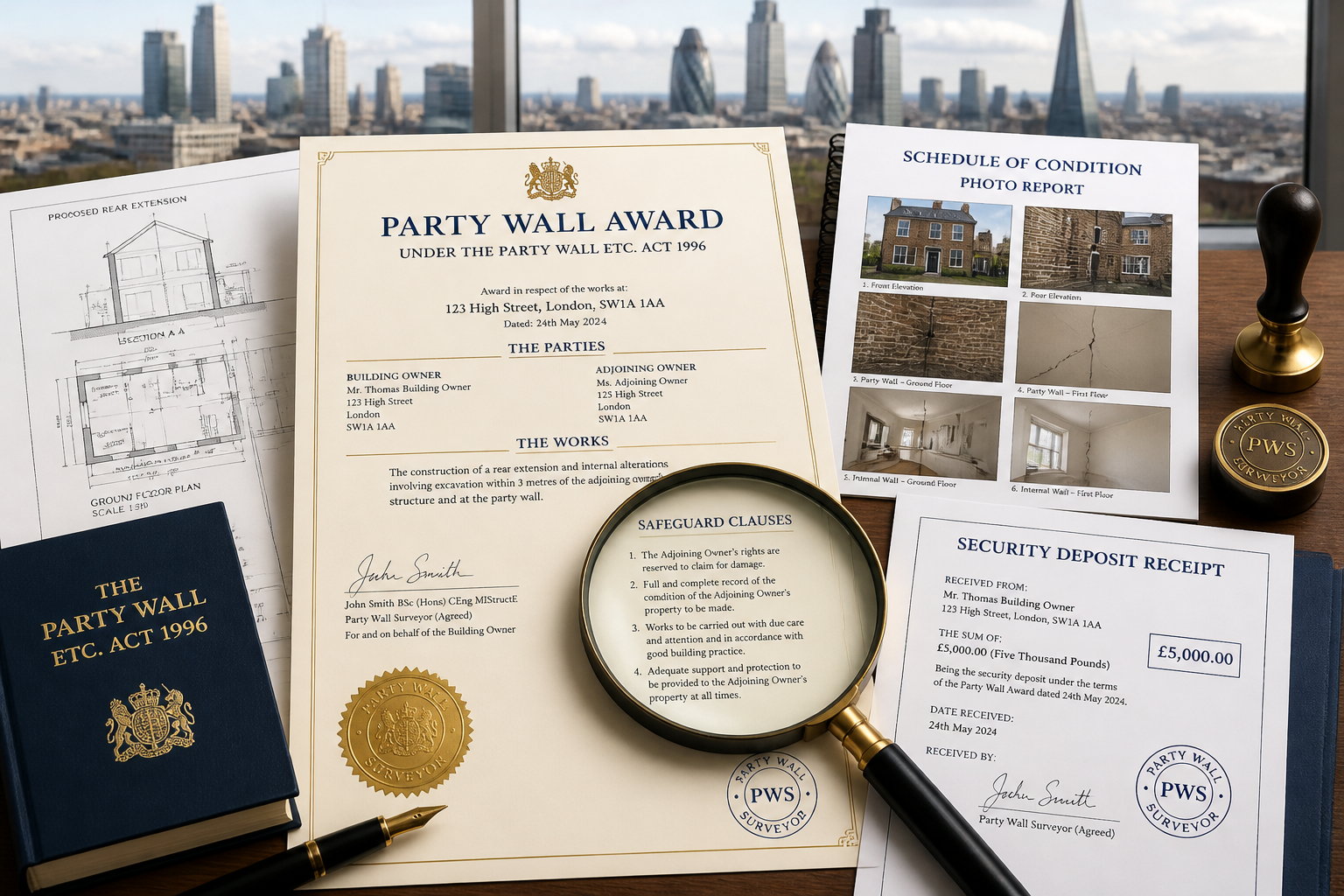
    Detailed () infographic-style image showing a formal Party Wall Award document on a desk with legal stamps, surrounded by

    What Are Safeguard Clauses?

    Safeguard clauses are legally binding provisions within a Party Wall Award that protect the adjoining owner’s property and financial interests during and after underpinning works. In 2026, with regulatory guidance evolving, well-drafted awards following RICS standards have become critical for minimising appeals and keeping projects on track. [1][4]

    The most important safeguard clauses for underpinning works include:

    1. Security for Expenses 🔒
    Under the Party Wall etc Act 1996, adjoining owners may serve notice requiring the building owner to provide agreed security — or a security amount determined through the dispute resolution process under Section 10 — before work commences. [3]

    This provision exists for a very specific reason: if the building owner delays, stalls, or stops works mid-way through underpinning, open excavation bays can leave the adjoining structure dangerously unsupported. Security for expenses ensures funds are immediately available to instruct contractors to backfill open trenches or complete underpinning without waiting for the building owner to act. [3]

    2. Schedule of Condition 📸
    Every Party Wall Award involving underpinning must include a schedule of condition — a detailed photographic and written record of the adjoining property’s pre-works state. [2] This document is the single most important piece of evidence if a damage dispute arises after works complete.

    A robust schedule of condition should cover:

    • All internal rooms adjacent to or above the works
    • External walls, brickwork, and render
    • Existing cracks (measured and photographed)
    • Drainage inspection chambers
    • Garden surfaces and boundary structures

    For more on how schedules of condition work in practice, see the dedicated schedule of condition service.

    3. Working Hours and Noise Restrictions
    Awards should specify permitted working hours, maximum vibration levels, and notification requirements before particularly disruptive phases such as breaking out existing foundations.

    4. Damage Notification Protocol
    A clear clause requiring the contractor to immediately notify both surveyors if any unexpected cracking, movement, or structural anomaly is detected during works.

    5. Completion and Reinstatement Obligations
    The award should specify exactly how and when the building owner must make good any damage caused to the adjoining property, including timescales and the standard of repair required.

    Retrospective Awards: When Things Go Wrong

    Despite best efforts, disputes do arise. When damage complaints emerge after underpinning works, retrospective Party Wall Awards can be drawn up with an agreed surveyor or two party wall surveyors appointed with both owners’ knowledge. [2] These retrospective agreements address damage claims, clarify the scope of works undertaken, and establish a framework for compensation or repair.

    The lesson for 2026 urban projects is clear: a comprehensive award drafted before works begin is far less costly — financially and relationally — than attempting to resolve disputes after the fact.


    2026 Urban Projects: Rising Disputes and RICS Compliance

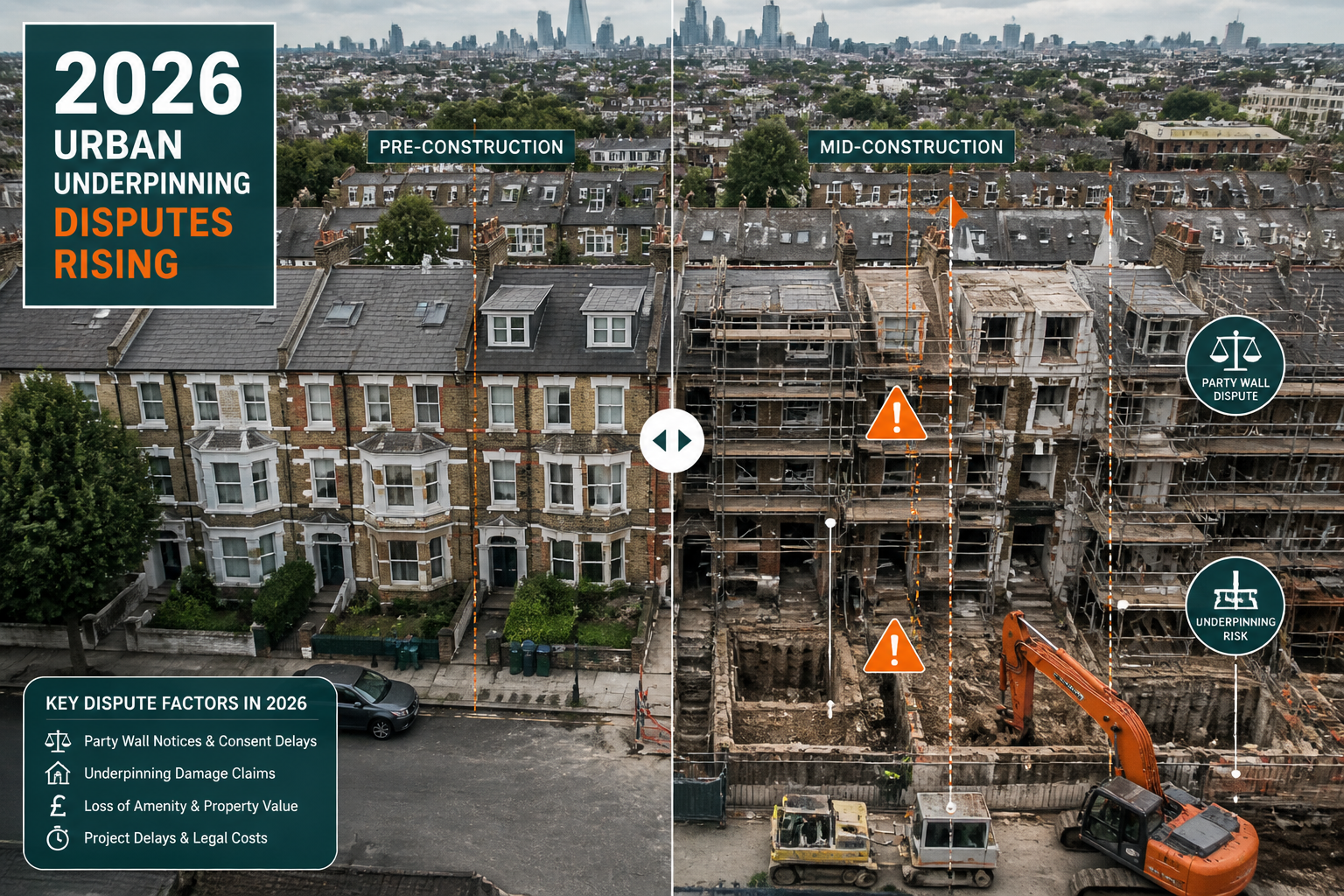
    Detailed () wide-angle aerial view of a dense urban London residential street in 2026 showing multiple simultaneous

    The 2026 Construction Uptick and Its Impact

    The construction sector in 2026 is experiencing a significant uptick in activity, particularly in dense urban areas. This surge has placed party wall surveyors under considerable pressure, with dispute volumes rising in areas such as East London, South London, and inner-city boroughs where terrace housing predominates. [4]

    During this period, RICS-compliant awards have proven their value. Well-prepared awards that follow RICS standards are significantly reducing the number of appeals to the County Court, allowing projects to proceed more efficiently and with greater certainty for all parties. [4]

    For location-specific expertise, specialist surveyors operate across East London, South London, North London, and West London — each area presenting its own soil conditions, housing stock characteristics, and dispute patterns.

    Common Dispute Triggers in 2026 Underpinning Cases

    The following issues are driving the majority of underpinning-related party wall disputes in 2026 urban projects:

    • Inadequate notice — building owners proceeding without serving proper Party Structure Notices
    • Missing method statements — awards that fail to incorporate detailed underpinning sequences
    • No security for expenses — adjoining owners left financially exposed if works stall
    • Incomplete schedules of condition — disputes about pre-existing versus new damage
    • Scope creep — works extending beyond what the award authorised

    Understanding the Costs

    Party wall surveyors charge between £150–£200 per hour, with a complete Party Wall Award costing approximately £1,000. [2] The building owner carrying out the works is responsible for paying all surveyor fees, including the adjoining owner’s surveyor if one is appointed. [2]

    For those looking to manage costs without cutting corners, this guide on how to keep party wall costs down offers practical strategies. It is also worth understanding the full costs of the party wall process before committing to a project timeline.

    For a deeper understanding of what a Party Wall Award contains and how it is structured, the party wall contract template guide is an excellent starting point.

    Key Questions to Ask Before Underpinning Begins

    ✅ Has a Party Structure Notice been correctly served on all adjoining owners?
    ✅ Has the adjoining owner consented or has a dispute been formally triggered?
    ✅ Has a structural engineer produced a detailed underpinning method statement?
    ✅ Does the draft award include security for expenses provisions?
    ✅ Has a full schedule of condition been completed and agreed?
    ✅ Are monitoring points installed and a settlement monitoring regime in place?
    ✅ Do all three parties — architect, engineer, and contractor — understand the procedural requirements?


    Conclusion: Protecting All Parties in 2026 Urban Underpinning Projects

    Party Wall Awards for Underpinning Works: Surveyor Risk Assessments and Safeguard Clauses in 2026 Urban Projects demand a higher standard of preparation than almost any other type of party wall matter. The combination of high structural risk, dense urban housing stock, and rising construction activity in 2026 means that gaps in the award — missing safeguard clauses, inadequate risk assessments, absent security provisions — translate directly into disputes, delays, and damage claims.

    Actionable Next Steps

    1. Serve notice early — allow the full statutory period before works begin; rushing this step is the single most common cause of disputes.
    2. Appoint a qualified party wall surveyor with specific experience in underpinning and foundation works — not all party wall matters are equal.
    3. Commission a detailed schedule of condition before any excavation begins; photographs taken after the fact carry little evidential weight.
    4. Insist on a method statement from the structural engineer and ensure it is incorporated into the award.
    5. Discuss security for expenses with your surveyor at the outset — adjoining owners should not wait until works begin to raise this.
    6. Budget realistically — the cost of a properly drafted award is a fraction of the cost of a subsidence claim or County Court appeal.

    Whether acting as a building owner or an adjoining owner, understanding the full scope of party wall obligations for underpinning works is the foundation — quite literally — of a successful urban project in 2026.


    References

    [1] Evergreen Guide To Party Wall Awards Drafting Enforceable Agreements Under 2026 Regulatory Updates – https://nottinghillsurveyors.com/blog/evergreen-guide-to-party-wall-awards-drafting-enforceable-agreements-under-2026-regulatory-updates

    [2] Party Wall Agreement – https://hoa.org.uk/advice/guides-for-homeowners/i-am-improving/party-wall-agreement/

    [3] Underpinning A Party Wall – https://stokemont.com/advice/underpinning-a-party-wall/

    [4] Party Wall Surveys And Neighbour Disputes During 2026s Construction Uptick RICS Compliance Framework – https://nottinghillsurveyors.com/blog/party-wall-surveys-and-neighbour-disputes-during-2026s-construction-uptick-rics-compliance-framework


  • Party Wall Act Updates Post-2025: Key Changes Impacting Notices and

    }

    Nearly one in three party wall disputes in England and Wales escalates unnecessarily — not because of genuine disagreement between neighbours, but because the procedural steps were mishandled from the start. As construction activity rebounds across London and beyond, the Party Wall Act Updates Post-2025: Key Changes Impacting Notices and Awards in 2026 Projects have introduced a sharper regulatory lens on how notices are served and how awards are drafted. For building owners, adjoining owners, and surveyors alike, understanding what has changed is no longer optional — it is the foundation of a legally sound project.

    Professional () hero image with : 'Party Wall Act Updates Post-2025' in extra large white with dark semi-transparent


    Key Takeaways 📋

    • The RICS 8th Edition consultation is reshaping party wall practice guidance, introducing updated award formats, revised appointment letters, and stronger conduct standards [1].
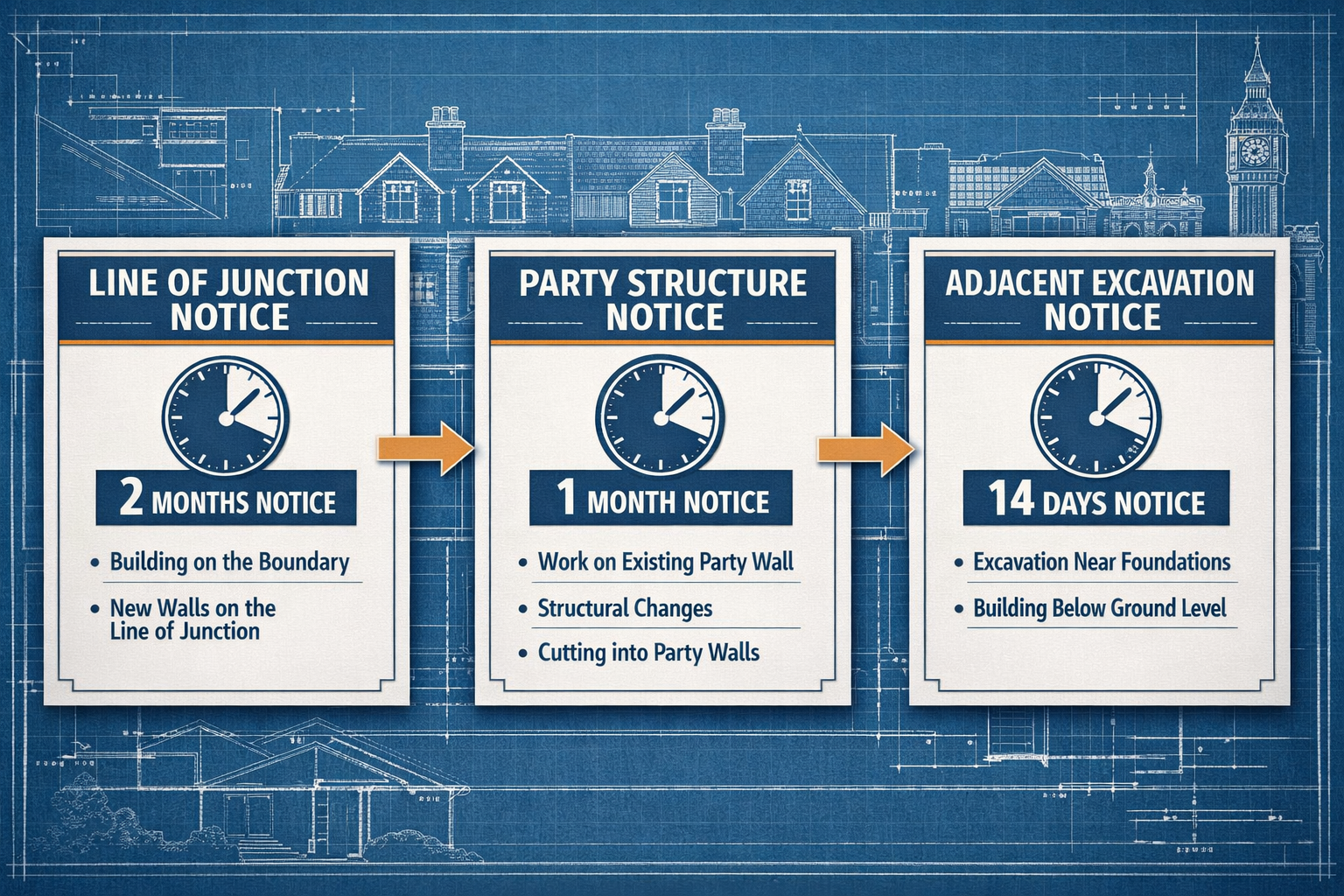
    • Three notice types govern party wall procedures: Line of Junction Notice, Party Structure Notice, and Adjacent Excavation Notice — each with distinct timelines [3].
    • Party wall awards are non-transferable to new building owners; fresh notices or agreements must be obtained upon property sale [4].
    • 2026 regulatory updates have tightened compliance requirements around award drafting and enforcement procedures [2].
    • Surveyors must adapt quickly to rising dispute volumes by leveraging updated RICS guidance on Third Surveyor referrals and fee transparency [1].

    Understanding the Regulatory Landscape in 2026

    The Party Wall etc. Act 1996 has remained the statutory backbone of neighbour relations in construction for nearly three decades. However, the post-2025 period has brought meaningful shifts in how that legislation is interpreted and applied in practice. The Party Wall Act Updates Post-2025: Key Changes Impacting Notices and Awards in 2026 Projects reflect both formal RICS guidance revisions and updated regulatory frameworks that tighten compliance obligations across the board [2].

    💡 Pull Quote: “Updated guidance is intended to support high standards of competence, conduct and consistency, while also helping practitioners navigate the statutory process with greater clarity and confidence.” — James Kavanagh, RICS Head of Professional Practice (Land & Development) [1]

    The Royal Institution of Chartered Surveyors has launched a consultation on the 8th Edition of its party wall practice guidance, replacing the 7th edition. This is not a cosmetic refresh. The 8th edition includes:

    • Enhanced appendices covering complex construction scenarios
    • Revised letters of appointment and terms of engagement
    • Updated draft award formats aligned with 2026 compliance expectations
    • Strengthened guidance on fee practices, Third Surveyor use, and public engagement [1]

    For practitioners working on 2026 projects, this guidance shift demands an immediate review of existing templates and appointment procedures. Those relying on outdated 7th edition formats risk producing awards that may face challenge or non-enforcement.

    To understand the full statutory framework underpinning these changes, the Party Wall etc. Act 1996 overview provides essential context for both professionals and property owners.


    The Three Notice Types: Timelines, Triggers, and 2026 Compliance

    Detailed () infographic-style illustration showing three distinct party wall notice types arranged as labeled document

    One of the most practically impactful areas of the Party Wall Act Updates Post-2025 concerns how notices are served and within what timeframes. Getting this wrong can invalidate the entire process, expose building owners to injunctions, and cause costly project delays.

    The Three Categories of Party Wall Notices

    Party wall notices fall into three distinct categories, each triggered by a different type of work [3]:

    Notice Type Trigger Notice Period
    Line of Junction Notice Building a new wall on or at the boundary line 1 month
    Party Structure Notice Works affecting a shared (party) wall or floor 2 months
    Adjacent Excavation Notice Excavation within 3–6 metres of a neighbouring structure 1 month

    Key Timelines to Know ⏱️

    • 2-month notice period: Required for works directly affecting a party wall or boundary line — giving neighbours adequate time to respond or raise concerns [6].
    • 1-month notice period: Applies to excavation works and new boundary wall construction, offering expedited processing for specific work types [6].
    • 14-day response window: Once a Party Wall Notice is received, the adjoining owner has 14 days to respond. Failure to respond within this window triggers a dispute resolution process under the Act [3].

    Serving Notices Correctly in 2026

    The updated regulatory environment places greater scrutiny on how notices are served, not just when. Key compliance points for 2026 include:

    • Notices must clearly identify the type of work being proposed and reference the relevant section of the Act.
    • Service must be made to the correct legal owner of the adjoining property — not merely an occupant.
    • Electronic service of notices, while increasingly common, should be backed by confirmation of receipt to avoid disputes over validity.

    For a detailed breakdown of the notice serving process, the guide on party wall notices and how to respond is an essential reference. Building owners can also explore the types of party wall works that trigger notice obligations to ensure nothing is overlooked at project inception.


    Award Drafting Under the RICS 8th Edition: What Has Changed?

    () showing a surveyor in hard hat and professional attire at a desk reviewing the RICS 8th Edition party wall guidance

    The party wall award is the legal instrument that defines the rights and obligations of both parties during construction. Under the Party Wall Act Updates Post-2025: Key Changes Impacting Notices and Awards in 2026 Projects, award drafting has become a more rigorous and scrutinised process [2].

    Updated Award Formats and Enforceable Agreements

    The RICS 8th Edition introduces updated draft award formats that reflect current regulatory expectations. Key changes include:

    • Greater specificity in describing permitted works, hours of operation, and access rights
    • Clearer provisions for schedule of condition surveys, protecting adjoining owners from unsubstantiated damage claims
    • Explicit fee transparency clauses, addressing longstanding concerns about surveyor costs being disproportionate to the works involved [1]
    • Strengthened Third Surveyor referral procedures, ensuring disputes between appointed surveyors are resolved efficiently

    ⚠️ Important: Awards drafted using outdated templates may lack the specificity required under 2026 standards, making them harder to enforce and more vulnerable to appeal.

    For those seeking a practical starting point, the guide on party wall awards and contract templates offers a detailed walkthrough of what a compliant award should contain. The party wall awards service page also outlines how professional surveyors structure enforceable agreements.

    The Schedule of Condition: Now More Critical Than Ever

    A schedule of condition — a documented record of the adjoining property’s state before works begin — has always been best practice. Under 2026 frameworks, it is increasingly treated as a mandatory component of a robust award rather than an optional add-on [2].

    A properly executed schedule of condition protects both parties: it gives adjoining owners a clear baseline for any damage claims and protects building owners from inflated or spurious allegations.

    Fee Practices Under the Spotlight 🔍

    One of the more contentious areas addressed in the RICS 8th Edition is surveyor fee practices. The updated guidance calls for:

    • Transparent fee agreements at the point of appointment
    • Proportionality between fees charged and the complexity of the works
    • Clear communication about who bears the cost of the surveyor (typically the building owner)

    For property owners concerned about costs, the resource on how to keep party wall costs down provides practical strategies that remain valid under the updated framework.


    Non-Transferability of Awards: A Critical Issue for 2026 Property Transactions

    One of the most frequently misunderstood aspects of party wall law — and one that the post-2025 updates have brought into sharper focus — is the non-transferability of party wall awards [4].

    What Non-Transferability Means in Practice

    When a building owner sells a property mid-project or before works begin, the party wall award does not automatically transfer to the new owner. This creates significant risk:

    • The new building owner must serve fresh notices before proceeding with any notifiable works.
    • Written consent obtained by the previous owner from an adjoining owner does not bind the adjoining owner to accept the new building owner’s works [4].
    • Buyers who proceed without fresh notices risk injunctions that halt construction entirely.

    The Joint Notice Strategy 🤝

    A practical solution gaining traction in 2026 is the joint notice strategy. When a building owner is selling, both the seller and buyer can serve notice jointly. This approach:

    • Ensures the award remains valid for future owners
    • Accounts for changes in ownership during the notice period
    • Reduces the risk of procedural gaps that could delay construction

    This is particularly relevant for buy-to-let expansions and institutional landlord projects, where property portfolios change hands regularly and construction timelines span multiple ownership periods [5].

    For adjoining owners uncertain about their rights when a neighbouring property is sold, the adjoining owners’ guidance explains the protections available under the Act.


    Surveyor Strategies for Navigating Rising Disputes in 2026

    Party wall disputes are rising. Increased urban densification, loft conversions, basement extensions, and boundary-adjacent developments have pushed dispute volumes higher across London and major cities. Surveyors must adapt their approach to remain effective under the Party Wall Act Updates Post-2025 framework.

    Practical Strategies for Surveyors ✅

    1. Adopt RICS 8th Edition templates immediately
    Do not wait for the consultation to conclude before updating appointment letters and award formats. The direction of travel is clear, and early adoption reduces the risk of producing documents that will require revision [1].

    2. Prioritise Third Surveyor clarity
    The updated guidance places renewed emphasis on the Third Surveyor’s role. Surveyors should ensure Third Surveyor selection is agreed and documented at the earliest opportunity — before disputes arise, not after [1].

    3. Conduct thorough pre-notice site assessments
    Before any notice is served, a detailed assessment of the proposed works and their likely impact on adjoining properties reduces the risk of disputes escalating to formal award proceedings.

    4. Communicate proactively with adjoining owners
    Many disputes stem from poor communication rather than genuine legal disagreement. Early, transparent dialogue — even before formal notices are served — can prevent the 14-day response window from becoming adversarial [3].

    5. Document everything
    Under 2026 regulatory standards, comprehensive documentation of every stage — from notice service to award execution — is essential for defending decisions if challenged [2].

    For building owners managing their own projects, the building owners’ guidance outlines responsibilities and rights at each stage of the process.


    Regional Considerations: London’s Unique Party Wall Challenges

    London presents a particularly complex party wall environment. High-density housing, Victorian terrace rows, and active basement conversion markets mean that party wall issues arise on almost every significant residential project. The post-2025 updates are especially relevant for London-based practitioners and property owners.

    Whether a project is located in the East End, South of the river, or in a central borough, local expertise matters. Specialist surveyors operating across East London, South London, and North London are well-positioned to navigate the nuances of both the updated Act requirements and local planning contexts.


    Conclusion: Actionable Next Steps for 2026 Projects

    The Party Wall Act Updates Post-2025: Key Changes Impacting Notices and Awards in 2026 Projects represent the most significant shift in party wall practice guidance in years. The RICS 8th Edition consultation, tightened compliance requirements, and the growing complexity of urban construction projects demand a proactive, informed approach from all parties involved.

    Actionable Next Steps 🚀

    • Building owners: Serve notices early and verify the correct notice type for each element of proposed works. Do not assume previous consent or awards transfer on property sale.
    • Adjoining owners: Respond within the 14-day window and appoint a surveyor promptly if consent is withheld, to ensure your rights are protected under an enforceable award.
    • Surveyors: Update appointment letters, award templates, and Third Surveyor procedures to align with RICS 8th Edition guidance without delay.
    • Property buyers: Before completing a purchase where party wall works are planned or in progress, obtain independent legal and surveying advice on whether fresh notices are required.
    • All parties: Treat the schedule of condition as a non-negotiable component of every award, not an optional extra.

    The party wall process, when handled correctly, protects everyone. The 2026 updates make that process more rigorous — but also more transparent and more enforceable than ever before.


    References

    [1] RICS Launches Consultation On Updated Party Wall Practice Guidance – https://www.rics.org/news-insights/rics-launches-consultation-on-updated-party-wall-practice-guidance

    [2] Evergreen Guide To Party Wall Awards Drafting Enforceable Agreements Under 2026 Regulatory Updates – https://nottinghillsurveyors.com/blog/evergreen-guide-to-party-wall-awards-drafting-enforceable-agreements-under-2026-regulatory-updates

    [3] Difference Between Party Wall Notices And Awards – https://www.partywallslimited.com/blog/difference-between-party-wall-notices-and-awards

    [4] Buying Property Party Wall Award – https://osborneslaw.com/blog/buying-property-party-wall-award/

    [5] Party Wall Awards For Buy To Let Expansions In 2026 Protocols Amid Institutional Landlord Surge – https://nottinghillsurveyors.com/blog/party-wall-awards-for-buy-to-let-expansions-in-2026-protocols-amid-institutional-landlord-surge

    [6] Party Wall Agreement – https://hoa.org.uk/advice/guides-for-homeowners/i-am-improving/party-wall-agreement/


  • Party Wall Awards for 5G and Fibre Optic Installations: Emerging

    {“cover”:”Professional landscape format (1536×1024) hero image with bold text overlay: ‘Party Wall Awards for 5G & Fibre Optic Installations: Notice Requirements & Safeguards’ in extra large 72pt white bold sans-serif font with dark semi-transparent overlay box, centered upper-third composition. Background shows a dramatic split-scene: left half depicts a modern brick terraced house party wall with drilling equipment and fibre optic cables being installed, right half shows a 5G mast rising beside a residential building. Color palette: deep navy blue, white text, electric teal accents representing connectivity. Magazine cover aesthetic, editorial quality, high contrast, photorealistic style.”,”content”:[“Detailed landscape format (1536×1024) editorial illustration showing a cross-section diagram of a shared party wall between two terraced houses, with a 5G mast foundation excavation reaching 2-4 metres depth on the left side and fibre optic cables being threaded through the wall on the right. A surveyor in a hard hat holds official Party Wall Act notice documents. Overlaid infographic elements show Section 6 and Section 2(2) notice triggers with arrows and labels. Color scheme: architectural blueprint blue and white with orange highlight accents. Technical, professional, informative visual style.”,”Detailed landscape format (1536×1024) flat-lay style image of a professional desk showing a Party Wall Award legal document with highlighted clauses, a surveyor’s schedule of condition report with photographs clipped to it, a pen, and a smartphone displaying a 5G signal strength diagram. Beside these sits a printed timeline chart showing notice periods: 1 month, 2 months, 60 days. Soft warm office lighting, top-down bird’s-eye perspective, clean minimal composition. Color palette: cream, charcoal, gold accents. Editorial quality, professional property law aesthetic.”,”Detailed landscape format (1536×1024) conceptual illustration showing two neighbouring property owners shaking hands across a shared garden fence, with a party wall surveyor standing between them holding a bound Party Wall Award document. In the background, a telecom engineer installs fibre optic cable along the roofline of a semi-detached house. Speech bubbles show key safeguard terms: ‘Schedule of Condition’, ‘Damage Liability’, ‘Working Hours’. Color palette: forest green, white, slate grey. Friendly yet professional editorial style, moderate depth of field, community-focused composition.”]

    Professional landscape hero image () with : "Party Wall Awards for 5G and Fibre Optic Installations: Emerging Notice

    Britain’s 5G rollout is accelerating at a pace that most homeowners never anticipated — and with it comes a largely overlooked legal obligation. Most 5G mast foundations require excavations of 2 to 4 metres in depth, a range that frequently triggers formal notice requirements under the Party Wall etc. Act 1996 in residential areas [2]. When that excavation happens near a shared wall, the legal and structural stakes rise sharply for both building owners and their neighbours.

    Party Wall Awards for 5G and Fibre Optic Installations: Emerging Notice Requirements and Safeguards sit at the intersection of telecommunications law, property rights, and structural surveying — a combination that is catching many property owners off guard in 2026. This article unpacks exactly when telecom upgrades trigger Party Wall Act obligations, what a properly drafted Party Wall Award must include, and how adjoining owners can protect their homes from drilling, cabling, and excavation works.

    Key Takeaways infographic visualizing Party Wall Awards for 5G installations, featuring a split-screen landscape layout with


    Key Takeaways 📋

    • Excavation depth matters: 5G mast foundations at 2–4 metres depth routinely trigger Section 6 notice requirements under the Party Wall etc. Act 1996.
    • Fibre optic drilling through shared walls can constitute notifiable party structure works, requiring a formal Party Wall Notice before works begin.
    • A Party Wall Award is the legal document that governs how telecom works near shared structures must proceed, including working hours, damage liability, and reinstatement.
    • Adjoining owners have the right to appoint their own surveyor, request a Schedule of Condition, and challenge works that risk structural harm.
    • Failing to serve notice before telecom installations can expose building owners to injunctions, compensation claims, and costly delays.

    When Telecom Upgrades Trigger the Party Wall etc. Act 1996

    The Party Wall etc. Act 1996 was drafted long before 5G existed, yet its provisions are broad enough to capture a wide range of modern telecom works. Understanding precisely when the Act applies is the first step for any building owner or telecoms contractor.

    Section 2: Works to an Existing Party Wall or Structure

    Section 2 of the Act covers works carried out directly to a party wall or party structure. Fibre optic installations frequently fall into this category when:

    • Cables are drilled through a shared wall to connect properties to a street-level distribution point.
    • Conduits or trunking are fixed to the face of a party wall, altering its structural integrity.
    • Equipment housings or junction boxes are mounted on shared structures.

    Under Section 2(2), a building owner must serve a Party Structure Notice at least one month before works begin. You can learn more about what a Party Structure Notice is and how to serve it in the context of London properties specifically.

    Section 6: Excavations Near Adjoining Properties

    Section 6 is the provision most relevant to 5G mast installations. It applies when:

    • Excavation is planned within 3 metres of an adjoining owner’s building and the excavation will go deeper than the neighbour’s foundations.
    • Excavation is planned within 6 metres of an adjoining structure and the works will cut a line drawn downward at 45 degrees from the bottom of the neighbour’s foundations.

    Given that 5G mast foundations commonly reach 2–4 metres [2], Section 6 notices are not a theoretical concern — they are a practical necessity on most urban and suburban installations near residential buildings.

    💡 Pull Quote: “A 5G mast sited three metres from a terraced house boundary is not just a planning matter — it is a party wall matter. Failing to serve notice is not an option.”

    For a broader understanding of the types of party wall works that trigger these obligations, reviewing the full spectrum of notifiable activities is strongly recommended.


    Understanding Party Wall Awards for 5G and Fibre Optic Installations: Emerging Notice Requirements and Safeguards

    Conceptual illustration depicting telecommunications infrastructure intersecting with residential property boundaries,

    When a neighbour disputes a telecom installation — or simply does not consent in writing — the process moves to the appointment of surveyors and the drafting of a Party Wall Award. This legally binding document is the cornerstone of protection for both parties.

    What Is a Party Wall Award?

    A Party Wall Award (sometimes called a Party Wall Agreement) is a formal document drawn up by one or more appointed surveyors. It sets out:

    Award Component Purpose
    Description of works Defines exactly what telecom works are permitted
    Method of working Specifies drilling methods, vibration limits, and access routes
    Working hours Restricts noisy or disruptive works to agreed times
    Schedule of Condition Records the pre-works state of the adjoining property
    Damage liability Confirms the building owner’s responsibility for any damage caused
    Reinstatement obligations Requires the building owner to make good any damage
    Security for expenses May require a financial deposit before works begin

    For a detailed breakdown of how these documents are structured, the Party Wall Awards guide provides practical insight into the process.

    The Schedule of Condition: A Critical Safeguard

    One of the most important protections for an adjoining owner facing nearby telecom works is the Schedule of Condition. This is a photographic and written record of the property’s state before any drilling, excavation, or cable installation begins.

    Without this record, proving that a crack in a party wall was caused by a 5G mast excavation — rather than pre-existing settlement — becomes extremely difficult. A properly compiled schedule of condition is therefore not optional; it is essential.

    Notice Periods for Telecom Works

    The Act specifies minimum notice periods that cannot be waived unilaterally:

    • Party Structure Notice (Section 2): Minimum 1 month before works begin.
    • Line of Junction Notice (Section 1): Minimum 1 month before works begin.
    • Notice of Adjacent Excavation (Section 6): Minimum 1 month before works begin.

    These timelines are separate from any planning permission or permitted development rights that may apply to 5G infrastructure under the Electronic Communications Code. Telecom operators must satisfy both planning and party wall requirements independently.

    For reference, US telecommunications regulators have adopted similarly structured advance notice frameworks — the FCC now requires written advance notice at least 60 days before submitting mid-sized or large broadband attachment orders, with a mandatory meet-and-confer period within 30 days [1]. While these rules apply in a different jurisdiction, they reflect a global recognition that structured notice periods protect all parties in infrastructure rollouts.


    Practical Safeguards: Protecting Shared Walls from Drilling and Cabling Works

    Comprehensive visual explainer of Party Wall Awards for emerging telecommunications infrastructure, featuring a

    Understanding the legal framework is one thing; knowing how to use it effectively is another. The following safeguards are available to both building owners carrying out telecom works and adjoining owners who need protection.

    For Adjoining Owners: Your Rights Under the Act

    If a telecoms contractor or neighbouring property owner serves a Party Wall Notice, an adjoining owner has several options:

    1. Consent in writing — Works can proceed under agreed conditions without a formal Award.
    2. Dissent and appoint a surveyor — Triggers the Award process, ensuring independent oversight.
    3. Dissent and agree to a single agreed surveyor — A cost-effective middle ground.

    Adjoining owners should never ignore a notice. Silence does not equal consent — after 14 days without a response, a dispute is deemed to have arisen automatically, and the surveyor appointment process begins regardless. Learn more about party wall notices and how to respond to avoid missing critical deadlines.

    Key Clauses to Include in a Telecom-Related Party Wall Award

    A well-drafted Award for fibre optic or 5G-related works should contain specific clauses that standard residential Awards may not always address:

    • Vibration monitoring requirements — Particularly important for percussive drilling near older masonry walls.
    • Cable routing restrictions — Specifying that cables must not pass through structural elements without prior structural engineer sign-off.
    • Electromagnetic interference provisions — While rare, high-frequency installations near sensitive equipment may warrant mention.
    • Reinstatement to match existing finishes — Ensuring that any wall penetrations are made good to the same standard as the surrounding surface.
    • Ongoing access rights — Clarifying whether telecoms engineers can return for maintenance without serving fresh notices.

    Fibre Optic Installations: Consent Requests and the Party Wall Process

    Fibre optic cable installations present a slightly different challenge. Tower companies and wireless carriers typically send consent request letters when seeking to add fibre optic cable to existing infrastructure [3]. In a residential context, this consent process can run parallel to — but must not replace — the formal Party Wall Notice process.

    Where fibre optic cables pass through or along a party wall, the building owner must assess whether the works constitute notifiable party structure works. Factors to consider include:

    • Depth of any associated trenching relative to neighbouring foundations.
    • Whether drilling penetrates the full thickness of a shared wall.
    • The structural significance of the wall being accessed.

    Regulatory compliance in telecom projects increasingly demands that operators understand not just federal or national frameworks but also the granular local property law obligations that apply at each installation site [5].

    For Building Owners: Managing Compliance and Costs

    Building owners commissioning telecom installations on or near party walls carry the primary legal responsibility for compliance. Key steps include:

    Appoint a qualified party wall surveyor early — Before any contractor mobilises on site.
    Serve notices with the correct lead time — Rushing notice periods is a common and costly mistake.
    Commission a structural engineer’s report for any excavation exceeding 1.5 metres near shared structures.
    Keep records of all correspondence with adjoining owners and surveyors.
    Budget for the Award process — Understanding the costs of the party wall process upfront prevents project delays.

    For those looking to manage expenditure, there are also practical tips on how to keep party wall costs down without compromising on legal protection.


    The Evolving Legal Landscape in 2026: What’s Changing

    The intersection of telecommunications law and property law is not static. Several developments in 2026 are reshaping how Party Wall Awards for 5G and Fibre Optic Installations: Emerging Notice Requirements and Safeguards are being approached by surveyors and legal professionals.

    RICS Protocols and Professional Guidance

    The Royal Institution of Chartered Surveyors (RICS) has been developing clearer protocols for party wall surveyors dealing with telecom infrastructure. These protocols acknowledge that standard residential party wall procedures need adaptation when:

    • Works are commissioned by telecoms operators rather than individual property owners.
    • Multiple adjoining owners are affected simultaneously by a single installation.
    • The building owner is a corporate entity rather than a private individual.

    RICS protocols now emphasise the importance of early structural assessment for any 5G mast installation near residential party walls [2], reflecting the profession’s recognition that this is a genuinely specialist area.

    The Electronic Communications Code and Its Limits

    The Electronic Communications Code (as amended by the Product Security and Telecommunications Infrastructure Act 2022) grants telecoms operators significant rights to install equipment on and near properties. However, these rights do not override the Party Wall etc. Act 1996. The two frameworks operate independently, and operators who rely solely on Code rights without serving party wall notices remain legally exposed.

    ⚠️ Important: Electronic Communications Code rights and Party Wall Act obligations are not mutually exclusive. Both must be satisfied for a legally compliant installation.


    Conclusion: Actionable Next Steps for Property Owners and Telecoms Operators

    The rapid expansion of 5G and fibre optic infrastructure across the UK is creating a new category of party wall dispute — one that neither the Act’s original drafters nor most property owners anticipated. Yet the legal framework is clear, and the protections it offers are robust when used correctly.

    Here are the actionable next steps for each party involved:

    If You Are a Building Owner or Telecoms Operator:

    1. Identify all party walls and shared structures within 3–6 metres of any planned excavation or installation.
    2. Serve the correct notice under the appropriate section of the Act, with the full statutory notice period.
    3. Appoint a party wall surveyor experienced in telecoms-related works before mobilising contractors.
    4. Ensure the Party Wall Award contains specific clauses for vibration, cable routing, and reinstatement.

    If You Are an Adjoining Owner:

    1. Do not ignore any notice — respond within 14 days to preserve your rights.
    2. Appoint your own surveyor to ensure the Award genuinely protects your property.
    3. Request a Schedule of Condition before any works begin — this is your primary evidence tool.
    4. Seek specialist advice if you are unsure whether works near your property require a notice.

    The Party Wall etc. Act 1996 overview remains the definitive starting point for understanding your rights and obligations. For those in London, specialist surveyors are available across all London locations to provide tailored guidance on telecoms-related party wall matters.

    The digital infrastructure of tomorrow is being built through the walls of today’s homes. Getting the legal framework right is not a bureaucratic inconvenience — it is the foundation of a fair and damage-free installation for everyone involved.


    References

    [1] FCC Adopts New Pole Attachment Rules to Speed Broadband Deployment – https://www.benton.org/blog/fcc-adopts-new-pole-attachment-rules-speed-broadband-deployment

    [2] Party Wall Surveys for 5G Mast Installations: RICS Protocols Amid 2026 Telecom Infrastructure Expansion – https://nottinghillsurveyors.com/blog/party-wall-surveys-for-5g-mast-installations-rics-protocols-amid-2026-telecom-infrastructure-expansion

    [3] Consent Requests for Fiber Optic Cable – https://www.steelintheair.com/blog/consent-requests-for-fiber-optic-cable/

    [4] BEAD Obligations for Subgrantees Deploying Network Guidance – https://broadbandusa.ntia.gov/sites/default/files/2024-08/BEAD_Obligations_for_Subgrantees_Deploying_Network_Guidance.pdf

    [5] Regulatory Compliance in Telecom: Understanding the Federal, State and Local Laws Impacting Resident Choice at Your Property – https://realtycompartners.com/regulatory-compliance-in-telecom-understanding-the-federal-state-and-local-laws-impacting-resident-choice-at-your-property/


  • Women in Party Wall Surveying: Breaking Barriers and Rising Demand in

    Women make up just 13.7% of the construction workforce in 2026 — yet within specialist disciplines like party wall surveying, a quiet but powerful shift is underway [2]. The story of Women in Party Wall Surveying: Breaking Barriers and Rising Demand in 2026’s Male-Dominated Field is not simply one of statistics. It is a story of expertise, resilience, and a profession beginning to recognise that diversity makes it stronger.

    As London’s residential construction boom continues and neighbour disputes over shared walls grow more complex, the demand for skilled party wall surveyors has never been higher. Female surveyors — inspired by trailblazers and supported by evolving professional networks — are stepping into this space with confidence, bringing technical precision and a distinct approach to dispute resolution that clients increasingly value.


    Key Takeaways 📌

    • Women represent a small but rapidly growing share of party wall surveyors in 2026, driven by construction sector growth and shifting professional culture.
    • Female surveyors are recognised for emotional intelligence and communication skills that are particularly effective in neighbour dispute resolution.
    • Industry bodies like RICS are updating party wall practice guidance, creating new entry points and professional pathways [4].
    • Structural barriers — including workplace culture, lack of mentorship, and retention challenges — remain significant but are being actively addressed [3].
    • Demand for party wall expertise is rising sharply, making 2026 an ideal moment for women to enter or advance in this specialist field.

    () editorial infographic-style image showing a split composition: left side displays a bar chart comparing percentage of

    The State of Women in Construction and Surveying in 2026

    A Profession Still Dominated by Men — But Changing Fast

    The construction sector has long been one of the least gender-diverse industries in the UK and across Europe. According to data from the European Building Construction sector, women remain significantly underrepresented despite gradual progress over the past decade [3]. In party wall surveying specifically — a niche discipline governed by the Party Wall etc. Act 1996 — the gender gap has historically been even more pronounced than in general construction.

    Yet 2026 marks a turning point. Several converging forces are reshaping who enters the profession:

    • 🏗️ A surge in residential construction across London and major UK cities is creating unprecedented demand for qualified surveyors.
    • 📚 Updated RICS guidance on party wall practice is drawing fresh attention to the discipline and encouraging new entrants [4].
    • 🤝 Professional networks and mentorship programmes specifically targeting women in surveying are gaining momentum.
    • 📣 Industry media is amplifying female voices — publications like Walls & Ceilings have launched dedicated features celebrating women who build [1].

    “The profession is not waiting for permission to change — women are simply showing up, doing exceptional work, and redefining what a party wall surveyor looks like.”

    What the Data Actually Shows

    Metric 2020 2023 2026 (Est.)
    Women in UK construction workforce 11.2% 12.8% 13.7%
    Women in surveying disciplines ~14% ~17% ~20%
    Women in specialist party wall roles Very limited data Growing Actively tracked

    Sources: [2][3]

    While party wall surveying lacks its own gender-specific dataset, the broader surveying trend is clear: more women are entering technical property disciplines, and retention is improving as workplace culture evolves [2].


    Breaking Barriers: The Real Challenges Female Party Wall Surveyors Face

    Cultural and Structural Obstacles That Persist

    Understanding the story of Women in Party Wall Surveying: Breaking Barriers and Rising Demand in 2026’s Male-Dominated Field requires an honest look at what women are still navigating. The barriers are real, even as they slowly erode.

    1. Workplace Culture
    Construction sites and surveying offices have historically operated with cultures that can feel unwelcoming to women. From informal networks that exclude female professionals to assumptions about physical capability, these cultural norms have deterred many talented candidates [3].

    2. Lack of Visible Role Models
    When women cannot see themselves reflected in senior roles, it is harder to envision a long-term career path. The party wall surveying world has very few publicly prominent female figures — though this is changing as industry media increasingly spotlights women who build [1].

    3. Retention Challenges
    Research consistently shows that women are more likely to leave construction-related roles within the first five years [2]. Reasons include limited flexible working arrangements, inadequate parental leave policies, and a perception that career progression requires conforming to a male-defined professional identity.

    4. Client Perception
    Some female surveyors report that clients — particularly on contentious neighbour disputes — initially question their authority. This is a challenge that requires both individual resilience and systemic change in how the profession presents itself.

    () concept illustration showing a diverse group of three professional women surveyors gathered around a table reviewing

    The Emotional Intelligence Advantage in Neighbour Disputes

    Here is where the narrative becomes particularly compelling. Party wall surveying is not purely a technical exercise. It sits at the intersection of construction law, property rights, and — crucially — human relationships.

    When neighbours disagree about works affecting a party fence wall or boundary wall, emotions run high. A surveyor’s ability to de-escalate tension, communicate complex legal obligations clearly, and help both parties reach agreement is just as important as their technical knowledge of the Party Wall etc. Act 1996.

    Many female surveyors — and the clients who work with them — report that women often bring a distinct strength to this aspect of the role:

    • Active listening that helps adjoining owners feel genuinely heard
    • Clear, jargon-free communication that reduces misunderstanding
    • Empathetic but firm negotiation that keeps disputes from escalating to formal proceedings
    • Attention to relationship preservation, recognising that neighbours must continue living beside each other after the works conclude

    “Emotional intelligence is not a soft skill in party wall surveying — it is a core professional competency.”

    For building owners navigating the party wall notice process or adjoining owners concerned about works next door, a surveyor who communicates with both authority and empathy can make an enormous practical difference.


    Rising Demand in 2026: Why Now Is the Moment for Women in Party Wall Surveying

    The Construction Surge Is Creating Real Opportunity

    London’s residential construction pipeline is at one of its busiest points in recent memory. Loft conversions, basement excavations, extensions, and new builds are generating a high volume of cases requiring formal party wall procedures. Understanding the types of party wall works that trigger these obligations — from line of junction works to excavations near neighbouring foundations — is a specialist skill set in high demand.

    This demand is not limited to one part of the city. Whether in South London, Central London, or East London, the volume of party wall cases is growing — and so is the need for qualified professionals to handle them.

    RICS Guidance Updates: A New Entry Point

    In 2026, RICS launched a consultation on updated party wall practice guidance, signalling a professionalisation of the discipline that creates clearer pathways for new entrants [4]. This is significant for women considering party wall surveying as a career: clearer professional standards mean more transparent routes to qualification and recognition.

    The update also reflects a broader maturation of the field — one that is increasingly attractive to professionals who value intellectual rigour, client interaction, and the satisfaction of resolving complex disputes.

    Women Who Build: Industry Recognition Is Growing 🏆

    The launch of dedicated features celebrating female construction professionals — such as Walls & Ceilings magazine’s “Women Who Build” series — signals a cultural shift in how the industry presents itself [1]. When professional media actively spotlights women’s achievements, it sends a powerful message to the next generation of surveyors.

    Similarly, Women in Construction Week 2026 highlighted the women behind construction practice, drawing attention to specialist disciplines including surveying [5]. These initiatives matter not just symbolically — they create networks, mentorship connections, and visibility that translate into real career opportunities.

    Pathways Into Party Wall Surveying for Women in 2026

    For women considering this career path, the routes in are more varied than ever:

    Entry Route Description
    RICS-accredited degree Property, building surveying, or civil engineering
    Apprenticeship Degree-level apprenticeships in surveying are expanding
    Lateral move from construction Experienced site managers and project managers transitioning
    Legal or conveyancing background Understanding of property law is directly transferable
    Mentorship programmes Industry bodies and firms offering structured support

    Understanding the full costs and process of party wall work is part of the knowledge base new entrants build — and it is a body of knowledge that rewards careful, methodical learners.

    () forward-looking scene depicting a young female party wall surveyor mentoring a female university student on a residential


    Building the Future: What Needs to Change — and What Already Has

    The Role of Firms and Professional Bodies

    The responsibility for creating a more inclusive profession does not rest solely on individual women. Firms, professional bodies, and industry associations have a critical role to play.

    What progressive firms are doing:

    • 🔹 Offering flexible working arrangements that support work-life balance
    • 🔹 Implementing blind recruitment processes to reduce unconscious bias
    • 🔹 Creating structured mentorship programmes pairing junior female surveyors with senior professionals
    • 🔹 Actively promoting female surveyors in client-facing and leadership roles
    • 🔹 Tracking and publishing gender diversity data to create accountability

    For adjoining owners and building owners alike, working with a firm that values diversity often means working with a team that brings broader perspectives to complex problems. Whether you need an adjoining owner’s surveyor or a building owner’s surveyor, the quality of expertise matters most — and that expertise increasingly comes in diverse forms.

    The Inspiration of Industry Voices

    Voices like Sarah Tanner — and the growing community of female surveyors she represents — are reshaping the profession’s identity. These are not pioneers in isolation. They are part of a broader movement that includes mentors, allies, professional associations, and clients who actively seek diverse expertise.

    The message from Women in Construction Week 2026 was clear: the women behind construction practice are not waiting to be invited in — they are building the table [5].

    Practical Steps for Aspiring Female Party Wall Surveyors

    For women at any stage of their career considering this path, here are concrete next steps:

    1. Research the legal framework — Familiarise yourself with the Party Wall etc. Act 1996 and how party wall notices work in practice.
    2. Connect with professional networks — RICS, the Pyramus & Thisbe Club, and Women in Property all offer valuable connections.
    3. Seek mentorship actively — Identify female surveyors whose careers you admire and reach out directly.
    4. Build technical and interpersonal skills in parallel — The best party wall surveyors combine legal knowledge with exceptional communication.
    5. Consider specialist firms — Working with a dedicated party wall practice accelerates learning far faster than a generalist role.

    Conclusion: The Walls Are Coming Down 🏛️

    The story of Women in Party Wall Surveying: Breaking Barriers and Rising Demand in 2026’s Male-Dominated Field is ultimately one of momentum. The barriers are real — cultural, structural, and historical. But they are not immovable.

    In 2026, the combination of a booming construction sector, updated professional guidance, growing industry recognition, and a new generation of confident female professionals is creating conditions for genuine transformation. The emotional intelligence, communication skills, and rigorous technical expertise that female surveyors bring are not just welcome additions to the profession — they are competitive advantages.

    For women considering this path: the demand is there, the pathways are clearer than ever, and the profession needs what you bring.

    Actionable next steps:

    • 📋 Learn how party wall awards work and what they mean for both parties in a dispute.
    • 🗺️ Explore opportunities with specialist firms across London’s diverse boroughs.
    • 🤝 Join professional networks dedicated to women in surveying and construction.
    • 📖 Stay informed on RICS guidance updates that shape the profession’s future.
    • 💬 Advocate within your firm or organisation for the structural changes that make the profession more inclusive.

    The party wall surveying profession is changing. The only question is how quickly — and who will lead that change.


    References

    [1] Walls And Ceilings Introduces Women Who Build Elevating The Leaders Shaping The Future Of Walls And Ceilings – https://www.wconline.com/articles/97925-walls-and-ceilings-introduces-women-who-build-elevating-the-leaders-shaping-the-future-of-walls-and-ceilings

    [2] Women In Construction 2026 Data Jobsite Reality – https://blog.bluebeam.com/women-in-construction-2026-data-jobsite-reality/

    [3] International Womens Day 2026 Women Remain Underrepresented In Construction Despite Gradual Progress – https://www.ebc-construction.eu/news/international-womens-day-2026-women-remain-underrepresented-in-construction-despite-gradual-progress/

    [4] Rics Launches Consultation Updated Party Wall Practice Guidance – https://todaysconveyancer.co.uk/rics-launches-consultation-updated-party-wall-practice-guidance/

    [5] 2026 Women In Construction Week Series Women Behind The Construction Practice – https://www.kmco.com/insights/2026-women-in-construction-week-series-women-behind-the-construction-practice/


  • Party Wall Agreements vs. Formal Awards: When Adjoining Owners

    Thousands of neighbour disputes escalate to court every year — not because the original building work was unreasonable, but because the paperwork behind it had no legal teeth. A casual “yes, go ahead” from the person next door is not a party wall agreement. Understanding the difference between a voluntary consent agreement and a formally issued Party Wall Award is one of the most practical things any homeowner or developer can do before breaking ground in 2026.

    This guide cuts through the confusion around Party Wall Agreements vs. Formal Awards: When Adjoining Owners Consent and How to Draft Binding Settlements in 2026, explaining exactly which document applies in which situation, what each must contain, and how to ensure both parties are genuinely protected.


    Key Takeaways 📋

    • A Party Wall Notice starts the process; a Party Wall Award concludes it — both documents serve distinct legal functions.
    • Adjoining owner consent can lead to a written agreement, but it must still include a Schedule of Condition and working terms to be enforceable.
    • Failure to respond within 14 days to a Party Wall Notice is treated as dissent, automatically triggering the Award process.
    • A neighbour refusing consent does not stop building work — it simply means a formal Award must be issued instead.
    • Retrospective agreements are possible but carry greater risk and complexity; acting before works begin is always preferable.

    Detailed () editorial illustration showing a side-by-side comparison diagram: on the left, two neighbors shaking hands

    Understanding the Two Documents: Party Wall Agreements vs. Formal Awards

    Before diving into drafting specifics, it is essential to understand what each document actually is — and what it is not.

    What Is a Party Wall Notice?

    A Party Wall Notice is the formal written document a building owner must serve on all adjoining owners before carrying out any notifiable works. It is the trigger — the starting gun. The notice describes the proposed works, the intended start date, and the rights being exercised under the Party Wall etc. Act 1996.

    Common works that require a notice include loft conversions, extension foundations, and damp proof course insertions. Once served, the adjoining owner has 14 days to respond [1].

    What Is a Party Wall Agreement (Consent)?

    When an adjoining owner receives a Party Wall Notice and consents in writing, the result is a Party Wall Agreement. This document confirms the neighbour has agreed to the proposed works. However, consent alone is not enough — a properly drafted agreement must also include [1][4]:

    • ✅ Details of working hours
    • ✅ Access arrangements for surveyors or contractors
    • ✅ A Schedule of Condition recording the property’s pre-work state
    • ✅ Procedures for handling any damage claims

    Think of the Party Wall Agreement as the friendly route — faster, cheaper, and less formal, but only valid when properly documented.

    What Is a Party Wall Award?

    A Party Wall Award is a legally binding document issued by one or more appointed Party Wall Surveyors. It comes into play when:

    • The adjoining owner dissents to the notice
    • The adjoining owner fails to respond within 14 days (treated as dissent) [1]
    • The parties cannot agree on the terms of the works

    💬 Pull Quote: “A Party Wall Award is not a punishment — it is a protection mechanism for both parties, ensuring impartial oversight of works that could affect a shared structure.”

    The Award is far more comprehensive than a consent agreement. It is drafted by surveyors, not the homeowners themselves, and carries the full weight of the Act behind it [3].


    The 14-Day Window and What Happens Next

    The timeline following a Party Wall Notice is strict and consequential. Understanding it helps both building owners and adjoining owners avoid accidental escalation.

    Adjoining Owner’s Response Outcome
    Consents in writing within 14 days Party Wall Agreement drafted; no surveyors required
    Dissents within 14 days Surveyor(s) appointed; Party Wall Award issued
    No response within 14 days Treated as dissent; Award process begins automatically [1]
    Agrees to a single agreed surveyor One surveyor acts for both parties
    Appoints their own surveyor Two surveyors act; may appoint a Third Surveyor if needed

    This table makes one thing clear: silence is not consent. Many adjoining owners make the mistake of ignoring a notice, assuming inaction is a neutral position. It is not — it triggers the formal Award route and all associated costs [1].


    () overhead aerial-style editorial image showing a construction scene at a party wall between two properties: one side has

    How to Draft Binding Settlements: What Each Document Must Contain

    Whether the outcome is a consent-based agreement or a formal Award, the content must be thorough. Vague documentation is the primary reason informal agreements fail to protect either party.

    Drafting a Party Wall Agreement After Consent

    When an adjoining owner agrees to the works, having a party wall agreement without a surveyor is technically possible — but risky without professional guidance. A properly drafted consent agreement should include:

    1. Full identification of all parties — names, addresses, and roles (building owner vs. adjoining owner)
    2. Property descriptions — both properties clearly identified
    3. Scope of proposed works — detailed description matching the original notice
    4. Working hours — agreed start and finish times, weekend restrictions
    5. Access arrangements — when and how contractors may access the adjoining property
    6. Schedule of Condition — photographic and written record of the adjoining property’s condition before works begin [4]
    7. Damage resolution process — agreed steps if the neighbour believes the works have caused damage
    8. Signatures of both parties — dated and witnessed

    📌 Pro tip: A free sample party wall agreement template can provide a useful starting framework, but always have the final document reviewed by a qualified surveyor.

    Mandatory Components of a Formal Party Wall Award

    A Party Wall Award is more detailed by necessity. According to established practice under the Act, it must contain [1][3]:

    • Party identification — all owners and their appointed surveyors
    • Property details — both properties fully described
    • Description of works — precise scope, method, and sequence
    • Surveyor appointments and signatures — confirming authority to act
    • Schedule of Condition — photographic evidence attached as an appendix
    • Rights and responsibilities — including working hours and safety measures
    • Access provisions — legal right of access for inspection during works
    • Dispute resolution procedures — what happens if damage is alleged
    • Third Surveyor details — in case of disagreement between the two appointed surveyors

    The Award is served on both parties once agreed and signed. Either party has 14 days to appeal to the County Court if they disagree with its terms [2].

    The Schedule of Condition: Non-Negotiable in Both Routes

    Whether the parties consent or dissent, a Schedule of Condition is essential. This document — typically a combination of written notes and photographs — records the exact state of the adjoining property before any work begins.

    Without it, proving whether a crack in a wall or a damaged ceiling pre-existed the building works becomes nearly impossible. The Schedule of Condition is the single most important safeguard in any party wall settlement [4].


    When Consent Bypasses the Formal Award Process (and When It Cannot)

    Understanding Party Wall Agreements vs. Formal Awards: When Adjoining Owners Consent and How to Draft Binding Settlements in 2026 also means knowing the limits of consent.

    When Consent Is Sufficient

    Consent works well when:

    • The works are relatively minor (e.g., minor repairs, non-structural changes)
    • The relationship between neighbours is cooperative and trust is established
    • Both parties are willing to document the agreement in writing
    • A Schedule of Condition is prepared and attached

    In these cases, the parties avoid surveyor fees entirely — a meaningful saving, particularly for smaller projects. For guidance on managing costs, the party wall costs and process guide provides a clear breakdown.

    When a Formal Award Is Necessary

    A formal Award becomes necessary when [1][2]:

    • The adjoining owner dissents or does not respond
    • Works are significant — such as underpinning, loft conversions, or new foundations near the boundary
    • The relationship is contentious — even if the neighbour verbally agrees, a formal Award provides stronger legal protection
    • The building owner wants certainty — an Award is harder to challenge retrospectively than an informal agreement

    💬 Pull Quote: “A neighbour’s refusal to consent does not end the project — it simply means an independent surveyor takes over the decision-making, which can actually benefit both parties.” [4]

    Surveyor Independence: A Critical Requirement

    One point that trips up many homeowners: the agreed Party Wall Surveyor must be independent. The surveyor cannot be the same professional already engaged by the building owner for the project. An adjoining owner will — rightly — question the neutrality of someone already on the other side’s payroll [4].

    For those in specific areas, finding a qualified local professional is straightforward through resources such as a party wall surveyor in North London or other regional specialists.


    () close-up editorial image of a professional party wall surveyor's desk with a formal Party Wall Award document spread

    Retrospective Agreements and the Risks of Acting Without Documentation

    One of the more overlooked aspects of Party Wall Agreements vs. Formal Awards: When Adjoining Owners Consent and How to Draft Binding Settlements in 2026 is what happens when works proceed without any documentation at all.

    Retrospective Party Wall Agreements

    It is possible to draw up a retrospective party wall agreement after works have begun or even been completed. This may be necessary when [4]:

    • Damage complaints arise during or after construction
    • A neighbour makes a claim and documentation is needed
    • Clarity is required on the scope of works already carried out

    However, retrospective agreements are significantly more complex. Without a pre-works Schedule of Condition, establishing the baseline state of the adjoining property is difficult. Both parties must appoint surveyors with knowledge of the works already carried out, and the process can become contentious quickly.

    The lesson is clear: acting before works begin is always the better path.

    Geographic Scope of the Act

    It is worth noting that the Party Wall etc. Act 1996 applies only in England and Wales. In Scotland and Northern Ireland, party wall matters are governed by common law rather than statute [5]. This distinction matters for anyone purchasing property or planning works near borders between jurisdictions.


    Practical Steps for Building Owners and Adjoining Owners in 2026

    For Building Owners 🏗️

    1. Serve the correct notice — ensure the right type of notice is used for the type of works planned. A party structure notice guide explains the distinctions clearly.
    2. Allow the full 14-day response window — do not start works before this period expires.
    3. Document everything — whether consent is given or an Award is issued, keep copies of all correspondence.
    4. Appoint an independent surveyor — if the neighbour dissents, use a surveyor not already connected to the project.
    5. Commission a Schedule of Condition — regardless of the route taken.

    For Adjoining Owners 🏠

    1. Respond to the notice within 14 days — silence is treated as dissent.
    2. Read the notice carefully — check the party wall act notices guide to understand your rights.
    3. Request a Schedule of Condition — insist this is included in any agreement.
    4. Appoint your own surveyor if needed — the building owner typically pays for this [1].
    5. Do not withhold consent unreasonably — it will not stop the works; it will only formalise the process.

    Conclusion: Protecting Both Parties Through Proper Documentation

    The distinction between a Party Wall Agreement and a formal Party Wall Award is not merely procedural — it is the difference between a document that holds up under legal scrutiny and one that collapses the moment a dispute arises.

    Consent is valuable, but it must be documented. A handshake agreement or a verbal “yes” offers no protection to either party. Whether the route leads to a consent-based agreement or a surveyor-drafted Award, the essentials remain the same: clear identification of parties, a detailed scope of works, agreed working conditions, and — critically — a Schedule of Condition prepared before a single brick is moved.

    In 2026, with construction activity in urban areas continuing to rise, getting this right from the outset is not optional. It is the foundation of a dispute-free build.

    ✅ Actionable Next Steps

    • Serve the correct Party Wall Notice at least two months before planned works begin.
    • Use a professionally drafted template as a starting point, but always have it reviewed.
    • Commission a Schedule of Condition regardless of whether the neighbour consents or dissents.
    • Consult a qualified Party Wall Surveyor early — the cost of advice is far lower than the cost of litigation.
    • Keep all correspondence — dates, responses, and signed documents create a clear paper trail.

    References

    [1] Difference Between Party Wall Notices And Awards – https://www.partywallslimited.com/blog/difference-between-party-wall-notices-and-awards

    [2] Evergreen Guide To Party Wall Awards Drafting Enforceable Agreements Under 2026 Regulatory Updates – https://nottinghillsurveyors.com/blog/evergreen-guide-to-party-wall-awards-drafting-enforceable-agreements-under-2026-regulatory-updates

    [3] What Is A Party Wall Agreement And Party Wall Award – https://westvilleassociates.com/blog/what-is-a-party-wall-agreement-and-party-wall-award

    [4] Party Wall Agreement – https://hoa.org.uk/advice/guides-for-homeowners/i-am-improving/party-wall-agreement/

    [5] Party Wall Agreements What You Need To Know – https://www.fmb.org.uk/find-a-builder/ultimate-guides-to-home-renovation/party-wall-agreements-what-you-need-to-know.html


  • Party Wall Awards for Basement Excavations: Depth Calculations,

    London’s basement conversion market grew by an estimated 35% between 2020 and 2025, driven by soaring property values and the push to maximise every square metre of urban space. Yet beneath the appeal of extra living space lies a legally and technically complex process — one where a single miscalculated excavation depth can trigger disputes, injunctions, and costly structural damage to neighbouring properties. Understanding Party Wall Awards for Basement Excavations: Depth Calculations, Structural Risk Assessment, and 2026 Surveyor Protocols is no longer optional for homeowners, developers, or contractors working in densely built urban environments.

    Detailed () technical diagram illustration showing cross-section of two adjoining terraced houses with 3-metre and 6-metre


    Key Takeaways 📋

    • Depth determines notice obligations: Whether the 3-metre or 6-metre rule applies depends on how deep your excavation goes relative to your neighbour’s foundations.
    • The 45-degree rule is the critical test for the 6-metre trigger — if your excavation intersects that plane, a Section 6 notice is mandatory. [1]
    • A Party Wall Award is a legally binding document that protects both the building owner and the adjoining owner throughout the works.
    • Surveyor fees typically start around £1,000 per award, with hourly rates of £150–£200. [3]
    • 2026 protocols emphasise pre-commencement schedules of condition and digital monitoring as standard practice for deep basement works.

    Why Basement Excavations Are the Most Complex Party Wall Scenario

    Most party wall disputes involve relatively straightforward works — a loft conversion, a rear extension, or repairs to a shared wall. Basement excavations are fundamentally different. They involve removing large volumes of soil close to or beneath existing foundations, often in Victorian or Edwardian terraced streets where foundations are shallow, inconsistent, and poorly documented.

    The Party Wall etc. Act 1996 governs these works through two specific provisions:

    • Section 6(1): Applies when excavation is within 3 metres of a neighbouring structure and goes deeper than the neighbour’s foundations.
    • Section 6(2): Applies when excavation is within 6 metres of a neighbouring structure and intersects a 45-degree plane drawn downward from the base of the neighbour’s foundations. [1]

    💡 Pull Quote: “The 6-metre rule is the primary concern for basement conversions and deep piling — and it catches many building owners by surprise.” [1]

    The key distinction is depth relative to the neighbour’s foundation base, not just horizontal distance. For the 3-metre rule to apply, the planned excavation must go lower than the base of the adjoining property’s existing foundations. Shallower excavations — even within 3 metres — do not automatically trigger the requirement. [1]

    This nuance is why professional depth calculations are essential before any basement project begins.


    Understanding Depth Calculations: The 3-Metre and 6-Metre Rules Explained

    () showing a professional party wall surveyor in hard hat and hi-vis vest conducting structural risk assessment at a deep

    How Surveyors Calculate Trigger Depths

    Accurate depth calculations require surveyors to establish two key measurements:

    1. The depth of the proposed excavation — taken from ground level to the lowest point of the new basement slab or pile.
    2. The depth of the adjoining owner’s existing foundations — often estimated from property age and construction type, or confirmed through trial pits.
    Property Type Typical Foundation Depth Common Trigger Risk
    Victorian terraced (pre-1900) 0.5m – 1.0m High (most basements exceed this)
    Edwardian semi-detached 0.75m – 1.2m High
    1930s–1960s suburban 0.9m – 1.5m Medium
    Modern construction (post-1990) 1.0m – 1.8m Lower, but still possible

    Once foundation depths are estimated, surveyors apply the 45-degree rule for the 6-metre test: a line is drawn at 45 degrees downward from the base of the neighbour’s foundation toward the building owner’s property. If any part of the proposed excavation intersects this line, a Section 6(2) notice is required. [1]

    Section 6 Notice Requirements

    A valid Section 6 notice must be served at least one month before work begins and must include: [1]

    • Plans and sections showing the location and depth of the proposed excavation
    • Details of any underpinning, strengthening, or safeguarding works proposed
    • The name and address of the building owner

    Failure to serve a valid notice can result in injunctions that halt work entirely — a costly outcome on any basement project. [2]

    For a detailed walkthrough of the notice process, see the guide on party wall act notices and how to respond.


    Structural Risk Assessment: What Surveyors Evaluate in 2026

    The Core Risk Factors

    Structural risk assessment for basement excavations has become increasingly sophisticated. In 2026, surveyors are expected to evaluate the following factors as standard:

    🏗️ 1. Foundation Type and Condition

    • Strip, pad, raft, or pile foundations all behave differently under adjacent excavation stress.
    • Older strip foundations in clay soils are particularly vulnerable to settlement and heave.

    🌍 2. Soil and Ground Conditions

    • London clay is notoriously susceptible to shrinkage and swelling.
    • Made ground (common in urban areas) can shift unpredictably during excavation.
    • Groundwater levels affect both excavation stability and neighbouring foundation behaviour.

    📐 3. Proximity and Geometry

    • The closer the excavation, the higher the risk of lateral soil movement.
    • Basement walls that run parallel to party walls create sustained lateral pressure.

    🏚️ 4. Existing Structural Condition of Adjoining Properties

    • Pre-existing cracks, subsidence history, and building age all affect vulnerability.
    • A schedule of condition survey documents the adjoining property’s state before works begin — this is now considered essential practice.

    ⚙️ 5. Construction Method

    • Secant pile walls, contiguous pile walls, and traditional mass concrete underpinning each carry different risk profiles.
    • Temporary works design (propping, shoring) must be reviewed.

    The Schedule of Condition: A Non-Negotiable Step

    A schedule of condition is a photographic and written record of the adjoining property’s condition before excavation begins. It protects both parties: it gives the adjoining owner evidence if damage occurs, and it protects the building owner from inflated or fraudulent damage claims.

    In 2026, digital schedules using high-resolution photography, thermal imaging, and crack monitoring data are increasingly standard on basement projects in London. [4]


    Party Wall Awards for Basement Excavations: What the Document Must Contain

    () flat-lay overhead composition of a party wall award legal document spread open on architect's desk surrounded by 2026

    A party wall award is the formal legal document that resolves disputes and sets out the rights and obligations of both parties during the works. For basement excavations specifically, the award must go well beyond the standard template.

    Essential Clauses for Basement Excavation Awards

    📄 Standard clauses (all awards):

    • Identity of the building owner and adjoining owner
    • Description of the notifiable works
    • Working hours and access provisions
    • Damage liability and dispute resolution

    🏗️ Basement-specific clauses (2026 protocols):

    • Monitoring requirements: Specifying crack monitoring gauges, settlement pins, or inclinometers to be installed and read at defined intervals
    • Groundwater management: Requirements for dewatering and its impact on neighbouring foundations
    • Structural engineer sign-off: Requiring a structural engineer to approve temporary works before each stage of excavation
    • Notification triggers: Defining what level of movement or cracking requires work to stop
    • Reinstatement obligations: Detailed specification for making good any damage caused
    • Insurance confirmation: Evidence of adequate contractor insurance before works commence

    💡 Pull Quote: “A well-drafted party wall award for a basement excavation is not a formality — it is the primary legal instrument protecting both neighbours throughout a high-risk construction process.”

    For a comprehensive overview of what these documents contain, the party wall contract template guide on party wall awards provides useful context.


    2026 Surveyor Protocols: What Has Changed?

    The profession has evolved significantly in response to the increasing complexity of basement projects. Key 2026 protocols reflect both technological advances and lessons learned from high-profile disputes.

    Digital-First Documentation

    Surveyors are now routinely using:

    • Drone surveys for external condition assessments in tight urban plots
    • 3D laser scanning to capture precise pre-works geometry
    • Digital crack monitoring systems with automated alerts
    • Cloud-based award management platforms for multi-party coordination

    Agreed Surveyor vs. Two-Surveyor Approach

    For complex basement projects, the choice of surveyor structure matters:

    Approach Pros Cons
    Agreed Surveyor (single surveyor for both parties) Cost-effective, faster Perception of conflict of interest
    Two Surveyors (one each) Independent representation Higher cost, potential for dispute
    Third Surveyor (appointed in advance) Resolves deadlock Only engaged if needed

    For adjoining owners concerned about protecting their interests, understanding the role of an adjoining owner’s surveyor is essential before consenting to any arrangement.

    Costs in 2026

    Party wall awards for basement excavations are among the most expensive in the residential sector. A standard award costs approximately £1,000, but basement excavation awards — with their additional complexity — often run to £1,500–£3,000 or more per award. Surveyor hourly rates typically range from £150 to £200. [3]

    Factors that increase costs include:

    • Multiple adjoining owners (e.g., terraced properties with neighbours on both sides)
    • Disputes requiring third surveyor involvement
    • Complex structural engineering input required
    • Extended monitoring periods

    For practical advice on managing expenditure, the guide on how to keep party wall costs down offers actionable strategies.


    Common Mistakes That Invalidate Awards or Trigger Injunctions

    Even experienced contractors make errors that create legal exposure. The most common include:

    1. Starting work before the notice period expires — the one-month minimum for Section 6 notices is non-negotiable. [1]
    2. Serving notices without adequate plans — vague or incomplete drawings render notices invalid. [2]
    3. Failing to identify all adjoining owners — owners of properties below (e.g., basement flats) and above must all be notified.
    4. Ignoring the 45-degree rule — assuming horizontal distance alone determines the trigger is a frequent and costly error. [1]
    5. Proceeding without a schedule of condition — leaves the building owner exposed to unverifiable damage claims.

    Those carrying out works should review the dedicated guidance for building owners undertaking party wall works before serving any notices.


    Regional Considerations: London’s Unique Basement Challenge

    London presents specific challenges that make party wall compliance particularly critical for basement projects:

    • High density of Victorian terraced housing with shallow, often unmortared rubble foundations
    • London clay geology creating elevated subsidence and heave risk
    • Groundwater complexity in areas like Islington, Hackney, and Southwark
    • Conservation area restrictions adding planning constraints alongside party wall obligations

    Whether a project is in North London, South London, East London, or West London, local ground conditions and property stock characteristics should inform the structural risk assessment from the outset.


    Conclusion: Actionable Next Steps for 2026 Basement Projects

    Party Wall Awards for Basement Excavations: Depth Calculations, Structural Risk Assessment, and 2026 Surveyor Protocols represent a high-stakes intersection of law, engineering, and professional practice. Getting it right protects property values, neighbourly relationships, and legal standing.

    Here are the concrete steps to take before breaking ground:

    Step 1: Engage a qualified party wall surveyor at the design stage — before planning permission is even submitted. Early identification of trigger distances prevents costly redesigns later.

    Step 2: Commission a trial pit or structural engineer’s report to establish the adjoining property’s foundation depth. Do not rely on assumptions.

    Step 3: Serve valid Section 6 notices with complete plans and sections at least one month before the intended start date. [1]

    Step 4: Agree on a schedule of condition for all adjoining properties before any excavation begins.

    Step 5: Ensure the party wall award contains all basement-specific clauses — monitoring protocols, notification triggers, and reinstatement obligations.

    Step 6: Maintain open communication with adjoining owners throughout the project. Disputes are far more expensive than proactive engagement.

    The complexity of basement excavation work demands expert guidance. Working with experienced surveyors who understand both the legal framework and the structural engineering realities of deep excavation is the single most effective risk mitigation strategy available in 2026.


    References

    [1] Excavation And The Party Wall Act Navigating The 3 And 6 Metre Rules For Foundations – https://www.partywallslimited.com/blog/excavation-and-the-party-wall-act-navigating-the-3–and-6-metre-rules-for-foundations

    [2] Party Wall Act Notices For Excavations Near Boundaries Serving Valid Notices To Avoid Injunctions In 2026 – https://nottinghillsurveyors.com/blog/party-wall-act-notices-for-excavations-near-boundaries-serving-valid-notices-to-avoid-injunctions-in-2026

    [3] Party Wall Agreement – https://hoa.org.uk/advice/guides-for-homeowners/i-am-improving/party-wall-agreement/

    [4] Party Wall Survey Guide – https://strutsurveyors.com/party-wall-survey-guide/