RICS
Looking for expert solutions?
Request a Quote

Author: admin

  • Party Wall Awards for Basement Excavations: Depth Calculations,

    London’s basement conversion market grew by an estimated 35% between 2020 and 2025, driven by soaring property values and the push to maximise every square metre of urban space. Yet beneath the appeal of extra living space lies a legally and technically complex process — one where a single miscalculated excavation depth can trigger disputes, injunctions, and costly structural damage to neighbouring properties. Understanding Party Wall Awards for Basement Excavations: Depth Calculations, Structural Risk Assessment, and 2026 Surveyor Protocols is no longer optional for homeowners, developers, or contractors working in densely built urban environments.
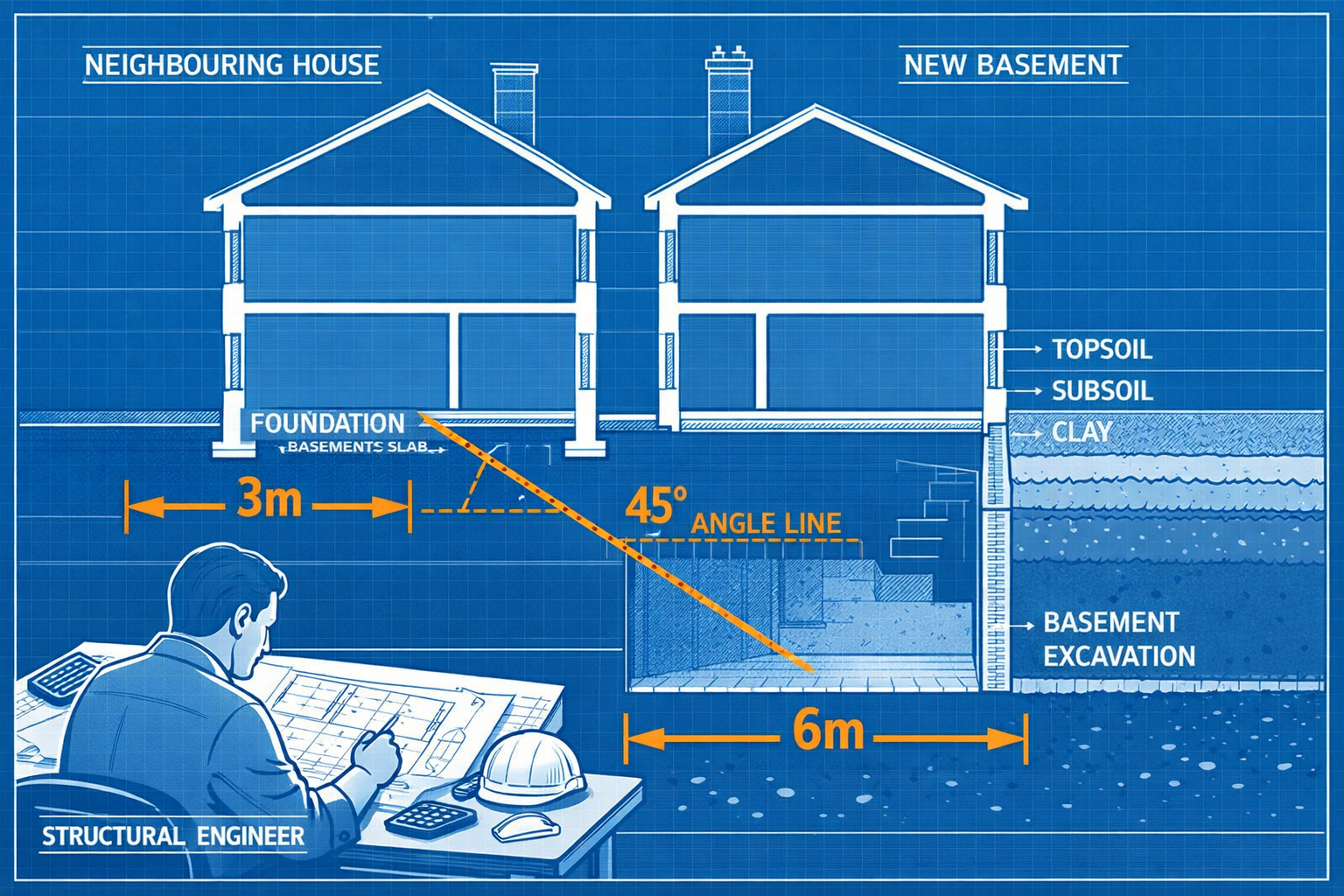
    Detailed () technical diagram illustration showing cross-section of two adjoining terraced houses with 3-metre and 6-metre


    Key Takeaways 📋

    • Depth determines notice obligations: Whether the 3-metre or 6-metre rule applies depends on how deep your excavation goes relative to your neighbour’s foundations.
    • The 45-degree rule is the critical test for the 6-metre trigger — if your excavation intersects that plane, a Section 6 notice is mandatory. [1]
    • A Party Wall Award is a legally binding document that protects both the building owner and the adjoining owner throughout the works.
    • Surveyor fees typically start around £1,000 per award, with hourly rates of £150–£200. [3]
    • 2026 protocols emphasise pre-commencement schedules of condition and digital monitoring as standard practice for deep basement works.

    Why Basement Excavations Are the Most Complex Party Wall Scenario

    Most party wall disputes involve relatively straightforward works — a loft conversion, a rear extension, or repairs to a shared wall. Basement excavations are fundamentally different. They involve removing large volumes of soil close to or beneath existing foundations, often in Victorian or Edwardian terraced streets where foundations are shallow, inconsistent, and poorly documented.

    The Party Wall etc. Act 1996 governs these works through two specific provisions:

    • Section 6(1): Applies when excavation is within 3 metres of a neighbouring structure and goes deeper than the neighbour’s foundations.
    • Section 6(2): Applies when excavation is within 6 metres of a neighbouring structure and intersects a 45-degree plane drawn downward from the base of the neighbour’s foundations. [1]

    💡 Pull Quote: “The 6-metre rule is the primary concern for basement conversions and deep piling — and it catches many building owners by surprise.” [1]

    The key distinction is depth relative to the neighbour’s foundation base, not just horizontal distance. For the 3-metre rule to apply, the planned excavation must go lower than the base of the adjoining property’s existing foundations. Shallower excavations — even within 3 metres — do not automatically trigger the requirement. [1]

    This nuance is why professional depth calculations are essential before any basement project begins.


    Understanding Depth Calculations: The 3-Metre and 6-Metre Rules Explained

    () showing a professional party wall surveyor in hard hat and hi-vis vest conducting structural risk assessment at a deep

    How Surveyors Calculate Trigger Depths

    Accurate depth calculations require surveyors to establish two key measurements:

    1. The depth of the proposed excavation — taken from ground level to the lowest point of the new basement slab or pile.
    2. The depth of the adjoining owner’s existing foundations — often estimated from property age and construction type, or confirmed through trial pits.
    Property Type Typical Foundation Depth Common Trigger Risk
    Victorian terraced (pre-1900) 0.5m – 1.0m High (most basements exceed this)
    Edwardian semi-detached 0.75m – 1.2m High
    1930s–1960s suburban 0.9m – 1.5m Medium
    Modern construction (post-1990) 1.0m – 1.8m Lower, but still possible

    Once foundation depths are estimated, surveyors apply the 45-degree rule for the 6-metre test: a line is drawn at 45 degrees downward from the base of the neighbour’s foundation toward the building owner’s property. If any part of the proposed excavation intersects this line, a Section 6(2) notice is required. [1]

    Section 6 Notice Requirements

    A valid Section 6 notice must be served at least one month before work begins and must include: [1]

    • Plans and sections showing the location and depth of the proposed excavation
    • Details of any underpinning, strengthening, or safeguarding works proposed
    • The name and address of the building owner

    Failure to serve a valid notice can result in injunctions that halt work entirely — a costly outcome on any basement project. [2]

    For a detailed walkthrough of the notice process, see the guide on party wall act notices and how to respond.


    Structural Risk Assessment: What Surveyors Evaluate in 2026

    The Core Risk Factors

    Structural risk assessment for basement excavations has become increasingly sophisticated. In 2026, surveyors are expected to evaluate the following factors as standard:

    🏗️ 1. Foundation Type and Condition

    • Strip, pad, raft, or pile foundations all behave differently under adjacent excavation stress.
    • Older strip foundations in clay soils are particularly vulnerable to settlement and heave.

    🌍 2. Soil and Ground Conditions

    • London clay is notoriously susceptible to shrinkage and swelling.
    • Made ground (common in urban areas) can shift unpredictably during excavation.
    • Groundwater levels affect both excavation stability and neighbouring foundation behaviour.

    📐 3. Proximity and Geometry

    • The closer the excavation, the higher the risk of lateral soil movement.
    • Basement walls that run parallel to party walls create sustained lateral pressure.

    🏚️ 4. Existing Structural Condition of Adjoining Properties

    • Pre-existing cracks, subsidence history, and building age all affect vulnerability.
    • A schedule of condition survey documents the adjoining property’s state before works begin — this is now considered essential practice.

    ⚙️ 5. Construction Method

    • Secant pile walls, contiguous pile walls, and traditional mass concrete underpinning each carry different risk profiles.
    • Temporary works design (propping, shoring) must be reviewed.

    The Schedule of Condition: A Non-Negotiable Step

    A schedule of condition is a photographic and written record of the adjoining property’s condition before excavation begins. It protects both parties: it gives the adjoining owner evidence if damage occurs, and it protects the building owner from inflated or fraudulent damage claims.

    In 2026, digital schedules using high-resolution photography, thermal imaging, and crack monitoring data are increasingly standard on basement projects in London. [4]


    Party Wall Awards for Basement Excavations: What the Document Must Contain
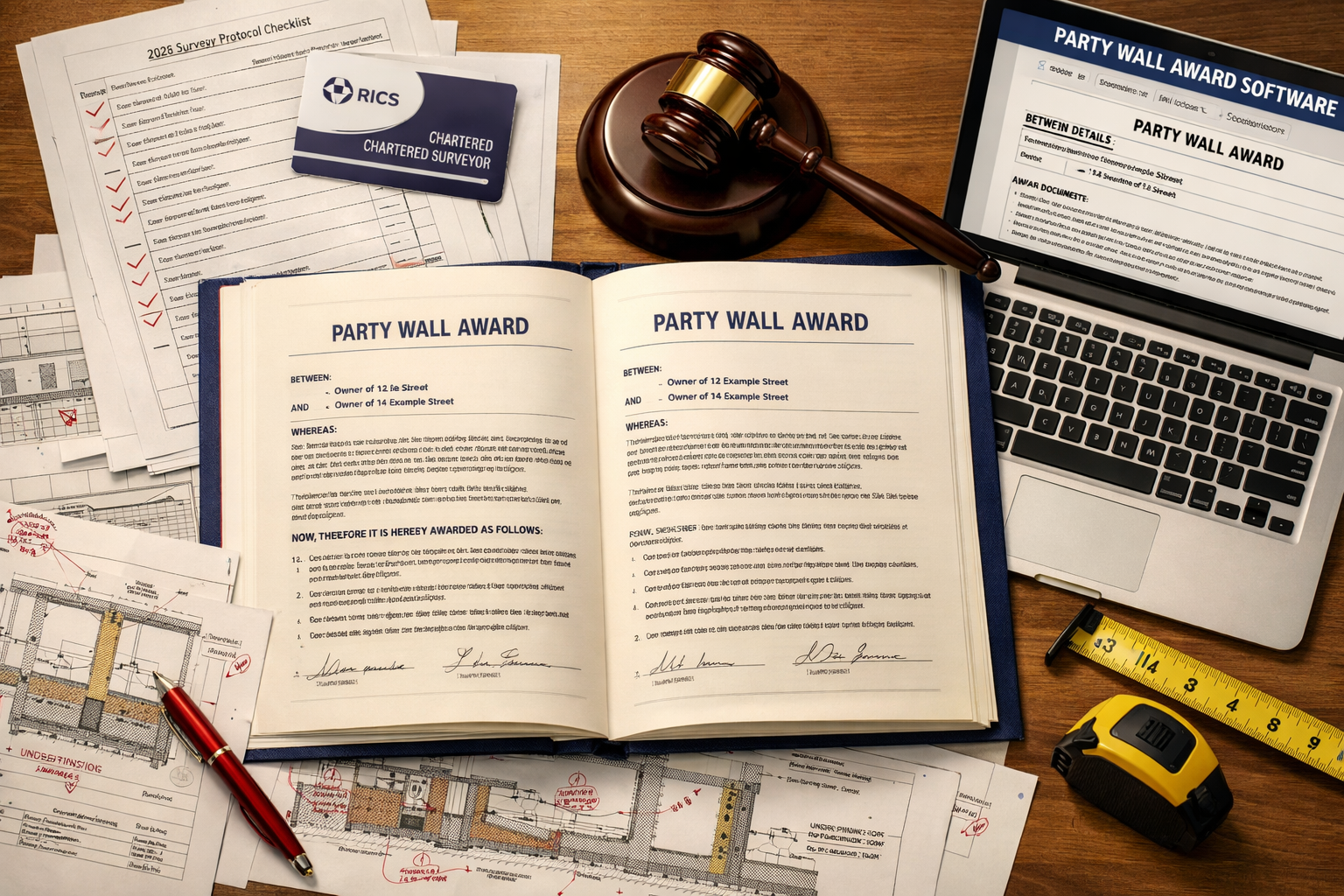
    () flat-lay overhead composition of a party wall award legal document spread open on architect's desk surrounded by 2026

    A party wall award is the formal legal document that resolves disputes and sets out the rights and obligations of both parties during the works. For basement excavations specifically, the award must go well beyond the standard template.

    Essential Clauses for Basement Excavation Awards

    📄 Standard clauses (all awards):

    • Identity of the building owner and adjoining owner
    • Description of the notifiable works
    • Working hours and access provisions
    • Damage liability and dispute resolution

    🏗️ Basement-specific clauses (2026 protocols):

    • Monitoring requirements: Specifying crack monitoring gauges, settlement pins, or inclinometers to be installed and read at defined intervals
    • Groundwater management: Requirements for dewatering and its impact on neighbouring foundations
    • Structural engineer sign-off: Requiring a structural engineer to approve temporary works before each stage of excavation
    • Notification triggers: Defining what level of movement or cracking requires work to stop
    • Reinstatement obligations: Detailed specification for making good any damage caused
    • Insurance confirmation: Evidence of adequate contractor insurance before works commence

    💡 Pull Quote: “A well-drafted party wall award for a basement excavation is not a formality — it is the primary legal instrument protecting both neighbours throughout a high-risk construction process.”

    For a comprehensive overview of what these documents contain, the party wall contract template guide on party wall awards provides useful context.


    2026 Surveyor Protocols: What Has Changed?

    The profession has evolved significantly in response to the increasing complexity of basement projects. Key 2026 protocols reflect both technological advances and lessons learned from high-profile disputes.

    Digital-First Documentation

    Surveyors are now routinely using:

    • Drone surveys for external condition assessments in tight urban plots
    • 3D laser scanning to capture precise pre-works geometry
    • Digital crack monitoring systems with automated alerts
    • Cloud-based award management platforms for multi-party coordination

    Agreed Surveyor vs. Two-Surveyor Approach

    For complex basement projects, the choice of surveyor structure matters:

    Approach Pros Cons
    Agreed Surveyor (single surveyor for both parties) Cost-effective, faster Perception of conflict of interest
    Two Surveyors (one each) Independent representation Higher cost, potential for dispute
    Third Surveyor (appointed in advance) Resolves deadlock Only engaged if needed

    For adjoining owners concerned about protecting their interests, understanding the role of an adjoining owner’s surveyor is essential before consenting to any arrangement.

    Costs in 2026

    Party wall awards for basement excavations are among the most expensive in the residential sector. A standard award costs approximately £1,000, but basement excavation awards — with their additional complexity — often run to £1,500–£3,000 or more per award. Surveyor hourly rates typically range from £150 to £200. [3]

    Factors that increase costs include:

    • Multiple adjoining owners (e.g., terraced properties with neighbours on both sides)
    • Disputes requiring third surveyor involvement
    • Complex structural engineering input required
    • Extended monitoring periods

    For practical advice on managing expenditure, the guide on how to keep party wall costs down offers actionable strategies.


    Common Mistakes That Invalidate Awards or Trigger Injunctions

    Even experienced contractors make errors that create legal exposure. The most common include:

    1. Starting work before the notice period expires — the one-month minimum for Section 6 notices is non-negotiable. [1]
    2. Serving notices without adequate plans — vague or incomplete drawings render notices invalid. [2]
    3. Failing to identify all adjoining owners — owners of properties below (e.g., basement flats) and above must all be notified.
    4. Ignoring the 45-degree rule — assuming horizontal distance alone determines the trigger is a frequent and costly error. [1]
    5. Proceeding without a schedule of condition — leaves the building owner exposed to unverifiable damage claims.

    Those carrying out works should review the dedicated guidance for building owners undertaking party wall works before serving any notices.


    Regional Considerations: London’s Unique Basement Challenge

    London presents specific challenges that make party wall compliance particularly critical for basement projects:

    • High density of Victorian terraced housing with shallow, often unmortared rubble foundations
    • London clay geology creating elevated subsidence and heave risk
    • Groundwater complexity in areas like Islington, Hackney, and Southwark
    • Conservation area restrictions adding planning constraints alongside party wall obligations

    Whether a project is in North London, South London, East London, or West London, local ground conditions and property stock characteristics should inform the structural risk assessment from the outset.


    Conclusion: Actionable Next Steps for 2026 Basement Projects

    Party Wall Awards for Basement Excavations: Depth Calculations, Structural Risk Assessment, and 2026 Surveyor Protocols represent a high-stakes intersection of law, engineering, and professional practice. Getting it right protects property values, neighbourly relationships, and legal standing.

    Here are the concrete steps to take before breaking ground:

    Step 1: Engage a qualified party wall surveyor at the design stage — before planning permission is even submitted. Early identification of trigger distances prevents costly redesigns later.

    Step 2: Commission a trial pit or structural engineer’s report to establish the adjoining property’s foundation depth. Do not rely on assumptions.

    Step 3: Serve valid Section 6 notices with complete plans and sections at least one month before the intended start date. [1]

    Step 4: Agree on a schedule of condition for all adjoining properties before any excavation begins.

    Step 5: Ensure the party wall award contains all basement-specific clauses — monitoring protocols, notification triggers, and reinstatement obligations.

    Step 6: Maintain open communication with adjoining owners throughout the project. Disputes are far more expensive than proactive engagement.

    The complexity of basement excavation work demands expert guidance. Working with experienced surveyors who understand both the legal framework and the structural engineering realities of deep excavation is the single most effective risk mitigation strategy available in 2026.


    References

    [1] Excavation And The Party Wall Act Navigating The 3 And 6 Metre Rules For Foundations – https://www.partywallslimited.com/blog/excavation-and-the-party-wall-act-navigating-the-3–and-6-metre-rules-for-foundations

    [2] Party Wall Act Notices For Excavations Near Boundaries Serving Valid Notices To Avoid Injunctions In 2026 – https://nottinghillsurveyors.com/blog/party-wall-act-notices-for-excavations-near-boundaries-serving-valid-notices-to-avoid-injunctions-in-2026

    [3] Party Wall Agreement – https://hoa.org.uk/advice/guides-for-homeowners/i-am-improving/party-wall-agreement/

    [4] Party Wall Survey Guide – https://strutsurveyors.com/party-wall-survey-guide/

  • London Extensions Party Wall 2026: Complete Homeowner Guide

    Since the November 2025 Budget introduced a high-value council tax surcharge and the March 2026 Spring Statement left stamp duty thresholds stagnant, London estate agents have reported a sharp uptick in homeowners choosing to extend rather than move. That decision — sensible as it is — triggers one of the most misunderstood pieces of legislation in UK property law: the Party Wall etc. Act 1996. Getting it wrong can halt your build, expose you to injunctions, and sour neighbourly relations for years.

    This guide cuts through the complexity of London extensions party wall 2026, covering every notice type, timeline, and cost question you are likely to face.


    Key Takeaways 🏠

    • Three sections of the Act (1, 2, and 6) cover different works — knowing which applies to your project determines your notice period.
    • Two-month notice is required for party structure works; one-month notice applies to adjacent excavations.
    • A neighbour’s dissent triggers the Party Wall Award procedure — this is normal and legally protective for both sides.
    • The building owner typically pays surveyor fees, but this is not absolute.
    • Party wall procedure runs entirely separately from planning permission and building regulations — you may need all three simultaneously.

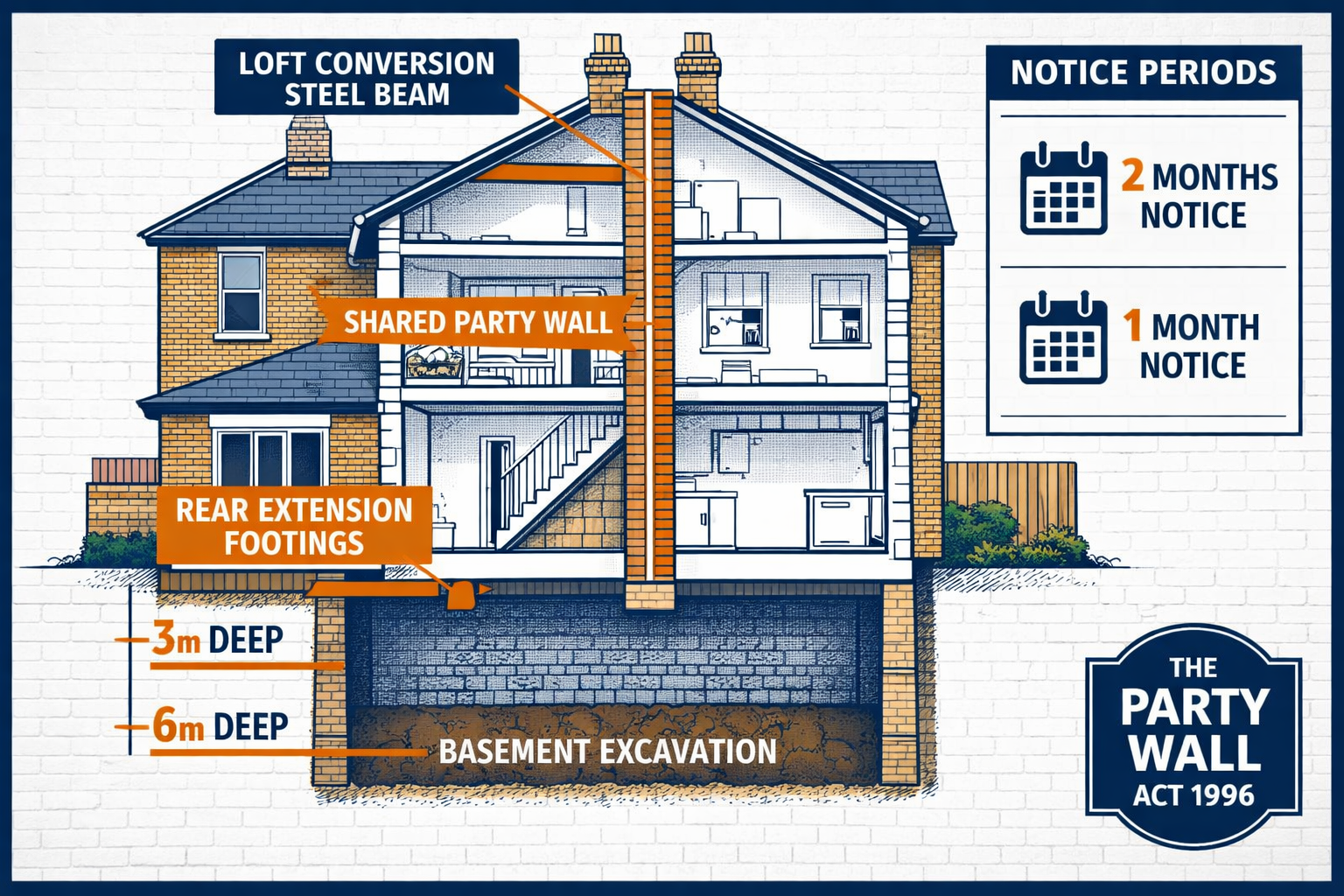
    Detailed () editorial infographic illustration showing a cross-section diagram of a London Victorian terraced house with


    What the Party Wall etc. Act 1996 Actually Covers

    The Act creates a legal framework for three categories of work, each governed by a different section:

    Section Work Type Notice Required
    Section 1 New wall on or astride the boundary line 1 month
    Section 2 Works to an existing party wall or structure 2 months
    Section 6 Excavations within 3 m or 6 m of a neighbour’s structure 1 month

    💡 Pull quote: “The Act applies even to work entirely on your own land — a fact that catches many London homeowners off guard.”

    A critical point: party wall procedure is completely separate from planning permission and building control. Your architect secures planning approval, your structural engineer deals with building control, and your party wall surveyor handles the Act — all three can run concurrently. Skipping any one of them creates legal exposure.

    For a deeper look at how the legislation works in practice, see our overview of the Party Wall etc. Act 1996.


    When Is a Party Wall Notice Required? London Scenarios Explained

    Loft Conversions

    Most London loft conversions involve cutting into a party wall to insert steel beams (flitch beams or padstones). This is notifiable under Section 2. You must serve a Party Structure Notice at least two months before work begins.

    Design and planning alone typically takes two to four months, followed by four to six weeks for technical drawings — so factor notice periods into your programme from day one. Learn more about what a Party Structure Notice is and how to serve it in London.

    Rear Extensions

    A single-storey rear extension on a mid-terrace or semi-detached property often involves:

    • Section 2 works if the rear wall being demolished or altered is a party wall.
    • Section 6 works if new footings are excavated within 3.0 metres of the neighbour’s structure and deeper than their foundations.

    Rear extensions in London typically cost £35,000–£75,000. Given that investment, a procedural error that triggers an injunction is a risk no one can afford.

    Basement Digs 🏗️

    Basement excavations are the most notice-intensive London project type. Deep digs routinely engage both Section 2 and Section 6. Under Section 6, excavation is notifiable if it falls within 3.0 metres of an adjoining structure and is deeper than that structure’s foundations — or within 6.0 metres if a 45-degree line from the base of the neighbour’s foundations intersects your excavation. Basement projects can extend the overall build timeline to well over 12 months.

    New Boundary Wall (Section 1)

    Building a new wall on the boundary line — rather than just inside your own land — requires a one-month notice under Section 1. This is common in London side-return extensions. Our guide on boundary wall rules and the difference between a party fence wall and a boundary wall explains the distinctions clearly.


    Notice Periods: 2 Months vs 1 Month

    Notice Type Relevant Section Minimum Notice Period
    Party Structure Notice Section 2 2 months
    Line of Junction Notice Section 1 1 month
    Adjacent Excavation Notice Section 6 1 month

    The two-month notice period for Section 2 works is non-negotiable. Starting work before the period expires — even with a neighbour’s verbal agreement — leaves you legally exposed. Always serve notices in writing. For guidance on how to serve party wall notices and how to respond, our dedicated resource walks through every step.


    Dissent, Consent, and the Party Wall Award Procedure

    Once a notice is served, the adjoining owner has 14 days to respond. Three outcomes are possible:

    1. Consent — work may proceed; no Award needed.
    2. Dissent (appointing own surveyor) — the two surveyors (or an Agreed Surveyor) draw up a Party Wall Award.
    3. 🔇 No response — deemed dissent after 14 days; the Award procedure is triggered automatically.

    What Is a Party Wall Award?

    A Party Wall Award is a legally binding document that sets out:

    • The scope and method of the notifiable works
    • A schedule of condition recording the adjoining property’s pre-works state
    • Working hours and site access arrangements
    • Compensation provisions if damage occurs

    Dissent is not hostile — it is simply the statutory mechanism that protects both parties. For a full explanation, visit our page on Party Wall Awards.

    Agreed Surveyor vs Two Surveyors

    Both owners can appoint a single Agreed Surveyor to act impartially for both parties — this is typically faster and cheaper. If each party appoints their own surveyor and those two cannot agree, they select a Third Surveyor whose determination is binding. Our guide on keeping party wall costs down explains when an Agreed Surveyor makes financial sense.


    Who Pays the Surveyor Fees?

    The general rule under the Act is that the building owner (the person carrying out the works) pays the reasonable surveyor fees of both parties. However, there are exceptions:

    • If the adjoining owner’s own works contributed to the need for repairs, costs may be apportioned.
    • An unreasonably obstructive adjoining owner may bear some costs at the surveyors’ discretion.

    For a full breakdown of what to expect financially, see our costs of party wall and the process page.


    London Extensions Party Wall 2026: Regional Considerations

    London’s dense, mixed-tenure housing stock creates party wall scenarios that are more complex than anywhere else in England and Wales. Whether you are in a Victorian terrace in East London, a mansion flat in Central London, or a 1930s semi in South London, the Act applies equally — but the physical conditions vary enormously.

    Common London-specific complications include:

    • Shallow Victorian foundations that make even modest rear extensions notifiable under Section 6
    • Converted flats where the party structure is a floor/ceiling rather than a wall
    • Leasehold complications requiring freeholder consent alongside party wall notices
    • Multiple adjoining owners on corner plots or mid-terrace properties

    London Extensions Party Wall 2026: Your Action Checklist ✅

    Before breaking ground on any London extension in 2026, work through this sequence:

    1. Identify which sections apply to your specific works (Sections 1, 2, and/or 6).
    2. Appoint a party wall surveyor early — ideally during the design stage.
    3. Serve the correct notice with the required lead time (1 or 2 months).
    4. Await the response — 14 days for consent or deemed dissent.
    5. Agree on an Agreed Surveyor where possible to reduce costs and delays.
    6. Commission a schedule of condition before works commence.
    7. Keep copies of all correspondence — the Award is a legal document.

    If you are the neighbour receiving a notice, visit our adjoining owners page to understand your rights.


    Conclusion: Act Early, Build Confidently

    The surge in London home extensions in 2026 — driven by stamp duty inertia and council tax pressures — means party wall surveyors across the capital are in high demand. The single biggest mistake homeowners make is treating the Party Wall etc. Act 1996 as an afterthought. Notices served too late, or not at all, can result in injunctions that freeze your entire project.

    Your actionable next steps:

    • Building owners: Serve your party wall notices as soon as your design is confirmed — do not wait for planning approval.
    • Adjoining owners: Understand that dissent is not confrontational; it gives you legal protection and a formal record of your property’s condition.
    • Both parties: Consider appointing an Agreed Surveyor to keep the process efficient and costs proportionate.

    Whether your project is in North London, West London, or anywhere across the capital, specialist party wall surveyors are available to guide you through every stage — from the first notice to the final Award.


  • Party Wall Awards in Matrimonial Disputes: Surveyor Roles and RICS

    {“cover”:”Professional landscape format (1536×1024) hero image with bold text overlay: ‘Party Wall Awards in Matrimonial Disputes: Surveyor Roles & RICS Valuation Protocols 2026’, extra large 72pt white bold sans-serif font with dark semi-transparent overlay box, centered upper-third composition. Background shows split-scene imagery: left side a brick shared party wall between two terraced houses, right side a courtroom/legal setting with documents and a surveyor’s measuring tools. Color palette: deep navy blue, white, gold accents. High contrast, editorial magazine cover quality, professional lighting.”,”content”:[“Wide-angle editorial illustration showing a professional party wall surveyor in a hard hat examining a shared brick wall between two semi-detached houses, holding a clipboard with survey documents and RICS logo visible. In the foreground, legal documents labeled ‘Party Wall Award’ and ‘Matrimonial Proceedings’ are spread on a table. Warm professional lighting, architectural photography style, 1536×1024 landscape format, color palette of slate grey, brick red, and white, conveying the intersection of construction surveying and family law.”,”Overhead flat-lay composition on a dark oak desk showing RICS valuation protocol documents, a property valuation report, a divorce petition paperwork, a surveyor’s measuring tape, pen, and reading glasses. A small architectural model of terraced housing sits in the corner. Subtle gold and navy color accents. Clean, editorial product-style photography, 1536×1024 landscape format, sharp focus on document headings including ‘Expert Witness Report’ and ‘RICS Red Book Valuation 2026’, professional legal and surveying aesthetic.”,”Split-panel infographic-style editorial image: left panel shows a timeline flowchart of the party wall award process with icons for Notice, Surveyor Appointment, Award, and Court steps in navy and gold. Right panel depicts two opposing solicitors and a neutral surveyor figure at a round table with a shared property blueprint between them, symbolizing dispute resolution. Clean modern design, 1536×1024 landscape format, professional sans-serif typography, color scheme of deep blue, white, and amber, conveying impartiality and structured legal process.”}

    Professional landscape hero image () with : "Party Wall Awards in Matrimonial Disputes: Surveyor Roles and RICS Valuation

    Fewer than 30% of divorcing couples in England and Wales who co-own a property with a shared wall ever seek specialist party wall advice — yet the condition, legal status, and outstanding awards attached to that wall can directly affect how a court divides the matrimonial estate. Understanding Party Wall Awards in Matrimonial Disputes: Surveyor Roles and RICS Valuation Protocols for 2026 is no longer a niche concern; it sits at the crossroads of construction law, property valuation, and family proceedings.

    When a marriage breaks down and the family home shares a structural wall with a neighbour’s property, the existence of a live party wall award — or the absence of one where works have already been carried out — can complicate asset division, affect property value, and even introduce expert witness obligations into court proceedings.


    Key Takeaways 📌

    • Party wall awards are legally binding documents that can affect the market value of a matrimonial property and must be disclosed during financial remedy proceedings.
    • RICS-accredited surveyors play a dual role in matrimonial disputes: as party wall surveyors under the Party Wall etc. Act 1996 and as expert witnesses providing impartial valuations.
    • Updated RICS protocols for 2026 require greater transparency around conflicts of interest when a surveyor is appointed in proceedings involving estranged co-owners.
    • Outstanding or disputed awards can delay property sales and affect settlement negotiations between divorcing parties.
    • Early specialist advice — from both a party wall surveyor and a family law solicitor — is essential when shared-wall properties are involved in divorce.

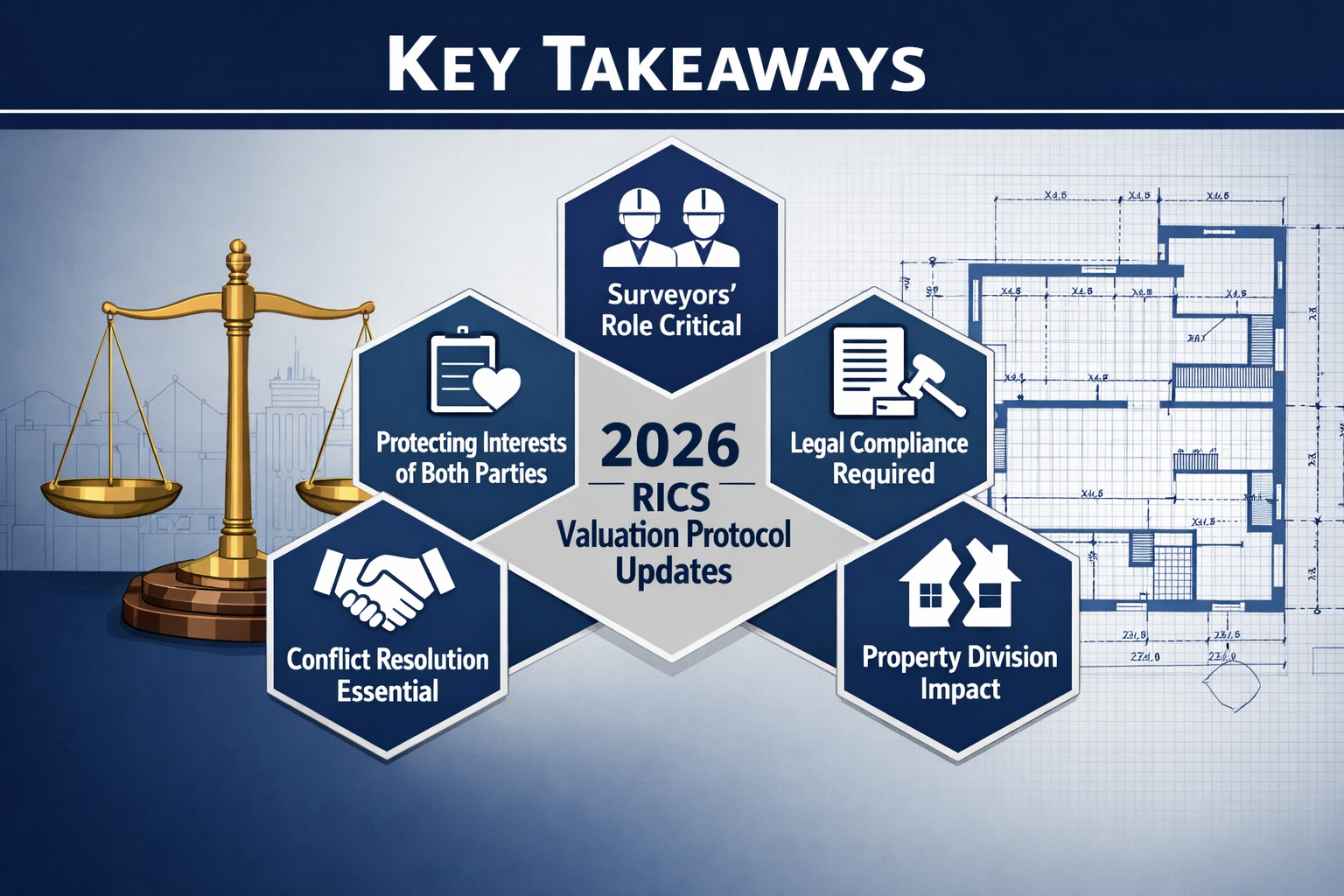
    Key Takeaways section infographic: Split-screen design with legal scales on left, property survey blueprint on right.

    What Is a Party Wall Award and Why Does It Matter in Divorce?

    A party wall award is a formal legal document produced under the Party Wall etc. Act 1996. It sets out the rights and responsibilities of both the building owner (the party carrying out works) and the adjoining owner (the neighbour) when construction affects a shared wall, boundary, or excavation near a neighbouring property [2].

    In a matrimonial context, this document becomes significant for several reasons:

    How Awards Affect Property Value

    “An unresolved party wall dispute or an outstanding award with unpaid costs can reduce a property’s marketability and its assessed value — a factor courts must consider when dividing assets.”

    When a couple separates, any property they own is subject to financial remedy proceedings. If that property has:

    • An active party wall award with ongoing obligations
    • Unpaid surveyor fees attached to a previous award
    • Damage claims arising from notified works
    • A schedule of condition dispute with the adjoining owner

    …then the property’s net value for division purposes may be lower than its headline market price. Solicitors and family courts increasingly rely on RICS-accredited surveyors to clarify these liabilities [4].

    The Party Wall Act and Co-Ownership Complications

    When both spouses are registered as co-owners of a property, they are jointly considered the “building owner” or “adjoining owner” under the Act. Separation creates an immediate problem: one party may want to proceed with notified works while the other does not. This disagreement can trigger the dispute resolution mechanism under the Act, requiring the appointment of surveyors — even between estranged spouses.

    Understanding party wall notices and how to respond to them is a critical first step for any divorcing homeowner with shared-wall obligations.


    Surveyor Roles in Matrimonial Proceedings: Party Wall Awards in Matrimonial Disputes

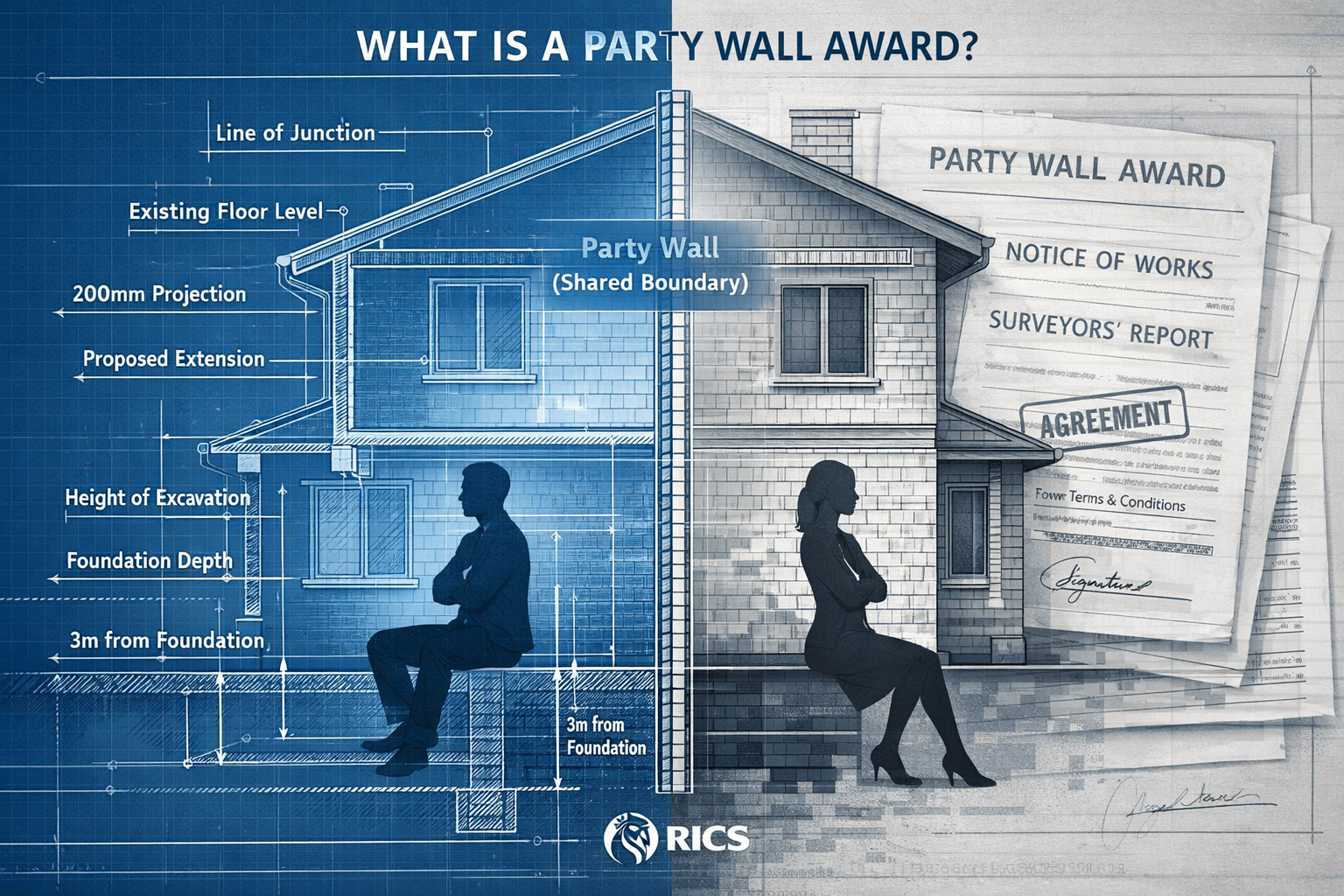
    Conceptual illustration for 'What Is a Party Wall Award' section: Split property visualization showing two adjacent

    The role of a surveyor in matrimonial disputes involving party wall matters is multifaceted. In 2026, RICS guidance has sharpened the distinction between three distinct functions a surveyor may perform [5]:

    1. 🏗️ The Party Wall Surveyor

    Appointed under Section 10 of the Party Wall etc. Act 1996, this surveyor’s primary duty is to the award itself — not to either party. Even in matrimonial disputes, the surveyor’s statutory obligation is to act impartially and resolve the dispute between building and adjoining owners.

    Key responsibilities include:

    • Serving or receiving party wall notices
    • Preparing and agreeing the award document
    • Producing a schedule of condition to record the pre-works state of the adjoining property
    • Determining costs and who bears them

    2. 📋 The Expert Witness

    When party wall matters become contested within financial remedy proceedings, a court may direct that a single joint expert (SJE) be appointed. This expert — typically a chartered surveyor — must comply with:

    • Civil Procedure Rules (CPR) Part 35 on expert evidence
    • RICS Practice Statement: Surveyors Acting as Expert Witnesses (4th edition, updated guidance 2026)
    • The overriding duty to the court, which supersedes any duty to the instructing party

    The expert witness role is distinct from the party wall surveyor role. A surveyor who has already acted as party wall surveyor in a dispute should not then act as expert witness in related matrimonial proceedings, as this creates a conflict of interest that RICS guidance now explicitly addresses [5].

    3. 💷 The Valuation Surveyor

    Separate from both roles above, a RICS Red Book valuation may be commissioned to establish the market value of the matrimonial property, taking into account:

    Factor Impact on Valuation
    Active party wall award May reduce value if obligations are onerous
    Unpaid party wall costs Deducted from net equity
    Damage from notified works Reduces value; may generate claim
    Completed works with valid award Neutral or positive (if works improved property)
    No award where one was required Potential legal liability; negative impact

    For divorcing couples in London, specialist local knowledge is essential. Whether the property is in East London, South London, or North London, the density of terraced and semi-detached housing means party wall issues are extremely common in matrimonial property cases.


    RICS Valuation Protocols for 2026: Key Updates for Matrimonial Cases

    The RICS Red Book Global Standards (2022, updated 2026) and the UK National Supplement contain specific provisions for matrimonial and litigation valuations. These are distinct from standard market valuations and carry additional requirements for impartiality and disclosure [5].

    What Makes a Matrimonial Valuation Different?

    A standard market valuation answers: “What would this property sell for on the open market today?”

    A matrimonial valuation must also answer:

    • What liabilities (including party wall obligations) are attached to the property?
    • Are there any outstanding awards, notices, or disputes that affect value?
    • What is the impact of any works carried out without a valid award?
    • Are there any third-party rights over the shared wall that affect the property’s use?

    “In 2026, RICS guidance requires surveyors accepting matrimonial instructions to confirm in writing that they have no prior involvement with either party in a party wall capacity — a safeguard that protects the integrity of the valuation.” [5]

    The Conflict of Interest Problem

    One of the most significant updates in 2026 RICS protocols relates to conflict of interest disclosure. When a surveyor has previously acted as the building owner’s surveyor or the adjoining owner’s surveyor in a party wall matter, they must:

    1. Disclose this prior involvement to the court or instructing solicitors
    2. Confirm whether the prior role affects their ability to provide an impartial valuation
    3. Stand aside if a conflict cannot be adequately managed

    This is particularly relevant in London, where the same surveying firms often handle both party wall and valuation work in the same neighbourhoods.

    Practical Steps for Solicitors and Parties in 2026

    Family law solicitors handling matrimonial property cases in 2026 should routinely:

    • ✅ Request copies of all party wall notices and awards from both parties
    • ✅ Commission a RICS-compliant matrimonial valuation that explicitly addresses party wall liabilities
    • ✅ Instruct a party wall surveyor to review any outstanding awards before settlement
    • ✅ Check whether works were carried out without proper notice — a common issue that creates hidden liabilities [3]
    • ✅ Consider whether the party wall award affects the property’s saleability for the purposes of a clean-break settlement

    Navigating the Process: A Step-by-Step Guide

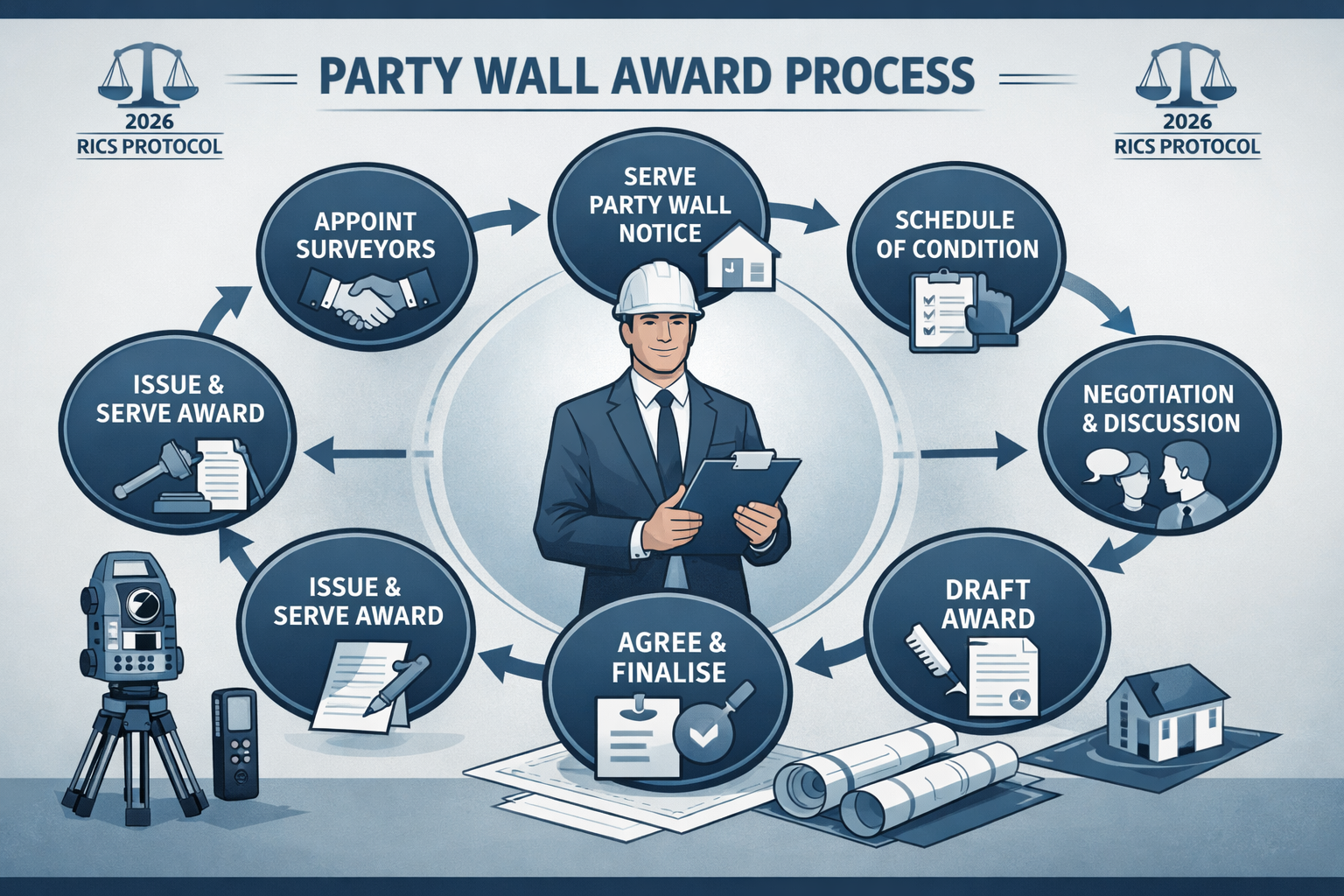
    Surveyor Roles visualization: Professional workflow diagram showing step-by-step process of Party Wall Award assessment.

    Understanding the practical workflow helps both divorcing parties and their legal advisers manage party wall issues efficiently within matrimonial proceedings.

    Step 1: Identify All Party Wall Matters

    Before any financial settlement is reached, both parties should disclose:

    Step 2: Appoint the Right Surveyor

    The surveyor appointed must be:

    • RICS-accredited and experienced in both party wall work and matrimonial valuations
    • Free from conflicts of interest with either party or their legal representatives
    • Willing to act as a single joint expert if directed by the court

    For properties in Central London or West London, where high-value properties with complex party wall histories are common, specialist expertise is especially important.

    Step 3: Commission the Award Review and Valuation

    The surveyor should:

    1. Review all existing party wall documentation
    2. Inspect the shared wall and any works carried out
    3. Identify any outstanding liabilities or unresolved disputes
    4. Produce a written report suitable for use in financial remedy proceedings

    Step 4: Factor Costs Into the Settlement

    Party wall surveyor fees and any outstanding award costs must be accounted for in the financial settlement [3]. Understanding how party wall costs are structured helps solicitors ensure that these liabilities are properly reflected in any proposed division of assets.


    Common Pitfalls and How to Avoid Them ⚠️

    Several recurring mistakes arise when party wall matters intersect with matrimonial proceedings:

    1. Failing to disclose existing awards
    An award is a legal document that runs with the land. Failing to disclose it during financial remedy proceedings can amount to non-disclosure of a material fact.

    2. Proceeding with works during separation
    One spouse instructing building works on a shared property during separation — without the other’s agreement and without proper party wall notices — can create significant legal and financial complications [2].

    3. Confusing the surveyor’s roles
    Using the same surveyor as both party wall surveyor and expert witness in the same proceedings is a conflict of interest that can undermine both the award and the court’s reliance on the evidence [5].

    4. Ignoring the impact on sale proceeds
    If the matrimonial home is to be sold as part of the settlement, any unresolved party wall disputes can delay the sale or reduce the achievable price — directly affecting both parties’ financial outcomes [4].

    5. Not seeking specialist advice early
    The earlier a party wall surveyor is involved in matrimonial proceedings, the more efficiently issues can be resolved. Late disclosure of party wall liabilities has derailed otherwise agreed financial settlements.


    Conclusion: Actionable Next Steps for 2026

    Party Wall Awards in Matrimonial Disputes: Surveyor Roles and RICS Valuation Protocols for 2026 represent a genuinely specialist area where property law, construction law, and family law converge. The stakes are high: unresolved party wall matters can reduce property values, delay settlements, and introduce expert witness complications into already difficult proceedings.

    Here are the most important actions to take right now:

    1. Instruct a RICS-accredited party wall surveyor immediately if there is any shared wall, boundary, or excavation issue connected to the matrimonial property — do not wait until settlement negotiations are advanced.

    2. Disclose all party wall notices and awards to your family law solicitor at the earliest opportunity. These are material documents in financial remedy proceedings.

    3. Commission a matrimonial-specific RICS valuation that explicitly addresses party wall liabilities, not just a standard market appraisal.

    4. Ensure your surveyor confirms no conflict of interest in writing before accepting instructions, in line with updated 2026 RICS protocols.

    5. Seek specialist family law advice from solicitors experienced in matrimonial property disputes, particularly those familiar with the Party Wall etc. Act 1996 and its interaction with financial remedy proceedings.

    The intersection of party wall law and matrimonial proceedings is complex — but with the right expert guidance, it is entirely manageable. Early action protects both parties’ interests and keeps the path to settlement as clear as possible.


    References

    [1] Party Wall Agreement – https://www.contractscounsel.com/t/us/party-wall-agreement

    [2] Party Wall Agreement – https://hoa.org.uk/advice/guides-for-homeowners/i-am-improving/party-wall-agreement/

    [3] Party Wall Disputes – https://collyerbristow.com/real-estate/real-estate-disputes/party-wall-disputes/

    [4] Buying Property Party Wall Award – https://osborneslaw.com/blog/buying-property-party-wall-award/

    [5] Party Wall Surveys And Neighbour Disputes During 2026s Construction Uptick Rics Compliance Framework – https://nottinghillsurveyors.com/blog/party-wall-surveys-and-neighbour-disputes-during-2026s-construction-uptick-rics-compliance-framework

    [6] Nysba Family Law Section Update January 2026 – https://nysba.org/wp-content/uploads/2026/01/NYSBA-Family-Law-Section-Update-January-2026.docx

  • Digital Tools Transforming Party Wall Notices: SurvPal and FPWS Tech

    Digital tools transforming party wall notices SurvPal FPWS Tech 2026

    Nearly one in three party wall disputes in England and Wales stems not from a genuine disagreement between neighbours — but from a notice that was served incorrectly, too late, or not at all. That single administrative failure can halt a construction project for weeks, trigger costly legal proceedings, and destroy neighbourly relations in an instant. As the UK construction sector faces a wave of mandatory process reforms [1], the case for purpose-built digital tools has never been stronger.

    Digital Tools Transforming Party Wall Notices: SurvPal and FPWS Tech for 2026 Compliance represents a genuine shift in how surveyors, building owners, and adjoining owners manage one of the most legally sensitive parts of any domestic or commercial build. Platforms like SurvPal and FPWS Tech are being recommended by experienced practitioners precisely because they reduce the human error that paper-based workflows invite — and because busy London markets simply cannot afford the delays that errors cause.


    Key Takeaways 📌

    • SurvPal and FPWS Tech are purpose-built platforms that automate notice serving, deadline tracking, and award documentation under the Party Wall etc. Act 1996.
    • Digital notice tools dramatically reduce the risk of invalid service — one of the most common and costly pitfalls in party wall practice.
    • Automation features such as templated notices, e-signature capture, and real-time compliance dashboards are reshaping surveyor workflows in 2026.
    • Building owners and adjoining owners both benefit: faster turnaround, clearer audit trails, and reduced professional fees.
    • Adopting verified digital platforms does not replace the need for a qualified surveyor — it makes their work faster, more accurate, and more defensible.

    Why Paper-Based Party Wall Notices Are Failing in 2026

    The Party Wall etc. Act 1996 imposes strict procedural requirements. Notices must be served within specific timeframes, contain prescribed information, and be delivered to the correct parties. Miss any element, and the notice is invalid — full stop.

    For decades, this process relied on printed templates, recorded post, and manual diary reminders. That approach was workable when transaction volumes were lower. Today, it is a liability.

    “The volume of notifiable works in London alone has increased sharply as permitted development rights expanded. A paper system simply cannot keep pace.” — Industry observation, 2026

    The 2026 homebuying and construction reform agenda is accelerating the pressure further. Mandatory upfront surveys and faster transaction timelines mean surveyors are handling more files simultaneously [1]. A single missed deadline on a party wall notice can cascade into project delays measured in months, not days.

    The Most Common Paper-Based Pitfalls

    ❌ Common Failure 💥 Consequence
    Wrong notice type served Invalid notice; process restarts
    Incorrect adjoining owner named Dispute over validity
    Notice served too late Statutory timeframe breached
    No proof of delivery Unenforceable in dispute
    Award not documented properly Surveyor liability exposure
    Deadline not tracked Consent period lapses unnoticed

    Understanding what a party structure notice is and how to serve it correctly is the essential first step — but knowing the rules and executing them flawlessly under time pressure are two very different challenges.


    How Digital Tools Transforming Party Wall Notices: SurvPal and FPWS Tech for 2026 Compliance Actually Work

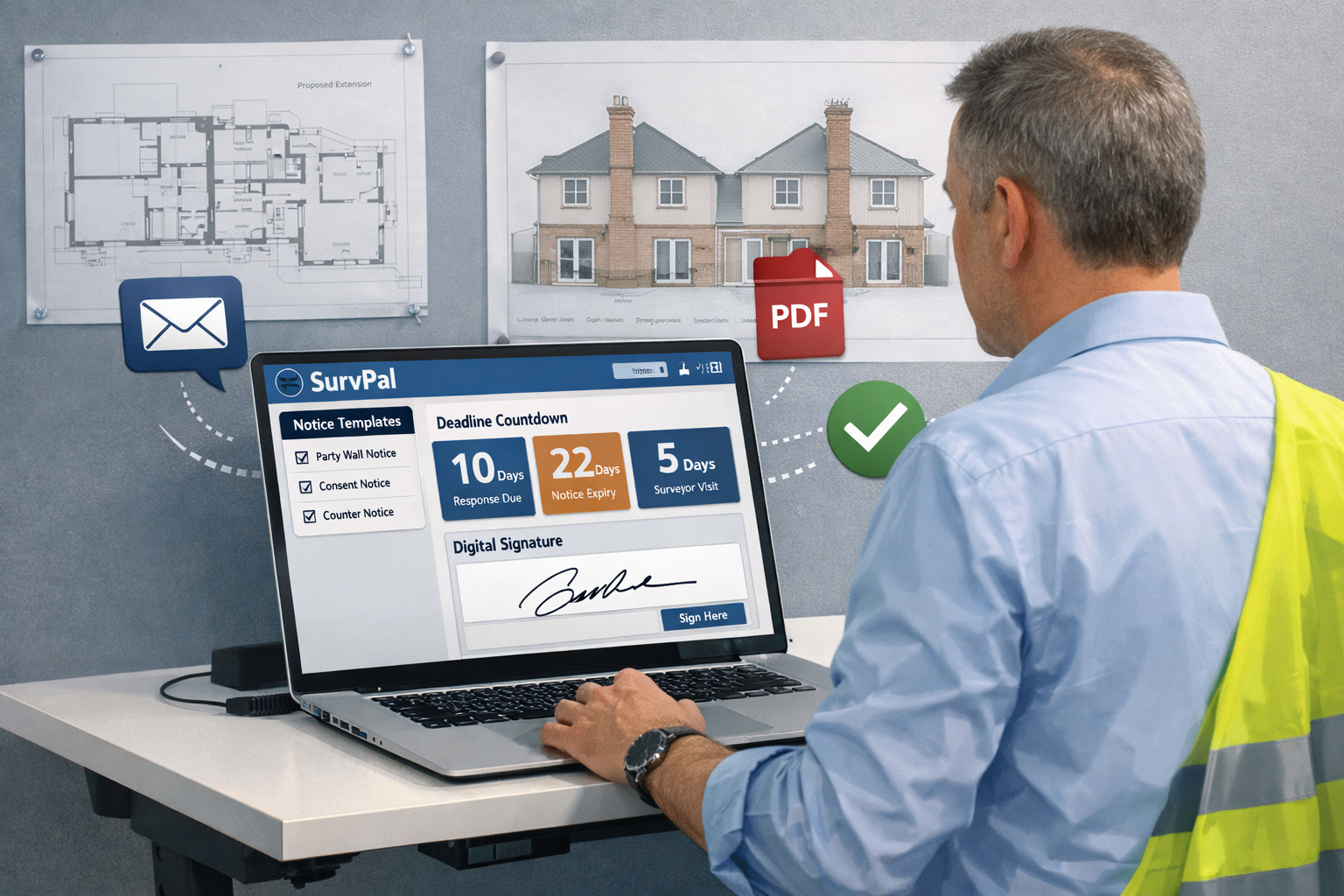
    Wide () editorial illustration showing a UK party wall surveyor at a modern standing desk using a laptop displaying the

    SurvPal: Built for the Practising Surveyor

    SurvPal is a cloud-based platform designed specifically for party wall practitioners. Its core value proposition is simple: eliminate the administrative errors that invalidate notices and delay projects. Here is what experienced surveyors highlight as its most practical features.

    🔹 Templated, Legally Compliant Notices
    SurvPal maintains an up-to-date library of notice templates — Line of Junction Notices, Party Structure Notices, and Three Metre Notices — all pre-formatted to satisfy the Act’s requirements. Users populate project-specific fields; the platform handles the legal structure.

    🔹 Automated Deadline Tracking
    Once a notice is served, SurvPal’s calendar engine automatically calculates the statutory response window (typically 14 days for consent or dissent) and fires reminders to both the building owner’s surveyor and, where applicable, the adjoining owner. No manual diary entry. No forgotten deadlines.

    🔹 Digital Delivery with Proof of Service
    The platform generates a timestamped, auditable delivery record for every notice sent. This is critical: in any dispute, the ability to prove when and how a notice was served can be the difference between a valid process and an invalid one.

    🔹 Award Document Generation
    SurvPal supports the drafting of party wall awards directly within the platform. Surveyors can attach schedules of condition, annotated photographs, and agreed working method statements — all stored in a single, shareable project file.

    🔹 Multi-Party Collaboration
    Where an agreed surveyor or two appointed surveyors are involved, SurvPal provides a shared workspace. Comments, document versions, and approval statuses are visible to all authorised parties in real time. This directly addresses the communication lag that inflates professional fees.

    FPWS Tech: Compliance Infrastructure at Scale

    FPWS Tech approaches the same problem from a slightly different angle. While SurvPal is optimised for individual surveyors and small practices, FPWS Tech is built for larger firms and developers managing multiple concurrent party wall matters.

    Key FPWS Tech capabilities include:

    • Bulk notice management — serve and track notices across dozens of properties from a single dashboard
    • Integration with BIM and project management platforms — construction technology is increasingly interconnected, and FPWS Tech plugs into existing workflows [4]
    • Automated compliance reporting — generate audit-ready compliance summaries for each project
    • Adjoining owner portal — a dedicated interface where adjoining owners can review notices, ask questions, and record consent or dissent without requiring email chains

    The adjoining owner portal is particularly significant. One of the most frustrating delays in party wall practice occurs when an adjoining owner simply does not respond — not out of objection, but out of confusion about the process. A clear, guided digital interface reduces that friction considerably.


    Preventing the Pitfalls: A Practical Comparison for Busy London Markets

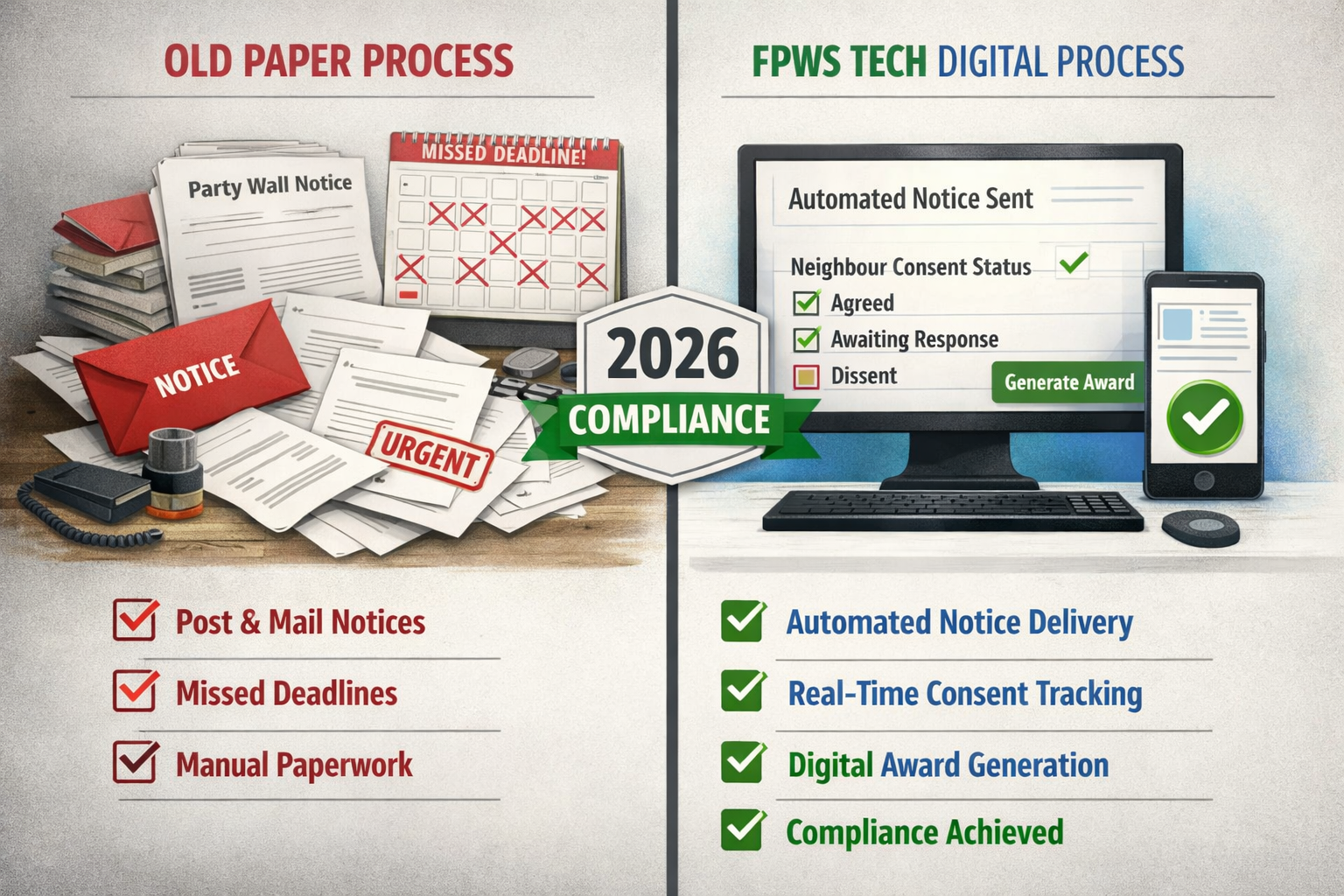
    () infographic-style illustration comparing traditional paper-based party wall notice workflow versus FPWS Tech digital

    London’s property market is uniquely demanding. Dense terraced streets mean almost every significant renovation triggers party wall obligations. Building owners in areas like North London, Central London, and South London are routinely dealing with multiple adjoining owners simultaneously — each with their own response timeline and potential for dispute.

    The cost of getting it wrong is not just financial — it is reputational. A surveyor who serves an invalid notice in a competitive market loses clients fast.

    Side-by-Side: Traditional vs. Digital Workflow

    📋 Stage 🗂️ Traditional Approach 💻 SurvPal / FPWS Tech
    Notice preparation Manual template, Word doc Auto-populated, legally verified template
    Delivery Recorded post Digital delivery + timestamped proof
    Deadline tracking Manual diary/calendar Automated alerts to all parties
    Adjoining owner response Phone/email chase Portal notification + digital consent capture
    Award drafting Word processor, email attachments Integrated drafting with condition schedule
    Document storage Local files, email threads Cloud-based, searchable, shareable
    Audit trail Partial at best Complete, timestamped, exportable

    The efficiency gains are not trivial. Practitioners report that digital platforms can reduce the administrative time per party wall matter by 30–50%, freeing surveyors to focus on the technical and legal judgements that genuinely require professional expertise.

    This matters especially when considering the costs of the party wall process. Faster, more efficient workflows mean lower professional fees — a direct benefit to building owners who are already managing tight project budgets.

    What Technology Cannot Replace

    It is worth being direct here: digital tools are not a substitute for professional expertise. The Party Wall etc. Act 1996 involves genuine legal and technical complexity. Determining the correct notice type, assessing the scope of notifiable works, and drafting an award that protects all parties requires a qualified surveyor’s judgement.

    The question of having a party wall agreement without a surveyor is one that property owners frequently raise — and while it is technically possible in limited circumstances, the risks are significant. Digital tools make the surveyor’s job more efficient; they do not make the surveyor redundant.

    Technology is reshaping construction broadly — AI, computer vision, and BIM adoption are accelerating across the sector [4], and building surveying is no exception [2]. But in a legally governed process like party wall notice service, the human professional remains accountable for the outcome.


    Integrating Digital Tools into a Party Wall Practice: Actionable Guidance

    () scene showing a close-up of a professional surveyor's hands holding a tablet displaying a schedule of condition report

    For surveyors and building owners considering the move to platforms like SurvPal or FPWS Tech, the following practical steps apply.

    For Surveyors and Practices 🏗️

    1. Audit your current workflow first.
    Before adopting any platform, map out where errors and delays most commonly occur in your current process. Is it notice preparation? Deadline tracking? Award drafting? Identify the highest-risk points.

    2. Verify legal compliance of platform templates.
    Any platform used to serve party wall notices must use templates that satisfy the Act’s requirements. Confirm that the provider updates templates in response to any legislative or case law developments.

    3. Train the whole team — not just the lead surveyor.
    Digital tools only deliver their efficiency benefits if everyone in the practice uses them consistently. Invest in onboarding time upfront.

    4. Use the audit trail actively.
    The timestamped delivery records and document histories that platforms like SurvPal generate are not just administrative convenience — they are legal protection. Make a habit of exporting and storing these records for every matter.

    5. Communicate the digital process to clients.
    Building owners and adjoining owners who understand how the digital process works are more cooperative and less likely to cause delays. A brief explainer at the outset of each matter pays dividends.

    For Building Owners 🏠

    • Ask your surveyor whether they use a digital notice management platform — it is a reasonable question and signals that you understand the process.
    • Understand the types of party wall works that apply to your project before any notice is served.
    • Keep your own copy of all digitally served notices and proof-of-delivery records.
    • Do not assume that using digital tools means the process is instant — statutory timeframes still apply, and neighbours still have the right to dissent.

    For Adjoining Owners 🏘️

    • If your neighbour’s surveyor uses a digital platform with an adjoining owner portal, engage with it promptly. Delays in responding can complicate the process unnecessarily.
    • Review the party wall notices you receive carefully — digital delivery does not reduce your rights.
    • Consider appointing your own adjoining owner’s surveyor to review the award on your behalf.

    The Broader Technology Shift in Building Surveying

    The adoption of SurvPal and FPWS Tech sits within a much larger transformation of the building surveying profession. Drones, 3D laser scanning, digital twins, and AI-assisted condition assessment are all entering mainstream practice [2]. Construction project management is increasingly software-driven, with permit tracking, compliance monitoring, and stakeholder communication all moving to integrated platforms [3].

    The construction sector is being reshaped by four converging forces in 2026: labour constraints, regulatory complexity, sustainability requirements, and digital transformation [4]. Party wall compliance is a microcosm of that broader shift.

    Firms that adopt digital tools early gain a competitive advantage — not just in efficiency, but in the quality of service they can offer. A surveyor who can demonstrate a complete, auditable digital record of every notice served and every award issued is a more credible professional than one relying on a filing cabinet and a diary.

    The homebuying reform agenda reinforces this direction of travel. As upfront surveys become mandatory and transaction timelines compress [1], the entire property profession — including party wall surveyors — will need to operate with greater speed and precision. Digital tools are not a luxury in that environment. They are infrastructure.


    Conclusion: Make the Switch Before the Deadline Catches You

    The argument for Digital Tools Transforming Party Wall Notices: SurvPal and FPWS Tech for 2026 Compliance is not abstract. It is grounded in the daily reality of a busy London surveying practice: too many notices, too many deadlines, too many adjoining owners to manage — and too much professional liability riding on every document.

    SurvPal and FPWS Tech do not promise to make party wall practice effortless. They promise to eliminate the avoidable errors — the wrong template, the missed deadline, the missing proof of service — that derail projects and damage reputations.

    ✅ Actionable Next Steps

    1. Surveyors: Trial SurvPal or FPWS Tech on your next three party wall matters and measure the time saved versus your current workflow.
    2. Building owners: Before appointing a surveyor, ask specifically whether they use a digital notice management platform and what their proof-of-service process looks like.
    3. Adjoining owners: Familiarise yourself with how party wall notices work and how to respond — digital delivery is becoming the norm.
    4. All parties: Understand the full scope of the Party Wall etc. Act 1996 — digital tools operate within this legal framework, not outside it.
    5. Practices managing volume: Evaluate FPWS Tech’s bulk management and BIM integration capabilities if you are handling multiple concurrent developments.

    The paper era of party wall practice is ending. The practices that thrive in 2026 and beyond will be those that embraced the digital shift before the compliance pressure made it unavoidable.


    References

    [1] Homebuying Process Reforms 2026 How Mandatory Upfront Surveys Will Transform Building Surveyor Workloads – https://nottinghillsurveyors.com/blog/homebuying-process-reforms-2026-how-mandatory-upfront-surveys-will-transform-building-surveyor-workloads

    [2] How Technology Is Transforming Building Surveying – https://www.bressummerark.co.uk/insights/how-technology-is-transforming-building-surveying/

    [3] Construction Technology – https://www.permitflow.com/blog/construction-technology

    [4] The 4 Forces Reshaping Construction In 2026 – https://kylenitchen.substack.com/p/the-4-forces-reshaping-construction-in-2026


  • Adjoining Owner Rights in Party Wall Awards: Case Law Evolution

    Fewer than 20% of adjoining owners in England and Wales fully understand their legal rights under a party wall award — yet those rights have been dramatically reshaped by a sequence of landmark rulings that every property owner and surveyor must now navigate. The question of Adjoining Owner Rights in Party Wall Awards: Case Law Evolution Post-Welter v McKeeve 2026 sits at the heart of modern party wall practice, demanding a clear-eyed analysis of what the courts have decided, what surveyors must do, and what neighbours can realistically enforce.

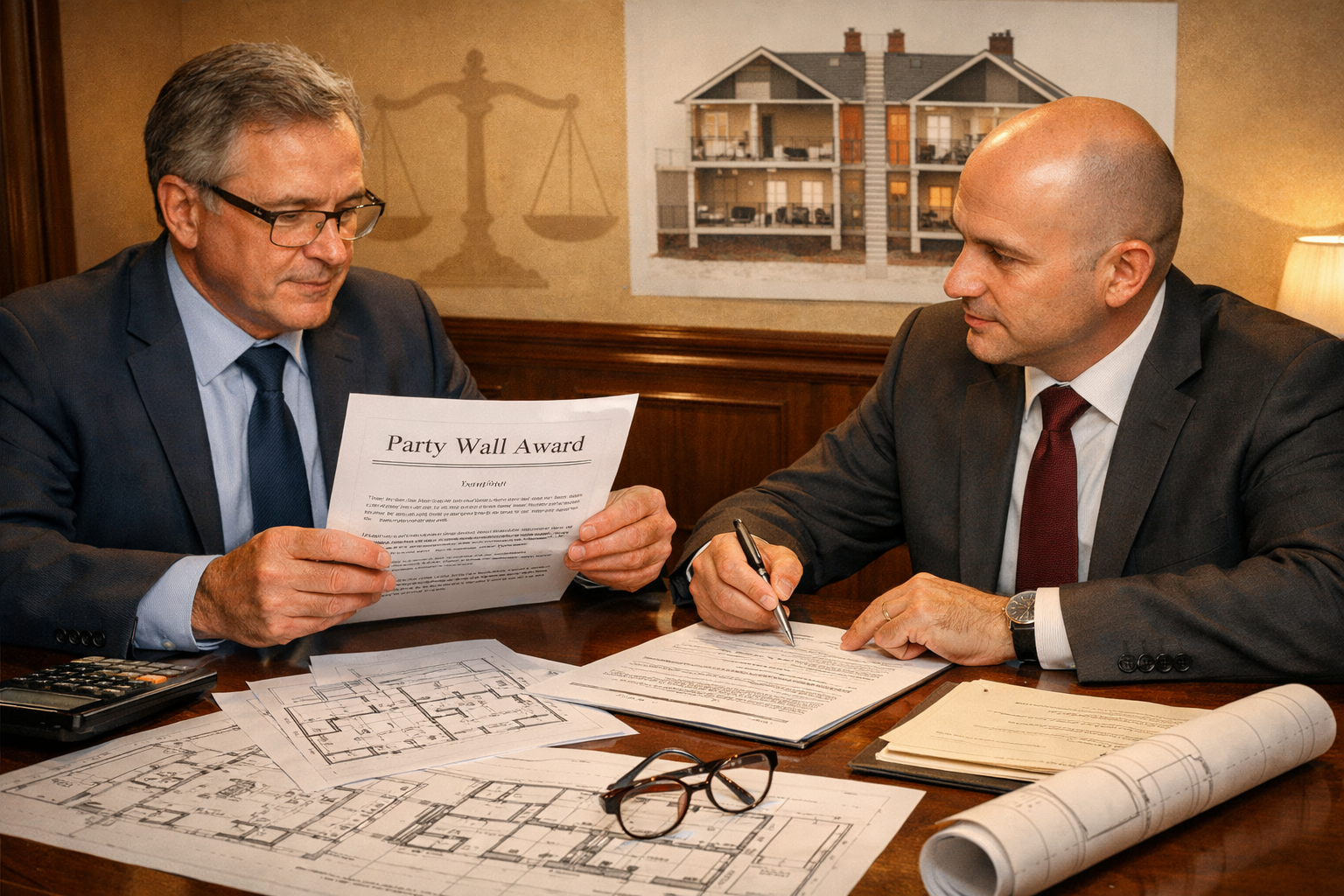
    Detailed () editorial illustration showing a formal party wall surveyor meeting scene: two professional surveyors in suits


    Key Takeaways 📋

    • Welter v McKeeve established that party wall surveyors must act impartially — they are not agents of the owner who appointed them.
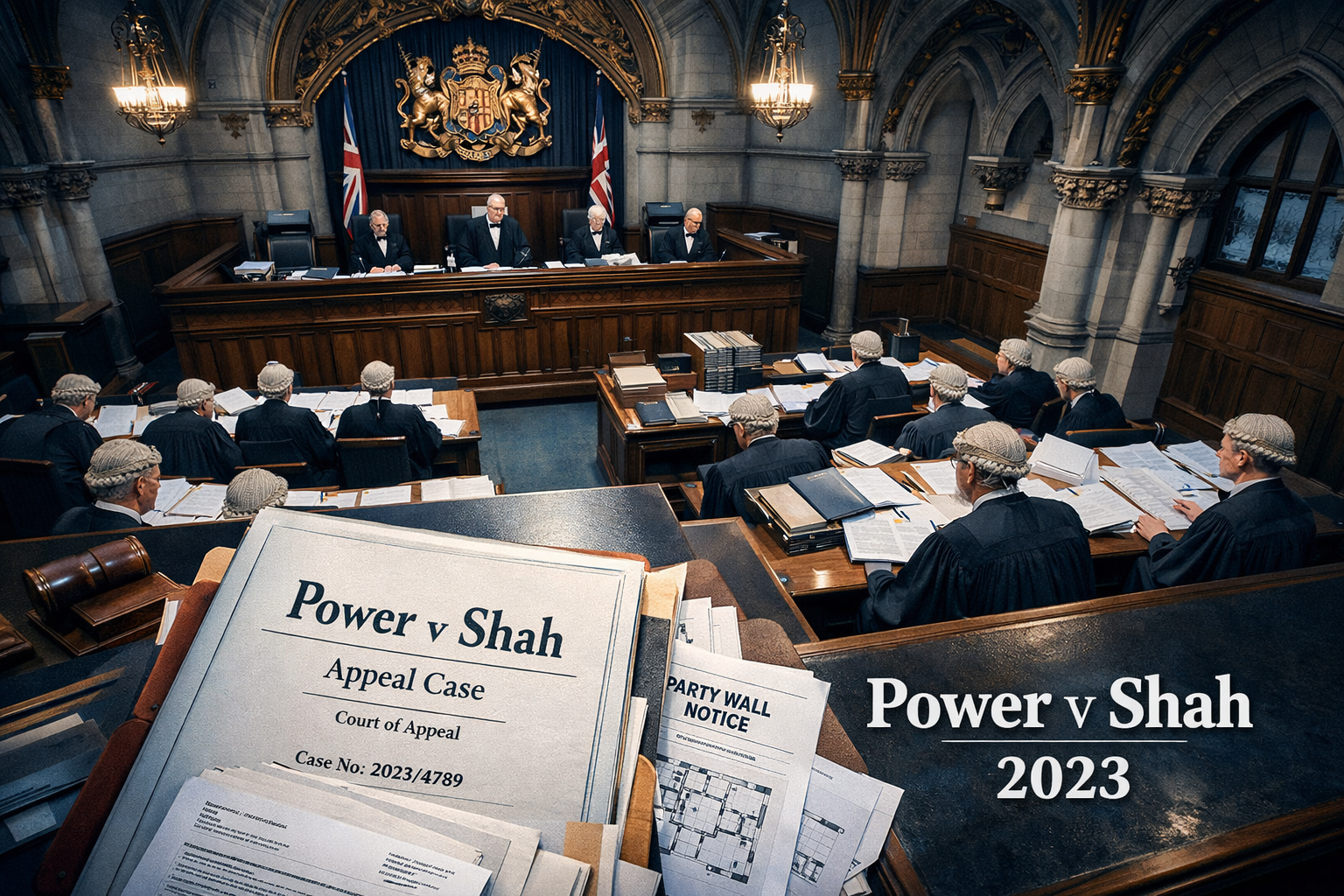
    • Power and another v Shah [2023] confirmed that adjoining owners cannot unilaterally trigger or impose a party wall award; the building owner must first serve a valid notice.
    • Adjoining owners retain powerful indirect protections through surveyor duties, schedule of condition rights, and the courts’ injunction jurisdiction.
    • Challenging a flawed award within 14 days of service remains the most effective remedy for an aggrieved adjoining owner.
    • Proactive engagement — appointing a dedicated surveyor early — is the single most impactful step an adjoining owner can take.

    Understanding the Party Wall Framework: Who Has What Rights?

    Before examining how case law has evolved, it helps to be clear on the basic structure of the Party Wall etc. Act 1996. The Act creates a statutory dispute resolution mechanism triggered by a building owner — the person proposing to carry out works. An adjoining owner is the neighbouring property owner or occupier whose land or structure may be affected.

    The Building Owner’s Monopoly on Trigger Rights

    The Act is explicit: only a building owner can serve a party wall notice and set the machinery in motion. This design choice has profound implications. It means that if a neighbour begins excavation or party wall works without serving notice, the adjoining owner cannot simply “invoke” the Act themselves and demand a surveyor-drafted award [1].

    “The Act grants building owner rights only — adjoining owners have no freestanding right to invoke the Act.” [1][3]

    This is not a loophole. It is an intentional boundary that the Court of Appeal confirmed in 2023. Understanding it is essential to knowing where an adjoining owner’s real leverage lies.

    What a Party Wall Award Actually Covers

    A party wall award is a legally binding document that sets out:

    • The scope and method of proposed works
    • Hours of working and access arrangements
    • Protective measures for the adjoining property
    • Compensation provisions for any damage caused
    • Rights to inspect and monitor during construction

    For a detailed breakdown of what these documents contain, the party wall contract template guide provides an accessible starting point.


    Welter v McKeeve and the Impartiality Principle

    The ruling in Welter v McKeeve (2018–2019) was a watershed moment for party wall practice. The case centred on whether a surveyor appointed by a building owner could act in a way that systematically favoured that owner’s interests, effectively acting as their agent rather than as an independent professional [6][7].

    What the Court Decided

    The judgment was unambiguous: party wall surveyors owe a duty of impartiality to both parties, regardless of who appointed them. A surveyor appointed solely by the building owner is not that owner’s advocate. Their function is quasi-judicial — to resolve a dispute fairly, with proper regard for the adjoining owner’s legitimate interests [6].

    Key principles from Welter v McKeeve include:

    Principle Practical Effect
    Surveyors are not agents of appointing owners Awards cannot be skewed to favour one party
    Impartiality is a statutory duty, not a courtesy Breach can invalidate an award
    Adjoining owners can challenge biased awards 14-day appeal window to the County Court
    Third surveyor appointments must be genuinely neutral Cannot be a pre-selected ally of either party

    This ruling gave adjoining owners a powerful tool: if a surveyor fails to act impartially, the award itself is vulnerable [5][7].

    Why Impartiality Matters in Practice

    Before Welter v McKeeve, some building owners treated their appointed surveyor as a hired gun — someone to produce an award that minimised restrictions on works and maximised speed of delivery. The ruling ended that approach, at least in principle. In 2026, any surveyor who drafts an award that ignores reasonable protective conditions for the adjoining property risks having that award set aside on appeal [5].

    For adjoining owners, this means the most effective strategy is appointing a dedicated adjoining owner’s surveyor as early as possible. A specialist surveyor will scrutinise the proposed works, insist on a thorough schedule of condition before works begin, and negotiate protective provisions into the award.


    Power and Another v Shah [2023]: The Limits of Adjoining Owner Rights

    If Welter v McKeeve expanded adjoining owner protections through the impartiality principle, the 2023 Court of Appeal decision in Power and another v Shah drew a firm line around what adjoining owners cannot do [1][3].

    () dynamic legal courtroom aerial perspective showing a judge's bench with the Power v Shah case documents prominently

    The Facts and the Ruling

    The case arose where an adjoining owner attempted to use the party wall machinery to compel a building owner to submit to an award, even though the building owner had not served a valid party wall notice. The Court of Appeal held that the Act does not give adjoining owners any independent right to trigger the award process [3].

    The implications are significant:

    • ❌ Adjoining owners cannot appoint surveyors and produce an award in the absence of a valid notice from the building owner
    • ❌ They cannot use the Act as a sword — only as a shield
    • ✅ They can seek an injunction from the civil courts if a building owner proceeds without notice
    • ✅ They can pursue compensation through the courts for damage caused by unlawful works [1][3]

    What This Means for Adjoining Owners in 2026

    The Power v Shah ruling clarified the landscape considerably. The Adjoining Owner Rights in Party Wall Awards: Case Law Evolution Post-Welter v McKeeve 2026 story is, in part, a story about courts defining boundaries — both literally and legally.

    For adjoining owners whose neighbours begin notifiable works without serving notice, the correct route is not to attempt to self-invoke the Act. Instead, the options are:

    1. Write to the building owner formally requesting that they serve the correct notices
    2. Seek an injunction to halt works until proper notice is served and an award is in place
    3. Document all damage meticulously for a subsequent compensation claim
    4. Contact a specialist surveyor who can advise on the appropriate legal route

    The party wall notices guide explains what valid notices look like and how they should be served — useful knowledge for any adjoining owner checking whether their neighbour has complied.


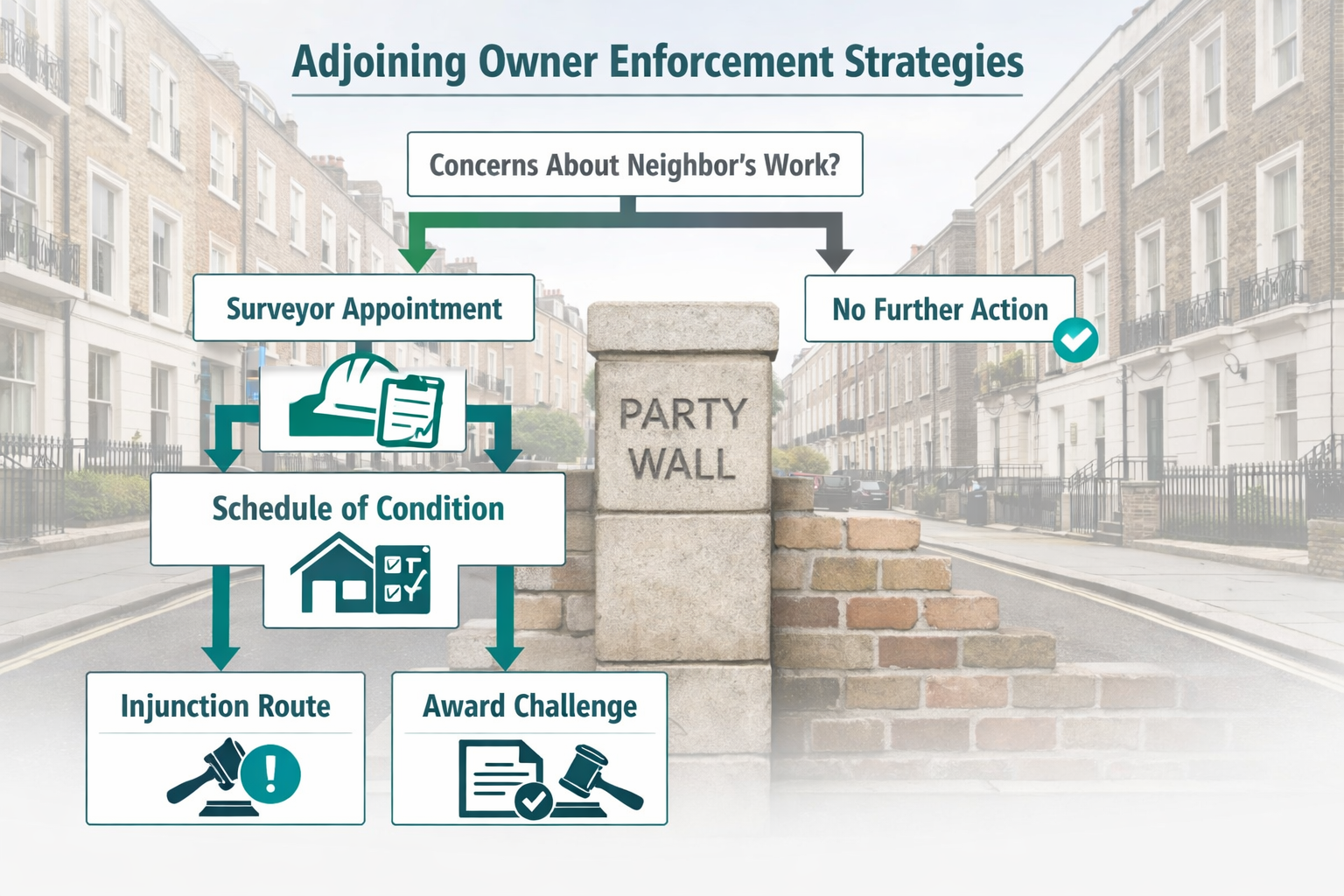
    Practical Enforcement Strategies for Adjoining Owners in 2026

    Understanding the case law is one thing. Translating it into effective action is another. The Adjoining Owner Rights in Party Wall Awards: Case Law Evolution Post-Welter v McKeeve 2026 framework points toward several concrete strategies.

    () strategic infographic-style image showing a flowchart diagram of adjoining owner enforcement strategies: branching

    Strategy 1: Appoint Early and Appoint Well

    The single most impactful decision an adjoining owner can make is appointing a qualified surveyor as soon as a party wall notice arrives. Under the Act, adjoining owners have the right to appoint their own surveyor, with costs typically borne by the building owner [2][4].

    An experienced adjoining owner’s surveyor will:

    • Review the notice for validity and completeness
    • Inspect the proposed works and identify risks
    • Negotiate protective conditions into the award
    • Ensure a comprehensive schedule of condition is prepared
    • Monitor compliance during the works

    Strategy 2: Insist on a Thorough Schedule of Condition

    A schedule of condition is a photographic and written record of the adjoining property’s state before works begin. It is the cornerstone of any compensation claim if damage occurs. Yet many adjoining owners either skip this step or accept a superficial document.

    Post-Welter v McKeeve, surveyors are expected to prepare schedules that are genuinely comprehensive — covering not just the party wall itself but floors, ceilings, windows, and any vulnerable features nearby [6][7].

    Strategy 3: Challenge Flawed Awards Promptly

    If an award is produced that fails to protect the adjoining owner’s legitimate interests — whether because a surveyor acted partially or because key conditions were omitted — the remedy is an appeal to the County Court within 14 days of the award being served [2][4].

    Key grounds for appeal include:

    • ✅ Surveyor bias or failure of impartiality (Welter v McKeeve principle)
    • ✅ Award exceeding the surveyors’ jurisdiction
    • ✅ Failure to properly assess and compensate for foreseeable damage
    • ✅ Procedural irregularities in notice service

    Pro tip: The 14-day deadline is strict. Missing it can extinguish appeal rights entirely. Always seek legal advice immediately if an award appears defective.

    Strategy 4: Use the Third Surveyor Mechanism

    Where the two appointed surveyors cannot agree, either party can refer the matter to a third surveyor — a neutral figure selected at the outset of the process. Post-Welter v McKeeve, the third surveyor’s role has been reinforced as genuinely independent [5][6].

    Adjoining owners should ensure the third surveyor is agreed upon and recorded before any dispute arises, not after — when tensions may make neutral selection more difficult.

    Strategy 5: Know When to Go to Court

    Not every dispute is best resolved through the party wall machinery. Following Power v Shah, it is clear that where a building owner has bypassed the Act entirely, the civil courts — not party wall surveyors — are the appropriate forum [1][3].

    Injunctions can be obtained relatively quickly in urgent cases, particularly where structural damage is imminent. The costs of obtaining an injunction may ultimately be recoverable from the building owner if they were clearly in breach of their statutory duties.


    The Evolving Landscape: What 2026 Practice Looks Like

    The cumulative effect of Welter v McKeeve and Power v Shah, combined with ongoing RICS guidance on surveyor impartiality [5], has produced a noticeably more sophisticated party wall practice in 2026.

    Key Shifts in Professional Practice

    Before Case Law Evolution Post-Welter/Power v Shah 2026
    Building owner’s surveyor often acted as advocate Surveyors now expected to act with genuine impartiality
    Adjoining owners sometimes attempted to self-invoke the Act Clear understanding that notice must come from building owner first
    Schedules of condition were sometimes cursory Comprehensive documentation now standard expectation
    Third surveyor selection often contentious Early agreement on third surveyor now best practice
    Award challenges were rare Adjoining owners more willing and able to appeal flawed awards

    The Role of Specialist Surveyors

    The complexity of the post-Welter landscape makes specialist knowledge more valuable than ever. Whether works involve a loft conversion, basement excavation, or rear extension, the types of party wall works that trigger the Act are varied — and the risks to adjoining properties differ significantly depending on the nature of the works.

    For London property owners specifically, accessing local expertise matters. Surveyors familiar with the specific construction challenges of North London, South London, and other areas bring practical knowledge that generic advice cannot replicate.


    Common Misconceptions About Adjoining Owner Rights

    Several myths persist in this area, often leading adjoining owners to either under-protect or over-reach their position.

    Myth 1: “I can refuse to engage and the works cannot proceed.”
    ❌ False. If an adjoining owner fails to respond to a notice within the statutory period, a deemed dispute arises and the Act’s machinery proceeds regardless.

    Myth 2: “The party wall award protects me automatically.”
    ❌ Partially false. An award only protects what it covers. A poorly negotiated award may leave significant gaps. Active engagement is essential.

    Myth 3: “I can use the Act to stop my neighbour’s works entirely.”
    ❌ False. The Act is not a veto mechanism. It regulates how works are carried out, not whether they can proceed (subject to planning and building regulations).

    Myth 4: “My neighbour’s surveyor will look after my interests.”
    ⚠️ Risky assumption. While Welter v McKeeve requires impartiality, the safest approach is always to appoint a dedicated adjoining owner’s surveyor.


    Conclusion: Actionable Next Steps for Adjoining Owners

    The Adjoining Owner Rights in Party Wall Awards: Case Law Evolution Post-Welter v McKeeve 2026 story is ultimately one of clarification and empowerment — but only for those who understand the rules. The courts have been consistent: adjoining owners cannot trigger the Act themselves, but they have robust protections once the process is engaged, provided they use them actively.

    Your Action Plan 🎯

    1. Respond to every party wall notice — do not ignore it or assume silence protects you
    2. Appoint a specialist adjoining owner’s surveyor immediately upon receiving a notice
    3. Insist on a comprehensive schedule of condition before any works begin
    4. Review every award carefully — challenge within 14 days if it fails to protect your interests
    5. If works begin without notice, seek legal advice about injunctive relief rather than attempting to self-invoke the Act
    6. Keep records of all correspondence, damage, and surveyor communications throughout

    The law has never been clearer about the boundaries of adjoining owner rights. The key is knowing those boundaries — and working effectively within them.


    References

    [1] Adjoining Owners And Party Wall Act Awards – https://www.localgovernmentlawyer.co.uk/property/313-property-features/53379-adjoining-owners-and-party-wall-act-awards

    [2] Party Walls In Case Law – https://ww3.rics.org/uk/en/journals/property-journal/party-walls-in-case-law.html

    [3] Court Of Appeal Rules That Party Wall Act Awards Cannot Be Imposed On Building Owners By Adjoining Owners – https://cornerstonebarristers.com/court-of-appeal-rules-that-party-wall-act-awards-cannot-be-imposed-on-building-owners-by-adjoining-owners/

    [4] Party Walls Articles – https://www.scribd.com/document/744214518/Party-Walls-Articles-1655710731

    [5] Party Wall Surveyors Impartiality – https://ww3.rics.org/uk/en/journals/built-environment-journal/party-wall-surveyors-impartiality.html

    [6] Welter V Mckeeve 2018 – https://stokemont.com/advice/welter-v-mckeeve-2018/

    [7] Party Wall Case Law Welter V Mckeeve – https://www.ansteyhorne.co.uk/news/party-wall-case-law-welter-v-mckeeve

    [8] Y2024v13i1p57 65 – https://ideas.repec.org/a/aza/jbsav0/y2024v13i1p57-65.html


  • Public Engagement and Notice Service Rules: RICS 8th Edition Updates

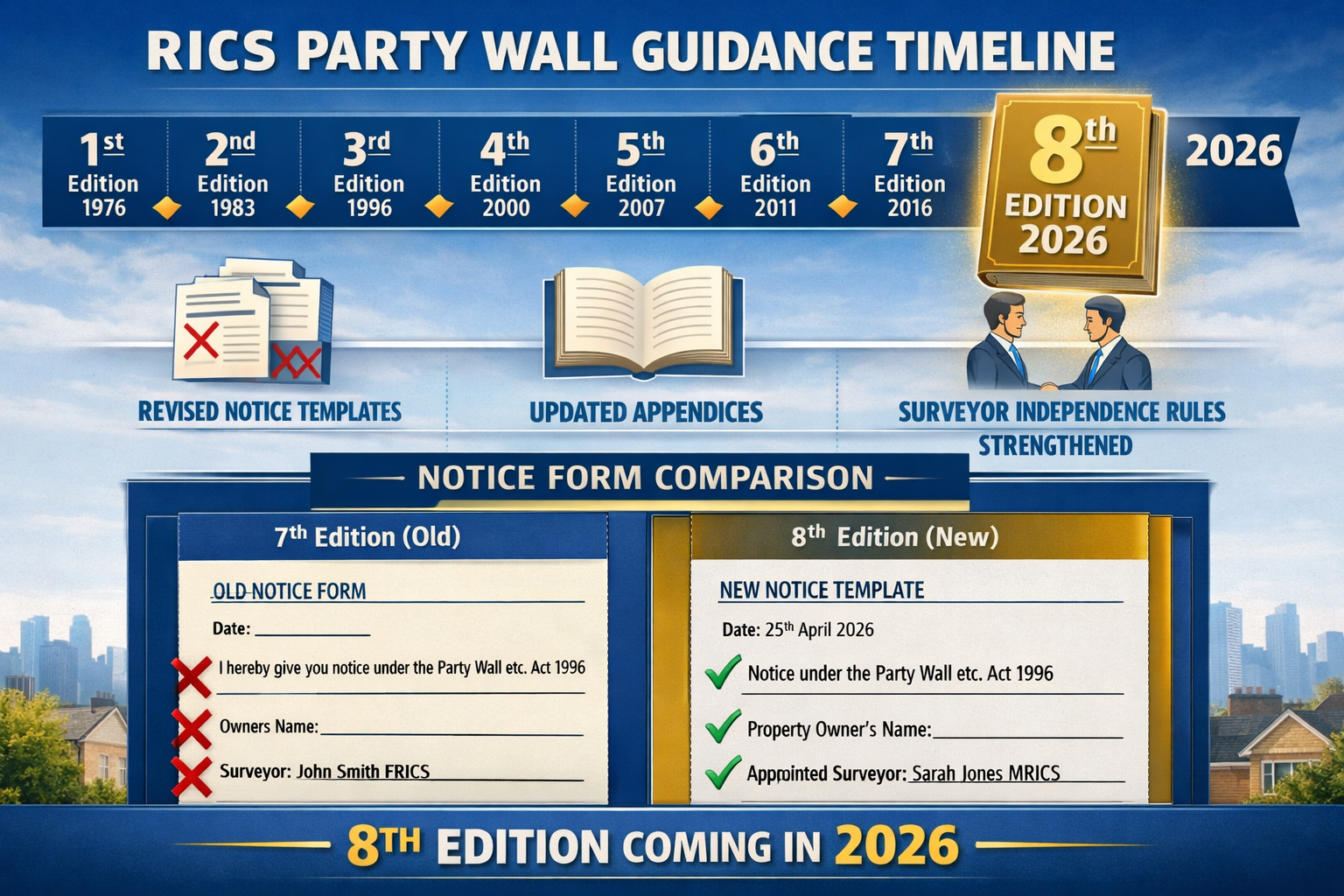
    RICS 8th Edition party wall notice service rules 2026 hero

    Fewer than one in five party wall awards challenged in UK courts are overturned on the merits of the dispute itself — the majority fail on procedural grounds, most commonly defective notice service. That single statistic explains why the RICS 8th Edition consultation, running through April and May 2026, places strengthened public engagement and notice service protocols at the heart of its proposed reforms [1][2].

    The Public Engagement and Notice Service Rules: RICS 8th Edition Updates for Party Wall Surveyors represent the most significant overhaul of professional guidance in this field since the 7th edition. The draft guidance, currently open for stakeholder feedback, targets surveyors, legal professionals, property developers, and homeowners across England and Wales — anyone with a stake in how party wall matters are initiated, managed, and resolved [1][3]. This article unpacks what those changes mean in practice, with a focus on ensuring award enforceability in 2026 and beyond.


    Key Takeaways 📋

    • The RICS 8th Edition consultation (April–May 2026) includes strengthened guidance on notice service and public engagement as part of updated regulatory and conduct requirements.
    • Awards can be — and regularly are — challenged successfully when notices are served on the wrong parties or without proper authority.
    • The draft 8th edition clarifies that a party wall surveyor’s appointment is personal and statutory, independent of client instruction, reinforcing notice service obligations.
    • Updated award templates and appointment letters are included to standardise documentation and reduce procedural vulnerabilities.
    • Surveyors, building owners, and adjoining owners all benefit from understanding these changes before works commence.

    Why Notice Service Rules Matter More Than Ever in 2026

    The Party Wall etc. Act 1996 is deceptively straightforward on paper. In practice, the chain of events from initial notice to enforceable award is riddled with procedural pitfalls. A notice served on a tenant rather than the freeholder, an award issued where no genuine dispute existed, or a surveyor acting without proper jurisdiction — any one of these errors can unravel months of professional work [1].

    The RICS 8th Edition consultation directly addresses improper jurisdiction concerns arising from cases where awards were challenged because surveyors acted without proper authority. This includes circumstances where no genuine dispute existed between parties — a scenario that has direct implications for notice service validity [1].

    💬 “The statutory appointment of a party wall surveyor is personal and independent of client instruction. This distinction is not merely academic — it defines the limits of a surveyor’s authority to act.” [2][3]

    Understanding what the Party Wall etc. Act 1996 requires is the essential starting point. The Act sets out who must be notified, when, and in what form — but it has always relied on professional guidance to fill the gaps. The 8th edition aims to close those gaps more firmly than its predecessors.

    Who Must Be Notified? The Expanding Circle of Affected Parties

    One of the most practically significant aspects of the updated guidance is its treatment of non-owner parties — those who are affected by party wall works but do not hold freehold title. This includes:

    Party Type Notification Obligation Common Oversight
    Freeholder Primary notice recipient Serving only on tenant
    Long leaseholder (21+ years) Must be notified separately Overlooked in multi-unit buildings
    Mortgagee in possession Notice may be required Rarely considered
    Tenant (short-term) Informational notice advisable Confused with formal notice
    Management company Relevant where common parts affected Often omitted entirely

    The draft 8th edition guidance strengthens the requirement to identify all relevant parties before serving notice, not just the most obvious property owner. In London’s complex leasehold landscape — where a single terraced house may have a freeholder, a head leaseholder, and multiple sub-tenants — this is not a minor administrative point. It is the difference between a valid and an unenforceable award.

    For those navigating party wall notices for the first time, this expanded scope of notification may come as a surprise. The 8th edition makes it explicit rather than leaving it to professional discretion.


    Public Engagement and Notice Service Rules: RICS 8th Edition Updates for Party Wall Surveyors — The Consultation in Detail

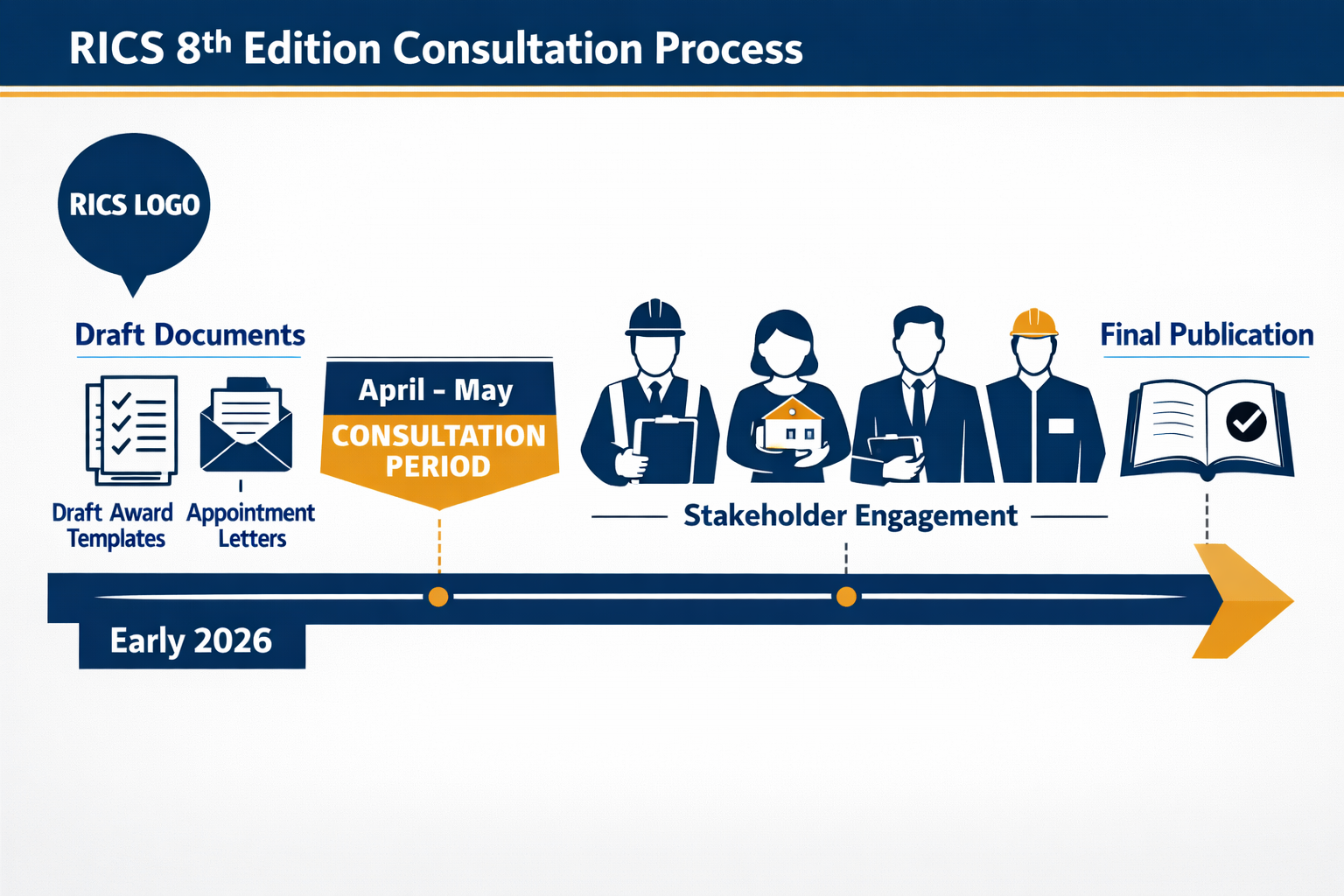
    () editorial illustration showing a timeline infographic of the RICS 8th Edition consultation process: a horizontal timeline

    The eight-week consultation period running through April and May 2026 is not a formality. RICS has structured it to gather substantive feedback from a deliberately broad range of stakeholders [1][2]. Understanding what is being consulted on — and what has already been decided — is essential for practitioners and property owners alike.

    What the Draft 8th Edition Contains

    The draft guidance includes several distinct components, each with implications for notice service and public engagement:

    1. Strengthened Regulatory and Conduct Guidance
    The most significant change for day-to-day practice. The draft clarifies that a party wall surveyor’s appointment is personal and statutory, not contractual. This means a surveyor cannot simply follow a client’s instruction to delay notice service, serve notice on a preferred party, or withdraw from an appointment because the client requests it [2][3].

    2. Updated Draft Award Template
    A standardised award template is included to reduce the variation in documentation quality that has historically created enforcement vulnerabilities [1]. The template incorporates clearer recitals about notice service — specifically, confirmation that valid notice was served on all relevant parties before the award was made.

    3. Revised Appointment Letters and Terms
    Enhanced appendices provide updated frameworks for professional conduct, including clearer terms around the surveyor’s obligations to communicate with all affected parties, not just the appointing owner [2].

    4. Guidance on Jurisdiction and Dispute Existence
    The draft addresses a recurring problem: surveyors proceeding to award in circumstances where no genuine dispute exists, or where the dispute has been resolved informally. Awards made without proper jurisdiction are vulnerable to challenge — and the 8th edition provides clearer tests for surveyors to apply before proceeding [1].

    The Consultation Process: How to Engage

    RICS has targeted the consultation at multiple stakeholder groups [1][2]:

    • 🏗️ Surveyors (building owners’ and adjoining owners’ surveyors)
    • ⚖️ Legal professionals (solicitors and barristers handling party wall disputes)
    • 🏘️ Property developers (particularly those undertaking basement, extension, or demolition works)
    • 🏠 Homeowners (those planning extensions, loft conversions, or renovations)
    • 🔍 Dispute resolution practitioners

    Feedback submitted during the consultation period will inform the final published 8th edition. Practitioners who have encountered specific problems with notice service validity or public engagement in recent cases have a direct opportunity to shape the guidance.


    Practical Implications: Ensuring Award Enforceability Under the New Rules

    () detailed scene showing a party wall surveyor at a desk in a London office, reviewing a formal party wall notice document

    The updated Public Engagement and Notice Service Rules: RICS 8th Edition guidance is not purely theoretical. Its practical implications for award enforceability are immediate and significant — particularly for works already in progress or planned for later in 2026.

    The Notice Service Chain: A Step-by-Step Framework

    Under the strengthened 8th edition guidance, a robust notice service process should follow this sequence:

    1. Identify all relevant parties — freeholders, long leaseholders, mortgagees in possession, and any management companies with an interest in affected structures.
    2. Serve notice in the correct form — using the appropriate notice type for the works proposed. The Party Structure Notice applies to works on the party wall itself; a Line of Junction Notice applies to new walls at the boundary; an Excavation Notice applies to foundation works within specified distances.
    3. Serve at the correct address — the registered address of the property or the last known address of the owner. Serving at the site address alone is insufficient where the owner is not resident.
    4. Allow the correct response period — 14 days for a response to a Party Structure Notice; one month for a Line of Junction Notice.
    5. Document service — retain proof of postage, recorded delivery receipts, or personal service records. The 8th edition guidance reinforces the importance of this documentation as part of the award recitals.
    6. Confirm jurisdiction before proceeding — verify that a genuine dispute exists (or that the response period has expired without consent) before appointing surveyors and proceeding to award.

    💡 Key point: An award made before valid notice has been served — or served on the wrong party — is not merely procedurally irregular. It may be void ab initio, meaning it has no legal effect from the outset.

    2026 Examples: Where Notice Service Failures Arise

    Several scenarios illustrate the practical relevance of the 8th edition updates in 2026:

    Scenario A: The Absent Freeholder
    A building owner in East London serves a Party Structure Notice on the occupying tenant of an adjoining flat, not realising the freehold is held by a separate company. The tenant does not respond. The building owner’s surveyor proceeds to appointment. The award is later challenged by the freeholder, who had no knowledge of the works. Under the 8th edition guidance, the surveyor should have conducted a Land Registry search to identify the correct notice recipient before serving.

    Scenario B: The Informal Agreement That Wasn’t
    A building owner in South London reaches an informal agreement with their neighbour about proposed loft conversion works. Both parties believe no formal process is needed. A surveyor is later appointed — not because a dispute exists, but because the building owner’s solicitor advises it for mortgage purposes. Under the 8th edition’s jurisdiction guidance, an award made in these circumstances may be challenged as made without proper authority [1].

    Scenario C: The Multi-Unit Development
    A developer in Central London undertakes basement excavation works affecting three adjoining properties. Notices are served on the freeholders of two, but the third is held on a long lease. The leaseholder is not notified. The resulting award is enforceable against the two freeholders but vulnerable in respect of the third property.

    For those involved in types of party wall works that affect multiple adjoining owners, the 8th edition’s expanded notification requirements are particularly relevant.

    The Surveyor’s Independent Role: A Reinforced Principle

    One of the most important — and sometimes misunderstood — aspects of the updated guidance is its treatment of surveyor independence. The draft 8th edition makes clear that a party wall surveyor’s appointment is personal and statutory, independent of client instruction [2][3].

    This has direct implications for public engagement:

    • A surveyor cannot agree to delay notice service because the building owner asks for more time.
    • A surveyor cannot serve notice on a party the client prefers, rather than the legally correct recipient.
    • A surveyor must communicate with all affected parties, not just the appointing owner.

    This principle is not new — it derives from the Act itself — but the 8th edition guidance articulates it more clearly and provides practical examples of where it applies [3].

    For building owners who want to understand their own obligations, the building owners’ section provides a useful overview. For adjoining owners concerned about their rights, the adjoining owners’ section explains the protections available.


    Public Engagement and Notice Service Rules: RICS 8th Edition Updates for Party Wall Surveyors — What Changes for Different Stakeholders

    () conceptual image showing two adjacent property owners on opposite sides of a brick party wall, each holding official

    The 8th edition updates affect different parties in different ways. Here is a concise breakdown:

    For Party Wall Surveyors

    • Review appointment letter templates against the updated appendices once the final edition is published.
    • Update notice service checklists to include identification of all relevant parties, not just freeholders.
    • Document jurisdiction more explicitly in award recitals — confirm that valid notice was served and that a genuine dispute exists or that the response period has expired.
    • Maintain independence from client instruction on notice service decisions — the 8th edition guidance reinforces this obligation [2][3].

    As of March 2026, RICS members and regulated firms must already comply with updated professional standards affecting party wall work [4]. The 8th edition, once finalised, will add a further layer of specific guidance.

    For Building Owners

    • Instruct a surveyor early — before serving notice — to ensure the correct parties are identified and the correct notice type is used.
    • Do not rely on informal agreements as a substitute for formal notice where the Act applies.
    • Retain all proof of service — recorded delivery receipts, Land Registry search results, and correspondence with all notified parties.
    • Understand the costs implications — defective notice service can require the entire process to restart, significantly increasing costs. Guidance on keeping party wall costs down is available for those managing budgets carefully.

    For Adjoining Owners

    • Check that notice has been served correctly — if works have commenced without valid notice, the building owner may be acting unlawfully.
    • Understand your right to appoint a surveyor — the adjoining owners’ surveyor acts in your interests throughout the process.
    • Request a Schedule of Condition before works begin — this documents the pre-existing state of your property and is essential if a damage claim arises later. Learn more about the schedule of condition process.

    Frequently Asked Questions About the 8th Edition Updates

    Q: When will the RICS 8th Edition be formally published?
    The consultation runs through April and May 2026 [1][2]. Publication is expected later in 2026, though RICS has not confirmed a specific date.

    Q: Does the 8th edition change the Party Wall etc. Act 1996 itself?
    No. The Act remains unchanged. The 8th edition is professional guidance that interprets and supplements the Act — it does not have the force of statute, but courts and tribunals give it significant weight.

    Q: What happens if a notice is served incorrectly under the new guidance?
    An incorrectly served notice may be invalid, meaning the response period does not run and any subsequent award may be unenforceable. The building owner may need to re-serve notice, potentially delaying works significantly.

    Q: Are the updated award templates mandatory?
    The draft template is guidance, not a mandatory form. However, using it reduces the risk of procedural challenges and demonstrates compliance with professional standards.


    Conclusion: Acting Now to Stay Ahead of the 8th Edition

    The RICS 8th Edition consultation is an opportunity — not just a regulatory exercise. The strengthened Public Engagement and Notice Service Rules: RICS 8th Edition Updates for Party Wall Surveyors address real, recurring problems that have caused awards to fail and disputes to escalate unnecessarily. For surveyors, the message is clear: document everything, serve notice on the right parties, and never compromise independence for client convenience.

    Actionable Next Steps ✅

    1. Surveyors: Review the draft 8th edition guidance during the consultation period and submit feedback where your practice experience identifies gaps or ambiguities [1].
    2. Building owners: Before serving any party wall notice in 2026, conduct a Land Registry search to identify all relevant parties — freeholders, long leaseholders, and mortgagees in possession.
    3. Adjoining owners: If you receive a party wall notice, check that it has been served correctly and that you have been given the full response period before any works commence.
    4. All parties: Use the updated award templates and appointment letters once the final 8th edition is published — they are designed to reduce the procedural vulnerabilities that lead to costly challenges.
    5. Seek professional advice early — whether you are carrying out works or your neighbour is building, early professional involvement prevents the procedural errors that the 8th edition is designed to eliminate.

    The party wall process works well when it is followed correctly. The 8th edition guidance is designed to make correct procedure clearer, more consistent, and more enforceable — a goal that benefits every party involved.


    References

    [1] Rics Launches Consultation On Updated Party Wall Practice Guidance – https://www.rics.org/news-insights/rics-launches-consultation-on-updated-party-wall-practice-guidance

    [2] Rics Opens Consultation On Party Wall Guidance Update – https://www.propertywire.com/news/uk/rics-opens-consultation-on-party-wall-guidance-update/

    [3] Rics Launches Consultation On Party Wall Guidance – https://thenegotiator.co.uk/news/regulation-law-news/rics-launches-consultation-on-party-wall-guidance/

    [4] Party Wall Surveys For 5g Mast Installations Rics Protocols Amid 2026 Telecom Infrastructure Expansion – https://nottinghillsurveyors.com/blog/party-wall-surveys-for-5g-mast-installations-rics-protocols-amid-2026-telecom-infrastructure-expansion

  • Party Wall Surveyor Duties to Adjoining Owners: Insights from Recent

    A single court ruling in 2021 fundamentally changed how thousands of party wall disputes are administered across England and Wales — and many surveyors, building owners, and adjoining owners are still catching up with the consequences. The Evans v Paterson judgment confirmed a principle that had long been debated: no dispute, no award. Combined with the RICS consultation on its draft 8th edition of Party Wall Legislation and Procedure launched in April 2026, the landscape governing Party Wall Surveyor Duties to Adjoining Owners: Insights from Recent Case Law Trends and RICS 8th Edition Alignment has never been more dynamic — or more consequential for property owners navigating building works. [1][3]

    () editorial illustration showing a UK courtroom gavel resting on a Party Wall Act 1996 document beside a surveyor's


    Key Takeaways 📋

    • The Evans v Paterson (2021) ruling confirmed that a valid dispute must exist before surveyors can make a binding award under the Party Wall etc. Act 1996.
    • The RICS draft 8th edition (consultation running April–May 2026) strengthens guidance on fee transparency, third surveyor use, notice service, and statutory independence.
    • A party wall surveyor’s appointment is personal and statutory — it cannot be overridden by client instruction.
    • Adjoining owners hold significant protections under the Act, but these rights depend on correct procedural steps being followed by all parties.
    • Recent case law and updated guidance together demand higher standards of impartiality and jurisdiction awareness from all appointed surveyors.

    Understanding the Role of the Party Wall Surveyor

    Before examining how case law and updated guidance affect practice, it is essential to understand the foundational role a party wall surveyor plays. Under the Party Wall etc. Act 1996, when a building owner proposes works affecting a shared wall, boundary, or excavation near a neighbouring property, the adjoining owner must be formally notified. [1]

    Where the adjoining owner does not consent to the proposed works, a surveyor will determine the time and manner in which the works can be carried out. [1] This is not simply a matter of professional courtesy — it is a statutory function.

    Who Appoints the Surveyor?

    There are three appointment models under the Act:

    Appointment Type Description
    Agreed Surveyor One surveyor acts for both parties by mutual agreement
    Two Surveyors Each party appoints their own surveyor
    Three Surveyors Two appointed surveyors select a third to resolve disagreements

    The RICS draft 8th edition places particular emphasis on the use of the Third Surveyor — clarifying when referral is appropriate and how it should be managed. [3] For adjoining owners uncertain about their rights, understanding the role of an adjoining owner’s surveyor is a critical first step.

    💬 “A party wall surveyor’s appointment is personal and statutory, and independent of client instruction.” — RICS Draft 8th Edition Guidance [3]

    This independence is not merely aspirational. It is a professional and legal requirement. A surveyor who acts purely in the interests of the party who appointed them — rather than administering the Act impartially — risks producing an award that is legally vulnerable to challenge.


    Case Law Trends Reshaping Party Wall Surveyor Duties to Adjoining Owners

    () infographic-style image showing a formal RICS 8th Edition guidebook open on a mahogany desk, surrounded by icons

    The Evans v Paterson Principle: No Dispute, No Award

    The most significant recent development in party wall case law is the confirmation of the “no dispute, no award” principle in Evans v Paterson (2021). [2] This ruling established that a dispute must have genuinely arisen for surveyors to make an award for compensation under section 7(2) of the Act.

    This has profound implications for how the Act is administered in practice:

    • ✅ Surveyors cannot assume a dispute exists simply because an adjoining owner has dissented to a notice.
    • ✅ Awards made without proper jurisdiction — where no genuine dispute existed — are vulnerable to being struck down.
    • ✅ Compensation claims under section 7(2) require a real, existing dispute as their foundation.

    The RICS has since highlighted concerns arising from cases where awards have been challenged precisely because surveyors acted without proper jurisdiction. [3] This is now a focal point of the updated 8th edition guidance.

    Defining “Dispute” Under the Act

    Section 10(10)(b) of the Party Wall etc. Act 1996 defines a dispute as “any matter relating to the notified works which is in dispute between the building owner and the adjoining owner.” Section 10(12) extends this to include “any other matter arising out of or incidental to the dispute.” [2]

    This seemingly broad definition has been tested in court. The key lesson from recent case law is that the scope of a surveyor’s jurisdiction is bounded by the genuine dispute — surveyors cannot expand their remit to cover matters that were never in contention between the parties.

    The Farrs Lane Exception and Its Limits

    A 2016 case — Farrs Lane Developments Ltd v Bristol Magistrates Court — created a narrow exception: surveyor fees can be addressed in an award even when fees were not the primary subject of dispute. [2] However, Evans v Paterson subsequently limited the circumstances in which this exception applies, reinforcing that jurisdiction must always be grounded in a real dispute.

    For building owners and adjoining owners alike, these rulings underline the importance of understanding what party wall notices are and how to respond to them correctly from the outset — because procedural errors at the notice stage can undermine the entire award process.

    Practical Implications for Adjoining Owners

    These case law developments strengthen adjoining owner protections in several concrete ways:

    1. Awards cannot be manufactured — a surveyor cannot create jurisdiction where none exists.
    2. Compensation claims must be grounded in a genuine, identified dispute.
    3. Adjoining owners can challenge awards that were made without proper jurisdiction.
    4. Surveyor impartiality is legally enforceable, not merely aspirational.

    For anyone whose neighbour is carrying out works, understanding your rights as an adjoining owner has never been more important.


    RICS 8th Edition Alignment: Strengthening Standards for Party Wall Surveyor Duties to Adjoining Owners

    () showing a party wall surveyor in professional attire standing between two property owners at a shared boundary wall,

    What the Draft 8th Edition Changes

    In April 2026, RICS launched a formal consultation on the draft 8th edition of Party Wall Legislation and Procedure, running for approximately eight weeks through May 2026. [3] This replaces the 7th edition and introduces several significant updates directly relevant to party wall surveyor duties to adjoining owners.

    Key areas of enhanced guidance include:

    Area What’s Changing
    Fee Practices Clearer standards on how fees are set, disclosed, and justified
    Third Surveyor Use Updated guidance on when and how to refer matters to the third surveyor
    Service of Notices Revised procedures to reduce jurisdictional errors
    Public Engagement Improved guidance on communicating with non-professional parties
    Statutory Independence Strengthened emphasis that appointment is personal and cannot be overridden by clients
    Regulatory Conduct Enhanced appendices covering professional conduct obligations

    [3]

    Statutory Independence: A Non-Negotiable Principle

    One of the most significant emphases in the draft 8th edition is the personal and statutory nature of a surveyor’s appointment. [3] This means:

    • A building owner cannot instruct their appointed surveyor to act in ways that disadvantage the adjoining owner.
    • An adjoining owner’s surveyor cannot be pressured into accepting unreasonable terms by the opposing party.
    • Both surveyors must administer the Act in accordance with its purpose — not in the interests of the party who pays them.

    This principle has direct implications for building owners’ surveyors and adjoining owners’ surveyors alike. The 8th edition makes clear that professional conduct obligations sit above client instructions.

    Fee Transparency and Adjoining Owner Protections 💰

    One area where adjoining owners have historically faced challenges is surveyor fee disputes. The draft 8th edition addresses this directly by strengthening guidance on fee practices. [3]

    Under the Act, it is typically the building owner who bears the cost of the party wall process — including the reasonable fees of the adjoining owner’s surveyor. However, what constitutes “reasonable” has been a persistent source of conflict.

    The updated guidance aims to:

    • Provide clearer benchmarks for fee assessment
    • Reduce the risk of disproportionate fee awards
    • Ensure fee transparency from the point of appointment

    For those concerned about costs, a practical overview of party wall costs and the process can help set realistic expectations before appointing a surveyor.

    Notice Service: Getting the Foundation Right

    The draft 8th edition also revises guidance on service of notices — a procedural step that, when done incorrectly, can invalidate the entire process. [3] Under the Party Wall etc. Act 1996, building owners must serve the correct type of notice depending on the works proposed. Understanding what a party wall notice involves is essential for both parties.

    Common notice errors that have led to jurisdictional challenges include:

    • Serving notice too late (minimum 1–2 months before works begin, depending on notice type)
    • Serving the wrong type of notice for the works proposed
    • Failing to identify all adjoining owners correctly
    • Incorrect description of proposed works

    Balancing Building Owner and Adjoining Owner Rights: The Impartiality Imperative

    The Party Wall etc. Act 1996 applies across England and Wales and is designed to balance the rights of building owners to carry out legitimate works with the rights of adjoining owners to be protected from damage and disruption. [1]

    This balance is the core purpose of the party wall surveyor’s role. Recent case law and the RICS 8th edition consultation both reinforce that impartiality is not optional — it is the legal and professional foundation of the entire framework.

    What Adjoining Owners Should Expect from Their Surveyor

    An adjoining owner’s appointed surveyor should:

    • ✅ Act independently, not as an advocate for the adjoining owner
    • ✅ Assess proposed works objectively against the Act’s requirements
    • ✅ Ensure a schedule of condition is prepared before works begin
    • ✅ Raise genuine concerns through the correct procedural channels
    • ✅ Refer unresolved matters to the Third Surveyor where appropriate
    • ✅ Produce or contribute to a party wall award that is legally sound and within jurisdiction

    What Building Owners Should Expect from the Process

    Building owners are entitled to carry out notifiable works — but must follow the correct procedure. Key obligations include:

    • Serving valid notices within the correct timeframes
    • Cooperating with the adjoining owner’s surveyor
    • Bearing the reasonable costs of the process
    • Complying with the terms of any award made

    For a full breakdown of types of party wall works that trigger the Act’s requirements, reviewing the relevant guidance before starting any project is strongly recommended.


    Party Wall Surveyor Duties to Adjoining Owners: Insights from Recent Case Law Trends and RICS 8th Edition Alignment in Practice

    The convergence of Evans v Paterson and the RICS 8th edition consultation creates a clearer — and more demanding — standard for party wall practice in 2026. For adjoining owners, the key practical takeaways are:

    🏠 Before Works Begin

    • Respond formally to any party wall notice within 14 days
    • If dissenting, appoint a qualified party wall surveyor promptly
    • Request a schedule of condition to document the existing state of your property

    📋 During the Award Process

    • Ensure your surveyor is acting within jurisdiction — i.e., that a genuine dispute exists
    • Review the draft award carefully before it is finalised
    • Understand that the award is a legally binding document — challenge it within 14 days if there are grounds to do so

    ⚖️ If Damage Occurs

    • Document all damage immediately with photographs and written records
    • Raise a compensation claim through the correct party wall procedure
    • Remember that post-Evans v Paterson, compensation claims must be grounded in a genuine, identified dispute

    For those in London, specialist support is available from party wall surveyors across Central London, South London, North London, and beyond.


    Conclusion: Actionable Next Steps for 2026

    The evolution of party wall surveyor duties to adjoining owners — shaped by landmark case law and the forthcoming RICS 8th edition — points in one clear direction: higher standards, greater transparency, and stronger protections for all parties.

    For adjoining owners, the message is empowering. The law is on your side, provided the correct procedures are followed. Surveyors who act without jurisdiction, fail to disclose fees transparently, or allow client pressure to compromise their independence are now operating in an environment where such conduct is more visible — and more challengeable — than ever before.

    Actionable next steps:

    1. If you have received a party wall notice — respond within 14 days and consider appointing a qualified surveyor to protect your interests.
    2. If works are already underway — document any impact on your property and seek professional advice promptly.
    3. If you are a building owner — ensure your surveyor is administering the Act correctly and within jurisdiction to avoid costly award challenges.
    4. If you are a surveyor — engage with the RICS 8th edition consultation and update your practice to reflect the latest guidance on fees, notices, and statutory independence.
    5. For any party wall matter in London — seek specialist advice from a qualified professional familiar with the latest case law and RICS guidance.

    The party wall framework exists to enable progress while protecting neighbours. When it works as intended — with impartial, jurisdiction-aware surveyors on both sides — it is a genuinely effective dispute prevention tool. The challenge for 2026 and beyond is ensuring that practice consistently matches that standard.


    References

    [1] Rics Consumer Guide Party Walls – https://www.ricsfirms.com/residential/legal-issues/party-walls/rics-consumer-guide-party-walls/

    [2] Practice Changing Party Wall Case Law Evans V Paterson 2021 – https://www.peterbarry.co.uk/blog/practice-changing-party-wall-case-law-evans-v-paterson-2021/

    [3] Rics Launches Consultation On Updated Party Wall Practice Guidance – https://www.rics.org/news-insights/rics-launches-consultation-on-updated-party-wall-practice-guidance

    [4] Y2024v13i1p57 65 – https://ideas.repec.org/a/aza/jbsav0/y2024v13i1p57-65.html


  • Party Wall Awards in 2026 Construction Boom: Surveyor Strategies for

    Wide-angle editorial photograph of a professional party wall surveyor in a hard hat and suit jacket standing between two

    Over 40,000 party wall disputes are estimated to arise annually across England and Wales — and in 2026, that number is climbing fast. The UK’s sustained housing boom, driven by government housebuilding targets and a wave of home extension projects, has pushed demand for qualified party wall surveyors to record levels. For surveyors, building owners, and adjoining property owners alike, understanding Party Wall Awards in 2026 Construction Boom: Surveyor Strategies for High-Demand Dispute Management has never been more critical.

    The Party Wall etc. Act 1996 remains the governing legislation, but the pressure of today’s construction environment is testing its processes like never before. Surveyors who master efficient, legally sound strategies will be the ones who thrive — and protect their clients — in this demanding landscape.


    Key Takeaways 📋

    • 🏗️ The 2026 UK construction boom is generating unprecedented demand for party wall surveyors, making speed and compliance more important than ever.
    • 📄 Three distinct notice types exist under the Act, each with specific timelines that must be respected to avoid costly delays.
    • ⚖️ Appointing a single agreed surveyor can significantly fast-track the process without compromising legal protection.
    • 💷 Surveyor costs typically range from £150–£200 per hour, with a complete party wall award averaging around £1,000 [3].
    • 🔍 Proactive dispute management — including thorough schedules of condition — is the most effective way to prevent escalation.

    What Is a Party Wall Award and Why Does It Matter in 2026?

    A party wall award is a legally binding document produced by one or more appointed surveyors. It sets out the rights and responsibilities of both the building owner (the party carrying out works) and the adjoining owner (the neighbour affected by those works). Think of it as a construction rulebook agreed upon by an impartial authority.

    In 2026, with residential extensions, loft conversions, and basement digs surging across urban areas, the award has become the cornerstone of neighbourly construction relations. Without one, disputes can escalate into injunctions, court proceedings, and significant financial loss for all parties.

    The Three Types of Party Wall Notices

    Before an award can be issued, the correct notice must be served. There are three types [4]:

    Notice Type Trigger Notice Period
    Party Structure Notice Works to an existing shared wall 2 months
    Line of Junction Notice Building a new wall on or at the boundary 1 month
    Adjacent Excavation Notice Excavation within 3–6 metres of a neighbour’s structure 1 month

    💡 Pull Quote: “Serving the wrong notice — or serving it too late — can halt a project entirely. In a booming construction market, that delay costs real money.”

    Understanding what a party structure notice is and how to serve it is the essential first step for any building owner embarking on works in 2026 [3].


    Surveyor Strategies for High-Demand Dispute Management in the 2026 Construction Boom

    Overhead flat-lay editorial composition showing a large wooden desk with party wall award legal documents, a surveyor's

    The surge in construction activity means surveyors are juggling more cases simultaneously than at any previous point. Effective strategies are no longer optional — they are a professional necessity.

    Strategy 1: Prioritise Early Notice Compliance

    The single most effective way to fast-track a party wall award is to ensure notices are served correctly and on time. Delays caused by defective or late notices ripple through the entire project timeline.

    Practical steps for surveyors and building owners:

    • Serve notices as early as possible — ideally before finalising contractor bookings.
    • Use clear, compliant language. Refer to a reliable party wall notice guide to avoid common errors.
    • Keep proof of delivery (recorded post, hand-delivery with witness, or electronic service where accepted).

    Surveyors should also educate their building owner clients on the types of party wall works that trigger notice requirements, since many homeowners are unaware that even minor works can fall under the Act.

    Strategy 2: Recommend the Agreed Surveyor Approach

    One of the most powerful tools for managing high-volume caseloads efficiently is the agreed surveyor model. Rather than each party appointing their own surveyor (which doubles costs and communication layers), both the building owner and the adjoining owner jointly appoint a single impartial professional [4].

    Benefits of the agreed surveyor approach:

    • ✅ Faster award production — one decision-maker, not two
    • ✅ Lower combined costs for both parties
    • ✅ Reduced risk of procedural disagreements between surveyors
    • ✅ Streamlined communication with contractors and architects

    This approach works particularly well in straightforward cases such as standard loft conversions or single-storey rear extensions. For more complex or contentious disputes, separate surveyors may still be advisable [3].

    Strategy 3: Conduct Thorough Schedules of Condition

    A schedule of condition is a detailed photographic and written record of the adjoining property’s state before works begin. It is arguably the most dispute-preventive document in a surveyor’s toolkit.

    In 2026’s high-demand environment, skipping or rushing this step is a false economy. When post-construction damage claims arise — and they do — a comprehensive schedule of condition is the clearest evidence available to determine whether the building owner is liable.

    What a robust schedule of condition should include:

    • Timestamped photographs of all internal and external walls, ceilings, and floors adjacent to the works
    • Notes on pre-existing cracks, settlement, or defects
    • Measurements of any existing structural movement
    • Signed agreement from both parties

    Strategy 4: Use Digital Tools to Manage Caseload Pressure

    The 2026 construction boom demands that surveyors work smarter. Digital case management platforms, electronic notice serving, and cloud-based document storage are no longer luxuries — they are competitive necessities.

    Key digital efficiencies:

    • Electronic notice templates reduce drafting time and error rates
    • CRM software tracks notice periods, response deadlines, and award milestones
    • Digital signature platforms speed up award execution without requiring in-person meetings
    • Drone photography for schedules of condition in hard-to-access areas

    Managing Disputes: When Awards Are Contested

    Split-screen infographic-style editorial image: left side shows a stressed homeowner and neighbour in dispute outside a

    Even with the best preparation, disputes arise. Understanding how to manage them efficiently — without compromising the integrity of the Act — is what separates good surveyors from exceptional ones.

    Common Causes of Party Wall Disputes in 2026

    Research highlights a persistent concern that some litigation processes may inadvertently sideline structural safety considerations in favour of procedural arguments [2]. Surveyors must guard against this tendency by keeping structural and safety issues at the forefront of every award.

    The most frequent dispute triggers include:

    1. Damage claims — Cracks, subsidence, or water ingress attributed to neighbouring works
    2. Access disputes — Building owners requiring access to the adjoining property that the neighbour refuses
    3. Working hours disagreements — Noise and disruption outside agreed hours
    4. Inadequate notice — Adjoining owners claiming they were not properly informed
    5. Cost allocation disputes — Arguments over who pays surveyor fees

    💡 Pull Quote: “The best dispute management strategy is prevention. A well-drafted award anticipates conflict before it starts.”

    The Third Surveyor Mechanism

    When two appointed surveyors cannot agree, the Act provides for a third surveyor — selected at the outset by both party surveyors — to make a binding determination. This mechanism is underused but highly effective.

    In a busy 2026 market, surveyors should agree on their third surveyor choice early in the process, not after a deadlock has already formed. This saves weeks of delay.

    Cost Considerations for All Parties

    Understanding how to keep party wall costs down is a genuine concern for homeowners navigating the process. In 2026, typical surveyor fees are:

    Service Typical Cost
    Surveyor hourly rate £150–£200 per hour
    Complete party wall award ~£1,000
    Third surveyor determination Variable (often higher)
    Schedule of condition £300–£600 (typical)

    Source: [3]

    The building owner is generally responsible for reasonable surveyor costs on both sides. However, if an adjoining owner appoints an unnecessarily expensive surveyor or escalates a simple matter, cost allocation can become contentious. Clear communication from the outset minimises this risk.


    Regional Demand Patterns: Where Is Pressure Highest?

    London remains the epicentre of party wall activity in 2026. Dense Victorian and Edwardian terraced housing stock, combined with intense development pressure, means that surveyors across the capital are working at capacity.

    High-demand areas include:

    Outside London, cities including Manchester, Birmingham, and Bristol are also experiencing elevated demand as regional housebuilding programmes accelerate.


    Upholding Act Standards Under Pressure: The Non-Negotiables

    The pressure of a construction boom can tempt some practitioners to cut corners — rushing awards, skipping condition surveys, or serving defective notices. This approach carries serious professional and legal risk.

    The Party Wall etc. Act 1996 is clear in its requirements, and the courts have consistently upheld its provisions. Surveyors who produce awards that fail to meet statutory standards face the prospect of those awards being set aside — leaving works without legal protection and clients exposed to injunctions [6].

    Non-negotiable standards every surveyor must maintain:

    • ✅ Correct notice type served with adequate notice period
    • ✅ Award clearly identifies the works, the parties, and the conditions
    • ✅ Both parties’ rights explicitly protected
    • ✅ Structural safety considerations documented and addressed [2]
    • ✅ Award signed and served before works commence

    💡 Pull Quote: “Speed is valuable. Compliance is essential. In 2026’s construction boom, surveyors must deliver both — not choose between them.”

    The RICS provides professional guidance and training for surveyors working in this space, reinforcing that technical competence must keep pace with market demand [5].


    Practical Guidance for Building Owners and Adjoining Owners

    Both sides of a party wall dispute benefit from understanding the process. Building owners who understand their obligations are less likely to trigger disputes. Adjoining owners who understand their rights are less likely to feel steamrolled.

    For building owners:

    • Serve notices as early as possible — don’t wait until the contractor is booked
    • Consider appointing an agreed surveyor to save time and money
    • Engage proactively with your neighbour before formal notice is served
    • Review the costs of party wall process to budget accurately

    For adjoining owners:

    • Respond to notices within the statutory period (14 days to consent or dissent)
    • Understand that dissenting triggers the surveyor appointment process — it does not stop the works
    • Request a schedule of condition to protect your property
    • Seek independent advice from an adjoining owner’s surveyor if unsure

    Conclusion: Thriving in the 2026 Party Wall Landscape

    The intersection of Party Wall Awards in 2026 Construction Boom: Surveyor Strategies for High-Demand Dispute Management is not just a professional challenge — it is an opportunity. Surveyors who invest in efficient processes, digital tools, and deep statutory knowledge will be best positioned to serve clients well and build a reputation that outlasts any single boom cycle.

    The fundamentals remain unchanged: serve correct notices, conduct thorough condition surveys, draft clear and comprehensive awards, and keep structural safety at the centre of every decision. What changes in 2026 is the pace — and the strategies required to maintain quality at speed.

    Actionable Next Steps ✅

    1. Audit your notice templates — Ensure they comply with current Act requirements and are free of common errors.
    2. Build your agreed surveyor network — Identify trusted colleagues for joint appointments in straightforward cases.
    3. Invest in digital case management — Reduce administrative burden so more time goes to technical work.
    4. Complete a schedule of condition on every case — No exceptions, regardless of how minor the works appear.
    5. Stay current with RICS guidance — Professional standards evolve; make sure your practice does too [5].
    6. Communicate early with all parties — Most disputes are rooted in poor communication, not legal complexity.

    Whether acting for a building owner or an adjoining owner, the goal is the same: a fair, legally sound award that protects everyone and keeps construction moving forward.


    References

    [1] Border Wall Contractor Says $2B Federal Award Package Sets Stage For 2026 Construction – https://www.enr.com/articles/62240-border-wall-contractor-says-2b-federal-award-package-sets-stage-for-2026-construction

    [2] ASCE Library – Party Wall Disputes and Structural Safety – https://ascelibrary.org/doi/abs/10.1061/(ASCE)LA.1943-4170.0000496

    [3] Party Wall Agreement – HOA.org.uk – https://hoa.org.uk/advice/guides-for-homeowners/i-am-improving/party-wall-agreement/

    [4] Party Wall Act Explained (Video) – https://www.youtube.com/watch?v=RGl9deRpNvU

    [5] Party Walls: The Fundamentals – RICS Training – https://www.rics.org/training-events/online-training/on-demand/party-walls-the-fundamentals

    [6] Understanding the Party Wall Act – Designing Buildings – https://www.designingbuildings.co.uk/wiki/Understanding%20the%20party%20wall%20act

  • PEEPs April 2026: High-Rise Fire Safety & Party Wall Guide

    Approximately 12,500 residential buildings in England stand over 18 metres tall — and as of 6 April 2026, every qualifying one must have a formal system in place to help vulnerable residents escape safely in a fire. That date is not a future deadline. It has already passed. If you own, manage, or survey a high-rise or medium-rise residential building in London, the clock is ticking on compliance.

    The introduction of Personal Emergency Evacuation Plans PEEPs April 2026 high-rise medium-rise buildings marks one of the most significant shifts in residential fire safety law since the Grenfell Tower tragedy. Driven by the Grenfell Tower Inquiry Phase 1 recommendations and enacted through the Fire Safety (Residential Evacuation Plans) (England) Regulations 2025, these rules place new, enforceable duties on Responsible Persons — and they intersect directly with party wall obligations in ways that many building professionals have not yet considered.

    London high-rise buildings with PEEP compliance overview


    Key Takeaways 🔑

    • PEEPs are now law for qualifying high-rise and medium-rise residential buildings in England from 6 April 2026.
    • High-rise buildings (18m+ or 7+ storeys) and medium-rise buildings (11m+) with simultaneous evacuation strategies are in scope.
    • Responsible Persons must proactively engage residents who may need individual evacuation plans.
    • Party wall works that affect fire compartmentation, escape routes, or shared evacuation infrastructure can trigger PEEP review obligations.
    • London freeholders and building managers should seek specialist advice where party wall awards and fire safety duties overlap.

    What Are Residential PEEPs and Who Do They Apply To?

    A Residential Personal Emergency Evacuation Plan (RPEEP) is an individual, person-centred plan created for any resident who may need assistance to safely leave their home during a fire. This includes people with:

    • 🦽 Permanent or temporary mobility limitations
    • 👁️ Visual or hearing impairments
    • 🏥 Medical conditions or injuries affecting evacuation
    • Any other circumstance making unaided escape difficult

    The plan is not a generic document. It is tailored to the individual, created in consultation with the resident, and must only be prepared with their consent.

    Which Buildings Are In Scope?

    The regulations apply to two distinct categories:

    Building Type Height Threshold Additional Condition
    High-rise residential 18 metres or 7+ storeys Two or more sets of domestic premises
    Medium-rise residential More than 11 metres Must operate a simultaneous evacuation strategy

    💡 Pull Quote: “A simultaneous evacuation strategy — where all residents leave as soon as the alarm sounds — triggers PEEP obligations for buildings over 11 metres. Many London mansion blocks and purpose-built flats fall squarely in this category.”

    Notably, short-term rental buildings also fall within scope if they meet the height or evacuation strategy conditions. London’s significant short-let sector should take note.


    What Must a PEEP Actually Contain?

    Each plan must document several specific elements to be compliant. A well-prepared RPEEP will include:

    1. Agreed place of safety away from the building
    2. Safest evacuation route from the resident’s flat to the exit
    3. Names of willing assistants and backup assistants
    4. Specialist equipment needs (e.g., evacuation chairs)
    5. Fire and Rescue Service access details — key codes, entry methods
    6. Activities that must NOT be attempted during a rescue
    7. Communication methods for alerting the resident to an emergency

    The Responsible Person must also maintain a Building Emergency Evacuation Plan (BEEP) — a master document that incorporates all individual PEEPs, resident instructions, and details of any Evacuation Alert Systems installed in the building.

    The Responsible Person’s Duties

    The Responsible Person — typically the freeholder, building manager, or managing agent — must:

    • Proactively communicate to all residents that they can request a PEEP
    • Prepare PEEPs in consultation with self-identifying residents
    • Review and update plans when a resident’s circumstances change
    • Share relevant information with the Fire and Rescue Service

    This is not a passive duty. Waiting for residents to come forward is insufficient. Active outreach is required.


    Personal Emergency Evacuation Plans PEEPs April 2026: Implications for London Building Managers

    Party wall surveyor reviewing fire compartmentation drawings

    London presents a unique compliance landscape. The capital has a high concentration of converted Victorian and Edwardian buildings, purpose-built post-war blocks, and new high-rise developments — many of which sit in the 11–30 metre height range. For building managers overseeing these properties, the priority actions are clear:

    Immediate Steps for Compliance

    • Identify whether your building is in scope — check height, storey count, and evacuation strategy
    • Conduct a gap analysis against the April 2026 requirements
    • Begin resident engagement — issue formal communications explaining the right to request a PEEP
    • Update your Safety Case and fire risk assessment assumptions
    • Brief your board or freeholder on new legal duties and associated costs
    • Appoint a competent PEEP provider if in-house capacity is limited

    For leaseholders, the picture is equally important. If you have a disability or health condition affecting your ability to evacuate, you have a legal right to request an RPEEP from your building’s Responsible Person. Do not assume this will happen automatically.


    Where Party Wall Works and PEEPs Collide

    This is where the conversation becomes particularly important for London freeholders, developers, and building owners undertaking construction works.

    Party wall works — whether involving structural alterations, extensions, or excavations — can directly affect the fire safety infrastructure of a building. Specifically:

    Fire Compartmentation and Party Walls

    Many party walls in residential buildings serve a dual function: they are both structural boundaries and fire compartmentation elements. Works that breach, alter, or temporarily compromise these walls can:

    • Disrupt fire-rated separations between flats
    • Create gaps in protected escape routes
    • Affect the integrity of fire doors and intumescent seals

    Under the Party Wall etc. Act 1996, any notifiable works to a party structure require formal notice and, where consent is withheld, a party wall award. From April 2026, surveyors drafting those awards must now consider whether the proposed works could affect:

    • Existing PEEPs — particularly agreed evacuation routes
    • Shared evacuation infrastructure (corridors, lobbies, stairwells)
    • The building’s overall BEEP assumptions

    🔥 Key Point: A party wall award that permits works affecting a protected escape corridor could inadvertently invalidate an existing PEEP for a disabled resident on that floor. This is a live legal risk.

    What Should Party Wall Awards Address?

    When party wall notices are served for works in qualifying buildings, the award should now routinely consider:

    • Pre-works fire risk assessment confirming compartmentation status
    • Conditions requiring reinstatement of fire-rated elements to original specification
    • Notification obligations — informing the Responsible Person of works affecting escape routes
    • Temporary evacuation provisions during the construction phase
    • Post-works sign-off by a competent fire safety professional

    For adjoining owners in high-rise or medium-rise buildings, this matters enormously. Works next door could affect your flat’s fire safety without your knowledge — unless the party wall process properly captures these risks.

    A well-drafted schedule of condition prepared before works begin should now document fire safety elements — door ratings, intumescent strips, compartmentation walls — as standard practice in qualifying buildings.


    The London Context: Why Specialist Advice Matters

    London’s residential building stock is complex. Many buildings straddle multiple regulatory regimes simultaneously: the Building Safety Act 2022, the Fire Safety Act 2021, the Party Wall etc. Act 1996, and now the Fire Safety (Residential Evacuation Plans) (England) Regulations 2025.

    For building owners carrying out works, navigating these overlapping duties without specialist support is genuinely risky. A party wall surveyor who understands fire safety obligations — and vice versa — is no longer a luxury. It is a practical necessity.

    Whether your project is in Central London, East London, or South London, the intersection of party wall obligations and PEEP compliance is a real and growing concern for anyone working on qualifying residential buildings.


    Conclusion: Act Now — Compliance Is Not Optional

    The Personal Emergency Evacuation Plans PEEPs April 2026 high-rise medium-rise buildings regime is in force. For London freeholders, leaseholders, and building managers, the question is no longer whether to comply — it is how quickly you can get there.

    Here are your actionable next steps:

    1. Determine scope — is your building 18m+, 7+ storeys, or 11m+ with simultaneous evacuation? If yes, you are in scope now.
    2. Appoint or review your Responsible Person — ensure they understand the new RPEEP duties.
    3. Issue resident communications — formally notify all residents of their right to request a PEEP.
    4. Review any planned or ongoing party wall works — assess whether they affect fire compartmentation or evacuation routes.
    5. Instruct a specialist party wall surveyor who understands the fire safety landscape — particularly where works touch shared escape infrastructure.

    At Party Wall Surveyor London, we work with freeholders, leaseholders, and building managers across the capital to ensure party wall awards properly reflect modern fire safety obligations. If you are navigating the new PEEP requirements alongside construction works, contact us to discuss how we can help protect your building, your residents, and your legal position.


  • Updating Party Wall Notices for RICS Draft 8th Edition: Avoiding

    Nearly one in three party wall awards challenged in recent years has involved a defect traceable back to the original notice — a flawed description of works, a missed service deadline, or a surveyor acting without proper jurisdiction. With RICS now consulting on its Draft 8th Edition Party Wall Practice Guidance through April and May 2026 [1], building owners, surveyors, and legal professionals face a pivotal moment: update your notice procedures now, or risk invalidity on live projects.

    This article breaks down what the RICS Draft 8th Edition changes mean for updating party wall notices for RICS Draft 8th Edition: avoiding invalidity in 2026 projects — covering revised templates, common pitfalls, and surveyor-vetted wording that keeps your project on solid legal ground.


    Key Takeaways 📋

    • The RICS Draft 8th Edition replaces the 7th Edition and is currently open for stakeholder consultation through May 2026 [1]
    • Updated guidance strengthens rules on notice service procedures, fee practices, and surveyor independence [1]
    • Awards can be challenged — and invalidated — when no genuine dispute existed or when surveyors lacked proper jurisdiction [2]
    • Revised appendices include updated notice templates, letters of appointment, and a new draft award template [2]
    • Building owners should review and update their notice wording before serving on adjoining owners to avoid costly delays

    Detailed () infographic-style illustration showing a timeline of RICS party wall guidance editions from 1st to 8th, with the

    What the RICS Draft 8th Edition Actually Changes

    From 7th to 8th Edition: A Necessary Evolution

    The RICS Party Wall Practice Guidance has been the professional benchmark for surveyors accepting instructions under the Party Wall etc. Act 1996 since its first publication. The forthcoming 8th Edition is not a minor refresh — it is a substantive rewrite designed to address real-world failures that have emerged over years of practice [1].

    The consultation, running through April and May 2026, invites feedback from surveyors, legal professionals, dispute resolution practitioners, and other stakeholders across England and Wales [1][3]. This broad input signals that the final guidance will reflect genuine industry consensus rather than a top-down revision.

    💡 Pull Quote: “The draft 8th edition provides updated best-practice support for RICS members accepting instructions where the Party Wall etc. Act 1996 may apply.” — RICS [1]

    Key structural changes in the draft include:

    Area of Change 7th Edition Draft 8th Edition
    Notice templates Basic appendices Enhanced appendices with revised wording
    Letters of appointment Standard format Revised terms and conditions
    Award template Existing format Updated draft award template [2]
    Surveyor independence Guidance only Strengthened statutory clarity [2]
    Fee practices Limited guidance Explicit regulatory provisions [1]
    Third Surveyor use Referenced Strengthened procedural guidance [1]

    Strengthened Surveyor Independence: Why It Matters for Notice Validity

    One of the most consequential changes in the draft concerns surveyor independence. The new guidance makes explicit that party wall surveyors’ appointments are personal and statutory — meaning they must act independently of client instruction [2].

    This matters directly for notice validity. When a surveyor acts outside their jurisdiction, or when an award is made in the absence of a genuine dispute, the entire process — including the underlying notice — becomes vulnerable to legal challenge [2]. Building owners who assume their surveyor will “sort it out” are exposed if that surveyor has been directed rather than instructed.

    For those carrying out works as building owners, understanding this distinction is essential before the first notice is even drafted.


    Common Notice Pitfalls Fixed by the Draft 8th Edition Updates

    Detailed () showing a close-up overhead shot of a party wall notice document spread flat on a wooden desk, with a surveyor's

    The Five Most Frequent Causes of Notice Invalidity

    Before examining what the updated guidance fixes, it helps to understand what breaks notices in practice. Based on case law and professional experience, these are the most common invalidity triggers:

    1. Inadequate Description of Proposed Works ⚠️
    A notice that describes works vaguely — “general building works” or “loft conversion” — fails to give the adjoining owner sufficient information to assess the impact. The Act requires enough detail for a reasonable person to understand what is proposed.

    2. Incorrect Notice Period

    • Party Structure Notice: Minimum 2 months before works begin
    • Line of Junction Notice: Minimum 1 month before works begin
    • Three-Metre / Six-Metre Notice: Minimum 1 month before works begin

    Serving a notice with the wrong lead time is a procedural defect that can invalidate the entire process. Learn more about what party wall notices are and how to respond to understand the full service framework.

    3. Wrong Service Method 📬
    The Act permits service by hand, by post (recorded or otherwise), or by leaving at the last known address. Serving by email alone — without prior written agreement — has been held insufficient in several disputes. The Draft 8th Edition’s strengthened guidance on service of notices as a key regulatory matter [1] is expected to provide clearer rules here.

    4. Missing or Incorrect Party Details
    Notices must correctly identify both the building owner and the adjoining owner. Errors in ownership details — particularly common where properties are held in trust, by companies, or through recent conveyancing — can render a notice defective.

    5. No Genuine Dispute Preceding the Award
    The Draft 8th Edition specifically addresses awards challenged when no genuine dispute existed between parties [2]. If an adjoining owner consents but a surveyor proceeds to make an award regardless, that award is vulnerable. The notice process must reflect the actual procedural posture of the parties.

    Surveyor-Vetted Wording: What Good Notice Language Looks Like

    The following examples illustrate the difference between weak and robust notice wording, aligned with the principles emerging from the Draft 8th Edition:

    ❌ Weak wording (common pitfall):

    “The building owner intends to carry out works to the party wall including structural alterations.”

    ✅ Stronger wording (Draft 8th Edition aligned):

    “The building owner intends to carry out works pursuant to Section 2(2)(a) of the Party Wall etc. Act 1996, namely: cutting into the party wall at first floor level to insert a steel beam measuring approximately [X]mm, at a height of approximately [X]mm above finished floor level, to support the proposed rear extension as shown on the attached drawings [Drawing Ref: XX/XX/XX].”

    The difference is specificity. The adjoining owner needs to understand what, where, and at what level the works will occur. Attaching drawings — and referencing them explicitly in the notice — is best practice under both current guidance and the emerging 8th Edition standards.

    For a Party Structure Notice specifically, the description must also reference the relevant section of the Act under which the notice is served.

    Updated Appendices: What to Expect in the Final Guidance

    The Draft 8th Edition includes enhanced appendices with revised letters of appointment, updated terms, and a new draft award template [2]. While the full text remains in consultation, practitioners should anticipate:

    • Revised notice pro-forma templates with clearer fields for works description, drawings references, and service details
    • Updated consent and dissent response forms aligned with the revised notice templates
    • New appointment letters that reinforce the surveyor’s statutory independence from the outset

    Building owners and surveyors should not wait for the final publication to begin updating their internal templates. The direction of travel is clear, and notices served in 2026 should already reflect these principles.


    Practical Steps for Avoiding Invalidity in 2026 Projects

    Detailed () showing a professional party wall surveyor in business attire standing between two semi-detached London houses,

    Updating Party Wall Notices for RICS Draft 8th Edition: A 2026 Compliance Checklist

    Whether managing a single residential extension or a complex mixed-use development, the following checklist helps ensure notices align with the Draft 8th Edition’s emerging standards:

    Before Drafting the Notice:

    • Confirm ownership details for all adjoining properties (Land Registry search recommended)
    • Identify the correct notice type(s) required — explore the types of party wall works to confirm which sections of the Act apply
    • Prepare scaled drawings showing the proposed works in sufficient detail
    • Confirm the correct notice period for each notice type

    When Drafting the Notice:

    • Reference the specific section(s) of the Act under which the notice is served
    • Describe works with precision: location, method, materials, dimensions
    • Attach and reference all relevant drawings
    • Include the building owner’s full name, address, and contact details
    • Include the adjoining owner’s correct full name and service address

    When Serving the Notice:

    • Use a permitted service method (hand delivery, post, or agreed electronic means)
    • Retain proof of service (recorded delivery receipt, signed acknowledgement)
    • Diarise the response deadline (14 days from service)
    • Note the works commencement date to confirm the notice period is satisfied

    After Service:

    • If consent is given, confirm in writing and retain documentation
    • If dissent is given or no response received, appoint surveyors promptly
    • Ensure appointed surveyor(s) understand their statutory independence obligations [2]

    The Invalidity Risk: When Awards Get Challenged

    Understanding the invalidity risk is not scaremongering — it is risk management. Courts have set aside party wall awards on multiple grounds, including:

    • Jurisdictional defect: The surveyor acted without a valid notice triggering their appointment
    • No genuine dispute: An award was made when the adjoining owner had in fact consented [2]
    • Procedural irregularity: The Third Surveyor was not properly appointed or consulted

    The Draft 8th Edition’s strengthened provisions on the use of the Third Surveyor [1] are particularly relevant here. Where disputes arise between the two appointed surveyors, the Third Surveyor’s role is critical — and any procedural misstep in their appointment can cascade back to invalidate the award itself.

    For adjoining owners concerned about a neighbour’s works, understanding your rights as an adjoining owner is equally important.

    Cost Implications of Getting Notices Wrong

    Invalid notices do not just cause legal headaches — they cost money. A notice that must be re-served restarts the clock on the minimum notice period, potentially delaying a project by two months or more. Where a contractor is already mobilised, that delay can translate directly into abortive costs, extended preliminaries, and contractual penalties.

    The costs of the party wall process are already significant; adding avoidable invalidity costs is a poor return on what is often a straightforward administrative step.

    💡 Pull Quote: “A two-month delay caused by a defective notice can cost more than the entire party wall surveyor’s fee — and it is entirely avoidable with correct drafting.”

    What the Consultation Process Means for 2026 Projects

    The consultation running through May 2026 invites input from surveyors, legal professionals, and dispute resolution practitioners [3]. The final 8th Edition guidance will incorporate this feedback before publication.

    For building owners and project managers with works planned for late 2026 or early 2027, this creates a practical window:

    1. Serve notices now using principles already established in the draft — do not wait for final publication
    2. Engage a surveyor who is actively following the consultation and updating their practice accordingly
    3. Review existing notice templates against the draft’s enhanced appendix framework [2]
    4. Document everything — the draft’s emphasis on public engagement and transparency [1] signals that procedural records will matter more, not less

    For projects in specific London areas, local expertise matters. Whether working in North London, South London, or Central London, the density of party wall situations means that notice errors surface quickly and disputes escalate fast.

    A Note on Party Wall Awards and the Notice Foundation

    Every party wall award rests on the foundation of a valid notice. If that foundation is cracked, the award built on top of it is at risk. The Draft 8th Edition’s focus on notice service procedures as a key regulatory matter [1] reflects an industry-wide recognition that this foundational step has been treated too casually.

    The revised award template included in the enhanced appendices [2] is expected to include clearer recitals of the notice served, the parties’ responses, and the basis of the surveyors’ jurisdiction — all of which reinforce the importance of getting the notice right from the start.


    Conclusion: Act Now, Not After Publication

    The RICS Draft 8th Edition Party Wall Practice Guidance is not yet final, but its direction is clear. Updating party wall notices for RICS Draft 8th Edition: avoiding invalidity in 2026 projects is not a future task — it is an immediate priority for anyone serving notices or advising clients on party wall matters this year.

    Actionable Next Steps ✅

    1. Audit your current notice templates against the five invalidity triggers identified above — fix deficient descriptions, check notice periods, and confirm service methods
    2. Brief your appointed surveyor on the Draft 8th Edition’s emphasis on statutory independence and jurisdictional clarity [2]
    3. Download and review the RICS consultation draft directly from the RICS website to understand the enhanced appendices before they are finalised [1]
    4. Serve notices with precision — attach drawings, reference Act sections, and retain proof of service
    5. Engage early with adjoining owners to establish whether genuine consent or dissent exists, avoiding the invalidity trap of awards made without a real dispute [2]
    6. Consult a qualified party wall surveyor familiar with the Draft 8th Edition principles before serving any notice on a complex or high-value project

    The window between now and the final publication of the 8th Edition is an opportunity, not a reason to wait. Projects served with notices that already reflect the draft’s principles will be better protected — and better positioned — when the final guidance lands.


    References

    [1] RICS Launches Consultation on Updated Party Wall Practice Guidance – https://www.rics.org/news-insights/rics-launches-consultation-on-updated-party-wall-practice-guidance

    [2] RICS Opens Consultation on Party Wall Guidance Update – https://www.propertywire.com/news/uk/rics-opens-consultation-on-party-wall-guidance-update/

    [3] RICS Launches Consultation on Party Wall Guidance – https://thenegotiator.co.uk/news/regulation-law-news/rics-launches-consultation-on-party-wall-guidance/