Looking for expert solutions?
Request a Quote

Category: Uncategorized

  • Third Surveyor Awards in Party Wall Disputes: When, Why, and What

    Third Surveyor Awards in Party Wall Disputes: When, Why, and What

    Fewer than 1% of party wall surveyor appointments ever reach the stage where a Third Surveyor must step in — yet when they do, the costs, delays, and legal complexity can catch property owners completely off guard. Understanding Third Surveyor Awards in Party Wall Disputes: When, Why, and What Owners Should Expect in 2026 is no longer optional knowledge for homeowners planning extensions, loft conversions, or basement digs in London and beyond. [4]

    With construction activity continuing to rise across the capital in 2026, neighbour disputes under the Party Wall etc. Act 1996 are becoming more common — and more contentious. [5] This guide breaks down exactly how the Third Surveyor mechanism works, what triggers it, how much it costs, and what both building owners and adjoining owners should realistically expect when the process reaches deadlock.


    Key Takeaways 📌

    • A Third Surveyor is only called upon when the two appointed surveyors cannot agree on a disputed matter — it is a last resort, not a routine step.
    • Both surveyors must jointly nominate the Third Surveyor “forthwith” after their own appointments are confirmed — ideally before any dispute arises.
    • The most common referrals involve surveyor fees or damage claims caused by construction works.
    • The Third Surveyor’s determination is legally binding on all parties, with appeal rights limited to 14 days via County Court.
    • Who initiates the referral often bears the cost, even if the Third Surveyor rules in their favour — making early resolution strategies critical.
    Third Surveyor Awards in Party Wall Disputes: When, Why, and What

    What Is a Third Surveyor and When Are They Needed?

    The Party Wall etc. Act 1996 creates a structured framework for resolving disputes between neighbouring property owners. When a building owner serves a valid party wall notice and the adjoining owner dissents, both parties appoint their own surveyor. These two surveyors are then expected to work together to produce a Party Wall Award — a legally binding document that governs how the works will be carried out.

    But what happens when those two surveyors simply cannot agree?

    That is precisely the scenario the Third Surveyor mechanism was designed to address. Under Section 10(1)(b) of the Act, the two appointed surveyors are required to select a Third Surveyor “forthwith” — meaning immediately after their own appointments are confirmed. [2] This is not a reactive measure; it is a proactive safeguard built into the process from the very beginning.

    💬 “The Third Surveyor is not an arbitrator chosen by the parties — they are a neutral expert selected jointly by the two appointed surveyors, specifically to resolve points of professional disagreement.”

    The Selection Process: How Is a Third Surveyor Chosen?

    The selection procedure follows a well-established competitive nomination process. [2] Typically:

    1. The building owner’s surveyor proposes three potential Third Surveyors.
    2. The adjoining owner’s surveyor either selects one from the list, requests additional names, or makes counter-suggestions.
    3. This back-and-forth continues until both surveyors agree on a single candidate.

    This process succeeds in approximately 99% of cases without escalating further. [2] The chosen Third Surveyor must be a neutral, experienced party wall specialist — someone with no prior involvement in the dispute and no financial or professional ties to either party. [1]

    Crucially, neither the building owner nor the adjoining owner has the right to choose the Third Surveyor themselves. The appointment rests entirely with the two appointed surveyors. [1]


    When and Why Third Surveyor Awards Are Made: Key Triggers in 2026

    Understanding Third Surveyor Awards in Party Wall Disputes: When, Why, and What Owners Should Expect in 2026 requires knowing exactly what types of disagreements trigger a referral. The Third Surveyor does not review the entire party wall matter from scratch — they rule only on the specific disputed points referred to them. [1]

    Most Common Reasons for Third Surveyor Referrals

    Dispute Type Description
    Surveyor Fees The adjoining owner’s surveyor proposes fees the building owner considers excessive
    Damage Claims Disagreement over whether damage was caused by the works and its extent
    Award Terms Specific conditions or restrictions within the draft Award that surveyors cannot agree on
    Schedule of Condition Disputes over the pre-works record of the adjoining property’s condition
    Access Rights Disagreement over the scope or timing of access to the adjoining property

    According to available data, the largest proportion of Third Surveyor referrals relate to either the fee proposed by the adjoining owner’s surveyor or damage caused by the works. [2] Fee disputes are particularly common in 2026 as construction costs — and professional fees — have risen significantly across London. [5]

    The Review Process: What Does the Third Surveyor Actually Do?

    Once referred, the Third Surveyor takes a structured approach:

    • 📋 Reviews all written evidence submitted by both appointed surveyors
    • 🏠 Conducts a site visit to assess the property and works firsthand
    • 🗣️ Evaluates the arguments put forward by each surveyor
    • ⚖️ Issues a binding determination on the specific disputed point(s)

    This determination then enables the two appointed surveyors to finalise and issue the complete Party Wall Award. [1] The Third Surveyor does not replace the two surveyors — they resolve the blockage so the process can move forward.

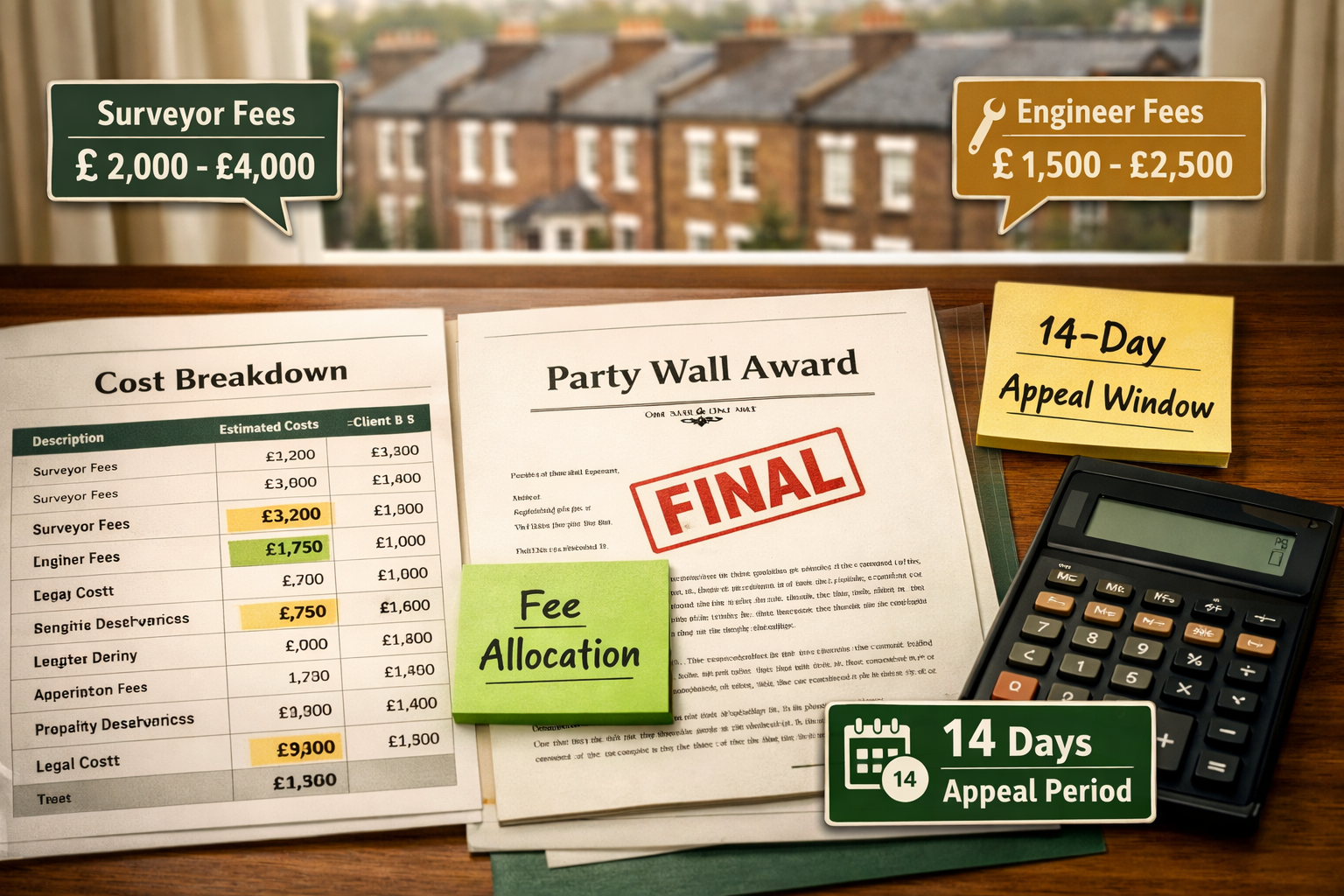
    Costs and Fee Allocation: What Owners Should Expect 💷

    This is where many property owners are caught off guard. The cost implications of a Third Surveyor referral are significant and often misunderstood.

    Key cost facts for 2026:

    • The Third Surveyor can demand payment before issuing their award — unlike the two appointed surveyors. [2]
    • They typically ask both owners to pay half upfront, with final allocation determined in the Award. [2]
    • Who initiates the referral generally bears the cost — even if the Third Surveyor ultimately rules in their favour. [3]
    • If the Third Surveyor does not fully agree with one party’s position, fees can be apportioned accordingly in the final Award. [2]

    ⚠️ Important: Initiating a Third Surveyor referral purely as a tactical move — to delay works or pressure the other party — can backfire significantly. The costs can be substantial, and the outcome is never guaranteed.

    For a broader understanding of how party wall costs are structured, the costs of the party wall process page provides a useful overview of what owners typically pay at each stage.


    What Owners Should Expect: Process, Timelines, and Appeal Rights

    Understanding Third Surveyor Awards in Party Wall Disputes: When, Why, and What Owners Should Expect in 2026 means being realistic about timelines and legal rights once the process is triggered.

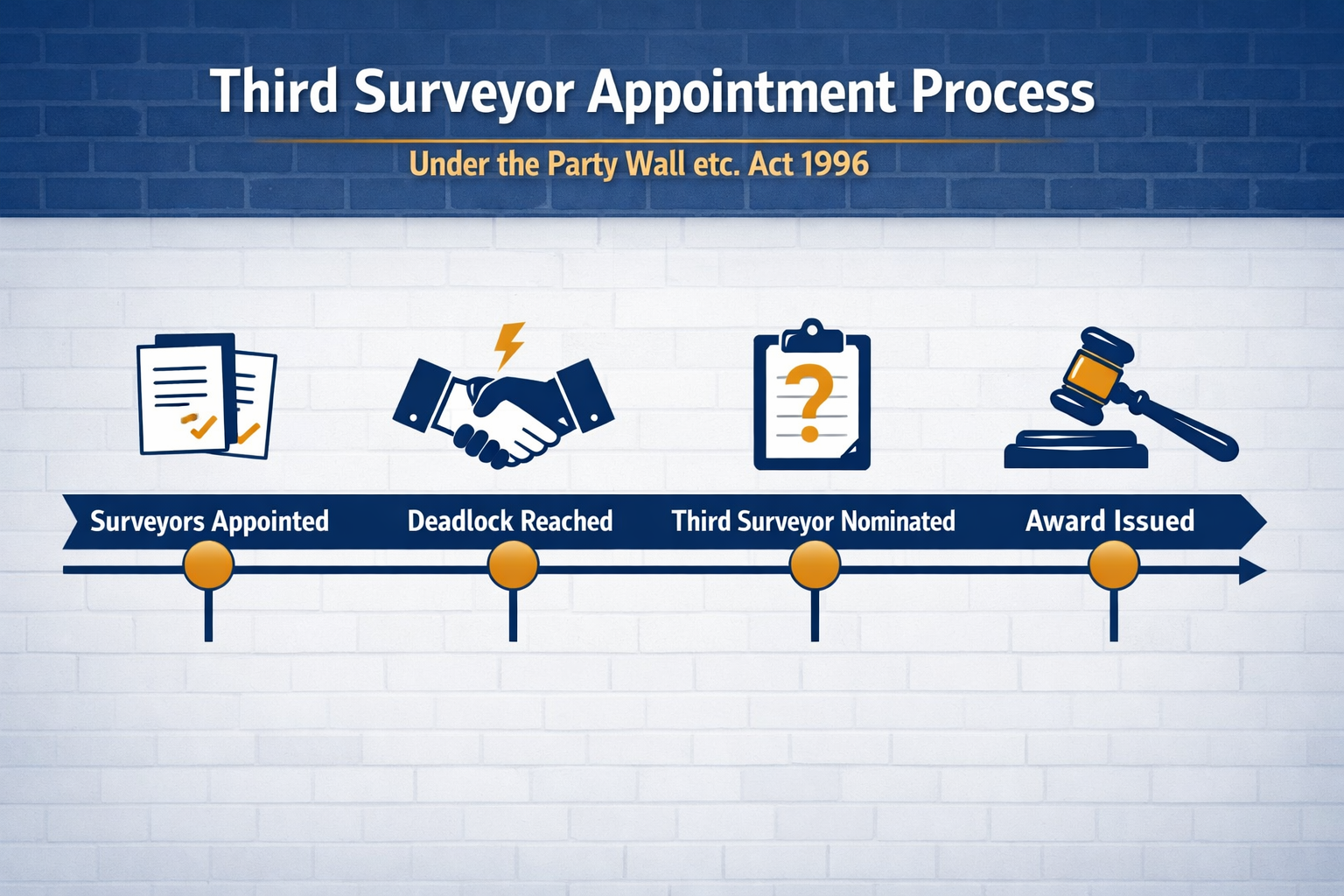
    The Step-by-Step Process at a Glance

    1. Two surveyors appointed → Third Surveyor nominated "forthwith"
    2. Deadlock reached on specific point(s)
    3. One or both surveyors refer the disputed matter to the Third Surveyor
    4. Third Surveyor reviews evidence, visits site, evaluates arguments
    5. Third Surveyor issues binding determination
    6. Two surveyors finalise and serve the Party Wall Award
    7. 14-day appeal window opens for County Court challenge
    

    Timelines: How Long Does This Take?

    There is no fixed statutory timeline for the Third Surveyor to issue their determination. However, in practice:

    • Nomination of the Third Surveyor: Should happen immediately after the two surveyors are appointed — often within days. [2]
    • Referral to the Third Surveyor: Can happen at any point during the Award preparation process when deadlock occurs.
    • Determination timeline: Varies depending on the complexity of the dispute, the Third Surveyor’s availability, and whether a site visit is required. In straightforward fee disputes, a determination may be issued within a few weeks. Complex damage claims can take considerably longer.

    Delays at this stage can hold up construction works entirely — a significant concern for building owners with contractors already engaged. This is one reason why understanding the party wall act process thoroughly before works begin is so important.

    Appeal Rights: The 14-Day Window ⏱️

    Third Surveyor Awards in Party Wall Disputes: When, Why, and What — image 5

    Once the Third Surveyor’s determination is served, all parties have a 14-day window to file an appeal with the County Court under Section 10(17) of the Act. [1] After this window closes, the determination becomes final and cannot be challenged.

    However, appeals face a very high bar:

    • Courts will generally only consider an appeal if the Third Surveyor acted beyond their powers or outside the scope of the Act. [1] [3]
    • Appeals are rare, highly technical, and expensive. [1]
    • Simply disagreeing with the outcome is not sufficient grounds for a successful appeal.

    💬 “The Third Surveyor’s ruling on disputed matters is binding on all parties and the two appointed surveyors — it is not a starting point for further negotiation.” [1]

    This is why choosing experienced, qualified surveyors from the outset matters so much. Both building owners and adjoining owners benefit from representation by surveyors who understand the Act deeply and can navigate disputes without escalating to Third Surveyor level unnecessarily.


    How to Avoid Reaching Third Surveyor Stage: Prevention Strategies for 2026

    The best outcome for all parties is one where the Third Surveyor is nominated but never actually called upon. Here are practical strategies to reduce the risk of escalation:

    ✅ For Building Owners

    • Serve notices correctly and on time — errors in party wall notices are a leading cause of disputes. Review the guidance on party wall act notices before serving.
    • Appoint an experienced surveyor who has a track record of reaching agreed Awards without escalation.
    • Be realistic about surveyor fees — challenging reasonable adjoining owner surveyor fees is one of the most common triggers for Third Surveyor referrals. [2]
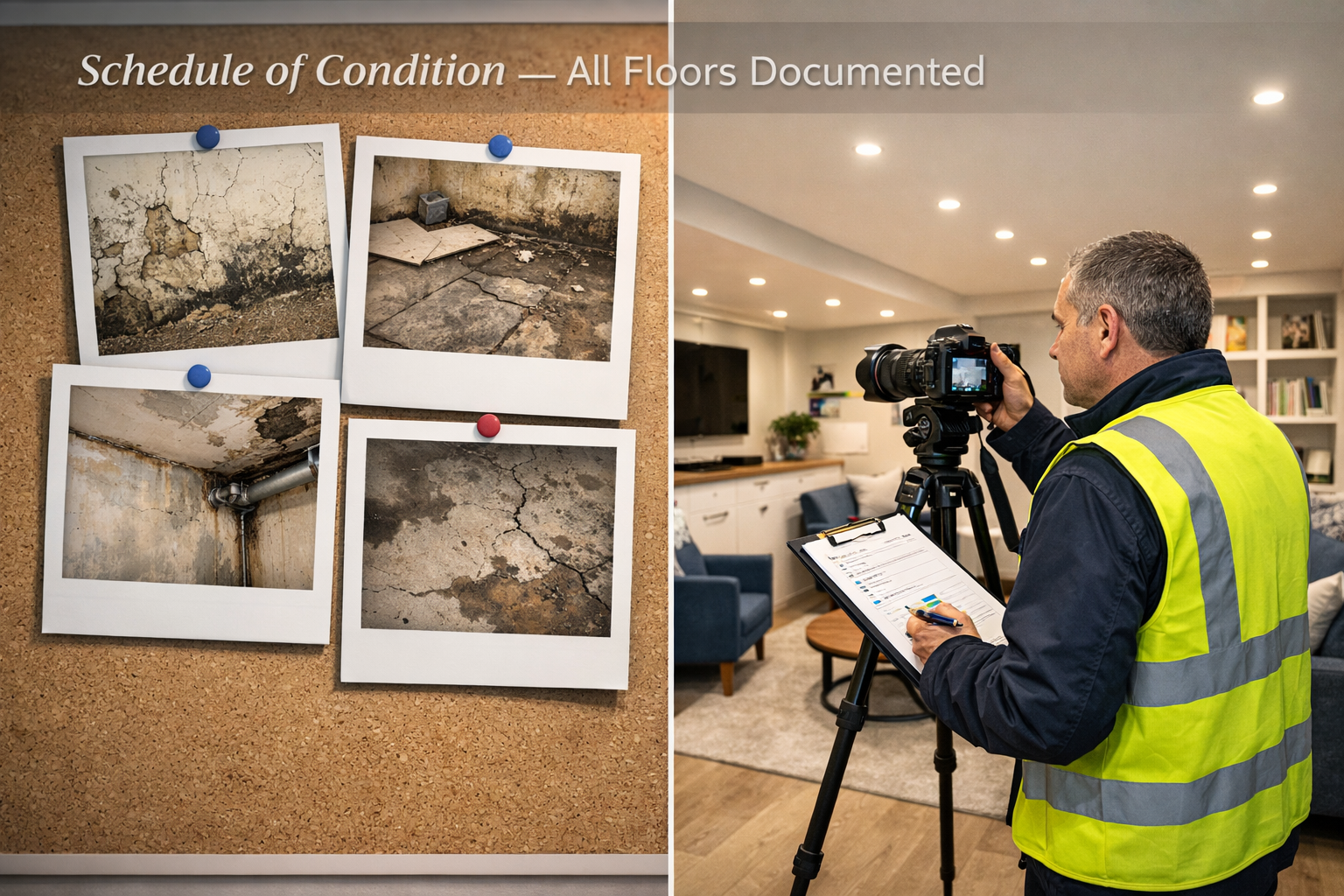
    • Commission a thorough schedule of condition before works begin to reduce the risk of damage disputes later.

    ✅ For Adjoining Owners

    • Engage promptly when a party wall notice is received — delays increase tension and reduce options.
    • Appoint a qualified surveyor who will advocate effectively without being unnecessarily obstructive.
    • Understand what the Act does and does not cover — unreasonable demands fall outside the Act’s scope and can lead to costly referrals.
    • Consider whether agreement is possible — in some cases, a party wall agreement without a surveyor may be achievable for lower-risk works, though professional advice is always recommended.

    The Role of Communication in Dispute Prevention 🤝

    Many Third Surveyor referrals stem not from genuinely irreconcilable technical disagreements, but from a breakdown in professional communication between the two appointed surveyors. In 2026, experienced practitioners increasingly emphasise early dialogue, clear documentation of positions, and a willingness to compromise on non-essential points as the most effective tools for keeping disputes out of Third Surveyor territory. [4]


    Frequently Asked Questions About Third Surveyor Awards

    Q: Can the building owner or adjoining owner choose the Third Surveyor?
    No. The Third Surveyor must be jointly selected by the two appointed surveyors. Neither property owner has a direct say in the selection. [1]

    Q: Does the Third Surveyor review the entire Party Wall Award?
    No. The Third Surveyor rules only on the specific disputed point(s) referred to them — not the entire Award. [1]

    Q: What if one surveyor refuses to cooperate in nominating a Third Surveyor?
    Section 10 of the Act provides mechanisms to address this, including the ability for the appointing party to make the appointment themselves in certain circumstances. This is an area where specialist legal advice may be needed.

    Q: Can both surveyors refer a matter to the Third Surveyor, or only one?
    Either surveyor can make the referral — it does not require both to agree to do so. [3]

    Q: Is the Third Surveyor’s fee always paid by the losing party?
    Not necessarily. The Award determines fee allocation, and if the Third Surveyor does not fully agree with either party, fees may be apportioned. The party who initiates the referral often bears the cost regardless of outcome. [2] [3]


    Conclusion: Navigating Third Surveyor Awards Confidently in 2026

    Third Surveyor Awards represent the Act’s built-in safety valve — a mechanism that ensures party wall disputes can always be resolved, even when professional agreement proves impossible. But reaching that stage carries real costs, delays, and uncertainty for both building owners and adjoining owners.

    The most important takeaway for 2026 is this: prevention is always cheaper than resolution. Investing in experienced, qualified surveyors from the start — professionals who understand both the technical and interpersonal dimensions of party wall work — dramatically reduces the likelihood of ever needing a Third Surveyor to intervene.

    Actionable Next Steps 🚀

    1. Before serving notice: Familiarise yourself with the types of party wall works covered by the Act to ensure your project is properly within scope.
    2. When appointing a surveyor: Ask specifically about their experience with contested Awards and Third Surveyor referrals.
    3. If a dispute arises: Seek advice early — do not wait until positions have hardened.
    4. If a Third Surveyor is called: Understand the cost implications upfront and ensure your surveyor has submitted clear, well-evidenced arguments.
    5. After a determination: Note the 14-day appeal window and take legal advice immediately if there are genuine grounds to challenge.

    Whether you are a building owner planning works or an adjoining owner seeking to protect your property, understanding the full party wall process — including the Third Surveyor mechanism — puts you in a far stronger position. For tailored guidance, contact a specialist party wall surveyor who can advise on your specific situation in 2026.


    References

    [1] Appointing The Third Surveyor When Disagreements Arise And Why This Costly Step Is Necessary – partywallslimited.com

    [2] Role Of The Third Surveyor In Party Wall Matters – taylor-mitchell.co.uk

    [3] Disputing Party Wall Third Surveyor – stokemont.com

    [4] Party Wall Surveys And Neighbour Disputes During 2026s Construction Uptick Rics Compliance Framework – https://nottinghillsurveyors.com/blog/party-wall-surveys-and-neighbour-disputes-during-2026s-construction-uptick-rics-compliance-framework

    [5] Party Wall Agreement London 2026 – mayfairstudio.co.uk

  • Party Wall Surveyor Independence vs Client Loyalty: Navigating the

    Party Wall Surveyor Independence vs Client Loyalty: Navigating the

    Nearly one in three party wall awards issued in England and Wales faces some form of challenge — and a growing share of those challenges hinge on a single, uncomfortable question: whose side is the surveyor actually on? The tension at the heart of Party Wall Surveyor Independence vs Client Loyalty: Navigating the Impartiality Paradox in 2026 is not new, but it has never been more sharply defined. In April 2026, RICS launched a formal consultation on the 8th edition of its Party Wall Legislation and Procedure guidance — the first major overhaul in several years — placing surveyor impartiality squarely at the centre of professional debate [1][2].

    This article unpacks why that paradox exists, how emerging case law is reshaping the boundaries of acceptable conduct, and what the new RICS guidance means for surveyors, building owners, and adjoining owners alike.

    Party Wall Surveyor Independence vs Client Loyalty: Navigating the


    Key Takeaways 📌

    • A party wall surveyor’s appointment is statutory, not contractual — meaning duties run to the process and the law, not to the client who pays the fee.
    • The RICS 8th Edition draft guidance (consulted April–May 2026) explicitly defines surveyor appointments as “personal and statutory, independent of client instruction” [1].
    • Recent case law has seen awards set aside where surveyors acted without genuine dispute or proper jurisdiction — a direct consequence of blurred independence boundaries.
    • The Third Surveyor mechanism remains the most powerful tool for resolving deadlock while preserving impartiality on both sides.
    • Homeowners and developers can take practical steps to protect themselves by understanding the difference between a surveyor’s legal duty and their professional loyalty.

    What Is the Impartiality Paradox?

    At first glance, the party wall system appears straightforward. A building owner serves notice under the Party Wall etc. Act 1996, the adjoining owner either consents or dissents, and — if there is a dispute — each party appoints their own surveyor. Those two surveyors then work together (or refer matters to a Third Surveyor) to produce a party wall award.

    The paradox emerges here: the surveyor is appointed by and paid by one party, yet is legally required to act independently of that party’s wishes.

    💬 “The surveyor’s duty is to the Act, not to the appointing owner. That is not a courtesy — it is a statutory obligation.”

    This is fundamentally different from most professional relationships. A solicitor advocates for their client. An architect designs to the client’s brief. But a party wall surveyor — even one appointed solely by the building owner — must weigh the interests of both sides when making decisions under the Act.

    Why This Creates Real-World Friction

    The friction is practical and financial. The building owner pays the surveyor’s fee. They want the project to proceed quickly and cheaply. They may push for a narrow schedule of condition, a fast-tracked award, or minimal protective conditions for the adjoining owner’s property.

    A surveyor who yields to that pressure — even subtly — crosses the line from professional service into client advocacy. And in 2026, that line is being policed more rigorously than ever before.


    The RICS 8th Edition: Redefining the Boundaries in 2026

    Party Wall Surveyor Independence vs Client Loyalty: Navigating the — image 3

    The April 2026 RICS consultation on the 8th edition of Party Wall Legislation and Procedure is the clearest signal yet that the profession has recognised the impartiality problem as urgent [1][2]. The consultation ran for approximately eight weeks across April and May 2026, targeting surveyors, legal professionals, dispute resolution practitioners, and other stakeholders across England and Wales.

    Key Changes That Address the Independence Question

    The draft guidance introduces several provisions directly relevant to Party Wall Surveyor Independence vs Client Loyalty: Navigating the Impartiality Paradox in 2026:

    Provision What It Does
    Statutory independence declaration Explicitly defines appointments as personal and statutory, not subject to client instruction [1]
    Revised letters of appointment New templates clarify independence obligations from the outset [1]
    Enhanced fee practice guidance Tightens rules on how fees are structured to reduce financial pressure on surveyors [1]
    Updated Third Surveyor provisions Strengthens the referral mechanism to prevent deadlock and bias [1]
    Revised award framework Updated draft award reduces ambiguity about what surveyors can and cannot decide [1]
    Enhanced appendices on competence Supports consistency in how surveyors maintain independence across different practice contexts [1]

    RICS has stated that clarity and professional rigour are “especially important” in the current period [1] — language that signals the regulator views independence failures not as edge cases, but as a systemic risk to the profession’s credibility.

    Why the “Personal and Statutory” Language Matters

    The phrase “personal and statutory, independent of client instruction” [1] is legally significant. It means:

    • A client cannot instruct a surveyor to reach a particular outcome.
    • A surveyor cannot be dismissed by their appointing owner mid-process simply for making decisions the owner dislikes.
    • The surveyor’s duty of care runs to the integrity of the award, not to the satisfaction of the paying party.

    This language directly responds to a pattern of cases where building owners — frustrated by surveyors who applied proper protective conditions — attempted to replace their appointed surveyor with a more compliant one. The 8th edition guidance is designed to make clear that such conduct is impermissible.


    Case Law Trends: When Independence Fails

    The courts have been increasingly willing to scrutinise party wall awards where surveyor independence is in doubt. Several recurring fact patterns have emerged in recent years.

    Awards Challenged for Lack of Genuine Dispute

    One of the most significant trends involves surveyors proceeding to make awards without a genuine dispute existing between the parties [1]. Under the Act, the dispute mechanism is triggered by dissent or deemed dissent — not simply by a building owner wanting the process to move faster.

    Where surveyors have issued awards in the absence of real disagreement, courts have set those awards aside. This matters for independence because the temptation to manufacture or assume a dispute often comes from client pressure to formalise the process quickly, bypassing the need for genuine negotiation.

    The “Compliant Surveyor” Problem

    A more subtle pattern involves surveyors who are technically independent but practically deferential. Signs of this include:

    • 🚩 Schedules of condition that are superficial or incomplete
    • 🚩 Awards that grant the building owner unusually wide working hours without justification
    • 🚩 Failure to include standard protective conditions for the adjoining property
    • 🚩 Unreasonably fast turnaround that prevents proper review

    Understanding the role of a building owner’s surveyor versus an adjoining owner’s surveyor is essential here. Both are bound by the same statutory independence obligations — but the practical pressures they face differ significantly.

    The Third Surveyor as a Safeguard

    When the two appointed surveyors cannot agree, either may refer the matter to the Third Surveyor — a pre-agreed neutral figure. This mechanism is one of the Act’s most powerful tools for preserving impartiality, yet it is underused in practice.

    The 8th edition guidance strengthens Third Surveyor provisions precisely because referrals are sometimes avoided — by surveyors who fear appearing obstructive to their appointing owner, or who want to resolve matters bilaterally even when that produces a suboptimal outcome [1].


    Practical Implications: What This Means for Owners and Surveyors

    Party Wall Surveyor Independence vs Client Loyalty: Navigating the — image 5

    Understanding Party Wall Surveyor Independence vs Client Loyalty: Navigating the Impartiality Paradox in 2026 is not just an academic exercise. It has direct, practical consequences for everyone involved in a party wall process.

    For Building Owners 🏗️

    Building owners sometimes misunderstand what they are paying for when they appoint a party wall surveyor. They are not purchasing advocacy — they are funding a statutory process. Key points to understand:

    • The surveyor you appoint cannot simply do what you ask if it conflicts with the Act.
    • Attempting to pressure your surveyor into a favourable outcome can invalidate the award.
    • A properly conducted process — even one that imposes conditions — provides legal certainty that protects your project long-term.

    For those carrying out works, the building owners’ section provides a clear overview of rights and responsibilities under the Act.

    For Adjoining Owners 🏠

    Adjoining owners benefit most directly from surveyor independence. However, they should also be aware that:

    • Their appointed surveyor is equally bound by the independence obligation — they cannot simply demand outcomes that the Act does not support.
    • A schedule of condition prepared independently and thoroughly is one of the most important protections available.
    • If the adjoining owner’s surveyor appears to be colluding with the building owner’s surveyor, the Third Surveyor referral mechanism is the appropriate remedy.

    For neighbours affected by nearby works, the adjoining owners’ section explains the full range of rights available.

    For Surveyors: A Checklist for Maintaining Independence ✅

    Action Why It Matters
    Use the new RICS letter of appointment template Establishes statutory independence from day one
    Decline instructions that conflict with the Act Client pressure does not override statutory duty
    Document all decisions with clear reasoning Creates an audit trail if the award is challenged
    Use the Third Surveyor when genuinely deadlocked Avoids the appearance of bilateral compromise
    Conduct thorough schedules of condition Protects both parties and the integrity of the award
    Review fee structures for conflicts of interest Contingency or success-based fees are incompatible with independence

    The Cost Dimension: Does Independence Make Party Wall Work More Expensive?

    One common concern is that rigorous independence — surveyors who apply full protective conditions, conduct thorough inspections, and resist client pressure — drives up costs. This concern is understandable but largely misplaced.

    The real cost driver in party wall disputes is poor process, not thorough process. Awards that are challenged, set aside, or litigated cost far more than awards that are properly made from the outset. For practical guidance on managing expenditure without compromising quality, see how to keep party wall costs down.

    It is also worth noting that in many straightforward cases, the parties can reach agreement without triggering the full dispute mechanism — a point explored in detail in the guide on having a party wall agreement without a surveyor. Where works are genuinely uncontroversial and both parties are cooperative, the formal appointment process may not be necessary at all.


    London-Specific Considerations in 2026

    London’s dense urban environment — with its terraced streets, basement extensions, and loft conversions — creates a particularly acute version of the impartiality paradox. The sheer volume of party wall work in the capital, combined with competitive fee pressure among surveyors, creates conditions where independence can erode gradually rather than dramatically.

    Whether the works are in East London, West London, South London, North London, or Central London, the same statutory independence obligations apply. The 8th edition guidance is national in scope, but its impact will be felt most acutely in high-volume urban markets like London, where the temptation to streamline — and thereby cut corners — is greatest.


    Conclusion: Choosing Independence Is Not Optional

    The impartiality paradox at the heart of party wall surveying is not a flaw in the system — it is a feature. The Act deliberately creates a tension between the surveyor’s relationship with their appointing owner and their duty to the statutory process, because that tension is what keeps the system honest.

    In 2026, the RICS 8th Edition consultation has made clear that the profession is taking this tension seriously [1][2]. The explicit framing of appointments as “personal and statutory, independent of client instruction” is not bureaucratic language — it is a statement of principle that has real consequences for how surveyors conduct themselves and how awards are made.

    Actionable Next Steps

    For building owners: Appoint a surveyor who explains their independence obligations clearly at the outset. A surveyor who promises to “get this done quickly on your terms” is a red flag, not a selling point.

    For adjoining owners: Exercise your right to appoint your own surveyor. Do not rely solely on the building owner’s surveyor, even in apparently straightforward cases.

    For surveyors: Review the RICS 8th Edition draft guidance carefully. Update your letters of appointment, review your fee structures, and document your decision-making process on every file.

    For everyone: Understand that a properly independent party wall process — one that respects the statutory framework — is the fastest route to a legally secure outcome. Shortcuts that compromise independence create delays, disputes, and costs that far outweigh any short-term convenience.

    The impartiality paradox is navigable. But navigating it requires surveyors, owners, and advisers to understand exactly what the law demands — and to hold that line even when client pressure pushes in the opposite direction.


    References

    [1] Rics Launches Consultation On Updated Party Wall Practice Guidance – rics.org

    [2] Rics Launches Consultation Updated Party Wall Practice Guidance – todaysconveyancer.co.uk


  • Third Surveyor Decisions in Party Wall Disputes: Costs, Timelines,

    Third Surveyor Decisions in Party Wall Disputes: Costs, Timelines,

    Only around 1% of party wall disputes ever reach a Third Surveyor — yet when they do, the financial and legal stakes rise sharply for everyone involved. Understanding Third Surveyor Decisions in Party Wall Disputes: Costs, Timelines, and Recent Podcast Insights for 2026 Cases is no longer optional for homeowners, developers, or property professionals navigating London’s increasingly active construction market. This guide breaks down exactly how the Third Surveyor mechanism works, what it costs, how long it takes, and what recent professional discussions — including insights shared via FPWS (Faculty of Party Wall Surveyors) podcast content — reveal about managing these escalating disputes effectively in 2026.


    Key Takeaways 📌

    • A Third Surveyor is only triggered when the two appointed surveyors cannot agree — making prevention the most cost-effective strategy.
    • Third Surveyors hold legally binding authority to determine specific points of dispute, with appeals only possible within 14 days via County Court.
    • The most common referrals involve surveyor fee disputes and damage claims — not technical construction matters.
    • Third Surveyor fees can be significant, and who pays is entirely at the Third Surveyor’s discretion.
    • Early, professional engagement with the Party Wall etc. Act 1996 process dramatically reduces the risk of reaching this stage.

    Third Surveyor Decisions in Party Wall Disputes: Costs, Timelines,

    What Is a Third Surveyor and When Are They Triggered?

    The Statutory Trigger: Deadlock Between Appointed Surveyors

    The Third Surveyor is not a routine figure in party wall proceedings. Their involvement is strictly triggered by deadlock — specifically, when the two appointed surveyors (one representing the building owner, one representing the adjoining owner) cannot agree on a matter under dispute or cannot finalise the terms of a Party Wall Award [1].

    This distinction matters enormously. The Third Surveyor does not oversee the entire dispute from the start. They are called in to resolve a specific, defined point of contention. Think of them as a referee brought onto the pitch only when two players cannot agree on whether the ball crossed the line.

    💡 Pull Quote: “The Third Surveyor’s determination on the specific point of dispute is final and legally binding on all parties — including the two appointed surveyors.” [1]

    Who Actually Appoints the Third Surveyor?

    This surprises many property owners: the building owner and adjoining owner do not appoint the Third Surveyor. The appointment is made by the two appointed surveyors themselves, through a negotiated process [2].

    The standard procedure works like this:

    1. One surveyor proposes three potential Third Surveyors
    2. The other surveyor reviews the list and negotiates
    3. Back-and-forth continues until both agree on one name [2]

    If the two surveyors fail to agree on a Third Surveyor, the responsibility passes to the “appointing officer” — typically the head of Building Control at the relevant local authority. In cases where the local authority is itself a party to the dispute, the Secretary of State makes the selection [2].

    RICS Qualifications: Who Can Serve?

    Not just anyone can step into this role. According to RICS guidance, only chartered surveyors holding MRICS or FRICS designations should be appointed as party wall surveyors [3]. This professional standard ensures that the Third Surveyor brings the technical competence and impartiality the role demands — particularly as RICS continues to consult on updated party wall practice guidance [5].


    Third Surveyor Decisions in Party Wall Disputes: Costs, Timelines, and Recent Podcast Insights for 2026 Cases

    What Does a Third Surveyor Actually Cost?

    Cost is where many property owners get an unwelcome shock. Third Surveyor fees are not capped and can vary significantly depending on the complexity of the dispute, the seniority of the appointed surveyor, and the time required to review submissions and issue a determination.

    Here is a realistic breakdown of the cost landscape:

    Cost Element Typical Range (2026) Who Pays?
    Third Surveyor’s own fees £1,500 – £5,000+ Determined by Third Surveyor
    Appointed surveyors’ submission costs £500 – £2,000 each Determined by Third Surveyor
    County Court appeal costs £5,000 – £20,000+ Losing party (typically)
    Total dispute escalation cost £3,000 – £25,000+ Varies

    A critical procedural point: unlike the two appointed surveyors, Third Surveyors can and do insist on payment before serving their award [2]. This upfront payment requirement is a practical reality that both parties must prepare for.

    On cost allocation, the Third Surveyor holds full discretion. The general principle is that costs are allocated to the party whose surveyor’s position or instruction led to the unnecessary disagreement [1]. In practice, Third Surveyors often ask both owners to pay half initially, then leave the final allocation to be sorted after the award is served [2].

    For those looking to manage overall party wall costs proactively, reviewing how to keep party wall costs down before disputes escalate is strongly recommended.

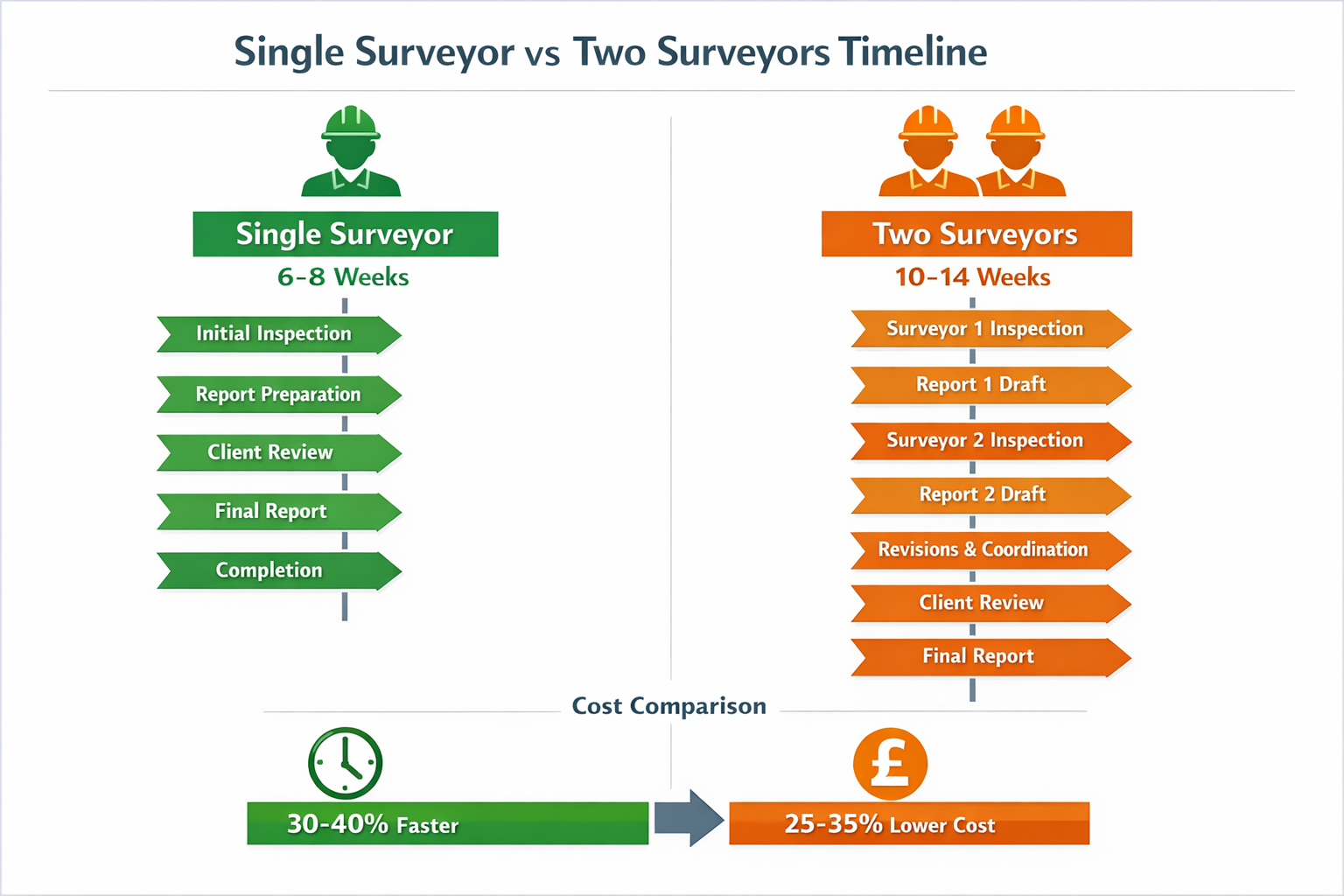
    Timeline: How Long Does the Process Take?

    Speed is not a hallmark of Third Surveyor proceedings. Here is a realistic timeline for 2026 cases:

    ⏱️ Typical Third Surveyor Timeline:

    • Week 1–2: Deadlock identified; surveyors begin negotiating Third Surveyor appointment
    • Week 2–4: Third Surveyor selected and formally appointed
    • Week 3–6: Both surveyors submit written representations and evidence
    • Week 6–10: Third Surveyor reviews submissions, may request further information
    • Week 8–12: Determination issued and served on all parties
    • Day 1–14 post-service: Window for County Court appeal under Section 10(17)

    The 14-day appeal window is non-negotiable [1]. Miss it, and the determination stands as final regardless of any perceived unfairness. Appeals are described by practitioners as rare, highly technical, and often extremely expensive — making them a last resort rather than a routine option [1].

    What Types of Disputes Reach the Third Surveyor?

    The data here is revealing. The largest proportion of Third Surveyor referrals relate to either:

    1. 🏷️ Fees proposed by the adjoining owner’s surveyor — disputes over whether the costs being charged are reasonable
    2. 🔨 Damage caused by the works — disagreements about whether damage occurred, its extent, and who is liable [2]

    Technical construction disputes — arguments about methodology, materials, or structural approach — are actually less common triggers than many assume. This means that professional fee management and thorough schedule of condition surveys are among the most effective preventative measures available.

    A properly prepared schedule of condition before works begin is one of the most powerful tools for avoiding damage-related Third Surveyor referrals entirely.


    Third Surveyor Decisions in Party Wall Disputes: Costs, Timelines, — image 3

    Recent Podcast Insights and 2026 Trends in Third Surveyor Cases

    What FPWS Podcast Discussions Reveal About Award-Making in 2026

    The Faculty of Party Wall Surveyors (FPWS) has increasingly used podcast formats to share practitioner insights on award-making, cost disputes, and the evolving landscape of Third Surveyor referrals. Several themes have emerged as particularly relevant for Third Surveyor Decisions in Party Wall Disputes: Costs, Timelines, and Recent Podcast Insights for 2026 Cases:

    🎙️ Key themes from professional podcast discussions:

    • Fee transparency is under scrutiny. Practitioners are increasingly discussing the need for adjoining owner surveyors to provide detailed fee justifications upfront, reducing the likelihood of fee disputes reaching the Third Surveyor stage.
    • The “nuclear option” framing. Experienced surveyors consistently frame Third Surveyor referral as a last resort — a costly, time-consuming process that damages professional relationships and delays construction projects.
    • Proportionality in award-making. There is growing professional consensus that awards should be proportionate to the scale of works, and that disproportionate fee demands are a primary driver of unnecessary escalation.
    • Digital submissions and efficiency. Some Third Surveyors are now accepting digital-only submissions, which is reducing administrative timelines in straightforward cases.

    The 2026 Construction Uptick: Why Third Surveyor Cases Are Rising

    London’s construction activity has increased notably in 2026, driven by planning reforms, housing targets, and a renewed appetite for basement conversions, rear extensions, and loft developments. This uptick directly correlates with higher volumes of party wall notices being served — and, statistically, more disputes [3].

    For homeowners in areas with dense terrace housing, the risk of neighbour disputes is particularly elevated. Whether dealing with works in North London, South London, or Central London, the principles governing Third Surveyor appointments remain consistent — but local construction intensity affects how quickly disputes arise.

    Strategies Practitioners Are Recommending to Avoid Third Surveyor Referral

    Based on professional discussions and established best practice, the following strategies are consistently highlighted as the most effective ways to avoid the cost and delay of Third Surveyor proceedings:

    ✅ Prevention Strategies for 2026 Cases:

    1. Serve notices correctly and on time. Errors in party wall notices are a common source of early-stage friction that can snowball into larger disputes.
    2. Appoint experienced, RICS-qualified surveyors. Surveyors who understand professional norms are less likely to adopt unreasonable positions that trigger referral.
    3. Agree fees transparently at the outset. The most common Third Surveyor trigger — fee disputes — is largely preventable through early, written fee agreements.
    4. Commission a thorough schedule of condition. Documented pre-works condition reduces the scope for damage disputes post-construction.
    5. Maintain professional communication. Many referrals stem from personality clashes rather than genuine legal disagreements. Experienced surveyors know how to de-escalate.
    6. Understand the award process. Familiarity with party wall award templates and contract guides helps all parties understand what a reasonable award looks like.

    Third Surveyor Decisions in Party Wall Disputes: Costs, Timelines, — image 5

    Practical Guidance for Building Owners and Adjoining Owners

    If You Are the Building Owner

    As the party initiating works, the building owner typically bears the primary cost responsibility for the party wall process — including, potentially, Third Surveyor fees if the referral arises from an unreasonable position taken by your appointed surveyor [1].

    Key actions to protect your position:

    • Instruct your building owner’s surveyor to adopt reasonable, well-evidenced positions in all award negotiations
    • Do not pressure your surveyor to resist legitimate adjoining owner concerns — this is a primary driver of unnecessary escalation
    • Budget contingency funds for potential Third Surveyor costs if your project is complex or relations with neighbours are strained

    If You Are the Adjoining Owner

    Adjoining owners sometimes assume that disputing everything strengthens their position. In reality, unreasonable positions by the adjoining owner’s surveyor are the single largest driver of Third Surveyor referrals — and costs can be awarded against the adjoining owner as a result [1][2].

    Key actions to protect your position:

    The Award: What Happens After the Third Surveyor Decides?

    Once the Third Surveyor issues their determination, it must be served on all owners — typically via the appointed surveyors. The award also formally determines:

    • Who pays the Third Surveyor’s fees
    • Who pays the appointed surveyors’ fees incurred in relation to their submissions
    • The specific resolution of the disputed point [2]

    From the moment of service, the 14-day clock for County Court appeal begins running [1]. Given the cost and complexity of appeals, the overwhelming majority of determinations are accepted and implemented without challenge.


    Conclusion: Actionable Next Steps for 2026 Disputes

    The Third Surveyor mechanism exists as a vital safety valve in the party wall system — but it is a safety valve that comes with a significant price tag, measured in both money and time. For anyone involved in party wall proceedings in 2026, the clearest message from practitioners, podcast discussions, and legal commentary is consistent: prevention is dramatically cheaper than resolution.

    Actionable Next Steps ✅

    1. Serve correct notices from day one. Use professional guidance on party wall act notices to avoid procedural errors.
    2. Appoint MRICS or FRICS qualified surveyors who have demonstrable party wall experience and professional reputations to protect.
    3. Agree surveyor fees in writing before appointment — this eliminates the most common trigger for Third Surveyor referral.
    4. Commission a schedule of condition before any works begin to create a clear baseline for damage assessment.
    5. If deadlock arises, engage the Third Surveyor process promptly rather than allowing the dispute to fester — delay adds cost without adding resolution.
    6. Budget realistically. If your project is complex, factor potential Third Surveyor costs into your overall construction budget from the outset.
    7. Seek specialist advice early — whether you are in East London, West London, or anywhere across the capital, local expertise matters.

    The Third Surveyor’s binding determination is a powerful legal instrument. Understanding how it works — and how to avoid needing it — is the mark of a well-prepared property professional or homeowner in 2026.


    References

    [1] Appointing The Third Surveyor When Disagreements Arise And Why This Costly Step Is Necessary – partywallslimited.com

    [2] Role Of The Third Surveyor In Party Wall Matters – taylor-mitchell.co.uk

    [3] Party Wall Surveys And Neighbour Disputes During 2026s Construction Uptick Rics Compliance Framework – https://nottinghillsurveyors.com/blog/party-wall-surveys-and-neighbour-disputes-during-2026s-construction-uptick-rics-compliance-framework

    [4] Party Wall Agreement – hoa.org.uk

    [5] Rics Consults On Updated Party Wall Practice Guidance – lexisnexis.co.uk

  • Drafting Flawless Party Wall Notices: Common Errors, Legal Fixes, and

    Drafting Flawless Party Wall Notices: Common Errors, Legal Fixes, and

    Nearly one in three party wall notices served in England and Wales contains at least one error significant enough to render it invalid — a statistic that costs building owners thousands in delays, legal fees, and damaged neighbour relationships. Whether it’s a missing floor plan, an incorrect notice period, or a notice served on the wrong person, these mistakes are almost entirely preventable. This guide to Drafting Flawless Party Wall Notices: Common Errors, Legal Fixes, and RICS 8th Edition Templates breaks down exactly where notices go wrong, how to fix them, and what the updated RICS 8th Edition guidance means for compliance in 2026.


    Key Takeaways 📋

    • Invalid notices are common — errors in description, service method, or timing can void a notice entirely.
    • RICS launched an 8th Edition consultation in April 2026, updating templates, fee guidance, and jurisdiction rules. [1]
    • Three notice types exist under the Party Wall etc. Act 1996 — each has distinct requirements that must be met precisely.
    • Corrected templates aligned with RICS 8th Edition drafts provide a reliable starting point for 2026 compliance.
    • Professional surveyors remain the safest route to a valid, dispute-free notice process, but understanding the rules helps every building owner.

    Drafting Flawless Party Wall Notices: Common Errors, Legal Fixes, and

    The Three Types of Party Wall Notices and Why Each One Matters

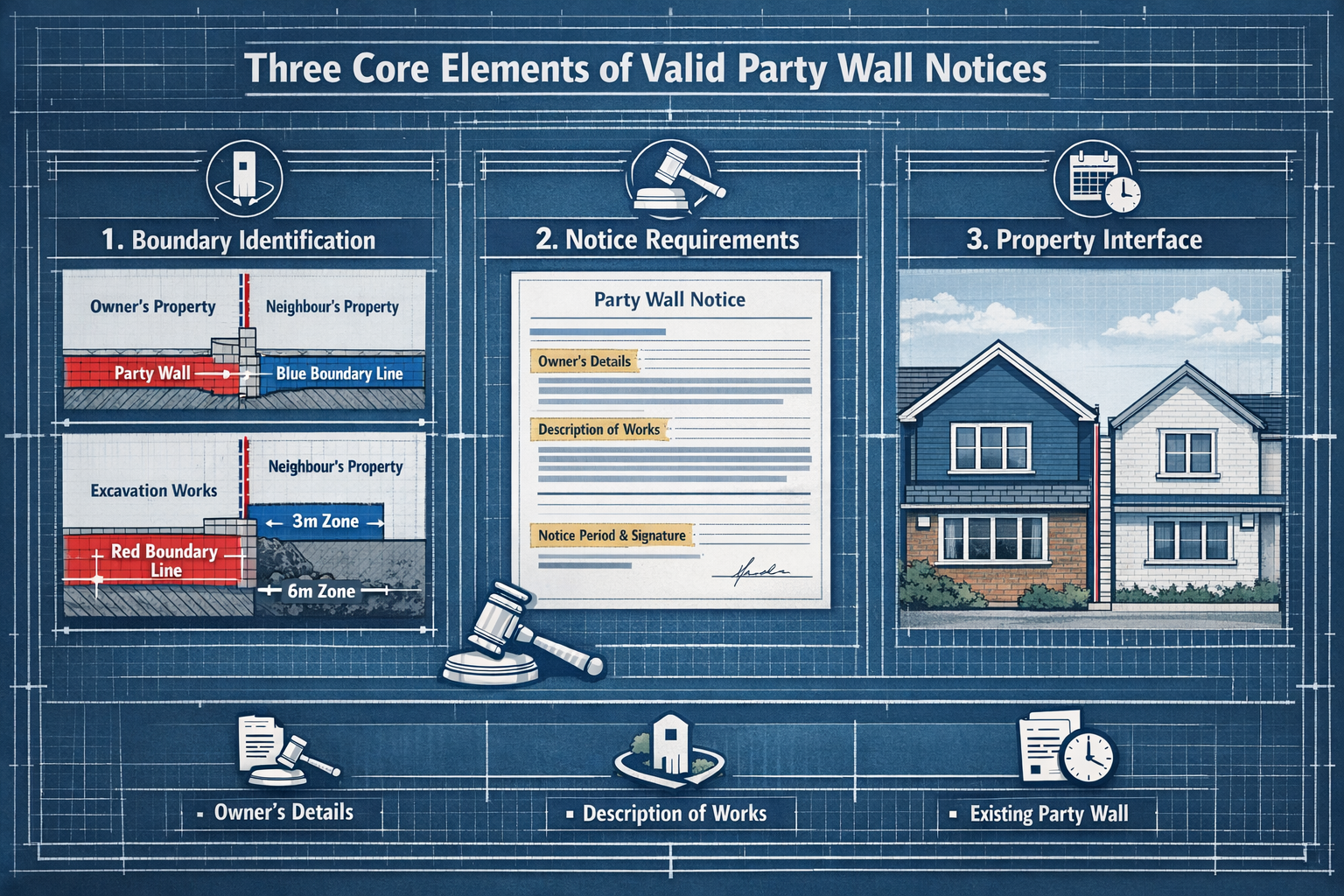
    Before exploring errors, it helps to understand the legal framework. The Party Wall etc. Act 1996 creates three distinct notice types, each triggered by different works:

    Notice Type Trigger Works Minimum Notice Period
    Party Structure Notice Works to a shared wall, floor, or structure 2 months
    Line of Junction Notice Building a new wall on or near the boundary 1 month
    Three Metre / Six Metre Notice Excavations near a neighbour’s foundations 1 month

    Each notice type carries its own mandatory content requirements. Confusing them — or serving the wrong notice for the planned works — is one of the most common and costly mistakes.

    💡 Pull Quote: “Serving the wrong notice type is not a minor technicality. It can void the entire process and expose a building owner to an injunction.”

    For a detailed breakdown of what each notice covers, the party wall notices overview explains the distinctions clearly.


    Drafting Flawless Party Wall Notices: Common Errors, Legal Fixes, and RICS 8th Edition Templates — The Error Catalogue

    This section covers the most frequent invalidation pitfalls, with corrected examples and practical fixes.

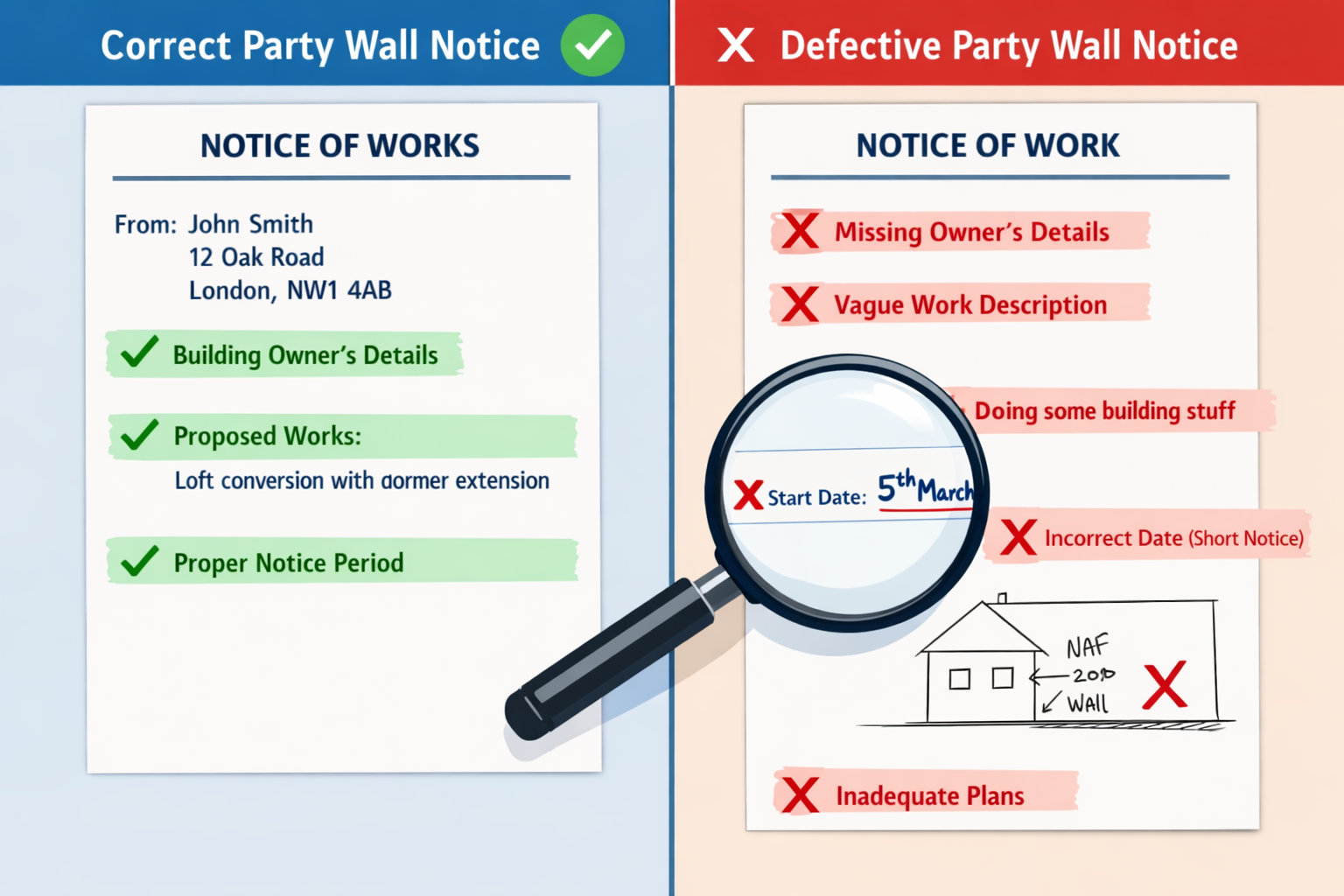
    ❌ Error 1: Vague or Incorrect Property Description

    The problem: A notice that describes the property as “the house next door” or omits the full postal address is legally deficient. Courts and surveyors have challenged notices where the property affected was not precisely identified.

    The fix: Include the full postal address, Land Registry title number where available, and a brief description of the structure affected (e.g., “the party wall forming the shared boundary between No. 14 and No. 16 Elm Street”).


    ❌ Error 2: Missing or Inadequate Plans

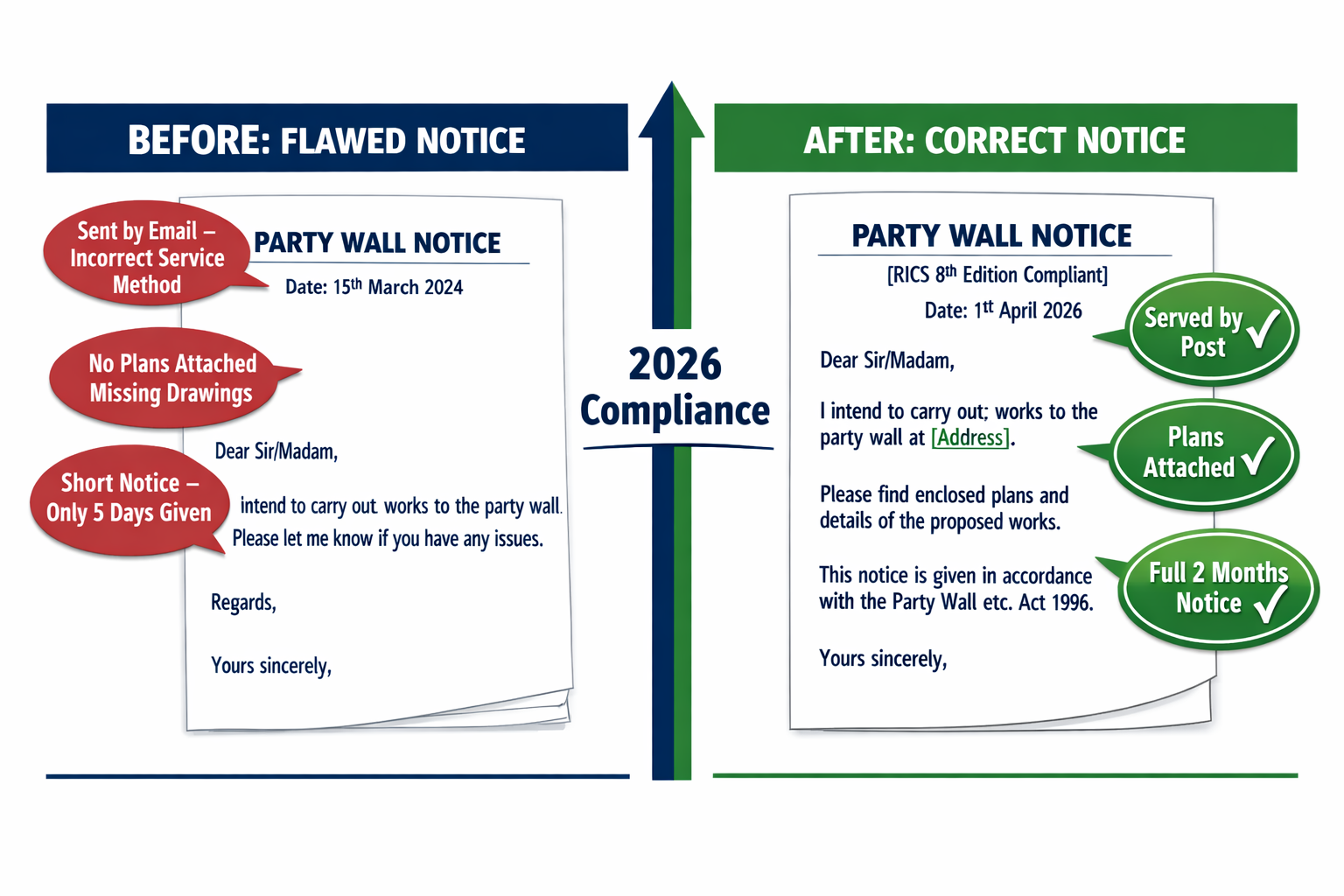
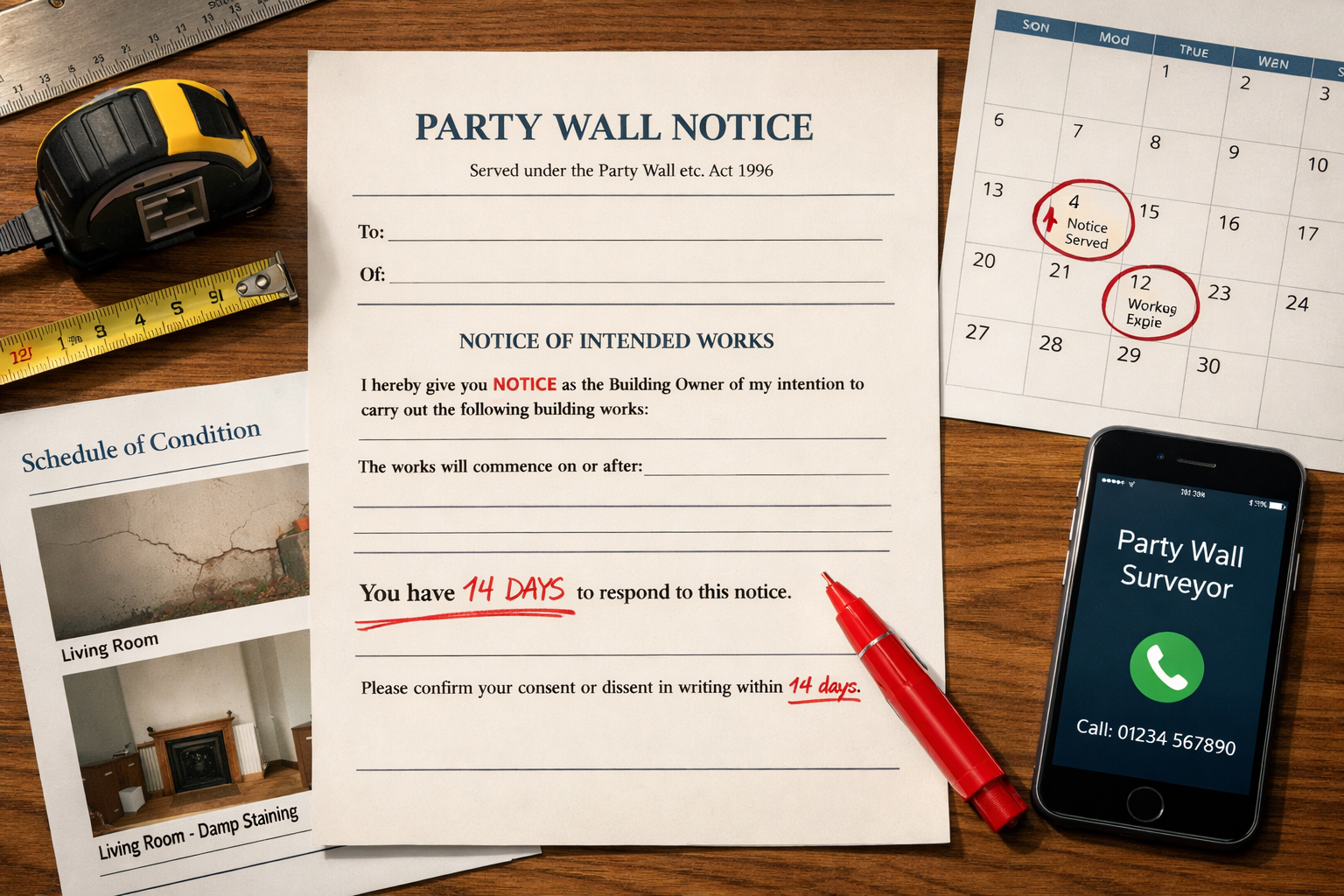
    The problem: The Party Wall etc. Act 1996 requires that notices include plans and sections showing the proposed works. Many building owners serve notices with no drawings at all, or attach sketches that lack sufficient detail — no dimensions, no indication of depth, no relationship to the party wall shown.

    The fix: Attach scaled drawings that show:

    • The location of the works relative to the party wall or boundary
    • Depth of any excavations
    • Any structural elements being altered or removed
    • The footprint of any new structure

    The RICS 8th Edition draft reinforces that supporting documentation must be adequate for the adjoining owner to understand the scope of works. [2]


    ❌ Error 3: Incorrect Notice Period

    The problem: A building owner eager to start works may serve a Party Structure Notice and begin works after only three weeks, not realising the statutory two-month minimum applies. This is a jurisdictional error — works begun before the notice period expires are technically unlawful.

    The fix: Calculate the notice period from the date of service, not the date of drafting. If serving by post, add two business days. Mark the earliest lawful start date clearly on the notice itself.


    ❌ Error 4: Serving Notice on the Wrong Person

    The problem: The Act requires notice to be served on the adjoining owner — the person with a freehold or leasehold interest of more than one year. Serving notice only on a tenant when the freeholder is a different person, or vice versa, creates a gap in the legal process.

    The fix: Conduct a Land Registry search before serving. If the property is tenanted, serve notice on both the freeholder and any qualifying leaseholder. For adjoining owners, understanding their rights from the outset reduces disputes.


    ❌ Error 5: Invalid Service Method

    The problem: Hand-delivering a notice by pushing it through the letterbox without any record of delivery, or emailing a notice without prior written consent to accept electronic service, are both problematic. If the adjoining owner later claims they never received the notice, there is no evidence trail.

    The fix: Serve by:

    • Recorded delivery post (Royal Mail Signed For or Special Delivery)
    • Personal service with a witness
    • Electronic means only if the adjoining owner has explicitly agreed in writing

    Keep a dated record of every service attempt.


    ❌ Error 6: Omitting the Response Options

    The problem: A valid notice must inform the adjoining owner of their right to consent, dissent, or appoint a surveyor. Notices that simply state “we intend to carry out works” without explaining the response mechanism are incomplete.

    The fix: Include a clear statement of the adjoining owner’s options:

    1. Consent in writing within the response period
    2. Dissent and appoint their own surveyor
    3. Agree to appoint a single agreed surveyor

    For more on how the response process works, see party wall act notices — what they are and how to respond.


    ❌ Error 7: Acting Without Proper Jurisdiction

    The problem: The RICS 8th Edition draft specifically addresses cases where surveyors have proceeded to issue awards when no genuine dispute existed — or where the notice itself was invalid, stripping the surveyors of jurisdiction entirely. [2][4] Awards issued without valid jurisdiction have been successfully challenged in court.

    The fix: Surveyors must confirm that a valid notice has been properly served and that a genuine dispute or deemed dispute exists before proceeding to award. Building owners should not pressure surveyors to skip steps.


    Drafting Flawless Party Wall Notices: Common Errors, Legal Fixes, and — image 3

    What the RICS 8th Edition Draft Changes — and Why It Matters in 2026

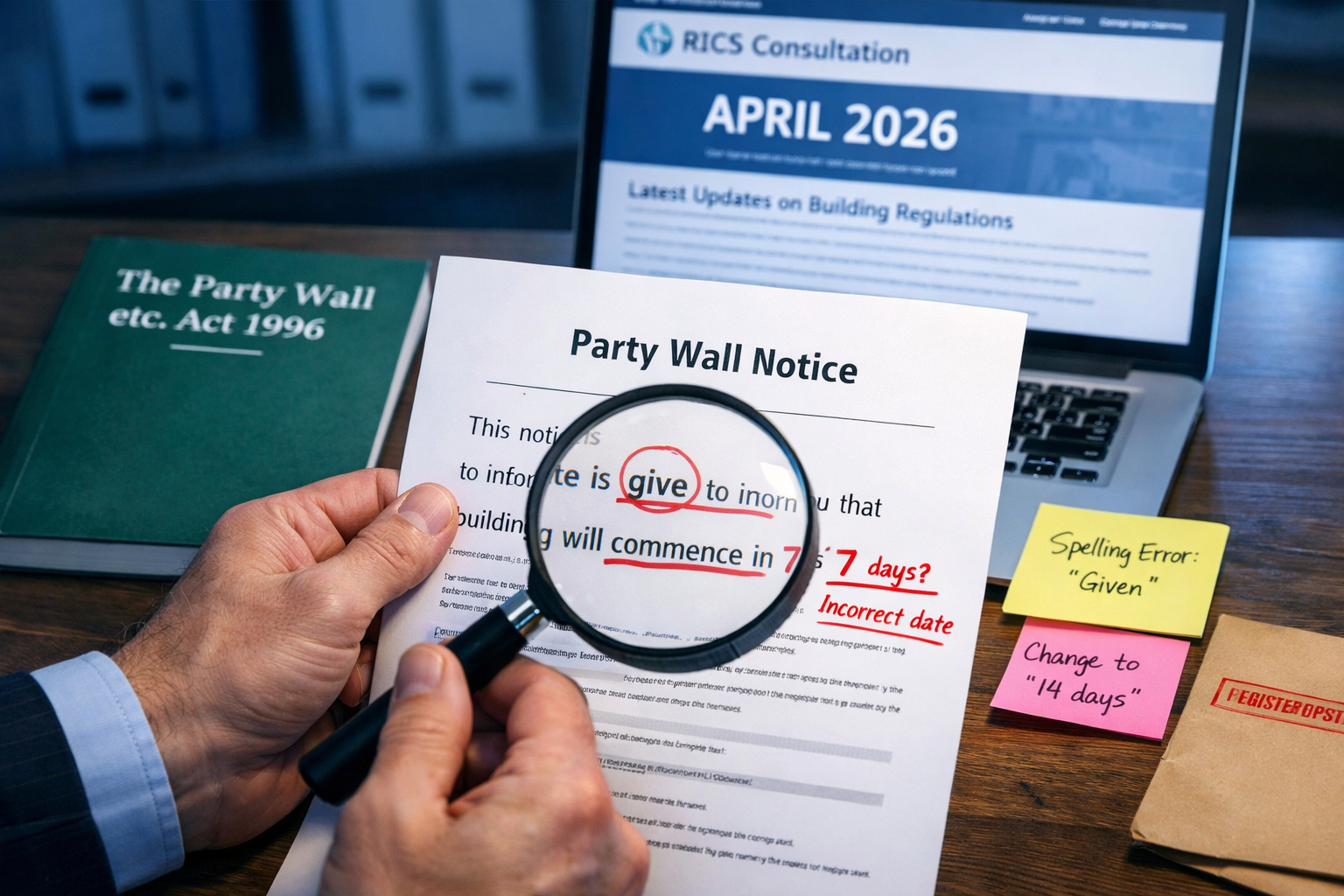
    In April 2026, RICS launched an eight-week consultation on the draft 8th Edition of Party Wall Legislation and Procedure, replacing the existing 7th Edition. [1][3] The consultation targets surveyors, legal professionals, dispute resolution practitioners, and other stakeholders across England and Wales. [1]

    Key Updates in the Draft 8th Edition

    🔹 Enhanced Templates and Appendices
    The draft includes revised letters of appointment, updated terms of engagement, and a refreshed draft award template. [1] These templates reflect current best practice and are designed to reduce the jurisdictional and procedural errors that have led to award challenges in recent years. [2]

    🔹 Strengthened Fee Guidance
    One recurring source of dispute has been disproportionate or opaque fee structures. The 8th Edition strengthens guidance on fee practices to promote transparency and fairness. [1] For building owners concerned about costs, understanding how to keep party wall costs down is increasingly important.

    🔹 Clearer Guidance on the Third Surveyor
    The updated edition provides clearer direction on when and how the Third Surveyor should be engaged, reducing ambiguity in contested situations. [1]

    🔹 Surveyor Independence Reinforced
    A key principle in the draft is that a party wall surveyor’s appointment is personal and statutory — independent of client instruction. [2] This means a building owner cannot instruct their surveyor to act in a way that compromises the surveyor’s statutory duty. This is a significant conduct reminder for all practitioners.

    🔹 Jurisdiction Concerns Addressed
    The draft directly tackles the problem of surveyors acting without proper jurisdiction — particularly in cases where awards have been challenged because no genuine dispute existed. [2][4] This has real implications for how notices are drafted and served, since an invalid notice means no valid jurisdiction.

    💡 Pull Quote: “A surveyor’s appointment is personal and statutory. No client instruction can override the duty to act impartially within the law.” — RICS 8th Edition Draft Principle [2]


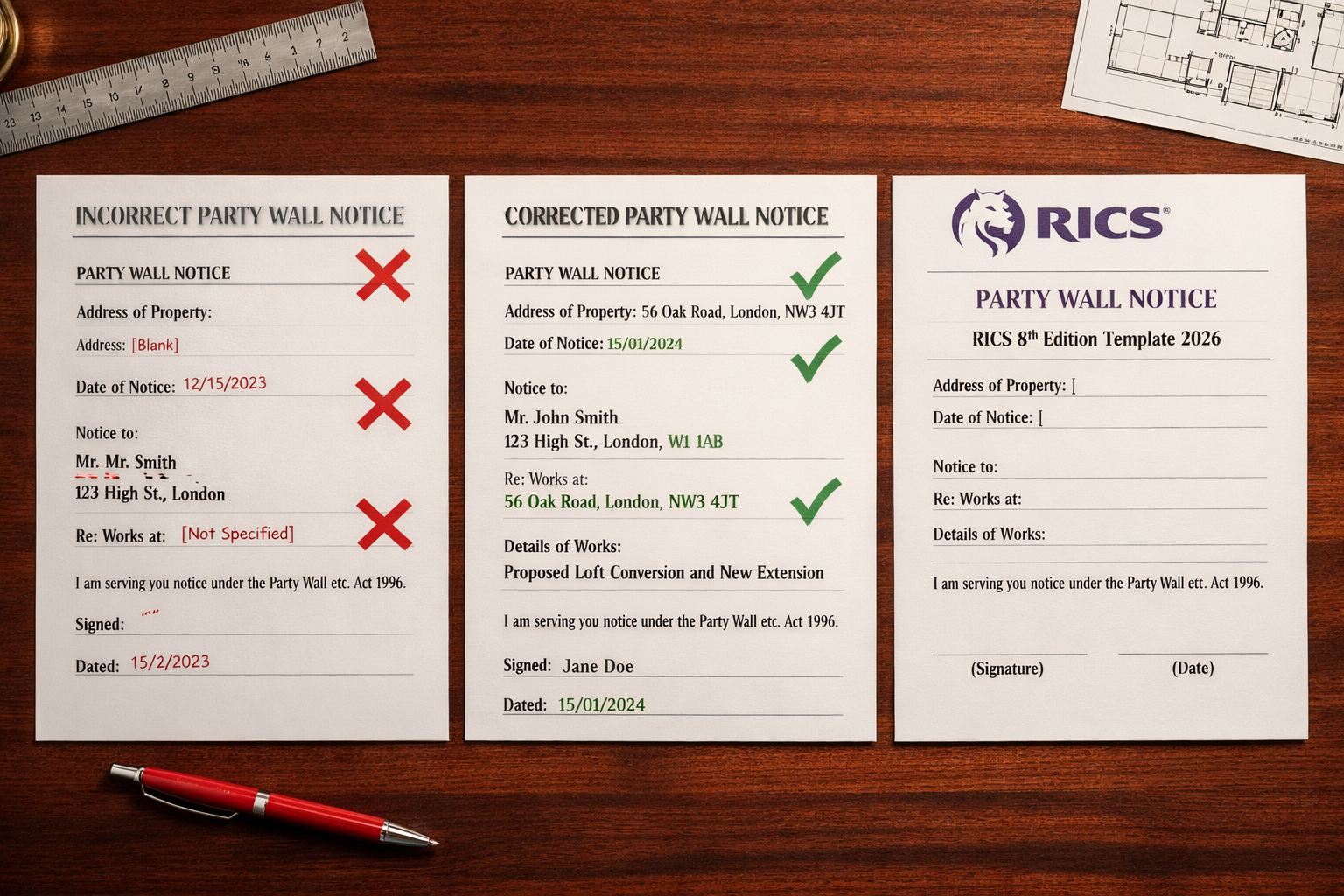
    RICS 8th Edition Template Preview: What a Compliant Party Structure Notice Looks Like

    While the full templates are subject to the ongoing consultation, the following structure reflects the requirements of a compliant Party Structure Notice under the Act and the anticipated 8th Edition standards.

    ✅ Compliant Party Structure Notice — Key Elements Checklist

    Element Required Detail
    Building Owner’s Name & Address Full legal name and correspondence address
    Adjoining Owner’s Name & Address Full legal name, confirmed via Land Registry
    Description of Works Specific, referenced to attached plans
    Supporting Plans Scaled, dimensioned, showing party wall relationship
    Proposed Start Date At least 2 months from date of service
    Response Options Consent / Dissent / Agreed Surveyor clearly stated
    Surveyor Details Name and address of building owner’s surveyor (if appointed)
    Service Method Record Date, method, and evidence of service

    For those wanting a ready-to-use starting point, a free sample party wall agreement template provides a practical foundation before engaging a professional.


    Drafting Flawless Party Wall Notices: Common Errors, Legal Fixes, and RICS 8th Edition Templates — Practical Workflow

    Following a structured workflow dramatically reduces the risk of notice invalidation. Here is a step-by-step process aligned with 2026 best practice:

    Step-by-Step Notice Workflow 🗂️

    1. Confirm the works trigger the Act — Not all construction work requires a party wall notice. Review the types of party wall works that fall under the Act.

    2. Identify the correct notice type — Match the planned works to the appropriate notice (Party Structure, Line of Junction, or Excavation).

    3. Identify all adjoining owners — Run a Land Registry search. Serve notice on every qualifying owner, including freeholders and long leaseholders.

    4. Prepare scaled drawings — Commission an architect or structural engineer to produce compliant plans if needed.

    5. Draft the notice — Use an RICS-aligned template. Include all mandatory elements from the checklist above.

    6. Calculate the notice period — Count forward from the date of service, not drafting. Mark the earliest lawful start date.

    7. Serve the notice — Use a recorded method. Retain proof of service.

    8. Record the response — If the adjoining owner consents in writing, works can proceed after the notice period. If they dissent or fail to respond within 14 days, a dispute is deemed to have arisen and the surveyor process begins.

    For building owners navigating this process alone, the guide on having a party wall agreement without a surveyor outlines the risks and limitations clearly.


    Drafting Flawless Party Wall Notices: Common Errors, Legal Fixes, and — image 5

    When Professional Help Is Non-Negotiable

    Some situations carry too much legal and financial risk to manage without a qualified surveyor:

    • Complex structural works — loft conversions, basement excavations, underpinning
    • Disputed boundaries — where the exact line of the party wall is unclear
    • Multiple adjoining owners — terraced properties with several neighbours affected
    • Prior relationship damage — where the neighbour relationship is already strained
    • High-value properties — where the cost of an injunction or damages claim is significant

    A party wall award issued by qualified surveyors provides legal protection for both sides. It is not just a formality — it is a binding document that defines the rights and obligations of each party throughout the works.

    For London-based projects, specialist surveyors are available across all areas, including South London, North London, and beyond.


    Conclusion: Actionable Next Steps for 2026 Compliance

    Drafting flawless party wall notices is not about legal complexity for its own sake — it is about protecting a project, a property, and a neighbourly relationship. The most common errors (vague descriptions, missing plans, wrong service methods, incorrect notice periods) are all avoidable with the right knowledge and templates.

    The RICS 8th Edition consultation launched in April 2026 signals a tightening of standards across the board — from template quality to surveyor conduct and jurisdiction rules. [1][3] Building owners and surveyors who align with these updated standards now will be better positioned to avoid the disputes and court challenges that have plagued poorly served notices.

    ✅ Take These Steps Today:

    1. Audit any draft notice against the checklist in this article before serving.
    2. Download a compliant template and cross-reference it with the RICS 8th Edition guidance once published.
    3. Confirm service method — use recorded delivery and keep proof.
    4. Consult a qualified party wall surveyor for any works involving structural changes, excavations, or disputed boundaries.
    5. Stay updated on the RICS 8th Edition final publication, expected following the April–May 2026 consultation period.

    A small investment in getting the notice right at the start saves significant time, money, and stress throughout the entire project.


    References

    [1] RICS Launches Consultation On Updated Party Wall Practice Guidance – rics.org

    [2] RICS Opens Consultation On Party Wall Guidance Update – propertywire.com

    [3] RICS Launches Consultation Updated Party Wall Practice Guidance – todaysconveyancer.co.uk

    [4] RICS Consults On Updated Party Wall Practice Guidance – lexisnexis.co.uk

  • Evolving Duties of Party Wall Surveyors: Case Law Trends Favoring

    Evolving Duties of Party Wall Surveyors: Case Law Trends Favoring

    Nearly one in three party wall disputes that reach the County Court in England and Wales now results in an award being challenged on procedural grounds — a striking shift that signals a new era of legal scrutiny for the profession. The Evolving Duties of Party Wall Surveyors: Case Law Trends Favoring Adjoining Owners in 2026 Awards is not simply a legal curiosity; it is a live and urgent reality reshaping how surveyors must approach every instruction they accept. As RICS launches its draft 8th edition consultation in 2026 and courts apply increasingly demanding standards to awards, both surveyors and property owners need to understand where the law is heading — and fast.

    Evolving Duties of Party Wall Surveyors: Case Law Trends Favoring


    Key Takeaways 📋

    • Courts are applying tighter scrutiny to party wall awards in 2026, with surveyors increasingly exposed to adverse costs orders for procedural errors.
    • The RICS draft 8th edition guidance, currently in consultation, sets higher competence and consistency standards that will directly affect how awards are drafted.
    • Adjoining owners hold stronger legal tools than many realise — including the right to appeal within 14 days and the ability to seek injunctions against non-compliant building owners.
    • The quasi-judicial nature of the surveyor’s role means impartiality is not optional; it is a legal duty enforced by the courts.
    • Best practice in 2026 demands robust schedules of condition, transparent award drafting, and proactive communication — all of which protect surveyors and adjoining owners alike.

    The Legal Foundation: What the Party Wall etc. Act 1996 Actually Requires

    Before examining case law trends, it is worth grounding the discussion in the statutory framework. The Party Wall etc. Act 1996 creates a structured dispute resolution system that sits between civil litigation and informal negotiation. When a building owner proposes notifiable works — such as excavations near a boundary, alterations to a shared wall, or new structures on the line of junction — the Act requires formal party wall notices to be served on all adjoining owners.

    If an adjoining owner dissents or fails to respond within the statutory period, a surveyor framework is triggered. The parties may each appoint their own surveyor, or they may agree on a single agreed surveyor. Crucially, an agreed surveyor must be independent — they cannot be the building owner’s own surveyor [3]. This independence requirement is not a formality; it is a cornerstone of the Act’s protective intent.

    The surveyors then produce a party wall award: a legally binding document that governs how, when, and under what conditions the works may proceed. Understanding what a party wall award must contain is essential for both parties.

    💬 Pull Quote: “The party wall award is not a courtesy document — it is a quasi-judicial determination that carries the weight of a court order and must be drafted with equivalent rigour.”


    Evolving Duties of Party Wall Surveyors: Case Law Trends Favoring Adjoining Owners in 2026 Awards

    The Quasi-Judicial Role Under the Microscope

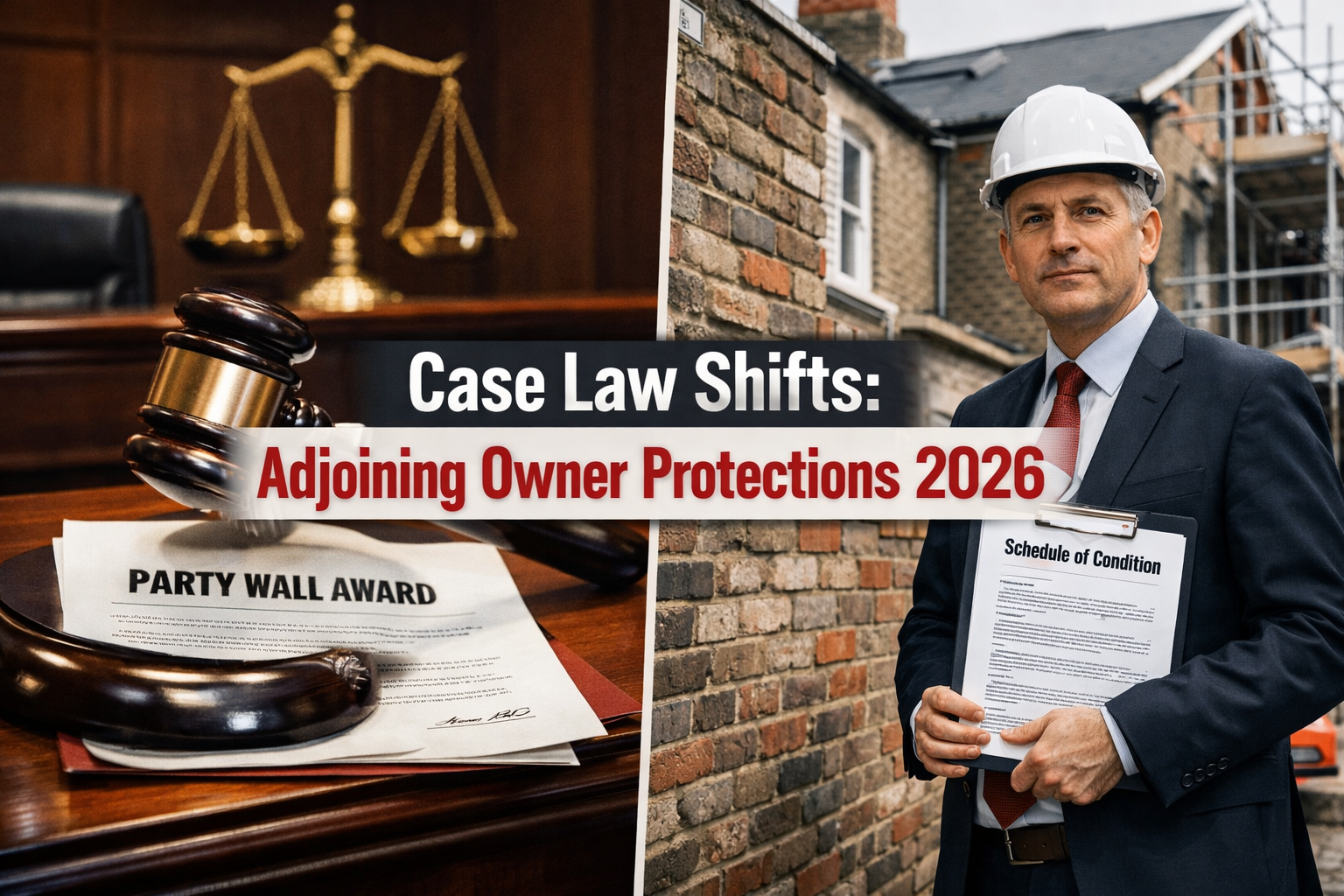
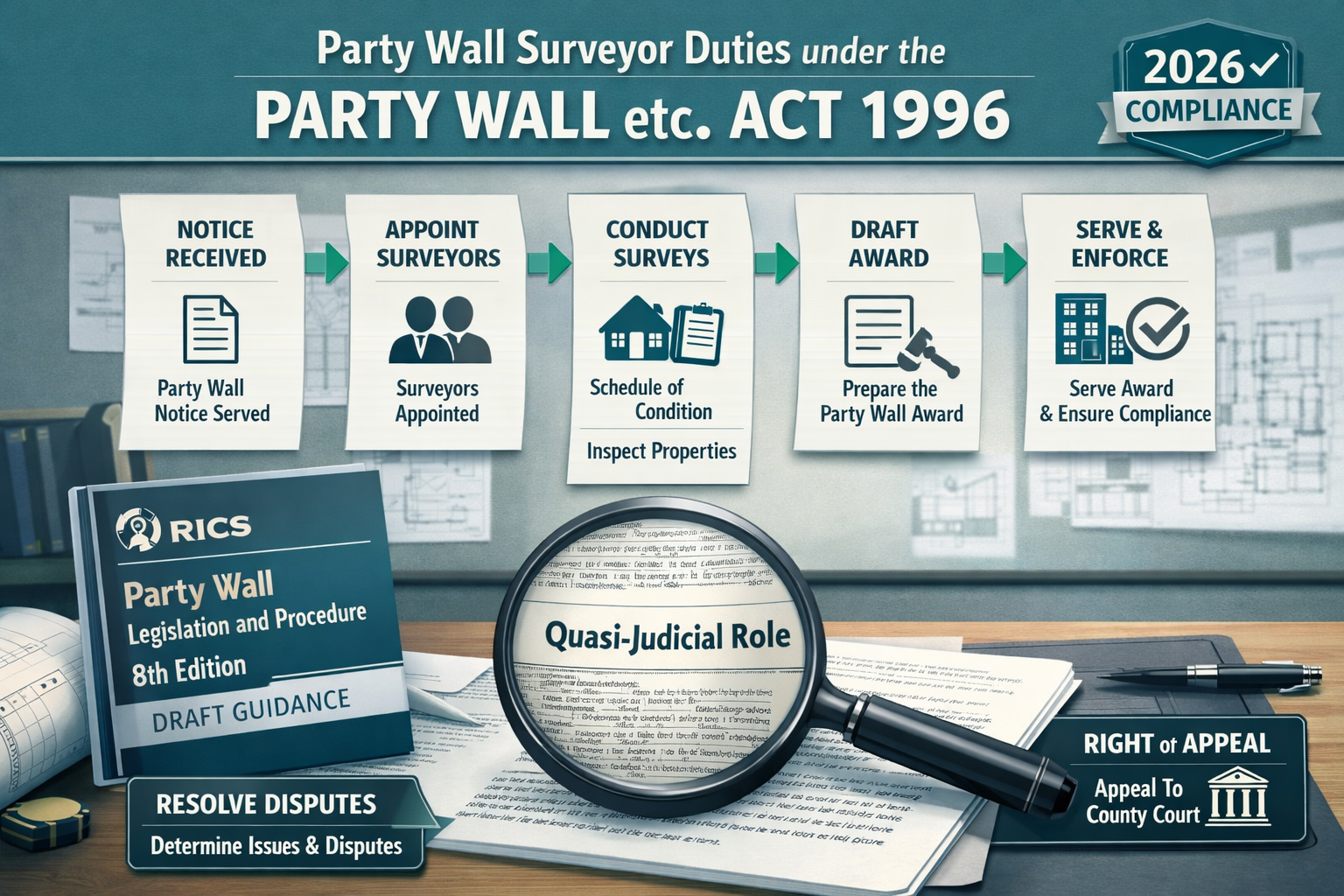
    The most significant legal development shaping the Evolving Duties of Party Wall Surveyors: Case Law Trends Favoring Adjoining Owners in 2026 Awards is the judicial confirmation — and expansion — of the surveyor’s quasi-judicial status. The Court of Appeal has established that party wall surveyors occupy a unique position: they are not advocates for the party who appointed them, but rather neutral decision-makers whose awards must withstand judicial review [1].

    This has profound practical consequences:

    Surveyor Behaviour Old Expectation 2026 Legal Standard
    Drafting award terms Reflect appointing party’s wishes Independently assess and balance both parties’ interests
    Handling procedural errors Often overlooked Now grounds for adverse costs orders
    Responding to court challenges Rare involvement Surveyors increasingly named as parties
    Documenting decisions Informal notes sufficient Full reasoning expected in award text

    The shift is clear: surveyors who act as de facto advocates for the building owner are now legally exposed. Courts have shown willingness to make surveyors parties to county court actions when their awards contain procedural errors, and adverse costs orders against surveyors personally are no longer exceptional [1].

    Why Adjoining Owners Are Winning More Challenges

    Several converging factors explain why case law trends are increasingly favouring adjoining owners in 2026:

    1. Stricter procedural standards
    Courts are examining whether surveyors followed correct procedures before issuing awards. Errors in notice service, failure to allow adequate response time, or awards that exceed the surveyor’s jurisdiction are being treated as fatal flaws.

    2. The schedule of condition requirement
    Party wall agreements must include a schedule of condition that documents the state of adjoining properties before work begins [3]. When surveyors fail to prepare thorough schedules — or prepare them superficially — adjoining owners lose critical evidence. Courts are now treating inadequate schedules as a breach of the surveyor’s duty, strengthening damage claims after works complete. For adjoining owners, engaging a dedicated adjoining owner’s surveyor who prioritises this documentation is increasingly important.

    3. The 14-day appeal window — and how courts are using it
    Adjoining owners have 14 days from service of an award to appeal to the County Court [3]. While this window has always existed, courts in 2026 are applying it with greater flexibility in cases where surveyors failed to properly notify adjoining owners of their rights. This procedural generosity reflects judicial sympathy for adjoining owners who were not adequately informed.

    4. Injunction powers
    Adjoining owners can apply for an injunction to halt building works where proper notice has not been served [3]. The availability of this remedy — and courts’ willingness to grant it — creates a powerful deterrent against building owners who attempt to bypass the Act.


    The RICS 8th Edition Consultation: What Changes Are Coming in 2026?

    In April and May 2026, RICS launched a formal eight-week consultation on the draft 8th edition of its Party Wall Legislation and Procedure guidance [2]. This is the first major update to official guidance in this edition cycle, and its implications are significant.

    The draft 8th edition explicitly aims to support competence and consistency in party wall professional work, establishing updated standards that RICS members must follow when the Party Wall etc. Act 1996 applies [2]. Key themes emerging from the consultation include:

    • 🔍 Enhanced documentation requirements — surveyors must demonstrate their reasoning, not just their conclusions
    • ⚖️ Clearer impartiality obligations — particularly for agreed surveyors navigating dual-party expectations
    • 📋 Strengthened schedule of condition protocols — minimum content standards are expected to be formalised
    • 🏗️ Updated guidance on new construction types — including telecom infrastructure, where new RICS compliance obligations took effect on 9 March 2026 [5]

    Separately, new RICS compliance obligations for certain party wall work took effect on 9 March 2026, establishing updated protocols that professionals must follow for specific installation types [5]. This signals a broader regulatory direction: the profession is being asked to raise its standards across the board, not just in traditional residential contexts.

    For surveyors practising across London — whether in East London, South London, North London, or West London — the 8th edition will set the benchmark against which their conduct is measured in any future court challenge.

    Evolving Duties of Party Wall Surveyors: Case Law Trends Favoring — image 3


    Evolving Duties of Party Wall Surveyors: Case Law Trends Favoring Adjoining Owners in 2026 Awards — Best Practice for Surveyors

    Balancing Impartiality With Client Duties

    The central tension in party wall surveying has always been this: a surveyor is appointed by one party but must act in the interests of both. The Evolving Duties of Party Wall Surveyors: Case Law Trends Favoring Adjoining Owners in 2026 Awards makes this tension more acute — and more consequential — than at any previous point.

    Here are the best practice principles that surveyors must embed into their practice in 2026:

    ✅ Draft Awards That Show Your Reasoning

    Courts are no longer satisfied with awards that simply state outcomes. The quasi-judicial nature of the role [1] means that surveyors should document why each term was included, what evidence was considered, and how competing interests were balanced. This protects the surveyor if the award is challenged and demonstrates genuine impartiality.

    ✅ Prepare Comprehensive Schedules of Condition

    A superficial schedule of condition is worse than useless — it creates a false sense of security. Surveyors should photograph every relevant surface, record existing cracks with reference markers, and note structural features that could be affected by the proposed works. This protects adjoining owners and insulates surveyors from later allegations of negligence. Learn more about schedule of condition requirements and best practice.

    ✅ Verify Notice Validity Before Proceeding

    Awards issued following defective notices are increasingly being set aside by courts. Surveyors must independently verify that notices were correctly served, contained all required information, and were issued within the correct timeframe. Reviewing the party wall act notices guidance is a useful starting point for understanding what valid service requires.

    ✅ Communicate Proactively With All Parties

    Adjoining owners who feel ignored or excluded are more likely to challenge awards. Regular, clear communication — explaining what the award contains, what rights the adjoining owner retains, and what the appeal process involves — reduces disputes and demonstrates the surveyor’s impartiality.

    ✅ Know When to Decline an Instruction

    If a building owner is pressuring a surveyor to produce an award that does not fairly reflect the adjoining owner’s interests, the correct response is to decline the instruction — not to comply and hope the award is not challenged. The personal costs exposure identified in recent case law [1] makes this not just an ethical imperative but a commercial one.


    What Adjoining Owners Should Know in 2026

    The legal landscape in 2026 offers adjoining owners more protection than many realise. Here is a practical summary of key rights:

    Right Detail
    Appoint own surveyor At the building owner’s expense in most cases
    Receive schedule of condition Before works begin — not after
    Appeal any award Within 14 days to the County Court [3]
    Seek injunction If proper notice was not served [3]
    Claim compensation For damage caused by notifiable works

    Adjoining owners who are unsure of their position should explore the dedicated adjoining owners guidance resource, which sets out the process in plain terms. It is also worth noting that the Act applies only in England and Wales — Scotland and Northern Ireland operate under different legal frameworks [3], so protections vary by jurisdiction.

    One common misconception is that a party wall agreement can be reached without professional involvement. While this is technically possible in limited circumstances, the risks are significant — particularly when works are complex or relations between neighbours are strained. The guide on having a party wall agreement without a surveyor explains where this approach is viable and where it is not.

    💬 Pull Quote: “An adjoining owner who understands their rights under the 1996 Act is an adjoining owner who is far less likely to suffer uncompensated damage — or to be steamrolled by an inadequate award.”


    Jurisdiction, Costs, and the Practical Reality of 2026 Awards

    Who Pays for Party Wall Surveyors?

    In the vast majority of cases, the building owner bears the cost of the party wall process — including the fees of the adjoining owner’s surveyor. This is a significant protection that many adjoining owners do not know they have. Understanding the costs of party wall process helps adjoining owners engage confidently rather than avoiding the process for fear of expense.

    However, costs can escalate when disputes are prolonged or when awards are challenged in court. Surveyors who draft clear, well-reasoned awards reduce the likelihood of costly litigation — which benefits all parties.

    The Limits of Surveyor Jurisdiction

    Party wall surveyors can only determine matters that fall within the scope of the Act. They cannot resolve boundary disputes, enforce planning conditions, or address matters unrelated to the notifiable works. Awards that stray beyond this jurisdiction are vulnerable to challenge — and this is another area where case law is tightening the boundaries of what surveyors may legitimately decide.

    Evolving Duties of Party Wall Surveyors: Case Law Trends Favoring — image 5


    Conclusion: Actionable Next Steps for Surveyors and Adjoining Owners

    The Evolving Duties of Party Wall Surveyors: Case Law Trends Favoring Adjoining Owners in 2026 Awards represents a genuine and accelerating shift in the legal landscape. Courts are applying higher standards to awards, RICS is raising the bar through its 8th edition consultation, and adjoining owners are increasingly aware of — and willing to exercise — their statutory rights.

    For surveyors, the message is clear: the quasi-judicial nature of the role is not a metaphor. It carries real legal consequences. Surveyors who draft reasoned, procedurally sound awards; prepare thorough schedules of condition; and maintain genuine impartiality will be well-positioned to withstand scrutiny. Those who do not face personal costs exposure and reputational damage.

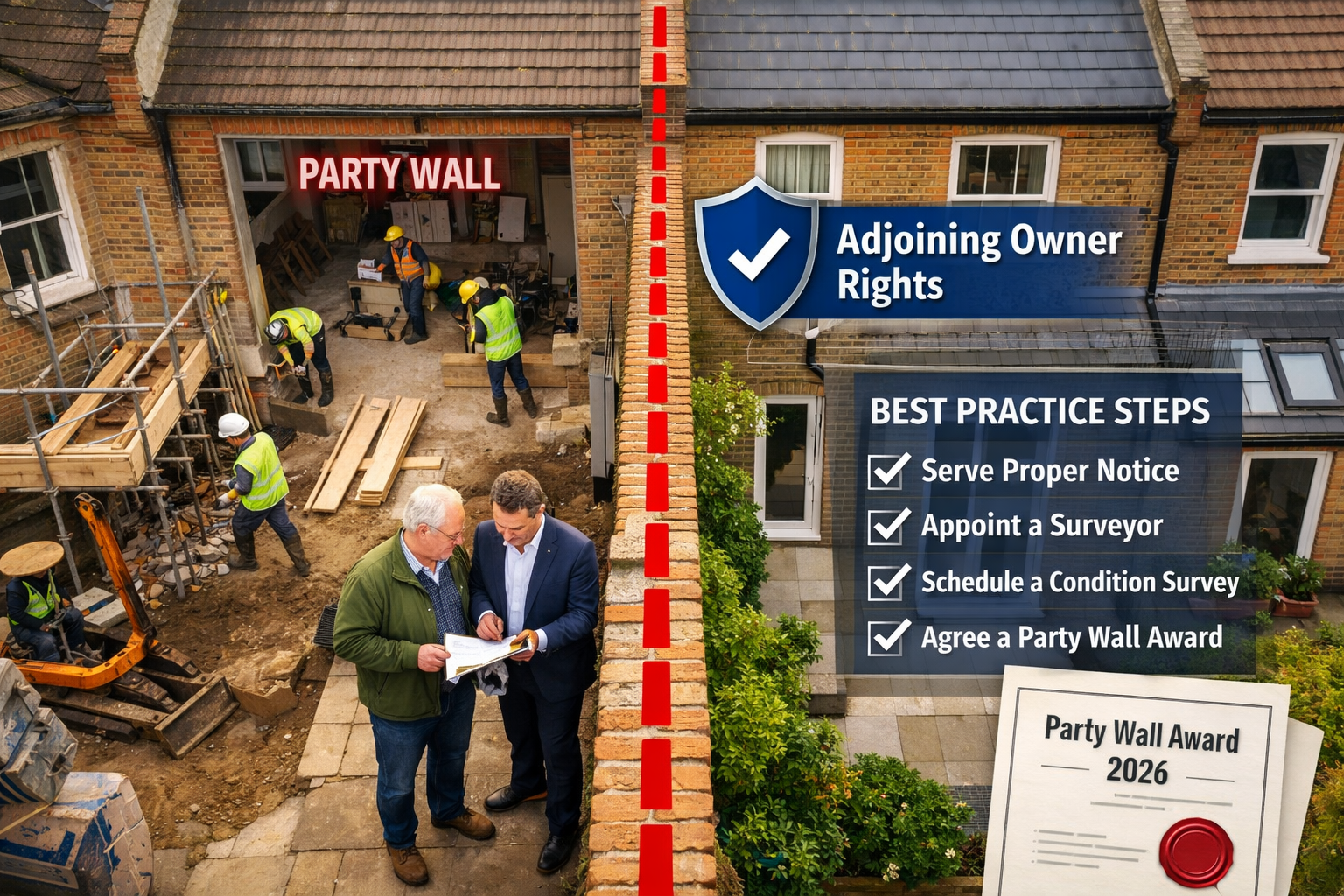
    For adjoining owners, 2026 is a good year to know your rights. You are entitled to your own surveyor (usually at the building owner’s expense), a comprehensive schedule of condition, and the right to appeal any award within 14 days. Do not sign anything or agree to anything before understanding what the Act provides.

    Actionable Next Steps ✅

    1. Surveyors: Review the RICS draft 8th edition consultation documents and submit feedback before the May 2026 deadline.
    2. Adjoining owners: Before any notifiable works begin next door, engage a qualified adjoining owner’s surveyor to protect your interests.
    3. Both parties: Ensure a thorough schedule of condition is prepared and agreed before works commence.
    4. Building owners: Engage a qualified building owner’s surveyor early to avoid procedural errors that could invalidate your award.
    5. All parties: If in doubt about the process, seek specialist advice — the cost of getting it right is always lower than the cost of getting it wrong.

    References

    [1] The Unique Role Of A Party Wall Surveyor – dwfgroup.com

    [2] Rics Launches Consultation On Updated Party Wall Practice Guidance – rics.org

    [3] Party Wall Agreement – hoa.org.uk

    [4] Party Wall Surveys And Neighbour Disputes During 2026s Construction Uptick Rics Compliance Framework – https://nottinghillsurveyors.com/blog/party-wall-surveys-and-neighbour-disputes-during-2026s-construction-uptick-rics-compliance-framework

    [5] Party Wall Surveys For 5g Mast Installations Rics Protocols Amid 2026 Telecom Infrastructure Expansion – https://nottinghillsurveyors.com/blog/party-wall-surveys-for-5g-mast-installations-rics-protocols-amid-2026-telecom-infrastructure-expansion

  • Party Wall Act for Loft Conversions: Structural Beam Insertions,

    Party Wall Act for Loft Conversions: Structural Beam Insertions,

    Nearly one in three loft conversion disputes in England and Wales involves a failure to serve the correct party wall notice before structural beams are inserted — a costly oversight that can halt construction and trigger legal action. For homeowners planning a loft conversion in 2026, understanding the Party Wall Act for Loft Conversions: Structural Beam Insertions, Notices, and Award Enforcement is not optional. It is the legal foundation on which every safe, dispute-free conversion is built.

    This guide examines the specific obligations triggered when steel beams are cut into shared walls, how to draft notices that hold up under scrutiny, and what enforcement options exist when a party wall award is ignored.


    Key Takeaways 📋

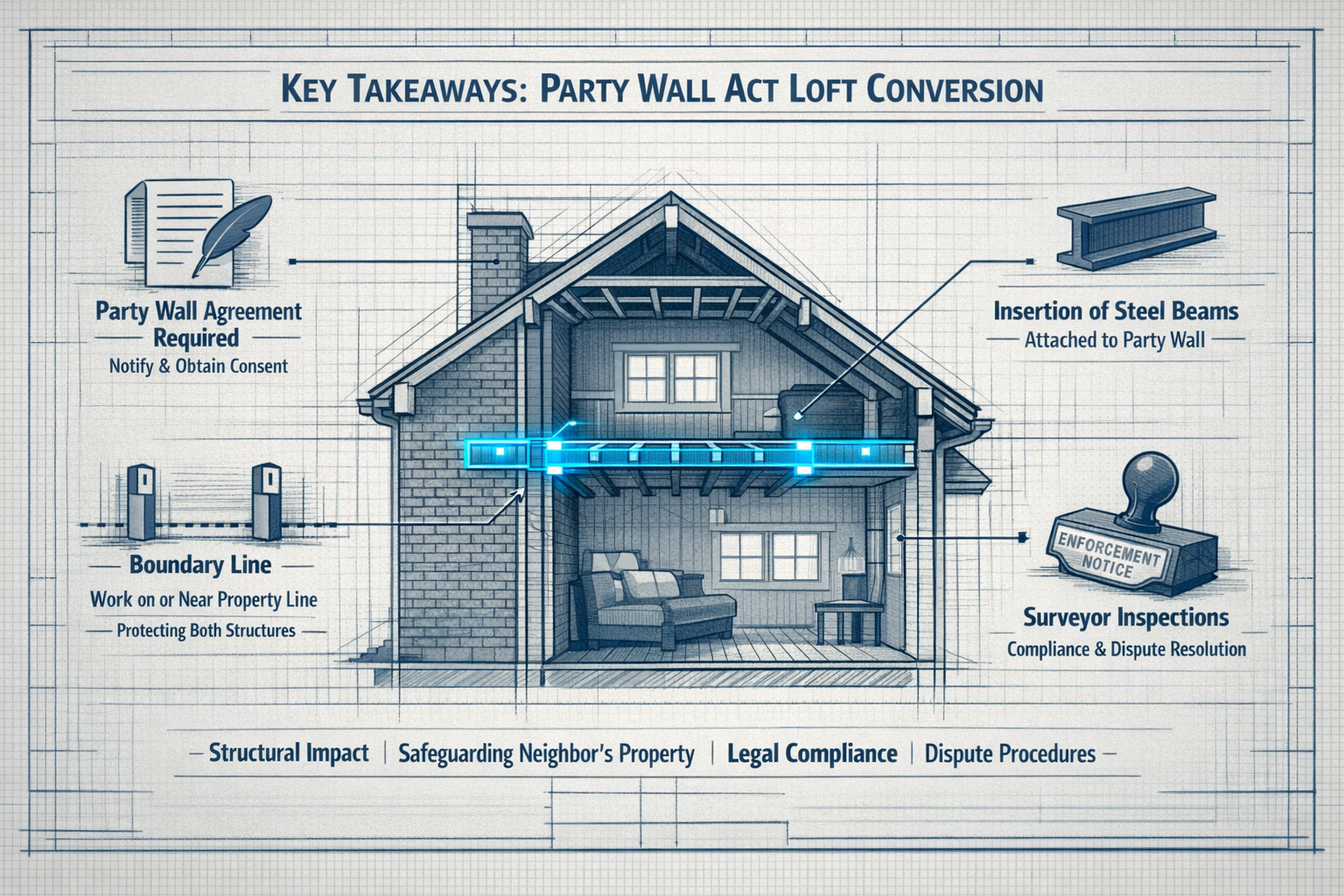
    • Steel beam insertion into a party wall triggers mandatory compliance under Section 2 of the Party Wall etc. Act 1996 — no exceptions for terraced or semi-detached homes.
    • A Party Structure Notice must be served at least two months before work begins, giving adjoining owners time to consent or appoint a surveyor.
    • A Schedule of Condition protects both parties by documenting the neighbour’s property before any structural work starts.
    • Party wall awards are legally binding and can be enforced through the County Court if either party fails to comply.
    • Detached homes are generally exempt, but any shared or boundary wall element must still be carefully assessed.

    Party Wall Act for Loft Conversions: Structural Beam Insertions,

    What the Party Wall etc. Act 1996 Means for Loft Conversions

    The Party Wall etc. Act 1996 is a piece of legislation that governs construction work affecting shared walls, boundary structures, and excavations near neighbouring properties. For loft conversions specifically, it becomes relevant the moment any structural work touches or penetrates a party wall — the wall shared between two adjoining properties.

    Which Properties Are Affected?

    Not every loft conversion triggers the Act. Property type matters significantly [4]:

    Property Type Party Wall Act Applies?
    Terraced house ✅ Yes — shared walls on one or both sides
    Semi-detached house ✅ Yes — shared wall on one side
    End-of-terrace ✅ Possibly — depends on shared wall presence
    Detached house ❌ Generally no — no shared walls
    Flat (upper floor) ✅ Yes — floor/ceiling as party structure

    💡 Pull Quote: “If your loft conversion involves cutting into, building on, or loading a wall shared with a neighbour, the Party Wall Act almost certainly applies — regardless of how minor the work seems.”

    Works That Trigger the Act During a Loft Conversion

    The types of party wall works that commonly arise during loft conversions include [1][2]:

    • Inserting steel RSJ (Rolled Steel Joist) beams into or through a party wall
    • Cutting pockets or openings into brick party walls to seat beam ends (Section 2(2)(f))
    • Raising or thickening the party wall to gain headroom
    • Cutting into the wall to place new floor joists or supports
    • Modifying chimney breasts that form part of the party wall
    • Roof works that structurally load or alter a shared gable wall

    Each of these activities falls under Section 2 of the Act, which covers works to party structures. Inserting a steel beam is one of the most common triggers — and one of the most frequently mishandled [2].


    Party Wall Act for Loft Conversions: Structural Beam Insertions and Notice Drafting

    Party Wall Act for Loft Conversions: Structural Beam Insertions, — image 3

    Why Steel Beam Insertions Demand Special Attention

    When a structural engineer specifies a steel beam to carry new loft floor loads, that beam typically needs to bear on the party wall. This means cutting rectangular pockets into the brickwork — a process that physically alters the shared structure. Under Section 2(2)(f) of the Act, cutting into a party wall to insert a beam or to support a new structure is explicitly covered [4].

    The structural implications are significant. A steel RSJ can weigh several hundred kilograms. The load it transfers into the party wall affects the neighbour’s property just as much as the building owner’s. This is precisely why the Act demands formal notification before a single brick is touched [2].

    Drafting a Party Structure Notice: What Must Be Included

    The correct notice for loft conversion beam work is a Party Structure Notice, served under Section 3 of the Act. Serving a proper notice is not just a formality — it is the legal trigger that activates the Act’s protections for both parties. For a detailed walkthrough, see this guide on what a Party Structure Notice is and how to serve it.

    A compliant Party Structure Notice must include:

    • ✅ Full name and address of the building owner (the person doing the work)
    • ✅ Full address of the property where work will take place
    • ✅ Description of the proposed works — including beam dimensions, pocket sizes, and structural method
    • ✅ Proposed start date (work cannot begin for at least two months after notice is served)
    • ✅ Drawings and plans showing the extent of the work affecting the party wall
    • ✅ Statement that the notice is served under the Party Wall etc. Act 1996

    Common drafting errors that invalidate notices include:

    • Vague descriptions (“some structural work”) rather than specific beam specifications
    • Missing or incorrect start dates
    • Failure to include structural drawings
    • Serving notice on the wrong person (tenant vs. freeholder)

    ⚠️ Critical Point: An invalid notice provides no legal protection. If damage occurs and the notice was defective, the building owner may face uncapped liability for repairs.

    The Schedule of Condition: A Non-Negotiable Safeguard

    Before any beam insertion begins, a Schedule of Condition should be prepared. This is a detailed photographic and written record of the adjoining property’s condition — ceilings, walls, floors, and any existing cracks — taken before construction starts.

    Why does this matter? If the neighbour later claims that a crack in their bedroom ceiling was caused by the beam installation, the Schedule of Condition is the definitive evidence. Without it, the building owner has no baseline to dispute the claim. Surveyors in 2026 routinely recommend this as standard practice for all terraced house loft conversions in dense urban markets [5].

    Surveyor Strategies for Terraced House Conversions in 2026

    In London’s high-density housing market, party wall disputes have become increasingly sophisticated. Experienced surveyors working on terraced house loft conversions now adopt several proactive strategies:

    1. Pre-notice consultation — Meeting informally with neighbours before serving formal notice to explain the works and reduce anxiety
    2. Structural drawings included with notice — Going beyond minimum requirements to show beam positions, pocket dimensions, and temporary support arrangements
    3. Early Schedule of Condition — Commissioning this before any preliminary works, not just before main construction
    4. Agreed surveyor appointments — Where both parties trust a single surveyor, costs are significantly reduced; learn more about keeping party wall costs down
    5. Digital notice delivery — While physical delivery remains standard, many surveyors now use tracked email with read receipts as supplementary evidence

    Party Wall Awards: Drafting, Disputes, and Enforcement

    Party Wall Act for Loft Conversions: Structural Beam Insertions, — image 5

    What Is a Party Wall Award?

    When an adjoining owner does not consent to the proposed works within 14 days of receiving a Party Wall Notice, a dispute is deemed to have arisen. At this point, surveyors are appointed and a Party Wall Award is prepared. This is a legally binding document — sometimes called a party wall agreement — that sets out:

    • The scope of permitted works and how they must be carried out
    • Working hours and access arrangements
    • Protection measures for the adjoining property
    • Liability provisions if damage occurs
    • Compensation terms if applicable

    For a comprehensive understanding of what these documents contain, the guide on party wall awards covers the key elements in detail.

    The Award Drafting Process

    The award is prepared by the appointed surveyor(s). There are three possible surveyor arrangements:

    Arrangement Description Typical Cost
    Agreed surveyor One surveyor acts for both parties Lower — single fee
    Two surveyors Each party appoints their own Moderate — two fees
    Three surveyors Two appointed + a third agreed surveyor for disputes Higher — three fees

    The award must be served on both parties and becomes effective immediately unless appealed. Either party has 14 days from service to appeal to the County Court. After that window closes, the award is final and enforceable.

    For building owners who want to understand costs before committing, reviewing the costs of party wall process is a useful first step.

    Enforcement of Party Wall Awards

    This is where many homeowners are caught off guard. A party wall award is not merely advisory — it carries the force of law. If either party breaches its terms, the other has clear legal remedies.

    Common breaches include:

    • Starting work before the award is served
    • Exceeding permitted working hours
    • Failing to implement protection measures
    • Refusing to allow access for inspection
    • Not making good damage within agreed timeframes

    Enforcement options available in 2026:

    1. County Court injunction — To stop work immediately if it is proceeding in breach of the award
    2. Damages claim — For losses suffered as a result of the breach
    3. Third surveyor referral — If the dispute is between the two appointed surveyors, the third surveyor can make a binding determination
    4. Section 7(2) claim — The Act specifically provides that building owners are liable for damage caused to adjoining owners’ property

    💡 Pull Quote: “A party wall award without enforcement teeth is just paper. The County Court has consistently upheld awards where building owners have ignored their obligations — and costs orders against the defaulting party can be substantial.”

    What Adjoining Owners Should Know

    If a neighbour is carrying out a loft conversion and has served a notice, adjoining owners have important rights. They can:

    • Consent to the works in writing within 14 days (no surveyor needed)
    • Dissent and appoint their own surveyor (costs typically paid by the building owner)
    • Request a Schedule of Condition before work begins
    • Appeal the award within 14 days if they believe it is unjust

    Adjoining owners should not ignore notices. Doing so does not make the problem go away — it simply means the building owner may proceed after the statutory period expires. For those on the receiving end of a notice, understanding how to respond to party wall notices is essential reading.

    When No Notice Was Served: Retrospective Situations

    A surprisingly common scenario in 2026: construction has already begun, beams have been inserted, and no notice was ever served. This creates a serious legal problem. The Act does not provide for retrospective notices — once work has started without compliance, the building owner is exposed to:

    • Injunctions requiring work to stop or be undone
    • Damages claims from neighbours
    • Difficulty selling the property (solicitors will flag the absence of party wall documentation)

    The only practical remedy is to appoint a surveyor immediately, attempt to negotiate a retrospective agreement (which has no formal legal standing but can resolve disputes practically), and document the current condition of both properties thoroughly [3].


    Conclusion: Actionable Next Steps for 2026 Loft Conversions

    The Party Wall Act for Loft Conversions: Structural Beam Insertions, Notices, and Award Enforcement framework exists to protect everyone involved — building owners, neighbours, and the structural integrity of shared buildings. In 2026’s competitive and legally aware property market, cutting corners on party wall compliance is a risk no homeowner can afford.

    Your Action Plan 🔑

    1. Confirm applicability early — Before instructing an architect or structural engineer, establish whether your property has a party wall and whether the proposed works will affect it.

    2. Instruct a party wall surveyor before design is finalised — A surveyor can flag notice requirements and help shape the structural design to minimise neighbour impact. Whether you are in North London, South London, or elsewhere, local expertise matters.

    3. Serve notice at least two months before the planned start date — Factor this into your project timeline from day one.

    4. Commission a Schedule of Condition — Do this before any preliminary works begin, not just before main construction.

    5. Keep copies of everything — Notices, acknowledgements, awards, and correspondence form a legal paper trail that protects you if disputes arise later.

    6. If in doubt, seek professional advice — The party wall notices guidance and building owners’ resources provide a strong starting point.

    The legal framework is clear, the process is manageable, and the protection it offers is genuine. Serve the right notices, commission a thorough award, and enforce it if necessary — that is the formula for a loft conversion that adds value without adding conflict.


    References

    [1] Party Wall Act And Loft Conversion Projects – charrettelaw.co.uk

    [2] Steel Beam Into Party Wall – mosaicpw.co.uk

    [3] Loft Conversion Party Wall Advice – stokemont.com

    [4] Loft Conversions And The Party Wall Act – peterbarry.co.uk

    [5] Party Wall Surveyor Loft Conversion – biggerlivinglofts.com


  • Basement Extensions and Party Wall Notices: Surveyor Protocols for

    Basement Extensions and Party Wall Notices: Surveyor Protocols for

    Only 38% of homeowners planning a basement conversion in 2026 correctly identify which party wall notices apply to their project before breaking ground — a gap that leads to costly disputes, injunctions, and structural damage claims that could have been avoided entirely. Understanding Basement Extensions and Party Wall Notices: Surveyor Protocols for Excavation Safeguards Near Shared Boundaries is not just a legal formality; it is the single most important step in protecting both the building owner and their neighbours during one of the highest-risk construction activities in urban settings.

    Basement excavation near shared boundaries triggers multiple overlapping obligations under the Party Wall etc. Act 1996. Each obligation carries its own notice type, timeline, and surveyor protocol. Getting any one of them wrong can halt a project mid-dig.

    Basement Extensions and Party Wall Notices: Surveyor Protocols for


    Key Takeaways 📋

    • Three separate notice types may apply to a basement project: Section 1 (Line of Junction), Section 2 (Party Structure), and Section 6 (Adjacent Excavation) — each with different trigger conditions and notice periods.
    • Section 6 notices are the most commonly misunderstood: they apply when excavation reaches within 3.0m of a neighbour’s foundations (or 6.0m for deep pile foundations).
    • A schedule of condition for basement and underpinning works must cover all floors of the adjoining property — a significantly wider scope than for standard extensions.
    • Vibration monitoring and temporary works provisions must be explicitly written into the party wall award for excavation projects.
    • In London in 2026, surveyor fees typically range from £750–£1,800 per neighbour, and the full process takes 2–4 months [4].

    Understanding the Three Notice Types for Basement Projects

    Not all basement extensions trigger the same notice. The type of notice — and the statutory timeline attached to it — depends on the precise relationship between the proposed works and the shared boundary or party structure.

    Section 1: Line of Junction Notice

    A Line of Junction Notice under Section 1 of the Act is required when a basement extension pushes beyond the original footprint of the building to a shared boundary line. Common examples include:

    • Light wells cut into the rear garden adjacent to the boundary
    • Rear garden basement extensions extending toward a shared fence or wall

    The statutory notice period is one month [1]. This notice is often overlooked because homeowners focus on the party wall itself and forget that any new build up to or astride the boundary line also triggers obligations. For a clear breakdown of how boundary walls interact with party wall law, see this guide on boundary wall rules and the difference between party fence walls and boundary walls.

    Section 2: Party Structure Notice

    A Party Structure Notice under Section 2 is mandatory for semi-detached and terraced properties where basement works involve:

    • Underpinning the party wall
    • Cutting into the party wall to insert beams or needle supports
    • Exposing the party wall foundations

    The statutory notice period is two months [1][2]. Critically, if the property is divided into flats, the notice must be served on the specific leaseholder whose demise includes the section of party wall being affected — not simply the freeholder [1]. For example, if a beam pocket is being cut into the ground-floor section of a party wall, the ground-floor flat owner must receive the notice directly.

    💡 Pull Quote: “Serving a Section 2 notice on the wrong party — such as the freeholder when a ground-floor leaseholder’s wall is affected — can invalidate the entire notice process and delay a project by months.”

    For a detailed explanation of how to serve this notice correctly, the Party Structure Notice guide is an essential reference.

    Section 6: Adjacent Excavation Notice — The Most Complex Trigger

    Section 6 is the notice type most frequently misunderstood and misapplied in basement projects. It is triggered when:

    Condition Distance Threshold
    Excavation near standard strip/pad foundations Within 3.0 metres of a neighbouring structure
    Excavation near deep foundations (e.g., augured piles) Within 6.0 metres of a neighbouring structure
    Excavation depth Must exceed the base of the neighbour’s foundations

    The notice period is one month [1]. For stacked flats sharing common foundations, the Section 6 notice must be served on all leaseholders whose flats sit above the foundations being undermined — not just the ground-floor occupier [1].


    Section 6 in Practice: Vibration Monitoring, Temporary Works, and Award Provisions

    Basement Extensions and Party Wall Notices: Surveyor Protocols for — image 3

    This is where Basement Extensions and Party Wall Notices: Surveyor Protocols for Excavation Safeguards Near Shared Boundaries becomes most technically demanding. A Section 6 notice alone is not sufficient protection. The party wall award — the legally binding document produced by the appointed surveyor(s) — must include specific provisions tailored to the risks of deep excavation.

    What Must Be Written Into the Award

    A well-drafted party wall award for a basement or underpinning project should include all of the following:

    🔧 Temporary Works Specifications

    • Details of any temporary propping, needling, or shoring to be installed before and during excavation
    • Approval of the method statement from the structural engineer
    • Requirements for underpinning sequences (e.g., bay-by-bay underpinning with maximum bay widths specified)

    📡 Vibration Monitoring

    • Installation of vibration monitoring sensors on the adjoining structure before works begin
    • Defined peak particle velocity (PPV) thresholds — typically following BS 7385 or BS 5228 guidelines — at which works must pause
    • Frequency of data logging (often continuous during active excavation phases)
    • Obligation to share monitoring data with the adjoining owner’s surveyor on request

    🏗️ Working Hours and Access

    • Restricted working hours (commonly 8:00am–6:00pm Monday to Friday; 8:00am–1:00pm Saturday; no Sunday working)
    • Defined access arrangements for surveyors to inspect works in progress [2]
    • Dust and noise mitigation measures

    ⚠️ Damage Notification Protocol

    • A clear procedure for reporting any cracking or movement observed in the adjoining property during works
    • Obligation to halt works if structural movement exceeds agreed thresholds

    The Building Owner’s Statutory Duty

    Under Section 11(8) of the Party Wall etc. Act 1996, building owners carry a statutory duty to make good any damage caused by underpinning or adjacent excavation [1]. Adjoining owners can request payment in lieu of physical repairs — meaning the building owner pays the cost of rectification rather than carrying out the work themselves.

    It is worth noting that for basement and underpinning projects, minor damage (BRE Damage Category 0–1) — hairline cracking — is often considered an inevitable consequence of the works [1]. The award should acknowledge this and set a clear threshold above which formal compensation becomes payable.

    For building owners who want to understand their full obligations before serving notice, the building owner’s surveyor guide provides a practical overview of the process.


    Schedule of Condition: Why Basement Projects Require Extended Scope

    A schedule of condition is a photographic and written record of the state of an adjoining property before works begin. It serves as the baseline evidence in any future dispute about whether the building owner’s works caused a particular crack or defect [2].

    For standard loft conversions or rear extensions, a schedule of condition typically covers a 3–4 metre radius from the works. For basement excavation and underpinning projects, the scope is fundamentally different:

    💡 Pull Quote: “For basement and underpinning works, the schedule of condition must be doubled in measurement scope and extended to cover all floors of the adjoining property — not just the ground floor or the area immediately adjacent to the works.” [1]

    Basement Extensions and Party Wall Notices: Surveyor Protocols for — image 5

    What a Comprehensive Basement Schedule of Condition Covers

    Area What Is Documented
    All floors (basement to roof) Cracks, settlement, plasterwork condition
    External walls Existing cracking, pointing condition, render
    Internal walls and ceilings Hairline cracks, staining, movement joints
    Floors Levelness, existing damage, screed condition
    Drainage CCTV survey of shared or adjacent drains recommended
    Garden and boundary structures Condition of fences, walls, paving

    This extended scope matters enormously. Subsidence and vibration effects from deep excavation can manifest several floors above the excavation level and at distances greater than those seen with above-ground construction. A schedule that only covers the ground floor will leave both parties exposed in a dispute.

    For adjoining owners who want to understand their rights and what a proper schedule should include, the schedule of condition page is a valuable resource. Adjoining owners also have the right to appoint their own surveyor — details of which are covered in the adjoining owner’s surveyor guide.


    Practical Tips for 2026 Urban Basement Projects: Minimising Neighbour Disruption

    London’s construction activity in 2026 continues to intensify, with basement conversions remaining one of the most sought-after ways to add space in high-density areas. The following practical steps help building owners manage the process efficiently while keeping neighbour relationships intact.

    Before Serving Notice

    ✅ Commission a structural engineer’s report first. Understand the proposed foundation depth, soil conditions, and proximity to neighbouring foundations before determining which notices apply. This prevents serving the wrong notice type.

    ✅ Identify all parties who need to receive notice. In leasehold buildings, this may include multiple flat owners, freeholders, and mortgagees. Missing a single party can invalidate the process.

    ✅ Allow realistic timelines. With a two-month notice period for Section 2 works and a one-month period for Section 6, plus time for surveyor appointment and award drafting, the full process realistically takes 2–4 months before a spade enters the ground [4].

    ✅ Engage a specialist party wall surveyor early. For basement projects specifically, experience with underpinning and excavation awards is essential. A surveyor unfamiliar with vibration monitoring thresholds or temporary works specifications will produce an inadequate award.

    During the Notice Period

    ✅ Open a dialogue with neighbours. A neighbour who understands what is happening and feels informed is far less likely to dissent or appoint an aggressive surveyor. Early communication reduces costs for everyone.

    ✅ Prepare a detailed method statement. Surveyors on both sides will want to review the structural engineer’s proposed excavation sequence. Having this ready accelerates the award drafting process.

    ✅ Consider the costs. In London in 2026, surveyor fees range from £750–£1,800 per neighbour [4]. For projects with multiple adjoining owners, costs can accumulate quickly. For guidance on managing these costs, see how to keep party wall costs down.

    During Works

    ✅ Do not deviate from the agreed method statement without consulting the party wall surveyor. Changes to excavation sequences or propping arrangements mid-project can void the protections offered by the award.

    ✅ Keep vibration monitoring logs up to date and share them proactively with the adjoining owner’s surveyor. Transparency builds trust and reduces the risk of emergency injunctions.

    ✅ Photograph any new cracking in the adjoining property immediately and notify all parties. Prompt reporting demonstrates good faith and prevents minor issues from escalating.


    Serving Notices Correctly: A Checklist for Building Owners

    Getting the notice right from the start is critical. Use this checklist before serving any notice for a basement project:

    • Confirm the type(s) of notice required (Section 1, 2, and/or 6)
    • Identify all adjoining owners, including leaseholders and freeholders
    • Confirm notice periods: 1 month (Sections 1 & 6) or 2 months (Section 2)
    • Include all required information: description of works, start date, structural drawings
    • Serve notice in writing (hand delivery, recorded post, or agreed electronic means)
    • Record the date of service and keep proof of delivery
    • Await response within 14 days; if no response or dissent, appoint surveyors

    For a full overview of the notice process, the party wall notices guide covers all notice types and how to respond to them. Building owners can also review the Party Wall etc. Act 1996 overview for the statutory framework underpinning all of these obligations.


    Conclusion: Actionable Next Steps for a Safe, Compliant Basement Project

    Basement Extensions and Party Wall Notices: Surveyor Protocols for Excavation Safeguards Near Shared Boundaries is a topic that rewards careful preparation. The consequences of getting it wrong — injunctions, structural damage claims, neighbour disputes, and project delays — are far more costly than the investment in proper professional guidance from the outset.

    Actionable Next Steps

    1. Engage a structural engineer to confirm excavation depth and proximity to neighbouring foundations before determining notice requirements.
    2. Identify all notice types that apply to the specific project — do not assume a single notice covers all obligations.
    3. Appoint an experienced party wall surveyor with a proven track record in basement and underpinning awards, not just standard extensions.
    4. Serve notices with the correct statutory periods and to all relevant parties, including leaseholders in divided buildings.
    5. Insist on a comprehensive schedule of condition covering all floors of every adjoining property at risk.
    6. Ensure the party wall award explicitly addresses vibration monitoring thresholds, temporary works specifications, and the damage notification protocol.
    7. Maintain open communication with neighbours throughout the project — it is the single most effective way to prevent disputes from escalating.

    For building owners ready to begin the process, the building owners section provides a clear starting point, and the team at Party Wall Surveyor London can be reached directly through the contact page.


    References

    [1] Basements And The Party Wall Act – peterbarry.co.uk
    [2] Party Wall Agreement – hoa.org.uk
    [3] Party Wall Surveys And Neighbour Disputes During 2026s Construction Uptick Rics Compliance Framework – https://nottinghillsurveyors.com/blog/party-wall-surveys-and-neighbour-disputes-during-2026s-construction-uptick-rics-compliance-framework
    [4] Party Wall Agreement London 2026 – mayfairstudio.co.uk
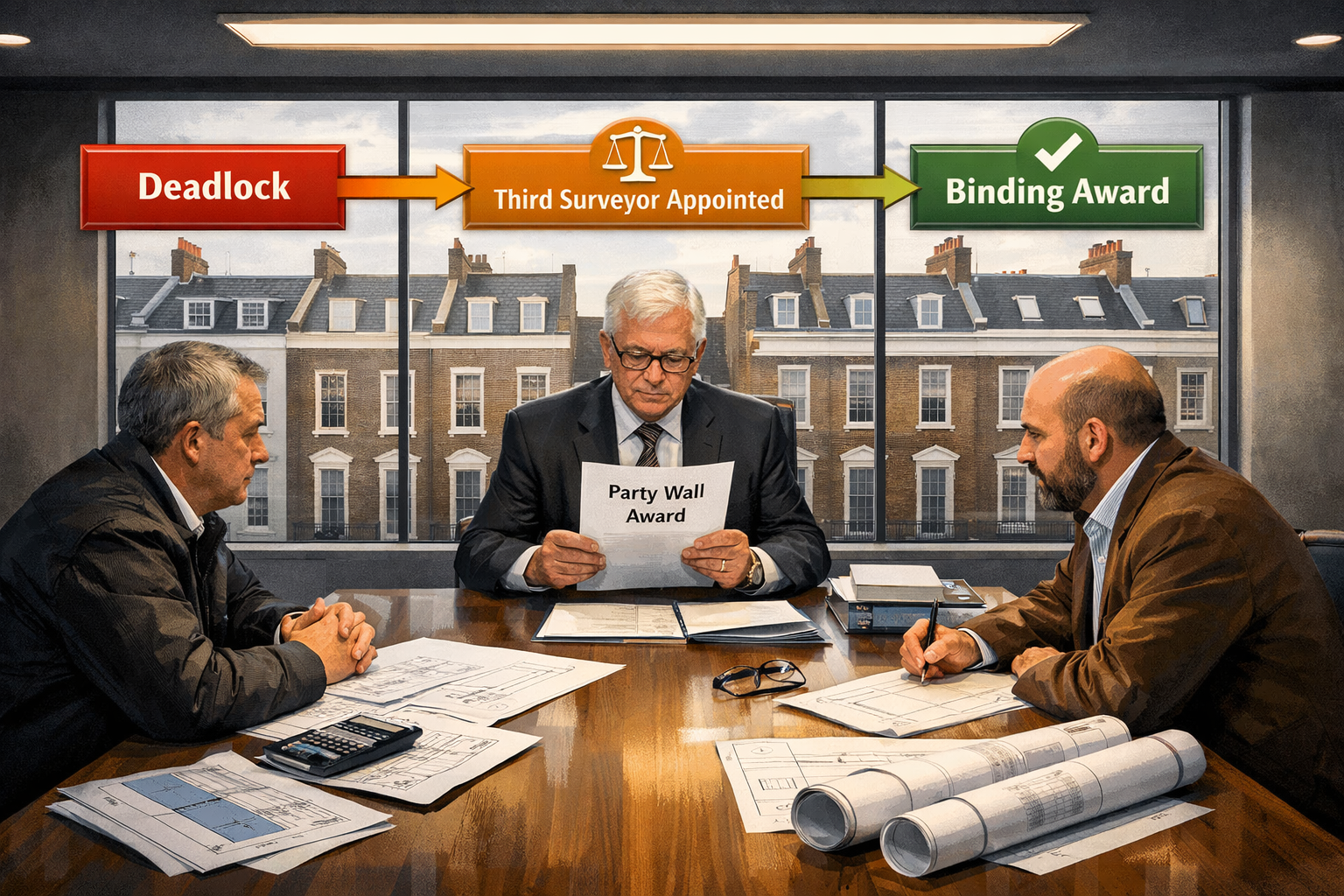

  • Agreed Surveyor vs Separate Appointments: Cost-Benefit Analysis and

    Agreed Surveyor vs Separate Appointments: Cost-Benefit Analysis and

    Hiring two surveyors instead of one can quietly double your party wall costs — yet most building owners never question whether a single agreed surveyor would serve them just as well. The choice between an agreed surveyor vs separate appointments is one of the most financially significant decisions in any 2026 construction project governed by the Party Wall etc. Act 1996, and it is one that is routinely made without a proper cost-benefit analysis. This guide breaks down both options, compares real-world costs, draws on RICS guidance on impartiality, and provides clear checklists to help building owners and adjoining owners choose the right path.


    Key Takeaways 📋

    • An agreed surveyor is a single professional appointed by both parties, typically cutting total surveyor fees by 30–50% compared to dual appointments.
    • Separate appointments provide each party with independent representation, which is best suited to high-value, high-risk, or contentious disputes.
    • RICS guidance requires an agreed surveyor to act impartially — not as an advocate for either party.
    • The nature of the works (scale, risk, relationship between neighbours) is the primary factor in choosing the right appointment model.
    • Early communication between neighbours before serving notice can determine which model is appropriate and save significant time and money.

    Agreed Surveyor vs Separate Appointments: Cost-Benefit Analysis and

    Understanding the Two Appointment Models Under the Party Wall Act

    Before conducting any cost-benefit analysis, it is essential to understand what each appointment model actually means under the Party Wall etc. Act 1996.

    What Is an Agreed Surveyor?

    An agreed surveyor is a single, jointly appointed professional who acts on behalf of both the building owner and the adjoining owner. This arrangement is permitted under Section 10(1)(b) of the Party Wall etc. Act 1996. Crucially, the agreed surveyor does not represent either party — they act as a neutral decision-maker whose role is to produce a fair and legally binding party wall award.

    💡 Pull Quote: “An agreed surveyor is not a compromise — they are a statutory officer of the process, bound by the same duties of impartiality as any tribunal.”

    Key characteristics:

    • Appointed jointly by written consent of both parties
    • Acts impartially — not as an advocate
    • Produces a single award that binds both parties
    • Fees are typically paid by the building owner
    • Cannot be the building owner’s own surveyor acting in a dual capacity

    What Are Separate Appointments?

    Under Section 10(1)(a) of the Act, each party appoints their own surveyor. The two surveyors then work together — and if they disagree, they appoint a third surveyor to adjudicate. This is the more traditional route and is the default when parties cannot agree on a single surveyor.

    Key characteristics:

    • The building owner’s surveyor represents the building owner’s interests
    • The adjoining owner’s surveyor represents the adjoining owner’s interests
    • A third surveyor is pre-selected in case of dispute
    • Fees for both surveyors are generally paid by the building owner
    • The process can be slower but offers stronger individual advocacy

    Agreed Surveyor vs Separate Appointments: Cost-Benefit Analysis and Best Practices for 2026 Projects

    Agreed Surveyor vs Separate Appointments: Cost-Benefit Analysis and — image 3

    The Real Cost Difference in 2026

    Understanding the financial implications of each model is central to any meaningful cost-benefit analysis. In 2026, London party wall surveyor fees typically fall within the following ranges:

    Appointment Model Typical Fee Range (London) Who Pays?
    Agreed Surveyor £800 – £1,400 Building owner
    Two Separate Surveyors £1,400 – £2,800 (combined) Building owner
    Third Surveyor (if needed) £500 – £1,500 additional Determined by award

    ⚠️ Note: These are indicative 2026 figures for standard residential projects. Complex commercial or structural projects may attract significantly higher fees.

    For a standard loft conversion or rear extension in London — the most common party wall scenarios — the agreed surveyor route can save £600 to £1,400 in surveyor fees alone. Over the lifetime of a project, that saving compounds when you factor in faster award production, fewer correspondence rounds, and reduced delays to the build programme.

    For detailed guidance on managing these costs, see this resource on how to keep party wall costs down.

    Time Efficiency: A Hidden Cost

    Cost is not only financial. Time is a critical project resource, particularly in 2026 when construction timelines are tight due to material supply pressures and contractor availability.

    • Agreed surveyor: Typically produces an award in 2–4 weeks from appointment
    • Separate appointments: Typically require 4–8 weeks, sometimes longer if surveyors disagree and a third surveyor is needed

    For a building owner paying contractor standing time or bridging finance, a 4-week delay can cost far more than the difference in surveyor fees.

    RICS Guidance on Impartiality: Does It Actually Work?

    A common concern about the agreed surveyor model is whether one professional can truly be impartial. The RICS (Royal Institution of Chartered Surveyors) guidance on party wall matters is clear: an agreed surveyor must act as a quasi-judicial officer, not as a representative of either party. This is reinforced by the statutory framework of the Act itself.

    In practice, RICS-regulated surveyors who accept agreed appointments are bound by professional conduct rules. Any bias or failure to act impartially can result in:

    • The award being challenged in the County Court
    • A complaint to RICS under its professional standards framework
    • Personal liability for costs

    The impartiality concern is therefore largely mitigated when appointing a properly qualified, RICS-regulated surveyor. The risk increases only when parties attempt to appoint someone with an existing relationship to one side — which a competent surveyor would decline.

    Checklist: When to Choose an Agreed Surveyor ✅

    Use the agreed surveyor model when:

    • The works are straightforward (loft conversion, rear extension, underpinning)
    • Both neighbours have a good or neutral relationship
    • The adjoining owner has no specific concerns about the works
    • The project timeline is time-sensitive
    • Both parties want to minimise costs
    • The adjoining property has no known structural vulnerabilities
    • Both parties are willing to jointly instruct a single professional

    Checklist: When to Choose Separate Appointments ✅

    Use separate appointments when:

    • There is an existing dispute between neighbours
    • The works are high-risk (deep excavations, structural alterations near foundations)
    • The adjoining owner has specific concerns they want independently represented
    • The project involves high-value properties where the stakes of any damage are significant
    • The adjoining owner is unfamiliar with the process and wants their own advocate
    • There is a history of non-compliance by the building owner
    • The building owner’s contractor has a poor reputation in the area

    Best Practices for 2026 Projects: Streamlining the Award Process

    Agreed Surveyor vs Separate Appointments: Cost-Benefit Analysis and — image 5

    Start With the Notice — Get It Right First Time

    The entire party wall process begins with serving the correct notice. Errors at this stage cause delays regardless of which appointment model is chosen. Understanding what a party structure notice is and how to serve it is the essential first step for any building owner in 2026.

    A correctly served notice:

    • Triggers the statutory 14-day response period
    • Allows the adjoining owner to consent, dissent, or appoint a surveyor
    • Sets the legal clock running for the award process

    If the adjoining owner consents in writing to the works within 14 days, no surveyor is required at all. This is the most cost-effective outcome and is worth pursuing through early, transparent communication. For more on this possibility, see the guide on having a party wall agreement without a surveyor.

    The Schedule of Condition: Non-Negotiable in Either Model

    Regardless of whether an agreed surveyor or separate appointments are used, a schedule of condition should always be prepared before works begin. This is a photographic and written record of the adjoining property’s pre-existing condition.

    Without a schedule of condition:

    • Any damage claim becomes a dispute about what existed before
    • The building owner is exposed to inflated or unfounded claims
    • The award process becomes more contentious

    A proper schedule of condition is one of the most protective documents in the entire party wall process. It protects both parties — the adjoining owner by establishing a baseline, and the building owner by limiting liability to actual damage caused.

    Practical Tips for Agreed Surveyor Appointments in 2026

    1. Agree on the surveyor before dissent is served
    Both parties should discuss and agree on a suitable professional before the formal dissent period. This avoids the default position of separate appointments being triggered automatically.

    2. Confirm the appointment in writing
    Both the building owner and adjoining owner must confirm the agreed appointment in writing. A verbal agreement is not sufficient under the Act.

    3. Check RICS registration
    Always verify that the proposed agreed surveyor holds current RICS membership or is a member of the Faculty of Party Wall Surveyors (FPWS). This ensures professional accountability.

    4. Clarify fee arrangements upfront
    Agree in writing who pays what and when. While the building owner typically bears all costs, the agreed surveyor’s fee structure should be transparent from the outset. See the full breakdown of party wall costs and the process for a detailed overview.

    5. Do not pressure the agreed surveyor
    Once appointed, the agreed surveyor must be allowed to act independently. Any attempt to influence the award by either party undermines the statutory process and can invalidate the award.

    Regional Considerations for London Projects

    Party wall matters in London carry additional complexity due to dense terraced housing stock, basement extensions, and proximity of properties. Whether working in Central London, North London, South London, or West London, the same principles apply — but local knowledge of soil conditions, building types, and common dispute patterns adds genuine value.

    In densely built areas, the agreed surveyor model is particularly efficient because:

    • Many surveyors are familiar with local property types
    • Turnaround times are faster when only one professional manages correspondence
    • Award templates for common works (loft conversions, extensions) can be adapted quickly

    Agreed Surveyor vs Separate Appointments: Cost-Benefit Analysis Summary Table

    Factor Agreed Surveyor Separate Appointments
    Cost Lower (single fee) Higher (two fees + possible third)
    Speed Faster (2–4 weeks) Slower (4–8+ weeks)
    Impartiality Statutory duty, RICS-regulated Each surveyor advocates for their client
    Advocacy None — neutral decision-maker Full representation for each party
    Best for Simple, low-risk, amicable projects Complex, high-risk, contentious projects
    Risk of third surveyor None Present if surveyors disagree
    Adjoining owner protection Relies on surveyor’s impartiality Direct representation
    Building owner control Less direct influence on outcome More strategic input via own surveyor

    Conclusion: Making the Right Choice for Your 2026 Project

    The agreed surveyor vs separate appointments decision is not a matter of one model being universally superior. It is a contextual choice driven by the nature of the works, the relationship between neighbours, the risk profile of the project, and the financial constraints of the building owner.

    For the majority of standard residential projects in 2026 — loft conversions, single-storey extensions, and straightforward structural works — the agreed surveyor route offers compelling advantages: lower cost, faster award production, and a streamlined process that keeps projects on schedule.

    For high-risk, high-value, or contentious situations, separate appointments provide the independent advocacy that protects both parties and reduces the likelihood of post-completion disputes.

    Actionable Next Steps 🚀

    1. Assess your project risk — use the checklists above to determine which model fits your situation
    2. Communicate early — speak to your neighbour before serving notice; consent may eliminate the need for surveyors entirely
    3. Serve the correct notice — ensure notices are properly prepared and served to start the statutory clock correctly
    4. Verify surveyor credentials — only appoint RICS-registered or FPWS-accredited professionals
    5. Document everything — insist on a schedule of condition regardless of appointment model
    6. Get fee agreements in writing — confirm costs before appointment to avoid disputes later

    Taking these steps early in the project lifecycle will save time, money, and neighbourly goodwill — three resources that are always in short supply on any construction project.


  • Party Wall Notice Drafting Errors That Invalidate Compliance:

    Party Wall Notice Drafting Errors That Invalidate Compliance:

    A staggering 90% of building owners serve invalid Party Wall Notices due to statutory defects that could have been easily prevented. These seemingly minor drafting errors—missing dates, incorrect owner identification, vague work descriptions—can halt construction projects, trigger costly legal disputes, and expose property owners to injunctions before a single brick is laid. Understanding Party Wall Notice drafting errors that invalidate compliance: avoiding legal challenges before work begins is not merely advisable; it’s essential for anyone planning construction work near shared boundaries in 2026.

    The Party Wall etc. Act 1996 establishes strict requirements for notifying adjoining owners about planned works. Yet despite clear statutory guidance, the majority of DIY notices fail to meet basic legal standards. This comprehensive guide examines the critical mistakes that render notices invalid, provides actionable checklists to ensure compliance, and equips building owners with the knowledge to navigate party wall procedures confidently.

    Party Wall Notice Drafting Errors That Invalidate Compliance:

    Key Takeaways

    • Three mandatory elements must be present in every valid notice: clear identification of the building owner, accurate description of proposed works, and correct service within statutory timeframes
    • Wrong notice type selection is a primary cause of invalidity—Section 1, Section 3, and Section 6 notices each serve different purposes and require specific information
    • Incorrect owner identification renders notices void—notices must be served to all legal owners including freeholders, long leaseholders, and joint owners, not just occupants
    • Notice periods matter critically: two months for party wall works, one month for excavation works, with a 12-month validity window from service date
    • 2026 legislative changes have expanded tenant rights considerations, particularly affecting institutional buy-to-let properties with new compliance obligations

    Understanding the Three Core Elements of Valid Party Wall Notices

    Every legally compliant party wall notice must contain three fundamental components that work together to satisfy statutory requirements. Missing even one element can invalidate the entire notice and leave building owners vulnerable to legal challenges.

    Element 1: Clear Building Owner Identification

    The building owner’s identification must be precise and legally accurate. This means:

    • Full legal name exactly as it appears on Land Registry records
    • Complete address of the property where works will occur
    • Contact information for correspondence

    A common mistake occurs when notices list a trading name, abbreviated name, or informal version that doesn’t match official property ownership records. For example, serving a notice as “J. Smith” when Land Registry shows “Jonathan Michael Smith” creates a discrepancy that can invalidate the notice.

    In 2026, with increasingly complex property ownership structures including trusts, companies, and multiple joint owners, this requirement demands careful verification. Building owners should obtain current Land Registry documents before drafting notices to ensure accuracy.

    Element 2: Accurate Work Description

    Vagueness is the primary reason DIY notices fail legal scrutiny. The work description must be sufficiently detailed that an adjoining owner can reasonably understand what is being proposed without ambiguity.

    A valid description includes:

    ✅ Specific work type: “Construction of single-storey rear extension” not “building work”
    ✅ Dimensions and measurements: “3.5m wide x 4m deep x 3m high”
    ✅ Materials to be used: “Brick cavity wall construction with concrete foundations”
    ✅ Relationship to party wall: “Works will involve cutting into existing party wall to insert steel beam”
    ✅ Foundation details: Depth, width, and proximity to boundary for excavation works

    Generic phrases like “home improvements,” “renovation works,” or “extension” provide insufficient detail. Adjoining owners must be able to assess potential impact on their property, which requires concrete specifications.

    For guidance on different work categories, review the comprehensive information on types of party wall works that require formal notification.

    Element 3: Correct Service and Timing

    The notice must be served correctly and within the appropriate timeframe:

    Work Type Required Notice Period Statutory Reference
    Party wall or structure works 2 months Section 3
    New wall on boundary line 1 month Section 1
    Excavation within 3m (deeper than neighbour’s foundation) 1 month Section 6
    Excavation within 6m (within 45° plane) 1 month Section 6

    Critical timing considerations:

    ⏰ Proposed start date must be clearly stated and at least the minimum notice period away
    ⏰ 12-month validity window: Works must commence within 12 months of service or the notice expires
    ⏰ No premature commencement: Starting work before the notice period expires invalidates the entire process

    Service must be in writing (paper or electronic) and delivered by legally recognized methods: hand delivery, recorded post, or another method that provides evidence of receipt. Verbal notifications have no legal standing under the Act.

    Understanding party wall notices and their proper service requirements is fundamental to compliance.

    Common Drafting Errors That Invalidate Party Wall Notices

    Party Wall Notice Drafting Errors That Invalidate Compliance: — image 3

    Error 1: Wrong Notice Type Selection

    The Party Wall etc. Act 1996 establishes three distinct notice types, each designed for specific work categories. Using the wrong notice type—or attempting to use a generic template for all situations—is a fundamental error that invalidates compliance.

    Section 1 Notice (Line of Junction Notice) 📋
    Required for: Building a new wall directly on the boundary line between properties

    Section 3 Notice (Party Structure Notice) 🏗️
    Required for: Works to existing party walls, party structures, or boundary walls (repairs, alterations, underpinning, cutting into walls, inserting beams)

    Section 6 Notice (Excavation Notice) ⛏️
    Required for: Excavation or construction of foundations within specified distances of neighbouring buildings

    Many DIY notices fail because building owners use a Section 3 template for excavation works or attempt to combine multiple notice types into a single document. Each notice type requires different technical information and documentation.

    For detailed guidance on party structure works, consult resources on what is a party structure notice and how to serve it.

    Error 2: Incorrect or Incomplete Adjoining Owner Identification

    One of the most frequent invalidating errors involves serving notices to the wrong party or failing to identify all legal owners. In 2026, property ownership structures have become increasingly complex, making this error more common.

    Who must receive notice:

    ✔️ Freeholders (always)
    ✔️ Long leaseholders (leases with more than one year remaining)
    ✔️ All joint owners (each must receive individual notice)
    ✔️ Mortgagees in certain circumstances

    Common mistakes:

    ❌ Serving notice only to the occupant when they’re tenants, not owners
    ❌ Serving to “The Owner” or “The Occupier” rather than named individuals
    ❌ Missing joint owners (e.g., serving only one spouse when both are on the title)
    ❌ Serving to outdated owners after property has changed hands
    ❌ Assuming the person you speak to is the legal owner

    2026 Legislative Update: Recent changes have repositioned tenant rights as central to party wall procedures, particularly for institutional buy-to-let properties. While tenants aren’t typically served with notices (as they’re not legal owners), landlords must now consider additional compliance obligations when initiating works that may affect tenanted properties.

    To verify current ownership, building owners should:

    1. Obtain up-to-date Land Registry title documents (£3 online)
    2. Check for multiple registered proprietors
    3. Verify lease lengths for leasehold properties
    4. Confirm current addresses for service

    Error 3: Insufficient or Missing Technical Drawings

    Visual documentation is not merely helpful—it’s often statutorily required for notices to be valid. The level of detail required varies by notice type, but insufficient drawings are a common deficiency that can invalidate notices.

    Minimum drawing requirements:

    📐 Location plan: Showing the property, adjoining properties, and boundary lines
    📐 Proposed work drawings: Elevations, sections, and floor plans showing the work in relation to the party wall
    📐 Foundation details: For excavation works, showing depth, distance from boundary, and relationship to neighbouring foundations
    📐 Structural details: For works involving cutting into walls or inserting beams

    Common drawing deficiencies:

    • Hand-sketched diagrams without measurements
    • Plans that don’t clearly show the party wall location
    • Missing cross-sections for excavation works
    • No indication of existing neighbouring structures
    • Drawings that contradict the written description

    Professional architectural drawings aren’t always necessary, but drawings must be clear, scaled (or dimensioned), and sufficiently detailed for the adjoining owner and their surveyor to understand the proposal’s impact.

    Error 4: Missing or Incorrect Statutory Information

    Party wall notices must include specific statutory information beyond basic work descriptions. Omitting required details creates grounds for challenge.

    Required statutory elements:

    📄 Building owner’s name and address (exact legal name)
    📄 Property address where works will occur
    📄 Adjoining owner’s name and address (verified legal owners)
    📄 Proposed start date (meeting minimum notice periods)
    📄 Description of works (detailed and specific)
    📄 Section of Act under which notice is served (Section 1, 3, or 6)
    📄 Statement of adjoining owner’s rights (14-day response period, right to appoint surveyor)

    Many template notices downloaded from the internet omit the statutory statement about adjoining owners’ rights or fail to reference the specific section of the Act being invoked. These omissions can render notices invalid.

    For those preparing notices themselves, reviewing a sample party wall agreement template can provide insight into required elements, though professional advice is recommended.

    Error 5: Timing and Validity Period Mistakes

    Timing errors represent a critical category of invalidating mistakes that can expose building owners to legal challenges and work stoppages.

    Critical timing rules:

    ⏱️ Two-month minimum for Section 3 (party structure) notices
    ⏱️ One-month minimum for Section 1 and Section 6 notices
    ⏱️ 12-month validity from date of service—works must commence within this window
    ⏱️ No retrospective notices—notices cannot be served after works have begun

    Common timing errors:

    1. Insufficient notice period: Serving a notice 6 weeks before proposed start date for party wall works (requires 8 weeks minimum)
    2. Missing proposed start date: Notices must state when works will begin
    3. Premature commencement: Starting work before the notice period expires
    4. Expired notices: Attempting to rely on notices served more than 12 months ago when works haven’t commenced
    5. Vague timing: Using phrases like “early 2026” or “spring” instead of specific dates

    The 12-month validity window is particularly important. If circumstances delay the project beyond this period, new notices must be served. Simply resuming work under an expired notice is non-compliant and exposes building owners to injunctions.

    Understanding costs of party wall procedures helps building owners budget appropriately when timing delays require re-serving notices.

    Error 6: Unverifiable Service Methods

    Even a perfectly drafted notice becomes invalid if it cannot be proven to have been properly served. Service method and documentation are critical.

    Acceptable service methods:

    ✉️ Hand delivery: Personal delivery to the adjoining owner (obtain signed receipt)
    ✉️ Recorded delivery post: Provides proof of delivery date
    ✉️ Registered post: Traditional method with signature confirmation
    ✉️ Email: Acceptable if you can prove receipt (read receipt or acknowledgment)

    Unacceptable or risky methods:

    ❌ Verbal notification: Has no legal standing whatsoever
    ❌ Standard post: No proof of delivery if disputed
    ❌ Leaving notice with occupant: Unless they’re the legal owner
    ❌ Posting through letterbox: Without additional proof

    Best practice documentation:

    • Photograph the sealed envelope with visible address before posting
    • Retain postal receipts and tracking information
    • Keep copies of signed delivery confirmations
    • For hand delivery, obtain dated signature on a duplicate copy
    • For email, retain delivery and read receipts

    If service is later disputed, the burden falls on the building owner to prove proper service occurred. Without documentation, even valid notices can be challenged successfully.

    Checklist for Ensuring Party Wall Notice Compliance

    Party Wall Notice Drafting Errors That Invalidate Compliance: — image 5

    Pre-Drafting Verification Checklist

    Before drafting any party wall notice, complete these verification steps:

    Ownership Verification 🔍

    • Obtain current Land Registry title for your property
    • Obtain current Land Registry title for adjoining property
    • Verify all registered proprietors (including joint owners)
    • Check lease lengths for leasehold properties
    • Confirm current addresses for all owners
    • Identify any mortgagees requiring notice

    Work Classification 📋

    • Determine which section of the Act applies (1, 3, or 6)
    • Identify if multiple notice types are required
    • Confirm work involves party wall, boundary, or excavation
    • Assess if work falls within statutory distances

    Timing Calculation 📅

    • Determine realistic project start date
    • Calculate minimum notice period required
    • Add buffer time for potential disputes
    • Confirm work can commence within 12-month validity window

    Notice Drafting Checklist

    When drafting the notice, ensure inclusion of:

    Essential Information ✍️

    • Building owner’s full legal name (matching Land Registry)
    • Building owner’s complete address
    • Building owner’s contact details
    • Adjoining owner’s full legal name (all joint owners)
    • Adjoining owner’s complete address
    • Property address where works will occur
    • Specific section of Act being invoked

    Work Description 🏗️

    • Detailed description of proposed works
    • Specific dimensions and measurements
    • Materials to be used
    • Relationship to party wall/boundary
    • Foundation depths (for excavation works)
    • Structural interventions (beams, cutting, etc.)

    Timing Information ⏰

    • Specific proposed start date
    • Date notice is being served
    • Confirmation of appropriate notice period

    Statutory Statements 📄

    • Statement of adjoining owner’s rights
    • 14-day response period notification
    • Right to appoint surveyor
    • Consequences of non-response

    Supporting Documentation 📎

    • Location plan attached
    • Proposed work drawings attached
    • Cross-sections (where applicable)
    • Foundation details (for excavation)
    • All drawings clearly labeled and scaled

    Service and Documentation Checklist

    After drafting, ensure proper service:

    Service Preparation 📬

    • Print notice on quality paper
    • Include all required attachments
    • Prepare duplicate for your records
    • Choose appropriate service method

    Service Execution ✅

    • Serve to correct address for each owner
    • Use trackable delivery method
    • Obtain proof of service (signature/receipt)
    • Photograph envelope before posting (if postal)
    • Retain all postal receipts and tracking numbers

    Post-Service Documentation 📝

    • File copy of served notice
    • File proof of service documentation
    • Create service date record
    • Calculate response deadline (14 days)
    • Calculate earliest work commencement date
    • Set reminder for 12-month validity expiry

    For building owners managing the process themselves, understanding how to keep party wall costs down while maintaining compliance is valuable.

    Regional Considerations for Party Wall Notices in 2026

    While the Party Wall etc. Act 1996 applies uniformly across England and Wales, practical considerations vary by region, particularly in urban areas with high-density housing.

    London-Specific Considerations 🏙️

    London’s dense housing stock and complex ownership structures create unique challenges:

    • Higher proportion of leasehold properties requiring multiple notices
    • More frequent basement excavations triggering Section 6 notices
    • Greater likelihood of terraced housing with multiple adjoining owners
    • Professional surveyor involvement more common due to property values

    Regional resources are available for party wall surveyors in Central London, East London, South London, North London, and West London.

    Buy-to-Let and Rental Properties 🏢

    The 2026 legislative changes have significantly impacted party wall procedures for rental properties. Building owners with tenanted properties must now consider:

    • Enhanced tenant notification requirements
    • Additional compliance obligations for institutional landlords
    • Coordination with Section 8 possession proceedings if works require vacant possession
    • Tenant rights considerations in party wall award negotiations

    These changes represent a fundamental shift in how party wall procedures intersect with tenancy law, particularly affecting professional landlords and property investment companies.

    Consequences of Invalid Notices and Legal Remedies

    Serving an invalid party wall notice creates significant risks and potential legal consequences that extend far beyond simple delays.

    Immediate Consequences ⚠️

    Work Stoppage: Adjoining owners can obtain injunctions to halt works commenced under invalid notices

    Trespass Claims: Works affecting party structures without valid notice may constitute trespass, exposing building owners to damages claims

    Nullified Agreements: Any agreements or awards based on invalid notices may be void

    Financial Exposure: Building owners may be liable for adjoining owners’ legal costs in challenging invalid notices

    Legal Remedies for Building Owners

    If a notice is discovered to be invalid:

    1. Immediate cessation: Stop all works immediately
    2. Re-serve correct notice: Draft and serve compliant notice following proper procedures
    3. Reset timeline: Restart the statutory notice period
    4. Engage professional help: Consider appointing a party wall surveyor to manage the process
    5. Document everything: Maintain comprehensive records of corrective actions

    Dispute Resolution Process

    When notice validity is disputed, the Party Wall etc. Act 1996 provides a statutory dispute resolution mechanism:

    • Either party can appoint a party wall surveyor
    • Surveyors prepare a party wall award resolving the dispute
    • Awards are binding and enforceable
    • Appeals are limited to specific grounds

    Understanding the party wall awards process helps building owners navigate disputes effectively.

    For adjoining owners receiving notices, resources on responding to party wall notices clarify rights and options.

    When to Engage Professional Party Wall Surveyors

    While the Act permits building owners to serve notices themselves, professional involvement significantly reduces the risk of invalidating errors.

    Situations Requiring Professional Assistance

    Consider engaging a party wall surveyor when:

    🏗️ Complex structural works: Basement excavations, major extensions, structural alterations
    🏗️ Multiple adjoining owners: Terraced properties or developments affecting several neighbors
    🏗️ High-value properties: Where potential damages or disputes could be costly
    🏗️ Commercial properties: Greater complexity and higher stakes
    🏗️ Previous disputes: Difficult relationships with adjoining owners
    🏗️ Tight timelines: When delays would be particularly costly

    Professional Services Available

    Building Owner’s Surveyor 👷

    • Prepares and serves compliant notices
    • Manages the statutory process
    • Prepares schedules of condition
    • Negotiates party wall awards
    • Protects building owner’s interests

    Adjoining Owner’s Surveyor 🏡

    • Reviews notices for validity and completeness
    • Protects adjoining owner’s interests
    • Ensures adequate protection measures
    • Negotiates fair compensation terms

    Agreed Surveyor 🤝

    • Acts impartially for both parties
    • More cost-effective when parties cooperate
    • Prepares single party wall award

    Resources for building owners and adjoining owners provide guidance on working with surveyors.

    Cost Considerations

    Professional party wall surveyor fees typically range from £700-£2,000+ depending on:

    • Complexity of works
    • Number of adjoining owners
    • Property location
    • Whether disputes arise

    Important: Under the Act, building owners typically bear the reasonable costs of both their own surveyor and the adjoining owner’s surveyor, making initial compliance even more critical to avoid unnecessary expenses.

    Best Practices for Party Wall Notice Compliance in 2026

    Start Early 📆

    Begin the party wall process at least 3-4 months before intended work commencement to allow for:

    • Proper notice periods
    • Potential disputes or negotiations
    • Schedule of condition surveys
    • Unexpected delays

    Maintain Comprehensive Records 📋

    Document every aspect of the party wall process:

    • Copies of all notices served
    • Proof of service documentation
    • Correspondence with adjoining owners
    • Photographs of properties before work begins
    • Surveyor appointments and awards
    • Dates of all key events

    Communicate Proactively 🗣️

    While formal written notice is mandatory, informal communication can prevent disputes:

    • Discuss plans with neighbors before serving formal notice
    • Explain the work and expected timeline
    • Address concerns proactively
    • Maintain respectful, professional communication throughout

    Use Professional Templates Cautiously ⚠️

    If using templates:

    • Ensure they’re current with 2026 requirements
    • Customize completely for your specific situation
    • Never use generic descriptions
    • Verify all statutory elements are included
    • Consider having a surveyor review before serving

    Understand Your Specific Situation 🔍

    Party wall requirements vary based on:

    • Type of work planned
    • Property type and construction
    • Ownership structure
    • Local factors

    Generic advice may not apply to your circumstances. When in doubt, seek professional guidance.

    For those managing works themselves, reviewing information about carrying out works provides valuable context.

    Conclusion

    Party wall notice drafting errors that invalidate compliance represent a preventable risk that can derail construction projects, trigger costly legal disputes, and damage neighbor relationships. The statistics are sobering: 90% of DIY notices contain statutory defects that could render them invalid. Yet with proper understanding and attention to detail, building owners can navigate the party wall process successfully.

    The three mandatory elements—correct building owner identification, accurate work description, and proper service within statutory timeframes—form the foundation of compliance. Beyond these basics, selecting the correct notice type, identifying all legal owners, providing adequate technical drawings, and documenting service properly are essential to avoiding invalidating errors.

    In 2026, with enhanced tenant rights considerations and increasingly complex ownership structures, the margin for error has narrowed. Building owners must approach party wall procedures with diligence, precision, and—when circumstances warrant—professional assistance.

    Actionable Next Steps

    Before serving any party wall notice:

    1. Verify ownership: Obtain current Land Registry documents for all affected properties
    2. Classify your work: Determine which section of the Act applies and which notice type is required
    3. Calculate timing: Ensure adequate notice periods and confirm work can commence within 12 months
    4. Draft comprehensively: Include all statutory elements with specific, detailed work descriptions
    5. Prepare documentation: Create clear, scaled drawings showing proposed works
    6. Serve properly: Use trackable methods and retain proof of service
    7. Consider professional help: For complex works or multiple adjoining owners, engage a party wall surveyor

    If you’re an adjoining owner who has received a notice:

    The Party Wall etc. Act 1996 provides a clear framework for managing construction works near shared boundaries. By understanding common drafting errors and following compliance checklists, building owners can protect their projects, maintain good neighbor relations, and avoid the legal challenges that invalid notices inevitably trigger.

    For comprehensive guidance on the statutory framework, review information about the Party Wall etc. Act 1996 and consider consulting with qualified professionals for your specific circumstances.


    References

    [1] 2026 Diy Party Wall Notice Validity Tips – simplesurvey.co.uk

    [2] How To Serve A Party Wall Notice – onlinearchitecturalservices.com

    [3] Party Wall Agreement – hoa.org.uk

    [4] Party Wall Surveys For Renters Rights Act Compliance Managing Notices When Landlord Initiated Works Face New Section 8 Ground Requirements – https://nottinghillsurveyors.com/blog/party-wall-surveys-for-renters-rights-act-compliance-managing-notices-when-landlord-initiated-works-face-new-section-8-ground-requirements

  • The Role of the Agreed Surveyor in Party Wall Disputes: How Single

    The Role of the Agreed Surveyor in Party Wall Disputes: How Single

    More than 60% of party wall disputes in London during 2026 stem from misunderstandings about surveyor appointments and the resulting cost escalation when both parties hire separate professionals. The Party Wall etc. Act 1996 offers a streamlined alternative that many property owners overlook: appointing a single agreed surveyor to represent both the building owner and the adjoining owner. Understanding The Role of the Agreed Surveyor in Party Wall Disputes: How Single Surveyor Appointments Save Time and Money can transform what might become a lengthy, expensive process into an efficient resolution that protects everyone’s interests.

    When neighbors agree to work together rather than against each other, the benefits extend far beyond reduced fees. A single agreed surveyor eliminates the communication delays, conflicting opinions, and adversarial dynamics that often characterize party wall procedures. This approach represents the most cost-effective and time-efficient path through the statutory requirements, provided both parties understand their rights and the surveyor maintains complete independence.

    The Role of the Agreed Surveyor in Party Wall Disputes: How Single

    Key Takeaways

    ✅ Appointing a single agreed surveyor typically reduces total surveyor fees by 40-60% compared to each party hiring separate professionals

    ⏱️ Timeline acceleration: Single surveyor appointments can complete the Party Wall Award process in 6-8 weeks versus 10-14 weeks with two surveyors

    🤝 Independence is mandatory: The agreed surveyor must be completely independent from both parties and cannot be the building owner’s project surveyor

    📋 Legal authority remains identical: An agreed surveyor has the same statutory powers to create binding Party Wall Awards as two separate surveyors

    ⚖️ Best for cooperative relationships: This approach works optimally when both neighbors maintain reasonable communication and trust

    Understanding the Agreed Surveyor’s Unique Position

    The agreed surveyor occupies a distinctive role within the framework of the Party Wall etc. Act 1996. Unlike situations where the building owner appoints their own surveyor and the adjoining owner appoints a separate professional, the agreed surveyor serves both parties simultaneously with equal duty of care to each.[2]

    Legal Framework and Authority

    Under Section 10 of the Party Wall etc. Act 1996, when a dispute arises (or is deemed to arise) regarding party wall works, the parties have three options:

    1. Each party appoints their own surveyor (who then select a third surveyor if needed)
    2. Both parties jointly appoint a single agreed surveyor
    3. Allow the dispute to escalate (not recommended)

    The agreed surveyor possesses the same legal authority as two separate surveyors working together. They can issue a legally binding Party Wall Award that details the proposed works, protective measures, access arrangements, and cost allocation.[2][3]

    The Independence Requirement

    Critical point: The agreed surveyor must be genuinely independent. They cannot be the same professional the building owner is already using for design, project management, or construction oversight.[3] This independence ensures the adjoining owner views the surveyor as neutral and impartial rather than biased toward the building owner’s interests.

    Many disputes arise when building owners suggest their own project surveyor act as the agreed surveyor—a proposal that violates the spirit of the Act and undermines neighbor confidence. When seeking an agreed surveyor, both parties should participate in the selection process or at minimum, the adjoining owner must explicitly consent to the appointment.

    The Role of the Agreed Surveyor in Party Wall Disputes: How Single Surveyor Appointments Streamline the Process

    The efficiency gains from appointing a single agreed surveyor become apparent throughout every stage of the party wall procedure. From initial assessment to final award issuance, having one professional coordinate the entire process eliminates common bottlenecks.

    Timeline Comparison: Single vs. Dual Surveyor Appointments

    Process Stage Single Agreed Surveyor Two Separate Surveyors
    Initial appointment 1-3 days 5-10 days (both must appoint)
    Site inspection 1 visit (both parties present) 2-3 visits (coordination required)
    Schedule of condition 3-5 days 7-10 days (agreement between surveyors)
    Award drafting 2-3 weeks 3-5 weeks (negotiation between surveyors)
    Total timeline 6-8 weeks 10-14 weeks

    The Role of the Agreed Surveyor in Party Wall Disputes: How Single — image 3

    The Ten-Day Appointment Window

    When an adjoining owner receives party wall notices and either dissents or fails to respond within the statutory period, a dispute is deemed to have arisen. At this point, the clock starts on surveyor appointments. The agreed surveyor should typically be appointed within ten days to begin the formal process and maintain project momentum.[3]

    This rapid appointment prevents the construction delays that frustrate building owners and helps maintain positive neighbor relations. When working with party wall surveyors in North London, Central London, or other high-density areas where construction schedules are tight, this timeline advantage proves invaluable.

    Simplified Communication Channels

    With two separate surveyors, every decision requires:

    • Building owner → Building owner’s surveyor
    • Building owner’s surveyor → Adjoining owner’s surveyor
    • Adjoining owner’s surveyor → Adjoining owner
    • Response travels back through the same chain

    This four-step communication process introduces delays at each stage. The agreed surveyor eliminates these intermediary steps, communicating directly with both parties and making decisions more efficiently while maintaining impartiality.

    How Single Surveyor Appointments Reduce Costs Substantially

    The financial benefits of appointing an agreed surveyor extend beyond simply halving the surveyor fees. The cost savings cascade through multiple aspects of the party wall process.

    Direct Fee Savings

    Typical fee structure comparison (based on standard residential extension in London, 2026):

    Two Separate Surveyors:

    • Building owner’s surveyor: £800-£1,200
    • Adjoining owner’s surveyor: £800-£1,200
    • Third surveyor (if required): £600-£1,000
    • Total potential cost: £2,200-£3,400

    Single Agreed Surveyor:

    • Agreed surveyor fee: £1,000-£1,500
    • No second surveyor needed
    • No third surveyor needed
    • Total cost: £1,000-£1,500

    The building owner typically pays all surveyor fees under the Act, so these savings directly benefit their project budget.[3] For those wondering about how to keep party wall costs down, the agreed surveyor route represents the single most impactful decision.

    Reduced Project Delays = Lower Construction Costs

    Construction delays cost money. When contractors wait for party wall procedures to complete, building owners face:

    • Extended preliminaries costs: Site security, welfare facilities, insurance
    • Contractor standing time charges: Labor and equipment sitting idle
    • Material price fluctuations: Longer timelines expose projects to price increases
    • Financing costs: Extended loan interest or opportunity costs

    A project delayed by 4-6 weeks due to protracted surveyor negotiations can easily incur £2,000-£5,000 in additional costs beyond the surveyor fees themselves. The streamlined timeline from a single agreed surveyor helps avoid these hidden expenses.

    Fewer Disputes and Appeals

    When two surveyors with potentially different interpretations work together, disagreements sometimes arise that require third surveyor involvement. This adds both cost and delay. A single agreed surveyor makes consistent decisions throughout, reducing the likelihood of internal conflicts that escalate costs.

    Both parties retain the right to appeal to the County Court within 14 days if they believe the award is unfair,[3] but well-drafted awards from experienced agreed surveyors rarely face challenges.

    Essential Responsibilities of the Agreed Surveyor

    Understanding what the agreed surveyor actually does helps property owners appreciate the value this professional provides and why their independence matters so critically.

    Conducting the Schedule of Condition

    One of the agreed surveyor’s primary responsibilities involves preparing a comprehensive schedule of condition that documents the adjoining owner’s property before works commence.[3] This detailed record typically includes:

    📸 Photographic evidence of all rooms, walls, ceilings, and external features
    📏 Measurements and descriptions of existing cracks, settlement, or defects
    🔍 Close-up documentation of areas most likely affected by the works
    📝 Written narrative describing the property’s current condition

    This schedule protects both parties. It gives the building owner a baseline to defend against spurious damage claims, while giving the adjoining owner evidence if legitimate damage occurs. The agreed surveyor’s impartiality ensures this document accurately reflects reality rather than favoring either party.

    The Role of the Agreed Surveyor in Party Wall Disputes: How Single — image 5

    Drafting the Party Wall Award

    The Party Wall Award represents the legally binding document that governs the works. The agreed surveyor must ensure this award includes:[2][3]

    ✅ Detailed description of the proposed works
    ✅ Timing and method of work execution
    ✅ Access arrangements for the building owner
    ✅ Protective measures to prevent damage
    ✅ Rights and responsibilities of both parties
    ✅ Cost allocation including surveyor fees
    ✅ Dispute resolution mechanisms if issues arise

    The award must be fair, reasonable, and compliant with the Act. An experienced agreed surveyor balances the building owner’s need to complete their project with the adjoining owner’s right to protection from damage and unreasonable disturbance.

    Ongoing Monitoring and Dispute Resolution

    The agreed surveyor’s role doesn’t end when the award is issued. Throughout the construction process, they remain available to:

    • Inspect works to ensure compliance with the award
    • Resolve disagreements that arise during construction
    • Assess any damage that may occur
    • Determine appropriate remediation if damage is proven
    • Update the award if circumstances change

    This ongoing involvement provides both parties with professional oversight and a mechanism to address concerns before they escalate into formal disputes or litigation.[4]

    When Single Surveyor Appointments Work Best (And When They Don’t)

    While the agreed surveyor route offers significant advantages, it’s not universally appropriate. Understanding when this approach works optimally helps property owners make informed decisions.

    Ideal Scenarios for Agreed Surveyors

    ✅ Cooperative neighbor relationships: When both parties communicate reasonably and want to minimize costs and delays

    ✅ Straightforward works: Standard residential extensions, loft conversions, or basement excavations without unusual complications

    ✅ Experienced professionals: When both parties understand their rights and trust the process

    ✅ Clear scope: Projects with well-defined plans and minimal likelihood of scope changes

    ✅ Mutual selection: When both parties participate in choosing the surveyor or the adjoining owner genuinely consents to the building owner’s suggestion

    Situations Requiring Separate Surveyors

    ❌ Adversarial relationships: When neighbors have existing conflicts or deep mistrust

    ❌ Complex projects: Major structural works, commercial developments, or projects with significant risk

    ❌ Vulnerable parties: When the adjoining owner lacks construction knowledge and needs dedicated advocacy

    ❌ Disputed scope: When parties fundamentally disagree about what works are necessary or appropriate

    ❌ Previous damage: When the building owner has a history of causing damage or ignoring obligations

    In these situations, having separate building owner’s surveyors and adjoining owner’s surveyors provides additional checks and balances that protect both parties’ interests more effectively.

    Practical Steps to Appoint an Agreed Surveyor

    For property owners interested in pursuing this cost-effective route, the appointment process follows a straightforward sequence.

    Step 1: Serve Proper Notice

    Before any surveyor appointment, the building owner must serve the appropriate party wall notice at least two months before works affecting a party wall begin.[4] Failure to provide proper notice is among the most common causes of party wall disputes and cannot be remedied by simply appointing a surveyor later.

    Step 2: Discuss the Agreed Surveyor Option

    When the adjoining owner responds (or fails to respond, creating a deemed dispute), the building owner should discuss the agreed surveyor option. This conversation should emphasize:

    • 💰 Cost savings for the building owner (who pays the fees)
    • ⏱️ Time savings benefiting both parties
    • 🤝 The surveyor’s independence and equal duty to both parties
    • 📋 Identical legal protections compared to separate surveyors

    Step 3: Select a Qualified Professional

    Both parties should agree on a surveyor who:

    • Holds relevant qualifications (RICS member, FFPWS designation preferred)
    • Has significant party wall experience in your area
    • Demonstrates clear independence from both parties
    • Provides transparent fee information upfront
    • Maintains professional indemnity insurance

    When searching for professionals across West London, East London, or South London, look for surveyors with local knowledge of construction practices and property types in your specific area.

    Step 4: Formalize the Appointment

    The appointment should be documented in writing, with both parties signing an agreement that confirms:

    • The surveyor’s name and contact details
    • The surveyor’s fee structure and payment terms
    • Acknowledgment of the surveyor’s independence
    • Agreement to be bound by the surveyor’s award
    • Understanding of appeal rights

    Step 5: Cooperate with the Process

    Once appointed, both parties should:

    • Provide prompt access for inspections
    • Respond quickly to surveyor requests for information
    • Maintain open communication throughout the process
    • Trust the professional judgment of the agreed surveyor
    • Raise concerns immediately rather than letting issues fester

    Common Misconceptions About Agreed Surveyors

    Several myths about agreed surveyors persist, often preventing property owners from choosing this efficient option.

    Myth 1: “The Agreed Surveyor Will Favor the Building Owner”

    Reality: The agreed surveyor owes equal duty of care to both parties and risks professional sanctions for bias. Their reputation depends on fairness, and the adjoining owner retains full appeal rights if the award seems unreasonable.[3]

    Myth 2: “Adjoining Owners Get Less Protection”

    Reality: The legal protections are identical whether one or two surveyors are appointed. The agreed surveyor must still prepare a schedule of condition, ensure proper protective measures, and hold the building owner accountable for any damage.[2][3]

    Myth 3: “It’s Too Late Once We’ve Started with Separate Surveyors”

    Reality: While less common, parties can agree to consolidate to a single agreed surveyor even after initially appointing separate professionals, though this requires both appointed surveyors to step aside.

    Myth 4: “Agreed Surveyors Rush the Process”

    Reality: Agreed surveyors work more efficiently by eliminating communication delays, not by cutting corners. They must still comply with all statutory requirements and produce thorough documentation.

    Myth 5: “You Can’t Have an Agreed Surveyor Without Perfect Neighbor Relations”

    Reality: While cooperation helps, the agreed surveyor route works for any situation where both parties are reasonable and want to avoid unnecessary costs. You don’t need to be friends with your neighbor—just willing to follow a fair process.

    The Legal Framework Supporting Agreed Surveyor Appointments

    The Party Wall etc. Act 1996 explicitly provides for agreed surveyor appointments as a primary dispute resolution mechanism, not as a secondary option.[2] Understanding this legal foundation helps property owners recognize that choosing this route is fully supported by statute.

    Statutory Authority

    Section 10(1)(b) of the Act states that when a dispute arises, the parties may “concur in the appointment of one surveyor” (the agreed surveyor). This language places the agreed surveyor option on equal footing with separate surveyor appointments, making it a legitimate first choice rather than a compromise.

    Case Law Developments

    Recent case law, including the practice-changing Evans v Paterson (2021) decision, has clarified surveyors’ roles and responsibilities under the Act.[5] These cases emphasize that surveyors—whether agreed or separate—are appointed specifically to resolve disputes with binding authority, not merely to provide advice.

    This legal authority means the agreed surveyor’s decisions carry the same weight as court judgments (subject to appeal rights), providing both parties with certainty and finality once the award is issued.

    Cost Recovery Rights

    The Act provides that the building owner typically bears all reasonable surveyor costs, including fees for the agreed surveyor.[2][3] This statutory cost allocation makes the agreed surveyor route particularly attractive to building owners, as their savings directly benefit their project budget.

    However, if the building owner acts unreasonably or causes unnecessary expense, the agreed surveyor can allocate costs differently in the award—another protection for adjoining owners.

    Maximizing the Benefits: Best Practices for Property Owners

    Whether you’re the building owner initiating works or the adjoining owner receiving notice, certain practices help maximize the benefits of the agreed surveyor route.

    For Building Owners

    🏗️ Serve notice early: Don’t wait until the last minute, as this pressures neighbors and reduces cooperation likelihood

    💬 Communicate proactively: Explain your project to neighbors before formal notices arrive

    💰 Emphasize cost benefits: Help neighbors understand that the agreed surveyor route protects their interests while reducing your costs (which might otherwise impact your project scope)

    📋 Provide complete information: Give the agreed surveyor comprehensive plans and specifications to avoid later amendments

    🤝 Remain flexible: Be willing to adjust timing or methods if the surveyor identifies concerns

    For Adjoining Owners

    📖 Understand your rights: Read the Party Wall etc. Act 1996 or consult resources explaining your protections

    ❓ Ask questions: Before agreeing to an agreed surveyor, ensure you understand their independence and duties

    🔍 Verify qualifications: Check the proposed surveyor’s credentials and experience

    📝 Document everything: Keep copies of all notices, correspondence, and the final award

    ⚖️ Know your appeal rights: You have 14 days to appeal to the County Court if the award seems unfair[3]

    For Both Parties

    🗣️ Maintain communication: Most party wall disputes escalate due to poor communication rather than genuine conflicts of interest

    ⏰ Respect timelines: The Act provides specific time periods for responses and appointments—honor them

    🎯 Focus on outcomes: Keep sight of the goal (completing works safely with proper protection) rather than getting caught in adversarial dynamics

    💼 Trust the process: The party wall framework has resolved hundreds of thousands of disputes successfully when parties engage in good faith

    Alternative Scenarios: When Agreements Fail

    Despite best intentions, sometimes the agreed surveyor route proves unworkable. Understanding the alternatives helps property owners navigate these situations.

    Appointing Separate Surveyors

    When parties cannot agree on a single surveyor, each appoints their own professional. The two surveyors then work together to produce the Party Wall Award, selecting a third surveyor who can resolve any disagreements between them.[2]

    While more expensive and time-consuming, this route provides additional advocacy for parties who need it. Those interested in understanding the costs of the party wall process should factor in these higher fees when separate appointments become necessary.

    Third Surveyor Involvement

    When two appointed surveyors cannot agree on specific matters, they refer the dispute to the third surveyor (also called the “selected surveyor”). This professional’s decision on the disputed point is final and binding, subject only to appeal to the County Court.[2]

    Third surveyor fees typically range from £600-£1,000 for straightforward disagreements, adding to the overall cost burden on the building owner.

    Court Appeals

    Either party can appeal a Party Wall Award to the County Court within 14 days of receiving it.[3] However, courts generally defer to surveyor expertise unless clear errors of law or procedure are demonstrated. Appeals are expensive, time-consuming, and rarely successful, making them a last resort.

    Proceeding Without Agreement

    Some building owners mistakenly believe they can proceed without following party wall procedures if neighbors are uncooperative. This is incorrect and potentially costly. Working without proper awards exposes building owners to:

    • Injunctions stopping work immediately
    • Damage liability without the protection of agreed procedures
    • Legal costs defending against neighbor actions
    • Project delays far exceeding the time saved by skipping procedures

    For those wondering about having a party wall agreement without a surveyor, the answer is that while informal agreements are possible for minor works, any significant works affecting party walls require proper procedures under the Act.

    The 2026 Construction Landscape and Party Wall Implications

    The construction boom continuing through 2026 has increased party wall activity significantly, particularly in high-density urban areas where properties share walls and boundaries.[6] This heightened activity makes efficient party wall procedures more important than ever.

    Increased Demand for Surveyor Services

    With more homeowners undertaking extensions, loft conversions, and basement excavations, party wall surveyors face unprecedented demand. This increased workload can extend timelines when separate surveyors are appointed, as each professional juggles multiple projects simultaneously.

    The agreed surveyor route helps mitigate these capacity constraints by requiring only one professional rather than two (or potentially three), making appointments easier to schedule and complete promptly.

    Rising Construction Costs

    Construction material and labor costs continue rising in 2026, making project delays increasingly expensive. The time savings from agreed surveyor appointments translate directly to cost savings by getting projects started sooner and avoiding extended preliminaries periods.

    Neighbor Relations in Dense Urban Areas

    In cities like London, where terraced houses and semi-detached properties dominate, nearly every significant home improvement triggers party wall procedures. Maintaining good neighbor relations becomes essential for long-term property enjoyment, making the cooperative approach of agreed surveyor appointments particularly valuable.

    Conclusion: Making the Smart Choice for Your Party Wall Needs

    The Role of the Agreed Surveyor in Party Wall Disputes: How Single Surveyor Appointments Save Time and Money represents more than just a cost-cutting measure—it embodies a collaborative approach to resolving the inevitable conflicts that arise when properties share walls and boundaries. By choosing this route when circumstances permit, property owners demonstrate commitment to fair processes while achieving significant practical benefits.

    The evidence is compelling: agreed surveyor appointments typically reduce costs by 40-60% and accelerate timelines by 4-6 weeks compared to separate surveyor appointments. These savings benefit building owners directly while still providing adjoining owners with complete statutory protections and an independent professional overseeing the works.

    Your Next Steps

    If you’re planning building works:

    1. Serve proper notice at least two months before starting works affecting party walls
    2. Open dialogue with your neighbors about the agreed surveyor option
    3. Research qualified professionals with strong party wall experience in your area
    4. Document everything in writing to avoid later misunderstandings
    5. Budget appropriately for surveyor fees (£1,000-£1,500 for agreed surveyor route)

    If you’ve received a party wall notice:

    1. Respond within 14 days to preserve your rights and avoid deemed consent
    2. Consider the agreed surveyor option if your neighbor suggests it and the surveyor is truly independent
    3. Ask questions about the surveyor’s qualifications, experience, and approach
    4. Understand your protections including schedule of condition, award provisions, and appeal rights
    5. Maintain open communication with both your neighbor and the appointed surveyor

    The party wall framework exists to protect everyone’s interests while allowing necessary building works to proceed. When both parties engage constructively and consider the agreed surveyor route where appropriate, the system works efficiently and fairly—saving time, money, and neighbor relationships in the process.

    Whether you’re undertaking works or responding to a neighbor’s notice, making informed decisions about surveyor appointments sets the foundation for a smooth party wall process that protects your interests while respecting statutory requirements and community relationships.


    References

    [1] Watch – youtube.com

    [2] If You Cant Agree – gov.uk

    [3] Party Wall Agreement – hoa.org.uk

    [4] Common Party Wall Disputes And How To Resolve Them Effectively – partywallslimited.com

    [5] Practice Changing Party Wall Case Law Evans V Paterson 2021 – peterbarry.co.uk

    [6] Party Wall Surveys Amid 2026 Construction Boom Handling Disputes In High Demand Uk Housing Markets – https://nottinghillsurveyors.com/blog/party-wall-surveys-amid-2026-construction-boom-handling-disputes-in-high-demand-uk-housing-markets

  • When Does the Party Wall Act Apply? Determining Notifiable Works vs.

    When Does the Party Wall Act Apply? Determining Notifiable Works vs.

    “

    More than 60% of homeowners in England and Wales unknowingly breach the Party Wall Act 1996 when undertaking renovations, primarily because they misunderstand which projects trigger formal notice requirements and which fall outside the legislation’s scope. Understanding when does the Party Wall Act apply? Determining notifiable works vs. exemptions in 2026 remains one of the most critical yet confusing aspects of property development, with consequences ranging from work stoppages to costly legal disputes.

    The Party Wall Act 1996 creates specific legal obligations for property owners planning construction work that affects shared walls, boundaries, or adjacent structures. However, not every home improvement project requires formal party wall procedures. This comprehensive guide clarifies the precise circumstances that trigger Party Wall Act requirements, identifies common exemptions, and provides practical decision frameworks for homeowners, developers, and construction professionals navigating these regulations in 2026.

    When Does the Party Wall Act Apply? Determining Notifiable Works vs.

    Key Takeaways

    • Geographic Limitation: The Party Wall Act 1996 applies exclusively to England and Wales—not Scotland or Northern Ireland—establishing clear territorial boundaries for compliance.[5]
    • Three Distinct Categories: The Act covers work to existing party walls (Section 2), new walls on boundaries (Section 1), and excavation near neighbouring structures (Section 6), each with specific notice requirements.
    • Notice Timing Matters: Different work types require either two months’ notice (existing party structures) or one month’s notice (new boundary walls and excavation) before construction begins.[5]
    • Common Exemptions Exist: Internal decorative work, repairs not affecting structure, and construction entirely within your property boundary typically fall outside the Act’s scope.
    • Professional Guidance Updated: The Royal Institution of Chartered Surveyors launched consultation on the 8th edition of Party Wall guidance in April 2026, representing the most current professional standards.[1]

    Understanding the Fundamental Scope: When Does the Party Wall Act Apply?

    The Party Wall Act 1996 establishes a legal framework governing specific construction activities that affect shared structures or boundaries between properties. Determining when does the Party Wall Act apply? Determining notifiable works vs. exemptions in 2026 requires understanding three fundamental trigger categories defined within the legislation.

    The Three Core Sections of Notifiable Works

    The Act divides notifiable works into three distinct categories, each governed by separate sections with unique requirements:

    Section 1: New Walls on Boundaries 🏗️
    This section addresses construction of new walls directly on the boundary line or astride it (straddling both properties). Works covered include:

    • Building a new wall directly on the property boundary line
    • Constructing a wall that straddles the boundary between two properties
    • Erecting garden walls, fence walls, or boundary structures at the dividing line

    Section 2: Work to Existing Party Walls 🔨
    This represents the most commonly invoked section, covering modifications to structures already shared between properties:

    • Cutting into party walls to insert beams or joists
    • Raising party walls for loft conversions or extensions
    • Underpinning existing party walls or party structures
    • Removing chimney breasts that form part of the party wall
    • Demolishing and rebuilding party walls
    • Cutting away projections or weathering from party walls

    Section 6: Excavation Near Neighbouring Buildings ⛏️
    This section governs excavation work within specified distances of adjoining structures:

    • Excavating within 3 meters of a neighbour’s building if going deeper than their foundations
    • Excavating within 6 meters of a neighbour’s building if going deeper than a line drawn at 45 degrees from the bottom of their foundations

    Understanding these types of party wall works provides the foundation for determining whether your project requires formal notices.

    Geographic and Property Type Limitations

    The Party Wall Act 1996 applies exclusively within England and Wales.[5] Properties in Scotland operate under different legal frameworks, while Northern Ireland has separate legislation governing boundary disputes and shared structures.

    The Act applies to all property types where structures are shared or boundaries are affected, including:

    • ✅ Residential terraced houses
    • ✅ Semi-detached properties
    • ✅ Flats and maisonettes with shared floors/ceilings
    • ✅ Commercial buildings with party walls
    • ✅ Mixed-use properties
    • ✅ Detached properties (for excavation provisions only)

    Even detached properties can fall under the Act’s jurisdiction when excavation work meets the distance and depth criteria specified in Section 6, making it incorrect to assume the legislation only affects attached buildings.

    Comprehensive Guide to Notifiable Works: When Does the Party Wall Act Apply? Determining Notifiable Works vs. Exemptions in 2026

    When Does the Party Wall Act Apply? Determining Notifiable Works vs. — image 3

    Determining which construction activities require party wall notices demands careful evaluation of both the work type and its relationship to shared structures or boundaries. The following comprehensive breakdown clarifies common scenarios.

    Structural Work to Existing Party Walls (Section 2 Works)

    These works represent the most frequent triggers for Party Wall Act procedures and require two months’ written notice before commencing.[5]

    Definite Notifiable Works ⚠️

    Work Type Description Why It’s Notifiable
    Loft Conversions Installing steel beams through party walls Structurally alters shared wall integrity
    Beam Insertions Cutting into party walls for load-bearing supports Directly affects structural stability
    Chimney Breast Removal Removing chimney sections forming part of party wall Changes structural loading and support
    Wall Raising Increasing party wall height for extensions Alters shared structure dimensions
    Underpinning Strengthening foundations beneath party walls Affects structural support system
    Damp-Proof Course Installation Inserting DPC through party wall thickness Requires cutting into shared structure

    Common Scenarios Requiring Notices

    Rear Extensions with Party Wall Involvement: When building a single-storey or two-storey rear extension that requires:

    • Cutting into the party wall to tie in new walls
    • Inserting steel beams or joists into the party wall
    • Raising the party wall height to accommodate the extension
    • Underpinning the party wall to support additional loads

    Basement Conversions: Excavation beneath existing properties almost always triggers both Section 2 (if affecting party walls) and Section 6 (excavation provisions) requirements.[3]

    Kitchen and Bathroom Renovations: These typically require notices when:

    • Removing load-bearing walls that form part of the party structure
    • Installing new steel beams that penetrate or rest on party walls
    • Significantly altering drainage systems affecting party wall foundations

    For building owners carrying out works, understanding these triggers prevents costly delays and legal complications.

    Boundary Construction (Section 1 Works)

    New construction directly on or astride property boundaries requires one month’s written notice before starting work.[5]

    When Section 1 Applies

    Garden Walls and Boundary Structures: Building walls positioned:

    • Directly on the boundary line between properties
    • Straddling the boundary (partially on each property)
    • As party fence walls separating gardens or yards

    The distinction between party fence walls and boundary walls significantly impacts whether notices are required.

    Important Distinction: A wall built entirely within your own property, even close to the boundary, does not require a Section 1 notice. The wall must be on or astride the actual boundary line to trigger this requirement.

    Excavation Work (Section 6 Works)

    Excavation provisions apply based on proximity and depth relative to neighbouring foundations, requiring one month’s written notice.[5]

    The Distance and Depth Tests

    3-Meter Rule: Notice required if excavating:

    • Within 3 meters of any part of a neighbouring building or structure
    • To a depth lower than the neighbour’s foundation level

    6-Meter Rule: Notice required if excavating:

    • Within 6 meters of any part of a neighbouring building or structure
    • To a depth that would intersect a line drawn downward at 45 degrees from the bottom of the neighbour’s foundations

    Practical Excavation Scenarios

    Basement Conversions in Terraced Houses: Almost always trigger Section 6 requirements due to proximity to adjoining properties and depth of excavation below existing foundation levels.

    Swimming Pool Installation: May require notices if excavation depth and proximity meet the distance/depth criteria, even for detached properties.

    Foundation Work for Extensions: Requires careful measurement of excavation depth relative to neighbouring foundations, particularly in areas with varying ground levels.

    Understanding what constitutes a party structure notice helps clarify these complex excavation scenarios.

    Critical Exemptions: When Does the Party Wall Act Apply? Determining Notifiable Works vs. Exemptions in 2026

    When Does the Party Wall Act Apply? Determining Notifiable Works vs. — image 5

    Understanding exemptions proves equally important to identifying notifiable works. Many common home improvement projects fall outside the Act’s scope, avoiding the need for formal procedures.

    Works That Do NOT Require Party Wall Notices

    Internal Non-Structural Work ✅

    The following internal works typically proceed without party wall procedures:

    Decorative and Finishing Work:

    • Plastering or re-plastering party walls
    • Painting or wallpapering shared walls
    • Installing plasterboard or dry-lining on your side of party walls
    • Fixing shelving, cabinets, or fixtures to party walls (using appropriate fixings)

    Minor Services Installation:

    • Running electrical cables through party walls (using existing routes)
    • Installing sockets or switches on party walls
    • Plumbing work that doesn’t compromise structural integrity
    • Installing central heating pipes within your property

    Important Caveat: Even “minor” work requires notices if it involves cutting significantly into the party wall structure or affects its load-bearing capacity.[3]

    Repairs and Maintenance

    Like-for-Like Repairs: Maintenance work that restores existing conditions without structural alteration generally falls outside the Act:

    • Repointing brickwork on your side of a party wall
    • Replacing damaged render or external finishes
    • Repairing roof coverings where they meet party walls
    • Fixing leaks or damp issues without structural intervention

    The “Making Good” Principle: Repairs that simply restore the wall to its previous condition, without altering dimensions, materials, or structural function, typically don’t require notices.

    Work Entirely Within Your Property

    Single-Property Construction: Work confined completely within your property boundaries and not affecting shared structures:

    • Building internal stud walls away from party walls
    • Installing new windows in external walls only
    • Constructing garden structures entirely on your land (not on boundary)
    • Loft conversions using only your roof structure (not party walls)

    Distance from Boundaries: Garden walls, sheds, or outbuildings built entirely within your property, at least several inches from the boundary line, don’t trigger Section 1 requirements.

    For guidance on boundary wall rules, consult detailed resources specific to your project type.

    The Grey Areas: When Professional Advice Becomes Essential

    Certain scenarios create ambiguity requiring professional surveyor assessment:

    Permitted Development Roof Work: Some roof alterations fall under permitted development rights but may still require party wall notices if they affect shared structures. The two systems operate independently—permitted development addresses planning, while the Party Wall Act addresses neighbour rights.[6]

    Minor Beam Insertions: Small structural changes may or may not require notices depending on whether they genuinely affect the party wall’s structural integrity.

    Superficial vs. Structural: The distinction between surface work and structural intervention isn’t always clear-cut, particularly for older properties with complex construction.

    When uncertainty exists, consulting experienced professionals prevents costly mistakes. Services offering party wall agreements without surveyors may seem attractive but risk non-compliance in complex cases.

    Notice Requirements and Timelines: Practical Application in 2026

    Understanding when does the Party Wall Act apply? Determining notifiable works vs. exemptions in 2026 extends beyond identifying notifiable works to implementing correct procedures.

    Statutory Notice Periods

    The Act establishes specific minimum notice periods:

    Two-Month Notice (Section 2 Works):

    • Work to existing party structures
    • Must be served at least 2 months before intended start date
    • Allows neighbours adequate time to consider implications and appoint surveyors if needed[5]

    One-Month Notice (Sections 1 and 6 Works):

    • New boundary walls
    • Excavation work
    • Must be served at least 1 month before intended start date[5]

    Critical Timing Consideration: These represent minimum periods. Complex projects benefit from earlier notification, allowing time for surveyor appointments, schedule of condition surveys, and party wall awards preparation.

    The Notice and Response Process

    Step 1: Serve Formal Notice 📋
    Written notice must include:

    • Detailed description of proposed works
    • Drawings and specifications
    • Proposed start date
    • Your contact information

    Step 2: Neighbour Response (14 Days)
    Neighbours have 14 days to either:

    • Consent in writing (work may proceed after notice period expires)
    • Dissent or fail to respond (triggers dispute resolution process)

    Step 3: Dispute Resolution (If Consent Not Given)

    • Both parties appoint surveyors (or agree to share an “agreed surveyor”)
    • Surveyors inspect properties and prepare schedule of condition
    • Surveyors issue party wall award detailing work scope, timings, and protections

    Understanding how to respond to party wall notices helps both building owners and adjoining owners navigate this process effectively.

    2026 Professional Standards Update

    In April 2026, the Royal Institution of Chartered Surveyors launched consultation on the draft 8th edition of Party Wall Legislation and Procedure, representing the most current authoritative revision of professional standards.[1] This consultation includes:

    • Enhanced appendices with updated guidance
    • Revised letters of appointment templates
    • Updated award templates reflecting current best practices
    • Clarifications on emerging issues in party wall practice

    These updates reinforce the importance of working with qualified professionals familiar with current standards when navigating complex party wall scenarios.

    Decision Framework: Applying the Rules to Your Project

    To determine whether your specific project requires party wall procedures, apply this systematic framework:

    Decision Tree for Common Projects

    Question 1: Where is your property located?

    • ❌ Scotland or Northern Ireland → Party Wall Act 1996 does NOT apply
    • ✅ England or Wales → Proceed to Question 2

    Question 2: Does your work affect a shared wall, floor, or structure?

    • ✅ Yes → Likely requires Section 2 notice (proceed to Question 3)
    • ❌ No → Proceed to Question 4

    Question 3: What type of work to the shared structure?

    • Cutting into it, inserting beams, raising height, underpinning → ✅ Requires 2-month notice
    • Only plastering, decorating, or minor fixtures on your side → ❌ Likely exempt

    Question 4: Are you building a new wall on or astride the boundary?

    • ✅ Yes → Requires 1-month Section 1 notice
    • ❌ No → Proceed to Question 5

    Question 5: Are you excavating near a neighbour’s building?

    • Within 3m and deeper than their foundations → ✅ Requires 1-month Section 6 notice
    • Within 6m and below 45-degree line from their foundations → ✅ Requires 1-month Section 6 notice
    • Further away or shallower → ❌ Likely exempt

    Regional Considerations

    While the Act applies uniformly across England and Wales, practical implementation varies by location:

    Urban Areas: Higher density means more party wall situations. Specialists in party wall surveying in Central London, North London, South London, East London, and West London handle complex terraced and semi-detached scenarios routinely.

    Suburban and Rural Areas: Fewer attached properties but excavation provisions still apply to detached houses when work meets proximity/depth criteria.

    Cost Implications and Risk Management

    Understanding when the Act applies directly impacts project budgets and timelines.

    Financial Considerations

    Party Wall Surveyor Fees: Typically range from £700-£1,500+ depending on project complexity, with building owners responsible for both their own and the adjoining owner’s reasonable surveyor fees.[6]

    Schedule of Condition Costs: Professional photographic surveys documenting pre-work property condition add £300-£800 to budgets but provide essential protection.

    Delay Costs: Non-compliance can result in:

    • Injunctions stopping work immediately
    • Legal costs defending disputes
    • Relationship damage with neighbours
    • Project delays extending months

    For practical advice on keeping party wall costs down, explore cost-effective compliance strategies.

    Risk Mitigation Strategies

    Early Assessment: Determine applicability during project planning, not after contractors are booked.

    Professional Consultation: When uncertainty exists, invest in professional advice early. The cost of preliminary surveyor consultation (often £200-£400) far outweighs the expense of non-compliance.

    Neighbour Relations: Informal discussion before formal notices often smooths the process, though formal written notices remain legally required.

    Documentation: Maintain comprehensive records of all notices served, responses received, and agreements reached.

    Neighbour Perspective: Receiving Party Wall Notices

    Understanding the Act from both sides provides complete perspective. If your neighbour is carrying out works affecting your property:

    Your Rights as Adjoining Owner

    Right to Information: Receive detailed notice of proposed works with adequate time to consider implications.

    Right to Appoint Surveyor: Select your own professional surveyor to protect your interests, with reasonable fees paid by the building owner.

    Right to Schedule of Condition: Insist on comprehensive pre-work documentation of your property’s condition.

    Right to Appropriate Award: Ensure the party wall award includes adequate protections, working hours restrictions, and remediation provisions.

    Response Options

    Consent: If satisfied with proposed works and confident no damage will occur, written consent allows work to proceed after the notice period.

    Dissent or Non-Response: Triggers the surveyor appointment process, providing formal protections through a party wall award.

    Never Ignore Notices: Failure to respond within 14 days constitutes dissent, and the building owner can appoint a surveyor on your behalf—losing your opportunity to select your own representative.

    Understanding party wall contract templates and awards clarifies what to expect from the formal process.

    Common Misconceptions and Mistakes

    Several persistent myths about when does the Party Wall Act apply? Determining notifiable works vs. exemptions in 2026 lead to compliance failures:

    Myth 1: “Planning Permission Covers Party Wall Requirements”

    Reality: Planning permission and party wall procedures are completely separate legal frameworks. Obtaining planning approval doesn’t satisfy Party Wall Act obligations.[6]

    Myth 2: “Only Terraced Houses Need Party Wall Notices”

    Reality: Semi-detached properties, flats, and even detached houses (for excavation work) fall under the Act when criteria are met.

    Myth 3: “Good Neighbour Relations Make Formal Notices Unnecessary”

    Reality: The Act requires written notices regardless of relationship quality. Informal agreements don’t satisfy legal obligations or provide protection if disputes arise later.

    Myth 4: “Small Projects Don’t Need Notices”

    Reality: Project size doesn’t determine applicability—the type and location of work does. Even minor structural interventions affecting party walls require proper procedures.

    Myth 5: “Builders Handle Party Wall Matters”

    Reality: Legal responsibility for serving notices rests with property owners, not contractors. Builders may advise, but owners must ensure compliance.

    Future Considerations: Party Wall Practice Beyond 2026

    The landscape of party wall practice continues evolving with emerging trends:

    Updated Professional Guidance: The RICS 8th edition consultation in April 2026 signals ongoing refinement of professional standards, with final publication expected later in 2026.[1]

    Renters’ Rights Act Implications: Recent legislation affecting landlord-tenant relationships may intersect with party wall procedures when landlords initiate works affecting multiple units.[2]

    Digital Notice Systems: Increasing digitization of construction processes may eventually modernize notice serving and documentation, though current legal requirements remain paper-based.

    Climate Adaptation Works: Increasing retrofit and insulation projects to improve energy efficiency often involve party wall works, driving higher volumes of notices.

    Dispute Resolution Evolution: Professional bodies continue developing best practices for efficient, cost-effective dispute resolution that protects all parties’ interests.

    Conclusion

    Determining when does the Party Wall Act apply? Determining notifiable works vs. exemptions in 2026 requires careful evaluation of work type, location, and relationship to shared structures or boundaries. The Act establishes clear triggers across three categories: work to existing party structures (Section 2), new boundary construction (Section 1), and excavation near neighbouring buildings (Section 6). However, numerous common home improvement projects fall outside the Act’s scope, particularly internal decorative work and construction entirely within property boundaries.

    The consequences of misunderstanding applicability range from project delays and legal disputes to damaged neighbour relations and costly remediation. Conversely, proper compliance protects all parties’ interests, provides clear documentation of pre-work conditions, and establishes frameworks for addressing any issues that arise during construction.

    Actionable Next Steps

    ✅ Assess Your Project Early: Determine Party Wall Act applicability during initial planning, not after booking contractors.

    ✅ Seek Professional Guidance: When uncertainty exists, consult qualified party wall surveyors familiar with current 2026 standards and the forthcoming RICS 8th edition guidance.

    ✅ Serve Notices Promptly: Allow adequate time for the full notice period plus potential surveyor appointment and award preparation—typically 3-4 months total for complex projects.

    ✅ Document Everything: Maintain comprehensive records of notices, responses, surveyor appointments, and agreements throughout the process.

    ✅ Communicate with Neighbours: While formal procedures remain legally required, early informal discussion often facilitates smoother processes and preserves relationships.

    ✅ Budget Appropriately: Include party wall surveyor fees, schedule of condition costs, and potential delays in project budgets from the outset.

    For comprehensive support navigating party wall requirements, explore detailed resources on the Party Wall etc. Act 1996 and consider consulting qualified professionals who can assess your specific circumstances and ensure full compliance with current regulations.

    Understanding when the Party Wall Act applies—and when it doesn’t—empowers property owners to plan confidently, comply fully, and maintain positive neighbour relations while achieving their construction goals in 2026 and beyond.


    References

    [1] Rics Launches Consultation On Updated Party Wall Practice Guidance – rics.org

    [2] Party Wall Surveys For Renters Rights Act Compliance Managing Notices When Landlord Initiated Works Face New Section 8 Ground Requirements – https://nottinghillsurveyors.com/blog/party-wall-surveys-for-renters-rights-act-compliance-managing-notices-when-landlord-initiated-works-face-new-section-8-ground-requirements

    [3] Understanding Party Wall Act What Homeowners Need Know Before Renovating – partywallslimited.com

    [4] How To Serve A Party Wall Notice – onlinearchitecturalservices.com

    [5] Party Wall Agreement – hoa.org.uk

    [6] Do I Need Party Wall Agreement Uk 2026 – sharedwalls.co.uk

  • Understanding Party Wall Awards: What Building Owners Need to Know

    Understanding Party Wall Awards: What Building Owners Need to Know

    Nearly 70% of property disputes between neighbors stem from construction damage claims that could have been prevented with proper documentation. When planning building works that affect shared structures, the difference between a smooth project and a costly legal battle often hinges on understanding two critical elements: Party Wall Awards and Schedules of Condition. Understanding Party Wall Awards: What Building Owners Need to Know About Schedules of Condition and Protection Measures is essential for anyone undertaking construction work near neighboring properties in 2026.

    These legal instruments work together to protect both building owners and adjoining owners throughout construction projects. While many property owners confuse these documents or assume they’re interchangeable, each serves a distinct purpose within the framework of the Party Wall etc. Act 1996.

    Key Takeaways

    • 🏗️ Party Wall Awards are comprehensive legal documents that outline working procedures, access rights, and dispute resolution mechanisms—far more than simple photographic records
    • 📸 Schedules of Condition provide crucial evidence of pre-construction property conditions but don’t replace the legal protections of a formal Award
    • ⚖️ Legal protection remains intact under Section 10 of the Party Wall etc. Act 1996, even when neighbors consent to works without a formal Award[4]
    • ⏰ Strict timelines apply: Building owners must serve notices 1-2 months before works begin, and adjoining owners have just 14 days to respond[8]
    • 💰 Professional documentation costs are modest compared to potential dispute resolution expenses—Schedule of Condition surveys typically cost around £585 + VAT[1]

    Understanding Party Wall Awards: What Building Owners Need to Know

    What Is a Party Wall Award and Why It Matters

    A Party Wall Award represents a legally binding agreement issued under the Party Wall etc. Act 1996 when disputes arise—or are deemed to have arisen—between building owners and adjoining owners. This formal document goes far beyond simple consent, establishing a comprehensive framework for construction works that affect shared structures.

    Core Components of Party Wall Awards

    Party Wall Awards contain several essential elements that protect all parties involved:

    Legal and Technical Specifications:

    • Detailed descriptions of proposed works with technical drawings
    • Specific methodologies for construction activities
    • Timeline for work commencement and completion
    • Access provisions to neighboring properties when required[2]

    Protection Measures:

    • Working hours restrictions (typically 8am-6pm weekdays)
    • Noise and vibration control requirements
    • Dust suppression and site management protocols
    • Structural monitoring arrangements[5]

    Dispute Resolution Framework:

    • Names and responsibilities of appointed surveyors
    • Damage assessment procedures
    • Compensation calculation methods
    • Appeal mechanisms and timelines[2]

    The formal Award resolution process creates a structured approach to managing construction activities. When disagreements arise, surveyors appointed under the Party Wall Award act impartially to resolve disputes while protecting each property’s interests[1].

    Legal Protection Under Section 10

    A critical aspect that many property owners overlook: even if an adjoining owner consents to construction works, they retain full legal protection under Section 10 of the Party Wall etc. Act 1996—regardless of whether a formal Party Wall Award is obtained[4]. This statutory protection ensures that neighbors can seek compensation for any damage caused by building works, even years after completion.

    This protection includes:

    ✅ The right to claim compensation for construction-related damage
    ✅ Access to statutory dispute resolution mechanisms
    ✅ Protection against unreasonable construction methods
    ✅ Rights to structural surveys and condition assessments

    Understanding Schedules of Condition in Party Wall Matters

    A Schedule of Condition serves as a detailed photographic and written record of a property’s condition at a specific point in time—typically before construction works begin. However, it’s crucial to understand what this document is and, more importantly, what it isn’t.

    What Schedules of Condition Actually Provide

    According to professional surveying standards, a comprehensive Schedule of Condition includes:

    Visual Documentation:

    • High-resolution photographs of all relevant areas
    • Multiple angles of walls, ceilings, floors, and external features
    • Close-up images of existing defects, cracks, or damage
    • Date-stamped imagery for verification purposes[6]

    Written Records:

    • Detailed descriptions of existing conditions
    • Measurements of visible cracks or defects
    • Notes on structural elements and finishes
    • Property layout and room-by-room assessments[3]

    Technical Details:

    • Building materials identification
    • Age and condition assessments
    • Notable features or vulnerabilities
    • Environmental factors (dampness, subsidence indicators)[6]

    The Critical Distinction: Evidence vs. Legal Protection

    Here’s where many property owners make a costly mistake: A Schedule of Condition is only evidence—it is NOT, by itself, equivalent to the comprehensive protection provided by a Party Wall Award[3].

    Think of it this way:

    Schedule of Condition Party Wall Award
    📸 Photographic evidence 📋 Legal framework
    📝 Written observations ⚖️ Binding agreement
    🕐 Point-in-time snapshot 🔄 Ongoing protection
    💡 Proves pre-existing state 🛡️ Defines rights and remedies
    📊 Documentary record 👥 Surveyor oversight

    A Schedule of Condition proves what existed before works began, but a Party Wall Award establishes the legal mechanisms for addressing any damage that occurs during construction[5].

    Who Prepares Schedules of Condition?

    Party Wall Surveyors responsible for creating schedules of condition are typically qualified surveyors from the Royal Institution of Chartered Surveyors (RICS) and must operate with fairness and impartiality[6]. Their professional qualifications ensure that documentation meets legal standards and can withstand scrutiny in dispute resolution proceedings.

    The typical cost for a Schedule of Condition survey is approximately £585 + VAT, depending on property size[1]—a modest investment compared to the potential costs of disputed damage claims.

    Understanding Party Wall Awards: What Building Owners Need to Know — image 3

    Key Protection Measures in Understanding Party Wall Awards

    Understanding Party Wall Awards: What Building Owners Need to Know About Schedules of Condition and Protection Measures requires examining the specific protective mechanisms that Awards establish. These measures form the practical framework for safe, considerate construction work.

    Working Hours and Access Arrangements

    Party Wall Awards typically specify strict working hours restrictions to minimize disruption to adjoining owners. Standard provisions include:

    Typical Working Hours:

    • Monday to Friday: 8:00 AM – 6:00 PM
    • Saturday: 8:00 AM – 1:00 PM
    • Sunday and Bank Holidays: No works permitted[2]

    Access Provisions:
    When construction requires access to neighboring properties, the Award must clearly define:

    • Specific dates and times for access
    • Areas of the property requiring entry
    • Duration of access requirements
    • Notice periods before each visit
    • Compensation for significant inconvenience[2]

    These provisions balance the building owner’s need to complete works efficiently with the adjoining owner’s right to peaceful enjoyment of their property.

    Structural Protection and Monitoring

    Comprehensive Party Wall Awards include detailed protection measures designed to prevent or minimize damage:

    Before Works Begin:

    • Installation of vibration monitoring equipment
    • Crack monitoring gauges on vulnerable structures
    • Photographic surveys (Schedule of Condition)
    • Structural assessments of adjoining properties[1]

    During Construction:

    • Regular monitoring readings and reports
    • Protective boarding and dust screens
    • Underpinning or temporary support where necessary
    • Immediate notification protocols for emerging issues[5]

    After Completion:

    • Final condition surveys comparing pre- and post-construction states
    • Remedial works for any identified damage
    • Sign-off procedures confirming satisfactory completion[3]

    Damage Resolution Procedures

    One of the most valuable aspects of Party Wall Awards is the clear framework for addressing construction-related damage. The Award specifies:

    Assessment Process:

    1. Immediate notification of suspected damage
    2. Joint inspection by appointed surveyors
    3. Determination of causation (construction-related or pre-existing)
    4. Scope of necessary remedial works[2]

    Resolution Timeline:

    • Initial damage report: Within 48 hours of discovery
    • Surveyor inspection: Within 7 days
    • Remediation proposal: Within 14 days
    • Completion of repairs: As specified in Award[8]

    Compensation Framework:

    • Direct repair by building owner’s contractors
    • Financial compensation for equivalent repairs
    • Alternative accommodation costs if property becomes uninhabitable
    • Professional fees for additional surveys or assessments[5]

    The Role of Appointed Surveyors

    When disagreements arise during construction, surveyors appointed under the Party Wall Award act as impartial professionals to resolve disputes while protecting each property’s interests[1]. Their responsibilities include:

    🔍 Monitoring compliance with Award conditions
    ⚖️ Adjudicating disputes about work methods or damage
    📋 Issuing additional awards if circumstances change
    🤝 Facilitating communication between parties
    ✅ Certifying completion and satisfactory remediation

    This professional oversight provides crucial protection that a simple Schedule of Condition cannot offer.

    Understanding Party Wall Awards: What Building Owners Need to Know — image 5

    The Party Wall Notice Process and Timeline

    Understanding Party Wall Awards: What Building Owners Need to Know About Schedules of Condition and Protection Measures requires familiarity with the statutory notice process that precedes Award issuance.

    Notice Periods and Requirements

    Building owners must provide adjoining owners with proper notice before starting notifiable works under the Party Wall etc. Act 1996:

    Notice Periods:

    • Two months’ notice: For works to existing party walls or party structures
    • One month’s notice: For excavations within 3-6 meters of neighboring buildings or new walls at boundaries[8]

    The Party Wall Notice Service typically costs £65 + VAT per neighbor[1]—a small price for legal compliance.

    Response Options for Adjoining Owners

    Upon receiving a Party Wall Notice, adjoining owners have 14 days to respond with one of three options:

    1. Consent to the works (no Award required, but Section 10 protection remains)[4]
    2. Dissent or fail to respond (triggers Award procedure)
    3. Request specific conditions or modifications to proposed works[8]

    If dissent occurs or no response is received, a “dispute” is deemed to have arisen, requiring the appointment of surveyors and preparation of a Party Wall Award.

    Award Challenge and Appeal Rights

    Adjoining owners who disagree with Award terms have 14 days to challenge a Party Wall Award in the county court[8]. This appeal window provides an important safeguard against unreasonable or inadequate protective measures.

    Grounds for appeal typically include:

    • Inadequate protection measures
    • Unreasonable working hours or access requirements
    • Insufficient compensation provisions
    • Procedural irregularities in Award preparation

    Practical Benefits of Proper Documentation

    The protective documentation framework—combining Schedules of Condition with comprehensive Party Wall Awards—delivers significant benefits to all parties involved in construction projects.

    Dispute Prevention and Evidence

    Schedules of Condition reduce disputes by providing concrete evidence of property conditions before construction begins[5]. When disagreements arise about whether damage existed before works commenced, photographic and written records provide objective evidence that can:

    ✅ Quickly resolve false damage claims
    ✅ Identify genuinely new construction-related damage
    ✅ Support insurance claims when necessary
    ✅ Provide court-admissible evidence if disputes escalate

    Project Continuity and Peace of Mind

    Proper documentation facilitates smooth project progress without interruptions from false damage claims[5]. Building owners benefit from:

    • Reduced risk of work stoppages due to neighbor complaints
    • Clear procedures for addressing legitimate concerns
    • Professional surveyor support throughout construction
    • Defined timelines and expectations for all parties

    Adjoining owners gain peace of mind knowing that:

    • Their property condition is thoroughly documented
    • Professional surveyors monitor construction activities
    • Clear remediation procedures exist for any damage
    • Legal protections are formally established and enforceable[5]

    Cost-Effectiveness Compared to Disputes

    While some building owners view Party Wall procedures as unnecessary expenses, the costs are minimal compared to potential dispute resolution:

    Typical Costs:

    • Party Wall Notice Service: £65 + VAT per neighbor[1]
    • Schedule of Condition: £585 + VAT[1]
    • Party Wall Award preparation: Variable, often shared between parties
    • Total upfront investment: Typically £1,000-£3,000

    Potential Dispute Costs:

    • Legal fees: £5,000-£50,000+
    • Court costs and expert witnesses: £10,000-£100,000+
    • Project delays: Variable, potentially substantial
    • Damaged neighbor relationships: Priceless

    For guidance on keeping Party Wall costs down, building owners should engage qualified surveyors early in the planning process.

    Common Scenarios Requiring Party Wall Awards

    Understanding when Party Wall Awards and Schedules of Condition are necessary helps building owners plan appropriately and avoid legal complications.

    Types of Works Requiring Party Wall Procedures

    The Party Wall etc. Act 1996 applies to various types of party wall works, including:

    Works to Existing Party Walls:

    • Cutting into party walls for beam installation
    • Raising party walls for loft conversions
    • Underpinning party walls
    • Inserting damp-proof courses
    • Demolishing and rebuilding party walls[8]

    Excavations Near Boundaries:

    • Digging within 3 meters of a neighbor’s structure (deeper than its foundations)
    • Digging within 6 meters of a neighbor’s structure (below a 45-degree line from foundation base)
    • Basement excavations affecting neighboring properties

    New Walls at Boundaries:

    • Building new walls directly on boundary lines
    • Constructing party fence walls between properties

    Regional Considerations

    While the Party Wall etc. Act 1996 applies throughout England and Wales, practical considerations vary by location. Urban areas with closely-spaced properties require particular attention:

    Dense urban environments typically require more comprehensive documentation due to the proximity of structures and higher risk of construction impact.

    Best Practices for Building Owners

    For those planning construction work, following best practices ensures compliance and protects all parties’ interests.

    Early Planning and Surveyor Engagement

    Start the Party Wall process early—ideally 3-4 months before planned construction begins. This timeline allows for:

    • Proper notice periods (1-2 months)[8]
    • Surveyor appointment and Award preparation
    • Schedule of Condition completion
    • Resolution of any disputes before construction starts

    Engaging a qualified building owner’s surveyor at the project planning stage prevents costly delays and ensures proper procedure from the outset.

    Clear Communication with Neighbors

    While formal notices are legally required, informal communication with neighbors before serving official notices can:

    • Explain the planned works in accessible terms
    • Address concerns proactively
    • Build goodwill and cooperation
    • Reduce the likelihood of disputes

    Many disputes arise from misunderstandings that could have been prevented through clear, early communication.

    Comprehensive Documentation

    Ensure that Schedules of Condition cover:

    ✅ All rooms adjoining the party wall
    ✅ External features visible from neighboring property
    ✅ Structural elements potentially affected by works
    ✅ Existing defects, however minor
    ✅ Decorative finishes and fixtures

    The more comprehensive the pre-construction documentation, the easier it becomes to distinguish new damage from pre-existing conditions.

    Professional Surveyor Selection

    Choose surveyors who are:

    • RICS-qualified with party wall expertise[6]
    • Experienced in similar construction projects
    • Local to the area (familiar with regional building types)
    • Impartial and professional in approach
    • Clear communicators with all parties

    The right surveyor can make the difference between a smooth process and a contentious dispute.

    Best Practices for Adjoining Owners

    Adjoining owners also have responsibilities and opportunities to protect their interests when receiving Party Wall Notices.

    Responding to Party Wall Notices

    When receiving a notice about your neighbor’s construction works:

    Within 14 days, you should:

    1. Review the notice carefully and understand proposed works
    2. Consider whether to consent or dissent
    3. Appoint your own surveyor if dissenting (or allow the building owner’s surveyor to act for both parties)
    4. Request a Schedule of Condition if not already offered[8]

    Don’t ignore the notice—failure to respond within 14 days is deemed dissent, triggering the Award procedure anyway.

    Appointing Your Own Surveyor

    Adjoining owners have the right to appoint their own adjoining owner’s surveyor to represent their interests. Benefits include:

    • Independent professional advice about proposed works
    • Negotiation of stronger protection measures
    • Monitoring of construction activities
    • Advocacy in damage assessment and remediation

    While this adds cost, the building owner typically pays reasonable surveyor fees as part of the Party Wall process.

    Understanding Your Rights

    Key rights for adjoining owners include:

    🛡️ Protection against damage with remediation at building owner’s expense
    📸 Right to Schedule of Condition documenting pre-construction state
    ⏰ Reasonable working hours and advance notice of access requirements
    👥 Independent surveyor representation in Award preparation
    ⚖️ Appeal rights if Award terms are unreasonable

    Understanding these rights empowers adjoining owners to engage constructively in the process while protecting their property interests.

    Conclusion: Protecting Your Property Through Proper Procedures

    Understanding Party Wall Awards: What Building Owners Need to Know About Schedules of Condition and Protection Measures is essential for anyone involved in construction work affecting shared structures in 2026. The distinction between these two instruments—Schedules of Condition as evidence and Party Wall Awards as comprehensive legal frameworks—forms the foundation of effective property protection.

    The Party Wall etc. Act 1996 provides a robust statutory framework that balances building owners’ rights to develop their properties with adjoining owners’ rights to protection from construction damage. When properly implemented, this framework facilitates construction projects while minimizing disputes and ensuring fair treatment for all parties.

    Key Takeaways for Success

    For Building Owners:

    • Start the Party Wall process 3-4 months before construction
    • Engage qualified RICS surveyors early in planning
    • Serve proper notices within statutory timeframes
    • Commission comprehensive Schedules of Condition
    • Maintain open communication with neighbors throughout the project

    For Adjoining Owners:

    • Respond to Party Wall Notices within 14 days
    • Consider appointing your own surveyor for independent advice
    • Insist on thorough Schedule of Condition documentation
    • Understand your rights under Section 10 protection
    • Engage constructively in the Award process

    For Both Parties:

    • Recognize that proper documentation protects everyone’s interests
    • View the process as risk management, not unnecessary bureaucracy
    • Maintain professional, courteous relationships throughout construction
    • Address concerns promptly through established procedures
    • Remember that upfront costs are minimal compared to dispute resolution expenses

    Next Steps

    If you’re planning construction work that may affect party walls or neighboring properties:

    1. Review your project plans to identify notifiable works under the Party Wall etc. Act 1996
    2. Consult a qualified party wall surveyor to understand your obligations and timeline
    3. Prepare and serve appropriate notices to adjoining owners with proper lead time
    4. Commission a Schedule of Condition before works commence
    5. Ensure a comprehensive Party Wall Award is prepared if disputes arise

    For more detailed guidance, explore resources on party wall awards and building owner responsibilities to ensure your project proceeds smoothly and legally.

    By understanding and properly implementing these protective measures, building owners and adjoining owners can navigate construction projects with confidence, knowing that their interests are protected by robust legal frameworks and professional documentation. The modest investment in proper Party Wall procedures pays dividends in dispute prevention, project continuity, and preserved neighbor relationships—benefits that far exceed the initial costs.


    References

    [1] How Far Can Party Wall Surveyors Go To Protect Adjoining Owners – houricanassociates.com

    [2] What Is A Party Wall Agreement And Party Wall Award – westvilleassociates.com

    [3] Schedule Of Condition Explained Why It Matters Before Your Neighbour Starts Work – grandlinesurveyors.co.uk

    [4] Party Wall Schedule Of Condition – grahamkinnear.com

    [5] Difference Between Schedule Of Condition Report And Party Wall Award – expresspartywall.com

    [6] Schedule Of Condition For Party Wall – thepartywallguru.com

    [8] Party Wall Contract Guide And Party Wall Award Template – https://nottinghillsurveyors.com/blog/party-wall-contract-guide-and-party-wall-award-template